
Submitted:
26 September 2026
Posted:
29 September 2026
Read the latest preprint version here
Abstract
Whether a monetary anchor independent of discretionary issuance can remain stable at the macro level is the central open problem identified by the first paper of this program (Cheng and Cheng 2026a). The present paper takes up that problem under the program’s normative premises and develops a conditional reconstruction of inflation and macrostability. We first specify the complete life cycle of the currency: issuance and extinction are mirror images of the creation and consumption of value. Consumption events trigger the cancellation of the corresponding money at the platform clearing node; durable value is extinguished on an amortization schedule that tracks physical depreciation; money issued against non-rival knowledge persists. The money stock thereby corresponds to the surviving value stock at every instant, M(t) ≡ ks·V(t). On this basis we identify five mechanisms through which inflation is structurally precluded rather than suppressed — temporal synchrony, the quantity identity, channel excision, expectation self-stabilization, and the separation of relative prices from the price level — and we state the structural price-stability proposition with its scope made explicit: the accounting unit, the money price of a unit of negentropic value, satisfies P(t) ≡ ks as a matter of accounting construction, while the consumer price level experienced by households is governed by the dual-price band analyzed in Section 4.7. Inflation is then rediagnosed as the relative deviation produced by four identifiable integrity failures: accounting falsification, consensus distortion, issuance corruption, and extinction failure. The zero-inflation condition, the monotonic structure of consensus distortion, and the existence of a buffering bound for the stability coefficient ks are stated as propositions, together with a viability condition for the metabolism backstop, a composition bound on experienced inflation, an optimal buffering rule under stochastic shocks, and a tipping condition for the transition window. Four embedded stabilizers — the objectivity anchor of accounting, the procedural anchor of consensus revision, the functional anchor of countercyclical public investment, and the social anchor of unconditional basic income — replace interest-rate policy, and a technology–consensus co-evolution cycle replaces the financial–debt cycle as the dominant form of fluctuation. The framework is applied to three contemporary monetary problems, and historical episodes are mapped as illustrations rather than tests. Falsifiable hypotheses with explicit verification designs are stated, and the limitations include, with emphasis, the gap between the constructed accounting unit and the experienced price level.
Keywords:
inflation theory
; monetary anchor
; negentropic value
; consensus coefficient
; macrostability
; monetary life cycle
1. Introduction
The first paper of this program (Cheng and Cheng 2026a) did three things: it migrated the monetary value anchor from scarcity to net order creation under an explicitly normative premise; it constructed the value equation Wτ = √(Eτ·Tτ·Iτ) together with its axiomatized incentive structure; and it supplied component-level correlational evidence. It also stated, without qualification, that the macrostability of a scarcity-free anchor is the program’s central open problem. The present paper takes up that problem.
The historical evidence makes the problem sharp. Every successful stabilization of hyperinflation on record — the Rentenmark of 1923, the four cases studied by Sargent (1982) — ultimately relied on some credible nominal anchor: precious metal, foreign currency, fiscal discipline, or institutional commitment. If the ontology of monetary value is no longer scarcity but the accounting of net order creation, then stability can no longer rest on the physical constraint of scarcity. It must rest on the integrity of the accounting and consensus processes themselves. This is a new stability problem, and the existing literature offers no ready-made answer.
Our answer comes in three layers. The first is the life-cycle layer. Issuance solves only half the problem: it specifies how money is born, but not how it dies. If the negentropy created is consumed while the corresponding money keeps circulating, the money stock outgrows the surviving value stock, the M/V ratio decouples, and the inflationary channel reopens through the back door. We therefore specify the complete cycle — creation accounting, platform issuance, distribution to creators, circulation, aggregation at the platform clearing pool, and extinction — in which the death of money mirrors the death of value. The stock identity M(t) ≡ ks·V(t) then holds at every instant, not merely on average. The second layer is the principle layer: five mechanisms that explain why inflation has no structural locus of generation in such a system, rather than merely being counteracted by policy. The third layer is the failure model: whatever inflation can still occur is shown to decompose into four identifiable integrity failures — accounting falsification, consensus distortion, issuance corruption, and extinction failure — each of which is an auditable object rather than a macroeconomic mystery.
Two methodological declarations precede the argument, and the first has been strengthened for this revision. The conditional register is maintained throughout: the claim is that, granted the NVC normative premises and structural assumptions, inflation and stability exhibit the following structure; we do not claim that actual economies already operate this way. Within that register, we further distinguish two objects that earlier drafts conflated: the accounting unit, whose constancy is indeed a construction identity (Proposition 0), and the experienced price level of households, whose behavior depends on the dual-price mechanism and is analyzed on its own terms in Section 4.7. The distinction costs the paper its most quotable slogan and buys it defensibility. Second, the relationship to the first paper is a division of labor within one program. The first paper established the value ontology and the microeconomic incentives; this paper handles macroeconomic issuance, circulation, extinction, and stability; the two share one symbol system (Wτ, ατ, CU, ks, δ), and every definition or proposition inherited from the first paper is explicitly marked.
Section 2 positions the paper in the literature. Section 3 presents the four-layer price-formation structure and the full monetary life cycle. Section 4 gives the principle-level mechanisms and states the structural proposition with its exact scope. Section 5 formalizes the failure model and states three further propositions. Section 6 treats the cycle form and the four embedded stabilizers. Section 7 applies the framework to three contemporary monetary problems. Section 8 offers historical mappings as illustrations, not tests. Section 9 lists falsifiable hypotheses and verification designs. Section 10 states limitations. Section 11 concludes.
2. Literature Positioning
2.1. Theories of Inflation: From Money Quantity to Expectation Management
The quantity theory traced inflation to an excess of money relative to output (Fisher 1911), and Friedman (1968) pushed the claim to its limit: inflation is always and everywhere a monetary phenomenon. This tradition correctly identified the long-run correlation between money supply and the price level, but it never answered a decisive empirical puzzle: why does monetary expansion sometimes appear as consumer-price inflation, sometimes as asset-price inflation, and sometimes — as in the quantitative easing after 2008 — as almost no price movement at all? The New Keynesian Phillips curve grounds inflation dynamics in nominal rigidity and expectation management (Clarida et al. 1999); its policy implication concentrates on central-bank credibility and interest-rate rules, while the structural composition of inflation — which sector’s prices are rising and why — is absent from the model. Sargent (1982) showed that the termination of four big inflations required a credible switch of the fiscal-monetary regime, an insight that already approaches “inflation as institutional failure,” yet the insight remained at the level of commitment credibility and never touched value accounting itself. The present model can be read as a deepening of Sargent’s insight: commitments are incredible because the anchor itself rests on promises; when the anchor migrates to independently recomputable accounting, the commitment problem is replaced by a measurement-integrity problem.
One further tradition must be engaged, because it is the closest to this paper’s diagnosis. The conflict theory of inflation (Rowthorn 1977; Lavoie 2014) locates inflation in distributional struggle: workers and firms each claim a share of output, and when inconsistent claims exceed the available product, the price level arbitrates. The present framework can be read as radicalizing this insight one step further. Distributional claims that outrun measured creation are, in our vocabulary, unaccounted α-assignments — the market’s pricing of asset speculation before 2008 was a captured α in this sense — so conflict inflation becomes a special case of consensus distortion (Mode B). What the conflict tradition lacked was an accounting layer in which the distortion could be measured; what the present framework adds is instrumentation: the deviation αdi − αti is in principle observable, auditable, and attributable, which converts distributional struggle from an irreducible macroeconomic fate into a governable — though still political — object.
2.2. Anchors of Money: Endogenous Money, Sovereign Money, Physical Standards, and Mission Orientation
Post-Keynesian endogenous-money theory established that the money supply is created endogenously by credit demand (Lavoie 2014), correctly dissolving the myth of the exogenous money multiplier, but it left unsolved the matching problem between endogenous money and value creation — credit can flow into speculative assets while corresponding to no order creation at all. Modern Money Theory locates the ontology of sovereign money in tax-driven mechanics (Wray 2015; Kelton 2020); its policy implication of functional finance is fundamentally asymmetric between reserve-issuing and non-reserve-issuing countries.
The physical-standard lineage is the closest structural relative and must be confronted head-on. Soddy (1926) proposed anchoring money to the flow of available energy; the technocracy movement’s energy certificates (Technocracy Inc. 1933) carried the proposal to a concrete denomination; Kümmel (2011) later showed that exergy input earns its place in estimated production functions. The present framework shares the premise that money should answer to physics and rejects the shared conclusion that energy throughput is the right physical quantity: energy consumed is as compatible with waste as with order, so the anchor must be the net order increment, with energy as one factor and the ecological entropy debt of its source deducted at the accounting point (Cheng and Cheng 2026a, Section 4.2). Gesell’s (1916) stamped scrip, discussed sympathetically by Keynes (1936, ch. 23) and tested briefly at Wörgl in 1932–33 (Douthwaite 1996), supplies the ancestor of our metabolism rate δ; the differences are that δ is constitutionally bounded, calibrated through democratic procedure, and avoidable through the Civilization Time Bank rather than unconditionally levied (Section 4.6 and Section 6.2). Mazzucato (2018), finally, made the case for mission-oriented public investment, with the state as risk-taker and direction-setter; the GPF mechanism of Section 6 is closely aligned with that position and can be read as a globalization of mission-oriented capital at the level of the value anchor. Against all four traditions, the present framework differs in the origin of money creation: money is created neither by credit demand (post-Keynesian) nor by sovereign fiscal authority (MMT), nor against raw energy throughput (the physical standards), but by consensus-weighted net order creation itself — value creation creates money, not credit demand.
2.3. The Measurement-Critique Tradition: The GDP Dispute and Value Accounting
The critique of national accounts shows that a dominant system of value measurement can itself become a source of economic failure: GDP records destructive activities and remedial expenditure as equal contributions and records ecological overdraft at zero cost (Stiglitz et al. 2009; Coyle 2014). The present paper shares with this tradition the premise that measurement determines governance, but moves in the opposite direction. The GDP critique points at the falsity of existing measurement; we ask the converse question — if the measurement system were honest, taking recomputable order creation as its object, could macroeconomic pathologies such as inflation be eliminated at the level of causation rather than managed at the level of symptoms? In other words, we rewrite inflation theory from “aggregate dynamics under a given measurement system” into “the dynamics of the measurement system’s integrity.”
3. The Analytical Framework: A Four-Layer Price-Formation Structure and the Full Monetary Life Cycle
The task of this section is to lift the microeconomic value theory of the first paper (Cheng and Cheng 2026a) into a macroeconomic price-formation framework. The system consists of four layers — measurement, calibration, issuance, and extinction — and the failure of each layer corresponds to one class of inflationary causation. Together the four layers support the complete life cycle of the currency.
Definition 1 (measurement layer). The Contribution Real-time-accounting Network (CRN) computes, for each value-creation event τ, the negentropic value Wτ = √(Eτ·Tτ·Iτ), where Eτ is the net negentropy flow (physical efficiency net of ecological entropy debt), Tτ is non-equilibrium maintenance time, and Iτ is structural information gain (the KL-convergence of the field’s distribution toward its accepted knowledge-base reference distribution). The unit of evaluation is the activity event within a time window. The output of the measurement layer is an objective quantity: any third party can independently recompute it under stated public conventions.
Definition 2 (calibration layer). The consensus coefficient ατ ∈ [0, 2] is determined by the Civilization Progress Preference Algorithm (CPPA) through a three-stage procedure of Delphi survey, agent-based simulation, and parliamentary review, expressing society’s relative preferences among categories of value creation. The output of the calibration layer is a democratic quantity: it carries value judgments, and its legitimacy derives from procedure rather than objectivity.
Definition 3 (issuance layer). Money issuance follows the proof-of-contribution principle:
where ks is the macrostability coefficient, whose function is to smooth the short-run purchasing-power fluctuation that an explosive growth of W output under technological breakthrough could induce (a value buffer pool). The only legitimate inputs of the issuance layer are the outputs of the measurement and calibration layers; any issuance deviating from equation (1) is issuance corruption.
M = (Σi Wi × αi) × ks, ks ∈ [0.95, 0.98] (1)
Definition 4 (extinction layer). The death of money mirrors the death of value: negentropy is born in creation and dies in consumption and depreciation; money is born in issuance and dies in the clearing of consumption events. Extinction proceeds along three paths according to the type of value. First, consumption-triggered extinction: when a consumer purchases a final consumption good or service through the platform, the money paid is not transferred to the producer — the producer’s remuneration was already issued at the moment of creation — but is cancelled at the platform’s clearing node. For example, a designer completes a design with Wτ = 4×10⁴ √(J·s), and the platform issues 4.4×10⁴ NVC to her (ατ = 1.1); when a consumer buys the product at its civilization cost price and consumes it, the money the consumer pays is cancelled by the platform. Money lives and dies with value in a closed cycle of “issued at creation, cancelled at consumption.” Second, amortized extinction of durables: the negentropic value of durable goods and infrastructure erodes with physical depreciation, and the corresponding money is cancelled in instalments on the same depreciation schedule — a building that provides fifty years of housing service has its corresponding money extinguished over fifty years, in step with the physical erosion of the value stock. Third, persistence of non-rival value: knowledge and ecosystems undergo no consumptive death, and the corresponding money persists, accumulating in step with civilization’s value stock. The intrinsic metabolism rate δ (Section 6.2) serves above these paths as the basal-metabolism backstop, absorbing the extinction demand of residual off-platform circulation, untracked depreciation, and hoarding motives. The issuance layer and the extinction layer together constitute the complete life cycle of the currency — a bionic closed loop of photosynthesis and decomposition.
A walkthrough of the closed loop in six stages. Taking the end-to-end demonstration of the Global Brain Science Program from the first paper (Cheng and Cheng 2026a, Section 11.2), the complete life cycle of money closes along six stages:
Stage 1, creation and accounting. A research team completes a theoretical model. The CRN perception layer computes Eτ (green-power server energy and itemized metering of fMRI, EEG, and optogenetics rigs), Tτ (flow-state time computed under trusted-execution-environment privacy computing), and Iτ (the structural information gain of the theoretical model toward the field’s knowledge base), yielding Wτ = √(Eτ·Tτ·Iτ). The audit layer cross-validates energy reports against laboratory logs, and highly controversial results go to interpretive-community review.
Stage 2, platform issuance. The platform issues M = Wτ×ατ×ks according to equation (1) — in the demonstration, basic research enters the α ≥ 0.9 regime by CPPA consensus, with ατ = 0.95 — and credits the creators’ accounts; the issuance record is committed to the chain.
Stage 3, distribution to creators. The issued amount belongs in full to the creating individual or team. Where AI participates deeply in the creation, the 70/30 protocol applies (70% to the designers, trainers, and maintainers of the AI system, 30% compulsorily allocated to the Global Public Value Fund in return for the data commons and the open-source ecology). No tax is withheld — the system has abolished the tax instrument.
Stage 4, circulation. The holder puts the money to three uses: purchasing means of life and production within the platform at the dual price of civilization cost price (CCP) plus a market floating price (MFP) bounded to ±30%; depositing in the Civilization Time Bank (CTB), converting it into a revenue share of long-horizon strategic projects (patient capital); or subscribing to equity certificates of high-α projects.
Stage 5, aggregation at the platform. In every consumptive purchase, the money paid by the buyer is aggregated into the platform’s clearing pool — not transferred to the seller, because the seller’s remuneration was completed at issuance. The platform is thereby the estuary of money.
Stage 6, extinction. The clearing pool cancels the aggregated money along the three paths of Definition 4 — cancellation upon consumption, amortized cancellation on depreciation schedules, and no cancellation for knowledge-type value; the δ metabolism rate absorbs the untracked residual.
The loop thus returns to Stage 1: the issuance space vacated by extinction is filled by new value creation, and the money stock satisfies the stock identity (1′) at every instant. Of the six stages, the first two are the birth of money, the middle two its career, and the last two its death — birth, career, and death are all anchored to the real physical process of value. This is the morphological dividing line between the present system and every historical form of money.
The stock identity. Let I(t) be the issuance flow in period t (= ks·Σ over creation events of Wα), X(t) the extinction flow (= ks·Σ over consumption and depreciation events of Wα), and V(t) the surviving negentropic value stock. The event-mirroring of issuance and extinction gives dM/dt = I(t) − X(t) = ks·dV/dt, and hence, at every instant t,
M(t) = ks·V(t) (1′)
The correspondence between the money stock and the value stock holds not merely as a single-period flow but as a stock, at every point in time. This supplies the stock foundation for the quantity-identity mechanism of Section 4.2 and for Proposition 0. If there were issuance without extinction, the money stock would accumulate monotonically while the value stock does not, and M/V would decouple again — the extinction layer is precisely the structural component that seals this residual inflationary channel.
The policy meaning of the four-layer structure is immediate: stabilizing the general price level does not require regulating “the money supply”; it requires maintaining four integrity conditions — the measurement layer unfalsified, the calibration layer uncaptured, the issuance layer uncorrupted, and the extinction layer unfailing. Conventional monetary policy faces a black box, with an untraceable transmission chain between money and prices; the present framework faces a white box, in which every deviation of the price level can be located in one failure of one layer. This is the exact meaning of the shift from aggregate regulation to integrity maintenance.
4. The Principle-Level Mechanisms: Why Inflation Has No Locus of Generation in This Structure
Section 3 gave a static structural description; this section answers the deeper question — why anchoring to net order creation blocks inflation in principle, rather than merely supplying new instruments for managing it. We identify five mechanisms: the first four sever one deep transmission channel of traditional inflation each, the fifth separates relative prices from the price level, and a symmetric sixth seals the deflationary end. Together they support the strongest structural proposition of the paper (Proposition 0), whose exact scope — the accounting unit, not the experienced consumer price level — is stated with the proposition and analyzed in Section 4.7.
4.1. Temporal Synchrony: Ex-Post Issuance Eliminates the Value Gap
The inflationary seed of conventional credit money is buried in its temporal structure: credit issues money before value creation — money is a claim on future value, and whether that future value materializes is uncertain. When expected value fails to materialize, the total of monetary claims exceeds the total of realized value, and this value gap admits only two modes of settlement: default (financial crisis) or rising prices (inflation). Inflation and crisis are thus two expressions of the same gap. Proof-of-contribution issuance reverses this temporal order: money is issued after value creation has been verified by the CRN, and each unit of NVC is a certificate of completed order creation, not a claim on future value. Claims and value are generated synchronously; the gap does not exist in principle. This can be read as a strengthened form of the real bills doctrine: money corresponds not merely to real transactions but to verified real creation — behind the issuance stands not a bill but an order increment itself.
4.2. The Quantity Identity: The Quantity Theory Turns from Approximation into Construction
Let the total real value supply, measured in negentropy units, be V = ΣiWti, and define the accounting-unit price as the money price of a unit of negentropic value, P = M/V. In conventional systems, M and V are driven by mutually independent processes — M by credit expansion and fiscal needs, V by production — their decoupling is the norm, MV = PY is only an approximation, and the fluctuation of P cannot be excluded from within the system. In the present system, issuance follows equation (1): M ≡ ks·Σi(Wti×αti). Under the CPPA normalization convention (α is a weight vector, W-weighted and normalized to unit mean), Σi(Wti×αti) = ΣiWti = V, and therefore P ≡ ks — a published constant. By the stock identity (1′) of Definition 4, this correspondence is lifted from the single-period flow to the stock at every instant: M(t) ≡ ks·V(t). The quantity theory thereby turns from an empirical approximation into a construction identity: the synchronization of the money supply with real value creation is not a policy target but a constructed feature of the system. Inflation of the accounting unit requires the decoupling of M from V, and the only channels of decoupling within the structure are accounting falsification (V falsely reported) and issuance corruption (M deviating from equation (1)) — which converts the inflation problem once and for all from a problem of policy discipline into a problem of integrity maintenance. What this identity does not by itself settle is the purchasing power of the unit over a changing basket of goods; Section 4.7 takes up that question.
4.3. Channel Excision: The Three Engines of Traditional Inflation do Not Exist
Even granting the identity, the skeptic will ask whether the system retains the transmission channels of traditional inflation. Inspection shows that all three main engines are structurally removed. First, the fiscal-monetization channel: the issuance rule has no discretionary interface, public expenditure is allocated by the GPF from the already-issued stock, and no government can create money for spending — the inflation tax, the oldest and most concealed engine of inflation, is institutionally impossible. Second, the credit-multiplier channel: the system knows neither fractional reserves nor debt money, the money multiplier is identically one, and the chain of credit expansion, asset bubble, and debt crisis loses its starting point. Third, the interest-burden channel: interest on debt contracts is abolished in favor of revenue sharing under the creative-capital theory, and the compound-interest structure no longer compels the money supply to expand exponentially — the hidden inflationary pressure of scarcity-anchored money, in which interest demands continuous monetary growth on pain of cascading default, disappears with it. The removal of the three engines is not a regulatory prohibition, which can be evaded, but a structural absence: the corresponding institutional positions do not exist.
4.4. Expectation Self-Stabilization: Recomputability Replaces Commitment Credibility
The core transmission of modern inflation dynamics runs through expectations: inflation is self-fulfilling because the credibility of the anchor rests on institutional promises, and promises can always be doubted. Sargent’s (1982) lesson is precisely this — ending hyperinflation requires a credible regime switch. The present system substitutes recomputability for commitment as the basis of credibility: ΣW can be independently recomputed by any third party under public conventions, and any deviation of M from equation (1) is in principle immediately observable, auditable, and attributable. Expectation anchoring no longer depends on trusting that the authority will keep discipline; it depends on anyone being able to verify whether discipline has been kept — the object of trust shifts from institutional character to public computability. Expectation-driven amplifiers such as wage–price spirals and panic buying draw their fuel from the uncertainty that the anchor might drift; recomputability removes that fuel. This is the completed form of Sargent’s insight, stated in Section 2.1: the commitment problem is not solved by a better promise but eliminated.
4.5. The Separation of Relative Prices from the Price Level
Supply-shock inflation, as in the oil crises of the 1970s, propagates in conventional systems from cost push to a rise in the general price level. In the present system, a real shock changes the relative structure of W and α across sectors, and is expressed through the dual-pricing mechanism — the CCP anchor plus the MFP band of ±30% — as a relative-price adjustment, while the accounting unit is locked by the identity. Baumol-type structural inflation is handled the same way: intersectoral productivity differences are absorbed by α revaluation into relative-price signals rather than diffusing into aggregate inflation. The point of the distinction is that relative-price changes are information, the signals necessary for resource allocation, whereas price-level changes are noise, a distortion of the unit of account. The institutional design leaves the former entirely free and sets the latter to zero by construction — with the scope qualification of Section 4.7 kept in view.
4.6. The Symmetric Mechanism: The δ Metabolism Rate Seals the Deflationary End
Stability is bidirectional: the symmetric failure of inflation is the hoarding-driven deflationary spiral. The zero storage cost of digital money makes indefinite hoarding possible, and a fall in velocity can amplify itself into a deflationary trap. The intrinsic metabolism rate δ, the basal layer of the extinction structure of Definition 4, imposes a mild, public, and avoidable holding cost on idle balances, keeping velocity in the active band; the CTB offers savings an exit that does not break the value correspondence — savings are converted into revenue shares of strategic projects rather than withdrawn from circulation as dead hoards. The inflationary end is sealed by the identity and the deflationary end by the metabolism rate; bidirectional stability is thereby closed.
Intellectual honesty requires locating δ in its lineage. A holding charge on idle money is Gesell’s (1916) stamped scrip, which Keynes (1936, ch. 23) judged to contain the germ of a sound idea, and which the Wörgl experiment briefly embodied in practice (Douthwaite 1996). Three design features distinguish δ from its ancestor. First, avoidability: a holder can escape extinction entirely by depositing in the CTB, converting the charge from a tax on liquidity into a redirector of saving toward patient capital; Gesell’s stamp admitted no such exit. Second, boundedness: δ is constitutionally confined to a calibrated band (0.5%–1%) and adjustable only through the parliamentary procedure of the companion governance paper (Cheng and Cheng 2026c), whereas historical demurrage rates were set by issuing authorities at discretion. Third, embedding: δ does not stand alone but serves as the residual absorber beneath the three tracked extinction paths of Definition 4, a role no earlier demurrage currency contemplated because none had an extinction layer. The claim is continuity with redesign, not invention ex nihilo.
The mechanism also has a quantitative limit, which earlier versions left implicit and which we now state as a proposition, because it disciplines the role δ can play.
ΔX(t+1) = (1−δ)·ΔX(t) + ℓ·C(t) (4)
Proposition 0a (viability condition for the metabolism backstop). Let a share ℓ of consumption spending escape platform tracking each period, generating an extinction gap that accumulates according to (4), with the value stock growing at rate gV and consumption C(t) = c·V(t). Then the overhang ratio d(t) ≡ ΔX(t)/V(t) converges to d∗ = ℓc/(gV + δ), and the deviation of the accounting-unit price from its constant, |P − ks|/ks = d/(1 + d), remains within a pre-registered tolerance ε if and only if ℓ ≤ ε(gV + δ)/c. Proof. Dividing (4) by V(t+1) = (1+gV)V(t) gives the contraction d(t+1) = ((1−δ)/(1+gV))·d(t) + ℓc/(1+gV), whose unique fixed point is d∗; the convergence factor (1−δ)/(1+gV) is below one whenever δ > −gV. □
The proposition quantifies what was previously a qualitative caveat. With δ = 1%, trend value growth gV = 2%, a consumption share c = 0.6, and a tolerance ε = 1%, tolerable untracked leakage is ℓ ≤ 0.05% of consumption spending. The δ backstop is thin: platform coverage, not metabolism calibration, is the load-bearing defense of the extinction layer, and a constitution implementing this system should specify coverage floors with the same seriousness as parameter bands. The fifth limitation of Section 10 is thereby converted from a caveat into a checkable engineering requirement.
Proposition 0 (constancy of the accounting unit, stock form). Under the integrity conditions (i)–(iv) (Section 5.3) and the α normalization convention, M(t) ≡ ks·V(t) holds for all t, and the accounting-unit price P(t) = M(t)/V(t) ≡ ks is a published constant; any persistent change of P occurs if and only if some integrity condition fails. Proof: the issuance–extinction mirroring of Definition 4 yields the stock identity (1′); substitution into P = M/V completes the proof. □
Scope of Proposition 0. The proposition is a construction identity about the unit of account, and we present it as exactly that. It asserts that the money price of one unit of measured negentropic value cannot drift while integrity holds; it does not assert that the money price of a basket of consumer goods is constant, because the negentropic content of a given basket changes with technology, preferences, and the composition of the value stock. Whether the experienced price level inherits the unit’s stability is a further question, taken up in Section 4.7, and the answer turns out to be conditional rather than definitional. Earlier drafts of this program blurred the two claims; the present version treats the distinction as load-bearing.
4.7. The Accounting Unit and the Experienced Price Level
Define the experienced consumer price level as a conventional index over consumption goods, CPI(t) = Σj ωj(t)·pj(t), where pj(t) = CCPj(t)·(1 + mj(t)) is the dual price of good j, CCPj is its civilization cost price denominated in negentropy units and converted to money at the unit price ks, mj ∈ [−0.3, +0.3] is the market floating premium, and ωj are expenditure weights. Three observations discipline the analysis. First, the MFP band bounds the contribution of premium movements: even if every mj swings from one rail to the other, the mechanical effect on CPI is bounded by the band width, roughly ±30% at the extreme and far less under independent movements; the band converts unbounded price-level drift into bounded relative-price noise. Second, the CCP anchor moves only when the measured negentropic content of goods changes — productivity gains lower CCPj as the same basket embodies less ordering effort per unit of service, so the dominant long-run force on the index is benign deflation of cost prices, the mirror of technological progress, rather than monetary debasement. Third, the composition condition is the real residual risk: if the value stock V(t) grows in directions distant from household consumption needs (say, an epoch of α-weighted megaprojects), the money stock grows with it while the consumption basket stagnates, and the CPI can then rise through premium congestion at the upper rail of the band even with P ≡ ks intact. We state this as a condition to be monitored — the alignment between the composition of α-weighted creation and the composition of consumption demand, itself an observable, auditable quantity — rather than as a defect discovered by critics. The governance implication lands in the calibration layer: consumption-relevance indicators belong in CPPA’s dimension mapping, and the companion governance paper assigns exactly this monitoring to the AEAC’s quarterly audits (Cheng and Cheng 2026c).
What this section buys the framework is precision. The slogan “price-level constancy is a construction identity” survives only for the accounting unit; for the experienced price level the claim is weaker and empirical — bounded premium noise, technology-driven benign drift of cost prices, and one named residual risk with a named institutional monitor. We regard this division of claims as the minimum an honest macrostability theory owes its readers.
πCPIMFP ≤ m̄·(1 − A(t)), A(t) ≡ Σj min(sjc, sjd) (5)
Proposition 0b (composition bound on experienced inflation). Let sjc be the α-weighted creation share of consumption class j and sjd its consumption-demand share, and define the alignment index A(t) ≡ Σj min(sjc, sjd) ∈ [0, 1]. Suppose the market premium responds to class-level excess demand as mj = min(m̄, κ·max(0, sjd − sjc)) with sensitivity κ and band half-width m̄ = 0.3. Then the premium-driven component of experienced inflation satisfies (5), and the residual driver of CPI drift is the drift of civilization cost prices — negative under sustained technical progress. Proof. Since Σj sjc = Σj sjd = 1, the total shortfall mass is Σj max(0, sjd − sjc) = 1 − A; each shortfall class contributes at most m̄ to the premium component, weighted by its expenditure share. □ The bound is sharp in the limiting sense that full misalignment (A = 0) permits premium-driven drift up to the full band half-width — which is precisely why the composition monitor (duty seven of the AEAC, in the third paper’s terms) is a stability institution rather than an ornament.
5. Inflation as System Failure: The Formal Model
5.1. The Inflation-Rate Identity
Let the true negentropy creation of the period be {Wti} with true consensus coefficients {αti}; let the creation recorded by the accounting system, possibly including falsified components, be {Wfi + Wti}, and let the consensus coefficients actually in force, possibly distorted, be {αdi}. Define the inflation rate as the relative excess of distorted issuance over true issuance:
where ΔX is the money that should have been extinguished but was not (the extinction gap). Equation (2) is an identity, not a behavioral equation: given the issuance structure P = αW, the deviation of the price level from its true-value benchmark equals by definition the deviation of the money stock from its true correspondence. The theoretical content lies in the causal analysis of the failure terms on the right-hand side (Section 5.2) and in the governability argument (Section 5.3). The inflation rate defined here pertains to the accounting unit; its translation into experienced CPI movements passes through the mechanism of Section 4.7.
π = (Σi Wfi×αdi − Σi Wti×αti + ΔX) / (Σi Wti×αti) (2)
5.2. Four Failure Modes
Mode A (accounting falsification, Wf > 0). The CRN suffers contamination, collusive attack, or design defects, and falsified negentropy creation obtains issuance. The epistemic basis is information asymmetry: without multi-node cross-validation, malicious agents can fabricate order creation. An example from the monograph (Cheng 2026): an organization tampers with sensor data, fabricates an ecological-restoration negentropy of Wf = 5×10⁷ √(J·s), and obtains the corresponding issuance.
Mode B (consensus distortion, αd > αt in low-value domains). The α coefficients are captured by vested interests or fall into populist error, assigning excessive premia to rent-seeking, speculation, or low-value repetitive production. The theoretical basis is public-choice theory (Buchanan and Tullock 1962): interest groups influence public decisions through lobbying and bend α away from the public interest. The monograph’s example: the true coefficient αt = 0.2 of a heavily polluting chemical industry is raised to αd = 0.8, and the industry’s falsely weighted creation reaches 1×10⁸ √(J·s).
Mode C (issuance corruption). The issuance stage deviates from equation (1) — over-issuance for fiscal purposes (the residual temptation of the inflation tax) or political manipulation of ks. Mode C is excluded in principle by the design of a built-in issuance rule with no discretionary interface, but we do not assume it impossible — it corresponds to the link most difficult to eradicate in real institutional design, and is listed separately for that reason.
Mode D (extinction failure, ΔX > 0). Value has been consumed or depreciated while the corresponding money is not cancelled: off-platform black-market transactions bypass the clearing node, depreciation schedules are manipulated, consumption records are concealed — each leaves the money stock in excess of the surviving value stock, producing overhang inflation. This is the only one of the four modes driven by stock dynamics rather than flow events. Its governance rests on the fact that the extinction layer and the measurement layer share one infrastructure: consumption-clearing records and CRN verification use the same blockchain notarization, and the extinction gap ΔX is itself an auditable quantity, with the δ metabolism rate continuously absorbing extinction demand that precise tracking misses.
5.3. Propositions
Proposition 1 (a sufficient condition for zero inflation). If the four-layer integrities hold simultaneously — (i) Wfi = 0 for all i (accounting unfalsified); (ii) αdi = αti for all i (consensus undistorted); (iii) issuance strictly follows equation (1) (issuance uncorrupted); (iv) ΔX = 0 (extinction unfailing) — then π = 0. Proof: by equation (2), the four conditions set the numerator to zero. □
Proposition 1 is elementary, and its significance is classificatory rather than mathematical: it converts the problem of inflation governance entirely into a problem of integrity maintenance — there is no fifth class of inflationary causation for the accounting unit. Every observed persistent rise of P must be locatable in one of (i)–(iv). The contrast with the quantity theory is instructive: in the quantity theory an untraceable transmission mechanism stands between “excess money” and “the real economy,” whereas every term of equation (2) corresponds to an auditable operational object.
Proposition 2 (monotonicity and structure of consensus distortion). Suppose only Mode B occurs (Wf ≡ 0). Then π is a weighted linear function of the distortions (αdi − αti) across domains, with weights equal to each domain’s share of true weighted creation in the total; and the partial derivative of π with respect to any domain’s distortion is non-negative. Proof: direct partial differentiation of equation (2). □
A corollary of Proposition 2 deserves emphasis: the sensitivity of the inflation rate to distortion concentrates in high-weight domains. A distortion of 0.1 in a domain accounting for 30% of total issuance is equivalent to the same distortion in thirty domains of 1% each. This yields an allocation principle for regulatory resources: consensus audits should be ordered by domain issuance weight, not spread uniformly across domains by count.
Proposition 3 (existence of a buffering bound for ks). Let the true creation total grow at rate g in some period owing to a technological leap (a disruptive technology raising ΣW by g×100%), with issuance following equation (1) and ks adjustable within [0.95, 0.98]. Then for any g ≤ (1 − ks)/ks there exists a value of ks such that the money-supply growth rate does not exceed the level implied by 1 − ks; specifically, the issuance growth rate equals (1+g)·ks − 1, and issuance does not expand when ks ≤ 1/(1+g). For larger shocks with g > (1 − ks)/ks, the buffering capacity is exhausted and the residual fluctuation must be absorbed by the calibration layer (the pacing of α adjustment) and the functional anchor (countercyclical GPF investment). Proof: direct computation from equation (1). □
Proposition 3 delimits the capacity of ks: it can absorb output shocks on the order of 2% to 5.3% (ks = 0.98 corresponds to g ≤ 2.04%; ks = 0.95 to g ≤ 5.26%); shocks beyond this range require an institutional response. Stating this boundary honestly matters — we do not claim that ks is an all-purpose stabilizer; it is the first and the smallest line of defense.
ks∗ = Π[0.95, 0.98]( E[1+g] / E[(1+g)²] ) (6)
Proposition 3a (optimal buffering under stochastic shocks). Let the technological-shock rate g be random with finite second moment, and take as the loss of a buffering choice the expected squared deviation of gross issuance growth from unity, L(ks) = E[((1+g)ks − 1)²]. Then L is strictly convex in ks, and its unique minimizer, projected onto the constitutional band, is given by (6). Proof. L is quadratic in ks with leading coefficient E[(1+g)²] > 0; setting the derivative to zero gives the unconstrained minimizer E[1+g]/E[(1+g)²], and projection onto [0.95, 0.98] preserves uniqueness. □ The band earns its keep in the result: when the unconstrained optimum falls below 0.95, shocks are too large for the first line of defense, and the residual passes to the calibration layer exactly as Proposition 3 describes.
6. Macrostability Mechanisms
6.1. The Cycle Form Reconstructed: The Technology–Consensus Co-Evolution Cycle
In the present system the traditional financial–debt cycle loses its basis, since there is no interest and no credit-expansion mechanism built on debt contracts. The dominant form of fluctuation is reconstructed as the technology–consensus co-evolution cycle:
where ΔT ∈ [0, 2] is the intensity of technological paradigm revolution (1 for baseline progress, 2 for disruptive revolution) and Δα ∈ [0, 1.5] is the amplitude of consensus adjustment (1 for routine adjustment, 1.5 for major reorientation). The interaction term k3ΔTΔα captures the mechanism by which technological revolution forces consensus revaluation — a breakthrough in strong AI revalues the W of traditional labor — while the lag of consensus revaluation amplifies the structural pains of the technological shock. Compared with real business cycle theory (Kydland and Prescott 1982), the present model grants technology shocks their central place but rejects the setting in which the shock is a purely exogenous physical event: the economic consequence of a technology shock depends on the response function of social consensus, and the consensus response can be smoothed by institutional design, namely the three-stage procedure.
cycle amplitude = f(ΔT, Δα) = k1ΔT + k2Δα + k3ΔT×Δα (3)
A minimal linear reduction gives the claim quantitative content. Let a technology shock decay at rate λT, and let consensus adjust toward the level the shock implies at speed η, with coupling coefficient k3 from (3). The linearized (ΔT, Δα) system oscillates if and only if (λT − η)² < 4ηk3ΔT̄, where ΔT̄ is the mean shock intensity: slow consensus adjustment relative to shock-coupling strength produces oscillation, and sufficiently fast — though not instantaneous — adjustment damps it. The three-stage pacing of α adjustment thereby acquires a stability-theoretic meaning: its conservatism is a damping parameter, and the oscillatory regime of the first paper’s Scenario 2 corresponds to the discriminant condition above rather than to an unspecified malfunction.
6.2. Four Embedded Stabilizers
The objectivity anchor (accounting). Wτ rests on the cross-validation of physical energy data, time records, and information gain, and depends on neither financial expectations nor subjective judgment. The causal path: objective accounting → truthful value information → undistorted resource allocation → fewer sources of fluctuation. This is the first line of defense, corresponding to condition (i) of Proposition 1.
The procedural anchor (consensus prudence). Adjustment of α passes through the three-stage procedure of Delphi survey, ABM simulation, and parliamentary review, preventing sharp-turn consensus swings. The causal path: prudent adjustment → stable incentive signals → stable expectations → smooth resource allocation. This corresponds to condition (ii) of Proposition 1 and acts directly on the Δα term of equation (3) — the function of the procedure is to confine the rate of change of Δα within the system’s absorptive capacity.
The functional anchor (countercyclical GPF investment). In periods of consensus disorientation or structural adjustment, the Global Public Value Fund expands countercyclical investment in high-α strategic domains such as basic science and ecological restoration. The resemblance to Keynesian countercyclical policy is superficial: the Keynesian instruments are fiscal expenditure and the interest rate, addressed to an undifferentiated aggregate demand, whereas the GPF’s instrument is directed investment ordered by α, addressed to the value-creation capacity of strategic domains. The causal path: countercyclical investment → stability of strategic domains → uninterrupted creation incentives → structural adjustment does not escalate into crisis.
The social anchor (UBI as demand floor). Unconditional basic income guarantees the basic life of individuals; it is funded by the issuance corresponding to negentropic value created by or with AI — not by taxation or debt — and its amount adjusts dynamically with civilization’s total negentropy creation. The causal path: the UBI floor → basic needs met → stable basic consumption → fluctuations cannot amplify themselves along the spiral of shrinking demand and shrinking creation.
The four stabilizers cooperate as layered defenses: the objectivity anchor reduces the sources of fluctuation, the procedural anchor smooths the process of adjustment, the functional anchor absorbs structural shocks, and the social anchor blocks crisis transmission. The theoretical dialogue is with the binary opposition of Keynesian demand management and neoclassical spontaneous equilibrium: the present system replaces that opposition with consensus guidance on the supply side (α) plus institutional floors on the demand side (UBI and the GPF), and it accords with the notion of resilience in complex-systems science (Holling 1973) — stability is not the maintenance of a static equilibrium but the dynamic capacity of a system to preserve its core functions under shock.
6.3. The Transition Window: When the Structural Absences Are not Yet Structural
Section 4.3 and Section 6.1 describe a system in which the three traditional engines of inflation — credit multiplication, interest-rate transmission, and discretionary issuance — do not exist. During any realistic transition, however, the new unit coexists with legacy money, and the engines are absent only in proportion to adoption. Let σ(t) ∈ [0, 1] denote the share of transactions settled in the new unit. The hybrid economy’s effective credit multiplier is then μeff = σ + μold(1−σ), the interest channel operates on the legacy share, and the integrity claims of Section 5 apply only to the new-unit circuit.
dσ/dt = σ(1−σ)·(uN(σ) − uT), uN(σ) = u0 + βσ − δω (7)
Proposition 4 (transition tipping point). Suppose adoption follows the replicator dynamic (7), where uN(σ) is the utility of transacting in the new unit — comprising a base utility u0, network benefits βσ, and the holding-cost burden δω, with ω the average idle-balance share — and uT is the utility of the legacy alternative. If β > 0 and u0 − δω < uT < u0 + β − δω, there exists a critical coverage σc = (uT − u0 + δω)/β ∈ (0,1) such that adoption converges to full coverage whenever σ(0) > σc and collapses to zero whenever σ(0) < σc. Proof. The dynamic has equilibria at σ = 0, σ = 1, and σ = σc; the sign of dσ/dt on each side of σc gives instability of the interior equilibrium and stability of the two corners. □
Corollary (transition policy). The metabolism rate enters the tipping point positively: ∂σc/∂δ = ω/β > 0. During the transition window, δ should therefore sit at the bottom of its band — or be suspended by explicit constitutional clause — until coverage passes σc, after which it can be phased in. Symmetrically, anchor demand created by public procurement and GPF disbursement in the new unit raises u0 and lowers σc: the state’s own settlement choices are the cheapest credibility investment available in the transition.
The corollary formalizes a point the trilogy’s political-economy discussion had left at the level of intuition (Cheng and Cheng 2026a, Section 14): transition viability is a coverage race with a computable tipping point, and the design parameters that are virtues in steady state — the holding cost above all — are liabilities before it.
7. Structural Responses to Contemporary Monetary Problems
The value of the framework is ultimately tested by its capacity to answer recognized pathologies of the present monetary and financial system. This section takes up three of them and shows that what the framework offers is not policy repair but structural preclusion.
7.1. Inflation: from Aggregate Regulation to Integrity Maintenance
Section 4 and Section 5 have given the full account: inflation of the accounting unit in this system is the relative deviation produced by four integrity failures — accounting falsification, consensus distortion, issuance corruption, and extinction failure; with integrity intact, P(t) ≡ ks as a construction identity, and the experienced price level is bounded and monitored through the mechanism of Section 4.7. The difference from the contemporary system lies in the nature of the governance object. The contemporary central bank regulates a black box, in which the money supply affects prices through an untraceable transmission chain; the present system maintains a white box, in which every cause of inflation corresponds to an auditable, locatable, attributable operational object. Inflation governance changes from the art of gaming expectations into the engineering of guarding four-layer integrity.
7.2. The Self-Circulating Expansion of Money Detached from the Real Economy: Three Structural Seals
The deep pathology of the contemporary financial system is that money and finance reproduce themselves apart from value creation: credit money can flow into real-estate and derivatives speculation while corresponding to no real creation, and the self-circulating scale of financial assets far exceeds the real economy — global financial assets exceed 400% of GDP, of which less than 10% directly serve the real economy (BIS 2021); the crisis of 2008 was the concentrated outbreak of this pathology. The present system seals it with three structures.
The first seal, birth-locking, leaves no entrance for idling circulation. The birth certificate of every unit of money is uniquely anchored to a CRN-verified negentropy-creation event — no money without a corresponding value exists anywhere in the system. The two self-expansion engines, the credit multiplier and fiscal monetization, are structurally absent (Section 4.3); for money to detach from the real economy it must first fabricate the real, and fabrication is the auditable object of Mode A in Section 5.2.
The second seal, the proliferation ban, leaves no motive for idling circulation. Interest is abolished, so money cannot reproduce itself through lending relations; the constitutional rule of financial minimalism prohibits the creation and trading of highly leveraged derivatives (credit default swaps, naked short options, nested securitization), and financial activity is confined to simple insurance serving real risk management and to equity shares of real projects assessed by the CRN for negentropy potential — every legal form of finance leads to real creation, and the pure symbolic proliferation of money breeding money does not exist at the level of the rules.
The third seal, the extinction loop, leaves no dwelling place for idling circulation. Money dies in consumption clearing (Definition 4) and cannot linger and circulate in the financial system indefinitely; the δ metabolism rate makes the holding return of idle money negative, and speculative hoarding dissolves itself. The three seals together answer a question that contemporary regulation cannot answer: not how to prevent funds from leaving the real for the fictitious, but how to make the departure structurally placeless.
7.3. Demand Validation Under Ex-Post Issuance: The Knowledge Problem, Answered at the Right Layer
A structural objection to the whole life-cycle design must be answered here, because it concerns the macroeconomic core of this paper rather than the micro-foundations of the first. If producers are remunerated in full at the moment of creation (Stage 2), while consumers’ payments are extinguished at the platform rather than transferred to producers (Stages 5–6), then the producer’s income no longer depends on whether anyone wants the product. The market’s demand test — the ordinary mechanism by which unwanted production is disciplined — appears to be abolished, and with it the price system’s function of aggregating dispersed knowledge (Hayek 1945). The objection is serious, and the framework’s answer has three parts.
First, the demand signal is demoted, not deleted. The MFP component of the dual price is formed by actual purchase decisions and is publicly recorded at the clearing node. A creation whose market premium persistently sits at or below the lower rail of the band — or whose goods go unpurchased — generates an observable, quantitative rejection signal. Second, the signal has institutional teeth: under the CRN audit rules inherited from the first paper (Cheng and Cheng 2026a, Section 11.1), sustained divergence between the accounted Wτ of an activity class and its revealed demand triggers L2 review, and CPPA recalibrates the class’s α downward; unpurchased goods receive no extinction-linked issuance beyond their initial event, and their producers’ subsequent Wτ claims face heightened audit. Money issued against unwanted creation is not clawed back — the issuance was honest payment for verified ordering work — but the incentive channel narrows quickly, which is what discipline means in a system without bankruptcy. Third, the residual gap is acknowledged: the framework replaces the instantaneous, decentralized punishment of the market with a slower, auditable, procedure-mediated correction, and whether that correction is fast enough to prevent systematic assortment failure is an empirical question that only pilot operation can settle. We record it as such in Section 10 rather than dissolve it with rhetoric.
7.4. Long-Run Monetary Reward for Major Theoretical Discovery: The Persistent Issuance Stream
The contemporary system fails structurally to reward paradigm-level theoretical discovery: the foundational papers of relativity, calculus, or CRISPR created enormous long-run civilizational value, while their discoverers captured almost nothing monetarily — market prices reward only excludable, immediately monetizable inventions; non-rival knowledge cannot be priced; one-off prizes such as the Nobel are limited in amount and largely symbolic. Basic theory is thereby systematically under-incentivized, a blind spot of scarcity-exchange accounting for which the blind-spot calibration of the first paper (Section 12.2 there) provides order-of-magnitude evidence. The present system’s solution has four layers.
The first layer is high-Iτ measurement. Paradigm-level theoretical breakthroughs produce the largest structural information gain in the I dimension — a major theory brings a field’s distribution into far closer convergence with the reference knowledge base — so that the measurement of Wτ is intrinsically tilted toward theoretical discovery rather than toward energy-intensive activity alone.
The second layer is high-α allocation. Basic research enters the α ≥ 0.9 premium regime by CPPA consensus (ατ = 0.95 in the first paper’s brain-science demonstration), and the civilizational priority of theoretical discovery is converted explicitly into an issuance premium.
The third layer is the persistent issuance stream, the core of the long-run reward. Knowledge is non-rival and is not extinguished (the third path of Definition 4), so the corresponding money persists. More decisively, under the rule of knowledge-genealogy attribution, every subsequent creation event that applies the theory constitutes a new Wτ event, and a share of the issuance is allocated to the original discoverer according to the attribution weights of the citation genealogy — the discoverer receives not a one-off prize but a long-run issuance stream linked to the actual scale and duration of the theory’s use. A theory used for a century yields its discoverer (or the discoverer’s designated successor or public fund) a continuing proportional issuance; the historical poverty of discoverers — Tesla’s destitute old age, the impoverished deaths of so many mathematicians — is structurally excluded.
The fourth layer is CTB amplification. The discoverer may deposit the issuance stream in the Civilization Time Bank and share the future returns of long-horizon strategic projects, converting one theoretical breakthrough into a trans-generational participation in creation.
An honest qualification is required: the attribution weights of the genealogy are conventional parameters, to be calibrated through the CPPA’s three-stage procedure and audited by the AEAC; trans-generational attribution involves inheritance rules, a governance matter belonging to the third paper (Cheng and Cheng 2026c). The argument of this section is structural — that a long-run reward mechanism exists in this system and is linked to the real usage trajectory of value — not that the attribution parameters are already optimal.
8. Conceptual Mappings of Historical Episodes (Illustrative Readings)
The four historical readings that follow are illustrative mappings of the concepts, offered to display the explanatory structure of the framework; they do not constitute tests of the model. The test designs are in Section 9.
Weimar 1923 and Zimbabwe 2008. The common structure of the two episodes is issuance corruption (Mode C) superimposed on the complete absence of an accounting anchor: money issuance ceased to correspond to any accountable real creation, and the explosion of the price level was the limiting case of issuance decoupling entirely from real value. Within the present framework, locating the lesion of such hyperinflations is trivial — condition (iii) fails outright — and the framework’s contribution is to explain the reverse: why the cure of such inflations must introduce an external anchor (the Rentenmark, dollarization). Once internal accounting integrity collapses, it can only be replaced by external credible accounting.
Wörgl 1932–33. The experiment is the closest historical anticipation of the δ mechanism, and the framework reads it with sympathy and precision at once. A demurrage-bearing local scrip restored circulation velocity in a deflationary local economy, exactly as the symmetric mechanism of Section 4.6 predicts; its suppression by the central bank illustrates the political fragility of any monetary device that lacks constitutional embedding — the lesson our Clause 1 (Cheng and Cheng 2026c, Section 6) draws when it confines δ to a calibrated band under parliamentary control. The mapping also displays the distance between ancestor and descendant: Wörgl’s stamp had no extinction layer, no accounting anchor, and no exit into patient capital, so it could stabilize velocity but could not define value.
The stagflation of the 1970s. The oil shock is a cost-push inflation in the standard narrative; in the present framework it reads as a measurement-layer failure: energy price signals failed to reflect the true ecological entropy debt (the T0ΔSeco term of Eτ was entirely absent from the accounting systems of the time — GDP and the market-price system), so that resource misallocation accumulated until it surfaced as low growth combined with high inflation, exposing the divergence between measurement falsity and real constraint. This reading agrees with the diagnosis of the GDP-critique tradition (Stiglitz et al. 2009).
The asset bubble of 2008. A vast range of activities within the financial system — the chain of structured derivatives — was assigned high prices and high returns in the existing accounts while corresponding to no net order creation. This is the form that consensus distortion (Mode B) takes within a scarcity-anchor system: the market-pricing system itself functioned as a captured α, assigning a systematically high premium to speculative activity. The framework thereby explains a fact that the quantity theory cannot: the contemporaneous monetary expansion appeared chiefly as asset-price inflation rather than consumer-price inflation, because the distorted α — market pricing — happened to concentrate in the asset domain.
9. Falsifiable Hypotheses and Verification Designs
All of the following hypotheses are executable but unexecuted; the distinction between a completed design and a completed result is maintained throughout.
H1 (a simulation test of the zero-inflation theorem). Implement the complete issuance structure (1) and the three-stage calibration procedure in an agent-based model, inject controlled accounting attacks (Mode A) and lobbying shocks (Mode B), and test: (a) the rate at which π converges to zero in the absence of shocks; (b) whether the response function of π to shock magnitudes matches the linear structure of Proposition 2; (c) the absorption efficiency of the three-stage procedure relative to single-stage procedures against Mode B shocks. Criterion: the regression slope of π on shock magnitude agrees with the direction and magnitude structure predicted by Proposition 2 (Spearman ρ ≥ 0.8). The computational execution of this hypothesis is reported in Appendix C.
H2 (the ks buffering-bound test). Inject technological-leap shocks of magnitude g ∈ [1%, 50%] in the ABM, test the agreement of the issuance growth rate with Proposition 3, and locate the critical g at which buffering capacity is exhausted. Criterion: the observed critical point falls within the interval [2%, 5.3%] predicted by Proposition 3.
H3 (decomposition of the marginal contributions of the four stabilizers). In the ABM, ablate the four stabilizers one at a time and measure the system’s recovery time and amplitude loss under a standard shock. Criterion: each stabilizer’s marginal contribution is positive, and removing the objectivity anchor does significantly more damage than removing any of the other three (the priority hypothesis of the objectivity anchor).
H4 (an indirect test with real-world proxy indicators). The framework predicts that a deterioration of measurement integrity and consensus integrity should precede inflationary manifestations. Construct real-world proxies — an index of the independence of national statistical systems (measurement integrity) and an index of lobbying transparency in policy-making (consensus integrity) — and test their predictive power for subsequent inflation volatility, with conventional monetary aggregates as the control. Criterion: in a cross-country panel, the incremental explanatory power of the integrity proxies for inflation volatility is positive and statistically significant.
H5 (the stock-identity and extinction-mechanism test). In the ABM, activate the full issuance–extinction life-cycle clearing and test whether the deviation of the money–value stock ratio M(t)/V(t) from ks remains within the pre-registered threshold (±1%); then deactivate the extinction layer as a control and test whether the deviation widens significantly with an accompanying rise of the price level — a direct test of the necessity of the extinction layer. Criteria: the activated group’s deviation converges to the fixed point d∗ predicted by Proposition 0a for the simulated leakage rate; the control group’s deviation rises monotonically over time and is statistically significant. The test thereby examines both the necessity of the extinction layer and the quantitative claim of Proposition 0a.
H6 (the band-and-composition test, added in this revision). In the ABM, activate the dual-price mechanism with the ±30% MFP band and track both the accounting unit P(t) and a simulated CPI over consumption goods under two scenarios: α-weighted creation aligned with consumption demand, and α-weighted creation concentrated in long-horizon megaprojects. Criterion: under alignment, CPI drift stays within the pre-registered band while P ≡ ks; under misalignment, the composition condition of Section 4.7 manifests as premium congestion at the upper rail, measurable as the share of goods with mj above +0.25, which Proposition 0b predicts to equal 1 − A(t) within the pre-registered margin. This test directly examines the residual risk named in Section 4.7 rather than leaving it as a caveat.
10. Limitations and Honest Boundaries
First, this paper is a pure theoretical construction; all propositions hold under their assumptions, and their relevance to reality depends on the acceptance of the normative premises and structural assumptions. We expressly do not claim that actual economies already operate this way. Second, the historical readings of Section 8 are heuristic and carry the risk of post-hoc attribution — any sufficiently flexible framework can “reread” history; the falsifiability of the program lies in the prospective test designs of Section 9. Third, the democratic procedure of α consensus may itself become a battlefield for interest groups — the public-choice problem does not disappear with procedural democratization but migrates; the three-stage procedure raises the cost of capture rather than eliminating the possibility. Fourth, the CRN is at present a research program, not a deployable system, and accounting integrity is technically unrealized. Fifth, the extinction layer depends on the platform’s complete coverage of consumption events: off-platform transactions constitute the residual channel of extinction failure, the setting of depreciation schedules for durables is convention-dependent, and the δ backstop can absorb untracked extinction demand only approximately — Proposition 0a quantifies the fragility: at δ = 1% and 2% trend value growth, tolerable untracked leakage is roughly 0.05% of consumption spending for a 1% unit tolerance, so coverage floors, not δ, carry the extinction layer — this is the most fragile link in the real-world execution of the stock identity. Sixth, the framework internalizes a circularity risk: the measure of civilization utility depends on W, while the calibration of W depends on CU goals — the first paper (Cheng and Cheng 2026a) exits the circle through layered proof, and this paper inherits that solution, but the solution rests on its normative premises.
Two further limitations, made explicit in this revision, deserve emphasis. Seventh, Proposition 0 is a construction identity for the accounting unit: it establishes that the money price of a unit of measured negentropic value is constant under integrity, not that the consumer price level experienced by households is constant. Section 4.7 converts the gap into a named composition condition with an institutional monitor, and H6 makes it testable; but until the test is executed, the claim “this system precludes inflation” must always be read with its two-object qualifier. Eighth, the demand-validation mechanism of Section 7.3 replaces the market’s instantaneous discipline with procedure-mediated correction whose speed is unknown. If the correction is systematically slower than the formation of unwanted production, the system exhibits a shortage-and-glut pathology familiar from planned economies, and no feature of the present design excludes that outcome in advance. We regard these two limitations, together with the fifth, as the three points at which pilot experiments, not further theory, must carry the program forward. Ninth, the structural absences of Section 4.3 hold only beyond the transition window of Section 6.3: while the new unit coexists with legacy money, the credit-multiplier and interest channels continue to operate on the legacy share, and the hybrid economy’s stability is governed by the tipping condition of Proposition 4 rather than by Proposition 0. Nothing in this paper establishes that real-world adoption can be driven past σc; identifying the institutional vehicles that can do so is the program’s most consequential open problem.
11. Conclusion
This paper has decomposed the open problem established by the first paper — the macrostability of a scarcity-free anchor — into a life-cycle layer, a principle layer, and a failure layer, and has given a conditional answer at each. At the life-cycle layer, issuance and extinction mirror the creation and consumption of value, and the stock identity M(t) ≡ ks·V(t) holds at every instant: money is born with value and dies with value. At the principle layer, five mechanisms — temporal synchrony, the quantity identity, channel excision, expectation self-stabilization, and the separation of relative prices from the price level — leave inflation with no structural locus of generation; the accounting unit is constant by construction (Proposition 0, with its scope stated), and the experienced price level is bounded by the dual-price band and guarded by the composition condition (Section 4.7). At the failure layer, inflation is the relative deviation produced by four integrity failures, the sufficient condition for zero inflation is the simultaneous holding of four-layer integrity, and the object of governance shifts from the money supply to integrity maintenance. The place of the interest-rate instrument is taken by four embedded stabilizers, and the place of the financial–debt cycle by the technology–consensus co-evolution cycle. The framework’s application to three contemporary pathologies — inflation, the self-circulating expansion of money, and the missing long-run reward for theoretical discovery — shows that what the program offers is structural preclusion, not policy repair. The two papers together form a complete conditional program: value ontology (first paper) → macro issuance, circulation, extinction, and stability (this paper) → governance architecture and transition path (subsequent work). The program’s next step is to execute the simulation tests of Section 9; the governance architecture — the Global Value Parliament and the three constitutional firewalls — has been formalized in the third paper (Cheng and Cheng 2026c).
Funding
The authors received no funding for this research.
Data availability
The complete simulation code, seeded configurations, and replication data for the computational test of H1 reported in Appendix C are available from the corresponding author on reasonable request; they will be deposited on the OSF platform upon publication. The remaining hypotheses (H2–H6) await execution.
Competing interests
The authors declare no competing interests.
Appendix A. Notation
| Symbol | Meaning |
| M(t), V(t) | Money stock; measured negentropic value stock |
| ks ∈ [0.95, 0.98] | Stability coefficient (issuance buffer) |
| δ ∈ [0.5%, 1%] | Intrinsic metabolism (demurrage) rate |
| ΔX(t) | Extinction gap from untracked consumption |
| ℓ, c, gV | Off-platform leakage share; consumption–value ratio; value growth rate |
| d∗ = ℓc/(gV + δ) | Asymptotic overhang ratio (Proposition 0a) |
| P(t) ≡ M(t)/V(t) | Accounting-unit price |
| CCPj, mj ∈ [−0.3, +0.3] | Civilization cost price; market floating premium |
| A(t) ∈ [0, 1] | Composition alignment index (Proposition 0b) |
| σ(t), σc | New-unit transaction coverage; tipping point (Proposition 4) |
| ΔT, Δα, k1, k2, k3 | Cycle variables and coefficients (equation (3)) |
Appendix B. Premise Dependency Map
Premise layers: L0 physical law; L1 measurement conventions (first paper); L2 axioms and screening criteria (first paper); L3 the normative survival-first premise; L4 parameter settings; L5 the structural assumptions of this paper (platform coverage, integrity conditions).
| Result | Premise layers | Survives rejection of L3? |
| Proposition 0 (unit constancy) | L1, L2, L5 | Yes, as accounting |
| Proposition 0a (δ viability) | L4, L5 | Yes |
| Proposition 0b (composition bound) | L4, L5 | Yes |
| Propositions 1–2 (inflation as failure) | L2, L5 | Yes |
| Propositions 3, 3a (buffering) | L4, L5 | Yes |
| Proposition 4 (transition tipping) | L4 | Yes |
| Stabilizers and cycle analysis (Section 6) | L3, L4 | Partly (objective-dependent) |
As in the first paper, the apparatus is premise-inexpensive: every formal result in this paper survives rejection of the normative premise, because each is a statement about an accounting identity, an accumulation dynamic, or a fixed point. The normative premise enters only through the objective that the stabilizers serve.
Appendix C. A Computational Stress Test of Hypothesis H1
This appendix reports the computational execution of Hypothesis H1 registered in Section 9 of the main paper. The agent-based model implements the issuance–extinction identity (equation (1) of the main paper), the extinction-gap accumulation (equation (4)), the unit-deviation formula (equation (2)), the error-correction calibration of the consensus coefficients, and the attack modules for Mode A (accounting falsification) and Mode B (consensus distortion). All design points use thirty replications; all criteria, including the Spearman ρ ≥ 0.8 threshold for the dose–response test, were fixed before execution. The exercise is an internal consistency demonstration — it establishes that the construction behaves as the theory claims under controlled stress — and is not external validation. A standalone, extended version of this study is available as a companion working paper.
C.1 Model Implementation
C.1.1 Agents and Value Creation
The economy contains six activity domains — basic research, manufacturing, ecology, care, services, and low-value repetitive production — with fifty firms each and one thousand households. True negentropy creation in domain j grows at the trend rate gV = 2% with small domain-level noise; the true shadow prices αt = (4.0, 2.0, 1.5, 1.2, 1.0, 0.5) encode the theory’s premium on research and its discount on low-value repetition. Households consume a fixed share c = 0.6 of the value flow across domains. The model is intentionally compact: the theory’s claims concern the accounting and calibration layers, and agent complexity is introduced only where a claim requires it — heterogeneity in firm productivity, stochastic demand, and the attack and audit modules.
C.1.2 Measurement, Audit, and Attacks
Measured creation equals true creation plus any falsified flow. A Mode A attack injects a falsified flow of magnitude m (as a share of total true creation) into the ecology domain; the multi-node audit layer detects an active attack with per-period hazard qA = 0.25, upon which the falsified flow ceases but the over-issued money remains in the stock and decays only through metabolism. A Mode B attack adds an absolute distortion to the applied coefficient of a target domain from period 30; its subsequent path depends on the correction procedure (Section C.1.3). For the dose–response experiment we additionally use a fixed-duration variant (eight periods) that separates the structural linearity of the response from the stochasticity of detection.
C.1.3 Calibration Dynamics and Correction Procedures
The applied coefficient vector follows the error-correction rule of the companion theory (Cheng and Cheng 2026a): αd(t+1) = αd(t) − η·[αd(t) − α̂(t)], with α̂ a noisy observation of the shadow price (2% observation noise) and η = 0.2 the baseline adjustment speed. Under the three-stage procedure, a Mode B distortion persists for a review lag of three periods and is then removed linearly over eight periods. Under the single-stage comparator, the distortion is removed within two periods, but with probability 0.4 the procedure is captured and the distortion instead persists at 1.5 times its initial magnitude for fifty periods. The no-correction benchmark leaves the distortion in place for fifty periods.
C.1.4 The Control Arm
A discretionary-money control arm (TMS) replaces the issuance rule with an exogenous money growth rate of 5% plus a discretionary three-point expansion lasting ten periods from period 30, with the deviation computed as money growth minus value growth. The control arm does not replicate any specific historical system; it isolates the structural difference the theory claims — the presence or absence of an issuance rule whose deviations are observable and correctable.

Table C.1.
Parameters of the baseline configuration.
| Parameter | Value | Role |
| Domains J / firms per domain / households | 6 / 50 / 1000 | activity structure |
| True shadow prices αt | (4.0, 2.0, 1.5, 1.2, 1.0, 0.5) | research premium, repetition discount |
| Stability coefficient ks | 0.97 | issuance buffer, equation (1) |
| Metabolism rate δ | 1% per period | extinction backstop, equation (2) |
| Platform leakage ℓ | 0.02% (baseline) | untracked consumption share |
| Value growth gV / consumption share c | 2% / 0.6 | trend and demand |
| Audit hazard qA | 0.25 per period | multi-node detection |
| Calibration speed η / observation noise | 0.2 / 2% | error-correction rule |
| Mode B review lag / correction length | 3 / 8 periods | three-stage procedure |
| Single-stage capture probability | 0.4 | capture-risk comparator |
| Replications per design point | 30 | dispersion reporting |
C.2 Experimental Design
Four experiment series execute the registered hypothesis. E0 (baseline convergence) runs the shock-free system under three platform-coverage regimes — compliant (ℓ = 0.02%), violation (ℓ = 0.5%), and severe violation (ℓ = 5%) — plus the TMS control, testing whether the unit converges to the pre-registered ±1% tolerance and whether the boundary behavior matches the viability fixed point d∗ = ℓc/(gV + δ). E1 (Mode A dose–response) injects falsified flows of 1%, 2%, 5%, 10%, and 20% of total measured creation for a fixed duration of eight periods, testing the linear structure of the response against the pre-registered criterion of Spearman ρ ≥ 0.8; a companion run with stochastic auditing (E1b) measures detection lags and recovery times. E2 (Mode B) applies coefficient distortions of 0.1 to 0.5 in a high-weight and a low-weight domain to test the weight-concentration corollary, and compares the three-stage, single-stage, and no-correction procedures at a distortion of 0.3. E3 (sensitivity) varies the audit hazard, calibration speed, metabolism rate, and leakage one at a time across a doubling and halving of their baseline values. All randomness is seeded, all design points use thirty replications, and all reported intervals are 95% percentile intervals across replications.
C.3 Results
C.3.1 Baseline Convergence Is Conditional on Coverage
Under compliant coverage the unit deviation converges to the tolerance band: mean time to sustained entry into the ±1% band is 25.7 periods (SD 34.3), and the mean absolute deviation over the final thirty periods is 0.34% (SD 0.24%). Under the violation regime the system never enters the band, settling at a mean deviation of 6.1%; under severe violation the deviation grows to 61.4%. The TMS control persists at 3.0% throughout. The three NVC regimes map onto the viability fixed point d∗ = ℓc/(gV + δ), which predicts asymptotic deviation ratios of 0.4%, 16.7%, and 100% respectively; measured relative to the α-weighted warranted flow, the simulated steady states are consistent with these predictions (Figure C.1). The convergence claim of the zero-inflation theorem is thus confirmed with its exact scope condition: the accounting unit is constant under integrity, and platform coverage is the integrity condition that binds.
Figure C.1.
Baseline unit deviation under three coverage regimes and the discretionary-money control. Means and 95% percentile bands over 30 replications.
Figure C.1.
Baseline unit deviation under three coverage regimes and the discretionary-money control. Means and 95% percentile bands over 30 replications.
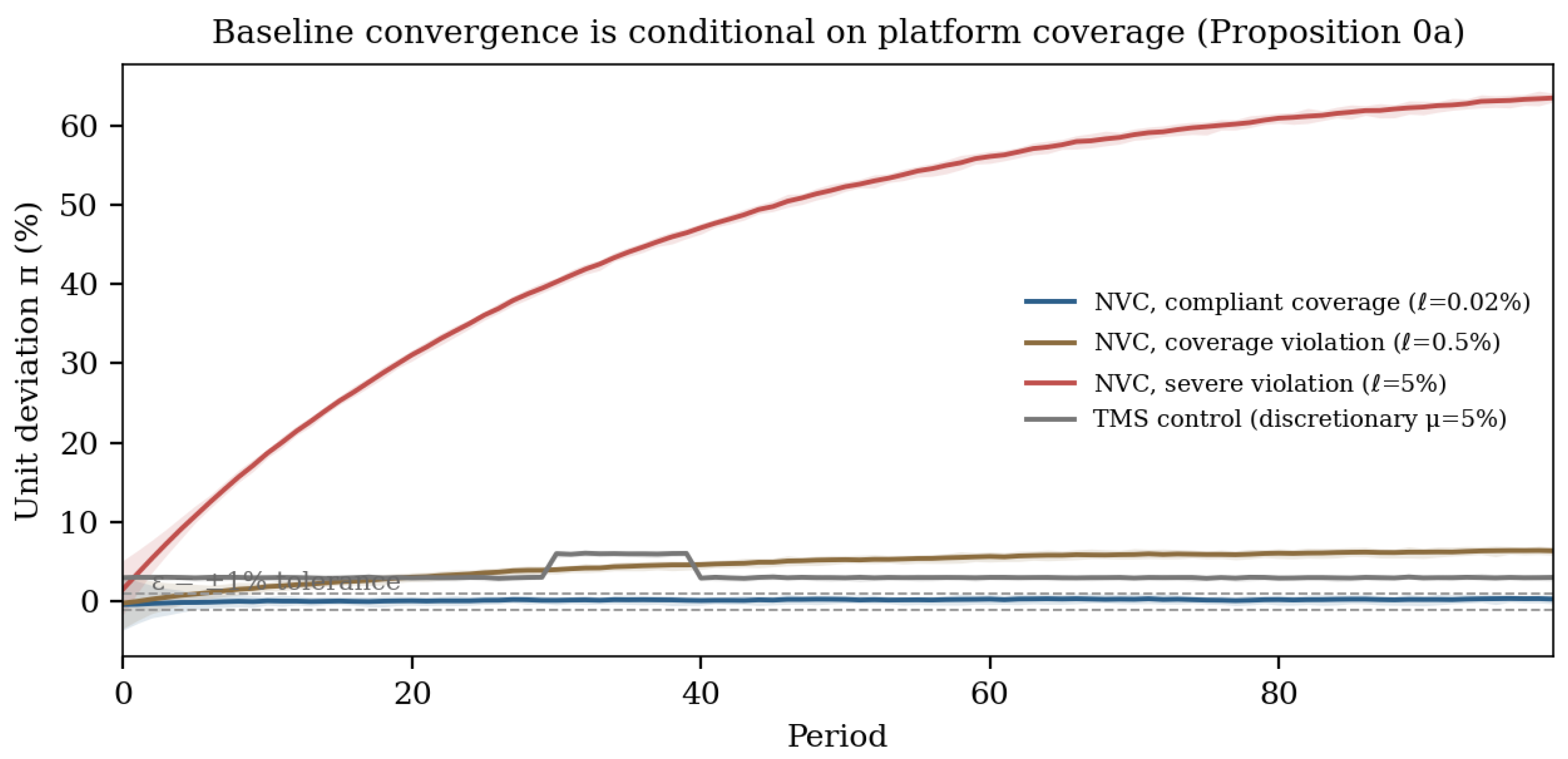
C.3.2 The Dose–Response Matches the Monotonicity Proposition
With attack duration fixed at eight periods, peak deviation rises linearly with the falsified share (Figure C.2): mean peak deviations are 1.5%, 2.4%, 5.4%, 10.3%, and 20.2% for falsified shares of 1% through 20%. The regression slope is 0.988 (R² = 0.998), against the theoretical slope of 0.982 implied by the attack domain’s share of α-weighted creation, and the rank correlation is Spearman ρ = 0.980 (p < 10⁻¹⁰⁴), exceeding the pre-registered criterion of ρ ≥ 0.8. The response surface of the system is therefore exactly the one the monotonicity proposition describes: the deviation is a linear, weight-proportional function of the falsification, with no threshold, saturation, or amplification effects within the tested range.
Figure C.2.
Mode A stress test. (a) Mean response paths for five falsification magnitudes (attack window shaded). (b) Peak deviation against falsified share, thirty replications per point; fitted slope versus the slope predicted by the monotonicity proposition.
Figure C.2.
Mode A stress test. (a) Mean response paths for five falsification magnitudes (attack window shaded). (b) Peak deviation against falsified share, thirty replications per point; fitted slope versus the slope predicted by the monotonicity proposition.
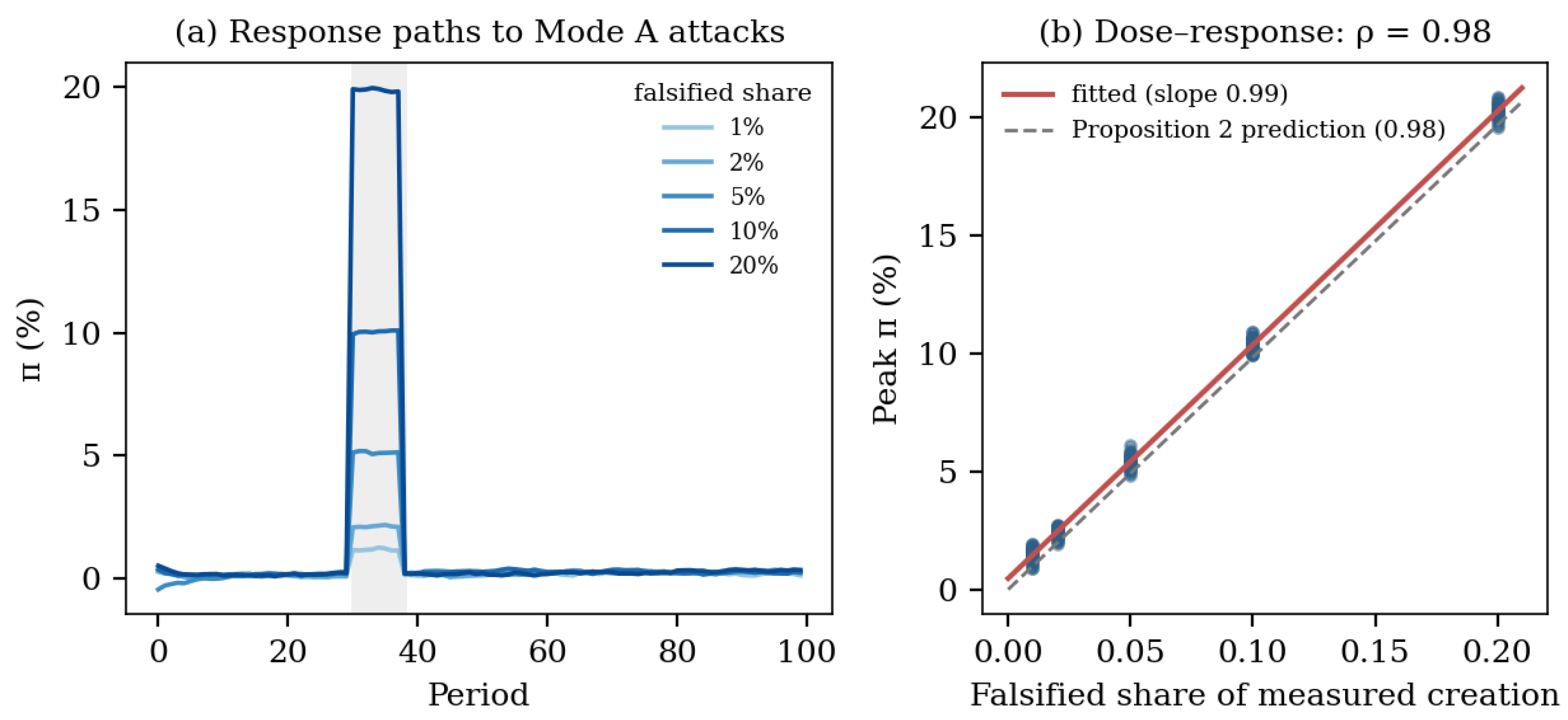
C.3.3 Detection and Recovery Under Stochastic Auditing
With the audit layer active (per-period detection hazard 0.25), a 5% falsification attack is stopped after a geometrically distributed lag, and the system recovers to the tolerance band in a mean of 10.4 periods after attack onset (SD 14.9; 95% range 1–45). The long right tail has a structural explanation: detection stops the falsified flow immediately, but the money issued against falsified value remains in the stock and decays only at the metabolism rate. Detection speed and stock hygiene are separate problems, and the second is governed by δ — which is precisely the division of labor the theory assigns to the extinction layer.
C.3.4 Weight Concentration and the Comparative Absorption of Correction Procedures
The weight-concentration corollary holds quantitatively. The same absolute coefficient distortion produces a cumulative deviation 1.57 times larger when applied to the high-weight domain (manufacturing, 27.3% of true creation) than to the low-weight domain (6.0%); the ratio predicted by the proposition’s weight structure is 1.50. The procedure comparison delivers the paper’s central policy-relevant result (Figure C.3). Against a distortion of 0.3, cumulative absolute deviation over the fifty periods following the attack is 1.90 without correction, 1.23 under the single-stage procedure, and 0.43 under the three-stage procedure: absorption efficiencies of 78% and 36% respectively, with Cohen’s d = 0.88. The single-stage arm’s bimodality — its dispersion (SD 1.28) dwarfs the three-stage arm’s (SD 0.06) — is the signature of capture risk: fast correction works when it is not captured and fails catastrophically when it is. The prudent procedure’s slowness is, as the theory claims, the price of its robustness.
Figure C.3.
Mode B stress test. (a) Mean response paths under three correction regimes. (b) Cumulative absolute deviation over the fifty periods following the attack; error bars are cross-replication standard deviations.
Figure C.3.
Mode B stress test. (a) Mean response paths under three correction regimes. (b) Cumulative absolute deviation over the fifty periods following the attack; error bars are cross-replication standard deviations.
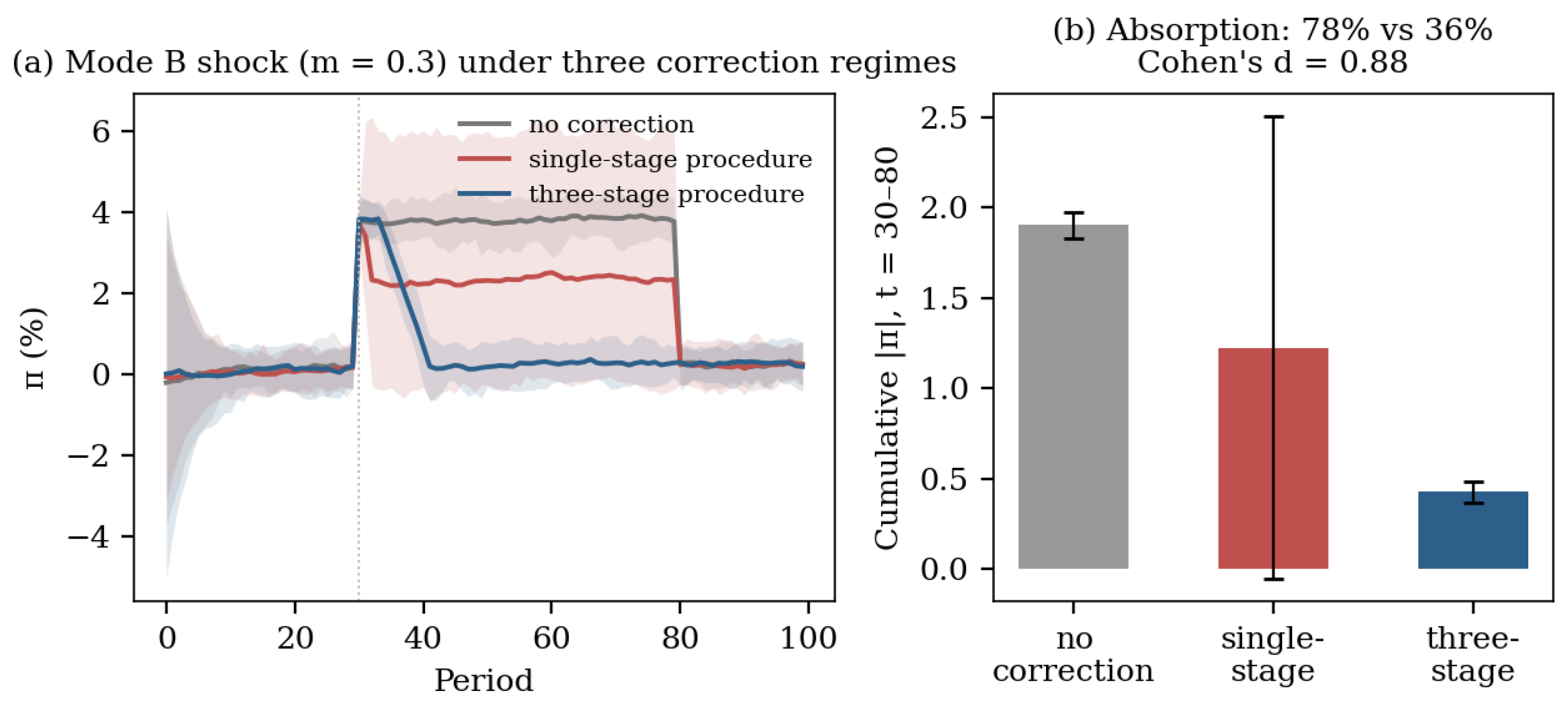
C.3.5 Sensitivity: A Speed–Noise Trade-Off and the Dominance of Leakage
One-at-a-time variation of the four operational parameters (Figure C.4) yields two findings the theory did not anticipate. First, calibration speed exhibits a speed–noise trade-off: halving η to 0.1 shortens mean recovery to 3.5 periods while doubling it to 0.4 lengthens recovery to 36.7 periods and worsens the steady-state deviation — faster error correction tracks the 2% observation noise more faithfully and injects it into the coefficient path. There is an interior optimum in adjustment speed, and the conservative pacing of the three-stage procedure may sit closer to it than a maximal-speed rule. Second, platform leakage dominates every other parameter: doubling ℓ from 0.02% to 0.04% more than doubles mean recovery time and raises the steady-state deviation by two-thirds, while doubling the audit hazard changes recovery by barely two periods. The system’s stability budget should be spent on coverage, not on faster detection — the quantitative counterpart of the theory’s conclusion that the metabolism backstop is thin.
Figure C.4.
One-at-a-time sensitivity of recovery time and steady-state deviation to the audit hazard, calibration speed, metabolism rate, and platform leakage (halved-to-doubled ranges).
Figure C.4.
One-at-a-time sensitivity of recovery time and steady-state deviation to the audit hazard, calibration speed, metabolism rate, and platform leakage (halved-to-doubled ranges).
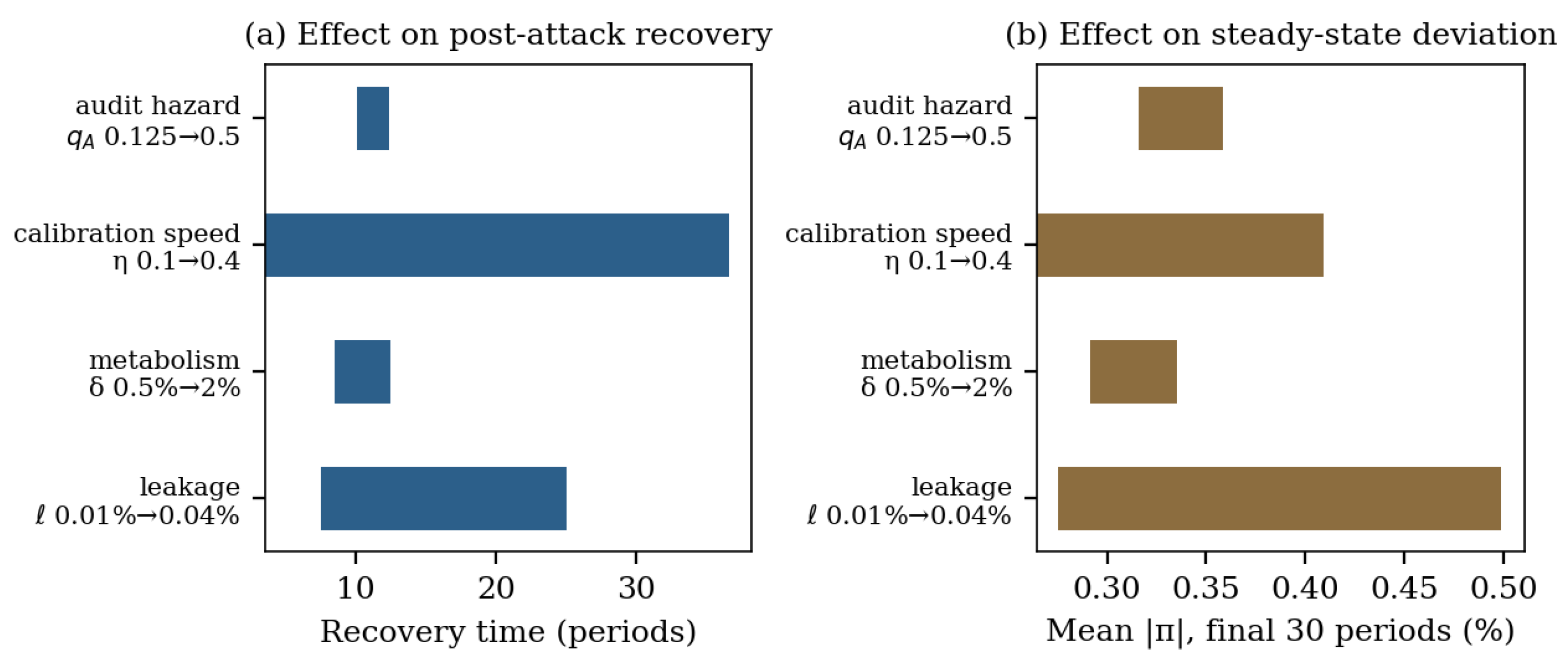
C.3.6 Design Implications
Three design implications follow. First, coverage floors deserve constitutional status. The viability condition is not a soft regularity but a fixed point: a system that permits 0.5% untracked leakage converges to a deviation roughly sixteen times the tolerance band, and no adjustment of δ within its band can compensate. A pilot implementation should therefore treat the coverage ratio as a monitored constitutional variable with pre-committed responses, exactly as the theory paper’s sixth falsifiable hypothesis proposes. Second, audit investment should target the exposure hazard rather than detection speed alone: once coverage is compliant, the marginal return to faster detection is small, while the return to making falsification expensive — the penalty term of the capture calculus in the companion governance paper (Cheng and Cheng 2026c) — is what the hazard represents. Third, calibration speed should be chosen against the speed–noise trade-off, not maximized: the optimal adjustment rate is interior, and the procedure that finds it should itself be slow enough to resist capture. There is a coherence between these implications and the historical record the theory engages: the systems that failed for lack of an anchor — from assignats to discretionary inflations (Sargent 1982) — failed at the institutional layer this paper stress-tests, not at the arithmetic layer.
The comparison with the control arm should be read carefully. The TMS arm is not a model of any actual central bank, which disposes of far richer instruments; it isolates one structural property — the absence of an observable issuance rule — and shows that the property alone suffices to prevent convergence. What the NVC adds is not cleverness of control but observability of deviation: any third party can recompute the warranted flow and locate the failing integrity condition. The stress test shows this property surviving controlled attacks; whether it would survive the ingenuity of real attackers is a question no simulation can settle.
C.4 Limitations
The limitations are substantial and we state them plainly. First and largest: this is an internal consistency demonstration. The model implements the theory’s equations, so the experiments cannot falsify the theory’s correspondence to reality — they can only have falsified its internal coherence, which the pre-registered criteria were designed to do and which the structure survived. External validation requires a pilot economy, and nothing here substitutes for one. Second, the attack models are stylized: real falsification adapts to the audit rule, and real lobbying targets the procedure’s choke points rather than a coefficient directly. Third, the calibration layer observes shadow prices with a fixed noise process; endogenizing the quality of observation — making measurement effort a choice variable, as the theory’s mechanism-design section contemplates — would couple the attack and defense layers in ways the present design holds apart. Fourth, the extinction layer is represented by a single leakage parameter and a linear metabolism rate; durable-good depreciation schedules, inventory cycles, and cross-border leakage are absent. Fifth, thirty replications and one hundred periods are adequate for the reported effects but small for tail properties; the long right tail of recovery times is the least precisely estimated quantity in the paper.
C.5 Conclusion
The zero-inflation theorem of the negentropic value currency survives its first computational stress test, and — more importantly — the test converts the theory’s qualitative claims into quantitative design constraints. The accounting unit converges if and only if platform coverage holds the viability condition; the deviation’s response to falsification is linear with the predicted slope; the three-stage calibration procedure’s prudence buys a two-fold improvement in absorption over a fast procedure because it denies attackers a capturable choke point; and the system’s stability budget belongs to coverage, not to detection speed or metabolism calibration. The program’s next step is unchanged and unavoidable: a pilot. What the simulation adds is a precise statement of what the pilot must achieve — a coverage floor, an audit hazard, and a calibration speed within the ranges identified here — and a registered set of quantitative expectations against which the pilot’s behavior can be checked.
References
- Bank for International Settlements (BIS) (2021) Annual Economic Report 2021. BIS, Basel.
- Buchanan, JM; Tullock, G. The Calculus of Consent: Logical Foundations of Constitutional Democracy; University of Michigan Press: Ann Arbor, 1962. [Google Scholar]
- Cheng J (2026) Value Consensus Currency: A Monetary Theory for Post-Scarcity Civilization (VCC). Monograph manuscript (the monographic foundation of the NVC program).
- Cheng D, Cheng J (2026a) Negentropic Value Currency: A Research Program for Re-Anchoring Monetary Value in Net Order Creation. Working paper (paper 1 of the series, under submission).
- Cheng D, Cheng J (2026c) Algorithmic Democracy and Constitutional Firewalls: The Governance Architecture of Negentropic Value Currency. Working paper (paper 3 of the series).
- Clarida, R; Galí, J; Gertler, M. The science of monetary policy: A New Keynesian perspective. Journal of Economic Literature 1999, 37(4), 1661–1707. [Google Scholar] [CrossRef]
- Coyle, D. GDP: A Brief but Affectionate History; Princeton University Press: Princeton, 2014. [Google Scholar]
- Douthwaite, R. Short Circuit: Strengthening Local Economies for Security in an Unstable World; Green Books: Totnes, 1996. [Google Scholar]
- Fisher, I. The Purchasing Power of Money; Macmillan: New York, 1911. [Google Scholar]
- Friedman, M. The role of monetary policy. American Economic Review 1968, 58(1), 1–17. [Google Scholar]
- Gesell S (1916) Die natürliche Wirtschaftsordnung durch Freiland und Freigeld. Neo-Verlag, Berlin (English translation: The Natural Economic Order, Free Economy Publishing, San Antonio, 1934).
- Hayek, FA. The use of knowledge in society. American Economic Review 1945, 35(4), 519–530. [Google Scholar]
- Holling, CS. Resilience and stability of ecological systems. Annual Review of Ecology and Systematics 1973, 4, 1–23. [Google Scholar] [CrossRef]
- Kelton, S. The Deficit Myth: Modern Monetary Theory and the Birth of the People’s Economy; PublicAffairs: New York, 2020. [Google Scholar]
- Keynes, JM. The General Theory of Employment, Interest and Money; Macmillan: London, 1936; chapter 23. [Google Scholar]
- Kümmel, R. The Second Law of Economics: Energy, Entropy, and the Origins of Wealth; Springer: New York, 2011. [Google Scholar]
- Kydland, FE; Prescott, EC. Time to build and aggregate fluctuations. Econometrica 1982, 50(6), 1345–1370. [Google Scholar] [CrossRef]
- Lavoie, M. Post-Keynesian Economics: New Foundations; Edward Elgar: Cheltenham, 2014. [Google Scholar]
- Mazzucato, M. The Value of Everything: Making and Taking in the Global Economy; Allen Lane: London, 2018. [Google Scholar]
- Rowthorn, RE. Conflict, inflation and money. Cambridge Journal of Economics 1977, 1(3), 215–239. [Google Scholar] [CrossRef]
- Sargent TJ (1982) The ends of four big inflations. In: Hall RE (ed) Inflation: Causes and Effects. University of Chicago Press, Chicago, pp 41–98.
- Soddy F (1926) Wealth, Virtual Wealth and Debt: The Solution of the Economic Paradox. E. P. Dutton, New York.
- Stiglitz, JE; Sen, A; Fitoussi, JP. Report by the Commission on the Measurement of Economic Performance and Social Progress; Commission on the Measurement of Economic Performance and Social Progress.: Paris, 2009. [Google Scholar]
- Technocracy, Inc. Technocracy Study Course; Technocracy Inc.: New York, 1933. [Google Scholar]
- Wray, LR. Modern Money Theory: A Primer on Macroeconomics for Sovereign Monetary Systems, 2nd edn; Palgrave Macmillan: London, 2015. [Google Scholar]
Disclaimer/Publisher’s Note: The statements, opinions and data contained in all publications are solely those of the individual author(s) and contributor(s) and not of MDPI and/or the editor(s). MDPI and/or the editor(s) disclaim responsibility for any injury to people or property resulting from any ideas, methods, instructions or products referred to in the content. |
© 2026 by the authors. Licensee MDPI, Basel, Switzerland. This article is an open access article distributed under the terms and conditions of the Creative Commons Attribution (CC BY) license (http://creativecommons.org/licenses/by/4.0/).
Copyright: This open access article is published under a Creative Commons CC BY 4.0 license, which permit the free download, distribution, and reuse, provided that the author and preprint are cited in any reuse.