
Submitted:
29 September 2026
Posted:
29 September 2026
You are already at the latest version
Abstract
Background: In Israel, fentanyl and pregabalin prescription rates for pain management have increased over the years. However, Health Maintenance Organizations (HMOs) implemented restrictions on opioid prescription in 2022, substantially changing fentanyl availability while pregabalin had no limitations. We aimed to evaluate whether fentanyl and pregabalin misuse between 2021 and 2025 among individuals receiving methadone maintenance treatment (MMT) in Tel Aviv reflected national prescription availability, and to characterize fentanyl misuse groups. Methods: Between February 2021 and December 2025, patients were screened 3-4 times annually for fentanyl and pregabalin, in addition to their routine urine tests. Trends in pregabalin and fentanyl misuse were compared with published national prescription trends. Additionally, methadone doses and serum methadone levels were compared among patients who consistently tested positive for fentanyl, tested negative for fentanyl or Stopped/Started fentanyl use between 2023 and 2025. Results: Pregabalin positivity ranged between 11.2% and 15.9%, with no temporal trend. The fentanyl positivity rate increased from 9.8% in October 2021 to 15.1% in March 2023 and subsequently decreased to 7.5% in March 2025, paralleling the reduction in fentanyl availability following HMO restrictions. The methadone dose of patients testing positive for fentanyl was higher, whether they discontinued or continued fentanyl use, compared with patients who consistently tested negative for fentanyl. Conclusions: Fentanyl misuse among patients receiving MMT decreased following reduced fentanyl availability after HMO restrictions, supporting considering of similar restrictions for pregabalin. However, additional follow-up and studies are warranted. Maintaining an adequate methadone dose may help reduce illicit opioid use and facilitate opioid abstinence.
Keywords:
fentanyl
; pregabalin
; methadone maintenance
; trends
; misuse
1. Introduction
The opioid epidemic in the United States and other countries, where the prescribing of opioids for chronic, non-cancer pain was vigorously advocated, thereby facilitating pervasive diversion and misuse, has been well documented [1]. Pain is defined as an unpleasant sensory and emotional experience associated with actual or potential tissue damage, or resembling that associated with such damage [2]. During the 1990s, efforts by the American Pain Society, the International Association for the Study of Pain, and the Joint Commission on Accreditation of Healthcare Organizations to promote pain as the "fifth vital sign" unintentionally encouraged inappropriate opioid prescribing, contributing to the opioid epidemic [3,4,5].
The opioid epidemic was also reflected in Israel by an increase in opioid prescribing; between 2012 and 2015, opioid consumption increased by 125%, the largest rise among Organization for Economic Co-operation and Development countries [6], followed by a dramatic increase in fentanyl prescriptions [7]. Data from Israel’s largest health care provider Clalit Health Services showed a further increase in outpatient opioid consumption in 2016–2018, largely driven by fentanyl use among non-elderly patients without malignancy [7]. However, unlike in the USA, there is no evidence of a large-scale illicit fentanyl market in Israel. Fentanyl is typically prescribed by any physician as a potent pain reliever for serious medical conditions, and non-medical use often arises from diversion, misuse of prescriptions, or sharing of legally obtained patches and other formulations.
As with fentanyl, and consistent with reports from other countries [8], prescription rates of the non-opioid gabapentinoid analgesic pregabalin in Israel increased substantially between 2009 and 2019 [9].
MMT is the most effective treatment for opioid use disorder (OUD) [10,11]. As OUD is a chronic, relapsing disorder, opioids and other substances are screened as part of the treatment. According to the Israeli Ministry of Health in 2004 guidelines, the use of opioids, including morphine, heroin and codeine, as well as cocaine, benzodiazepines, amphetamines, and cannabis is routinely monitored in patients receiving an individually adjusted adequate methadone dose, defined as the minimum individualized dose that successfully prevents withdrawal symptoms and overdose, blocks mu-opioid receptors, reduces craving, stabilizes the hypothalamic-pituitary-adrenal axis, and facilitates opioid abstinence, as reflected by negative urine opioid tests [10,12]. In addition, monitoring non-opioid substance use is also important, primarily to assess patients' rehabilitation progress and to inform decisions regarding patients’ privileges; patients may be granted take-home methadone doses (THD) based on complete and sustained abstinence from substance use, as defined by negative urine screening results. Therefore, in addition to the routine screening, monitoring protocols are updated to include newly incident substances.
Due to the substantial increase in fentanyl [7,13] and pregabalin [9] prescriptions in Israel, the MMT clinic of a large tertiary university medical center in Tel Aviv implemented routine urine screening for these substances, as these medications were not regularly tested. All MMT patients were screened every quarter while those with THD privileges were tested monthly. Using data from this clinic, we previously reported an increase in the proportion of patients with fentanyl-positive urine tests from 9.8% in February 2021 to 15.1% in March 2023 [14], as well as a high prevalence of pregabalin misuse, with,17.7% of patients testing positive in December 2017 [15].
In July 2022, following guidelines issued by the Israeli Ministry of Health, HMOs were required to establish monitoring mechanisms for prolonged opioid prescriptions. Specifically, HMOs were instructed to ensure that every patient receiving opioids for at least 90 days was subsequently evaluated by a pain specialist. This policy change was soon followed by a significant reduction in the volume of opioid prescriptions [16].
We hypothesized that a reduction in fentanyl availability would be reflected in a decreased prevalence of fentanyl misuse among patients receiving MMT, with no corresponding change in pregabalin misuse, because, unlike fentanyl, pregabalin was not subjected to new regulatory restrictions.
Therefore, we specifically studied among individuals with OUD receiving MMT: (1) The prevalence and temporal trends of fentanyl and pregabalin misuse between 2021 and 2025 among all current patients receiving MMT, and their corresponding methadone doses. 2. In a follow-up study of patients who remained in treatment between 2023 and 2025, we compared the characteristics of patients who consistently tested positive for fentanyl, those who never tested positive, and those with discordant results, either started or discontinued fentanyl use.
2. Materials and Methods
The study analysis was approved by the Institutional Review Board (IRB) of the Medical Center, Helsinki Committee, Protocol No. 07-111. Informed consent was obtained from all subjects. All methods were performed in accordance with the relevant guidelines and regulations.
Study Population
The MMT clinic is accredited by the Commission on Accreditation of Rehabilitation Facilities and is part of a large, tertiary university medical center in Tel Aviv, Israel. The clinic was established in June 1993 and admits individuals aged ≥18 years who are diagnosed with OUD (Diagnostic and Statistical Manual (DSM)-5 or DSM-IV-TR) and have failed two or more inpatient detoxification attempts. Exclusion criteria were age <18 years, failure to meet the DSM diagnostic criteria for OUD, or fewer than two unsuccessful inpatient detoxification attempts. Since June 1993, 1,039 new patients had initiated treatment by February 2021, when the study began, and 1,196 by December 2025, when the study ended, with approximately 300 current patients each month.
Patients receive their methadone dose daily at the clinic and attend regular appointments with a designated personal therapist. Patients may earn the privilege for THD, up to a maximum of two weeks of THD. Specifically, first THD can be achieved if urine screens are negative for all substances for at least 3 months, followed by additional monthly THD, up to one week, while two weeks of THD can be achieved following an additional two years of full abstinence (for details see [17]).
Urine Toxicology
Patients in our MMT clinic undergo repeated observed, random urine testing, approximately twice monthly, throughout the duration of treatment for opioids including morphine, heroin and codeine, the cocaine metabolite benzoylecgonine, benzodiazepine, cannabis, and methadone metabolite, using enzyme immunoassay systems (DRI® and CEDIA®) [18]. For each substance, a positive monthly result was defined as at least one positive urine sample during that month.
Since February 2021, in addition to the routine urine tests above, additional substances - fentanyl, oxycodone, tramadol, pregabalin, methylphenidate, and alcohol were screened monthly among patients with THD using Rapid Test (JusCheck®). However, these urine screenings were performed in all current patients every 3-4 months, with three screening time points in 2021, February, June, and October, and four screening time points annually from 2022 to 2025, March, June, September, and December, for a total of 19 time points.
The Prevalence and Temporal Trends
Temporal trends were assessed using the 19 time points that were available for all substances, among all current patients between 2021 and 2025, ranging from 291 to 311 individuals per time point. We further analyzed methadone doses at the beginning of each of the 19 time point months.
Follow-Up Study Group
Patients who were consistently in MMT with available fentanyl urine screening results (N=239) were analyzed for changes in methadone dose and serum levels. The patients were categorized according to their fentanyl urine-screening results in March 2023 and March 2025 into 3 groups, "Always", “Never", and "Started/Stopped".
Methadone Dose and Serum Level
Methadone dose in March 2023 and March 2025, and the closest available serum methadone level to each time point were used for analysis. Patients are routinely evaluated for serum methadone levels before receiving their first THD privilege. THD privileges were provided when patients were clinically stabilized on methadone, maintained on a stable methadone dose, and had no detectable opioids, cocaine, cannabis, or benzodiazepines in urine screening for at least three months. For patients receiving ≥150 mg/day, serum methadone levels are measured annually; for those receiving <150 mg/day, levels are measured biennially. Methadone concentrations were determined using gas chromatography-mass spectrometry (GC-MS; Clinical Science Laboratory, Mansfield, MA, USA).
Statistical Analysis
Statistical analyses were performed using the IBM SPSS Statistics version 29. To evaluate temporal trends in the proportion of fentanyl, pregabalin, and other substances at 19 time-points between 2021 and 2025, we used generalized estimating equations (GEE), with patient ID specified as the subject variable and the time point specified as the within-subject variable. A binomial distribution with a logit link function was used to account for the binary urine test results and the correlation among repeated measurements from the same patient. Additionally, we used GEE for the methadone dose trend, with a continuous outcome assuming a normal distribution, while accounting for the binary pregabalin and fentanyl urine results.
Comparisons among fentanyl groups in March 2023 and March 2025,"Always", “Never", and "Started/Stopped", were conducted using the chi-square or Fisher’s exact test for categorical variables and one-way analysis of variance (ANOVA) for continuous variables. When the assumption of homogeneity of variances was violated, Welch's ANOVA was used. Repeated-measures analyses were used to evaluate changes in methadone doses and serum methadone levels between March 2023 and March 2025, stratified by fentanyl groups.
3. Results
3.1. The Prevalence and Temporal Trends
Patient Characteristics
At study initiation, of the 291 current patients (February 2021), 21.6% were females, 52.6% had a history of opioid use for ≥ 20 years before admission to MMT, 26.1% had ≥ 12 years of education, 57% had ever injected drugs, 54.3% had antibodies to hepatitis C, and 6.2% had antibodies to HIV. At admission to MMT, in addition to opioids, 51.9% tested positive for benzodiazepine, 12.7% for cannabis, and 29% for cocaine.
3.2. Trends 2021 and 2025
The proportion of pregabalin and fentanyl between February 2021 and December 2025 are presented in Figure 1 and Figure 2.
Pregabalin positivity ranged between 11.2% and 15.9% with no significant temporal effect across 2021–2025 (Wald χ² = 0.9, p = 0.9) (Figure 1). In contrast, a significant temporal effect on the proportion of fentanyl-positive urine screens was observed between 2021 and 2025 (Wald χ² = 28.4, p < 0.001). Specifically, fentanyl positivity increased from a minimum of 9.8% in 2021 to a peak of 15.1% in 2023, followed by a significant decrease to 7.5% in 2025. The increase during 2021–2023 was significant (Wald χ² = 13.7, p < 0.001), as was the subsequent decrease during 2023–2025 (Wald χ² = 20.1, p < 0.001). (Figure 2).
The proportions of other routinely screened opioids at these time points ranged between 8.8% and 15.1% with no significant temporal effect across 2021-2025 (Wald χ² = 4.9, p = 0.3). Similarly, no significant temporal effect was observed for oxycodone, which ranged between 0.3% and 2.4% (Wald χ² = 5.2, p = 0.3). Tramadol positivity decreased significantly from 3.8% in February 2021 to 0% in June 2023. No significant trends were observed for methylphenidate which ranged between 7.5% and 11.2%, Wald χ² = 3.7, p = 0.4, cocaine, which ranged between 16.5% and 23.3%, Wald χ² = 7.4, p = 0.1, or cannabis, which ranged between 10.9% and 15.1%, Wald χ² = 3.6, p = 0.5. With respect to benzodiazepine, which ranged between 20.8 and 29.5%, a significant overall difference across years was observed when year was modeled as a categorical factor (Wald χ² = 9.8, p = 0.04), however, no significant linear temporal trend was observed (B = 0.036, Wald χ² = 1.3, p = 0.25).
Methadone dose over the study period, stratified by fentanyl and pregabalin urine-test status, is presented in Figure 3a–b.
Between 2021 and 2025, a significant temporal effect was observed for methadone dose (Wald χ² = 9.5, p = 0.05) with a significant temporal increase when year was modeled as a continuous covariate (B=1.2 mg/year, Wald χ² = 4.7, p=0.03). Including fentanyl in the GEE model, methadone dose increased significantly over time among fentanyl-positive patients (B=6.26 mg/year, p<0.001), whereas the increase was substantially smaller among fentanyl-negative patients (B=0.75 mg/year). The difference in the slopes between the two groups was statistically significant (Year × fentanyl interaction: B=−5.51, p=0.001). In 2021, methadone dose did not differ significantly between fentanyl-positive and fentanyl-negative patients (p=0.602).
In a GEE model including pregabalin, patients with pregabalin positive urine test had significantly higher methadone doses (B=2.89 mg, p=0.025), but the temporal change in methadone dose did not differ significantly according to pregabalin status (Year × pregabalin interaction: B=−2.09, p=0.137).
In a GEE model including both fentanyl and pregabalin, the interaction between fentanyl and year remained significant (B=-5.54 mg/year, p<0.001), with no significant temporal interaction for pregabalin (B=-1.39 mg/year, p=0.31).
3.3. Follow-Up Study Group
Patient Characteristics (Table 1)
The fentanyl group includes 15 patients who "Always" tested positive for fentanyl (March 2023 and March 2025), 202 who "Never" tested positive, and 22 patients with discordant results (18 discontinued fentanyl and tested positive only in March 2023, whereas 4 initiated fentanyl use and tested positive only in March 2025). The groups differed only by concomitant substance use. Specifically, the highest prevalence of concomitant substance use was observed among patients who consistently tested positive for fentanyl (benzodiazepine 46.7%, cannabis 33.3%, cocaine 40%, pregabalin 33.3%, methylphenidate 13.3%), followed by those who changed fentanyl status, predominantly those who discontinued fentanyl use, and the lowest prevalence among patients who never tested positive (benzodiazepine 15.8%, cannabis 7.9%, cocaine 17.8%, pregabalin 7.4%, methylphenidate 2.5%). Methadone doses differed significantly among the three fentanyl groups (Welch's ANOVA, F(2, df) = 7.7, p = 0.002), with significantly lower doses in the Never group compared with the Stop/Start group (Bonferroni-adjusted p = 0.046). Similarly, serum methadone levels were significantly lower in the Never group than in the Stop/Start group (Bonferroni-adjusted p = 0.039).
Methadone Dose and Serum Level (Table 2)
Methadone doses in March 2023 and March 2025 differed across the three fentanyl groups, with a significant time effect (p<0.001) and a significant time-by-group interaction (p=0.01). Specifically, methadone doses increased among patients who consistently tested positive for fentanyl or changed fentanyl status, but remained stable among patients who were consistently fentanyl-negative. A significant group effect was also observed (p=0.016), reflecting lower methadone doses in the consistently fentanyl-negative group compared with the other two groups (Table 2). Evaluation of changes in serum methadone levels, adjusted for the methadone dose at the time of measurement, among 170 patients revealed a significant group effect with no significant time effect or time-by-group interaction.
4. Discussion
The observed reduction in the proportion of fentanyl-positive urine tests among patients receiving MMT parallels the reduction in fentanyl availability following HMO restrictions, which was implemented in response to earlier prescribing policies that allowed a broader scope of fentanyl prescribing. Importantly, fentanyl prevalence among patients receiving MMT declined, most likely reflecting reduced availability on the illicit or diverted market. Among the cohort of patients tested in both 2023 and 2025, those who tested positive for fentanyl at both time points, referred to as "always", had the highest proportion of concomitant substance use, benzodiazepine 46.7%, cannabis 33.3%, cocaine 40%, pregabalin 40%, and methylphenidate, 13.3%, compared with patients who consistently tested negative, referred to as "never": benzodiazepine 15.8%, cannabis 7.9%, cocaine 17.8%, pregabalin 6.9%, and methylphenidate, 2.5%. Patients who discontinued or initiated fentanyl use fell between these two groups with respect to treatment duration and substance use. These findings may reflect the rehabilitation process, which requires time within treatment.
The adequate methadone dose required to achieve opioid abstinence may differ by opioid type and is generally higher among fentanyl users than among users of other opioids. Fentanyl is a highly potent opioid, with a potency of more than 50 times greater than that of heroin and morphine, resulting in the development of higher opioid tolerance compared with heroin or prescription opioids [19]. Consequently, the need for higher initial methadone doses and more rapid dose escalation has been emphasized in recent guidance from leading substance-use authorities in both Canada and the United States [20,21]. In a study examining self-reported methadone dose adequacy, individuals exposed to fentanyl were more likely to perceive their methadone dose as insufficient, while those who were exposed to non-fentanyl opioids did not report this perception, despite similar methadone doses between the groups [22].
In the current study cohort, we observed significantly higher methadone doses and a non-significant trend toward higher serum methadone levels among all fentanyl users (134.6±23.2 mg/day and 637.5±191.7 ng/ml, respectively), including those who screened positive for fentanyl only once, referred to as "Stopped/Started", compared with patients who never screened positive (112.2±39.0 mg/day and 588.1±304.5 ng/ml respectively). Patients who never tested positive for fentanyl were clinically stable and opioid abstinent on an adequate, relatively low methadone dose. In contrast, patients with ongoing or intermittent fentanyl use, many of whom were polysubstance users, likely required higher methadone doses, and while some achieved adequate dosing, as reflected by fentanyl discontinuation, others continued fentanyl misuse, suggesting ongoing underdosing or more complex treatment needs. However, the groups were small and differed with respect to concomitant substance use, warranting further investigation in future studies. Importantly, between 2023 and 2025, the methadone doses increased among the "always" and "stopped/Started" fentanyl groups, while no dose change was observed among the consistently fentanyl negative group, which may support the role of dose optimization in facilitating fentanyl cessation. Serum methadone levels were available only for a subset of patients, which limited statistical power to detect temporal changes.
While our findings regarding opioids, specifically, the significant reduction following the implementation of regulated procedures, support the importance of clear regulatory frameworks for medications with abuse potential, the absence of similar guidelines for other drug classes is reflected in our findings concerning pregabalin. Pregabalin (Lyrica), one of two gabapentinoid medications, is indicated in Israel for the treatment of neuropathic pain in adults, fibromyalgia, and generalized anxiety disorder in adults. Despite these clear indications, pregabalin is frequently prescribed for nonspecific pain complaints, often without adequate evaluation of pain etiology, adherence to minimum effective dosing, or consideration of its abuse potential and safety risks. This issue is particularly concerning among patients receiving MMT, a population with well-documented vulnerability to substance misuse, and in whom the risk of fatal outcomes associated with the combination of opioids, especially methadone and gabapentinoids, is well established [23,24,25]. Consistent with the lack of regulatory oversight, pregabalin positivity in urine samples remained unchanged throughout the study period.
Collectively, these findings highlight the urgent need for clear national policies issued by the Ministry of Health regarding the prescription of medications with documented addictive potential and risk of fatal outcomes, including mandatory consideration of drug–drug interactions in patients receiving polypharmacy. It should be mentioned that as there are not enough pain specialists in Israel, HMO implementation is still a long way from completion, and each HMO struggles its way through the process. In parallel, there is a need for innovative pain-management strategies, including the development of new pharmacological classes or novel combinations of existing medications with alternative indications, to reduce reliance on high-risk medications.
Limitations and Strengths
The strength of this study lies in the use of objective data derived from random urine drug screening, which provided objective evidence of the observed decrease in fentanyl use and the stable prevalence of pregabalin use. However, several limitations should be acknowledged. First, the findings are derived from a single MMT clinic, which limits generalizability. Nevertheless, this clinic is currently the only one in Israel that conducts periodic prevalence monitoring of fentanyl and pregabalin. Future studies should include larger samples, longer follow-up periods, and data from multiple MMT clinics and treatment facilities to validate and extend these findings. In addition, serum methadone level measurements were not available for all participants at both assessment time points, which may have limited the precision of analyses related to methadone dosing and serum concentrations.
5. Conclusions
The reduction in fentanyl misuse prevalence among patients receiving MMT appears to reflect decreased availability, potentially attributed to stricter prescription regulations implemented by HMOs. In contrast, the consistently high prevalence of pregabalin misuse among patients in MMT underscores the need for regulatory measures to better control its prescription and distribution.
Author Contributions
Conceptualization, E.P., S.S. and M.A.; methodology, E.P.; formal analysis, E.P.; All authors have read and agreed to the published version of the manuscript.
Funding
This research was funded by Adelson Family Foundation.
Institutional Review Board Statement
The study was conducted in accordance with the Declaration of Helsinki, and approved by the Institutional Review Board of Tel Aviv Sourasky Medical Center (Protocol No. 07-111.)” for studies involving humans.
Informed Consent Statement
Informed consent was obtained from all subjects involved in the study.
Data Availability Statement
Data cannot be shared openly but are available from the authors upon reasonable request.
Conflicts of Interest
The authors declare no conflicts of interest.
Abbreviations
The following abbreviations are used in this manuscript:
| HMO | Health Maintenance Organizations |
| MMT | Methadone maintenance Treatment |
| OUD | Opioid Use Disorder |
| THD | Take-home Methadone Dose |
| DSM | Diagnostic and Statistical Manual |
| GEE | Generalized Estimating Equations |
| ANOVA | analysis of variance |
References
- Compton, W.M.; Volkow, N.D. Major increases in opioid analgesic abuse in the United States: concerns and strategies. Drug Alcohol Depend. 2006, 81, 103–107. [Google Scholar] [CrossRef]
- IASP Terminology Part III: Pain Terms, A Current List with Definitions and Notes on Usage" (pp 209-214) Classification of Chronic Pain, Second Edition, IASP Task Force on Taxonomy, edited by H. Merskey and N. Bogduk, IASP Press, Seattle, ©1994; Available online: https://www.iasp-pain.org/PublicationsNews/Content.aspx?ItemNumber=1957&navItemNumber=677.
- The Joint Commission on Accreditation of Healthcare Organizations Pain Standards for 2001. Available online: http://www.jcaho.com/standard/pm.html (accessed on 30 May 2020).
- Jalal, H.; Buchanich, J.M.; Roberts, M.S.; Balmert, L.C.; Zhang, K.; Burke, D.S. Changing dynamics of the drug overdose epidemic in the United States from 1979 through 2016. Science 2018, 361, 1–6. [Google Scholar] [CrossRef]
- Skolnick, P. The opioid epidemic: Crisis and solutions. Annu. Rev. Pharmacol. Toxicol. 2018, 58, 143–159. [Google Scholar] [CrossRef]
- Addressing Problematic Opioid Use in OECD Countries | en | OECD. 2021. Available online: https://www.oecd.org/health/addressing-problematic-opioid-use-in-oecd-countries-a18286f0-en.htm.
- Miron, O.; Zeltzer, D.; Shir, T.; Balicer, R.D.; Einav, L.; Feldman, B.S. Rising opioid prescription fulfillment among non-cancer and non-elderly patients—Israel’s alarming example. Reg. Anesth. Pain Med. Reg. Anesth. Pain Med. 2021, 46, 455–456. [Google Scholar] [CrossRef]
- Karami, S.; Yoo, J.W.; Woods, C.; Conrad, S.W.; McAninch, J.; Meyer, T.; et al. Gabapentin utilization and nontherapeutic use relative to select comparator drugs, United States 2013-2022. Drug Alcohol Depend. 2026, 279, 113026. [Google Scholar] [CrossRef]
- Benassayag Kaduri, N.; Dressler, R.; Abu Ahmad, W.; Rotshild, V. Trends in Pregabalin Use and Prescribing Patterns in the Adult Population: A 10-Year Pharmacoepidemiologic Study. CNS Drugs 2024, 38, 153–162. [Google Scholar] [CrossRef]
- Kreek, M.J. Methadone-related opioid agonist pharmacotherapy for heroin addiction. History, recent molecular and neurochemical research and future in mainstream medicine. Ann. N Y Acad. Sci. 2000, 909, 186–216. [Google Scholar] [CrossRef]
- Mattick, R.P.; Breen, C.; Kimber, J.; Davoli, M. Buprenorphine maintenance versus placebo or methadone maintenance for opioid dependence. Cochrane Database Syst. Rev. 2014, CD002207. [Google Scholar] [CrossRef]
- Walcher, S.; Koc, J.; Reichel, V.; Schlote, F.; Verthein, U.; Reimer, J. The opiate dosage adequacy scale for identification of the right methadone dose--a prospective cohort study. BMC Pharmacol. Toxicol. 2016, 17, 15. [Google Scholar] [CrossRef]
- Dressler, R.L.; Kaliner, E.; Cohen, M.J. Trends in Israeli community-based opioid prescribing, 2010–2020, an observational study of the country’s largest HMO. Isr. J. Health Policy Res. 2023, 12, 34. [Google Scholar] [CrossRef]
- Sason, A.; Adelson, M.; Schreiber, S.; Peles, E. Fentanyl abuse proportion in methadone maintenance treatment, and patients' knowledge about its risks. J. Psychiatr. Res. 2024, 173, 254–259. [Google Scholar] [CrossRef]
- Sason, A.; Adelson, M.; Schreiber, S.; Peles, E. Pregabalin misuse in methadone maintenance treatment patients in Israel: Prevalence and risk factors. Drug Alcohol Depend. 2018, 189, 8–11. [Google Scholar] [CrossRef]
- Miron, O.; Wolff-Sagy, Y.; Levin, M.; Lubich, E.; Lewinski, J.; Shpunt, M.; et al. Fentanyl Initiation Rate Following the Requirement for Specialist Approval. J. Gen. Intern Med. 2025, 40, 3097–3103. [Google Scholar] [CrossRef]
- Peles, E.; Schreiber, S.; Sason, A.; Adelson, M. Similarities and changes between 15- and 24-year survival and retention rates of patients in a large medical-affiliated methadone maintenance treatment (MMT) center. Drug Alcohol Depend. 2018, 185, 112–119. [Google Scholar] [CrossRef]
- Hawks, R.L. Analytical methodology. NIDA Res. Monogr. 1986, 73, 30–42. [Google Scholar]
- Volkow, N.D. The epidemic of fentanyl misuse and overdoses: Challenges and strategies. World Psychiatry 2021, 20, 195–196. [Google Scholar] [CrossRef]
- Substance Abuse and Mental Health Services Administration. 2024. Federal Guidelines for Opioid Treatment Programs. HHS Publication No. PEP24-02-011. Substance Abuse and Mental Health Services Administration: Rockville, MD. [Google Scholar]
- META:PHI. Methadone as opioid agonist therapy: Guidance for prescribers; META:PHI: Toronto, ON, 2025; Available online: www.metaphi.ca/wp-content/uploads/MethadoneGuidance.pdf.
- Young, S.; Raboud, J.; Dodd, Z.; DeBeck, K.; Milloy, M.J.; Wilson, D.; et al. Examining the association between fentanyl use and perceived adequacy of methadone dose: A retrospective cohort study. Drug Alcohol Depend. 2025, 267, 112547. [Google Scholar] [CrossRef]
- Abrahamsson, T.; Berge, J.; Öjehagen, A.; Håkansson, A. Benzodiazepine, z-drug and pregabalin prescriptions and mortality among patients in opioid maintenance treatment-A nation-wide register-based open cohort study. Drug Alcohol Depend. 2017, 174, 58–64. [Google Scholar] [CrossRef]
- Häkkinen, M.; Vuori, E.; Kalso, E.; Gergov, M.; Ojanperä, I. Profiles of pregabalin and gabapentin abuse by postmortem toxicology. Forensic Sci. Int. 2014, 241, 1–6. [Google Scholar] [CrossRef]
- Lyndon, A.; Audrey, S.; Wells, C.; Burnell, E.S.; Ingle, S.; Hill, R.; et al. Risk to heroin users of polydrug use of pregabalin or gabapentin. Addiction 2017, 112, 1580–1589. [Google Scholar] [CrossRef]
Figure 1.
Pregabalin prevalence (%) among current MMT patients between 2021 and 2025, measured at each assessment time point. The number of patients assessed at each time point is reported.
Figure 1.
Pregabalin prevalence (%) among current MMT patients between 2021 and 2025, measured at each assessment time point. The number of patients assessed at each time point is reported.
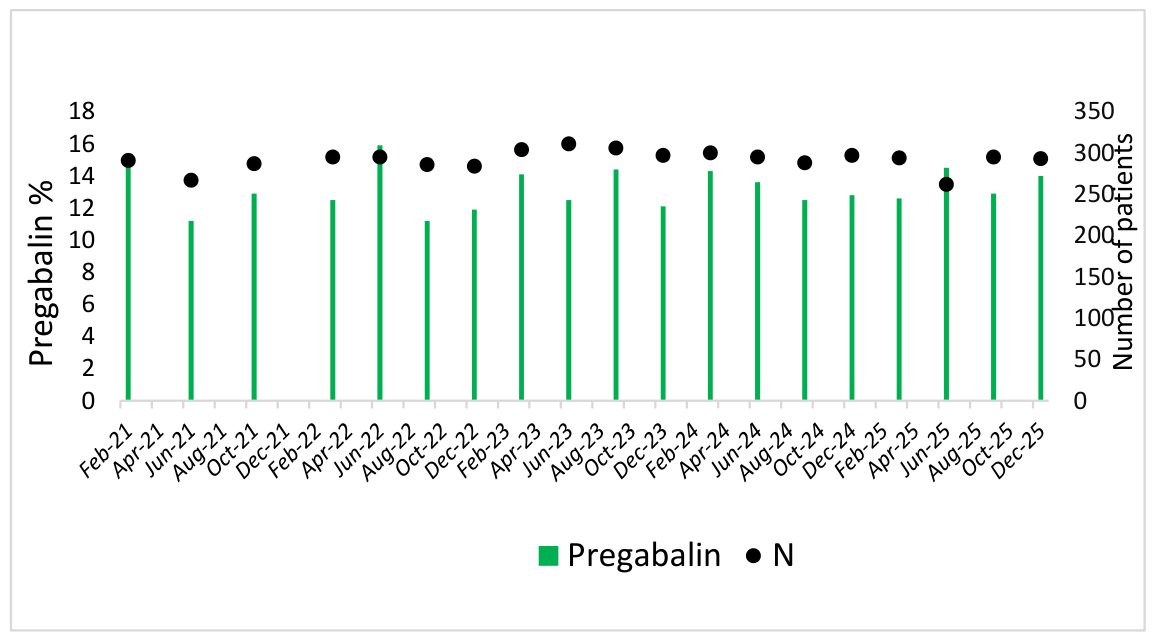
Figure 2.
Fentanyl prevalence (%) among current MMT patients between 2021 and 2025, measured at each assessment time point. The number of patients assessed at each time point is reported.
Figure 2.
Fentanyl prevalence (%) among current MMT patients between 2021 and 2025, measured at each assessment time point. The number of patients assessed at each time point is reported.
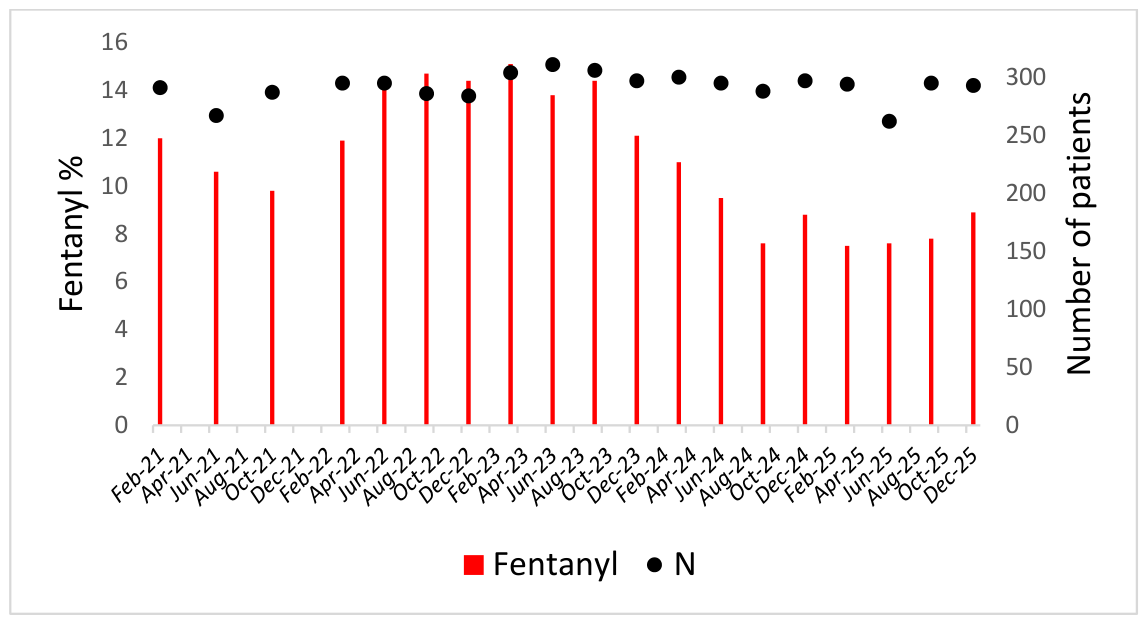
Figure 3.
a: Mean methadone dose from 2021 to 2025 at each assessment stratified by current pregabalin use. Significant differences (p < 0.05) in methadone dose between patients who tested positive and those who tested negative for pregabalin at individual assessment time point are indicated. b: Mean methadone dose from 2021 to 2025 at each assessment stratified by current fentanyl use. Significant differences (p < 0.05) in methadone dose between patients who tested positive and those who tested negative for fentanyl at individual assessment time point are indicated.
Figure 3.
a: Mean methadone dose from 2021 to 2025 at each assessment stratified by current pregabalin use. Significant differences (p < 0.05) in methadone dose between patients who tested positive and those who tested negative for pregabalin at individual assessment time point are indicated. b: Mean methadone dose from 2021 to 2025 at each assessment stratified by current fentanyl use. Significant differences (p < 0.05) in methadone dose between patients who tested positive and those who tested negative for fentanyl at individual assessment time point are indicated.
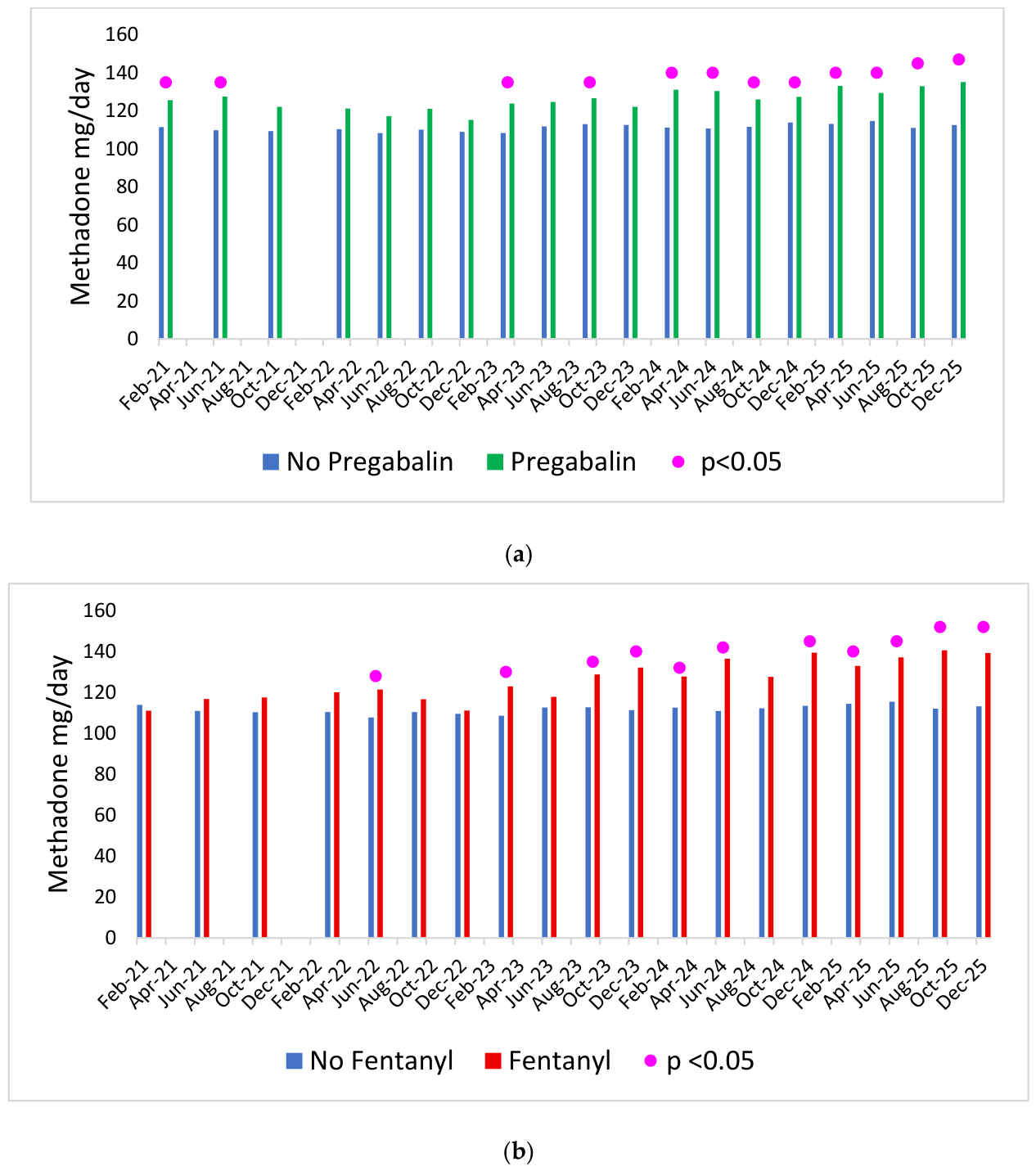

Table 1.
Comparison between patient groups according to their fentanyl urine-screening results in March 2023 and March 2025.
Table 1.
Comparison between patient groups according to their fentanyl urine-screening results in March 2023 and March 2025.
|
Positive "Always" N=15(%) |
Stopped/Started N=22(%) |
Negative "Never" N=202(%) |
p value | |||
| Female gender, % | 1(6.7) | 5 (22.7) | 50(24.8) | 0.2 | ||
| Current age, y | 56.2±10.9 | 57.4±7.7 | 56.5±9.7 | 0.9 | ||
| Age at admission, y | 41.7±11.7 | 44.0±10.1 | 43.3±11.5 | 0.8 | ||
| Duration in MMT, y | 14.3±9.2 | 13.1±8.3 | 12.8±9.2 | 0.8 | ||
| Opioid ≥20y, % | 10(66.7) | 11(50.0) | 101(50.0) | 0.5 | ||
| Education ≥12y, % | 6(40.0) | 4(18.2) | 52(25.7) | 0.3 | ||
| Drug injected, % | 6(40.0) | 11(50.0) | 93(46.0) | 0.8 | ||
| Hepatitis C Antibody, % | 5(33.3) | 13(59.1) | 102(50.5) | 0.2 | ||
| HIV antibody, % | 0(0.0) | 2(9.1) | 9(4.5) | 0.3 | ||
| Drug in urine (March 2023) | ||||||
| Benzodiazepine, % | 7(46.7) | 9(40.9) | 32(15.8) | 0.002(12.7) | ||
| Cannabis, % | 5(33.3) | 5(22.7) | 16(7.9) | 0.007(9.9) | ||
| Opioids, % | 3(20.0) | 5(22.7) | 24(11.9) | 0.3 | ||
| Cocaine, % | 6(40.0) | 8(36.4) | 36(17.8) | 0.03(6.8) | ||
| Pregabalin, % | 6(40.0) | 7(31.8) | 14(6.9) | <0.001(19.1) | ||
| Methylphenidate, % | 2(13.3) | 8(27.3) | 10(2.5) | <0.001(17.3) | ||
| Methadone (March 2023) | ||||||
| Dose, mg/day | 134.6±23.2 | 132.4±34.8 | 112.2±39.0 | 0.008(4,9, df=2)* | ||
| Serum, ng/ml | 637.5±191.7 | 765.0±432.3 | 588.1±304.5* | 0.042(3.2, df=2)** | ||
Categorical variables are compared using the Chi-square (Likelihood Ratio). Continuous variables are compared using ANOVA mean ±S.D. is presented. *Methadone dose - Post hoc Bonferroni p=0.046 between Never and Stop/start groups. Welch F(2, df) 7.7, p=0.002. **Methadone serum level - Post hoc Bonferroni p=0.039 between Never and Stop/start groups. Welch F(2,df) =1.9, p=0.1.
Table 2.
Methadone dose and serum level changes by patient groups according to their fentanyl urine-screening results in March 2023 and March 2025 (Repeated measures analyses).
Table 2.
Methadone dose and serum level changes by patient groups according to their fentanyl urine-screening results in March 2023 and March 2025 (Repeated measures analyses).
| N | March 2023 | March 2025 | p(F) Time | p(F) Interaction | p(F) Group | |
| Methadone dose, mg/day | <0.001 (24.3,df=1) |
0.01 (4.7, df=2) |
0.015 (4.3,df=2) |
|||
| Never | 198# | 108.2±37.5 | 111.0±39.8 | |||
| Stopped/Started | 22 | 122.7±29.8 | 134.3±34.9 | |||
| Always | 15 | 121.0±19.6 | 135.7±26.6 | |||
| Methadone dose,* mg/day | 0.3 | 0.07 | 0.02 (3.9,df=2) |
|||
| Never | 141 | 114.5±40.0 | 113.5±40.9 | |||
| Stopped/Started | 14 | 138.6±39.4 | 143.9±34.7 | |||
| Always | 10 | 133.0±23.7 | 133.0±23.7 | |||
| Methadone level,* ng/ml | 0.8 | 0.3 | 0.08 | |||
| Never | 141 | 600.4±306.8 | 576.2±264.4 | |||
| Stopped/Started | 14 | 750.7±476.2 | 787.5±596.9 | |||
| Always | 10 | 673.0±185.0 | 678.0±180.1 | |||
# Four patients were excluded, as treated with buprenorphine *Methadone dose when serum level was done in 2023 and again in 2024 or 2025 (n=170).
Disclaimer/Publisher’s Note: The statements, opinions and data contained in all publications are solely those of the individual author(s) and contributor(s) and not of MDPI and/or the editor(s). MDPI and/or the editor(s) disclaim responsibility for any injury to people or property resulting from any ideas, methods, instructions or products referred to in the content. |
© 2026 by the authors. Licensee MDPI, Basel, Switzerland. This article is an open access article distributed under the terms and conditions of the Creative Commons Attribution (CC BY) license.
Copyright: This open access article is published under a Creative Commons CC BY 4.0 license, which permit the free download, distribution, and reuse, provided that the author and preprint are cited in any reuse.