

Submitted:
26 September 2026
Posted:
29 September 2026
You are already at the latest version
Abstract
Background: Acute myocardial infarction (AMI) remains a leading cause of cardiovascu-lar morbidity and mortality worldwide. Accurate early risk stratification upon admission is critical for optimizing therapeutic strategies. The lactate-to-albumin ratio (LAR) has emerged as a novel composite biomarker reflecting metabolic stress, tissue hypoperfusion, and systemic inflammation. This study aimed to evaluate the prognostic value of LAR in predicting in-hospital outcomes in AMI patients undergoing percutaneous coronary in-tervention (PCI) at Nhan Dan Gia Dinh Hospital. Methods: A prospective cohort study was conducted on 121 AMI patients who underwent PCI between January 2026 and June 2026 at Nhan Dan Gia Dinh Hospital. Clinical base-line characteristics, laboratory parameters (including blood lactate and serum albumin upon admission), and in-hospital clinical outcomes were collected. The predictive per-formance of LAR for in-hospital all-cause mortality was evaluated using Receiver Oper-ating Characteristic (ROC) curve analysis. Multivariate logistic regression was performed to determine the independent prognostic value of LAR. Results: Among the 121 enrolled patients, in-hospital all-cause mortality occurred in 8 pa-tients (6.6%). Median LAR levels were significantly higher in non-survivors compared to survivors (1.22 [IQR: 0.72–2.18] vs 0.41 [IQR: 0.29–0.58], p < 0.001). ROC curve analysis demonstrated that LAR had an excellent accuracy in predicting in-hospital mortality with an Area Under the Curve (AUC) of 0.97 (95% CI: 0.93–1.00, p < 0.001). At the optimal cutoff value of 0.65, LAR yielded 100.0% sensitivity, 88.5% specificity, 38.1% positive predictive value, and 100.0% negative predictive value. In univariate analysis, each 0.1-unit increase in LAR was associated with higher odds of mortality (OR = 2.64, 95% CI: 1.35–5.18, p = 0.005). After adjusting for Killip class III–IV (OR = 2.56, p = 0.008), eGFR (OR = 2.75, p = 0.006), and neutrophil count (OR = 2.87, p = 0.022), elevated LAR remained an independ-ent predictor of in-hospital mortality. Conclusions: LAR is a simple, rapidly accessible, and independent biomarker for predict-ing in-hospital mortality in AMI patients undergoing PCI. Integrating LAR into early clin-ical risk assessment can assist in identifying high-risk patients requiring intensive man-agement.
Keywords:
Keywords: Acute Myocardial Infarction
; Lactate-to-Albumin Ratio
; LAR
; Percutaneous Coronary Intervention
; In-Hospital Mortality
; Risk Stratification
1. Introduction
Acute myocardial infarction (AMI) remains a major cause of cardiovascular morbidity and mortality worldwide despite substantial advances in reperfusion therapy, antithrombotic treatment, and secondary prevention [1]. AMI is a time-critical condition in which early recognition of patients at high risk of adverse outcomes is essential for guiding treatment intensity and monitoring. Although contemporary management has substantially improved survival, complications such as cardiogenic shock, heart failure, malignant arrhythmias, and death may still occur during hospitalization [2,3,4]. Therefore, accurate early risk stratification remains an important component of AMI care.
Several established clinical risk assessment tools, including the Killip classification, TIMI score, and GRACE score, are routinely used to estimate the risk of adverse outcomes in patients with acute coronary syndromes [3,4]. However, these scores require the integration of multiple clinical, laboratory, and electrocardiographic variables. Simple biomarkers obtained at the time of admission may provide complementary information regarding the systemic physiological response to acute myocardial injury and may be particularly useful when rapid risk assessment is required.
Lactate is a marker of metabolic stress that may increase in response to tissue hypoperfusion, adrenergic stimulation, altered cellular metabolism, and impaired clearance. Elevated lactate concentrations have been associated with adverse outcomes in patients with acute cardiovascular conditions, including those presenting with suspected ST-segment elevation myocardial infarction [5,6]. However, lactate is not specific to myocardial ischemia or tissue hypoperfusion, and its concentration may be influenced by several non-cardiac factors. In contrast, serum albumin reflects several aspects of systemic physiological reserve and is influenced by inflammation, nutritional status, fluid distribution, and other chronic or acute conditions. Low serum albumin has been associated with increased mortality across a range of cardiovascular and critical illnesses [7].
The lactate-to-albumin ratio (LAR), calculated as lactate concentration divided by serum albumin concentration, combines information from these two biomarkers into a single index. LAR has been investigated as a prognostic marker in critically ill patients and in several cardiovascular conditions [8]. In patients with AMI, recent observational studies have reported associations between higher LAR and mortality or other adverse outcomes [9,10,11]. A systematic review and meta-analysis published in 2025 further supported an association between elevated LAR and all-cause mortality among patients with myocardial infarction, suggesting that LAR may have potential as a prognostic marker [8]. Nevertheless, the magnitude of this association and the discriminatory performance of LAR have varied across studies.
Several factors may account for these differences. Previous studies have included heterogeneous AMI populations, ranging from patients treated in intensive care settings to broader AMI cohorts, and have evaluated different outcomes and follow-up periods [9,10,11]. Reported cutoff values and measures of discrimination have also differed. Furthermore, the prognostic information provided by LAR may partly reflect the contribution of lactate itself, and it remains uncertain whether LAR provides incremental prognostic information beyond established indicators of AMI severity. These considerations are particularly relevant when LAR is evaluated in patients undergoing percutaneous coronary intervention (PCI), in whom the timing of biomarker measurement and the severity of hemodynamic compromise may influence its prognostic performance.
Evidence from Vietnam remains limited. Existing Vietnamese data have primarily described the clinical characteristics, management, and complications of patients with AMI, while evidence specifically evaluating the prognostic performance of admission LAR in patients undergoing PCI is scarce [12]. Establishing the prognostic characteristics of LAR in this population may therefore provide locally relevant information on whether a simple index derived from routinely available laboratory tests can complement conventional risk assessment.
Accordingly, this study evaluated the prognostic value of admission LAR in patients with AMI undergoing PCI at Gia Dinh People’s Hospital. We assessed its ability to discriminate in-hospital mortality, determined an optimal cutoff using receiver operating characteristic analysis, and examined the association between LAR and mortality after adjustment for selected clinical indicators of disease severity. In our cohort of 121 patients, eight patients died during hospitalization, and admission LAR demonstrated excellent discrimination for in-hospital mortality (area under the curve, 0.968; 95% confidence interval, 0.929–1.000). A cutoff of LAR ≥0.6463 yielded 100% sensitivity and 88.5% specificity, while each 0.1-unit increase in LAR was associated with higher odds of in-hospital mortality. These findings support LAR as a potentially useful adjunct to early risk assessment, while the internally derived cutoff should be considered exploratory and requires validation in larger, independent populations.factors.
2. Materials and Methods
2.1. Study Design and Setting
This was a prospective cohort study conducted in the Interventional Cardiology Department of Gia Dinh People’s Hospital, Ho Chi Minh City, Vietnam. Patients were recruited consecutively from January through June 2026.
2.2. Participants
Eligible participants were adults aged ≥ 18 years with a diagnosis of AMI according to contemporary criteria, who underwent measurement of lactate and albumin before coronary intervention and agreed to participate. Exclusion criteria were Child–Pugh class B or C cirrhosis; end-stage chronic kidney disease or ongoing nephrotic syndrome; malnutrition; active cancer; severe anemia (hemoglobin < 5 g/dL); lactic acidosis at admission; septic or hypovolemic shock; major trauma; and insufficient clinical or laboratory data.
2.3. Biomarker Measurement and LAR Calculation
Venous blood samples were obtained at admission, before PCI, together with routine biochemical testing. The first available admission values were used. Lactate was measured using an enzymatic lactate dehydrogenase method (mmol/L) and albumin using the bromocresol green method. LAR was calculated as the admission serum lactate concentration (mmol/L) divided by the serum albumin concentration expressed in conventional units (g/dL), consistent with the LAR literature and local laboratory reporting practice.
2.4. Outcomes
The primary outcome was in-hospital all-cause mortality, including death during hospitalization or death after a decision for discharge because of critical illness. Other recorded in-hospital events included cardiogenic shock, ventricular fibrillation or hemodynamically significant ventricular tachycardia, third-degree atrioventricular block, mechanical complications, and recurrent myocardial infarction.
2.5. Statistical Analysis
Continuous variables were summarized as mean ± standard deviation or median (IQR), according to distribution. Categorical variables were summarized as counts and percentages. Between-group comparisons used Student’s t test or Mann–Whitney U test for continuous variables, and chi-square or Fisher’s exact test for categorical variables, as appropriate. ROC analysis was used to evaluate the discrimination of LAR for in-hospital mortality. The optimal cutoff was identified by the maximum Youden index. Sensitivity, specificity, positive and negative predictive values, and likelihood ratios were calculated at the selected cutoff.
Logistic regression was performed with LAR modeled continuously; the OR was expressed per 0.1-unit increase in LAR. Univariable models were examined, followed by separate adjusted models including LAR and one selected covariate at a time (Killip class III–IV, eGFR, or neutrophil count). Because only eight deaths occurred, a fully adjusted multivariable model containing multiple covariates simultaneously was not considered reliable and was not used. A two-sided p value < 0.05 was considered statistically significant. Analyses were performed using SPSS version 25.0.
2.6. Ethics
The study was approved by the Biomedical Research Ethics Committee of Gia Dinh People’s Hospital on January 29, 2026 (Approval No. 11/BVNDĐ-HĐĐĐ). Written informed consent was obtained from participants. Patient information was coded and handled confidentially.
3. Results
3.1. Baseline Characteristics
A total of 121 patients were included. The mean age was 63.07 ± 11.88 years (range, 34–88 years), and 77 (63.6%) were men. STEMI was present in 64 patients (52.9%) and NSTEMI in 57 (47.1%). Killip class III–IV was present in 23.1%. Hypertension was the most common comorbidity (87.6%), followed by dyslipidemia (65.3%) and diabetes mellitus (38.4%) (Table 1).
3.2. In-Hospital Outcomes
Eight patients died during hospitalization, corresponding to an in-hospital mortality rate of 6.6%. Cardiogenic shock occurred in 13 patients (10.7%), ventricular fibrillation or ventricular tachycardia in 9 (7.4%), third-degree atrioventricular block in 8 (6.6%), free-wall rupture in 4 (3.3%), and recurrent myocardial infarction in 1 (0.8%). All eight deaths were classified as cardiovascular deaths in the study dataset.
3.3. LAR and Other Admission Biomarkers According to Survival
Median admission lactate was significantly higher in nonsurvivors than survivors (4.01 vs. 1.60 mmol/L; p < 0.001). Median LAR was also significantly higher among nonsurvivors (1.22 vs. 0.41; p < 0.001). Albumin did not differ significantly between groups (3.87 vs. 3.99 g/dL; p = 0.514). Troponin I was numerically higher in nonsurvivors but did not reach statistical significance (p = 0.069). White blood cell and neutrophil counts were higher among nonsurvivors (p = 0.009 and p = 0.008, respectively) (Table 2).
3.4. Discriminatory Performance of LAR
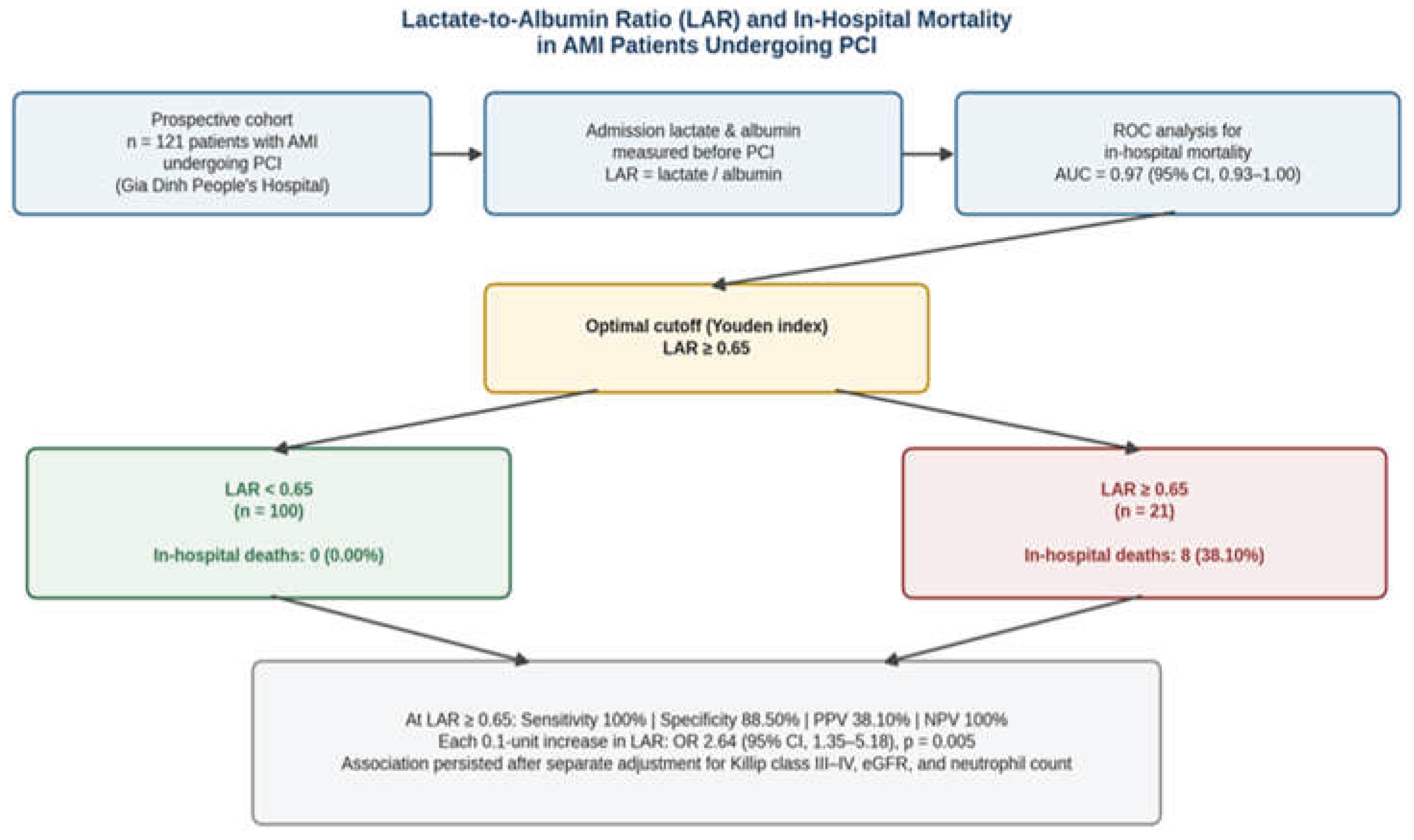
Admission LAR demonstrated excellent discrimination for in-hospital mortality, with an AUC of 0.97 (standard error, 0.02; 95% CI, 0.93–1.00; p < 0.001) (Figure 1). The optimal cutoff determined by the Youden index was LAR ≥ 0.65 (Youden J = 0.89). At this threshold, sensitivity was 100%, specificity 88.5%, positive predictive value 38.1%, negative predictive value 100%, positive likelihood ratio 8.7, and negative likelihood ratio 0.0. Among 100 patients with LAR < 0.65, no in-hospital deaths occurred. Among 21 patients with LAR ≥ 0.65, 8 died (38.10%; p < 0.001).
3.5. Association Between LAR and In-Hospital Mortality
In univariable logistic regression, each 0.1-unit increase in LAR was associated with 2.64-fold higher odds of in-hospital mortality (Table 3). The association remained statistically significant in separate adjusted models for Killip class III–IV, eGFR, and neutrophil count. These analyses should be interpreted as separate adjustment models rather than a single fully adjusted multivariable model
3.6. Figures, Tables and Schemes
Figure 2.
Central Illustration. Overview of the study cohort, LAR calculation, ROC-based discrimination, the Youden-derived cutoff (LAR ≥ 0.65), in-hospital mortality according to cutoff group, and the main performance and regression estimates. AMI, acute myocardial infarction; AUC, area under the curve; CI, confidence interval; eGFR, estimated glomerular filtration rate; LAR, lactate-to-albumin ratio; NPV, negative predictive value; OR, odds ratio; PCI, percutaneous coronary intervention; PPV, positive predictive value; ROC, receiver operating characteristic.
Figure 2.
Central Illustration. Overview of the study cohort, LAR calculation, ROC-based discrimination, the Youden-derived cutoff (LAR ≥ 0.65), in-hospital mortality according to cutoff group, and the main performance and regression estimates. AMI, acute myocardial infarction; AUC, area under the curve; CI, confidence interval; eGFR, estimated glomerular filtration rate; LAR, lactate-to-albumin ratio; NPV, negative predictive value; OR, odds ratio; PCI, percutaneous coronary intervention; PPV, positive predictive value; ROC, receiver operating characteristic.
4. Discussion
In this prospective cohort of 121 patients with AMI undergoing PCI, admission LAR was strongly associated with in-hospital mortality and showed excellent discrimination. Three findings are particularly relevant. First, in-hospital mortality was 6.6%. Second, LAR was substantially higher in nonsurvivors and achieved an AUC of 0.97. Third, the association between continuous LAR and mortality persisted after separate adjustment for Killip class III–IV, eGFR, and neutrophil count.
The median LAR of 0.41 in the present cohort was lower than values reported in studies restricted to critically ill AMI populations. Jin et al.8 reported higher LAR values among critically ill patients with AMI, while Wang et al.10 and Chen et al.9 evaluated populations drawn from intensive care databases. Differences in disease severity, heart failure, organ dysfunction, ICU selection, timing of blood sampling, and laboratory methods may account for these differences. The present cohort included patients across a broader spectrum of severity, although all underwent coronary intervention.
The observed AUC of 0.97 was higher than the AUCs reported in previous AMI studies. Wang et al.10 reported AUCs of approximately 0.73 for 14, 28, and 90-day mortality, whereas Chen et al.9 reported an AUC of approximately 0.78 for in-hospital mortality. The stronger apparent discrimination in the present study may partly reflect the relatively homogeneous single-center cohort and the marked separation of LAR values between the eight nonsurvivors and survivors.
The cutoff of 0.65 is close to the cutoff reported in a previous AMI population, but it should not be considered a universal threshold. Cutoffs may vary with patient selection, timing of sampling, assay methods, albumin units, and outcome definitions. In the present cohort, all eight deaths occurred above the cutoff, resulting in an observed sensitivity of 100%. However, this estimate is based on only eight deaths and may be unstable in other populations.
The biological plausibility of LAR as a prognostic marker is supported by the complementary information provided by its components. Elevated lactate has previously been shown to carry prognostic value early after STEMI presentation,12 and low serum albumin has independently been associated with increased mortality risk across various clinical populations.16 In the present study, however, albumin alone did not differ significantly between survivors and nonsurvivors, whereas lactate and LAR differed markedly. Thus, the observed prognostic signal of LAR in this cohort appears to be driven predominantly by the lactate component. The study therefore does not establish that LAR is superior to lactate alone.
Similar associations between LAR and adverse outcomes have also been reported in patients with heart failure after myocardial infarction11 and in other critically ill populations,14,15 supporting the broader prognostic relevance of this ratio across the cardiovascular disease spectrum.
The association between LAR and mortality remained significant after separate adjustment for Killip class III–IV, eGFR, and neutrophil count. These variables represent clinically relevant dimensions of AMI severity, including hemodynamic compromise, renal function, and systemic inflammatory response. The consistency of the LAR ORs across the separate models supports the robustness of the association within the available data, although residual confounding cannot be excluded.
Clinically, LAR has the advantage of being simple to calculate from tests that are generally available during initial AMI assessment. It may therefore serve as an adjunct to clinical evaluation and established risk stratification. A high LAR should not be used as a stand-alone trigger for ICU transfer, vasoactive therapy, mechanical circulatory support, or any specific intervention. Instead, it may identify patients who warrant closer assessment of hemodynamics, tissue perfusion, renal function, and evolving complications..
5. Conclusions
In patients with acute myocardial infarction undergoing PCI, admission lactate-to-albumin ratio was strongly associated with in-hospital mortality and demonstrated excellent discrimination in this single-center cohort. A cutoff of ≥ 0.65 showed high sensitivity and specificity in the study population, and each 0.1-unit increase in LAR was associated with higher odds of in-hospital death. LAR may be a useful adjunct to early risk assessment, but the observed performance and cutoff should be considered exploratory and validated in larger, multicenter cohorts before clinical implementation.
Abbreviations
The following abbreviations are used in this manuscript:
| Abbreviation | Full term |
| AMI | Acute myocardial infarction |
| AUC | Area under the curve |
| CI | Confidence interval |
| eGFR | Estimated glomerular filtration rate |
| IQR | Interquartile range |
| LAR | Lactate-to-albumin ratio |
| NSTEMI | Non-ST-segment elevation myocardial infarction |
| OR | Odds ratio |
| PCI | Percutaneous coronary intervention |
| STEMI | ST-segment elevation myocardial infarction |
References
- Martin, S.S.; Aday, A.W.; Almarzooq, Z.I.; et al. 2024 Heart Disease and Stroke Statistics: A Report of US and Global Data From the American Heart Association. Circulation 2024, 149, e347–e913. [Google Scholar] [CrossRef] [PubMed]
- Thygesen, K.; Alpert, J.S.; Jaffe, A.S.; et al. Fourth Universal Definition of Myocardial Infarction (2018). Circulation 2018, 138, e618–e651. [Google Scholar] [CrossRef] [PubMed]
- Rao, S.V.; O’Donoghue, M.L.; et al. 2025 ACC/AHA/ACEP/NAEMSP/SCAI Guideline for the Management of Patients With Acute Coronary Syndromes. Circulation 2025, 151, e771–e862. [Google Scholar] [CrossRef] [PubMed]
- Byrne, R.A.; Rossello, X.; et al. 2023 ESC Guidelines for the management of acute coronary syndromes. Eur. Heart J. 2023, 44, 3720–3826. [Google Scholar] [CrossRef] [PubMed]
- Li, X.; Yang, Y.; et al. Lactate metabolism in human health and disease. Signal Transduct. Target Ther. 2022, 7, 305. [Google Scholar] [CrossRef] [PubMed]
- Frydland, M.; Møller, J.E.; et al. Lactate is a Prognostic Factor in Patients Admitted With Suspected ST-Elevation Myocardial Infarction. Shock. 2019, 51, 321–327. [Google Scholar] [CrossRef] [PubMed]
- Allison, S.P.; Lobo, D.N. The clinical significance of hypoalbuminaemia. Clin. Nutr. 2024, 43, 909–914. [Google Scholar] [CrossRef] [PubMed]
- Ul Islam, M.; Gollapinni, U.; et al. Lactate-to-Albumin Ratio (LAR) as a Predictor of All-Cause Mortality in Patients With Myocardial Infarction: A Systematic Review and Meta-Analysis. Cureus 2025, 17, e82166. [Google Scholar] [CrossRef] [PubMed]
- Jin, P.; Bian, Y.; et al. Association between lactate/albumin ratio and 28-day all-cause mortality in critically ill patients with acute myocardial infarction. Sci. Rep. 2024, 14, 23677. [Google Scholar] [CrossRef] [PubMed]
- Chen, Y.; Lai, W.; et al. Association between lactate/albumin ratio and prognosis in patients with acute myocardial infarction. Eur. J. Clin. Invest. 2024, 54, e14094. [Google Scholar] [CrossRef] [PubMed]
- Wang, D.; Luo, C.; et al. Association between lactate/albumin ratio and all-cause mortality in critical patients with acute myocardial infarction. Sci. Rep. 2023, 13, 15561. [Google Scholar] [CrossRef] [PubMed]
- Nguyen, H.L.; Bui, Q.T.; et al. Characteristics, in-hospital management, and complications of acute myocardial infarction in northern and Central Vietnam. Int. J. Cardiol. 2022, 364, 133–138. [Google Scholar] [CrossRef] [PubMed]
Figure 1.
Receiver operating characteristic (ROC) curve of admission LAR for in-hospital mortality.
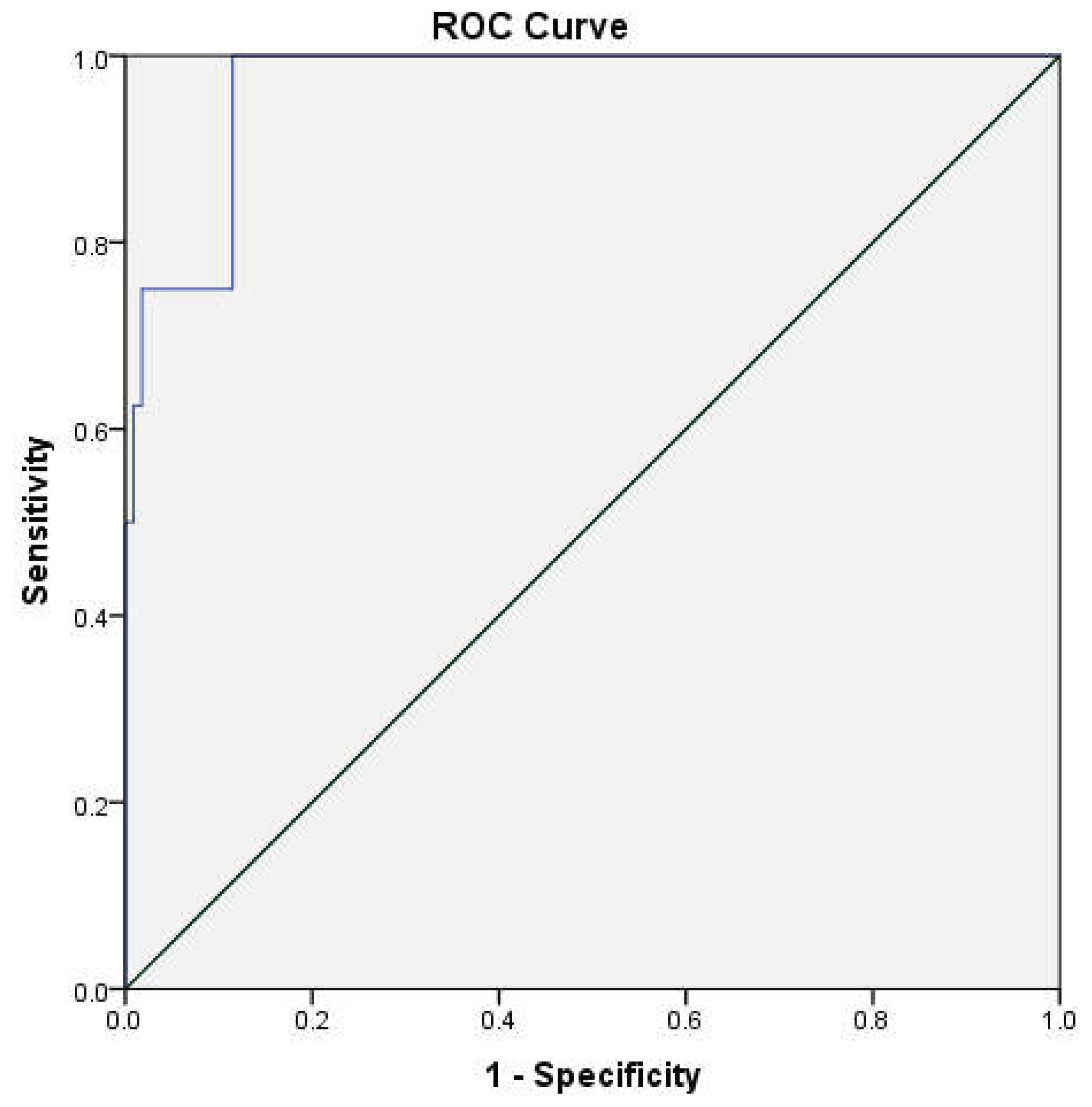

Table 1.
Selected baseline characteristics of the study population (N = 121).
| Characteristic | Value |
|---|---|
| Age, mean ± SD, years | 63.07 ± 11.88 |
| Male sex, n (%) | 77 (63.6) |
| STEMI, n (%) | 64 (52.9) |
| Killip III–IV, n (%) | 28 (23.1) |
| Hypertension, n (%) | 106 (87.6) |
| Diabetes mellitus, n (%) | 46 (38.4) |
| Dyslipidemia, n (%) | 79 (65.3) |
| Chronic kidney disease, n (%) | 24 (19.8) |
| Current smoking, n (%) | 66 (54.5) |
| Alcohol use, n (%) | 38 (31.4) |
| Admission lactate, median (IQR), mmol/L | 1.7 (1.21–2.42) |
| Admission albumin, median (IQR), g/dL | 3.99 (3.69–4.3) |
| Admission LAR, median (IQR) | 0.41 (0.31–0.6) |
| eGFR, median (IQR), mL/min/1.73 m2 | 71.63 (52–89) |
SD, standard deviation; IQR, interquartile range; STEMI, ST-segment elevation myocardial infarction; eGFR, estimated glomerular filtration rate; LAR, lactate-to-albumin ratio.
Table 2.
Admission laboratory characteristics according to in-hospital survival.
| Variable | Survivors (n=113) | Nonsurvivors (n=8) | P value |
|---|---|---|---|
| Lactate, mmol/L | 1.60 (1.18–2.33) | 4.01 (2.57–8.91) | <0.001 |
| Albumin, g/dL | 3.99 (3.70–4.30) | 3.87 (2.87–4.44) | 0.514 |
| LAR | 0.41 (0.29–0.58) | 1.22 (0.72–2.18) | <0.001 |
| Troponin I, ng/L | 5,642.6 (1,358.6–43,435.6) |
32,915.45 (10,166.50–100,403.0) |
0.069 |
| Creatinine, µmol/L | 94.5 (82.15–113.95) | 119.75 (89.45–168.74) | 0.066 |
| WBC, G/L | 10.17 (8.1–13.05) | 14.63 (11.57–16.76) | 0.009 |
| Neutrophils, G/L | 7 (4.9–9.57) | 11.36 (9.8–13.41) | 0.008 |
LAR, lactate-to-albumin ratio; eGFR, estimated glomerular filtration rate; WBC, white blood cell count.
Table 3.
Logistic regression analyses of the association between LAR and in-hospital mortality (OR per 0.1-unit increase in LAR).
Table 3.
Logistic regression analyses of the association between LAR and in-hospital mortality (OR per 0.1-unit increase in LAR).
| Model | OR | 95% CI | P value |
|---|---|---|---|
| Univariable | 2.64 | 1.35–5.18 | 0.005 |
| Adjusted for Killip III–IV | 2.56 | 1.28–5.12 | 0.008 |
| Adjusted for eGFR | 2.75 | 1.34–5.63 | 0.006 |
| Adjusted for neutrophil count | 2.87 | 1.17–7.03 | 0.022 |
LAR, lactate-to-albumin ratio; OR, odds ratio; CI, confidence interval; eGFR, estimated glomerular filtration rate.
Disclaimer/Publisher’s Note: The statements, opinions and data contained in all publications are solely those of the individual author(s) and contributor(s) and not of MDPI and/or the editor(s). MDPI and/or the editor(s) disclaim responsibility for any injury to people or property resulting from any ideas, methods, instructions or products referred to in the content. |
© 2026 by the authors. Licensee MDPI, Basel, Switzerland. This article is an open access article distributed under the terms and conditions of the Creative Commons Attribution (CC BY) license (http://creativecommons.org/licenses/by/4.0/).
Copyright: This open access article is published under a Creative Commons CC BY 4.0 license, which permit the free download, distribution, and reuse, provided that the author and preprint are cited in any reuse.