

Submitted:
25 September 2026
Posted:
29 September 2026
You are already at the latest version
Abstract
Robotic systems have become critical assets across manufacturing, healthcare, logistics, and field operations, yet their maintenance remains fragmented across a literature that treats sensing, actuation, mechanical wear, and system-level failure as unrelated topics rather than facets of a single problem. This survey addresses that fragmentation by organizing robot fault detection, diagnosis, prognosis, and fault-tolerant control around a unified four-category taxonomy, sensor, actuator, mechanical, and system-level faults, applied consistently across eight robot platforms: industrial robotic arms, wheeled mobile robots, legged robots, collaborative robots, aerial robots, surgical robots, underwater robots, and humanoid robots. Following a PRISMA-inspired screening process across four databases (IEEE Xplore, Google Scholar, Scopus, and ScienceDirect) covering publications from 2022 to 2026, an initial pool of approximately 1,800 identified records was narrowed through duplicate removal, title and abstract screening, and full-text eligibility assessment to 115 studies meeting this survey's inclusion criteria. Within this literature, industrial robotic arms account for the largest share of coverage, while acoustic emission sensing, optical and fiber Bragg grating sensing, communication-layer system faults, and humanoid-specific fault detection are addressed by a comparatively small number of studies despite the same search effort applied uniformly across every category. Methods are reviewed independently of fault category, spanning classical machine learning, deep learning architectures including recurrent, convolutional, state-space, and generative models, graph neural networks, federated learning, hybrid approaches, and model-based probabilistic methods. Recurring challenges are identified across the reviewed literature, including data scarcity relative to normal operating hours, heterogeneous data across robot fleets, domain shift between laboratory and deployment conditions, sensor corruption under real-world noise, real-time feasibility on constrained onboard hardware, and platform-specific limitations most pronounced for humanoid, surgical, and underwater robots. This survey does not propose new fault-detection algorithms; its contribution is the taxonomy itself and the structured synthesis of existing methods against it, together with a research agenda mapping identified challenges to near-term, mid-term, and long-term directions for the field.
Keywords:
robotics
; predictive maintenance
; prognostic and health management
; fault diagnosis
; literature review
1. Introduction
Robotic systems have become indispensable assets across modern manufacturing, healthcare, logistics, and field operations, with the global installed base of industrial robots alone surpassing four million units and continuing to grow rapidly [1,2]. As robots take on increasingly critical roles in automated production lines, autonomous transport, surgical assistance, and infrastructure inspection, their reliability and availability have become directly tied to operational continuity and, in many deployment contexts, to human safety. Unplanned robot downtime carries significant financial and operational consequences, disrupting production schedules, interrupting downstream processes, and, on platforms operating in close proximity to people, introducing safety risk that a purely economic framing understates [3]. Despite this criticality, many facilities continue to rely on reactive maintenance, servicing a robot only after a failure has already occurred, or on fixed-interval preventive maintenance that replaces components regardless of their actual condition [4]. Both approaches are increasingly insufficient for modern robotic systems, which operate under dynamic, mission-dependent conditions that make failure timing unpredictable and scheduled maintenance intervals difficult to optimize [5,6].
The emergence of Industry 4.0 has created both the motivation and the technical foundation for a shift from reactive and preventive maintenance toward condition-based and predictive approaches [6,7,8]. Advances in sensor technology, edge computing, and machine learning have made it possible to collect and analyze operational data from robotic systems in real time, enabling the detection of developing faults before they cause failures [9,10,11]. Deep learning methods in particular have demonstrated strong performance on fault detection and diagnosis tasks across a wide range of industrial equipment [12,13], and more recent work has begun extending these capabilities toward distributed, IoT-connected robot fleets and generative modeling approaches for data-scarce settings [14,15]. In parallel, vision-language and world models have begun to be explored for autonomous visual inspection tasks more broadly [16,17].
However, the existing body of survey literature on predictive maintenance and fault diagnosis addresses robotic systems only partially. General predictive maintenance surveys [7,9,10,18,19] cover machine learning methods and industrial equipment broadly but do not address the sensing, actuation, and kinematic characteristics that distinguish robots from general rotating machinery. Deep learning surveys for predictive maintenance [11,13,20] provide comprehensive method taxonomies but treat robotics as one application domain among many rather than as the primary focus. Digital twin and explainability surveys adjacent to this space [21,22] likewise touch on robotic applications without integrating them into a unified maintenance framework. No existing survey addresses the complete maintenance stack, sensing through fault-tolerant control, across all four fault-origin categories and all major robot platforms in a single, consistently applied taxonomy. This survey is intended to close that gap.
1.1. Contributions and Organization
This survey makes the following contributions:
- 1.
- A unified four-category fault taxonomy. We organize robot faults by origin, sensor, actuator, mechanical, and system-level (Fig. 1), rather than by robot platform or research venue, applied consistently across every platform and every stage of the maintenance pipeline reviewed in this survey.
- 2.
- Systematic, multi-database coverage. Following a PRISMA-inspired screening process across four databases and a 2022–2026 date window, this survey reviews 115 studies meeting explicit inclusion criteria, providing a defensible empirical basis for the quantitative claims made throughout.
- 3.
- Cross-platform breadth. Eight robot platforms are covered under the same taxonomy and the same evaluation standard: industrial robotic arms, wheeled mobile robots, legged robots, collaborative robots, aerial robots, surgical robots, underwater robots, and humanoid robots.
- 4.
- Method review independent of fault category. Diagnostic and prognostic methods, spanning classical machine learning, deep learning, graph neural networks, federated learning, hybrid approaches, and model-based probabilistic techniques, are reviewed as a shared algorithmic toolbox applied across all four fault categories, rather than re-derived separately for each.
- 5.
- Explicit identification of research gaps. Several fault subcategories and platforms, including acoustic emission sensing, optical and fiber Bragg grating sensing, communication-layer system faults, and humanoid-specific fault detection, are shown to be addressed by only a small number of studies despite the same search effort applied uniformly across every category, a gap this survey documents rather than obscures.
- 6.
- A time-horizon-mapped research agenda. Recurring challenges identified across the reviewed literature are mapped to concrete near-term, mid-term, and long-term future directions, grounded in limitations the reviewed authors themselves report rather than proposed independently of the literature.
This survey does not propose new fault-detection, diagnosis, or prognosis algorithms; its contribution is the taxonomy itself and the structured synthesis of existing methods against it.
The remainder of this survey is organized as follows. Section 2 introduces the terminology and maintenance paradigms underlying the rest of the paper. Section 3 describes the systematic search, screening, and inclusion process. Section 4 introduces the eight robot platforms covered. Section 5 presents the four-category fault taxonomy in full. Section 6 surveys the methods applied across all four categories. Section 7 synthesizes recurring challenges, Section 8 maps these to a research agenda, Section 9 addresses this survey’s own methodological limitations, and Section 10 concludes.
2. Background and Fundamentals
This section grounds the reader by defining terminology used for faults and describing different paradigms of maintenance.
2.1. Terminology
A consistent terminology is necessary to compare methods across different robot platforms and maintenance pipeline stages. Below are common words and phrases within the field coupled with their corresponding definitions.
Fault refers to any abnormality in a robot component or subsystem that may lead to degraded performance or failure if left unaddressed [23].
Fault Detection is the process of determining that a fault has occurred or is developing within the system, without necessarily identifying its location or cause [23].
Fault Diagnosis goes beyond detection to identify the type, location, and severity of the fault [23].
Fault Prognosis estimates the future health trajectory of the system and predicts the remaining useful life (RUL), defined as the time from the current observation until the system can no longer perform its required function within acceptable limits [24].
Fault-Tolerant Control refers to control strategies that allow a robot to continue operating safely within acceptable performance bounds even after a fault has been detected and identified [25,26].
Fig. 1 organizes these fault types by origin category, distinguishing sensor, actuator, mechanical, and system-level faults across the platforms covered in this survey.
2.2. Maintenance
In the area of robotics, maintenance is any action performed on the robot by a maintainer to prolong the usefulness and life of the robot. Whereas a maintenance event will occur at some point, the question of “when” varies drastically. The main distinction between answers to this question is the use of intelligent systems.
2.2.1. Non-intelligent System
A non-intelligent system simply means a system of maintenance that lacks AI components of the monitoring system. These are typically the simplest form of monitoring that will lead to unexpected downtime or waste of potential use of the mechanical components; however, these are the simplest to implement in practice.
Corrective or Reactive Maintenance
Corrective maintenance (also known as reactive maintenance) involves a maintenance event after a failure has occurred. This method of maintenance minimizes the costs associated with expensive monitoring systems with the understood sacrifice of unexpected down-times [4]. This is the simplest form of maintenance scheduling as there is no schedule. Maintenance only occurs once a fault occurs, which brings the negative effects of increased cost and time due to unplanned down-time, and possible secondary faults caused by the initial fault. Some of this is avoided when moving to a preventive maintenance schema.
Preventive Maintenance
Preventive maintenance is a schema of maintenance that focuses on performing regularly scheduled maintenance events to prolong the life of a mechanical system. The maintainers utilize suggestions from part or system manufacturers to plan for maintenance and restock of needed parts. This mitigates the first negative effect that comes with corrective maintenance. This schema does introduce a new flaw where a maintenance event can occur when one is not needed. An unneeded maintenance event usually comes with a waste of a functional part, which creates a waste of space if the part is not recycled, or a waste of time or money since a maintenance event was performed unnecessarily. These issues can be addressed through the introduction of intelligent systems.
2.2.2. Intelligent System
The idea of intelligent system maintenance comes in the form of an AI monitoring system with an abundance of historical data from the machinery being monitored. In a robotics scenario, this data could look similar to actuator and sensor readings over an extended period of time. Additionally, this data should have numerous operating conditions, i.e., fully functional, failing, operating with a fault, etc.
Condition-based Maintenance
Condition-based maintenance (CBM) is a maintenance paradigm built on continuously collecting and analyzing operational data to assess system health and trigger maintenance actions. This is typically achieved through sensor-driven condition monitoring, where features such as vibration, temperature, and usage patterns are processed to estimate degradation and detect anomalies [7]. This monitoring could either take the form of an anomaly detection model or human determination.
Predictive Maintenance
Predictive maintenance (PdM) is a paradigm of maintenance that overlaps heavily with the field of machine learning. PdM utilizes AI and historical data to predict a fault in a mechanical system [27]. With this paradigm, maintenance events can be planned close to the failure event so as to maximize the use of the mechanical part; moreover, this lowers the cost associated with maintaining the system.
The combination of increasing sensor availability, edge computing capabilities, and advances in deep learning has made predictive maintenance increasingly practical for robotic systems operating in real industrial environments [11,14]. Surveys covering predictive maintenance methods broadly confirm that data-driven approaches now dominate the field, with deep learning architectures achieving strong performance across a wide range of equipment types [10,13,20].
Fig. 2 illustrates how these paradigms, reactive, preventive, condition-based, and predictive, relate to a robot’s health state over its operational lifetime.
Autonomous Maintenance
Autonomous maintenance brings the decision-making ability to the robots without the need for human intervention. The robotic agents monitor their own health, make maintenance decisions for themselves, and, when in a team, make maintenance decisions for other agents [28,29]. This paradigm serves well for swarm robotics and long-distance robots that are performing actions away from human maintainers. While this remains largely aspirational, frameworks have been proposed for future implementation and testing [30].
This survey primarily focuses on predictive maintenance and its components, as these represent the most active and developed area of robot maintenance research. Additionally, fault-tolerant control is reviewed as part of an integrated maintenance pipeline.
3. Survey Methodology
The following section describes the methodology used to survey the literature.
3.1. Search Strategy
Papers were identified through systematic searches of four databases: IEEE Xplore, Google Scholar, Scopus, and ScienceDirect, applying a publication-year filter of 2022 to 2026 uniformly across all four. Search terms were organized thematically to ensure balanced coverage across both robot platforms and fault categories rather than concentrating on any single, well-represented area of the literature. One set of queries targeted robot platforms specifically, industrial robots and collaborative robots, mobile and legged robots, humanoid robots, aerial robots, underwater robots, and surgical and medical robots, each combined with general fault- and maintenance-related terms such as “fault detection,” “fault diagnosis,” “predictive maintenance,” “condition monitoring,” “remaining useful life,” and “prognostics and health management.” A second set of queries targeted fault categories directly, covering actuator, motor, joint, and gearbox faults; mechanical degradation; and cable, tendon, and transmission faults, reflecting the actuator and mechanical categories developed later in Section 5.2 and Section 5.3. A third set targeted sensing modalities, including thermal and infrared sensing, ultrasonic and acoustic emission sensing, optical and fiber Bragg grating sensing, and multi-modal or IoT-based monitoring, corresponding to the sensor-fault taxonomy developed in Section 5.1. A final set targeted machine learning and system-level failure terms directly, ensuring that the methods reviewed in Section 6 and the system-level faults reviewed in Section 5.4 were both represented in the initial search rather than surfaced only incidentally through platform- or component-specific queries. The complete set of Boolean query strings used across all four databases is provided in Appendix A. Additional backward citation searches were performed on retained papers to capture relevant earlier works not directly surfaced by the database queries.
3.2. Inclusion and Exclusion Criteria
Table 1 summarizes the criteria applied during full-text screening. The primary inclusion requirement is that the paper proposes or evaluates a maintenance, fault detection, diagnosis, prognosis, or fault-tolerant control method validated on a robotic platform where the robot is the asset being maintained.
3.3. Paper Selection Process
The paper selection process followed a PRISMA-inspired screening workflow, illustrated in Fig. 3. An initial search across the four databases returned approximately 1,800 candidate records (approximately 275 from IEEE Xplore, 500 from Google Scholar, 475 from Scopus, and 550 from ScienceDirect). After duplicate removal, approximately 1,570 unique records remained. Title screening excluded approximately 800 records as clearly irrelevant, leaving approximately 770 records for abstract-level screening. Abstract screening excluded a further approximately 400 records, leaving 370 records assessed for full-text eligibility. Full-text review excluded 255 additional records against the criteria in Table 1, yielding a final set of 115 studies included in this survey. Table 2 summarizes the selection counts at each stage, and Table 3 details the reasons for exclusion at each screening level. Consistent with the scale of this literature, the identification, duplicate-removal, and screening-stage counts are reported as approximate; the final included count of 115 is exact.
3.4. Exclusions
Seven exclusion reasons were applied consistently across title, abstract, and full-text screening, summarized in Table 3 and described in detail below.
Not based on a robotic system. Studies involving conventional machinery, industrial equipment without a robotic platform, human health monitoring, rehabilitation subjects, human fall detection, or other non-robotic systems were excluded.
Robot used to inspect or maintain an external asset. Studies in which robots were used primarily to inspect or maintain infrastructure, machinery, crops, pipelines, structures, or other external assets were excluded because the robot itself was not the object of health or maintenance analysis [32,33].
No fault or maintenance objective. Studies addressing general motion control, trajectory tracking, localization, navigation, manipulation, perception, sensing, materials, or actuator design were excluded when they did not explicitly evaluate fault detection, diagnosis, prognosis, health monitoring, remaining useful life, predictive maintenance, or fault-tolerant operation.
Simulation-only validation. Studies evaluated exclusively through numerical simulation, MATLAB/Simulink, Gazebo, MuJoCo, Webots, or other simulated environments were excluded when no physical robotic experiment or real robotic data were used. This criterion is consistent with the emphasis, throughout Section 5.1, Section 5.2, Section 5.3 and Section 5.4, on studies validated on physical hardware.
Review, survey, or other non-primary study. Review articles, survey papers, book chapters, encyclopedic articles, and other secondary studies were excluded from the primary study set, although selected works were retained for background discussion in Section 1 and Section 2 and for direct comparison in Section 3.5.
Insufficient methodological or validation detail. Studies were excluded when the available description did not provide sufficient methodological, experimental, or validation information to determine whether the proposed approach satisfied the survey criteria.
Non-peer-reviewed or insufficient publication quality. Preprints without a peer-reviewed counterpart were generally excluded; a small number were retained where the reported experiments were validated on physical robotic hardware and the preprint had accumulated sufficient independent citation to indicate community relevance, consistent with practice in fast-moving subfields where formal publication can lag technical contribution.
3.5. Relationship to Existing Surveys
Several existing surveys address adjacent topics but differ in scope from this work. General predictive maintenance surveys provide comprehensive method taxonomies but treat robotics as one application among many rather than as the primary domain. Carvalho et al. systematically review machine learning methods applied to predictive maintenance broadly, spanning multiple industrial equipment types without robot-specific sensing or kinematic treatment [9]. Zhu et al. similarly organize predictive maintenance systems by purpose and approach across general industrial assets [18], and Krupitzer et al. survey predictive maintenance specifically within an Industry 4.0 framing, covering condition monitoring broadly rather than the joint- and drivetrain-specific diagnostic patterns that dominate the robotics literature reviewed in this survey [7]. Meitz et al. extend this line of work with an open-research-challenges framing for predictive maintenance in Industry 4.0 [8], and Mallioris et al. provide a systematic multi-sector mapping of predictive maintenance applications, of which robotics is only one sector among several considered [19].
Deep-learning-focused predictive maintenance surveys narrow the scope methodologically rather than by asset type, and share a similar limitation. Serradilla et al. compare deep learning architectures for predictive maintenance across equipment types [10], Li et al. survey deep-learning-driven architectures for predictive maintenance broadly [11], and Khan et al. provide a comprehensive survey of deep-learning-based predictive maintenance methods [20]. None of these three organizes its coverage around the physical and kinematic distinctions, joint-level instrumentation, drivetrain topology, platform-specific actuation, that this survey argues are necessary to meaningfully compare fault diagnosis methods across robot types. Saeed et al. address deep-learning-based fault diagnosis specifically for resource-constrained industrial machinery health management [13], a framing adjacent to but distinct from the cross-platform robotic taxonomy developed here.
A smaller cluster of surveys addresses emerging or adjacent themes without integrating them into a unified robot maintenance framework. Wahab et al. review predictive maintenance and digital twin technologies jointly, identifying challenges and best practices, but do not organize this discussion around a fault-origin taxonomy or robot-platform coverage [21]. Siraskar et al. provide a systematic technical review of reinforcement learning for predictive maintenance, a methodological focus that intersects with but does not encompass the broader method landscape, classical machine learning, graph neural networks, federated learning, and model-based approaches, reviewed in Section 6 of this survey [22]. Bitam et al. and Li et al. each address emerging technical directions, artificial intelligence of things for predictive maintenance and generative AI for manufacturing predictive maintenance, respectively, that this survey’s Section 8 identifies as forward-looking research directions rather than as an already-established body of robot-specific literature [14,15]. Jamshidi et al. analyze predictive maintenance prognostics through the lens of classification and regression methodology, a framing orthogonal to this survey’s fault-origin taxonomy [34].
The present survey differs from all of the above in three respects: it treats the robot as the maintained asset explicitly, rather than as one example among general industrial equipment; it organizes its coverage by fault origin, sensor, actuator, mechanical, and system-level, applied consistently across every platform, rather than by method family or industry sector alone; and it is grounded in a systematic, PRISMA-inspired search and screening process spanning four databases and a defined 2022–2026 window, yielding 115 included studies against explicit inclusion criteria, rather than a narrative or convenience-sampled literature review. This combination of platform breadth, taxonomic consistency, and systematic methodology is, to the best of our knowledge, not provided by any existing survey in this space.
4. Robot Platforms and Applications
The taxonomy introduced in Section 2 classifies faults by where they originate rather than by the robot they occur on, but the practical consequence of any given fault, and the sensing and control resources available to detect it, depend heavily on the physical platform involved. A servo-motor current signature that reliably flags a gearbox fault on a six-axis industrial arm carries different implications on a battery-powered quadruped, where the same underlying degradation competes with locomotion dynamics for the controller’s attention. Before organizing the literature by fault type in Section 5.1, Section 5.2, Section 5.3 and Section 5.4, this section introduces the eight robot platforms covered in this survey: industrial robotic arms, wheeled mobile robots, legged robots, collaborative robots, aerial robots, surgical robots, underwater robots, and humanoid robots. For each, we describe the platform’s typical mode of operation, its principal application domains, its structural and actuation characteristics, and the operating conditions that shape its maintenance needs. Diagnostic and prognostic detail for each platform is deferred to the fault-category sections that follow; the objective here is to establish the physical and operational context against which those faults occur, and to make clear why a single, generic notion of “robot maintenance” is insufficient across so heterogeneous a set of systems.
The volume of literature is not evenly distributed across these eight platforms, and this imbalance warrants explicit note before proceeding. Industrial robotic arms, having been deployed at scale in manufacturing for decades, are by far the most extensively studied, with a correspondingly mature body of sensing and diagnostic work spanning nearly every stage of the maintenance pipeline. Wheeled and underwater platforms follow with a substantial and technically varied literature, while legged, collaborative, surgical, and aerial platforms are represented by a smaller but still meaningful set of studies. Surgical, aerial, and humanoid platforms in particular are addressed by a comparatively small number of studies meeting our inclusion criteria, despite extensive search effort across the same databases and date range used for every other platform; this reflects both their more recent adoption for autonomous operation and the practical and ethical difficulty of collecting fault data from safety-critical, field-deployed, or high-cost systems, rather than any narrowing of our search strategy. Table 4 summarizes this coverage alongside the primary fault concerns characteristic of each platform, and the imbalance is discussed further, along with its implications for future research, in Section 7.
4.1. Industrial Robotic Arms
Industrial robotic arms are fixed-base, multi-jointed manipulators that execute repetitive, high-precision tasks such as welding, assembly, painting, and material handling on production lines. The global installed base of industrial robots has surpassed four million units and continues to grow rapidly, with arms accounting for the substantial majority of that deployment [1,2]. Most designs follow a serial-link architecture with four to seven rotational joints, each driven by an independent servo motor coupled to the load through a speed-reduction stage, most commonly a harmonic or cycloidal (RV) reducer, allowing the motor to run at high, efficient speed while the joint itself moves slowly and with high torque. This drivetrain arrangement gives each joint a largely independent potential failure site, which is why joint-level instrumentation, rather than whole-robot instrumentation, has become the default sensing strategy for this platform, a pattern discussed further in Section 5.1.
Fig. 4 shows a representative pair of six-axis arms, illustrating the serial-link, per-joint layout described above and the independent failure sites that joint-level instrumentation is designed to monitor.
Because industrial arms operate continuously under sustained, repeatable load cycles in structured factory environments, the underlying degradation processes, reducer wear, bearing fatigue, belt and gear-tooth damage, motor winding faults, unfold over predictable operating hours rather than under the more variable, mission-dependent conditions faced by mobile or field robots [23,30,35]. This predictability, combined with decades of prior deployment, has made industrial arms the platform on which the largest share of the fault-diagnosis and predictive-maintenance literature has been developed, and the resulting body of work is correspondingly broad in scope, addressing whole-robot instrumentation, individual drivetrain components, and system-level maintenance frameworks in roughly equal measure.
At the whole-robot level, several studies instrument every joint of a six-axis arm simultaneously in order to capture compound faults that involve more than one joint at once. Hu et al. design a compositional generalization model that trains on single- and double-joint faults but is evaluated on unseen triple- and quadruple-joint combinations, testing whether a diagnostic model can generalize to compound failure patterns it has never directly observed [36]. Jiang et al. extend this multi-joint instrumentation to realistic production conditions, showing that a diagnostic model explicitly designed to tolerate sensor faults and environmental noise degrades far less than conventional approaches once the clean-laboratory assumption common in prior work breaks down [37]. Wang et al. address a related but distinct problem, missing or corrupted sensor channels caused by hardware issues and unstable communication, by jointly learning data imputation and fault diagnosis so that the two tasks reinforce one another [38]. Liu et al. take a different instrumentation approach entirely, replacing conventional accelerometers with fiber Bragg grating sensors embedded in each joint to capture vibration across multiple signal domains [39].
A second, larger cluster of studies narrows the diagnostic target from the whole robot to a single drivetrain component, most often the reducer or gearbox responsible for converting motor speed into joint torque. Acoustic emission sensing has been applied specifically to this problem: He et al. use two broadband acoustic emission sensors to pinpoint the exact position within a robot’s motion cycle at which an RV reducer fault begins [40], Liu et al. combine a dedicated denoising stage with mode decomposition and support vector classification to detect harmonic reducer faults reliably despite structural and load noise [41], and You et al. target sudden gearbox fracture specifically, using a controlled method to simulate transient stress waves without inflicting real damage on the test rig [42]. Fan et al. instead sidestep added acoustic or vibration instrumentation altogether, showing that the signal already available from a servo motor’s built-in encoder carries enough information to detect gear tooth faults, which is particularly valuable where limited joint space makes mounting an external sensor impractical [43]. Reducer bearing degradation has been addressed through deep wavelet scattering applied to embedded motor-current measurements [44], through in-situ, non-disassembly diagnosis using multi-scale convolutional networks that exploit complementary frequency-scale information [45,46], and through analysis of real, naturally occurring bearing-retainer and needle-roller degradation collected from robots previously operated on an active manufacturing line rather than from artificially injected laboratory faults [47]. Adaptive cochlea-simulating acoustic methods have more recently been proposed to extract fault-sensitive frequency regions directly from joint sound under non-stationary robot operation [48].
Belt, pulley, and bearing degradation in the broader transmission system have received similar attention. Wang et al. combine vibration and motor-current signals in the time-frequency domain to identify nine distinct belt and pulley fault types, including wear, fracture, tooth cracking, and looseness [49]. Autsou et al. apply fuzzy-logic rules derived from vibration frequency spectra to distinguish belt overtension and lubrication-related overheating without requiring a large training dataset or an exact mathematical model of the transmission [50]. Bilal et al. use a hybrid transfer-learning architecture to diagnose inner- and outer-race bearing defects of increasing severity in the flexible joints of a collaborative-grade industrial arm under varying load and speed conditions [51], and Liu et al. transfer diagnostic knowledge learned on one robot axis to another axis with only a small amount of target-axis fault data, addressing the practical problem of insufficient labeled data for every individual joint [52].
A third group of studies targets the motor and drive level directly, again favoring signals already available from the robot’s own controller over dedicated additional sensors. Shestakov et al. diagnose inter-turn short-circuit faults in permanent magnet synchronous motors from three-phase current asymmetry alone, while explicitly addressing how motor load and supply frequency variation destabilize the diagnostic features used [53]. Chen et al. apply a few-shot, domain-generalization approach to detect subtle ball-screw wear from current signals before it becomes severe enough to affect positioning accuracy [54], Elahi et al. use continuous-wavelet transformation of current signals combined with transfer learning to monitor RV reducer health under variable operating speeds [55], and Wu et al. and Zang et al. each combine multi-scale temporal and graph-attention modeling to classify overall drivetrain health state from current signatures alone [56,57]. Where fault occurrences are especially rare relative to normal operating hours, additional work has explored discriminative feature learning from attitude data [58], prototypical few-shot classification of transmission faults [59], inertial-measurement-unit error calibration for anomaly detection [60], wavelet-based real-time diagnosis [61], and mechanical fault identification specific to SCARA-configuration arms [62].
Beyond diagnosis of the drivetrain itself, industrial arms have also served as the primary testbed for broader maintenance-system concepts that extend past a single component. Welding-process health has been monitored through electrical, thermal, and motion signals checked against real maintenance records [63], through remaining-useful-life prediction of a welding robot’s supporting cooling fan [64], and through an IoT architecture that streams robot alarms and process data to a cloud platform for remote monitoring [65]. Digital-twin and multi-modal sensor-fusion approaches have been used to detect gradual trajectory drift caused by motor wear and belt stretching [66], and low-power wireless condition monitoring has been demonstrated as a way to decouple maintenance sensing from a wired factory network [67]. Unsupervised anomaly detection has also been evaluated directly on live production data, with anomaly scores shown to rise ahead of an actual line failure [68]. At the fleet level, federated and quantum-assisted learning frameworks have begun to address the challenge of training a shared diagnostic model across multiple manipulators without centralizing raw sensor data [69,70], while system-level health-state and reliability frameworks synthesize these component-level signals into an overall assessment of robot condition [71,72]. The economic stakes are also directly measurable on this platform: unplanned downtime on a production line interrupts not only the faulted robot but frequently an entire downstream assembly process, which is a major reason predictive maintenance research has concentrated so heavily here relative to every other platform surveyed in this paper.
4.2. Wheeled Mobile Robots
Wheeled mobile robots navigate factory floors, warehouses, and outdoor pathways using differential-drive, Mecanum, or omnidirectional wheel configurations, and are increasingly deployed as automated guided vehicles (AGVs) and autonomous mobile robots (AMRs) for material transport, inventory movement, and last-mile logistics [73,74]. Unlike a fixed industrial arm, a wheeled robot’s fault signatures are entangled with its ongoing motion: a degrading wheel bearing produces vibration that varies with speed, floor surface, and payload, and a motor fault may be difficult to distinguish from the effect of an obstacle or an uneven floor section unless the diagnostic method explicitly accounts for the robot’s current trajectory and load. Gheorghe et al. illustrate this directly by introducing controlled structural gaps of increasing severity into a mobile robot’s aluminum-profile frame and showing that the resulting vibration signature must be interpreted relative to the robot’s ongoing wheel-drive motion rather than in isolation [75]. Mei et al. address the same entanglement using an adaptive temporal-topological graph model that jointly captures sensor relationships and their evolution over time across two physically distinct wheeled platforms [76], while Miao et al. fuse heterogeneous IMU and wheel-encoder channels through independent per-channel feature extraction before fusing them for classification, distinguishing motor-shaft and wheel-drive mechanical faults from encoder and IMU sensor faults [77].
Wheeled platforms are also frequently studied at the level of heterogeneous multisensor instrumentation, since a robot capable of both steering and driving simultaneously produces coupled mechanical behavior that a single sensor type cannot fully characterize. Mao et al. derive sensor correlations directly from the kinematic and dynamic models of three distinct wheeled robot types, Mecanum, four-wheel-drive, and omnidirectional, rather than relying on purely data-driven graph construction, and show that the resulting physics-informed graph generalizes across all three robot geometries even under a federated training setup with highly heterogeneous client data [78]. Ye et al. combine a similar physical-prior encoding with a large language model that fuses structured mechanical knowledge and real-time sensor correlations into a single diagnostic graph, validated on both a four-wheel Mecanum robot and a three-wheel omnidirectional robot [79]. Gultekin et al. take a signal-fusion approach specific to an autonomous transfer vehicle, converting sound and vibration from both drive motors into time-frequency representations and fusing them through a convolutional network to detect obstacles and wheel interference during operation [80].
A distinctly platform-level maintenance challenge also recurs across this literature that has no close analogue among the largely single-unit industrial arms discussed above: wheeled robots are typically deployed as fleets rather than as individual units, and robots operating on different floors, routes, shift schedules, or physical configurations collect systematically different sensor data even when nominally identical faults are present. This fleet-level heterogeneity, rather than the difficulty of diagnosing a single robot, is precisely what motivates the federated diagnostic approaches of Mao et al. and Ye et al. above, and it recurs as a central theme in the broader methods survey of Section 6.
Beyond individual-robot diagnosis, wheeled platforms have also motivated a range of system-level and fleet-level maintenance frameworks. Ren et al. apply a combined failure-mode-and-effects and Delphi expert-study methodology to a networked mobile robot system and show that ranking failure modes by their effect on the whole networked system, rather than by the risk of each component in isolation, changes which failure is judged most critical [81]. Akpinar et al. build a ROS-based fault-detection pipeline that feeds directly into a virtual-reality troubleshooting interface, addressing the practical problem of getting a detected fault in front of a maintenance technician quickly [74]. Schrick et al. propose a microservice-based control architecture that distributes robot functionality across independent software nodes with continuous internal diagnostics for safety-critical delivery robots operating in public spaces [82], Peddi and Bezzo combine decision-tree-based fault monitoring with reachability analysis and model predictive control to select safe corrective actions under decision uncertainty [83], Cao et al. address adversarial rather than mechanical failure, using an event-triggered, watermarked sensor-fusion strategy to maintain accurate state estimates when transmitted measurements are maliciously modified in a man-in-the-middle attack [84], and Racanelli and Mascolo demonstrate a fail-safe controller that switches a differential-drive vehicle to a safe state upon detecting encoder or motor-disconnection faults [85]. Castellano-Quero et al. integrate anomaly detectors and recovery processes at multiple levels of abstraction within a Bayesian architecture for real-time mobile-robot sensory fault handling [86].
4.3. Legged Robots
Legged robots, most commonly quadrupeds, use articulated limbs to traverse unstructured or uneven terrain that wheeled platforms cannot access, including stairs, rubble, and outdoor natural environments. Fig. 5 depicts a representative quadruped platform, whose four articulated limbs exemplify the multi-limb kinematic structure that gives rise to the mechanical coupling discussed in this section.
Their joints experience continuously varying, dynamically coupled loads during locomotion rather than the more repeatable load cycles of a fixed arm, which makes isolating a single faulty joint especially difficult: a single degraded actuator changes the robot’s whole-body posture and, in turn, the load and sensor readings at every other joint [26,87]. Wang et al. address this by injecting continuously varying fault magnitudes into the hip and knee joints of a quadruped, using a time-varying fault function rather than an abrupt on/off failure to more realistically simulate progressive degradation, and combine a synthetic-data generation stage with a random-forest channel expansion step to compensate for how rare genuine fault data is during normal operation [26]. Liu et al. isolate a related but more specific failure mode, partial torque-tracking loss in which a motor retains some output but cannot fully respond to commands, defining a continuous torque retention rate rather than treating the joint as simply broken or healthy, and pair this with a real-time controller that continuously refines its estimate of the fault and compensates without retraining [87]. Legged platforms are also more constrained in onboard sensing and compute than industrial arms, since every additional sensor or heavier processing pipeline consumes payload and power that would otherwise extend operating range; Yang et al. address this constraint directly by tracking battery voltage, a signal requiring no additional hardware, across a fleet of quadrupeds using a lightweight GRU-based model with attention to separate long-term degradation trends from short-term noise [88]. Fault-tolerant recovery under mechanical degradation has been demonstrated through fast online adaptation on a related tracked and simulated legged platform [89]. Equilibrium-maintenance and proactive fault-avoidance behavior has also been explored at the level of general robot agents rather than a specific quadruped design, including work enabling a robot to monitor its own stability and preemptively adjust its behavior to avoid an impending loss of equilibrium [28], and a predictive approach to fault tolerance in robot swarms that anticipates degradation before it manifests as an outright failure [29].
4.4. Collaborative Robots
Collaborative robots, or cobots, are designed to share workspace directly with human operators, which imposes safety and compliance requirements not present on caged industrial arms. Because a single cobot is frequently reprogrammed to perform many different tasks over its operating life, rather than repeating one fixed motion indefinitely, its sensor data distribution shifts with every new task assignment, a characteristic that complicates fault detection methods trained on a fixed task profile. Yoo and Lee address this directly, building a unified anomaly detection framework that must generalize across many different motion commands rather than a single fixed task, using two complementary consistency checks to separate genuinely new commands from actual anomalies occurring within already-familiar ones [90]. Kolvig-Raun et al. face a related form of task variability from the prognosis side: a cobot joint’s remaining useful life depends heavily on the specific mix of loads, speeds, and environments it happens to be assigned across its deployment, and their knowledge-based stress-indicator model, validated across 408 deployed cobots and over 1,400 individual joints, is designed to track wear regardless of which tasks produced it [91]. Cobots are also deployed in tightly interconnected leader-follower and human-robot interaction configurations, in which a fault in one unit’s sensing, actuation, or communication can directly affect the safety of a co-located human operator, making rapid, low-latency diagnosis a stronger practical requirement than on a fully caged industrial arm. Peng et al. demonstrate this with a fuzzy echo-state network that diagnoses leader and follower sensor faults, actuator faults, and communication interruptions using only measurements from the follower robot, reporting an online diagnosis time of roughly ten milliseconds [92]. Bertoli et al. build an IoT-enabled software architecture specifically for welding cobots to support user-friendly fault diagnosis and identification [65], Zhong et al. use an external, low-cost camera independent of the cobot’s own internal sensors to catch anomalous end-effector trajectories that could bring the robot too close to a nearby human worker [93], and Velasco-Guillen et al. address the physical human-robot interaction requirement directly, proposing a stiffness-fault-tolerant impedance control strategy for the compliant, elastic actuators that cobots use to trade rigid precision for safer physical contact [94]. Goller et al. further integrate fault detection, diagnosis, and recovery directly into a manipulation-task planning pipeline, demonstrating both forward and backward recovery strategies on a physical seven-degree-of-freedom cobot performing assembly [95]. System-level failure recovery has also been examined in heterogeneous telerobotic teams operating in space environments, where a framework enabling robots to monitor autonomous task execution, attempt predefined recovery actions, and proactively request human assistance when autonomous recovery proves insufficient was demonstrated in an International Space Station-to-Earth experiment using the humanoid robot Rollin’ Justin, in which an intentionally induced localization error caused an insertion failure that the robot detected before an astronaut assumed direct teleoperation to complete the task [96].
4.5. Aerial Robots
Aerial robots, predominantly multirotor unmanned aerial vehicles (UAVs), are used for inspection, delivery, and surveillance tasks that require rapid coverage of large or difficult-to-access areas. Their propellers and motors operate under continuous high-speed rotation with essentially no structural redundancy: the loss or degradation of a single rotor can compromise flight stability far more immediately than a comparable actuator fault would on a grounded platform. Puchalski et al. address propeller fracture directly, mounting accelerometers on each arm of a multirotor UAV and showing that the fundamental frequency of the resulting vibration disturbance corresponds directly to the rotational speed of the damaged propeller, making frequency-domain analysis a natural detection strategy [97]. Mohammed et al. target subtler damage, edge cuts, cracks, and surface defects that degrade flight performance without a complete propeller failure, extracting a large set of statistical time-domain descriptors from a dual inertial-measurement-unit system and reporting strong classification performance across multiple flight trajectories [98]. Strict weight and power budgets further constrain UAV maintenance systems to lightweight, low-latency onboard processing, since any diagnostic hardware or computation is a direct trade-off against flight time or payload capacity. Li et al. address this with a hybrid model that combines a learned sequence predictor with a physics-based autoregressive model, continuously reweighting the two based on which is currently predicting sensor readings more accurately, favoring the lighter model during stable flight and the more expressive one once conditions become dynamic [99], and Shao et al. propose a neuromorphic spiking recurrent network for gyroscope fault classification that reduces computational requirements specifically for embedded onboard deployment under noisy flight conditions [100]. Han et al. address a further layer of the problem, systematic partial actuator faults in rotary-wing UAVs, representing degradation as a time-varying effectiveness coefficient and pairing an observer-based early-warning indicator with a fault-tolerant controller that maintains path-following performance despite reduced motor output [101].
4.6. Surgical Robots
Surgical robots are teleoperated or semi-autonomous systems used to perform minimally invasive procedures with precision beyond typical unassisted human capability. Their actuation frequently relies on tendon- or wire-driven transmission rather than direct-drive joints, in order to keep the working end of the instrument small enough for confined anatomical spaces, which introduces failure modes largely absent from other platforms. Zheng et al. characterize two physically distinct failure modes in surgical wire-rope transmission through fatigue-wear experiments: a soft failure driven by gradual, cumulative tension loss from sliding friction, modeled as a Wiener process, and a hard failure from sudden thread fracture, modeled through a proportional-hazards process, showing that the two are statistically dependent rather than independent, with accumulated tension loss increasing the subsequent hard-failure rate [24]. Fiber Bragg grating sensing has been used to preserve force- and moment-sensing capability even after individual optical elements fail: Li et al. build a six-axis FBG sensor with two redundant elements beyond the minimum required, allowing continued six-axis measurement after one or two element fractures through a trained neural-network model library that reconstructs the missing information [102], and Zhao et al. apply step-coated FBG sensing integrated directly into surgical forceps for a spinal endoscopic robot, using wavelet fuzzy entropy to identify degraded wavelength signals and an extreme learning machine for fault-tolerant force decoupling, validated through spine-model and animal experiments [103]. Because a fault occurring mid-procedure carries direct patient-safety consequences, this literature also places weight on postmarket surveillance: Hammadeh et al. analyze seventeen years of adverse-event reports for a widely deployed surgical robot system and find a recurring hardware-software failure pattern that persists across three successive hardware generations [104]. Gu and Wang address active fault tolerance for a different class of surgical device, a sensorless, disposable, cable-driven soft manipulator, detecting a locked-motor fault from image-based visual-servoing error alone and reconfiguring the controller to exclude the affected cable while driving the task error back toward zero [105]. A consumption-based diagnostic approach evaluated on a multi-degree-of-freedom manipulator in a medical robotics venue is also relevant to this platform’s broader toolkit [106].
4.7. Underwater Robots
Underwater robots, including remotely operated vehicles (ROVs) and autonomous underwater vehicles (AUVs), use thruster arrays to navigate marine environments for exploration, inspection, and research missions. A related body of literature on unmanned surface vessels, which share similar thruster-based propulsion and formation-control challenges, is adjacent to but outside the scope of this survey’s platform taxonomy [107]. Thruster degradation is especially difficult to isolate on this platform because its effects on vehicle motion closely resemble those of ordinary environmental disturbances such as currents, a confound noted repeatedly across the underwater fault-diagnosis literature [25,108]. The marine environment also constrains data collection more severely than on any other platform surveyed here, since connectivity to a surface station is limited or absent during a mission and hardware access for instrumentation or repair is far more costly than on a land-based robot; this scarcity of labeled fault data has motivated a cluster of few-shot and semi-supervised approaches specific to this platform. Chen et al. propose a meta-transfer learning network combining asymmetric convolution with multi-head self-attention that transfers a feature extractor trained on one operating condition to new conditions using only a handful of labeled samples, reporting accuracies above 99% for both single- and multi-target transfer tasks on real underwater thruster data [109]. Wang et al. address the same data scarcity from a semi-supervised angle, combining a dynamic hypergraph attention network with a graph convolutional network to exploit unlabeled samples while explicitly suppressing the interference introduced by marine signal noise, evaluated under interference-free, Gaussian-noise, and texture-noise conditions on a physical AUV [110]. Li et al. address a complementary problem, incorporating new fault classes as they are discovered over an AUV’s operational life without forgetting previously learned fault types, using a rainbow-memory-based incremental learning framework [111], with a dedicated line of work specifically targeting early-stage, weak thruster faults before they progress to complete failure [112,113,114].
Reliability and control concerns extend beyond thruster diagnosis alone on this platform. Ren et al. propose a reinforcement-learning-based, self-triggered sliding-mode controller for an AUV with one bow rudder and four independently actuated stern rudders, using an adaptive observer to estimate rudder-effectiveness factors online and an Actor-Critic controller to generate compensating commands, validated through both simulation and physical lake trials with a deliberately fixed rudder [115]. Xu et al. and Huang et al. each propose hybrid and interpretable neural architectures for diagnosing propeller damage and other mechanical faults under changing operating conditions, evaluated on both the Haizhe AUV dataset and a separate BlueROV2 platform [116,117], while Huang et al. separately combine an improved parrot optimization algorithm with a random forest classifier, reporting accuracy improvements over seventeen comparison algorithms on the same AUV fault dataset [108]. Navigation-sensor integrity has also been addressed directly: Chen et al. propose a unified framework combining anomaly detection, rollback to the estimated fault onset, and gated-recurrent-unit-based recovery of corrupted inertial and Doppler velocity log measurements, validated through sea trials with an average detection accuracy above 97% [118]. Fault tolerance has additionally been examined at the mechanism level, with Jiang et al. analyzing the parallel-manipulator linkage used to vector underwater thrust and demonstrating that the mechanism retains its required rotational degrees of freedom even when one actuator becomes stuck [119], and reliability modeling has been extended beyond thrusters entirely to the buoyancy-control system of a self-powered underwater glider, where a Bayesian and machine-learning framework corrected an eighteen-percent prediction deviation relative to a traditional reliability model [120]. Related propulsion and formation-control fault-tolerance concepts have also been demonstrated on unmanned surface vessels operating in the same marine domain [121].
4.8. Humanoid Robots
Humanoid robots use a bipedal or human-like articulated form intended for operation in environments built for people, including stairs, doorways, and human-scale tools. Bipedal balance makes humanoid platforms uniquely vulnerable to a failure mode not meaningfully present elsewhere in this survey: the fall, in which loss of balance following a joint, sensor, or control fault can cause immediate and severe physical damage to the robot. Real-time constraints are also unusually strict for this platform, since maintaining balance typically requires control loops running at very high frequency, leaving little computational headroom for onboard fault-detection processing without specialized, resource-efficient model designs. Despite an extensive search applying the same databases and date range used for every other platform in this survey, only three studies meeting our inclusion criteria address humanoid-specific fault or failure detection, making this the most sparsely represented platform reviewed. Fig. 6 depicts a representative bipedal platform, illustrating the dense, multi-joint actuation across both arms and legs that underlies the fall-risk and real-time constraints discussed in this section.
Zhang et al. propose a convex-hull-based feature-selection algorithm for fall analysis and prediction, reducing over 300 raw sensor dimensions to a compact 13-dimensional input, and show that the resulting classifier can predict a fall more than one second in advance with a zero false-positive rate, validated on a physical humanoid under small-sample training [122]. Hirashima et al. combine inertial, proprioceptive, and acoustic signals in a hierarchical decision process, showing that this multimodal fusion reduces false positives compared to any single sensing modality alone, since normal walking gait can otherwise trigger individual sensors falsely [123]. Messina et al. address the onboard-compute constraint directly, quantizing a convolutional model for fall-direction classification to eight-bit precision so that it fits within a few kilobytes of memory on the robot’s own intelligent sensor hardware [124]. Together, these three studies define the current, still-narrow scope of humanoid-specific fault and failure research reviewed in this survey, a gap we return to explicitly in Section 7.
5. Robot Fault Taxonomy
Having introduced the eight robot platforms surveyed in Section 4, we now turn to how these systems actually fail. Fig. 1 organizes robot faults into four categories by origin: sensor faults, which concern the instruments that report on a robot’s condition rather than the robot’s physical structure itself; actuator faults, which concern the active drive-and-command layer that generates motion; mechanical faults, which concern the passive structural and transmission components that degrade independently of the drive signal; and system-level faults, which emerge from software, communication, or multi-component interaction rather than any single physical part. This section reviews the literature within each category in turn, following the order in which a fault would typically be observed, diagnosed, and traced to its origin: sensing comes first, since every fault in the remaining three categories is, in practice, observed through the sensing layer discussed below.
5.1. Sensor Faults
Sensor faults occupy a distinct position in this taxonomy: a fault that produces no detectable signal is, for practical purposes, invisible to any of the diagnostic methods surveyed in Section 6. This subsection reviews the sensing modalities used across the platforms introduced in Section 4, organized by the physical principle each modality relies on, and Fig. 7 summarizes how unevenly these modalities are distributed across robot types: industrial arms receive by far the broadest instrumentation, while most other platforms rely on only one or two sensing channels.
Table 5 summarizes these six sensing modalities alongside the platforms they have been applied to and the fault types each is capable of detecting.
5.1.1. Accelerometers and Vibration Sensors
Vibration is the most widely used indirect indicator of mechanical health across the robots surveyed in this paper, and accelerometers remain the default instrument for capturing it, though how they are deployed differs considerably by platform. On wheeled robots, accelerometers are mounted on the robot body itself and combined with gyroscope and encoder readings to capture the coupled linear and angular motion produced by simultaneous steering and driving, an arrangement used in physics-informed fault diagnosis validated across three distinct wheeled-robot geometries [78], and in a large-language-model-guided diagnostic graph validated on both a Mecanum and an omnidirectional robot [79]. On legged robots, the same sensing principle is applied at a substantially higher sampling rate to capture the faster, more dynamically coupled motion of locomotion [26], reflecting the more demanding temporal resolution that walking or trotting gaits require compared to a wheeled robot’s smoother motion profile.
Industrial robotic arms take a different instrumentation strategy: because each joint is an independent potential failure site, vibration sensors are placed at every joint rather than on the robot body as a whole, an approach used to identify degradation mechanisms across compound multi-joint fault combinations [36] and to maintain diagnostic accuracy under realistic sensor-fault and environmental-noise conditions rather than idealized laboratory settings [37]. On aerial platforms, accelerometers are instead mounted near the rotors themselves, since propeller damage produces a vibration signature whose dominant frequency tracks the rotor’s rotational speed directly, making frequency-domain analysis a natural fit for this fault type [97]. Beyond conventional accelerometers, a small number of studies substitute alternative sensing technologies to capture vibration indirectly, most notably fiber Bragg grating sensors embedded within a joint structure [39], discussed further in Section 5.1.3 below, and combined force-and-torque sensing has also been used as a complementary channel to distinguish normal task execution from failed execution attempts on robotic manipulators [69].
5.1.2. Acoustic Emission
Acoustic emission sensing detects high-frequency stress waves generated by mechanical activity inside a component, and is particularly suited to internal rotating parts, such as reducers and gearboxes, where the fault-relevant deformation occurs deep within an enclosed housing that external vibration sensors may not adequately capture. Within our final paper set, this modality is addressed almost exclusively in the context of industrial robot reducers and gearboxes: broadband acoustic emission sensors mounted on a reducer housing have been used to reveal the periodic structure of a robot’s motion cycle and pinpoint exactly where within that cycle a fault signal originates [40], a dedicated denoising and mode-decomposition pipeline has been proposed to separate genuine acoustic emission energy from structural and load noise in harmonic reducer diagnosis [41], and a dual-sensor acquisition platform has been used to identify sudden gearbox fracture through controlled simulation of transient stress waves [42].
It is worth noting explicitly that acoustic emission sensing, despite its demonstrated usefulness for exactly this class of internal, hard-to-instrument fault, is addressed by only these three studies in our final paper set, notably fewer than accelerometer-based vibration sensing or current-based electrical sensing discussed below. This is not a reflection of a narrower search on our part, since the same databases and search terms were applied uniformly across all sensing modalities, but appears instead to reflect a genuine gap in the published literature, one we return to in Section 7.
5.1.3. Optical and Fiber Bragg Grating (FBG)
Fiber Bragg grating sensors detect mechanical strain by measuring shifts in the wavelength of light reflected through an optical fiber, and were the only optical sensing technology represented in our final paper set. Their principal advantage over conventional electrical sensors is immunity to electromagnetic interference and compatibility with confined or sensitive environments, which has made them particularly attractive in two otherwise very different settings. In industrial robotics, FBG sensors have been installed along the axis of each joint, connected within a single optical fiber, offering a lighter and less obtrusive alternative to conventional accelerometers for capturing joint-level vibration [39]. In surgical robotics, a six-axis FBG force and moment sensor built from cross-suspended optical fibers has been used to provide continuous tactile feedback during procedures such as bone drilling, where the sensor’s small form factor allows it to be embedded directly in the working end of the instrument [125], a constraint that effectively rules out most conventional accelerometer-based designs. As with acoustic emission sensing, FBG-based instrumentation appears in only these two studies within our final paper set, concentrated in these specific application niches rather than distributed broadly across platforms.
5.1.4. Electrical and Encoder-Based Sensing
Current, voltage, and encoder signals offer a fundamentally different sensing strategy from the physical sensors discussed above: rather than adding new hardware to the robot, these signals are already produced by the motor drivers and controllers present on essentially every robot platform, which means fault-relevant information can often be extracted without any additional instrumentation cost. This advantage has made electrical and encoder-based sensing the most heavily represented modality among the studies reviewed in this survey. Motor current alone has been used as a diagnostic signal for a striking range of fault types and granularities: current read across all six axes of an industrial arm has been used to capture general fault conditions [38], current drawn by a ball screw has been used to catch subtle wear well before it becomes mechanically obvious [54], and voltage and current instabilities have been used as one of several fault indicators in welding robots alongside the robot’s normal process-control role [63].
A second pattern within this modality involves repurposing signals that already exist for an entirely different control purpose. Built-in servo-motor encoders, whose primary function is closed-loop position control, have been shown to carry enough information to detect gear-tooth faults in reducers and gearboxes [43], which is especially valuable in precisely the tight, cable-constrained spaces where mounting an external sensor is impractical. A related approach compares a robot’s commanded and actual current draw as a stress indicator for cumulative mechanical wear at the joint level, requiring nothing beyond what the robot’s own controller already reports [91]. Electrical signals are also frequently combined into a larger multi-sensor picture rather than used in isolation, appearing alongside vibration, torque, and temperature measurements in graph-based diagnostic frameworks [70], alongside joint angle in unified anomaly detection for collaborative robots [90], and as one channel among several in wheeled-robot sensor arrangements where current specifically captures the electrical coupling between a motor drive and the mechanical load it is turning [79].
5.1.5. Camera and Visual Sensors
Cameras provide an external, non-contact sensing modality that observes a robot from outside its own mechanical structure, which makes them particularly valuable in two situations: when a robot’s internal sensing may itself be compromised, and when the object of interest is not the robot at all, but its surrounding environment. In the first category, an external camera paired with fiducial markers has been used to track a collaborative robot’s end-effector entirely independently of its internal sensors, on the reasoning that a robot cannot always be trusted to accurately report its own state [93], while a camera paired with inertial sensing has been used at the joint level specifically to catch the gap between what a robot’s controller believes its joints are doing and where they are actually located [66], a form of drift that internal encoders alone tend to miss. A closely related use of visual perception involves monitoring the reliability of the robot’s own perception system, where prediction uncertainty combined with information about the camera’s physical distance from a target object has been used to decide whether a learned perception output should be trusted or rejected during task execution [126].
5.1.6. Multi-modal and IoT Sensing
A final group of approaches either combines multiple sensing modalities to compensate for what any single one would miss, or focuses on how sensor data reaches a person or system capable of acting on it, rather than on sensing hardware itself. Several studies pursue the first strategy explicitly: motor, electrical, and thermal signals have been jointly represented as nodes in a graph structure so that correlations between them can be learned directly rather than assumed in advance [70], and a full humanoid robot’s orientation, proprioceptive, and acoustic signals have been combined in a staged decision process on the reasoning that an impact detectable acoustically might otherwise be missed by motion sensors alone [123]. A related but distinct pattern reuses a signal that already exists for another purpose rather than adding new sensing capacity: an intelligent sensor processing unit paired with an inertial sensor has been used to run a fall-detection model directly on-chip, transmitting only the final classification rather than streaming raw sensor data back to a central controller [124].
The remaining work in this category addresses the practical problem of transporting sensor data off the robot rather than sensing itself. Low-power, long-range wireless connectivity has been used to decouple predictive maintenance monitoring from a wired factory network [67], and an Internet-of-Things architecture has been used to route robot alarms and process data to a cloud platform that notifies operators automatically [65], removing the need for anyone to be physically present to learn that a fault has occurred. A multidimensional Bayesian architecture that integrates heterogeneous sensory information, anomaly detectors, and recovery logic at multiple levels of abstraction has also been proposed specifically to address the temporal evolution of sensor behavior in real-time mobile-robot monitoring [86].
5.2. Actuator Faults
In practice, a single physical joint can exhibit both an actuator fault and the mechanical faults discussed in Section 5.3 simultaneously, and the diagnostic methods reviewed below often address the drive-layer symptom even where the underlying cause is ultimately mechanical. Fig. 8 summarizes the actuator fault types identified across the platforms surveyed, and Table 6 details each fault mode alongside its underlying failure mechanism.
5.2.1. Industrial Robot Joints and Reducers
Industrial robot joints are, as established in Section 4, the most extensively studied actuator failure site in this survey, and the literature reviewed here approaches drive-layer diagnosis from several complementary directions. At the whole-robot level, compound multi-joint faults, in which two or more joints fail concurrently, have been addressed by training on individually observed single- and double-joint fault combinations and evaluating generalization to unseen triple- and quadruple-joint combinations [36], testing whether a diagnostic model can extrapolate to compound failure patterns rather than memorizing only what it has directly observed. Complementary work has replaced functional reducers and motors with physically faulty components rather than relying on simulated damage, covering both single-actuator and simultaneous multi-actuator failure scenarios [38] to produce more realistic training data than laboratory-injected faults typically allow.
At the component level, harmonic reducer faults have been addressed through a combination of dedicated denoising and mode-decomposition techniques designed to separate genuine fault signatures from structural and load noise [41], while sudden gearbox fracture, a comparatively rare but high-consequence event, has been studied using a controlled method for simulating transient stress waves without inflicting real damage on test equipment [42]. Gear-tooth faults specifically have also been shown to be detectable using signals already produced by a servo motor’s own built-in encoder [43], sidestepping the need for any additional vibration or acoustic instrumentation. Permanent-magnet synchronous motor faults, specifically inter-turn short circuits that produce abnormal current asymmetry across the motor’s three phases, have been addressed with particular attention to how motor load and supply-frequency variation destabilize the diagnostic features used [53], an important practical consideration since a model trained under one operating condition often fails to generalize to another. Bearing-related actuator degradation, distinct from the gear-and-transmission wear discussed in Section 5.3, has also been addressed through graph-based representations that jointly model vibration, current, torque, temperature, and speed as correlated signals from a single underlying drive system [70].
5.2.2. Motors and Drives
Beyond the industrial-arm-specific studies above, motor- and drive-level diagnosis has also been addressed as a general problem applicable across platforms. Domain-adaptive approaches have been proposed to transfer a diagnostic model trained on one motor to a different motor using only a small amount of labeled target-motor data [53], addressing the practical reality that fault-labeled data is typically available only under controlled laboratory conditions on a specific source motor. Few-shot and lightweight model architectures have similarly been developed for settings where labeled fault data is scarce relative to the volume of normal operating data a robot accumulates [54], and hybrid architectures combining multi-scale temporal and graph-attention modeling have been used to classify overall drivetrain health state directly from current signatures [56,57], rather than requiring separate diagnosis of each individual component. On aerial platforms, systematic partial actuator faults, in which a rotor’s effectiveness degrades gradually rather than failing outright, have been represented through a time-varying effectiveness coefficient paired with an observer that provides an early-warning indicator [101] well before the degradation would otherwise become apparent through flight-performance changes alone.
Hydraulic actuation, though less common in this survey than electric drives, has also been addressed directly: model-based fault diagnosis for a downhole traction robot’s hydraulic actuation system has considered internal leakage in hydraulic cylinders, blockage of speed-control valves, and insufficient opening of reversing valves, using mathematical component models and simulation to characterize single and multiple faults alongside a physical hydraulic test system that experimentally emulates cylinder leakage, with flow- and pressure-based deviation estimators used to locate the leakage and assess its severity [128].
5.2.3. Legged and Humanoid Robot Actuators
Legged robot actuators present a diagnostic challenge not present on fixed industrial arms: because locomotion couples all limbs mechanically, a fault in one joint changes the load and posture at every other joint simultaneously, making the faulty joint difficult to isolate through joint-local sensing alone. This has motivated approaches that inject continuously varying, rather than abrupt, fault magnitudes into a quadruped’s hip and knee joints to more realistically capture progressive actuator degradation [26], and approaches that define a continuous torque-retention rate rather than treating a joint as simply functional or failed, allowing a real-time controller to track and compensate for partial torque loss without retraining [87]. Battery-related actuator health, while not a mechanical fault in the traditional sense, has also been addressed on this platform through lightweight, attention-augmented sequence models designed to separate long-term voltage degradation trends from short-term operational noise across a fleet of quadrupeds [88]. On humanoid platforms, actuator-related failure is closely tied to the fall risk discussed in Section 4, and on-chip, quantized inference has been proposed specifically to allow fall-direction classification to run within the strict memory and real-time constraints of onboard humanoid hardware [124].
5.2.4. Underwater and Surgical Robot Actuators
Underwater and surgical robots share a structural characteristic that distinguishes their actuator faults from those of the platforms discussed above: both frequently rely on a single or redundant set of actuators whose partial failure can, to some degree, be compensated for by the remaining healthy actuators, making the central diagnostic question one of remaining operating margin rather than binary fault presence. On underwater vehicles, thruster faults spanning both complete failure and partial efficiency loss have been addressed by activating compensation once an adaptive controller detects that disturbances exceed its normal control authority, rather than first requiring an explicit diagnosis of which thruster has failed [25], and reinforcement-learning-based sliding-mode control has been used to compensate for rudder-effectiveness loss through an online observer paired with an Actor-Critic controller [115]. Fault tolerance has also been examined at the level of the underlying actuation mechanism itself, with parallel-manipulator linkages used for thrust vectoring shown to retain their required degrees of freedom even when one active actuator becomes stuck [119].
A related line of work addresses thruster faults specifically in their earliest, weakest stage, before they progress to the complete or partial failure conditions discussed above. Early-stage thruster faults, typically defined as a thrust loss below ten percent, are difficult to detect because the fault-relevant signal is comparable in magnitude to ordinary environmental interference. A baseline study established that among fifty-two candidate features extracted from surge-velocity, control, tracking-error, and yaw-angle signals across the time, frequency, and time-frequency domains, only a small subset varies monotonically with fault severity and is therefore usable for subsequent severity identification, and proposed an improved frequency-domain feature calculation method to recover useful features where the conventional formulation failed to do so [112]. Building on this feature set, a two-stage fusion framework was proposed to address two remaining weaknesses of prior approaches: a substantial lag between fault occurrence and detection, addressed by extracting features from thrust deviation via a sliding-window Fourier transform rather than from the raw velocity signal directly, and an insufficient fault-to-interference feature ratio under weak-fault conditions, addressed by fusing a cross-correlation feature between longitudinal and heading signals into the final fused fault feature via Dempster-Shafer evidence theory [113]. Most recently, this line of work has been extended to a broader multi-input setting, combining feature-mode decomposition with wavelet denoising and an energy-operator-based enhancement stage tailored separately to each of four heterogeneous input signals, resolving a non-monotonic feature-to-severity mapping that emerged once additional, weakly correlated signals were incorporated [114]. All three studies were validated through pool experiments on the same physical AUV platform under progressively lower fault severities.
On surgical robots, wire- and tendon-driven actuation introduces failure modes with no close analogue elsewhere in this survey: gradual tension loss from sliding friction and sudden thread fracture have been characterized as two statistically dependent processes, in which accumulated tension loss increases the subsequent risk of fracture, using a combined stochastic degradation model [24]. Locked-motor faults in sensorless, disposable, cable-driven soft manipulators have been addressed through image-based visual-servoing error alone, without requiring any dedicated fault sensor [105], and command-filtered impedance control with tendon-tension compensation has been used to maintain trajectory accuracy in tendon-driven continuum manipulators following partial actuator loss of effectiveness [127]. Long-horizon postmarket surveillance of device malfunctions in a widely deployed surgical robot system has further shown that hardware-software interaction faults recur across successive hardware generations [104], indicating that actuator-related reliability concerns on this platform persist beyond any single design iteration.
5.3. Mechanical Faults
Fig. 9 summarizes the mechanical fault types identified across the platforms surveyed, organized by the component in which degradation occurs, and Table 7 details each fault mode alongside its underlying physical mechanism.
5.3.1. Structural and Propulsion-System Degradation
On underwater platforms, propeller and thruster blade damage represents the most frequently studied mechanical fault, and the literature here is shaped by two recurring constraints: labeled fault data is comparatively scarce, since damaging a real propeller for data-collection purposes is costly, and marine signal interference complicates the extraction of clean fault features from onboard measurements. Multisensor fusion of current and underwater acoustic measurements has been used to distinguish healthy, half-broken, fully broken, and biofouled propeller blades under both pool and open-water lake conditions [121]. Incremental learning approaches have been proposed specifically to incorporate newly discovered propeller-damage classes over a vehicle’s operational life without forgetting previously learned fault types [111], addressing the reality that not every fault variant is known in advance. Hybrid neural architectures combining dual-attention feature extraction with online fine-tuning have been used to adapt to changes in propeller-damage severity as it evolves [116], and correlation-aware belief-rule approaches have been proposed to provide interpretable diagnostic reasoning alongside their classification output [117], an emphasis on interpretability that recurs less frequently among the other fault categories reviewed in this survey. Ensemble optimization approaches combining bio-inspired search with classical machine learning have also been applied to distinguish among several propeller-damage severities and other operational fault conditions on the same underwater vehicle platform [108].
5.3.2. Reducer, Gearbox, and Transmission Faults
Reducer, gearbox, and belt-transmission wear on industrial arms constitutes the largest single cluster of mechanical-fault literature reviewed in this survey, reflecting both the mechanical complexity of these components and their central role in converting motor torque into precise joint motion. Acoustic sensing approaches inspired by biological hearing have been used to extract fault-sensitive frequency regions directly from joint sound under realistic, non-stationary operating conditions [48], while few-shot metric-learning frameworks combining temporal and spectral representations have been proposed to diagnose transmission faults, including gear-tooth breakage and pitting, using only a small number of labeled examples [59]. Transfer-learning approaches applying continuous wavelet transformation to motor-current signals have been used to monitor reducer health across healthy, faulty, and progressively aged fault conditions [55], and attention-enhanced convolutional architectures have been used to transfer diagnostic knowledge learned on one robot axis to a different axis [52], addressing the practical difficulty of obtaining sufficient labeled fault data for every individual joint on a multi-axis robot.
Belt and pulley degradation has been addressed through fusion of vibration and current signals in the time-frequency domain to distinguish among several distinct fault types, including wear, fracture, tooth cracking, and mechanical looseness [49], and through fuzzy-logic rule sets derived from vibration frequency spectra that avoid the need for a large training dataset or an exact mathematical transmission model [50]. Compound faults involving multiple joints simultaneously have also been addressed at the transmission level specifically, using attention-based residual architectures designed to decouple overlapping fault signatures and generalize to previously unseen combinations of faulty joints [46], and complementary work has combined graph-attention modeling with multi-scale temporal features to classify overall drivetrain health from motor-current signatures alone [56], without requiring dedicated vibration or acoustic instrumentation.
5.3.3. Gear and Bearing Degradation
Gear-tooth and bearing degradation, while closely related to the transmission faults discussed above, have also been studied as a more narrowly defined diagnostic target in their own right. Deep wavelet scattering applied to embedded motor-current measurements has been used to extract fault-sensitive features for a strain-wave gear reducer’s inner-bearing fault [44], with the resulting diagnostic model shown to generalize across a range of simple and complex robot motion profiles rather than requiring a fixed operating pattern. A separate line of work has analyzed real, naturally occurring reducer degradation collected from robots previously operated on an active manufacturing line, involving actual bearing-retainer wear and needle-roller breakage rather than artificially injected laboratory faults [47], offering a data source that reflects genuine field conditions rather than controlled fault simulation. Rolling-bearing defects in the flexible joints of a collaborative-grade industrial robot have also been addressed through hybrid transfer-learning architectures evaluated under multiple load and speed conditions [51], reflecting the reality that bearing wear signatures shift with operating regime.
5.3.4. Structural and Compliant-Element Degradation
Beyond the drivetrain itself, structural degradation of a robot’s supporting frame and compliant elements has received growing attention, particularly on wheeled and mobile platforms. Progressive structural looseness in a bolted frame connection has been studied by introducing controlled gaps of increasing severity and tracking the resulting change in vibration response over time [75], directly modeling the kind of gradual, cumulative degradation that a single snapshot measurement would fail to capture. Adaptive graph-based approaches that jointly model sensor relationships and their evolution over time have been proposed to generalize across physically distinct wheeled-robot platforms [76], while heterogeneous sensor-fusion architectures combining inertial and wheel-encoder channels have been used to distinguish genuine mechanical faults, such as motor-shaft offset or wheel-drive failure, from the sensor faults discussed in Section 5.1 [77]. On industrial arms, attitude-based sensing from a single end-effector-mounted sensor has been combined with capsule-network architectures to diagnose planetary-gear crack and broken-tooth faults across multiple joint locations [58], and dedicated fault-identification methods have also been proposed specifically for the SCARA configuration, whose planar, selectively compliant kinematic structure differs enough from a standard six-axis arm to warrant separate treatment [62].
5.3.5. Cable and Wire-Rope Degradation
Cable- and wire-driven transmission represents a mechanically distinct failure mode addressed by only a small number of studies in this survey, concentrated on platforms where a slender transmission element replaces a rigid drivetrain. On surgical robots, wire-rope degradation has been modeled as two coupled physical processes, a stochastic, continuously accumulating tension loss and a statistically dependent sudden fracture risk that increases as accumulated tension loss grows [24], a framework discussed in its actuator-diagnosis context in Section 5.2 and revisited here for its underlying mechanical degradation model. On cable-driven manipulators more broadly, physics-informed estimation of cable tension has been combined with diffusion-based trajectory planning to redistribute mechanical load away from damaged cables [129], exploiting the redundancy inherent in a hyper-redundant, multi-cable transmission design to maintain safe operation even as individual cables wear.
5.4. System-Level Faults
This is the most heterogeneous of the four categories, and it is addressed here through a lighter, less structurally uniform organization than the three preceding subsections, reflecting the genuine diversity of what counts as a system-level fault across the literature reviewed. Table 8 summarizes the studies discussed below.
5.4.1. Communication and Network Failures
Faults originating in the communication layer, rather than in any sensor or actuator, are addressed by only a single study within our final paper set, which examines secure multisensor fusion under a deliberate adversarial threat rather than a naturally occurring hardware failure: a dynamic event-triggered mechanism combined with measurement watermarking is used to reconstruct sensor readings that have been maliciously altered during transmission in a man-in-the-middle attack, validated on a physical mobile robot using ultra-wideband and lidar sensing [84]. This is among the most sparsely represented subcategories in the entire survey, and while communication reliability is addressed indirectly within several of the multi-robot and fleet-level studies discussed elsewhere in this section, dedicated treatment of communication-channel faults as a distinct problem is notably limited relative to the sensor, actuator, and mechanical categories reviewed above.
5.4.2. Execution and Task-Level Failures
A larger and more active body of work addresses faults that occur not in a physical component, but in the successful completion of a commanded task. Anomaly-triggered recovery has been proposed for heterogeneous multi-robot laboratory workflows, using vision-based detection to localize task failures such as incorrect object retrieval or missing materials while limiting how far a detected anomaly propagates to unrelated tasks running concurrently [130]. Ontology-based frameworks have been developed to monitor plan feasibility during execution and automatically trigger high-level replanning when a task fails or the environment changes in a way that invalidates the original plan [131], using semantic reasoning to select among several recovery strategies rather than defaulting to a single fixed response. Decision-tree-based monitoring combined with reachability analysis and model predictive control has been used to select safe corrective actions when the underlying cause of a failure is itself uncertain [83], an important distinction from the sensor and actuator faults discussed earlier, where the fault type is typically assumed to be identifiable from data alone. Fault handling has also been integrated directly into manipulation-task planning pipelines, supporting both forward recovery, such as a search motion following a failed insertion attempt, and backward recovery, such as retreating from an unexpected collision and restarting the task sequence [95], and closed-loop grasping frameworks have combined causal reasoning with meta-reinforcement learning to diagnose why a grasp attempt failed and select an appropriate corrective adjustment before re-attempting [132].
5.4.3. Trajectory and Operational Anomalies
A related but distinct category concerns anomalies in a robot’s overall operational behavior, observed at the level of trajectory or process outcome rather than at the level of an individual planning failure. System-level fault diagnosis methodologies for fleets of automated guided vehicles have been developed to account for interactions between individual vehicles and their surrounding industrial environment, monitoring events such as insufficient localization reference points, repeated warning states, and deviations between commanded and actual vehicle speed using data collected from vehicles operating in a real manufacturing plant rather than a laboratory setting [73]. Multisensory deep-learning approaches combining sound and vibration from both drive motors have also been used to diagnose operational faults, such as an obstruction in the vehicle’s path, on an autonomous transfer vehicle [80], with the resulting model deployed on an onboard computing platform for real-time diagnosis during operation.
5.4.4. Device and Integrated-System Malfunctions
The final subcategory covers faults that manifest at the level of the whole device or integrated software-hardware system, rather than at any single subsystem. This is the most methodologically varied subcategory in the survey, spanning several distinct approaches to recognizing that something has gone wrong somewhere in a large, interconnected system, without necessarily assuming in advance which subsystem is responsible. Fault correction for an integrated mechatronic device has been demonstrated using multiple parallel neural subnetworks combined through evidence fusion to produce a system-level diagnosis, paired with a genetic algorithm to determine corrective configuration for automated recovery [133]. Parallel-serial belief-rule frameworks have been used to assess overall industrial-robot health across multiple operational indicators while reducing the complexity of the underlying rule set, validated using operational data collected over an extended period from a robot deployed on an active welding production line [71].
An empirical study analyzing several hundred real-world robotic-system bugs spanning physical-environment interaction, hardware usage, software implementation, and system configuration found that different diagnostic data sources are useful for different fault types, with distributed execution traces particularly valuable for faults involving interaction among multiple software components, and trajectory data particularly valuable for faults involving the robot’s physical behavior in its environment [134]. Fail-safe control architectures have been proposed to switch a vehicle to a safe operating state upon detecting abnormal encoder or motor-disconnection conditions [85], and fault detection, isolation, and recovery frameworks integrating monitoring across motors, sensors, firmware, and higher-level software have been developed for planetary rover locomotion subsystems, where recovery actions range from sensor fallback modes to subsystem-level power recovery [135]. Hybrid neural-stochastic frameworks combining failure prediction with stochastic state modeling have been proposed for system-level reliability assessment across a fleet of deployed collaborative robots [72], and expert-knowledge-grounded frameworks combining robot telemetry with structured maintenance knowledge have been used to support diagnostic reasoning in networked multi-robot systems, evaluated against representative failure scenarios such as wheel entanglement and extreme battery depletion [136]. Microservice-based control architectures distributing robot functionality across independent software nodes have also been proposed specifically for safety-critical mobile robots operating in public spaces, incorporating continuous internal diagnostics and fault-specific recovery procedures [82], and collaborative reliability-assessment frameworks integrating system-level modeling with maintenance knowledge graphs have been used to link individual robot-level condition monitoring to overall multi-robot manufacturing system reliability [137]. Decentralized fault detection, isolation, and recovery for collaborative localization and map updating across multiple robots has further been shown to distinguish faults originating from a robot’s own observations, from prior map data, and from odometry, using shared information across robots to improve fault isolation beyond what any single robot could achieve independently [138].
Having reviewed all four fault-origin categories, sensor, actuator, mechanical, and system-level, in Section 5, the taxonomy of Fig. 1 is now fully populated with the literature reviewed in this survey. We next turn from what fails to how these failures are actually detected, diagnosed, and predicted in practice: Section 6 surveys the algorithmic methods applied across all four categories, tying the taxonomy established here to the computational toolbox the field has developed to act on it.
6. Methods for Fault Detection, Diagnosis, and Prognosis
Section 5 established the four-category taxonomy of where robot faults originate. This section turns from what fails to how the field actually detects, diagnoses, and predicts these failures computationally. The methods reviewed here are organized by algorithmic family rather than by fault category, because the same architecture, an LSTM, a graph neural network, a support vector machine, recurs across sensor, actuator, mechanical, and system-level fault diagnosis alike; a GRU used to track legged-robot joint torque loss in Section 5.2 and a GRU used to predict a welding robot’s remaining useful life are architecturally the same tool applied to different points in the taxonomy. Fig. 10 presents this method-level taxonomy, spanning classical machine learning, deep learning architectures, graph neural networks, federated learning, hybrid approaches, and model-based probabilistic methods, and Table 9 and Table 10 consolidate the reference, method, robot type, input signal, and validation platform for every method discussed below.
6.1. Classical Machine Learning
Classical machine learning methods remain relevant wherever labeled data is limited or interpretability and computational efficiency matter more than raw predictive power, and several of the studies already discussed in Section 5.1, Section 5.2, Section 5.3 and Section 5.4 rely on exactly this class of method. K-nearest-neighbor anomaly detection, trained exclusively on normal vibration samples to avoid the need for labeled fault data, has been used to flag joint anomalies from fiber Bragg grating signals [39]. Support vector machines have been applied to humanoid fall prediction following aggressive feature-selection to reduce a high-dimensional raw signal down to a compact input [122], and to harmonic reducer fault detection following variational mode decomposition of acoustic emission signals [41]. Ensemble and statistical classifiers, favored specifically for their low computational footprint, have been used for propeller-damage classification directly onboard a UAV [98]. Unsupervised approaches, useful when labeled failure data is scarce relative to normal operating hours, have been compared directly against one another on industrial-arm joint data, including principal component analysis, one-nearest-neighbor distance, distributional divergence measures, and a convolutional autoencoder [68], and wavelet-based real-time diagnosis has been demonstrated on a physical industrial-arm test rig using controlled joint disturbances [61].
6.2. Deep Learning Approaches
Deep learning methods trade the interpretability and low compute cost of classical approaches for the ability to learn complex temporal and spatial fault patterns directly from raw sensor data, at the cost of requiring more labeled training examples and, in most cases, more onboard or offboard computational capacity. This subsection organizes the deep learning literature reviewed in this survey into four architectural families, recurrent networks, convolutional networks, state space models, and generative approaches, since each family recurs across multiple fault categories with a distinct architectural rationale.
6.2.1. Recurrent Neural Networks (RNN)
Long Short-Term Memory networks improve on a basic recurrent architecture’s ability to retain information over long sequences, and the studies reviewed here consistently apply this strength to tracking gradual degradation over time rather than detecting an instantaneous fault. A standard LSTM pipeline has been used to predict the remaining useful life of a welding robot’s cooling fan [64], and combined LSTM-GRU architectures have been used to jointly perform fault diagnosis and remaining-life prediction for welding robots [63]. Gated Recurrent Units simplify the LSTM’s recurrent computation at roughly half the computational cost, which matters specifically for continuous, onboard monitoring rather than one-off offline training. A GRU-based detector has been used to estimate legged-robot joint torque loss in real time from orientation, velocity, and joint-state signals [87], a GRU paired with an attention mechanism has been used to separate long-term battery-voltage degradation trends from short-term operational noise across a fleet of quadrupeds [88], and a GRU combined with convolution has been used to continuously track surgical-procedure stage from sensor data [125]. Bidirectional LSTM networks, which learn from a sequence in both temporal directions simultaneously, have been applied to camera-based robot pose data, using one model to map noisy camera measurements onto the true robot location and a second to predict how far off that first estimate is likely to be [93].
6.2.2. Convolutional Neural Networks (CNNs)
Convolutional architectures, adapted from computer vision to slide a kernel across a time series rather than an image, have been used for two distinct purposes in the literature reviewed here. Two-dimensional convolutions have been used to keep a few-shot fault-diagnosis model efficient by combining several convolution types in parallel [54], and separately to extract complementary features from multiple representations of the same vibration signal, time-domain, frequency-domain, and time-frequency, paired with a one-dimensional convolution run on the purely temporal signal [39]. A one-dimensional convolutional model has also been deployed in a fundamentally different regime: quantized to eight-bit precision and compressed to fit within a few kilobytes of memory, it classifies fall direction directly on a humanoid robot’s own sensor hardware [124]. Combining attention-based source weighting, convolutional feature extraction, and bidirectional temporal modeling, a hybrid architecture has been used to capture both local and long-term degradation patterns in industrial-robot predictive maintenance from multi-source vibration, current, and torque data [57].
6.2.3. State Space Models (SSMs)
State space models predict system behavior through differential equations expressed via a hidden-state representation, combining the sequential modeling capacity of a recurrent network with computational properties closer to a convolutional kernel. Most state space approaches in the robot fault-diagnosis literature build on the Mamba architecture, which was introduced as a computationally efficient alternative to transformer-based sequence modeling [139]. A three-stage architecture built on this foundation processes each industrial-robot joint’s vibration signal separately before an attention-guided fusion stage and a Mamba-based sequence mixer capture long-range relationships across all joints, trained only on single- and double-joint faults and evaluated on unseen triple- and quadruple-joint combinations [36]. A related architecture pairs a trainable discrete wavelet convolution backbone, which suppresses environmental noise while preserving joint-specific fault patterns, with a bidirectional Mamba mixer to model long-range dependencies across joints under realistic sensor-fault and noise conditions [37].
6.2.4. Generative AI Models
Generative and foundation-model architectures address the persistent problem of scarce fault data in three distinct ways, only one of which is generative in the strict sense of producing new training examples. A self-attention-based generative adversarial network has been used to synthesize temporal fault data directly, expanding a limited real dataset before a fault-identification model is trained on the combined set [26]. A transformer encoder trained to reconstruct normal multi-sensor sequences takes a different approach, treating a poor reconstruction as the signal of an anomaly rather than generating new data at all [90]. A time-frequency convolutional autoencoder, applied after Kalman-filter compensation for inertial-sensor attitude drift, has also been used to detect short-duration impact anomalies and sustained vibration disturbances on a physical industrial robot [60].
6.3. Graph Neural Networks (GNNs)
Most data-driven graph construction strategies build sensor graphs from statistical similarity, such as k-nearest-neighbor or correlation coefficients, which risks introducing spurious connections that do not correspond to any real physical relationship between sensors. Several studies reviewed here instead derive graph structure from the robot’s own kinematic or dynamic model. Sensor correlations have been derived directly from the kinematic and dynamic models of three distinct wheeled-robot types and encoded into a physics-informed adjacency matrix, with a spatial-temporal difference graph convolutional network applied on top to capture fault features across both the resulting graph structure and the time dimension [78]. A bidirectional graph-attention framework has been used to jointly address data imputation and fault diagnosis on an industrial arm, sharing core attention and encoder parameters between both tasks so that imputation and diagnosis reinforce one another [38]. A related approach fuses a structured natural-language encoding of physical priors with real-time statistical sensor correlations through a large language model, producing a fusion graph that guides a lightweight spatial-temporal network for wheeled-robot fault diagnosis [79]. Graph convolutional and graph attention architectures have also been used to represent vibration, current, torque, temperature, and speed as correlated nodes in a single drive-system graph, classifying bearing fault conditions while simultaneously generating a continuous health-severity score [70].
6.4. Federated Learning
When multiple robots operate under different environments, tasks, or physical configurations, each collects sensor data that may look systematically different from every other robot’s data, which makes training a single shared diagnostic model directly on pooled data both a privacy concern and a statistical challenge. A federated framework addressing this has each robot train a local fault-diagnosis model using only its own data, sharing only the model’s learned parameters with a central server rather than raw sensor readings, with a quantum-inspired personalization step applied locally at each robot to adapt to its own specific fault patterns while still benefiting from knowledge aggregated across the fleet [69]. This remains a comparatively small cluster of literature within the survey, reflecting that federated diagnostic learning for robot fleets is a more recent research direction than single-robot diagnosis.
6.5. Hybrid Approaches
The term “hybrid” covers more than one underlying idea in the literature reviewed here, spanning combinations of two prediction models, combinations of components enabling transfer across hardware, and combinations of classical signal processing with a lightweight learned model. A UAV fault-detection framework combines a Long Short-Term Memory model with an autoregressive model with exogenous input, continuously reweighting the two based on which is currently predicting sensor readings more accurately, favoring the simpler model during stable flight and the more expressive one once conditions become dynamic [99]. A different sense of hybrid combines a feature extractor, a fault classifier, and a domain discriminator, jointly trained so that a model trained on one motor can transfer to a different motor without extensive labeled fault data from the new hardware [53]. A third pattern pairs a classical signal-processing step, windowed frequency-domain feature extraction, with a small feedforward neural network for UAV actuator fault classification, favoring a lightweight learned classifier over a fully hand-designed or fully learned pipeline [97]. For underwater navigation specifically, an adaptive cumulative-sum anomaly detector has been integrated with a maximum-likelihood rollback mechanism and a GRU-based measurement-recovery module to prevent abnormal Doppler velocity log beams from contaminating the overall navigation solution [118].
6.6. Model-Based and Probabilistic Methods
Model-based methods use explicit mathematical representations of degradation or failure mechanisms rather than relying exclusively on large labeled datasets, which makes them particularly suited to platforms and fault types where real fault data is inherently rare. Surgical-robot wire-rope degradation has been modeled as a continuously evolving stochastic process, combining a Wiener process for gradual tension loss with a proportional hazards model for sudden fracture risk, validated against physical wire-rope fatigue experiments [24]. A knowledge-based remaining-life model for collaborative-robot joints addresses the same underlying data scarcity from a different angle, combining accelerated life testing and synthetic degradation trajectories with validation against real failed joints, avoiding dependence on a large naturally occurring run-to-failure dataset [91]. Together, these two studies illustrate complementary uses of model-based reasoning: one models stochastic degradation and abrupt failure within a single probabilistic framework, the other combines engineered degradation knowledge with synthetic data and real-world validation, and both reduce dependence on large labeled fault datasets while retaining a direct connection to physically observed degradation.
Having reviewed the taxonomy of what fails in Section 5 and the algorithmic toolbox used to detect, diagnose, and predict it in this section, we now turn to the recurring problems that cut across every fault category and every method family, followed by the research directions the field is pursuing in response.
7. Challenges
The challenges surfaced across the reviewed literature fall into four broad categories: data-related, sensing-related, computational and deployment-related, and platform-specific. Fig. 11 summarizes these challenges, annotated with how frequently each is explicitly identified by the reviewed authors and a severity score reflecting the author-stated deployment impact. Data-related issues are both the most frequently reported and the most foundational, since nearly every downstream diagnostic method reviewed in Section 6 inherits whatever limitations exist in the data it is trained on.
7.1. Data Scarcity and Labeling Limitations
Run-to-failure datasets are rare and fault labels are expensive to obtain in operational robotic environments, a bottleneck described as the most stubborn constraint in AI-driven robotic prognostics and health management, with heavy reliance on simulated faults and generative augmentation identified as the current workaround and self-supervised learning approaches flagged as severely underutilized [140]. This is not a problem confined to any single platform. Industrial-arm fault diagnosis methods have been shown to struggle once a robot operates under conditions different from those seen during training, since robots spend most of their time in normal operation and fault occurrences are rare to begin with [54], and abnormal operating conditions have been reported as rarely observed during normal production, making it difficult to collect sufficient labeled fault data for supervised learning in the first place [39]. Legged robots face an even sharper version of the same problem, with small-sample data scarcity explicitly framed as the core challenge motivating dedicated fault-identification work on quadruped platforms, where fault events are infrequent and resulting datasets are often too small to train reliable diagnostic models [26]. This data-scarcity constraint recurs independently across industrial arms, legged robots, and the general predictive-health-management literature [26,39,54,140], suggesting that rare fault occurrence is structural to robotic operation rather than an artifact of any single dataset.
7.2. Heterogeneous Data Across Robot Fleets
A closely related but distinct data problem emerges once fault diagnosis is extended across fleets of robots rather than a single unit. Standard distributed training approaches have been shown to lose significant accuracy when data is unevenly distributed across robots compared to training on all data together in one place, since different robots operating under different conditions collect systematically different types of data [69]. A comparable difficulty has been reported in a fleet of heterogeneous wheeled robots, broken into two components: multisensor fusion, since the complexity of robot movement produces strongly coupled, high-dimensional data that complicate mining relationships between sensors, and heterogeneous data silos, where dispersibility, privacy constraints, and cross-robot differences produce non-independent and identically distributed data that limits the development of universal diagnostic models [78]. This heterogeneous-data problem recurs independently across a robotic manipulator platform and a fleet of wheeled robots [69,78], indicating that non-IID data distribution is a structural barrier to federated diagnostic learning rather than one tied to a specific robot type.
7.3. Domain Shift and Generalization
Even where enough data exists, it does not always transfer to new equipment or new operating conditions. Labeled training data for fault conditions has been noted as typically obtainable only under laboratory conditions using a specific source motor, with transferring the resulting model to new hardware leading to accuracy degradation due to differences in motor structure and operating conditions [53]. A related generalization problem resurfaces at deployment rather than only at model-transfer time: an anomaly-detection system’s training dataset has been shown to require ideal process data from the same robot model and program combination as the inference data for the system to function correctly, an ongoing limitation calling for further validation on larger datasets with more failure occurrences and daily-usage scenarios [68]. Domain shift therefore recurs across three independent industrial-arm studies [53,54,68], indicating that even within a single platform category, diagnostic models struggle to generalize beyond the exact conditions under which they were trained.
7.4. Sensor Corruption and Environmental Noise
A further cluster of challenges concerns the sensing layer itself, that is, what happens once data is being collected rather than whether enough of it exists. Models trained exclusively on clean vibration data have been shown to degrade significantly in precision and recall once deployed under real-world sensor faults and environmental noise, since these disturbances mask or alter the fault-relevant cues learned during training [37], leaving robustness to concurrent sensor faults and noise in multi-joint diagnosis a largely unaddressed challenge. A related but more hardware-specific version of the same problem has been reported for collaborative robots monitored with affordable external cameras, where inconsistent measurements from high noise levels, discontinuous data from insufficient sampling rates during fast motion, and low positional accuracy were identified as primary limitations [93]. Sensor corruption and noise therefore degrade reliability across independent studies spanning multi-joint industrial arms and collaborative robots [37,38,93], indicating that robustness to real-world sensing conditions remains an unresolved, platform-independent requirement.
7.5. Real-Time Feasibility Under Onboard Constraints
A third category of challenges concerns the computational and modeling constraints of deployment itself, rather than the data or the sensors. A UAV fault-injection method has been acknowledged to modify parameters inside flight-control software rather than fully replicating physical hardware failures such as motor seizure or propeller damage, leaving a gap between software-simulated and real hardware faults that limits confidence in deployment readiness, alongside a broader unresolved trade-off in the field between accuracy and real-time feasibility when a method attempts to catch multiple fault types together under onboard resource limits [99]. This gap between laboratory-trained models and real deployment conditions is reported independently for an aerial platform and an industrial-arm platform [37,99], suggesting the sim-to-real transfer problem is structural to robot fault diagnosis rather than confined to a single robot type. The real-time constraint resurfaces sharply at the hardware level: transformer-based temporal models have been found unable to meet real-time detection requirements for legged-robot joint fault detection due to inference speeds below one hertz, with IMU drift during in-place stepping further reducing threshold-based detection effectiveness in low-motion scenarios [87]. A humanoid fall-classification model has similarly required a second optimization phase to speed up execution after an initial architecture, though highly accurate, proved too slow for real-time use on the platform’s constrained onboard memory [124]. This real-time inference constraint recurs across an aerial vehicle, a legged robot, and a humanoid robot [87,99,124], indicating that meeting real-time requirements under limited onboard compute is a structural challenge across robot fault diagnosis rather than one confined to a single hardware platform.
7.6. Model Reliability and Emerging Model Classes
Model reliability under these constraints raises a further question beyond speed: whether a network has actually learned something trustworthy. Digital twins for robotic maintenance at scale have been reported to face three primary bottlenecks: insufficient model fidelity from unmodeled friction, contact nonlinearity, and electromechanical coupling; real-time synchronization latency in multi-sensor environments; and the absence of standardized interfaces that would allow digital twins from different vendors to interoperate [141]. Newer model classes bring a related version of the same reliability question.
7.7. Platform-Specific Challenges
A final category of challenges is tied to specific robot platforms rather than to data, sensing, or computation in general. Humanoid fall prediction methods have been reported to rely on scenario-specific assumptions that break down under speed changes or different fault types, alongside a lack of attention to computation time despite the high control-frequency requirement of humanoid robots and a general lack of robustness to sensor noise in real hardware [122]. A complementary detection-side study on the same platform reports that heuristically chosen thresholds remain a limitation, and that recovery success after a detected fall remains far from the reliability required for practical deployment in unstructured environments [123]. Postmarket surveillance of surgical-robot malfunctions has been shown to rely primarily on passive adverse-event reporting, limiting the ability to detect systematic failure patterns before patient harm occurs, with software-interface and output problems persisting across successive hardware generations [104]. Underwater robots face a different kind of ambiguity, since thruster faults and environmental disturbances produce very similar effects on vehicle motion, which has been noted to make separating one from the other during operation genuinely difficult [25]. Applying data-driven fault diagnosis to programmable collaborative robots has also been reported as more difficult than for fixed-task industrial robots, since sensor data patterns change with every new task or motion command, requiring individual diagnostic models per motion type in existing approaches [90]. Finally, quadrupedal robots carry batteries in constrained onboard spaces and are limited in the number of usable sensors, restricting the available features for battery-fault diagnosis to a small set of measurements, with fixed thresholds identified as inadequate under dynamic operating conditions [88].
8. Future Directions
The future directions identified in this survey are derived directly from limitations and open problems explicitly stated by the authors of the reviewed papers, rather than proposed independently by this survey. Each direction is assigned a time horizon based on three criteria: whether a working solution has already been demonstrated on real hardware (near-term), demonstrated only in simulation or under limited conditions (mid-term), or identified as a gap without any demonstrated solution (long-term). Table 13 maps each challenge from Section 7 directly to its corresponding future direction and estimated time horizon.
Two proposed directions call for deeper AI integration while running into the same underlying tension: more capable models are harder to fit onto a robot’s limited onboard hardware. A larger role for large language models in fault diagnosis has been proposed specifically alongside continual learning, so a model adapts as operating conditions change, more automated prompt construction to reduce manual setup, and compressed or edge-optimized versions so real-time diagnosis remains feasible on constrained hardware [79]. A parallel direction on the digital-twin side calls for deeper integration of physics-informed and generative AI into twin models, standardized interfaces so twins from different vendors can interoperate, and edge-native synchronization that keeps this integration secure and responsive without relying on a distant server [141]. Both directions, in effect, treat smarter AI and lighter-weight deployment as the same problem rather than two separate ones.
A second pair of directions pushes federated learning toward conditions closer to real deployment than the simplified settings it has mostly been tested under so far. Quantum-enhanced federated approaches have been proposed for testing on larger industrial datasets and on real quantum hardware rather than simulators, alongside smarter aggregation strategies for fleets whose robots have meaningfully different data distributions [69]. A broader case for federated learning standardization has also been made, so training can be distributed across robot fleets in different locations without exposing proprietary production data, alongside human-centric explainable AI and larger multimodal datasets to reduce reliance on synthetic augmentation [140]. Read together, these directions suggest that federated learning for robot fleets works in principle but still needs to be proven at the scale and heterogeneity of a real deployment rather than a controlled experiment.
The remaining directions are narrower, tied to a single platform or a specific technical gap rather than a theme shared across the reviewed papers. Fault diagnosis methods that keep working with very little labeled data and across different operating conditions have been identified as a specific need for industrial robots [54]. Control reallocation and mission reconfiguration have been identified as the key open problem for underwater robots that lose several thrusters at once and risk losing controllability entirely [25]. Moving anomaly detection from a single laboratory robot to a full multi-robot factory floor has been flagged as raising network, bandwidth, and synchronization questions that are not yet well understood [39], and aerial-robot maintenance has been argued to need a wider range of sensor types, such as location tracking, distance measurement, and air pressure, rather than relying on attitude sensors alone [99]. Unlike the AI-integration and federated-learning directions above, these gaps do not obviously converge on one shared solution, which suggests that platform-specific engineering problems remain a real and separate part of the field’s remaining work, alongside the more cross-cutting algorithmic directions.
The directions summarized in Table 13 collectively define a structured research agenda for transitioning robot maintenance from laboratory demonstrations to reliable, scalable deployment across all major robot platforms.
9. Limitations of This Survey
Section 7 described limitations of the reviewed field itself; this section turns to limitations of this survey’s own methodology, distinct from what the literature can or cannot yet do.
- 1.
- Database coverage. Papers were identified through systematic searches of IEEE Xplore, Google Scholar, Scopus, and ScienceDirect, supplemented by backward citation searches of retained papers. Although these databases provide broad coverage of robotics, engineering, and predictive-maintenance research, relevant studies indexed exclusively in other sources, such as Web of Science, ACM Digital Library, SpringerLink, or domain-specific databases, may not have been captured. Consequently, some relevant literature may be underrepresented despite the multi-database search strategy.
- 2.
- Date window. The survey is restricted to papers published between 2022 and 2026. Earlier foundational work relevant to robot fault diagnosis is captured only where it was cited by a paper within this window, not through independent systematic search of the pre-2022 literature.
- 3.
- Language restriction. Only English-language papers were included. Robotics research published in other languages, including a substantial body of work from non-English-language venues, is excluded regardless of its relevance or quality.
- 4.
- Screening process. Title and abstract screening followed the PRISMA-inspired criteria described in Section 3. Where screening decisions were not independently cross-validated by a second reviewer for every excluded record, some borderline papers may have been excluded or retained inconsistently with how a second screener would have judged them.
- 5.
- Fault-category assignment. The four-category taxonomy in Fig. 1 assigns each paper to a primary fault category for organizational clarity, but several papers reviewed in this survey, most notably wire-rope degradation studies discussed in both Section 5.2 and Section 5.3, genuinely span more than one category. This survey records such cases explicitly where they arise rather than forcing an artificial single assignment, but the underlying taxonomy remains a simplification of what is, in some cases, a continuous rather than discrete boundary between fault types.
- 6.
- Publication bias. The reviewed literature, like most published research, skews toward positive or successful results. Studies reporting failed or inconclusive fault-diagnosis attempts are structurally underrepresented in the venues searched, which may bias the overall picture of method maturity presented in Section 6 toward greater apparent success than the underlying research process actually experienced.
10. Conclusion
This survey has presented a taxonomy-guided review of fault detection, diagnosis, prognosis, and fault-tolerant control methods applied to robotic systems, organized around four fault-origin categories, sensor, actuator, mechanical, and system-level, across eight robot platforms. By treating the robot as the maintained asset and organizing the literature by where a fault originates rather than by which paper studied it, this survey addresses a gap in the existing literature, where general predictive-maintenance surveys lack robotics specificity and robot-focused reviews cover only a subset of platforms or fault types.
The reviewed literature reveals several consistent patterns. Industrial robotic arms are by far the most extensively studied platform, with mature coverage across sensing, actuator diagnosis, mechanical degradation, and system-level reliability alike. Legged, aerial, surgical, underwater, and humanoid platforms remain comparatively underserved, particularly for prognosis and fault-tolerant control, and several fault subcategories, acoustic emission sensing, optical and FBG sensing, and communication-layer faults among them, are addressed by only a small handful of studies despite the same search effort applied uniformly across every category in this survey. Across methods, deep learning architectures dominate the recent literature, with graph neural networks emerging as a structured way to model physical dependencies between sensors and robot components, federated learning beginning to address the practical challenge of heterogeneous data across robot fleets, and model-based and probabilistic methods remaining essential wherever labeled fault data is inherently scarce.
The most consistent challenge across all platforms and fault categories is the gap between laboratory validation and real deployment conditions. Models trained on clean or simulated data degrade under real-world sensor corruption, environmental noise, and distributional shift, and closing this gap will require continued progress in domain adaptation, robust sensing architectures, and self-supervised or few-shot learning approaches that reduce dependence on labeled failure data. Future research priorities span three horizons: near-term work on quantized on-device inference and unified anomaly detection across variable task assignments; mid-term work on self-supervised learning for data-scarce platforms and federated learning standardization across robot fleets; and long-term work on physics-informed digital-twin calibration, deeper large-language-model integration for physical knowledge encoding, and large-scale multimodal robotic datasets that move the field beyond synthetic data augmentation.
As robotic systems become more capable, more autonomous, and more deeply integrated into safety-critical operations, reliable and intelligent maintenance will only grow in importance. This survey provides a structured, taxonomy-grounded foundation for researchers and practitioners working toward that goal.
Acknowledgments
The authors used Claude (Anthropic) and ChatGPT (OpenAI) to assist with drafting and refining descriptive text in the related works and survey sections of this manuscript. ChatGPT (OpenAI) was also used to generate graphical icons incorporated into the figures in the manuscript. All AI-assisted textual and graphical content was carefully reviewed, verified, and revised by the authors to ensure factual accuracy, technical correctness, visual appropriateness, and alignment with the cited source materials. The authors take full responsibility for the integrity and accuracy of all content presented in this paper.
Appendix A. Boolean Search Query Strings
The following Boolean query strings were applied, with minor syntax adjustments for each database’s query parser, across IEEE Xplore, Google Scholar, Scopus, and ScienceDirect over the 2022–2026 publication window. Negative keywords excluding inspection- and maintenance-tool robots were applied at the screening stage, consistent with the exclusion criteria in Table 1.
Appendix A.1. General Robot Fault Diagnosis and Predictive Maintenance
- robot AND maintenance
- robot AND ("fault detection" OR "fault diagnosis" OR "condition monitoring")
- robot AND ("predictive maintenance" OR "health monitoring" OR "condition monitoring" OR "anomaly detection")
- robot AND ("remaining useful life" OR RUL OR prognostics OR PHM)
- (robot OR manipulator) AND ("remaining useful life" OR RUL OR prognostics) AND (fault OR degradation OR wear)
Appendix A.2. Industrial Robots, Manipulators, and Collaborative Robots
- ("industrial robot" OR "robotic manipulator" OR cobot) AND ("fault diagnosis" OR "predictive maintenance" OR "health monitoring" OR "condition monitoring")
- ("industrial robot" OR "robotic manipulator" OR "robotic arm" OR "collaborative robot" OR cobot) AND ("fault detection" OR "fault diagnosis" OR "predictive maintenance")
- ("robot joint" OR "robotic arm" OR "robot actuator" OR "robot gearbox") AND ("fault diagnosis" OR "fault detection" OR "condition monitoring")
Appendix A.3. Mobile and Legged Robots
- ("mobile robot" OR "autonomous mobile robot" OR AMR OR "legged robot") AND ("predictive maintenance" OR "fault diagnosis" OR "anomaly detection")
- ("industrial robot" OR "collaborative robot" OR "mobile robot" OR "legged robot") AND ("predictive maintenance" OR "fault diagnosis" OR "anomaly detection") AND (sensor OR vibration OR "current signal")
Appendix A.4. Humanoid Robots
- ("humanoid robot" OR "biped robot") AND ("fault detection" OR "fault diagnosis" OR "anomaly detection" OR "condition monitoring" OR "predictive maintenance")
- ("humanoid robot" OR NAO OR "Atlas robot" OR ASIMO) AND ("joint fault" OR "actuator fault" OR "gait anomaly" OR "fall detection" OR "health monitoring")
- ("humanoid robot" OR "bipedal robot") AND ("joint fault" OR "actuator fault" OR "motor fault" OR "sensor fault")
- "humanoid robot" AND "actuator fault" AND experiment
- "humanoid robot" AND "fault diagnosis" AND hardware
- "biped robot" AND "motor fault" AND experimental
Appendix A.5. Aerial Robots
- ("aerial robot" OR UAV OR UAS OR drone OR quadrotor OR multirotor OR hexacopter OR "unmanned aerial vehicle") AND ("fault detection" OR "fault diagnosis" OR "failure detection" OR "health monitoring" OR "condition monitoring" OR "fault prognosis" OR "remaining useful life" OR "predictive maintenance" OR "fault-tolerant control")
Appendix A.6. Underwater Robots
- ("underwater robot" OR AUV OR ROV OR "underwater vehicle") AND ("fault diagnosis" OR "fault detection" OR "predictive maintenance" OR "condition monitoring" OR prognostics)
Appendix A.7. Medical and Surgical Robots
- ("surgical robot" OR "medical robot" OR "rehabilitation robot" OR "da Vinci") AND ("fault detection" OR "fault diagnosis" OR "anomaly detection" OR "safety monitoring" OR "condition monitoring")
- ("robotic surgery" OR "robot-assisted surgery") AND (fault OR "failure detection" OR "predictive maintenance" OR reliability)
- ("surgical robot" OR "robotic surgical system" OR "soft manipulator") AND ("actuator fault" OR "motor fault" OR "sensor fault")
- ("surgical robot" OR "robot-assisted surgery" OR "robotic surgery") AND ("fault detection" OR "fault diagnosis" OR "fault-tolerant control")
Appendix A.8. Actuator, Motor, Joint, and Gearbox Faults
- ("robotic arm" OR "robotic system") AND "actuator fault"
- ("robot joint" OR "robot actuator" OR "robot gearbox" OR "robotic arm") AND ("fault diagnosis" OR "fault detection" OR "condition monitoring")
- ("joint fault" OR "gearbox fault" OR "motor fault" OR "bearing fault" OR "actuator fault" OR "encoder fault") AND (robot OR robotic)
Appendix A.9. Mechanical Faults
- robot AND ("mechanical fault" OR "mechanical degradation") AND (experiment OR experimental OR hardware)
- ("gearbox" OR bearing OR joint OR actuator) AND (robot OR robotic) AND (fault OR degradation OR wear)
Appendix A.10. Cable, Tendon, and Transmission Faults
- ("surgical robot" OR "continuum robot") AND ("wire rope" OR cable OR tendon OR transmission) AND (degradation OR fault OR fatigue)
- ("cable-driven robot" OR "tendon-driven robot" OR "surgical robot" OR "cable-driven manipulator") AND ("cable failure" OR "cable fault" OR "tendon failure" OR "tendon wear" OR "tendon degradation" OR "cable breakage" OR "cable tension loss" OR "cable slack" OR "cable fatigue")
Appendix A.11. Thermal Sensors and Temperature Monitoring
- ("infrared thermography" OR "thermal imaging" OR "thermal sensor") AND (robot OR robotic) AND ("fault detection" OR "condition monitoring" OR "predictive maintenance")
- ("temperature sensor" OR "thermal monitoring" OR "thermal imaging") AND ("robot joint" OR "robotic actuator" OR "servo motor" OR "robot motor") AND (fault OR overheating OR "condition monitoring")
- ("motor temperature" OR "thermal fault" OR "overheating detection") AND ("industrial robot" OR "robotic arm" OR "collaborative robot") AND ("fault detection" OR "predictive maintenance")
- (infrared OR thermal) AND (gearbox OR bearing OR joint OR actuator) AND (robot OR robotic) AND (fault OR degradation OR "health monitoring")
Appendix A.12. Ultrasonic and Acoustic Emission Sensors
- ("ultrasonic sensor" OR "acoustic emission" OR ultrasound) AND (robot OR robotic) AND ("fault detection" OR "condition monitoring" OR "structural health monitoring")
- ("acoustic emission" OR "AE sensor") AND ("robot joint" OR "robotic arm" OR gearbox) AND (fault OR degradation OR "wear detection")
Appendix A.13. Optical and Visual Sensors
- ("optical sensor" OR "fiber optic" OR "strain sensor" OR "Fiber Bragg Grating") AND (robot OR robotic) AND ("fault detection" OR "condition monitoring" OR "force sensing")
- ("vision-based" OR "camera-based") AND (robot OR "robotic arm") AND ("fault detection" OR "anomaly detection" OR "condition monitoring")
Appendix A.14. Multi-Modal, IoT, and IIoT Monitoring
- ("Industrial Internet of Things" OR IIoT) AND (robot OR "robotic system") AND ("predictive maintenance" OR "fault detection" OR "condition monitoring")
- ("edge computing" OR "cloud computing" OR IoT) AND (robot OR robotic) AND ("predictive maintenance" OR "fault diagnosis" OR "health monitoring")
Appendix A.15. Machine Learning and Data-Driven Methods
- (robot OR "robotic system") AND "predictive maintenance" AND ("deep learning" OR "machine learning" OR "neural network")
- (robot OR robotic) AND ("fault diagnosis" OR "predictive maintenance") AND ("deep learning" OR "machine learning" OR "digital twin" OR "signal processing" OR "vibration analysis" OR "transfer learning" OR "model-based" OR "data-driven")
Appendix A.16. System-Level Faults
- robot AND ("system-level fault" OR "system failure") AND ("fault detection" OR "fault diagnosis" OR recovery)
- robot AND ("software fault" OR "device malfunction" OR "operational failure") AND (monitoring OR diagnosis OR recovery)
References
- Soori, M.; Dastres, R.; Arezoo, B.; Jough, F.K.G. Intelligent robotic systems in Industry 4.0: A review. J. Adv. Manuf. Sci. Technol. 2024, 4, 2024007. [Google Scholar] [CrossRef]
- Bogue, R. Predictive maintenance for industrial robots. Ind. Robot Int. J. Robot. Res. Appl. 2025, 52, 305–311. [Google Scholar] [CrossRef]
- Borgi, T.; Hidri, A.; Neef, B.; Naceur, M.S. Data analytics for predictive maintenance of industrial robots. In Proceedings of the 2017 International Conference on Advanced Systems and Electric Technologies (IC_ASET); IEEE, 2017; pp. 412–417. [Google Scholar]
- Molęda, M.; Małysiak-Mrozek, B.; Ding, W.; Sunderam, V.; Mrozek, D. From corrective to predictive maintenance—A review of maintenance approaches for the power industry. Sensors 2023, 23, 5970. [Google Scholar] [CrossRef]
- Nunes, P.; Santos, J.; Rocha, E. Challenges in predictive maintenance–A review. CIRP J. Manuf. Sci. Technol. 2023, 40, 53–67. [Google Scholar] [CrossRef]
- Zonta, T.; Da Costa, C.A.; da Rosa Righi, R.; De Lima, M.J.; Da Trindade, E.S.; Li, G.P. Predictive maintenance in the Industry 4.0: A systematic literature review. Comput. Ind. Eng. 2020, 150, 106889. [Google Scholar] [CrossRef]
- Krupitzer, C.; Wagenhals, T.; Züfle, M.; Lesch, V.; Schäfer, D.; Mozaffarin, A.; Edinger, J.; Becker, C.; Kounev, S. A survey on predictive maintenance for industry 4.0. arXiv 2020, arXiv:2002.08224. [Google Scholar]
- Meitz, L.; Senge, J.; Wagenhals, T.; Schöler, T.; Hähner, J.; Edinger, J.; Krupitzer, C. A literature review framework and open research challenges for predictive maintenance in industry 4.0. Comput. Ind. Eng. 2025, 206, 111193. [Google Scholar] [CrossRef]
- Carvalho, T.P.; Soares, F.A.; Vita, R.; Francisco, R.d.P.; Basto, J.P.; Alcalá, S.G. A systematic literature review of machine learning methods applied to predictive maintenance. Comput. Ind. Eng. 2019, 137, 106024. [Google Scholar] [CrossRef]
- Serradilla, O.; Zugasti, E.; Rodriguez, J.; Zurutuza, U. Deep learning models for predictive maintenance: a survey, comparison, challenges and prospects. Appl. Intell. 2022, 52, 10934–10964. [Google Scholar] [CrossRef]
- Li, Z.; He, Q.; Li, J. A survey of deep learning-driven architecture for predictive maintenance. Eng. Appl. Artif. Intell. 2024, 133, 108285. [Google Scholar] [CrossRef]
- Ucar, A.; Karakose, M.; Kırımça, N. Artificial intelligence for predictive maintenance applications: key components, trustworthiness, and future trends. Appl. Sci. 2024, 14, 898. [Google Scholar] [CrossRef]
- Saeed, A.; A. Khan, M.; Akram, U.; J. Obidallah, W.; Jawed, S.; Ahmad, A. Deep learning based approaches for intelligent industrial machinery health management and fault diagnosis in resource-constrained environments. Sci. Rep. 2025, 15, 1114. [Google Scholar] [CrossRef]
- Bitam, T.; Yahiaoui, A.; Boubiche, D.E.; Martínez-Peláez, R.; Toral-Cruz, H.; Velarde-Alvarado, P. Artificial intelligence of things for next-generation predictive maintenance. Sensors 2025, 25, 7636. [Google Scholar] [CrossRef]
- Li, X.; Wang, P.; Li, X.; Lee, J.; Zhou, Q.; Jun, M.B.G.; Gao, R.X. Generative AI for predictive maintenance for manufacturing: a survey. Procedia CIRP 2026, 139, 35–40. [Google Scholar] [CrossRef]
- Aydogmus, O.; Boztas, G. Zero-Shot Visual Anomaly Detection on a Quadruped Robot Using State of the Art Visual Language Models. IEEE Access 2026, 14, 17842–17852. [Google Scholar] [CrossRef]
- Ho, M.; Ginting, M.F.; Ward, I.R.; Reinke, A.; Kochenderfer, M.J.; Agha-Mohammadi, A.a.; Omidshafiei, S. World Model Failure Classification and Anomaly Detection for Autonomous Inspection. IEEE International Conference on Robotics & Automation (ICRA) arXiv, 2026. [Google Scholar]
- Zhu, T.; Ran, Y.; Zhou, X.; Wen, Y. A survey of predictive maintenance: Systems, purposes and approaches. arXiv 2019, arXiv:1912.07383. [Google Scholar]
- Mallioris, P.; Aivazidou, E.; Bechtsis, D. Predictive maintenance in Industry 4.0: A systematic multi-sector mapping. CIRP J. Manuf. Sci. Technol. 2024, 50, 80–103. [Google Scholar] [CrossRef]
- Khan, U.; Cheng, D.S.; Setti, F.; Fummi, F.; Cristani, M.; Capogrosso, L. A comprehensive survey on deep learning-based predictive maintenance. ACM Trans. Embed. Comput. Syst. 2026, 25, 1–43. [Google Scholar] [CrossRef]
- Abd Wahab, N.H.; Hasikin, K.; Lai, K.W.; Xia, K.; Bei, L.; Huang, K.; Wu, X. Systematic review of predictive maintenance and digital twin technologies challenges, opportunities, and best practices. PeerJ Comput. Sci. 2024, 10, e1943. [Google Scholar] [CrossRef]
- Siraskar, R.; Kumar, S.; Patil, S.; Bongale, A.; Kotecha, K. Reinforcement learning for predictive maintenance: a systematic technical review. Artif. Intell. Rev. 2023, 56, 12885–12947. [Google Scholar] [CrossRef]
- Sabry, A.H.; Amirulddin, U.A.B.U. A review on fault detection and diagnosis of industrial robots and multi-axis machines. Results Eng. 2024, 23, 102397. [Google Scholar] [CrossRef]
- Zheng, R.; Liu, Z.; Xing, Y.; Niu, T.; Cai, C.; Altinzoy, E.; Ren, X. Health assessment for transmission wire ropes subject to dependent failure modes. Reliab. Eng. Syst. Saf. 2026, 112228. [Google Scholar] [CrossRef]
- Chen, Y.; Miao, Z.; Wei, J.; Wang, Y.; Liu, M.; He, W. Robust Fault-Tolerant Control for Underwater Vehicles With Saturation-Triggered Thruster Health Estimation. IEEE Robotics and Automation Letters, 2026. [Google Scholar]
- Wang, Z.; Li, H.; Du, Y.; Chen, Z. Learning-Based Fault Identification and Fault-Tolerant Control for Quadruped Robots With Small Samples. IEEE Transactions on Industrial Electronics, 2025. [Google Scholar]
- Cummins, L.; Sommers, A.; Ramezani, S.B.; Mittal, S.; Jabour, J.; Seale, M.; Rahimi, S. Explainable predictive maintenance: A survey of current methods, challenges and opportunities. IEEE Access 2024, 12, 57574–57602. [Google Scholar] [CrossRef]
- Grosinger, J.; Pecora, F.; Saffiotti, A. Making Robots Proactive through Equilibrium Maintenance. Proc. IJCAI 2016, Vol. 16, 3375–3381. [Google Scholar]
- O’Keeffe, J. Anticipating degradation: a predictive approach to fault tolerance in robot swarms. IEEE Robot. Autom. Lett. 2025, 10, 8954–8961. [Google Scholar] [CrossRef]
- Ohuei, E.; Aji, I. Robotic Systems and Intelligent Maintenance Strategies for Enhanced Manufacturing Efficiency. Int. J. Innov. Sci. Res. Technol. 2025, 10, 1160–1176. [Google Scholar] [CrossRef]
- Page, M.J.; McKenzie, J.E.; Bossuyt, P.M.; Boutron, I.; Hoffmann, T.C.; Mulrow, C.D.; et al. The PRISMA 2020 statement: an updated guideline for reporting systematic reviews. BMJ 2021, 372, n71. [Google Scholar] [CrossRef]
- Szrek, J.; Wodecki, J.; Błażej, R.; Zimroz, R. An inspection robot for belt conveyor maintenance in underground mine—Infrared thermography for overheated idlers detection. Appl. Sci. 2020, 10, 4984. [Google Scholar] [CrossRef]
- Samarathunga, A.I.; Piyasundara, N.; Wanigasooriya, A.I.; Kumara, B.S.; Vithanage, V.P.; Chathuranga, D.S. A robotic platform for aircraft composite structure inspection using thermography. Robotics 2022, 11, 62. [Google Scholar] [CrossRef]
- Jamshidi, A.; Kim, D.; Arif, M. A survey of predictive maintenance methods: an analysis of prognostics via classification and regression. arXiv 2025, arXiv:2506.20090. [Google Scholar]
- Azeta, J.; Omeche, T.T.; Daniyan, I.; Abiola, J.O.; Daniyan, L.; Phuluwa, H.S.; Muvunzi, R. Artificial intelligence and robotics in predictive maintenance: a comprehensive review. Front. Mech. Eng. 2025, 11, 1722114. [Google Scholar]
- Hu, X.; Jiang, C.; Huang, Y.; Peng, D.; Su, H.; He, Y.; Chen, Z. SMNet: A Novel Compositional Generalization Model for Industrial Robot Multijoint Fault Diagnosis. IEEE Internet Things J. 2026, 13, 13005–13018. [Google Scholar] [CrossRef]
- Jiang, C.; Huang, Y.; Hu, X.; He, Y.; Cao, J.; Wang, N.; Peng, D. JFDNet: A Robust Industrial Robot Multijoint Fault Detection Network Under Sensor Fault and Environmental Noise Scenarios. IEEE Sens. J. 2026, 26, 12398–12407. [Google Scholar] [CrossRef]
- Wang, Z.; Xiao, W.; Chen, C.; Wang, T.; Yu, Z.; Chen, Z.; Song, X. Bidirectional-Graph Attention Networks Parallel Encoder for Data Imputation and Fault Diagnosis of Industrial Robots. IEEE Internet Things J. 2026, 13, 20822–20835. [Google Scholar] [CrossRef]
- Liu, Q.; Yu, Y.; Han, B.S.; Zhou, W. A Vibration-Based Hybrid Deep Learning Approach for Anomaly Detection of Multijoint Industrial Robots. IEEE Sens. J. 2026, 26, 8349–8359. [Google Scholar] [CrossRef]
- He, B.; Ma, X.; Cui, S. Research on Technology of Extracting the Starting Position of Reciprocating Motion Period Based on Cross-Correlation. In Proceedings of the 2023 3rd International Signal Processing, Communications and Engineering Management Conference (ISPCEM), 2023; pp. 652–656. [Google Scholar] [CrossRef]
- Liu, L.; Zhi, Z.; Yang, Y.; Shirmohammadi, S.; Liu, D. Harmonic Reducer Fault Detection With Acoustic Emission. IEEE Trans. Instrum. Meas. 2023, 72, 1–12. [Google Scholar] [CrossRef]
- You, J.; Qiao, S.; Cheng, Z.; Zhang, H.; Yuan, X.; Li, M. Research on the Method of Sudden Failure Identification for Industrial Robot Gearboxes Based on Acoustic Emission Technology. In Proceedings of the 2023 6th International Conference on Robotics, Control and Automation Engineering (RCAE), 2023; pp. 411–415. [Google Scholar] [CrossRef]
- Fan, J.; Guo, Y.; Na, J.; Yin, X. Gear Tooth Fault Detection in Servo Motor Transmission Chain Using the Built-In Encoder of Servo Motors. IEEE Trans. Instrum. Meas. 2024, 73, 1–9. [Google Scholar] [CrossRef]
- Raouf, I.; Lee, H.; Noh, Y.R.; Youn, B.D.; Kim, H.S. Prognostic health management of the robotic strain wave gear reducer based on variable speed of operation: A data-driven via deep learning approach. J. Comput. Des. Eng. 2022, 9, 1775–1788. [Google Scholar] [CrossRef]
- He, Y.; Chen, J.; Zhou, X.; Huang, S. In-situ fault diagnosis for the harmonic reducer of industrial robots via multi-scale mixed convolutional neural networks. J. Manuf. Syst. 2023, 66, 233–247. [Google Scholar] [CrossRef]
- He, Y.; Zhao, C.; Zhou, X.; Shen, W. MJAR: A novel joint generalization-based diagnosis method for industrial robots with compound faults. Robot. Comput.-Integr. Manuf. 2024, 86, 102668. [Google Scholar] [CrossRef]
- Guo, D.; Zhang, Y.; Chen, X.; Peng, H.; Jiang, Z.; Ma, H.; Du, W. Data-driven fault identification method of RV reducer used in industrial robot. Heliyon 2024, 10. [Google Scholar] [CrossRef]
- Qiao, Y.; Wang, H.; Dhupia, J.S.; Lei, Y.; Zhao, H.; Li, N.; Cao, J. Adaptive cochlea-simulating acoustic diagnosis method of industrial robot RV reducers. Mech. Syst. Signal Process. 2026, 258, 114737. [Google Scholar] [CrossRef]
- Wang, H.; Qiao, Y.; Lei, Y.; Li, N.; Zhang, Y.; Cao, J. Asymmetric-dot-pattern fusion fault identification of motor-driven belt transmission system in industrial robots. Measurement 2025, 251, 117267. [Google Scholar] [CrossRef]
- Autsou, S.; Kudelina, K.; Vaimann, T.; Rassõlkin, A. The Usage of Fuzzy Logic for Detecting Mechanical Faults in Gearboxes of Robotic System. In Proceedings of the 2024 International Conference on Electrical Machines (ICEM), 2024; pp. 1–7. [Google Scholar] [CrossRef]
- Bilal, H.; Obaidat, M.S.; Shamrooz Aslam, M.; Zhang, J.; Yin, B.; Mahmood, K. Online Fault Diagnosis of Industrial Robot Using IoRT and Hybrid Deep Learning Techniques: An Experimental Approach. IEEE Internet Things J. 2024, 11, 31422–31437. [Google Scholar] [CrossRef]
- Liu, Y.; Chen, C.; Wang, T.; Cheng, L. An attention enhanced dilated CNN approach for cross-axis industrial robotics fault diagnosis. Auton. Intell. Syst. 2022, 2, 11. [Google Scholar] [CrossRef]
- Shestakov, A.L.; Galyshev, D.V.; Eremeeva, V.A.; Ibryaeva, O.L. Domain-Adaptive and Multifactor Invariant Diagnosis of Inter-Turn Short Circuits in Permanent Magnet Synchronous Motors. In Proceedings of the 2026 28th International Conference on Digital Signal Processing and its Applications (DSPA), 2026; pp. 1–6. [Google Scholar] [CrossRef]
- Chen, L.; Chen, Q.; Li, Q.; Li, X.; Shen, C. Few-Shot Adversarial Domain Generalization: An Out-of-Distribution Generalization Method for Fault Diagnosis Based on Lightweight Models. IEEE/ASME Trans. Mechatron. 2026, 1–11. [Google Scholar] [CrossRef]
- Elahi, M.U.; Raouf, I.; Khalid, S.; Ahmad, F.; Kim, H.S. Transfer learning-based health monitoring of robotic rotate vector reducer under variable working conditions. Machines 2025, 13, 60. [Google Scholar] [CrossRef]
- Wu, J.; Zhang, Y.; Gao, B.; Xia, L.; Zhu, X.; Wang, H.; Wan, X. A Hybrid Deep Learning Framework for Enhanced Fault Diagnosis in Industrial Robots. Algorithms 2025, 18, 779. [Google Scholar] [CrossRef]
- Zang, Z.; Zhang, Y.; Ruan, S.; Wang, L.; Zhang, X.; Song, L.; Huang, Y.; Ye, S. An AM-CNN-BiGRU network with spatiotemporal feature fusion for industrial robot predictive maintenance. Sci. Rep. 2025, 15, 44961. [Google Scholar] [CrossRef]
- Long, J.; Qin, Y.; Yang, Z.; Huang, Y.; Li, C. Discriminative feature learning using a multiscale convolutional capsule network from attitude data for fault diagnosis of industrial robots. Mech. Syst. Signal Process. 2023, 182, 109569. [Google Scholar] [CrossRef]
- Wang, D.; Wang, T.; Wang, X. Few-shot fault diagnosis for industrial robot transmission systems via a prototypical time-frequency mixer. IEEE Access, 2025. [Google Scholar]
- Li, J.; Liu, X.; Wu, X.; Wang, D.; Xu, K.; Li, Y. A time and frequency convolutional Autoencoder for anomaly detection in industrial robots based on inertial measurement unit error calibration. Eng. Appl. Artif. Intell. 2025, 162, 112269. [Google Scholar] [CrossRef]
- Alobaidy, M.A.A.; Abdul-Jabbar, J.M.; Aly, M.; Hassanpour, R. Real time fault diagnosis in industrial robotics using discrete and slantlet wavelet transformations. Sci. Rep. 2025, 15, 34145. [Google Scholar] [CrossRef]
- Wang, X.; Sun, L.; Bai, H.; Yu, K.; Wang, B. SCARA mechanical fault identification based on WPM-SE+ BPNN method. Meas. Sci. Technol. 2022, 33, 085007. [Google Scholar] [CrossRef]
- Ngnassi Djami, A.B.; Abdelhakim, B. Integrated Diagnosis and Prognosis of Dynamic Systems Using Deep Learning: Case Study on a Welding Robot. IEEE Access 2026, 14, 36737–36757. [Google Scholar] [CrossRef]
- Sani, A.; Afdila, R.; Razali, M.; Dewi, A.R.; Sani, F.K.; Setiawan, B.Y. Accuracy Comparison of Long Short-Term Memory and Linear Regression Methods for Welding Robots Predictive Maintenance. In Proceedings of the 2024 8th International Conference on Electrical, Telecommunication and Computer Engineering (ELTICOM), 2024; pp. 13–18. [Google Scholar] [CrossRef]
- Bertoli, A.; Ferraguti, F.; Fantuzzi, C. An IoT-enabled Software Architecture for User-Friendly Fault Diagnosis and Identification: The Welding Cobot Use Case. In Proceedings of the 2024 7th Iberian Robotics Conference (ROBOT), 2024; pp. 1–6. [Google Scholar] [CrossRef]
- Gardner, M.; Dixon, C.; Galloway, M.; Arbuckle, G. Development of a Multi-Modal Sensor Fusion Framework for Digital Twin Synchronization in Smart Manufacturing. Proc. SoutheastCon 2026, 2026, 1–4. [Google Scholar] [CrossRef]
- Pokhriyal, V.; V, P.; Kannan, V.; Mahto, D.K.; Acharya, V. Predictive Maintenance for An Industrial Robotic Arm Using LoRa Technology. In Proceedings of the 2024 IEEE 3rd International Conference on Computing and Machine Intelligence (ICMI), 2024; pp. 1–9. [Google Scholar] [CrossRef]
- Pardini, G.; Caldeira, C.E.; Kretzer, A.R.; de Mello, A.R. Robot Health: Anomaly Detection for Predictive Maintenance. In Proceedings of the 2025 12th International Conference on Soft Computing & Machine Intelligence (ISCMI), 2025; pp. 584–588. [Google Scholar] [CrossRef]
- Dhanraj, J.; R, S.; Naik, M.N.; M, L.; Saxena, S.; A, V.F. A Hybrid Quantum–Classical Federated Learning Integrated Framework for Diagnosing Robot Execution Failures under IID and non-IID Conditions. 2026 International Conference on Next-Gen Quantum and Advanced Computing: Algorithms, Security, and Beyond (NQComp), 2026; pp. 7–12. [Google Scholar]
- Dhanraj, J.A.; Londhe, G.; R, S.; Lakshmanan, M.; Tamilamuthan, R.; Hole, S.R. Fault Diagnosis of Servo Motor Using Graph Neural Networks and Digital Twin Enhanced Reinforcement Learning. In Proceedings of the 2026 International Conference on Emerging Technologies and Future Innovations (ETFI), 2026; pp. 1–6. [Google Scholar] [CrossRef]
- Yin, X.; He, W.; Wang, J.; Peng, S.; Cao, Y.; Zhang, B. Health state assessment based on the Parallel–Serial Belief Rule Base for industrial robot systems. Eng. Appl. Artif. Intell. 2025, 142, 109856. [Google Scholar] [CrossRef]
- Fazlollahtabar, H. Reliability Evaluation of Advanced Robotic Manufacturing Systems in Industry 4.0: A Hybrid Neural-Stochastic Framework. Results in Engineering, 2026; p. 111946. [Google Scholar]
- Bertoli, A.; Battilani, N.; Fantuzzi, C. Fault diagnosis and identification in AGVs system. IFAC-PapersOnLine 2024, 58, 246–251. [Google Scholar] [CrossRef]
- Akpinar, C.T.; Koşar, Ö.; Durdu, A. Virtual Reality Solutions for Troubleshooting Autonomous Industrial Mobile Robots. In In Proceedings of the 2025 24th International Symposium INFOTEH-JAHORINA (INFOTEH), 2025; pp. 1–5. [Google Scholar] [CrossRef]
- Gheorghe, V.I.; Cartal, L.A.; Comeagă, C.D.; Mocanu, B.C.; Rotaru, A.; Nistor, M.I.; Vartic, M.V.; Tăbuşcă, Ş.A. Intelligent Fault Detection in the Mechanical Structure of a Wheeled Mobile Robot. Technologies 2026, 14, 25. [Google Scholar] [CrossRef]
- Mei, X.; Yuan, X.; Jin, J.; Song, Y.; Zhang, L.; Zhou, F.; Chen, X.; Zhang, T. ATGCN: An Adaptive Temporal-Topological Graph Convolution Network With Nodal Attention for Robot Fault Diagnosis. IEEE/ASME Trans. Mechatron. 2025, 30, 6525–6535. [Google Scholar] [CrossRef]
- Miao, Z.; Zhou, F.; Yuan, X.; Xia, Y.; Chen, K. Multi-heterogeneous sensor data fusion method via convolutional neural network for fault diagnosis of wheeled mobile robot. Appl. Soft Comput. 2022, 129, 109554. [Google Scholar] [CrossRef]
- Mao, G.; Li, Y.; Zhang, Y.; Wang, T.; Noman, K.; Cai, Z. Federated Physics-Informed Graph Framework Guided by Multianchors for Heterogeneous Wheeled Robots Collaborative Fault Diagnosis. IEEE Trans. Ind. Inform. 2026, 22, 2265–2276. [Google Scholar] [CrossRef]
- Ye, T.; Yuan, X.; Liu, J.; Mei, X.; Niu, X.; Song, Y.; Zhou, F. Integrating Large Language Model and Lightweight Network for Robust Multimodal Fault Diagnosis in Wheeled Robots. IEEE/ASME Trans. Mechatron. 2026, 31, 3594–3605. [Google Scholar] [CrossRef]
- Gültekin, Ö.; Cinar, E.; Özkan, K.; Yazıcı, A. Multisensory data fusion-based deep learning approach for fault diagnosis of an industrial autonomous transfer vehicle. Expert Syst. With Appl. 2022, 200, 117055. [Google Scholar] [CrossRef]
- Ren, Y.; Deichsel, F.; Hopf, V.; Seiler, J.; Kaup, A.; Beckerle, P. Networked Systems Diagnostics: A Fusion of Failure Mode and Effects Analysis and a Delphi Expert Study. 2024 IEEE International Conference on Systems, Man, and Cybernetics (SMC), 2024; pp. 2041–2046. [Google Scholar]
- Schrick, M.; Hinckeldeyn, J.; Thiel, M.; Kreutzfeldt, J. A microservice based control architecture for mobile robots in safety-critical applications. Robot. Auton. Syst. 2025, 183, 104795. [Google Scholar] [CrossRef]
- Peddi, R.; Bezzo, N. A Decision Tree-based Monitoring and Recovery Framework for Autonomous Robots with Decision Uncertainties. In Proceedings of the 2023 IEEE/RSJ International Conference on Intelligent Robots and Systems (IROS), 2023; pp. 9722–9728. [Google Scholar] [CrossRef]
- Cao, X.; Zhao, L.; Xia, Y.; Yang, H. Event-triggered secure fusion estimation with watermarking against linear man-in-the-middle attacks in multirate multisensor systems. IEEE Trans. Autom. Sci. Eng. 2025, 22, 23798–23809. [Google Scholar] [CrossRef]
- Racanelli, V.A.; Mascolo, S. Safe and fault tolerant control of industrial differential drive vehicles. IFAC-PapersOnLine 2024, 58, 150–155. [Google Scholar] [CrossRef]
- Castellano-Quero, M.; Castillo-López, M.; Fernandez-Madrigal, J.A.; Arevalo-Espejo, V.; Voos, H.; Garcia-Cerezo, A. A multidimensional Bayesian architecture for real-time anomaly detection and recovery in mobile robot sensory systems. Eng. Appl. Artif. Intell. 2023, 125, 106673. [Google Scholar] [CrossRef]
- Liu, K.; Wang, Z.; Li, B.; Zhu, L.; Ding, H. Fault Joint Detection and Adaptive Fault-Tolerant Control of Legged Robots Under Joint Partial Failures. IEEE Robot. Autom. Lett. 2025, 10, 10234–10241. [Google Scholar] [CrossRef]
- Yang, Y.; Chen, X.; Liu, W.; Wang, C.; Yuan, W.; Peng, J. GRU-TemporalAttention Model with Time Series Decomposition Module for Battery Fault Diagnosis in Quadrupedal Robots. In Proceedings of the 2024 IEEE International Conference on Industrial Technology (ICIT), 2024; pp. 1–6. [Google Scholar] [CrossRef]
- Allard, M.; Flageat, M.; Lim, B.; Cully, A. Getting robots back on track by reconstituting control in unexpected situations with online learning. Nat. Commun. 2026, 17, 3715. [Google Scholar] [CrossRef]
- Yoo, D.Y.; Lee, J.W. Unified Detection Method of Joint Anomaly for Collaborative Robots. IEEE Access 2026, 14, 78806–78823. [Google Scholar] [CrossRef]
- Kolvig-Raun, E.S.; Kjærgaard, M.B.; Brorsen, R. Joint Stress Estimation and Remaining Useful Life Prediction for Collaborative Robots to Support Predictive Maintenance. IEEE Robot. Autom. Lett. 2024, 9, 3554–3561. [Google Scholar] [CrossRef]
- Peng, S.; Guo, Z.; Liu, X.; Zhang, T.; Yang, Y. Fuzzy echo state network-based fault diagnosis of remote-controlled robotic arms. Appl. Sci. 2025, 15, 5829. [Google Scholar] [CrossRef]
- Zhong, Y.; Wen, Y.; Hopko, S.; Karthikeyan, A.; Pagilla, P.; Mehta, R.K.; Bukkapatnam, S.T.S. Detecting Anomalous Robot Motion in Collaborative Robotic Manufacturing Systems. IEEE Internet Things J. 2024, 11, 13722–13733. [Google Scholar] [CrossRef]
- Velasco-Guillen, R.J.; Furnémont, R.; Verstraten, T.; Vanderborght, B.; Font-Llagunes, J.M.; Beckerle, P. Stiffness-fault-tolerant control strategy for elastic actuators with interaction impedance adaptation. Mechatronics 2024, 104, 103265. [Google Scholar] [CrossRef]
- Goller, T.; Hopf, V.; Völz, A.; Graichen, K. Fault Handling in Robotic Manipulation Tasks for Model Predictive Interaction Control. IEEE Robot. Autom. Lett. 2025, 10, 9002–9009. [Google Scholar] [CrossRef]
- Kopken, A.; Batti, N.; Bauer, A.S.; ButterfaB, J.; Ehlert, T.; Friedl, W.; Gumpert, T.; Lay, F.S.; Luo, X.; Manaparampil, A.N.; et al. Toward robust task execution through telerobotic failure recovery in space operations. In Proceedings of the 2025 IEEE Aerospace Conference; IEEE, 2025; pp. 1–13. [Google Scholar]
- Puchalski, R.; Bondyra, A.; Giernacki, W.; Zhang, Y. Actuator fault detection and isolation system for multirotor unmanned aerial vehicles. In Proceedings of the 2022 26th International Conference on Methods and Models in Automation and Robotics (MMAR), 2022; pp. 364–369. [Google Scholar] [CrossRef]
- Mohammed, K.J.; Ogaili, A.A.F.; Jweri, A.R.K.; Jaber, A.A.; Al-Haddad, L.A. Intelligent fault detection of UAV propellers through time-domain vibration analysis and ensemble learning. Aerosp. Syst. 2026, 9, 365–381. [Google Scholar] [CrossRef]
- Li, T.; Wei, Z.; Feng, Y.; Yu, R.; Ma, Z.; Shen, Y.; Ma, J.; Liu, Y. AeroGuard: Towards Real-Time UAV Fault Detection With Hybrid Models. IEEE Trans. Mob. Comput. 2026, 25, 9075–9088. [Google Scholar] [CrossRef]
- Shao, J.; Lan, W.; He, S.; Guo, D. An accurate and efficient neuromorphic computing framework with UKF-assisted spiking recurrent neural network for fault detection in UAV. Digit. Signal Process. 2026, 106160. [Google Scholar] [CrossRef]
- Han, P.; Zhang, W.; Chen, H. Fault-Tolerant Control and Identification of Systematic Partial Actuator Faults for RUAV. In In Proceedings of the 2025 11th International Conference on Electrical Engineering, Control and Robotics (EECR), 2025; pp. 111–116. [Google Scholar] [CrossRef]
- Li, T.; Guo, J.; Zheng, H.; Wang, S.; Qiu, L.; Ren, H. Fault-tolerant six-axis FBG force/moment sensing for robotic interventions. IEEE/ASME Trans. Mechatron. 2023, 28, 3537–3550. [Google Scholar] [CrossRef]
- Zhao, C.; Li, C.; Du, M.; Fan, H.; Diao, J.; Wang, K.; Wang, J.; Xia, W.; Duan, X.; Liu, H.; et al. 3-Axial force self Fault-Tolerant decoupling of surgical forceps integrating Step-Coated FBG for spinal endoscopic robot. IEEE Trans. Autom. Sci. Eng. 2025, 22, 18933–18950. [Google Scholar] [CrossRef]
- Hammadeh, B.M.; Hussein, A.M.; Alhamwi, N.; Mohammad, A.K.; Ghanem, R. Device malfunctions and patient harm in robotic-assisted prostatectomy: a 17-year review of the FDA MAUDE database. J. Robot. Surg. 2026, 20, 420. [Google Scholar] [CrossRef]
- Gu, H.; Wang, H. Fault detection and tolerant-control method for sensorless disposable soft manipulators. IEEE Trans. Ind. Electron. 2023, 70, 12576–12585. [Google Scholar] [CrossRef]
- Sabry, A.H.; Amirulddin, U.A.B.U.; Bahrin, S.Z.A.S.K.; Jalal, M.F.A. A Consumption-Based Approach for Fault Diagnosis in Multi-DOF Robots. IEEE Transactions on Medical Robotics and Bionics, 2026. [Google Scholar]
- Xu, L.; Zhang, Q.; Zhu, G.; Hu, X.; Xu, S. Global robust adaptive fault-tolerant formation control of unmanned surface vessels with internal/external uncertainties and saturated actuators under deception attacks. Eng. Appl. Artif. Intell. 2026, 181, 115546. [Google Scholar] [CrossRef]
- Huang, K.; Li, W.; Fang, H.; Wu, X.; Wang, L.; Peng, H. IPORF: A combined improved parrot optimizer algorithm and random forest for fault diagnosis in AUV. Ocean Eng. 2024, 313, 119665. [Google Scholar] [CrossRef]
- Chen, Y.; Yu, R.; Liu, Z.; Huang, B.; Zhang, D.; Jiang, Q. Asymmetric convolution and multi-head self-attention based meta-transfer learning network for fault diagnosis of underwater thrusters under few-shot and multi-condition scenarios. Ocean Eng. 2025, 342, 123044. [Google Scholar] [CrossRef]
- Wang, H.; Xue, G.; Liu, B.; Jiang, J.; Yu, L.; Li, S.; Du, W. Fault diagnosis of Autonomous Underwater Vehicle thruster based on semi supervised interference suppression network. Ocean Eng. 2025, 341, 122658. [Google Scholar] [CrossRef]
- Li, Y.; Ye, Y.; Zhang, Z.; Wen, L. A new incremental learning method based on rainbow memory for fault diagnosis of AUV. Sensors 2025, 25, 4539. [Google Scholar] [CrossRef]
- Yu, D.; Zhu, C.; Zhang, M.; Liu, X. Experimental study on multi-domain fault features of AUV with weak thruster fault. Machines 2022, 10, 236. [Google Scholar] [CrossRef]
- Gai, N.; Zhang, M.; Liu, X. Fault feature extraction method for AUV thruster based on two-stage fusion from multi-source information. Ocean Eng. 2024, 294, 116738. [Google Scholar] [CrossRef]
- Yu, D.; Yao, F.; Gao, Y.; Liu, X.; Zhang, M. Weak fault feature extraction for AUV thrusters with multi-input signals. J. Mar. Sci. Eng. 2025, 13, 1519. [Google Scholar] [CrossRef]
- Ren, H.; Chen, G.; Gao, J.; Gao, L.; Ding, H.; Zhang, F.; Pan, G. Reinforcement learning based self-triggered sliding mode fault-tolerant control for underwater vehicles. Ocean Eng. 2025, 342, 122989. [Google Scholar] [CrossRef]
- Xu, L.; Ji, D.; Ang, M.H.; Tan, Y.Z. A hybrid neural network with dual attention and online fine-tuning for complex fault diagnosis in autonomous underwater vehicles. Ocean Eng. 2026, 363, 126713. [Google Scholar] [CrossRef]
- Huang, H.; Mai, J.; He, W.; Ma, N.; Cao, Y. A deep belief rule with backward deduction process for the autonomous underwater vehicle fault diagnosis. Appl. Soft Comput. 2026, 115227. [Google Scholar] [CrossRef]
- Chen, Y.; Zhao, Y.; Li, S.; He, Y.; Yao, W.; Kayacan, E. Integrated anomaly detection, rollback, and recovery for robust INS/DVL navigation. Ocean Eng. 2025, 342, 122715. [Google Scholar] [CrossRef]
- Jiang, D.; Fang, Z.; Zheng, T.; Yan, K.; Wang, D.; Li, H.; Zhang, C.; Yang, G. Fault-tolerance analysis and application of tripod parallel manipulator utilized in underwater vectored thruster. Ocean Eng. 2025, 327, 120992. [Google Scholar] [CrossRef]
- Wang, G.; Lian, Y.; Yang, M. Dynamic reliability analysis for unmanned systems with epistemic uncertainty: An application to the variable buoyancy system of a self-powered underwater glider. Reliab. Eng. Syst. Saf. 2026, 276, 112902. [Google Scholar] [CrossRef]
- Tsai, C.M.; Wang, C.S.; Chung, Y.J.; Sun, Y.D.; Perng, J.W. Multisensor fusion time–frequency analysis of thruster blade fault diagnosis based on deep learning. IEEE Sens. J. 2022, 22, 19761–19771. [Google Scholar] [CrossRef]
- Zhang, C.; Gao, J.; Chen, Z.; Zhong, S.; Qiao, H. Fall analysis and prediction for humanoids. Robot. Auton. Syst. 2025, 190, 104995. [Google Scholar] [CrossRef]
- Hirashima, K.; Zamora, D.C.; Gim, K.G.; Kim, J. Self-rising Bipedal Robot for Embracing Fall Impact and Fall Detection with Multimodal Sensing. In Proceedings of the 2026 IEEE/SICE International Symposium on System Integration (SII), 2026; pp. 339–344. [Google Scholar] [CrossRef]
- Messina, G.; Filistad, Y.; Santoro, C. A.I. at the Edge of the Edge: Intelligent Sensor Falling Detection for Humanoid Robot. In In Proceedings of the 2025 IEEE International Conference on Simulation, Modeling, and Programming for Autonomous Robots (SIMPAR), 2025; pp. 1–6. [Google Scholar] [CrossRef]
- Li, T.; Zhao, C.; Wen, Y.; Chen, F.; Tan, Y.; Zhou, Z. Elliptical torus-based Six-axis FBG Force Sensor with In-situ Calibration for Condition Monitoring of Orthopedic Surgical Robot*. In Proceedings of the 2024 IEEE International Conference on Robotics and Automation (ICRA), 2024; pp. 3561–3566. [Google Scholar] [CrossRef]
- Nair, D.; Panchangam, S.; Olivares-Mendez, M.A.; Hochgeschwender, N. Embodied Runtime Monitoring of Learning-enabled Robot Perception Components. In Proceedings of the 2024 IEEE 20th International Conference on Automation Science and Engineering (CASE), 2024; pp. 2983–2989. [Google Scholar] [CrossRef]
- Zheng, X.; Yu, Z.; Ding, M.; Liu, L.; Guo, J.; Guo, Y. Command Filtered Cartesian Impedance Control for Tendon Driven Continuum Manipulators with Actuator Fault Compensation. In Proceedings of the 2025 IEEE International Conference on Robotics and Automation (ICRA), 2025; pp. 13987–13993. [Google Scholar] [CrossRef]
- Fang, D.; Xue, Y.; Jia, G.; Li, P.; Tang, J.; Wang, X. Fault Analysis and Diagnosis of Downhole Traction Robot Hydraulic System. Int. J. Fluid Power 2023, 24, 513–536. [Google Scholar] [CrossRef]
- Hu, D.; Xu, D.; Karimi, H.R.; Wang, Q.; Wang, Y.; Zhang, H.; Li, Q.; Zhai, Y. Fault-tolerant path planning for cable-driven manipulators based on a diffusion strategy. Mech. Syst. Signal Process. 2026, 244, 113840. [Google Scholar] [CrossRef]
- Yang, Y.; Yang, J.; Lu, H.; Liu, H.; Gao, W. Multi-robot coordination for effective anomaly handling in self-driving laboratories. Eng. Appl. Artif. Intell. 2026, 181, 115568. [Google Scholar] [CrossRef]
- Bernardo, R.; Sousa, J.M.; Gonçalves, P.J. Ontological framework for high-level task replanning for autonomous robotic systems. Robot. Auton. Syst. 2025, 184, 104861. [Google Scholar] [CrossRef]
- Zhang, Y.; Tian, J.; Tao, C.; Ma, Z.; Li, B. Adaptive Closed-Loop Robotic Grasping via Causal Reasoning and Hierarchical Meta-Reinforcement Learning. IEEE Access, 2026. [Google Scholar]
- Cheng, J. Intelligent Repair System of Table Tennis Server Based on Data Analysis Algorithm. In Proceedings of the 2022 International Conference on Artificial Intelligence and Autonomous Robot Systems (AIARS); IEEE, 2022; pp. 135–138. [Google Scholar]
- Song, X.; Li, Y.; Dong, Z.; Liu, S.; Cao, J.; Peng, X. An Empirical Study on Fault Diagnosis in Robotic Systems. In Proceedings of the 2023 IEEE International Conference on Software Maintenance and Evolution (ICSME), 2023; pp. 207–219. [Google Scholar] [CrossRef]
- Skibbe, J.; Aitier, E.; Barthelmes, S.; Bihler, M.; Brusq, G.; Hacker, F.; Sedlmayr, H.J. Fault Detection, Isolation and Recovery in the MMX Rover Locomotion Subsystem. In Proceedings of the 2023 IEEE Aerospace Conference, 2023; pp. 1–9. [Google Scholar] [CrossRef]
- Ren, Y.; Deichsel, F.; Seiler, J.; Kaup, A.; Beckerle, P. Enhancing LLM inference with human expert knowledge: a case study on multi-agent robotics fault diagnosis and prediction. Artif. Life Robot. 2026, 1–8. [Google Scholar] [CrossRef]
- Zhou, J.; Zheng, L.; Wang, Y. Collaborative optimization for multirobot manufacturing system reliability through integration of SysML simulation and maintenance knowledge graph. J. Manuf. Syst. 2025, 80, 749–775. [Google Scholar] [CrossRef]
- Escourrou, M.; Al Hage, J.; Bonnifait, P. Fault tolerant decentralized collaboration for simultaneous localization and prior map update with stable 2D features. Robot. Auton. Syst. 2026, 105402. [Google Scholar] [CrossRef]
- Gu, A.; Dao, T. Mamba: Linear-time sequence modeling with selective state spaces. arXiv 2023, arXiv:2312.00752. [Google Scholar]
- Tanveer, M.; Yazdani, M.H.; Khan, R.T.A.; Kim, H.S. Real-Time AI-Driven Prognostics and Health Management in Robotics. Appl. Sci. 2026, 16, 3441. [Google Scholar] [CrossRef]
- Sun, Y.; Fu, Z.; Li, P.; Xu, Y.; Xiong, Z.; Ji, J. Robotic Digital Twin: A Lifecycle Perspective from Design to Application and Maintenance—A Review. CHAIN 2026, 3, 37–52. [Google Scholar] [CrossRef]
Figure 1.
Taxonomy of fault types in robotic systems organized by fault origin category. Sensor faults affect the data collection layer, actuator faults impair motion generation, mechanical faults arise from physical component degradation, and system-level faults emerge from software, communication, or operational failures.
Figure 1.
Taxonomy of fault types in robotic systems organized by fault origin category. Sensor faults affect the data collection layer, actuator faults impair motion generation, mechanical faults arise from physical component degradation, and system-level faults emerge from software, communication, or operational failures.
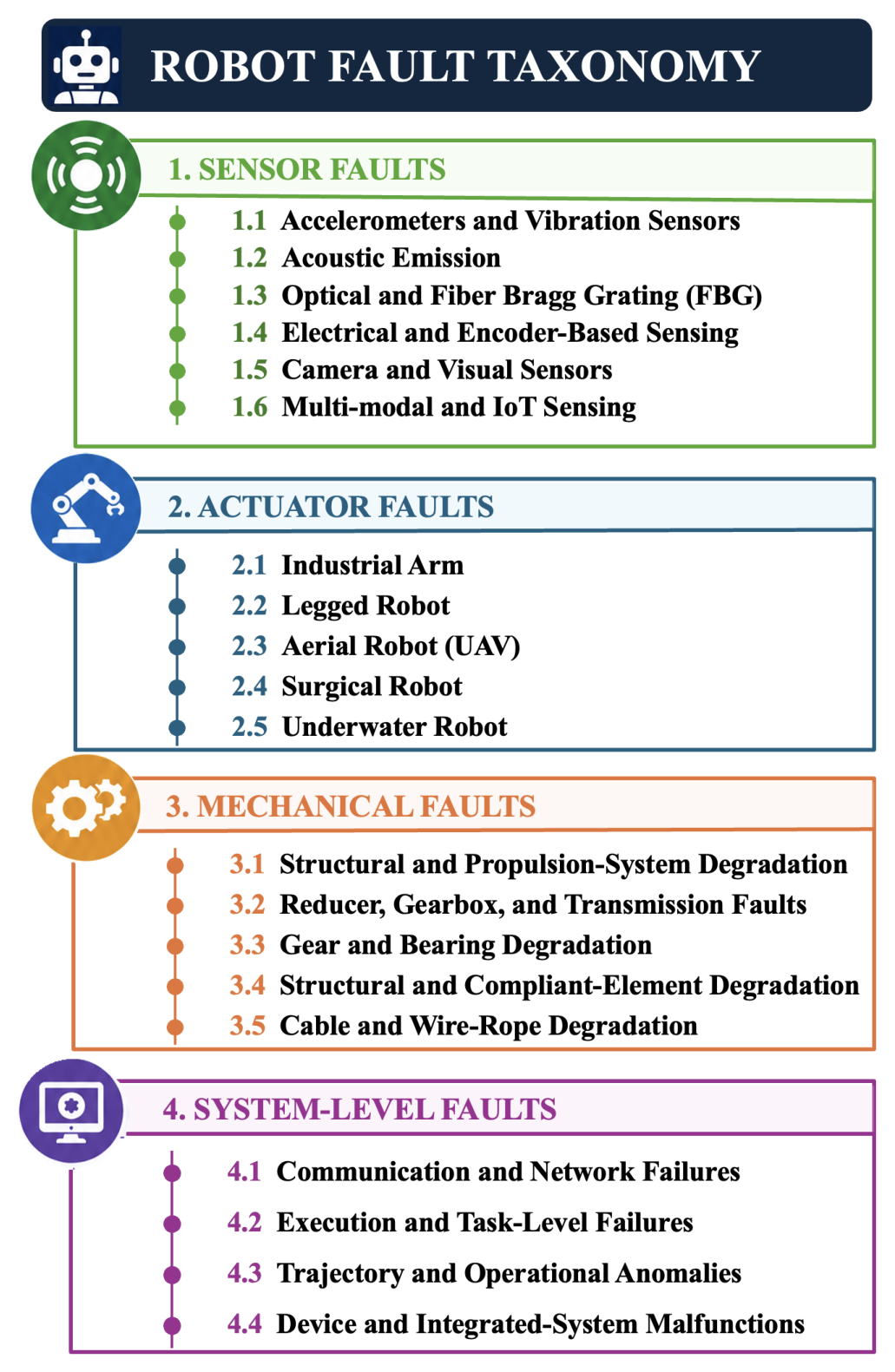
Figure 2.
Different maintenance paradigms through the lifetime of a robot. Green represents healthy, red represents failing, and grey represents downtime.Robot icons created by Hilmy Abiyyu A. - Flaticon. Hammer icons created by Icon home - Flaticon. Weakness and Calendar icons created by Freepik - Flaticon
Figure 2.
Different maintenance paradigms through the lifetime of a robot. Green represents healthy, red represents failing, and grey represents downtime.Robot icons created by Hilmy Abiyyu A. - Flaticon. Hammer icons created by Icon home - Flaticon. Weakness and Calendar icons created by Freepik - Flaticon
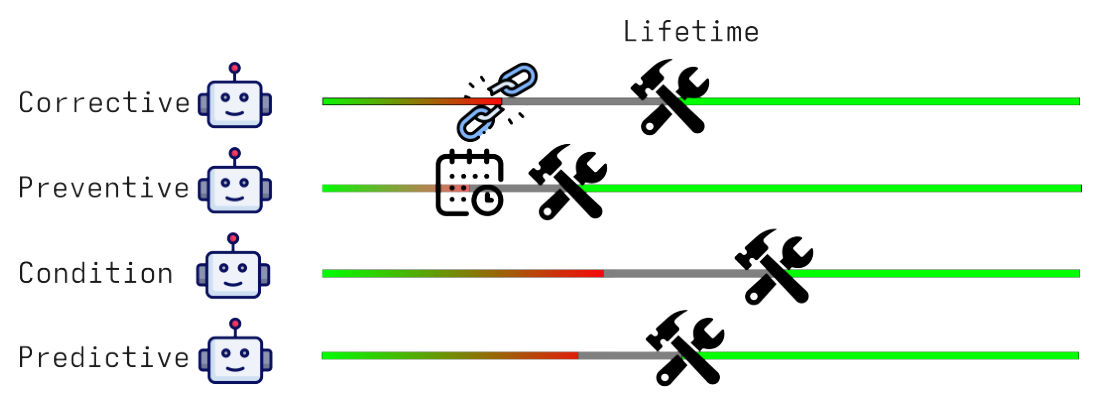
Figure 3.
PRISMA-inspired literature selection flow, adapted from the PRISMA 2020 framework [31]. All counts are approximate except the final included total.
Figure 3.
PRISMA-inspired literature selection flow, adapted from the PRISMA 2020 framework [31]. All counts are approximate except the final included total.
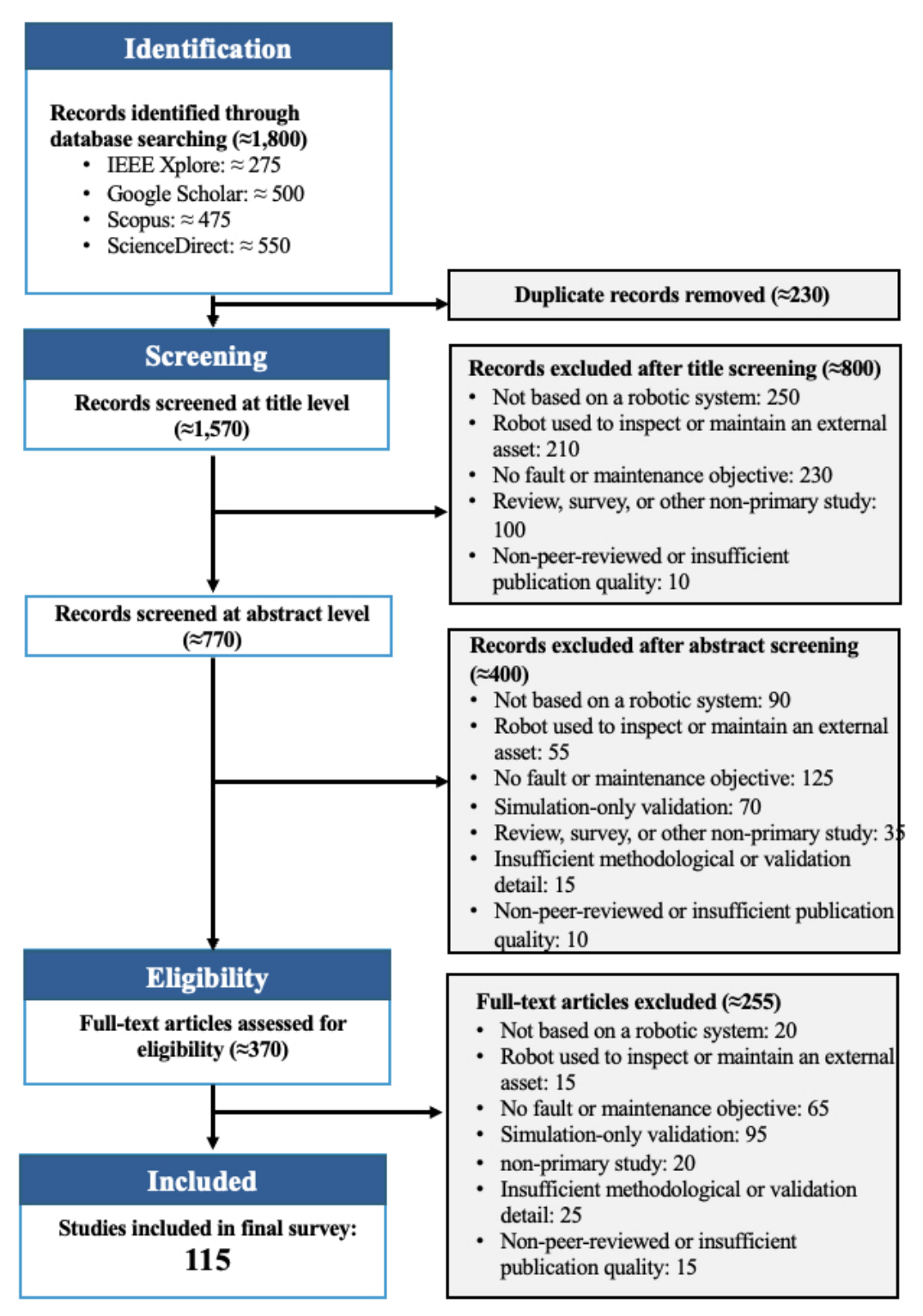
Figure 4.
Two Kinova Robotics Gen 3 robotic arms. Each joint is an independently monitorable failure site; the joint-level reducer and drivetrain faults reviewed in Section 5.2 concentrate at exactly these points.
Figure 4.
Two Kinova Robotics Gen 3 robotic arms. Each joint is an independently monitorable failure site; the joint-level reducer and drivetrain faults reviewed in Section 5.2 concentrate at exactly these points.
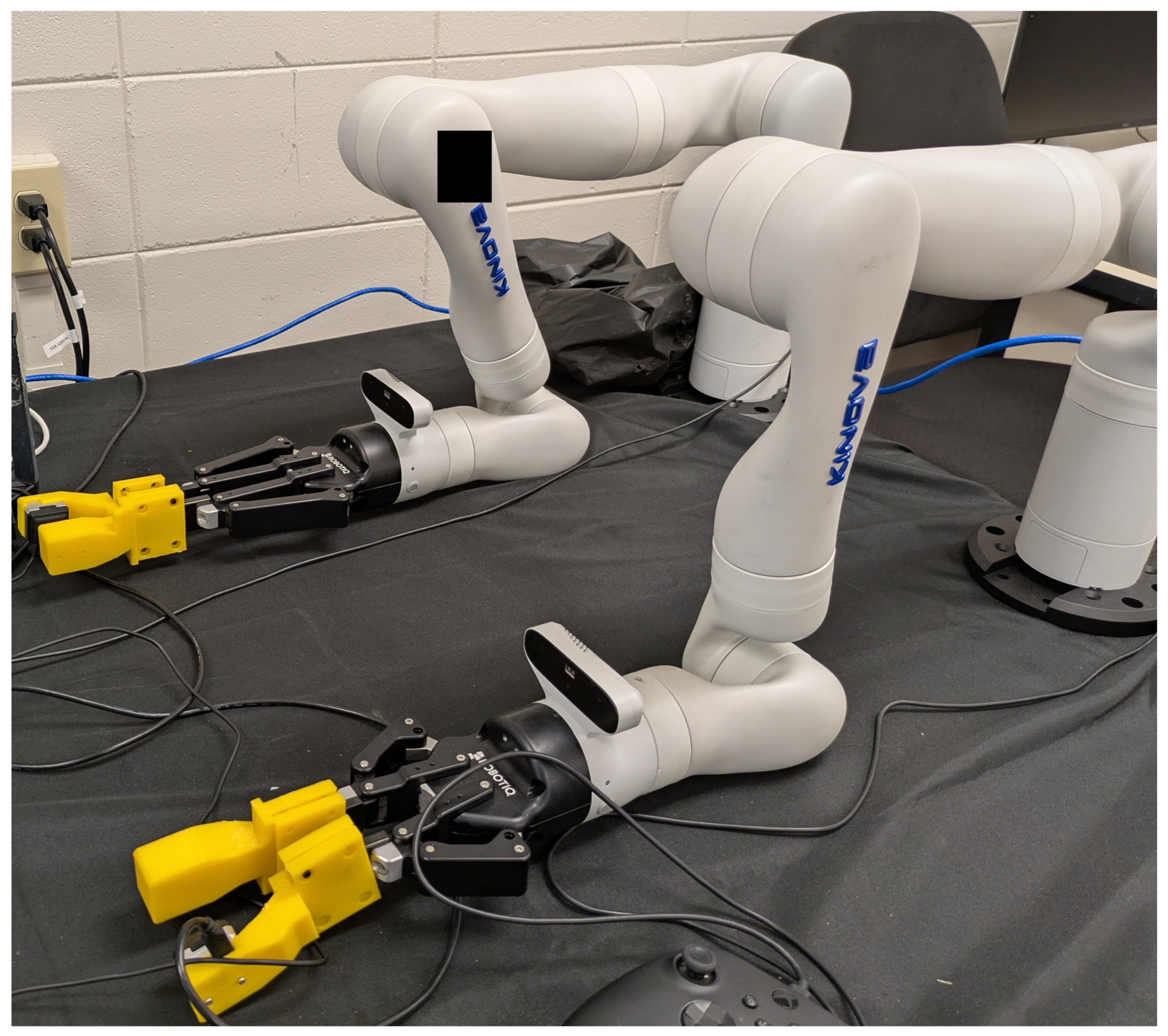
Figure 5.
A Ghost Robotics quadruped robot. Locomotion couples all four limbs mechanically, so a single joint fault propagates into the sensor readings of every other joint, a coupling problem discussed further in Section 5.2.
Figure 5.
A Ghost Robotics quadruped robot. Locomotion couples all four limbs mechanically, so a single joint fault propagates into the sensor readings of every other joint, a coupling problem discussed further in Section 5.2.
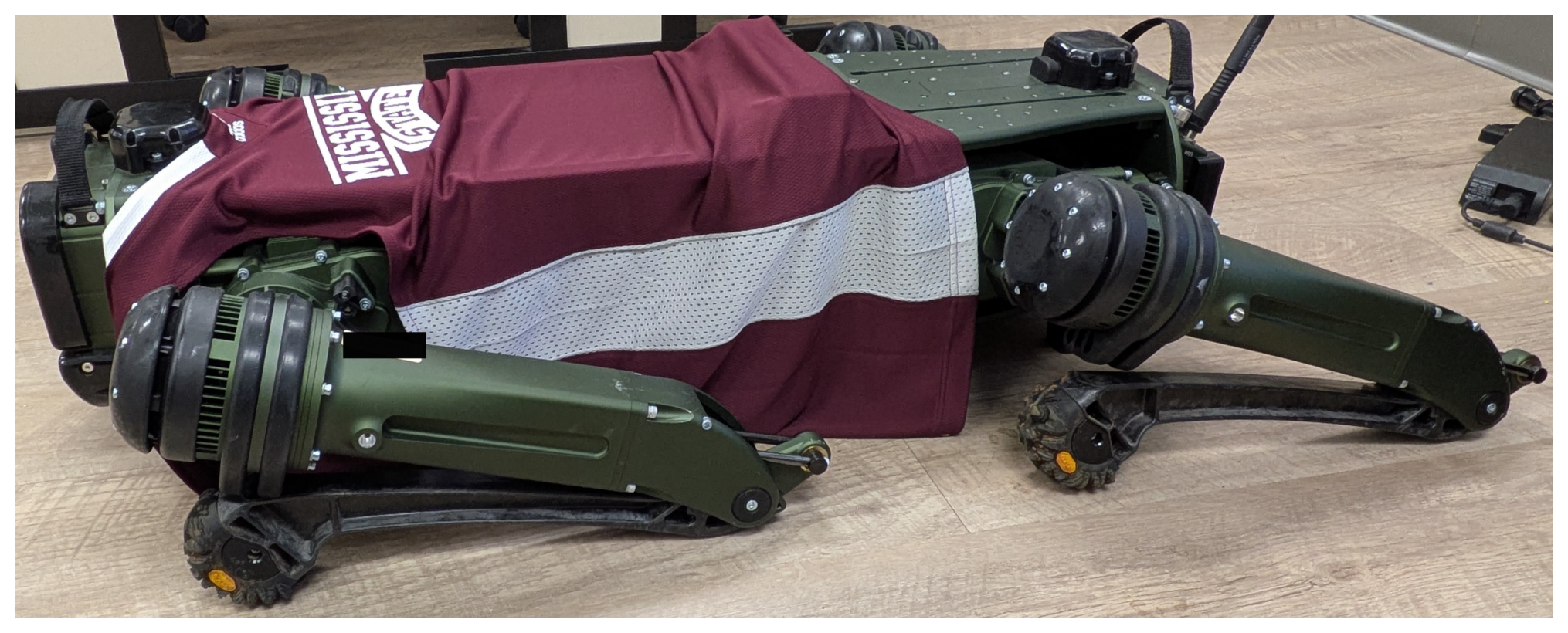
Figure 6.
A bipedal humanoid robot navigating an office environment, its dense multi-joint actuation across arms and legs the source of the fall risk and real-time constraints discussed in Section 4.8.
Figure 6.
A bipedal humanoid robot navigating an office environment, its dense multi-joint actuation across arms and legs the source of the fall risk and real-time constraints discussed in Section 4.8.
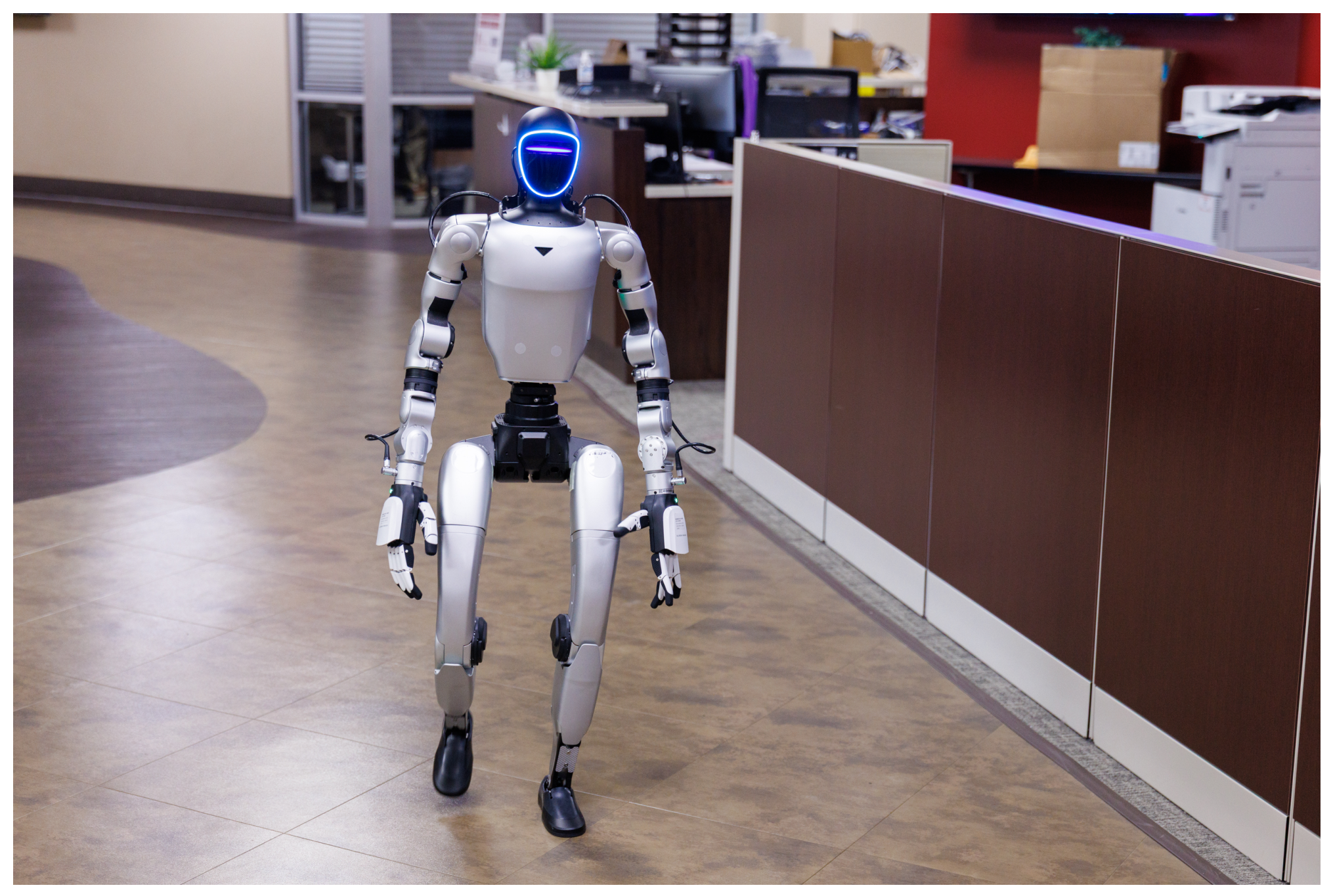
Figure 7.
Radar chart showing the number of papers per sensor modality across robot types. Industrial arms demonstrate the broadest instrumentation coverage, while most other platforms rely on only one or two modalities. Underwater robots are omitted from the chart, having zero dedicated sensor-fault papers within our final Section 5.1 coverage; this gap is discussed further in Section 7.
Figure 7.
Radar chart showing the number of papers per sensor modality across robot types. Industrial arms demonstrate the broadest instrumentation coverage, while most other platforms rely on only one or two modalities. Underwater robots are omitted from the chart, having zero dedicated sensor-fault papers within our final Section 5.1 coverage; this gap is discussed further in Section 7.
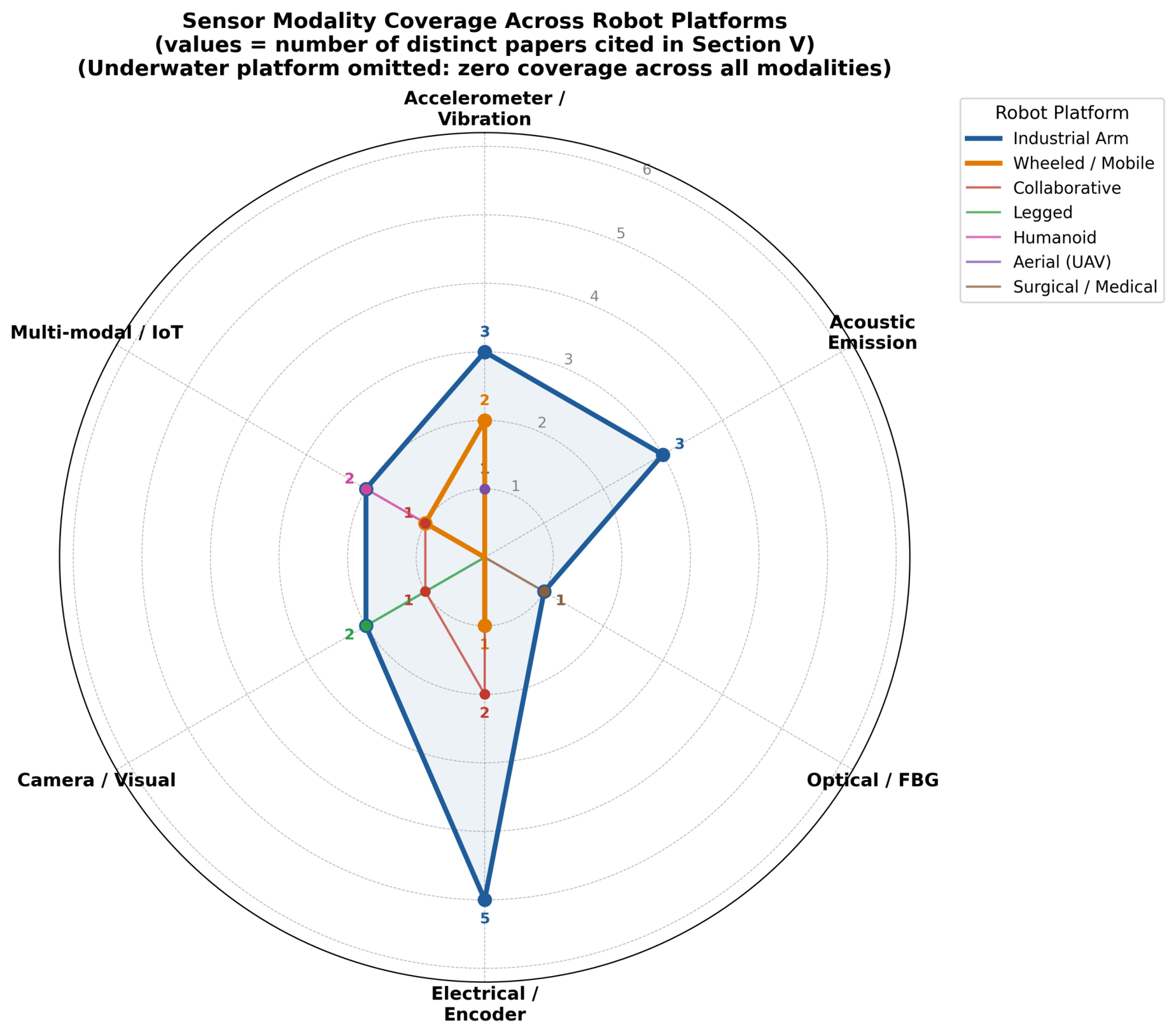
Figure 8.
Taxonomy of actuator fault types studied across robot platforms in the reviewed literature. Each platform branch is color-coded and each leaf node represents a distinct fault mode.
Figure 8.
Taxonomy of actuator fault types studied across robot platforms in the reviewed literature. Each platform branch is color-coded and each leaf node represents a distinct fault mode.
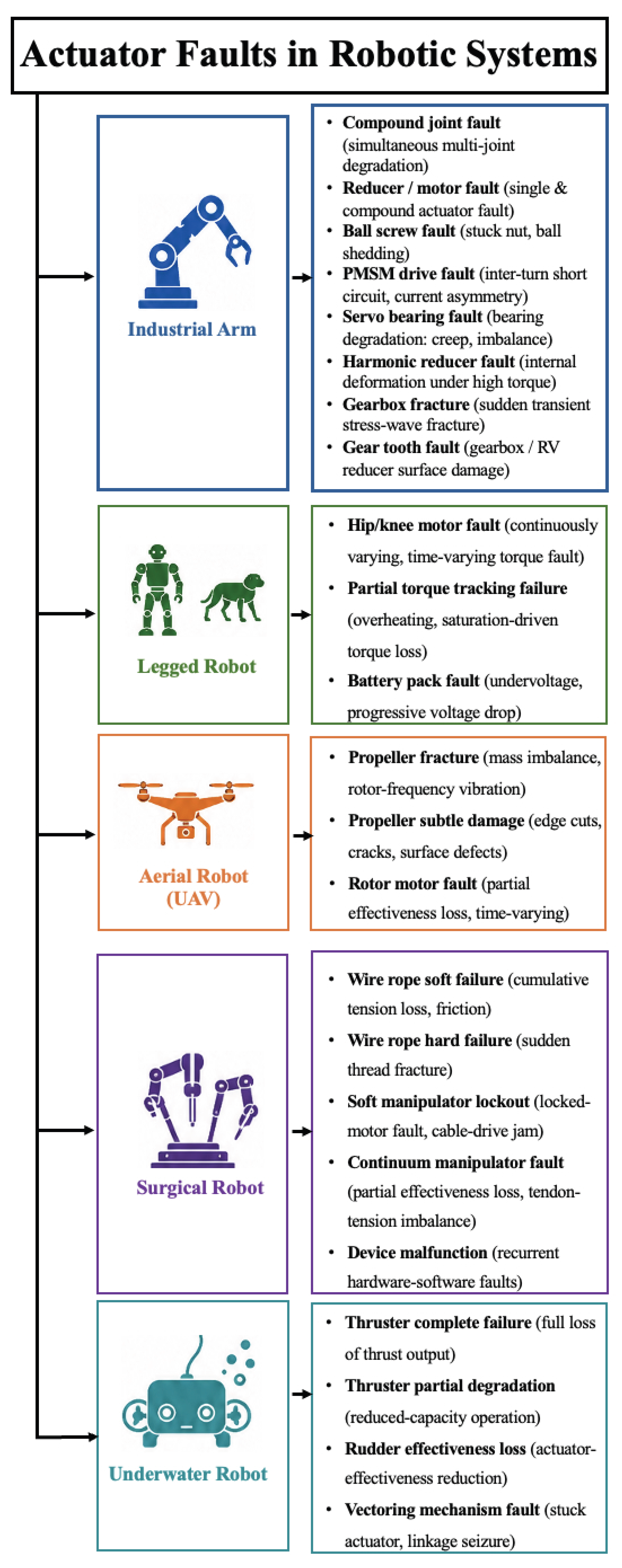
Figure 9.
Taxonomy of mechanical fault types studied across robot platforms in the reviewed literature. Each platform branch is color-coded and each leaf node represents a distinct fault mode.
Figure 9.
Taxonomy of mechanical fault types studied across robot platforms in the reviewed literature. Each platform branch is color-coded and each leaf node represents a distinct fault mode.
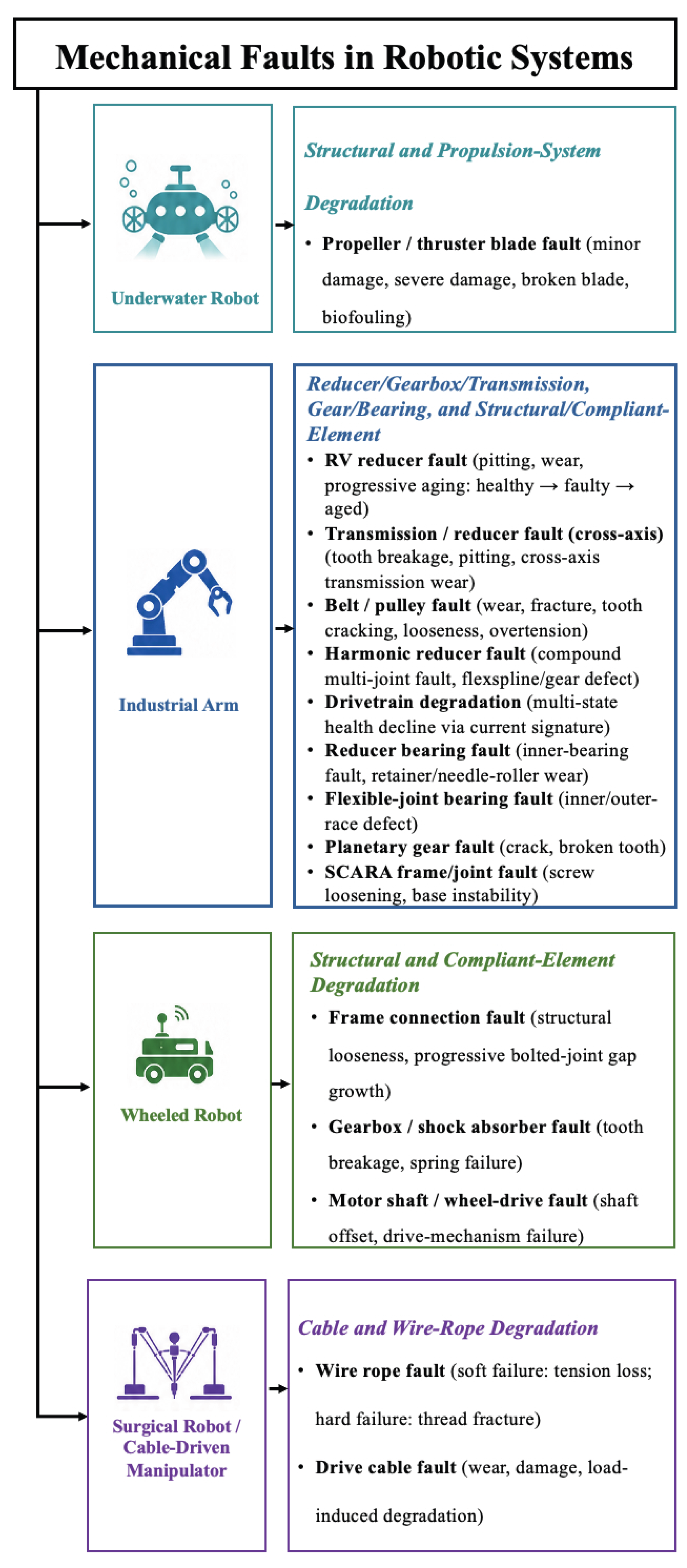
Figure 10.
Taxonomy of methods applied to robot fault detection, diagnosis, and prognosis, organized into six algorithmic families independent of the fault-origin category each method is applied to.
Figure 10.
Taxonomy of methods applied to robot fault detection, diagnosis, and prognosis, organized into six algorithmic families independent of the fault-origin category each method is applied to.
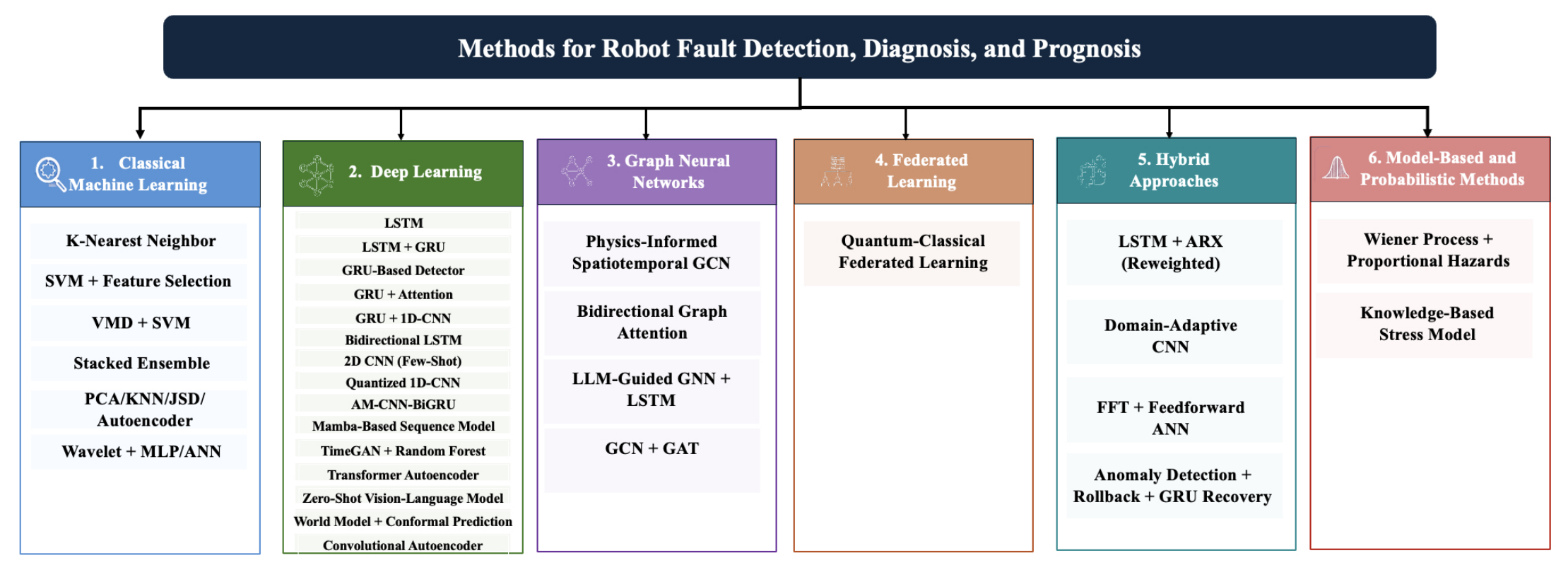
Figure 11.
Classification of deployment challenges in robot fault detection, diagnosis, and prognosis across four categories. Each challenge is annotated with its frequency and an author-stated severity score. Data-related challenges dominate in frequency while sensing-related and platform-specific challenges consistently carry the highest severity scores.
Figure 11.
Classification of deployment challenges in robot fault detection, diagnosis, and prognosis across four categories. Each challenge is annotated with its frequency and an author-stated severity score. Data-related challenges dominate in frequency while sensing-related and platform-specific challenges consistently carry the highest severity scores.
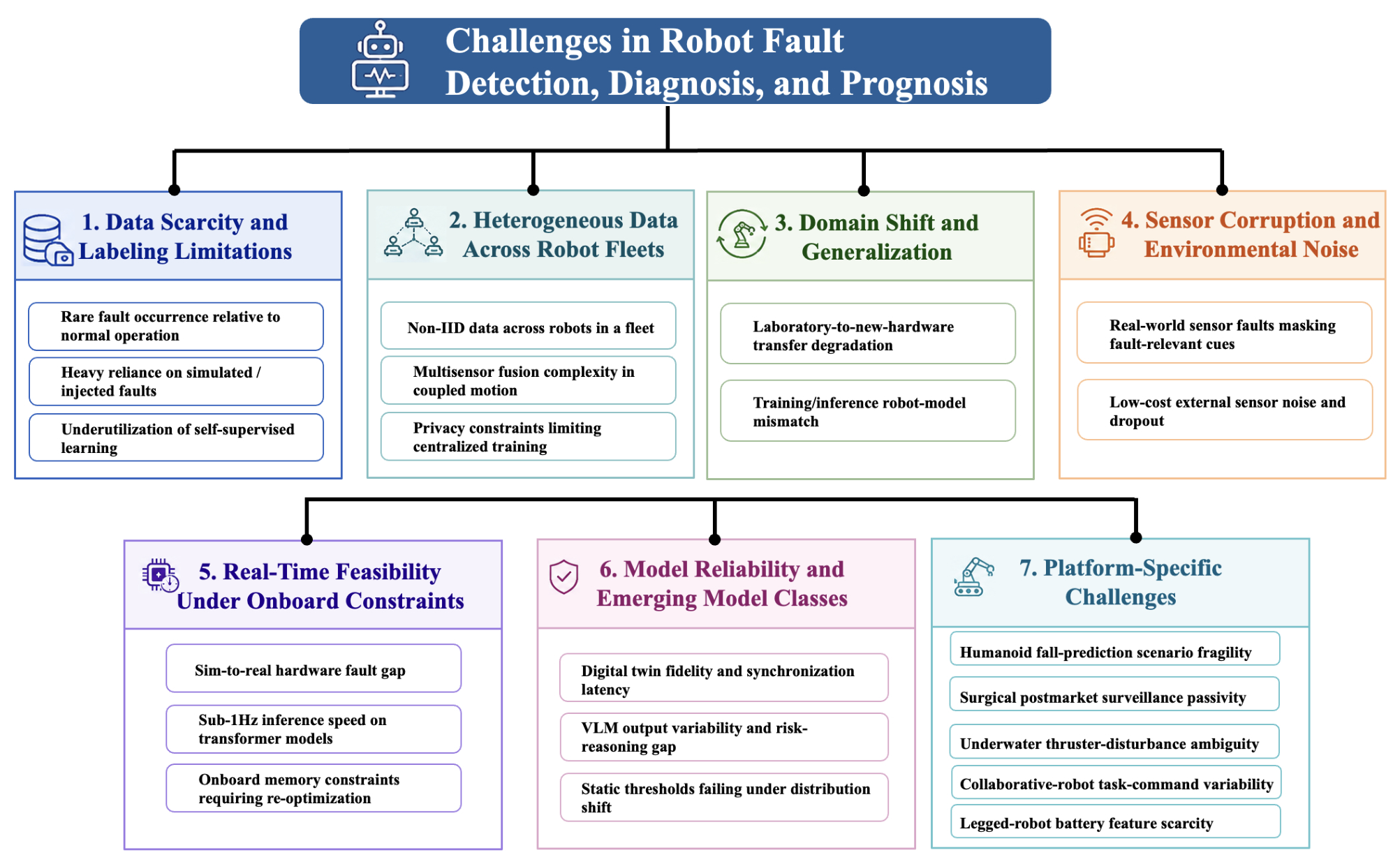

Table 1.
Inclusion and Exclusion Criteria
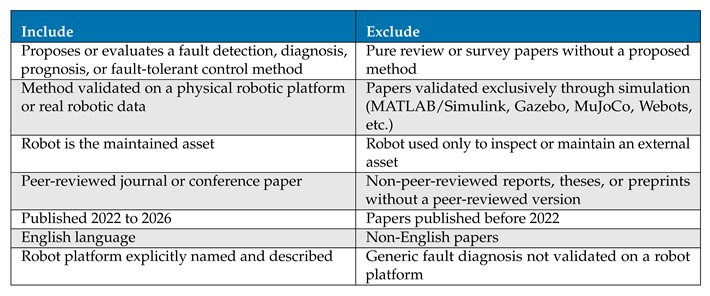 |
Table 2.
PRISMA-Inspired Literature Selection Summary. All counts are approximate except the final included total.
Table 2.
PRISMA-Inspired Literature Selection Summary. All counts are approximate except the final included total.
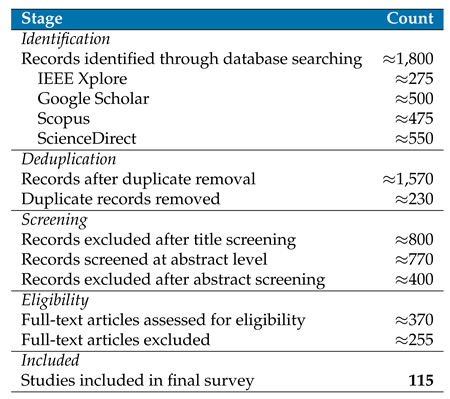 |
Table 3.
Reasons for exclusion during literature screening. Each excluded record was assigned a single primary exclusion reason to avoid double counting.
Table 3.
Reasons for exclusion during literature screening. Each excluded record was assigned a single primary exclusion reason to avoid double counting.
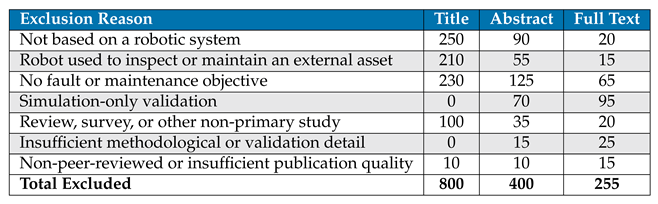 |
Table 4.
Overview of robot platforms covered in this survey, with paper counts reflecting citations discussed in Section 4. The literature is not evenly distributed across platforms: industrial arms alone account for a substantial share of coverage, while surgical, aerial, and humanoid systems are addressed by a comparatively small number of studies despite the same search strategy and date range (2022–2026) being applied uniformly across all eight platforms. Consistent with the inclusion criteria in Table 1, studies validated exclusively through simulation, without physical robotic experiments or real robotic data, were excluded; this contributes to the narrower coverage observed for platforms where hardware access is costly or safety-constrained.
Table 4.
Overview of robot platforms covered in this survey, with paper counts reflecting citations discussed in Section 4. The literature is not evenly distributed across platforms: industrial arms alone account for a substantial share of coverage, while surgical, aerial, and humanoid systems are addressed by a comparatively small number of studies despite the same search strategy and date range (2022–2026) being applied uniformly across all eight platforms. Consistent with the inclusion criteria in Table 1, studies validated exclusively through simulation, without physical robotic experiments or real robotic data, were excluded; this contributes to the narrower coverage observed for platforms where hardware access is costly or safety-constrained.
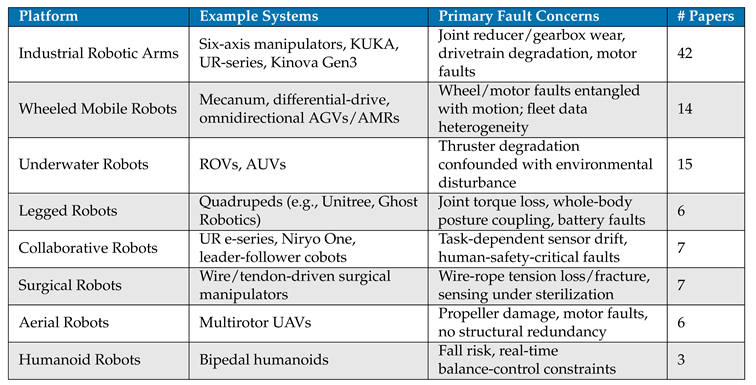 |
Table 5.
Sensing modalities reviewed in this survey, grouped by physical principle. Paper counts reflect studies discussed in Section 5.1 and are not mutually exclusive, as several studies combine more than one modality. Acoustic emission and optical/FBG sensing are represented by markedly fewer studies than accelerometer- or current-based sensing, discussed further in Section 7.
Table 5.
Sensing modalities reviewed in this survey, grouped by physical principle. Paper counts reflect studies discussed in Section 5.1 and are not mutually exclusive, as several studies combine more than one modality. Acoustic emission and optical/FBG sensing are represented by markedly fewer studies than accelerometer- or current-based sensing, discussed further in Section 7.
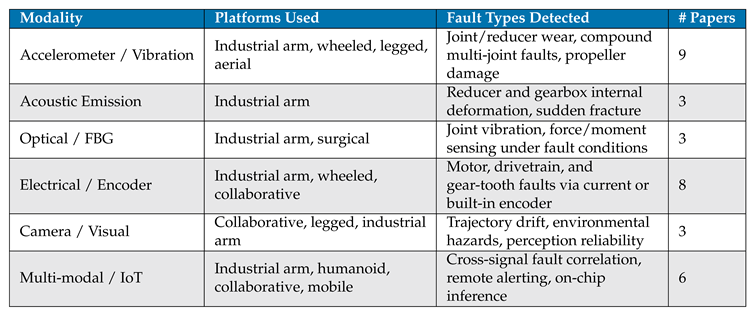 |
Table 6.
Actuator Fault Types per Robot Platform (Industrial Arm, Legged Robot, Aerial, Surgical, and Underwater Robots). Detection Difficulty reflects the level of coupling, data scarcity, or signal ambiguity reported by the source studies.
Table 6.
Actuator Fault Types per Robot Platform (Industrial Arm, Legged Robot, Aerial, Surgical, and Underwater Robots). Detection Difficulty reflects the level of coupling, data scarcity, or signal ambiguity reported by the source studies.
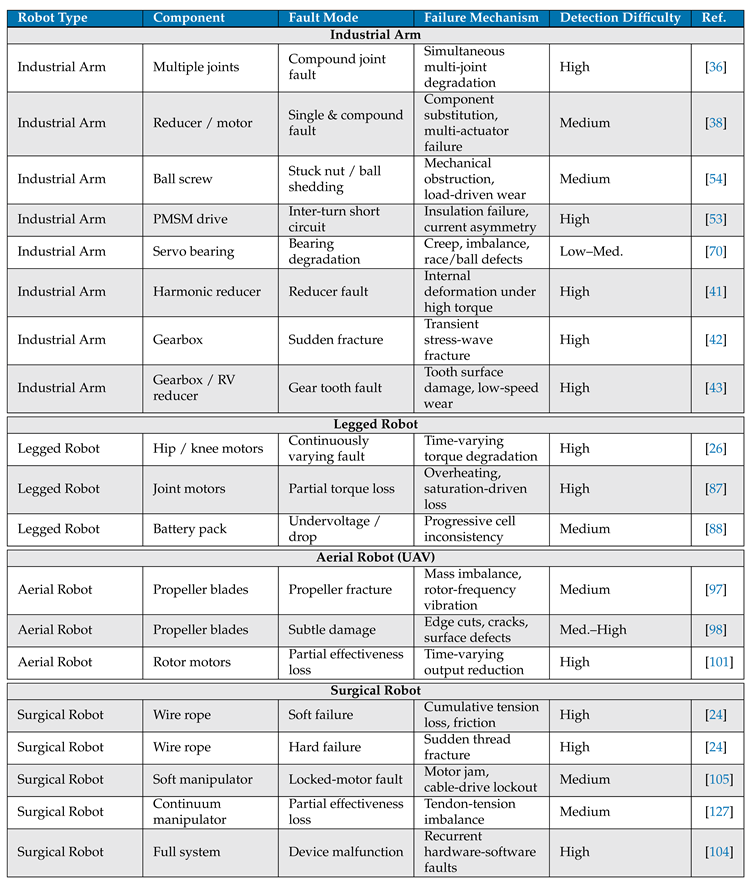 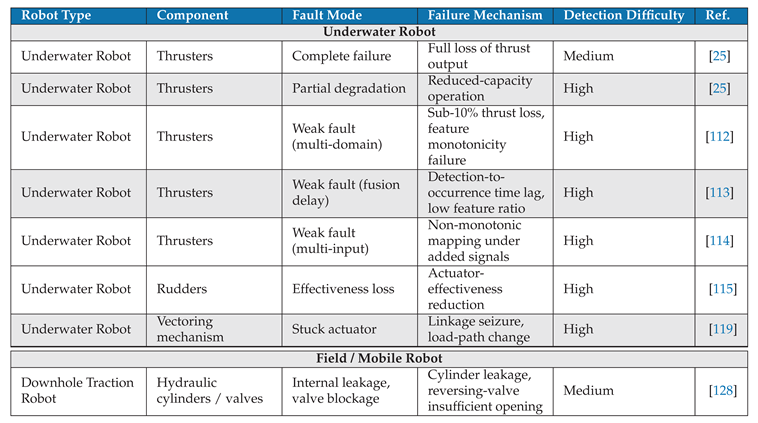
|
Table 7.
Mechanical Fault Types per Robot Platform (Underwater, Industrial Arm, Wheeled, Surgical, and Cable-Driven Manipulators). Detection Difficulty reflects the level of coupling, data scarcity, or signal ambiguity reported by the source studies.
Table 7.
Mechanical Fault Types per Robot Platform (Underwater, Industrial Arm, Wheeled, Surgical, and Cable-Driven Manipulators). Detection Difficulty reflects the level of coupling, data scarcity, or signal ambiguity reported by the source studies.
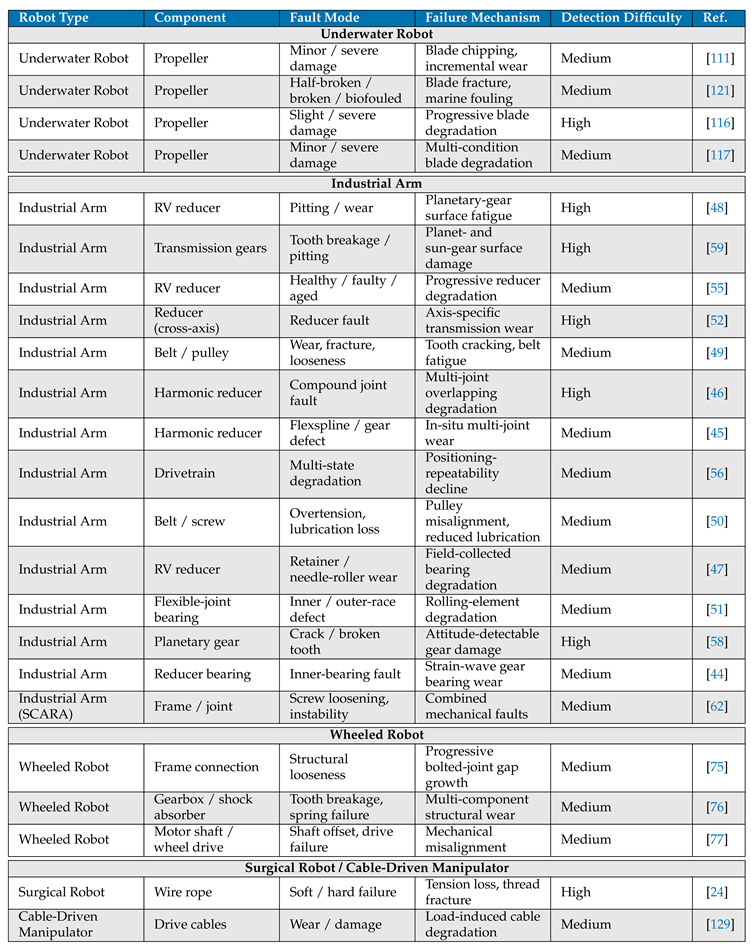 |
Table 8.
System-Level Faults Reviewed, Organized by Failure Locus. Unlike sensor, actuator, and mechanical faults, system-level faults emerge from software, communication, multi-component interaction, or task-execution logic rather than a single physical component. Communication/Network is the most sparsely represented subcategory in this survey.
Table 8.
System-Level Faults Reviewed, Organized by Failure Locus. Unlike sensor, actuator, and mechanical faults, system-level faults emerge from software, communication, multi-component interaction, or task-execution logic rather than a single physical component. Communication/Network is the most sparsely represented subcategory in this survey.
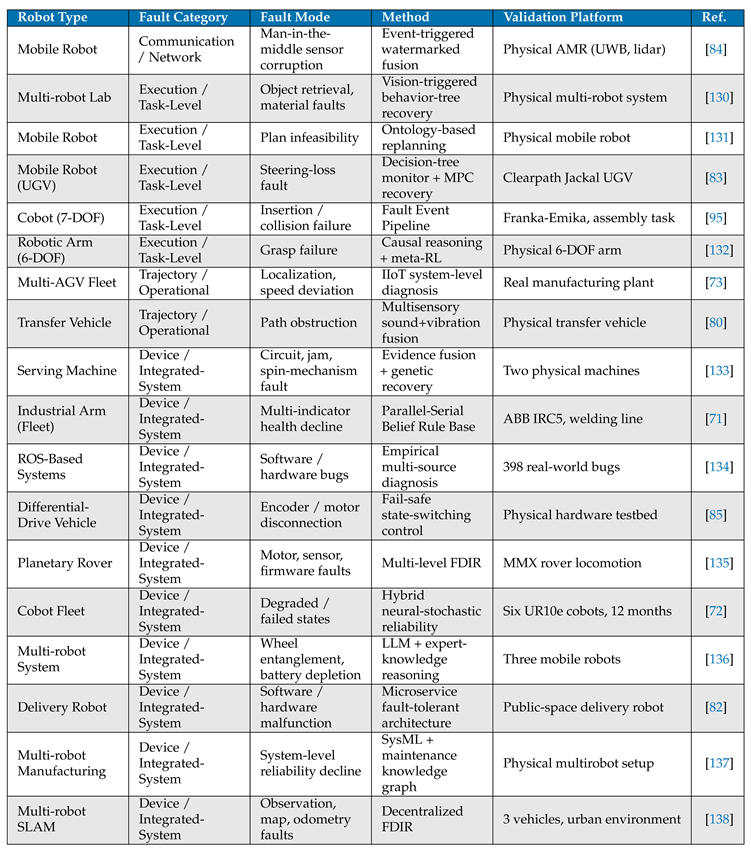 |
Table 9.
Comparison of Methods Applied to Robot Fault Detection, Diagnosis, and Prognosis (Part I: Classical Machine Learning and Deep Learning).
Table 9.
Comparison of Methods Applied to Robot Fault Detection, Diagnosis, and Prognosis (Part I: Classical Machine Learning and Deep Learning).
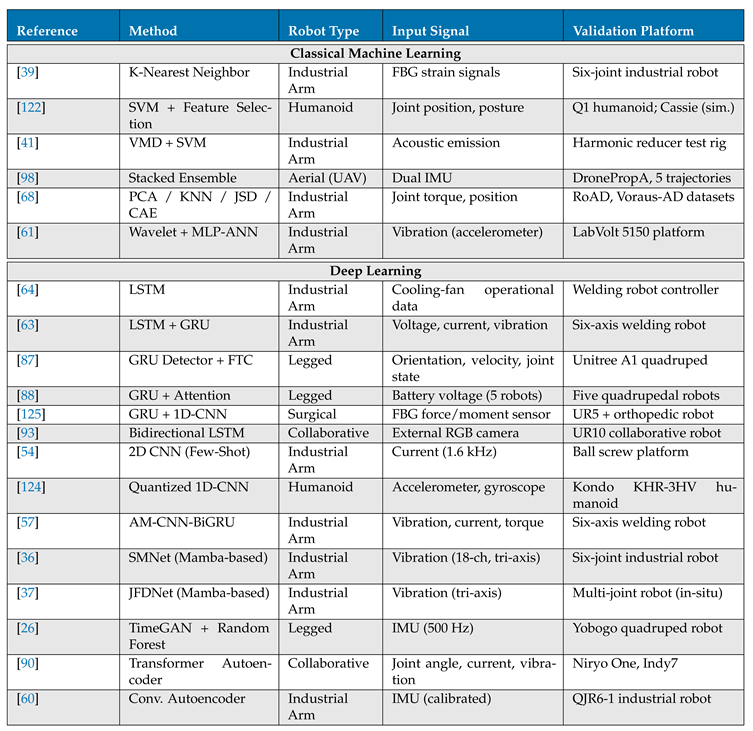 |
Table 10.
Comparison of Methods Applied to Robot Fault Detection, Diagnosis, and Prognosis (Part II: Graph Neural Networks, Federated Learning, Hybrid, and Model-Based Methods). Abbreviations: VMD = Variational Mode Decomposition; SVM = Support Vector Machine; PCA = Principal Component Analysis; JSD = Jensen-Shannon Divergence; CAE = Convolutional Autoencoder; MLP-ANN = Multilayer Perceptron Artificial Neural Network; LSTM = Long Short-Term Memory; GRU = Gated Recurrent Unit; FTC = Fault-Tolerant Control; CNN = Convolutional Neural Network; VLM = Vision-Language Model; GCN = Graph Convolutional Network; GAT = Graph Attention Network; STDGCN = Spatiotemporal Dynamic Graph Convolutional Network; LLM = Large Language Model; ARX = AutoRegressive with eXogenous input; FFT = Fast Fourier Transform; ANN = Artificial Neural Network; ACUSUM = Adaptive Cumulative Sum; INS = Inertial Navigation System; DVL = Doppler Velocity Log.
Table 10.
Comparison of Methods Applied to Robot Fault Detection, Diagnosis, and Prognosis (Part II: Graph Neural Networks, Federated Learning, Hybrid, and Model-Based Methods). Abbreviations: VMD = Variational Mode Decomposition; SVM = Support Vector Machine; PCA = Principal Component Analysis; JSD = Jensen-Shannon Divergence; CAE = Convolutional Autoencoder; MLP-ANN = Multilayer Perceptron Artificial Neural Network; LSTM = Long Short-Term Memory; GRU = Gated Recurrent Unit; FTC = Fault-Tolerant Control; CNN = Convolutional Neural Network; VLM = Vision-Language Model; GCN = Graph Convolutional Network; GAT = Graph Attention Network; STDGCN = Spatiotemporal Dynamic Graph Convolutional Network; LLM = Large Language Model; ARX = AutoRegressive with eXogenous input; FFT = Fast Fourier Transform; ANN = Artificial Neural Network; ACUSUM = Adaptive Cumulative Sum; INS = Inertial Navigation System; DVL = Doppler Velocity Log.
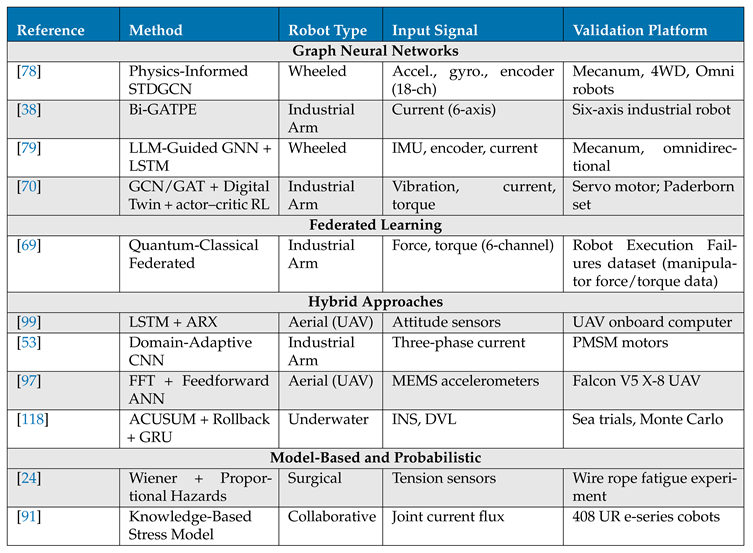 |
Table 11.
Master Summary of Reviewed Papers (Part I). Fault Category: S = Sensor, A = Actuator, M = Mechanical, Sys = System-Level; GNN, Fed., Model, and Gen. AI denote the primary method family where directly relevant. Dual tags indicate a paper spans more than one fault category or is discussed under more than one method family in this survey.
Table 11.
Master Summary of Reviewed Papers (Part I). Fault Category: S = Sensor, A = Actuator, M = Mechanical, Sys = System-Level; GNN, Fed., Model, and Gen. AI denote the primary method family where directly relevant. Dual tags indicate a paper spans more than one fault category or is discussed under more than one method family in this survey.
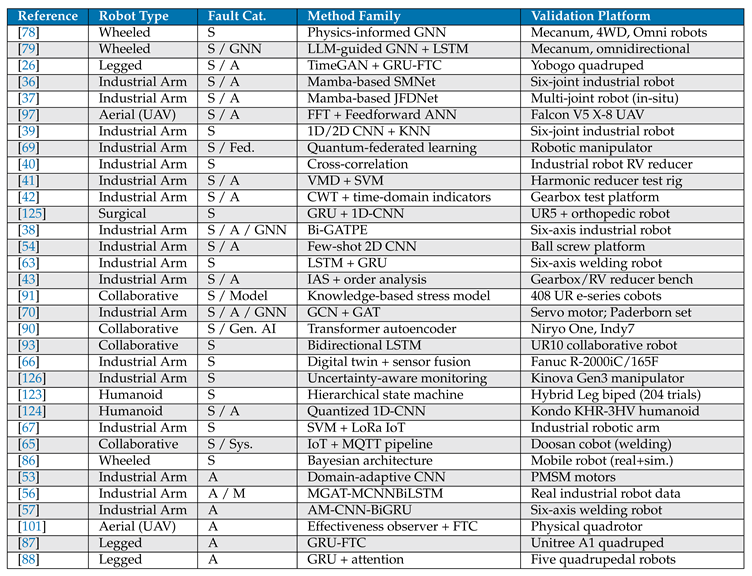 |
Table 12.
Master Summary of Reviewed Papers (Part II). Fault Category: S = Sensor, A = Actuator, M = Mechanical, Sys = System-Level. FDIR = Fault Detection, Isolation, and Recovery; GA = Genetic Algorithm; RUL = Remaining Useful Life.
Table 12.
Master Summary of Reviewed Papers (Part II). Fault Category: S = Sensor, A = Actuator, M = Mechanical, Sys = System-Level. FDIR = Fault Detection, Isolation, and Recovery; GA = Genetic Algorithm; RUL = Remaining Useful Life.
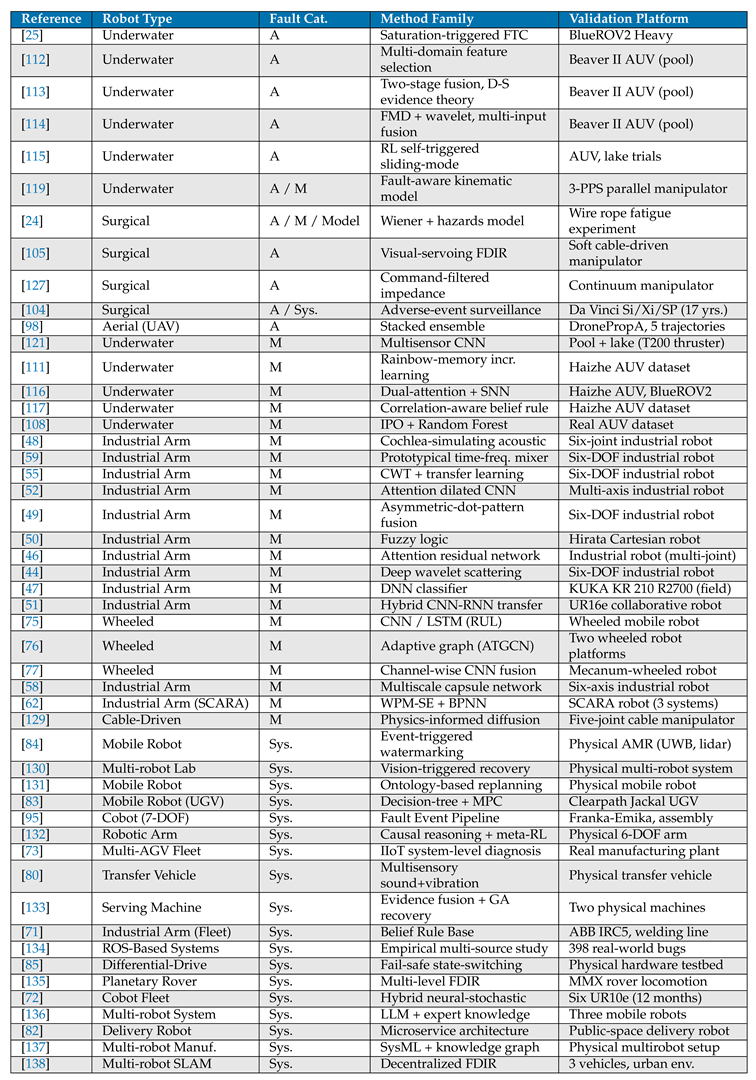 |
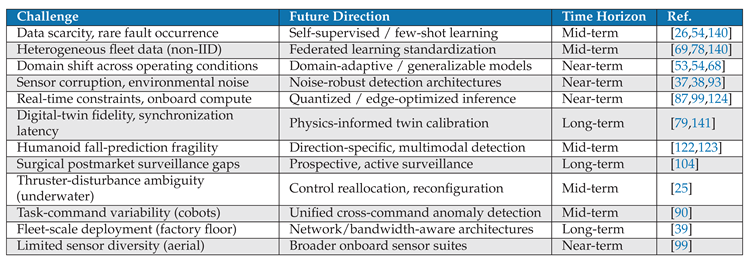
Disclaimer/Publisher’s Note: The statements, opinions and data contained in all publications are solely those of the individual author(s) and contributor(s) and not of MDPI and/or the editor(s). MDPI and/or the editor(s) disclaim responsibility for any injury to people or property resulting from any ideas, methods, instructions or products referred to in the content. |
© 2026 by the authors. Licensee MDPI, Basel, Switzerland. This article is an open access article distributed under the terms and conditions of the Creative Commons Attribution (CC BY) license.
Copyright: This open access article is published under a Creative Commons CC BY 4.0 license, which permit the free download, distribution, and reuse, provided that the author and preprint are cited in any reuse.