

Submitted:
25 September 2026
Posted:
29 September 2026
You are already at the latest version
Abstract
Background: Severe hemorrhage simultaneously compromises circulating volume, hemostasis, red-cell oxygen-carrying capacity, and tissue oxygen delivery. Fresh whole blood can restore several of these functions and remains the biological reference for hemorrhagic shock resuscitation when promptly available. Military medicine and emergency medical services (EMS), however, increasingly face scenarios in which these functions require support before appropriate blood products and surgical care can reach the patient. Objective: This Perspective examines the transition from unit-based blood replacement toward function-based resuscitation, with particular attention to prolonged casualty care, contested evacuation, drone-dominated warfare, strategic blood readiness, hemostatic technologies, oxygen-delivery therapeutics, and fieldable delivery systems. Evidence framework: Peer-reviewed military, trauma, transfusion, and oxygen-carrier literature was considered alongside Joint Trauma System guidance and official U.S. Department of Defense, U.S. Army, NATO, DARPA, FDA, Congressional, and Government Accountability Office documents. This is a narrative and translational Perspective, not a systematic review. Perspective: During the twentieth century, military trauma systems progressively compressed injury-to-surgical-care intervals from approximately 6-12 hours during World War II to 2-4 hours in Korea and approximately one hour during Vietnam [3]. During Afghanistan, implementation of the U.S. Department of Defense Golden Hour policy reduced median helicopter transport time in a large cohort from 90 to 43 minutes [6]. The operational assumption is now being challenged. Contemporary large-scale combat operation planning anticipates delayed or denied evacuation [10-17]. Ukrainian experience documents prolonged casualty care lasting 24 hours to multiple days, while drone saturation has displaced evacuation and surgical nodes farther from the contact line and increased the proportion of casualties arriving after prolonged intervals [10,11]. NATO has described the emerging transition from the “Golden Hour” toward a “Golden Day” in drone-contested environments [12]. U.S. requirements extend further: current Army planning discusses a 72-hour expectation, U.S. Marine Corps standards include capability beyond 96 hours for selected personnel, and USSOCOM research requirements seek far-forward solutions capable of supporting 3-5 patients for at least 5-7 days [13,16,17]. These changes redefine the engineering problem. The objective is no longer solely to move casualties rapidly toward advanced medical capability. Increasingly, therapeutic capability must move toward the casualty, remain available during prolonged holding and transport, and function with minimal infrastructure, personnel burden, weight, volume, and cold-chain dependence. Military medical research increasingly reflects this functional architecture. DARPA’s FSHARP program separated critical blood functions including oxygen delivery, hemostasis, and volume support [29]. Its 2026 RAPIID program explicitly advances “shelf-stable” oxygen carriers, platelet-derived products, and dried plasma toward clinical trials, regulatory authorization, scale manufacturing, and field deployment [31]. DARPA’s GOLDEVAC program independently explores automated prolonged resuscitation and oxygenation through a single intravascular interface extending from near the point of injury through evacuation [30]. Authors’ perspective: Next-generation far-forward oxygen therapeutics should be evaluated by both molecular oxygen-carrying performance and operational delivery architecture: shelf stability, compact form factor, minimal preparation, closed delivery, monitored administration, compatibility with clinically practical vascular access, flexibility during transport, and limited dependence on gravity-fed infusion systems. Within this framework, BHOC (Biological Hemoglobin Oxygen Carrier) is proposed as a candidate component of Precision Oxygen Therapeutics. Its intended function is oxygen transport and delivery under defined conditions, rather than replacement of the broader functions of whole blood. A proposed BHOC treatment protocol would pair a characterized biological oxygen carrier with a compact cartridge-based, controlled-delivery system. This concept requires independent physicochemical, engineering, preclinical, regulatory, and clinical validation. Conclusion: The central scientific question is changing from “How do we replace blood?” to “Which biological function is failing, how long must that function be supported, and how can it reach the point of casualty before appropriate definitive blood therapy becomes available?” This transition may define the next phase of military resuscitation, civilian EMS, and Precision Oxygen Therapeutics.
Keywords:
military medicine
; prehospital
; bloodless transfusion
; perfusion
; emergency
; EMS
; Transfusion
; Donor blood
; RBC
; combat casualty care
; hemorrhagic shock
; prolonged casualty care
; medical evacuation
; drones
; oxygen delivery
; HBOC
; oxygen therapeutics
; Perftoran
; freeze-dried plasma
; whole blood
; DARPA
; BHOC
; Precision Oxygen Therapeutics
1. Introduction
The physiology of hemorrhage begins immediately. Definitive transfusion capability does not.
At the point of injury, ongoing hemorrhage progressively reduces circulating volume and pressure, red-cell mass, coagulation capacity, oxygen-carrying capacity, and ultimately tissue oxygen delivery and systemic metabolic support. Tissue oxygen requirements continue throughout this interval.
The resulting problem is both physiological and temporal: injury occurs now; definitive blood products and surgical intervention may become available later.
For much of modern military medicine, the dominant systems solution was to shorten this interval. Forward surgical teams, helicopter evacuation, improved communications, organized trauma networks, walking blood banks, damage-control resuscitation, and rapid aeromedical evacuation progressively compressed the distance between the casualty and definitive care [3,6].
That strategy was extraordinarily successful. The contemporary battlefield, however, increasingly challenges its underlying assumption. Contested airspace, persistent unmanned surveillance, long-range precision fires, dispersed operations, mass casualties, degraded infrastructure, and disrupted logistical corridors can delay the movement of providers and patients [10,11,12,13].
The relevant question is therefore changing. Historically: How rapidly can the casualty reach definitive care? Increasingly: How rapidly can the necessary biological function reach the casualty, and how long can it remain available and functional?
2. Scope and Methodological Approach
This article is a narrative historical and translational Perspective.
The analysis integrates peer-reviewed military and civilian trauma literature; transfusion and oxygen-carrier literature; Joint Trauma System clinical guidance; U.S. Army and Department of Defense documents; NATO doctrine and operational publications; DARPA program documentation; FDA regulatory records; U.S. Congressional testimony; and Government Accountability Office reports.
The organizing translational framework is:
operational constraint -> physiological deficit -> required biological function -> therapeutic technology -> delivery architecture -> military implementation -> civilian translation.
The technologies discussed differ substantially in mechanism, developmental maturity, regulatory status, safety evidence, and demonstrated clinical efficacy. Their inclusion in a common functional framework should not be interpreted as evidence that they are therapeutically equivalent.
3. From the Golden Hour to the Golden Day: The Changing Time Matrix of Military Evacuation
3.1. Historical Compression of Evacuation Time
One of the major achievements of twentieth-century military trauma medicine was progressive reduction in the time between injury and advanced surgical care. Historical analyses describe approximate injury-to-surgery intervals of 6-12 hours during World War II, 2-4 hours during the Korean War, and approximately 1 hour during the Vietnam War [3].
Forward surgical capability, MASH deployment, rotary-wing evacuation, improved communications, and organized trauma systems progressively moved advanced care closer to the battlefield. The result was a major care construct shift: the casualty no longer had to survive untreated for many hours before surgery.
3.2. Persian Gulf War, 1991: Broad Variability Remained
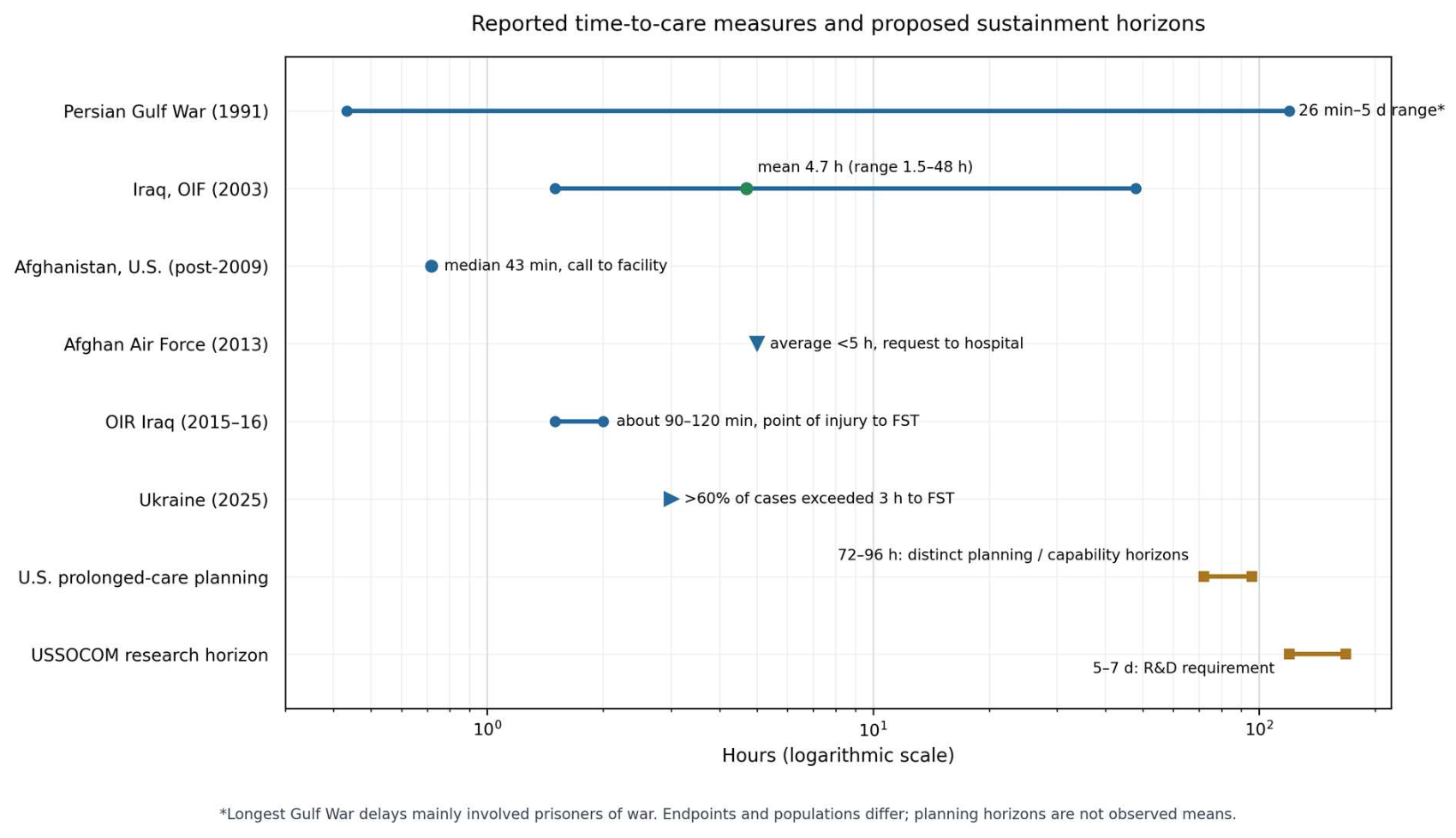
The Persian Gulf War demonstrated that evacuation intervals remained heterogeneous even within a highly mobile modern campaign. Burkle and colleagues reported 461 coalition and enemy casualties treated at the Al Khanjar Navy-Marine Trauma Center. Injury-to-arrival times ranged from approximately 26 minutes to 5 days, although the longest delays primarily involved prisoners of war [4].
The result is important because it demonstrates that an apparently efficient theater medical system can still contain a long tail of delayed access. The clinically relevant requirement is therefore not represented solely by an average transport time. It is also determined by casualties at the far end of the distribution.
3.3. Iraq, 2003: Several Hours to Surgery
During the initial phase of Operation Iraqi Freedom, Marshall described the experience of a U.S. Marine Corps surgical company treating 93 U.S. and Iraqi combat casualties. Mean time from injury to surgical care was 4.7 hours, with a reported range of 1.5-48 hours [5].
The author considered this interval prolonged relative to contemporary civilian trauma care. This early Iraq experience illustrates a recurring military problem: a mobile surgical unit may need to bridge a substantial time-space gap between injury and more definitive care.
3.4. Afghanistan and the Golden Hour
Afghanistan subsequently demonstrated how dramatically this interval could be compressed when aviation, communications, surgical capability, trauma-system coordination, and air superiority were aligned.
In 2009, U.S. Secretary of Defense Robert Gates established a policy requiring critically injured casualties to reach appropriate treatment capability within approximately 60 minutes. Kotwal and colleagues examined 21,089 U.S. military casualties and detailed helicopter transport data for 4,542 casualties. Median transport time declined from 90 minutes before the mandate to 43 minutes after implementation [6]. The proportion of helicopter missions achieving transport within 60 minutes increased from 24.8% to 75.2% [6].
The Golden Hour was therefore not simply a clinical concept. It became a logistics and command requirement. It also created an assumption that would influence military medical planning for more than a decade: the casualty could often be moved to advanced capability faster than advanced capability had to remain with the casualty.
3.5. Afghanistan Also Demonstrated System Dependence
The Golden Hour was not a universal Afghanistan experience. In January 2013, NATO reported that the Afghan Air Force had reduced its own battlefield request-to-hospital interval from more than 24 hours approximately three months earlier to an average of less than five hours [7].
The same war therefore contained radically different evacuation realities depending on available aviation, command structure, training, medical system, and logistical capability. This distinction has major implications for future oxygen and “blood-support” technologies. The value of a bridge therapy is inherently dependent on the duration of the bridge.
3.6. Operation Inherent Resolve, Iraq, 2015-2016
During the early re-entry phase of Operation Inherent Resolve, a split Forward Surgical Team treated 300 Iraqi casualties in an austere, medically immature environment. Patients reached the FST primarily by ground transportation. Point-of-injury-to-FST evacuation time was approximately 90-120 minutes [8].
The FST had limited holding capacity and blood inventory, illustrating again that advanced resuscitative capability can exist physically closer to the battlefield while remaining logistically constrained. The authors described the role of the FST as bridging the time-space gap between wounding and definitive surgical care [8].
3.7. Syria: Important Theater, Insufficient Quantitative Resolution
Operation Inherent Resolve included both Iraq and Syria. However, the Department of Defense Trauma Registry analysis covering the first 30 months of OIR included 826 adult encounters, of which 816 originated in Iraq and only 10 originated in Syria [9].
This dataset therefore cannot support a robust Syria-specific evacuation-time estimate. For this reason, Syria is retained in the historical narrative but intentionally excluded as a quantitative point from Figure 1. Absence of a defensible number is preferable to false numerical precision.
3.8. Ukraine, 2022-2026: Prolonged Casualty Care Becomes Routine
The war in Ukraine represents a potentially fundamental change in evacuation geometry. A 2025 qualitative assessment of Ukrainian trauma care found that most clinical respondents had experienced prolonged casualty care lasting 24 hours to multiple days [10]. Participants described some casualties remaining forward for approximately 24 hours and others remaining on the battlefield for approximately 48 hours because routes were under fire and movement had to wait for safer conditions [10].
The study emphasized that air evacuation was frequently impossible because of contested airspace and that ground movement was constrained by distance, infrastructure degradation, and targeting risk [10]. In this environment, evacuation delay becomes more than a transportation problem. It becomes a requirement for extended physiological maintenance.
3.9. Quantitative Evidence of the Drone Effect
A 2026 comparative study by Yatsun and colleagues provides more direct quantitative evidence. The investigators compared tourniquet-treated casualties from a 2016 pre-drone cohort with casualties treated during defensive operations between January and April 2025.
In the 2025 cohort, 65% of injuries were drone-related, more than 60% of casualties reached the Forward Surgical Team after >3 hours, compared with 15% in the 2016 cohort, and medical evacuation stages had been displaced approximately 10-15 km farther from the contact line because of drone threat [11].
Persistent aerial surveillance and precision attack therefore affect not only injury mechanisms. They alter where medical facilities can safely exist. That changes the distance between hemorrhage and surgery.
3.10. NATO: From the Golden Hour Toward a Golden Day
NATO Allied Command Transformation, working with the NATO-Ukraine Joint Analysis, Training and Education Centre, explicitly identified this shift during its 2025 Frontline Medical Innovation Challenge. NATO reported casualty-evacuation delays of 60-120 minutes as common in drone-saturated areas and described the operational transition from a Golden Hour toward a “Golden Day”, with wounded personnel waiting hours to reach surgical capability [12].
The challenge emphasized point-of-injury stabilization, prolonged field care, low-signature medical capability, autonomous extraction, reduced personnel dependency, resilient command and control, and compact deployable technologies [12]. The implication is profound: the medical system is no longer optimizing only the speed of evacuation. It is also optimizing the duration of survivable delay.
3.11. Current U.S. LSCO Planning: 72 Hours is an Expectation, not Necessarily an Attainable Standard
Current U.S. Army analysis states that combat medics may be expected to stabilize casualties for up to 72 hours [13]. Importantly, the same Army analysis argues that this expectation is often unrealistic under present training and equipment.
The authors propose more operationally attainable planning windows according to echelon: frontline medics approximately 2-6 hours; Role 1 approximately 6-24 hours; and Role 2 with surgical capability up to approximately 48 hours, with further system evolution potentially extending capability [13].
This distinction is crucial. A planning requirement is not the same as demonstrated medical capability.
3.12. NATO Does Not Publicly Impose One Universal 96-Hour Standard
It is therefore important not to state that NATO has adopted a universal four-day rule. Public NATO doctrine does not establish one fixed requirement that every casualty must remain at the point of injury for exactly 96 hours. Rather, Allied medical doctrine recognizes that when evacuation is impracticable, medical forces may have to stabilize and hold patients for “several days” [14].
NATO therefore recognizes prolonged holding as an operational reality without defining one universal time applicable to every mission, echelon, injury, or national force.
3.13. U.S. Requirements Extend to and Beyond Four Days
Specific U.S. requirements are more explicit. The Joint Trauma System maintains dedicated Prolonged Casualty Care guidance for situations in which evacuation or mission requirements exceed available capabilities [15]. U.S. Marine Corps training standards for selected reconnaissance medical personnel specify advanced tactical casualty-care capability involving greater than 96-hour patient sustainability without evacuation or augmentation [16].
USSOCOM’s current biomedical capability requirements extend further. Its Prolonged Field Care research area seeks technologies enabling SOF medical personnel to manage 3-5 patients for a minimum of 5-7 days [17].
Thus, the progression is better represented as Golden Hour -> Golden Day -> 72-96-hour capability horizon -> 5-7-day research horizon, rather than as a simplistic universal “four-day NATO standard.”
3.14. Iran-Related Operations, 2026: An Evidence Gap
The evolving Middle East operational environment in 2026 is relevant to the broader prolonged-care question. However, as of this review, we identified no peer-reviewed or sufficiently standardized official theater-wide dataset that would support placement of an Iran-specific point-of-injury-to-Role-2 or point-of-injury-to-surgery value on Figure 1.
Accordingly, Iran-related operations are included in the contemporary strategic context but excluded from quantitative comparison. Future versions of this review should incorporate validated theater data if and when they become available.

Table 1.
Selected evacuation and prolonged-care intervals.
| Conflict / period | Approximate period | Endpoint | Reported interval | Interpretation |
|---|---|---|---|---|
| World War II | 1939-1945 | Injury -> surgery | 6-12 h | Historical benchmark [3] |
| Korean War | 1950-1953 | Injury -> surgical care | 2-4 h | MASH/helicopter era [3] |
| Vietnam War | 1960s-1970s | Injury -> surgical care | ~1 h | Mature rotary-wing evacuation [3] |
| Persian Gulf War | 1991 | Injury -> Al Khanjar trauma center | 26 min-5 d | Broad range; longest delays mainly POWs [4] |
| Iraq, OIF | 2003 | Injury -> surgery | Mean 4.7 h; 1.5-48 h range | Early expeditionary surgery [5] |
| Afghanistan, U.S. system | post-2009 | Evacuation call -> treatment facility | Median 43 min | Golden Hour system [6] |
| Afghan Air Force | 2013 | Battlefield request -> hospital | Average <5 h | Had been >24 h months earlier [7] |
| OIR Iraq | 2015-2016 | POI -> FST | ~90-120 min | Predominantly ground evacuation [8] |
| OIR Syria | 2014-2017 | - | No defensible Syria-specific estimate | Only 10 Syria cases in 826-case registry cohort [9] |
| Ukraine | 2023-2024 | PCC duration | 24 h to multiple days reported | Qualitative clinical evidence [10] |
| Ukraine | 2025 | POI -> FST | >60% >3 h | Drone-era cohort [11] |
| U.S. tactical planning | current | PCC horizon | up to 72 h expectation | Planning requirement, not observed mean [13] |
| Selected USMC standard | current | Patient sustainment | >96 h | Specific personnel/capability standard [16] |
| USSOCOM R&D | current | Prolonged Field Care | minimum 5-7 d | Research design horizon [17] |
4. Figure 1: From Rapid Evacuation to Prolonged-Care Design Horizons
Figure 1.
From rapid evacuation to prolonged-care design horizons. Selected reported evacuation and treatment intervals from the Persian Gulf War, Operation Iraqi Freedom, Afghanistan, Operation Inherent Resolve, and contemporary Ukraine are shown together with emerging U.S. prolonged-care capability and research horizons. A logarithmic time scale is used because the relevant interval now extends from less than one hour to several days. Historical values represent heterogeneous endpoints, including injury-to-arrival, injury-to-surgery, evacuation-call-to-facility, and point-of-injury-to-forward-surgical-team intervals. The 72-96-hour and 5-7-day values are capability, training, planning, or R&D horizons, not measured evacuation-time averages. Syria and Iran-related operations are intentionally excluded from the quantitative graph because sufficiently robust theater-specific evacuation-time estimates were not identified.
5. What Changed: The Patient Can No Longer Always Move Toward the Therapy
The twentieth-century military trauma model can be simplified as injury -> stabilization -> rapid evacuation -> surgery and blood.
The emerging LSCO model may instead become injury -> stabilization -> holding -> intermittent movement -> continued treatment -> evacuation when tactically possible -> definitive blood and surgery.
The difference is fundamental. Under the first model, reducing transport time is the dominant systems solution. Under the second, the medical system must also increase the time for which physiology can be sustained outside definitive care.
The problem shifts from moving the casualty faster toward simultaneously keeping the casualty physiologically viable longer.
6. Drone Warfare Changes More Than Evacuation Time
Persistent unmanned surveillance creates a highly observable battlespace. Medical assets that remain stationary, generate recognizable signatures, concentrate personnel, or require predictable evacuation corridors may themselves become vulnerable.
This can drive wider dispersion of medical capability, relocation of stabilization points, smaller treatment footprints, reduced concentration of personnel, ground rather than air evacuation, delayed patient movement, and intermittent rather than continuous evacuation windows [10,11,12].
Consequently, medical technology and its support must increasingly be evaluated not only according to clinical efficacy but according to its ability to function under movement, dispersion, limited staffing, limited resupply, and prolonged care.
7. Drones Are Also Part of the Medical Solution
The relationship between unmanned systems and medical care is paradoxical. Drones can make conventional evacuation more dangerous. They can also move medical capability toward casualties.
A 2025 case report described the first reported combat massive transfusion facilitated by an autonomous UAV. A drone delivered whole blood and plasma to a casualty when immediate evacuation was not available [19].
The case does not establish clinical superiority of drone-based blood logistics. It demonstrates feasibility. The conceptual shift is important: if the casualty cannot immediately move toward blood, blood - or another therapeutic capability - may move toward the casualty. This same principle can extend beyond blood logistics to compact therapeutic systems.
8. Prolonged Care Creates a Mass and Volume Problem
More medical capability normally means more equipment. That quickly becomes operationally unsustainable.
A 2026 Department of Defense-supported effort to construct Prolonged Field Care Kits found that the initial evidence-derived equipment and medication recommendations exceeded 50 lb and 80 L [18]. The developers concluded that this was operationally impractical for distributed Role 1 care and redesigned the system around reduction of weight, volume, administration burden, cognitive burden, and logistical footprint [18].
This finding has implications far beyond equipment bags. The future military medical requirement is increasingly more physiological capability per unit of mass, volume, personnel, energy, time, and infrastructure.
9. Hemorrhage Is the Loss of Functions, Not Simply the Loss of Fluid
Whole blood is not one function. It is a biological system. Hemorrhage therefore removes multiple capabilities simultaneously.
9.1. Circulating Volume
Loss of intravascular volume decreases venous return, cardiac output, and tissue perfusion.
9.2. Hemostasis
Hemorrhage removes and disrupts coagulation factors, fibrinogen, platelets, endothelial function, and multiple cellular mechanisms.
9.3. Oxygen-Carrying Capacity
Loss of erythrocytes reduces circulating hemoglobin and the amount of oxygen that can be transported.
9.4. Oxygen Distribution and Unloading
Transport is insufficient if oxygen cannot be released where tissue requires it.
9.5. Integrated Regulation
Blood also contributes acid-base buffering, rheological behavior, endothelial signaling, immune function, metabolism, heat distribution, and multiple regulatory interactions.
No current engineered product reproduces this full architecture. That may not be necessary for every therapeutic interval.
10. Function-Based Resuscitation
The therapeutic problem can instead be decomposed according to physiological need.
| Lost function | Biological reference | Current or emerging approaches |
| Hemorrhage control | Intact vascular system | Mechanical, endovascular, surgical control |
| Plasma coagulation | Plasma | Conventional plasma, freeze-dried plasma |
| Platelet function | Platelets | Conventional, cold-stored, dried/engineered platelet approaches |
| Oxygen transport | RBC hemoglobin | RBCs, whole blood, HBOCs, PFC systems, next-generation oxygen carriers |
| Circulating volume | Plasma/water | Blood products and selected resuscitation fluids |
| Integrated function | Whole blood | Whole blood or future modular blood-analog systems |
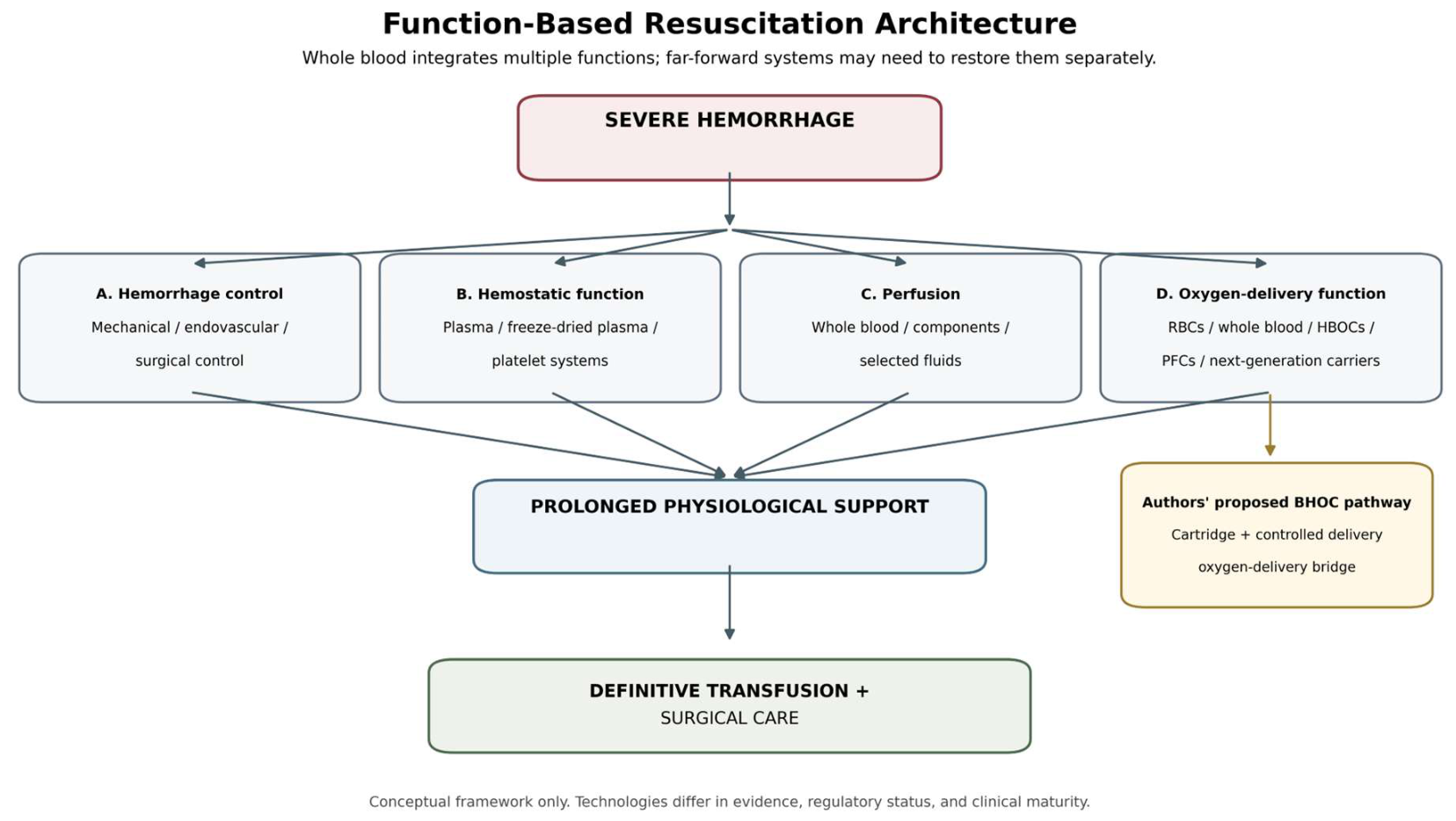
The research question changes accordingly. Instead of asking “What can replace blood?”, one asks “Which physiological function is currently becoming limiting?” and “How can that specific function be maintained until definitive therapy becomes available?”
Figure 2.
Function-based resuscitation architecture. A conceptual framework separating hemorrhage control, hemostatic function, perfusion, and oxygen-delivery function. Whole blood can restore several functions simultaneously; far-forward systems may require individual functions to be restored by different technologies. The BHOC pathway is an authors’ proposed research concept, not established clinical performance.
11. Whole Blood: The Biological Reference Standard
Function-based resuscitation should not be interpreted as an argument against whole blood. Whole blood provides the most obvious natural example of integrated function: red cells -> oxygen transport; plasma -> coagulation proteins and volume; platelets -> cellular hemostasis.
The Joint Trauma System, Defense Committee on Trauma, and Armed Services Blood Program endorse low-titer group O whole blood as the resuscitation product of choice for hemorrhagic shock across roles of care and recommend availability as early as operationally possible [20]. Whole blood therefore remains the principal biological benchmark.
The principal constraints in far-forward use are logistical and supply-related. Donor blood requires donor availability, collection, testing, processing, storage, inventory management, temperature control, transport, rotation, and trained personnel, while supply remains finite and subject to blood-group compatibility, product age, and donor-related variability.
The key strategic question is therefore not “Is whole blood effective?” It is “Can sufficient appropriate whole blood be safe and positioned wherever casualties occur and remain continuously available through prolonged contested operations?”
12. September 11, 2001: The Strategic Reserve Lesson
The September 11 attacks exposed an important paradox in emergency blood preparedness. The public responded with an extraordinary donation surge. Yet relatively little additional blood was required by surviving casualties.
On November 6, 2001, American Red Cross President Bernadine Healy testified before the U.S. House Committee on Energy and Commerce. She argued that national terrorism preparedness required a “strategic blood reserve of frozen O-type blood” [21].
The concept was straightforward. Freshly donated red cells have finite storage life. Frozen red cells could create a durable reserve that existed before another mass-casualty event. This was an early formulation of a principle that remains relevant to modern military medicine: readiness must exist before injury occurs.
13. GAO: Blood Collected After the Disaster Is Too Late for the First Victims
The U.S. Government Accountability Office subsequently evaluated the blood-system response. An estimated 475,000-572,000 additional units were collected following September 11. Fewer than 260 units were reportedly used to treat victims of the attacks, and a substantial portion of the excess inventory ultimately expired [22].
GAO’s conclusion was strategically important. The blood needs of most emergencies are better addressed by maintaining an adequate inventory continuously rather than relying on post-disaster donation surges [22].
This can be expressed more simply: the blood that saves patients in the first hours of a catastrophe is primarily blood that already exists and is already deployable. This principle applies equally to military medical logistics.
14. Freeze-Dried Plasma: Moving Hemostatic Function Forward
Plasma provides important coagulation-related functions. Conventional frozen plasma, however, imposes logistical requirements including frozen storage, power, thawing, preparation time, and transport infrastructure.
Freeze drying changes the logistical architecture without attempting to replace every function of blood. The therapeutic target remains primarily hemostatic support. The location at which it can be provided moves farther forward. This makes freeze-dried plasma a useful example of function-based resuscitation.
15. Military-to-Civilian Translation: The Eight-Year Freeze-Dried Plasma Example
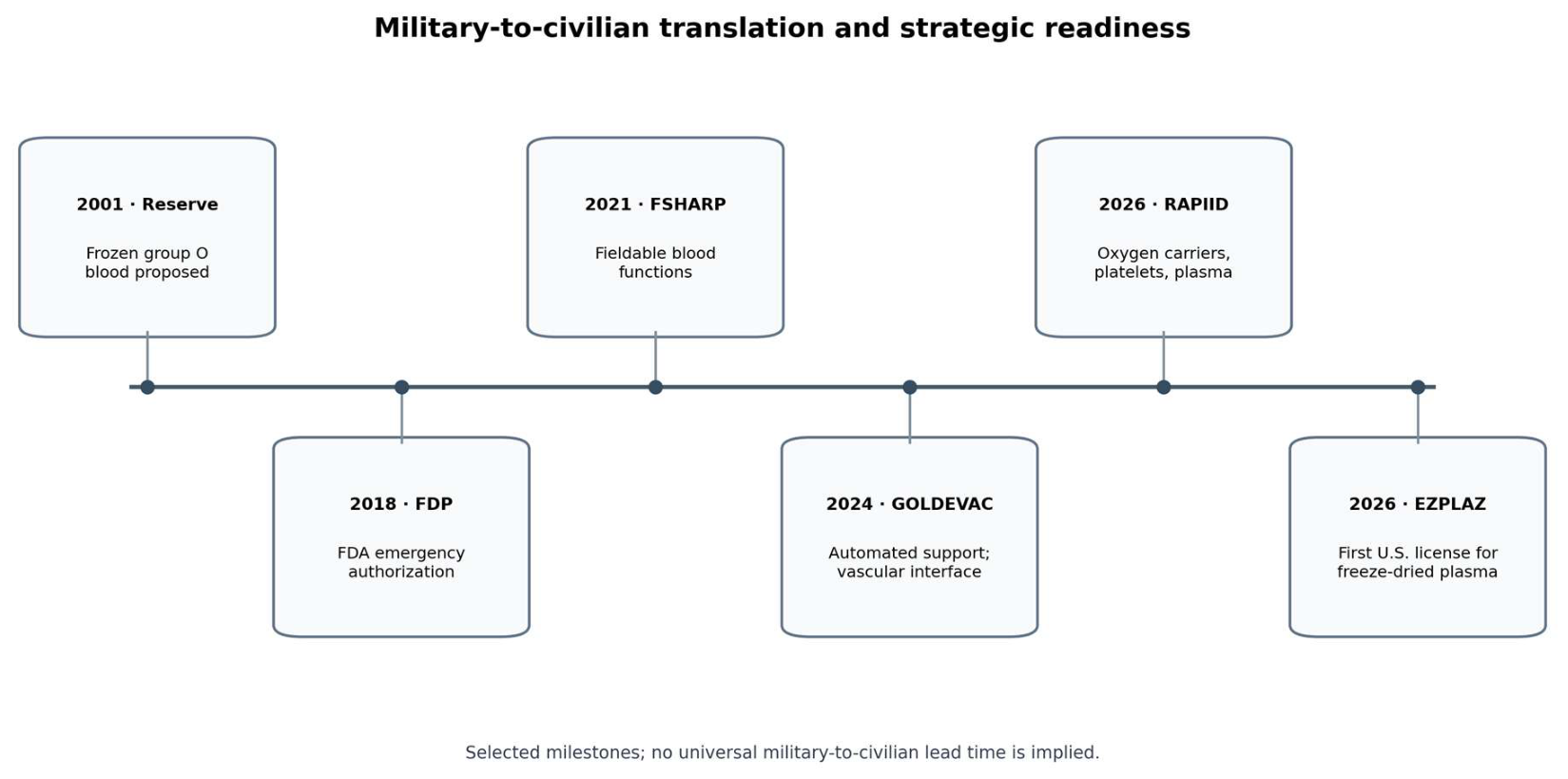
On July 9, 2018, FDA issued an Emergency Use Authorization enabling U.S. Department of Defense use of French pathogen-reduced freeze-dried plasma [23].
On July 29, 2026, FDA licensed EZPLAZ Freeze Dried Plasma, the first FDA-licensed freeze-dried plasma product in the United States [24].
The interval is approximately 8 years between U.S. military emergency access and first U.S. licensure of a freeze-dried plasma product.
This should not be generalized into a claim that military medicine is universally eight years ahead of civilian medicine. The more precise conclusion is: Military operational necessity can create a substantial translational lead for selected technologies, with broader civilian regulatory availability following years later.
Figure 3.
Military-to-civilian translation and strategic readiness timeline. Selected milestones from the post-September 11 strategic frozen-blood-reserve discussion through military freeze-dried-plasma access, DARPA FSHARP and GOLDEVAC, RAPIID, and the 2026 U.S. licensure of EZPLAZ. This figure illustrates a translational pattern, not a universal fixed military-to-civilian lead time.
16. Hemostasis Does Not Restore Oxygen Transport
Freeze-dried plasma addresses one important component of hemorrhage physiology. It does not restore red-cell oxygen-carrying capacity.
A patient may therefore have improved coagulation support while remaining progressively deficient in hemoglobin-mediated oxygen transport. This creates a different therapeutic question: Can oxygen transport be temporarily supported when donor RBCs or whole blood are delayed, constrained, unacceptable, or unavailable?
17. Hemoglobin-Based Oxygen Carriers
Hemoglobin-based oxygen carriers seek to provide oxygen-binding and oxygen-transport function without transfusing intact donor erythrocytes.
The field has encountered important historical broadly characterized limitations, including vascular reactivity, nitric-oxide interactions, oxidative effects, molecular-size effects, methemoglobin formation, dosing challenges, trial-design problems, and adverse-event and variable reported toxicity concerns. Most broadly characterized prior HBOC programs failed to obtain routine U.S. licensure.
Yet the military oxygen therapeutic requirement did not disappear. In a hospital, the comparator may be broadly grouped as oxygen carrier versus readily available RBCs. In far-forward care, the relevant comparison can instead be oxygen-carrier support versus delayed access to any oxygen-carrying transfusion. Pusateri, Glassberg, and Weiskopf specifically reassessed the need for an oxygen carrier in traumatic hemorrhage when conventional blood is not an option [26]. Traumatic brain injury when there is impaired blood
19. The U.S. Army-South Africa Program
This concept moved beyond a single laboratory study. In 2018-2019, the U.S. Department of Defense, U.S. Army Institute of Surgical Research, Stellenbosch University, and other South African institutions developed a large prehospital research program evaluating Hemopure and Bioplasma freeze-dried plasma in significant traumatic hemorrhage.
The program was reported as approximately US$8.2 million and was designed around a network including 21 hospitals and 27 ambulance bases [32,33]. The proposed clinical strategy was noteworthy because it separated two functions: oxygen carrying and hemostatic support.
The originally envisioned large clinical program did not subsequently generate a published randomized human mortality result demonstrating efficacy of the combined strategy. That limitation must remain explicit. However, the translational work continued.
20. Continued Hemopure/FDP Translational Research
In 2024, Pusateri and colleagues reported a non-human-primate study of Hemopure plus Bioplasma FDP after approximately 30% blood-volume hemorrhage [27]. The study was terminated early because of limited availability of rhesus macaques and included only nine animals.
Within those limitations, investigators reported no pattern of cardiovascular, pulmonary, renal, metabolic, coagulation, histological, or neurological findings indicating additional harm from the combined treatment compared with the comparator [27]. All animals survived the study observation period with intact neurological recovery.
This did not establish human clinical efficacy. It provided safety-oriented translational evidence supporting further investigation. The distinction is important: promising translational evidence is not equivalent to proven clinical benefit.
Preclinical and organ-perfusion studies with hemoglobin-based oxygen carriers have reported signals of functional recovery and tissue preservation in selected ischemia-reperfusion models, including myocardial recovery and liver preservation [38,39,40]. HBOC-based machine-perfusion protocols have also been used in clinical liver-transplantation studies to resuscitate and select initially declined donor livers for transplantation [41]. These findings provide a rationale for investigation; they do not establish a general regenerative effect or human clinical efficacy for a future BHOC product.
21. Perfluorocarbon Oxygen Carriers: A Different Molecular Route
Hemoglobin is not the only possible architecture for oxygen transport. Perfluorocarbon emulsions represent a fundamentally different approach. Unlike hemoglobin, perfluorocarbons do not bind oxygen through a heme group. They physically dissolve respiratory gases in proportion to partial pressure.
This creates two historically distinct oxygen-carrier families: hemoglobin-based oxygen carriers and perfluorocarbon-based oxygen carriers. The existence of two fundamentally different molecular strategies reinforces the idea that the therapeutic objective is broader than any individual product. The target is oxygen delivery.
22. Perftoran as a Historical Example
Perftoran is an important historical perfluorocarbon example. It was developed in Russia as an intravenous perfluorocarbon emulsion for conditions involving hemorrhagic anemia and tissue ischemia.
A 2019 review reports that Perftoran was approved for clinical use in Russia in 1996 and used in both the Russian Armed Forces and civilian care [28]. Historical reports of use should not be considered equivalent to contemporary multicenter randomized evidence or current FDA validation.
Its relevance to the present Perspective is conceptual. Perftoran demonstrates that red-cell-independent oxygen transport has been pursued through an entirely different physicochemical platform. Therefore, the research field should not be defined simply as HBOC development. It is more appropriately understood as therapeutic support of metabolic oxygen delivery.
23. Oxygen Carrying Is Not the Same as Oxygen Delivery
This distinction is fundamental. A therapeutic molecule can bind or dissolve oxygen without necessarily producing clinically useful tissue oxygenation.
Functional oxygen delivery depends on multiple interacting variables: carrier concentration; cardiac output; blood flow; oxygen saturation; oxygen affinity; P50 where applicable; complete oxygen-dissociation behavior; pH; CO2; temperature; viscosity; vascular reactivity; nitric-oxide interactions; diffusion distance; microvascular distribution and perfusion; circulation time; and tissue metabolic demand.
Thus, a clinically relevant oxygen therapeutic should not be judged only by how much oxygen it can carry. It must also be evaluated according to whether oxygen reaches and is released where tissues require it and controlled metabolism is supported.
This distinction is central to the concept of Precision Oxygen Therapeutics.
24. DARPA FSHARP: Blood Becomes a Set of Functions
In 2021, DARPA launched the Fieldable Solutions for Hemorrhage with bio-Artificial Resuscitation Products (FSHARP) program [29].
FSHARP explicitly addressed several critical blood functions, including oxygen delivery, cessation of bleeding, restoration of circulating volume, and coagulation-related support [29]. The program also emphasized shelf stability, environmental tolerance, portability, manufacturability, reduced cold-chain dependence, and the ability to tailor formulations to different injury profiles [29].
This represents a conceptual departure from the historic idea that “artificial blood” should be one universal liquid. Instead, blood can be understood as a collection of functions that can potentially be reconstructed through complementary components.
25. DARPA GOLDEVAC: The Delivery Interface Also Becomes Part of the Therapy
Molecular therapy alone does not solve the prolonged-care problem. The delivery system also matters.
DARPA’s GOLDen Hour Extended EVACuation (GOLDEVAC) program directly addresses this problem [30]. The program asks whether a complex polytrauma patient can be managed from near the point of injury throughout evacuation through a single intravascular interface, coupled with automated resuscitation and oxygenation capabilities [30].
GOLDEVAC is not an oxygen-carrier program and should not be presented as validation of BHOC. Its significance is different. It independently demonstrates that future military medical research is moving toward patient-attached capability, reduced dependence on multiple external devices, automation, prolonged support, continuation of therapy during evacuation, and simplified vascular interface.
This closely parallels the operational logic underlying a cartridge-based oxygen-therapeutic concept.
26. DARPA RAPIID 2026: Functional Modularity Becomes Explicit
In May 2026, DARPA launched RAPIID - Resuscitation and Prevention of Ischemia-Induced Dysfunction [31]. RAPIID builds on FSHARP but moves the field toward clinical trials, regulatory authorization, scalable manufacturing, commercialization, field-ready packaging, and point-of-care diagnostics.
Most importantly, its first technical area explicitly identifies three separate component classes: shelf-stable oxygen carriers, platelet-derived products, and dried plasma [31].
The biological correspondence is striking: oxygen carrier -> oxygen transport; platelet-derived product -> cellular hemostasis; dried plasma -> coagulation-factor support. RAPIID therefore formalizes the concept of functional modularity.
The target is not necessarily one artificial blood molecule. The target is a shelf-stable system capable of reproducing the functions required for resuscitation when conventional blood products cannot be reliably supplied or metabolically supported.
27. From the Hanging Bag to a Mobile Treatment Architecture
Current blood transfusion systems are designed around a fundamentally effective and clinically established architecture: blood bag -> tubing -> gravity or infusion system -> vascular access -> monitoring. This remains appropriate for current blood products.
The emerging operational environment, however, raises a new design question. A patient may need to be concealed, moved repeatedly, transferred between vehicles, transported by unmanned platforms, held in confined spaces, managed by a small team, or supported for many hours.
In such an environment, therapies requiring prolonged external suspension, extensive tubing, substantial ancillary hardware, frequent manipulation, or continuous specialist attention may become increasingly operationally burdensome.
This does not establish that conventional hanging blood bags are obsolete. No such claim is supported by the evidence. Rather, it generates a design hypothesis: future far-forward therapeutics should minimize the amount of external equipment and manual intervention required to maintain therapy during patient movement.
28. Drug and Delivery System Should Be Developed Together
Traditional pharmacological development often treats the drug and its delivery hardware as separate considerations. Prolonged field care makes that distinction increasingly artificial.
An excellent therapeutic that requires bulky equipment, prolonged preparation, large power requirements, repeated manual adjustment, extensive tubing, or continuous expert supervision may be unsuitable for the operational environment in which it is most needed.
Future oxygen-therapeutic development should therefore consider molecule + container + metering + vascular interface + monitoring + transport compatibility as one integrated therapeutic architecture. GOLDEVAC provides an independent example of this system-level approach [30].
29. Authors’ Perspective: BHOC as a Precision Oxygen Therapeutic
Within this framework, we propose BHOC - Biological Hemoglobin Oxygen Carrier as an investigational concept for further research.
BHOC should not be framed primarily as artificial blood or a universal blood substitute. Its proposed biological target is narrower: support of oxygen-delivery function during a defined interval in which native red-cell oxygen transport has become insufficient and definitive RBC or whole-blood therapy is delayed or unavailable.
This places BHOC conceptually within Precision Oxygen Therapeutics rather than traditional blood-substitute terminology. The distinction is important. The proposed therapeutic objective is not to reproduce the entirety of blood. It is to support one critically important biological function.
30. Proposed BHOC Operational Architecture
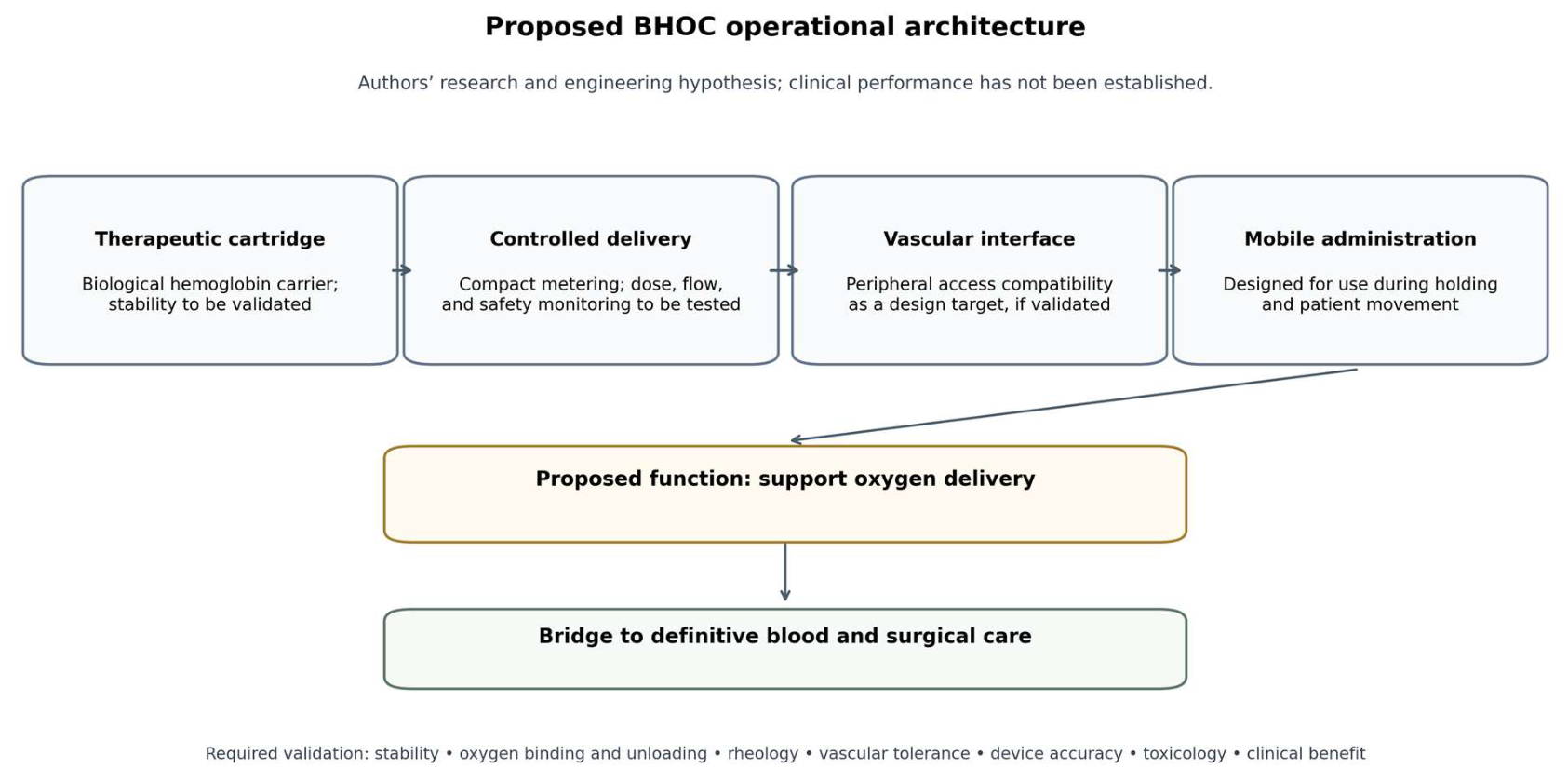
The following characteristics represent author-proposed design objectives. They are not established product-performance claims.
Regulatory product-definition boundary for biological products. For biological products, product definition is not established by the molecular name or proposed mechanism of action alone. Core EU/ICH and U.S. regulatory frameworks require the product to be defined and controlled through its biological source and starting materials, manufacturing and purification process, process controls, analytical characterisation, biological activity or potency, purity and impurities, stability, and justified specifications. EU Directive 2001/83/EC links the characterisation and quality of a biological substance to physicochemical and biological testing together with the production process and its control. ICH Q6B treats specifications as one part of the overall control strategy for a characterised biological product, while ICH Q11 links starting materials and manufacturing-process understanding to the control strategy. FDA biologics licensing similarly requires a comprehensive product and manufacturing quality package, and FDA/ICH Q5E requires comparability assessment when manufacturing changes may affect product quality, safety, or efficacy. Accordingly, any specific BHOC product must first be characterised and controlled as a defined manufactured biological product; route, delivery system, repeat dosing, treatment duration, and clinical performance must then be established for that specific product [34,35,42,43,44].
Regulatory synthesis: source/starting material -> manufacturing and purification -> process controls / QA-QC -> characterised final product -> justified specifications -> product-specific nonclinical and clinical qualification.
30.1. Treatment Procedure with Cartridge
We propose considering the therapeutic unit as a BHOC treatment procedure with cartridge, rather than as an analogue of a conventional donor-blood bag. The cartridge would represent a standardized treatment module integrated with the delivery architecture. Fine-bore tubing may be considered where supported by formulation, flow, device, and vascular-access validation. Alternative routes or sites of administration may be considered, subject to product- and route-specific validation.
30.2. Closed Therapeutic System
A closed system could potentially reduce preparation steps, environmental exposure, external manipulation, and tubing complexity. This architecture may offer technical and clinical advantages, but these require engineering and clinical validation.
30.3. Automated Controlled Delivery
A compact automated pump could theoretically provide controlled administration while reducing continuous manual intervention. This engineering approach requires validation of flow performance, reliability, environmental robustness, battery/power options, occlusion detection, dose control, and fail-safe behavior and monitoring.
30.4. Clinically Practical Peripheral Vascular Access
For far-forward medicine, dependence on specialized large central access would substantially limit deployability. A desirable design objective would therefore be compatibility with routine peripheral vascular access where validation by formulation and device testing has been executed.
This should not be interpreted as a claim that BHOC can currently be administered through any vein or any catheter system. Required studies should establish flow characteristics, vascular perfusion, dose rate, catheter compatibility, and local safety. No specific catheter size or infusion rate should be assumed before such testing.
30.5. Low Logistical Footprint
A fieldable oxygen therapeutic should maximize physiological capability while minimizing weight, volume, refrigeration, ancillary equipment, preparation time, and personnel burden. The 2026 PFAK development experience demonstrates why these characteristics matter operationally [18].
30.6. Compatibility with Movement
The delivery architecture should ideally permit continued and monitored controlled therapy during ground transport, air transport, repeated patient transfer, prolonged holding, and potentially unmanned evacuation. This requirement becomes increasingly important in a drone-contested environment.
Figure 4.
Proposed BHOC operational architecture. Authors’ design hypothesis for integrating a Biological Hemoglobin Oxygen Carrier into a compact treatment procedure with cartridge, automated metering, clinically practical vascular access, and mobile administration. The figure represents a research and engineering concept, not established clinical performance or an approved indication.
31. BHOC as a Functional Component, Not a Complete Resuscitation System
The BHOC concept should not be interpreted as eliminating the need for hemorrhage control, plasma, platelets, whole blood, RBCs, or surgery.
An oxygen carrier addresses only part of hemorrhage physiology and systemic metabolic support. This can be represented as hemorrhage control + hemostatic support + perfusion + oxygen-delivery support + definitive blood and or component/surgery.
The optimal treatment may require multiple components. DARPA RAPIID’s architecture independently reflects this functional separation [31].
32. The Four-Day and Seven-Day Design Problem
The move from approximately one hour to 72-96 hours - and in development requirements to 5-7 days - changes the pharmacological assessment as well as the logistical problem [13,16,17].
A support therapy designed for a 30-minute bridge will need definition and discovery of outcomes suitable for a 24-hour or multi-day bridge. Future oxygen-therapeutic development must therefore evaluate metabolic and sustainability of duration of action, frequency of repeat dosing, accumulation, elimination, specific metabolism, oxidation control, methemoglobin control where relevant, vascular effects, renal effects, inflammatory biology, oxygen affinity over time, tissue unloading, interaction with subsequent RBC transfusion, and compatibility with hemostatic treatment.
The duration of the bridge should therefore become an explicit variable in oxygen-therapeutic development and the metabolism, elimination and recycle of the biologic molecule.
33. A New Relationship Between Evacuation and Therapy
The older model assumed: the casualty moves toward the therapy. The emerging model increasingly permits: the therapy moves toward the casualty.
Freeze-dried plasma demonstrates this principle. UAV blood delivery demonstrates it [19]. DARPA’s blood-analog programs demonstrate it [29,31]. GOLDEVAC extends the concept by attempting to keep automated life-support capability physically connected to the patient during evacuation [30].
This may become one of the defining principles of future military medical systems.
34. Strategic Blood Reserve 2.0
The 2001 post-September 11 discussion focused on frozen type O red cells [21]. The underlying principle was more important than the specific product: strategically important biological capability should exist before mass casualties occur.
Twenty-five years later, the concept can be revisited. A future strategic hemorrhage-readiness matrix could potentially include whole blood/RBC capability + freeze-dried plasma + future shelf-stable platelet technologies + validated shelf-stable oxygen therapeutics + field-ready delivery devices + point-of-care diagnostics + distributed manufacturing and inventory systems.
This is not currently one approved integrated national reserve. It represents the direction suggested by the convergence of military doctrine, DARPA development, and recent FDA translation. The consideration of having blood donors on call, together with an oxygen therapeutic with potential repeated or prolonged administration bridging the time to corrective medical action over 2 to 5 days, could reduce selected inventory and logistics burdens; this requires prospective health-economic and operational analysis. Whether such an approach can reduce ischemia-reperfusion injury requires direct testing.
35. The 2026 Regulatory Inflection Point
The year 2026 represents an important translational inflection point for the field.
Three developments occurred within the same broader period. First, military planning increasingly formalized prolonged and contested casualty-care requirements [11,12,13,14,15,16,17,18]. Second, DARPA moved from FSHARP proof-of-concept development toward RAPIID’s explicit pathway to clinical testing, regulatory authorization, manufacturing, and field deployment [29,31]. Third, FDA licensed the first freeze-dried plasma product in the United States [24].
These events should not be interpreted as evidence that a complete shelf-stable “blood” alternative now exists. It does not. They do indicate that the field is moving from concept → component development → regulatory translation → manufacturing → field deployment.
36. Military Medicine as an Innovation Accelerator
Military medicine should not be described as universally superior to civilian medicine or universally “7-10 years ahead.” The evidence does not support such a generalization.
Military and civilian environments differ in populations, injury mechanisms, evacuation systems, acceptable logistical constraints, regulatory pathways, risk-benefit calculations, and resource availability.
However, military operational necessity frequently exposes logistical problems earlier and more severely. For selected technologies, this can accelerate research, field evaluation, emergency authorization, and implementation.
Freeze-dried plasma provides a measurable contemporary example: 2018 - U.S. military emergency access -> 2026 - first FDA licensure -> approximately 8 years.
Thus, a more defensible statement is: Military medicine can serve as an operational innovation accelerator for selected technologies whose broader civilian adoption and regulatory availability follow years later.
37. Implications for Civilian EMS
The same conceptual transition is relevant to civilian emergency medicine. Rural EMS, maritime medicine, wilderness care, disasters, remote communities, mass-casualty events, and periods of blood-supply disruption can reproduce elements of the military time-space problem.
The traditional civilian question has been: How rapidly can the patient reach the trauma center? The emerging question is increasingly: Which definitive physiological functions can safely begin before the patient reaches the trauma center?
Current answers increasingly include prehospital whole blood, RBCs, and plasma. Future answers may include selected shelf-stable systems if clinical efficacy and safety are established. Military medicine may therefore continue to act as a translational laboratory for civilian EMS.
38. Research Priorities
38.1. Define Which Patients Actually Need Oxygen-Delivery Support (Perfusion)
Not every bleeding patient will become limited by oxygen-carrying capacity before definitive blood becomes available. Patient selection will be essential.
38.2. Define Physiological Triggers
Hemoglobin concentration needs direct response measures, RBC count needs activity measures, or SpO2 alone may not adequately characterize functional regional specific oxygen delivery. Development should integrate oxygen debt, perfusion, lactate, tissue oxygenation, oxygen affinity, oxygen unloading, and microcirculatory behavior.
38.3. Characterize Oxygen Unloading
An effective carrier must not simply load oxygen. It must release oxygen under relevant tissue conditions.
38.4. Define the Required Bridge Duration
The risk-benefit profile may differ substantially when the bridge is 30 minutes, 3 hours, 24 hours, or 96 hours.
38.5. Develop Molecule and Device Together
The oxygen carrier and its field delivery system should be treated as an integrated translational problem.
38.6. Study Combination Therapy
Oxygen transport cannot be considered independently from hemorrhage control, coagulation, perfusion, and subsequent transfusion.
38.7. Establish Realistic Comparators
In a far-forward indication, the scientifically relevant comparator may not always be immediate optimal whole-blood transfusion. The operational comparator may sometimes be delayed access to definitive blood. This issue deserves explicit consideration in future trial design.
38.8. Define Strategic-Stockpile Requirements
39. Limitations
This Perspective integrates heterogeneous historical, operational, translational, and regulatory sources. Historical evacuation-time measurements are not directly comparable across conflicts because they represent different casualty populations, endpoints, transport systems, definitions, and operational environments. Accordingly, Figure 1 should not be interpreted as a continuous epidemiological time series.
The 72-hour, >96-hour, and 5-7-day values represent planning, training, capability, or development requirements rather than observed average evacuation times. Evidence from Ukraine remains heterogeneous and derives from an active, rapidly changing conflict environment.
No robust Syria-specific evacuation statistic could be derived from the available OIR registry cohort. No sufficiently standardized 2026 Iran-related theater evacuation metric was identified for quantitative inclusion.
Technologies described in this article differ substantially in mechanism, evidence quality, and regulatory maturity. Historical military or civilian use should not be interpreted as proof of current efficacy.
Finally, BHOC has not been demonstrated in the present article to possess the proposed operational characteristics. The BHOC cartridge, automated-delivery, peripheral-access-compatible, and Precision Oxygen Therapeutic concepts presented herein are authors’ hypotheses and proposed design objectives requiring independent experimental and clinical validation.
40. Conclusion
Military trauma medicine spent much of the twentieth century compressing the interval between injury and definitive care. World War II measured that interval in hours. Korea shortened it. Vietnam approached approximately one hour. Afghanistan institutionalized the Golden Hour [3,6].
The contemporary battlefield may now be forcing another transition. Persistent drones, contested airspace, dispersed operations, mass casualties, and degraded logistics can extend casualty care from minutes toward hours and, in some circumstances, days [10,11,12,13,14,15,16,17].
The scientific challenge consequently changes.
Whole blood remains the integrated biological benchmark when it can be delivered [20]. Freeze-dried plasma demonstrates that hemostatic function can be moved closer to the point of injury and provides a concrete example of military-to-civilian translation [23,24]. Hemoglobin-based and perfluorocarbon-based oxygen carriers represent distinct technological attempts to support oxygen transport and tissue delivery when RBC access is constrained [25,26,27,28]. DARPA FSHARP formally separated the critical functions of blood [29]. GOLDEVAC extends the concept to automated, patient-attached prolonged support through a simplified vascular interface [30]. RAPIID now explicitly advances shelf-stable oxygen carriers, platelet-derived products, and dried plasma as complementary components of a future blood-analog system [31].
The historical question was: Can we create artificial blood?
The emerging questions are more precise:
- • Which biological function is failing now?
- • How long must that function be supported?
- • Can that treatment move with the casualty?
- • Can it function with minimal infrastructure and personnel?
- • Can oxygen delivery be maintained until definitive blood and blood components become available?
In the authors’ view, these questions provide the scientific basis for a different development process: Precision Oxygen Therapeutics to support cellular functions.
Within this framework, BHOC should be investigated as a candidate function-specific Biological Hemoglobin Oxygen Carrier integrated into a compact treatment protocol intended to support oxygen delivery during the interval between inadequate native red-cell oxygen transport and access to definitive blood therapy.
The previous objective was primarily to move the casualty faster. The emerging objective is broader: support physiology continuously by moving therapeutic capability toward, and potentially with, the casualty.
That transition will define the next generation of military resuscitation and civilian prehospital care.
Ethics statement
Not applicable to this narrative Perspective; no new human or animal experiments were conducted for this manuscript.
Data availability: No original dataset was generated. All information derives from cited published literature and public government or institutional documents.
AI-assisted preparation: AI-assisted tools supported literature organization, draft development, and language editing. The authors take responsibility for the final content, source attribution, and scientific interpretations.
Author contributions
Carl W. Rausch: historical oxygen-therapeutic development; military and translational perspective; critical manuscript review. Bing-Lou Wong: hemoglobin and oxygen-carrier science; physiological interpretation; review and editing. Archil Jaliashvili: conceptualization; function-based resuscitation framework; Precision Oxygen Therapeutics and BHOC hypothesis; literature synthesis; original manuscript drafting. Lee Ka Yan Karen: literature review; scientific review and editing.
Declarations: Funding: This work was self-funded by the authors. No external funding was received.
Conflicts of Interest
Bing-Lou Wong, Carl W. Rausch, Archil Jaliashvili, and Lee Ka Yan Karen have current or historical professional interests related to hemoglobin-based oxygen therapeutics and associated product-development concepts.
References
- Rausch, C.W.; Jaliashvili, A. Precision Oxygen Therapeutics: From Blood Substitutes to the Biological Hemoglobin Oxygen Carrier (BHOC) Framework for Controlled Microvascular and Tissue-Level Oxygen Delivery. Preprints 2026. [Google Scholar] [CrossRef]
- Rausch, C.W.; Wong, B.L.; Jaliashvili, A. BHOC - Biological Hemoglobin Oxygen Carriers in Emergency, Prehospital, and Military Medicine: Historical Development, Product Characterization, and the Evolution Toward Precision Oxygen Therapeutics. Preprint manuscript submitted to Preprints.org. 2026. [Google Scholar]
- National Academies of Sciences; Engineering; and Medicine. A National Trauma Care System: Integrating Military and Civilian Trauma Systems to Achieve Zero Preventable Deaths After Injury; National Academies Press: Washington, DC, 2016. [Google Scholar]
- Burkle, F.M., Jr.; Newland, C.; Orebaugh, S.; Blood, C.G. Emergency medicine in the Persian Gulf War - Part 2: Triage methodology and lessons learned. Ann. Emerg. Med. 1994, 23(4), 748–754. [Google Scholar] [CrossRef] [PubMed]
- Marshall, T.J., Jr. Combat casualty care: the Alpha Surgical Company experience during Operation Iraqi Freedom. Mil. Med. 2005, 170(6), 469–472. [Google Scholar] [CrossRef] [PubMed]
- Kotwal, R.S.; Howard, J.T.; Orman, J.A.; Tarpey, B.W.; Bailey, J.A.; Champion, H.R.; et al. The effect of a Golden Hour policy on the morbidity and mortality of combat casualties. JAMA Surg. 2016, 151(1), 15–24. [Google Scholar] [CrossRef] [PubMed]
- North Atlantic Treaty Organization. Afghan Air Force Reduces Casualty Evacuation Time. NATO News, January 23, 2013. [Google Scholar]
- Hahn, C.; Staudt, A.M.; Brockmeyer, J.; Mann-Salinas, E.A.; Gurney, J.M. Characteristics of Iraqi patients treated during Operation Inherent Resolve by a Forward Surgical Team. Mil. Med. 2019, 184 (Suppl 1), 301–305. [Google Scholar] [CrossRef] [PubMed]
- Schauer, S.G.; Naylor, J.F.; April, M.D.; Thronson, E.E.; Maddry, J.K.; Becker, T.E.; Gross, K.R. The first 30 months experience in the non-doctrinal Operation Inherent Resolve medical theater. Mil. Med. 2019, 184(5-6), e319–e322. [Google Scholar] [CrossRef] [PubMed]
- Lawry, L.L.; Korona-Bailey, J.; Kanagaratnam, A.; et al. Qualitative assessment of point of injury to Role 2+ combat casualty care in Ukraine. Trauma Surg. Acute Care Open 2025, 10(2), e001674. [Google Scholar] [CrossRef] [PubMed]
- Yatsun, V.; Ungar-Sargon, J.; Gumeniuk, K.; Gybalo, R.; Korol, S.; Kuziv, R.; et al. Impact of tactical drone warfare on tourniquet application and medical evacuation: a comparative analysis of combat operations. Mil. Med. Published online. 2026. [Google Scholar] [CrossRef] [PubMed]
- NATO Allied Command Transformation. Frontline Medical Innovation: NATO’s 17th Innovation Challenge Advances Care in a Drone-Dominated Battlespace. 2025. [Google Scholar] [PubMed]
- Gurney, J.M.; Tadlock, M.D.; Ferguson, D.M.; Carlson, A.N.; Donaldson, C.; Wilson, J.A. When the Golden Hour goes away: prolonged casualty care in LSCO - considerations for commanders and decision-makers. Mil. Rev. 2025. [Google Scholar]
- North Atlantic Treaty Organization. AJP-4.10, Allied Joint Doctrine for Medical Support. In Edition C; NATO Standardization Office, 2019. [Google Scholar]
- Joint Trauma System. Prolonged Casualty Care Guidelines. Clin. Pract. Guidel. 2021. [CrossRef] [PubMed]
- United States Marine Corps. NAVMC 3500.84B; Health Services Training and Readiness Manual, Change 2. Advanced Tactical Casualty Care requirement.
- United States Special Operations Command. Capability Areas of Interest: Prolonged Field Care. Requirement for management of 3-5 patients for a minimum of 5-7 days.
- Keeney-Bonthrone, T.P.; Russo, R.M.; Donovan, K.; Greenberg, A.; Tobin, J.M.; Clark, W.F.; et al. Operational implementation of Prolonged Field Care Kits for large-scale combat operations. Mil. Med. Published online. 2026. [Google Scholar] [CrossRef] [PubMed]
- Turkoglu, B.; Unlu, M.G.; Camur, M.; Coskun, A.K.; Unlu, A. Massive transfusion on the combat field using autonomous drones: a case report. Transfusion 2025, 65(7), 1373–1376. [Google Scholar] [CrossRef] [PubMed]
- Shackelford, S.A.; et al. Joint Trauma System, Defense Committee on Trauma, and Armed Services Blood Program consensus statement on whole blood. Transfusion 2021, 61 (Suppl 1), S333–S335. [Google Scholar] [CrossRef] [PubMed]
- U.S. House of Representatives; Committee on Energy and Commerce; Subcommittee on Oversight and Investigations. Charitable Contributions for September 11: Protecting Against Fraud, Waste, and Abuse Testimony of Bernadine Healy, President. In Hearing; American Red Cross, 6 November 2001; pp. Serial No. 107–67. [Google Scholar]
- U.S. General Accounting Office. GAO-02-1095T; Public Health: Maintaining an Adequate Blood Supply Is Key to Emergency Preparedness. Washington, DC, 10 September 2002.
- U.S. Food and Drug Administration. Emergency Use Authorization: Pathogen-Reduced Leukocyte-Depleted Freeze-Dried Plasma, Centre de Transfusion Sanguine des Armees. Initial authorization July 9, 2018.
- U.S. Food and Drug Administration. STN BL 125702; FDA Licenses First-Ever Freeze-Dried Plasma Product in the U.S. EZPLAZ Freeze Dried Plasma. 29 July 2026.
- Meledeo, M.A.; Peltier, G.C.; McIntosh, C.S.; Taylor, A.S.; Bynum, J.A.; Pusateri, A.E.; Cap, A.P. Freeze-dried plasma mitigates the dilution effects of a hemoglobin-based oxygen carrier (HBOC-201) in a model of resuscitation for hemorrhage and hemodilution. J. Trauma Acute Care Surg. 2019, 87((1S) Suppl 1, S83–S90. [Google Scholar] [CrossRef] [PubMed]
- Pusateri, A.E.; Glassberg, E.; Weiskopf, R.B. Reassessment of the need for an oxygen carrier for the treatment of traumatic hemorrhage when blood is not an option. Shock. 2019, 52((1S) Suppl 1, 55–59. [Google Scholar] [CrossRef] [PubMed]
- Pusateri, A.E.; Morgan, C.G.; Neidert, L.E.; Tiller, M.M.; Glaser, J.J.; Weiskopf, R.B.; et al. Safety of Bioplasma FDP and Hemopure in rhesus macaques after 30% hemorrhage. Trauma Surg. Acute Care Open 2024, 9 (Suppl 1), e001147. [Google Scholar] [CrossRef] [PubMed]
- Latson, G.W. Perftoran (Vidaphor) - Introduction to Western Medicine. Shock. 2019, 52((1S) Suppl 1, 65–69. [Google Scholar] [CrossRef] [PubMed]
- Defense Advanced Research Projects Agency. Fieldable Solutions for Hemorrhage with bio-Artificial Resuscitation Products (FSHARP); DARPA Biological Technologies Office, 2021-2026. [Google Scholar]
- Defense Advanced Research Projects Agency. GOLDen Hour Extended EVACuation (GOLDEVAC); DARPA Biological Technologies Office, 2024. [Google Scholar]
- Defense Advanced Research Projects Agency. DARPA-PS-26-124; Resuscitation and Prevention of Ischemia-Induced Dysfunction (RAPIID). May 2026.
- Phillips, A. U.S. Army medical researchers partnering with South African experts on synthetic blood project. Def. Vis. Inf. Distrib. Serv. 2019. [Google Scholar]
- Stellenbosch University Faculty of Medicine and Health Sciences. SU Awarded Contract to Direct Large Clinical Study in Trauma Resuscitation. November 1, 2018.
- International Council for Harmonisation (ICH). Q6B: Specifications: Test Procedures and Acceptance Criteria for Biotechnological/Biological Products. Final guidance. Off. EMA 1999. [Google Scholar]
- International Council for Harmonisation (ICH). Q11: Development and Manufacture of Drug Substances (Chemical Entities and Biotechnological/Biological Entities). ICH Harmon. Guidel. Off. EMA 2012. [Google Scholar] [CrossRef]
- U.S. Food and Drug Administration. Expanded Access Categories for Drugs (Including Biologics): Individual Patient Access in an Emergency / Emergency IND. FDA.
- Mei, Z.W.; Raval, J.S.; Arnall, J.; Hwang, S.H.; Rodberg, K.; Quon, D.; Ward, D.C.; Ziman, A.; McGonigle, A.M.; Jahr, J.S. Artificial Oxygen Carriers Save Lives in Expanded Access Use: Three Cases when Blood Was Not an Option. Am. J. Ther. 2025, 32(1), e30–e34. [Google Scholar] [CrossRef] [PubMed]
- Caswell, J.E.; Strange, M.B.; Rimmer, D.M., 3rd; Gibson, M.F.; Cole, P.; Lefer, D.J. A novel hemoglobin-based blood substitute protects against myocardial reperfusion injury. Am. J. Physiol. Heart Circ. Physiol. 2005, 288(4), H1796–H1801. [Google Scholar] [CrossRef] [PubMed]
- George, I.; Yi, G.H.; Schulman, A.R.; Morrow, B.T.; Cheng, Y.; Gu, A.; Zhang, G.; Oz, M.C.; Burkhoff, D.; Wang, J. A polymerized bovine hemoglobin oxygen carrier preserves regional myocardial function and reduces infarct size after acute myocardial ischemia. Am. J. Physiol. Heart Circ. Physiol. 2006, 291(3), H1126–H1137. [Google Scholar] [CrossRef] [PubMed]
- Fontes, P.; Lopez, R.; van der Plaats, A.; et al. Liver preservation with machine perfusion and a newly developed cell-free oxygen carrier solution under subnormothermic conditions. Am. J. Transplant. 2015, 15(2), 381–394. [Google Scholar] [CrossRef] [PubMed]
- van Leeuwen, O.B.; de Vries, Y.; Fujiyoshi, M.; et al. Transplantation of High-risk Donor Livers After Ex Situ Resuscitation and Assessment Using Combined Hypo- and Normothermic Machine Perfusion: A Prospective Clinical Trial. Ann. Surg. 2019, 270(5), 906–914. [Google Scholar] [CrossRef] [PubMed]
- European Parliament and Council. Directive 2001/83/EC on the Community code relating to medicinal products for human use, Annex I: biological medicinal products, starting materials, manufacturing process and control. Official EUR-Lex.
- U.S. Food and Drug Administration. Biologics License Applications (BLAs) for CBER-Regulated Products. Official FDA.
- U.S. Food and Drug Administration. Q5E Comparability of Biotechnological/Biological Products Subject to Changes in Their Manufacturing Process. Final Guidance; 2005. Official FDA. 2005.
Disclaimer/Publisher’s Note: The statements, opinions and data contained in all publications are solely those of the individual author(s) and contributor(s) and not of MDPI and/or the editor(s). MDPI and/or the editor(s) disclaim responsibility for any injury to people or property resulting from any ideas, methods, instructions or products referred to in the content. |
© 2026 by the authors. Licensee MDPI, Basel, Switzerland. This article is an open access article distributed under the terms and conditions of the Creative Commons Attribution (CC BY) license (http://creativecommons.org/licenses/by/4.0/).
Copyright: This open access article is published under a Creative Commons CC BY 4.0 license, which permit the free download, distribution, and reuse, provided that the author and preprint are cited in any reuse.