

Submitted:
18 September 2026
Posted:
29 September 2026
You are already at the latest version
Abstract
Telehealth approaches are needed to enhance access to rehabilitation, particularly for rural populations; yet clinician use of video‑based telehealth, including for administering Physical Performance Measures (PPMs), remains suboptimal. Most PPMs were designed for in‑person use and lack guidance for remote delivery. This Special Communication reports a Quality Improvement (QI) initiative within the U.S. Veterans Health Administration (VHA) using a Plan–Do–Study–Act (PDSA) framework to: develop, beta test, refine, and disseminate telehealth‑adapted instructions for selected PPMs. The project identified 66 PPMs with potential for telehealth delivery. Using predefined feasibility criteria for synchronous and asynchronous administration, 16 of these were identified for further consideration. Using a modified Delphi process, an expert panel then selected five PPMs for refining instructions to enable video administration: 30‑Second Chair Stand, 4‑Stage Balance Test, Timed Get Up and Go, 30‑Second Arm Curl, and Finger Tapping Test. Revised instructions were drafted using established procedures and expert panel input. Twelve clinicians conducted pragmatic beta testing with 30 Veterans over four months. Survey feedback indicated usability of the adapted instructions and minimal refinement needs. Follow‑up interviews with Veterans (n=5) similarly confirmed ease of use. Refinements included adding brief patient‑facing videos. This QI initiative demonstrates a practical, replicable approach for producing telehealth‑adapted PPM instructions that beta testers perceived as clear, feasible, and safe. This communication offers resources and a structured QI process for organizations or rehabilitation services to enable the use of PPMs within their telehealth platforms.
Keywords:
telemedicine
; rehabilitation
; physical functional performance
; quality improvement
; veterans health services
Introduction
Telerehabilitation is a suitable alternative or complement to in-person care, as suggested by practice guidelines[1,2,3,4] and supported by systematic reviews showing non-inferior effectiveness and lower costs for remote versus in-person rehabilitation [5,6,7]. Telerehabilitation mitigates geographic inequities by expanding specialty care reach, especially for rural residents who face provider shortages, long travel distances, and limited finances for travel costs [8,9,10]. The Veterans Administration (VA) runs an integrated health system (Veterans Health Administration: VHA) that includes the entire United States and its territories. To extend access to care, the VHA has been proactive in developing, adapting, and using tele-technology for health care delivery. [11,12,13]. Although rapid advances have been made in the use of telerehabilitation within the VHA, just as in the private sector, widespread adoption is far from being achieved [11,12,13].
Despite the potential benefits of telerehabilitation, suboptimal uptake and implementation barriers have been widely noted in the literature [11,13,14,15,16]. A recent scoping review of use of videoconference-based (i.e., synchronous) telehealth by allied health professions reported barriers such as the lack of technology access, lack of digital literacy skills, and unreliable network connection [15]. These barriers may be magnified in rural contexts due to lower broadband connectivity, or lower digital literacy including among caregivers,[3,9,12,13,14,16,17] which may create additional challenges for the tele-administration of assessment measures.
Physical Performance Measures (PPMs) are objective measures of physical function used to evaluate patients with disability or at risk of disability and determine appropriate care. Some PPMs have been specifically developed, adapted, and validated for delivery via telehealth [18,19,20]. For example, the Arm Capacity and Movement Test (ArmCAM) was specifically developed for the remote videoconference assessment of upper extremity motor function among stroke survivors, with initial evidence supporting its reliability and validity [18]. More established measures such as the Fugl-Meyer Assessment and the Tinetti Performance-Oriented Mobility Assessment-Gait subscale have also been adapted for remote administration, including the Tele-FMA [19,20,21,22,23] and Tele-POMA-G [19,20,24]. Studies of these tele-assessment versions have reported encouraging reliability, validity, agreement with face-to-face assessment, and feasibility among stroke survivors, although most validation studies have evaluated these measures within clinician-led, real-time videoconference assessment models, with fewer examining asynchronous administration [19,20,21,22,23].
Recent systematic reviews applied the COSMIN criteria (COnsensus-based Standards for the selection of Health Measurement Instruments) to the use of PPMs in the teleassessment of people with neurological impairments [20,25,26]. One early review, current through mid-2021, recommended only using measures that had been tested as administered by telephone [25] Two more recent reviews were published, both current through mid-2024 [20,26]. One of those recent reviews recommended two measures for tele assessment of stroke (i.e., FMA and POMA-G) and three for multiple sclerosis (i.e., Five Times Sit-to-Stand Test, the Nine-Hole Peg Test, and the Timed 25-Foot Walk Test) [20]. The other recent review also applied an additional criteria of clinical utility [27], beyond the COSMIN, and found high variability in the quality and clinical utility limitation of the 11 instruments identified, with no instruments fully meeting the clinical utility criteria [26]. Clinical utility of the use of many PPMs in teleassessments were especially hampered by their complexity (e.g., need for non-standard equipment, materials, or specialist training) in addition to their associated costs [26]. Moreover, instructions for video administration typically are for synchronous (live) video administration, often in a remote clinical setting rather than in the home.
Overall, most PPMs were not originally designed nor adapted for use with video telehealth technology. They lack a telehealth data collection form, are costly or complex to implement via telehealth and/or do not come with practical guidance on how clinicians can conduct or adapt them for tele-administration. Research shows PPMs can be carried out remotely, with good accuracy, but only if done correctly by accounting for the virtual modality [28,29,30]. Thus, adapted administration might be required, especially in the absence of required or specialized equipment, under suboptimal digital literacy or network connectivity conditions such as in rural areas.
It is understandable that clinicians may be hesitant to use PPMs remotely without directions for remote administration, and related concerns about safety and accuracy. Hence, implementation of PPMs via telehealth, both in terms of its use (i.e., uptake) and correct use (i.e., fidelity), might benefit from information pertaining to their tele-administration, including potential real-world barriers such as the absence of key equipment, the need for complex instructions (including visual guidance or demonstration), administration time, and other tele-technology requirements [26,31,32,33], as well as challenges related to cognitive impairment, physical limitations affecting technology use (e.g., reduced manual dexterity), or the need for caregiver or in-person technical support to facilitate successful remote assessment [34]. Adaptation of instructional materials and administration procedures for video-based assessment may help address these barriers and support accurate and equitable implementation.
This special communication describes the process and results of an internally-funded Quality Improvement (QI) initiative within the VHA with 2 related purposes: 1) to develop and disseminate a toolkit with information relevant to video administration of PPMs, and 2) to develop and beta test instructions adapted for synchronous (live) and asynchronous (store-and-forward) video administration of several exemplar PPMs. While carried out in the VHA, the focus was to develop materials of broad clinical utility across health care systems and clinical contexts. Additionally, the QI process for development and beta testing of the adapted instructions reported here illustrates one possible way by which institutions can develop, beta test, and integrate adapted instructions into their own telehealth platforms.
Methods
Design: A QI project was conducted using a Plan-Do-Study-Act (PDSA) structure, which is a widely used and accepted for guiding healthcare improvement activities [35,36]. In addition to using the PDSA format, we used the guidance of the SQUIRE 2.0 (Standards for QUality Improvement Reporting Excellence) [37] for reporting the QI methods and results.
Ethics Review: The project was deemed to be quality improvement by the VHA Office of Connected Care (OCC). In addition, involvement of Clinicians in the Do step (beta-testing instructional materials) was reviewed and approved by the American Federation for Government Employees (AFGE).
Context: The VHA is an integrated health system covering a wide and geographically dispersed population, thereby relying heavily on telehealth to extend outreach. Among its telehealth platforms, there are synchronous (VA Video Connect (VVC)) and asynchronous (My VA Images, (MVAI)) video tele-technology options for use by Veterans from their homes. These two modalities have complementary benefits. Asynchronous imaging may be needed to supplement a synchronous video visit when internet connectivity limits image quality, while synchronous video may be needed to coach patients when problems are identified in an asynchronous video recording. Both types of Telehealth fall under the VHA OCC, which partners with VHA Health Services Research & Development (HSR&D) Virtual Care Consortium of Research (VC CORE) to carry out research and quality improvement activities on use of virtual care.
Planphase methods:
The planning phase focused on identifying and selecting a feasible number (n= 3-5) of key PPMs for the development and beta testing of telehealth-adapted instructional materials in the next phase. This identification and selection process involved the participation of a multidisciplinary Expert Panel (n= 9) whose members included clinician and/or scholar experts in physical therapy (CH, KM), occupational therapy (TJ, SR), geriatric medicine (NA), geriatric rehabilitation (HH), neurology (LM), and exercise physiology (KA, KH), with pertinent added expertise in telehealth (KA, NA, CH, HH, KH, LM) and/or rural health (TJ, KM,SR).
Candidate PPMs were first identified through expert panel recommendations and structured searches of the Rehabilitation Measures Database (RMD), conducted by two expert PT and OT clinicians (not involved in the expert panel), supplemented by the Project Lead – a senior rehabilitation and geriatrics scholar and practitioner (HH). The RMD [38] is an open web-based knowledge translation tool, a free, online, clinician-focused and continuously updated resource that compiles standardized rehabilitation outcome measures (along with their instructions, psychometric properties, and clinical applications) to help providers select and use valid, reliable assessment tools [39] The searches in and then snowballing from the RMD were conducted from January 2023 to April 2023, but it was also consulted as needed thereafter. The RMD search filters were applied via Assessment Type (Observer, Performance Measure), Area of Assessment (Body Function, Movement, Vestibular), and Body Structure (e.g., Lower Extremity, Upper Extremity), without restricting population. The expert panel reviewed the PPMs identified through the RMD and was invited to suggest additional PPMs for inclusion.
For each PPM, PT and OT experts used a custom data-extraction sheet to record the test focus, target population, description, directions (including any video guidance), cost, required equipment, environmental and tele-equipment needs, administration time, endorsements, and available psychometric data. They drew this information primarily from the RMD and, when clarification was needed, consulted the measure itself and other relevant sources. The experts also assessed each measure for safety concerns and caregiver needs; the Project Lead reviewed these assessments and discussed them with the Expert Panel as needed.
The extracted information (compiled into a table) was reviewed by the Project Lead, who used a priori selection criteria to identify measures for further consideration, with a goal of broad applicability and use via synchronous or asynchronous video. The a priori established criteria were as follows: it had to be free to use (i.e., no acquisition or use cost involved), require no special equipment (i.e., equipment not usually available or replaceable at someone’s home), and take less than 1 minute to complete (for ease with asynchronous upload). Among the PPMs retained, safety of telehealth implementation and caregiver-support needs were further assessed collaboratively with the expert panel, as was the feasibility of adaptations to enable administration in the home.
The final PPM selection used a modified Delphi process with the multidisciplinary expert panel. In this process, expert panel members were provided with the database containing extracted information about each measure and a link to the measure in the RMD (or similar source) if they wanted to review additional information. Using a 1-5 Lickert scale, panelists rated each PPM on each of the following: ease of use, safety, clarity of potential instructions, clinical utility, breadth of use across clinical areas, and overall recommendation, and provided familiarity ratings and comments. Ratings were carried out by anonymized electronic survey and/or via videoconference calls.
Do phase methods:
The Do phase incorporated 1) development of the adapted instructions, and 2) their pilot implementation and beta testing
Adapted Instructions Development:
Development of the adapted instructions, for both synchronous and asynchronous formats, followed a structured, iterative process. The team began by reviewing existing in-person administration instructions for the PPMs. Using the RMD, along with targeted literature and internet searches, they identified established instructions and any preliminary guidance for video-based administration. This foundation ensured that subsequent adaptations were anchored in accepted clinical practice.
The Project Lead drafted the initial versions of the instructional materials, based on these sources. Drawing on extensive experience with both synchronous (VVC) and asynchronous (MVAI) telehealth modalities within the VHA, the Project Lead shaped the instructions to account for the distinct demands of each format. The drafts were intentionally written at an eighth grade reading level and explicitly specified any equipment, environmental setup, or caregiver support required to conduct the tests safely and effectively in a home setting.
The draft PPM video instructions then underwent a multi-layered review. The expert panel and team’s OT/PT expert clinicians independently and then collectively assessed the clarity, feasibility, and clinical appropriateness of the instructions prompting refinement before pilot implementation and beta testing.
Pilot implementation and Beta Testing
Pilot implementation used VA-based beta testers — clinicians not involved in developing the adapted instructions — who agreed to use and test them in routine telehealth practice to evaluate the toolkit and inform its refinement and dissemination.
Clinician beta-testers were recruited with support from National Program Office collaborators. Recruitment emails emphasized the project’s clinical relevance and included supporting documents such as a project summary, AFGE Union approval, and the VHA OCC determination of Quality Improvement status. Prior to the beta-testing itself, all clinician testers completed a one-hour orientation session, which provided training in the My VA Image asynchronous video application, reviewed VVC competencies, and the specific PPMs being evaluated, and outlined the testing procedures. Beta testing included use of the instructions pragmatically during routine telehealth care, through synchronous or asynchronous video, with appropriate patients over a 3–4-month period. At the conclusion of the testing period (which included the evaluation of the adapted instructions), clinicians received a small token of appreciation and a letter acknowledging their contribution.
Clinicians identified potential Veterans to provide feedback by soliciting interest from their patients who participated in the beta testing. Interested Veterans were referred to project staff for follow-up.
Study phase methods
Evaluation of the toolkit involved collecting structured feedback from both clinician beta-testers and Veterans regarding the clarity, usability, and safety of the provided instructions.
Each time clinicians administered a PPM during beta testing, they completed an online REDCap survey documenting their discipline, prior experience with the specific PPM, and their use of synchronous or asynchronous video in routine practice. They also recorded which PPM was administered, the mode of video delivery, and rated the clarity and usability of the instructions. Additional survey items assessed how instructions were communicated to Veterans, whether Veterans were able to complete the test, and whether image quality allowed accurate observation. Clinicians could add free-text comments to identify concerns, missing functionality, or other suggestions. See Supplementary Appendix 1 for the REDCap survey. Finally, clinician testers were asked whether the instructions were ready for national release for either or both telehealth modalities.
At the end of the project, clinician beta-testers and the referred Veterans participated in qualitative interviews conducted by a single, experienced qualitative analyst not involved in the development of the toolkit. Interviews explored how Veterans completed the test (i.e., synchronous or asynchronous) and then probed their experiences with preparation, camera setup, and environmental adjustments. Veterans were asked about their sense of safety, task difficulty, unexpected issues, and overall clarity of the instructions. Interview transcripts were analyzed using conventional content analysis methods [40]. Data saturation was observed; all interviewed participants were reporting similar experiences, understanding, and ease of use.
Act phase methods
After beta testing, the PPM instructions were revised to incorporate clinician and Veteran feedback regarding clarity, usability, and safety. The results of the beta testing were also presented at a focus group discussion with the expert panel to inform further refinement as well as plans for implementation and dissemination. Finally, venues for dissemination were identified and relevant parties contacted.
Results
We use the PDSA template to report on the results of this QI activity
Plan phase results
Figure 1 depicts the results of our sequential process. A total of 66 PPMs (44 Lower Extremity (LE), including Gait and Balance, 22 Upper Extremity (UE)) were identified with potential for use with virtual telehealth technologies.
Of these, 16 PPMs (11 LE, including Gait and Balance, 5 UE) were determined to be suitable for further consideration based on the a priori criteria (free, all equipment and environmental needs could be met in the home, test time of approximately one-minute or less). Table 1 shows the 16 PPMs that were found suitable for inclusion in modified Delphi phase).
During the Delphi process, the 16 PPMs were formally rated using 5-point Likert scales on the predefined criteria:. Qualitative consensus discussions among the Expert Panel considered key trade-offs, including breadth of potential use across professional disciplines and medical conditions, overall feasibility, psychometric rigor, and safety for tele-administration.
The LE PPMs required only a single Delphi round to reach consensus. This was partly due to scope overlaps among several of the identified PPMs. For the UE measures, the Expert Panel reached consensus on prioritizing the 30-Second Arm Curl Test in the first Delphi round, whereas the remaining four UE PPMs advanced to a second Delphi round.
At the conclusion of the Delphi process, five PPMs (two UE and three LE (including Gait/Balance) were prioritized by the multidisciplinary panel for development of video administration instructions and beta testing (see bolded measures in Table 1).
Do phase results:
Draft instructions for synchronous and asynchronous video administration were developed and subsequently evaluated through beta testing for each of the five selected PPMs.
A total of 32 beta testers were trained, of whom 12 (9 (75.0%) PTs; 3 (25.0%) OTs) collectively carried out 30 beta tests with 30 unique Veterans (76.7% of them > 61 years old), within a 4-month period. The PTs were the test administrators in 63.3% of these evaluations. The tele-assessments occurred more often (86.7%) during a synchronous tele-visit than via asynchronous telehealth. Among the PPMs tested, the “30 Second Chair Stand” was the used the most (n=18; 60.0%), followed by the “4-Stage Balance Test” (n=7; 23.3%); the “Finger Tapping Test” was the least used, only one time (see Table 2).
During the beta testing period, MVAI national database data suggested the QI project influenced PPM utilization: 72.9% of beta testers used the asynchronous MVAI video function compared with 23.3% among non-beta testers.
Study phase results
Clinicians’ survey ratings: Twelve clinicians provided surveys from 30 telehealth visits. Table 2 reports results reflecting potential refinement needs for specific PPM instructions.
Only one out of 30 clinician ratings found it “hard or very hard” for the veteran to follow the adapted instructions. That occurred for the 30 Second Chair Stand, out of 18 administrations of this PPM (6% of its uses).
Most tests were rated as easy or very easy for the clinician to see everything needed to accurately score the PPMs via video; however, a 'hard' clinician rating was generated with the Finger Tapping Test (1 of 1 uses, 100%), the Timed Get Up and Go (1 of 2 uses, 50.0%), and the 4-Stage Balance Test (1 of 7 uses, 14%).
One measure (30 Second Chair Stand), in one of its 18 usages (5.6% of this PPM’s usage, or 3.3% of the total usages of all PPMs), obtained a rating that the instructions were “little helpful or unhelpful”.
Regarding envisioned readiness for widespread dissemination, two of the seven ratings of the 4-Stage Balance Test (28.6%) indicated that the instructions required additional refinement before dissemination. The same answer applied to one out of 18 (5.6%) uses of the 30 Second Chair Stand.
Finally, none of the 30 provider interactions generated a clinician rating considering the procedure or instructions as “unsafe” or “very unsafe” for any of the PPMs, and no adverse events were reported during test administration.
Clinicians’ Qualitative Comments: Eight clinicians provided comments in the free text fields on their surveys, in response to two main prompts.
Regarding “what functions are missing from the Instructions”, eight responses (from a total of five providers) suggested ways to refine the instructions for clarity. For example, adding instructions to tell the Veteran when to start the test and when to stop the test as some Veterans were starting and stopping whenever the providers started or stopped speaking. Clinicians also recommended including the directions for all of the stages in the 4-Stage Balance test in a single set of directions.
On the question “do you have any other concerns about the test or the instructions”, five responses from four providers addressed ways to improve the Veteran’s experience, such as add instructions to let the Veteran know they may need a helper to use a gait belt for safety with the balance test and to maybe add pictures or a videoclip of the test to send to the Veterans beforehand.
Veterans Qualitative Comments: Interviews were completed with 5 Veterans, all of whom carried out the tele-assessment via the synchronous video modality. All Veterans emphasized the instructions were easy to understand and reported no obstacles during the assessment including finding and following the instructions.
Based on Study phase and the focus group discussion with the expert panel, minor edits were incorporated into the instructions such as including citations for videoclips of the various tests and verifying that instructions clearly indicate when a helper was needed (e.g., to put on a gait belt).
Act phase results
Based on Study phase feedback and subsequent Expert Panel review, we determined that the asynchronous instructions for the 4-Stage Balance Test should not be disseminated. Although no safety concerns or adverse events were reported during beta testing, the Expert Panel concluded that balance performance in the asynchronous format could not be actively monitored and that clinicians would be unable to provide real-time guidance or intervene if safety concerns arose. In contrast, the synchronous version was considered acceptable because clinicians could directly observe performance and provide guidance as needed. Feedback also indicated that a single set of directions covering all four stages was preferred over separate instructions for each stage; accordingly, individual stage directions were not released.
Within the VHA, dissemination of the PPM video instructions occurred through the CPRS-Booster Dot Phrase National Library (a VA electronic health record–integrated content distribution tool), to ease inclusion into My HealtheVet messages and/or MVAI instructions. The Virtual Performance Measures searchable database with data on all 66 PPMs is available on the VHA Occupational Therapy SharePoint. The results of this QI Project were presented at VA OT Research Day on April 30, 2026, and at the VHA National Physical Therapy monthly call on July 9, 2026.
Outside the VA, study results were presented in a Webinar at the 2026 Gerontological Society of America meeting [57] The instructions for video administration and the database were made available under the Remote Assessments section in the Functional Assessment Measures Core of the Duke Claude D. Pepper Older Americans Independence Center [58]
Finally, this special communication provides another form of dissemination. Not only does it offer the refined tele-adapted instructions for the final five PMMs (which were applied to the context of the VA and its own platforms and were part of an internal QI process) but also of the characteristics of the 66 PPMs initially identified.
Supplementary Appendix 2 provides the final telehealth-adapted instructions for the five beta-tested measures. Instructions are provided for both synchronous and asynchronous administration where applicable; the asynchronous version of the 4-Stage Balance Test is excluded based on post-beta-testing Expert Panel review. Supplementary Appendix 3 provides a searchable/filterable database with the initial 66 PPMs identified and key characteristics that may affect their ability to be adopted and adapted for telehealth delivery. Each stakeholder or organization can use that database to engage in the process of selecting their own measures as suitable or prioritized for video administration and adapting specific PPM instructions for their other contexts.
Discussion
This special communication addresses the emerging need to adapt instructions of key PPMs to support delivery through telehealth modalities. It describes a QI activity illustrating how a PDSA cycle could be used to select, adapt, beta-test, and refine instructions for commonly used PPMs to be delivered through both synchronous and asynchronous video technologies within the VA health system. Clinicians and patients involved in beta testing generally found the adapted instructions feasible and easy to use. Clinicians considered the instructions ready for dissemination following minor refinements. Based on clinician feedback and subsequent Expert Panel review, the asynchronous version of the 4-Stage Balance Test was not disseminated because clinicians cannot actively monitor balance performance or provide real-time guidance during asynchronous administration. No safety concerns or adverse events were reported during pragmatic beta testing. Although this QI activity was not intended to establish generalizable validity across diverse practice settings, it demonstrates a practical QI approach that health systems may adopt to improve clarity and usability of clinician and patient instructions within remote functional assessment.
Several instructional design features may have contributed to the good feasibility and acceptability among VA beta testers. These included a focus on health literacy, and providing explicit, modality-specific as well as PPM-specific procedural instructions tailored to both synchronous and asynchronous formats. Such adaptations may help address common telehealth implementation barriers described in the literature such as limited internet connectivity, absence of specialized home equipment, digital literacy challenges for patients and providers, and the inherent challenge of offering guidance remotely rather than hands-on [13,15,26,31,32]
Task-specific, sequenced instructions can reduce task complexity as an implementation barrier[26,31,32] and the associated cognitive load for both clinicians and patients, in turn improving compliance and reducing the need for repeated testing or workflow disruption [59,60,61] — important advantages in time-limited or bandwidth-constrained telehealth encounters [31] Reducing required health literacy and/or cognitive demands may also make procedures more inclusive for patients with cognitive impairments [31,61,62,63] Clear procedural guidance may alleviate clinician ambivalence regarding the remote use of PPMs. Improved procedural clarity for adapted instructions may strengthen clinicians’ ability, self-efficacy, and perceived control when administering PPMs remotely, which are well-established behavioral-change determinants increasingly addressed improvement and implementation science interventions [64,65,66].
Within the iterative nature of a PDSA-based QI, the final instructions incorporated beta testers’ feedback to improve usability. For example, clinicians recommended adding links to brief patient-facing videos. Similarly, beta testing results indicated that, for synchronous administration, instructions for the four stages of the 4-Stage Balance Test should be consolidated into a single document, allowing clinicians to guide participants through each stage sequentially during real-time assessment. These iterative refinements aligned with the usability beta-testing goals as well as reflect a core principle of PDSA-guided QI cycle: testing small changes, integrating user feedback, and optimizing materials before broad dissemination.
This QI intervention moves beyond traditional educational or audit-and-feedback strategies for implementing the use of standardized rehabilitation measures,[67]. which typically target knowledge or attitude change. Instead, it adopts a more enabling approach that addresses key implementation barriers (e.g., lack of procedural guidance, complexity of required tasks, absence of specialized equipment in patients’ homes). Nonetheless, by describing the VHA context (including its synchronous and asynchronous platforms), intervention components, and reporting usability-driven refinements, it aligns with recommended QI reporting expectations [37]. It also contributes to ongoing efforts to strengthen QI reporting in rehabilitation. QI work in rehabilitation remains infrequently published and often does not meet minimum reporting standards,[68,69,70]. despite increasing emphasis on structured methodologies and rigorous reporting frameworks in both general healthcare [36,37,71] and rehabilitation [68,72].
Although conducted within the VA, the intervention’s underlying logic — perhaps more so than the specific instructions — may be applicable in other contexts. The criteria used for PPM selection (free to use, brief, and requiring minimal equipment) are broadly relevant, and most health systems can integrate prepared instructions into their electronic medical record templates or patient-portal messaging workflows. The shared catalogue of 66 candidate PPMs and its characteristics related to telehealth administration offers opportunities for local adaptation using structured expert review or local field testing. Contextual factors such as telehealth platform characteristics, workflow constraints, population needs, and safety considerations must be assessed before adopting or modifying these materials for other use contexts.
Limitations
This pragmatic QI activity allowed beta testers to independently choose which PPMs to use, with which patients, when, and at what frequency. While reflective of real-world practice, this resulted in uneven beta-testing volume across PPMs. Also, the beta testers included more PTs than OTs, which may have influenced which PPMs were tested the most. For example, the 30-Second Chair Stand was the most frequently used. In contrast, the Finger Tapping Test was used only once, which limited interpretation of results and reduced opportunities for refinement based on feedback. Given the lack of additional concerns raised during testing (including safety), instructions for the Finger Tapping Test were maintained as originally drafted. However, clinicians need to be mindful of the relative limitation in the extent of testing, particularly as pertains to safety for use with diverse patients, and apply clinical judgement to when, how and for whom to use any of the PPM instructions,
Although usage of the adapted instructions was tracked, this QI activity was not designed to assess improved uptake or its determinants. Future research should evaluate whether instruction toolkits lead to measurable improvements in tele-PPM uptake, quality, or clinical relevance when scaled. Further work should also examine which mechanisms (e.g., increased self-efficacy, reduced cognitive load, clearer expectations, or improved workflow fit) drive improvements in PPM use. Understanding how and why QI and implementation interventions work, across diverse conditions and contexts, remains a priority in the field [73].
The absence of reported safety concerns should not be interpreted as evidence that the adapted instructions can be used without clinical judgment or caution. Beta testers were volunteers and likely more motivated than the average clinician, which could have led to selection bias and their usage patterns or feedback may not reflect the broader clinician population even with the VHA. Reported usage also should not be interpreted as adoption rates, as no denominator representing clinical need or opportunity was available. No standardized measures of feasibility, acceptability or appropriateness of the innovation were used, as the goal was to obtain refinement feedback rather than establish a feasibility grading. Tele-assessment is a rapidly evolving field, and new measures continue to emerge, so the 66-measure catalogue should be interpreted or used with temporal caution. Finally, this initiative was a QI activity focused on usability and refinement, not on validating psychometric performance of PPMs administered with adapted instructions.
Conclusions
This QI initiative demonstrates that telehealth-adapted instructions — developed through structured selection, dual-modality design, and iterative refinement — can facilitate the use of tele-assessment in routine rehabilitation practice in ways that clinicians and patients perceived as clear, safe, and feasible. By addressing barriers related to clarity, safety, equipment access, cognitive demands, or digital literacy, this instruction-first strategy may offer a practical approach for improving the confidence and consistency of the use of remote PPM administration. Although additional research is needed to evaluate broader accuracy and implementation outcomes, the QI approach is adaptable and potentially relevant to both VA and non-VA settings seeking to strengthen telehealth-based functional assessment.
Funding
1.Virtual Care Consortium of Research (VC-Core), VA Health Systems Research, Veterans Health Administration. 2.Duke Older Americans Independence Center, Grant No. NIA AG028716 (Hoenig & Hall). 3.Salary support for Keith Myers and Sergio Romero was funded by the Department of Veterans Affairs, Veterans Health Administration, Office of Rural Health, NOMAD # PROG-0000094. The contents do not represent the views of Department of Veterans Affairs or the United States government
Acknowledgements
The authors thank Quenicia Nobles OTR and Judith Johnson PT for their assistance in reviewing and collating information on Physical Performance Measures.
Conflicts of Interest
The authors declare no conflicts of interest
Institutional Review Board (IRB) Statement and Informed Consent Statement
The project was deemed to be quality improvement by the VHA Office of Connected Care (OCC). No additional ethical approval or informed consent is required for this initiative.
Abbreviations
| ArmCAM | Arm Capacity and Movement Test |
| FMA | Fugl-Meyer Assessment |
| LE | Lower Extremity |
| MVAI | My VA Images |
| OT | Occupational Therapy / Occupational Therapist |
| PDSA | Plan-Do-Study-Act |
| PPM | Physical Performance Measure |
| POMA-G | Performance Oriented Mobility Assessment, Gait Subscale |
| PT | Physical Therapy / Physical Therapist |
| QI | Quality Improvement |
| RMD | Rehabilitation Measures Database |
| Tele-FMA | Telehealth Fugl-Meyer Assessment |
| UE | Upper Extremity |
| VA | Department of Veterans Affairs |
| VHA | Veterans Health Administration |
References
- Feigin, V.L.; Owolabi, M.O. Pragmatic solutions to reduce the global burden of stroke: a World Stroke Organization-Lancet Neurology Commission. Lancet Neurol. 2023. [Google Scholar] [CrossRef]
- Hildebrand, M.W.; Geller, D.; Proffitt, R. Occupational Therapy Practice Guidelines for Adults With Stroke. Am. J. Occup. Ther. 2023, 77(5). [Google Scholar] [CrossRef]
- Salbach, N.M.; Mountain, A.; Lindsay, M.P.; et al. Canadian Stroke Best Practice Recommendations: Virtual Stroke Rehabilitation Interim Consensus Statement 2022. Am. J. Phys. Med. Rehabil. 2022, 101(11), 1076–82. [Google Scholar] [CrossRef]
- Winstein, C.J.; Stein, J.; Arena, R.; et al. Guidelines for Adult Stroke Rehabilitation and Recovery: A Guideline for Healthcare Professionals From the American Heart Association/American Stroke Association. Stroke 2016, 47(6), e98–e169. [Google Scholar] [CrossRef]
- Tchero, H.; Tabue Teguo, M.; Lannuzel, A.; et al. Telerehabilitation for Stroke Survivors: Systematic Review and Meta-Analysis. J. Med. Internet Res. 2018, 20(10), e10867. [Google Scholar] [CrossRef]
- Laver, K.E.; Adey-Wakeling, Z.; Crotty, M.; et al. Telerehabilitation services for stroke. Cochrane Database Syst. Rev. 2020, 1(1), Cd010255. [Google Scholar] [CrossRef]
- Hao, J.; Pu, Y.; Chen, Z.; et al. Effects of virtual reality-based telerehabilitation for stroke patients: A systematic review and meta-analysis of randomized controlled trials. J. Stroke Cerebrovasc. Dis. 2023, 32(3), 106960. [Google Scholar] [CrossRef]
- Centers for Medicare; Medicaid Services. The CMS Framework for Advancing Health Care in Rural, Tribal, and Geographically Isolated Communities. 2022.
- Harrington, R.A.; Califf, R.M.; Balamurugan, A.; et al. Call to Action: Rural Health: A Presidential Advisory From the American Heart Association and American Stroke Association. Circulation 2020, 141(10), e615–e44. [Google Scholar] [CrossRef]
- Wozny, J.; Parker, D.; Sonawane, K.; et al. Surveying Stroke Rehabilitation in Texas: Capturing Geographic Disparities in Outpatient Clinic Availability. Arch. Phys. Med. Rehabil. 2021, 102(10), e29–e30. [Google Scholar] [CrossRef]
- Cary, M.P., Jr.; Spencer, M.; Carroll, A.; et al. Benefits and Challenges of Delivering Tele-rehabilitation Services to Rural Veterans. Home Healthc. Now. 2016, 34(8), 440–6. [Google Scholar] [CrossRef]
- Hale-Gallardo, J.L.; Kreider, C.M.; Jia, H.; et al. Telerehabilitation for Rural Veterans: A Qualitative Assessment of Barriers and Facilitators to Implementation. J. Multidiscip. Healthc. 2020, 13, 559–70. [Google Scholar] [CrossRef]
- Gately, M.E.; Quach, E.D.; Shirk, S.D.; et al. Understanding Variation in Adoption of Video Telehealth and Implications for Health Care Systems. Med. Res. Arch. 2022, 10(5). [Google Scholar] [CrossRef]
- Kringle, E.A.; Skidmore, E.R.; Baum, M.C.; et al. Stakeholders' Experiences Using Videoconferencing for a Group-Based Stroke Intervention During COVID-19: A Thematic Analysis. The American journal of occupational therapy: official publication of the American Occupational Therapy Association 2023, 77(3). [Google Scholar] [CrossRef]
- Rettinger, L.; Kuhn, S. Barriers to Video Call-Based Telehealth in Allied Health Professions and Nursing: Scoping Review and Mapping Process. J. Med. Internet Res. 2023, 25, e46715. [Google Scholar] [CrossRef]
- Swietek, K.; Jones, K.A.; Bettger, J.P.; et al. What Explains Inequalities in Telehealth Utilization Among North Carolina Medicaid Beneficiaries? Telemed. J. E Health 2024, 30(8), e2319–e26. [Google Scholar] [CrossRef]
- Zhu, C.; Tran, P.M.; Dreyer, R.P.; et al. Disparities in Internet Use Among US Stroke Survivors: Implications for Telerehabilitation During COVID-19 and Beyond. Stroke 2022, 53(3), e90–e91. [Google Scholar] [CrossRef]
- Yang, C.L.; Simpson, L.A.; Eng, J.J. A Pilot Study for Remote Evaluation of Upper Extremity Motor Function After Stroke: The Arm Capacity and Movement Test (ArmCAM). Am. J. Occup. Ther. 2023, 77(1). [Google Scholar] [CrossRef]
- Zhang, Z.Y.; Huang, L.; Gao, M.; et al. Parallel-Forms Reliability and Minimal Detectable Change of the Four Telerehabilitation Version Mobility-Related Function Scales in Stroke Survivors. Arch. Phys. Med. Rehabil. 2024, 105(6), 1124–32. [Google Scholar] [CrossRef]
- Baroni, A.; Perachiotti, G.; Carpineto, A.; et al. Clinical Utility of Remote Teleassessment of Motor Performance in Individuals With Neurologic Disabilities: A COSMIN Systematic Review. Arch. Phys. Med. Rehabil. 2025, 106(12), 1899–911. [Google Scholar] [CrossRef]
- Liz, L.; da Silva, T.G.; Michaelsen, S.M. Validity, Reliability, and Measurement Error of the Remote Fugl-Meyer Assessment by Videoconferencing: Tele-FMA. Phys. Ther. 2023, 103(8). [Google Scholar] [CrossRef]
- Peters, S.; Botero, M.; Evers, A.; et al. Development and feasibility of a modified Fugl-Meyer lower extremity assessment for telerehabilitation: a pilot study. Pilot Feasibility Stud. 2021, 7(1), 121. [Google Scholar] [CrossRef]
- Falchini, F.; Germanotta, M.; Fasano, A.; et al. Reliability of the Italian Version of the Fugl-Meyer Upper Extremity Scale Administered Remotely. J. Clin. Med. 2024, 13(24). [Google Scholar] [CrossRef]
- Önal, B.; Köse, N.; Önal, Ş. N.; et al. Validity and intra- and inter-rater reliability of the Tinetti performance-oriented mobility assessment balance subscale using different tele-assessment methods in patients with chronic stroke. Top. Stroke Rehabil. 2024, 31(6), 547–55. [Google Scholar] [CrossRef]
- Brito, S.A.F.; Scianni, A.A.; Peniche, P.D.C.; et al. Measurement properties of outcome measures used in neurological telerehabilitation: A systematic review using COSMIN checklist. Clin. Rehabil. 2023, 37(3), 415–35. [Google Scholar] [CrossRef]
- Sauerzopf, L.; Luft, A.R.; Baldissera, A.; et al. Remotely Assessing Motor Function and Activity of the Upper Extremity After Stroke: A Systematic Review of Validity and Clinical Utility of Tele-Assessments. Clin. Rehabil. 2024, 38(9), 1214–25. [Google Scholar] [CrossRef]
- Tyson, S.; Connell, L. The psychometric properties and clinical utility of measures of walking and mobility in neurological conditions: a systematic review. Clin. Rehabil. 2009, 23(11), 1018–33. [Google Scholar] [CrossRef]
- Venkataraman, K.; Morgan, M.; Amis, K.A.; et al. Tele-Assessment of the Berg Balance Scale: Effects of Transmission Characteristics. Arch. Phys. Med. Rehabil. 2017, 98(4), 659–64.e1. [Google Scholar] [CrossRef]
- Venkataraman, K.; Amis, K.; Landerman, L.R.; et al. Teleassessment of Gait and Gait Aids: Validity and Interrater Reliability. Phys. Ther. 2020, 100(4), 708–17. [Google Scholar] [CrossRef]
- Hoenig, H.M.; Amis, K.; Edmonds, C.; et al. Testing fine motor coordination via telehealth: Effects of video characteristics on reliability and validity. J. Telemed. Telecare 2018, 24(5), 365–72. [Google Scholar] [CrossRef]
- Rabbani, M.G.; Alam, A.; Prybutok, V.R. Digital Health Transformation Through Telemedicine (2020–2025): Barriers, Facilitators, and Clinical Outcomes—A Systematic Review and Meta-Analysis. Encyclopedia 2025, 5(4), 206. [Google Scholar] [CrossRef]
- Kemp, M.; Rising, K.L.; Laynor, G.; et al. Barriers to telehealth uptake and use: a scoping review. JAMIA Open 2025, 8(2). [Google Scholar] [CrossRef]
- Moulaei, K.; Kazemi-Arpanahi, H. Telemedicine-based geriatric assessment (tele-GA): A scoping review on applications, benefits and challenges. Health Policy Technol. 2026, 15(3), 101157. [Google Scholar] [CrossRef]
- Alexander, N.B.; Phillips, K.; Wagner-Felkey, J.; et al. Team VA Video Connect (VVC) to optimize mobility and physical activity in post-hospital discharge older veterans: baseline assessment. BMC Geriatr. 2021, 21(1), 502. [Google Scholar] [CrossRef]
- Taylor, M.J.; McNicholas, C.; Nicolay, C.; et al. Systematic review of the application of the plan-do-study-act method to improve quality in healthcare. BMJ Qual. Saf. 2014, 23(4), 290–8. [Google Scholar] [CrossRef]
- Knudsen, S.V.; Laursen, H.V.B.; Johnsen, S.P.; et al. Can quality improvement improve the quality of care? A systematic review of reported effects and methodological rigor in plan-do-study-act projects. BMC Health Serv. Res. 2019, 19(1), 683. [Google Scholar] [CrossRef]
- Ogrinc, G.; Davies, L.; Goodman, D.; et al. SQUIRE 2.0 (Standards for QUality Improvement Reporting Excellence): revised publication guidelines from a detailed consensus process. BMJ Qual. Saf. 2016, 25(12), 986–92. [Google Scholar] [CrossRef]
- Moore, J.L.; Raad, J.; Ehrlich-Jones, L.; et al. Development and use of a knowledge translation tool: the rehabilitation measures database. Arch. Phys. Med. Rehabil. 2014, 95(1), 197–202. [Google Scholar] [CrossRef]
- AbilityLab, S.R. Rehabilitation Measures Database 2026. Available online: https://www.sralab.org/rehabilitation-measures.
- Hsieh, H.F.; Shannon, S.E. Three approaches to qualitative content analysis. Qual. Health Res. 2005, 15(9), 1277–88. [Google Scholar] [CrossRef]
- Dite, W.; Temple, V.A. A clinical test of stepping and change of direction to identify multiple falling older adults. Arch. Phys. Med. Rehabil. 2002, 83(11), 1566–71. [Google Scholar] [CrossRef]
- Rikli, R.E.; Jones, C.J. Development and Validation of a Functional Fitness Test for Community-Residing Older Adults. J. Aging Phys. Act. 1999, 7(2), 129–61. [Google Scholar] [CrossRef]
- Centers for Disease Control and Prevention. 4-Stage Balance Test. CDC: Atlanta, GA, 2017. Available online: https://www.cdc.gov/steadi.
- Barreca, S.R.; Stratford, P.W.; Lambert, C.L.; et al. Test-retest reliability, validity, and sensitivity of the Chedoke arm and hand activity inventory: a new measure of upper-limb function for survivors of stroke. Arch. Phys. Med. Rehabil. 2005, 86(8), 1616–22. [Google Scholar] [CrossRef]
- Bohannon, R.W. Reference values for the five-repetition sit-to-stand test: a descriptive meta-analysis of data from elders. Percept. Mot. Ski. 2006, 103(1), 215–22. [Google Scholar] [CrossRef]
- Axelrod, B.N.; Meyers, J.E.; Davis, J.J. Finger Tapping Test Performance as a Measure of Performance Validity. Clin. Neuropsychol. 2014, 28(5), 876–88. [Google Scholar] [CrossRef]
- Jones, C.J.; Rikli, R.E.; Beam, W.C. A 30-s chair-stand test as a measure of lower body strength in community-residing older adults. Res. Q. Exerc Sport 1999, 70(2), 113–9. [Google Scholar] [CrossRef]
- Souza, C.P.; Oliveira, G.N.; Foss, M.P.; et al. The interlocking finger test in patients with Parkinson's disease and healthy subjects. J. Clin. Neurosci. 2016, 29, 145–8. [Google Scholar] [CrossRef]
- Soke, F.; Guclu-Gunduz, A.; Ozkan, T.; et al. Reliability and validity of the timed 360° turn test in people with Parkinson's disease. Eur. Geriatr. Med. 2020, 11(3), 417–26. [Google Scholar] [CrossRef]
- Logue, E.; Marceaux, J.; Balldin, V.; et al. Further Validation of the Pillbox Test in a Mixed Clinical Sample. Clin. Neuropsychol. 2015, 29(5), 611–23. [Google Scholar] [CrossRef]
- de Morton, N.A.; Davidson, M.; Keating, J.L. Validity, responsiveness and the minimal clinically important difference for the de Morton Mobility Index (DEMMI) in an older acute medical population. BMC Geriatr. 2010, 10, 72. [Google Scholar] [CrossRef]
- Gorman, S.L.; Radtka, S.; Melnick, M.E.; et al. Development and validation of the Function In Sitting Test in adults with acute stroke. J. Neurol. Phys. Ther. 2010, 34(3), 150–60. [Google Scholar] [CrossRef]
- Duncan, P.W.; Weiner, D.K.; Chandler, J.; et al. Functional reach: a new clinical measure of balance. J. Gerontol. 1990, 45(6), M192–7. [Google Scholar] [CrossRef]
- Bohannon, R.W. Comfortable and maximum walking speed of adults aged 20-79 years: reference values and determinants. Age Ageing 1997, 26(1), 15–9. [Google Scholar] [CrossRef]
- Ng, S.S.M.; Chen, P.; Chan, T.C.W.; et al. Reliability and validity of the supine-to-stand test in people with stroke. J. Rehabil. Med. 2023, 55, jrm12372. [Google Scholar] [CrossRef]
- Podsiadlo, D.; Richardson, S. The timed "Up & Go": a test of basic functional mobility for frail elderly persons. J. Am. Geriatr. Soc. 1991, 39(2), 142–8. [Google Scholar] [CrossRef]
- Moo, L. G.M.; Hawley, C.; Hoenig, H.; Rauzi, M. Interdisciplinary Functional Assessment via Telemedicine: Geriatric Considerations; Gerontological Society of America: Washington DC., 2026. [Google Scholar]
- Duke Aging Center. Functional Assessment Measures 2026. Available online: https://agingcenter.duke.edu/functional-assessment (accessed on 15 July 2026).
- Antonio, M.G.; Williamson, A.; Kameswaran, V.; et al. Targeting Patients’ Cognitive Load for Telehealth Video Visits Through Student-Delivered Helping Sessions at a United States Federally Qualified Health Center: Equity-Focused, Mixed Methods Pilot Intervention Study. J. Med. Internet Res. 2023, 25, e42586. [Google Scholar] [CrossRef]
- Williamson, A.K.; Antonio, M.G.; Davis, S.; et al. Human technology intermediation to reduce cognitive load: understanding healthcare staff members’ practices to facilitate telehealth access in a Federally Qualified Health Center patient population. J. Am. Med. Inform. Assoc. 2024, 31(4), 832–45. [Google Scholar] [CrossRef]
- Mayer, R.E.; Moreno, R. Nine Ways to Reduce Cognitive Load in Multimedia Learning. Educ. Psychol. 2003, 38(1), 43–52. [Google Scholar] [CrossRef]
- Ullrich, P.; Dutzi, I.; Buchner, T.; et al. Implementation of intervention programs specifically tailored for patients with cognitive impairment as comorbidity in early rehabilitation during acute hospitalization: An umbrella and scoping review. Geriatr. Nurs. 2025, 63, 94–104. [Google Scholar] [CrossRef]
- McGilton, K.S.; Davis, A.M.; Naglie, G.; et al. Evaluation of patient-centered rehabilitation model targeting older persons with a hip fracture, including those with cognitive impairment. BMC Geriatr. 2013, 13, 136. [Google Scholar] [CrossRef]
- Michie, S.; Richardson, M.; Johnston, M.; et al. The Behavior Change Technique Taxonomy (v1) of 93 Hierarchically Clustered Techniques: Building an International Consensus for the Reporting of Behavior Change Interventions. Ann. Behav. Med. 2013, 46(1), 81–95. [Google Scholar] [CrossRef]
- Mather, M.; Pettigrew, L.M.; Navaratnam, S. Barriers and facilitators to clinical behaviour change by primary care practitioners: a theory-informed systematic review of reviews using the Theoretical Domains Framework and Behaviour Change Wheel. Syst. Rev. 2022, 11(1), 180. [Google Scholar] [CrossRef]
- Dyson, J.; Cowdell, F. How is the Theoretical Domains Framework applied in designing interventions to support healthcare practitioner behaviour change? A systematic review. Int. J. Qual. Health Care 2021, 33(3). [Google Scholar] [CrossRef]
- Colquhoun, H.L.; Lamontagne, M.E.; Duncan, E.A.; et al. A systematic review of interventions to increase the use of standardized outcome measures by rehabilitation professionals. Clin. Rehabil. 2017, 31(3), 299–309. [Google Scholar] [CrossRef]
- Crick, J.P., Jr.; Rethorn, T.J.; Beauregard, T.A.; et al. The Use of Quality Improvement in the Physical Therapy Literature: A Scoping Review. J. Healthc. Qual. 2023, 45(5), 280–96. [Google Scholar] [CrossRef]
- Jesus, T.S.; Papadimitriou, C.; Pinho, C.S.; et al. Key Characteristics of Rehabilitation Quality Improvement Publications: Scoping Review From 2010 to 2016. Arch. Phys. Med. Rehabil. 2018, 99(6), 1141–48.e4. [Google Scholar] [CrossRef]
- Jesus, T.S.; Stern, B.Z.; Struhar, J.; et al. The use of patient experience feedback in rehabilitation quality improvement and codesign activities: Scoping review of the literature. Clin. Rehabil. 2023, 37(2), 261–76. [Google Scholar] [CrossRef]
- Bierbaum, M.; Best, S.; Williams, S.; et al. The integration of quality improvement and implementation science methods and frameworks in healthcare: a systematic review. BMC Health Serv. Res. 2025, 25(1), 558. [Google Scholar] [CrossRef]
- Guo, M.; Fortin, C.; Mayo, A.L.; et al. Quality Improvement in Rehabilitation: A Primer for Physical Medicine and Rehabilitation Specialists. Pm R 2019, 11(7), 771–78. [Google Scholar] [CrossRef]
- Nielsen, L.; Riddle, M.; King, J.W.; et al. The NIH Science of Behavior Change Program: Transforming the science through a focus on mechanisms of change. Behav. Res. Ther. 2018, 101, 3–11. [Google Scholar] [CrossRef]
Figure 1.
Number of Upper (UE) and Lower (LE) Extremity measures at each stage.
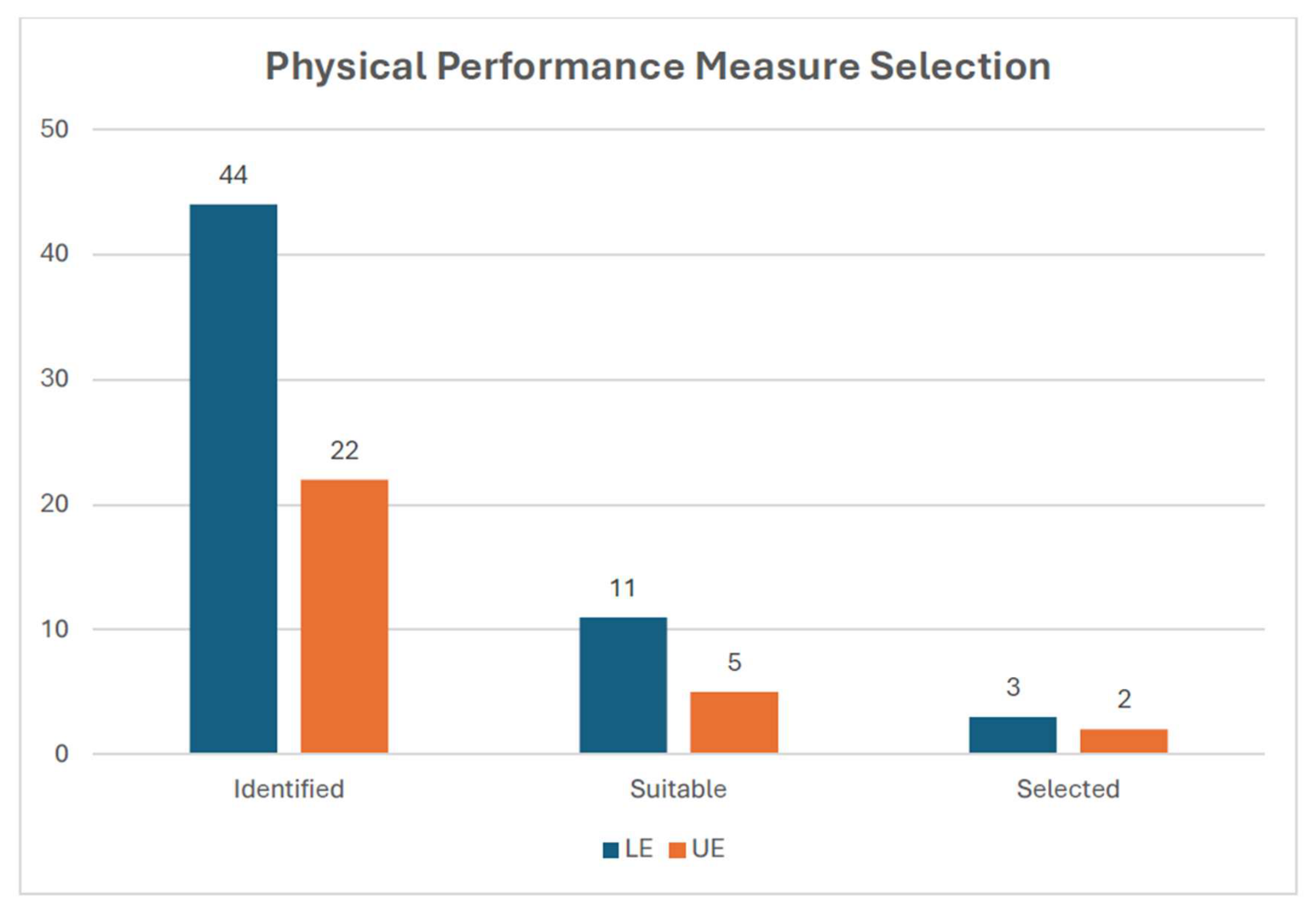

Table 1.
PPMs included in and then selected through the Delphi Rounds, organized by lower and upper extremity and alphabetic order.
Table 1.
PPMs included in and then selected through the Delphi Rounds, organized by lower and upper extremity and alphabetic order.
| Lower Extremity (including Gait/Balance) | Upper Extremity |
|---|---|
| 4-Square Step Test [41] | 30-Second Arm Curl Test [42] |
| 4-Stage Balance Test [43] | Chedoke Arm and Hand Activity Inventory [44] |
| 5-Times Chair Stand Test [45] | Finger Tapping Test [46] |
| 30-Second Chair Stand Test [47] | Interlocking Finger Test [48] |
| 360-Degree Turn Test [49] | Pill Box Test [50] |
| De Mortin Mobility Index [51] | |
| Function in Sitting Test [52] | |
| Functional Reach Test [53] | |
| Gait Speed [54] | |
| Supine-to-Stand Test [55] | |
| Timed Up and Go [56] | |
| Note: Bolded measures were those selected via the Delphi Rounds for instructional development. | |
Table 2.
Measure-specific concerns rated in the clinician survey results.
| Number of clinician’s' ratings showing concerns or refinement needs | ||||||
|---|---|---|---|---|---|---|
| Measure with Telehealth-delivery Instructions | Uses reported | “Hard/very hard” for Veteran to follow | “Hard” for the clinician to see and score | Instructions “little helpful or unhelpful” to carry out the PPM | “Not ready” for dissemination in present form | Safety concern (“unsafe/ very unsafe”) |
| 30-Second Chair Stand | 18 | 1 | 0 | 1 | 1 | 0 |
| 4-Stage Balance Test | 7 | 0 | 1 | 0 | 2 | 0 |
| Timed Get Up and Go | 2 | 0 | 1 | 0 | 0 | 0 |
| 30-Second Arm Curl | 2 | 0 | 0 | 0 | 0 | 0 |
| Finger Tapping Test | 1 | 0 | 1 | 0 | 0 | 0 |
| Total | 30 | 1 | 3 | 1 | 3 | 0 |
Disclaimer/Publisher’s Note: The statements, opinions and data contained in all publications are solely those of the individual author(s) and contributor(s) and not of MDPI and/or the editor(s). MDPI and/or the editor(s) disclaim responsibility for any injury to people or property resulting from any ideas, methods, instructions or products referred to in the content. |
© 2026 by the authors. Licensee MDPI, Basel, Switzerland. This article is an open access article distributed under the terms and conditions of the Creative Commons Attribution (CC BY) license (http://creativecommons.org/licenses/by/4.0/).
Copyright: This open access article is published under a Creative Commons CC BY 4.0 license, which permit the free download, distribution, and reuse, provided that the author and preprint are cited in any reuse.