

Submitted:
26 September 2026
Posted:
29 September 2026
You are already at the latest version
Abstract
Semax and Selank are synthetic regulatory peptides that are not FDA-approved for human use but are marketed direct-to-consumer for cognition, mood and stress resilience. The extent of the documented use of these unapproved peptides in routine clinical care remains poorly characterized and, because neither is dispensed through regulated pathways, is largely absent from structured medication data of Electronic Health Records (EHRs). Using Large Language Model (LLM) curation of de-identified clinical notes from the nference federated data network with manual adjudication of the LLM-curated insights, here we characterize the clinically documented use of each peptide and the real-world medical contexts in which their use occurs. Clinical note documentation of both Semax and Selank increased starting in 2024, with an average quarter-over-quarter growth of 14% for Semax and 16% for Selank over the past year. Among 43 and 39 patients with clinical note-mentions of Semax or Selank, use was confirmed via LLM curation in 22 (51%) and 27 (69%) patients, respectively. Physician adjudication agreed with the LLM’s use classification in 164 of 165 individual note-level assessments (99.4%) across patients with a Semax or Selank mention, including patients whose use was not confirmed. In the pooled cohort of patients with confirmed Semax or Selank use (N = 49), cognitive enhancement (28.6%) and mood/anxiety/stress support (28.6%) were the most common reasons for use provided by the patients, with less common reasons including energy or performance, sleep, musculoskeletal and gastrointestinal indications. Manual adjudication showed 86.7% agreement with the LLM-curated reasons for use. Both peptides were commonly administered intranasally (37%), and there was documentation of “stacking” with other peptides in 33 patients (67%), such as CJC-1295, ipamorelin, semaglutide, and tirzepatide. In the pooled cohort, clinical notes recorded patient-reported positive or effective responses in 16 of 49 patients (33%) and product- or administration-related safety concerns or adverse-event sentiments in 13 of 49 (27%). Manual adjudication agreed with LLM-curated self-reported-effect classifications in 94.2% of 103 reviewed records. Manual review showed isolated dyspnea, palpitations, flushing, and emergency department visits during the temporal periods overlapping with patient-reported use of Semax or Selank (n<11). This study is not designed to evaluate the effectiveness or harm of Semax or Selank. Rather, it highlights the rising use of unapproved direct-to-consumer peptides without any structured coding mechanism in EHR systems, emphasizing the need for greater awareness among healthcare practitioners.
Keywords:
Semax
; Selank
; direct-to-consumer peptides
; electronic health records
; large language models
; real-world evidence
; unapproved drugs
Introduction
Semax and Selank are short synthetic peptides developed as neuroactive agents and now marketed directly to consumers as “nootropics.” Semax is a synthetic analogue of a fragment of adrenocorticotropic hormone (ACTH(4–10))[1], and Selank is a synthetic analogue of the immunomodulatory peptide tuftsin. Both are promoted for cognitive enhancement, attention, mood, anxiety and stress resilience.[2,3] Neither peptide is approved by the U.S. Food and Drug Administration (FDA) or the European Medicines Agency (EMA). The only marketing authorizations either peptide holds are in Russia and a few neighboring countries,[4] and the scientific rationale advanced for these consumer uses is derived largely from preclinical and small early-phase studies, rather than from adequately powered human trials.[5,6,7]
Human evidence on the efficacy and safety of Semax and Selank remains limited, and neither product is manufactured, prescribed or dispensed through conventional regulated pathways in the United States. Both are typically procured from compounding pharmacies, research-chemical vendors and other direct-to-consumer sources, with uncertain product identity, purity and sterility, and both are used within a broader ecosystem of unapproved performance- and wellness-oriented peptides.[8] Understanding who uses these compounds, why, and with what documented outcomes is therefore of clinical and public-health relevance.
Because Semax and Selank are unapproved and are generally obtained outside conventional prescribing pathways, their use is expected to be absent from structured medical records. Clinical notes may therefore provide the only EHR evidence confirming use and describing product source, reason for use, perceived benefit and possible adverse effects. Ascertaining such use from free text at scale requires curation of whole notes and careful separation of genuine use from discussion, consideration or denial of use; large language models (LLMs) can perform this task, and physician adjudication can serve to validate model outputs.[9,10]
Here we used LLM-based curation of de-identified clinical notes as the primary approach to ascertain Semax and Selank exposure and to characterize the real-world contexts in which these peptides are used, applying the same auditable note-curation methodology previously validated for other agents in this data network.[10,11] We focused on quantifying temporal changes in documented utilization, characterizing the patients who report using these peptides and their reasons for doing so, and descriptively capturing the positive or negative outcomes that are reported in the EHR following confirmed use.
Methods
Study Design and Data Source
We conducted a retrospective observational study of de-identified EHR data using the nference federated network. The study population comprised patients with any mention of Semax or Selank in their clinical documentation through the second quarter of 2026. Because neither peptide has an approved product, neither has a National Drug Code or a structured prescription record; exposure ascertainment was therefore derived from clinical notes, and the complete clinical-note history of each patient with a Semax or Selank mention was retrieved for adjudication. No minimum duration of follow-up was required for cohort entry. Follow-up began on the index date (defined as the date of the earliest note confirming peptide exposure) and continued until the patient's last clinical note, with a data cutoff date of June 30, 2026. The two peptides were ascertained and analyzed as separate cohorts and, where noted, summarized together (“pooled cohort”).
Exposure Ascertainment from Clinical Notes
Candidate patients were retrieved using peptide names and documented synonyms with word-boundary matching to avoid spurious substring matches. A large language model (GPT-OSS-20B[12]) then adjudicated each candidate patient's full note text to determine whether the patient actually took the peptide, distinguishing confirmed exposure from discussion without use, denial of use, and unclear documentation. Whole notes were supplied as context. The auditable LLM-curation methodology, including its prior validation against structured records for incretin exposure ascertainment, has been described previously[10,11]; the model configuration and the full text of every extraction prompt are provided in Supplementary Methods S1 (model configuration) and S2 (extraction prompts).
Use-Pattern, Reason and Outcome Curation
For each confirmed user, additional LLM extractions curated the documented route of administration, supply channel, reason for use, concurrent use of other therapeutic agents (monotherapy versus stacking) and non-drug interventions, the patient- or clinician-reported effect and benefit type, the reported duration of use, and any new-onset clinical phenotypes documented in the year after first confirmed use. Each extraction was issued as a structured classification against a fixed schema and used only the text of the patient's own notes. Outcome fields were treated as documentation signals rather than measured endpoints.
Physician Validation
The accuracy of the LLM extractions was assessed by manual physician review. For each core extraction, all adjudicated records were reviewed (full-census) and the physician reviewer compared the model's assignment with the source note; agreement was computed as the physician–model concordance rate with Wilson score 95% confidence intervals (Table 1). Review was performed at participating sites and was unblinded, with the reviewer shown the model's assignment alongside the note. Domains that the model populated only rarely from the notes (supply channel and new-onset phenotypes) are reported descriptively and were not assigned a validation accuracy.

Table 1.
Full-census physician validation of both peptides pooled across the federated network (overall physician–model agreement 93.2%, 723 of 776 adjudicated domain-records; 'unable to comment' excluded). The rows show the domains presented in this manuscript, while the overall agreement reflects all adjudicated domains. Agreement is the physician–model concordance rate with Wilson 95% confidence intervals; n is the number of adjudicated records. Validation is reported only for domains the model populates from the notes; supply channel and new-onset phenotype were seldom documented (correctly returned as not-stated) and are not validated. Reason-for-use is assessed at the reported category level (the granularity presented here); most residual disagreements were finer-grained indication refinements within the same category (e.g. anxiety, attention, mood, sleep) rather than reclassification out of it. The four tabulated rows total 362 of the 776 adjudicated records; the remaining records are additional reviewed fields that are not individually shown.
Table 1.
Full-census physician validation of both peptides pooled across the federated network (overall physician–model agreement 93.2%, 723 of 776 adjudicated domain-records; 'unable to comment' excluded). The rows show the domains presented in this manuscript, while the overall agreement reflects all adjudicated domains. Agreement is the physician–model concordance rate with Wilson 95% confidence intervals; n is the number of adjudicated records. Validation is reported only for domains the model populates from the notes; supply channel and new-onset phenotype were seldom documented (correctly returned as not-stated) and are not validated. Reason-for-use is assessed at the reported category level (the granularity presented here); most residual disagreements were finer-grained indication refinements within the same category (e.g. anxiety, attention, mood, sleep) rather than reclassification out of it. The four tabulated rows total 362 of the 776 adjudicated records; the remaining records are additional reviewed fields that are not individually shown.
| LLM adjudication | Physician agreement (95% CI) | n adjudicated |
|---|---|---|
| Confirmed use (vs unclear/non-use) | 99.4% (96.6–99.9) | 165 |
| Reason for use (category) | 86.7% (73.8–93.7) | 45 |
| Self-reported effect | 94.2% (87.9–97.3) | 103 |
| Stacked status (monotherapy vs other-peptide use) | 91.8% (80.8–96.8) | 49 |
Table 2.
Per-peptide characteristics of note-confirmed Semax and Selank users across the federated data network. Proportions are shown with Wilson 95% confidence intervals; means are shown ± standard deviation. Counts below 11 are suppressed to protect privacy*. Route of administration, supply channel, and individual co-used agents were each documented in fewer than 11 patients per peptide, and are therefore shown only for the pooled Semax/Selank cohort (N = 49) in Figure 1.
Table 2.
Per-peptide characteristics of note-confirmed Semax and Selank users across the federated data network. Proportions are shown with Wilson 95% confidence intervals; means are shown ± standard deviation. Counts below 11 are suppressed to protect privacy*. Route of administration, supply channel, and individual co-used agents were each documented in fewer than 11 patients per peptide, and are therefore shown only for the pooled Semax/Selank cohort (N = 49) in Figure 1.
| Characteristic | Semax (N = 22) | Selank (N = 27) |
|---|---|---|
| Age at first documented use, mean ± SD (years) | 50.9 ± 19.0 | 46.2 ± 16.5 |
| Sex — male, n (%) | not shown* | 14 (52%) |
| Race — White, % (95% CI) | 95% (77–99) | 100% (87–100) |
| Median documented follow-up (days) | 166 | 218 |
| Reported duration of use, mean ± SD (days) | 83 ± 150 | 35 ± 90 |
| Use stacked with ≥1 other agent, n (%) | 15 (68%) | 19 (70%) |
| Documented reason for use — cognition, mood, n (%) | 12 (55%) | 17 (63%) |
Statistical Analysis
Proportions are reported with Wilson score 95% confidence intervals. Denominators are the LLM-confirmed users of each peptide (Semax N = 22, Selank N = 27), except for race, which uses the known-race denominator in each group and in the source network. Pre-specified two-group comparisons were performed using a log-rank test for Kaplan–Meier documented follow-up, and Fisher's exact test for the comparison of race composition. For the Kaplan–Meier analysis, documented follow-up was measured from the first confirming note to each patient's last available clinical note of any type, which served as the endpoint; June 30, 2026 was the overall data cutoff (the latest date a note could be observed). Because patient-level values cannot leave each site, means and standard deviations were computed across the federated network from site-level aggregates—each site's patient count, sum of values, and sum of squared values—from which the pooled mean and standard deviation are reconstructed. All estimates are pooled across the federated network from additive counts; because distinct patients do not span sites, pooled counts equal the sum of site counts. To protect against re-identification, any category with a patient count below 11 is reported as “<11” with derived percentages suppressed; metrics whose documented categories are all below this threshold are summarized without counts, with their categories named. The study is reported in accordance with the STROBE and RECORD reporting guidelines.[13,14]
De-Identification and HIPAA Compliance Certification
Prior to analysis, all EHR data were de-identified under an expert determination consistent with the Health Insurance Portability and Accountability Act (HIPAA) Privacy Rule (45 CFR §164.514(b)(1)). The de-identification methodology employed a multi-layered transformation approach to both structured and unstructured data fields[15]. In structured data, direct identifiers including patient names and precise geographic locations were excluded entirely, while indirect identifiers underwent specific transformations: patient identifiers, medical record numbers, and accession numbers were replaced with one-way cryptographic hashes using confidential salts to preserve linkage across patient encounters; all dates were shifted backward by patient-specific random offsets (1-31 days) to preserve temporal relationships while obscuring exact event timing; the ZIP codes were truncated to two-digit state-level resolution; and continuous variables including age, height, weight, and BMI were thresholded to prevent identification of extreme values (for example, ages more than 89 years transformed to ‘89+’ and BMI >40 transformed to ‘40+’). In clinical text, an ensemble de-identification system that combines attention-based deep learning with rule-based methods achieved an estimated >99% recall for personally identifiable information (PII) detection[15], with detected identifiers replaced by plausible fictional surrogates. nference established secure data environments within each participating center, specifically designed to enable data access and analysis without requiring Institutional Review Board oversight, approval, or exemption confirmation. Accordingly, informed consent and IRB review were not required for this study.
Results
Exposure Ascertainment and Growth of Documented Use of Semax and Selank
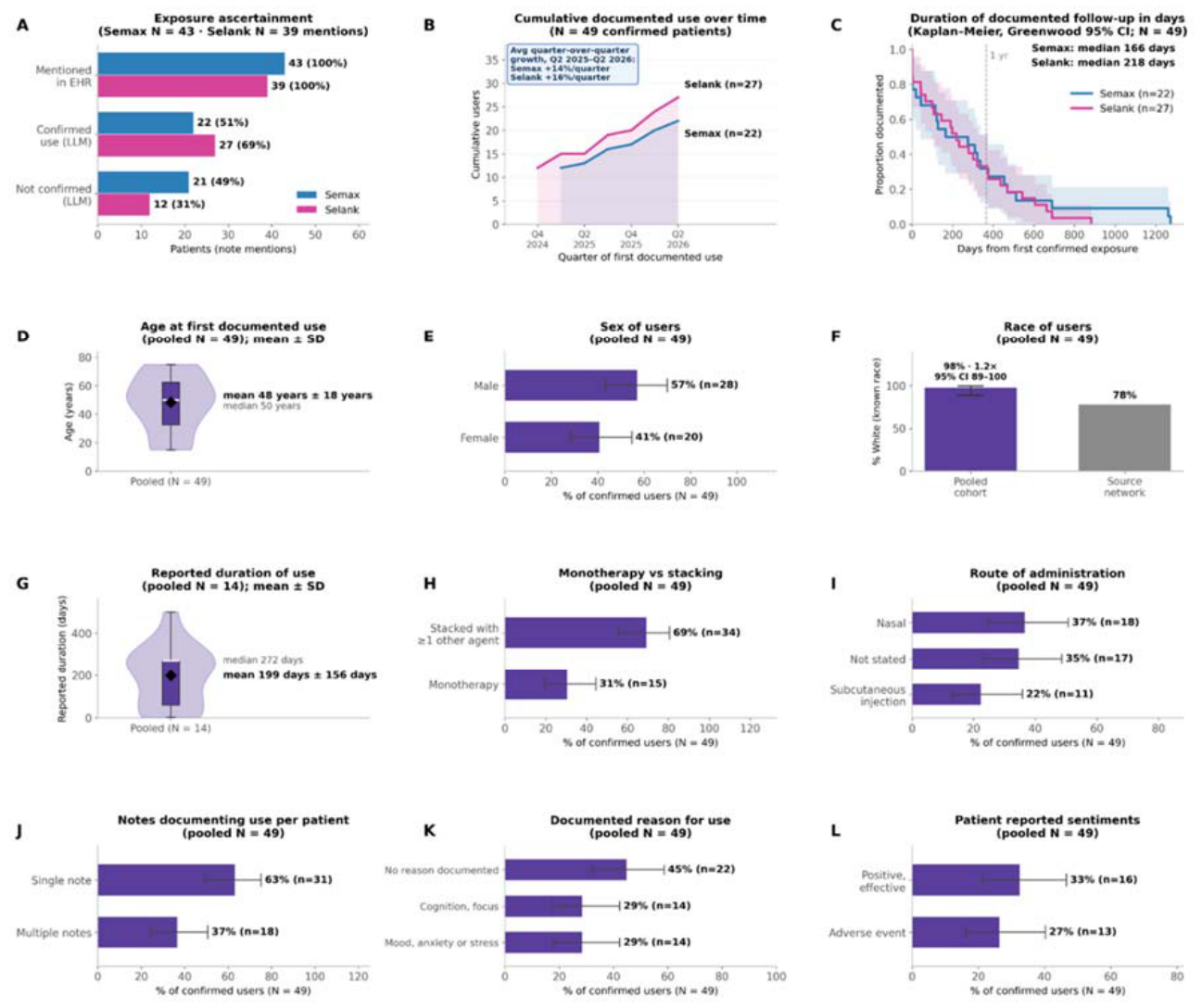
Across the federated network, 43 patients had a note mentioning Semax and 39 had a note mentioning Selank. Large language model (LLM) curation of the full note text confirmed use in 22 of 43 Semax-mentioned patients (51.2%) and 27 of 39 Selank-mentioned patients (69.2%), yielding 49 confirmed patients in the pooled cohort (Figure 1A). The remaining mentions reflected consideration, denial or otherwise unclear documentation and were not counted as confirmed use. Physician adjudication of the LLM-curated confirmation of use demonstrated 99.4% agreement across 165 note-level adjudications—exposure was adjudicated one note at a time across all patients with a Semax or Selank mention, not only the 49 confirmed users—supporting the reliability of note-based exposure ascertainment (Table 1).
Documented use of these peptides was predominantly recent: the cumulative number of patients with documented use increased beginning in 2024 and grew by an average of approximately 14% (Semax) and 16% (Selank) per quarter from the second quarter of 2025 through the second quarter of 2026 (Figure 1B). It is important to note that these represent growth rates in the number of documented patients rather than estimates of population prevalence.
The median documented follow-up time, from the first note confirming use to the last available clinical note of any type, was 166 days for Semax and 218 days for Selank, with no significant difference between peptides (log-rank P = 0.63). 16 of the 49 confirmed users (33%) had at least one documented interaction with the health system at least one year after the first confirmed use (Figure 1C).
Demographic Characteristics and Reported Duration of Use of Pooled Selank/Semax Users
In the pooled cohort, the mean age at first documented use was 48 ± 18 years, and the median was 50 years (Figure 1D). Twenty-eight of 49 users (57%) were male and 20 (41%) were female (Figure 1E). Among those with a recorded race, 98% were White, compared with 78% of the source network (Fisher's exact P < 0.001; Figure 1F). A reported duration of use could be recovered for 14 of 49 patients. In this subset, mean reported use was 199 ± 156 days and median use was 272 days (Figure 1G).
Concurrent Agents, Route of Administration and Clinical Documentation of Pooled Users
Documented use was more often part of a broader regimen than an isolated intervention. Thirty-four of 49 patients (69%) used Semax or Selank alongside at least one other agent, compared with 15 patients (31%) with monotherapy documented (Figure 1H). Co-use with another peptide was recorded for 33 of 49 patients (67%), with individual co-agents including the peptides CJC-1295, ipamorelin, semaglutide or tirzepatide. Expert adjudication agreed with the LLM-curated classification of monotherapy versus other-peptide co-use in 91.8% of 49 reviewed patients’ records (Table 1). The high frequency of concurrent use limits attribution of any reported response to Semax or Selank individually.
Nasal spray-based administration was documented for 18 of 49 patients (37%) and subcutaneous injection for 11 patients (22%), whereas the route of administration was not stated for 17 patients (35%; Figure 1I). A supply channel was seldom classifiable from the notes, but where documented, direct-to-consumer sources predominated (29%). Thirty-one of the pooled 49 patients (63%) had only one note documenting the use of Semax or Selank, limiting assessment of changes over time (Figure 1J).
Documented Clinical Reasons for Use of Semax or Selank Peptide
There was a documented reason for use in 27 of 49 pooled patients who were users of either the Semax or Selank peptides (55%). Across the full cohort, cognition or focus was the documented reason for 14 patients (28.6%) and mood, anxiety or stress support for 14 (28.6%; Figure 1K). Other documented reasons included energy or performance, sleep, and musculoskeletal or gastrointestinal concerns, each of which contained fewer than 11 patients. Physician adjudication agreed with the LLM-curated reason-for-use category in 86.7% of 45 reviewed records. Most disagreements refined an indication within the cognitive or psychiatric domain rather than reclassifying it outside that domain (Table 1).
Patient-Reported Sentiments and Temporally Documented Concerns
LLM-curated clinical notes classified 16 of 49 pooled patients (33%) as reporting a positive or effective response and 13 of 49 pooled patients (27%) as having a product- or administration-related safety concern or an adverse event sentiment (Figure 1L). Physician adjudication agreed with the LLM-curated self-reported-effect classification in 94.2% of 103 reviewed records (Table 1). This agreement validates extraction from the notes, but it does not establish that a reported benefit or adverse event was caused by either peptide.
Physician review identified isolated notes documenting dyspnea, palpitations, flushing, and an emergency department visit during periods overlapping reported Semax or Selank use; each event type involved fewer than 11 patients. These observations do not establish causality or permit an incidence estimate. Across all adjudicated fields, physician–model classifications agreed in 723 of 776 domain-records (93.2%). This total includes 362 records from the four domains detailed in Table 1 (confirmed use, reason for use, self-reported effect, and stacked status) and 414 records covering route, formulation, symptom-response direction, reporter identity, and ascertainment of reported use duration.
Discussion
To our knowledge, this is the first characterization of direct-to-consumer Semax and Selank use captured from clinical notes in the real-world setting. We found a small but rapidly growing group of patients who were predominantly White and middle aged. Documented use of these unapproved peptides has grown predominantly since 2024, with frequently cited reasons for utilization including cognitive, mood or anxiety-related reasons. These peptides were often used in combination with other peptides and were most commonly administered intranasally. That such use is being recorded at all, despite the absence of structured fields, illustrates both the expanding consumer market for unapproved peptides and the value of clinical notes as the primary EHR signal of that use.
This study was not designed to evaluate the effectiveness of Semax or Selank, and its findings should not be read as evidence of benefit. Critical pharmacological information, such as dose, frequency, adherence and product identity, is absent as they cannot be determined effectively from clinical documentation in current EHR systems. The outcomes are patient-reported and clinician-documented rather than measured via imaging endpoints or other diagnostic modalities, and thus the documented outcomes are prone to selection, confirmation, and reporting bias. Further, it is not possible to distinguish specific therapy-associated outcomes given concurrent peptide stacking, other co-treatments, non-drug interventions, placebo effects, regression to the mean, or selection, reporting and confirmation biases. The high frequency of documented stacking, in particular, confounds attribution of any documented change to a single peptide.
The predominance of direct-to-consumer sourcing and multi-agent stacking, together with the near-absence of structured records, has public-health relevance. Patients are using purported neuroactive peptides of uncertain identity, purity and quality, obtained outside regulated pathways[16]. This use is largely invisible to conventional pharmacovigilance systems that rely on prescriptions, claims or structured EHR data fields. Documented new-onset phenotypes in the year after first use were sparse and cannot be used to estimate adverse event rates, but they can serve as hypothesis-generating signals for future investigation. From a methodological standpoint, the auditable, note-based LLM-curation approach used here, which demonstrated high agreement with physician review, is a generalizable one that can provide a practical basis for real-world surveillance of other unapproved compounds[8,17].
This study has several limitations. First, it is a retrospective analysis of patient-reported use of and outcomes associated with unapproved compounds, a framework susceptible to multiple sources of bias and confounding. Any results must be interpreted as descriptive characteristics of a subset of patients who chose to reveal their use to a provider. There are certainly additional patients within the health systems who used these peptides without reporting it, so the true utilization incidence cannot be determined. Second, the analytic cohort presented here is very small, which can lead to imprecise estimates and underpowered analyses. Despite that, the robust quarter-over-quarter growth in documented use starting in 2024 does suggest that future iterations of this analysis may yield larger cohorts that can provide a better substrate for formal analyses of safety, tolerability, and effectiveness. Third, there is no objective measurement of exposure or outcome and no active comparator, so no causal or comparative claims can be made. Fourth, the index date is the first confirming note, which likely often occurs after the actual date of peptide initiation. Fifth, physician validation was unblinded, which could lead to overestimation of model accuracy due to confirmation bias or anchoring effects. Sixth, each extraction was run only once at a sampling temperature of 0.7, which permits variation in the model’s output. Repeating an extraction on the same note could therefore produce a different classification, but we did not measure this run-to-run variability. Finally, the analyzed population is not fully representative of the U.S. population.
Across a large U.S. federated health system network, documented direct-to-consumer use of the unapproved peptides Semax and Selank is small in magnitude but rising, is predominantly recent, and is concentrated among predominantly White, working-age patients. The descriptive findings reported here are not meant to establish effectiveness or safety, but rather to highlight an emerging and poorly characterized pattern of use that is largely invisible to structured records. This study and others[8,17] validate LLM-based clinical note curation combined with physician validation as a feasible approach for the real-world surveillance of unapproved compounds. That said, given the recent proliferation of direct-to-consumer medication use, concerted efforts to enable clinicians to record the use of non-prescribed compounds (e.g., including dose, route of administration, source of procurement, and perceived patient sentiment) would facilitate more robust clinical research and ultimately could improve patient care.
Data availability: This study analyzed de-identified electronic health record data. The data were extracted under an established privacy-preserving protocol and cannot be shared beyond what is reported here due to the parameters of the expert determination.
Code availability: The analysis code is not publicly available. Please contact the corresponding author for details.
Competing Interest Statement: The authors are employees of nference, inc., which conducts research collaborations with various biopharmaceutical companies. None of these companies, nor any other nference collaborator, funded, supported, or had any role in the independent study design, data acquisition, analysis, interpretation, manuscript preparation, or the decision to submit this work for publication. All analyses were conducted by the authors using de-identified electronic health record data. The authors declare no additional competing interests.
Author Contributions
Venky Soundararajan conceived and supervised the study. Venky Soundararajan and Adhikaar Marwaha designed the study and conducted the analysis. Adhikaar Marwaha and Karthik Murugadoss developed the LLM methods and evaluated the LLM curated insights. Christopher Gregg and AJ Venkatakrishnan reviewed the data and the interpretations with Venky Soundararajan and Adhikaar Marwaha’s inputs. Venky Soundararajan and Adhikaar Marwaha wrote the manuscript. Gowtham Varma and Santhosh Shiv conducted the physician validation of the LLM-curated insights. All authors contributed to the reviews and revision of the manuscript, and prepared the study for submission.
Funding
No external funding was obtained for this study.
Acknowledgments
The authors thank Patrick Lenehan for thorough review of the manuscript.
References
- Dolotov, O. V.; et al. Semax, an analog of ACTH(4-10) with cognitive effects, regulates BDNF and trkB expression in the rat hippocampus. Brain Res. 2006, 1117, 54–60. [Google Scholar] [CrossRef]
- Eremin, K. O.; et al. Semax, an ACTH(4-10) analogue with nootropic properties, activates dopaminergic and serotoninergic brain systems in rodents. Neurochem. Res. 2005, 30, 1493–1500. [Google Scholar] [CrossRef]
- Vyunova, T. V.; Andreeva, L.; Shevchenko, K.; Myasoedov, N. Peptide-based anxiolytics: The molecular aspects of heptapeptide Selank biological activity. Protein Pept. Lett. 2018, 25, 914–923. [Google Scholar] [CrossRef]
- Certain bulk drug substances for use in compounding that may present significant safety risks. U.S. Food and Drug Administration. 2026. Available online: https://www.fda.gov/drugs/human-drug-compounding/certain-bulk-drug-substances-use-compounding-may-present-significant-safety-risks.
- Koroleva, M. V.; Meĭzerov, E. E.; Nezavibat’ko, V. N.; Kamenskiĭ, A. A.; Dubynin, V. A. Effect of the heptapeptide Semax on the human electroencephalogram. Biull. Eksp. Biol. Med. 1996, 121, 116–117. [Google Scholar] [CrossRef]
- Zozulia, A. A.; et al. Efficacy and possible mechanisms of action of a new peptide anxiolytic selank in the therapy of generalized anxiety disorders and neurasthenia. Zh. Nevrol. Psikhiatr. Im. S S Korsakova 2008, 108, 38–48. [Google Scholar]
- Panikratova, Y. R.; et al. Functional connectomic approach to studying Selank and Semax effects. Dokl. Biol. Sci. 2020, 490, 9–11. [Google Scholar] [CrossRef]
- Murugadoss, K.; Venkatakrishnan, A. J.; Soundararajan, V. Accelerating use of unapproved retatrutide is associated with weaker weight loss and increased cardiovascular symptoms. Preprints 2026. [Google Scholar] [CrossRef]
- Alsentzer, E.; et al. Zero-shot interpretable phenotyping of postpartum hemorrhage using large language models. npj Digit. Med. 2023, 6, 212. [Google Scholar] [CrossRef]
- Varma, G.; et al. Auditable large language model curation of clinical notes refines glucagon-like peptide-1 initiation, persistence ascertainment, and compounding use beyond prescription records. Biol. Methods Protoc. 2026, 11, bpag035. [Google Scholar] [CrossRef]
- Murugadoss, K.; Venkatakrishnan, A. J.; Soundararajan, V. Comparison of cardiometabolic benefits and tolerability in patients on sustained low doses of semaglutide or tirzepatide. Biol. Methods Protoc. 2026, 11, bpag048. [Google Scholar] [CrossRef]
- Agarwal, O. S.; et al. gpt-oss-120b & gpt-oss-20b Model Card. arXiv [cs.CL] 2025. [Google Scholar] [CrossRef]
- von Elm, E.; et al. The Strengthening the Reporting of Observational Studies in Epidemiology (STROBE) statement: guidelines for reporting observational studies. Lancet 2007, 370, 1453–1457. [Google Scholar] [CrossRef]
- Benchimol, E. I.; et al. The REporting of studies Conducted using Observational Routinely-collected health Data (RECORD) statement. PLoS Med. 2015, 12, e1001885. [Google Scholar] [CrossRef]
- Murugadoss, K.; et al. Building a best-in-class automated de-identification tool for electronic health records through ensemble learning. Patterns (N. Y.) 2021, 2, 100255. [Google Scholar] [CrossRef]
- Hailu, K. T.; et al. Unregulated peptide use in the age of biohacking: Digital promotion, gray-market access, and emerging public health risks. Cureus 2026, 18, e110657. [Google Scholar] [CrossRef]
- Venkatakrishnan, A. J.; et al. Rising use of unapproved BPC-157 (‘wolverine peptide’) and associated patient-reported outcomes curated from clinical notes. Preprints 2026. [Google Scholar] [CrossRef]
Figure 1.
LLM-ascertained Semax and Selank peptide exposure, growth, documented follow-up, demographics, use patterns, and patient-reported sentiments across the federated network. Panels A–C show the two peptides separately (Semax, blue; Selank, pink); panels D–L pool both Semax and Selank peptides (purple). (A) Exposure ascertainment: mentions, LLM-confirmed Semax or Selank users. (B) Cumulative confirmed users by quarter of first documented use. (C) Kaplan–Meier time from first to last documented note with a Greenwood 95% confidence band and each peptide's median documented follow-up in days. (D) Age at first documented use of the pooled peptides, shown as a distribution (violin with the median/interquartile-range box and full-range whiskers). (E) Sex of confirmed pooled users of the two peptides. (F) Recorded race in the pooled cohort versus the overall source-network population; the fold-change (×) is the pooled cohort White race percentage divided by the source White race percentage. (G) Reported duration of use for pooled cohorts, shown as a distribution. (H) Monotherapy versus stacking with ≥1 other therapeutic agent. (I) Route of administration. (J) Notes documenting use per patient (single versus multiple). (K) Documented reason for use. (L) Patient-reported sentiments: positive/effective versus a product- or injection-related safety concern or adverse event. Categories documented in fewer than 11 patients are not shown so as to protect patient privacy.
Figure 1.
LLM-ascertained Semax and Selank peptide exposure, growth, documented follow-up, demographics, use patterns, and patient-reported sentiments across the federated network. Panels A–C show the two peptides separately (Semax, blue; Selank, pink); panels D–L pool both Semax and Selank peptides (purple). (A) Exposure ascertainment: mentions, LLM-confirmed Semax or Selank users. (B) Cumulative confirmed users by quarter of first documented use. (C) Kaplan–Meier time from first to last documented note with a Greenwood 95% confidence band and each peptide's median documented follow-up in days. (D) Age at first documented use of the pooled peptides, shown as a distribution (violin with the median/interquartile-range box and full-range whiskers). (E) Sex of confirmed pooled users of the two peptides. (F) Recorded race in the pooled cohort versus the overall source-network population; the fold-change (×) is the pooled cohort White race percentage divided by the source White race percentage. (G) Reported duration of use for pooled cohorts, shown as a distribution. (H) Monotherapy versus stacking with ≥1 other therapeutic agent. (I) Route of administration. (J) Notes documenting use per patient (single versus multiple). (K) Documented reason for use. (L) Patient-reported sentiments: positive/effective versus a product- or injection-related safety concern or adverse event. Categories documented in fewer than 11 patients are not shown so as to protect patient privacy.
Disclaimer/Publisher’s Note: The statements, opinions and data contained in all publications are solely those of the individual author(s) and contributor(s) and not of MDPI and/or the editor(s). MDPI and/or the editor(s) disclaim responsibility for any injury to people or property resulting from any ideas, methods, instructions or products referred to in the content. |
© 2026 by the authors. Licensee MDPI, Basel, Switzerland. This article is an open access article distributed under the terms and conditions of the Creative Commons Attribution (CC BY) license.
Copyright: This open access article is published under a Creative Commons CC BY 4.0 license, which permit the free download, distribution, and reuse, provided that the author and preprint are cited in any reuse.