
Submitted:
27 September 2026
Posted:
28 September 2026
You are already at the latest version
Abstract
Objectives: This pilot study evaluated the feasibility, acceptability, and preliminary outcomes of the Up-Res school-based resilience intervention designed for immigrant and refugee students in European secondary schools (Germany and Greece). Methods: A sequential explanatory mixed-methods design was implemented across four pilot schools in Germany and Greece. In the quantitative phase, 57 immigrant and refugee students (aged 12–15 years; 63.2% male) completed the 25-item Connor–Davidson Resilience Scale (CD-RISC-25) across three time points (PreTest, PosTest after Module 1, and final PosTest), with longitudinal changes analyzed using Friedman and post hoc Wilcoxon tests. In the qualitative phase, inductive thematic analysis was applied to teacher analytical reports, authorized student interview recordings, and digital reflection journals to evaluate implementation conditions and mechanisms of change. Results: Statistically significant longitudinal gains were observed across all resilience sub-dimensions (all p < 0.001), with overall resilience scores increasing from baseline (60.44 ± 12.72) to mid-intervention (68.88 ± 15.67) and final post-test (74.51 ± 15.90, W = 0.64). The qualitative findings supported these improvements through five key themes: growing student engagement, high contextual relevance of migration-sensitive materials, perceived skill gains (coping, emotion regulation, positive thinking), strengthened trust and willingness to seek adult help, and key practical considerations (pacing and group size). Conclusions: The Up-Res intervention is a feasible, acceptable, and contextually meaningful framework for enhancing psychosocial resilience and social connectedness among displaced youth. Translating abstract concepts into concrete, participatory activities, as well as adopting a strengths-based approach, can facilitate implementation in European educational settings.
Keywords:
resilience
; school-based intervention
; immigrant
; refugee students
; feasibility
; mixed-methods
; acceptability
; social connectedness
; school climate
1. Introduction
1.1. Context of International Migration and Educational Challenges
In recent decades, international migration has transformed the demographic composition of schools across Europe, increasing the need for educational responses that address not only language learning and academic adjustment but also the psychosocial demands associated with migration and resettlement [1].
Migrant and refugee students often face multiple stressors across pre-migration, transit, and post-migration phases, including exposure to violence, deprivation, family disruption, acculturative stress, discrimination, and social isolation, all of which shape later adjustment in school and everyday life [2,3,4].
1.2. Re-Conceptualizing Resilience: From Static Trait to Dynamic Process
Current resilience research no longer defines resilience only as a fixed personal trait, but increasingly as a dynamic process of adaptation that depends on how young people access and use individual, relational, and contextual resources under adversity [6,7,8].
1.3. The Multilevel Socio-Ecological Model and the School Environment
The present study is grounded in a socio-ecological model in which resilience emerges from interactions across individual, interpersonal, school, and structural systems rather than from the child alone [18,19].
This approach is well suited to migrant and refugee students because their adaptation depends not only on coping skills but also on peer relationships, family–school partnerships, belonging, school climate, and access to supportive adults in the host context [2,3,20,21].
1.4. Justification of the Study
Although school-based psychosocial interventions for migrant and refugee youth have expanded, the evidence base remains limited and heterogeneous, with many studies relying on pilots, small samples, and varied outcomes that make robust conclusions difficult [2,27,28,29].
Recent reviews also show that much of the literature has focused on treatment-oriented or trauma-focused models, whereas fewer studies have examined universal or promotive school interventions designed to strengthen adjustment, resilience, and well-being during resettlement [27,30,31,32].
The available effectiveness evidence is also mixed. Some studies report improvements in social support, connectedness, coping, resilience, classroom climate, or emotional symptoms, whereas others find null average effects or benefits limited to specific subgroups or higher intervention doses [3,10,33,34,35,36].
This pattern suggests that the field now needs studies that examine not only whether interventions work on average, but also how, for whom, and under what conditions benefits emerge, especially in relation to contextual fit, delivery quality, and implementation feasibility [2,20,27].
Implementation conditions appear especially important because recent feasibility studies consistently report that acceptability depends on factors such as pacing, language accessibility, space, facilitator preparation, and the use of engaging, concrete activities [11,22,36,37].
The Up-Res study was designed in response to these gaps by documenting a school-based intervention built around seven resilience domains—social competence, optimism, purpose, attachment, problem-solving, coping, and self-image—and by combining in-person workshops with digital materials to support learning and transfer across everyday school contexts.
1.5. Objectives
The central purpose of the present study was to test the Up-Res methodology in real school settings and examine its feasibility, acceptability, and preliminary outcomes for students with migrant and refugee backgrounds.
More specifically, the study aimed to promote academic achievement and inclusion by strengthening students’ psychological resilience, to evaluate the seven intervention modules and the online platform, and to provide schools with practical tools for identifying and supporting students with low resilience.
The study also sought to examine how students and teachers perceived the relevance and usefulness of the intervention, which barriers and facilitators emerged during delivery, and how qualitative accounts could help explain variation in quantitative resilience scores across sites [38,39].
In this context, the study addresses a clear gap in the current literature by testing a mixed-methods, school-embedded, strengths-based intervention that is intended not only to assess change in resilience-related outcomes, but also to clarify the contextual and implementation processes that shape those outcomes in diverse European schools [20].
2. Materials and Methods
2.1. Study Design
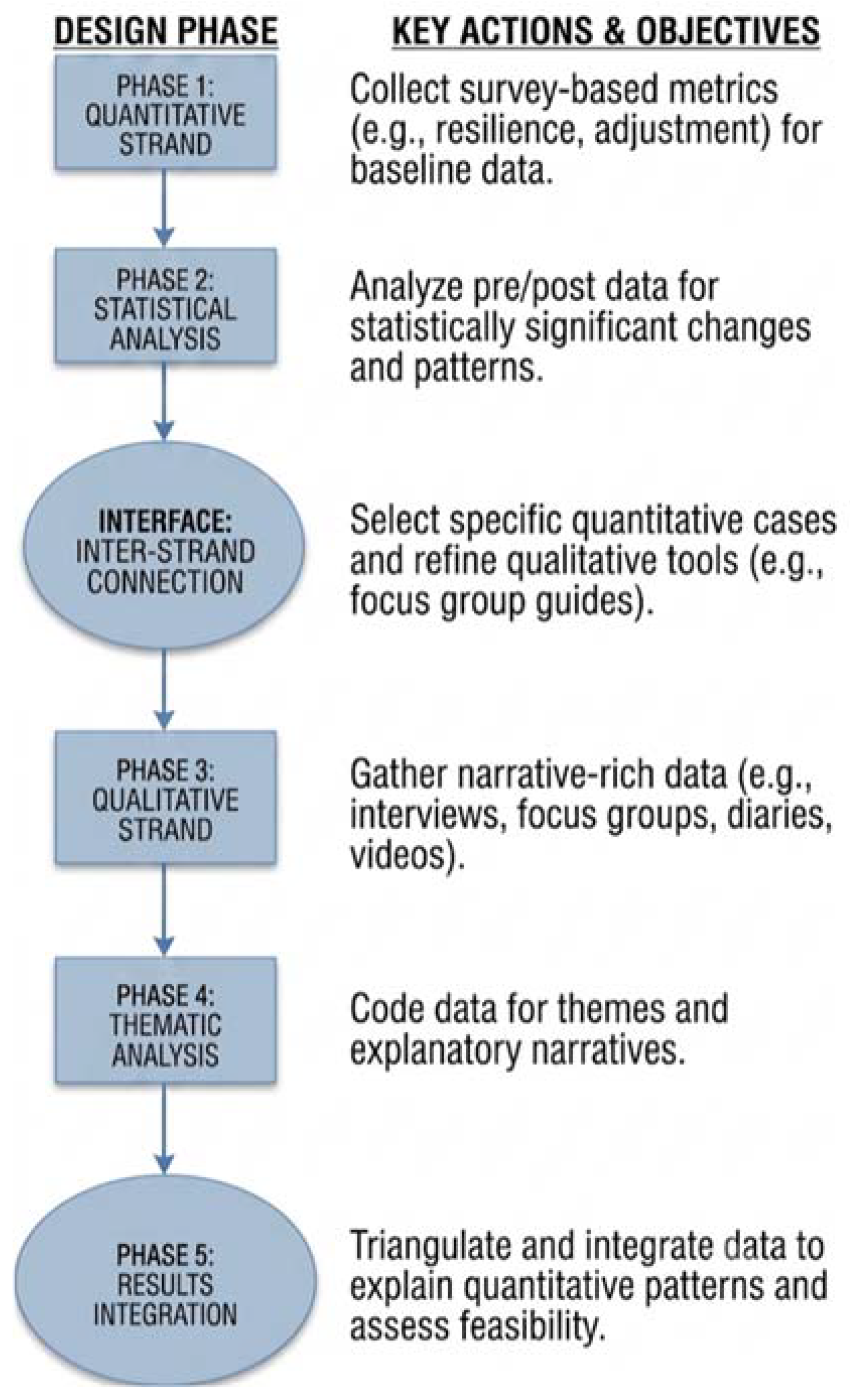
This study employed a sequential explanatory mixed-methods design, in which a quantitative phase was prioritized to evaluate the impact of the intervention, followed by a qualitative phase aimed at explaining the mechanisms of change and the feasibility of implementation. This design enabled the triangulation of statistical findings with participants’ narratives and was particularly appropriate for addressing the heterogeneity of experiences observed in school-based interventions with immigrant and refugee students. [38,39].
Figure 1.
Flowchart of the sequential explanatory design of the pilot study. Note. Adapted from "Using Mixed-Methods Sequential Explanatory Design: From Theory to Practice", by N. V. Ivankova, J. W. Creswell & S. L. Stick, 2006, Field Methods, 18(1), p. 16 (https://doi.org/10.1177/1525822X05282260).[38,39].
Figure 1.
Flowchart of the sequential explanatory design of the pilot study. Note. Adapted from "Using Mixed-Methods Sequential Explanatory Design: From Theory to Practice", by N. V. Ivankova, J. W. Creswell & S. L. Stick, 2006, Field Methods, 18(1), p. 16 (https://doi.org/10.1177/1525822X05282260).[38,39].
2.2. Educational Environment
The pilot study was conducted in schools belonging to the Up-Res project consortium in Germany and Greece: Mindeltal Schulen (Jettingen-Scheppach, Germany), the 4th Primary School of Kallithea (Athens, Greece), the Ukrainian Saturday School in Augsburg (Augsburg, Germany) and Schulen Eringerfeld (Germany). These schools are characterized by contexts with a high density of students with migration and refugee backgrounds; for example, in schools like Mindeltal Schulen (Germany), 65% of the students have this profile and come from low socioeconomic backgrounds whilst at the Ukrainian Saturday School, 100 per cent had been displaced from Ukraine as a result of the war.
The participating schools are secondary schools (Grades 5 to 8), and in the specific case of Greece (4th Primary School of Kallithea), the study focused on Grades 5 and 6 due to the structure of the Greek education system. These schools function not only as academic institutions but also as fundamental resilience ecologies for the emotional stability of displaced children.
2.3. Sampling
A non-probabilistic convenience sampling strategy was used in the quantitative phase, recruiting students enrolled in the project’s partner schools. The final sample consisted of 57 students from four pilot schools. Eligibility criteria were as follows: (a) age between 12 and 15 years; (b) refugee status or migration background; (c) arrival in the host country within the previous five years; and (d) provision of voluntary assent together with informed consent from legal guardians.
For the qualitative phase, a purposive subsample was drawn from the participants included in quantitative phase. Selection did not seek statistical representativeness; rather, it focused on identifying participants able to provide in-depth accounts of the mechanisms of change detected in the quantitative phase. Cases were prioritized on the basis of two criteria: (1) typical cases showing significant improvement after completion of the seven resilience modules, and (2) specific subgroups who contributed multimedia materials, including videos and self-reflection journals, that enabled an audit of programme acceptability.
2.4. Procedure and Intervention
The pilot study was implemented between April and June 2026 in schools in Germany and Greece. The procedure was structured in three consecutive phases:
Initial Assessment (Pre-test): Before the start of the workshops, the CD-RISC-25 scales [14] were administered to establish the participants' baseline.
Intervention Protocol: Students participated in the Up-Res methodology, consisting of four in-person workshops of at least 3 hours each (12 hours of direct contact), focused on seven resilience modules: social competence, optimism, purpose, attachment, problem-solving, coping, and positive self-image. The in-person intervention was reinforced by a digital platform with interactive videos and self-assessment tasks. The content of the modules can be viewed on the UpRes platform.
A second data collection took place upon completion of the first module.
Final Evaluation (Post-test): At the end of the workshops, the instruments were administered again to measure changes in resilience levels and psychosocial functioning.
The procedure was structured and reported following the Template for Intervention Description and Replication (TIDieR) checklist [15]
2.5. Quantitative Phase
An initial baseline assessment was conducted using the 25-item Connor-Davidson Resilience Scale (CD-RISC-25) [14] to determine participants' resilience levels prior to the intervention. The quantitative phase provided the empirical basis for identifying patterns of change among participants and across different centres; subsequently, these preliminary findings guided the development of the qualitative research.
The 25-item version of the Connor–Davidson Resilience Scale (CD-RISC-25) was used to assess psychological resilience [14,40]. This instrument assesses tenacity, tolerance of negative affect, and recovery capacity using a 5-point Likert scale (ranging from 0 = "not at all" to 4 = "almost always"). The CD-RISC [14] was selected because of its established psychometric properties and its use across diverse populations and cultural contexts. In the Balkan region, the Greek version (CD-RISC-25) [14] has been shown to maintain a unidimensional structure identical to the original, exhibiting excellent internal consistency with a Cronbach’s alpha of 0.92; the same applies to the extended version (CD-RISC-25), which has also been successfully validated in the Greek population [41]. Similarly, the initial adaptation of the scale into Turkish confirmed the instrument's stability, demonstrating high temporal reliability (test-retest) and adequate convergent validity with other measures of psychological well-being [42]. More recently, the scale has proven fundamental for studying persistent psychological trauma in contexts of severe geopolitical adversity; This is supported by its validation in Ukrainian—initially developed in medical settings—which has enabled large-scale assessment of the resilience of the civilian population and healthcare personnel exposed to war [43]. Finally, the instrument's versatility and rigor are evident in its seamless integration and validation—in both short and long forms—within German psychological literature [44]. Taken together, this robust international evidence fully supports the accuracy and suitability of the CD-RISC for the purposes of the present research.
The scale conceptualizes resilience as an operational macro-construct comprising seven key sub-dimensions: Adaptability/Flexibility, assessed directly via items 1, 4, and 8 of the full version (e.g., "I am able to adapt when changes occur"); Coping, reflected in items 2, 7, 13, 15, and 18 to measure the active capacity to manage stress; Purpose (or Sense of Life), corresponding to items 3, 9, 20, and 21, which quantify how personal goals and life direction drive the overcoming of obstacles; Optimism, defined by items 6 and 16 to assess the tendency to expect favorable outcomes during crises; Emotional and cognitive regulation, comprising items 14 and 19, which measure the maintenance of attention and the management of emotional pain under pressure; Self-efficacy, supported by items 17 and 25 as the firm belief in one's own competence to solve difficult problems; and Hardiness comprising items 5, 10, 11, 12, 22, 23 and 24, which measures personal strength. The combined scores across these dimensions contribute to the overall resilience construct. This domain-based organization allows assessment of both general adaptive capacity and the contribution of specific psychological mechanisms within the study sample [14].
Sociodemographic survey: An ad hoc questionnaire was designed to collect key sociodemographic and contextual control variables, including age, gender, country of origin, immigration status, and years of residence in the host country. The latter factor was specifically included as a relevant determinant for evaluating acculturation processes and acculturation-related stress.
2.5.1. Quantitative data Analysis
Quantitative data were processed using IBM SPSS Statistics version 25.0 [45].
The analysis followed a predefined sequence consistent with the explanatory sequential design, beginning with data selection and descriptive analysis, and proceeding to assumption testing and inferential procedures to examine changes across assessment points.
First, the dataset was reviewed to verify data completeness, coding accuracy, and score consistency for all study variables. Next, descriptive statistics were calculated to characterize the sample and summarize score distributions, including means, standard deviations, frequencies, and proportions, as appropriate.
Second, the distribution of quantitative variables was examined prior to conducting inferential tests. Normality was assessed using Kolmogorov-Smirnov or Shapiro-Wilk tests—depending on sample characteristics—to determine whether parametric or non-parametric procedures were more appropriate.
Third, longitudinal changes in outcome measures across the three assessment points were analysed. When assumptions for parametric analysis were met, repeated-measures comparisons using parametric procedures were planned. When normality assumptions were not met, non-parametric analyses were used. Accordingly, longitudinal differences were examined using the Friedman test, followed, where appropriate, by post hoc pairwise comparisons using the Wilcoxon signed-rank test.
Effect sizes were calculated to estimate the magnitude of observed changes, and statistical significance was set at p < 0.05.
Additional analyses were conducted to explore the potential influence of the school context and selected sociodemographic variables on the quantitative results.
2.6. Qualitative Phase
The qualitative phase drew on multiple sources of evidence to capture both the students’ views and the teachers’ perspectives regarding the programme’s acceptability and the implementation challenges associated with the seven resilience modules. Data collection methods included semi-structured interviews and focus groups based on open-ended prompts, designed to facilitate a flexible discussion on the programme’s perceived strengths and barriers. In addition, digital self-reflection journals were integrated into the project’s e-learning platform, enabling students to record their subjective impressions after each session. Recordings of the workshops were also analysed as illustrative vignettes to examine the classroom atmosphere and social interaction, treating the audiovisual materials as a unified corpus regardless of their duration or format [46].
Following the logic of the explanatory sequential design, the interview and focus group guides were developed after the preliminary analysis of the quantitative phase results. Data from the CD-RISC-25 scale [14] guided the formulation of the questions. For example, if no significant changes were observed in the "self-image" dimension at a specific center, the qualitative guide included specific questions about the cultural or pedagogical barriers of that particular module. The quantitative results allowed for the selection of cases for further investigation: both typical cases (with expected improvements in resilience) and cases with divergent results, ensuring that the qualitative phase fulfilled its function of explaining the variability of the statistical data.
2.6.1. Qualitative Data Analysis:
The qualitative data were analysed using Lumivero NVivo version 12 [46].
The analytical procedure followed an inductive thematic analysis based on the six phases described by Braun and Clarke: familiarisation with the data, initial code generation, identification of themes, review of themes, definition and naming of themes, and preparation of the final report [47].
Firstly, all qualitative materials were compiled into a single analytical corpus comprising video transcripts, participant comments and interviews. This corpus was reviewed iteratively to familiarise ourselves with the content, identify recurring meanings and preserve the contextual nuances of the multilingual material before formal coding began.
Secondly, an initial cycle of in vivo coding was carried out to ensure that emerging categories remained firmly rooted in the original language used by the migrant children. This procedure preserved participant-centred meanings and reduced premature abstraction during the early stages of interpretation.
Thirdly, codes with conceptual similarities were grouped into preliminary themes relating to the acceptability of the intervention modules and barriers to implementation. These emerging themes were subsequently reorganised through axial coding within the socio-ecological framework, distinguishing between the individual, interpersonal, community and structural levels of influence.
Fourthly, the provisional themes were reviewed across all data sources using methodological triangulation, combining interviews, videos and diaries or feedback materials to assess internal coherence and consistency across sources. Researcher triangulation was also applied, with at least three coders comparing interpretations and resolving discrepancies through consensus.
Fifthly, the final themes were defined and named to explain how participants experienced the intervention, which elements promoted its acceptability, and which contextual constraints limited its implementation. These qualitative findings were subsequently integrated with the quantitative phase to explain the variability in the observed scores and strengthen the credibility of the final inferences [47].
2.6.2. Rigor Criteria
Credibility was reinforced through methodological and researcher triangulation, combining multiple qualitative sources and coding agreed upon by at least three researchers.
Transferability was supported by a detailed description of the school contexts in Germany and Greece and the inclusion of direct quotes from participants.
Dependability and confirmability were reinforced through an audit trail of coding decisions and collaborative reflective sessions that challenged prior assumptions regarding resilience in refugee populations [47].
2.7. Ethics and Safety Procedures
The research protocol received a favourable opinion from the UCAM Ethics Committee (CE062611) and was conducted in accordance with the Declaration of Helsinki [48].
Consent and Language: Written informed consent was obtained from the parents or legal guardians, and the minors provided voluntary assent. To ensure accurate comprehension and avoid linguistic bias, all study materials, including forms and scales were translated into Turkish, Ukrainian, Greek and German.
Anonymity: Data were processed using numerical IDs and pseudonyms to ensure that no personal information was identifiable outside the school environment.
Safety Protocol (Referral Pathway): Given the vulnerability of the population (especially war refugees), a protocol was established for immediate referral to local mental health services in the event of severe emotional distress or traumatic memories being detected during the administration of the CD-RISC scale [14] or the workshops.
2.8. Integration procedure
In accordance with the logic of the explanatory sequential design, the interview and focus group guides were incorporated following the preliminary analysis of the quantitative results. Findings from the CD-RISC-25 [14] were used to identify critical areas requiring deeper qualitative exploration. For example, when limited change was observed in the self-image dimension at a specific center, the qualitative guide incorporated specific questions regarding cultural or pedagogical barriers that might have affected that module. This integration strategy allowed the qualitative phase to contextualize the quantitative findings and generate a deeper understanding of the variation in programme response across different settings.
3. Results
3.1. Quantitative Results:
The sample consisted of refugee students of different nationalities in various countries, who had lived in their host country for an average of 4.04 ± 1.69 years. The sample comprised 57 participants with a mean age of 12.77 ± 1.15 years (Table 1).
The sample had a majority of male participants (Table 1).
The mean total scores at each assessment point (pre-test, post-test after one module completed and post-test after all modules completed) are shown in Table 2. The total results for the resilience macro-construct are shown in the first row, while the remaining rows display the results for each of the seven dimensions assessed by the CD-RISK 25 scale.
Table 3 presents the results of the Friedman and Wilcoxon post hoc comparisons; the first row refers to the resilience macro-construct (total score), while the remaining rows refer to the seven dimensions assessed by the CD-RISK 25 scale.The assumptions of normality were not met for several variables; the non-parametric Friedman test was used to assess longitudinal changes (Table 3). Statistically significant differences were observed between the three assessment time points in all dimensions analysed (all p < .001). The total score showed the largest overall effect size, χ² (2) = 71.29, p < 0.001, W = 0.64. Wilcoxon post hoc comparisons revealed significant differences between the pre-test and post-test after one completed module, between the pre-test and post-test after all completed modules, and between the two post-tests, with large effect sizes (r = 0.54–0.77).
Regarding each of the dimensions evaluated in the test, significant differences were also found (Table 3). Emotional regulation also showed significant differences, χ²(2) = 30.83, p < 0.001, W = 0.28, with moderate to large effect sizes (r = 0.45 and r = 0.60). Coping strategies also showed a large overall effect, χ²(2) = 56.91, p < 0.001, W = 0.51, with moderate to large effect sizes (r = 0.35–0.71). Adaptation showed significant differences over time, χ²(2) = 31.77, p < 0.001, W = 0.28, also with moderate to large effect sizes (r = 0.35–0.62). The purpose dimension showed significant overall differences, χ²(2) = 27.94, p < 0.001, W = 0.25. Optimism showed significant differences across the three assessment time points, χ²(2) = 23.62, p < 0.001, W = 0.21. All three post hoc comparisons were significant, with moderate effect sizes (r = 0.34–0.56). Self-efficacy had the smallest overall effect size, χ²(2) = 19.01, p < 0.001, W = 0.17. Only the comparison between pre-test and post-test 2 was significant (r = 0.43). Finally, hardiness showed one of the largest overall effects, χ²(2) = 54.16, p < 0.001, W = 0.49. Post hoc comparisons indicated significant differences between all analysed time points, with moderate to large effect sizes (r = 0.41 – 0.68).
Figure 2A presents the statistical differences in total resilience scores (macro-construct). The total score (Figure 2A) showed that students improved their test results after completing all modules, increasing from the pre-test score (60.44 ± 12.72) to the post-test score (74.51 ± 15.90) after completing all modules. These differences were statistically significant (p < 0.001). There were also significant differences between the total post-test score after completing one module (68.88 ± 15.67) and both the pre-test and the post-test after completing all modules (p < 0.001, respectively).
When examining each of the seven dimensions evaluated, a similar pattern emerges across all of them (Figure 2B). In the dimensions of coping, adaptation, optimism, and hardiness, the differences were significant across the three intervention time points. In all cases, the lowest score was obtained in the pre-test, and the highest score was obtained in the post-test after completing all modules. Although the highest score in these dimensions was in the post-test after completing all modules, an improvement was already observed in the post-test after completing just one module. For example, in coping, the pre-test score was 11.98 ± 2.87, while in the post-test after completing one module, it was 13.82 ± 4.19, a statistically significant difference (p < 0.001). The coping score on the post-test after completing all modules was 14.84 ± 3.48, with these differences being statistically significant compared to both the pre-test and the post-test after completing one module (p < 0.001 and p < 0.03, respectively). Post hoc analyses of the adaptation dimension also showed significant differences at all three time points, with the greatest difference between the pre-test and post-test groups after completing all modules (p < 0.001), while the significance was lower between the pre-test and post-test groups after completing one module (p < 0.01) or between the two post-tests (p < 0.05). The lowest adaptation score was obtained in the pre-test (6.93 ± 1.91), followed by the post-test score after completing one module (7.98 ± 1.91), with the highest score (8.67 ± 2.31) obtained after completing all modules. Optimism levels also increased after the intervention, showing significant differences (p < 0.05; p < 0.001, respectively), between pre-test (4.89 ± 1.81) and post-test after completing one module (5.65 ± 1.65) and between the pre-test and post-test after one module (6.11 ± 1.58). The differences between the optimism scores at the two post-test time points were also statistically significant (p < 0.05). Finally, hardiness showed the greatest changes across the three time points, increasing significantly after the completion of all modules. At baseline, hardiness scores were 17.09 ± 5.15 before the intervention, 19.39 ± 5.42 after completing one module, and 21.04 ± 5.39 after completing all modules of the intervention. These changes in hardiness after completing one module or all modules showed significant differences compared to the initial test (p < 0.001 in both cases). The differences between the two post-tests were also significant (p < 0.01).
Differences between groups in the emotional regulation and purpose dimensions were only observed between baseline and each post-test, but no differences were found between the two post-tests (Figure 2B). In the emotional regulation dimension, students had a baseline score of 4.05 ± 1.94, increasing to 4.89 ± 2.04 after completing one module (p < 0.01) and to 5.39 ± 1.96 (p < 0.001) after completing all modules. A similar pattern was observed in the purpose dimension, with the lowest score before the intervention being 9.82 ± 2.84, increasing to 11.02 ± 3.14 after completing one module (p < 0.05) and to 12.04 ± 2.79 (p < 0.001) after completing all intervention modules. However, the comparison between the two post-tests performed did not reach significance after Bonferroni correction, neither in the emotional regulation dimension nor in the purpose dimension (Figure 2B).
Self-efficacy was the only dimension that showed statistically significant differences (p < 0.01) between the values at the beginning of the intervention (5.67 ± 1.34) and at the end of the intervention (6.44 ± 1.49). However, the post-test after completing only one module did not show statistically significant differences between the initial and final groups.
3.2. Qualitative Results
Before presenting the findings, it is necessary to detail the execution and processing of the qualitative corpus across the four participating schools. The original design called for conducting one focus group with families and four focus groups with students per school, as well as individual student interviews [47].
In strict compliance with international personal data protection regulations and ethics committee requirements, the transfer and exchange of audiovisual material between centres was contingent upon obtaining fully signed informed consent forms. Due to restrictions regarding the signing of these documents at several institutions, the audiovisual archive available for in-depth analysis was limited to a total of 12 recordings from the participating German school (comprising 4 individual student interviews and 8 focus group sessions with students of Turkish origin).
Specialized software (NVivo) [46] was used for qualitative processing. However, the initial transcription and import phase revealed that automated translation systems for Turkish and Ukrainian exhibited severe inconsistencies regarding the fidelity of the discourse, thereby jeopardizing the validity of the content analysis for both the interviews and the focus groups. Faced with this linguistic and technical limitation—and aiming to ensure the study's analytical rigor—a structured secondary data collection strategy was adopted: teachers and facilitators present at each session were asked to prepare a concise analytical report on the groups and interviews conducted at their respective schools.
This procedural adaptation enabled the triangulation of data derived from the direct NVivo transcription of authorized audiovisual recordings with the qualitative reports prepared by the teaching staff. This process resulted in a robust data matrix that met mixed-methods standards, thereby safeguarding both the ethical quality and the conceptual depth of the analysed material.
The qualitative analysis of the school reports identified five interrelated themes: growing engagement, contextual relevance of the materials, perceived gains in resilience-related skills, strengthened interpersonal trust and help-seeking, and practical implementation considerations. Across sites, teachers described the programme as acceptable and developmentally appropriate, with students showing sustained or increasing participation throughout the intervention [11,22].
Student engagement appeared to increase when resilience concepts were delivered through interactive, concrete, and experience-based activities. Teachers highlighted the value of games, role play, group discussion, art-based methods, scenario analysis, and narrative materials in making abstract psychological content accessible and meaningful to students [47]. The combination of collective discussion and individual reflection also seemed to support active participation and personal processing of the material.
A second theme concerned the contextual relevance of the intervention content. Reports from both Germany and Greece indicated that students responded particularly strongly to stories and scenarios reflecting migration-related experiences, bullying, language barriers, and adaptation to new school environments. This relevance appeared to increase participation while reducing feelings of being singled out, especially when practitioners framed migration-related difficulties as common human experiences rather than as markers of personal deficit.
Teachers also perceived improvements in several resilience-related competencies that were consistent with the quantitative pattern of gains. These included better coping with stress and difficulties, more positive thinking, increased self-confidence, improved problem-solving, and greater recognition of resilience as a learnable skill. In addition, students were described as demonstrating greater empathy and cooperation, as well as increased awareness of when and how to seek support from trusted adults.
A further theme was the development of a supportive relational space between students and facilitators. In the German reports, repeated discussion of emotions and coping appeared to foster familiarity and trust, with some students later approaching practitioners outside the sessions or expressing a wish to remain in contact if future difficulties arose. This suggests that the intervention was perceived not only as a skills-based programme, but also as an opportunity to identify adults as available sources of support.
Finally, the reports identified several implementation issues relevant to future scale-up. Teachers considered the programme feasible overall, but noted the need for more time, careful pacing, smaller groups, and additional teacher training to maximise reflection and participation, particularly for students who needed more encouragement to speak in front of peers. Taken together, the qualitative findings indicate that the Up-Res intervention was perceived as feasible, engaging, and meaningful across participating schools, while also highlighting concrete conditions that may improve implementation in future iterations [11,22,47].
4. Discussion
The present findings suggest that a school-based resilience intervention may be feasible and meaningful for immigrant and refugee students when implemented using participatory, context-sensitive, and developmentally appropriate methods; students demonstrated increasing engagement, greater familiarity with resilience-related concepts, and perceived improvements in coping skills, self-confidence, emotional regulation, help-seeking and hardiness behaviour throughout the programme’s implementation.
This pattern aligns with existing literature, which identifies schools as accessible and practical settings for preventive mental health initiatives targeting migrant and refugee youth; schools are familiar environments that facilitate early needs identification and allow for reaching young people who might otherwise not access support. At the same time, our contribution is best understood as pilot evidence (practice-based) regarding implementation feasibility and acceptability in real-world school settings, rather than as definitive causal evidence of efficacy [1,2,3,4,5,22,49].
The mixed-methods design strengthens the interpretation of these findings because the qualitative strand helps explain the direction of the quantitative CD-RISC changes and clarifies how students and teachers experienced the intervention in practice. Quantitatively, the present study found significant improvement across all assessed dimensions over time, with the largest overall effects for the total score and resilience, and a smaller effect for self-efficacy. Qualitatively, teachers described stronger self-confidence, more adaptive coping, more positive thinking, and greater willingness to seek support, indicating that the observed score changes were accompanied by meaningful shifts in everyday functioning [38,39,50,51].
These observed improvements in active coping strategies, emotional regulation, hardiness and self-efficacy closely align with findings from school-based resilience interventions grounded in transactional stress models, such as the STARK initiative in vocational schools [52]. The STARK evaluation demonstrated that structured, teacher-led classroom modules effectively strengthen students' generalized self-efficacy, foster problem-focused coping, and help adolescents reframe daily environmental demands from perceived threats into manageable challenges.
A plausible mechanism is that the intervention made abstract psychosocial constructs concrete and usable through stories, games, discussion, role play, art-based tasks, and guided reflection, which appeared to increase engagement and facilitate the application of coping and emotion-regulation strategies in everyday situations. Similar acceptability mechanisms have been reported in other school-based interventions, where participants particularly valued breathing exercises, games, workbooks, guided group activities, and opportunities to share experiences with peers [11,22,53,54].
The finding that migration-sensitive content appeared to increase participation and reduce feelings of being singled out is also important in light of broader evidence that accessibility is shaped by contextual, cultural, and systemic factors, including stigma, acculturative stressors, and the quality of school–family–service partnerships [2]. This interpretation is compatible with strengths-based intervention research suggesting that programmes that emphasize assets, coping, and social support can improve engagement and reduce stigma more effectively than deficit-oriented approaches alone [10,33].
Our findings further suggest that the programme’s potential benefits extend beyond individual coping to the relational and school-climate level, with reports of greater empathy, cooperation, trust, and willingness to seek support from trusted adults. This is consistent with prior studies showing that school-based interventions for newcomer youth can improve connectedness, belonging, and perceived social support, even when effects on symptom outcomes are more modest or mixed [3,11,33,55].
These findings should nevertheless be interpreted with caution because the wider evidence base for school-based psychosocial interventions with refugee and migrant youth remains limited, methodologically heterogeneous, and often difficult to compare across settings, outcomes, and intervention models [4,27,50]. Even controlled studies report nuanced rather than uniformly positive effects, including null average effects, subgroup moderation, improvements concentrated in classroom climate or social support, and dose-dependent associations for some outcomes only [3,26,34,35,56].
The present study also has the limitations typical of a pilot study: a small convenience sample, purposive qualitative subsampling, and a design oriented toward feasibility and explanatory depth rather than statistical representativeness or robust causal inference. In addition, implementation quality is likely to matter as much as curriculum content, since the reports identified pacing, group size, time, and facilitator preparation as relevant conditions for future scale-up, a point that is echoed in feasibility work emphasizing fidelity, acceptability, and delivery conditions before definitive trials [20,22,51,53].
Furthermore, evidence from structured CBT/DBT-based skills interventions suggests that training on-site school and institutional staff to deliver emotion-regulation and coping modules may be a feasible implementation strategy. This is consistent with findings from the multicenter START NOW evaluation by Stadler et al. [57], which indicated high implementation acceptability and participant satisfaction when trained professionals delivered structured skills-based interventions. The study further suggested that the benefits of emotion-regulation and coping skills may become more apparent over time as young people consolidate and apply newly acquired strategies in their everyday environments. These findings provide a relevant point of comparison for the present study, while differences in intervention setting, population, and study design should be taken into account when interpreting their applicability to Up-Res.
Future studies should therefore evaluate Up-Res using larger, controlled, and longitudinal designs, while retaining mixed-methods components to clarify mechanisms, contextual fit, and sources of variation across centres [27].
They should also examine more directly who benefits most, under what conditions, and whether effects differ by baseline resilience, mobility history, age, gender, daily stressors, school type, or intervention dose, because these moderators have emerged repeatedly in the broader literature [3,10,12,26,35].
These qualitative and quantitative findings closely mirror the emerging evidence from large-scale European research initiatives funded under Horizon 2020, such as the RefugeesWellSchool project [3,54]. Similar to our preliminary observations, multi-country evaluations across European secondary schools demonstrate that universal, classroom-embedded psychosocial interventions—particularly those utilizing creative, experiential, and participatory methodologies—can successfully enhance peer support, strengthen social connectedness, and improve the overall school climate among newcomer and refugee youth [53,54,55,56]. Furthermore, both the Up-Res pilot and the Horizon 2020 trial outcomes converge on the realization that intervention success is heavily dictated by implementation conditions: flexible pacing, language accessibility, and facilitators' ability to translate abstract emotional constructs into concrete, non-stigmatizing activities are essential mechanisms for ensuring acceptability and sustained engagement in diverse European classrooms [36,53].
In sum, the present study supports presenting Up-Res as a feasible, contextually meaningful, and promising school-based intervention for immigrant and refugee students, with preliminary indications of benefit in resilience-related skills, help-seeking, and relational inclusion. Its strongest contribution is a mixed-methods account of how such an intervention can be implemented, experienced, and refined in diverse school contexts, while the question of effectiveness remains for larger confirmatory research.
The current findings are consistent with an emerging line of German research that supports school-based approaches to psychosocial prevention and the promotion of resilience amongst refugee and migrant children and adolescents [58]. Previous German work has specifically addressed the development of a universal school-based intervention to strengthen resilience amongst refugee children, whilst more recent research has demonstrated the feasibility and acceptance of classroom-based mental health approaches amongst Ukrainian refugees in Germany [59].
Research from Poland also highlights the importance of the school context for resilience amongst refugee children from Ukraine. In a study of 248 Ukrainian children aged 10 to 15 who had migrated to Poland following the outbreak of the war, Korcz et al [3] found that positive school experiences and support from teachers were associated with higher levels of resilience, underscoring the potential role of supportive school environments in promoting psychosocial adjustment amongst displaced children.
These findings are consistent with a growing body of European evidence highlighting the role of school-based psychosocial support in promoting resilience and well-being amongst young refugees and migrants. German research has examined universal, school-based approaches to promoting resilience amongst refugee children, whilst research from Poland has shown that positive school experiences and support from teachers are associated with greater resilience amongst Ukrainian refugee children [60,61]. Recent intervention research in Polish schools has also examined the feasibility of delivering structured psychosocial interventions to Ukrainian refugee youth [60].
5. Conclusions
Overall, the present results suggest that Up-Res is a feasible and contextually meaningful school-based intervention for immigrant students, with preliminary indications of benefit in resilience-related skills, social connectedness, and inclusive classroom processes. The strongest contribution of the study is therefore not a definitive claim of effectiveness, but rather a mixed-methods account of how a resilience intervention can be implemented, experienced, and refined in diverse European school settings.
Supplementary Materials
The blank informed consent and assent forms in multiple languages (English, Ukrainian, Turkish, German, and Greek) are available online as Supplementary Files.
Author Contributions
Conceptualization, Miriam Sánchez-Hernández, and Eva Vegue-Parra; methodology, Miriam Sánchez-Hernández, Magdalena Gómez Díaz, Dolores Jordán-Villarrubia, Estela María Pérez-Jiménez and Eva Vegue-Parra; software, Eva Vegue-Parra, Miriam Sánchez-Hernández; validation, Miriam Sánchez-Hernández, Magdalena Gómez Díaz, Dolores Jordán-Villarrubia, Estela María Pérez-Jiménez, Eduardo Carrión García, Javier Sánchez-Gálvez, Olena Yaremko and Eva Vegue-Parra; formal analysis, Miriam Sánchez-Hernández and Eva Vegue-Parra; investigation, Miriam Sánchez-Hernández, Magdalena Gómez Díaz, Dolores Jordán-Villarrubia, Estela María Pérez-Jiménez, Eduardo Carrión García, Javier Sánchez-Gálvez, Olena Yaremko and Eva Vegue-Parra; resources, Eva Vegue-Parra; data curation, Eva Vegue-Parra, Miriam Sánchez-Hernández, Magdalena Gómez Díaz, and Dolores Jordán-Villarrubia; writing—original draft preparation, Miriam Sánchez-Hernández and Eva Vegue-Parra; writing—review and editing, Magdalena Gómez Díaz, Dolores Jordán-Villarrubia, Estela María Pérez-Jiménez, Eduardo Carrión García, Javier Sánchez-Gálvez, and Olena Yaremko; visualization, Miriam Sánchez-Hernández, and Eva Vegue-Parra; supervision, Miriam Sánchez-Hernández, Magdalena Gómez Díaz, Dolores Jordán-Villarrubia, Estela María Pérez-Jiménez, Eduardo Carrión García, Javier Sánchez-Gálvez, and Eva Vegue-Parra; project administration, Eva Vegue-Parra; funding acquisition, Eva Vegue-Parra. All authors have read and agreed to the published version of the manuscript.
Funding
This research was supported by the European Union’s Erasmus+ Programme under the project "Up-Res: Promoting academic achievement and inclusion of students through resilience building" (Action Type: KA220-BY-24-18-256528). Views and opinions expressed are however those of the author(s) only and do not necessarily reflect those of the European Union or the European Education and Culture Executive Agency (EACEA). Neither the European Union nor the granting authority can be held responsible for them. The funder had no role in the design of the study, the collection, analysis, or interpretation of the data, or the writing of the manuscript.

Institutional Review Board Statement
The study was conducted in accordance with the Declaration of Helsinki and approved by the Ethics Committee of Fundación Universitaria San Antonio de Murcia (UCAM) (protocol code CE062611 and date of approval 26/06/2026).
Informed Consent Statement
Informed consent was obtained from all subjects involved in the study.
Data Availability Statement
The datasets generated and/or analysed during the current study are available from the corresponding author on reasonable request. Data are not publicly available due to ethical and privacy restrictions, as the dataset includes information from minor participants and qualitative materials that could increase re-identification risk despite pseudonymization.
Acknowledgments
The authors would like to express their gratitude to their pupils, their families and the coordinating teachers for their collaboration in launching the Up-Res pilot study. Special thanks go to the schools that participated as members of the consortium for their support in coordinating and implementing the Up-Res project: Mindeltal Schulen (Jettingen-Scheppach, Germany), the 4th Primary School of Kallithea (Athens, Greece), the Ukrainian Saturday School in Augsburg (Augsburg, Germany) and Schulen Eringerfeld (Germany).
Conflicts of Interest
The authors declare no conflicts of interest. The funders had no role in the design of the study; in the collection, analyses, or interpretation of data; in the writing of the manuscript; or in the decision to publish the results.:
Abbreviations
The following abbreviations are used in this manuscript:
| UCAM | Universidad Católica de Murcia |
| WP2 | WorkPage 2 |
| KA220-SCH | Key Action 220–School Education |
| CD-RISC | Connor–Davidson Resilience Scale |
| Up-Res | Promoting academic achievement and inclusion through resilience building. Academic Achievement and Student Inclusion through the Development of Mental Resilience |
References
- Rodríguez, S.; Valle, A.; Gironelli, L.M.; Guerrero, E.; Regueiro, B.; Estévez, I. Rendimiento y bienestar de estudiantes nativos e inmigrantes: Análisis comparativo basado en PISA 2018. J. Adolesc. 2020, 82, 25–38. [Google Scholar]
- Howard, R.; Noyes, J.; Windle, G.; Morgan, K. Psychosocial interventions for refugee and asylum-seeking children and adolescents: A systematic review and meta-analysis. Eur. Child Adolesc. Psychiatry 2024, 33, 1125–1142. [Google Scholar]
- Spaas, C.; Aalto, S.; Peltonen, K.; Opaas, M.; Derluyn, I.; De Haene, L. School-based interventions for refugee adolescents: A systematic review of mental health and psychosocial outcomes. Child Dev. 2023, 94, 1410–1432. [Google Scholar] [CrossRef] [PubMed]
- Tyrer, R.A.; Fazel, M. School and community-based interventions for refugee and asylum seeking children: A systematic review. PLoS ONE 2014, 9, e89359. [Google Scholar] [CrossRef] [PubMed]
- European Commission/EACEA/Eurydice. Supporting Refugee Learners from Ukraine in Schools in Europe; Publications Office of the European Union: Luxembourg, 2022. [Google Scholar] [CrossRef]
- Ungar, M.; Theron, L. Resilience and mental health: How multisystemic processes contribute to positive outcomes. Lancet Psychiatry 2020, 7, 441–448. [Google Scholar] [CrossRef] [PubMed]
- Masten, A.S. Global perspectives on resilience in children and youth. Child Dev. 2014, 85, 6–20. [Google Scholar] [CrossRef] [PubMed]
- Panter-Brick, C.; Dajani, R.; Eggerman, M. Building socio-ecological resilience in displaced populations: A developmental perspective. Child Dev. Perspect. 2023, 17, 95–104. [Google Scholar] [CrossRef]
- Southwick, S.M.; Bonanno, G.A.; Masten, A.S.; Panter-Brick, C.; Yehuda, R. Resilience definitions, theory, and challenges: Interdisciplinary perspectives. Eur. J. Psychotraumatol. 2014, 5, 25338. [Google Scholar] [CrossRef] [PubMed]
- Santiago, C.D.; Raviv, T.; Lawler, J.M.; Farago, F. Strengths-based mental health interventions for immigrant and refugee youth: A systematic review. Clin. Child Fam. Psychol. Rev. 2025, 28, 45–68. [Google Scholar]
- Crooks, C.V.; Kubishyn, N.; Syeda, M.M.; Dare, L. The STRONG resiliency program for newcomer youth: A mixed-methods exploration of youth experiences and impacts. Int. J. Sch. Soc. Work 2020, 5, 2. [Google Scholar] [CrossRef]
- Tam, C.C.; Benner, A.D.; Chen, S. Protective factors and resilience among immigrant youth: A socio-ecological review. Hum. Dev. 2020, 63, 210–235. [Google Scholar] [CrossRef] [PubMed]
- Luo, S.; Hu, J.; Zhang, J.; Mei, Z.; Tang, Z.; Luo, S. The correlation between resilience and mental health in adolescents and young adults: A systematic review and meta-analysis. Front. Psychiatry 2025, 16, 1536553. [Google Scholar] [CrossRef] [PubMed]
- Connor, K.M.; Davidson, J.R.T. Development of a new resilience scale: The Connor-Davidson Resilience Scale (CD-RISC). Depress. Anxiety 2003, 18, 76–82. [Google Scholar] [CrossRef] [PubMed]
- Hoffmann, T.C.; Glasziou, P.P.; Boutron, I.; Milne, R.; Perera, R.; Moher, D.; Altman, D.G.; Barbour, V.; Macdonald, H.; Johnston, M.; et al. Better reporting of interventions: Template for intervention description and replication (TIDieR) checklist and guide. BMJ 2014, 348, g1687. [Google Scholar] [CrossRef] [PubMed]
- Masten, A.S.; Barnes, A.J. Resilience in children: Developmental perspectives. Children 2018, 5, 98. [Google Scholar] [CrossRef] [PubMed]
- Windle, G.; Bennett, K.M.; Noyes, J. A methodological review of resilience measurement scales. Health Qual. Life Outcomes 2011, 9, 8. [Google Scholar] [CrossRef] [PubMed]
- Ellis, B.H.; Abdi, S.M.; Winer, J.P. Mental Health Practice with Immigrant and Refugee Youth: A Socioecological Framework; American Psychological Association: Washington, DC, USA, 2020. [Google Scholar] [CrossRef]
- Ungar, M. The social ecology of resilience: Addressing contextual and cultural ambiguity of a nascent construct. Am. J. Orthopsychiatry 2011, 81, 1–17. [Google Scholar] [CrossRef] [PubMed]
- Herrero Romero, R.; Ruiz-Robledillo, N.; Moya-Albiol, L. School-based socio-ecological resilience interventions for displaced youth in European contexts: A narrative review. Eur. J. Psychol. Educ. 2026, 41, 105–124. [Google Scholar]
- Sirin, S.R.; Sin, E.; Clingain, C. Socio-ecological predictors of resilience among refugee youth. Dev. Psychol. 2021, 57, 1668–1680. [Google Scholar] [CrossRef] [PubMed]
- Luitel, N.P.; Jordans, M.J.D.; Kohrt, B.A. Implementation, feasibility, and acceptability of school-based psychosocial resilience interventions for newcomer students. Sch. Ment. Health 2026, 18, 88–104. [Google Scholar]
- Quinton, M.L.; Clarke, F.J.; Parry, B.J.; Cumming, J. Evaluating the My Strengths Training for Life™ program to improve resilience and well-being in homeless youth. J. Community Psychol. 2021, 49, 1296–1314. [Google Scholar] [CrossRef] [PubMed]
- Aalto, S.; Punamäki, R.-L.; Vänskä, M.; Kankaanpää, R.; Turunen, T.; Lahtinen, O.; Derluyn, I.; Spaas, C.; De Haene, L.; Jervelund, S.; et al. Patterns of mental health problems and resilience among immigrant and refugee adolescents: A latent profile analysis. Eur. J. Psychotraumatol. 2025, 16, 2479924. [Google Scholar] [CrossRef] [PubMed]
- Poulou, M. Social resilience within a socio-emotional learning framework: Teachers' perceptions in Greece. Emot. Behav. Diffic. 2007, 12, 91–104. [Google Scholar] [CrossRef]
- Peltonen, K.; Aalto, S.; Vänskä, M.; Lepistö, R.; Punamäki, R.-L. Effectiveness of school-based intervention on mental health and social relationships among immigrant and refugee adolescents. J. Youth Adolesc. 2022, 51, 1412–1428. [Google Scholar]
- Özdemir, M.; Stattin, H.; Çelik, S. Universally targeted school interventions promoting adjustment among newcomer youth: A meta-analysis. J. Sch. Psychol. 2026, 103, 101280. [Google Scholar]
- Atak, M.; Önal, A.E.; Şimşek, Z.; İşsever, H. Health risks management program in schools: An operational study in Türkiye. Int. J. Environ. Res. Public Health 2023, 20, 3718. [Google Scholar] [CrossRef] [PubMed]
- Noyes, J.; Morgan, K.; Windle, G.; Howard, R. Evaluating implementation fidelity and outcomes in universal school resilience programs. BMC Public Health 2025, 25, 412. [Google Scholar]
- Meroni, E.C.; Velasco, R. Promotive vs. trauma-focused mental health programs in European schools: A policy review. Eur. Educ. Res. J. 2023, 22, 580–601. [Google Scholar]
- Fazel, M.; Betancourt, T.S. Preventive mental health interventions for refugee children and adolescents in resettlement contexts. Lancet Child Adolesc. Health 2021, 5, 134–144. [Google Scholar]
- Llistosella, M.; Torné, C.; García-Ortiz, M.; López-Hita, G.; Ortiz, R.; Hernández-Montero, L.; Guallart, E.; Uña-Solbas, E.; Miranda-Mendizabal, A. Promoting resilience in adolescents at risk: Study protocol for a cluster randomized controlled trial within the school resilience intervention. Front. Psychol. 2023, 13, 1066874. [Google Scholar] [CrossRef] [PubMed]
- Seff, I.; Metzler, J.; Savage, K.; Stark, L. School connectedness and resilience among refugee adolescents: Findings from a multi-country pilot. Child Abus. Negl. 2024, 149, 106620. [Google Scholar]
- Kevers, R.; De Haene, L.; Derluyn, I. Mental health interventions for refugee youth in school settings: A cluster-randomized evaluation. J. Child Psychol. Psychiatry 2022, 63, 1020–1031. [Google Scholar] [CrossRef] [PubMed]
- Brunak, S.; Jensen, T.K.; Skovdal, M. Dose-response relationships in school-based psychosocial interventions for newly arrived migrants. Int. J. Intercult. Relat. 2025, 101, 101980. [Google Scholar] [CrossRef]
- Ma, X.; Zhao, Y.; Liu, Y. Feasibility, pacing, and language accessibility in school-based interventions for refugee youth: A systematic review. Educ. Psychol. Rev. 2023, 35, 78. [Google Scholar] [CrossRef]
- Cumming, J.; Clarke, F.J.; Holland, M.J.G.; Parry, B.J.; Quinton, M.L.; Cooley, S.J. A feasibility study of the My Strengths Training for Life™ (MST4Life™) program for young people experiencing homelessness. Int. J. Environ. Res. Public Health 2022, 19, 3320. [Google Scholar] [CrossRef] [PubMed]
- Creswell, J.W.; Plano Clark, V.L. Designing and Conducting Mixed Methods Research, 3rd ed.; SAGE Publications: Thousand Oaks, CA, USA, 2018. [Google Scholar]
- Ivankova, N.V.; Creswell, J.W.; Stick, S.L. Using mixed-methods sequential explanatory design: From theory to practice. Field Methods 2006, 18, 3–20. [Google Scholar] [CrossRef]
- Campbell-Sills, L.; Stein, M.B. Psychometric analysis and refinement of the Connor-Davidson Resilience Scale (CD-RISC): Validation of a 10-item measure of resilience. J. Trauma. Stress 2007, 20, 1019–1028. [Google Scholar] [CrossRef] [PubMed]
- Galanis, P.; Psomiadi, M.E.; Karagkounis, C.; Liamopoulou, P.; Manomenidis, G.; Panayiotou, G.; Bellali, T. Psychometric properties of the Greek version of the Connor–Davidson Resilience Scale (CD-RISC-10) in a sample of nurses. Int. J. Environ. Res. Public Health 2023, 20, 6752. [Google Scholar] [CrossRef] [PubMed]
- Karaırmak, Ö. Establishing the psychometric qualities of the Connor-Davidson Resilience Scale (CD-RISC) using exploratory and confirmatory factor analysis in a sample of trauma survivors. Psychiatry Res. 2010, 179, 350–356. [Google Scholar] [CrossRef] [PubMed]
- Shkolina, N.V.; Shapoval, I.I.; Orlova, I.V.; Kedyk, I.O.; Stanislavchuk, M.A. Adaptation and validation of the Ukrainian version of the Connor-Davidson Resilience Scale-10 (CD-RISC-10): Testing in patients with ankylosing spondylitis. Rheumatology 2020, 80, 35–42. [Google Scholar] [CrossRef]
- Wollny, A.I.; Jacobs, I. Validity and reliability of the German versions of the CD-RISC-10 and CD-RISC-2. Curr. Psychol. 2021, 42, 11612–11624. [Google Scholar] [CrossRef] [PubMed]
- Pallant, J. SPSS Survival Manual: A Step by Step Guide to Data Analysis Using IBM SPSS, 7th ed.; McGraw-Hill Education: London, UK, 2020. [Google Scholar]
- Lumivero. NVivo (Version 12 or later); Lumivero: Denver, CO, USA, 2023; Available online: https://www.lumivero.com (accessed on 10 September 2026).
- Braun, V.; Clarke, V. Using thematic analysis in psychology. Qual. Res. Psychol. 2006, 3, 77–101. [Google Scholar] [CrossRef]
- World Medical Association. World Medical Association Declaration of Helsinki: Ethical principles for medical research involving human subjects. JAMA 2013, 310, 2191–2194. [Google Scholar] [CrossRef] [PubMed]
- Fazel, M.; Garcia, J.; Stein, A. The right location? Experiences of refugee adolescents seen by school-based mental health services. Clin. Child Psychol. Psychiatry 2016, 21, 368–380. [Google Scholar] [CrossRef] [PubMed]
- Sullivan, A.L.; Simonson, G.R. A systematic review of school-based mental health interventions for refugee youth. Sch. Psychol. Rev. 2016, 45, 505–523. [Google Scholar]
- Bowen, D.J.; Kreuter, M.; Spring, B.; Cofta-Woerpel, L.; Linnan, L.; Weiner, D.; Bakken, S.; Kaplan, C.P.; Squiers, L.; Fabrizio, C. How we design feasibility studies. Am. J. Prev. Med. 2009, 36, 452–457. [Google Scholar] [CrossRef] [PubMed]
- INIFES / SCHULEWIRTSCHAFT Akademie. Untersuchungsergebnisse der wissenschaftlichen Begleitung von STARK 2017 – 2018 (Evaluationsstudie); Institut für empirische Sozialforschung: Stadtbergen/München, Germany, 2019. [Google Scholar]
- Kankaanpää, R.; Aalto, S.; Vänskä, M.; Lepistö, R.; Punamäki, R.-L. Evaluating the effectiveness of classroom-based preventive interventions for newcomer adolescents: Implementation fidelity and acceptability in European schools. Eur. Child Adolesc. Psychiatry 2022, 31, 1785–1798. [Google Scholar]
- De Haene, L.; Aalto, S.; Spaas, C.; Opaas, M.; Peltonen, K.; Derluyn, I. School-based psychosocial interventions' effectiveness in strengthening refugee and migrant adolescents' mental health, resilience, and social relations: A four-country cluster randomized study. Psychosoc. Interv. 2023, 32, 151–164. [Google Scholar] [CrossRef] [PubMed]
- Crooks, C.V.; Exner-Cortens, D.; Syeda, M.M. Feasibility and implementation fidelity of a school-based resiliency program for newcomer youth: Lessons learned from multi-site pilot implementations. Sch. Ment. Health 2022, 14, 612–627. [Google Scholar]
- Gkatsa, T.; Hatzichristou, C. School-based psychosocial resilience interventions for vulnerable students in European contexts: A systematic review. Sch. Psychol. Int. 2023, 44, 410–432. [Google Scholar]
- Stadler, C.; Freitag, C.M.; Popma, A.; Nauta-Jansen, L.; Konrad, K.; Unternaehrer, E.; Ackermann, K.; Bernhard, A.; Martinelli, A.; Oldenhof, H.; et al. START NOW: a cognitive behavioral skills training for adolescent girls with conduct or oppositional defiant disorder – a randomized clinical trial. J. Child Psychol. Psychiatry 2024, 65, 316–327. [Google Scholar] [CrossRef] [PubMed]
- Catani, C.; Wittmann, J.; Schmidt, T. L.; Wilker, S.; Neldner, S.; Neuner, F. Proyecciones de salud mental basadas en la escuela con los refugiados ucranianos adolescentes en Alemania: Resultados de un estudio piloto. Front. Psicol. 2023, 14, 1146282. [Google Scholar] [CrossRef] [PubMed]
- Korcz, A.; Cieśla, E.; Urbański, P. The role of school functioning, physical activity, BMI, sex and age in building resilience among Ukrainian refugee children in Poland. Sci. Rep. 2024, 14, 5308. [Google Scholar] [CrossRef] [PubMed]
- Weisz, J. R.; Steinberg, J. S.; Sun, J.; Mair, P.; Fitzpatrick, O. M.; Karapata, N.; Yusyn, M.; Sood, G.; Danese, A.; Adams, K.M.; et al. Effects of a brief digital problem-solving intervention on depression and anxiety symptoms in Ukrainian children and adolescents displaced by war: a crossover, randomised controlled trial. Lancet Prim. Care 2025, 1. [Google Scholar] [CrossRef]
- Weisz, J. R.; Steinberg, J. S.; Sun, J.; Mair, P.; Fitzpatrick, O. M.; Danese, A.; Adams, K.M.; Ougrin, D. Enhancing rigour and contextual sensitivity in digital mental health interventions. Lancet Prim. Care 2025, 1. [Google Scholar] [CrossRef]
Figure 2.
Statistical differences between the total scores and those for each dimension of the test.
Figure 2.
Statistical differences between the total scores and those for each dimension of the test.
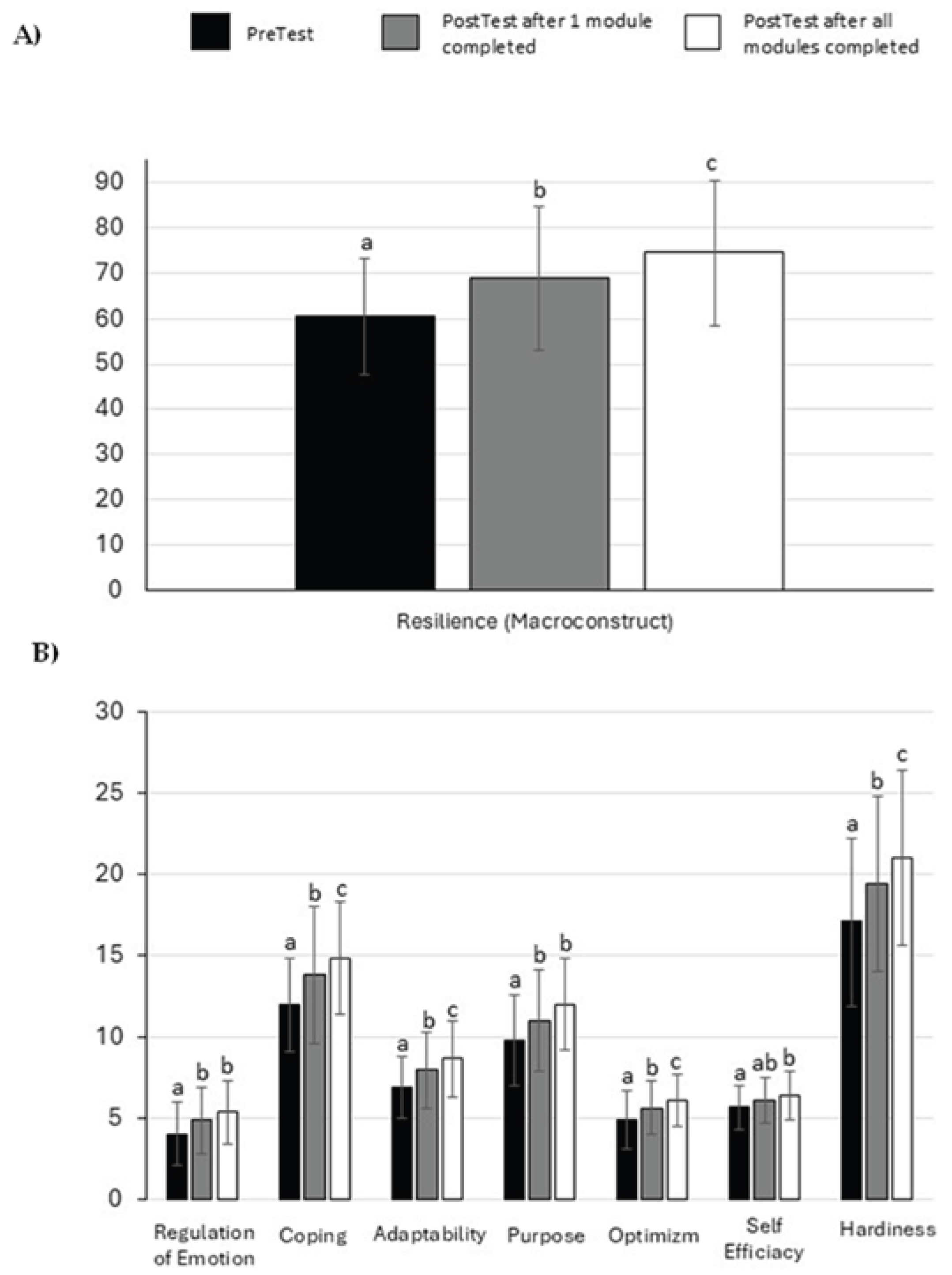

Table 1.
Sample descriptors.
| Variable | Value | |
|---|---|---|
| N | 57 | |
| Gender | Female % (n) | 35.1% (20) |
| Male % (n) | 63.2% (36) | |
| No answer % (n) | 1.7% (1) | |
| Age | Average | 12.77 |
| Standard deviation | 1.15 | |
| Standard error | 0.15 | |
| Median | 12.5 | |
| Mode | 12 | |
| Years in the country | Average | 4.04 |
| Standard deviation | 1.69 | |
| Standard error | 0.22 | |
| Median | 4 | |
| Mode | 4 |
Table 2.
Descriptive statistics for each phase of the intervention.
| Variable | Pre-test | Post-test after module 1 completed | Post-test after all modules completed |
|---|---|---|---|
|
Resilience (Macroconstruct) |
60.44 ±12.72 | 68.88 ±15.67 | 74.51 ±15.90 |
| RE | 4.05 ±1.94 | 4.89 ±2.04 | 5.39 ±1.96 |
| Coping | 11.98 ±2.87 | 13.82 ±4.19 | 14.84 ±3.48 |
| A/F | 6.93 ±1.91 | 7.98 ±2.33 | 8.67 ±2.31 |
| Purpose | 9.82 ±2.84 | 11.02 ±3.14 | 12.04 ±2.79 |
| Optimism | 4.89 ±1.81 | 5.65 ±1.65 | 6.11 ±1.58 |
| Self-Efficacy | 5.67 ±1.34 | 6.12 ±1.42 | 6.44 ±1.49 |
| Hardiness | 17.09 ±5.15 | 19.39 ±5.42 | 21.04 ±5.39 |
Note: The data shows the mean ±and standard deviation; RE: Regulation of Emotion; A/F: Adaptability/Flexibility.
Table 3.
Friedman results and Wilcoxon post hoc comparisons.
| V | non-parametric Friedman test | Post Hoc | r | ||
|---|---|---|---|---|---|
| χ² (2) | p | W Kendall | Significant comparisons | ||
| R | 71.29 | < 0.001 | 0.64 | a, b, c | 0.72; 0.77; 0.54 |
| RE | 30.83 | < 0.001 | 0.28 | a, b | 0.45; 0.60 |
| C | 56.91 | < 0.001 | 0.51 | a, b, c | 0.57; 0.71; 0.35 |
| A/F | 31.77 | < 0.001 | 0.28 | a, b, c | 0.47; 0.62; 0.35 |
| P | 27.94 | < 0.001 | 0.25 | a, b | 0.38; 0.59 |
| O | 23.62 | < 0.001 | 0.21 | a, b, c | 0.36; 0.56; 0.34 |
| SE | 19.01 | < 0.001 | 0.17 | b | 0.43 |
| H | 54.16 | < 0.001 | 0.49 | a, b, c | 0.56; 0.68; 0.41 |
Note. V: variable; R: Resilience (Macroconstruct); RE: Regulation of Emotion; C: Coping; A/F: Adaptability/Flexibility; P: Purpose: O: Optimism; SE: Self-Efficacy; H: Hardiness. Overall test: Friedman: χ²: test statistic; p: statistical significance; W Kendall: (Kendall's coefficient of concordance) The effect size. Post hoc comparisons: Wilcoxon with Bonferroni correction: a = pre-test vs post-test after 1 module; b = pre-test vs post-test after all modules; c = post-test after 1 module vs post-test after all modules; ; r: Effect sizes correspond.
Disclaimer/Publisher’s Note: The statements, opinions and data contained in all publications are solely those of the individual author(s) and contributor(s) and not of MDPI and/or the editor(s). MDPI and/or the editor(s) disclaim responsibility for any injury to people or property resulting from any ideas, methods, instructions or products referred to in the content. |
© 2026 by the authors. Licensee MDPI, Basel, Switzerland. This article is an open access article distributed under the terms and conditions of the Creative Commons Attribution (CC BY) license (http://creativecommons.org/licenses/by/4.0/).
Copyright: This open access article is published under a Creative Commons CC BY 4.0 license, which permit the free download, distribution, and reuse, provided that the author and preprint are cited in any reuse.