

Submitted:
25 September 2026
Posted:
28 September 2026
You are already at the latest version
Abstract
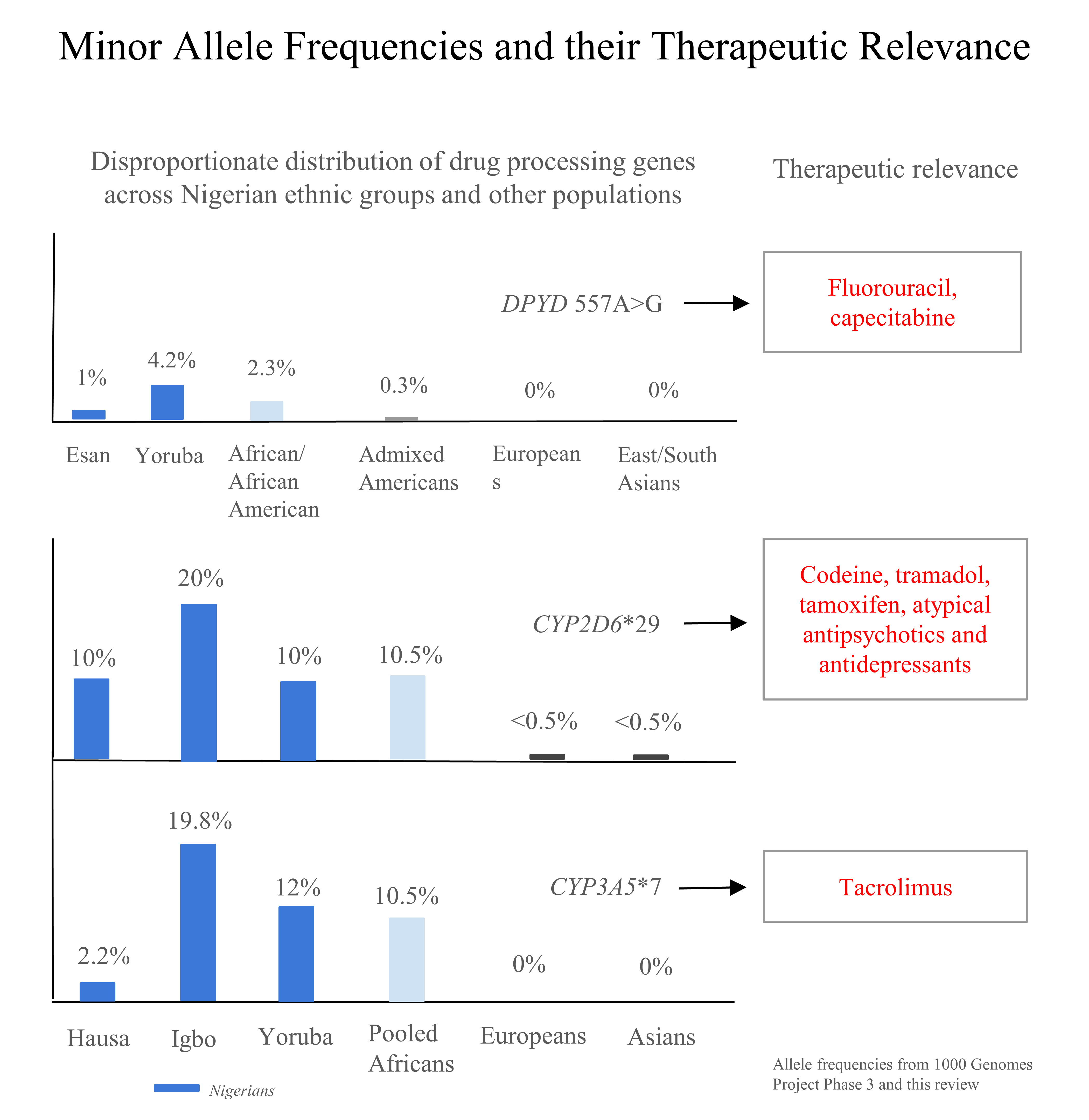
The underrepresentation of Nigerian genetic diversity in global databases presents an evidence gap in the population-specific effects of pharmacogenotypes on the therapeutic efficacy and safety within the country and relative to other populations. We investigated the implementation of pharmacogenetics in clinical trials and conducted a systematic review to identify clinical pharmacogenetic studies in Nigerians. Out of 11 clinical trials that have pharmacogenetic implications per U.S. FDA guidelines, only two implemented pharmacogenetics, predisposing participants to potential adverse drug effects and efficacy issues. Nigerian pharmacogenetic studies are limited, as fewer studies investigated the clinical significance of allele frequencies. Distribution of allele frequencies varied significantly within Nigerians and between other populations in high-impact variants, including CYP2C9*8, CYP2D6*29, and CYP3A5*7. CYP2C8*2 was observed at 17.9-19.5% in Nigerians compared to <2% in Europeans and Asians and resulted in lower imatinib concentrations in homozygous carriers, raising concerns about efficacy and safety. Marked ethnic differences within Nigerians (1% in Esan and 4.2% in Yoruba), compared to 2.6% in Sub-Saharan Africans, were observed in the African-ancestry DPYD 557A>G variant, which is not always present in UK and European genotyping panels, raising concerns about fluorouracil toxicity in Nigerians in diaspora and mixed-race populations. In conclusion, we found poor implementation of pharmacogenetics in clinical trials within the country and limited understanding of allele frequencies and their clinical implications. Therefore, it is important to investigate intra-Nigerian and intercontinental differences between genotypes and phenotypes to advance global precision medicine initiatives.
Keywords:
minor allele frequency
; population-specific pharmacogenomics
; Nigeria
; drug processing genes
; precision medicine
; pharmacogenotypes
; clinical trials
; therapeutic outcomes
Copyright: This open access article is published under a Creative Commons CC BY 4.0 license, which permit the free download, distribution, and reuse, provided that the author and preprint are cited in any reuse.