

Submitted:
26 September 2026
Posted:
28 September 2026
You are already at the latest version
Abstract
Visual design features can activate meanings that extend beyond their immediate perceptual properties. Building on research on visual symbolism, grounded cognition, and conceptual metaphor, we examine whether visual sharpness is associated with intelligence and how this association manifests across different levels of consumer processing. Across four studies, we provide convergent linguistic, perceptual, and associative evidence. Study 1 documents recurring sharpness–intelligence correspondences across 12 languages. Study 2 examines explicit perceptions across consumer products and category-neutral shapes and shows that the association is difficult to detect when competing product cues are available, but becomes more observable when such cues are reduced. Studies 3 and 4 use Implicit Association Tests and demonstrate greater response compatibility between sharp forms and intelligence-related concepts than between sharp forms and unintelligence-related concepts, replicating the pattern across student and general-population samples. Together, the findings suggest that visual sharpness can function as a symbolic cue that activates intelligence-related meaning, while its influence on explicit judgment depends on the informational context. The research extends visual symbolism by demonstrating how a basic geometric property can become connected with an abstract cognitive concept and distinguishes symbolic accessibility from the diagnostic role of visual cues in consumer judgment.
Keywords:
sharpness
; intelligence
; implicit association
; Implicit Association Test (IAT)
; consumer perception
; visual design
; symbolism
1. Introduction
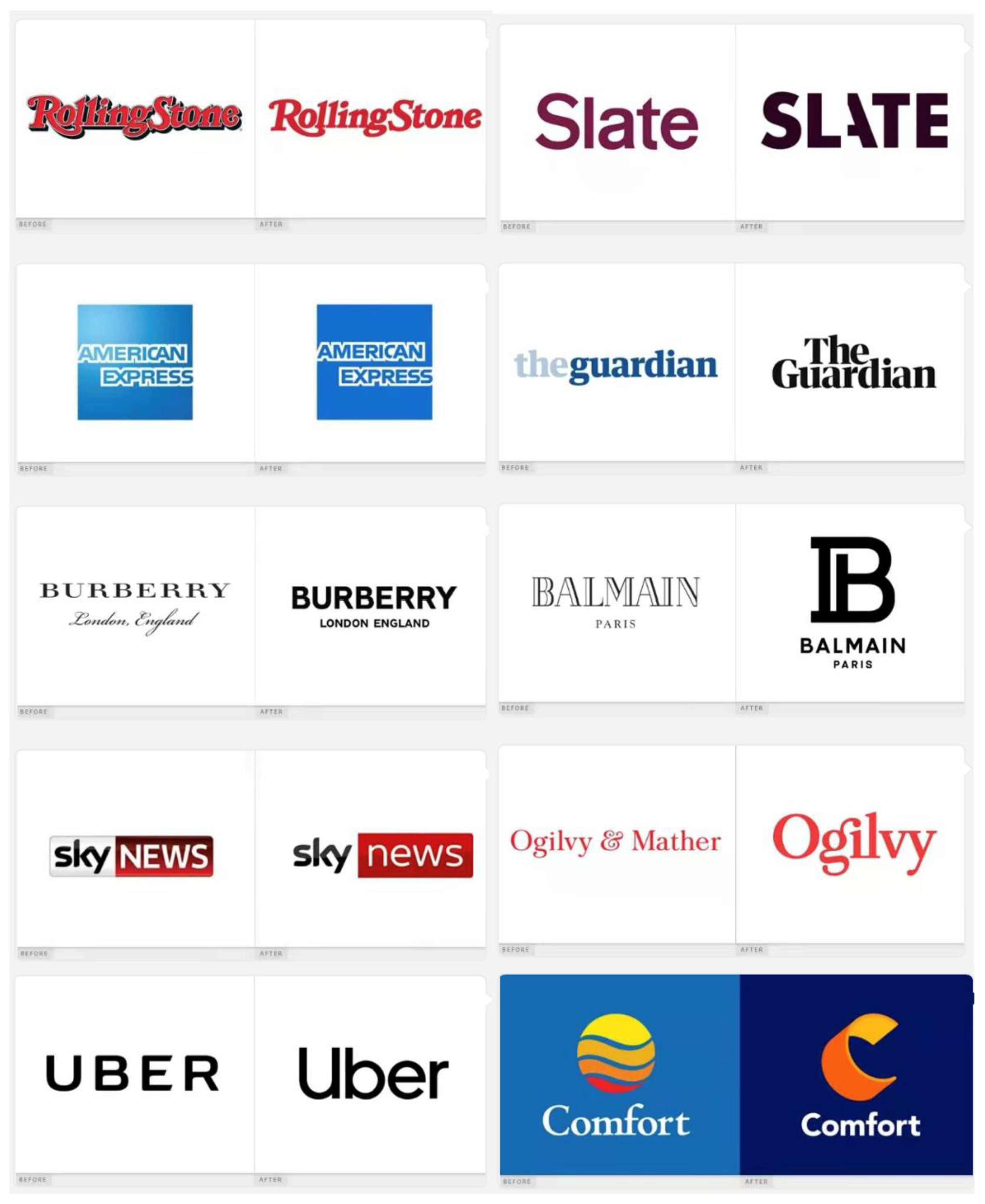
Symbols and visual metaphors provide the perceptual foundations through which consumers organize abstract meanings (Zaltman & Coulter, 1995). Grounded in embodied cognition and conceptual metaphor theory, sensory experiences systematically map onto abstract concepts, enabling basic visual features to activate meanings that extend far beyond their immediate physical properties (Brough et al., 2016; Meier & Robinson, 2004; Rozin et al., 2012). In consumer contexts, this sensory symbolism is critical: products, packages, logos, typefaces, and advertisements communicate through visual geometry long before consumers process verbal information (Childer & Jass, 2002; Gupta & Hagtvedt, 2021); McCarthy & Mothersbaugh, 2002). Appendix A shows that brand logo changes often involve adjustments of visual sharpness. While marketing literature extensively documents how curvature and angularity convey affective, experiential, or interpersonal attributes, such as warmth, softness, or hedonic appeal (Biswas et al., 2024; Wang et al., 2020; Westerman et al., 2012), far less is known about whether sharpness can signal abstract cognitive capabilities, such as intelligence.
We address this gap by proposing an implicit sharpness–intelligence association, whereby visually sharp forms (vs. round) are psychologically linked to higher perceived intelligence. Just as a sharp edge cut cleanly, a “sharp mind” tells apart complex situations and solves problems with precision. This conceptual similarly can be found in multiple language systems, where terms denoting physical sharpness (e.g., sharp, acute, cutting-edge) simultaneously denote cognitive capability. We ask: (1) Is there cross-cultural linguistic evidence linking sharpness and intelligence? (2) Do consumers perceive sharp (vs. round) product shapes as more intelligent? and (3) Does an implicit sharpness–intelligence association persist at the level of automatic cognition?
Across four multi-method studies, we test this implicit association across linguistic, perceptual, and automatic processing levels. Study 1 documents cross-linguistic evidence across 12 world languages, identifying 17 polysemous expressions connecting physical sharpness to cognitive acuity. Study 2 tests explicit consumer evaluations across product and non-product stimuli, demonstrating that while competing product cues (e.g., aesthetics, expensiveness) dominate explicit product ratings, the sharpness–intelligence relationship emerges when non-diagnostic, category-neutral shapes are evaluated. Studies 3 and 4 utilize the Implicit Association Test (IAT) across student and general-population samples, providing convergent evidence that consumers process sharp forms paired with intelligence-related concepts significantly faster than round forms.
The present research contributes to consumer research by showing how a basic geometric property can acquire an abstract cognitive meaning. Specifically, we propose that visual sharpness provides a perceptual basis for connecting concrete properties such as pointedness, precision, and discrimination with the more abstract concept of intelligence. This perspective extends research on visual symbolism beyond affective, sensory, and interpersonal meanings to consider how perceptual features may activate higher-order cognitive concepts. Rather than suggesting that consumers literally infer intelligence from the physical properties of an object, we argue that visual sharpness can function as a symbolic cue that makes intelligence-related meaning more accessible.
Second, this research contributes to the literature on implicit consumer cognition by distinguishing symbolic association from explicit evaluative influence. Across our studies, the sharpness–intelligence correspondence is evident in language and can be detected in direct perceptual judgments when competing product information is limited, while the IAT evidence indicates that the correspondence is also accessible under conditions that reduce reliance on deliberate evaluation. These findings suggest that visual symbolism may operate at different levels of consumer processing: a perceptual cue can activate an abstract meaning without necessarily becoming a dominant basis for conscious judgment. Thus, the contribution is not simply that sharp forms are associated with intelligence, but that a seemingly incidental geometric property can participate in the activation of an abstract cognitive concept.
Third, the findings have direct managerial implications for brand positioning, product appearance design, typeface choice and packaging. As visual sharpness may implicitly signal intelligence, marketers could take advantage of sharpness in contexts where cognitive capability, intelligence, expertise, or innovation is central to the desired positioning, such as for AI agents, robotics, and tech devices.
2. Literature Review and Hypothesis Development
2.1. Visual Form and Symbolic Meaning
Consumers often derive abstract meanings from basic visual features. Grounded cognition and sensory marketing perspectives suggest that cognition is partly rooted in perceptual and sensorimotor experiences, allowing sensory cues to activate concepts beyond their immediate physical properties (Krishna & Schwarz, 2014). Consistent with this view, consumer research shows that visual features can shape judgments even when those features have little functional relevance to the product. For example, the visual orientation of products can influence consumers’ mental simulations (Elder & Krishna, 2012), while spatial positioning can activate metaphorically related abstract concepts (Chen et al. 2021; for a review, see Cian, 2017). Such research suggest that visual form can operate as a symbolic cue through which consumers construct meaning.
Shape is particularly consequential because fundamental geometric properties such as curvature and angularity systematically evoke different psychological associations. Research has shown that circular forms tend to be associated with softness, whereas angular forms tend to evoke hardness, and these associations subsequently influence judgments of brand attributes (Jiang et al., 2016). Similarly, shape–trait associations allow consumers to infer product characteristics with appearance-based cues that can be altered or designed (Vallen et al., 2019). Research on shape symbolism agrees that consumers can extract affective, sensory, and social meanings from geometric properties, making visual form an important component of consumer interpretation and evaluation (Spence, 2012).
The meaning of visual form can also extend beyond immediate sensory or affective responses. As tangible experiences provide structures through which people understand more abstract concepts (Landau et al., 2018), properties such as softness, temperature, or angularity may serve as perceptual foundations for concepts that are not themselves perceptual. In consumer contexts, this process allows seemingly incidental design elements to influence higher-order judgments without requiring consciously articulation on the underlying connections.
However, extant research on visual shape has focused primarily on affective, sensory, and interpersonal meanings, with considerably less attention to whether visual form can communicate cognitive capabilities. In particular, little is known about whether visual sharpness can function as a symbolic cue for intelligence. Addressing this question requires distinguishing sharpness from the broader construct of angularity. Although the two properties can co-occur, they are conceptually distinct: angularity primarily concerns the presence of corners, straight edges, or non-curvilinear geometry, whereas sharpness emphasizes pointedness, edge definition, and perceptual acuity (Biswas et al., 2024; Blazhenkova & Dogerlioglu-Demir, 2020; Zhang et al., 2006). Accordingly, angular forms may communicate broader meanings such as hardness, strength, or assertiveness, whereas sharpness may be more closely associated with precision, discrimination, and cognitive acuity. Existing research on angular versus rounded forms therefore provides an important foundation for understanding the symbolic meanings of geometric form, but does not establish whether the more specific perceptual property of sharpness carries a distinct association with intelligence. Consistent with this distinction, Chen et al. (2024) found that angular (vs. circular) product shapes can reduce new-product adoption by signaling risk, attributing to angularity’s association with harm and threat rather than to sharpness’s association with precision or acuity. This divergence in outcomes (positive intelligence inference vs. negative adoption intention) reinforces that angularity and sharpness, while perceptually related, activate distinct downstream meanings and should not be treated as interchangeable constructs. This distinction motivates the present research.
2.2. From Visual Sharpness to Perceived Intelligence
Among the meanings conveyed by visual form, sharpness may be particularly relevant to the communication of cognitive capability because its perceptual properties emphasize precision and acuity. Conceptual metaphor theory proposes that concrete perceptual experiences can provide structures through which consumers understand more abstract concepts (Landau et al., 2018). Sharp objects possess pointed boundaries, distinct edges, and the capacity to penetrate or discriminate between surfaces. These properties are not themselves indicators of intelligence, but they provide a perceptual vocabulary for concepts such as acuity, precision, and discrimination.
The proposed mapping can therefore be understood as a progression from perceptual precision to cognitive acuity. A visually sharp form makes properties such as pointedness and clear differentiation perceptually salient. These properties conceptually overlap with how people describe effective cognitive functioning: a sharp mind is one that detects distinctions, processes information precisely, and reaches incisive judgments. Consistent with this interpretation, languages frequently use physical sharpness to describe intellectual qualities, including expressions such as “sharp mind” and “sharp intellect.” Thus, the proposed association does not require consumers to believe that a physically sharp object is literally more intelligent. Rather, visual sharpness may activate a semantic field surrounding acuity and precision, within which intelligence represents a higher-order cognitive meaning.
This account also helps distinguish the present proposition from prior findings concerning angularity. Angularity may evoke broad meanings such as hardness, strength, or assertiveness (Jiang et al., 2016; Spence, 2012), whereas sharpness emphasizes pointedness and perceptual discrimination. The present research therefore examines whether this more specific perceptual property is systematically associated with intelligence. Accordingly, we propose:
H1: Visual sharpness (vs. roundness) is positively associated with perceived intelligence, particularly when competing, more diagnostic product cues are minimized.
2.3. Accessibility of the Sharpness–Intelligence Association
The proposed association may not always be evident in consumers’ deliberate evaluations. When consumers evaluate an actual product, they can draw on information about functionality, aesthetics, price, category, and other attributes that may be more diagnostic than a relatively subtle visual cue. Consequently, a symbolic association can exist without becoming the primary basis of a conscious judgment.
This distinction is important because visual symbolism may operate at multiple levels of processing. A geometric property can activate an associated concept without consumers necessarily identifying or articulating the underlying connection. Research on grounded cognition suggests that sensory features can activate related concepts through relatively automatic processes (Krishna & Schwarz, 2014), while research using implicit association measures demonstrates that conceptual correspondences can be detected through differences in response performance (Greenwald et al., 1998; Greenwald et al., 2003).
The present research therefore does not assume that an IAT effect demonstrates an entirely unconscious or uncontrollable process. Instead, we use the IAT to examine whether the sharpness–intelligence correspondence remains accessible when sharpness and intelligence are paired within a categorization task. If sharp forms are more readily associated with intelligence than with unintelligence, participants should respond more efficiently when sharp and intelligent categories share a response key than when these categories are paired incongruently. Accordingly, we posit that:
H2: The association between visual sharpness and perceived intelligence is implicit.
3. Methodology and Studies Design
We test our hypothesis through four studies using complementary linguistic, explicit, and implicit approaches. Study 1 examines whether the association between visual sharpness and intelligence is reflected in language by identifying correspondences between physical sharpness and cognitive acuity across 12 languages. Study 2 then tests whether this association extends to consumers’ explicit perceptions, using a diverse set of product and visual stimuli while minimizing competing product cues. Studies 3 and 4 further examine whether the sharpness–intelligence association operates implicitly by using an Implicit Association Test (IAT) across student and general samples. Together, these studies provide convergent evidence for a visual association between sharpness and intelligence while examining how this association manifests across linguistic, explicit, and implicit levels.
4. Study 1: Cross-Linguistic Evidence
Language provides an important window into culturally shared semantic associations. Linguistic expressions and metaphors can reveal conceptual relationships that may not be explicitly articulated but are nevertheless embedded in everyday meaning systems (Lakoff, 1993; Esteky, 2022). Prior research used patterns of polysemy and metaphor to identify systematic conceptual associations across cultures. For example, Boroditsky and colleagues demonstrated how grammatical gender can shape conceptual associations, while Rozin et al. (2012) documented a cross-linguistic association between meat and maleness across 20 languages. Following this method, Study 1 examines whether sharpness and intelligence are linked at the lexical-semantic level across linguistically and culturally diverse contexts.
4.1. Procedures
We began by identifying candidate polysemous expressions in English, Chinese, and Spanish, where the same lexical form or expression can convey meanings related to both sharpness and intelligence. We then extended the search to additional languages using a combination of native-speaker consultation and established dictionaries. Following cross-linguistic research practices (Boroditsky et al., 2003; Rozin et al., 2012), we examined 12 languages spanning multiple language families and geographic regions: English, Chinese, Spanish, Portuguese, Italian, German, French, Japanese, Korean, Hindi, Russian, and Arabic.
For each language, we consulted multi-lingual native speakers to identify words, phrases, or expressions that contain overlapping meanings associated with physical or visual sharpness (e.g., sharp, cutting, acute, pointed) and cognitive qualities such as intelligence, clever, smart, or innovation. Candidate meanings were subsequently verified using established multilingual dictionaries. This procedure yielded 17 polysemous words or expressions across the 12 languages that capture both semantic domains. Representative examples include the English expressions “sharp idea”, “cutting-edge”, and “breakthrough”, as well as the Chinese term “敏锐,” which can describe both perceptual acuity and acute intellectual judgment.
4.2. Results
The full resulting polysemy are presented in Table 1. Importantly, these world languages differ substantially in linguistic structure, historical development, and geographic origin. The recurrence of overlapping sharpness–intelligence meanings across these linguistically distant systems provides initial evidence that the association may reflect a broadly shared conceptual mapping rather than a feature specific to English or another single linguistic tradition.
Beyond documenting the occurrence of the association, we also discussed in depth with the multi-lingual native speakers about the etymological and semantic characteristics of how the sharpness-intelligence meanings developed into these expressions within each language. These multi-lingual native speakers commonly mentioned that these words or expressions enjoy a long history and wide usage in their language system without identifiable reasons how they are formed. This suggests that the sharpness–intelligence correspondence reflects a globally recurring conceptualization embedded in language, rather than an isolated lexical coincidence, motivating the subsequent tests of whether this correspondence also operates at the perceptual (Study 2) and implicit-cognitive (Studies 3–4) levels.
5. Study 1: Cross-Linguistic Evidence
Study 1 provides cross-linguistic evidence that physical sharpness and cognitive acuity are systematically connected at the lexical-semantic level. The recurrence of this correspondence across linguistically diverse systems suggests that the sharpness–intelligence mapping is not restricted to a single language or cultural expression. However, linguistic correspondence alone cannot establish how consumers respond to visual sharpness when they encounter it perceptually. Study 2 therefore examines whether the semantic relationship extends to judgments of visually presented stimuli. We intentionally include both recognizable consumer products and category-neutral shapes because visual design is encountered in contexts in which multiple sources of information compete for attention. This design allows us to examine whether the proposed association remains detectable when consumers evaluate relatively complex stimuli and when competing product-level information is reduced.
We do not expect visual sharpness to dominate explicit evaluations of recognizable products. Rather, consistent with the symbolic nature of the proposed association, we expect its influence to be easier to detect when product-specific information is less diagnostic. Study 2 therefore provides a test of whether the sharpness–intelligence correspondence can extend beyond linguistic meaning into consumers’ explicit visual judgments, while also examining the extent to which competing product perceptions constrain its expression.
5.1. Participants and Procedure
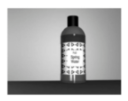
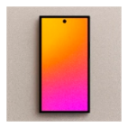
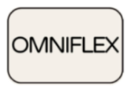
A total of 801 participants were recruited through Prolific and received financial compensation for their participation. No disqualified entries were found, and the final sample size remained 801. Participants were randomly assigned to view one of 16 stimuli representing the sharpness or roundness conditions across the eight stimulus pairs (see Table 2 for the complete set of stimuli). After viewing the assigned stimulus, participants reported their perceptions of its intelligence and sensibility on a 5-point Likert scale. The study was preregistered on AsPredicted (https://aspredicted.org/uc9qr8.pdf).
5.2. Stimuli
We employed eight pairs of stimuli spanning diverse product and visual categories, including food, fonts, brands, technology products, and other consumer-relevant objects (see Table 2). Within each pair, one stimulus represented the relatively sharp condition and the other represented relatively rounded conditions. We additionally included a pair of nonrepresentational, category-neutral stimuli to examine whether the association persists in the absence of a recognizable product category. Across the stimulus set, participants evaluated either the sharp or rounded version of each stimulus, allowing us to test whether visual sharpness systematically predicts perceived intelligence.
5.3. Measurements
Participants were asked to rate their Perceived Intelligence using a two-item semantic-differential scale adapted from Bartneck et al. (2009), capturing participants’ judgments of the stimulus’s intelligence and sensibility. We assessed Perceived Visual Sharpness using a four-item measure informed by Biswas et al. (2024), Blazhenkova and Dogerlioglu-Demir (2020), and Zhang et al. (2006), capturing sharpness, edge definition, angularity, and smoothness/roundness, with the latter reverse-coded. To assess whether the sharpness–intelligence relationship could be attributable to alternative product perceptions, we also measured Expected Expensiveness using one researcher-generated item, Touch Comfort using a one-item measure informed by Chen et al. (2009) and Hwang and Kim (2012), Expected Taste for edible stimuli using a one-item measure adapted from Wansink and Chandon (2007), Perceived Size using a three-item semantic-differential scale from Ketron (2018), and Aesthetic Evaluation using a four-item scale from Lavie and Tractinsky (2004). Multi-item measures were averaged to form composite scores. All measures used seven-point response scales unless otherwise specified in the experimental procedure, and the complete measurement items are reported in Appendix C.
5.4. Manipulation Check
To verify that the stimuli differed in perceived visual sharpness as intended, the four items of Perceived Visual Sharpness were aggregated. An independent-samples t-test comparing the composite sharpness measure across the two conditions indicated that participants perceived the sharp stimuli as significantly sharper than the round stimuli, t (800) = 17.01, p < .001, Msharp = 17.80, Mround = 14.35. Thus, the manipulation successfully differentiated the stimuli in perceived visual sharpness.
5.5. Alternative Explanations and Confounds
Five potential alternative explanations and confounds were tested for the predicted effect, including 1) perceived comfort of touching, 2) perceived product size, 3) perceived expensiveness, 4) perceived quality, and 5) aesthetic evaluation. Only participants assigned to the product conditions (cookies, chocolate, juice, and spring water) were asked the questions on perceived quality, using expected taste as a proxy. The results showed that round products or images were perceived more comfortable to touch ( t (800) = -2.64, p = .008, Msharp = 4.03, Mround = 4.31) and are larger in size (t (800) = 3.73, p < .001, Msharp = 11.80, Mround = 10.87). No significant difference was detected in the perceived expensiveness ( t(800) = 1.01, p = .315, Msharp = 3.52, Mround = 3.40), expected taste (t (408) = -0.80, p = .424, Msharp = 4.05, Mround = 4.18), or aesthetic evaluation (t (800) = 0.45, p = .655, Msharp = 13.79, Mround = 13.59) between the sharp or round shapes.
5.6. Regression Analyses
To control for the potential confounds, we regressed perceived intelligence on product shape sharpness while controlling for the confounds. Table 3 reports the regression results.
The overall regression model across all product pairs was significant (F(5, 796) = 97.25, p < .001), with visual sharpness explaining 37.9% of the variance in perceived intelligence (R2 = .38; adjusted R2 = .38). Product shape condition did not significantly predict perceived intelligence after accounting for the alternative confounders (β = .02, t = .65, p = .52). In contrast, perceived aesthetics (β = .32, t = 8.76, p < .001), expensiveness (β = .24, t = 7.48, p < .001), and perceived comfort (β = .17, t = 5.12, p < .001) were positively associated with perceived intelligence. Perceived size was not a significant predictor of perceived intelligence (β = .05, t = 1.52, p = .13).
Given that real life product perception can be very complicated for customers, we want to focus purely on the visual sharpness without confounders from products. We next conducted the same analysis using only the meaningless shape pair, allowing us to examine the shape–intelligence association in the absence of any specific product attributes. The regression result shows high significance (F(5, 95) = 7.89, p < .001), with visual sharpness accounting for 29.3% of the variance in perceived intelligence (R2 = .29; adjusted R2 = .26). Controlling the four confounders, the effect of product shape condition on perceived intelligence was positive but marginally significant (β = .16, t = 1.68, p = .096). Perceived aesthetics significantly and positively predicted perceived intelligence (β = .31, t = 2.56, p = .012), whereas perceived expensiveness (β = .17, t = 1.39, p = .17), perceived comfort (β = .12, t = 1.04, p = .30), and size (β = −.09, t = −.96, p = .34) did not.
Additionally, we conducted the same analysis using all food and drink products and included an extra confounder: expected taste, as a proxy for perceived product quality. The regression result shows high significance (F(6, 403) = 38.98, p < .001). Controlling the four confounders, the effect of product shape condition on perceived intelligence was not significant (β = .01, t = 0.22, p > 0.05). Perceived aesthetics significantly and positively predicted perceived intelligence (β = .31, t = 5.00, p < .001), perceived expensiveness also significantly and positively predicted perceived intelligence (β = .16, t = 3.80, p < .001), whereas perceived comfort (β = .07, t = 1.50, p = .14), and size (β = −.10, t = −.23, p = .82) did not.
5.7. Interpretations
Study 2 provides qualified evidence consistent with the proposed sharpness–intelligence association. Across recognizable products, visual sharpness did not independently predict perceived intelligence after accounting for competing product perceptions. This pattern is theoretically informative because it suggests that symbolic meaning conveyed by visual form does not necessarily dominate judgments when consumers have access to more diagnostic product information. For the category-neutral stimuli, the sharpness effect was positive and marginal after controlling for the measured alternative perceptions. We note that this subsample analysis, while theoretically motivated, was not the primary confirmatory test specified in the preregistration and should be interpreted as an exploratory robustness check rather than an independent confirmation of H1. Although this result should not be interpreted as conclusive evidence of a strong explicit effect, it is consistent with the possibility that the underlying symbolic correspondence becomes more detectable when competing sources of meaning are reduced. Thus, Study 2 helps establish an important boundary for the phenomenon: visual sharpness may provide an accessible symbolic cue without functioning as a dominant determinant of explicit product evaluation.
6. Study 3: Implicit Association Tests (IATs)
Study 2 provided initial evidence that the sharpness–intelligence correspondence can be reflected in explicit perceptions, while also suggesting that the correspondence may be difficult to observe when competing product information is available. This pattern raises an important question: does the sharpness–intelligence correspondence remain accessible when consumers are not directly asked to evaluate whether a visual form appears intelligent? Study 3 addresses this question by examining the correspondence through an Implicit Association Test (IAT), a widely used method for assessing conceptual associations that may be difficult to capture through direct self-report (Carpenter et al., 2019; Greenwald, Nosek, and Banaji, 2003).
The IAT provides a useful complement to the explicit judgments examined in Study 2 because it assesses relative response compatibility between concepts rather than directly asking participants to report their perceptions. In the present context, if visual sharpness is associated with intelligence, participants should respond more quickly when sharp visual stimuli and intelligence-related concepts share the same response key than when sharp stimuli are paired with unintelligence-related concepts. Such a pattern would indicate greater associative compatibility between sharpness and intelligence, providing evidence that the proposed correspondence extends beyond deliberate judgments of visual stimuli.
Prior research has used the IAT to examine conceptual associations across diverse psychological domains. For example, Bar-Anan, Liberman, and Trope (2006) used the IAT to examine the association between psychological distance and construal level, while Meier and Robinson (2004) used it to investigate the association between upward spatial orientation and positive affect. Marketing researchers have similarly used the IAT to examine associations between perceptual or sensory cues and abstract psychological meanings. Shani-Feinstein, Kyung, and Goldenberg (2022) examined the implicit association between perceived fast speed and abstract versus concrete mental representation, Esteky (2022) examined the association between edge versus center and risk, and Brough et al. (2016) examined the association between eco-friendliness and femininity.
The IAT is particularly appropriate for the present research because the proposed relationship connects two conceptually distinct domains: visual form and intelligence. If sharpness carries an associative connection with intelligence, participants should exhibit greater response compatibility when sharp visual stimuli and intelligent concepts are paired than when sharp stimuli and unintelligent concepts are paired. Importantly, we interpret such a pattern as evidence of associative accessibility rather than as definitive evidence that the association is unconscious, uncontrollable, or independent of other potentially related meanings. This distinction is consistent with the broader objective of the present research: to examine whether the sharpness–intelligence correspondence remains accessible under conditions that do not require participants to explicitly endorse the relationship.
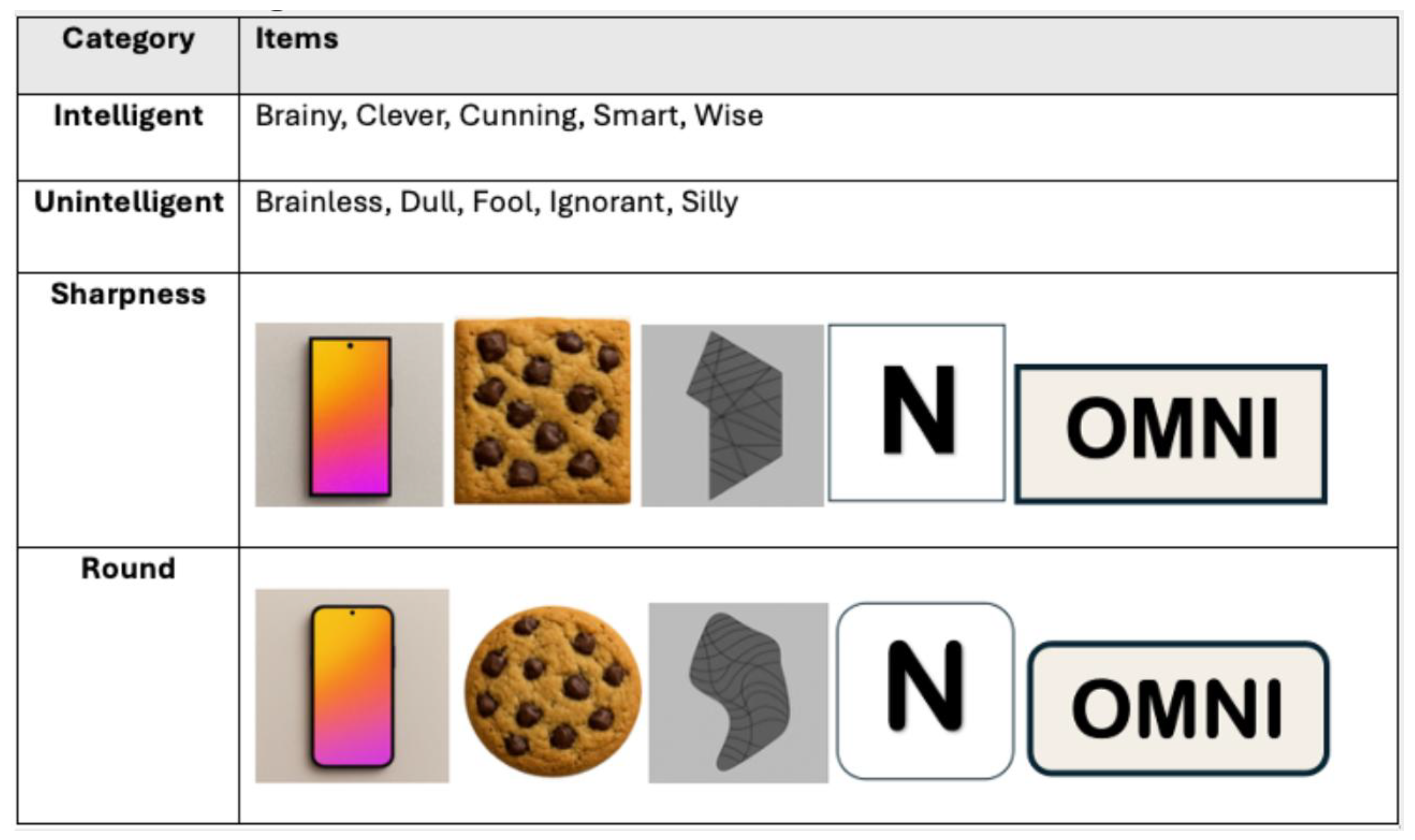
Accordingly, Study 3 employed a seven-block IAT using sharp versus round visual stimuli as the target categories and intelligent versus unintelligent concepts as the attribute categories. The IAT was created using the iatgen tool (Carpenter et al., 2019). The study was preregistered at AsPredicted (https://aspredicted.org/3vi7se.pdf). We expected that participants would exhibit faster responses in the congruent condition (sharp–intelligent and round–unintelligent) than in the incongruent condition (sharp–unintelligent and round–intelligent). Response accuracy was examined as a complementary measure to determine whether the predicted latency difference was accompanied by comparable or improved task accuracy.
6.1. Participants and Procedure
A total of 150 students participated in the study in exchange for extra course credit. After reviewing the IAT instructions, participants were randomly assigned to one of four key-placement conditions in a 2 (Sharpness key: left vs. right) × 2 (Intelligence key: left vs. right) between-subjects design. Following standard IAT procedures, participants completed seven blocks involving separate and combined categorization tasks. Stimuli were presented individually, and participants categorized each stimulus as quickly and accurately as possible using the left or right response key. The order of the compatible and incompatible combined blocks was counterbalanced across participants.
The attribute stimuli consisted of five intelligence-related words and five unintelligence-related words selected from dictionary thesaurus entries (Merriam-Webster Thesaurus, 2026a, 2026b). The target stimuli consisted of five sharp and five round geometric shapes that had been pretested in Study 2. The complete stimulus set is presented in Table 4, and the detailed IAT procedure is provided in Appendix D.
6.2. Measures and Analysis
Following standard IAT scoring procedures, response latency was the primary dependent measure of the implicit association. We compared performance between the hypothesis-congruent and incongruent combined conditions, with faster responses indicating a stronger automatic association between the matched pairs. Incorrect responses were handled according to standard IAT scoring procedures before calculating response-latency effects.
We also examined response accuracy as a complementary indicator of task performance. For each participant, accuracy was calculated as the proportion of correct classifications across the critical compatible and incompatible blocks. We compared accuracy between the two conditions to determine whether the predicted latency advantage was accompanied by differences in response accuracy. A significant latency without a corresponding accuracy disadvantage would provide evidence that the tested associations reflected differentiated processing rather than a speed–accuracy trade-off.
6.3. Results
A total of 147 participants completed the IAT. Consistent with preregistered data-screening procedures, 13 participants were excluded due to excessively rapid responding, resulting in a final sample of 134 participants for analysis. The overall timeout rate was negligible (0.19%), and the average error rate was 9.07%, indicating satisfactory task performance. The IAT demonstrated excellent internal reliability (r = .93).
Figure 1 visualizes the results. Participants’ response time was found much shorter in our hypothesis-congruent conditions than incongruent conditions across tasks (Meancongruent = 1,172.00 millisecond, Meanincongruent = 1,233.67 millisecond). Following the standard IAT scoring procedure (Greenwald et al., 2003), D-scores were calculated. A one-sample t-test comparing the congruent D-score against zero revealed a significant positive effect (Mean D-score = 0.21, SD D-score = 0.61, t (133) = 3.97, p < .001, 95% CI [0.10, 0.31], Cohen’s d = 0.34). The results indicate that participants responded more quickly when sharp shapes shared a response key with synonyms of intelligent than round shapes. The magnitude of the effect was small-to-moderate according to conventional benchmarks for IAT effects (Greenwald et al., 2003), providing evidence for an implicit cognitive association between visual sharpness and intelligence. The correct rate between hypothesis-congruent and incongruent does not significantly differ (t(133) = −0.46, p = .650). The results support H2. Participants showed greater response compatibility when sharp forms were paired with intelligence-related concepts than when the pairings were reversed. Because the IAT assesses relative associative compatibility rather than conscious endorsement, these findings indicate that the sharpness–intelligence correspondence remains accessible under an implicit association task. The absence of a significant accuracy difference further suggests that the response-time advantage was not accompanied by a general accuracy disadvantage.
7. Study 4: Replication of IAT with a Larger General-Population Sample
Study 4 provides a direct replication of the implicit-association evidence obtained in Study 3 using a substantially larger general-population sample recruited through Prolific. Replication is important because Study 3 relied on a student sample and because the proposed association is expected to reflect a relatively subtle perceptual-semantic correspondence rather than a deliberate evaluative belief. Using the same IAT procedures, allows us to examine whether the pattern observed in Study 3 generalizes beyond a small student population. Study 4 was pre-registered on Aspredicted.org (https://aspredicted.org/mg8ug7.pdf).
7.1. Procedures
401 participants were recruited from Prolific with financial incentives. The procedure is identical to Study 3. After reviewing the consent letter and detailed IAT instructions, participants completed seven rounds of IAT tasks and answered demographic questions.
7.2. Results
After excluding 11 participants due to excessively rapid responding, the final sample consisted of 390 participants. The overall timeout rate was negligible (0.33%), and the average error rate was 7.47%, indicating satisfactory task performance. The IAT demonstrated excellent internal reliability (r = .91).
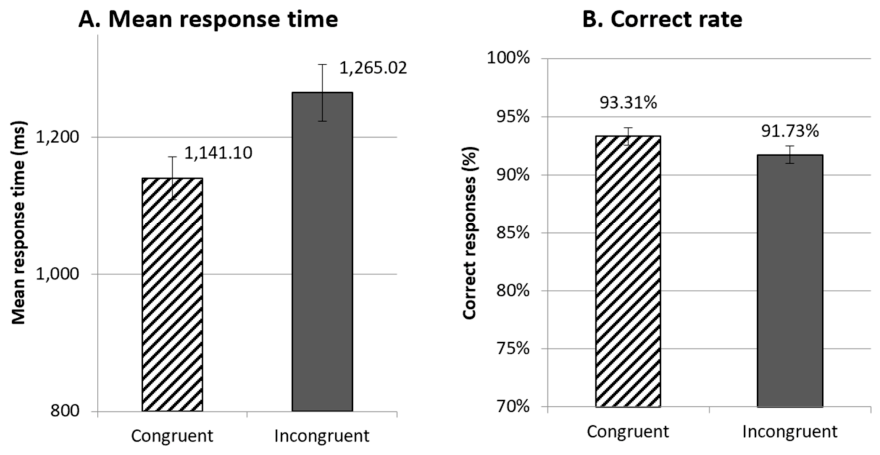
Consistent with Study 3, participants exhibited a significant shorter response time favoring congruent conditions (Meancongruent = 1,141.10 millisecond, Meanincongruent = 1,265.02 millisecond, Mean D-score = 0.25, SD D-score = 0.55, t (389) = 8.97, p < .001, 95% CI [0.19, 0.30], Cohen’s d = 0.45). The correct rate between hypothesis-congruent and incongruent conditions differed significantly (Meancongruent = 93.31%, Meanincongruent = 91.73%, t(389) = 4.16, p < .001); accuracy was higher in the congruent condition, suggesting that participants were both faster and more accurate in the congruent condition.
Figure 2.
Study 4 Response Time and Correct Rate Across Conditions. Note: Congruent: Sharp-intelligent and round-unintelligent match (Tasks 3 + 4). Incongruent: Round-intelligent and sharp-unintelligent match (Tasks 6 + 7). Error bars indicate 95% confidence intervals. N= 390.
Figure 2.
Study 4 Response Time and Correct Rate Across Conditions. Note: Congruent: Sharp-intelligent and round-unintelligent match (Tasks 3 + 4). Incongruent: Round-intelligent and sharp-unintelligent match (Tasks 6 + 7). Error bars indicate 95% confidence intervals. N= 390.
8. Discussion
Across four studies, this research provides convergent evidence for a sharpness–intelligence correspondence across linguistic, perceptual, and associative levels. Study 1 documented recurring lexical-semantic correspondences between physical sharpness and cognitive acuity across 12 languages. Study 2 examined whether this correspondence extends to explicit visual judgments and showed that the effect is not a dominant determinant of evaluations when consumers assess recognizable products with multiple competing cues. Studies 3 and 4 then demonstrated that sharpness and intelligence exhibit greater response compatibility in an IAT, with the pattern replicated across student and general-population samples.
Taken together, the findings suggest that visual sharpness can serve as a symbolic route through which concrete perceptual properties such as pointedness, precision, and discrimination become associated with the abstract concept of intelligence. Importantly, the evidence should not be interpreted as showing that consumers literally infer intelligence from sharp physical forms or that sharpness is a powerful standalone determinant of marketplace judgments. Rather, the findings suggest that sharpness can activate intelligence-related meaning while the extent to which that meaning influences explicit evaluation depends on the informational context in which the visual cue is encountered.
8.1. Visual Form as a Route to Abstract Cognitive Meaning
The first theoretical contribution concerns the scope of visual symbolism. Prior consumer research has shown that geometric properties can communicate meanings related to affect, sensory experience, interpersonal characteristics, and product personality. The present findings extend this perspective by showing that visual geometry can also be connected with an abstract cognitive concept. The theoretical implication is not simply that sharp forms are associated with intelligence, but that elementary perceptual properties may provide a symbolic route through which consumers access higher-order meanings that are not themselves perceptual.
Sharpness is particularly informative in this respect because its perceptual characteristics provide a plausible basis for the mapping. Pointedness, edge definition, and perceptual discrimination are concrete properties that conceptually overlap with acuity and precision in cognitive functioning. The recurring linguistic correspondence documented in Study 1 is consistent with this mapping, while the perceptual and IAT findings indicate that the correspondence can also be detected when consumers encounter visual forms. Thus, the findings broaden research on visual meaning from asking what geometric forms consumers prefer to asking how basic perceptual properties become connected with abstract concepts.
8.2. Symbolic Accessibility Versus Diagnostic Judgment
A second contribution concerns how symbolic meanings operate in marketplace judgments. The findings suggest that the accessibility of a symbolic association should not be equated with its influence on explicit evaluation. In Study 2, visual sharpness did not independently predict perceived intelligence across recognizable products after competing perceptions were taken into account. In contrast, Studies 3 and 4 revealed greater compatibility between sharpness and intelligence in an associative categorization task. Together, these findings suggest a distinction between symbolic accessibility and evaluative diagnosticity.
A visual feature may therefore activate an abstract meaning without becoming sufficiently diagnostic to determine a conscious judgment. Consumers evaluating a product can draw on more informative cues such as functionality, aesthetics, quality, price, and category knowledge. These cues may constrain the behavioral expression of a relatively subtle symbolic association even when the association remains cognitively accessible. This distinction helps explain why a perceptual correspondence can be detectable in associative processing while producing relatively weak or context-dependent effects in explicit marketplace judgments.
This perspective provides a broader implication for research on visual symbolism. Rather than assuming that a design feature has a fixed effect on consumer responses, researchers should distinguish between whether a perceptual cue activates a meaning and whether that meaning subsequently becomes diagnostic for a particular judgment. The latter should depend on the informational context and the relevance of the activated meaning to the judgment at hand.
8.3. Managerial Relevance
The value of sharpness is unlikely to lie in making a design simply “look intelligent.” Typeface sharpness could signal precision, as Park et al. (2022) found that sharper price typefaces increase consumers’ awareness of spending. The present study findings extend this logic by showing that the sharpness–precision–intelligence pathway operates beyond typeface, across product shape, logos, and category-neutral forms, and by demonstrating that this pathway is accessible at an implicit as well as explicit level. Instead, sharpness may be useful when a brand needs to communicate qualities that consumers connect with intelligence, such as expertise, precision, competence, or technological sophistication. This implication is especially relevant for products and services whose value proposition depends on cognitive capability, including technology, artificial intelligence, professional services, and other expertise-based offerings. At the same time, because sharpness carries meanings beyond intelligence, its effectiveness should depend on the fit between the visual cue and the desired brand meaning. A design that activates competence may be advantageous in one context but less appropriate when consumers primarily seek warmth, comfort, or softness.
More broadly, the present research points to a useful direction for research on visual meaning: rather than treating individual design features as having fixed effects on consumer responses, researchers can examine how elementary perceptual properties enter a broader system of symbolic interpretation. Sharpness may be one such perceptual cue whose meaning becomes connected to higher-order concepts through recurring perceptual, linguistic, and cultural experiences. The important theoretical question is therefore not simply whether consumers prefer one shape over another, but how seemingly incidental features of form acquire abstract meaning and under what conditions those meanings become consequential for judgment and behavior. In this sense, the sharpness–intelligence association provides a starting point for understanding how visual geometry can participate in consumers’ interpretation of otherwise intangible attributes.
9. Limitations and Future Studies
Several limitations provide opportunities for future research. First, although the findings are consistent with a perceptual-to-conceptual mapping from sharpness to cognitive acuity, the present studies do not directly isolate the psychological pathway through which the association develops. Sharpness emphasizes properties such as pointedness, precision, and discrimination, which provide a plausible conceptual basis for intelligence-related meaning. However, these properties may also overlap with broader meanings such as competence, sophistication, modernity, or technological capability. Future research could examine how these related meanings are differentiated and whether cognitive acuity represents a particularly central component of the sharpness–intelligence correspondence.
Second, the present research focuses on the association itself and does not directly test its downstream marketplace consequences. Although Study 2 includes consumer-relevant products and visual stimuli, the findings do not establish that sharpness necessarily improves brand evaluation, trust, adoption, or willingness to pay. Future research could examine when the accessibility of intelligence-related meaning becomes consequential for consumer behavior, particularly in contexts where expertise, precision, or cognitive capability is diagnostic.
Third, the present research does not establish that sharpness operates independently of broader shape characteristics such as angularity. Although sharpness and angularity are conceptually distinguishable, they can overlap perceptually. Future research could systematically manipulate these geometric properties to determine which aspects of visual form are responsible for different symbolic meanings.
Finally, the present evidence is centered on the sharpness–intelligence correspondence. Future research could examine whether the broader distinction between symbolic accessibility and evaluative diagnosticity applies to other perceptual features and abstract concepts. Such work could help establish whether the present phenomenon represents a specific sharpness–intelligence correspondence or a broader principle through which elementary visual properties acquire higher-order meaning.
Appendix A
Appendix B. Dictionary and Lexicon Sources for Table 1
Asociación de Academias de la Lengua Española (2026). Meaning of Spanish Word “Agudo”. Retrieved from: https://dle.rae.es/agudo
Cambridge Dictionary (2026a). Meaning of English Phrase “Sharp”. Retrieved from https://dictionary.cambridge.org/dictionary/english/sharp
Cambridge Dictionary (2026b). Meaning of English Phrase “Cutting-edge”. Retrieved from https://dictionary.cambridge.org/dictionary/english/cutting-edge
Cambridge Dictionary (2026c). Meaning of English Phrase “Breakthrough”. Retrieved from https://dictionary.cambridge.org/dictionary/english/breakthrough
Cambridge Dictionary (2026d). Meaning of Japanese Phrase “するどい(鋭い)”. Retrieved from https://dictionary.cambridge.org/dictionary/japanese-english/%E9%8B%AD%E3%81%84?q=%E3%81%99%E3%82%8B%E3%81%A9%E3%81%84
Cambridge Dictionary (2026e). Meaning of German Phrase “Schärfe”. Retrieved from https://dictionary.cambridge.org/dictionary/german-english/scharfen
Cambridge Dictionary (2026f). Meaning of Portugese Phrase “Agudo”. Retrieved from https://dictionary.cambridge.org/us/dictionary/portuguese-english/agudo
Collins Dictionary (2026a). Meaning of Spanish Word “Agudo”. Retrieved from: https://www.collinsdictionary.com/dictionary/spanish-english/agudo
Collins Dictionary (2026b). Meaning of Spanish Word “Avispado”. Retrieved from: https://www.collinsdictionary.com/dictionary/spanish-english/avispado
Collins Dictionary (2026c). Meaning of French Word “Aigu”. Retrieved from: https://www.collinsdictionary.com/dictionary/french-english/aigu
Collins Dictionary (2026d). Meaning of Italian Word “Acuto”. Retrieved from: https://www.collinsdictionary.com/dictionary/italian-english/acuto
Naver Dictionary (2026). Meaning of Korean Phrase “날카롭다”. Retrieved from https://en.dict.naver.com/#/search?query=%EB%82%A0%EC%B9%B4%EB%A1%AD%EB%8B%A4
Real Academica Española (2026). Meaning of Spanish Word “Agudo”. Retrieved from: https://dle.rae.es/agudo
Reverso Dictionary (2026). Meaning of Russian Phrase “ocтpый yм”. Retrieved from: https://context.reverso.net/translation/russian-english/%D0%BE%D1%81%D1%82%D1%80%D1%8B%D0%B9+%D1%83%D0%BC
Urdu Point Dictionary (2026). Meaning of Hindi Word “तेज़”. Retrieved from https://www.urdupoint.com/dictionary/english-to-hindi/acute-meaning-in-hindi/1412.html
Word Hippo (2026). Meaning of Arabian Word “ذكي (dhuki)”. Retrieved from https://www.wordhippo.com/what-is/the-meaning-of/arabic-word-547138def61784ebaa954d6a92a7504626b11bfe.html
Xu (100-121). Shuowen Jiezi (An ancient dictionary of China). 说文解字. 尔雅·释诂. Retrieved on March 11, 2026 from: https://baike.baidu.com/item/%E5%B0%94%E9%9B%85%C2%B7%E9%87%8A%E8%AF%82
汉语词典(2026a)Meaning of Chinese Character “锐”. Retrieved from: http://xh.5156edu.com/html3/14624.html
汉语词典(2026b)Meaning of Chinese Phrase “敏锐”. Retrieved from: http://xh.5156edu.com/html5/330879.html
汉语词典(2026c))Meaning of Chinese Character “新锐”. Retrieved from: http://xh.5156edu.com/html5/71724.html
汉语词典(2026d)Meaning of Chinese Phrase “犀利”. Retrieved from: http://xh.5156edu.com/html5/97497.html
汉语词典(2026e)Meaning of Chinese Character “颖”. Retrieved from: http://xh.5156edu.com/html3/22376.html
Appendix C. Measurement Scales (Study 2)
| Category | Construct | Item | Reference |
| IV | Perceived Sharpness |
1) This product’s shape looks sharp/edged. 2) The form of this product appears crisp and well-defined. 3) The product’s silhouette looks angular rather than soft. 4) The product’s shape looks smooth and rounded. (R) |
Biswas et al., 2024; Blazhenkova & Dogerlioglu-Demir, 2020; Zhang et al., 2006 |
| DV | Perceived Intelligence | Please refer back to the picture you just viewed and rate the product: 1) unintelligent to intelligent 2) foolish to sensible |
Bartneck et al., 2009 |
| Control 1 | Expected Expensiveness | I expect this product to be expensive. | Researcher generated |
| Control 2 | Perceived Comfort | I expect this product is comfortable to touch. | Chen et al., 2009; Hwang & Kim, 2012 |
| Control 3 | Expected Taste | I expect this [cookie] to be tasty/delicious. | Wansink & Chandon, 2007 |
| Control 4 | Size | Please refer back to the picture you just viewed and rate the product: 1) Little to Big 2) Small to Large 3) Tiny to Huge |
Ketron 2018 |
| Control 5 | Aesthetic |
1) The product was beautiful. 2) The product was pretty. 3) The product was artistic. 4) The product was aesthetically pleasing. |
Lavie & Tractinsky, 2004 |
Appendix D. IAT Procedures (Study 3 and Study 4)
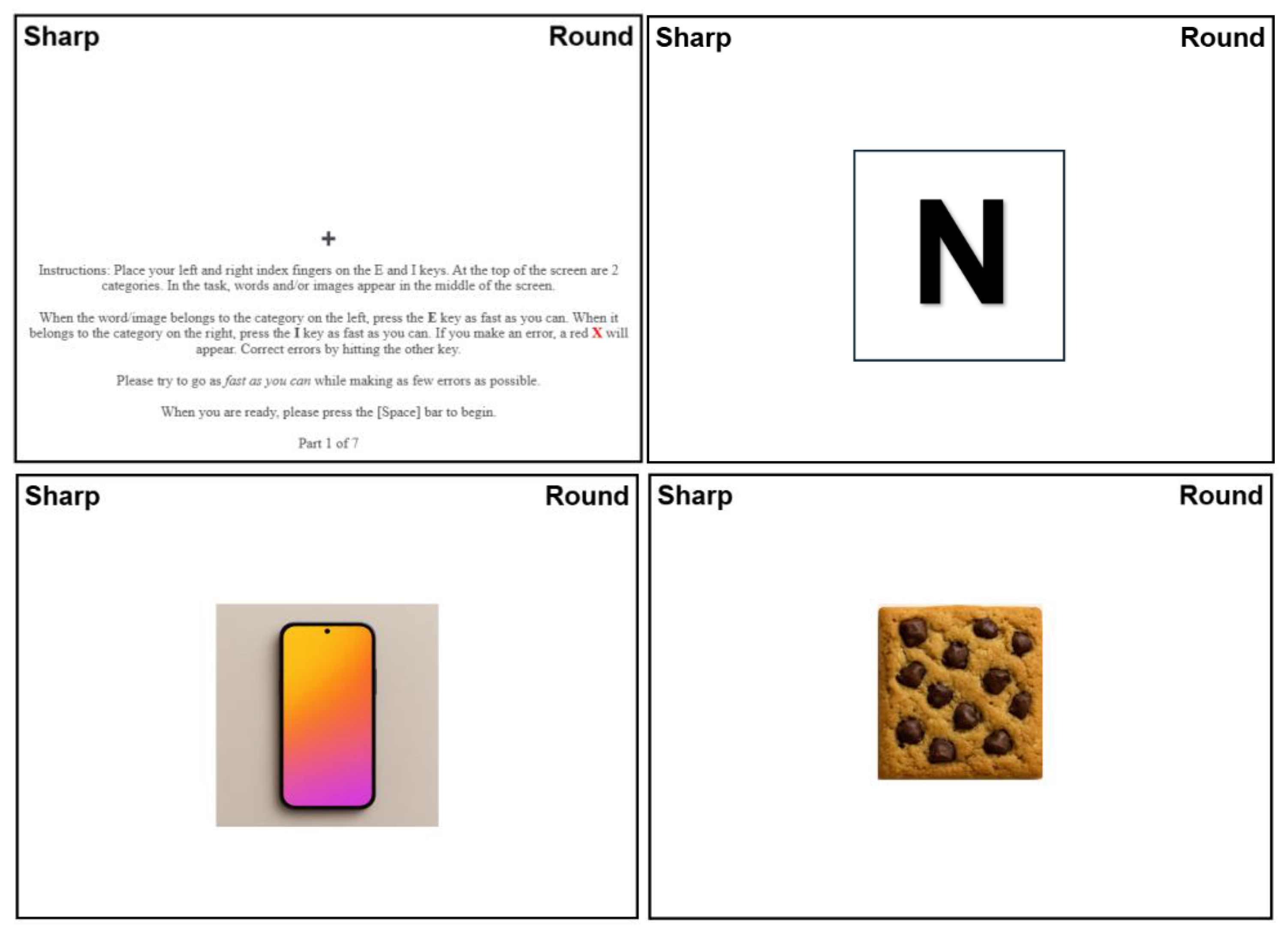
Each participant is required to complete the 7 tasks below in the same order. The stimuli (10 words, 10 pictures) are randomized in each task.
Task 1. Participants were presented 20 picture stimuli to judge whether they belong to Sharp or Round
Task 2. Participants were presented 20 picture stimuli to judge whether they belong to Intelligent or Unintelligent
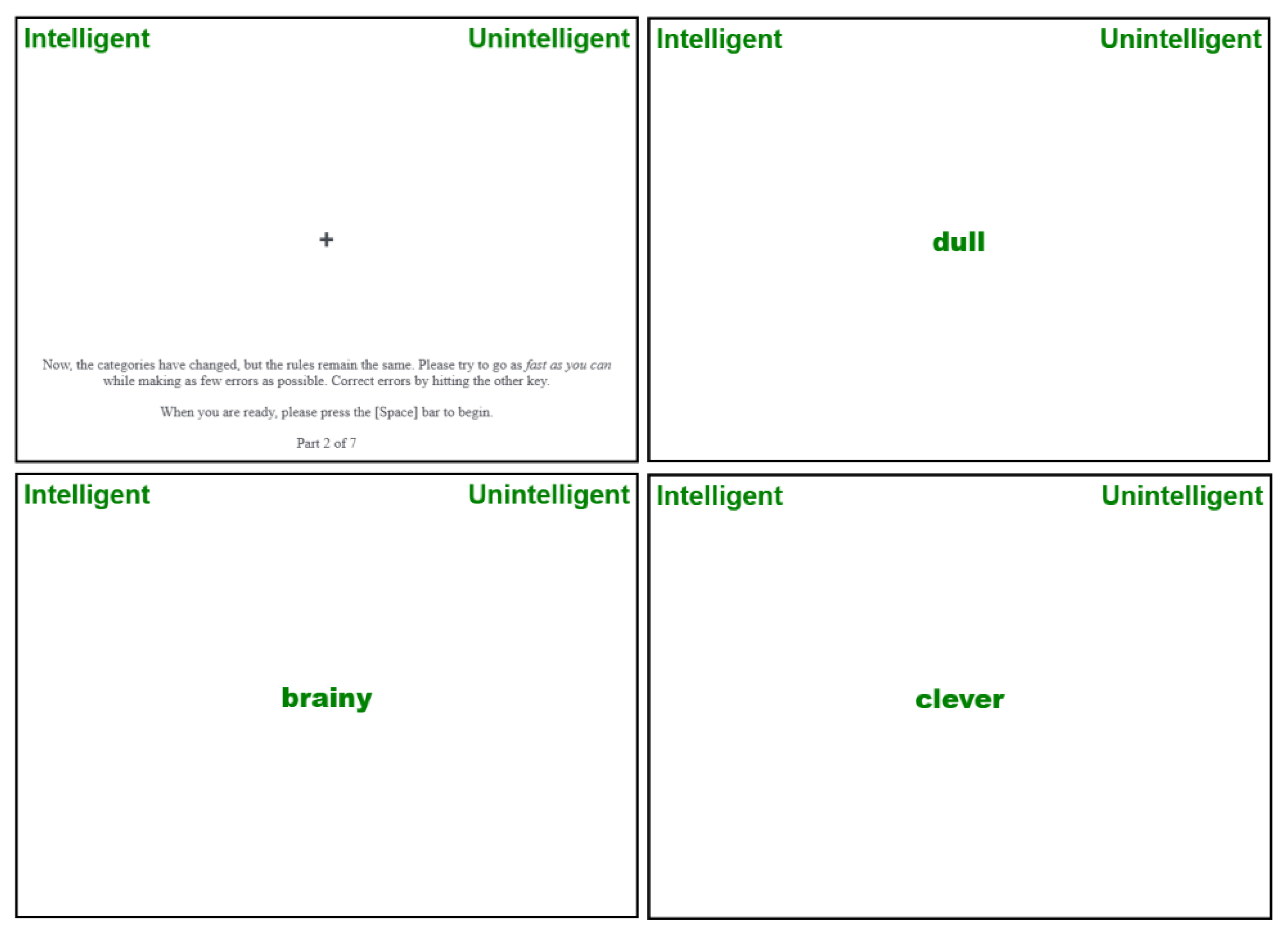
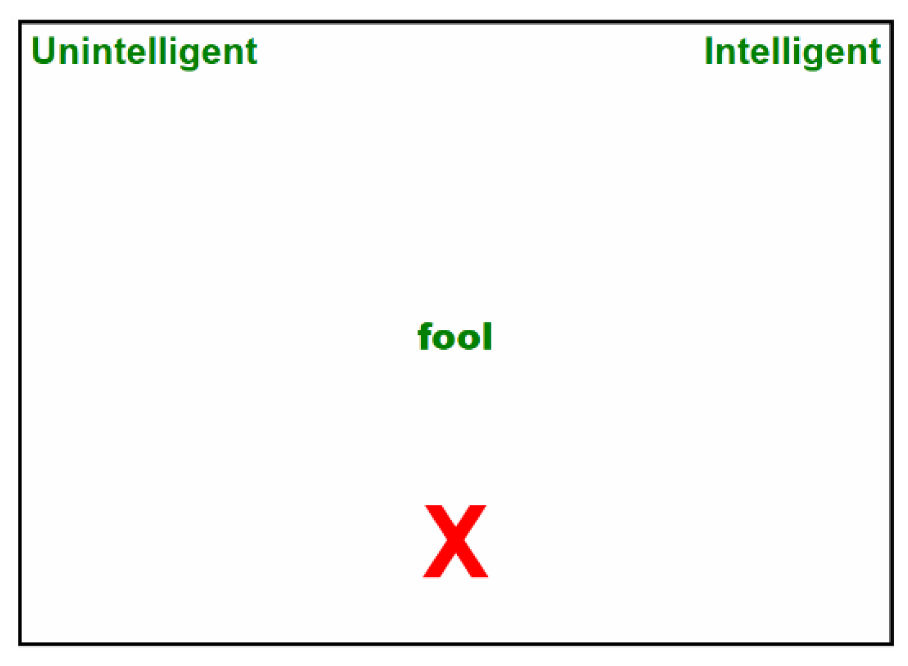
Task 3. Participants were presented 20 mixed picture and word stimuli to judge whether they belong to Sharp-Unintelligent association (left) or Round-Intelligent association (right). The words are in green color and pictures in black color to help participants to identify the appropriate category.
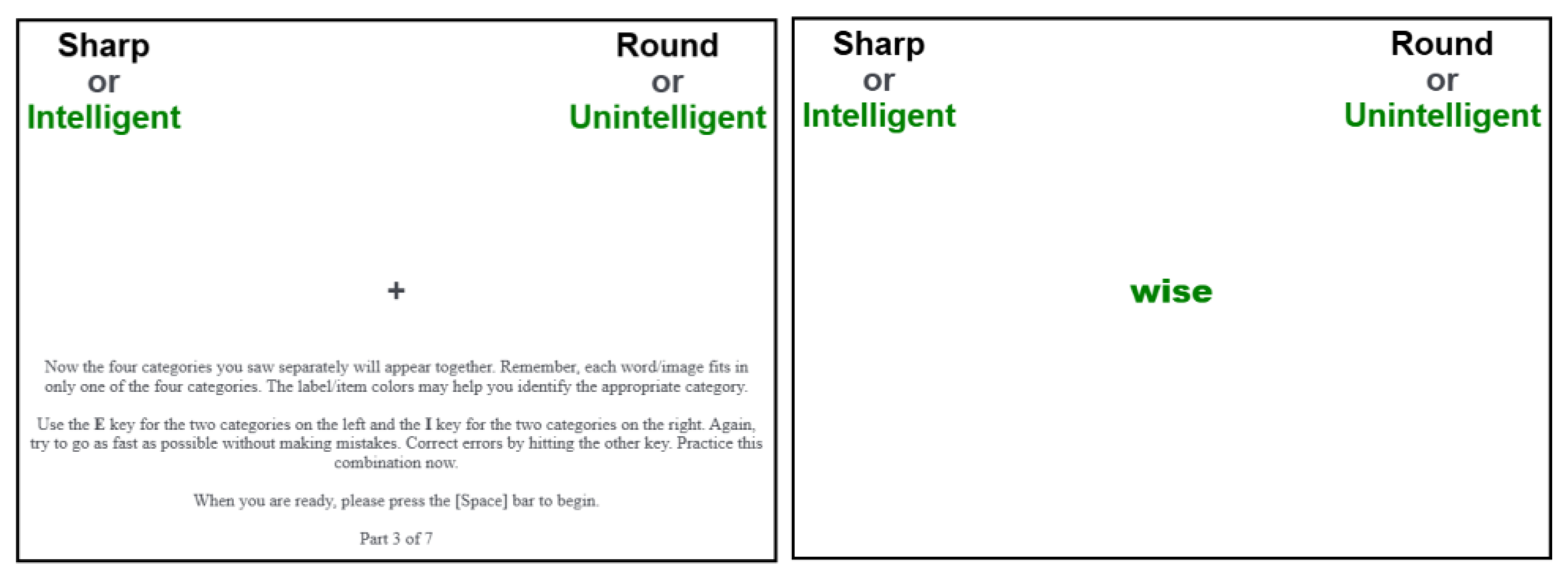
Task 4. Repeat Task 3 with 40 stimuli
Task 5. Repeat Task 1 with 40 stimuli, with “Round” and “Sharp” reversed side
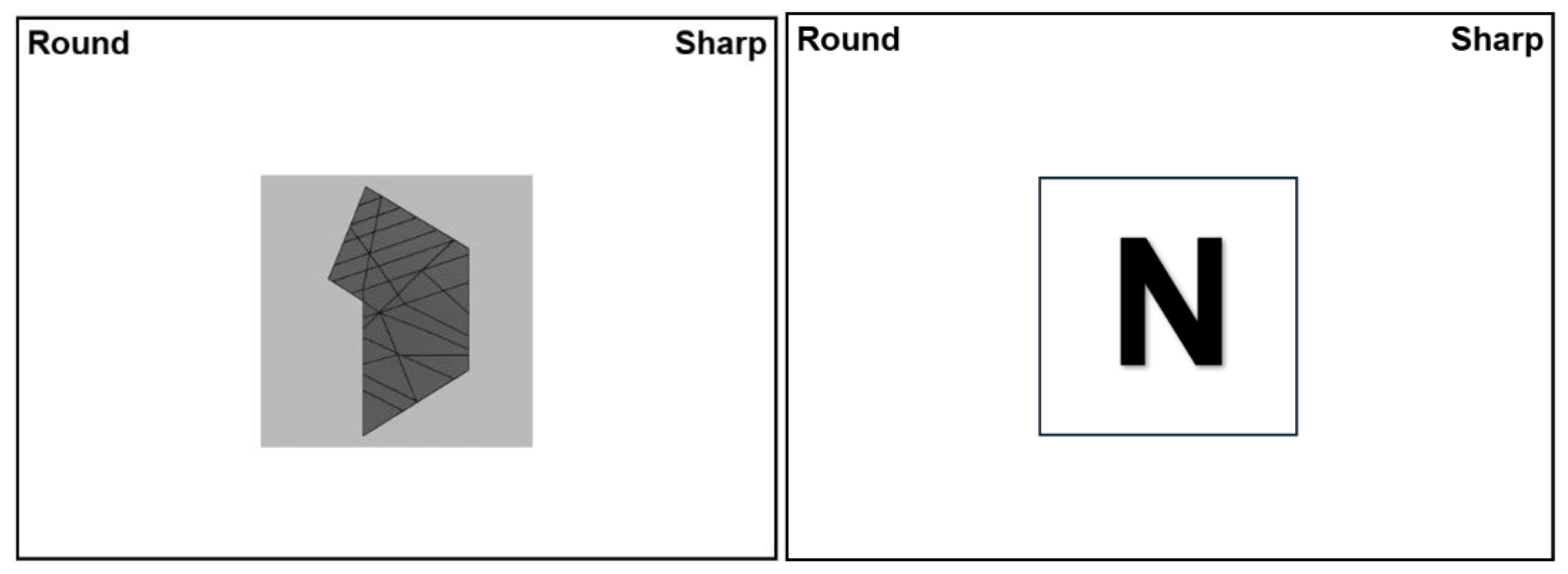
Task 6. Participants were presented 20 mixed picture and word stimuli to judge whether they belong to Round-Unintelligent association (left) or Sharp-Intelligent association (right). The words are in green color and pictures in black color to help participants to identify the appropriate category.
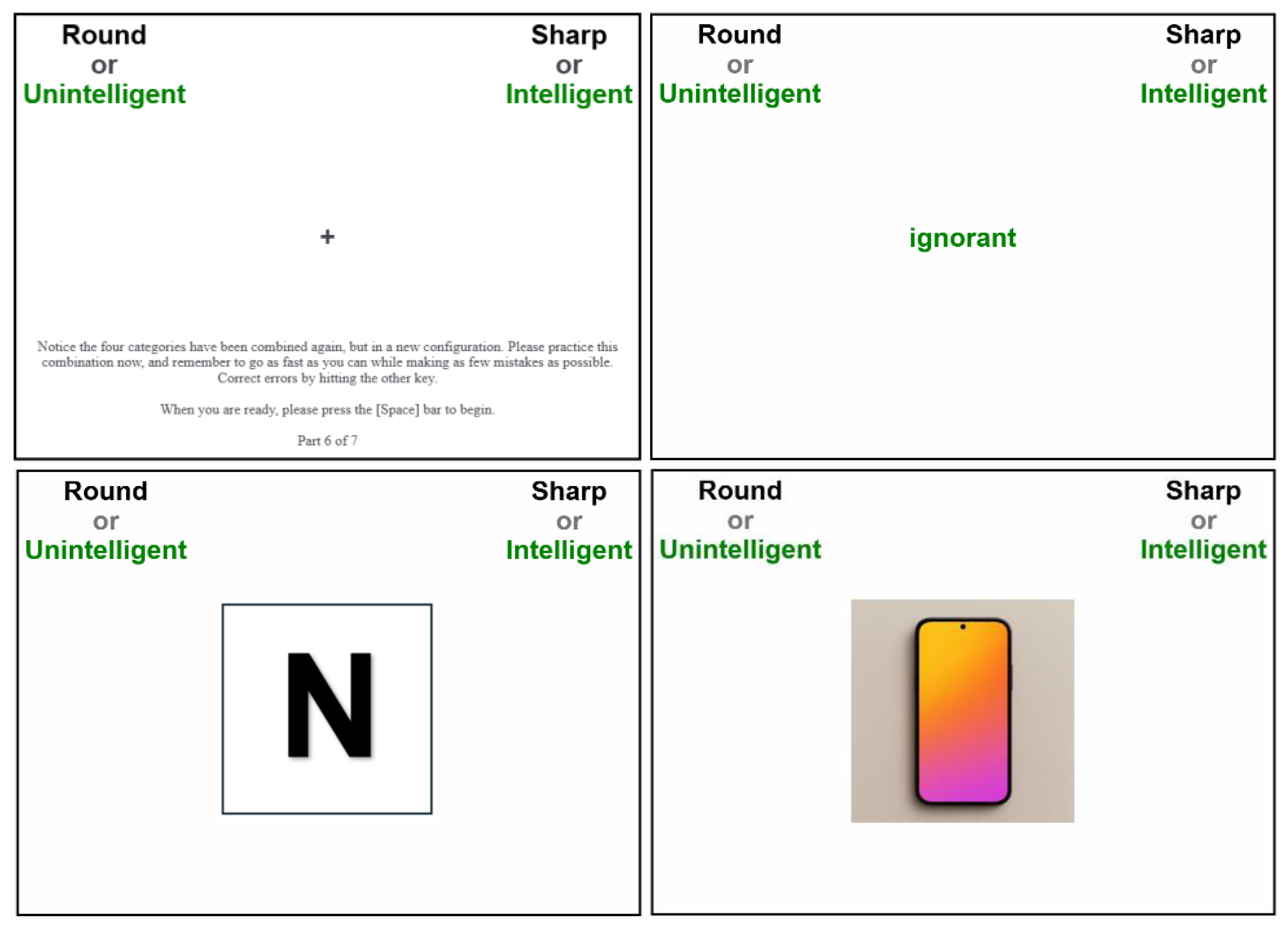
Task 7. Repeat Task 6 with 40 stimuli
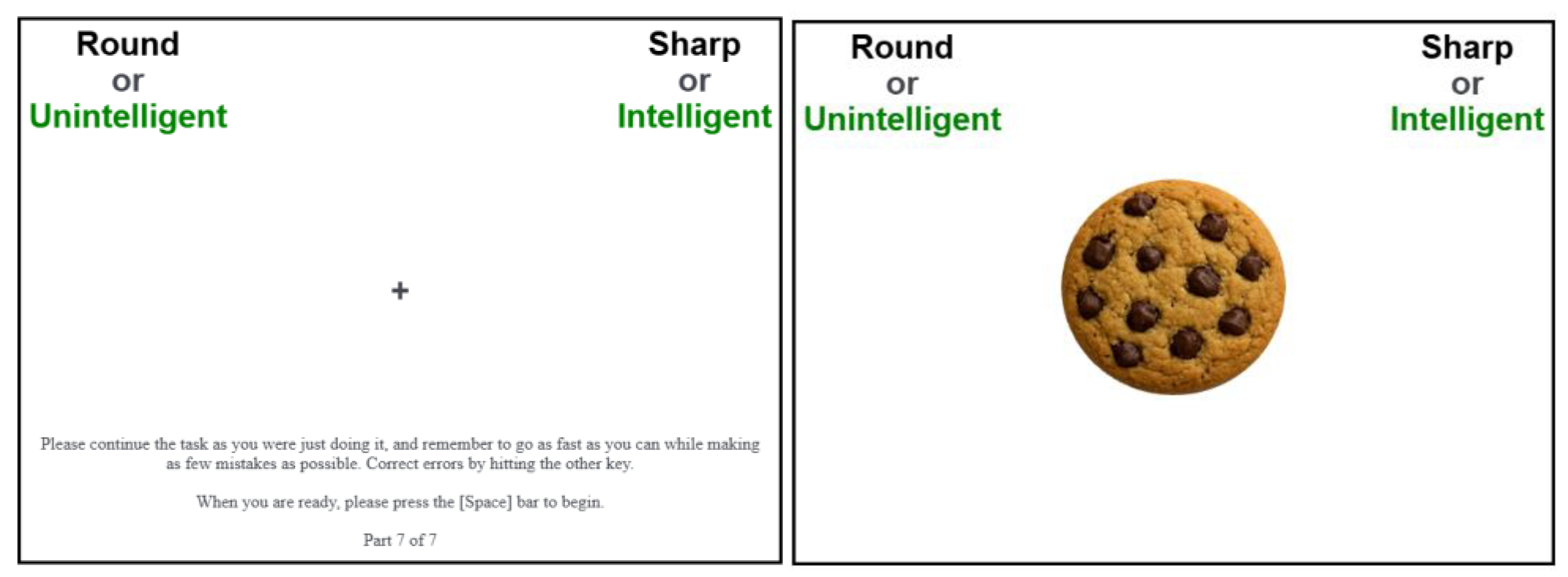
If participants selected a wrong match, the interface immediately shows a red cross sign, and participants can re-do the selection with minimum delay.
After completing all the IAT tasks, participants answered questions on their demographics.
References
- Bar, M.; Neta, M. Humans prefer curved visual objects. Psychol. Sci. 2006, 17(8), 645–648. [Google Scholar] [CrossRef] [PubMed]
- Bar-Anan, Y.; Liberman, N.; Trope, Y. The association between psychological distance and construal level: Evidence from an implicit association test. J. Exp. Psychol. General. 2006, 135(4), 609–622. [Google Scholar] [CrossRef] [PubMed]
- Bartneck, C.; Kulić, D.; Croft, E.; Zoghbi, S. Measurement instruments for the anthropomorphism, animacy, likeability, perceived intelligence, and perceived safety of robots. Int. J. Soc. Robot. 2009, 1(1), 71–81. [Google Scholar] [CrossRef]
- Biswas, D.; Abell, A.; Chacko, R. Curvy digital marketing designs: Virtual elements with rounded shapes enhance online click-through rates. J. Consum. Res. 2024, 51(3), 552–570. [Google Scholar] [CrossRef]
- Blazhenkova, O.; Dogerlioglu-Demir, K. The shape of the pill: Perceived effects, evoked bodily sensations and emotions. PLoS ONE 2020, 15(9), e0238378. [Google Scholar] [CrossRef] [PubMed]
- Boroditsky, L.; Schmidt, L. A.; Phillips, W. Sex, syntax, and semantics. In Language in mind: Advances in the study of language and thought; Gentner, D., Goldin-Meadow, S., Eds.; MIT Press, 2003; pp. 61–79. [Google Scholar]
- Brough, A. R.; Wilkie, J. E.; Ma, J.; Isaac, M. S.; Gal, D. Is eco-friendly unmanly? The green-feminine stereotype and its effect on sustainable consumption. J. Consum. Res. 2016, 43(4), 567–582. [Google Scholar] [CrossRef]
- Carpenter, T. P.; Pogacar, R.; Pullig, C.; Kouril, M.; Aguilar, S.; LaBouff, J.; Isenberg, N.; Chakroff, A. Survey-software implicit association tests: A methodological and empirical analysis. Behav. Res. Methods 2019, 51(5), 2194–2208. [Google Scholar] [CrossRef] [PubMed]
- Chandon, P.; Wansink, B. The biasing health halos of fast-food restaurant health claims: lower calorie estimates and higher side-dish consumption intentions. J. Consum. Res. 2007, 34(3), 301–314. [Google Scholar] [CrossRef]
- Chen, M.; Burke, R. R.; Hui, S. K.; Leykin, A. Understanding lateral and vertical biases in consumer attention: An in-store ambulatory eye-tracking study. J. Mark. Res. 2021, 58(6), 1120–1141. [Google Scholar] [CrossRef]
- Chen, T.; Ma, Z.; Xiao, M.; Qing, P. Be careful of the sharp edges! How and why circular versus angular shapes influence consumer adoption of new products. J. Bus. Res. 2024, 183, 114817. [Google Scholar] [CrossRef]
- Chen, X.; Barnes, C. J.; Childs, T. H. C.; Henson, B.; Shao, F. Materials’ tactile testing and characterisation for consumer products’ affective packaging design. Mater. Des. 2009, 30(10), 4299–4310. [Google Scholar] [CrossRef]
- Childers, T. L.; Jass, J. All dressed up with something to say: Effects of typeface semantic associations on brand perceptions and consumer memory. J. Consum. Psychol. 2002, 12(2), 93–106. [Google Scholar] [CrossRef] [PubMed]
- Cian, L. Verticality and conceptual metaphors: A systematic review. J. Assoc. Consum. Res. 2017, 2(4), 466–480. [Google Scholar] [CrossRef]
- Elder, R. S.; Krishna, A. The “visual depiction effect” in advertising: Facilitating embodied mental simulation through product orientation. J. Consum. Res. 2012, 38(6), 988–1003. [Google Scholar] [CrossRef]
- Esteky, S. Risk on the edge: The effect of relative spatial location on consumer preferences and choices. J. Mark. Res. 2022, 59(6), 1140–1159. [Google Scholar] [CrossRef]
- Greenwald, A. G.; McGhee, D. E.; Schwartz, J. L. K. Measuring individual differences in implicit cognition: The implicit association test. J. Personal. Soc. Psychol. 1998, 74(6), 1464–1480. [Google Scholar] [CrossRef] [PubMed]
- Greenwald, A. G.; Nosek, B. A.; Banaji, M. R. Understanding and using the Implicit Association Test: I. An improved scoring algorithm. J. Personal. Soc. Psychol. 2003, 85(2), 197–216. [Google Scholar] [CrossRef] [PubMed]
- Gupta, T.; Hagtvedt, H. Safe together, vulnerable apart: How interstitial space in text logos impacts brand attitudes in tight versus loose cultures. J. Consum. Res. 2021, 48(3), 474–491. [Google Scholar] [CrossRef]
- Harmand, S.; Lewis, J.; Feibel, C.; Lepre, C.; Prat, S.; Lenoble, A.; Boës, X.; Quinn, R. L.; Brenet, M.; Arroyo, A.; Taylor, N.; Clément, S.; Daver, G.; Brugal, J.-P.; Leakey, L.; Mortlock, R. A.; Wright, J. D.; Lokorodi, S.; Kirwa, C.; …; Roche, H. 3.3-million-year-old stone tools from Lomekwi 3, West Turkana, Kenya. Nature 2015, 521, 310–315. [Google Scholar] [CrossRef] [PubMed]
- Jiang, Y.; Gorn, G. J.; Galli, M.; Chattopadhyay, A. Does your company have the right logo? How and why circular- and angular-logo shapes influence brand attribute judgments. J. Consum. Res. 2016, 42(5), 709–726. [Google Scholar] [CrossRef]
- Ketron, S. Perceived product sizes in visually complex environments. J. Retail. 2018, 94(2), 154–166. [Google Scholar] [CrossRef]
- Kim, D. J.; Hwang, Y. A study of mobile internet user’s service quality perceptions from a user’s utilitarian and hedonic value tendency perspectives. Inf. Syst. Front. 2012, 14(2), 409–421. [Google Scholar] [CrossRef]
- Krishna, A.; Schwarz, N. Sensory marketing, embodiment, and grounded cognition: A review and introduction. J. Consum. Psychol. 2014, 24(2), 159–168. [Google Scholar] [CrossRef]
- Lacan, J. Écrits: A selection; Sheridan, A., Translator; W. W. Norton, 1977. [Google Scholar]
- Lakoff, G. The contemporary theory of metaphor. In Metaphor and thought, 2nd ed.; Ortony, A., Ed.; Cambridge University Press, 1993; pp. 202–251. [Google Scholar]
- Landau, M. J.; Zhong, C.-B.; Swanson, T. J. Conceptual metaphors shape consumer psychology. Consum. Psychol. Rev. 2018, 1(1), 54–71. [Google Scholar] [CrossRef]
- Lavie, T.; Tractinsky, N. Assessing dimensions of perceived visual aesthetics of web sites. Int. J. Hum.-Comput. Stud. 2004, 60(3), 269–298. [Google Scholar] [CrossRef]
- Masuda, T.; Nisbett, R. E. Attending holistically versus analytically: Comparing the context sensitivity of Japanese and Americans. J. Personal. Soc. Psychol. 2001, 81(5), 922. [Google Scholar] [CrossRef] [PubMed]
- McCarthy, M. S.; Mothersbaugh, D. L. Effects of typographic factors in advertising-based persuasion: A general model and initial empirical tests. Psychol. Mark. 2002, 19(7-8), 663–691. [Google Scholar] [CrossRef]
- Meier, B. P.; Robinson, M. D. Why the sunny side is up: Associations between affect and vertical position. Psychol. Sci. 2004, 15(4), 243–247. [Google Scholar] [PubMed]
- Merriam-Webster Thesaurus. (2026a). Synonyms & similar words to “intelligent.” Retrieved February 14, 2026. Available online: https://www.merriam-webster.com/thesaurus/intelligent.
- Merriam-Webster Thesaurus. (2026b). Synonyms & similar words to “unintelligent.” Retrieved February 14, 2026. Available online: https://www.merriam-webster.com/thesaurus/unintelligent.
- Park, J.; Velasco, C.; Spence, C. “Looking sharp”: Price typeface influences awareness of spending in mobile payment. Psychol. Mark. 2022, 39(6), 1170–1189. [Google Scholar] [CrossRef]
- Raghunathan, R.; Naylor, R. W.; Hoyer, W. D. The unhealthy = tasty intuition and its effects on taste inferences, enjoyment, and choice of food products. J. Mark. 2006, 70(4), 170–184. [Google Scholar] [CrossRef]
- Rozin, P.; Hormes, J. M.; Faith, M. S.; Wansink, B. Is meat male? A quantitative multimethod framework to establish metaphoric relationships. J. Consum. Res. 2012, 39(3), 629–643. [Google Scholar] [CrossRef]
- Shani-Feinstein, Y.; Kyung, E. J.; Goldenberg, J. Moving, fast or slow: How perceived speed influences mental representation and decision making. J. Consum. Res. 2022, 49(3), 520–542. [Google Scholar] [CrossRef]
- Spence, C. Managing sensory expectations concerning products and brands: Capitalizing on the potential of sound and shape symbolism. J. Consum. Psychol. 2012, 22(1), 37–54. [Google Scholar] [CrossRef]
- Vallen, B.; Sridhar, K.; Rubin, D.; Ilyuk, V.; Block, L. G.; Argo, J. J. Shape- and trait-congruency: Using appearance-based cues as a basis for product recommendations. J. Consum. Psychol. 2019, 29(2), 271–284. [Google Scholar] [CrossRef]
- Wang, L.; Yu, Y.; Li, O. The typeface curvature effect: The role of typeface curvature in increasing preference toward hedonic products. Psychol. Mark. 2020, 37(8), 1118–1137. [Google Scholar] [CrossRef]
- Westerman, S. J.; Gardner, P. H.; Sutherland, E. J.; White, T.; Jordan, K.; Watts, D.; Wells, S. Product design: Preference for rounded versus angular design elements. Psychol. Mark. 2012, 29(8), 595–605. [Google Scholar] [CrossRef]
- Zaltman, G.; Coulter, R. H. Seeing the voice of the customer: Metaphor-based advertising research. J. Advert. Res. 1995, 35(4), 35–51. [Google Scholar] [CrossRef]
- Zhang, Y.; Feick, L.; Price, L. J. The impact of self-construal on aesthetic preference for angular versus rounded shapes. Personal. Soc. Psychol. Bull. 2006, 32(6), 794–805. [Google Scholar] [CrossRef] [PubMed]
Figure 1.
Study 3 Response Time and Correct Rate Across Conditions. Note: Congruent: Sharp-intelligent and round-unintelligent match (Tasks 3 + 4). Incongruent: Round-intelligent and sharp-unintelligent match (Tasks 6 + 7). Error bars indicate 95% confidence intervals. N = 134.
Figure 1.
Study 3 Response Time and Correct Rate Across Conditions. Note: Congruent: Sharp-intelligent and round-unintelligent match (Tasks 3 + 4). Incongruent: Round-intelligent and sharp-unintelligent match (Tasks 6 + 7). Error bars indicate 95% confidence intervals. N = 134.
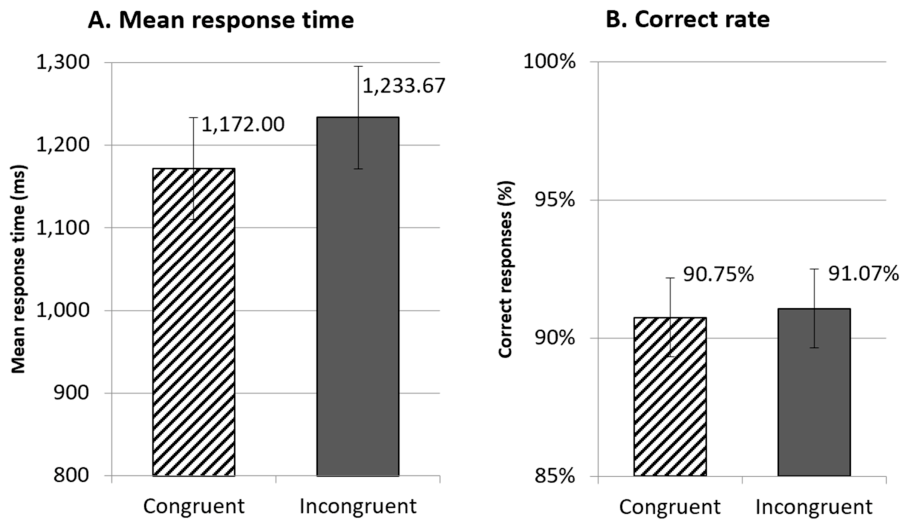

Table 1.
Sharpness-Intelligence Association in Polysemy in World Languages (Study 1).
| Languages | Words/Phrases | Source |
|---|---|---|
| 1. English |
1. Sharp 1. adj. having a thin edge or point that can cut something or make a hole in something 2. adj. intelligent or quick to notice things 3. adj. fashionable |
Cambridge Dictionary (2026a) |
| English |
2. Cutting-edge: 1. adj. very modern, and with all the newest features 2. adj. something that gives someone or something an advantage over others |
Cambridge Dictionary (2026b) |
| English |
3. Breakthrough n. an important discovery or development that helps to solve a problem |
Cambridge Dictionary (2026c) |
| 2. Chinese |
4. 锐 1. adj. sharp (knife) 2. adj. intelligent, react quickly e.g., 敏锐: intelligent, acutely smart e.g., 新锐: novel and sharp |
汉语词典(2026a, b, c) |
| Chinese |
5. 犀利 1. sharp, pointed 2. incisive, trenchant |
汉语词典(2026d) |
| Chinese |
6. 颖 1. the sharp point at the end of a stick 2. intelligent, smart e.g., 锋颖 e.g., 脱颖而出 |
汉语词典(2026e) |
| 3. Spanish |
7. Agudo 1. sharp, pointed 2. smart, clever, witty |
Asociación de Academias de la Lengua Española 2026; Collins Dictionary 2026a; Real Academica Española 2026 |
|
8. Avispado 1. sharp 2. clever |
Collins Dictionary 2026b | |
| 4. Hindi |
9. तेज़ (Tez in Roman Hindi) 1. adj. Sharp at the end; ending in a sharp point; pointed; -- opposed to blunt or obtuse 2. adj. Having nice discernment; perceiving or using minute distinctions; penetrating; clever; shrewd; -- opposed to dull or stupid |
Urdu Point Dictionary (2026) |
| 5. Japanese |
10. するどい(鋭い) 1. sharp , acute , piercing 2. intelligent and alert |
Cambridge Dictionary (2026d) |
| 6. Korean |
11. 날카롭다 1. Sharp, pointed 2. wit, incisive, trenchant |
Naver Dictionary (2026) |
| 7. Arabic |
12. ذكي (dhuki) 1. sharp 2. intelligent |
Word Hippo (2026) |
| 8. German |
13. Schärfe/scharf 1. sharpness 2. acuteness 3. keeness |
Cambridge Dictionary (2026e) |
| 9. Russian |
14. ocтpый (ostryy) 1. sharp, pointed (knife, blade) 2. sharp, keen, perceptive (mind, intellect) e.g., ocтpый нoж – sharp knife e.g., ocтpый yм– sharp mind |
Reverso Dictionary (2026) |
| 10. French |
15. aigu 1. sharp, pointed (sound or physical point) 2. sharp-minded, perceptive, acute e.g., un esprit aigu – a sharp mind |
Collins Dictionary (2026c) |
| 11. Italian |
16. acuto 1. sharp, pointed 2. acute, intelligent, perceptive e.g., mente acuta – acute mind |
Collins Dictionary (2026d) |
| 12. Portuguese |
17. agudo 1. adj. sharp, pointed 2. adj. alert |
Cambridge Dictionary (2026f) |
Note: Dictionary and lexicon sources for all entries are listed in Appendix B.
Table 2.
Stimuli in Online Experiment (Study 2).
| Sharp | Round | Reference | |
|---|---|---|---|
| Cookie |  |
 |
Authors’ own design |
| Chocolate |  |
 |
Authors’ own design |
| Juice |  |
 |
Authors’ own design |
| Spring Water |  |
 |
Westerman et al. 2012 |
| Phone | 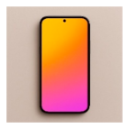 |
 |
Authors’ own design |
| Font |  |
 |
Authors’ own design |
| Logo |  |
 |
Authors’ own design |
| Meaningless |  |
 |
Bar and Neta 2006 |
Table 3.
Regression Results Predicting Perceived Intelligence (Study 2).
| Predictor | Perceived Intelligence Model 1 All Pairs |
Perceived Intelligence Model 2 All Pairs |
Perceived Intelligence Model 3 Meaningless Shape |
Perceived Intelligence Model 4 Meaningless Shape |
Perceived Intelligence Model 5 Food & Drink |
Perceived Intelligence Model 6 Food & Drink |
|---|---|---|---|---|---|---|
| Sharp (vs. Round) | .02 | 0.2 | .211* | .16† | -.02 | .01 |
| Perceived expensiveness | 0.24*** | .17 | .16*** | |||
| Perceived size | .05 | −.09 |
-.01 |
|||
| Perceived comfort | .17*** | .12 |
.07 |
|||
| Perceived aesthetics | .32*** | .31* | .31*** |
|||
| Expected taste |
.22*** |
|||||
| R2 | .00 | 0.38 | 0.05 | .29 | .02 | .61 |
| Adjusted R2 | .00 | 0.38 | 0.04 | .26 | -.00 | .36 |
| F | 0.40 | 97.25 | 4.62* | 7.89*** | .12 | 34.00*** |
| df | 1;800 | 5;796 | 1;99 | 5; 95 | 1;408 | 6;403 |
| N | 801 | 801 | 101 | 101 | 409 | 409 |
Note: Entries predictors are standardized regression coefficients (β). † p < .10. *p < .05. **p < .01. ***p < .001.
Table 4.
Stimuli in Implicit Association Tests (IAT; Study 3 & 4).
 |
Disclaimer/Publisher’s Note: The statements, opinions and data contained in all publications are solely those of the individual author(s) and contributor(s) and not of MDPI and/or the editor(s). MDPI and/or the editor(s) disclaim responsibility for any injury to people or property resulting from any ideas, methods, instructions or products referred to in the content. |
© 2026 by the authors. Licensee MDPI, Basel, Switzerland. This article is an open access article distributed under the terms and conditions of the Creative Commons Attribution (CC BY) license (http://creativecommons.org/licenses/by/4.0/).
Copyright: This open access article is published under a Creative Commons CC BY 4.0 license, which permit the free download, distribution, and reuse, provided that the author and preprint are cited in any reuse.