

Submitted:
25 September 2026
Posted:
28 September 2026
You are already at the latest version
Abstract
Background/Objectives: Among patients with rheumatoid arthritis (RA) and well-controlled inflammation, morning stiffness (MS) relief is an unmet need. Because MS is most pronounced immediately after waking, an intervention is necessary during sleep. We developed a low-temperature wrist warming device designed for overnight use and evaluated its feasibility, safety, and preliminary efficacy for improving MS. Methods: In this single-arm, open-label pilot study, 15 patients with RA recorded MS severity and duration during 2 weeks with and 2 weeks without device use. Secondary outcomes included grip strength, disease activity, and musculoskeletal ultrasound (MSUS) findings of 22 wrist and finger joints. Synovitis was assessed using semi-quantitative grayscale (GS) and power Doppler (PD) grading scores. Results: No burns occurred. Total GS and PD scores indicated no significant change after warming. A joint-level analysis indicated that most joints exhibited no change in grade. Only small bidirectional fluctuations occurred. No participant exhibited a pattern of progressive or widespread worsening. MS severity during the warming period was lower than that during the non-warming period (3.83 vs. 4.47; p = 0.0033). MS duration also decreased (99.8 vs. 124.2 min; p = 0.0049). Grip strength and Disease Activity Score 28 based on C-reactive protein remained unchanged. Conclusions: Continuous, overnight, low-temperature wrist warming was feasible and safe, without burns or evidence of synovitis exacerbation on MSUS. The safety profile and preliminary evidence of reduced MS severity and duration support further evaluation of this home-based, non-pharmacologic approach in large-scale controlled trials.
Keywords:
morning stiffness
; thermotherapy
; rheumatoid arthritis
; musculoskeletal ultrasound
; complementary therapy
1. Introduction
Morning stiffness (MS) is one of the most disabling symptoms of rheumatoid arthritis (RA). In the Good Days Fast survey in 2015, patients most frequently defined a “good day” as one without fatigue, followed by a day without pain and a day without MS [1]. Although biologics and targeted synthetic disease-modifying anti-rheumatic drugs (DMARDs) have markedly improved inflammation control and disease activity [2], MS often persists even in patients who achieve remission or low disease activity, indicating a weak relationship with standard disease activity indices [3]. A recent survey found that 27% of patients with Simplified Disease Activity Index remission still experienced MS that interfered with essential morning activities such as toileting, washing their face, dressing, and preparing breakfast [4]. A systematic review of 68 studies similarly identified MS, along with pain and fatigue, as one of the most frequently reported residual symptoms in this population [5]. This burden appears to be under-recognized in routine care because consultations tend to focus on pharmacological escalation rather than symptoms that have the most impact on daily function [6,7]. MS also reduces labor productivity and contributes to early retirement, thus highlighting its substantial social impact [8]. Therefore, MS relief is an unmet clinical need that is insufficiently addressed in current RA management.
Nocturnal modified-release glucocorticoid therapy can reduce MS duration [9]; however, concerns about steroid side effects such as infections [10] as well as steroid avoidance by patients [11] lead to difficulty with long-term continuation. Therefore, a non-pharmacologic strategy that can avoid these concerns is clinically valuable. The persistence of MS despite well-controlled inflammation suggests that mechanisms beyond synovitis, such as reduced muscle and tendon elasticity, altered tissue viscosity, and impaired nocturnal circulation, may contribute to stiffness. Because these mechanisms are multifactorial and not yet fully elucidated, targeting a single inflammatory pathway may not adequately improve MS. Therefore, we hypothesized that nonspecific physical stimulation, such as heat application, could alleviate MS by improving tissue extensibility and muscular function. Direct application of heat increases the extensibility of connective tissue [12]. Meta-analytic and systematic review evidence pertaining to both acute and chronic musculoskeletal conditions, such as knee osteoarthritis, demonstrated that local heat application alleviates pain, reduces stiffness, and enhances range of motion [13,14]. Additionally, many patients with RA report subjective relief of stiffness with warming [15].
Because MS is most pronounced immediately after waking, an effective intervention must occur during sleep so the tissues are already warmed at the moment of waking. Therefore, overnight warming is a physiologically reasonable approach for targeting MS. However, existing evidence regarding thermotherapy for patients with RA is limited to daytime session-based interventions such as paraffin wax baths and infrared sauna use, which provide short-term relief during or immediately after treatment [16,17]. To our knowledge, whether continuous low-level heat applied overnight during sleep can reduce MS at the moment of waking, when it is most disabling, has not been examined under temperature-controlled and burn-safe conditions.
Translating this daytime evidence into a continuous overnight intervention, however, is not simply a matter of extending treatment duration. Sustaining heat exposure for many hours during sleep, rather than for a brief supervised daytime session, raises safety concerns. Prolonged skin contact during sleep is associated with a risk of burn injury. Because the hands are among the joints that are most susceptible to synovitis in RA, warming them for many hours raises the theoretical concern that increased regional blood flow could aggravate, rather than relieve, inflammation. However, simply lowering the temperature to avoid burns may reduce therapeutic efficacy. To address these concerns, we developed a novel low-temperature warming device designed to maintain the skin temperature below the burn threshold (<42°C) that provides continuous overnight heating. In this pilot study, we evaluated the feasibility, safety, and preliminary efficacy of this newly developed warming device for reducing MS in patients with RA. By addressing the practical limitations of overnight thermotherapy, this study aimed to fill a critical gap in non-pharmacologic management of RA.
2. Materials and Methods
2.1. Study Design
Thermal stimulation is an intervention perceived by participants and cannot be controlled using a placebo. Therefore, this study was designed as a single-arm, open-label, interventional pilot study that enrolled patients with RA. The trial was conducted at the Department of Immunology of The University of Osaka Hospital between January 17, 2022 and December 31, 2023.
2.2. Warmer Design
The Henriques–Moritz model, which represents the relationship between temperature and exposure time, indicates the temperature that does not cause burns [18,19]. We jointly developed disposable warmers and holders in collaboration with Kobayashi Pharmaceutical Co., Ltd. (Osaka, Japan) as part of a cooperative research project. Kobayashi Pharmaceutical Co., Ltd. manufactured the devices and provided them for use in this study.
The warmers (7.0 cm × 8.8 cm) contained iron powder that generates heat through oxidation, reached a temperature of up to 44°C, and maintained the temperature at >40°C for up to 12.7 h. To confirm the skin temperature profile during overnight use, we measured the skin temperatures of six volunteers at Kobayashi Pharmaceutical Co., Ltd. under the same wearing conditions (Supplementary Figure S1). The average skin temperature at the application site ranged from 37°C to 39°C, with a maximum temperature of 40.8°C. According to the Henriques–Moritz model, a temperature of 41°C must be maintained for at least 30 h to induce a burn.
2.3. Participants
This study is the first to our knowledge to apply a device that delivers continuous heat and can be worn on the wrist of patients with RA while sleeping. Therefore, we determined the sample size based on the adequacy and feasibility of conducting the study with consenting patients with RA at a single institution. The main inclusion criteria were as follows: diagnosed with RA according to the 2010 American College of Rheumatology/European Alliance of Associations for Rheumatology classification criteria; age between 20 and 90 years at the time of consent; typically experience MS for a duration >15 min; and did not start or change RA treatment doses within 4 weeks before participating in this study. The main exclusion criteria comprised any type of skin disease at the application site, fever caused by infection or underlying disease, diabetes mellitus, peripheral neuropathy or sensory disturbance in the upper extremities, and inability to wear and remove the warmers.
2.4. Intervention
The warmers were placed inside holders and worn on the dorsal aspects of both wrists (Figure 1a). Compared with the hands and fingers, the wrists have an adequate surface area and reduced individual variability attributable to deformities. The patients were asked to wear the warming device from the time of going to bed at night to the time when they awakened. They were also asked to document their daily experiences with the warmers using a diary. To avoid burns at the warming sites, the device could be removed if it became too hot or uncomfortable. The participants were not allowed to use other warming devices, such as heated bedding, while wearing the warmers, and they were cautioned to avoid warming their wrists by any other means during the study.
The participants were given a diary, warmers, a pair of holders, and a Pneumatic Bulb Dynamometer grip strength meter (12-0293; Fabrication Enterprises, Inc., New York, NY, USA). Using the diaries, the participants recorded information about MS without the warmers for 2 weeks and that with the use of warmers on both wrists during the night for the following 2 weeks (Figure 1b). They visited the hospital on the final day of warmer application, and disease activity and skin symptoms at the warmer application sites were assessed. The participants were asked to avoid starting, changing, or discontinuing their RA treatment to maintain consistency in the evaluations.
2.5. Measurement Items
The following items were noted in the diaries: self-rated MS severity based on an integer scale of 0 to 10 (MS severity); MS duration (minutes); grip strength upon waking (psi); warmer status (whether it was worn or removed during sleep and the reason for removal); and burn symptoms such as redness, blisters, or pain after use (skin condition).
We evaluated RA disease activity using the Disease Activity Score 28 based on C-reactive protein (DAS28-CRP) before and after the warming period. To determine whether wrist heating induced or aggravated synovitis at the application sites, we performed musculoskeletal ultrasound (MSUS) examinations of the wrists and 20 finger joints (10 bilateral metacarpophalangeal and 10 proximal interphalangeal joints). All MSUS assessments were performed using a HITACHI ARIETTA 60 (Hitachi, Tokyo, Japan) with a 9- to 12-MHz transducer at baseline and at the end of the study. Synovial thickness was semi-quantitatively graded using grayscale (GS) and a scale of 0 to 3. Power Doppler (PD) enhancement was graded using a scale of 0 to 3 based on the European Alliance of Associations for Rheumatology–Outcome Measures in Rheumatology Ultrasound Taskforce scoring system [20]. For each participant, representative images of all examined joints were obtained. To evaluate joint-level changes, the GS and PD grades of each of the 22 joints at baseline and at the end of the study were compared and classified as decreased, unchanged, or increased. For each participant, the number of joints in each category was counted, and these counts were separately averaged for GS and PD across all participants.
The within-person design allowed comparisons of the effects of wearing and not wearing the warmers for 14 nights on each individual. The primary endpoint was a change in MS severity (recorded in diaries). The secondary endpoints were changes in the MS duration, grip strength upon waking, RA disease activity, and MSUS findings caused by wearing the warmers. All adverse events that occurred during the study were documented. The severity of adverse events was classified as mild (transient, easily tolerable), moderate (interference with some daily activities), or severe (impossible daily activities). The incidence of burns at the sites where the warmers were applied was the safety endpoint.
2.6. Statistical Analysis
The collected data were stored at the Data Coordinating Center of The University of Osaka Hospital and managed and monitored by an administrator without conflicts of interest associated with the study. Background information of the participants was summarized using descriptive statistics. Those who wore a warmer at least once were included in the full analysis set (FAS) and safety analysis set (SAS). The sensitivity of the primary endpoints in the per-protocol set (PPS) was analyzed. The PPS excluded the following participants in the FAS: those with <50% of the required diary records regarding wearing the device and those who wore the device during <50% of the study period. Continuous variables are described as means and standard deviations (SDs). Categorical variables are described as frequencies and percentages. The average MS severity, which was the primary endpoint, during the 2 weeks when the warmer was worn was calculated. Additionally, the average severity of MS during the 2 weeks when the device was not worn was calculated. The difference between severity during these two periods was compared using the paired t test or Wilcoxon signed-rank test based on normality. We calculated the mean values of the secondary endpoints during these periods using a paired comparison test. All p values were two-sided, and p = 0.05 was considered significant. All data were statistically analyzed using Bell Curve for Excel (Social Survey Research Information Co., Ltd., Tokyo, Japan).
3. Results
3.1. Patient Disposition and Clinical Characteristics
Written informed consent was obtained from all 15 patients who were screened and participated in this study. All participants wore warmers for at least 1 day and were included in the FAS and SAS. Two patients were excluded from the PPS: one withdrew consent and one wore the warmers during <50% of the designated period. Therefore, the PPS comprised 13 patients (Figure 2).
The average age of the participants was 61.7 years; 13 participants (86.7%) were female and 2 participants (13.3%) were male. Overall, five participants had RA for <5 years, five had RA for between 5 and <10 years, and five had RA for ≥10 years. The mean disease duration was 9.9 years. RA was managed by administering methotrexate to nine patients (60.0%), oral corticosteroids to four patients (26.7%), and biological DMARDs to five patients (33.3%). None of the participants received JAK inhibitors. Table 1 summarizes the background characteristics of the participants.
3.2. Stiffness Evaluation
Participants wore warmers for a mean duration of 12.3 days, representing 88.1% of the prescribed 14-day period. The mean recorded MS severity in the FAS was 4.47 (SD, 1.90) when the warmers were not worn; however, it was 3.83 (SD, 1.92) when they were worn. The mean change in MS severity (ΔMS) between the 2-week periods with and without the use of warmers was -0.639 (95% confidence interval [CI], -1.026 to -0.252; p = 0.0033), and the effect size calculated as Cohen’s d was -0.914 (paired t test). These results indicate significantly lower MS severity when the warmers were applied (Figure 3a). In the PPS, the mean MS severity was 4.70 (SD, 3.11) when the warmers were not worn; however, it was 4.01 (SD, 3.74) when they were worn. The mean ΔMS was -0.688 (95% CI, -1.103 to -0.272; p = 0.0036), indicating a significant reduction in MS severity when the warmers were used.
The recorded mean MS durations in the FAS when wearing and not wearing the warmers significantly differed (99.81 min [SD, 123.8] vs. 124.18 min [SD, 145.5]; p = 0.0049; Wilcoxon signed-rank test) (Figure 3b). These findings indicate that the MS duration significantly decreased when wearing warmers.
Changes in the grip strength of the dominant hand upon waking were assessed as an objective measure of MS. One participant was excluded because of finger pain that prevented assessment; therefore, the data of 14 patients were analyzed. The mean grip strength upon waking when wearing warmers was 6.21 psi (SD, 2.59); however, it was 5.87 psi (SD, 2.66) when not wearing warmers (mean difference, 0.337; 95% CI, -0.078 to 0.7513; p = 0.103; paired t test). Grip strength did not significantly differ between the warming and non-warming periods.
3.3. RA Activity
We assessed the DAS28-CRP scores of 13 of the 15 patients at enrollment because one patient was missing CRP data and one patient was missing visual analogue scale data. Baseline disease activity was generally stable, with a mean DAS28-CRP of 2.70 (SD, 0.86). Six patients had disease remission, three had low disease activity, and four had moderate disease activity. The mean DAS28-CRP score after 2 weeks of wearing the warmers was 2.32 (SD 0.79); this value did not significantly differ from that at baseline (p = 0.33; paired t test).
Table 2 summarizes the musculoskeletal ultrasound findings of the wrist and finger joints before and after overnight warming. The mean total GS score for 22 joints per patient showed no significant change between baseline and after warming (5.80 [SD, 5.29] vs. 5.33 [SD, 4.69]; p = 0.281; Wilcoxon signed-rank test). The total PD score also remained stable (2.47 [SD, 3.04] vs. 1.87 [SD, 2.36]; p = 0.323; Wilcoxon signed-rank test).
A joint-level analysis further demonstrated that synovitis remained largely unchanged. Of 22 joints examined with GS, an average of 2.00 joints (SD, 2.65) had decreased grades, 18.40 joints (SD, 3.76) exhibited no change, and 1.60 joints (SD, 2.26) had increased grades after warming. The corresponding values measured with PD were 0.93 joints (SD, 1.28), 20.67 joints (SD, 1.40), and 0.40 joints (SD, 0.63).
Most joints remained unchanged, and the number of joints with worsening grades did not exceed the number with improvement. This predominance of unchanged joints, with only small and bidirectional changes in the remainder, indicates that 2 weeks of overnight low-temperature wrist warming did not exacerbate synovitis in the evaluated joints.
3.4. Adverse Events
No burns at the warmer sites or severe adverse events occurred during the study period. Joint symptoms slightly worsened in two of the three patients who experienced adverse events. One participant experienced shoulder symptoms that were anatomically distant from the warmer application site; therefore, they were considered unrelated to the intervention. Another participant reported mild finger joint symptoms; however, no objective worsening of arthritis was observed during the joint examination or joint ultrasound of the affected joint. Both events resolved without treatment and were considered within the natural fluctuation of underlying RA rather than the result of the use of the warming device (Table 3).
4. Discussion
This open-label pilot study demonstrated the feasibility and safety of continuous, overnight, low-temperature wrist warming among patients with RA. No burn injury or evidence of synovitis exacerbation was observed. To our knowledge, this is the first clinical study to evaluate a temperature-controlled device capable of continuously delivering heat throughout sleep and formally assess its safety under these sustained conditions. In this context, the observed reduction in the severity and duration of MS during the warming period provides preliminary evidence that this approach may address a persistent symptom that is insufficiently managed even in patients with controlled inflammation.
Thermotherapy has been used to manage musculoskeletal symptoms, resulting in well-documented effects on pain relief, reduced muscle and tendon tension, improved tissue flexibility, and increased range of motion [13,14,21]. The improvement in MS observed in this study likely reflects a similar mechanism (direct physical stimulation of periarticular soft tissue) rather than suppression of synovitis itself. Because MS is most problematic immediately upon waking, we designed this intervention to involve the application of heat to the hands throughout the night during sleep.
The most important safety concerns were the risk of burn injury arising from prolonged skin contact with the heat source and blunted thermal and pain sensations during sleep. By using a device that maintained the skin temperature at <42°C, this study demonstrated no burn events, thus establishing the safety of this approach. As a safety objective, we determined whether continuous warming over the course of 2 weeks would induce or worsen arthritis at the warmed sites. Conventional clinical teaching indicates that cooling is effective for acute joint symptoms, whereas warming is effective for chronic symptoms [22]. Theoretical concerns and expert opinions [23,24] suggest that heat therapy for active arthritis, such as RA, should be avoided because of the risk of exacerbating inflammation; however, to our knowledge, no direct studies of humans have evaluated whether warming worsens arthritis. In this study, we assessed joint-level changes not only clinically but also using musculoskeletal ultrasound. Therefore, this study provides direct human evidence that continuous overnight warming does not worsen synovitis at the warmed sites of patients with RA.
This study had some limitations that should be acknowledged. The most important limitation was its open-label non-controlled design. Because a placebo was not included, the observed improvement in MS cannot be causally attributed to the warming intervention itself and should be regarded as preliminary. However, the primary purpose of this phase I study was to evaluate safety and feasibility rather than efficacy. Both pre-specified safety endpoints were achieved. No burn injury occurred and MSUS findings indicated no evidence of synovitis exacerbation. These safety findings provide the necessary foundation for a large-scale controlled trial to confirm the efficacy of this approach.
The sample size was small; however, this was consistent with the phase I pilot design. MS assessments were mainly subjective. Because no validated objective measure for MS exists, patient-reported outcomes are the standard measure [25,26]. The intervention period was limited to 2 weeks; therefore, long-term efficacy, safety, and adherence are unknown. Finally, the participants had stable disease activity. In this study, one-third of the participants were using biological DMARDs, and the overall cohort represented a population with well-controlled RA under consistent pharmacological treatment. Therefore, the generalizability of these findings to patients with higher disease activity is uncertain; however, this is broadly consistent with the current well-controlled population of patients with RA encountered in practice.
Importantly, patients with active RA typically require optimization of pharmacologic therapy rather than adjunctive non-pharmacologic interventions for MS. Therefore, the clinical relevance of our findings lies in addressing the unmet need of patients who continue to experience persistent MS despite controlled inflammation. Effective therapeutic options are limited for this population.
Despite these limitations, this study provides foundational evidence indicating that continuous, overnight, temperature-controlled thermotherapy is feasible and safe for patients with RA. It also provides preliminary evidence that this approach may alleviate MS, which is a symptom that continues to impair morning function despite modern RA treatment. Because of its low cost, ease of use, and suitability for home application, this approach warrants further evaluation in larger controlled studies to clarify its clinical utility and long-term safety.
5. Patents
The patent pending for the device used in this study, jointly applied for by KOBAYASHI Pharmaceutical Co., Ltd. and The University of Osaka.
Supplementary Materials
The following supporting information can be downloaded at the website of this paper posted on Preprints.org. Figure S1: Skin temperatures at the application sites of six healthy volunteers who wore the warmers on the wrists.
Author Contributions
Conceptualization, A.W. and Y.S.; methodology, A.W. and Y.S.; investigation, A.W., Y.S. and M.N.; resources, A.N. and E.K.; writing—original draft preparation, A.W.; writing—review and editing, Y.S.; supervision, Y.M.; project administration, A.W. and Y.S.; funding acquisition, Y.S. All authors have read and agreed to the published version of the manuscript.
Funding
This work was funded by a Joint Research Project of The University of Osaka and Kobayashi Pharmaceutical Co., Ltd. under grant number J210701801, and by a clinical research grant from The University of Osaka Hospital. The funders played no roles in the study design, data collection, analysis, or decision to publish or prepare the manuscript.
Institutional Review Board Statement
The study was conducted in accordance with the Declaration of Helsinki and approved by the Clinical Research Review Board of The University of Osaka (protocol code: S21010; December 16, 2021). This study was registered in the Japan Registry of Clinical Trials (jRCTs052210155; https://jrct.mhlw.go.jp/latest-detail/jRCTs052210155). This study was reported in accordance with the TREND (Transparent Reporting of Evaluations with Nonrandomized Designs) statement.
Informed Consent Statement
Written informed consent was obtained from all participants. Each participant received both oral and written explanations of the study. All participants provided written signed consent using the consent form approved by the review board.
Data Availability Statement
Individual-level data underlying this article cannot be shared publicly to protect participant confidentiality and intellectual property rights. The data will be shared upon reasonable request to the corresponding author.
Acknowledgments
We express our gratitude to the patients who participated in this study. This study was conducted using the Research Electronic Data Capture (REDCap) system operated by The University of Osaka Graduate School of Medicine and The University of Osaka Hospital. We thank Hiroyuki Kurakami and Kiwako Jinguji of the Data Coordinating Center of the University of Osaka Hospital for their support. We also thank Editage (www.editage.jp) for English language editing. We thank Mika Yoneo for technical assistance.
Conflicts of Interest
Kobayashi Pharmaceutical Co., Ltd. funded Akane Watanabe and Yoshihito Shima. Aoi Nohara, Eiji Kunitomo, and Yuji Matsushima are employees of Kobayashi Pharmaceutical Co., Ltd.; they participated in this study and helped design and develop the warmers and holders. The funders had no role in the study or preparation of the manuscript. The patent for the device used in this study is pending and was jointly applied for by KOBAYASHI Pharmaceutical Co., Ltd. and The University of Osaka. Data management, monitoring, and statistical analyses were conducted independently by the Data Coordinating Center of The University of Osaka Hospital. The study underwent external auditing to ensure methodological integrity and independence from the funder. All other authors declare no conflicts of interest.
Abbreviations
The following abbreviations are used in this manuscript:
| DAS28-CRP DMARD FAS GS MS MSUS PD PPS |
Disease Activity Score 28 based on C-reactive protein Disease-modifying antirheumatic drug Full analysis set Grayscale Morning stiffness Musculoskeletal ultrasound Power Doppler Per-protocol set |
| RA | Rheumatoid arthritis |
| SAS SD |
Safety analysis set Standard deviation |
References
- Strand, V.; Wright, G.C.; Bergman, M.J.; Tambiah, J.; Taylor, P.C. Patient expectations and perceptions of goal-setting strategies for disease management in rheumatoid arthritis. J. Rheumatol. 2015, 42, 2046–2054. [Google Scholar] [CrossRef] [PubMed]
- Smolen, J.S.; Landewé, R.B.M.; Bergstra, S.A.; Kerschbaumer, A.; Sepriano, A.; Aletaha, D.; Caporali, R.; Edwards, C.J.; Hyrich, K.L.; Pope, J.E.; et al. EULAR recommendations for the management of rheumatoid arthritis with synthetic and biological disease-modifying antirheumatic drugs: 2022 update. Ann. Rheum. Dis. 2023, 82, 3–18. [Google Scholar] [CrossRef] [PubMed]
- Boers, M.; Buttgereit, F.; Saag, K.; Alten, R.; Grahn, A.; Storey, D.; Rice, P.; Kirwan, J. What is the relationship between morning symptoms and measures of disease activity in patients with rheumatoid arthritis? Arthritis Care Res. (Hoboken) 2015, 67, 1202–1209. [Google Scholar] [CrossRef] [PubMed]
- Koyama, K.; Ohba, T.; Koizumi, R.; Haro, H. Prevalence and predictors of residual symptoms in rheumatoid arthritis patients in SDAI remission: A cross-sectional study using the illustrated Okomarigoto sheet. Clin. Rheumatol. 2025, 44, 3497–3504. [Google Scholar] [CrossRef] [PubMed]
- Ishida, M.; Kuroiwa, Y.; Yoshida, E.; Sato, M.; Krupa, D.; Henry, N.; Ikeda, K.; Kaneko, Y. Residual symptoms and disease burden among patients with rheumatoid arthritis in remission or low disease activity: A systematic literature review. Mod. Rheumatol. Japan Rheumatism Association. 2018, 28, 789–799. [Google Scholar] [CrossRef] [PubMed]
- Sacristán, J.A.; Dilla, T.; Díaz-Cerezo, S.; Gabás-Rivera, C.; Aceituno, S.; Lizán, L. Patient-physician discrepancy in the perception of immune-mediated inflammatory diseases: Rheumatoid arthritis, psoriatic arthritis and psoriasis. A qualitative systematic review of the literature. PLoS ONE 2020, 15, e0234705. [Google Scholar] [CrossRef] [PubMed]
- De Meyst, E.; Piessens, M.; Engelen, J.; Bertrand, D.; Doumen, M.; Degryse, N.; Verbeuren, N.; Westhovens, R.; Verschueren, P. Unmet needs in patients with RA judged in remission by the rheumatologist: A semi-structured interview study. Rheumatol. Adv. Pract. 2026, 10, rkag023. [Google Scholar] [CrossRef] [PubMed]
- Mattila, K.; Buttgereit, F.; Tuominen, R. Impact of morning stiffness on working behaviour and performance in people with rheumatoid arthritis. Rheumatol. Int. 2014, 34, 1751–1758. [Google Scholar] [CrossRef] [PubMed]
- Buttgereit, F.; Doering, G.; Schaeffler, A.; Witte, S.; Sierakowski, S.; Gromnica-Ihle, E.; Jeka, S.; Krueger, K.; Szechinski, J.; Alten, R. Efficacy of Modified-Release versus Standard prednisone to Reduce Duration of Morning Stiffness of the Joints in rheumatoid arthritis (CAPRA-1): A Double-Blind, randomised controlled trial. Lancet 2008, 371, 205–214. [Google Scholar] [CrossRef] [PubMed]
- George, M.D.; Baker, J.F.; Winthrop, K.; Hsu, J.Y.; Wu, Q.; Chen, L.; Xie, F.; Yun, H.; Curtis, J.R. Risk for serious infection with low-dose glucocorticoids in patients with rheumatoid arthritis: A cohort study: A cohort study. Ann. Intern. Med. 2020, 173, 870–878. [Google Scholar] [CrossRef] [PubMed]
- Morrison, E.; Crosbie, D.; Capell, H.A. Attitude of rheumatoid arthritis patients to treatment with oral corticosteroids. Rheumatol. (Oxf. Engl.) 2003, 42, 1247–1250. [Google Scholar] [CrossRef] [PubMed]
- Robertson, V.J.; Ward, A.R.; Jung, P. The effect of heat on tissue extensibility: A comparison of deep and superficial heating. Arch. Phys. Med. Rehabil. 2005, 86, 819–825. [Google Scholar] [CrossRef] [PubMed]
- Bleakley, C.M.; Costello, J.T. Do thermal agents affect range of movement and mechanical properties in soft tissues? A systematic review. Arch. Phys. Med. Rehabil. 2013, 94, 149–163. [Google Scholar] [CrossRef] [PubMed]
- Clijsen, R.; Stoop, R.; Hohenauer, E.; Aerenhouts, D.; Clarys, P.; Deflorin, C.; Taeymans, J. Local heat applications as a treatment of physical and functional parameters in acute and chronic musculoskeletal disorders or pain. Arch. Phys. Med. Rehabil. 2022, 103, 505–522. [Google Scholar] [CrossRef] [PubMed]
- Halls, S.; Dures, E.; Kirwan, J.; Pollock, J.; Baker, G.; Edmunds, A.; Hewlett, S. Stiffness is more than just duration and severity: A qualitative exploration in people with rheumatoid arthritis. Rheumatology (Oxford) 2015, 54, 615–622. [Google Scholar] [CrossRef] [PubMed]
- Welch, V.; Brosseau, L.; Casimiro, L.; Judd, M.; Shea, B.; Tugwell, P.; Wells, G.A. Thermotherapy for treating rheumatoid arthritis. Cochrane Database Syst. Rev. 2002, CD002826. [Google Scholar] [CrossRef] [PubMed]
- Oosterveld, F.G.J.; Rasker, J.J.; Floors, M.; Landkroon, R.; van Rennes, B.; Zwijnenberg, J.; van de Laar, M.A.F.J.; Koel, G.J. Infrared sauna in patients with rheumatoid arthritis and ankylosing spondylitis. A pilot study showing good tolerance, short-term improvement of pain and stiffness, and a trend towards long-term beneficial effects. Clin. Rheumatol. 2009, 28, 29–34. [Google Scholar] [CrossRef] [PubMed]
- Moritz, A.R.; Henriques, F.C. Studies of thermal injury: II. The relative importance of time and surface temperature in the causation of cutaneous burns. Am. J. Pathol. 1947, 23, 695–720. [Google Scholar] [PubMed]
- Abraham, J.P.; Plourde, B.; Vallez, L.; Stark, J.; Diller, K.R. Estimating the time and temperature relationship for causation of deep-partial thickness skin burns. Burns 2015, 41, 1741–1747. [Google Scholar] [CrossRef] [PubMed]
- Naredo, E.; Bonilla, G.; Gamero, F.; Uson, J.; Carmona, L.; Laffon, A. Assessment of inflammatory activity in rheumatoid arthritis: A comparative study of clinical evaluation with grey scale and Power Doppler ultrasonography. Ann. Rheum. Dis. 2005, 64, 375–381. [Google Scholar] [CrossRef] [PubMed]
- Klemm, P.; Schulz, N.; Boettger, P.; Lange, U. Heat therapy in rheumatic and musculoskeletal diseases—An overview of clinical and molecular effects. Int. J. Hyperth. 2024, 41, 2322667. [Google Scholar] [CrossRef] [PubMed]
- Malanga, G.A.; Yan, N.; Stark, J. Mechanisms and efficacy of heat and cold therapies for musculoskeletal injury. Postgrad. Med. 2015, 127, 57–65. [Google Scholar] [CrossRef] [PubMed]
- Rossi, R. Heat therapy for different knee diseases: Expert opinion. Front. Rehabil. Sci. 2024, 5, 1390416. [Google Scholar] [CrossRef] [PubMed]
- Nossa, F.; Franco, M.; Magni, A.; Raimondo, E.; Ventriglia, G.; Gervasoni, F. Heat therapy for musculoskeletal pain conditions: Actionable suggestions for pharmacists from a panel of experts. Pharmacy (Basel) 2025, 13, 63. [Google Scholar] [CrossRef] [PubMed]
- Khan, N.A.; Yazici, Y.; Calvo-Alen, J.; Dadoniene, J.; Gossec, L.; Hansen, T.M.; Huisman, M.; Kallikorm, R.; Muller, R.; Liveborn, M.; et al. Reevaluation of the role of duration of morning stiffness in the assessment of rheumatoid arthritis activity. J. Rheumatol. 2009, 36, 2435–2442. [Google Scholar] [CrossRef] [PubMed]
- Bacci, E.D.; DeLozier, A.M.; Lin, C.Y.; Gaich, C.L.; Rooney, T.; Hoffman, R.; Wyrwich, K.W. Psychometric properties of morning joint stiffness duration and severity Measures in patients with moderately to severely active rheumatoid arthritis. Health Qual. Life Outcomes 2017, 15, 239. [Google Scholar] [CrossRef] [PubMed]
Figure 1.
Warmers and holders. A flat warmer is inserted in the holder and worn on the wrist. Dashed lines show the position of the warmer when the holder is attached to the wrist (a). Study schedule (b). DAS28-CRP, 28-joint Disease Activity Score 28 based on C-reactive protein; MSUS, musculoskeletal ultrasound.
Figure 1.
Warmers and holders. A flat warmer is inserted in the holder and worn on the wrist. Dashed lines show the position of the warmer when the holder is attached to the wrist (a). Study schedule (b). DAS28-CRP, 28-joint Disease Activity Score 28 based on C-reactive protein; MSUS, musculoskeletal ultrasound.
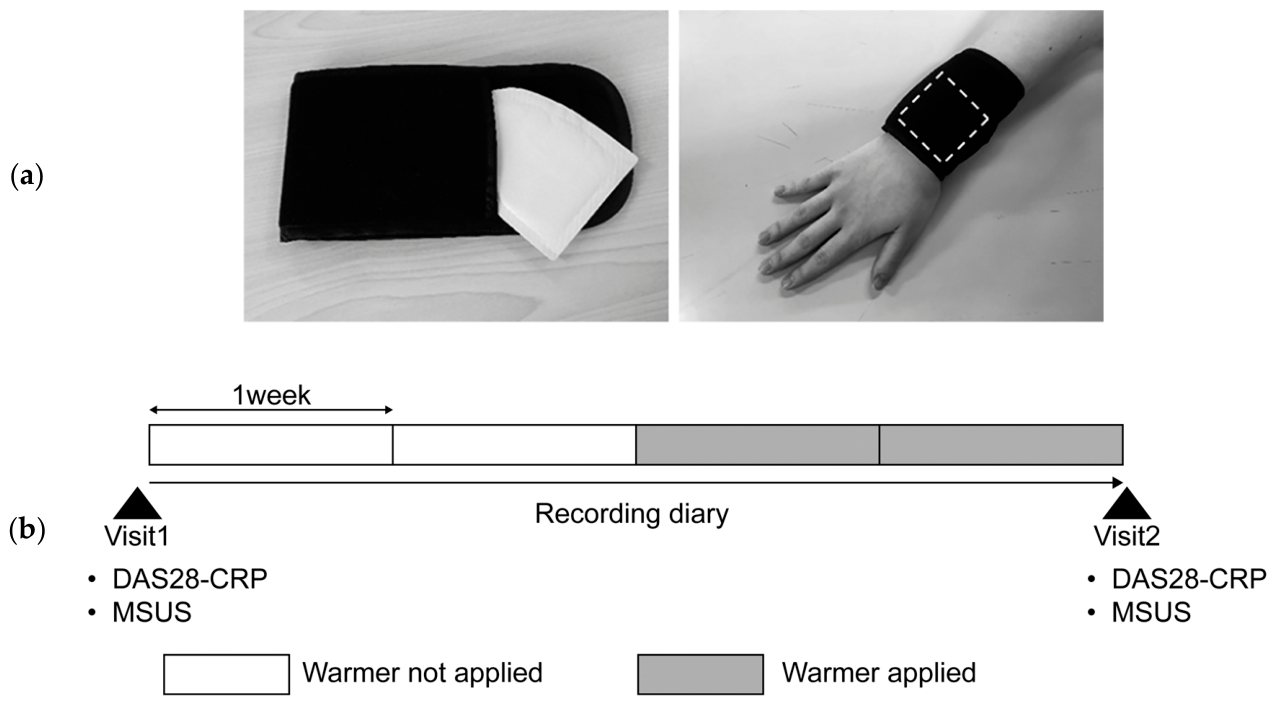
Figure 2.
Participants and analysis sets. This study included 15 patients. FAS, full analysis set; PPS, per-protocol set. SAS, safety analysis set.
Figure 2.
Participants and analysis sets. This study included 15 patients. FAS, full analysis set; PPS, per-protocol set. SAS, safety analysis set.
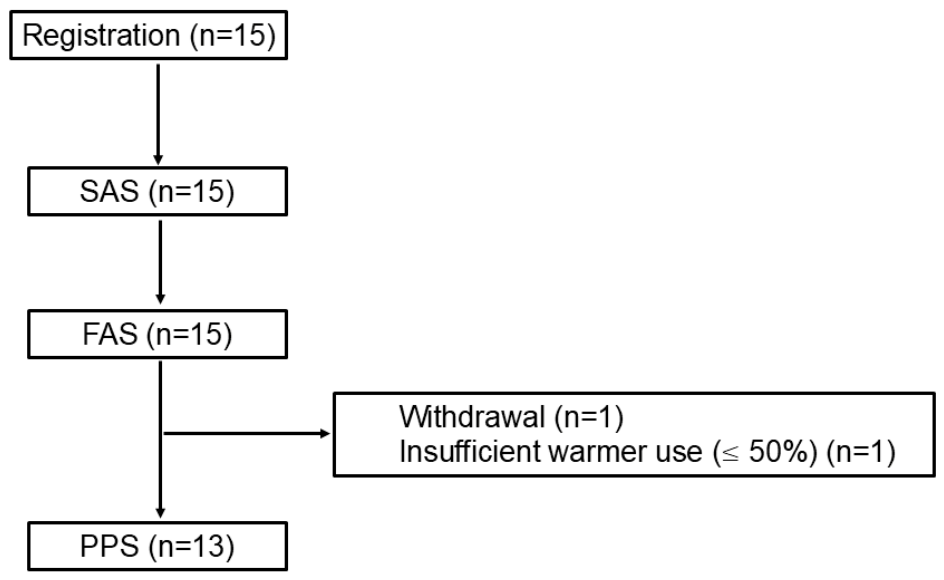
Figure 3.
Severity (a) and duration (b) of morning stiffness (MS) with warmer use for 2 weeks and without warmer use for 2 weeks in the full analysis set (FAS). Horizontal lines above and below the vertical bar in the box plot represent maximum and minimum values, respectively. n = 15. *p < 0.01, paired t test; †p < 0.01, Wilcoxon signed-rank test.
Figure 3.
Severity (a) and duration (b) of morning stiffness (MS) with warmer use for 2 weeks and without warmer use for 2 weeks in the full analysis set (FAS). Horizontal lines above and below the vertical bar in the box plot represent maximum and minimum values, respectively. n = 15. *p < 0.01, paired t test; †p < 0.01, Wilcoxon signed-rank test.
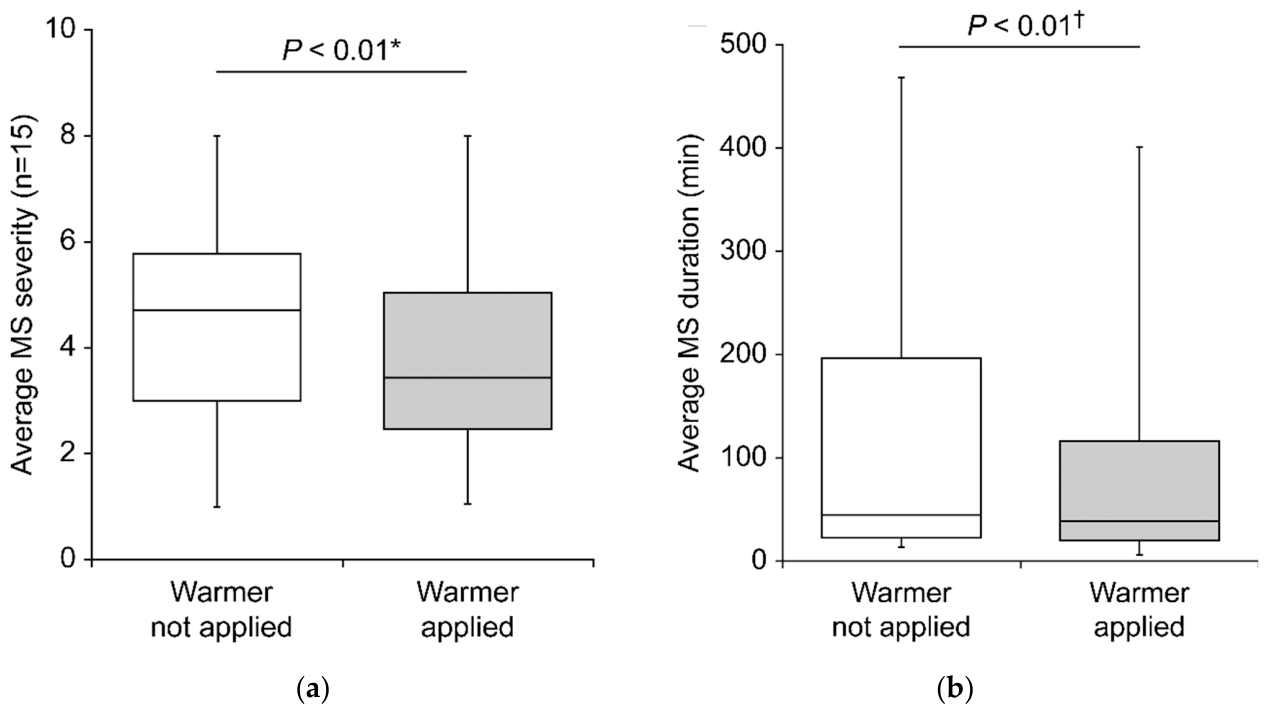

Table 1.
Background characteristics of the study participants (FAS: n = 15).
| Characteristic | Values |
|---|---|
| Age (y) Mean (range) |
61.7 (38–81) |
| Sex | |
| Male1 | 2 (13.3) |
| Female1 | 13 (86.7) |
| Disease duration (y) | |
| Mean | 9.9 |
| <51 | 5 (33.3) |
| 5–91 | 5 (33.3) |
| 10–141 | 1 (6.7) |
| 15–191 | 1 (6.7) |
| ≥201 | 3 (20.0) |
| Prior medications Biological DMARDs |
|
| Yes1 | 8 (53.3) |
| No1 | 7 (46.7) |
| JAK inhibitors | |
| Yes1 | 1 (6.7) |
| No1 | 14 (93.3) |
| Concomitant RA medications | |
| Conventional synthetic DMARDs | |
| Methotrexate1 | 9 (60.0) |
| Salazosulfapyridine1 | 1 (6.7) |
| Iguratimod1 | 2 (13.3) |
| Tacrolimus hydrate1 | 1 (6.7) |
| Biological DMARDs | |
| Adalimumab1 | 1 (6.7) |
| Abatacept1 | 2 (13.3) |
| Tocilizumab1 | 2 (13.3) |
| Other immune-modulating drugs | |
| Mizoribine1 | 1 (6.7) |
| Colchicine1 | 1 (6.7) |
1 Values are presented as the number of participants (%). DMARD, disease-modifying anti-rheumatic drug; FAS, full analysis set; JAK, Janus kinase; RA, rheumatoid arthritis.
Table 2.
Musculoskeletal ultrasound findings of 22 joints in hands, fingers, and wrists at baseline and at the end of the study (FAS: n=15).
Table 2.
Musculoskeletal ultrasound findings of 22 joints in hands, fingers, and wrists at baseline and at the end of the study (FAS: n=15).
| Total grading score | |||||||
|---|---|---|---|---|---|---|---|
| Total GS score | Total PD score | ||||||
| Baseline | End of study | Baseline | End of study | ||||
| 5.80 (5.29) | 5.33 (4.69) | 2.47 (3.04) | 1.87 (2.36) | ||||
| Number of joints with changes in the grading score according to the joint-level analysis | |||||||
| GS score | PD score | ||||||
| Decreased | Unchanged | Increased | Decreased | Unchanged | Increased | ||
| 2.00 (2.65) | 18.40 (3.76) | 1.60 (2.26) | 0.93 (1.28) | 20.67 (1.40) | 0.40 (0.63) | ||
FAS, full analysis set; GS, grayscale; PD, power Doppler; SD, standard deviation. Values are expressed as the mean (standard deviation).
Table 3.
Adverse events during the study period (SAS: n = 15).
| Event | Severity | Event onset | Correlation with the study |
|---|---|---|---|
| Arthralgia (finger) | Mild | Warmer applied | None |
| Arthralgia (shoulder) | Mild | Unknown | None |
| Limb pain | Mild | Warmer not applied | None |
SAS, safety analysis set.
Disclaimer/Publisher’s Note: The statements, opinions and data contained in all publications are solely those of the individual author(s) and contributor(s) and not of MDPI and/or the editor(s). MDPI and/or the editor(s) disclaim responsibility for any injury to people or property resulting from any ideas, methods, instructions or products referred to in the content. |
© 2026 by the authors. Licensee MDPI, Basel, Switzerland. This article is an open access article distributed under the terms and conditions of the Creative Commons Attribution (CC BY) license.
Copyright: This open access article is published under a Creative Commons CC BY 4.0 license, which permit the free download, distribution, and reuse, provided that the author and preprint are cited in any reuse.