

Submitted:
25 September 2026
Posted:
28 September 2026
You are already at the latest version
Abstract
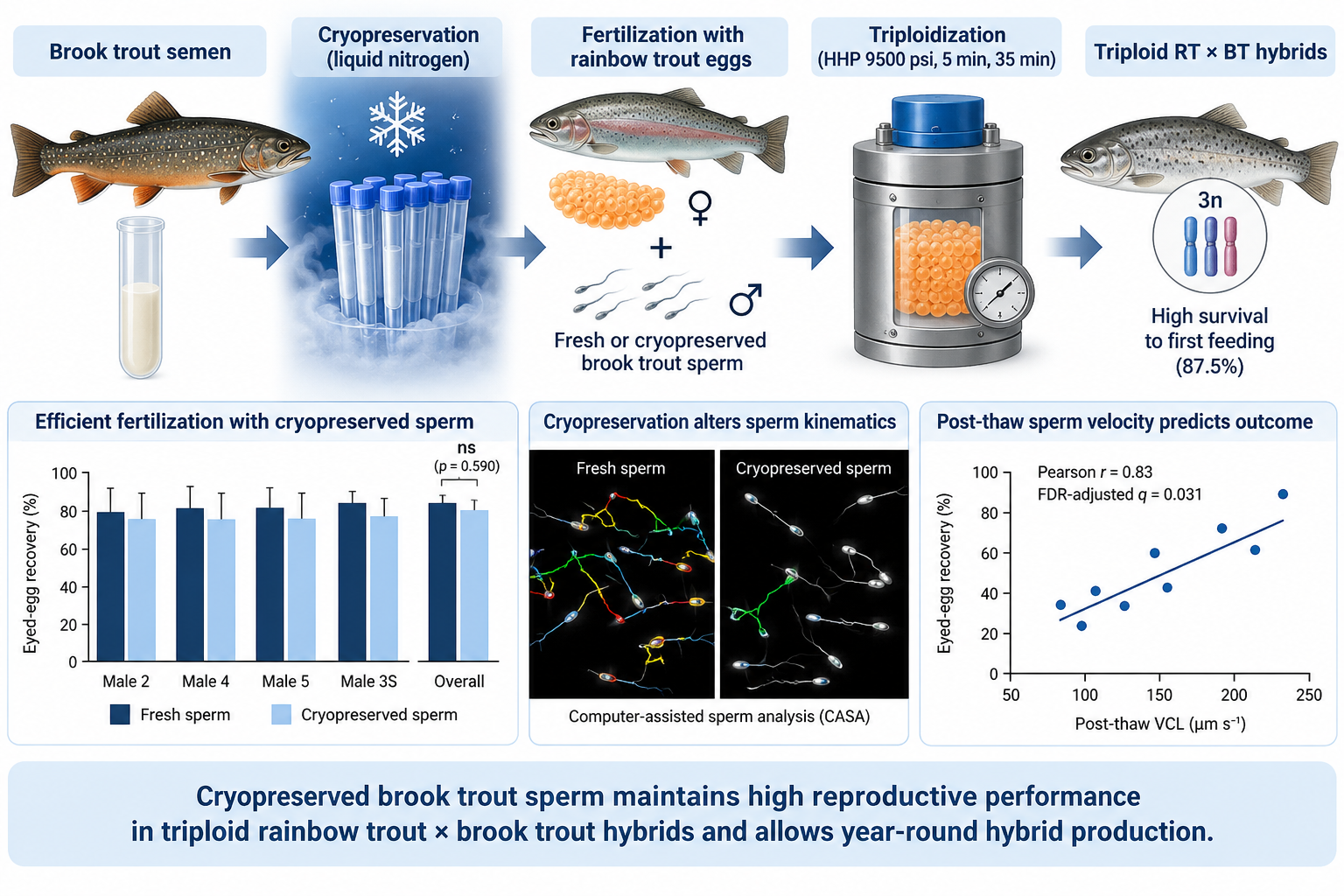
Triploidization can rescue otherwise poorly viable interspecific salmonid crosses, but practical production of rainbow trout (Oncorhynchus mykiss) female × brook trout (Salvelinus fontinalis) male hybrids remains constrained by parental seasonality and access to functionally competent paternal gametes. In this study, we compared fresh and cryopreserved sperm from four brook trout males in a paired hatchery trial. For each male and semen state, duplicate 350-mL rainbow trout egg batches were fertilized at 600,000 spermatozoa per egg and subjected to hydrostatic-pressure triploidization (9500 psi for 5 min at 350 degree-minutes). Cryopreservation reduced total motility from 91.05 ± 1.39% to 49.67 ± 10.83% (p = 0.0033), yet eyed-egg recovery remained high: 83.07 ± 10.57% with fresh and 77.96 ± 6.62% with cryopreserved semen (p = 0.590). At this dose, mean post-thaw MOT corresponded to ~2.98 × 10^5 motile spermatozoa per egg. Pooled viable embryos showed only 12.5% mortality from eyeing to first feeding, providing functional developmental evidence supporting the effectiveness of the employed allotriploidization protocol. Among thawed samples, VCL showed the largest observed donor-level correlation with of eyed-egg recovery (r = 0.83). Overall, cryobanking of brook trout sperm may extend paternal-gamete availability beyond the natural autumn spawning season and facilitate transportable, on-demand production of this hybrid at partner hatcheries.
Keywords:
Salvelinus fontinalis
; Oncorhynchus mykiss
; allotriploid hybrid
; sperm cryopreservation
; VCL
; CASA
; hydrostatic pressure
; spawning-season decoupling
; hatchery biotechnology
1. Introduction
Artificial triploidy is widely used in aquaculture to alter reproductive development and, in interspecific salmonid crosses, to improve viability that is severely compromised in the diploid hybrids. Blocking extrusion of the second polar body shortly after fertilization with physical or chemical shock retains an additional haploid maternal chromosome set, producing a triploid with two maternal and one paternal sets of chromosomes. The biological outcome depends strongly on the intensity, duration and developmental timing of the thermal or hydrostatic-pressure shock [1,2,3,4].
Intentional triploidization has been used to improve survival of the salmonid interspecies hybrids [5-7, among others]. The female rainbow trout × male brook trout cross has a particularly informative history. Chevassus et al. [4] showed that heat-shock triploidization substantially improved the viability of this otherwise poorly viable diploid cross: survival at day 161 reached 66.2% of the diploid rainbow trout control, whereas the corresponding unshocked diploid hybrid achieved only 12.3% of control survival. Ueda et al. [8] subsequently confirmed the same cross in Japan and cytogenetically identified both diploid and spontaneous triploid hybrids, with triploids carrying two rainbow trout genomes and one brook trout genome. These studies established biological feasibility of the cross, but did not address season-flexible hatchery production based on cryopreserved gametes. Broader freshwater-farming comparisons subsequently showed that early survival depression in rainbow-trout-based allotriploid hybrids is substantial and strongly cross-dependent [9]. Importantly, LaPatra et al. reported that triploid female rainbow trout × male brook trout hybrids survived the early life stage significantly better than the corresponding diploid hybrids and were less susceptible to infectious hematopoietic necrosis virus than pure-species rainbow trout groups [10].The key issue in artificial triploidization is to efficiently prevent extrusion of the 2nd polar body from the fertilized eggs. In the rainbow trout, such protocols have been established for fish from different strains including Spring and Winter spawning stocks with application of thermal or high hydrostatic pressure (HHP) shock [11]. The most frequently used is the HHP shock of 7000 to 9500 psi applied to the rainbow trout eggs 35–40 min after fertilization for 3–10 min. [12,13,14,15]. In practice, HHP pressures of approximately 7500–9500 psi have been successfully applied to rainbow trout eggs from different stocks and strains, whereas treatment duration and, particularly, the timing of shock initiation need to be adjusted according to egg developmental rate and incubation temperature. Another issue that needs to be discussed in production of triploid interspecies hybrids is spawning time of the parental species. Access to eggs from the Winter spawning rainbow trout enables hybridization with Salvelinus males. For spring-spawning rainbow trout stocks, cryopreserved sperm provides a practical means of overcoming the seasonal mismatch with charr males. SALMOCROSS was developed to convert this laboratory-scale concept into a practical production framework. Screening of pressure-shock conditions identified a robust regime of 9500 psi for 5 min, initiated at 350 degree-minutes after egg activation, corresponding to approximately 35 min post-activation at 10 °C. The same regime was subsequently used to generate a triploid rainbow trout × brook trout family whose hybrid status and ploidy were verified cytogenetically and genetically [16,17].
The production value of this cross has since been characterized by an independently generated SALMOCROSS family. Kuciński et al. [16] identified three phenotypic classes among triploid rainbow trout × brook trout hybrids: trout-like (50.8%), salmon-like (31.7%) and intermediate (17.5%). The salmon-like phenotype was considered of particular interest for commercial production because of its distinctive appearance together with complete sterility in females and delayed maturation in males until the third year, after market size had been reached [16]. This downstream characterization complements the present study, which addresses how the same hybrid type can be produced using cryopreserved paternal gametes.
The present study therefore asked whether cryopreserved brook trout sperm can be incorporated into this optimized triploid-hybrid production framework while maintaining eyed-egg recovery comparable to that obtained with fresh sperm. Four brook trout males were compared in a paired fresh-versus-cryopreserved design, with duplicate egg batches used as technical/process replicates. We further examined whether CASA traits explain reproductive outcome after thawing. Of particular interest was VCL, because Gage et al. [18] demonstrated in Atlantic salmon that relative sperm velocity—measured from the actual curvilinear path travelled by sperm—is a primary determinant of fertilization success. If the same relationship persists in this heterospecific cross, it would suggest that sperm velocity may remain an important determinant of salmonid fertilization success after cryopreservation and interspecific gamete pairing.
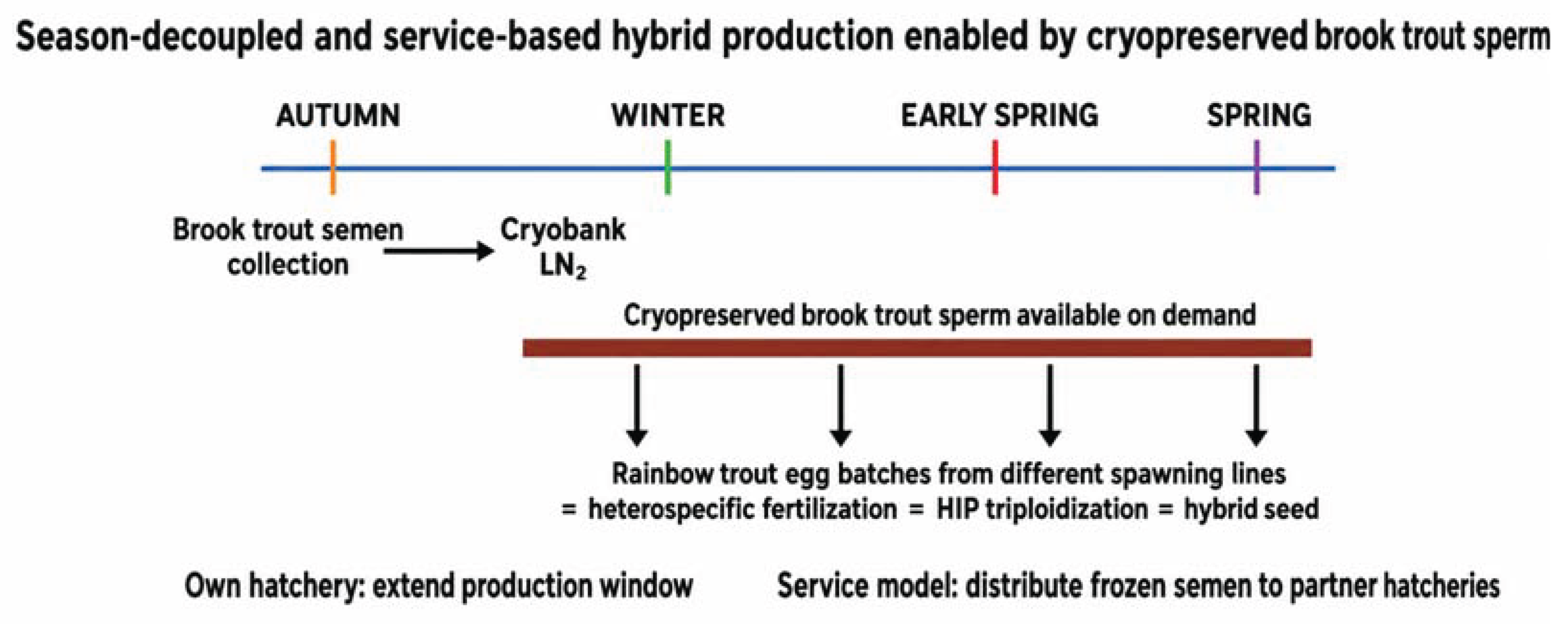
Production concept
Figure 1.
Conceptual model illustrating the potential use of cryopreserved brook trout sperm for extending access to paternal gametes beyond the spawning season. Semen collected during the autumn brook trout spawning period can be cryobanked and later used to fertilize rainbow trout egg batches available at different spawning times. This approach may also facilitate the distribution of cryopreserved paternal gametes among hatcheries.
2. Materials and Methods
2.1. Experimental Design and Hatchery Context
The production-scale trial was conducted on 9 November 2022 at the PSTRĄG TARNOWO hatchery (Tarnowo, Poland) within the SALMOCROSS research and implementation program. Semen from four individual brook trout males (fish from hatchery Pstrąg Tarnowo, average body weight 653.4 ± 46.7 g) was tested before cryopreservation and after thawing. For each male and semen state, two independent 350-mL rainbow trout egg batches were fertilized. These duplicate egg batches were treated as independent process replicates and averaged before donor-level statistical inference; the individual male was therefore the biological unit (n = 4). In total, 2.8 L of eggs were tested with fresh semen and 2.8 L with cryopreserved semen. For the experiment, 22 female rainbow trout with an average weight of 1.21 ± 0.22 kg were used. Eggs collected from all females were pooled, thoroughly mixed and then divided into 16 portions of 350ml each.
Facility-level broodstock husbandry for SALMOCROSS at PSTRĄG TARNOWO has been described by Kuciński et al. [16]. Broodfish were maintained in 10–30 m³ concrete ponds supplied with Dobrzyca River water (mean temperature approximately 10 °C; oxygenation above 80%), and feeding was stopped two weeks before the spawning period. That publication concerns a separate November 2021 SALMOCROSS family (five rainbow trout females × two brook trout males); it is cited here to document the common farm and broodstock-maintenance context, whereas the present validation used the 2022 males and egg batches specified above.
2.2. Semen Collection, Concentration and Cryopreservation
Brook trout semen was collected under hatchery conditions using contamination-avoiding procedures. Sperm concentration was measured before preparation of freezing doses. For the production trial, the freezing extender contained 100 mM glucose, 100 mM sucrose and 10% methanol. Semen was diluted fivefold (one part semen + four parts extender), and sperm concentration in the final freezing suspension was standardized to 1.5 × 10^9 spermatozoa mL−1. Samples were loaded into 500 µL straws, cryopreserved 3 cm above liquid-nitrogen vapor for 7 min and stored in liquid nitrogen until use. For each 350-mL egg batch fertilized with cryopreserved semen, seven 500-µL straws were used, corresponding to approximately 3.5ml of thawed sperm suspension. Straws were thawed by immersion in a water bath at 40 °C for 8 s. The use of a sugar–methanol extender and standardized sperm concentration/straw format is consistent with established salmonid cryopreservation studies [19,20].
2.3. Computer-Assisted Sperm Analysis
Sperm movement was assessed by computer-assisted sperm analysis (CASA) immediately before use in the fresh condition and after thawing in the cryopreserved condition. For sperm motility activation 1 μl of sperm was mixed with 100 μl of a buffer containing 20 mM Tris, 154 mM NaCl, 1 mM CaCl2, and 30 mM glycine [21] supplemented with 0.5% bovine serum albumin (BSA; Sigma-Aldrich, St. Louis, MO). Activated sperm sample was placed into a well of a multi-test microscope Teflon-coated slide with 16 wells (Tekdon, Inc., Myakka City, USA) and covered with a cover slip. Approximately four-second recordings (200 frames each, 46 fps) taken 6–10 s post-activation were analysed using the Crismas CASA system (Image House Ltd., Denmark). Sperm motility parameters were recorded with the use of a Basler a202K digital camera (Basler, Ahrensburg, Germany) integrated with an Olympus BX51 microscope (Plan FL N 10×/0.30 NH ph 1 lens) (Olympus, Tokyo, Japan). All CASA analyses were performed in duplicate. The recorded endpoints were curvilinear velocity (VCL), straight-line velocity (VSL), average-path velocity (VAP), linearity (LIN), straightness (STR), wobble (WOB), amplitude of lateral head displacement (ALH), beat-cross frequency (BCF), the exported track-length parameter (LSL), total motility (MOT), and progressive motility (PRG), defined as motility of spermatozoa with STR>80%. Duplicate CASA recordings within each male × semen-state combination were treated as technical measurements and averaged before donor-level inference; the biological unit was the individual male (n = 4). CASA was therefore used as a multidimensional sperm-quality assessment rather than relying on MOT alone, consistent with current recommendations for fish sperm evaluation [22].
2.4. Fertilization and High-Hydrostatic-Pressure (HHP) Triploidization
Rainbow trout eggs were allocated into 350-mL batches. Immediately before insemination, each egg batch was rinsed with 1% (w/v) NaHCO3 solution. Fertilization was performed in Billard fertilization medium [21] at a standardized dose of total 600,000 spermatozoa per egg. After gamete contact, eggs were transferred to water. All fertilized batches then entered the same high-hydrostatic-pressure (HHP) triploidization procedure. The optimized protocol was 9500 psi (approximately 65.5 MPa) for 5 min, initiated at 350 degree-minutes after egg activation; at 10 °C this corresponds to approximately 35 min post-activation. The operational window had been selected after broader screening of pressure, duration and treatment timing in the SALMOCROSS project. The same pressure magnitude, exposure duration and developmental timing were used in the independently characterized hybrid family reported by Kuciński et al. [16] and in subsequent molecular analyses of this hybrid system [17]. Ploidy and hybrid identity were not measured directly in these exact November 2022 production batches. Accordingly, the developmental survival endpoint described below was treated as functional production-level evidence supporting the effectiveness of the applied allotriploidization protocol rather than as an individual ploidy assay. The same HHP regime has independently produced rainbow trout × brook trout offspring whose triploid chromosome complement and hybrid identity were confirmed cytogenetically and by DNA genotyping [16,17].
2.5. Eyed-Egg Endpoint
Following HHP, all egg batches were incubated separately in vertical incubators equipped with egg trays under the hatchery conditions used for independently characterized rainbow trout × brook trout hybrid families: 7.0 ± 0.5 °C, dissolved oxygen 10.8 ± 0.5 mg L−1 and pH 7.5 ± 0.1 [16,17].
At the eyed stage, clearly non-viable and non-eyed eggs were removed during routine hatchery sorting, and the bulk volume of the remaining viable eyed eggs was recorded in millilitres. The original production worksheet retained this volumetric endpoint rather than individual egg counts and did not contain a more detailed record of the measuring vessel or additional secondary viability criteria; accordingly, the outcome is reported operationally as volumetric eyed-egg recovery. Recovery was expressed as the percentage of the initial 350-mL egg-batch volume remaining as viable eyed eggs. This endpoint integrates successful fertilization, tolerance of the pressure treatment and embryonic survival to eyeing and therefore should not be interpreted as a direct fertilization-rate measurement.
2.6. Post-Eyeing Incubation and Survival to First Feeding
After the eyed stage, non-viable and non-eyed eggs were removed. The remaining viable eyed embryos originating from the cryopreserved-semen treatments were pooled and incubated further under standard hatchery conditions until yolk-sac resorption and the onset of exogenous feeding. A corresponding pool derived from fertilizations performed with fresh brook trout semen was maintained in parallel. Because donor identity was no longer retained after pooling, post-eyeing survival was evaluated as a pooled production-level endpoint rather than as a donor-level biological replicate. Mortality from the eyed stage to first feeding was estimated using an indirect gravimetric method routinely applied under hatchery production conditions. Dead fish were collected and weighed, and the corresponding number of mortalities was estimated by dividing the total mass of dead fish by the mean individual body mass determined for fish of the same developmental stage on the respective sampling day. This procedure allowed cumulative mortality to be estimated without requiring direct counting of the entire pooled population. Mortality was recorded throughout the post-eyeing and yolk-sac stages until the onset of exogenous feeding.
2.7. Statistical Analysis
All statistical analyses were performed in R version 4.6.1 (R Foundation for Statistical Computing, Vienna, Austria), using functions implemented in the base stats package. Figures were prepared using GraphPad Prism 11 (GraphPad Software, San Diego, CA, USA). The individual male was considered the biological experimental unit (n = 4). Duplicate CASA measurements and duplicate fertilization batches obtained within each male × semen-state combination were treated as technical/process replicates and averaged before inferential analysis. Unless stated otherwise, data are presented as arithmetic means ± standard deviation (SD).
Fresh and cryopreserved semen obtained from the same males were compared using two-sided paired Student’s t-tests. Because only four independent males were available and distributional assumptions could not be meaningfully evaluated, exact paired Wilcoxon signed-rank tests were additionally performed as a distribution-free sensitivity analysis. Eyed-egg recovery was defined a priori as the principal functional endpoint and was therefore analyzed without adjustment for multiple testing. The 11 CASA variables constituted a separate family of secondary outcomes; nominal p-values from the paired comparisons were therefore adjusted using the Benjamini–Hochberg false-discovery-rate (FDR) procedure. Both nominal p-values and FDR-adjusted q-values are reported.
Associations between CASA characteristics and eyed-egg recovery were examined at the donor level. Pearson product–moment correlation coefficients were used as the principal measures of association, whereas Spearman rank correlations were calculated as a non-parametric sensitivity analysis. Because 11 CASA variables were screened against the same reproductive endpoint, the Benjamini–Hochberg procedure was also applied to the family of 11 Pearson correlation p-values. Correlations obtained for fresh and post-thaw semen were regarded as separate biological comparison families and were therefore adjusted independently within each semen state. Spearman correlations were used only to assess the robustness of the direction and relative magnitude of the observed associations and were not subjected to an additional multiplicity correction. Given the very small number of independent males (n = 4), all correlation analyses were considered exploratory and hypothesis-generating, and interpretation focused primarily on the magnitude and direction of the correlation coefficients rather than on statistical significance.
No formal equivalence or non-inferiority margin was prospectively defined. Accordingly, a non-significant difference in eyed-egg recovery between fresh and cryopreserved semen was interpreted as maintenance of high functional output rather than as evidence of statistical equivalence. After the eyed stage, embryos originating from individual males were pooled within production groups. Mortality from eyeing to first feeding was therefore summarized descriptively at the pooled-group level and was not included in donor-level inferential analyses.
3. Results
3.1. Eyed-Egg Recovery Did Not Differ Significantly Between Fresh and Cryopreserved Semen
After averaging the two egg batches within each male, eyed-egg recovery was 83.07 ± 10.57% with fresh semen and 77.96 ± 6.62% with cryopreserved semen. The paired difference (cryopreserved − fresh) was −5.11 percentage points (95% CI −32.10 to 21.89; paired t-test p = 0.590; exact Wilcoxon p = 0.625). Descriptively, eyed-egg recovery with cryopreserved-semen averaged 93.9% of the fresh-semen mean. Donor responses were heterogeneous: three males showed decreases after cryopreservation, whereas one male showed higher recovery after cryopreservation than when fresh (Figure 2).
3.2. Cryopreservation Reduced MOT and Altered Post-Thaw Sperm Kinematics
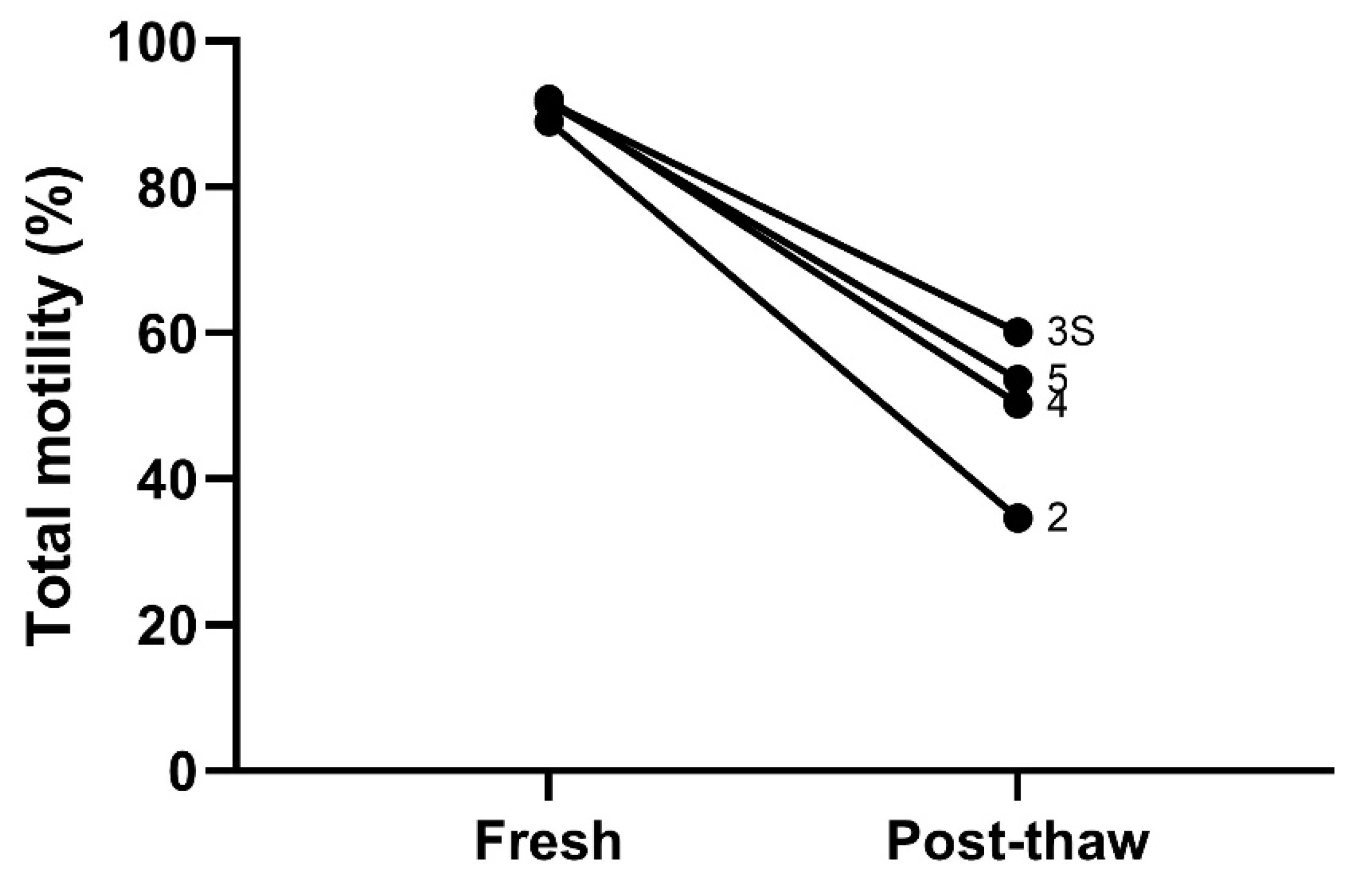
Total motility fell from 91.05 ± 1.39% in fresh semen to 49.67 ± 10.83% after thawing (mean paired change −41.38 percentage points; 95% CI −56.71 to −26.04; p = 0.0033; FDR q = 0.0183). Cryopreservation also altered the kinematic profile of the motile sperm fraction: VCL, ALH and BCF decreased, whereas LIN, STR, WOB and LSL increased; these differences remained significant after BH-FDR adjustment (q ≤ 0.0403). VSL, VAP and PRG did not differ after FDR correction (Table 1). Despite the major loss of MOT, eyed-egg recovery following fertilization with cryopreserved semen remained high and did not differ significantly from that obtained with fresh semen. At the standardized dose of 600,000 total sperm per egg, the observed post-thaw MOT corresponded to approximately 2.08–3.61 × 10^5 motile spermatozoa per egg among donors (mean ~2.98 × 10^5).
Figure 3.
Paired donor-level total sperm motility before cryopreservation and after thawing (n = 4 males). Each line connects fresh and cryopreserved measurements from the same male.
Figure 3.
Paired donor-level total sperm motility before cryopreservation and after thawing (n = 4 males). Each line connects fresh and cryopreserved measurements from the same male.
3.3. High Survival to First Feeding Provided Functional Evidence of Developmental Viability
High recovery at the eyed stage was followed by high survival during subsequent ontogenetic development. After removal of non-viable eggs and pooling of viable eyed embryos, cumulative mortality from eyeing to first feeding was 12.5%, corresponding to 87.5% survival through the post-eyeing period. No evident increase in mortality was observed relative to the corresponding pool produced with fresh brook trout semen (13,8%). Because embryos were pooled after eyeing, this comparison is descriptive rather than a replicated statistical test.
The developmental timing of this survival endpoint is particularly informative for the rainbow trout female × brook trout male cross. Diploid hybrids of these species have been reported to be non-viable, with 100% mortality occurring by the end of yolk-sac resorption, whereas artificial triploidization rescues developmental viability beyond this stage [17]. Thus, survival of the great majority of the present offspring through yolk-sac resorption and into first feeding provides functional biological evidence consistent with successful allotriploidization, although it does not constitute direct confirmation of ploidy at the individual level.
3.4. Post-Thaw Velocity Metrics Showed Stronger Associations with Eyed-Egg Recovery than MOT
Among fresh samples, none of the CASA endpoints showed a strong association with eyed-egg recovery (Supplementary Table S1). In thawed semen, the largest positive Pearson coefficients were observed for VCL (r = 0.828), VAP (r = 0.811) and ALH (r = 0.742), whereas total motility showed a substantially weaker association (MOT: r = 0.337). None of the 11 post-thaw Pearson associations remained statistically significant after BH-FDR adjustment (all q ≥ 0.670), and the Spearman sensitivity analysis did not change the exploratory interpretation. Given only four independent males, these results are presented as effect-size patterns rather than confirmatory predictor relationships (Table 2; Figure 4 and Figure 5).
4. Discussion
The central result is technological: cryopreserved brook trout sperm can be incorporated into a pressure-triploidization workflow while retaining high eyed-egg recovery. Eyed-egg recovery with cryopreserved semen averaged 78.0%, compared with 83.1% for fresh semen, despite an approximately 45% absolute reduction in total sperm motility. This demonstrates that cryopreserved brook trout sperm can be banked and subsequently used in the cross production workflow without losing its practical utility. The value of this result is therefore not simply that brook trout sperm survives freezing, but that frozen sperm remains competent through heterospecific fertilization and the subsequent HHP step used for allotriploid production.
The historical comparison emphasizes the advance. In the direct rainbow trout female × brook trout male cross, Chevassus et al. [4] reported day-161 survival of triploid hybrids equivalent to 66.2% of the diploid rainbow trout control, whereas the corresponding diploid hybrid was only 12.3% of control. Ueda et al. [8] then provided Japanese cytogenetic proof that viable triploid hybrids of the same cross occur and carry two maternal rainbow trout genomes plus one paternal brook trout genome, but their study was not designed to quantify hatchery production efficiency. Arai [23], using a different maternal species but the same brook trout paternal species, showed that HHP could rescue a largely inviable salmonid hybrid: 650 kg cm−2 (~9245 psi) for 7 min at 15 min post-insemination yielded 58.3% survival at day 100 versus 6.1% in the untreated hybrid. Our pressure amplitude, 9500 psi (~65.5 MPa), is strikingly similar, but the shorter 5-min exposure and the 350 degree-minute timing reflect optimization for rainbow trout eggs. Endpoints and species differ, so these percentages are not direct head-to-head efficacy comparisons; rather, they show the progression from biological rescue of hybrid viability to a practical hatchery protocol that yielded ~78% eyed-egg recovery with cryopreserved paternal gametes.
The later SALMOCROSS phenotype study adds an important production perspective to this historical sequence. In the independently generated family, Kuciński et al. [16] verified hybrid identity and triploidy and found trout-like, salmon-like and intermediate phenotypes, with the salmon-like class combining attractive appearance with female sterility and delayed male maturation. Thus, the present cryopreservation result should be viewed not only as efficient generation of eyed hybrid eggs, but also as a route to scheduling production of a cross for which distinct phenotypes of potential production interest have already been characterized.
The apparently paradoxical combination of low post-thaw MOT and high eyed-egg recovery is best interpreted in the context of sperm dose. The experiment used 600,000 spermatozoa per egg. This is twice the 300,000:1 dose at which Nynca et al. [24] found cryopreserved brook trout sperm to retain fertilizing capacity comparable with fresh semen in homologous fertilization. It is also three times the 200,000:1 dose at which cryopreserved rainbow trout sperm in a KCl-supplemented trehalose extender fertilized as effectively as fresh sperm [25]. After accounting for the mean post-thaw MOT of 49.7%, our nominal motile-sperm input was still ~298,000 cells per egg, and even the lowest-MOT donor supplied ~208,000 motile sperm per egg. One possible explanation is that the applied sperm dose provided a sufficient number of functionally competent sperm required for efficient fertilization. Under this interpretation, the substantial reduction in MOT would not necessarily translate into a proportional reduction in eyed-egg recovery output. This may also help explain why MOT showed only a weak association with eyed-egg recovery in the present dataset.
VCL may carry more biological information than MOT once the minimum sperm-number threshold has been exceeded. Gage et al. [18] showed in wild Atlantic salmon that relative sperm velocity was the primary determinant of paternity in controlled sperm-competition trials. Their velocity measure was based on the actual curvilinear distance travelled by a spermatozoon over time, making it conceptually equivalent to VCL in modern CASA terminology. Faster sperm were interpreted as searching the egg microenvironment more rapidly and reaching the single-entry micropyle sooner. In our heterospecific system, VCL showed the strongest positive relationship with eyed-egg recovery (r = 0.83), whereas MOT displayed a much weaker correlation (r = 0.34). Neither association was statistically significant after multiplicity correction, and with n = 4 the present analysis cannot validate VCL as a predictor. Gage et al. also studied competitive conspecific fertilization rather than single-male heterospecific fertilization. Even so, the similarity in the observed relationship is biologically interesting: despite interspecific gamete pairing and cryopreservation, the observed effect-size pattern raises the possibility that, once an adequate number of motile sperm is available, the quality and velocity of sperm movement may provide more information about reproductive performance than the bulk percentage of motile cells. This interpretation is consistent with a conserved role of micropyle search and entry in salmonid fertilization, but requires testing in larger donor series and across controlled sperm doses.
Cryobanking could create two distinct production opportunities. First, it could reduce the need to synchronize the short autumn brook trout spawning season with the availability of rainbow trout eggs. Semen collected during the brook trout spawning period could, in principle, be stored and subsequently used for rainbow trout egg batches fertilization later in the season, potentially extending the hybrid-production window across the full autumn-to-spring. Second, cryopreserved paternal could be transported between facilities, potentially allowing hatcheries without mature brook trout males to access selected paternal germplasm. A centralized cryobank can supply frozen brook trout semen to partner hatcheries on demand, enabling “service” production of triploid hybrids without each farm maintaining its own mature brook trout male broodstock. This could reduce broodstock-maintenance requirements, simplify genetic allocation of sires and facilitate technology transfer between hatcheries. This production logic is consistent with previous demonstration that a single application of cryopreserved rainbow trout semen can fertilize up to 8000 eggs [26] and with the broader salmonid cryopreservation framework, in which year-round gamete availability, transport of germplasm, selected crosses and scale-up to hatchery practice are key opportunities and challenges [27].
The HHP step is therefore not a downstream detail but an integral part of the technology. The SALMOCROSS regime of 9500 psi for 5 min at 350 degree-minutes after egg activation combines a pressure magnitude already known to be biologically effective in salmonid allotriploidization with developmental timing tailored to rainbow trout eggs. Expressing timing in degree-minutes is especially important for technology transfer because it links shock initiation to developmental rate rather than to a fixed number of minutes after fertilization. The same operating condition was later used in a family in which triploidy and hybrid identity were verified [16,17], providing independent biological validation of this HHP regime in the same hybrid combination.
An important additional observation is that the high eyed-egg recovery was not followed by a delayed mortality wave during yolk-sac development. Following removal of non-viable eggs at eyeing, only 12.5% cumulative mortality occurred before first feeding, corresponding to 87.5% survival through this critical developmental interval. This result has particular biological significance in the rainbow trout × brook trout cross. Diploid hybrids between these species are completely inviable and exhibit 100% mortality by the end of yolk-sac resorption [17], whereas their developmental viability can be restored by retention of an additional maternal chromosome set through triploidization [4,17]. Consequently, survival of most offspring beyond yolk-sac resorption cannot be regarded merely as evidence of successful fertilization; it is also consistent with the developmental rescue expected from successful allotriploidization under the HHP treatment.
This interpretation is further supported by independent characterization of rainbow trout × brook trout hybrids generated within the protocol using the same HHP regime of 9500 psi for 5 min initiated at 350 degree-minutes after egg activation. Kuciński et al. [16] confirmed both the hybrid nature and triploid chromosome complement of such offspring using molecular and cytogenetic approaches and subsequently demonstrated their long-term developmental viability and phenotypic differentiation. The present experiment therefore adds a complementary production-level observation: the same technological pathway remained effective when the paternal component was supplied as cryopreserved semen. Although ploidy was not measured directly in every larva from the present November 2022 batches, the combination of the independently validated HHP protocol [16], the known developmental mortality of diploid RT × BT hybrids by the end of yolk-sac resorption [17], and the observed 87.5% post-eyeing survival to first feeding provides convergent functional evidence consistent with successful allotriploidization in the present production batches.
From a hatchery perspective, survival to first feeding is also a more demanding functional endpoint than eyeing alone. Cryopreservation therefore did not merely preserve the capacity of brook trout sperm to initiate heterospecific development. It preserved the ability to generate offspring that survived the HHP procedure, embryogenesis, hatching and the subsequent yolk-sac period to the onset of exogenous feeding. Together with the similar eyed-egg recovery obtained with fresh and cryopreserved semen, the low post-eyeing mortality indicates that use of frozen paternal gametes did not produce an obvious deterioration in the developmental quality of the resulting hatchery material.
The study has several limitations. Only four independent males were available, so the CASA–outcome correlations should be interpreted as exploratory and the fresh-versus-cryopreserved comparison was not designed as a formal equivalence trial. In addition, individual ploidy was not directly determined in these specific November 2022 experimental batches. However, three complementary lines of evidence support the production outcome was consistent with successful allotriploidization: (i) all fertilized batches were exposed to the same optimized HHP regime subsequently validated cytogenetically and molecularly in the same hybrid combination [16]; (ii) diploid rainbow trout × brook trout hybrids are known to exhibit complete mortality by yolk-sac resorption [17]; and (iii) 87.5% of the present viable eyed embryos survived through the post-eyeing period to first feeding. The latter endpoint was obtained after pooling and therefore provides functional population-level evidence rather than a direct individual measurement of ploidy.
5. Conclusions
Cryopreserved brook trout sperm retained sufficient functional competence to support the production of viable rainbow trout × brook trout hybrid progeny using the established triploidization protocol. Despite a substantial reduction in total motility, eyed-egg recovery remained high under the standardized 600,000-sperm dose, and pooled eyed embryos showed 87.5% survival to first feeding. This post-eyeing developmental survival, together with the previously established effectiveness of the same HHP regime in producing molecularly confirmed triploid rainbow trout × brook trout hybrids, provides functional evidence supporting the effectiveness of the allotriploidization procedure, while not replacing direct ploidy measurement in the present production batches. The exploratory post-thaw CASA analysis indicated that some kinematic parameters, particularly the VCL, showed stronger associations with eyed-egg recovery than total motility. However, these relationships were not statistically significant after multiple-testing correction and should therefore be considered hypothesis-generating. Overall, the results demonstrate the potential of cryobanked brook trout sperm to extend paternal-gamete availability beyond the natural autumn spawning season and to facilitate transportable, on-demand production of this hybrid at partner hatcheries.
Supplementary Materials
The following supporting information can be downloaded at the website of this paper posted on Preprints.org, Supplementary Table S1: technical/process replicate values and donor means for eyed-egg recovery. Supplementary Table S2: complete fresh and post-thaw donor-level CASA–eyed-egg correlation results, including Pearson nominal p-values, BH-FDR q-values and Spearman sensitivity analyses. Supplementary Table S3: donor-level fresh and post-thaw CASA means used for statistical inference. Editable Excel source workbooks are additionally provided for Figure 2, Figure 3, Figure 4 and Figure 5.
Author Contributions
Conceptualization, R.K.K.; methodology, R.K.K., K.D., M.K., B.S., M.B.; investigation, R.K.K., K.D., M.K., B.S., M.B., W.J. and Z.P.; formal analysis, R.K.K.; resources, Z.P. and W.J.; data curation, R.K.K., K.D. and W.J.; writing—original draft preparation, R.K.K. and MK, writing—review and editing, R.K.K., MK and, K.O.; visualization, R.K.K. and B.S.; supervision, R.K.K. Z.P. and K.O.; project administration, R.K.K and Z.P. All authors have read and agreed to the published version of the manuscript.
Funding
This research was performed within the SALMOCROSS research and implementation project, agreement no. 00003-6521.1-OR1500002/17 dated 29 November 2021.
Institutional Review Board Statement
Ethical review and approval by a Local Ethics Committee for Animal Experimentation were not required for this study. The work was conducted during routine hatchery reproductive operations and did not involve any experimental procedure performed on live broodfish. Brook trout semen was collected by routine stripping during the natural spawning season, and only semen surplus to normal breeding requirements was allocated to cryopreservation and subsequent fertility assessment. Rainbow trout eggs were obtained and handled as part of standard breeding procedures. No additional invasive intervention, treatment, sampling, or handling was introduced for research purposes, and no live fish were subjected to a procedure expected to cause pain, suffering, distress, or lasting harm at or above the threshold of needle insertion. All study-specific manipulations concerned collected gametes and fertilized eggs within the normal hatchery breeding workflow and did not require additional procedures on live broodfish. Pursuant to Article 1(2)(1) of the Polish Act of 15 January 2015 on the Protection of Animals Used for Scientific or Educational Purposes (consolidated text: Journal of Laws of 2023, item 465, as amended), agricultural activities, including animal keeping and breeding, that are not undertaken for the purpose of performing scientific procedures fall outside the scope of the Act. This is also consistent with Article 1(5)(a), (d) and (f) of Directive 2010/63/EU. Accordingly, authorization from a Local Ethics Committee for Animal Experimentation was not required.
Informed Consent Statement
Not applicable.
Data Availability Statement
The individual-level data supporting the findings of this study are available from the corresponding author on reasonable request and can be supplied as de-identified Supplementary Material.
Acknowledgments
This research was carried out within the SALMOCROSS research and implementation project, co-financed by the European Union through the European Maritime and Fisheries Fund (EMFF) under the Operational Programme “Fisheries and Sea” 2014–2020, Priority 2 “Fostering environmentally sustainable, resource-efficient, innovative, competitive and knowledge-based aquaculture”, Measure 2.1 “Innovation”. The programme was managed by the Polish Ministry of Agriculture and Rural Development, with the Agency for Restructuring and Modernisation of Agriculture (ARMA) acting as the Intermediate Body. The project was implemented under funding agreement no. 00003-6521.1-OR1500002/17 of 29 November 2021. The study was partially supported by funds appropriated to the Institute of Animal Reproduction and Food Research of the Polish Academy of Sciences, Olsztyn.
Conflicts of Interest
The authors declare no conflicts of interest.
References
- Piferrer, F.; Beaumont, A.R.; Falguière, J.C.; Flajšhans, M.; Haffray, P.; Colombo, L. Polyploid fish and shellfish: Production, biology and applications to aquaculture for performance improvement and genetic containment. Aquaculture 2009, 293, 125–156. [Google Scholar] [CrossRef]
- Benfey, T.J. Use of sterile triploid Atlantic salmon (Salmo salar L.) for aquaculture in New Brunswick, Canada. ICES J. Mar. Sci. 2001, 58, 525–529. [Google Scholar] [CrossRef]
- Chourrout, D. Pressure-induced retention of second polar body and suppression of first cleavage in rainbow trout: Production of all-triploids, all-tetraploids, and heterozygous and homozygous diploid gynogenetics. Aquaculture 1984, 36, 111–126. [Google Scholar] [CrossRef]
- Chevassus, B.; Guyomard, R.; Chourrout, D.; Quillet, E. Production of viable hybrids in salmonids by triploidization. Genet. Sel. Evol. 1983, 15, 519–532. [Google Scholar] [CrossRef]
- Parsons, J.E.; Busch, R.A.; Thorgaard, G.H.; Scheerer, P.D. Increased resistance of triploid rainbow trout × coho salmon hybrids to infectious hematopoietic necrosis virus. Aquaculture 1986, 57, 337–343. [Google Scholar] [CrossRef]
- Scheerer, P.D.; Thorgaard, G.H. Increased survival in salmonid hybrids by induced triploidy. Can. J. Fish. Aquat. Sci. 1983, 40, 2040–2044. [Google Scholar] [CrossRef]
- Blanc, J.M.; Vallée, F.; Maunas, P.; Fouriot, J.P. Maternal variation in juvenile survival and growth of triploid hybrids between female rainbow trout and male brown trout and brook charr. Aquac. Res. 2005, 36(2), 120–129. [Google Scholar] [CrossRef]
- Ueda, T.; Ojima, Y.; Sato, R.; Fukuda, Y. Triploid hybrids between female rainbow trout and male brook trout. Nippon Suisan Gakkaishi 1984, 50, 1331–1336. [Google Scholar] [CrossRef]
- Quillet, E.; Chevassus, B.; Blanc, J.-M.; Krieg, F.; Chourrout, D. Performances of auto and allotriploids in salmonids. I. Survival and growth in fresh water farming. Aquat. Living Resour. 1988, 1, 29–43. [Google Scholar] [CrossRef]
- LaPatra, S.E.; Parsons, J.E.; Jones, G.R.; McRoberts, W.O. Early life stage survival and susceptibility of brook trout, coho salmon, rainbow trout, and their reciprocal hybrids to infectious hematopoietic necrosis virus. J. Aquat. Anim. Health 1993, 5, 270–274. [Google Scholar] [CrossRef]
- Pandian, T.A.; Koteeswaran, R. Ploidy induction and sex control in fish. Hydrobiologia 1998, 384, 167–243. [Google Scholar] [CrossRef]
- Pandey, N.; Vishvakarma, B.K.; Singh, R.; Gupta, M. Comparative study of heat shock and pressure shock for triploidy induction in rainbow trout (Oncorhynchus mykiss). Indian J. Fish. 2024, 71(1). [Google Scholar] [CrossRef]
- Lou, Y.D.; Purdom, C.E. Polyploidy induced by hydrostatic pressure in rainbow trout, Salmo gairdneri Richardson. J. Fish. Biol. 1984, 25, 345–351. [Google Scholar] [CrossRef]
- Jagiełło, K.; Dobosz, S.; Zalewski, T.; Polonis, M.; Ocalewicz, K. Developmental competence of eggs produced by rainbow trout Doubled Haploids (DHs) and generation of the clonal lines. Reprod. Domest. Anim. 2018, 53(5), 1176–1183. [Google Scholar] [CrossRef]
- Polonis, M.; Fujimoto, T.; Dobosz, S.; Zalewski, T.; Ocalewicz, K. Genome incompatibility between rainbow trout (Oncorhynchus mykiss) and sea trout (Salmo trutta) and induction of the interspecies gynogenesis. J. Appl. Genet. 2018, 59, 91–97. [Google Scholar] [CrossRef]
- Kuciński, M.; Trzeciak, P.; Pirtań, Z.; Jóźwiak, W.; Ocalewicz, K. The phenotype, sex ratio and gonadal development in triploid hybrids of rainbow trout (Oncorhynchus mykiss) ♀ and brook trout (Salvelinus fontinalis) ♂. Anim. Reprod. Sci. 2025, 272, 107659. [Google Scholar] [CrossRef]
- Kuciński, M.; Różyński, R.; Ocalewicz, K. Effects of hybridization and triploidization on transcription of core metabolic and stress response genes in rainbow trout (Oncorhynchus mykiss) × brook trout (Salvelinus fontinalis) hybrids—Preliminary results. Curr. Issues Mol. Biol. 2026, 48, 320. [Google Scholar] [CrossRef]
- Gage, M.J.G.; Macfarlane, C.P.; Yeates, S.; Ward, R.G.; Searle, J.B.; Parker, G.A. Spermatozoal traits and sperm competition in Atlantic salmon: Relative sperm velocity is the primary determinant of fertilization success. Curr. Biol. 2004, 14, 44–47. [Google Scholar] [CrossRef]
- Nynca, J.; Judycka, S.; Liszewska, E.; Dobosz, S.; Grudniewska, J.; Arai, K.; Fujimoto, T.; Ciereszko, A. Utility of different sugar extenders for cryopreservation and post-thaw storage of sperm from Salmonidae species. Aquaculture 2016, 464, 340–348. [Google Scholar] [CrossRef]
- Judycka, S.; Nynca, J.; Liszewska, E.; Dobosz, S.; Grudniewska, J.; Ciereszko, A. Optimal sperm concentration in straws and final glucose concentration in extender are crucial for improving the cryopreservation protocol of salmonid spermatozoa. Aquaculture 2018, 486, 90–97. [Google Scholar] [CrossRef]
- Billard, R. Reproduction in rainbow trout: sex differentiation, dynamics of gametogenesis, biology and preservation of gametes. Aquaculture 1992, 100, 263–298. [Google Scholar] [CrossRef]
- Kowalski, R.K.; Cejko, B.I. Sperm quality in fish: Determinants and affecting factors. Theriogenology 2019, 135, 94–108. [Google Scholar] [CrossRef]
- Arai, K. Effect of allotriploidization on development of the hybrids between female chum salmon and male brook trout. Nippon Suisan Gakkaishi 1986, 52, 823–829. [Google Scholar] [CrossRef]
- Nynca, J.; Dietrich, G.J.; Dobosz, S.; Zalewski, T.; Ciereszko, A. Effect of postthaw storage time and sperm-to-egg ratio on fertility of cryopreserved brook trout sperm. Theriogenology 2015, 83, 253–256. [Google Scholar] [CrossRef]
- Judycka, S.; Cejko, B.I.; Dryl, K.; Dobosz, S.; Grudniewska, J.; Kowalski, R.K. The effect of supplementation of a trehalose-based extender with KCl on rainbow trout (Oncorhynchus mykiss) sperm freezability and post-thaw motility. Aquaculture 2016, 465, 303–310. [Google Scholar] [CrossRef]
- Judycka, S.; Nynca, J.; Liszewska, E.; Dobosz, S.; Słowińska, M.; Różyński, R.; Ciereszko, A. Cryopreserved rainbow trout semen can be used for the fertilization of up to 8000 eggs in a single application. Aquaculture 2018, 490, 25–28. [Google Scholar] [CrossRef]
- Judycka, S.; Nynca, J.; Ciereszko, A. Opportunities and challenges related to the implementation of sperm cryopreservation into breeding of salmonid fishes. Theriogenology 2019, 132, 12–21. [Google Scholar] [CrossRef]
Figure 2.
Eyed-egg recovery for individual brook trout males and the overall donor mean after fertilization with fresh or cryopreserved semen. Individual-male bars represent the mean of two 350-mL process batches; error bars for individual males denote SD of the duplicate process batches, whereas overall error bars denote SD among the four male means. Donor-level inference used the individual male as the biological unit (n = 4).
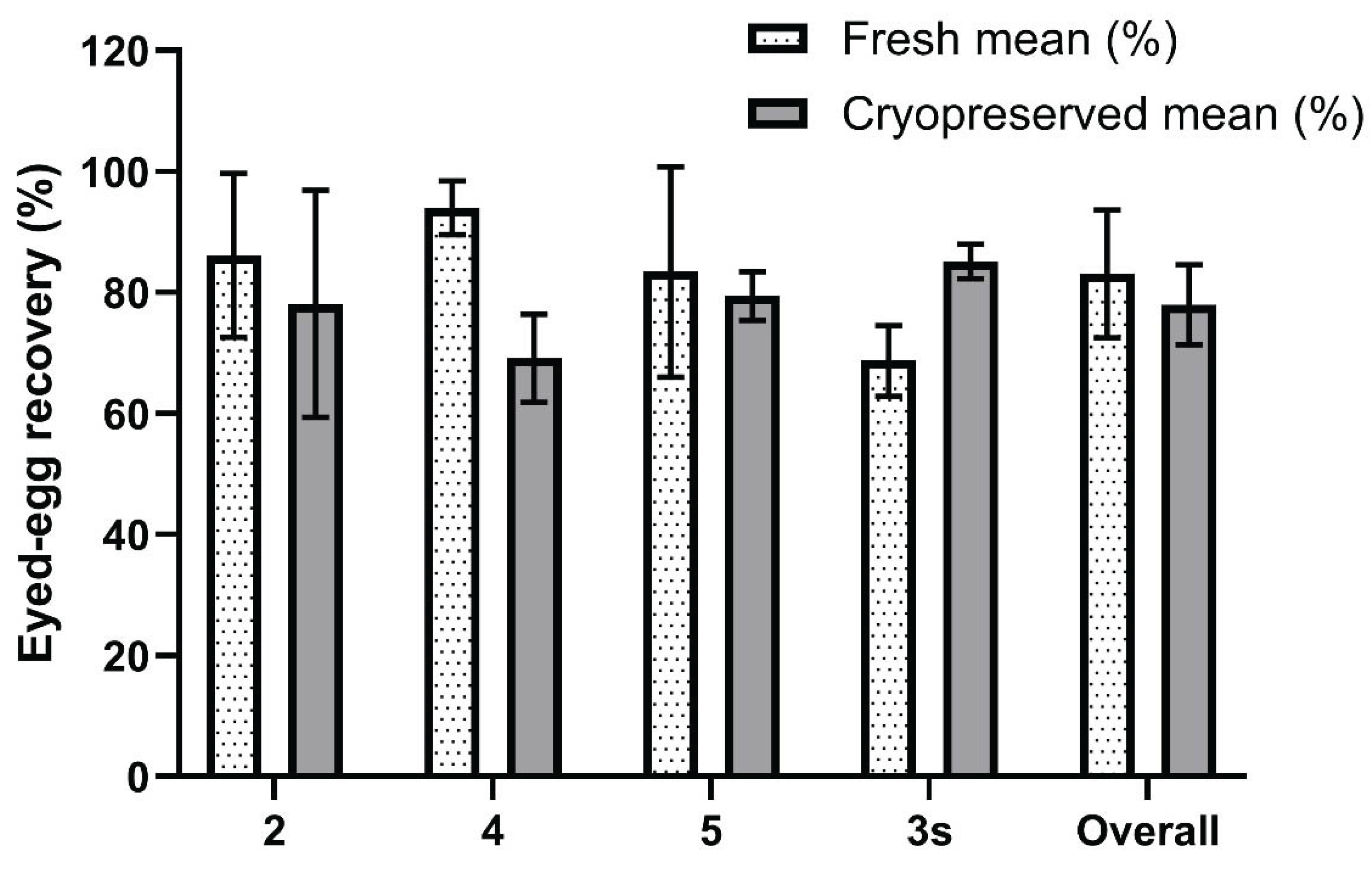
Figure 4.
Exploratory donor-level relationship between post-thaw VCL and eyed-egg recovery. VCL showed the strongest observed positive Pearson association (r = 0.828, nominal p = 0.172, BH-FDR q = 0.670; n = 4).
Figure 4.
Exploratory donor-level relationship between post-thaw VCL and eyed-egg recovery. VCL showed the strongest observed positive Pearson association (r = 0.828, nominal p = 0.172, BH-FDR q = 0.670; n = 4).
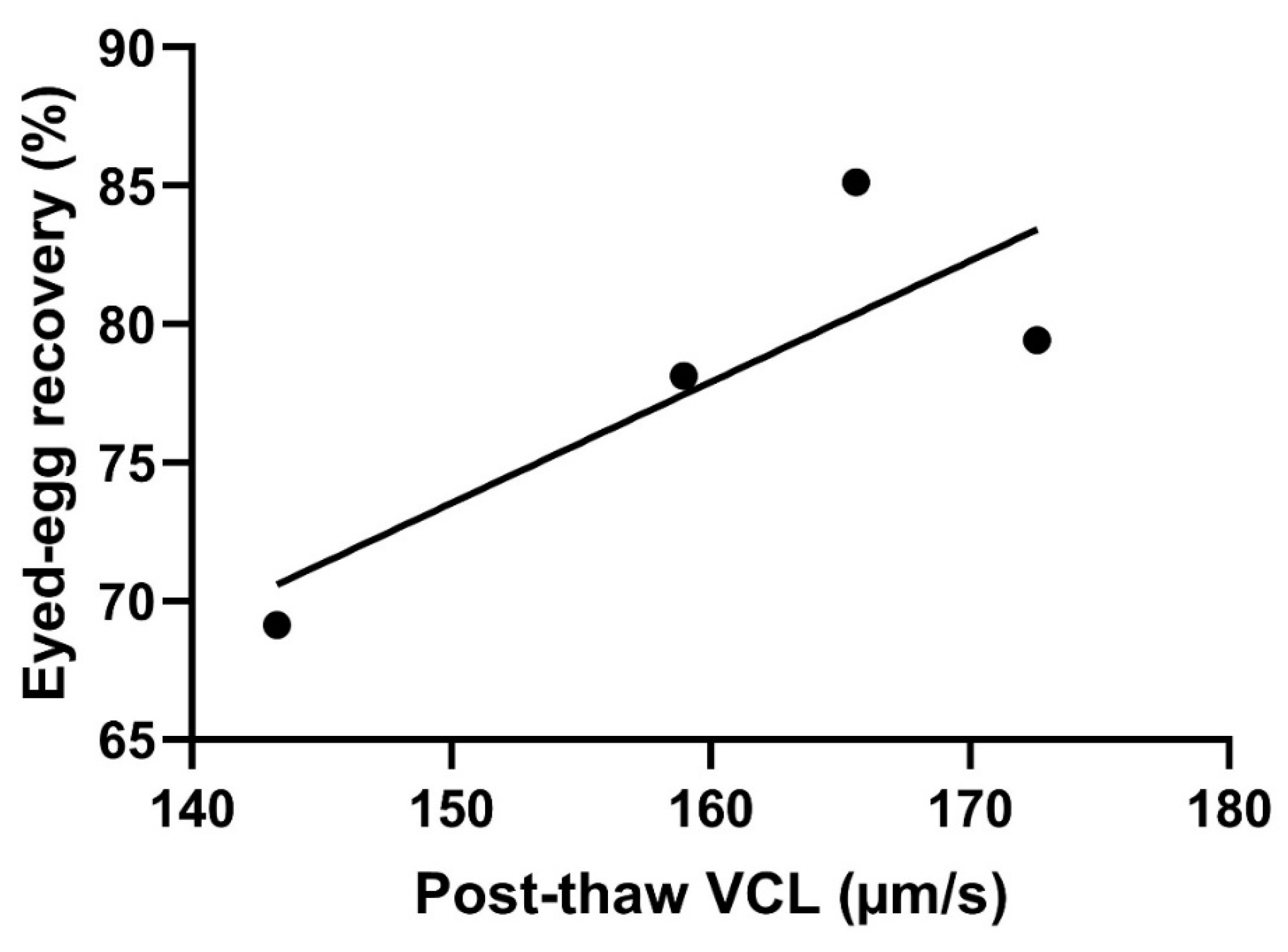
Figure 5.
Exploratory donor-level relationship between post-thaw total motility (MOT) and eyed-egg recovery. MOT showed a substantially weaker Pearson association than VCL (r = 0.337, nominal p = 0.664, BH-FDR q = 0.730; n = 4).
Figure 5.
Exploratory donor-level relationship between post-thaw total motility (MOT) and eyed-egg recovery. MOT showed a substantially weaker Pearson association than VCL (r = 0.337, nominal p = 0.664, BH-FDR q = 0.730; n = 4).
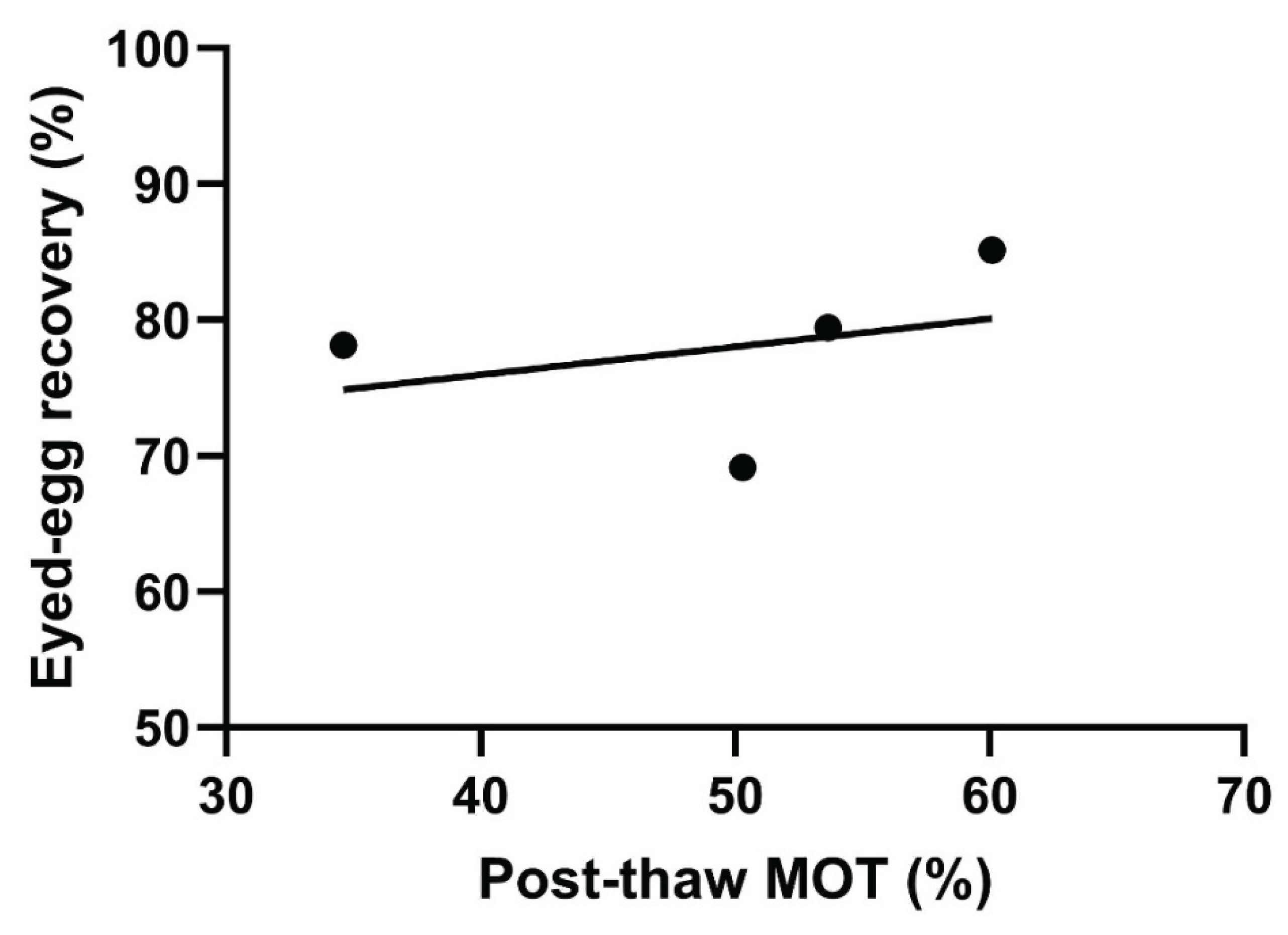

Table 1.
Paired CASA comparison between fresh and cryopreserved brook trout semen (n = 4 males). Values are donor means after averaging two CASA readings; nominal p-values are from paired t-tests and FDR q-values are Benjamini–Hochberg adjusted across the 11 CASA endpoints.
Table 1.
Paired CASA comparison between fresh and cryopreserved brook trout semen (n = 4 males). Values are donor means after averaging two CASA readings; nominal p-values are from paired t-tests and FDR q-values are Benjamini–Hochberg adjusted across the 11 CASA endpoints.
| CASA variable | Fresh mean ± SD | Cryopreserved mean ± SD | Paired change | 95% CI | p | FDR q |
|---|---|---|---|---|---|---|
| VCL | 179.02 ± 16.57 | 160.11 ± 12.53 | -18.90 | -33.20 to -4.60 | 0.0245 | 0.0403 |
| VSL | 109.55 ± 12.95 | 121.30 ± 8.60 | +11.76 | -1.81 to 25.32 | 0.0702 | 0.0858 |
| VAP | 161.51 ± 17.97 | 154.98 ± 12.18 | -6.52 | -21.17 to 8.13 | 0.2514 | 0.2766 |
| LIN | 61.00 ± 4.51 | 74.74 ± 4.29 | +13.74 | 6.97 to 20.50 | 0.0075 | 0.0229 |
| STR | 66.30 ± 3.76 | 76.47 ± 3.29 | +10.18 | 3.92 to 16.43 | 0.0140 | 0.0308 |
| WOB | 90.12 ± 2.62 | 96.51 ± 2.33 | +6.39 | 4.24 to 8.53 | 0.0025 | 0.0183 |
| ALH | 1.52 ± 0.20 | 1.15 ± 0.12 | -0.36 | -0.66 to -0.07 | 0.0293 | 0.0403 |
| BCF | 8.17 ± 0.38 | 7.43 ± 0.63 | -0.74 | -1.34 to -0.14 | 0.0291 | 0.0403 |
| LSL | 49.02 ± 7.54 | 65.32 ± 8.80 | +16.30 | 7.98 to 24.62 | 0.0083 | 0.0229 |
| MOT | 91.05 ± 1.39 | 49.67 ± 10.83 | -41.38 | -56.71 to -26.04 | 0.0033 | 0.0183 |
| PRG | 21.24 ± 6.37 | 20.00 ± 2.72 | -1.24 | -12.96 to 10.48 | 0.7587 | 0.7587 |
Table 2.
Exploratory donor-level correlations between post-thaw CASA parameters and eyed-egg recovery (n = 4). Pearson p-values were adjusted as one 11-test family using the Benjamini–Hochberg procedure; Spearman correlations are shown as a distribution-free sensitivity analysis and were not subjected to a second FDR correction.
| CASA variable | Pearson r | p | FDR q | Spearman ρ | p (Spearman) |
|---|---|---|---|---|---|
| VCL | 0.828 | 0.172 | 0.670 | 0.80 | 0.20 |
| VSL | 0.581 | 0.419 | 0.724 | 0.20 | 0.80 |
| VAP | 0.811 | 0.189 | 0.670 | 0.40 | 0.60 |
| LIN | -0.539 | 0.461 | 0.724 | -0.80 | 0.20 |
| STR | -0.742 | 0.258 | 0.670 | -0.80 | 0.20 |
| WOB | -0.080 | 0.920 | 0.920 | -0.80 | 0.20 |
| ALH | 0.742 | 0.258 | 0.670 | 0.80 | 0.20 |
| BCF | -0.340 | 0.660 | 0.730 | -0.20 | 0.80 |
| LSL | 0.695 | 0.305 | 0.670 | 0.40 | 0.60 |
| MOT | 0.337 | 0.664 | 0.730 | 0.80 | 0.20 |
| PRG | 0.383 | 0.617 | 0.730 | 0.40 | 0.60 |
Disclaimer/Publisher’s Note: The statements, opinions and data contained in all publications are solely those of the individual author(s) and contributor(s) and not of MDPI and/or the editor(s). MDPI and/or the editor(s) disclaim responsibility for any injury to people or property resulting from any ideas, methods, instructions or products referred to in the content. |
© 2026 by the authors. Licensee MDPI, Basel, Switzerland. This article is an open access article distributed under the terms and conditions of the Creative Commons Attribution (CC BY) license (http://creativecommons.org/licenses/by/4.0/).
Copyright: This open access article is published under a Creative Commons CC BY 4.0 license, which permit the free download, distribution, and reuse, provided that the author and preprint are cited in any reuse.