

Submitted:
22 September 2026
Posted:
28 September 2026
You are already at the latest version
Abstract
A graph \(G\) is Ramsey size-linear if \(R(G,H)=O(e(H))\) for every graph \(H\) without isolated vertices. Erdős, Faudree, Rousseau and Schelp asked whether every graph in which each \(k\)-vertex subgraph spans at most \(2k-3\) edges is Ramsey size-linear (Erdős Problem #566). We prove that every graph with no \(K_4\)-minor is Ramsey size-linear, with \(R(G,H)\leq 624\,v(G)\,e(H)\). This covers all \(2\)-trees, which attain the density \(2k-3\), and extends results of Erdős et al. for graphs \(K_1+T\) with \(T\) a tree and for connected graphs with at most \(v(G)+1\) edges. The proof combines the triangle-elimination process and an averaging argument of Bradač, Gishboliner and Sudakov. As consequences, a connected graph with at most \(v(G)+2\) edges is Ramsey size-linear unless it contains \(K_4\) or \(K_4^*\), and each of the pairs \(\{K_4^*,W_4\}\) and \(\{W_5^-,W_5\}\) contains a minimally non-Ramsey size-linear graph. We also make explicit further structures produced by the proof of Bradač, Gishboliner and Sudakov and, by a computer search over graphs on at most eight vertices, reduce the open cases of the question to \(49\) minimal graphs governed by eleven cores.
Keywords:
Ramsey size-linear graphs
; graph Ramsey numbers
; treewidth
; series–parallel graphs
; Erdős problems
MSC: 05C55; 05D10; 05C35; 05C83
1. Introduction
For graphs G and H, the Ramsey number is the smallest integer N such that for every graph on N vertices, contains a copy of G or its complement contains a copy of H. Harary conjectured that for every graph H without isolated vertices; this was proved by Sidorenko [18] and by Goddard and Kleitman [14]. Erdős, Faudree, Rousseau and Schelp [12] initiated a systematic study of this phenomenon and called a graph GRamsey size-linear if there is a constant such that
Among other results, they proved the following.
- (i)
- Every connected graph G with is Ramsey size-linear [12, Theorem 4].
- (ii)
- If G contains a subgraph with k vertices and at least edges, then G is not Ramsey size-linear [12, Corollary 1].
- (iii)
- If T is a tree, then is Ramsey size-linear; in fact [12, Theorem 3 and Corollary 2].
- (iv)
- Every graph with Turán number is Ramsey size-linear [12, Theorem 5]; examples mentioned there include and .
Fact (ii) comes from the lower bound , obtained by the probabilistic method [19] (see also [12,20]), where : a subgraph with k vertices and edges forces , and then grows faster than . Erdős et al. asked whether this is the only obstruction.
Question 1.1
They also asked whether , the cube and , the graph obtained from by subdividing one edge, are Ramsey size-linear [12, Question 2], noting that each of them would be minimally non-Ramsey size-linear otherwise; see also [11], and [2,5] for . Here a graph is minimally non-Ramsey size-linear if it is not Ramsey size-linear but all its proper subgraphs are. Erdős et al. observed that is such a graph and asked for others [12, Question 6] (Erdős Problem #79). Related questions are collected as Erdős Problems #566–#570 [3].
Facts (ii) and (iii) show that the density in Question 1.1 cannot be raised and is attained by Ramsey size-linear graphs. Balister, Schelp and Simonovits [2] proved that joining two vertices at distance d of a Ramsey size-linear graph by a new path of length at least preserves the property. They asked whether every 2-connected graph of minimum degree at least three fails to be Ramsey size-linear; this was answered negatively by combining (iv) with a construction of Janzer [16], as observed in [5]. Bradač, Gishboliner and Sudakov [5] proved that every subdivision of with at least six vertices is Ramsey size-linear, that for every bipartite F, and that , and remarked that Question 1.1 seems to be out of reach. Wigderson [20, Open problem 5] proved that there are infinitely many minimally non-Ramsey size-linear graphs; his argument is non-constructive, and he asked for an explicit example other than [20]. For cycles, the optimal linear constant was recently determined by Cambie, Freschi, Morawski, Petrova and Pokrovskiy [7]; see also [15].
Main Result
Theorem 1.2.
Let G be a graph with no -minor, equivalently a graph of treewidth at most two, and let . Then for every graph H with edges and no isolated vertices,
In particular, every -minor-free graph is Ramsey size-linear.
A graph of treewidth at most two on vertices has at most edges, with equality for 2-trees, and its subgraphs again have treewidth at most two. Thus Theorem 1.2 answers Question 1.1 affirmatively for a minor-closed class which contains graphs of the extremal density allowed there, including all 2-trees, all outerplanar graphs and all series–parallel graphs. It extends facts (i) and (iii): the graphs have treewidth two, and a connected graph containing a subdivision of has cyclomatic number , so connected graphs with at most edges have no -minor. The smallest graphs covered by Theorem 1.2 but by none of the results quoted above have six vertices: the 3-sun (a triangle with a further triangle attached along each of its edges), the strip of four triangles, and the triangular prism minus one of its three matching edges (Section 7). We have not found Theorem 1.2 stated in the literature.
The proof has two steps, both relying on ideas of [5]. The first (Lemma 3.1) is the averaging argument of [5, Claim 4.4], stated as a general embedding result: if a graph on N vertices has at most triangles, then contains every graph without isolated vertices having at most edges. The second (Lemma 4.1) uses the triangle-elimination process of [5, Section 4]: if H is a 2-tree on h vertices, the process eliminates every triangle of an H-free graph , so has at most triangles. In [5] these tools are used to find subdivisions of ; the point here is that for 2-trees they suffice on their own.
Consequences
Corollary 1.3.
Let G be a connected graph with .
- (a)
- If G contains neither nor , then G is Ramsey size-linear.
- (b)
- If G contains , then G is not Ramsey size-linear.
- (c)
- If G contains , then G is Ramsey size-linear if and only if is.
Thus the threshold of fact (i), which is sharp because of , can be raised to at the cost of a single unresolved graph, .
For let be the wheel with k spokes, and for let denote with one spoke removed; see Figure 1.
Proposition 1.4.
Let .
- (a)
- is not Ramsey size-linear, while minus a rim edge is. Consequently, is minimally non-Ramsey size-linear if and only if is Ramsey size-linear.
- (b)
- .
- (c)
- . Hence an affirmative answer to Question 1.1 would imply that every wheel with is minimally non-Ramsey size-linear.
- (d)
- For every proper subgraph of is Ramsey size-linear. Consequently each of the pairs and contains a minimally non-Ramsey size-linear graph. In particular, there are at least two minimally non-Ramsey size-linear graphs other than : one of on five vertices and one of on six vertices.
Proposition 1.4 does not depend on Theorem 1.2: it follows from facts (i)–(iii) and [5]. Erdős et al. already observed that would be minimally non-Ramsey size-linear if it were not Ramsey size-linear [12]; the new point is the other member of each pair. Part (d) does not settle Wigderson’s problem, since we cannot say which member of each pair is minimally non-Ramsey size-linear. It does show that any resolution of the question of Erdős et al. for , in either direction, produces an explicit minimally non-Ramsey size-linear graph other than : namely if is Ramsey size-linear, and itself otherwise. The same holds for and . Our computations (Section 7) show that, with the tools currently available, these are the only such pairs among the density-critical graphs on at most eight vertices.
Finally, in Section 6 we make explicit what the proof of [5, Theorem 4] actually produces, and in Section 7 we determine by an exhaustive computer search the minimal graphs on at most eight vertices that satisfy the hypothesis of Question 1.1 but whose Ramsey size-linearity does not follow from the results available. Apart from there are 3, 10 and 35 of them on six, seven and eight vertices. The three on six vertices are , the triangular prism and , and all of them reduce to one of eleven cores (Proposition 7.2).
Organization.Section 2 collects preliminaries. Lemma 3.1 is proved in Section 3 and Lemma 4.1 in Section 4. Section 5 contains the proofs of Theorem 1.2, Corollary 1.3 and Proposition 1.4, Section 6 the consequences of the proof of [5], Section 7 the census of small cases, and Section 8 concluding remarks and open questions.
2. Preliminaries
All graphs are finite and simple. For a graph we write and for the numbers of vertices and edges, and for the neighbourhood and the degree of a vertex x, for the number of triangles, and for the complement. We say that containsG if has a (not necessarily induced) subgraph isomorphic to G, and that is G-free otherwise. If then ; hence every subgraph of a Ramsey size-linear graph is Ramsey size-linear.
Treewidth.
A 2-tree is a graph obtained from a triangle by repeatedly adding a new vertex adjacent to both ends of an existing edge. A 2-tree on vertices has edges. We use the following standard facts; see [4,9,10].
- (T1)
- A graph has treewidth at most two if and only if it has no -minor.
- (T2)
- Every graph of treewidth at most two with at least three vertices is a spanning subgraph of a 2-tree.
- (T3)
- A graph has a -minor if and only if it contains a subdivision of .
Lemma 2.1
(Bradač, Gishboliner and Sudakov [5, Lemma 2.3]). Let H be a graph with m edges, let , and let A be a set of k vertices of largest degree in H. Let Γ be a graph on N vertices with average degree d, and let be an embedding of into . If
then extends to an embedding of H into .
(included for completeness)).Proof (Proof Let D denote the maximum in the displayed inequality and let . Fewer than vertices have degree larger than , so . Embed the vertices of one at a time into W. When x is to be embedded, each of the k vertices of A has degree at least , so . The vertices that x must avoid are the images of the vertices already embedded (fewer than ) and the -neighbours of the images of its embedded H-neighbours; each such image lies in or in W and so has -degree at most D. Hence fewer than vertices of W are excluded, and x can be embedded. □
Lemma 2.2
For disjoint unions one has , so a graph is Ramsey size-linear if and only if all its blocks are, and it suffices to study 2-connected graphs.
3. Graphs with Few Triangles
The following lemma isolates the averaging argument of [5, Claim 4.4] as a general statement.
Lemma 3.1.
Let and let Γ be a graph on N vertices with . Let H be a graph with edges and no isolated vertices. If , then contains H.
Proof.
If then is complete and contains H, as . So let and let be the average degree. For a vertex x let
For every edge we have or , so . Every edge of forms a triangle with x, so . Suppose first that and set
Since , we get . Fix x with . Then and
By (c) the graph has average degree less than , so by the Caro–Wei (or Turán) bound it contains an independent set I with . If then is triangle-free, every is independent, and the same conclusion holds with , using and .
Every satisfies , and also . If , then H embeds into , which is complete. Otherwise put , let A be a set of k vertices of largest degree in H, and let be any bijection; it embeds into because I is independent in . The maximum in Lemma 2.1 is at most , so
using . Lemma 2.1 extends to an embedding of H into . □
4. Triangles in Graphs Without a Given 2-Tree
Lemma 4.1.
Let H be a 2-tree on vertices. Then every H-free graph Γ satisfies .
Proof.
The elimination process below is the one of [5, Section 4], and the embedding step follows [5, Proposition 1.1]. Let be the set of triangles of . As long as some edge of lies in at least one and at most triangles of , choose such an edge and delete from all triangles containing it. After this step the chosen edge lies in no triangle of , and only shrinks, so each edge is chosen at most once. Hence at most triangles are deleted in total. Let be the final set. By construction, every edge lying in some triangle of lies in at least triangles of .
We claim , which gives . Suppose not. Order as so that is a triangle and each with is adjacent to exactly two earlier vertices , which are adjacent. Map onto the vertices of a triangle of . Inductively, assume are embedded injectively so that every edge of is mapped to an edge lying in a triangle of . The image of then lies in at least triangles of , whose third vertices are distinct, while only vertices other than the images of are already used. Choose an unused third vertex z and map to z; the two new edges belong to a triangle of , so the invariant is maintained. At the end we obtain a copy of H in , a contradiction. □
5. Proofs of the Main Results
Proof
(Proof of Theorem 1.2). If then ; otherwise, by (T1) and (T2), G is a spanning subgraph of a 2-tree on h vertices. In both cases for a 2-tree on h vertices. Let be a graph on vertices that does not contain G. Then is -free, so by Lemma 4.1, and Lemma 3.1 with shows that contains H, because . □
Proof
(Proof of Corollary 1.3). (b) follows from fact (ii), since . For (a) and (c), note first that if a connected graph G contains a connected subgraph S, then : G arises from S by adding edges and by adding vertices each joined by at least one edge. If G has no -minor, it is Ramsey size-linear by Theorem 1.2. Otherwise, by (T3), G contains a subdivision S of , and . Hence equality holds, which means that every edge of G outside S is a bridge: S is the only block of G with a cycle, and the other blocks are single edges. Now in case (a), and unless G contains ; the only subdivisions of with fewer than six vertices are and . So in case (a), S has at least six vertices and is Ramsey size-linear by [5]; single edges are Ramsey size-linear, and Lemma 2.2 shows that G is Ramsey size-linear. In case (c), the 2-connected graph lies in a block of G, hence in S; since S is 2-connected and , the argument above (applied to ) shows . Thus G is obtained from by attaching bridges, and it is Ramsey size-linear if is, by Lemma 2.2; the converse holds because . □
Proof
(Proof of Proposition 1.4). Let c be the hub of and its rim.
(a) has vertices and edges, so it is not Ramsey size-linear by fact (ii). Deleting the rim edge leaves the fan , which is Ramsey size-linear by fact (iii). Every proper subgraph of is contained in for some edge f, and for the automorphisms of act transitively on the spokes and on the rim edges. Hence all proper subgraphs of are Ramsey size-linear if and only if is.
(b) Deleting the spoke from leaves the complete graph on minus the edge , together with the path ; this is with the edge subdivided by .
(c) has vertices and edges. Let S be a proper subset of its vertices with . If , then S spans at most j edges of the rim cycle if , and at most edges otherwise; in both cases at most edges when , and at most 1 edge when . If , then is a proper subset of the rim, so it spans a linear forest with at most edges, and together with at most spokes S spans at most edges. Thus , and the second statement follows from (a).
(d) For : every proper subgraph of is contained in for an edge f, which is connected (as is 2-connected) and has edges, so it is Ramsey size-linear by fact (i). For , let . If f is a rim edge, then deleting c from leaves a path, so is a subgraph of and is Ramsey size-linear by fact (iii). If f is a spoke, then in the hub is adjacent to exactly three vertices of the rim , so is a subdivision of with six vertices (branch vertices: c and its three neighbours), which is Ramsey size-linear by [5]. Hence every proper subgraph of is Ramsey size-linear for .
Now fix . If is not Ramsey size-linear, then it is minimally non-Ramsey size-linear, since all its proper subgraphs are Ramsey size-linear. If is Ramsey size-linear, then is minimally non-Ramsey size-linear by (a). In either case the pair contains a minimally non-Ramsey size-linear graph; the two pairs are disjoint and do not contain , and by (b). □
6. More from the Proof of Bradač, Gishboliner and Sudakov
The proof of [5, Theorem 4] produces more than its statement asserts. We make this explicit, since it settles many small cases (Section 7). Throughout this section F is a graph with edges and no isolated vertices, is a graph on vertices whose complement contains no copy of F, and are the constants of [5, Section 4]. Let be the set of edges lying in a triangle that survives the triangle-elimination process of Section 4 (run with threshold ), so that
Lemma 6.1.
Let with , and let K be obtained from B by repeatedly adding a new vertex joined to both ends of an existing edge. If , then Γ contains a copy of K extending the copy of B.
Proof.
Add the vertices of in the order of the construction. When a vertex is to be joined to the ends of an edge e, the copy of e lies in , so by (1) it lies in at least triangles with all edges in ; their apexes are distinct, so one of them is unused. The two new edges lie in , so the invariant is maintained. □
Write for the graph with vertices v, , , w, , and edges , , , , and . For a multigraph Q on a set A of size s, write for the graph with vertices , A and one vertex for each , and edges together with the two edges joining to the ends of f. Finally, let , , be on , the graph obtained from it by subdividing once, and the graph obtained from it by subdividing twice. In the edge is called dead, in the edge of the subdivision path incident to y is called dead, and all other edges are live; in all edges are live.
Proposition 6.2.
With Γ as above and any fixed and Q:
- (a)
- Γ contains a copy of all of whose edges lie in ;
- (b)
- Γ contains a copy of all of whose edges lie in ;
- (c)
- Γ contains a copy of , of or of in which all live edges lie in .
Proof.
Part (a) is what Case 1 of the proof of [5, Theorem 4] produces: a vertex v, an edge of with , and such that and each have more than common neighbours in ; choosing distinct such common neighbours gives the copy. Part (b) is Case 2: it produces and a set of common -neighbours of and such that every pair in has more than common neighbours in ; there , and the same averaging gives once is large in terms of s and . Choosing a distinct such common neighbour for each edge of Q gives the copy. Part (c) is the case analysis at the end of Case 3, whose possible outcomes are a copy of in which all edges except the one joining the two tips of a diamond lie in , a copy of in , or a copy of in which all edges except one end edge of the subdivision path lie in . These arguments use only [5, Claims 4.1 and 4.4], which hold for every as above, and not the graph whose copy is being sought; hence they apply simultaneously. □
Corollary 6.3.
Every subgraph of a graph obtained from some or some by 2-tree steps is Ramsey size-linear. So is every graph which, for each , is a subgraph of a graph obtained from by 2-tree steps along live edges and along edges created by earlier steps.
Proof.
Combine Proposition 6.2 with Lemma 6.1 (applied to the live edges), taking larger than the order of the graph sought, and use that subgraphs of Ramsey size-linear graphs are Ramsey size-linear. □
Corollary 6.3 contains [5, Theorem 4], which is how that theorem is proved: a subdivision of on at least six vertices is a subdivision of , or , and a subdivided edge is a subgraph of a fan with hub y glued along by 2-tree steps.
7. The Remaining Small Cases
By Lemma 2.2 it suffices to consider 2-connected graphs. The next proposition describes the minimal graphs not covered by Theorem 1.2 and [5]. An S-ear of a subgraph S is a path of length at least one whose two (distinct) ends lie in S and whose inner vertices and edges do not belong to S.
Proposition 7.1.
Let G be a 2-connected graph with which has a -minor and is not a subdivision of with at least six vertices. Then G contains , or G contains a subgraph , where S is a subdivision of with at least six vertices and P is an S-ear. Every such is 2-connected, has a -minor and satisfies .
Proof.
By (T3), G contains a subdivision S of . We have because . If we are done; otherwise , and by assumption. If some edge of G outside S joins two vertices of S, it is an S-ear. Otherwise G has a vertex outside S; let C be a component of . Since G is 2-connected, C has neighbours in at least two vertices of S, and a path from x to y through C is an S-ear. The last sentence is clear, since adding an ear increases by one. □
Consequently, if only Theorem 1.2 and [5] are used, every minimal unresolved graph other than has the form and has exactly edges; Turán-type results can create exceptions, such as below. By the path-extension result of [2], is Ramsey size-linear whenever P has length at least , where are its ends, so only short ears matter.
Computation.
We enumerated all 2-connected graphs G with at most eight vertices and . For we used the atlas of all graphs on at most seven vertices, as implemented in NetworkX. For we used that such a graph has minimum degree 2 or 3 (as ), so it is obtained from a graph on seven vertices with by adding a vertex of degree 2 or 3; isomorphism classes were separated by Weisfeiler–Leman hashes followed by exact isomorphism tests. An independent enumeration, adding a vertex with an arbitrary neighbourhood to every graph on seven vertices, gave the same number, 1224. Each graph was classified by the following sufficient conditions for Ramsey size-linearity, all taken from the literature except (C3): (C1) [12, Theorem 4]; (C2) is a forest for some vertex v, that is, G is a subgraph of some [12, Theorem 3]; (C3) treewidth at most two (Theorem 1.2); (C4) G is a subdivision of with at least six vertices [5]; (C5) G is bipartite and all vertices of one colour class have degree at most two, whence its Turán number is [1,13]; (C6) G is a subgraph of or of , whose Turán numbers are stated to be in [12] (for (C5) and (C6) we use [12, Theorem 5]); (C7) G arises from a graph whose blocks satisfy one of the previous conditions by adding a path of length at least between two of its vertices [2, Corollary 2]; (C8) G is a subgraph of a graph satisfying one of (C1), (C2) or (C4)–(C7); (C9) G is a subgraph of a 2-tree extension of some or (Corollary 6.3); (C10) G lies in the extension class of each of (Corollary 6.3). Treewidth was tested by series–parallel reduction. A graph is unresolved if none of (C1)–(C8) applies, and minimal unresolved if moreover all its proper subgraphs are resolved. Conditions (C9) and (C10) were tested by a reduction: a graph lies in the extension class of a base B if and only if it can be reduced to a subgraph of B by repeatedly deleting a vertex of degree at most two and, when its degree is two, adding the edge between its two neighbours (an edge which must be live). Table 1 separates the contributions of (C3) and of (C9)–(C10).
On five vertices Theorem 1.2 adds nothing: Erdős et al. had already settled every graph on at most five vertices except [12, Section 3]. On six vertices it settles exactly three graphs not covered before, namely the 3-sun, the strip of four triangles and the prism minus a matching edge.
After all ten conditions, 49 minimal unresolved graphs remain: ; on six vertices , the triangular prism and ; and 10 and 35 graphs on seven and eight vertices, listed in Appendix A. They are governed by few cores. Call a graph a core if it has minimum degree at least three, and reduce a graph by repeatedly deleting a vertex of degree at most two, adding the edge between its two neighbours when the degree is two; each step undoes a 2-tree step, possibly after deleting edges.
Proposition 7.2.
Each of the 49 minimal unresolved graphs on at most eight vertices reduces to exactly one of the following eleven cores (listed with the number of graphs reducing to it):
- six cores which arenotRamsey size-linear, having edges: (5 graphs), the wheel (22 graphs), and four graphs on six vertices with ten edges (1 graph each);
- five cores with and minimum degree three: the triangular prism (10 graphs), (5), the cube , a graph on seven vertices with eleven edges, and a cubic graph on eight vertices (1 graph each).
In particular and are the smallest members of the first group: they are obtained from the non-Ramsey size-linear graphs and by subdividing one edge. The second group contains the graphs and of [12, Question 2]. No graph of either group lies in one of the extension classes of Corollary 6.3, so settling any of them requires a new argument.
Density-critical graphs.
Call Gdensity-critical if and every proper subset S of with spans at most edges. By fact (ii) such a graph is not Ramsey size-linear, and every minimal non-Ramsey size-linear graph G with is density-critical. A density-critical graph has minimum degree exactly three. There are 1, 1, 4, 15 and 109 of them on vertices. For each, we determined the unresolved 2-connected proper subgraphs (every proper subgraph lies in some , and every 2-connected subgraph of lies in a block of ). The argument of Proposition 1.4(d) applies to G exactly when all of them are minimal unresolved; this happens only for (with no unresolved subgraphs), for (with ) and for (with ).
8. Concluding Remarks
8.0.0.4. A programme.
By Proposition 7.2, settling Question 1.1 for all graphs on at most eight vertices amounts to settling the families attached to eleven cores. For the six cores that are not Ramsey size-linear, the question is whether subdividing edges of such a core, just enough to bring down to 2, always yields Ramsey size-linear graphs; and are the smallest instances. For the five cores with the question concerns the cores themselves, and for it requires . Testing each of the 49 graphs against the three configurations of Proposition 6.2(c) separately, with the dead edges declared live or not, shows how far the method is from each of them. For 45 graphs (all families except that of ) none of the three extension classes applies even when every edge is live, so a new structure is needed. For and three other graphs with core the obstruction is the configuration , even with all its edges live. For one graph on eight vertices, with a triangle glued along each end edge of its subdivision path (graph6 GJyGcc), the only obstruction is the dead edge of ; in the notation of [5, Case 3], it is present in unless the set U of tips induces a triangle-free graph all of whose edges have codegree at most seven.
Short cycles in links.
For a vertex a let be its link in ; by (1) it has minimum degree at least . If contains a cycle of length , then a together with this cycle spans a wheel (with ) all of whose edges lie in , and Lemma 6.1 applies to it. Testing the 49 minimal unresolved graphs against the extension classes of gives the following.
- If some link contains a cycle of length at most five, whichever length it is, then contains GJyGcc. Equivalently, if does not contain GJyGcc, then every link has girth at least six; this can also be checked by hand (a in gives a in ; a gives two tips of a diamond in with a third common neighbour; a gives the required path between the tips).
- If some link contains a or a , then contains , 19 further graphs with core , and GJyGcc.
- If some link contains a or a , then contains , GJyGcc and two further graphs with core .
In the quotients of -buildings of Remark 8.3 every link is the incidence graph of a projective plane and has girth six, so none of these hypotheses follows from (1) alone; a proof would have to use [5, Claim 4.1]. For the third item is little more than a reformulation, since every neighbourhood in a -free graph is -free; for and GJyGcc it is a genuine reduction.
Question 8.1.
Let Γ be as in Section 6. Must some link contain a cycle of length at most five? Must some link contain a cycle of length four or five?
A positive answer to the second part would show that is Ramsey size-linear and hence, by Proposition 1.4, that is an explicit minimally non-Ramsey size-linear graph.
8.0.0.6. The graph .
By Proposition 1.4, deciding whether is Ramsey size-linear would, in either direction, produce an explicit minimally non-Ramsey size-linear graph other than : if the answer is positive, and itself (together with a negative answer to Question 1.1) otherwise. The same is true for , but has resisted several attempts [2,5,12], and , whose rim is longer, may be more accessible. Natural intermediate steps, in analogy with [5], are the following.
Question 8.2.
Is for every bipartite graph F without isolated vertices? Is ?
The general bounds of [5] give .
Remark 8.3
(Limits of the method; sketch). The only property of G used in the proof of Theorem 1.2 is that G-free graphs have triangles. This fails for (consider complete tripartite graphs) and, less obviously, for . Let Δ be the Bruhat–Tits building of . Its vertex links are point–line incidence graphs of the projective plane [17], so every edge of its 1-skeleton lies in exactly triangles and every neighbourhood induces a bipartite graph of girth six. Suppose Δ contained , with hub c, rim path in the neighbourhood of c, and a further common neighbour of and . By girth six, and are at distance three in the link of c, i.e., opposite. In the CAT(0) metric of Δ [6], where all triangles are equilateral with side one, the path is then a geodesic of length 2, and would be a second geodesic of the same length between the same points, contradicting the uniqueness of geodesics. Cocompact lattices in exist (see e.g., [8]) and are residually finite, being finitely generated linear groups; hence Δ has finite quotients in which every ball of radius two is isomorphic to a ball of Δ. Their 1-skeleta are finite -free graphs with . Thus proving that is Ramsey size-linear requires more than triangle counting.
Question 8.4.
For which graphs G is there a constant such that every G-free graph Γ satisfies ? By Lemma 4.1 this holds when G has treewidth at most two. Does it fail for every graph with a -minor?
Constants.
The constant in Theorem 1.2 is far from optimal; for the truth is . It would be interesting to determine the order of magnitude of the best constant for 2-trees on h vertices.
Supplementary Materials
The following supporting information can be downloaded at the website of this paper posted on Preprints.org. File S1 (supplementary_material_S1.zip) contains: the Python scripts of the computer search of Section 7 and of the tests of Section 8 (rsl_census.py, bgs_extract.py, case3.py, census_final.py, cores.py, families_final.py, diagnostico.py, wheels.py and export_results.py); the file census_results.csv, which lists all 1403 graphs of the census with the conditions (C1)–(C10) that they satisfy; the expected output of every script; and a file README.txt with instructions.
Funding
This research received no external funding.
Data Availability Statement
All data of this paper are contained in or produced by Supplementary File S1 (see Supplementary materials). The scripts require Python 3 and NetworkX, and reproduce Table 1, Proposition 7.2, the analysis of density-critical graphs, the tests of Section 8 and the lists of Appendix A.
Conflicts of Interest
The author declares no conflicts of interest.
Use of artificial intelligence tools
This work was carried out with the assistance of the large language model Claude (Anthropic). The tool was used for literature search, for proposing and checking proofs, for writing and running the Python code of the computer search in Section 7 and of the tests in Section 8, and for drafting the text of the manuscript. The author independently checked the proofs of Lemmas 3.1 and 4.1 and is responsible for the content of the manuscript.
Appendix A. Minimal Unresolved Graphs on Seven and Eight Vertices
The graphs are given in graph6 format, as produced by NetworkX.
7 vertices (10 graphs).
Fhf_g FheoW FhEKw FhEMg FhdQW FMjDO
FhEJW FMohg FlBHo FhUk_
8 vertices (35 graphs).
G[EoIS GxUA?k GxUA?[ GeoJ@g Gewa?k GxSICK
GxSQCK GEtBDG GjCHSg GjCHSK G`DbKW GhogKc
GFwcAK GxOYCc GxOYCS GxSAKW GhT@Kg Ggogl_
GxOWSK GHt@Kg GHFEKW GhFKBC GhFK@c GxU?Gs
GHhGm_ GFw_MC GhEKcc GhdWbC GhUgMC GhUgLC
GhdYCS GJyGcc GJyGcK GMs`KK GhELQg
References
- Alon, N.; Krivelevich, M.; Sudakov, B. Turán numbers of bipartite graphs and related Ramsey-type questions. Comb. Probab. Comput. 2003, 12, 477–494. [Google Scholar] [CrossRef]
- Balister, P. N.; Schelp, R. H.; Simonovits, M. A note on Ramsey size-linear graphs. J. Graph Theory 2002, 39, 1–5. [Google Scholar] [CrossRef]
- Bloom, T. F. Erdős Problems, https://www.erdosproblems.com, Problems #79 and #566–#570. Accessed. (accessed on September 2026).
- Bodlaender, H. L. A partial k-arboretum of graphs with bounded treewidth. Theor. Comput. Sci. 1998, 209, 1–45. [Google Scholar] [CrossRef]
- Bradač, D.; Gishboliner, L.; Sudakov, B. On Ramsey size-linear graphs and related questions. SIAM J. Discret. Math. 2024, 38, 225–242. [Google Scholar] [CrossRef]
- Bridson, M. R.; Haefliger, A. Metric Spaces of Non-Positive Curvature; Springer: Berlin, 1999. [Google Scholar]
- Cambie, S.; Freschi, A.; Morawski, P.; Petrova, K.; Pokrovskiy, A. Ramsey number of a cycle versus a graph of a given size. arXiv 2026, arXiv:2601.10238. [Google Scholar]
- Cartwright, D. I.; Steger, T. A family of A˜n-groups. Isr. J. Math. 1998, 103, 125–140. [Google Scholar]
- Diestel, R. Graph Theory, 5th edition; Springer: Berlin, 2017. [Google Scholar]
- Duffin, R. J. Topology of series-parallel networks. J. Math. Anal. Appl. 1965, 10, 303–318. [Google Scholar] [CrossRef]
- Erdős, P. Some of my favourite problems in number theory, combinatorics, and geometry. Resenhas 1995, 2, 165–186. [Google Scholar]
- Erdős, P.; Faudree, R. J.; Rousseau, C. C.; Schelp, R. H. Ramsey size linear graphs. Comb. Probab. Comput. 1993, 2, 389–399. [Google Scholar] [CrossRef]
- Füredi, Z. On a Turán type problem of Erdős. Combinatorica 1991, 11, 75–79. [Google Scholar]
- Goddard, W.; Kleitman, D. J. An upper bound for the Ramsey numbers r(K3,G). Discret. Math. 1994, 125, 177–182. [Google Scholar] [CrossRef]
- Hng, E. K.; Ji, M.; Lamaison, A. Ramsey size linear and generalization. arXiv 2026, arXiv:2603.25453. [Google Scholar]
- Janzer, O. Disproof of a conjecture of Erdős and Simonovits on the Turán number of graphs with minimum degree 3. arXiv 2021, arXiv:2109.06110. [Google Scholar]
- Ronan, M. Lectures on Buildings; Academic Press: Boston, 1989. [Google Scholar]
- Sidorenko, A. F. The Ramsey number of an N-edge graph versus triangle is at most 2N+1. J. Comb. Theory Ser. B 1993, 58, 185–196. [Google Scholar] [CrossRef]
- Spencer, J. Asymptotic lower bounds for Ramsey functions. Discret. Math. 1977, 20, 69–76. [Google Scholar] [CrossRef]
- Wigderson, Y. Infinitely many minimally non-Ramsey size-linear graphs. Eur. J. Comb. 2025, 128, 104175. [Google Scholar] [CrossRef]
Figure 1.
The graphs of Proposition 1.4(d), and the two remaining minimal unresolved graphs on six vertices. , , the prism and are the minimal unresolved graphs on at most six vertices (Section 7); and are not Ramsey size-linear.
Figure 1.
The graphs of Proposition 1.4(d), and the two remaining minimal unresolved graphs on six vertices. , , the prism and are the minimal unresolved graphs on at most six vertices (Section 7); and are not Ramsey size-linear.
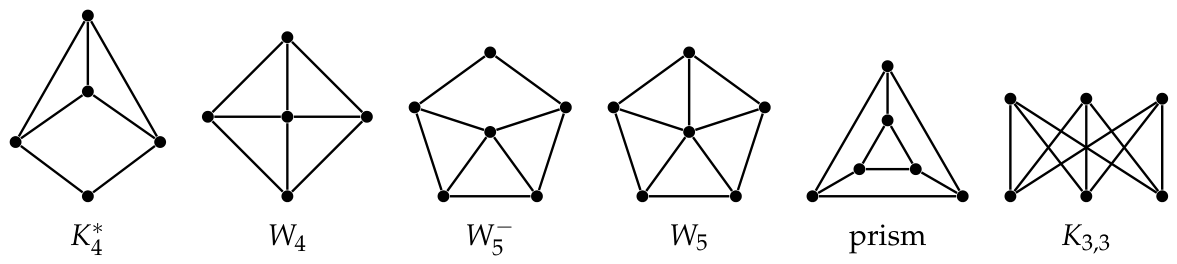

Table 1.
2-connected graphs with on vertices. “Earlier results” means (C1), (C2) and (C4)–(C8); the next two columns count the graphs resolved in addition by Theorem 1.2 and then by Corollary 6.3.
Table 1.
2-connected graphs with on vertices. “Earlier results” means (C1), (C2) and (C4)–(C8); the next two columns count the graphs resolved in addition by Theorem 1.2 and then by Corollary 6.3.
| v | 2-conn., | earlier results | + Theorem 1.2 | + Corollary 6.3 | unresolved | minimal unres. |
|---|---|---|---|---|---|---|
| 3 | 1 | 1 | 0 | 0 | 0 | 0 |
| 4 | 2 | 2 | 0 | 0 | 0 | 0 |
| 5 | 6 | 5 | 0 | 0 | 1 | 1 |
| 6 | 26 | 15 | 3 | 0 | 8 | 3 |
| 7 | 144 | 39 | 18 | 14 | 73 | 10 |
| 8 | 1224 | 115 | 127 | 139 | 843 | 35 |
Disclaimer/Publisher’s Note: The statements, opinions and data contained in all publications are solely those of the individual author(s) and contributor(s) and not of MDPI and/or the editor(s). MDPI and/or the editor(s) disclaim responsibility for any injury to people or property resulting from any ideas, methods, instructions or products referred to in the content. |
© 2026 by the authors. Licensee MDPI, Basel, Switzerland. This article is an open access article distributed under the terms and conditions of the Creative Commons Attribution (CC BY) license (http://creativecommons.org/licenses/by/4.0/).
Copyright: This open access article is published under a Creative Commons CC BY 4.0 license, which permit the free download, distribution, and reuse, provided that the author and preprint are cited in any reuse.