

Submitted:
22 September 2026
Posted:
28 September 2026
You are already at the latest version
Abstract
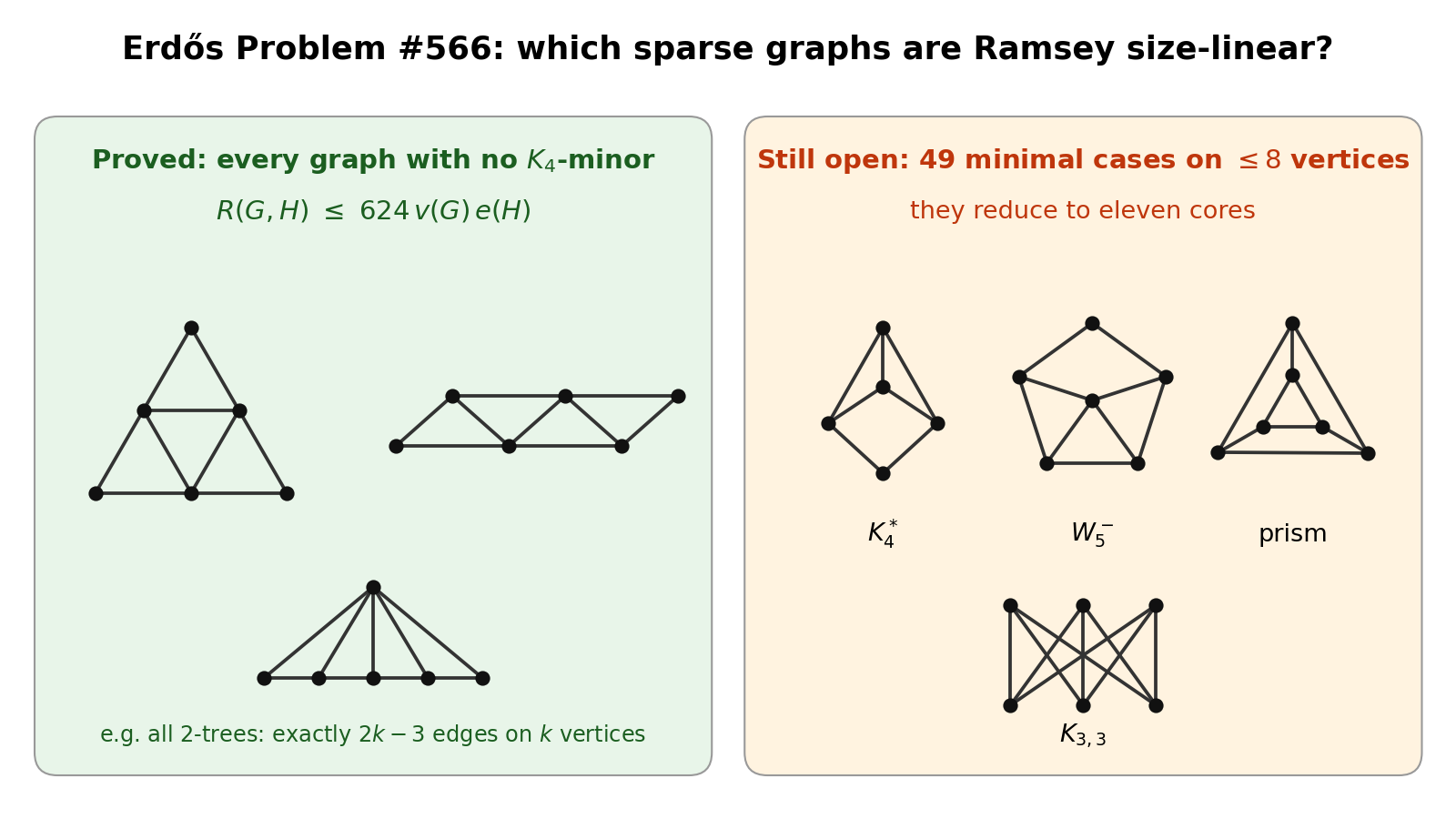
A graph \(G\) is Ramsey size-linear if \(R(G,H)=O(e(H))\) for every graph \(H\) without isolated vertices. Erdős, Faudree, Rousseau and Schelp asked whether every graph in which each \(k\)-vertex subgraph spans at most \(2k-3\) edges is Ramsey size-linear (Erdős Problem #566). We prove that every graph with no \(K_4\)-minor is Ramsey size-linear, with \(R(G,H)\leq 624\,v(G)\,e(H)\). This covers all \(2\)-trees, which attain the density \(2k-3\), and extends results of Erdős et al. for graphs \(K_1+T\) with \(T\) a tree and for connected graphs with at most \(v(G)+1\) edges. The proof combines the triangle-elimination process and an averaging argument of Bradač, Gishboliner and Sudakov. As consequences, a connected graph with at most \(v(G)+2\) edges is Ramsey size-linear unless it contains \(K_4\) or \(K_4^*\), and each of the pairs \(\{K_4^*,W_4\}\) and \(\{W_5^-,W_5\}\) contains a minimally non-Ramsey size-linear graph. We also make explicit further structures produced by the proof of Bradač, Gishboliner and Sudakov and, by a computer search over graphs on at most eight vertices, reduce the open cases of the question to \(49\) minimal graphs governed by eleven cores.
Keywords:
Ramsey size-linear graphs
; graph Ramsey numbers
; treewidth
; series–parallel graphs
; Erdős problems
Copyright: This open access article is published under a Creative Commons CC BY 4.0 license, which permit the free download, distribution, and reuse, provided that the author and preprint are cited in any reuse.