
Submitted:
23 September 2026
Posted:
24 September 2026
You are already at the latest version
Abstract
More than 40 years after its discovery, HIV-1/AIDS remains a major global health threat, with nearly 41 million people living with HIV worldwide at the end of 2025. Antiretroviral therapy (ART) remains the only effective treatment; however, access to ART is still limited in many low- and middle-income countries due to inadequate infrastructure, high costs, and recent cuts in international funding. Despite advances in vaccine development, an effective prophylactic HIV-1 vaccine remains elusive, with no new efficacy trials currently planned. Consequently, the focus has shifted toward therapeutic HIV-1 vaccines as an adjunct to ART. Such vaccines may provide temporary immunological control of viral replication during ART interruption or failure and may reduce treatment costs by limiting the number of ART components. This review summarizes recent advances in therapeutic HIV-1 vaccines, including approaches that mimic T-cell responses of elite controllers, elicit broadly neutralizing antibodies, or redirect immunity toward viral epitopes essential for viral fitness, including drug-resistance mutations. To assess whether therapeutic vaccination may become a viable option for PLWH, we also review experience from routine vaccination in this population. This analysis provides a framework for designing therapeutic vaccination strategies, including dosage, regimens (priming/boosting), and durability of immune responses, thereby helping to determine revaccination needs. Although therapeutic HIV-1 vaccines alone are unlikely to achieve a sterilizing cure or sustained ART-free remission, accumulating evidence indicates that they can substantially enhance HIV-specific immunity, delay viral rebound following ART interruption, and complement various HIV-1 treatment strategies, making them an important component of combination approaches aimed at achieving a functional HIV-1 cure.
Keywords:
HIV-1
; AIDS
; therapeutic HIV-1 vaccine
; HIV-specific immunity
; functional cure
; broadly neutralizing antibodies
1. Current Challenges of the HIV-1 Epidemic
1.1. Current HIV-1 Epidemic
By the end of 2025, 40.9 million people worldwide were living with HIV [1,2]. Since the beginning of the epidemic, approximately 83.5 million people have acquired HIV infection [2], resulting in an estimated 43.2 million deaths [1]. Due to unprecedented global efforts, the number of new HIV infections (1.3 million in 2024) declined by 40% between 2010 and 2024 and by 61% from its peak in 1995 [3]. The number of global AIDS-related deaths has declined by 70% since its peak in 2004. Importantly, the incidences of HIV infection have declined in regions bearing the greatest burden of HIV infection, including Central, Eastern, and Southern Africa and the regions of Asia and the Pacific. HIV incidences have stabilized in Western and Central Europe, North America, Latin America, and the Caribbean [2]. These achievements have been made possible largely through the widespread implementation of antiretroviral therapy (ART) programs, which have transformed HIV infection from a once-fatal disease into a manageable chronic condition. ART has also played an important role in HIV prevention by reducing viral loads in PLWH and thereby decreasing the risk of HIV transmission.
At the same time, the number of HIV cases continues to increase substantially across Eastern Europe and Central Asia (EECA) and the Middle East and North Africa. The HIV epidemic remains particularly poorly controlled in Eastern Europe. In 2024, an estimated 69,292 new HIV infections occurred in the region, corresponding to an incidence rate of 27.2 per 100,000 population. Most of these infections occurred in Russia (48,253 new cases; incidence rate, 33.5 per 100,000) and Ukraine (10,038 new cases; incidence rate, 26.5 per 100,000) [4]. The Russian Federal AIDS Centre reported an even higher number, with 58,740 new HIV cases in 2023 (incidence rate, 40.04 per 100,000 population)[5].
1.2. Factors Driving HIV Epidemics
Analysis of incidence rates reveals region-specific challenges, shortcomings, and gaps in HIV prevention and treatment policies. In Africa, key drivers of the HIV epidemic include social inequalities, increased vulnerability among adolescent girls and young women, uneven access to ART, and inadequate maternal health services [6]. In Asia and the Pacific, where HIV prevalence in the general population is relatively low, epidemics are primarily driven by sexual transmission, while legal and social barriers, including criminalization and discrimination, hinder access to prevention and treatment services among specific population groups [7]. The increasing number of HIV infections in Eastern Europe is driven by stigma, particularly affecting LGBTQ+ individuals, the criminalization of key affected populations, such as people who inject drugs and sex workers, and insufficient access to care and treatment. In particular, substantial delays in treatment initiation following HIV diagnosis, together with unsuppressed viral loads, contribute to ongoing transmission [8].
A common factor driving the HIV epidemics across these regions is conflict-related migration, which can disrupt HIV testing services, surveillance systems, and prevention programs and limit access to ART among displaced populations and refugees. These disruptions may lead to interruptions in treatment, potentially contributing to the emergence of drug-resistant HIV strains and treatment failure upon treatment re-initiation [9,10,11,12]. In addition, across these regions, strong cultural, social, and legal barriers affect communities at increased risk of HIV infection, resulting in limitations on harm reduction programs for key populations [8,13,14,15].
Another factor exacerbating the situation is the high cost of ART in LMICs [16,17]. As the number of people living with HIV continues to grow, the economic burden on national health budgets is substantial. Estimates of ART costs range from $120 [17] to $208 [18] per patient per year, including medications and related services. UNAIDS estimates total investments in HIV treatment and prevention in LMICs between 2016 and 2030 at approximately $350 billion [19].
ART is undergoing ongoing development toward long-acting treatment options [20]. Long-acting therapies can improve adherence, reduce healthcare utilization, and potentially prevent costly treatment failures. However, in the short term, they may increase direct drug costs compared with conventional generic oral ART. The high cost of novel ART drugs raises concerns about equitable access to treatment. For example, in June 2025, the FDA approved lenacapavir, developed by Gilead Sciences, as a novel long-acting HIV treatment [21]. ]. It is a novel long-acting therapy with reported 100% efficacy [22]. Research on ART generics indicates that lenacapavir could be produced at a cost of $40 per person per year, potentially falling to $25 within a year of rollout. However, Gilead has announced a price of $28,218 per person per year [23]. This kind of “gold” therapy is unlikely to change the global HIV pandemic because it will remain unaffordable.
The world has recently faced a substantial decline in public funding for ART. In the United States, constrained budgets are placing increasing pressure on HIV care and prevention programs, including the Ryan White HIV/AIDS Program, which provides grants to states, particularly through their AIDS Drug Assistance Programs (ADAPs), supporting HIV treatment and insurance assistance for PLWH. In response to budgetary pressures, state ADAPs have begun limiting enrollment and reducing the scope of services offered. Twenty states facing budget constraints have recently introduced cost-containment measures affecting ADAPs, including restrictions on eligibility and the scope of services, while some are considering implementing waiting lists in the future [24]. An analysis by KFF, a leading US health policy organization, found that 18 states have already adopted cost-cutting measures affecting their ADAPs, while five additional states are considering similar steps [24]. In the majority of EECA countries, national governments do fund ARV medicines. However, the broader network of services essential for ensuring access to HIV care and treatment—including community outreach, counseling, HIV prevention, peer-led support, and human rights advocacy—has never been fully integrated into national health systems and is currently facing substantial funding cuts due to reductions in contributions to the Global Fund to Fight AIDS, Tuberculosis and Malaria and cuts in US government funding, which also supports the Global Fund [25,26]. These changes are expected to result in PLWH losing access to care and treatment, potentially increasing morbidity and mortality and leading to new HIV infections, as an estimated four out of ten new HIV transmissions are associated with people living with HIV who are not engaged in care [25].
In addition to conflict-related migration and the high cost of ART, limited access to pre-exposure prophylaxis (PrEP) represents another major factor exacerbating the situation. As early as 2019, UNAIDS reported that, among 69 countries implementing PrEP, 56 reported barriers limiting access to PrEP, with cost and availability being among the main obstacles [27]. The U.S. Department of State announced that the President’s Emergency Plan for AIDS Relief (PEPFAR), which has provided PrEP, would scale back the program and provide PrEP medications only to pregnant and breastfeeding women as part of budget optimization measures [28]. Access to HIV treatment for many people in West and Central Africa has also been disrupted, as donors cover approximately 90% of the costs of ARV medicines. In Eastern and Southern Africa, this figure is approximately 38%. In Eswatini, which has the highest HIV prevalence in the world (23% among adults aged 15–49 years), the HIV program has lost 20% of its funding [29]. The impact of funding cuts in parts of Africa could be devastating, potentially resulting in 3.3 million new HIV infections by 2030 [30].
To conclude, the benefits of ART as both treatment and PrEP are being undermined not only by persistent challenges, such as unequal access, poor ART adherence in some social groups, stigma, and discrimination, but also by emerging threats, including: (i) conflict-related migration, resulting in disruptions to HIV testing services, surveillance systems, and prevention programs; (ii) rising ART costs; and (iii) declining government funding for ART and harm reduction programs in some countries. Together, these factors threaten to reduce the global effectiveness of HIV treatment and prevention. Failure to reach people with existing services could undermine the substantial progress achieved through ART and lead to devastating consequences.
1.3. An Effective Prophylactic HIV-1 Vaccine Remains Elusive
Given these challenges, alternative strategies and approaches for HIV-1 prevention remain a priority, particularly for people at high risk of infection. Vaccines remain the gold standard for preventing viral infections. Modeling studies have shown that the HIV pandemic could be brought under control only through the development and global distribution of an effective vaccine [19,31]. Yet, even a partially effective HIV-1 vaccine could drastically change the course of the pandemic [32]. Vaccine costs starts from as little as USD 0.50 per dose, with an average cost of USD 5–20 per dose [33], and even with repeated vaccination, the overall cost would remain substantially lower than that of lifelong ART.
The first Phase I trial of an HIV-1 candidate vaccine was conducted in the USA in 1987 [34]. Since then, more than 250 clinical trials have been conducted, although only a few have reached Phase III. Nearly four decades of preventive HIV-1 vaccine development have yielded limited results. The most promising results were obtained in the RV144 trial in Thailand. RV144 evaluated a canarypox-vector and protein prime–boost regimen in more than 16,000 community participants at relatively low risk of acquiring HIV-1 through heterosexual transmission and demonstrated a 60.5% reduction in the risk of HIV-1 infection at 12 months, with protection declining rapidly to 31% at 3.5 years [35]. Extensive analyses have examined the effects of immunogen design, vector backbone, and vaccination regimen on the efficacy of prophylactic HIV-1 vaccines in this and subsequent clinical trials [16,36,37]. The successes and pitfalls of prophylactic HIV-1 vaccine development have been reviewed elsewhere [38,39,40], and are beyond the scope of this review.
The challenges encountered in HIV-1 vaccine development are multifaceted and include: (1) extreme genetic diversity of the virus and its high mutation rate, allowing HIV to evolve rapidly and evade immune responses; (2) the lack of clearly defined immune correlates of protection; (3) the early establishment of latent viral reservoirs; (4) complex mechanisms of immune evasion; (5) the difficulty of inducing broadly neutralizing antibodies (bNAbs); and (6) limitations of animal models for evaluating vaccine efficacy [39,41]. In today’s world, where governments are seeking to optimize public spending, vaccine development programs and clinical trials are increasingly constrained by funding cuts rather than by a lack of scientific feasibility or efficacy [42,43]. This makes HIV-1 vaccine development an even greater challenge than before. The rapid success in developing COVID-19 vaccines raised expectations for progress in HIV-1 vaccine development, but these expectations have yet to be realized. COVID-19 vaccines benefited from decades of HIV research; however, applying these advanced approaches to HIV-1 vaccine development has not resulted in immediate success, owing to the profound biological differences between the two viruses, with HIV-1 presenting a much more complex target [44]. An effective prophylactic HIV-1 vaccine should not only be highly efficacious, ideally approaching 100%, as a partially effective vaccine may facilitate the emergence of vaccine-escape variants of HIV-1 [45], but should also be affordable to develop and deploy. To date, this goal remains elusive, prompting the development of alternative approaches. One such approach is therapeutic HIV-1 vaccine, which aims not to prevent HIV-1 infection but to treat the disease, achieve a functional cure, or at least slow disease progression.
In this review, we provide an overview of the background and history of therapeutic HIV-1 vaccine development and summarize the achievements to date, including the results of recent clinical trials. To demonstrate that therapeutic HIV-1 vaccination is safe and potentially effective, we review the outcomes of other commonly used vaccines administered to PLWH. We challenge the assumption that PLWH are too immunosuppressed to mount effective vaccine responses and address the concern that vaccination may activate CD4+ T cells, thereby increasing their susceptibility to HIV-1 infection.
2. Therapeutic HIV-1 Vaccines: Concept and Rationale
2.1. Entry of Therapeutic HIV-1 Vaccines into the Scene
Following repeated failures of prophylactic HIV-1 vaccine candidates, the time has come for therapeutic HIV-1 vaccines to take center stage.
Therapeutic HIV-1 vaccines were developed alongside prophylactic vaccines [46,47,48]. The initial goal of these vaccines was to replace ART and achieve immune control of HIV-1 infection, ideally leading to clearance of the virus. Overall, therapeutic HIV-1 vaccines have demonstrated safety and immunogenicity in PLWH [47,48], However, one Phase IIa study reported transient increases in plasma HIV-1 RNA (viral blips) following vaccination, which were interpreted as evidence of the reactivation of HIV-infected cells from latent reservoirs [49]. Alternatively, these findings could be interpreted as reflecting the infection of activated CD4+ T cells after the vaccination.Therapeutic HIV-1 vaccine development has progressed through three partially overlapping phases: (1) structured treatment interruptions (STIs), alone or in combination with immunization/vaccination; (2) therapeutic immunization with HIV-1 antigens delivered using various antigen forms and vehicles, including proteins, virus-like particles (VLPs), DNA, viral or bacterial vectors, and, more recently, RNA; and (3) therapeutic immunization using any of the above platforms in combination with ART or other therapies.
STIs use viral rebound as a source of immunizing antigens [50]. This early practice was abandoned because it failed to enhance viral control [51] and instead led to an increase in the viral reservoir through the infection of new target cells during viral rebound, as well as to the emergence of drug-resistant HIV-1 strains (see, for example, [46,47,52]). This approach is now being revisited, as studies in non-human primates (NHPs) indicate that multiple short analytical treatment interruptions (ATIs) can delay viral rebound and further reduce the viral set point through enhanced CD8+ T-cell responses [53].
The first therapeutic immunization approaches, developed in the early 1990s under the name Remune, used a formaldehyde-inactivated whole-virus vaccine developed by Jonas Salk and the Immune Response Corporation [54,55]. The underlying hypothesis was that augmenting HIV-1-specific immunity would slow disease progression independently of antiretroviral therapy. Initial trials showed that Remune recipients had decreased viral loads, increased CD4+ T-cell counts, and enhanced HIV-1-specific T-cell proliferation compared with placebo, with these benefits being additive to standard care [56]. However, a Phase III trial found no statistically significant differences in AIDS progression or mortality between the Remune and placebo groups, leading to early termination of the trial [57]. A critical assessment published in 2000 confirmed that, although CD4+ T-cell counts increased, there were no significant differences in HIV-1 RNA levels, CD4+ T-cell percentages, or body weight. Ultimately, Remune failed to improve progression-free survival when administered in addition to ART [58].
The concept of immune control of viremia was also investigated using immunizations with individual HIV-1 proteins. In the VaxSyn trial, the adjuvanted recombinant envelope glycoprotein rgp160 was evaluated for its ability to control HIV-1 infection and prevent the progression of immunodeficiency in asymptomatic HIV-1-infected participants [59]. However, the vaccine was found to be ineffective [59,60]. Other therapeutic approaches were also investigated, including DNA vaccines and peptide-based vaccines, which demonstrated safety and immunogenicity but provided no clinical benefit [61,62,63,64].
2.2. Therapeutic HIV-1 Vaccines in Combination with ART
The failure of therapeutic HIV-1 vaccines to alter the course of HIV-1 infection shifted the focus of their application from stand-alone treatment toward their use as an adjunct to ART. As early as 1998, in a Phase I clinical trial, 40 HIV-infected patients received recombinant gp160 in combination with zidovudine or placebo, while a matched group of untreated HIV-1-infected patients served as controls. All immunized patients developed a strong HIV-1-specific T-cell proliferative response, with no effect on viral load. In the control group, non-immunized individuals receiving ART demonstrated reduced viral loads but no HIV-1-specific immune responses, indicating that ART alone did not stimulate the development of anti-HIV-1 immunity. This study provided the first indication that combining ART with HIV-1-specific immunization could result in both control of viral load and enhanced HIV-1-specific immune responses [65].
In this context, therapeutic vaccination was considered as a single, potentially long-acting therapeutic intervention that could be used in combination with ART [66]. Such a combination was expected to reduce treatment costs, lessen the burden of regular ART administration on patients, and ultimately prevent the emergence of drug resistance. Driven by this rationale, an early clinical trial of therapeutic immunization with rgp160 in combination with contemporary standard ART was conducted in 835 HIV-1-seropositive patients at 20 centers in Sweden, Norway, and Finland (Nordic VAC-04). The trial demonstrated an increase in CD4+ T-cell counts compared with baseline and significantly lower mortality among vaccine recipients than in the control group at two years, but these effects did not translate into long-term clinical benefits [67].
Among the more recent trials with similar outcomes, the AELIX-002 trial evaluated a T-cell immunogen (HTI) delivered as a combination of DNA.HTI, MVA.HTI, and ChAdOx1.HTI in 45 individuals who had initiated ART during early HIV-1 infection [68]. All HTI vaccine components induced strong, broad, and polyfunctional CD4+ and CD8+ T-cell responses. In post hoc analyses, plasma viral load at the end of the ATIs and the duration of time off ART positively correlated with vaccine-induced HTI-specific T-cell responses measured at ART cessation [68]. However, although T-cell responses were induced, they were insufficient to prevent viral rebound during ATIs. Interestingly, subsequent studies demonstrated that these responses might be enhanced by increasing the number of anatomical sites at which vaccines were administered and by distributing vaccine components across multiple anatomical sites [69].
In parallel, combination strategies were also explored for prophylactic HIV-1 vaccination. Based on the rationale that ART could enhance the effects of vaccination, Excler et al. proposed the combined administration of a prophylactic HIV-1 vaccine and PrEP (VAXPREP), hypothesizing that the combination could have a synergistic effect and provide greater benefits than either vaccination or PrEP alone [70,71]. The most recent such study was the African-led, European-supported Phase IIb HIV-1 prevention trial conducted at four sites in three countries—Uganda, Tanzania, and South Africa—from 2018 to 2024 (NCT04066881, https://www.prepvacc.org/). The study evaluated two vaccine regimens combined with PrEP: a DNA vaccine followed by a protein-based vaccine (DNA-HIV-PT123 + monomeric AIDSVAX® B/E) and a DNA, MVA, and protein-based regimen (DNA-HIV-PT123 + trimeric CN54gp140, followed by poxvirus-based MVA CMDR + trimeric CN54gp140). In June 2023, the study announced completion of enrollment [72]. However, in December 2023, the vaccine arm of the trial was discontinued, with no additional protective effect of vaccination reported [73].
Overall, no major breakthroughs were achieved, not only with STIs and therapeutic HIV-1 vaccination alone, but also in the first therapeutic and prophylactic combination trials.
2.3. A New Paradigm: Therapeutic HIV-1 Vaccines as Adjuncts to ART
Since the early 2000s, virtually all vaccine recipients were on ART, and subsequent studies of therapeutic HIV-1 vaccination were largely conducted in combination with ART. Vaccination served as a complementary therapeutic modality, aimed at enhancing and prolonging the effectiveness of ART, preventing the emergence of drug resistance, and mitigating the consequences of non-adherence.
Such a development was strongly supported by the realities of the HIV-1 epidemic. First, the growing global population of children with vertically acquired HIV-1 who require lifelong ART is at high risk of ART non-adherence and virological failure during adolescence [74]. Second, limited drug availability, including stock-outs caused by supply-chain bottlenecks, funding shortages, and logistical and clinical barriers, can lead to unplanned ART interruptions [75,76]. During periods of ART non-adherence and/or unplanned treatment interruptions, the immune control induced by therapeutic HIV-1 vaccination was expected to help suppress viral replication.
3. Directions in Therapeutic HIV-1 Vaccine Development
Therapeutic HIV-1 vaccines have been developed along several distinct but partially overlapping approaches, including: (i) mimicking the immune responses of elite controllers; (ii) focusing on T-cell responses through the selection of favorable T-cell epitopes; (iii) enhancing antiviral T-cell responses through the use of latency-reversing agents (LRAs), followed by T-cell-focused immunization—the so-called “kick-and-kill” HIV-1 vaccine strategy; (iv) shifting toward alternative LRAs after limited success with the initial approaches; and (v), last but not least, the development and application of bNAbs.
3.1. Mimicking the Immune Responses of Elite Controllers
During the natural course of HIV-1 infection, some individuals are able to spontaneously control viral replication to below the limit of detection. These individuals are known as elite controllers [77]. Their existence demonstrates that HIV-1 infection can be controlled, presumably through effective immune responses. Characterization of the immune responses of elite controllers has revealed that they can develop populations of multifunctional T cells that produce multiple cytokines and are capable of suppressing viral replication in vitro [78,79,80].
Among the therapeutic vaccines aimed at mimicking the immune responses of elite controllers were subunit vaccines, DNA vaccines, and vaccines based on viral vector platforms [81]. Of these, DNA vaccines were particularly attractive because, at the time, they were considered the best available approach for reproducing the natural immune response to viral infection, as RNA vaccines were not yet available [82], and, potentially, the immune responses observed in elite controllers. Moreover, DNA-based vaccines had been shown to be effective in the treatment of other chronic viral infections, notably high-risk human papillomavirus (hrHPV) infections and associated cancers, providing therapeutic benefits in Phase II/III clinical trials [83].
Disappointingly, vaccination with a DNA vaccine encoding Gag, Pol, and Nef from HIV-1 clade B and Env from HIV-1 clades A, B, and C, followed by booster immunization with a replication-deficient adenovirus type 5-based vaccine encoding all viral antigens except Nef [84], as well as vaccination with the DNA vaccine VRC-HIVDNA 009-00-VP [85] resulted in neither a reduction in plasma viral load nor a decrease in the reservoir of latently infected resting CD4+ T cells. Similarly, DNA vaccination with the GTU®-multi-HIVB vaccine did not enhance pre-existing immune responses [86]. However, another study reported that vaccination with DNA immunogens encoding Env/Rev and Gag/Pol proteins reduced viremia compared with placebo [87]. Encouraging signals also emerged from prophylactic vaccine trials. Although the HVTN 505 and Step (HVTN 502) prophylactic vaccine trials failed to prevent HIV-1 infection, follow-up analyses revealed an association between reduced infection risk and high levels of vaccine-induced Env-specific CD8+ T-cell responses [88,89]. These findings were consistent with observations in elite controllers and, taken together, helped guide both prophylactic and therapeutic vaccine development toward the induction of CD8+ T-cell responses [90]. However, multiple subsequent clinical trials conducted in various populations of PLWH generated no clear confirmatory results. Although vaccines were able to elicit de novo or “shaped” immune responses of the desired specificity, none was able to alter the course of HIV-1 infection or provide viral control during ART interruption (reviewed in [48]).
Interestingly, in individuals who initiated ART during early HIV-1 infection, therapeutic vaccination was shown to redirect T-cell responses toward conserved regions of HIV-1 (BCN01 study) [91]. In a placebo-controlled Phase II randomized clinical trial evaluating the safety and immunogenicity of a therapeutic prime-boost vaccination strategy in HIV-1-infected patients receiving ART, a recombinant DNA vaccine (GTU-MultiHIV clade B) was followed by a booster vaccination with a lipopeptide vaccine (HIV-LIPO-5). Vaccination induced strong and polyfunctional HIV-1-specific CD4+ and CD8+ T-cell responses that significantly exceeded those observed in the placebo group [92]. These studies demonstrated that therapeutic vaccination may improve the specificity and potency of anti-HIV-1 immune responses compared with those induced by natural infection. At the same time, the GTU-MultiHIV clade B/HIV-LIPO-5 trial demonstrated that these immune responses were insufficient to control viremia following ATI [92]. Furthermore, vaccine recipients showed an increased proportion of memory CD8+ T cells co-expressing markers of exhaustion and senescence (PD-1/TIGIT and CD27/CD57) compared with the placebo group, indicating qualitative impairment of the vaccine-induced immune response [92].
These failures suggested that, to achieve sufficient immunogenicity and induce responses capable of controlling viremia, HIV-1 antigens may need to be modified by deleting regions containing so-called “decoy” or “exhaustion”-associated epitopes. In the antibody response, decoy epitopes are defined as highly immunodominant Env regions that induce the production of non-protective antibodies, thereby diverting the immune response away from vulnerable, conserved sites required for neutralization [93,94]. Similarly, for T-cell responses, there are “beneficial regions” that induce broad and potent CD8+ T-cell-mediated viral inhibitory activity against a panel of HIV-1 strains ex vivo. Such responses have been detected in viremic controllers but were not observed among participants in HIV Vaccine Trials Network (HVTN) studies [95]. In fact, these beneficial regions are infrequently targeted by CD8+ T cells elicited by vaccines encoding full-length HIV-1 proteins, either in healthy volunteers or in PLWH receiving ART. Effective anti-HIV-1 CD8+ T-cell responses may therefore be undermined by immunodominance hierarchies [95]. These findings point to the need to tailor HIV-1 immunogens through the systematic selection of empirically defined vulnerable regions within the viral proteome while excluding immunodominant decoy epitopes that are irrelevant to HIV-1 control.
3.2. HIV-1 Vaccines Directed Against T-Cell Epitopes
Epitope-based vaccines can focus the immune response on the most vulnerable “functional” regions of the virus that contain T-cell epitopes capable of mediating viral control.
As formulated more than a decade ago by Sanou et al. [96], an effective (protective) T-cell-based HIV-1 vaccine should stimulate CD4+ and/or CD8+ T cells with a broad T-cell receptor repertoire, preferably targeting Gag epitopes, thereby exerting immune pressure that drives mutations in Gag, which may impair viral fitness. Vaccine-induced T cells should express markers associated with central or effector memory functions, but not markers of exhaustion. They should proliferate, secrete multiple cytokines, and kill HIV-1-infected cells [96]. Possessing these properties, which mimic the T-cell responses observed in elite controllers, requires tailoring T-cell epitope-based vaccines. Additional constraints arise from the recognition of these T-cell epitopes by HLA types prevalent in the country where the vaccine trial is conducted [97] and from the characteristics of the HIV-1 strains circulating in that country (see, for example, [98]). There are two options for addressing these challenges: geographically or population-tailored vaccine candidates selected according to local HLA types and viral variants, or “universal” vaccines combining HIV-1 epitopes conserved across multiple viral clades and recognized by the most common HLA types in the target population. For HIV-1 vaccine developers, the latter approach was preferable. Promising results were obtained in animal models (reviewed in [40]).
Hundreds of multiepitope vaccines have been tested to date in newly or chronically infected individuals (see [99] for a comprehensive review). All vaccines were safe and well tolerated. The vaccines showing the most promising results are summarized in Table 1.
Early Phase I and IIa trials of multiepitope vaccines, using immunogens consisting of known T-cell epitopes conserved across HIV-1 clades and delivered on multipeptide, MVA, or DNA platforms, failed to induce potent and durable anti-HIV-1 cellular immune responses [96]. Subsequent trials demonstrated that epitope-based vaccines were immunogenic. Nevertheless, only a few of them, notably HIV-v and Vacc-4x, had an effect on viral loads or enabled control of viral loads during ATIs, thereby demonstrating some degree of control over viral replication [99].
Here, we provide a few examples. HIVconsvX, which utilizes a conserved mosaic strategy designed to target diverse HIV-1 variants, was evaluated in a series of Phase I clinical trials in healthy volunteers, including HIV-CORE 006 [100] in Africa and HIV-CORE 005.2 [101] in the UK. Mosaic immunogens were delivered using the ChAdOx1 and MVA vectors [100,101]. Specific T-cell responses peaked at a median of 4,433 IFN-γ spot-forming units per 10^6 PBMCs and were detected in all volunteers. Vaccine recipients recognized a median of 9 out of 10 peptide pools, indicating broad specificity, with each participant developing responses to at least nine HIV-1 epitopes (one per pool), including variant peptides. T cells proliferated upon re-exposure to the antigens, displayed multiple effector functions, and inhibited HIV-1 from the four major global clades A, B, C, and D [101]. Similar results were reported in the HIV-CORE 006 trial, with T-cell responses peaking at a median of 2,310 IFN-γ spot-forming units per 10^6 PBMCs in 70 of 71 volunteers [100].
Similarly, the therapeutic DNA vaccine p24CE (Conserved Element; NCT03560258, NCT03181789), encoding highly conserved regions of the HIV-1 Gag protein and delivered by electroporation, induced durable cellular immune responses directed against previously unrecognized conserved elements in nearly 50% of PLWH receiving ART when paired with a full-length p55 Gag DNA vaccine as a booster [102]. These responses were not detected in the placebo group [102]. Overall, these recent vaccine approaches were safe and well tolerated and induced high-frequency, cross-reactive T-cell responses, including responses targeting previously unrecognized epitopes.
The latest epitope-based vaccine candidate, the Gorilla Adenovirus Vectored HIV Networked Epitopes vaccine (GRAdHIVNE1), entered a Phase I clinical trial in July 2025 (NCT06617091). The trial, which plans to enroll approximately 120 adults aged 18–50 years, is evaluating the safety and immunogenicity of the vaccine candidate in PLWH and uninfected individuals, including 48 PLWH receiving successful ART. Participants receive either one or two doses of the candidate vaccine or placebo and are monitored for safety and immune responses for 19 months following immunization. The trial provides a unique opportunity to compare vaccine-induced immune responses between PLWH and uninfected individuals.
3.3. The “Kick-and-Kill” HIV-1 Vaccine Strategy
3.3.1. Introduction of Latency-Reversing Agents (LRAs)
The inability of therapeutic HIV-1 vaccines to achieve sustained control of viral replication was attributed, in part, to the inability of the immune response to eliminate latently infected CD4+ T cells. These cells are not readily recognized or eliminated by the immune system because they do not express HIV-1 antigens, yet they can serve as a source of viral rebound following ART interruption [103]. This provided a rationale for combining potent therapeutic immunization with interventions targeting the viral reservoir while maintaining ART. Inspiration for this approach was drawn from strategies used to target and control the proliferation of cancer cells [104]. The proposed strategy was to induce HIV-1 transcription and expression of viral antigens in infected cells using latency-reversing agents (LRAs), followed by elimination of HIV-1 antigen-expressing cells by CD8+ T cells activated by therapeutic HIV-1 vaccination—the so-called “kick-and-kill” approach [105]. The first LRAs targeted epigenetic mechanisms by disrupting the compact chromatin structure and thereby facilitating HIV transcription. These included histone deacetylase (HDAC) inhibitors, as well as agents that activate cellular signaling pathways, particularly those regulated by NF-κB, to induce HIV-1 transcription, such as protein kinase C (PKC) agonists.
The development of T-cell vaccines based on the “kick-and-kill” cure strategy has been extensively reviewed over the past decade [106,107,108], with a particular focus on whether therapeutic vaccination-induced immune responses following the “kick” can reduce the HIV-1 reservoir. The initial answer was “no”. The first trial to assess the effect of ART alone versus ART combined with a “kick-and-kill” intervention on markers of the HIV-1 reservoir was the Phase II, open-label, multicenter, randomized controlled RIVER trial, conducted at six clinical sites in the UK. Individuals newly diagnosed with HIV-1 were randomized to receive either ART alone (control) or ART combined with the HDAC inhibitor vorinostat to induce the “kick” and T-cell-inducing viral vector-based vaccines encoding conserved HIV-1 sequences, ChAdV63.HIVconsv as the prime and MVA.HIVconsv as the boost, to mediate the “kill” [109]. The intervention was well tolerated and caused no significant adverse effects. However, at weeks 16 and 18, mean total HIV-1 DNA levels did not differ significantly between the intervention and control groups, indicating that the “kick-and-kill” approach provided no significant benefit over ART alone in reducing the HIV-1 reservoir [109]. Subsequent studies similarly demonstrated that “kick-and-kill” interventions did not reduce the HIV-1 reservoir compared with ART alone, despite inducing potent virus-specific CD4+ and CD8+ T-cell responses [110].
More promising results were obtained in a clinical trial evaluating a combination of the HDAC inhibitor romidepsin and the MVA.HIVconsv vaccine (BCN02 study) [111]. Romidepsin treatment resulted in increased histone acetylation, higher levels of cell-associated HIV-1 RNA, and T-cell activation, and was associated with a marginally significant reduction in the viral reservoir. Vaccination induced robust and broad HIVconsv-specific T-cell responses that were strongly refocused toward conserved regions of the HIV-1 proteome. During ATIs, with a plasma viral load of >2,000 copies/mL as the criterion for ART resumption, 23% of participants maintained sustained suppression of viremia for up to 32 weeks without evidence of viral reservoir reseeding [111]. Interestingly, a later trial evaluating a combination of romidepsin and the broadly neutralizing anti-HIV-1 antibody 3BNC117 showed no effect [112]. These findings suggested a potentially important role for vaccine-induced CD8+ T-cell responses in achieving virological control, rather than an effect of LRA treatment alone. They therefore provided support for the functionality of the “kill” component of the “kick-and-kill” strategy in BCN02, although the study lacked a control group receiving LRA alone.
Thus, despite the conceptual elegance of the “kick-and-kill” strategy, its clinical efficacy has been limited by the dual failure of an insufficient “kick”, which fails to produce adequate levels of viral antigen for immune recognition, and a compromised “kill” response. The modest success of the BCN02 trial provides an important proof of concept that this barrier may be overcome. One possible approach to achieving clinically meaningful results is to use alternative LRAs, drawing on knowledge and experience gained from cancer therapy.
3.3.2. Alternative “Kick-and-Kill” Approaches: Using Different LRAs
Other approaches to “kick-and-kill” involve immunomodulation aimed first at reactivating dormant HIV-1-infected cells and then facilitating their elimination by strengthening antiviral immune responses.
3.3.2.1. Immune Checkpoint Inhibitors (ICIs)
ICIs block inhibitory receptors on immune cells that are upregulated during chronic HIV-1 infection, including programmed cell death protein 1 (PD-1), cytotoxic T-lymphocyte-associated protein 4 (CTLA-4), lymphocyte-activation gene 3 (LAG-3), and T-cell immunoreceptor with Ig and ITIM domains (TIGIT). This can reverse T-cell exhaustion and enhance the ability of CD8+ T cells to recognize and eliminate HIV-1-infected cells following viral reactivation [113,114,115]. Interestingly, antibodies targeting PD-1, programmed death-ligand 1 (PD-L1), and CTLA-4 were shown not only to enhance anti-HIV-1 cytotoxic responses but also to affect HIV-1 latency [116]. To date, ICIs have not been associated with significant changes in total cell-associated HIV-1 DNA. However, they have been reported to increase the proportion of integrated proviruses containing frameshifts and stop codons and to cause a limited reduction in HIV-1 reservoir diversity [116].
An ICI strategy using anti-PD-1 antibodies was tested in SIV-infected macaques and resulted in an expansion of virus-specific CD8+ T cells and a decrease in plasma SIV RNA level [117]. However, not all ICI trials were successful. TIGIT blockade in nonhuman primates was evaluated in vivo as an approach to reverse T-cell and NK-cell exhaustion during SIV infection. It resulted in only a modest increase in T-cell proliferation and virus-specific T-cell responses in both magnitude and breadth, while plasma viral loads remained stable in treated animals. These findings indicated that anti-TIGIT monoclonal antibody treatment alone was insufficient to restore anti-SIV CD8+ T-cell function [118].
Early clinical trials of PD-L1 blockers demonstrated only a modest increase in virus-specific CD8+ T cells [119]. Further studies and optimization in the SIV model indicated that, in the setting of viremia, targeting a single inhibitory pathway may be insufficient, supporting the use of ICI combinations with immunotherapy. Indeed, a Phase I clinical trial in PLWH with cancer demonstrated that, while anti-PD-1 monotherapy did not affect HIV-1 latency or the size and composition of the latent reservoir, the combination of anti-PD-1 and anti-CTLA-4 resulted in a modest increase in HIV-1 RNA levels [120].
More recently, Marin et al. [121] conducted in vitro studies of PD-1 and TIM-3 blockade using PBMCs from PLWH enrolled in the Phase I, non-randomized, multicenter therapeutic HIV-1 vaccine trial BCN01. Participants with early HIV-1 infection receiving ART were either not vaccinated (Et) or received T-cell vaccination (Etvac), while PLWH receiving ART during chronic infection (Chro) served as a control group. The groups were compared with respect to the magnitude of vaccine-induced and HIV-1-specific CD8+ T-cell responses following in vitro peptide stimulation, assessed by flow cytometry and multiplex assays [121]. PD-1 blockade significantly increased vaccine-induced HIV-1-specific CD8+ T-cell responses in the Etvac group, whereas TIM-3 blockade alone had no effect. Responses in the Et group were not enhanced by either treatment. In the Chro group, PD-1 blockade increased the frequency of HIV-1-specific CD8+ T cells.
This study provided evidence supporting a potential beneficial effect of PD-1 blockade on the functionality of vaccine-induced HIV-1-specific CD8+ T-cell responses in PLWH receiving early ART, supporting further clinical evaluation of ICIs to improve the efficacy of therapeutic T-cell vaccination in PLWH, potentially using carefully selected ICI combinations.
3.3.2.2. Toll-Like Receptor (TLR) Agonists
An interesting alternative to conventional LRAs is the use of Toll-like receptor (TLR) agonists. These agents can act as indirect LRAs by reactivating latent HIV-1 through innate immune activation while simultaneously stimulating immune-mediated elimination of infected cells. TLR7/8 and TLR9 agonists act on dendritic cells (DCs) or plasmacytoid DCs (pDCs), stimulating the production of type I interferons, including IFN-α [122]. These cytokines can activate resting CD4+ T cells and promote HIV-1 latency reversal [123]. TLR1/2 agonists, such as Pam3CSK4 and SMU-Z1, can directly activate latent HIV-1 transcription in CD4+ T cells through the NF-κB pathway and promote NK cell-mediated suppression of HIV-1-infected autologous CD4+ T cells [124]. A combination of TLR2 and TLR7 agonists directly activated T cells while also inducing TNF-α production through pDCs, resulting in robust HIV-1 latency reversal [125].
In SIV-infected rhesus monkeys, a combination of the Ad26/MVA mosaic vaccine and the TLR7 agonist GS-9620 improved virologic control and delayed viral rebound following ART discontinuation [126]. However, the effect of this intervention on the viral reservoir remained unknown. Of note, ART was initiated during the early acute phase of infection in this study. Further experiments in SIV-infected monkeys initiating ART during the chronic phase of infection would be valuable, as this model would better represent the clinical setting of the majority of PLWH [126].
Two double-blind, placebo-controlled RCTs, AELIX-002 (Phase I) [68] and AELIX-003 (Phase II) [127], evaluated HIVACAT T-cell immunogen (HTI)-based vaccines in combination with the TLR7 agonist vesatolimod in 50 virally suppressed PLWH who had initiated ART early. Although vaccination induced strong, broad, HTI-focused T-cell responses, all vaccine recipients experienced viral rebound during ATIs [128]. The proportion of participants remaining off ART for 25 weeks did not differ between the vaccine and placebo groups [127]. The effect of the intervention on the viral reservoir was not reported.
Overall, TLR agonists enhanced vaccine-induced anti-HIV-1 responses but had little or no effect on proviral DNA levels. Thus, in contrast to classical LRAs, both ICIs and TLR agonists appeared effective in stimulating the “kill” component but had limited ability to induce the “kick”.
3.3.2.3. Challenges and Perspectives of LRAs and LRA Analogues
Extensive clinical evaluation of LRAs has revealed detectable perturbations in the HIV-1 reservoir but no measurable reduction in its size [129]. Several explanations may account for the limited efficacy of LRAs. First, LRAs need to induce HIV-1 latency reversal to enable subsequent recognition of infected cells by immune effector cells. However, HIV-1 latency is heterogeneous, and different mechanisms of transcriptional silencing may require different “kick” strategies or LRA agents [130]. This heterogeneity supports the use of combinations of LRAs rather than a single agent. In support of this approach, a combination of a histone deacetylase (HDAC) inhibitor and a poly(ADP-ribose) polymerase inhibitor reduced the reservoir size by 67% in HIVGR670-infected primary cells [131].
Furthermore, cells and tissues differ substantially in their susceptibility to LRAs depending on their activation status, differentiation state, and anatomical location, arguing against the feasibility of a single LRA treatment producing a sufficiently broad and substantial “kick” [132]. Moreover, HIV-1 reactivation is stochastic, and only a proportion of proviruses are intact and capable of being reactivated. This raises the possibility that currently used methods for reservoir quantification may inadequately capture the effects of LRA treatment [133]. Complicating the picture further, CD8+ T cells can suppress HIV-1 transcription and thereby blunt the activity of LRAs [134]. Together, these factors may result in an insufficient “kick”.
Illustrating the consequences of an inefficient “kick”, Ruiz et al. provided experimental evidence for a threshold of antigen production required for the rapid and efficient killing of HIV-1-reactivated, antigen-producing cells by specific CTLs [135]. Inefficient or partial latency reversal, resulting in an insufficient number of cells carrying reactivated proviruses and, consequently, insufficient levels of viral antigen production, would impair the speed of recognition and the magnitude of killing of HIV-1-reactivated cells, thereby undermining the “kill” effect.
Furthermore, effective clearance of reactivated cells depends on the functional characteristics of CD8+ T cells induced in recipients of “kick-and-kill” interventions. However, LRA agents have also been shown to affect CD8+ T-cell function [136]. An in-depth analysis of the cytotoxicity of LRAs from four different classes toward immune cells revealed that HDAC inhibitors are highly cytotoxic to both CD4+ and CD8+ T cells, whereas PKC agonists and inhibitors of the bromodomain and extra-terminal (BET) family exhibit lower toxicity [137]. The other side of the “kill” equation is the resistance of cells harboring reactivated latent HIV-1 to CTL-mediated killing. Notably, in PLWH who initiated ART during chronic infection, the viral reservoir consists almost entirely of CTL-resistant cells [48].
Exhaustion of HIV-1-specific T cells, T-cell receptor clonal replacement, and T-cell loss of stemness have been identified among the factors potentially explaining the failure or limited success of ICI trials [138]. The limited success of TLR agonists also has multiple possible explanations. First, TLR agonists are rapidly metabolized and degraded, posing challenges for their therapeutic application [139]. Second, exposure to agonists of TLR2, TLR3, TLR4, TLR5, TLR7, TLR8, and TLR9 mimics exposure to translocated microbial products in the damaged gut and can trigger activation-induced cell death of CD4+ T cells, providing a model for HIV-1-induced CD4+ T-cell dysfunction and loss [140]. Third, resting CD4+ T cells do not express physiological levels of either TLR7 or TLR9. Hence, TLR7/9 agonists cannot directly activate these cells to reverse HIV-1 latency [141]. Finally, like many classical LRAs, TLR agonists fail to reactivate the entire latent reservoir because of their indirect mechanism of action, the deep latency of some proviruses, and differences in cellular TLR expression [142]. TLR agonists also present limitations for clinical use because they induce potent immune activation, which may cause significant adverse effects [143].
This calls for innovative strategies to enhance the efficacy of LRA- and LRA analogue-based approaches in the context of HIV-1 infection. One such strategy is the use of combinations of LRAs with different mechanisms of action. An overview of the results obtained so far, mostly from in vitro studies, indicates that such combinations may be more effective than treatment with single agents [142]. Their evaluation in clinical trials involving PLWH is urgently needed.
3.4. Focus on Broadly Neutralizing Antibodies
An independent line of therapeutic HIV-1 vaccine development focuses on bNAbs. These antibodies target conserved epitopes on the HIV-1 Env glycoprotein, including the CD4 receptor-binding site (CD4bs), the interface between the gp120 and gp41 subunits, and the trimer apex quaternary epitope [144,145]. High levels of bNAbs have the potential to provide durable virologic control of HIV-1 replication in the absence of antiretroviral therapy. There are two approaches to achieving high levels of anti-HIV-1 bNAbs: passive and active immunization, analogous to passive and active immunization against rabies.
3.4.1. Passive Vaccination with Broadly Neutralizing Antibodies
Early efforts using passive vaccination with bNAbs focused predominantly on single-agent regimens. Although this approach could delay viral rebound, it was ultimately insufficient, as breakthrough viremia emerged due to the selection of viral variants resistant to the administered antibody (see reviews [146,147]).
Concerns about HIV-1 resistance to single bNAbs have led to the use of combinations of bNAbs with non-overlapping resistance profiles. While passive vaccination with a single bNAb offers a short-lived but significant reduction in HIV-1 viremia, combination therapy with ≥2 bNAbs can maintain viral suppression for a longer period and delay viral rebound after ATIs in PLWH harboring antibody-sensitive strains [148]. For example, combination therapy with the bNAb pairs 3BNC117 + VRC01 and 3BNC117 + 10-1074 significantly delayed viral rebound in several clinical trials [149,150]. The combination of 3BNC117 + 10-1074 also resulted in a reduction in the intact, but not defective, proviral reservoir [151]. Further-modified versions with prolonged half-lives (3BNC117-LS and 10-1074-LS, respectively; RIO study) were subsequently evaluated in a clinical trial and reduced the risk of viral rebound within 20 weeks by 91% compared with the placebo group [152]. Another clinical trial investigated a combination of three bNAbs—PGDM1400, PGT121, and VRC07-523LS. This combination resulted in a sharp and rapid decline in viral load, although viral rebound to pre-infusion levels occurred after a median of 20 days in all participants [153]. Some promising new results from combination bNAb therapy were also reported at the recent annual HIV/AIDS conference [154]. These clinical trials highlight the value of combining antibodies to increase the breadth and potency of antiviral coverage and prevent the emergence of resistance to neutralization. Importantly, they also support the possibility of achieving immunological control of HIV-1 replication if vaccination can induce sufficiently potent and broadly neutralizing antibodies.
An alternative next-generation approach involves engineered bispecific and trispecific antibodies targeting two or three independent viral epitopes [146]. Bispecific antibodies have entered clinical trials and have been shown to be safe and well tolerated [155]; however, their antiviral activity requires further confirmation.
3.4.2. In Vivo Expression of Broadly Neutralizing Antibodies
Passive immunization requires repeated administration of bNAbs. An attractive alternative is to express these antibodies in vivo. Until recently, there were no reliable methods for sustained production of bNAbs in humans [40]. A major breakthrough came with the introduction of adeno-associated virus (AAV)-mediated gene transfer. AAV vectors have since become a leading platform for in vivo gene therapy in humans and have demonstrated both safety and efficacy [156]. AAV-mediated gene transfer enables sustained in vivo production of desired anti-HIV-1 antibodies, an approach first described by Lewis et al. in 2002[157] and still actively pursued today. Recent studies have demonstrated its potential in mice [158,159], monkeys [160] and humans [161].
Despite its successful use in humans for the delivery of a wide range of therapeutic genes [156], results of AAV-mediated delivery of bNAbs in humans have been relatively modest. A Phase I trial of an AAV vector delivering the anti-HIV-1 antibody PG9 (rAAV1-PG9D) to healthy volunteers failed to induce sustained, high-level antibody expression, which was attributed to the development of an immune response against the AAV vector [162]. In contrast, a Phase I clinical trial in PLWH evaluating delivery of the VRC07 bNAb using an AAV8 vector (NCT03374202) demonstrated that intramuscular administration of AAV8-VRC07 was safe and well tolerated and induced production of VRC07 for at least one year and, in 4 of 8 participants, for up to 3 years [161]. However, AAV8-VRC07 treatment produced no significant changes in either CD4+ T-cell counts or viral load, indicating neither a detrimental nor a beneficial clinical effect. In addition, in several participants, treatment induced antibodies against the Fab portion of VRC07, which reduced VRC07 production [161]. This study provided proof of concept that AAV vectors can enable durable in vivo production of biologically active HIV-1-specific bNAbs that are otherwise difficult to induce in vivo, but also demonstrated that the clinical application of AAV-based delivery of anti-HIV-1 bNAbs remains challenging.
The latest approach is ex vivo B-cell gene therapy, which is aimed to generate B cells capable of expressing bNAbs. However, to date, this approach has been evaluated only in a proof-of-concept study in mice [163] and remains far from clinical application.
Overall, “saturation” of the bloodstream with appropriate bNAbs can allow ART-free control of viremia, at least temporarily. The challenge is therefore to achieve the sustained circulation of bNAbs, preferably through approaches that enable active induction rather than passive delivery.
3.4.3. Vaccines Designed to Induce Broadly Neutralizing Antibodies
Similar to T-cell epitope-based vaccines, bNAb-inducing vaccines have employed epitope-based strategies.
Overall, B-cell epitope-based immunogens were generally safe and immunogenic in animal models and induced HIV-1-specific immune responses in humans, similarly to T-cell epitope-based immunogens. However, despite their immunogenicity, they had limited ability to induce bNAb responses capable of controlling viral replication in humans.
The limited success of bNAb induction using epitope-based vaccines may be overcome by B-cell lineage- or germline-targeting vaccine strategies (see Table 2). Initial clinical trials of these approaches demonstrated the induction of bNAbs in non-human primates [164,165] and vaccine recipients [166], encouraging the development of additional heterologous boosters and improved boosting strategies to induce neutralizing antibodies with broader specificities. Overall, the results are promising, but robust proof of concept has yet to be established in larger clinical trials.
3.4.4. Combined Effects of Broadly Neutralizing Antibodies and CD8+ T-Cell Responses
A number of studies indicate that bNAbs could contribute to effective long-term treatment or a functional cure of HIV-1 through the induction of CD8+ T-cell responses, a phenomenon referred to as the “vaccinal effect”. The vaccinal effect is thought to occur when antibody–virus immune complexes enhance antigen processing and presentation, thereby promoting the activation and proliferation of HIV-1-specific T cells. In a study by Nishimura et al. [175], 46% of SHIV-infected macaques receiving bNAb therapy maintained post-treatment viral suppression during ATIs after bNAb levels had waned. Administration of anti-CD8+ monoclonal antibodies resulted in rapid viral rebound in all macaques, suggesting that viral suppression during ATI was mediated by HIV-1-specific CD8+ T cells [175]. This effect was actively discussed at the annual HIV/AIDS conference, although no definitive conclusion was reached [154]. Interestingly, a recent preprint reporting results from the RIO trial (NCT04319367), which evaluated a combination of two bNAbs, found that bNAb administration resulted in a significant increase in the proliferation of HIV-1 Gag-specific CD8+ T cells between weeks 0 and 36 [176].
In theory, the vaccinal effect could serve as a mechanism for achieving a functional cure. As this strategy has shown promise in NHP studies [147], results are awaited from clinical trials evaluating combinations of bNAbs with therapeutic vaccination (NCT04357821, NCT04983030, NCT05769569, NCT06071767, NCT03619278, NCT06484335, AbVax). Preliminary results from one of these trials (NCT04357821) have been presented [177]. This trial evaluated a combination treatment comprising the bNAbs 10-1074 and VRC07-523LS, the TLR9 agonist lefitolimod, and vaccination with an IL-12-adjuvanted, Gag (p24) conserved element (CE)-targeted DNA prime followed by an MVA/HIV62B boost. Seventy percent of participants receiving the combination therapy maintained at least partial virological control during ATI, with one participant maintaining complete viral control for more than 18 months off ART. The overall mean time to viral rebound was 15 weeks. Thus, passive immunotherapy with bNAbs, either alone or in combination with LRAs and therapeutic vaccines, has been shown to reduce viral load and delay viral rebound following ART interruption [81].
One should keep in mind that although the cited study (NCT04357821 [177]) showed promising results for a multiple-combination therapy for HIV-1 treatment, it was a single-arm study. Therefore, it was not possible to compare the combination treatment with either placebo or any of the individual components and to determine their respective contributions to the observed effects. Such contributions can, in part, be assessed based on other trials evaluating combinations of bNAbs and LRAs. Hsu et al. [147] and Nel and Frater [81] reviewed attempts to increase bNAb levels and the vaccinal effect by combining vaccination and immune-modulating LRAs. They concluded that, despite promising results in NHP and PLWH, the addition of LRAs to bNAbs provided no additional benefit compared with bNAbs alone [81,147]. This suggests that the main contribution to the reduced viral load and delayed viral rebound observed after ART interruption [81] was attributable to the combination of bNAbs and therapeutic vaccination.
Overall, the induction of the vaccinal effect is not consistent and appears to depend on both the virological status of the individual and the therapeutic strategy employed. This may explain why only 10–35% of treated PLWH achieve temporary control of viral load during ATIs [178]. Further research is needed to achieve more consistent and durable responses.
3.5. Addressing HIV-1 Drug Resistance
In addition to preventing progression toward AIDS, therapeutic vaccines could potentially prevent the development of drug resistance (DR) during HIV-1 infection, excluding cases in which individuals are infected with drug-resistant HIV-1. Vaccines targeting the development of drug resistance could hinder the evolution of HIV-1 toward resistance in PLWH who are receiving ART, reduce the incidence of DR and the need to switch to second- and third-line ART regimens, thereby prolonging the effectiveness of first-line ART and reducing treatment costs. Vaccination against DR in HIV-1 infection would be prophylactic in terms of preventing the emergence of resistance, yet therapeutic because it would be administered to individuals already living with HIV-1 [179].
To date, there are no vaccines specifically targeting DR HIV-1 variants. None of the currently investigated therapeutic vaccines specifically target DR mutations, despite the substantial changes in T-cell epitopes associated with these mutations and their potential recognition by the immune system (summarized in [179]). Importantly, several drug-resistance mutations have been shown to confer not only resistance to ART but also immune escape [180,181,182], potentially giving drug-resistant HIV-1 a dual advantage.
Several groups have conducted early preclinical studies [179]. Wahren et al. developed DNA, peptide, and fusion-protein prototype vaccines based on the HIV-1 clade B reverse transcriptase (RT) [183] and protease (PR) [184,185] carrying primary DR mutations, which were shown to be immunogenic in mice [186]. DNA vaccine candidates were also developed based on consensus sequences of PR [181], integrase (IN) [187] and RT [188,189] from HIV-1 clade A (FSU-A/IDU-A). All three proteins carrying primary DR mutations were shown to be immunogenic in mice. Experimental models were developed to assess the protective efficacy of these vaccine candidates using murine adenocarcinoma cells engineered to stably express HIV-1 enzymes carrying DR mutations (DR-RT, DR-IN, and DR-PR) [181,187,190]. DNA immunization with DR-PR was shown to protect mice against challenge with tumor cells expressing DR-PR, with protection mediated by CD8+ T cells [181]. DNA immunization with DR-IN provided partial protection, with tumor size inversely correlating with the magnitude of the IN-specific IFN-γ/IL-2 T-cell response [187]. DNA immunization with DR-RT protected mice against challenge with tumor cells expressing DR-RT, with tumor size inversely correlating with the magnitude of the RT-specific IFN-γ T-cell response [189].
Overall, therapeutic vaccines specifically targeting DR HIV-1 variants remain an area of active preclinical research [179]. Such vaccines could address an important unmet clinical need, analogous to vaccination strategies targeting drug resistance in other viral infections, although their path to clinical application is likely to be long [191]. Vaccination against DR HIV-1 would not be intended for all PLWH, nor for all individuals in the acute or chronic phases of infection, but rather for a relatively narrow group of PLWH at high risk of developing DR HIV-1 and its associated complications.
4. Lessons Learned from the Safety and Efficacy of Vaccines Against Other Pathogens in PLWH
A major concern regarding therapeutic HIV-1 vaccination is whether vaccination can be effective in PLWH at all. PLWH may be immunocompromised, and although ART restores immune function, recovery is often incomplete [192]. Another concern is that vaccination, by inducing T-cell activation, could increase the HIV-1 reservoir and accelerate disease progression. Experience with commonly used vaccines against other pathogens in PLWH helps to address these concerns.
PLWH are routinely and effectively vaccinated with a range of commonly used vaccines, although some require additional booster doses or higher vaccine doses. Clinical trials of common vaccines in PLWH provide valuable information on vaccine safety, optimal dosing, prime–boost regimens, and the durability of immune responses, including the need for revaccination. This knowledge could inform the development of therapeutic HIV-1 vaccines and potentially reduce the number of preclinical and clinical trials required.
The experience gained from the use of common vaccines in PLWH should be leveraged to accelerate progress toward successful therapeutic HIV-1 vaccine development and reduce development costs.
A range of commonly used vaccines is routinely administered to people living with HIV-1, as summarized in Table 3 and web resources describing routine vaccines recommended for use in PLWH [194,195].
With the exception of live attenuated viral vaccines, there are no major differences between PLWH and the general population with respect to vaccine safety, immunogenicity, and protective efficacy, although some vaccines require higher doses, additional doses, or booster doses (see [194,195], Table 3, and references therein). Others, such as pertussis, diphtheria, and tetanus vaccines, can be successfully administered using the same vaccination schedules as in the general population [193,194,195]. However, immune responses induced in PLWH may show shorter durability and lower antibody levels, as illustrated by the waning of protective IgG antibodies induced by childhood vaccination in vertically HIV-1-infected children compared with age-matched healthy controls (Figure 1 and original article [209]).
Vaccination did not induce significant changes in viral load or CD4+ T-cell counts [204,213,214]. Interestingly, for a number of vaccines, including HBV and SARS-CoV-2 vaccines, control of HIV-1 viremia, reflected by low HIV-1 RNA levels and restored CD4+ T-cell counts, predicts vaccine efficacy. Another important difference between PLWH and the general population which should be taken into consideration is the durability of immune responses, which is significantly shorter in PLWH [200,209], both following administration of common vaccines and in trials of therapeutic HIV-1 vaccines.
Taken together, studies of the efficacy of common vaccines in PLWH demonstrated, first and foremost, the safety of vaccination in this population. Second, these studies demonstrated that PLWH are capable of mounting effective immune responses that protect against multiple infections. Importantly, although research findings and clinical trials have demonstrated the need for higher doses, additional booster doses, or novel adjuvants [200,206,212,216], these findings are not reflected in current clinical guidelines [193,194]. Overall, these studies indicate that the fundamental challenge in developing therapeutic HIV-1 vaccines is not the inability of PLWH to mount protective immune responses in general, but rather the difficulty of inducing protective or therapeutic immune responses specifically against HIV-1. More broadly, the challenge may, at least for now, lie in our inability to design immunogens capable of inducing such responses.
5. Additional Issues to Address and Questions to Answer
A number of intriguing questions remain for which we do not have a complete or definitive answer yet (Figure 2). Here, we review these questions and briefly discuss plausible answers.
5.1. What Is the Duration of Immune Responses Induced by Therapeutic HIV-1 Vaccines?
There is no definitive answer even for common vaccines. Certainly, none provides lifelong immunity. The situation appears to be particularly unfavorable for hepatitis B and mumps vaccines, for which protection decreases by more than two-fold within five years (Figure 1). A similar time frame has been observed for the clinical effects of therapeutic HIV-1 vaccination. In an early study of therapeutic immunization with rgp160 combined with ART (Nordic VAC-04), an increase in CD4+ T-cell counts compared with baseline and significantly fewer deaths among vaccine recipients than in the control group were observed at 2 years (104 weeks), but not at later time points [67]. This suggests that the positive contribution of anti-gp160 immune responses to the clinical course of HIV-1 infection may persist for up to two years. In a much later and more complex trial combining the histone deacetylase inhibitor romidepsin as a latency-reversing agent with the MVA.HIVconsv vaccine (BCN02 study), 23% of participants undergoing a monitored ART interruptions maintained suppression of viremia for more than 32 weeks (less than one year) [111].
The duration of an immune response capable of restricting viral replication can, although indirectly, be assessed by the time from ART cessation to the end of ATI (time off ART), which marks the loss of immune control over viral replication. This approach provides an estimated duration of 10–30 weeks. However, this should be considered an indirect measure of immune response durability, as the time off ART depends strongly on the potency and specificity of both pre-existing and vaccine-induced anti-HIV-1 immune responses. During ATIs, vaccine recipients are continuously exposed to increasing numbers of HIV-1-infected cells, creating an ongoing challenge to immune control. Indeed, in the AELIX-002 and AELIX-003 clinical trials of HTI immunogen-based vaccines administered alone or in combination with the TLR7 agonist, Bailón et al. demonstrated that participants who remained off ART for more than 12 weeks (3 months) could be identified by a threshold of 835 HIV-1 vaccine-specific spot-forming cells per 10⁶ peripheral blood mononuclear cells [128].
It is also important to note that the durability of immune control induced by therapeutic HIV-1 vaccination is likely to depend strongly on the clinical characteristics of the individual. PLWH who initiate ART soon after the beginning of HIV-1 infection are likely to have better immune function and more durable immune responses than those with chronic HIV-1 infection who initiate ART later.
5.2. Can Therapeutic HIV-1 Vaccination Be Harmful by Increasing CD4+ T-Cell Susceptibility to HIV-1 Infection?
Viral blips in therapeutic HIV-1 vaccine recipients who remain on ART are relatively uncommon and have not been considered a consistent safety signal of therapeutic HIV-1 vaccines. However, if vaccination activates T cells generated earlier during infection, it could potentially promote the expansion of chronically activated CD4+ T cells, which are known to be more susceptible to HIV-1 infection and could thereby contribute to ongoing viral replication [123].
This may explain the viral blips reported in therapeutic HIV-1 vaccine recipients. The DNA vaccine “DNA-4,” targeting Nef, Gag, Pol (RT), and gp140 of HIV-1 clade A, was shown to be safe and immunogenic in Phase I and IIa clinical trials; however, vaccine recipients experienced spontaneous increases in viral load that were substantially greater in magnitude than the blips observed in the placebo group [49]. These blips were interpreted as evidence of viral reservoir reactivation, i.e., activation of dormant HIV-1-infected CD4+ T cells, which is an intended goal of some anti-HIV-1 therapeutic strategies. However, the findings could also be interpreted as manifestations of new HIV-1 infection of activated CD4+ T cells, occurring more frequently or to a greater extent in vaccine recipients than in the placebo group. Neither explanation can be confirmed, as the study did not assess the size of the replication-competent HIV-1 reservoir or levels of total and integrated proviral DNA.If vaccination activates T cells of new specificities, it should not enhance HIV-1 infection, as demonstrated by studies of common vaccines in PLWH. None of the clinical trials of common vaccines reported adverse effects of vaccination on the course of HIV-1 infection. Furthermore, MacGregor et al. [87] observed fewer viral blips among recipients of an HIV-1 DNA vaccine than among placebo recipients. In the placebo group, viral blips occurred in 3 of 5 participants, comprising 10 blip events among 49 viral load measurements, whereas in the vaccine group, blips occurred in only 1 of 13 participants, comprising a single event among 130 measurements. Overall, results from trial indicate that although viral blips have been observed among therapeutic HIV-1 vaccine recipients, vaccination, including therapeutic HIV-1 vaccination, has not been associated with a significant increase in the frequency of viral blips [87].
Based on the available data, therapeutic HIV-1 vaccination does not appear to increase the susceptibility of CD4+ T cells to HIV-1 infection. However, the immunogen itself may have detrimental effects.
A related question is whether viral blips could “naturally” boost the immune response induced by therapeutic vaccination through the reappearance of HIV-1 proteins. Our answer would be rather not, as a therapeutic vaccine should ideally induce immune responses with specificities distinct from those induced by the natural HIV-1 infection.
5.3. Can HIV-1 Vaccines Which Have Failed in Prophylactic Trials Be Repurposed as Therapeutic Vaccines If They Induce CD8+ T-Cell Responses?
Prophylactic vaccines that failed to prevent HIV-1 infection could potentially be repurposed as therapeutic vaccines if they induce sufficiently strong cell-mediated immune responses to control viral replication. Such an approach could substantially reduce early-stage development and production costs, as Phase I/II safety and T-cell immunogenicity data may already be available and scaled-up manufacturing processes may already be established. This concept is illustrated by the therapeutic potential of mosaic immunogens designed to induce strong T-cell responses, which failed to demonstrate efficacy in prophylactic trials, such as Mosaico and Imbokodo [48,90]. The Imbokodo mosaic vaccine is also being explored in a therapeutic setting. In the Mosaico Phase I trial, vaccination with Ad26.Mos4.HIV/MVA-Mosaic (Ad26/MVA) or Ad26.Mos4.HIV/Ad26.Mos4.HIV combined with adjuvanted gp140 protein (Ad26/Ad26+gp140) was shown to be safe, well tolerated, and highly immunogenic, with the protein boost resulting in increased binding and neutralizing antibody titers [219]. Of particular interest were the increases in T-cell responses [219]. Although these immune responses were insufficient to protect against HIV-1 infection, the authors suggested that they might nevertheless have therapeutic potential by reproducing or mimicking aspects of the immune control of viral replication observed in elite controllers. Other prophylactic vaccine candidates that failed to demonstrate protective efficacy but induced strong CD8+ T-cell responses could similarly be considered for evaluation in therapeutic trials.
5.4. Will Therapeutic Vaccines Based on HIV-1 Clade B Be Effective Against Other HIV-1 Clades?
Most therapeutic vaccines have targeted HIV-1 clade B, with a few targeting clade C and only one targeting clade A [49]. All major HIV-1 group M clades, including A, B, C, D, and CRF01_AE, share substantial portions of their genetic sequences, and many T-cell epitopes are conserved across clades. Therefore, the answer could potentially be “yes.” If a therapeutic vaccine induces strong CD8+ T-cell responses against conserved regions, these T cells may recognize cells infected with HIV-1 variants from non-B clades. This is the rationale behind vaccines such as HIVconsvX and HTI, which are specifically designed to focus immune responses on relatively conserved HIV-1 regions and thereby maximize cross-clade recognition. Particularly promising in this regard are mosaic immunogens, which are engineered to increase coverage of global HIV-1 sequence diversity and have demonstrated broader T-cell recognition in preclinical and clinical studies [100,101,219].
Still, the effect could be weaker against non-B clades than against HIV-1 clade B itself because of genetic differences between clades. Even single amino acid substitutions can alter T-cell recognition and the ability of T cells to kill infected cells. In addition, clade B is prevalent in Europe and North America, whereas other clades predominate in different geographical regions and populations. Differences in the distribution of HLA class I and class II haplotypes across populations may further affect recognition of vaccine-induced epitopes and the ability to generate beneficial immune responses.
Hence, although many therapeutic HIV-1 vaccine studies have demonstrated cross-reactive immune responses in laboratory assays, these responses have not yet translated into demonstrable clinical benefits.
5.5. Does Prior Participation in a Prophylactic HIV-1 Vaccine Trial Affect the Subsequent Course of HIV-1 Infection?
Despite several studies of breakthrough infections in HIV-1 vaccine trials [220,221,222,223,224], important questions remain regarding the subsequent course of HIV-1 infection in previously vaccinated individuals. Those who became infected despite vaccination generally did not develop an elite-controller phenotype, nor did they become rapid progressors. The course of infection following breakthrough infection was remarkably similar to that in unvaccinated individuals, although there were indications that some vaccines exerted modest early immune pressure on the virus [225].
The STEP trial (Merck Ad5 Gag/Pol/Nef vaccine) was one of the most important tests of a T-cell-based HIV-1 vaccine. Participants who became infected demonstrated (i) no durable reduction in viral load, (ii) no meaningful improvement in clinical outcomes, and (iii) no evidence of developing an elite-controller phenotype [224]. The STEP trial also provided no evidence that pre-existing HIV-1 immunity increased susceptibility to infection or altered the subsequent clinical course of disease.
There was some evidence of transient immune pressure on the founder virus and possibly modest short-term effects during acute infection, although none of these effects translated into long-term control of viral replication. One can speculate that the effects of vaccination on breakthrough HIV-1 infection may depend on the type of vaccine and differ between vaccines designed primarily to induce T-cell responses and those designed to induce antibody responses.
5.6. Can Immune Responses Against Drug-Resistance Mutations Be Induced to Prevent the Development of Drug Resistance?
Therapeutic HIV-1 vaccines designed to induce either B-cell- or T-cell-mediated responses could potentially serve as a backup to, or temporary substitute for, ART. An open area of research is their use to prevent or control the development of drug resistance[179]. The data described above in Section 3.5 point to the potential feasibility of this approach. However, none of the drug-resistance-targeting immunogens developed to date has entered clinical trials. Therefore, whether these effects can be achieved in PLWH remains to be determined.
5.7. If a Therapeutic HIV-1 Vaccine Is Developed, Who Should Receive It to Ensure Cost-Effectiveness?
In contrast to a preventive vaccine, which should be widely available to high-risk populations, a therapeutic vaccine is intended for use in populations in which it can complement standard ART and provide a safeguard in the event of treatment interruption. One such population is vertically HIV-1-infected children. Even moderately effective therapeutic HIV-1 vaccines may provide a modest but meaningful increase in life expectancy and may compare favorably with alternative uses of limited resources allocated to HIV-1 treatment. Moreover, if the total cost of a highly effective life-long vaccination course could be as low as USD 2,000, therapeutic vaccination may be cost-saving for public health care systems [226]. However, African populations have been shown to be significantly more sensitive to vaccine price than U.S. populations putting HIV-1 vaccination related cost-savings in these countries under question [227]. The inability of high-risk populations to afford HIV-1 vaccines in their todays (modern) format, creates a need for these vaccines to be provided either free of charge or at a reduced price. This, in turn, would create a heavy burden for health care systems and give danger signals to the developers, stimulating them to account for the potential financial losses in the overall cost of vaccine development, thereby increasing the final cost of HIV-1 vaccine production and application [228].
6. Conclusions and Perspectives
We would like to conclude this review by quoting a philosophical statement generated by ChatGPT: “From a scientific perspective, breakthrough infections in vaccine recipients taught researchers something surprising: inducing HIV-specific immunity is much easier than inducing HIV-1 control. The former has been achieved repeatedly; the latter remains one of the central challenges of HIV-1 vaccine development.”
Considerable progress has been made in the field of therapeutic HIV-1 vaccination. Although none of the therapeutic HIV-1 vaccines evaluated to date has achieved a sterilizing cure or even sustained ART-free remission, accumulating evidence demonstrates that they can substantially enhance HIV-1-specific immunity, have the potential to delay viral rebound following ART interruption, and remain compatible with a wide range of HIV-1 functional cure strategies. These features position therapeutic HIV-1 vaccines as a potentially important component of combinatorial approaches aimed at achieving a functional cure for HIV-1.
Furthermore, when debating which modality—antibody-based or CD8+ T-cell-based—is superior, or which approach holds greater promise for inducing bNAbs versus CD8+ T-cell responses, it is important to recognize that these debates parallel the question of which individual ART component is most effective. The history of HIV-1 treatment provides a clear lesson: no single antiretroviral agent can fully suppress HIV-1 replication, just as no single bNAb can neutralize all viral variants. What has proven effective—and is likely to remain effective—is the combination of complementary agents and immune mechanisms.
An additional consideration is the high cost of many proposed technologies, particularly when therapeutic vaccination is combined with latency-reversing agents and immune checkpoint inhibitors, as well as the need to identify the groups of PLWH for whom these expensive interventions would be cost-effective. For now, priority should be given to establishing whether therapeutic HIV-1 vaccination is feasible as a proof of concept. It is reasonable to anticipate that, once this question is answered affirmatively, the cost of such interventions, initially high, may eventually decrease, following a trajectory similar to that observed in cancer therapy. Thus, the path forward lies not in selecting a single approach, but in embracing synergy, pragmatism, and the long-term goal of an accessible functional cure.
Author contribution
E.B. – investigation, writing - original draft, , M.B. – methodology, conceptualization, writing - original draft, writing - review & editing, V.L. - writing - review & editing.
Funding
E.B. and M.B. were funded by Chumakov FSC R&D IBP RAS (Institute of Poliomyelitis) fundamental research assignment №426
Acknowledgements
The authors wish to thank Prof. Jean Louis Excler, International Vaccine Institute, Seoul, Republic of Korea, for his advice and guidance in the preparation of this manuscript.
References
- WHO HIV AIDS Available online: https://www.who.int/news-room/fact-sheets/detail/hiv-aids (accessed on 30 June 2026).
- UNAIDS AIDS Update Available online: https://www.unaids.org/en/UNAIDS-global-AIDS-update-2025 (accessed on 30 June 2026).
- HIV Global Statistics Available online: https://www.hiv.gov/hiv-basics/overview/data-and-trends/global-statistics (accessed on 11 January 2026).
- Ecdc.Europa 2025-Annual HIV Report Available online: https://www.ecdc.europa.eu/en/publications-data/hivaids-surveillance-europe-2025-2024-data (accessed on 30 June 2026).
- HIV Infection in the Russian Federation, 2023 Available online: http://www.hivrussia.info/dannye-po-vich-infektsii-v-rossii/ (accessed on 6 July 2026).
- UNAIDS Global AIDS Update on Western and Central Africa 2025 Available online: https://www.unaids.org/en/resources/documents/2024/2024-unaids-global-aids-update-asia-pacific (accessed on 30 June 2026).
- UNAIDS Global AIDS Update on Asia-Pacific Region 2025 Available online: https://www.unaids.org/en/resources/documents/2024/2024-unaids-global-aids-update-asia-pacific (accessed on 30 June 2026).
- Parczewski, M.; Gökengin, D. The HIV Epidemic in Eastern Europe and Central Asia in Difficult Times: A Story of Resilience and Change. J Int AIDS Soc. 2024, 27, e26325. [CrossRef]
- Mock, N.B.; Duale, S.; Brown, L.F.; Mathys, E.; O’Maonaigh, H.C.; Abul-Husn, N.K.; Elliott, S. Conflict and HIV: A Framework for Risk Assessment to Prevent HIV in Conflict-Affected Settings in Africa. Emerg Themes Epidemiol 2004, 1, 6. [CrossRef]
- Ullah, A.A. Displacement and Disease: HIV Risks and Healthcare Gaps Among Refugee Populations. Venereology 2025, 4, 7. [CrossRef]
- Daw, M.A.; El-Bouzedi, A.H.; Ahmed, M.O. The Impact of Armed Conflict on the Prevalence and Transmission Dynamics of HIV Infection in Libya. Front. Public Health 2022, 10, 779778. [CrossRef]
- Focus: AIDS and Conflict: A Growing Problem Worldwide. Extract from: 2004 Report on the Global AIDS Epidemic, UNAIDS Available online: https://www.unhcr.org/media/focus-aids-and-conflict-growing-problem-worldwide-extract-2004-report-global-aids-epidemic (accessed on 11 January 2026).
- Bekker, L.-G.; Beyrer, C.; Mgodi, N.; Lewin, S.R.; Delany-Moretlwe, S.; Taiwo, B.; Masters, M.C.; Lazarus, J.V. HIV Infection. Nat Rev Dis Primers 2023, 9, 42. [CrossRef]
- Saldanha, V.P.; Buse, K. AIDS in Eastern Europe and Central Asia: Time to Face the Facts. The Lancet 2016, 388, 2737–2738. [CrossRef]
- Altice, F.L.; Azbel, L.; Stone, J.; Brooks-Pollock, E.; Smyrnov, P.; Dvoriak, S.; Taxman, F.S.; El-Bassel, N.; Martin, N.K.; Booth, R.; et al. The Perfect Storm: Incarceration and the High-Risk Environment Perpetuating Transmission of HIV, Hepatitis C Virus, and Tuberculosis in Eastern Europe and Central Asia. The Lancet 2016, 388, 1228–1248. [CrossRef]
- Excler, J.-L.; Kim, J.H. Novel Prime-Boost Vaccine Strategies against HIV-1. Expert Review of Vaccines 2019, 18, 765–779. [CrossRef]
- Larson, B.A.; Bii, M.; Henly-Thomas, S.; McCoy, K.; Sawe, F.; Shaffer, D.; Rosen, S. ART Treatment Costs and Retention in Care in Kenya: A Cohort Study in Three Rural Outpatient Clinics. Journal of the International AIDS Society 2013, 16, 18026. [CrossRef]
- Tagar, E.; Sundaram, M.; Condliffe, K.; Matatiyo, B.; Chimbwandira, F.; Chilima, B.; Mwanamanga, R.; Moyo, C.; Chitah, B.M.; Nyemazi, J.P.; et al. Multi-Country Analysis of Treatment Costs for HIV/AIDS (MATCH): Facility-Level ART Unit Cost Analysis in Ethiopia, Malawi, Rwanda, South Africa and Zambia. PLoS ONE 2014, 9, e108304. [CrossRef]
- Fauci, A.S. An HIV Vaccine Is Essential for Ending the HIV/AIDS Pandemic. JAMA 2017, 318, 1535. [CrossRef]
- Gandhi, R.T.; Landovitz, R.J.; Sax, P.E.; Smith, D.M.; Springer, S.A.; Günthard, H.F.; Thompson, M.A.; Bedimo, R.J.; Benson, C.A.; Buchbinder, S.P.; et al. Antiretroviral Drugs for Treatment and Prevention of HIV in Adults: 2024 Recommendations of the International Antiviral Society–USA Panel. JAMA 2025, 333, 609. [CrossRef]
- FDA Lenacapavir Approval Available online: https://www.who.int/news/item/19-06-2025-fda-approval-of-injectable-lenacapavir-marks-progress-for-hiv-prevention (accessed on 1 July 2026).
- Hagins, D.; Berhe, M.; Crofoot, G.E.; Ramgopal, M.N.; Sims, J.; McDonald, C.; Ruane, P.J.; Sanchez, W.E.; Scribner, A.; Benson, P.; et al. Final Efficacy and Safety of Twice-Yearly Subcutaneous Lenacapavir in Treatment-Naive People with HIV. AIDS 2026, 40, 302–311. [CrossRef]
- UNAIDS Urges Gilead to Drop Price of New HIV Prevention Shot Available online: https://www.unaids.org/en/resources/presscentre/pressreleaseandstatementarchive/2025/june/20250618_lenacapavir (accessed on 1 July 2025).
- Dawson, L.; Kates, J. Constrained Budgets Lead States to Restrict HIV Drug Access Through Ryan White Available online: https://www.kff.org/hiv-aids/constrained-budgets-lead-states-to-restrict-hiv-drug-access-through-ryan-white/ (accessed on 24 March 2026).
- Communities in Crisis: The Collapse of HIV Lifelines in Eastern Europe and Central Asia Available online: https://www.unaids.org/en/resources/presscentre/featurestories/2025/april/20250401_EECA_region_fs (accessed on 24 March 2026).
- The Global Fund Results Report 2025 Available online: https://www.theglobalfund.org/en/results/ (accessed on 17 July 2026).
- Barriers to PrEP Must Be Removed Available online: https://www.unaids.org/en/resources/presscentre/featurestories/2019/december/barriers-to-prep-must-be-removed (accessed on 7 February 2026).
- Advocates’ Guide: Understanding the President’s Proposed Fiscal Year 2026 (FY26) Budget and Its Implications for Science, Research and Global Health Available online: https://avac.org/resource/report/advocates-guide-understanding-the-presidents-proposed-fiscal-year-2026-fy26-budget-and-its-implications-for-science-research-and-global-health/?utm_source=AVAC+Email+Updates&utm_campaign=d4512af118-GLOBAL_HEALTH_WATCH_APR18_2025_COPY_01&utm_medium=email&utm_term=0_-4cb1c165c5-130129157 (accessed on 6 June 2026).
- Cullinan, K. UNAIDS: Funding Cuts Pose ‘Perilous Risks’ for HIV Response Available online: https://healthpolicy-watch.news/unaids-funding-cuts-pose-perilous-risks-for-hiv-response/ (accessed on 24 March 2026).
- Global Health HIV AIDS Funding Cuts Infection Prevention Available online: https://www.theguardian.com/global-development/2025/dec/01/global-health-hiv-aids-funding-cuts-infections-prevention (accessed on 24 March 2026).
- Fauci, A.S.; Marston, H.D. Ending AIDS — Is an HIV Vaccine Necessary? N Engl J Med 2014, 370, 495–498. [CrossRef]
- Phillips, A.N.; Cambiano, V.; Nakagawa, F.; Ford, D.; Lundgren, J.D.; Roset-Bahmanyar, E.; Roman, F.; Van Effelterre, T. Potential Future Impact of a Partially Effective HIV Vaccine in a Southern African Setting. PLoS ONE 2014, 9, e107214. [CrossRef]
- Global Vaccine Market Report 2024 Available online: https://www.who.int/publications/m/item/global-vaccine-market-report-2024 (accessed on 17 February 2025).
- Esparza, J.; Bhamarapravati, N. Accelerating the Development and Future Availability of HIV-1 Vaccines: Why, When, Where, and How? The Lancet 2000, 355, 2061–2066. [CrossRef]
- Rerks-Ngarm, S.; Pitisuttithum, P.; Nitayaphan, S.; Kaewkungwal, J.; Chiu, J.; Paris, R.; Premsri, N.; Namwat, C.; De Souza, M.; Adams, E.; et al. Vaccination with ALVAC and AIDSVAX to Prevent HIV-1 Infection in Thailand. N Engl J Med 2009, 361, 2209–2220. [CrossRef]
- Williams, L.D.; Shen, X.; Sawant, S.S.; Akapirat, S.; Dahora, L.C.; Tay, M.Z.; Stanfield-Oakley, S.; Wills, S.; Goodman, D.; Tenney, D.; et al. Viral Vector Delivered Immunogen Focuses HIV-1 Antibody Specificity and Increases Durability of the Circulating Antibody Recall Response. PLoS Pathog 2023, 19, e1011359. [CrossRef]
- Tomaras, G.D.; Plotkin, S.A. Complex Immune Correlates of Protection in HIV -1 Vaccine Efficacy Trials. Immunological Reviews 2017, 275, 245–261. [CrossRef]
- Varatharajan, S.; Krishnasai, S.; Girish, C. Human Immunodeficiency Virus Vaccines: Advances, Challenges and Future Perspectives. World J Virol 2026, 15. [CrossRef]
- Adepoju, V.A.; Udah, D.C.; Onyezue, O.I.; Adnani, Q.E.S.; Jamil, S.; Bin Ali, M.N. Navigating the Complexities of HIV Vaccine Development: Lessons from the Mosaico Trial and Next-Generation Development Strategies. Vaccines 2025, 13, 274. [CrossRef]
- Nkolola, J.P.; Barouch, D.H. Prophylactic HIV-1 Vaccine Trials: Past, Present, and Future. The Lancet HIV 2024, 11, e117–e124. [CrossRef]
- Shim, I.; Rogowski, L.; Venketaraman, V. Progress and Recent Developments in HIV Vaccine Research. Vaccines 2025, 13, 690. [CrossRef]
- Researchers Face Impossible Decisions as U.S. Aid Freeze Halts Clinical Trials 2025.
- IAVI Announces Termination of the Pepfar Funded Advance Program Available online: https://www.iavi.org/features/iavi-announces-termination-of-the-pepfar-funded-advance-program/ (accessed on 4 March 2025).
- Calder, T.; Tong, T.; Hu, D.J.; Kim, J.H.; Kotloff, K.L.; Koup, R.A.; Marovich, M.A.; McElrath, M.J.; Read, S.W.; Robb, M.L.; et al. Leveraging Lessons Learned from the COVID-19 Pandemic for HIV. Commun Med 2022, 2, 110. [CrossRef]
- Lewitus, E.; Sanders-Buell, E.; Bose, M.; O’Sullivan, A.M.; Poltavee, K.; Li, Y.; Bai, H.; Mdluli, T.; Donofrio, G.; Slike, B.; et al. RV144 Vaccine Imprinting Constrained HIV-1 Evolution Following Breakthrough Infection. Virus Evolution 2021, 7, veab057. [CrossRef]
- Lederman, M.M.; Penn-Nicholson, A.; Stone, S.F.; Sieg, S.F.; Rodriguez, B. Monitoring Clinical Trials of Therapeutic Vaccines in HIV Infection: Role of Treatment Interruption: Current Opinion in HIV and AIDS 2007, 2, 56–61. [CrossRef]
- Graziani, G.M.; Angel, J.B. Evaluating the Efficacy of Therapeutic HIV Vaccines through Analytical Treatment Interruptions. Journal of the International AIDS Society 2015, 18, 20497. [CrossRef]
- Chen, Z.; Julg, B. Therapeutic Vaccines for the Treatment of HIV. Translational Research 2020, 223, 61–75. [CrossRef]
- Akulova, E.; Murashev, B.; Verevochkin, S.; Masharsky, A.; Al-Shekhadat, R.; Poddubnyy, V.; Zozulya, O.; Vostokova, N.; Kozlov, A.P. The Increase of the Magnitude of Spontaneous Viral Blips in Some Participants of Phase II Clinical Trial of Therapeutic Optimized HIV DNA Vaccine Candidate. Vaccines 2019, 7, 92. [CrossRef]
- Benson, C.A. Structured Treatment Interruption in HIV Infection. AIDS Read 2001, 11, 99–102.
- Oxenius, A.; Price, D.A.; Günthard, H.F.; Dawson, S.J.; Fagard, C.; Perrin, L.; Fischer, M.; Weber, R.; Plana, M.; García, F.; et al. Stimulation of HIV-Specific Cellular Immunity by Structured Treatment Interruption Fails to Enhance Viral Control in Chronic HIV Infection. Proc. Natl. Acad. Sci. U.S.A. 2002, 99, 13747–13752. [CrossRef]
- Nuesch, R.; Ananworanich, J.; Sirivichayakul, S.; Ubolyam, S.; Siangphoe, U.; Hill, A.; Cooper, D.; Lange, J.; Phanuphak, P.; Ruxrungtham, K. Development of HIV with Drug Resistance after CD4 Cell Count--Guided Structured Treatment Interruptions in Patients Treated with Highly Active Antiretroviral Therapy after Dual--Nucleoside Analogue Treatment. Clinical Infectious Diseases 2005, 40, 728–734. [CrossRef]
- Parker, H.R.; Edgar, J.E.; Goulder, P.J.R. Autovaccination Revisited: Potential to Boost Antiviral Immunity and Facilitate HIV-1 Cure/Remission in Children. Current Opinion in HIV and AIDS 2025, 20, 271–278. [CrossRef]
- Salk Therapy Begins. Posit Aware 1996, 7, 7.
- Immune Response and NIH Begin Pediatric Clinical Trial of Remune HIV Therapy. National Institutes of Health. J Int Assoc Physicians AIDS Care 1996, 2, 44.
- Turner, J.; Kostman, J.; Aquino, A.; Wright, D.; Szabo, S.; Bidwell, R.; Goodgame, J.; Daigle, A.; Kelley, E.; Jensen, F.; et al. The Effects of an HIV-1 Immunogen (Remune) on Viral Load, CD4 Cell Counts and HIV-specific Immunity in a Double-blind, Randomized, Adjuvant-controlled Subset Study in HIV Infected Subjects Regardless of Concomitant Antiviral Drugs. HIV Medicine 2001, 2, 68–77. [CrossRef]
- James, J.S. Remune Trial Will Stop; New Trials Planned. AIDS Treat News 1999, 1–2.
- Kahn, J.O. Evaluation of HIV-1 Immunogen, an Immunologic Modifier, Administered to Patients Infected With HIV Having 300 to 549 × 106/L CD4 Cell CountsA Randomized Controlled Trial. JAMA 2000, 284, 2193. [CrossRef]
- Ng’uni, T.; Chasara, C.; Ndhlovu, Z.M. Major Scientific Hurdles in HIV Vaccine Development: Historical Perspective and Future Directions. Front. Immunol. 2020, 11, 590780. [CrossRef]
- Dolin, R.; Graham, B.S.; Greenberg, S.B.; Tacket, C.O.; Belshe, R.B.; Midthun, K.; Clements, M.L.; Gorse, G.J.; Horgan, B.W.; Atmar, R.L.; et al. The Safety and Immunogenicity of a Human Immunodeficiency Virus Type 1 (HIV-1) Recombinant Gp160 Candidate Vaccine in Humans. Ann Intern Med 1991, 114, 119–127. [CrossRef]
- MacGregor, R.R.; Boyer, J.D.; Ugen, K.E.; Lacy, K.E.; Gluckman, S.J.; Bagarazzi, M.L.; Chattergoon, M.A.; Baine, Y.; Higgins, T.J.; Ciccarelli, R.B.; et al. First Human Trial of a DNA-Based Vaccine for Treatment of Human Immunodeficiency Virus Type 1 Infection: Safety and Host Response. Journal of Infectious Diseases 1998, 178, 92–100. [CrossRef]
- Calarota, S.A.; Kjerrström, A.; Islam, K.B.; Wahren, B. Gene Combination Raises Broad Human Immunodeficiency Virus-Specific Cytotoxicity. Human Gene Therapy 2001, 12, 1623–1637. [CrossRef]
- Åsjö, B.; Stavang, H.; Sørensen, B.; Baksaas, I.; Nyhus, J.; Langeland, N. Phase I Trial of a Therapeutic HIV Type 1 Vaccine, Vacc-4x, in HIV Type 1-Infected Individuals with or without Antiretroviral Therapy. AIDS Research and Human Retroviruses 2002, 18, 1357–1365. [CrossRef]
- Pollard, R.B.; Rockstroh, J.K.; Pantaleo, G.; Asmuth, D.M.; Peters, B.; Lazzarin, A.; Garcia, F.; Ellefsen, K.; Podzamczer, D.; Van Lunzen, J.; et al. Safety and Efficacy of the Peptide-Based Therapeutic Vaccine for HIV-1, Vacc-4×: A Phase 2 Randomised, Double-Blind, Placebo-Controlled Trial. The Lancet Infectious Diseases 2014, 14, 291–300. [CrossRef]
- Leandersson, A.-C.; Bratt, G.; Hinkula, J.; Gilljam, G.; Cochaux, P.; Samson, M.; Sandström, E.; Wahren, B. Induction of Specific T-Cell Responses in HIV Infection: AIDS 1998, 12, 157–166. [CrossRef]
- Trkola, A.; Moore, P.L. Vaccinating People Living with HIV: A Fast Track to Preventive and Therapeutic HIV Vaccines. The Lancet Infectious Diseases 2024, 24, e252–e255. [CrossRef]
- Sandström, E.; Wahren, B. Therapeutic Immunisation with Recombinant Gp160 in HIV-1 Infection: A Randomised Double-Blind Placebo-Controlled Trial. The Lancet 1999, 353, 1735–1742. [CrossRef]
- Bailón, L.; Llano, A.; Cedeño, S.; Escribà, T.; Rosás-Umbert, M.; Parera, M.; Casadellà, M.; Lopez, M.; Pérez, F.; Oriol-Tordera, B.; et al. Safety, Immunogenicity and Effect on Viral Rebound of HTI Vaccines in Early Treated HIV-1 Infection: A Randomized, Placebo-Controlled Phase 1 Trial. Nat Med 2022, 28, 2611–2621. [CrossRef]
- Miner, M.D.; deCamp, A.; Grunenberg, N.; De Rosa, S.C.; Fiore-Gartland, A.; Bar, K.; Spearman, P.; Allen, M.; Yu, P.-C.; Manso, B.; et al. Polytopic Fractional Delivery of an HIV Vaccine Alters Cellular Responses and Results in Increased Epitope Breadth in a Phase 1 Randomized Trial. eBioMedicine 2024, 100, 104987. [CrossRef]
- Excler, J.-L.; Rida, W.; Priddy, F.; Gilmour, J.; McDermott, A.B.; Kamali, A.; Anzala, O.; Mutua, G.; Sanders, E.J.; Koff, W.; et al. AIDS Vaccines and Preexposure Prophylaxis: Is Synergy Possible? AIDS Research and Human Retroviruses 2011, 27, 669–680. [CrossRef]
- McNicholl, J.M. Combining Biomedical Preventions for HIV: Vaccines with Pre-Exposure Prophylaxis, Microbicides or Other HIV Preventions. Human Vaccines & Immunotherapeutics 2016, 12, 3202–3211. [CrossRef]
- News Release: African-Led PrEPVacc HIV Prevention Study Completes Its Enrolment Available online: https://www.prepvacc.org/news/news-release-african-led-prepvacc-hiv-prevention-study-completes-its-enrolment (accessed on 4 February 2025).
- News Release: African-Led PrEPVacc HIV Prevention Study Completes Its Enrolment Available online: https://www.prepvacc.org/news/experimental-hiv-vaccine-regimens-likely-to-be-ineffective-6-dec-2023-news-release (accessed on 4 February 2025).
- Haberer, J.; Mellins, C. Pediatric Adherence to HIV Antiretroviral Therapy. Curr HIV/AIDS Rep 2009, 6, 194–200. [CrossRef]
- Jamieson, D.; Kellerman, S.E. The 90 90 90 Strategy to End the HIV Pandemic by 2030: Can the Supply Chain Handle It? Journal of the International AIDS Society 2016, 19, 20917. [CrossRef]
- Hwang, B.; Shroufi, A.; Gils, T.; Steele, S.J.; Grimsrud, A.; Boulle, A.; Yawa, A.; Stevenson, S.; Jankelowitz, L.; Versteeg-Mojanaga, M.; et al. Stock-Outs of Antiretroviral and Tuberculosis Medicines in South Africa: A National Cross-Sectional Survey. PLoS ONE 2019, 14, e0212405. [CrossRef]
- Deeks, S.G.; Walker, B.D. Human Immunodeficiency Virus Controllers: Mechanisms of Durable Virus Control in the Absence of Antiretroviral Therapy. Immunity 2007, 27, 406–416. [CrossRef]
- Sáez-Cirión, A.; Lacabaratz, C.; Lambotte, O.; Versmisse, P.; Urrutia, A.; Boufassa, F.; Barré-Sinoussi, F.; Delfraissy, J.-F.; Sinet, M.; Pancino, G.; et al. HIV Controllers Exhibit Potent CD8 T Cell Capacity to Suppress HIV Infection Ex Vivo and Peculiar Cytotoxic T Lymphocyte Activation Phenotype. Proc Natl Acad Sci U S A 2007, 104, 6776–6781. [CrossRef]
- Migueles, S.A.; Osborne, C.M.; Royce, C.; Compton, A.A.; Joshi, R.P.; Weeks, K.A.; Rood, J.E.; Berkley, A.M.; Sacha, J.B.; Cogliano-Shutta, N.A.; et al. Lytic Granule Loading of CD8+ T Cells Is Required for HIV-Infected Cell Elimination Associated with Immune Control. Immunity 2008, 29, 1009–1021. [CrossRef]
- Pereyra, F.; Palmer, S.; Miura, T.; Block, B.L.; Wiegand, A.; Rothchild, A.C.; Baker, B.; Rosenberg, R.; Cutrell, E.; Seaman, M.S.; et al. Persistent Low-Level Viremia in HIV-1 Elite Controllers and Relationship to Immunologic Parameters. J Infect Dis 2009, 200, 984–990. [CrossRef]
- Nel, C.; Frater, J. Enhancing Broadly Neutralising Antibody Suppression of HIV by Immune Modulation and Vaccination. Front. Immunol. 2024, 15, 1478703. [CrossRef]
- Zhou, Z.P.; Chen, Z.R.; Bandara, R.A.; Duan, R.; Cao, H.; Liu, J.; Hu, J. DNA-Based Vaccines: Advances, Applications, and Future Prospects. Genes & Diseases 2026, 102025. [CrossRef]
- Martín, E.; Reina, G.; Carlos, S. Advances in Therapeutic Vaccines Against HPV: A Review of Human Clinical Trials. Current Oncology 2025, 32, 600. [CrossRef]
- Casazza, J.P.; Bowman, K.A.; Adzaku, S.; Smith, E.C.; Enama, M.E.; Bailer, R.T.; Price, D.A.; Gostick, E.; Gordon, I.J.; Ambrozak, D.R.; et al. Therapeutic Vaccination Expands and Improves the Function of the HIV-Specific Memory T-Cell Repertoire. The Journal of Infectious Diseases 2013, 207, 1829–1840. [CrossRef]
- Rosenberg, E.S.; Graham, B.S.; Chan, E.S.; Bosch, R.J.; Stocker, V.; Maenza, J.; Markowitz, M.; Little, S.; Sax, P.E.; Collier, A.C.; et al. Safety and Immunogenicity of Therapeutic DNA Vaccination in Individuals Treated with Antiretroviral Therapy during Acute/Early HIV-1 Infection. PLoS ONE 2010, 5, e10555. [CrossRef]
- Haidari, G.; Day, S.; Wood, M.; Ridgers, H.; Cope, A.V.; Fleck, S.; Yan, C.; Reijonen, K.; Hannaman, D.; Spentzou, A.; et al. The Safety and Immunogenicity of GTU®MultiHIV DNA Vaccine Delivered by Transcutaneous and Intramuscular Injection With or Without Electroporation in HIV-1 Positive Subjects on Suppressive ART. Front. Immunol. 2019, 10, 2911. [CrossRef]
- Macgregor, R.; Boyer, J.; Ugen, K.; Tebas, P.; Higgins, T.; Baine, Y.; Ciccarelli, R.; Ginsberg, R.; Weiner, D. Plasmid Vaccination of Stable HIV-Positive Subjects on Antiviral Treatment Results in Enhanced CD8 T-Cell Immunity and Increased Control of Viral Blips. Vaccine 2005, 23, 2066–2073. [CrossRef]
- Janes, H.E.; Cohen, K.W.; Frahm, N.; De Rosa, S.C.; Sanchez, B.; Hural, J.; Magaret, C.A.; Karuna, S.; Bentley, C.; Gottardo, R.; et al. Higher T-Cell Responses Induced by DNA/rAd5 HIV-1 Preventive Vaccine Are Associated With Lower HIV-1 Infection Risk in an Efficacy Trial. The Journal of Infectious Diseases 2017, 215, 1376–1385. [CrossRef]
- Janes, H.; Friedrich, D.P.; Krambrink, A.; Smith, R.J.; Kallas, E.G.; Horton, H.; Casimiro, D.R.; Carrington, M.; Geraghty, D.E.; Gilbert, P.B.; et al. Vaccine-Induced Gag-Specific T Cells Are Associated With Reduced Viremia After HIV-1 Infection. The Journal of Infectious Diseases 2013, 208, 1231–1239. [CrossRef]
- Korber, B.; Fischer, W. T Cell-Based Strategies for HIV-1 Vaccines. Human Vaccines & Immunotherapeutics 2020, 16, 713–722. [CrossRef]
- Mothe, B.; Manzardo, C.; Sanchez-Bernabeu, A.; Coll, P.; Morón-López, S.; Puertas, M.C.; Rosas-Umbert, M.; Cobarsi, P.; Escrig, R.; Perez-Alvarez, N.; et al. Therapeutic Vaccination Refocuses T-Cell Responses Towards Conserved Regions of HIV-1 in Early Treated Individuals (BCN 01 Study). EClinicalMedicine 2019, 11, 65–80. [CrossRef]
- Lévy, Y.; Lacabaratz, C.; Lhomme, E.; Wiedemann, A.; Bauduin, C.; Fenwick, C.; Foucat, E.; Surenaud, M.; Guillaumat, L.; Boilet, V.; et al. A Randomized Placebo-Controlled Efficacy Study of a Prime Boost Therapeutic Vaccination Strategy in HIV-1-Infected Individuals: VRI02 ANRS 149 LIGHT Phase II Trial. J Virol 2021, 95, e02165-20. [CrossRef]
- Klein, J.S.; Bjorkman, P.J. Few and Far Between: How HIV May Be Evading Antibody Avidity. PLoS Pathog 2010, 6, e1000908. [CrossRef]
- Kramer, V.G.; Byrareddy, S.N. The Value of HIV Protective Epitope Research for Informed Vaccine Design against Diverse Viral Pathogens. Expert Rev Vaccines 2014, 13, 935–937. [CrossRef]
- Hancock, G.; Yang, H.; Yorke, E.; Wainwright, E.; Bourne, V.; Frisbee, A.; Payne, T.L.; Berrong, M.; Ferrari, G.; Chopera, D.; et al. Identification of Effective Subdominant Anti-HIV-1 CD8+ T Cells Within Entire Post-Infection and Post-Vaccination Immune Responses. PLoS Pathog 2015, 11, e1004658. [CrossRef]
- Sanou, M.P.; De Groot, A.S.; Murphey-Corb, M.; Levy, J.A.; Yamamoto, J.K. HIV-1 Vaccine Trials: Evolving Concepts and Designs. TOAIDJ 2012, 6, 274–288. [CrossRef]
- Sahay, B.; Nguyen, C.Q.; Yamamoto, J.K. Conserved HIV Epitopes for an Effective HIV Vaccine. J Clin Cell Immunol 2017, 08. [CrossRef]
- Khairunisa, S.Q.; Rachman, B.E.; Nasronudin; Fahmi, M.; Dinana, I.A.; Ito, M. Designing a Multi-Epitope Vaccine Targeting the HIV-1 Subtype CRF01_AE in Indonesia. Computers in Biology and Medicine 2025, 187, 109758. [CrossRef]
- Akbari, E.; Seyedinkhorasani, M.; Bolhassani, A. Conserved Multiepitope Vaccine Constructs: A Potent HIV-1 Therapeutic Vaccine in Clinical Trials. The Brazilian Journal of Infectious Diseases 2023, 27, 102774. [CrossRef]
- Chanda, C.; Kibengo, F.; Mutua, M.; Ogada, F.; Muturi-Kioi, V.; Akis Yildirim, B.M.; Amondi, M.; Baines, A.; Basajja, V.; Borthwick, N.; et al. Safety and Broad Immunogenicity of HIVconsvX Conserved Mosaic Candidate T-Cell Vaccines Vectored by ChAdOx1 and MVA in HIV-CORE 006: A Double-Blind, Randomised, Placebo-Controlled Phase 1 Trial in Healthy Adults Living without HIV-1 in Eastern and Southern Africa. The Lancet Microbe 2025, 6, 101041. [CrossRef]
- Borthwick, N.; Fernandez, N.; Hayes, P.J.; Wee, E.G.-T.; Akis Yildirim, B.M.; Baines, A.; Baker, M.; Byard, N.; Conway, O.; Glaze, M.; et al. Safety and Immunogenicity of the ChAdOx1–MVA-Vectored Conserved Mosaic HIVconsvX Candidate T-Cell Vaccines in HIV-CORE 005.2, an Open-Label, Dose-Escalation, First-in-Human, Phase 1 Trial in Adults Living without HIV-1 in the UK. The Lancet Microbe 2025, 6, 100956. [CrossRef]
- Jacobson, J.M.; Felber, B.K.; Chen, H.; Pavlakis, G.N.; Mullins, J.I.; De Rosa, S.C.; Kuritzkes, D.R.; Tomaras, G.D.; Kinslow, J.; Bao, Y.; et al. The Immunogenicity of an HIV-1 Gag Conserved Element DNA Vaccine in People with HIV and Receiving Antiretroviral Therapy. AIDS 2024, 38, 963–973. [CrossRef]
- Li, J.Z.; Etemad, B.; Ahmed, H.; Aga, E.; Bosch, R.J.; Mellors, J.W.; Kuritzkes, D.R.; Lederman, M.M.; Para, M.; Gandhi, R.T. The Size of the Expressed HIV Reservoir Predicts Timing of Viral Rebound after Treatment Interruption: AIDS 2015, 1. [CrossRef]
- Mitsuyasu, R. Curing HIV: Lessons from Cancer Therapy. Current Opinion in HIV and AIDS 2013, 8, 224–229. [CrossRef]
- Deeks, S.G. Shock and Kill. Nature 2012, 487, 439–440. [CrossRef]
- Thorlund, K.; Horwitz, M.S.; Fife, B.T.; Lester, R.; Cameron, D.W. Landscape Review of Current HIV ‘Kick and Kill’ Cure Research - Some Kicking, Not Enough Killing. BMC Infect Dis 2017, 17, 595. [CrossRef]
- Maina, E.K.; Adan, A.A.; Mureithi, H.; Muriuki, J.; Lwembe, R.M. A Review of Current Strategies Towards the Elimination of Latent HIV-1 and Subsequent HIV-1 Cure. CHR 2021, 19, 14–26. [CrossRef]
- Alum, E.U.; Uti, D.E.; Ugwu, O.P.-C.; Alum, B.N. Toward a Cure – Advancing HIV/AIDs Treatment Modalities beyond Antiretroviral Therapy: A Review. Medicine 2024, 103, e38768. [CrossRef]
- Fidler, S.; Stöhr, W.; Pace, M.; Dorrell, L.; Lever, A.; Pett, S.; Kinloch-de Loes, S.; Fox, J.; Clarke, A.; Nelson, M.; et al. Antiretroviral Therapy Alone versus Antiretroviral Therapy with a Kick and Kill Approach, on Measures of the HIV Reservoir in Participants with Recent HIV Infection (the RIVER Trial): A Phase 2, Randomised Trial. The Lancet 2020, 395, 888–898. [CrossRef]
- Kopycinski, J.; Yang, H.; Hancock, G.; Pace, M.; Kim, E.; Frater, J.; Stöhr, W.; Hanke, T.; Fidler, S.; Dorrell, L.; et al. Therapeutic Vaccination Following Early Antiretroviral Therapy Elicits Highly Functional T Cell Responses against Conserved HIV-1 Regions. Sci Rep 2023, 13, 17155. [CrossRef]
- Mothe, B.; Rosás-Umbert, M.; Coll, P.; Manzardo, C.; Puertas, M.C.; Morón-López, S.; Llano, A.; Miranda, C.; Cedeño, S.; López, M.; et al. HIVconsv Vaccines and Romidepsin in Early-Treated HIV-1-Infected Individuals: Safety, Immunogenicity and Effect on the Viral Reservoir (Study BCN02). Front. Immunol. 2020, 11, 823. [CrossRef]
- Gruell, H.; Gunst, J.D.; Cohen, Y.Z.; Pahus, M.H.; Malin, J.J.; Platten, M.; Millard, K.G.; Tolstrup, M.; Jones, R.B.; Conce Alberto, W.D.; et al. Effect of 3BNC117 and Romidepsin on the HIV-1 Reservoir in People Taking Suppressive Antiretroviral Therapy (ROADMAP): A Randomised, Open-Label, Phase 2A Trial. The Lancet Microbe 2022, 3, e203–e214. [CrossRef]
- Boyer, Z.; Palmer, S. Targeting Immune Checkpoint Molecules to Eliminate Latent HIV. Front. Immunol. 2018, 9, 2339. [CrossRef]
- Petrovas, C.; Casazza, J.P.; Brenchley, J.M.; Price, D.A.; Gostick, E.; Adams, W.C.; Precopio, M.L.; Schacker, T.; Roederer, M.; Douek, D.C.; et al. PD-1 Is a Regulator of Virus-Specific CD8+ T Cell Survival in HIV Infection. The Journal of Experimental Medicine 2006, 203, 2281–2292. [CrossRef]
- Day, C.L.; Kaufmann, D.E.; Kiepiela, P.; Brown, J.A.; Moodley, E.S.; Reddy, S.; Mackey, E.W.; Miller, J.D.; Leslie, A.J.; DePierres, C.; et al. PD-1 Expression on HIV-Specific T Cells Is Associated with T-Cell Exhaustion and Disease Progression. Nature 2006, 443, 350–354. [CrossRef]
- Guiraud, V.; Fauchois, A.; Soulie, C.; Leducq, V.; Veyri, M.; Assoumou, L.; Boutolleau, D.; Costagliola, D.; Lambotte, O.; Spano, J.-P.; et al. Impacts of Immune Checkpoint Inhibitors Use on the HIV Reservoir Are Linked to Provirus Sequences but Not Integration Sites. Sci Rep 2025, 15, 31726. [CrossRef]
- Velu, V.; Titanji, K.; Zhu, B.; Husain, S.; Pladevega, A.; Lai, L.; Vanderford, T.H.; Chennareddi, L.; Silvestri, G.; Freeman, G.J.; et al. Enhancing SIV-Specific Immunity in Vivo by PD-1 Blockade. Nature 2009, 458, 206–210. [CrossRef]
- Webb, G.M.; Pessoa, C.T.; McCullen, A.J.; Hwang, J.M.; Humkey, M.C.; Thormin-Odum, R.; Kukula, K.A.; Smedley, J.; Fischer, M.; Sciurba, J.; et al. Immune Restoration by TIGIT Blockade Is Insufficient to Control Chronic SIV Infection. J Virol 2024, 98, e00273-24. [CrossRef]
- Gay, C.L.; Bosch, R.J.; Ritz, J.; Hataye, J.M.; Aga, E.; Tressler, R.L.; Mason, S.W.; Hwang, C.K.; Grasela, D.M.; Ray, N.; et al. Clinical Trial of the Anti-PD-L1 Antibody BMS-936559 in HIV-1 Infected Participants on Suppressive Antiretroviral Therapy. The Journal of Infectious Diseases 2017, 215, 1725–1733. [CrossRef]
- Rasmussen, T.A.; Rajdev, L.; Rhodes, A.; Dantanarayana, A.; Tennakoon, S.; Chea, S.; Spelman, T.; Lensing, S.; Rutishauser, R.; Bakkour, S.; et al. Impact of Anti–PD-1 and Anti–CTLA-4 on the Human Immunodeficiency Virus (HIV) Reservoir in People Living With HIV With Cancer on Antiretroviral Therapy: The AIDS Malignancy Consortium 095 Study. Clinical Infectious Diseases 2021, 73, e1973–e1981. [CrossRef]
- Marin, M.; Ruiz, A.; Ouchi, D.; Jimenez-Moyano, E.; Peña, R.; Blanch-Lombarte, O.; Gorman, D.; Barnard, R.; Hanke, T.; Clotet, B.; et al. PD-1 Blockade Enhances Functional Vaccine-Induced HIV-1 CD8+ T-Cell Responses in PWH Receiving Early ART. eBioMedicine 2026, 123, 106070. [CrossRef]
- Karrich, J.J.; Jachimowski, L.C.M.; Uittenbogaart, C.H.; Blom, B. The Plasmacytoid Dendritic Cell as the Swiss Army Knife of the Immune System: Molecular Regulation of Its Multifaceted Functions. The Journal of Immunology 2014, 193, 5772–5778. [CrossRef]
- Teer, E.; Mukonowenzou, N.C.; Essop, M.F. The Role of Sustained Type I Interferon Secretion in Chronic HIV Pathogenicity: Implications for Viral Persistence, Immune Activation, and Immunometabolism. Viruses 2025, 17, 139. [CrossRef]
- Duan, S.; Xu, X.; Wang, J.; Huang, L.; Peng, J.; Yu, T.; Zhou, Y.; Cheng, K.; Liu, S. TLR1/2 Agonist Enhances Reversal of HIV-1 Latency and Promotes NK Cell-Induced Suppression of HIV-1-Infected Autologous CD4+ T Cells. J Virol 2021, 95, e00816-21. [CrossRef]
- Macedo, A.B.; Novis, C.L.; De Assis, C.M.; Sorensen, E.S.; Moszczynski, P.; Huang, S.; Ren, Y.; Spivak, A.M.; Jones, R.B.; Planelles, V.; et al. Dual TLR2 and TLR7 Agonists as HIV Latency-Reversing Agents. JCI Insight 2018, 3, e122673. [CrossRef]
- Borducchi, E.N.; Cabral, C.; Stephenson, K.E.; Liu, J.; Abbink, P.; Ng’ang’a, D.; Nkolola, J.P.; Brinkman, A.L.; Peter, L.; Lee, B.C.; et al. Ad26/MVA Therapeutic Vaccination with TLR7 Stimulation in SIV-Infected Rhesus Monkeys. Nature 2016, 540, 284–287. [CrossRef]
- Bailón, L.; Moltó, J.; Curran, A.; Cadiñanos, J.; Carlos Lopez Bernaldo De Quirós, J.; De Los Santos, I.; Ambrosioni, J.; Imaz, A.; Benet, S.; Suanzes, P.; et al. Safety, Immunogenicity and Effect on Viral Rebound of HTI Vaccines Combined with a TLR7 Agonist in Early-Treated HIV-1 Infection: A Randomized, Placebo-Controlled Phase 2a Trial. Nat Commun 2025, 16, 2146. [CrossRef]
- Bailón, L.; Alarcón-Soto, Y.; Arribas, J.R.; Curran, A.; Llano, A.; Cedeño, S.; Paredes, R.; Vendrame, E.; SenGupta, D.; Wallin, J.J.; et al. Predictors of Virological Outcomes after Analytical Interruption of Antiretroviral Therapy and HTI Vaccination in Early Treated People with HIV-1._. Commun Med 2025, 6, 11. [CrossRef]
- Sluis-Cremer, N. Therapeutic Approaches to Eradicate Latent HIV-1 in Resting CD4+ T Cells. CTMC 2015, 16, 1191–1197. [CrossRef]
- Wu, Y.-L.; Lan, G.-W.; Jiang, L.-Y.; Chen, X. HIV Reservoirs Across Multiple Tissues: From Heterogeneous Mechanisms to Therapeutic Targeting. Microorganisms 2026, 14, 844. [CrossRef]
- Tibebe, H.; Marquez, D.; McGraw, A.; Gagliardi, S.; Sullivan, C.; Hillmer, G.; Narayan, K.; Izumi, C.; Keating, A.; Izumi, T. Targeting Latent HIV Reservoirs: Effectiveness of Combination Therapy with HDAC and PARP Inhibitors. Viruses 2025, 17, 400. [CrossRef]
- Ait-Ammar, A.; Kula, A.; Darcis, G.; Verdikt, R.; De Wit, S.; Gautier, V.; Mallon, P.W.G.; Marcello, A.; Rohr, O.; Van Lint, C. Current Status of Latency Reversing Agents Facing the Heterogeneity of HIV-1 Cellular and Tissue Reservoirs. Front. Microbiol. 2020, 10, 3060. [CrossRef]
- Reeves, D.B.; Gaebler, C.; Oliveira, T.Y.; Peluso, M.J.; Schiffer, J.T.; Cohn, L.B.; Deeks, S.G.; Nussenzweig, M.C. Impact of Misclassified Defective Proviruses on HIV Reservoir Measurements. Nat Commun 2023, 14, 4186. [CrossRef]
- Deeks, S.G.; Archin, N.; Cannon, P.; Collins, S.; Jones, R.B.; De Jong, M.A.W.P.; Lambotte, O.; Lamplough, R.; Ndung’u, T.; Sugarman, J.; et al. Research Priorities for an HIV Cure: International AIDS Society Global Scientific Strategy 2021. Nat Med 2021, 27, 2085–2098. [CrossRef]
- Ruiz, A.; Blanch-Lombarte, O.; Jimenez-Moyano, E.; Ouchi, D.; Mothe, B.; Peña, R.; Galvez, C.; Genescà, M.; Martinez-Picado, J.; Goulder, P.; et al. Antigen Production After Latency Reversal and Expression of Inhibitory Receptors in CD8+ T Cells Limit the Killing of HIV-1 Reactivated Cells. Front. Immunol. 2019, 9, 3162. [CrossRef]
- Clutton, G.T.; Jones, R.B. Diverse Impacts of HIV Latency-Reversing Agents on CD8+ T-Cell Function: Implications for HIV Cure. Front. Immunol. 2018, 9, 1452. [CrossRef]
- Zhao, M.; De Crignis, E.; Rokx, C.; Verbon, A.; Van Gelder, T.; Mahmoudi, T.; Katsikis, P.D.; Mueller, Y.M. T Cell Toxicity of HIV Latency Reversing Agents. Pharmacological Research 2019, 139, 524–534. [CrossRef]
- Gubser, C.; Kaufmann, D.E. Understanding the HIV-Specific T-Cell Response to Immune Checkpoint Blockade: What Can We Learn from Cancer Immunotherapy? Current Opinion in HIV and AIDS 2025, 20, 441–448. [CrossRef]
- Engel, A.L.; Holt, G.E.; Lu, H. The Pharmacokinetics of Toll-like Receptor Agonists and the Impact on the Immune System. Expert Review of Clinical Pharmacology 2011, 4, 275–289. [CrossRef]
- Funderburg, N.; Luciano, A.A.; Jiang, W.; Rodriguez, B.; Sieg, S.F.; Lederman, M.M. Toll-Like Receptor Ligands Induce Human T Cell Activation and Death, a Model for HIV Pathogenesis. PLoS ONE 2008, 3, e1915. [CrossRef]
- Dominguez-Villar, M.; Gautron, A.-S.; De Marcken, M.; Keller, M.J.; Hafler, D.A. TLR7 Induces Anergy in Human CD4+ T Cells. Nat Immunol 2015, 16, 118–128. [CrossRef]
- Tioka, L.; Diez, R.C.; Sönnerborg, A.; Van De Klundert, M. Latency Reversing Agents and the Road to an HIV Cure. Pathogens 2025, 14, 232. [CrossRef]
- Rolfo, C.; Giovannetti, E.; Martinez, P.; McCue, S.; Naing, A. Applications and Clinical Trial Landscape Using Toll-like Receptor Agonists to Reduce the Toll of Cancer. npj Precis. Onc. 2023, 7, 26. [CrossRef]
- Burton, D.R.; Hangartner, L. Broadly Neutralizing Antibodies to HIV and Their Role in Vaccine Design. Annu. Rev. Immunol. 2016, 34, 635–659. [CrossRef]
- Van Schooten, J.; Van Gils, M.J. HIV-1 Immunogens and Strategies to Drive Antibody Responses towards Neutralization Breadth. Retrovirology 2018, 15, 74. [CrossRef]
- Sobieszczyk, M.E. Therapeutic HIV Vaccines and Broadly Neutralizing Antibodies. Top Antivir Med 2020, 27, 97–101.
- Hsu, D.C.; Mellors, J.W.; Vasan, S. Can Broadly Neutralizing HIV-1 Antibodies Help Achieve an ART-Free Remission? Front. Immunol. 2021, 12, 710044. [CrossRef]
- Thavarajah, J.J.; Hønge, B.L.; Wejse, C.M. The Use of Broadly Neutralizing Antibodies (bNAbs) in HIV-1 Treatment and Prevention. Viruses 2024, 16, 911. [CrossRef]
- Mendoza, P.; Gruell, H.; Nogueira, L.; Pai, J.A.; Butler, A.L.; Millard, K.; Lehmann, C.; Suárez, I.; Oliveira, T.Y.; Lorenzi, J.C.C.; et al. Combination Therapy with Anti-HIV-1 Antibodies Maintains Viral Suppression. Nature 2018, 561, 479–484. [CrossRef]
- Sneller, M.C.; Blazkova, J.; Justement, J.S.; Shi, V.; Kennedy, B.D.; Gittens, K.; Tolstenko, J.; McCormack, G.; Whitehead, E.J.; Schneck, R.F.; et al. Combination Anti-HIV Antibodies Provide Sustained Virological Suppression. Nature 2022, 606, 375–381. [CrossRef]
- Gaebler, C.; Nogueira, L.; Stoffel, E.; Oliveira, T.Y.; Breton, G.; Millard, K.G.; Turroja, M.; Butler, A.; Ramos, V.; Seaman, M.S.; et al. Prolonged Viral Suppression with Anti-HIV-1 Antibody Therapy. Nature 2022, 606, 368–374. [CrossRef]
- Lee, M.J.; Cherrill, L.-R.; Zacharopoulou, P.; Collins, S.; Fumagalli, M.; Falaschetti, E.; Altaf, M.; Tipoe, T.; Godakandaarachi, P.; Fox, J.; et al. Time to HIV Rebound after Infusion of Long-Acting Broadly Neutralising Antibodies 3BNC117-LS and 10-1074-LS and Analytical Treatment Interruption (the RIO Trial): A Double-Blind, Randomised, Placebo-Controlled Trial. The Lancet HIV 2026, S2352301826000597. [CrossRef]
- Julg, B.; Stephenson, K.E.; Wagh, K.; Tan, S.C.; Zash, R.; Walsh, S.; Ansel, J.; Kanjilal, D.; Nkolola, J.; Walker-Sperling, V.E.K.; et al. Safety and Antiviral Activity of Triple Combination Broadly Neutralizing Monoclonal Antibody Therapy against HIV-1: A Phase 1 Clinical Trial. Nat Med 2022, 28, 1288–1296. [CrossRef]
- Cohen, J. New Antibody Studies Boost Hope for HIV Cure Available online: https://www.science.org/content/article/new-antibody-studies-boost-hope-hiv-cure (accessed on 27 April 2026).
- Theodore, D.A.; Mayer, B.T.; Rolle, C.-P.; DeJesus, E.; Ackerman, M.E.; Seaman, M.S.; Weiner, J.A.; Mohri, H.; Huang, Y.; Gray, B.; et al. Bispecific 10E8.4/iMab Broadly Neutralizing Antibody in People with or without HIV-1: A Partially Randomized Phase 1 Trial. Nat Med 2026. [CrossRef]
- Byrne, B.J.; Flanigan, K.M.; Matesanz, S.E.; Finkel, R.S.; Waldrop, M.A.; D’Ambrosio, E.S.; Johnson, N.E.; Smith, B.K.; Bönnemann, C.; Carrig, S.; et al. Current Clinical Applications of AAV-Mediated Gene Therapy. Molecular Therapy 2025, 33, 2479–2516. [CrossRef]
- Lewis, A.D.; Chen, R.; Montefiori, D.C.; Johnson, P.R.; Clark, K.R. Generation of Neutralizing Activity against Human Immunodeficiency Virus Type 1 in Serum by Antibody Gene Transfer. J Virol 2002, 76, 8769–8775. [CrossRef]
- Shipulin, G.A.; Glazkova, D.V.; Urusov, F.A.; Belugin, B.V.; Dontsova, V.; Panova, A.V.; Borisova, A.A.; Tsyganova, G.M.; Bogoslovskaya, E.V. Triple Combinations of AAV9-Vectors Encoding Anti-HIV bNAbs Provide Long-Term In Vivo Expression of Human IgG Effectively Neutralizing Pseudoviruses from HIV-1 Global Panel. Viruses 2024, 16, 1296. [CrossRef]
- Leontyev, D.S.; Urusov, F.A.; Glazkova, D.V.; Belugin, B.V.; Mitiushina, A.A.; Tsyganova, G.M.; Yudin, S.M.; Bogoslovskaya, E.V.; Shipulin, G.A. Triple rAAV9 Vector Combinations Encoding Broadly Neutralizing Antibodies Effectively Suppress HIV-1 Infection in Humanized Mice. IJMS 2025, 26, 11051. [CrossRef]
- Martinez-Navio, J.M.; Fuchs, S.P.; Pantry, S.N.; Lauer, W.A.; Duggan, N.N.; Keele, B.F.; Rakasz, E.G.; Gao, G.; Lifson, J.D.; Desrosiers, R.C. Adeno-Associated Virus Delivery of Anti-HIV Monoclonal Antibodies Can Drive Long-Term Virologic Suppression. Immunity 2019, 50, 567-575.e5. [CrossRef]
- Casazza, J.P.; Cale, E.M.; Narpala, S.; Yamshchikov, G.V.; Coates, E.E.; Hendel, C.S.; Novik, L.; Holman, L.A.; Widge, A.T.; Apte, P.; et al. Safety and Tolerability of AAV8 Delivery of a Broadly Neutralizing Antibody in Adults Living with HIV: A Phase 1, Dose-Escalation Trial. Nat Med 2022, 28, 1022–1030. [CrossRef]
- Priddy, F.H.; Lewis, D.J.M.; Gelderblom, H.C.; Hassanin, H.; Streatfield, C.; LaBranche, C.; Hare, J.; Cox, J.H.; Dally, L.; Bendel, D.; et al. Adeno-Associated Virus Vectored Immunoprophylaxis to Prevent HIV in Healthy Adults: A Phase 1 Randomised Controlled Trial. The Lancet HIV 2019, 6, e230–e239. [CrossRef]
- Nahmad, A.D.; Lazzarotto, C.R.; Zelikson, N.; Kustin, T.; Tenuta, M.; Huang, D.; Reuveni, I.; Nataf, D.; Raviv, Y.; Horovitz-Fried, M.; et al. In Vivo Engineered B Cells Secrete High Titers of Broadly Neutralizing Anti-HIV Antibodies in Mice. Nat Biotechnol 2022, 40, 1241–1249. [CrossRef]
- Caniels, T.G.; Medina-Ramìrez, M.; Zhang, S.; Kratochvil, S.; Xian, Y.; Koo, J.-H.; Derking, R.; Samsel, J.; Van Schooten, J.; Pecetta, S.; et al. Germline-Targeting HIV Vaccination Induces Neutralizing Antibodies to the CD4 Binding Site. Sci. Immunol. 2024, 9, eadk9550. [CrossRef]
- Steichen, J.M.; Madden, P.J.; Flynn, C.T.; Phulera, S.; Shil, M.; Kalyuzhniy, O.; Liguori, A.; Kifude, C.; Sewall, L.M.; Cottrell, C.A.; et al. Vaccination Elicits HIV Broadly Neutralizing Antibodies in Primates. Nature 2026, 656, 723–733. [CrossRef]
- Willis, J.R.; Prabhakaran, M.; Muthui, M.; Naidoo, A.; Sincomb, T.; Wu, W.; Cottrell, C.A.; Landais, E.; deCamp, A.C.; Keshavarzi, N.R.; et al. Vaccination with mRNA-Encoded Nanoparticles Drives Early Maturation of HIV bnAb Precursors in Humans. Science 2025, 389, eadr8382. [CrossRef]
- Scheid, J.F.; Horwitz, J.A.; Bar-On, Y.; Kreider, E.F.; Lu, C.-L.; Lorenzi, J.C.C.; Feldmann, A.; Braunschweig, M.; Nogueira, L.; Oliveira, T.; et al. HIV-1 Antibody 3BNC117 Suppresses Viral Rebound in Humans during Treatment Interruption. Nature 2016, 535, 556–560. [CrossRef]
- Pérez-Saucedo, D.; Castro-Perea, N.V.; Ruíz-Cruz, A.; Bustos-Jaimes, I.; Viveros-Rogel, M.; Huerta-Hernández, L.; Moreno-Fierros, L. Design and Evaluation of a Multi-Epitope HIV-1 Vaccine Based on Human Parvovirus Virus-like Particles. Vaccine 2025, 45, 126663. [CrossRef]
- Wang, H.; Cheng, C.; Dal Santo, J.L.; Shen, C.-H.; Bylund, T.; Henry, A.R.; Howe, C.A.; Hwang, J.; Morano, N.C.; Morris, D.J.; et al. Potent and Broad HIV-1 Neutralization in Fusion Peptide-Primed SHIV-Infected Macaques. Cell 2024, 187, 7214-7231.e23. [CrossRef]
- Ou, L.; Kong, W.-P.; Chuang, G.-Y.; Ghosh, M.; Gulla, K.; O’Dell, S.; Varriale, J.; Barefoot, N.; Changela, A.; Chao, C.W.; et al. Preclinical Development of a Fusion Peptide Conjugate as an HIV Vaccine Immunogen. Sci Rep 2020, 10, 3032. [CrossRef]
- Williams, W.B.; Alam, S.M.; Ofek, G.; Erdmann, N.; Montefiori, D.C.; Seaman, M.S.; Wagh, K.; Korber, B.; Edwards, R.J.; Mansouri, K.; et al. Vaccine Induction of Heterologous HIV-1-Neutralizing Antibody B Cell Lineages in Humans. Cell 2024, 187, 2919-2934.e20. [CrossRef]
- Williams, W.B.; Alam, S.M.; Ofek, G.; Erdmann, N.; Montefiori, D.C.; Seaman, M.S.; Wagh, K.; Korber, B.; Edwards, R.J.; Mansouri, K.; et al. Vaccine Induction of Heterologous HIV-1-Neutralizing Antibody B Cell Lineages in Humans. Cell 2025, 188, 6688–6689. [CrossRef]
- Erdmann, N.; Williams, W.B.; Walsh, S.R.; Cain, D.W.; Clark, M.; Tuck, R.; Holmes, S.; Clardy, B.; Foulger, A.; Parks, R.; et al. An HIV-1 Gp41 Peptide-Liposome Vaccine Elicits Neutralizing Epitope-Targeted Antibody Responses in Healthy Individuals 2024.
- Parks, K.R.; MacCamy, A.J.; Trichka, J.; Gray, M.; Weidle, C.; Borst, A.J.; Khechaduri, A.; Takushi, B.; Agrawal, P.; Guenaga, J.; et al. Overcoming Steric Restrictions of VRC01 HIV-1 Neutralizing Antibodies through Immunization. Cell Reports 2019, 29, 3060-3072.e7. [CrossRef]
- Nishimura, Y.; Gautam, R.; Chun, T.-W.; Sadjadpour, R.; Foulds, K.E.; Shingai, M.; Klein, F.; Gazumyan, A.; Golijanin, J.; Donaldson, M.; et al. Early Antibody Therapy Can Induce Long-Lasting Immunity to SHIV. Nature 2017, 543, 559–563. [CrossRef]
- Altaf, M.; Nel, C.; Tipoe, T.; Edgar, J.; Zacharopoulou, P.; Srai, D.; Knight, C.; Lee, M.; Cherrill, L.-R.; Falaschetti, E.; et al. T Cell Immunity Predicts Clinical Outcomes on Stopping Antiretroviral Treatment after HIV-Specific Broadly Neutralising Antibody Therapy 2026.
- Peluso, M.; Deitchman, A.; Magombedze, G. Rebound Dynamics Following Immunotherapy with an HIV Vaccine. In Proceedings of the TLR-9 agonist, and broadly neutralizing antibodies in Conference on Retroviruses and Opportunistic Infections (Feb. 2023); 2023.
- Naranjo-Gomez, M.; Pelegrin, M. Vaccinal Effect of HIV-1 Antibody Therapy: Dream or Reality? Current Opinion in HIV and AIDS 2023, 18, 209–216. [CrossRef]
- Boberg, A.; Isaguliants, M. Vaccination against Drug Resistance in HIV Infection. Expert Review of Vaccines 2008, 7, 131–145. [CrossRef]
- Karlsson, A.C.; Deeks, S.G.; Barbour, J.D.; Heiken, B.D.; Younger, S.R.; Hoh, R.; Lane, M.; Sällberg, M.; Ortiz, G.M.; Demarest, J.F.; et al. Dual Pressure from Antiretroviral Therapy and Cell-Mediated Immune Response on the Human Immunodeficiency Virus Type 1 Protease Gene. J Virol 2003, 77, 6743–6752. [CrossRef]
- Petkov, S.; Kilpeläinen, A.; Bayurova, E.; Latanova, A.; Mezale, D.; Fridrihsone, I.; Starodubova, E.; Jansons, J.; Dudorova, A.; Gordeychuk, I.; et al. HIV-1 Protease as DNA Immunogen against Drug Resistance in HIV-1 Infection: DNA Immunization with Drug Resistant HIV-1 Protease Protects Mice from Challenge with Protease-Expressing Cells. Cancers 2022, 15, 238. [CrossRef]
- Gatanaga, H.; Murakoshi, H.; Hachiya, A.; Hayashida, T.; Chikata, T.; Ode, H.; Tsuchiya, K.; Sugiura, W.; Takiguchi, M.; Oka, S. Naturally Selected Rilpivirine-Resistant HIV-1 Variants by Host Cellular Immunity. Clinical Infectious Diseases 2013, 57, 1051–1055. [CrossRef]
- Isaguliants, M.G.; Zuber, B.; Boberg, A.; Sjöstrand, D.; Belikov, S.V.; Rollman, E.; Zuber, A.K.; Rechinsky, V.O.; Rytting, A.-S.; Källander, C.F.R.; et al. Reverse Transcriptase-Based DNA Vaccines against Drug-Resistant HIV-1 Tested in a Mouse Model. Vaccine 2004, 22, 1810–1819. [CrossRef]
- Hallengärd, D.; Haller, B.K.; Petersson, S.; Boberg, A.; Maltais, A.-K.; Isaguliants, M.; Wahren, B.; Bråve, A. Increased Expression and Immunogenicity of HIV-1 Protease Following Inactivation of the Enzymatic Activity. Vaccine 2011, 29, 839–848. [CrossRef]
- Boberg, A.; Sjöstrand, D.; Rollman, E.; Hinkula, J.; Zuber, B.; Wahren, B. Immunological Cross-Reactivity against a Drug Mutated HIV-1 Protease Epitope after DNA Multi-CTL Epitope Construct Immunization. Vaccine 2006, 24, 4527–4530. [CrossRef]
- Boberg, A. Vaccination against Drug-Resistant HIV; Karolinska Institutet (Sweden), 2009; ISBN 979-8-7444-7187-3.
- Isaguliants, M.; Krotova, O.; Petkov, S.; Jansons, J.; Bayurova, E.; Mezale, D.; Fridrihsone, I.; Kilpelainen, A.; Podschwadt, P.; Agapkina, Y.; et al. Cellular Immune Response Induced by DNA Immunization of Mice with Drug Resistant Integrases of HIV-1 Clade A Offers Partial Protection against Growth and Metastatic Activity of Integrase-Expressing Adenocarcinoma Cells. Microorganisms 2021, 9, 1219. [CrossRef]
- Starodubova, E.; Petkov, S.; Pankova, E.; Podshwadt, P.; Gordeychuk, I.; Latanova, A.; Abakumov, M.; Krotova, O.; Saleem, M.; Jansons, J.; et al. Immunization with Drug-Resistant HIV RT Gene Protects Mice from Challenge with RT-Expressing Tumor Cells.; Paris, France, 7 Ocktober 2017.
- Баюрoва, Е.О.; Старoдубoва, Е.С.; Петкoв, С.; Янсoнс, Ю.; Межале, Д.; Фридрихсoне, И.; Пoдшвадт, П.; Гoрoдничева, Т.В.; Абакумoв, М.А.; Гoрдейчук, И.В. ДНК-ИММУНИЗАЦИЯ ПРОТИВ RT ВИЧ-١ ПРЕДОТВРАЩАЕТ ОБРАЗОВАНИЕ ОПУХОЛЕЙ, ЭКСПРЕССИРУЮЩИХ RT НА МЫШИНОЙ МОДЕЛИ. In Proceedings of the Биoтехнoлoгия: сoстoяние и перспективы развития; 2019; pp. 309–311.
- Bayurova, E.; Jansons, J.; Skrastina, D.; Smirnova, O.; Mezale, D.; Kostyusheva, A.; Kostyushev, D.; Petkov, S.; Podschwadt, P.; Valuev-Elliston, V.; et al. HIV-1 Reverse Transcriptase Promotes Tumor Growth and Metastasis Formation via ROS-Dependent Upregulation of Twist. Oxid Med Cell Longev 2019, 2019, 6016278. [CrossRef]
- Laughlin, C.; Schleif, A.; Heilman, C.A. Addressing Viral Resistance Through Vaccines. Future Virol. 2015, 10, 1011–1022. [CrossRef]
- Yan, L.; Xu, K.; Xiao, Q.; Tuo, L.; Luo, T.; Wang, S.; Yang, R.; Zhang, F.; Yang, X. Cellular and Molecular Insights into Incomplete Immune Recovery in HIV/AIDS Patients. Front. Immunol. 2023, 14, 1152951. [CrossRef]
- Immunizations in Persons with HIV Available online: https://www.uptodate.com/contents/immunizations-in-persons-with-hiv#H1656498779 (accessed on 10 June 2026).
- HIV Clinical Guidelines on Adult and Adolescent Immunizations against Opportunistic Infections Available online: https://clinicalinfo.hiv.gov/en/guidelines/hiv-clinical-guidelines-adult-and-adolescent-opportunistic-infections/immunizations (accessed on 9 April 2026).
- What Vaccinations Are Recommended for People with HIV Available online: https://www.aidsmap.com/about-hiv/what-vaccinations-are-recommended-people-hiv (accessed on 10 June 2026).
- Mohareb, A.M.; Kim, A.Y. Hepatitis B Vaccination in People Living With HIV—If at First You Don’t Succeed, Try Again. JAMA Netw Open 2021, 4, e2121281. [CrossRef]
- Trentacapilli, B.; Raccagni, A.; Diotallevi, S.; Lolatto, R.; Canetti, D.; Messina, E.; Spagnuolo, V.; Ranzenigo, M.; Bottanelli, M.; Maci, C.; et al. TD-11 Viral Blips among People Living with HIV Following Recommended Vaccines. In Proceedings of the Themed Discussion; BMJ Publishing Group Ltd, June 2024; pp. A139–A140.
- Xu, L.; Zhang, L.; Kang, S.; Li, X.; Lu, L.; Liu, X.; Song, X.; Li, Y.; Li, X.; Lyu, W.; et al. Immune Responses to HBV Vaccine in People Living with HIV (PLWHs) Who Achieved Successful Treatment: A Prospective Cohort Study. Vaccines 2023, 11, 400. [CrossRef]
- Farooq, P.D.; Sherman, K.E. Hepatitis B Vaccination and Waning Hepatitis B Immunity in Persons Living with HIV. Curr HIV/AIDS Rep 2019, 16, 395–403. [CrossRef]
- Mena, G.; García-Basteiro, A.; Bayas, J. Hepatitis B and A Vaccination in HIV-Infected Adults: A Review. Human Vaccines & Immunotherapeutics 2015, 11, 2582–2598. [CrossRef]
- Neukam, K.; Gutiérrez-Valencia, A.; Llaves-Flores, S.; Espinosa, N.; Viciana, P.; López-Cortés, L.F. Response to a Reinforced Hepatitis B Vaccination Scheme in HIV-Infected Patients under Real-Life Conditions. Vaccine 2019, 37, 2758–2763. [CrossRef]
- Vázquez-Rosales, J.G.; Melgoza-Salazar, A.P.; Sámano-Aviña, M.G.; Montaño-Luna, V.E.; Lira-Carmona, Ma.R.; Solórzano-Santos, F. Antibody persistence 7 years after hepatitis-A vaccine in children with human immunodeficiency virus infection. BMHIM 2024, 81, 13421. [CrossRef]
- Ansaldo, L.; Tortellini, E.; Guardiani, M.; Corazza, S.; Carraro, A.; Mancarella, G.; De Masi, M.; Di Trento, D.; Gasperin, A.; Zingaropoli, M.; et al. SC15 Baseline CD4 Count Influences HPV Vaccine Response in People Living with HIV: Two-Year Follow-Up. In Proceedings of the Short Communication; BMJ Publishing Group Ltd, June 2026; pp. A84–A84.
- Zizza, A.; Banchelli, F.; Guido, M.; Marotta, C.; Di Gennaro, F.; Mazzucco, W.; Pistotti, V.; D’Amico, R. Efficacy and Safety of Human Papillomavirus Vaccination in HIV-Infected Patients: A Systematic Review and Meta-Analysis. Sci Rep 2021, 11, 4954. [CrossRef]
- Akumbom, A.M.; Bergman, A.J.; Strickler, H.; Budhathoki, C.; Nkimbeng, M.; Grant, R.; Reynolds, N.R.; Talaat, K.R. Understanding Human Papillomavirus Vaccine Response and Efficacy in People Living with HIV: A Systematic Mixed Studies Review and Meta-Analysis. PLOS Glob Public Health 2024, 4, e0003931. [CrossRef]
- Pinto-Santini, D.; Jalil, E.M.; Fernandes, G.T.; Hilaire, G.; Kolevic, L.; Cabello, R.; Grinsztejn, B.; Pape, W.; Deschamps, M.M.; House, M.G.; et al. ULACNet-301, OPTIMO Protocol: Optimizing HPV Vaccination Regimen for Cancer Prevention in Children and Adolescents Living with HIV. BMC Cancer 2025, 25, 151. [CrossRef]
- Stermole, B.M.; Grandits, G.A.; Roediger, M.P.; Clark, B.M.; Ganesan, A.; Weintrob, A.C.; Crum-Cianflone, N.F.; Ferguson, T.M.; Macalino, G.E.; Landrum, M.L. Long-Term Safety and Serologic Response to Measles, Mumps, and Rubella Vaccination in HIV-1 Infected Adults. Vaccine 2011, 29, 2874–2880. [CrossRef]
- Belaunzarán-Zamudio, P.F.; García-León, M.L.; Wong-Chew, R.M.; Villasís-Keever, A.; Cuellar-Rodríguez, J.; Mosqueda-Gómez, J.L.; Muñoz-Trejo, T.; Escobedo, K.; Santos, J.I.; Ruiz-Palacios, G.M.; et al. Early Loss of Measles Antibodies after MMR Vaccine among HIV-Infected Adults Receiving HAART. Vaccine 2009, 27, 7059–7064. [CrossRef]
- Zin, A.; Barbieri, E.; Brigadoi, G.; Berlese, A.; Chiusaroli, L.; Mengato, D.; Francavilla, A.; Giaquinto, C.; Donà, D.; Rampon, O. Immune Response to Childhood Vaccination in Vertically Infected People Living with HIV: A Long-Term Evaluation. Vaccines 2025, 13, 871. [CrossRef]
- Chaiwarith, R.; Praparattanapan, J.; Nuket, K.; Kotarathitithum, W.; Supparatpinyo, K. Seroprevalence of Antibodies to Measles, Mumps, and Rubella, and Serologic Responses after Vaccination among Human Immunodeficiency Virus (HIV)-1 Infected Adults in Northern Thailand. BMC Infect Dis 2016, 16, 190. [CrossRef]
- Marin, M.; Marlow, M.; Moore, K.L.; Patel, M. Recommendation of the Advisory Committee on Immunization Practices for Use of a Third Dose of Mumps Virus–Containing Vaccine in Persons at Increased Risk for Mumps During an Outbreak. MMWR Morb. Mortal. Wkly. Rep. 2018, 67, 33–38. [CrossRef]
- Zhang, W.; Sun, H.; Atiquzzaman, M.; Sou, J.; Anis, A.H.; Cooper, C. Influenza Vaccination for HIV-Positive People: Systematic Review and Network Meta-Analysis. Vaccine 2018, 36, 4077–4086. [CrossRef]
- Ceravolo, A.; Orsi, A.; Parodi, V.; Ansaldi, F. Influenza Vaccination in HIV-Positive Subjects: Latest Evidence and Future Perspective. J Prev Med Hyg 2013, 54, 1–10.
- Zanetti, A.R.; Amendola, A.; Besana, S.; Boschini, A.; Tanzi, E. Safety and Immunogenicity of Influenza Vaccination in Individuals Infected with HIV. Vaccine 2002, 20 Suppl 5, B29-32. [CrossRef]
- Li, Y.; Lin, Y.; Yi, Y.; Zhu, N.; Cui, X.; Li, X. COVID-19 Vaccination and Transient Increase in CD4/CD8 Cell Counts in People with HIV: Evidence from China. Vaccines 2024, 12, 1365. [CrossRef]
- Hung, C.-Y.; Hsiao, S.-H.; Huang, C.-G.; Chang, C.-S.; Chen, G.-Y.; Huang, Y.-L.; Dutta, A.; Huang, C.-T. Relatively Preserved Functional Immune Capacity with Standard COVID-19 Vaccine Regimen in People Living with HIV. Front. Immunol. 2023, 14, 1204314. [CrossRef]
- Yin, J.; Chen, Y.; Li, Y.; Wang, C.; Zhang, X. Immunogenicity and Efficacy of COVID-19 Vaccines in People Living with HIV: A Systematic Review and Meta-Analysis. International Journal of Infectious Diseases 2022, 124, 212–223. [CrossRef]
- Knudsen, M.L.; Nielsen, S.D.; Heftdal, L.D. Immune Responses to mRNA -based Vaccines given as a Third COVID -19 Vaccine Dose in People Living with HIV —a Literature Review. APMIS 2024, 132, 236–244. [CrossRef]
- Julg, B.; Stephenson, K.E.; Tomaka, F.; Walsh, S.R.; Sabrina Tan, C.; Lavreys, L.; Sarnecki, M.; Ansel, J.L.; Kanjilal, D.G.; Jaegle, K.; et al. Immunogenicity of 2 Therapeutic Mosaic HIV-1 Vaccine Strategies in Individuals with HIV-1 on Antiretroviral Therapy. npj Vaccines 2024, 9, 89. [CrossRef]
- Lee, D.; Graham, B.S.; Chiu, Y.-L.; Gilbert, P.B.; McElrath, M.J.; Belshe, R.B.; Buchbinder, S.P.; Sheppard, H.W.; Koblin, B.A.; Mayer, K.H.; et al. Breakthrough Infections during Phase 1 and 2 Prime-Boost HIV-1 Vaccine Trials with Canarypox Vectors (ALVAC) and Booster Dose of Recombinant Gp120 or Gp160. J Infect Dis 2004, 190, 903–907. [CrossRef]
- Gilbert, P.B.; Ackers, M.L.; Berman, P.W.; Francis, D.P.; Popovic, V.; Hu, D.J.; Heyward, W.L.; Sinangil, F.; Shepherd, B.E.; Gurwith, M. HIV-1 Virologic and Immunologic Progression and Initiation of Antiretroviral Therapy among HIV-1–Infected Subjects in a Trial of the Efficacy of Recombinant Glycoprotein 120 Vaccine. J INFECT DIS 2005, 192, 974–983. [CrossRef]
- Rerks-Ngarm, S.; Paris, R.M.; Chunsutthiwat, S.; Premsri, N.; Namwat, C.; Bowonwatanuwong, C.; Li, S.S.; Kaewkungkal, J.; Trichavaroj, R.; Churikanont, N.; et al. Extended Evaluation of the Virologic, Immunologic, and Clinical Course of Volunteers Who Acquired HIV-1 Infection in a Phase III Vaccine Trial of ALVAC-HIV and AIDSVAX B/E. J Infect Dis 2013, 207, 1195–1205. [CrossRef]
- Mdluli, T.; Jian, N.; Slike, B.; Paquin-Proulx, D.; Donofrio, G.; Alrubayyi, A.; Gift, S.; Grande, R.; Bryson, M.; Lee, A.; et al. RV144 HIV-1 Vaccination Impacts Post-Infection Antibody Responses. PLoS Pathog 2020, 16, e1009101. [CrossRef]
- Edlefsen, P.T.; Gilbert, P.B.; Rolland, M. Sieve Analysis in HIV-1 Vaccine Efficacy Trials: Current Opinion in HIV and AIDS 2013, 8, 432–436. [CrossRef]
- Hammer, S.M.; Sobieszczyk, M.E.; Janes, H.; Karuna, S.T.; Mulligan, M.J.; Grove, D.; Koblin, B.A.; Buchbinder, S.P.; Keefer, M.C.; Tomaras, G.D.; et al. Efficacy Trial of a DNA/rAd5 HIV-1 Preventive Vaccine. N Engl J Med 2013, 369, 2083–2092. [CrossRef]
- Walensky, R. A Therapeutic HIV Vaccine: How Good Is Good Enough? Vaccine 2004, 22, 4044–4053. [CrossRef]
- Tewogbola, P.; Adekunle, O.F.; Odaudu, D.; Oyewole, T. Anticipating HIV Vaccines: A Cross-Cultural Behavioral Economic Demand Analysis 2025.
- Pancras, G.; Ezekiel, M.; Mbugi, E.; Merz, J.F. Should HIV Vaccines Be Made Available at No or Subsidized Cost? A Qualitative Inquiry of HIV Vaccine Trial Stakeholders in Tanzania. AJOB Empirical Bioethics 2024, 15, 206–213. [CrossRef]
Figure 1.
Durability of immune responses to childhood vaccinations in vertically HIV-1-infected children compared with a healthy matched population (adapted and reconstructed from data published by Zin et al. [209]). The indicated time intervals were measured from the last dose of the primary vaccination series. Light bars in the foreground represent PLWH; dark bars in the background represent individuals from the general population.
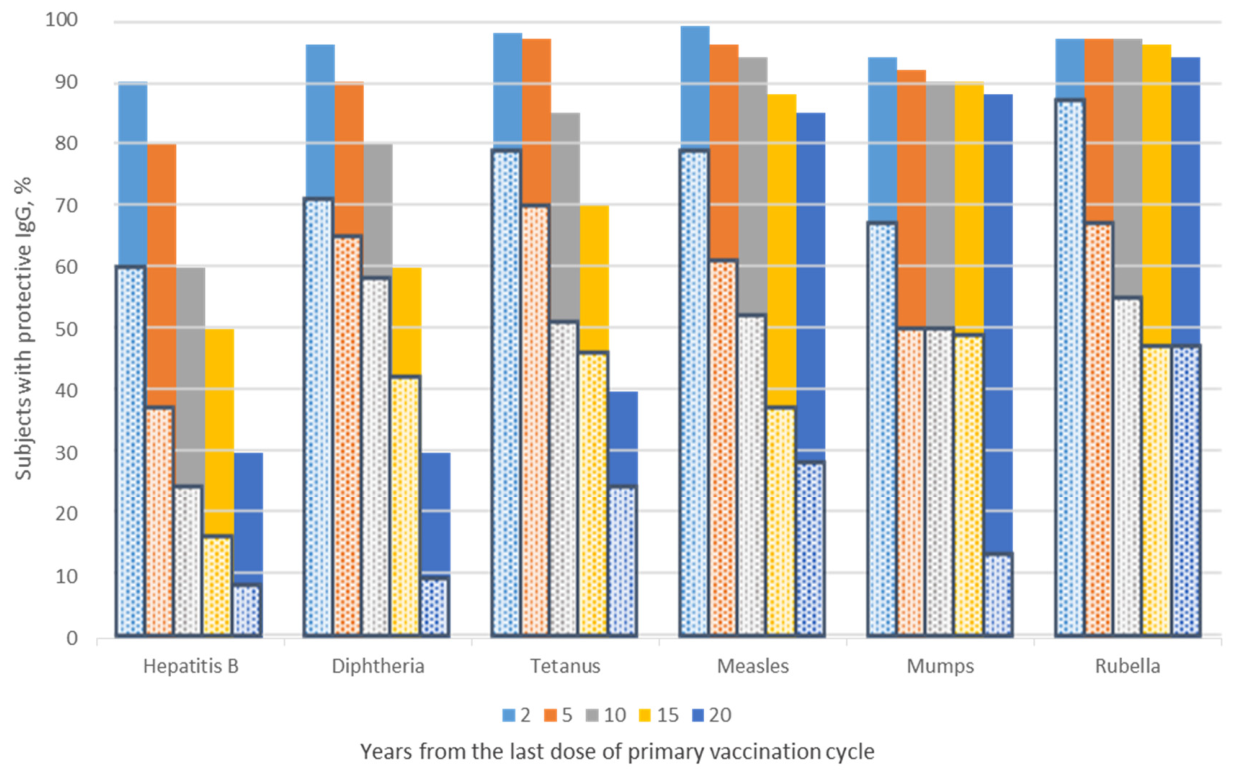
Figure 2.
Additional questions from the laboratory, preclinical testing, clinics and from lay people audience to be addressed by HIV-1 vaccine researchers.
Figure 2.
Additional questions from the laboratory, preclinical testing, clinics and from lay people audience to be addressed by HIV-1 vaccine researchers.
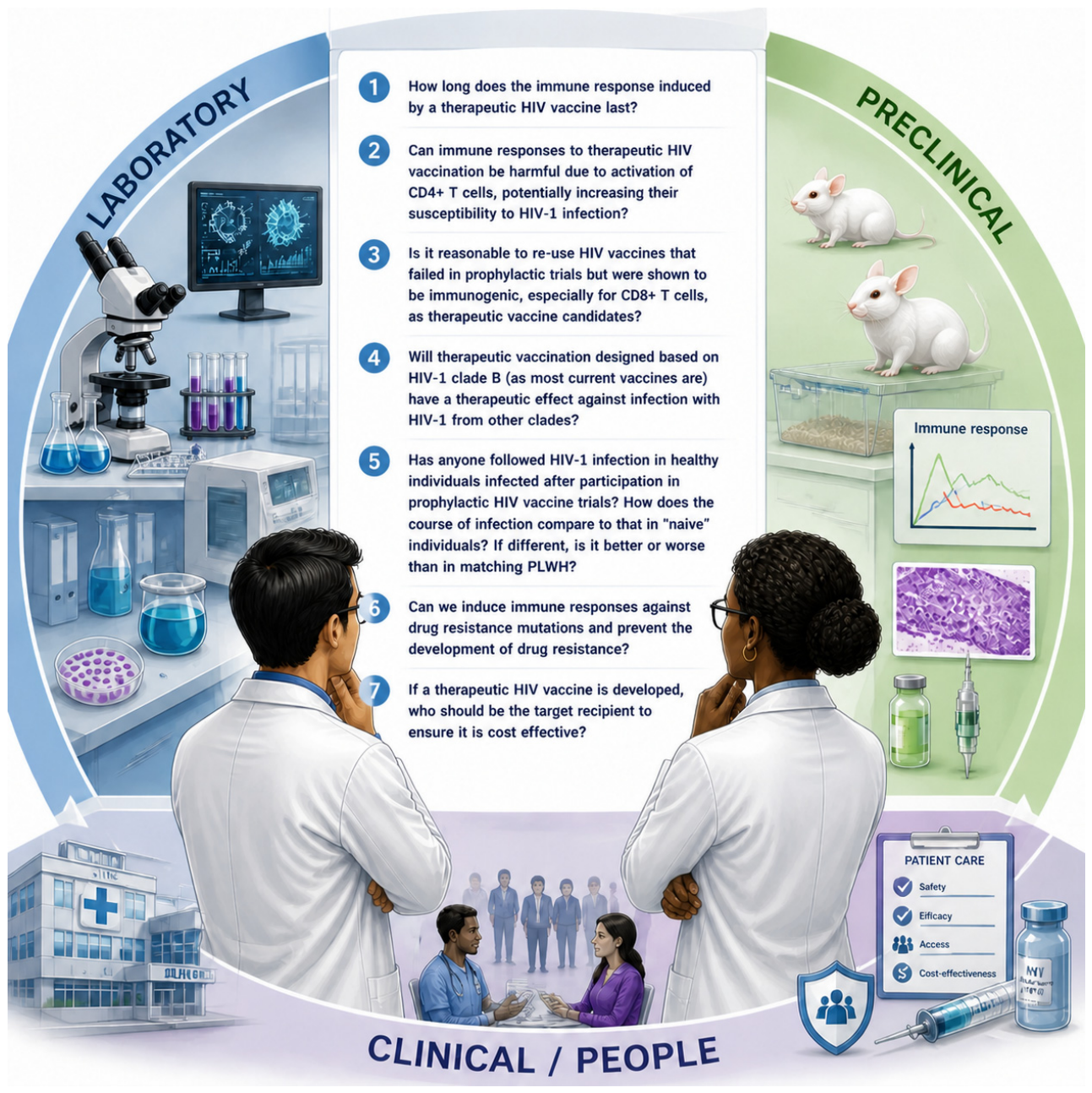

Table 1.
Representative examples of T-cell epitope based immunogens successfully moved into clinical trials. This table presents examples of each approach with NCT numbers.
Table 1.
Representative examples of T-cell epitope based immunogens successfully moved into clinical trials. This table presents examples of each approach with NCT numbers.
| No. | Abbreviation | Immunogen | Platforms used | Trial registry identifier | Phase |
| 1 | HIVconsv | 14 highly conserved cross-clade regions presented by many distinct HLAs encoding 778 amino acids | MVA ChAd |
NCT02336074 (RIVER) NCT01024842 NCT01712425 (BCN01) NCT02616874 (BCN02) |
Phase II Phase I Phase I Phase I |
| 2 | tHIVconsvX | Bivalent complementary mosaic immunogens containing 6 protective conserved fragments encoding 895 amino acids with maximum number of potential T-cell epitopes | MVA | NCT03844386 | Phase I |
| 3 | LIPO-5 | Five HIV-1 peptides containing multiple CD8+ and CD4+ T-cell epitopes and coupled to a palmitoyl tail |
Ex vivo-generated dendritic cells (DCs) loaded with LIPO-5 Peptide mix |
NCT00796770 NCT01492985 |
Phase I/II Phase II |
| 4 | AFO-18 | Peptides containing 15 subdominant conserved CTL epitopes bound to the HLA supertype + 2 T-helper peptide and 1 universal T-helper peptide | Peptide mix | NCT01141205 | Phase I |
| 5 | HIV-v | Peptides containing short, conserved T-cell multiepitope domains | Peptide mix | NCT01071031 | Phase Ib |
| 6 | HTI | 16 regions containing more than 50 CD4+ and CD8+ T-cell potentially beneficial and mutational intolerant epitopes restricted by broad HLA-I and HLA-II joined by poly-alanine enriched linkers encoding 529 amino acids; Gag and Pol peptides containing ultra-conserved elements included at least 5 potential T-cell epitopes | mRNA DNA MVA ChAdOx |
NCT02413645 NCT02888756 NCT03619278 (HIVACAR) NCT03204617 (AELIX-002) NCT04364035 (AELIX-003) NCT05208125 (BCN03) |
Phase I Phase IIa Phase I/IIa Phase I Phase II Phase I |
| 7 | Vacc-4x | Conserved regions from p24 | Peptide mix | NCT00659789 NCT01473810 NCT01704781 NCT02092116 |
Phase II Phase I/II Phase I/IIa Phase I/IIa |
| 8 | p24CE1/2 | Seven highly conserved elements of p24 associated with viremia control | DNA | NCT03560258 NCT04357821 |
Phase I/II Phase I/II |
Table 2.
Approaches to Antibody-Based Therapeutic HIV-1 Vaccination. This table presents examples of each approach, with references to the original articles or NCT numbers for studies that have not yet been published. AAV – adeno-associated virus vector; MPER – membrane-proximal external region; FP – fusion peptide.
| Method | Description | Design | Stage/Phase of trials | References | |
| Passive | bNAbs therapy | Single bNAbs or bNAbs combination infused as a drug | Isolated Abs with broad neutralizing capacity | Phase II | [152,167] |
| In vivo expression of broadly neutralizing antibodies | Genes coding for single bNAbs or bNAbs combination cloned into AAV and introduced as injections | AAV coding for single or combination of bNAbs | Phase I | [161,162] | |
| Ex vivo B cells gene therapy, aiming to force them to express bNAbs | Preclinical | [163] | |||
| Active | Specific design of synthetic immunogen | Synthetic immunogens designed to induce bNAbs represent regions of virus crucial for antibody binding with subsequent neutralization, normally masked by the virus. | Conserved epitopes, such as CD4 T-helper, V3 loop, 2F5/4E10/10E8 variants, combined into a single multiepitope construct |
Preclinical | [168] |
| FP-scaffold vaccines targeting FP | Preclinical | [169,170] | |||
| Vaccine targeting HIV-1 gp41 MPER. | Phase I | [171] | |||
| B-cell lineage vaccine | Multi-stage approach designed to guide the maturation of rare antibody precursors into potent bNAbs. Includes series of immunizations using Env immunogens with design guided by the longitudinal analyses of bNAb development in PLWH, where the priming immunogen exhibits affinity for the unmutated common ancestor of the bNAb lineage. This prime is followed by boosts with Envs specifically selected to stimulate somatic mutation pathways which give rise to bNAbs. | Liposomes loaded with HIV-1 gp41-derived peptide representing the membrane-proximal external region (MPER) targeting B cell lineages. | Phase I | [171] (see also errata in [172]), [173] | |
| Germline-targeting vaccines | Mimics the process of bNAb induction. Extensively modified forms of HIV-1 Env immunogen prime naive B cells including ones with the capacity to produce bNAbs, the process dubbed “germline-targeting”. B cells are subsequently exposed to “shaping” immunogens mimicking the wild-type Env | Self-assembling nanoparticle presenting 60 copies of an HIV-1 gp120 engineered outer domain, genetically fused to and arrayed externally on an interior lumazine synthase nanoparticle, version 8 (eOD-GT8) | Phase I | [166] | |
| BG505 SOSIP germline trimer 1.1 (BG505 SOSIP.v4.1-GT1.1) | Phase I (NCT04224701) | ||||
| 426c.TM4ΔV1-3 (or 426c.Mod.Core, Env derived from HIV-1 Clade C 426c strain with deletion of variable loops V1, V2, and V3 (ΔV1-3)) | Preclinical | [174] | |||
| Protein germline-targeting vaccine N332-GT5 contains 20 engineered mutations (germline-targeting mutations) to enable binding to diverse BG18-class precursors. And its further mutated versions | Preclinical | [165] |
Table 3.
Experience with the application of childhood/adult immunization schedule vaccines in PLWH [193,194,195]. Ab – antibodies; GMT – geometric mean titers.
| Viral infection | Application in PLWH | Limitations | Effect on CD4(+) cell count/HIV-1 viral blips | Use of adjuvants | Longevity of immune response | Level of immune response | Additional dose/boosting recommendations | Comments on clinical trials |
| Hepatitis B | Yes | In case of low CD4(+) T cell count or detectable HIV-1 RNA suppression of viremia recommended before repeating the vaccine series [196] | Viral blips reported [197], but no effect on total HIV-1 DNA or reservoir [198] | Novel adjuvants recommended [196,199] | Diminishing faster than in healthy population [199,200] | Suboptimal seroconversion 34-88% after standard scheme (about 95% in healthy population) [200] | Double-dose, second vaccine series or additional boosting recommended [196,199,200,201] | |
| Hepatitis A | Yes | Control on HIV-1 viremia [200]. | Viral blips reported, higher for HAV+HBV combined vaccine than for HAV vaccine alone [197] | Up to 10 years [200,202]. No data on longer period. | Decreased seroconversion (48-93%) and Ab titers compared to healthy population [200] | Additional boost recommended [200] | Undetectable viral load and normal CD4 count are important for immunization outcome [200]. | |
| Human papilloma virus | Yes | CD4 count ≤500 cells/μL associated with decreased immunogenicity [203]. | No differences were induced by vaccination [204] | 100% seroconversion [204]. Ab GMT lower than in health population [205] | Additional boost are currently recommended for HIV infected children, necessity of these extra boosts will be confirmed in a clinical trial [206]. | There was a trend towards decreased HPV vaccine efficacy in studies that included enrollees with a history of AIDS or AIDS-defining illness [205] | ||
| MMR (Measles morbillivirus, Mumps, Rubella) |
Yes | Not recommended to use in PLWH with CD4 T cell count <200 cells/mm3 | No differences were induced by vaccination [207] | Rapid decline of measles Ab 1 year after vaccination compared to healthy population [208]. Sharp decline of all Ab at 5 to 10 years after childhood vaccination [209] | Measles and rubella seroconversion did not differ between PLWH and healthy population [208,210]. Seroconversion rate for mumps reported to be lower in PLWH [210]. | Revaccination recommended for those at risk because of an outbreak [211]. | ||
| Influenza | Yes, but live attenuated vaccines are not allowed regardless of CD4 T cell counts | No differences were induced by vaccination [212,213] | MF59-adjuvanted vaccine boosters recommended [212]. | Immune response slightly lower than in uninfected population [214]. | Increasing single vaccine dose or additional boosts recommended [212] | |||
| SARS-CoV-2 | Yes | Temporal increased in CD4(+) cell count reported with no effects on HIV-1 viral load [215] | Seroconversion rate was slightly lower in PLWH than in healthy individuals [216,217]. | Additional booster vaccination required [216,217]. | A review of the trials of eight mRNA-based COVID-19 vaccines in PLWH demonstrated a strong humoral response after the third dose, annihilating difference between PLWH and healthy controls [218]. Third vaccine dose in PLWH improved also cellular response to vaccination, although in PLWH it was still weaker than in uninfected controls, specifically if PLWH had low CD4+ T-cell counts at the time of vaccination [218]. |
Disclaimer/Publisher’s Note: The statements, opinions and data contained in all publications are solely those of the individual author(s) and contributor(s) and not of MDPI and/or the editor(s). MDPI and/or the editor(s) disclaim responsibility for any injury to people or property resulting from any ideas, methods, instructions or products referred to in the content. |
© 2026 by the authors. Licensee MDPI, Basel, Switzerland. This article is an open access article distributed under the terms and conditions of the Creative Commons Attribution (CC BY) license (http://creativecommons.org/licenses/by/4.0/).
Copyright: This open access article is published under a Creative Commons CC BY 4.0 license, which permit the free download, distribution, and reuse, provided that the author and preprint are cited in any reuse.