

Submitted:
23 September 2026
Posted:
24 September 2026
You are already at the latest version
Abstract
The study considers the development of a nationally contextualized model of catastrophe risk insurance in the Republic of Tajikistan (RT) as an instrument for overcoming the insurance protection gap. The topic is relevant for RT due to high natural vulnerability, significant role of agriculture, hydropower and transport corridors, as well as the limited capacity of the national insurance market. Insurance protection against catastrophic risks cannot be reduced to a shortage of insurance lines, but has a complex institutional nature, encompassing legal, financial, informational, and behavioral constraints. The methodological basis is comparative institutional analysis. Tajikistan is considered as the main case, while China’s dirigiste model is used as a comparative reference point. The study also examines international approaches to managing natural disaster risks, parametric insurance, insurance pools, reinsurance, and public-private mechanisms for distributing catastrophic losses. Results. Reasonable solution for RT is not a universal insurance programme, but a hybrid multi-level system. The proposed model includes five interrelated elements: the state regulatory framework, a national insurance operator, a national insurance or reinsurance pool, a parametric level of insurance protection, and limited compulsory liability insurance in high-risk segments. A special role is assigned to the State insurer “Tojiksugurta” as a potential institutional hub for launching pilot products, accumulating insurance statistics, and facilitating interaction with the state, policyholders, and international partners. The insurance protection gap in Tajikistan can be bridged only through a combination of insurance instruments, state regulation, subsidization, reinsurance, data infrastructure, social protection, and the phased implementation of pilot mechanisms.
Keywords:
insurance
; natural disaster risks
; technological risk
; Tajikistan
; China
; innovative insurance
; Tojiksugurta insurance operator
; state regulation
1. Introduction
In the twenty-first century, catastrophe risks are no longer confined to the sphere of response by emergency management authorities. The economic consequences of such risks are increasingly recognized as an independent issue that affects the financial stability of the state, households, and the business sector. Factors such as climate change, urbanization, the concentration of population and assets in highly vulnerable areas, the deterioration of infrastructure, and the growing complexity of industrial systems create the potential for a single natural or technological event to escalate into a systemic financial shock. For states with limited fiscal and insurance capacity, such a transformation poses heightened risks: the direct damage caused by a disaster is exacerbated by a range of adverse consequences, including loss of income, rising poverty levels, disruptions to transport connectivity, reduced investment attractiveness, and the need to reallocate budgetary expenditures in the post-crisis period. [1].
An analysis of global trends reveals that gaps in protection systems remain a critical issue even for countries with well-developed insurance markets. According to the Swiss Re Institute [2], global economic losses from catastrophes amounted to USD 318 billion in 2024. At the same time, in the United States, insurance covered approximately 43% of these losses. This suggests that a significant portion of catastrophic damage still falls outside the scope of insurance mechanisms, even on a global scale. In the context of Tajikistan, where the insurance market has yet to reach a high level of development, this highlights the need not only to expand the range of voluntary insurance products but also to develop an institutional model that combines state participation, the functions of a national operator, mechanisms for establishing a specialized pool or reserve, and reinsurance instruments.
The Republic of Tajikistan is particularly vulnerable to catastrophe risks. The country’s geographical structure predisposes it to heightened exposure to natural hazards such as earthquakes, floods, mudflows, landslides, and avalanches. Its economic structure further exacerbates dependence on natural and climatic factors due to the significant role of agriculture, hydropower, and transport corridors. Meanwhile, the current institutional framework of the insurance market does not offer an adequate level of financial protection. According to the World Bank, Tajikistan is situated in a high-risk zone for floods, earthquakes, and landslides, and projected climate-related damage could result in a 5.6% decline in real GDP by 2050. The Vakhsh River basin is of particular importance, as it accounts for a substantial share of the country’s electricity generation; this transforms climatic and hydrological risks from an environmental issue into a category of macroeconomic threats [3].
It should be emphasized that catastrophe risks in Tajikistan are systemic rather than isolated. According to the results of the Subnational INFORM model assessment, the country exhibits the highest aggregate level of risk among Central Asian states: all administrative regions are classified as high-risk territories, with the greatest vulnerability observed in the Gorno-Badakhshan Autonomous Region, certain districts of republican subordination, and rural areas. Statistical data for the period 1997–2017 record approximately 150 natural disasters annually. Such a concentration of natural hazards indicates that catastrophe risk insurance cannot function as an optional financial product; it must be integrated into the national system of resilience, emergency management, and household protection [4]. At the same time, at the regional level, the problem manifests itself as a gap between expected catastrophe losses and the available instruments for financing them. According to World Bank estimates, annual losses from earthquakes and floods in Central Asia amount to billions of dollars, while the level of development of insurance markets remains insufficient. For Tajikistan, the amount of financing required to cover the consequences of disasters may exceed USD 400 million per year and, in the case of major catastrophes, may reach USD 1.5 billion [3]. Thus, the issue lies not only in the shortage of insurance products, but also in the absence of a fully developed integrated system of financial management for catastrophe risks.
The core scientific problem is that a substantial body of international academic literature [5,6,7,8] proposes universal instruments for managing catastrophe risks, such as catastrophe bonds, parametric insurance, insurance pools, public–private partnerships, and compulsory liability insurance. However, the effectiveness of these instruments depends significantly on the state of the institutional environment. Where the actuarial base is underdeveloped, public trust in insurance mechanisms is relatively low, effective demand is limited, reinsurance mechanisms are unstable, and the supervisory system is imperfect [3], directly copying foreign models may prove ineffective and may lead to formal imitation rather than a reduction in the insurance protection gap. Thus, Tajikistan does not need a mechanical borrowing of foreign practices; it needs a nationally contextualized model that integrates state participation, market incentives, and the function of a national insurance operator.
When developing a new model, it is appropriate to rely on accumulated international experience; however, its adaptation must take into account a fundamental consideration: catastrophe risk insurance should not be transformed into a mechanism of passive compensation for damage. If the insurance model is not linked to measures aimed at preventing and reducing risks, there is a danger of entrenching dependence on insurance payouts while failing to create incentives to improve the resilience of infrastructure facilities and the population. Studies on flood insurance practices in developing countries demonstrate that the potential of insurance as an adaptation instrument is realized only when risk transfer is combined with active risk reduction [9]. For Tajikistan, this implies the need to align insurance products with requirements for compliance with minimum safety standards, consideration of the actual condition of insured objects, the introduction of risk engineering elements, and the promotion of preventive measures.
This study aims to develop a nationally contextualized model of catastrophe risk insurance for the Republic of Tajikistan that is designed to close the insurance protection gap and is tailored to the country’s institutional, economic, and geographical conditions.
To achieve this purpose, the study pursues the following objectives:
- to analyze and systematize international models of catastrophe risk insurance;
- to identify the key natural, technological, and institutional risks specific to Tajikistan;
- to determine which elements of the Chinese state-directed (dirigiste) model are applicable in the context of the Republic of Tajikistan;
- to substantiate the functional role of the national insurance operator within the emerging system;
- to formulate a formalized institutional architecture for implementing the model and to develop a phased set of practical measures for its implementation.
The scientific novelty of the study lies in the transition from the analysis of individual insurance instruments to the development of an integrated institutional configuration. The proposed model combines five core elements — state regulation, a national insurance operator, a national insurance or reinsurance pool, a parametric level of protection, and limited compulsory liability insurance — with cross-cutting conditions such as subsidization, reinsurance, data infrastructure, social protection, communication, and state risk financing. At the same time, its central principle is not the maximum expansion of the role of the state, but the rational distribution of functions among the state framework, the national insurer, private insurers, policyholders, reinsurers, and international financial institutions.
The practical significance of the study is determined by the possibility of applying its results in shaping the strategy for the development of the insurance market, designing programmes to ensure financial resilience to disasters, creating pilot parametric insurance products, introducing mechanisms of compulsory liability insurance for hazardous facilities, and establishing interaction between the national insurer, government authorities, and international partners.
The political and institutional significance of the model lies in interpreting catastrophe risk insurance as an element of national resilience, social protection, and economic security, rather than as a narrowly commercial product.
The existence in Tajikistan of a strategic framework of state policy in the field of disaster risk reduction provides a key basis for developing a nationally contextualized model of catastrophe risk insurance. According to the provisions of the National Strategy of the Republic of Tajikistan for Disaster Risk Reduction for 2019–2030, the country’s territory is exposed to significant natural and other disasters that cause human losses, destruction of infrastructure, and long-term constraints on socio-economic development [10].
At the same time, this national framework was not formed in isolation, but in line with a broader international agenda set by the Sendai Framework for Disaster Risk Reduction 2015–2030, adopted by the UN Member States [11]. The significance of this document for the present study lies primarily in the fact that it established a fundamental shift from responding to the consequences of disasters toward risk management and prevention. Accordingly, catastrophe risk insurance should be considered not only as a mechanism for compensating damage after an event, but also as part of a broader system of ex ante financial preparedness, vulnerability reduction, and resilience-building.
From this perspective, the four applied priorities of the Sendai Framework are particularly important: understanding disaster risk, strengthening the institutional frameworks for risk governance, investing in resilience, and the principle of Build Back Better, which implies recovery after disasters on a safer and more sustainable basis. These priorities are directly aligned with the logic of the proposed model, since it also relies on the development of risk and loss data, institutional coordination, ex ante risk financing, the protection of critical infrastructure, and the promotion of preventive measures.
Within this logic, the proposed insurance model should not be viewed as an external financial add-on to Tajikistan’s state policy. On the contrary, it can be integrated into the existing national disaster risk reduction agenda as an instrument of ex ante risk financing, the accumulation of loss data, the promotion of preventive measures, the protection of critical infrastructure, and the enhancement of the financial resilience of households, businesses, and the state.
Literature review. Contemporary literature [7,12,13] on catastrophe risk management demonstrates an evolution of approaches: from the analysis of ex post compensation to the concept of ex ante financial planning. The traditional model of state response to a disaster involved action only after its occurrence — the reallocation of budgetary funds, the mobilization of donor assistance, borrowing, or acceptance of uncompensated losses. Although this approach ensures political manageability in the short term, it adversely affects financial predictability and contributes to the growth of social vulnerability.
By contrast, the contemporary approach [5,7,14,15] to financing natural disaster risks is based on the advance formation of a set of instruments. It provides for the differentiated application of mechanisms depending on the scale and frequency of threats: reserves and preventive measures are used for frequently recurring events, insurance mechanisms for medium-scale shocks, and reinsurance instruments, state guarantees, international pools, and capital market instruments for rare but large-scale catastrophes.
Within the current academic debate, catastrophe risk insurance is increasingly interpreted not as an isolated financial product, but as an element of a multi-level risk management system [16]. A number of studies [17] focus directly on the Central Asian region, demonstrating the severity and breadth of the problem, including publications by the Asian Development Bank (ADB) and studies conducted within the framework of CAREC (Central Asia Regional Economic Cooperation). States are facing a growing level of risks while lacking sufficient financial mechanisms for response [18]. The solution is seen in regional cooperation and the creation of regional risk transfer mechanisms.
It should be noted that the literature also contains discussions on which insurance model is most suitable for Central Asian countries, with issues of sovereignty coming to the fore, which is particularly relevant for Tajikistan [19,20].
Such differentiation of instruments by risk level makes it possible to optimize the distribution of the financial burden: relatively small and frequent losses are covered by reserves, medium-scale losses by insurance, and extreme events by reinsurance mechanisms and other specialized instruments. This approach is particularly important for developing countries, where ex post budgetary compensation is often delayed and insufficient in scale. Under such conditions, advance risk financing can not only accelerate post-crisis recovery but also significantly reduce the burden on public finances [7]. This should be taken into account in the subsequent development and application of the model.
The key concept within the framework of the approach under consideration is the insurance protection gap. It reflects not only the quantitative difference between total economic damage and insured losses, but also a broader institutional gap, including such aspects as a shortage of relevant data, low demand for insurance services, distrust of insurance institutions, insufficient capitalization of insurers, weak development of the reinsurance segment, and a high dependence of the budget on post-event external assistance. In developing countries, this gap becomes particularly persistent. This is due to the fact that households and small enterprises often perceive the insurance premium not as an instrument for protecting future income, but as an additional financial burden comparable to a tax payment.
The insurance protection gap should be considered not merely as a technical indicator of low insurance coverage, but as an institutional indicator of society’s insufficient financial resilience to catastrophic events. In the international academic literature, this term is traditionally understood as the difference between total economic losses from catastrophes and the share of those losses compensated through insurance payouts. According to available estimates, a significant share of losses from natural disasters at the global level remains uninsured. This problem becomes particularly acute for countries with limited fiscal capacity and a high dependence of households on current income. Under such conditions, overcoming gaps in insurance protection requires not only expanding the range of available insurance products, but also developing new mechanisms of financial interaction among the state, insurers, reinsurers, and international institutions [21].
International models of catastrophe risk insurance may be conditionally classified into three main groups, which makes it possible to systematize approaches to managing such threats under different institutional consyect:
- The first is the market-based model, characteristic of countries with a developed insurance culture, deep capital markets, and a highly developed reinsurance segment. This model ensures flexibility and promotes the introduction of innovative insurance products. However, its effectiveness decreases significantly in relation to low-income social groups and high-risk territories, where tariff formation leads to socially unacceptable levels.
- The second type is the public-private partnership model. Within this model, the state assumes part of the catastrophic burden, reducing the financial pressure on the private sector, while insurance organizations perform the key functions of underwriting, policy servicing, and claims settlement. This approach makes it possible to balance market efficiency with elements of state support, increasing the accessibility of insurance under challenging environment.
- The third group is the dirigiste model, in which the state defines mandatory participation rules, establishes safety standards, and outlines the contours of responsibility for market participants. In this case, insurance ceases to be an exclusively commercial instrument and becomes integrated into the system of sectoral regulation, functioning as an element of state policy for risk management.
This typology highlights the dependence of model selection on the institutional environment and makes it possible to substantiate the need to adapt international experience to the specific conditions of individual countries, including Tajikistan. An analysis of the existing models is presented in the table below (Table 1):
As noted earlier, for the Republic of Tajikistan, the most promising approach is not the direct borrowing of any single foreign model, but the targeted combination of their key elements with due regard to national specificities. The market-based model serves as an important source of methodological principles, particularly approaches to risk assessment, tariff formation, and the organization of reinsurance. The public-private partnership (PPP) model is valuable as a mechanism for distributing the catastrophic burden among system participants, thereby increasing its resilience. The experience of the Chinese dirigiste model is of particular relevance for Tajikistan: it demonstrates the possibility of integrating insurance for technological and environmental risks into the system of industrial safety, compulsory liability insurance, and preventive control.
Within the Chinese experience, insurance performs three interrelated functions: it provides financial protection, stimulates the implementation of preventive measures, and facilitates risk redistribution through reinsurance mechanisms. This functional triad may serve as a theoretical foundation for developing a national model of catastrophe risk insurance for Tajikistan. The significance of the Chinese case is further reinforced by its focus on the close connection between insurance and state risk management policy. According to research findings, since 2007 China has operated a system of compulsory civil liability insurance for enterprises in high-risk sectors of the economy, including the oil and gas, chemical, and mining industries. The introduction of such insurance makes it possible not only to guarantee compensation payments to affected parties, but also to reduce the financial burden on the state budget, while simultaneously increasing the level of business responsibility for ensuring production safety [23]. For Tajikistan, this experience has practical value not as a ready-made regulatory model to be copied, but as an illustration of the effective combination of insurance mechanisms with instruments of preventive regulation [27] — an approach that can be adapted to national conditions, taking into account the country’s institutional, economic, and geographical characteristics.
Analysis of scientific studies on developing countries [28,29,30,31] confirms that the effectiveness of insurance solutions may be significantly limited by institutional barriers, even when these solutions are technically justified. The most significant constraints include: a lack of actuarial information, limited historical data, opacity of loss data, a low level of insurance culture, distrust of financial institutions, weak solvency of the population, dependence on external financing, and imperfections in the regulatory framework. In Tajikistan, these constraints are particularly acute due to geographical and socio-economic specificities. The mountainous terrain determines the uneven distribution of natural hazards and complicates the organization of insurance protection. The territorial dispersion of risk zones increases administrative and logistical costs. The high share of the rural population and the instability of household incomes further reduce demand for insurance products.
These factors create an institutional environment in which the direct copying of standard insurance models proves to be of limited effectiveness. This underscores the need to develop a catastrophe risk insurance model adapted to local context.
A separate body of scientific research is devoted to parametric insurance [32,33,34], which is distinguished by a specific mechanism for fulfilling insurance obligations. Its key advantage lies in linking insurance payouts to a predetermined objective index, such as the amount of precipitation, wind speed, water level, earthquake magnitude, or temperature anomalies. This approach makes it possible to significantly accelerate the payment process and reduce administrative costs, which is of particular importance in the contect of underdeveloped claims settlement infrastructure.
At the same time, the introduction of parametric insurance requires a reliable system for data collection and processing, as well as a high level of trust among market participants in the index being used. When the insured party actually suffers damage, but the recorded value of the index does not reach the established threshold, the so-called basis risk arises, that is, the risk of a mismatch between the insurance payout and actual losses. Taking these features into account, for the Republic of Tajikistan, parametric insurance should be considered as a pilot instrument rather than a universal substitute for traditional forms of insurance protection. This approach will make it possible to assess the practical effectiveness of the mechanism under local conditions, minimize potential risks, and determine the optimal areas of its application within the national system of catastrophe risk management.
The literature review makes it possible to identify a significant research gap in the study of catastrophe risk management in the Republic of Tajikistan. Existing studies demonstrate a fragmented approach to the issue: on the one hand, catastrophe risks are often analyzed exclusively as a problem of the natural and infrastructural vulnerability of the territory, while financial protection mechanisms remain outside the scope of consideration. On the other hand, the insurance sector is frequently examined in isolation, as an independent segment of the financial market, without being linked to specific catastrophe threats and their socio-economic consequences. In addition, when describing international models of catastrophe risk insurance, insufficient attention is paid to the issues of their institutional adaptation to the specific conditions of individual countries, including Tajikistan. As a result, the academic literature lacks an integrated approach that would simultaneously take into account the specific nature of catastrophe risks in the country, the potential of the insurance sector as an instrument of financial protection, and the possibilities for adapting foreign practices with due regard to national institutional, economic, and geographical characteristics.
The present article aims to address this gap by developing an integrated perspective on catastrophe risk management. The integration of these aspects will make it possible to create a theoretical and methodological basis for developing a nationally contextualized system of catastrophe risk insurance in the Republic of Tajikistan, ensuring a balanced combination of preventive measures, financial protection mechanisms, and adapted institutional solutions.
2. Materials and Methods
The study is conducted within the logic of qualitative comparative institutional analysis, since the organization of catastrophe risk insurance is determined not only by the technical parameters of the insurance product, but also by the state of the legal environment, the level of state participation, the availability of data, trust in insurance institutions, fiscal capacity, and the degree of development of reinsurance infrastructure [16,35]. In this regard, the subject of analysis is not individual insurance instruments as such, but the institutional conditions under which such instruments can be introduced and function sustainably.
The main empirical case of the study is the Republic of Tajikistan. The choice of this case is determined by the combination of high natural and technological vulnerability, significant dependence of the economy and population on climate-sensitive sectors, infrastructure risks, mountainous terrain, seismic activity, and the limited insurance capacity of the national market. Under these conditions, catastrophe risks create not only the problem of compensating damage after an event has occurred, but also a broader challenge for the financial resilience of the state, households, enterprises, and critical infrastructure facilities.
China is considered as the comparative case, since its experience demonstrates a developed practice of state involvement in regulating insurance for technological, industrial, environmental, and other socially significant risks. The Chinese model is of interest not as an object of direct borrowing, but as an example of a dirigiste institutional logic in which insurance is incorporated into the system of state risk management, supervision, prevention, responsibility of economic entities, and the development of specialized insurance products.
The research methodology is based on the sequential use of the results of the literature review and includes four stages:
- At the first stage, the catastrophe risks of the Republic of Tajikistan are mapped. Within this stage, natural hazards are identified, including earthquakes, floods, mudflows, landslides, avalanches, and climate-related extreme events; technological hazards associated with the condition of infrastructure, hydropower facilities, tailings storage facilities, and hazardous industrial facilities; the socio-economic consequences of catastrophes, including damage to households, enterprises, transport corridors, and public finances; as well as institutional constraints that hinder the formation of a sustainable system of insurance protection.
- At the second stage, the results of the comparative analysis of international models conducted in the literature review are used as an analytical framework for assessing the applicability of individual instruments to the conditions of Tajikistan. In other words, international models are not analyzed again, but are considered as an already established set of possible institutional solutions: market-based, public-private, dirigiste, parametric, and pool-based. Their elements are assessed through the prism of Tajikistan’s national constraints: limited insurance capacity, a weak actuarial base, the high social sensitivity of insurance tariffs, dependence on budgetary response, and the need for the participation of a national insurance operator.
- At the third stage, the Chinese model is compared with the institutional, financial, and social conditions of the Republic of Tajikistan. The purpose of this comparison is to identify elements that can be transferred into the national system without significant loss of functionality, elements that require adaptation, and elements whose direct borrowing appears inappropriate. Transferable elements may include the phased introduction of compulsory insurance in the riskiest sectors, the linkage of insurance with prevention and supervision, and the use of a national operator as the institutional centre of the model. Partially transferable elements include subsidy mechanisms, insurance pools, and parametric products, since their effectiveness depends on data quality, fiscal capacity, and reinsurance capacity. Elements of excessively rigid administrative regulation are not transferable in an unchanged form, as they may create high transaction costs and reduce the social acceptability of the insurance model.
- At the fourth stage, a hybrid institutional model of catastrophe risk insurance for Tajikistan is developed. It is based on a combination of state regulation, a national insurance operator, an insurance pool or reserve, an external reinsurance framework, and a system of data on risks and losses. Within the model, the key parameters are formalized: aggregate risk, insurance premium, subsidy coefficient, the share of risk transferred to reinsurance, and the condition for system sustainability. Such formalization makes it possible to show that the proposed model is not limited to the introduction of a single insurance product, but represents an institutional system for distributing risk among policyholders, the national insurer, the state, and external risk-financing mechanisms.
The criteria for analysis in the study are defined as follows. The first criterion is institutional feasibility, that is, the possibility of introducing the instrument within the existing legal, administrative, and organizational environment without excessive transaction costs. The second criterion is financial sustainability, reflecting the ability of the instrument to reduce unpredictable pressure on the budget and to form a pre-defined payout mechanism. The third criterion is social acceptability, which involves assessing the affordability of the insurance premium for households, farmers, enterprises, and other groups of policyholders. The fourth criterion is information availability, that is, the presence of data required for tariff setting, underwriting, claims settlement, actuarial calculations, and reinsurance. The fifth criterion is scalability, showing whether a pilot insurance product or institutional mechanism can be expanded to other regions, sectors, and risk groups.
The analysis of the role of the national insurance operator is of particular importance in the study. Under conditions of limited development of the private insurance sector and an insufficient actuarial base, it is the national operator that may perform the functions of administrator of pilot products, risk aggregator, centre for accumulating insurance statistics, interface for interaction with the state, and potential participant in the national pool. At the same time, such centralization requires a separate supervisory framework, since the strengthening of the role of a single institutional actor must be accompanied by requirements for capital, transparency, reinsurance protection, stress testing, and the separation of commercial, social, and quasi-budgetary functions.
The limitations of the study are related to the incompleteness of open data on Tajikistan’s insurance market, insufficient detail in loss data by individual types of catastrophes, differences in the languages of sources, limited availability of actuarial statistics, and the absence of a full-fledged empirical base on demand for catastrophe insurance among households, farmers, and enterprises. These limitations do not reduce the significance of the results obtained, but they determine the nature of the proposed model: it is institutional and conceptual in character and is intended for further quantitative calibration based on data from the regulator, insurers, relevant ministries, emergency management authorities, and international partners.
Thus, the chosen methodology makes it possible to move consistently from the international models of catastrophe risk insurance already examined in the literature to an assessment of their applicability in the context of Tajikistan. The subsequent analysis focuses on comparing the Tajik institutional context with the Chinese dirigiste model and on developing a nationally contextualized hybrid model. This logic avoids duplication of the literature review and ensures a transition from the theoretical framework to the applied result of the study.
The choice of comparative institutional analysis as the methodological basis of the study is determined by the complex nature of catastrophe risk insurance. Its effectiveness depends not only on the technical possibility of calculating an insurance premium, but also on a number of institutional factors: the quality of law enforcement, the level of trust in insurance organizations, the availability of relevant data, the state’s capacity to subsidize socially significant insurance products, and the presence of a developed reinsurance infrastructure. In this regard, the study compares not individual insurance products, but integrated institutional configurations — market-based, public-private, and dirigiste models. This approach makes it possible to objectively assess the potential for transferring foreign experience to the specifics of the Republic of Tajikistan: to identify those elements that can be introduced without compromising the functional sustainability of the system, and to determine the aspects that require substantial adaptation to the national institutional, economic, and socio-political context [6,7,9].
In the context of developing a nationally contextualized model of catastrophe risk insurance, it is critically important to take into account not only the range of potential insurance instruments, but also the actual institutional structure of the insurance market of the Republic of Tajikistan. In this regard, the presence of a national insurance operator with the necessary territorial presence and accumulated experience in working with various types of insurance is of particular importance.
The State Unitary Enterprise “Tojiksugurta” has a network of 65 branches and 4 representative offices deployed in the cities and districts of the republic, and provides services across 22 types of insurance [36]. At the same time, the existing infrastructure in itself does not indicate readiness for the full-scale implementation of catastrophe risk insurance. Such insurance products impose increased requirements for the availability of an actuarial base, specialized loss data, reliable reinsurance protection, tested methods for assessing accumulated risk, and coordinated state participation. Nevertheless, the presence of an organization with an already established territorial network creates an important prerequisite for the phased introduction of pilot insurance mechanisms. Such a structure makes it possible to organize the collection of primary statistical information, establish communication with the population, and build effective interaction with the regulator.
The analysis of the role of the State Unitary Enterprise “Tojiksugurta” in this context makes it possible to correlate the proposed model not with an abstract construction of the insurance market, but with an actually existing institutional base. Provided that appropriate regulatory framework, reinsurance support, and systematic development of the information base are ensured, this infrastructure may serve as a basis for the consistent expansion of catastrophe risk insurance protection across the territory of the Republic of Tajikistan.
3. Results
Risk mapping shows that Tajikistan’s catastrophe vulnerability is not one-dimensional, but multi-layered in nature. It is formed at the intersection of natural, technological, climatic, infrastructural, financial, and socio-demographic factors, which together increase the potential scale of losses and complicate the construction of insurance protection. In this sense, catastrophe risk insurance for Tajikistan cannot be considered only as a mechanism for compensation after the occurrence of a single event; it must be embedded in a broader resilience management system that includes loss prevention, financial preparedness, household protection, and the preservation of the functioning of critical infrastructure [37].
The primary layer of vulnerability is formed by natural hazards. Tajikistan is characterized by earthquakes, floods, mudflows, landslides, avalanches, and other hazardous natural processes, whose regularity and spatial concentration are largely determined by the country’s mountainous terrain, seismic activity, and hydrological features. Topography intensifies the concentration of risks along river basins, mountain slopes, and transport corridors, where even a local event may produce consequences extending beyond the immediate affected area. Therefore, natural risk in Tajikistan manifests itself not only as the probability of physical destruction, but also as a factor disrupting territorial connectivity, access to services, markets, and sources of income.
The transport sector is particularly illustrative in this regard. Disasters affecting the road network generate not only direct repair costs associated with the restoration of damaged sections, bridges, slopes, and protective structures, but also significant indirect losses. These include delays in transport flows, increased logistics costs, disrupted access to markets, medical and educational services, the temporary isolation of settlements, reduced incomes, and deteriorating living level for remote communities [37]. In the World Bank’s assessment of Tajikistan’s key transport corridors, infrastructure damage and repair, search and rescue operations, human losses, disruption of transport movement, and community isolation are identified as separate categories of damage. According to the estimates, total annual economic losses from disasters affecting the road network may reach hundreds of millions of somoni and amount to about 0.5% of GDP per year. This makes it possible to consider transport corridors as one of the priority segments for pilot catastrophe risk insurance, since the protection of such facilities has not only property-related, but also broader economic significance.
The second layer of vulnerability is associated with technological and infrastructural risks. For Tajikistan, this layer is particularly important, since natural and technological hazards often interact with one another. An earthquake, flood, mudflow, or landslide may damage transport, energy, utility, or industrial infrastructure; trigger accidents, pollution, production shutdowns, power supply disruptions, or interruptions in access to basic services [3]. Hydropower facilities, tailings storage facilities, hazardous industrial facilities, and utility systems require particular attention, since damage in these segments may take on a cascading character. Therefore, the national insurance model should not be limited to traditional natural disaster insurance; it should take into account natural-technological chains of loss, in which a primary natural event triggers secondary financial, environmental, and social consequences.
The climate dimension further amplifies both natural and technological risks. In its Country Climate and Development Report on Tajikistan [3], the World Bank highlights the significant importance of droughts, floods, landslides, extreme heat, air pollution, and other climate-related hazards. Climate change increases uncertainty regarding the hydrological regime, the seasonal distribution of water resources, the intensity of precipitation, and the frequency of extreme events. In the long term, these changes may affect infrastructure, agriculture, livestock production, labour productivity, and overall macroeconomic performance. Consequently, climate risk should not be regarded as an external addition to catastrophe risks, but rather as a factor that reshapes their frequency, severity, geographical distribution, and financial assessment.
At the same time, climate and catastrophe risks have a pronounced distributional effect. They have a stronger impact on rural households, families with low-income diversification, women, children, persons with disabilities, and population groups with limited access to infrastructure, savings, and formal financial instruments. For such groups, disaster-related damage is not limited to the loss of property: it may take the form of reduced income, increased debt burden, deteriorating access to education and healthcare, and a longer recovery period after an emergency. This means that catastrophe risk insurance should be linked not only to the restoration of physical assets, but also to the task of maintaining social resilience.
The vulnerability of children and families to climate and catastrophe risks requires separate attention. According to estimates presented in the UNICEF, IFRC, and NORCAP [4] study on shock-responsive social protection in Central Asia, in Tajikistan 3.9 million children are exposed to air pollution, 2.8 million to extreme heat, 2.7 million to water scarcity, and 1.6 million children are located in areas of increased risk of climate-related disasters. These data show that catastrophe risks have not only an infrastructural and fiscal dimension, but also a socio-demographic one. Consequently, the insurance model should take into account the protection of households, the preservation of a minimum level of income, and the prevention of further deepening of poverty after emergencies.
The financial layer of vulnerability is manifested in the fact that catastrophe and climate risks are significant not only for insurance companies, but also for the banking and microfinance sectors. According to the CCDR [3] on Tajikistan, financial sector assets amount to approximately 30% of GDP, the lowest level in Central Asia, while the credit market remains limited and concentrated. At the same time, agriculture, industry, construction, and transport are among the sectors most sensitive to climate risks and simultaneously account for a significant share of credit exposure. Microcredit deposit-taking institutions operating in regions highly sensitive to climate change are particularly vulnerable. Under these conditions, catastrophe risk insurance can perform not only a compensatory function, but also a stabilizing role for the financial system by reducing the likelihood of a simultaneous deterioration in asset quality after major disasters.
Thus, the results of the mapping show that Tajikistan’s catastrophe vulnerability is formed not by isolated threats, but by their mutual overlap. Natural risks are amplified by climate change; infrastructural and technological risks acquire a cascading character; transport disruptions are transformed into income losses and reduced access to basic services; social vulnerability increases the duration of recovery; and the limited capacity of the financial and insurance markets complicates the advance distribution of losses. This is precisely why a nationally contextualized model of catastrophe risk insurance should be built as a hybrid system combining insurance products, state participation, data on risks and losses, reinsurance, social protection, and the priority protection of critical infrastructure.
The institutional constraints hindering the development of catastrophe risk insurance in Tajikistan are complex in nature and cannot be reduced to the absence of individual insurance products. They are formed at the intersection of legal, financial, informational, and behavioural factors, each of which in its own way limits the possibility of moving from ex post compensation for losses to an ex ante organized system of insurance protection.
The first group of constraints is related to the legal and regulatory environment [38]. General provisions of insurance legislation are not sufficient for forming a fully-fledged catastrophe insurance system: a specialized framework is required, defining the types of risks covered, compulsory or priority insurance segments, the procedure for state participation, subsidy conditions, requirements for insurance reserves, reinsurance rules, and the linkage between insurance mechanisms and the emergency management system. It is particularly important to align insurance rules with the regulation of industrial safety, environmental liability, critical infrastructure protection, and emergency management. Without such coordination, insurance may remain a formal financial instrument that is not embedded in the broader architecture of prevention, monitoring, and compensation for catastrophic damage.
The second group of barriers is financial in nature [39]. Catastrophe risk insurance requires sufficient capitalization of insurers, the availability of reinsurance protection, actuarially justified tariffs, and mechanisms for distributing losses among policyholders, the national insurer, the state, and the external reinsurance framework. Under conditions of limited insurance market capacity in Tajikistan, these requirements become particularly significant. On the one hand, excessively low tariffs may undermine the insurer’s sustainability and make the system incapable of making payouts after a major event. On the other hand, an economically justified insurance premium may prove socially sensitive for households, farmers, and small businesses. Therefore, the financial barrier manifests itself not only in the shortage of insurers’ capital, but also in the need to find a balance between the sustainability of the insurance system and the affordability of insurance protection for potential policyholders.
The third group of constraints relates to information and digital infrastructure [40]. Catastrophe insurance requires data not only on the occurrence of a disaster itself, but also on event frequency, the spatial concentration of risks, types of assets, the scale of losses, recovery costs, actual payouts, and the socio-economic vulnerability of affected groups. In Tajikistan, the problem lies in the gap between hazard data that may be used in the emergency management system and the data required for insurance modelling, tariff setting, underwriting, and reinsurance. Therefore, the development of catastrophe risk insurance requires the creation of a unified risk and loss database capable of linking information from government agencies, insurers, the regulator, meteorological services, emergency management authorities, and international partners.
The fourth group of barriers is behavioural and institutional-trust based in nature [29]. Even when insurance products are available, demand for them may remain limited if the population and enterprises do not trust insurers, do not understand coverage limits, are uncertain about the timeliness of payouts, or expect that the main assistance after a disaster will be provided by the state or international organizations. In this case, insurance is perceived not as a rational mechanism of ex ante protection, but as an additional expense with uncertain returns. This situation is particularly characteristic of markets where insurance culture is still emerging, and where experience with regular premium payments and transparent post-loss payouts remains insufficient.
Consequently, a key prerequisite for the development of catastrophe risk insurance is not only to strengthen the financial capacity of households and enterprises but also to build trust in the institutions responsible for risk management. Empirical studies show that households’ willingness to purchase natural disaster insurance depends on risk perception, previous experience of losses, awareness of insurance products, and trust in state and insurance institutions. For Tajikistan, this means that the expansion of insurance coverage cannot be achieved solely through the regulatory introduction of new products. Consistent institutional work is required: explaining insurance conditions, demonstrating successful payouts in pilot projects, ensuring transparent claims settlement, involving the national insurance operator in communication with the population, and creating a clear link between insurance, social protection, and the state emergency response system [29].
Thus, institutional barriers in Tajikistan are not isolated, but interrelated in nature. Insufficient legal certainty complicates the launch of compulsory or subsidized products; limited capitalization and reinsurance capacity increase the risk of the model’s financial instability; data shortages hinder tariff setting and actuarial calculations; and low trust limits demand even when a formal offer exists. Therefore, a nationally contextualized model of catastrophe risk insurance must simultaneously address four tasks: forming a legal framework, ensuring financial sustainability, developing data infrastructure, and gradually building trust in insurance as an instrument of ex ante protection, rather than only compensation after a disaster. All this information is summarized in the table below (Table 2):
It should be noted that the financial gap in catastrophe risk insurance is characterized by a dual nature. On the one hand, there is a low willingness among households and enterprises to pay for insurance services. On the other hand, the insurance sector faces increasing uncertainty, loss correlation, and a limited capacity to accumulate the capital required to cover large-scale catastrophic events.
The results of the review of studies on the impact of climate risks on the financial sector confirm that natural disasters and physical climate hazards can have a negative impact on key elements of the financial system: reducing the profitability of insurance organizations, undermining the stability of banks, destabilizing financial markets, and limiting the availability of credit resources [41]. In the context of the Republic of Tajikistan, the development of catastrophe risk insurance requires a comprehensive approach: it must be accompanied by targeted measures to strengthen the capital base of insurers, improve mechanisms of reinsurance protection, and introduce supervisory assessment of climate risks. This will make it possible to increase the resilience of the national insurance system to the impact of large-scale natural hazards.
At the same time, an analysis of the experience of developing countries shows that low levels of insurance market penetration cannot be attributed solely to supply shortages on the part of insurers [42]. Even in high-risk catastrophe environments, households often adopt a strategy of “zero insurance.” This occurs when the population distrusts insurance companies, has insufficient understanding of risk coverage mechanisms, doubts the timeliness of insurance payouts, or expects to receive state assistance after a natural disaster. Consequently, a catastrophe risk insurance market does not emerge automatically in an institutionally constrained environment. Its development requires a comprehensive approach that combines regulatory measures, subsidy mechanisms, targeted efforts to improve insurance literacy among the population, and a practical demonstration of the effectiveness of insurance mechanisms—in particular, through pilot programmes that provide visible evidence of successful insurance payouts.
The Experience of the Chinese Model of Catastrophe Risk Insurance. Comparison with the Chinese model makes it possible to clarify which elements of foreign experience can be used in developing a nationally contextualized system of catastrophe risk insurance in Tajikistan. The functional principles of the dirigiste approach are of greatest importance: the identification of priority insurance segments in areas associated with high societal losses, the integration of insurance with safety requirements, the use of tariff policy as an incentive for prevention, coordination between insurers and government authorities, and the systematic accumulation of data on risks, losses, payouts, and the condition of assets [23].
For Tajikistan, the phased introduction of insurance mechanisms in limited sectors of the economy appears to be the most applicable approach, particularly where potential damage extends beyond the interests of an individual enterprise and may affect the population, the environment, critical infrastructure, or public finances. Such segments may include hazardous industrial facilities, hydropower infrastructure, tailings storage facilities, and certain elements of transport and utility infrastructure. In this case, compulsory insurance functions not as a universal burden on businesses and the population, but as an element of risk-based regulation.
The additional significance of the Chinese experience lies in the fact that it demonstrates the connection between insurance and a broader risk management system. In China’s National Emergency Management System Plan for the 14th Five-Year Plan period, particular attention is paid to improving the legal and regulatory framework, strengthening supervision, monitoring and early warning, mapping risk zones, developing professional rescue forces, information systems, and technological support for emergency management [43]. Consequently, the effectiveness of insurance mechanisms increases when they are embedded in a framework of data, control, prevention, response, and recovery.
In this context, the experience of developing China’s liability insurance market is also important. The Lloyd’s report [44] on the Chinese liability market shows that the growth of this segment was associated not only with the expansion of insurance supply, but also with changes in the legal system, the increasing role of insurance as an instrument of social governance, the development of risk management, and the emergence of new product areas. For Tajikistan, this conclusion has practical significance, since liability insurance may become an intermediate link between narrow voluntary insurance and a full-fledged system of catastrophe risk financing. This primarily concerns liability insurance for hazardous industrial facilities, environmental risks, construction defects, infrastructure risks, and other socially significant areas.
Thus, the Chinese model is important for Tajikistan as a source of institutional solutions that can be used in forming a hybrid system of catastrophe risk insurance. The most promising elements are limited compulsory insurance in high-risk sectors, the linkage between insurance and prevention, the development of a risk database, the participation of a national insurance operator, the use of reinsurance, and the gradual expansion of insurance coverage through pilot mechanisms.
The results of the analysis show that, for Tajikistan, the most realistic direction of development is not the launch of a single universal insurance programme, but the formation of a multi-level system of insurance and risk financing. This is due to the fact that catastrophe risks differ in terms of frequency, scale of damage, range of affected actors, data requirements, and possibilities for insurance coverage. Consequently, an attempt to combine all threats within a single insurance product would be methodologically oversimplified and financially unsustainable. A more justified approach is one in which different types of risks are covered by different instruments, while their combination forms a unified institutional system.
- The first level of such a system may consist of micro- and meso-level products aimed at households, farmers, and small businesses. These include parametric or index-based insurance for agricultural risks, insurance for households in flood, mudflow, and landslide zones, as well as business interruption insurance for small enterprises after emergencies. These instruments make it possible to cover relatively localized and socially sensitive losses, but require subsidization, clear communication with the population, and the development of primary risk data.
- The second level should be linked to compulsory or quasi-compulsory liability insurance in the highest-risk sectors: hazardous industrial facilities, hydropower infrastructure, tailings storage facilities, and individual elements of transport, utility, and other critical infrastructure. Here, insurance performs not only a compensatory, but also a preventive function, since it can be linked to safety requirements, risk audits, and tariff differentiation.
- The third level involves the creation of a national insurance or reinsurance pool that accumulates part of the risks and distributes the burden among system participants. Such a pool is necessary because an individual insurer or a group of insurers cannot sustainably retain large catastrophe risks under conditions of limited national market capacity.
- Finally, the fourth level should include an external risk-financing framework: international reinsurance, credit lines, grant support, participation of international financial organizations, and, in the longer term, individual market instruments for covering extreme events. Such a multi-level architecture makes it possible to distinguish between frequent small losses, medium-scale risks, and rare catastrophic events requiring external financial capacity.
These levels describe the financial layering of catastrophe risks. They should not be confused with the five institutional elements of the proposed model, which define the actors, functions, and mechanisms required to operate this layered system.
In this system, the role of the national insurance operator acquires particular importance. In the case of Tajikistan, the State Unitary Enterprise “Tojiksugurta” may be considered not only in terms of its territorial network, but also as a potential institution of trust, coordination, and initial launch of pilot products. Under conditions of limited development of the insurance market, the national operator is capable of performing the functions of pilot administrator, centre for collecting insurance statistics, channel for distributing state subsidies, and participant in the formation of a national pool. However, this role must be institutionally transparent and limited: the task of the national operator is not to displace the private sector, but to create an infrastructural basis on which private insurers, reinsurers, government authorities, and international partners can participate in the distribution of catastrophe risks.
One of the key results of the analysis is the conclusion that insurance instruments need to be differentiated by type of risk. For frequent small-scale events, reserve mechanisms, microinsurance products, and local support programmes are more appropriate. For agricultural climate risks, index-based and parametric instruments based on pre-defined triggers are promising. For hazardous facilities and critical infrastructure, liability insurance with elements of compulsory coverage is appropriate. For transport and municipal infrastructure, public asset insurance programmes may be applied. For extreme earthquakes and other rare high-loss events, reinsurance, a national or regional pool, and international risk financing are required. Such differentiation makes it possible to avoid the mistake of a universal “all-catastrophe” policy and to move toward a more sustainable system in which each instrument corresponds to the nature of the risk covered.
Thus, the results of the study confirm the initial hypothesis: overcoming the insurance protection gap in Tajikistan is possible only through an institutionally adapted hybrid model. The market mechanism is necessary, since it is precisely this mechanism that ensures insurance discipline, tariff setting, risk distribution, and product development. However, under conditions of high catastrophe vulnerability and limited insurance capacity, it cannot be sufficient. State participation is also necessary, since without a legal framework, subsidization, data, supervision, and linkage with the disaster risk reduction strategy, the insurance system will not be able to become widespread and sustainable. At the same time, the state should not substitute for the insurance market, and the national operator should not turn into a monopolistic structure. The logic of the proposed approach lies in the distribution of functions and responsibilities among the state, the national insurer, private participants, reinsurers, international partners, and policyholders.
It is this conclusion that forms the transition to the discussion section of the article. If the results show which risks, barriers, and institutional prerequisites determine the specific features of Tajikistan, the subsequent discussion must answer the following question: how these elements can be assembled into a practically implementable model of catastrophe risk insurance. Therefore, what is proposed below is not a separate insurance product, but an institutional model in which legal regulation, the national operator, insurance products, the pool, reinsurance, subsidies, and data are combined into a unified system for the gradual overcoming of the insurance protection gap.
4. Discussion
The results of the analysis show that overcoming the insurance protection gap in Tajikistan cannot be ensured through a single universal insurance product or a simple expansion of voluntary insurance. Catastrophe risks in the country differ in nature, scale, and frequency of occurrence: some are associated with regular local events, others with infrastructural and natural-technological chains of loss, and still others with rare but potentially destructive catastrophes. Therefore, the proposed model should not be linear, but multi-level: it should distribute functions among the state, the national insurance operator, policyholders, the pool, reinsurers, and international partners (Figure 1).
It is precisely here that the national contextualization of the proposed approach becomes evident. It is expressed not in a rejection of international experience, but in its adaptation to the geographical, economic, institutional, and social conditions of Tajikistan. The geographical dimension is associated with mountainous terrain, seismicity, mudflow and landslide processes, dependence on river basins, and the high significance of transport corridors. The economic dimension is determined by the limited solvency of households, farmers, and small businesses, which does not allow the system to be built exclusively on actuarially full tariffs. The institutional dimension is linked to the limited capacity of the insurance market and the need for the participation of the state, the regulator, and the national insurance operator. Finally, the political and social dimension implies that catastrophe risk insurance should be perceived not as a narrow commercial product, but as an element of national resilience, population protection, and the preservation of the economic connectivity of territories.
The first element of the proposed model is the state framework, shown in Figure 1 within the regulatory and financial framework. Its main task is not to substitute for the insurance market and compensate all losses after a disaster occurs, but to create conditions for ex ante risk financing. To this end, the state should define priority segments of compulsory or subsidized insurance, establish data requirements, support the creation of risk maps, and ensure coordination among ministries, the regulator, insurers, and emergency management authorities. At the same time, state support should be targeted: subsidizing insurance premiums is justified for socially significant groups, pilot products, and markets that cannot yet emerge independently; however, it should not turn into uncontrolled budgetary coverage of commercial risks [45].
The second element is the national insurance operator, shown in Figure 1 within the operational insurance cycle. Under conditions of limited market development, its role may consist in the initial administration of pilot products, risk aggregation, accumulation of basic insurance statistics, participation in the formation of the pool, and communication with the population. In the case of Tajikistan, the State Unitary Enterprise “Tojiksugurta” may be considered one of the institutionally prepared participants in this process, since it already possesses a certain organizational infrastructure and may be used as a launch point for individual elements of the model. At the same time, this does not imply granting an exclusive privilege to a single company: it is more appropriate to view the national operator as an initial coordination hub, on the basis of which the participation of other insurers, reinsurers, and international partners may subsequently be expanded.
The data accumulation function is a cross-cutting condition of the model and is shown in Figure 1 as part of the operational insurance cycle. The National Disaster Risk Reduction Strategy provides for the creation of national and local databases for exchanging disaster-related information, including historical data, risk assessment results, warnings, information on consequences, assistance, and recovery. For the insurance model, this is of fundamental importance: without comparable data, it is impossible to properly assess event frequency, the scale of losses, the regional concentration of risks, premium levels, and reinsurance needs. Therefore, the insurance database should not be formed as a parallel closed system; it is more appropriate to consider it as a specialized financial and actuarial layer of the overall national disaster data infrastructure.
This approach is also consistent with Tajikistan’s need for higher-quality meteorological, hydrological, and climatological data required for early warning, risk management, and adaptation planning. For insurance, what matters is not only the fact that an event has occurred, but also the parameters of the insured object, the type of hazard, recurrence frequency, the amount of loss, payout conditions, recovery costs, and vulnerability factors. Within this logic, the national insurance operator may perform not only the function of selling policies or administering payouts, but also the function of an institutional hub for accumulating insurance statistics required for actuarial calculations, risk mapping, the development of parametric products, and subsequent access to reinsurance markets [10].
Another core element of the model is a national insurance or reinsurance pool (Figure 1) within the capitalization and reinsurance framework. Its purpose is to accumulate part of the premiums, aggregate risks, and distribute the burden among system participants. However, for a small economy, such a pool should not be regarded as a closed internal mechanism capable of retaining the full volume of catastrophic losses [5]. A more realistic approach is a phased logic of its formation: first, as an accounting and coordination mechanism for pilot products; then, as a reinsurance framework for individual insurance lines; and only after the accumulation of data and managerial experience, as a full-fledged stabilization instrument involving the state and international partners.
The need for an external framework is determined by the very nature of catastrophe risk. Losses from such events are distributed extremely unevenly over time: in ordinary years, the system may cope with the burden, but rare high-intensity events can sharply exceed the internal capacity of the national market [2]. Therefore, the sustainability of the model implies transferring part of the aggregated risk to an external framework — through reinsurance, regional or international pools, credit lines, grant mechanisms, and, in the long term, individual capital market instruments. In this sense, the national pool should retain the manageable share of risk, while transferring the catastrophic layer to the external risk-financing system [3].
The parametric level is an important product layer of the model. Although it is not shown in Figure 1 as a separate operational node, it is supported by the data, operator, and risk-financing flows presented in the model. For Tajikistan, it may be particularly promising in relation to droughts, floods, extreme precipitation, certain agricultural risks, and events that can be linked to objectively measurable triggers. The advantage of parametric insurance is that it reduces the dependence of payouts on lengthy individual loss assessment and makes it possible to define the compensation condition in advance: for example, the level of precipitation, a flood index, water level, earthquake magnitude, or another verifiable indicator. However, parametric products should not be considered a substitute for the entire insurance system. Their effectiveness depends on data quality, methodological transparency, minimization of basis risk, testing on historical data, and the availability of a mechanism for reviewing disputed cases. If these conditions are not met, basis risk may undermine trust in the instrument already at the pilot implementation stage [6].
In developing such products, it is important to take into account that the population of Tajikistan is generally not in a situation of complete unawareness of climate threats. According to a World Bank study, a significant share of respondents consider themselves well or sufficiently well informed about the possible consequences of climate change; among the most significant threats, they identified extremely hot and cold seasons, an increase in the number of natural disasters, and unpredictable weather conditions damaging agriculture. Consequently, insurance awareness-raising should be built not so much around explaining the very existence of risk, but around explaining the financial mechanisms of protection against already recognized threats: how the premium works, in which cases a payout is triggered, how a parametric product differs from compensation for actual damage, and why ex ante insurance reduces dependence on delayed post-disaster assistance [46].
The final element is compulsory or quasi-compulsory liability insurance in limited high-risk segments, which corresponds to the risk-exposed assets and liability-oriented part of the operational logic shown in Figure 1. The most justified areas for this approach are hazardous industrial facilities, hydropower infrastructure, waste storage facilities and tailings storage facilities, as well as construction and transport projects in high-risk zones. In these segments, potential damage may affect not only the owner of the facility, but also the population, the environment, infrastructure, and public finances. Therefore, liability insurance in this context can perform not only a compensatory, but also a preventive function, provided that it is linked to safety control, risk audits, and tariff differentiation. In other words, insurance should stimulate risk reduction rather than turn into an additional administrative burden on enterprises.
In simplified form, the logic of the model is as follows: the state defines the regulatory and subsidy framework; policyholders generate demand and provide data; the national operator aggregates risks, administers products, and maintains statistics; the pool distributes part of the risk; and the external framework of reinsurance and international financing covers extreme layers. This design makes it possible to avoid two extremes: full budgetary paternalism and the unrealistic belief that the private market will independently generate coverage under conditions of low solvency and weak insurance culture.
Taken together, the five institutional elements and their supporting mechanisms form a hybrid model in which each component has a distinct role. The state framework creates rules, subsidies, and coordination; the national operator ensures the launch of pilot products, data collection, and communication; the insurance pool accumulates and distributes part of the risks; the external reinsurance framework protects the system against peak losses; parametric products make it possible to respond quickly to certain types of climatic and natural events; and liability insurance creates a link between insurance protection and prevention in high-risk sectors. Such a model is not limited to a single instrument, but represents a system for distributing risk, responsibility, and financial burden among participants.
Consequently, the discussion contribution of the study lies in substantiating that, for Tajikistan, the most promising option is not a market-based, fully state-led, or purely dirigiste scheme (state-oriented), but an institutionally adapted hybrid model. Its task is to gradually reduce the insurance protection gap without undermining market incentives, while simultaneously taking into account limited insurance capacity, the social sensitivity of tariffs, data deficits, and the high importance of state coordination.
Formally, the model can be described through several key parameters. Let R(i) denote the risk of the i-th object or group of policyholders, L(i) – the potential loss, P(i) – the insurance premium, A the aggregate risk accumulated by the national operator or pool, α – the premium subsidy coefficient, β – the share of risk transferred to reinsurance, C – the system’s own capacity, and S – state support or reserve. Then risk aggregation is described as follows (Formula 1):
The premium taking subsidization into account may be defined as follows (Formula 2):
where f(R(i), L(i)) is the function for assessing risk and potential loss.
P(i) = (1 − α) * f(R(i),L(i)),
The retained share of risk is equal to (Formula 3):
A(ret) = (1 − β)A,
The share of risk transferred to reinsurance is defined as follows (Formula 4):
A(reret) = βA,
Then the condition for system sustainability takes the following form (Formula 5):
A(ret) ≤ C + S,
The meaning of Formula 5 is straightforward: the national system should not retain more risk than it is able to cover with its own capital and pre-defined support. At the same time, the formalization presented above does not claim to replace an actuarial model. Its task is to define the architecture of a managerial decision. If β is too low, the system retains excessive risk and becomes vulnerable to a major event. If α is too high, the system becomes fiscally dependent. If C does not grow together with A, the scaling of products increases, rather than reduces, systemic vulnerability. Consequently, the development of catastrophe risk insurance must be accompanied by the simultaneous growth of data, capital, reinsurance, and fiscal discipline.
The proposed institutional model should be considered as a system integrating four interrelated types of resilience:
- The first is fiscal resilience, implying the state’s ability to plan budgetary measures for responding to natural disasters in advance.
- The second is financial resilience, encompassing risk distribution mechanisms, insurance and reinsurance instruments, as well as the overall development of the insurance market.
- The third type is social resilience, which presupposes the interconnection between insurance protection, social assistance systems, and ensuring public access to basic infrastructure.
- The fourth is institutional resilience, expressed in the ability of government bodies, insurance organizations, and other system participants to adapt promptly to the consequences of a catastrophe and maintain continuity of functioning.
Such an integrated approach demonstrates that the proposed model is not limited to the introduction of a separate insurance product, but functions as an element of a broader system for ensuring national resilience, bringing together financial, social, and governance mechanisms for responding to catastrophe risks.
The practical implementation of the model should be phased. In the short term, it is necessary to establish a working group with the participation of the regulator, relevant ministries, “Tojiksugurta”, private insurers, and international partners; conduct a risk inventory; select pilot territories and products; and prepare basic rules for subsidization and reinsurance. In the medium term, a pilot parametric insurance scheme for agriculture and flood risks should be launched, compulsory elements of liability insurance for selected hazardous facilities should be introduced, a unified data platform should be created, and the formation of a pool should begin. In the long term, it may be possible to develop a regional Central Asian insurance mechanism, introduce CAT instruments, and integrate catastrophe insurance into climate budgeting. The roadmap for implementing the proposed model is presented below (Table 3):
It should be noted that the limitations of borrowing the Chinese model must be stated explicitly. China has an incomparably more capacious insurance market, a larger industrial scale, greater administrative resources, and more developed digital infrastructure. Therefore, for Tajikistan, an attempt to copy a rigid system of compulsory insurance in full is unacceptable. Only the principles are transferable: the priority of prevention, compulsory coverage for the most hazardous segments, tariff differentiation according to the level of safety, state-insurance coordination, data accumulation, and the development of reinsurance. These principles should be adapted through pilot programmes, regulatory experiments, and limited sectoral programmes.
The proposed model is both theoretical and applied in nature. Theoretically, it clarifies how a hybrid model of catastrophe risk insurance can be organized in a developing economy. Practically, it shows which institutions should participate, what functions they perform, which parameters determine the sustainability of the system, and what steps are necessary for the transition from fragmented insurance products to an integrated system of financial protection.
5. Conclusion
The study shows that Tajikistan’s insurance protection gap cannot be explained solely by an underdeveloped insurance market. Its causes are more complex and institutional: high natural and technological vulnerability, a limited actuarial base, fragmented risk and loss data, insufficient capitalization of insurers, weak financial capacity among many households and enterprises, and persistent reliance on ex post budgetary and donor response to emergencies. Addressing this gap therefore requires not a separate new product but a nationally contextualized institutional model that distributes risks, financial burdens, and responsibilities among the state, insurers, policyholders, reinsurers, and international partners.
International experience confirms that sustainable catastrophe insurance systems rely on risk layering. Frequent, relatively small events should be covered by reserves, microinsurance, social protection, and local support; medium-scale risks by insurance, subsidies, and pilot programmes; major catastrophes by national pools and reinsurance; and extreme shocks by international financial instruments, credit lines, grants, and external capital markets. This logic is especially important for Tajikistan, since a universal “all-catastrophe” insurance product would be methodologically oversimplified, financially unsustainable, and socially difficult to implement.
The comparative analysis shows that for Tajikistan the most promising option is a hybrid model combining market-based, state, and quasi-state elements. A market mechanism is essential, as it ensures insurance discipline, tariff setting, the distribution of responsibility, and the development of the product line. However, in case of high catastrophe vulnerability and limited insurance capacity, it cannot be sufficient. State participation is also necessary, since without a legal framework, subsidies, data, supervision, and alignment with the disaster risk reduction strategy, the insurance system cannot become widespread or sustainable. At the same time, the state should not replace the insurance market but should create conditions for its gradual development.
The proposed model comprises five interrelated elements: a state regulatory framework, a national insurance operator, a national insurance or reinsurance pool, a parametric layer of insurance protection, and limited compulsory liability insurance in high-risk segments. At the same time, data, reinsurance, blended financing, social protection, and public communication function not as independent elements of the model but as cross-cutting conditions for its sustainable operation.
The first element is a state regulatory framework, which provides legal framework, defines priority insurance segments, establishes subsidy rules, sets data requirements, ensures supervision, and supports coordination. The second element is a national insurance operator, which at the initial stage may serve as administrator of pilot programmes, risk aggregator, public communication channel, contributor to the development of insurance statistics, and facilitator of interaction among the state, policyholders, and international partners. In this context, the State Unitary Enterprise “Tojiksugurta” may be regarded as an institutionally prepared participant for launching the model, but not as a monopolistic structure that excludes the participation of private insurers and reinsurers.
The third element of the model is a national insurance or reinsurance pool. Its role is to provide primary risk aggregation, data collection, burden-sharing among participants, and retention of the portion of losses that can be financed within the national system. However, such a pool should not be viewed as a closed mechanism. For a small economy, retaining the entire catastrophic burden within the country is risky; therefore, the pool must be linked to an external reinsurance framework. It is precisely reinsurance, international pools, credit lines, grants, and other risk-financing instruments that make it possible to protect the system against peak losses arising from rare but destructive events.
The fourth element is a parametric layer of insurance protection. For agriculture, at the initial stage it is advisable to develop index-based and parametric products linked to precipitation, temperature, drought, river runoff, or area-based yield. For households in flood, mudflow, and landslide zones, simple insurance products with clear payout conditions could be piloted. For small businesses, business interruption insurance following emergencies is relevant. For hazardous industrial facilities, hydropower infrastructure, tailings storage facilities, and transport and construction projects in high-risk zones, it is advisable to introduce liability insurance with elements of compulsory coverage. For extreme earthquakes and other events with potentially systemic losses, reinsurance, a national or regional pool, and international risk financing are required.
The fifth element is a limited compulsory liability insurance in high-risk segments. It should not apply to all economic entities, but primarily to those facilities whose damage may affect the population, environment, critical infrastructure, or public finances. Such segments include hazardous industrial facilities, hydropower infrastructure, tailings storage facilities, and individual transport, construction, and utility projects in high-risk zones. In this block, insurance performs not only a compensatory, but also a preventive function: insurance conditions should be linked to safety audits, preventive measures, monitoring, and tariff differentiation.
The cross-cutting conditions that ensure the sustainability of all five elements are a unified data infrastructure, blended financing, reinsurance, social protection, public communication, and the gradual development of regulation. It is precisely these conditions that make it possible to link the individual elements of the model into an integrated system rather than a set of fragmented insurance instruments. In addition, the following points should be taken into account:
- Hydropower infrastructure is of particular importance for Tajikistan. Hydropower plants and reservoirs are sources of economic resilience but under climatic and natural-technological vulnerability. Changes in glacier- and snow-fed water regimes, seasonal water deficits, floods, mudflows, and extreme temperatures may affect both electricity generation and infrastructure safety. Tajikistan’s energy system is embedded in regional water-energy interdependencies, which intensifies technical, economic, and transboundary risks. Therefore, hydropower facilities should be identified as a separate priority segment for insurance and reinsurance coverage.
- A key condition for the practical functioning of the model is the development of data infrastructure. Without comparable data on the geographical location of assets, hazard types, event frequency, loss history, payout parameters, recovery costs, preventive measures, and the status of facilities, it is impossible to calculate tariffs correctly, compare regions, justify subsidies, or attract reinsurance. Therefore, one of the practical outcomes of the study is the proposal to establish a minimum insurance data standard for catastrophe risks. At the initial stage, it could be introduced as part of the national operator’s pilot products and subsequently extended to private insurers, the regulator, and other elements of the insurance system.
- The development of insurance products should proceed in parallel with the expansion of hydrometeorological monitoring, especially in mountainous areas. For parametric and index-based insurance, regular, independent, and verifiable data on temperature, precipitation, snow cover, glacier conditions, river runoff, water levels, and other parameters that may be used as insurance triggers are critically important. Otherwise, parametric products will face high basis risk, the risk that actual losses do not match the payout determined by the index. This may undermine trust in new instruments as early as at the pilot implementation stage.
- The social framework of the model is no less important than the actuarial or reinsurance framework. For vulnerable groups, catastrophe risk insurance should be linked to mechanisms of rapid cash assistance after emergencies. Insurance may cover pre-defined property, production, and infrastructure risks, while social assistance should provide minimum liquidity for households that do not have sufficient savings or cannot purchase full insurance protection. Such a linkage is particularly important in conditions where part of the population has historically perceived post-disaster assistance as a function of the state or international donors.
- The communication component is also an independent condition for the success of the model. For the population, farmers, and small businesses, catastrophe risk insurance should be explained not as an additional compulsory payment, but as an instrument for protecting income, property, and recovery after an event. Pilot products should be accompanied by simple payout rules, a public methodology for calculating the index, transparent claims settlement, demonstration of successful cases, and a clear mechanism for handling complaints. Without this, even a well-calculated insurance product may fail to generate demand due to distrust and limited understanding of its advantages.
- The financing of the model should be blended in nature. If the system is built only on budgetary subsidies, it will become vulnerable during periods of fiscal stress. If it relies only on commercial tariffs, it will be inaccessible to a significant share of households, farmers, and small businesses. If the model depends exclusively on international assistance, it will lose sustainability and national manageability. Therefore, the optimal financial architecture should combine policyholder premiums, targeted state subsidies, a reserve fund, a national pool, reinsurance, international credit lines, grants for data development, and support for adaptation infrastructure.
- The regulatory framework of the model should develop gradually. At the first stage, it is advisable to adopt by-laws for pilot insurance products, define requirements for information disclosure, subsidization procedures, reporting, and data exchange. At the second stage, special provisions may be introduced for catastrophe risk insurance and compulsory liability insurance for selected high-risk facilities. At the third stage, more complex instruments may be formed: a national pool, reinsurance rules, requirements for stress testing, climate disclosure, and assessment of insurers’ financial stability. Such sequencing reduces the risk of regulatory overload on the market and allows regulation to be adapted on the basis of pilot results.
- It is precisely the pilot logic that represents the most realistic way to implement the model under the conditions of Tajikistan. A pilot makes it possible to test demand, tariffs, data quality, the payout mechanism, interaction with public authorities, the participation of local communities, and the level of trust in insurance. After one or two payout cycles, the product parameters may be adjusted, the territory expanded, and new participants connected to the system. This approach is preferable to the immediate launch of a large-scale compulsory system, since it reduces the risk of formal compulsory coverage without real protection, tariff unaffordability, incorrect tariff setting, and excessive concentration of functions in a single operator.
- Possible implementation risks should be taken into account already at the design stage. The first risk consists in introducing compulsory insurance without sufficient limits, reinsurance, and payout control, which may discredit the very idea of insurance protection. The second risk is associated with tariff unaffordability for socially sensitive groups. The third risk is the concentration of functions in a single operator without transparent rules and a supervisory framework. The fourth risk is a lack of data, leading to incorrect risk assessment and the financial instability of products. The fifth risk is weak communication, under which insurance is perceived as an administrative burden rather than as a protection mechanism. Each of these risks requires a separate managerial solution in the design of the pilot model.
The proposed model has the potential for subsequent regional scaling. The Central Asia region faces similar threats: seismic risks, floods, mudflows, droughts, infrastructure vulnerability, and low insurance penetration. However, a regional mechanism should be established only after national-level calibration. Differences in legislation, data, tariffs, fiscal capacity, and institutional readiness may lead to conflicts of interest if a regional system is created without first testing national solutions. Therefore, for Tajikistan, the rational approach is to move from national pilots toward eventual participation in a regional risk-financing platform.
The theoretical contribution lies in substantiating the concept of a nationally contextualized model of catastrophe risk insurance as a hybrid institutional system in which five core elements are linked by cross-cutting conditions, including reinsurance, subsidies, social protection, communication, and data infrastructure. The practical contribution consists in proposing an implementation architecture applicable to Tajikistan and potentially relevant to other countries with similar risk structures and institutional constraints.
Further research should focus on the quantitative calibration of the proposed model. It is necessary to assess tariffs for individual types of risk, calculate the optimal level of subsidization, conduct stress testing of the national operator and the pool, model earthquake, flood, and drought scenarios, and study the willingness of households, farmers, and enterprises to pay for insurance protection. A promising way is the use of satellite data, including night-time lights data and geospatial flood contours, for rapid damage assessment, verification of parametric triggers, and monitoring of post-disaster recovery. With such calibration, the proposed conceptual model can become a basis for the practical implementation of a catastrophe risk insurance system in the Republic of Tajikistan.
Thus, the main conclusion of the study is that closing the insurance protection gap in Tajikistan is possible only through the phased development of a hybrid, institutionally adapted, and socially sensitive model. Such a model should combine core institutional elements with supporting mechanisms, including insurance products, state coordination, a national operator, data infrastructure, subsidies, reinsurance, social protection, and investments in risk reduction. Only then will catastrophe risk insurance be able to perform not an auxiliary but a systemic function—reducing the financial vulnerability of the state, households, enterprises, and critical infrastructure to future catastrophes.
Author Contributions
Conceptualization, Zh.P, N.S., Yu.B., Sh.M..; methodology, Zh.P., Yu.B.; validation, Zh.P., N.S. and V.T.; formal analysis Zh.P., Yu.B.; investigation, Yu.B..; data curation, Sh.M., V.T., A.V.; writing—original draft preparation, Yu.B., Zh.P.; writing—review and editing, Zh.P., N.S.; visualization, N.S., A.V.; project administration, V.T., Zh.P. All authors have read and agreed to the published version of the manuscript.
Funding
This research received no external funding.
Data Availability Statement
The data supporting the conclusions are based on publicly available sources and cited literature; no new datasets were created.
Acknowledgments
The study was carried out with the support of St. Petersburg State University, project 131381004.
Conflicts of Interest
The authors declare no conflicts of interest.
Abbreviations
The following abbreviations are used in this manuscript:
| ADB | Asian Development Bank |
| CAREC | Central Asia Regional Economic Cooperation |
| CAT | Catastrophe |
| CCDR | Country Climate and Development Report |
| GDP | Gross Domestic Product |
| GIS | Geographic Information System |
| IFIs | International Financial Institutions |
| IFRC | International Federation of Red Cross and Red Crescent Societies |
| INFORM | Index for Risk Management |
| NORCAP | Norwegian Refugee Council’s expert deployment capacity |
| PPP | Public–Private Partnership |
| UN | United Nations |
| UNDRR | United Nations Office for Disaster Risk Reduction |
| UNICEF | United Nations Children’s Fund |
| USD | United States dollar |
References
- UNDRR. GAR Special Report 2024: Forensic Insights for Future Resilience: Learning from Past Disasters. Available online: https://www.undrr.org/gar/gar2024-special-report (accessed on 15 April 2026).
- Swiss Re Institute. Natural Catastrophes: Insured Losses on Trend to USD 145 Billion in 2025. Sigma 2025, 1, 33 p. Available online: https://www.swissre.com/institute/research/sigma-research/sigma-2025-01-natural-catastrophes-trend.html (accessed on 15 April 2026).
- World Bank. Tajikistan Country Climate and Development Report. Available online: https://www.worldbank.org/en/country/tajikistan/publication/ccdr (accessed on 18 April 2026).
- NORCAP; UNICEF; IFRC. Scoping the Use and Coordination of Shock-Responsive Social Protection and Other Cash Assistance in Emergencies in Central Asia; NORCAP: Oslo, Norway, 2024; p. 56 p. [Google Scholar]
- Ciullo, A.; Strobl, E.; Meiler, S.; Martius, O.; Bresch, D.N. Increasing Countries’ Financial Resilience through Global Catastrophe Risk Pooling. Nat. Commun. 2023, 14, 922. [Google Scholar] [CrossRef]
- Broberg, M. Parametric Loss and Damage Insurance Schemes as a Means to Enhance Climate Change Resilience in Developing Countries. Clim. Policy 2020, 20, 85–100. [Google Scholar] [CrossRef]
- Linnerooth-Bayer, J.; Hochrainer-Stigler, S. Financial Instruments for Disaster Risk Management and Climate Change Adaptation. Clim. Change 2015, 133, 85–100. [Google Scholar] [CrossRef]
- Tavanaie Marvi, M.; Linders, D. Decomposition of Natural Catastrophe Risks: Insurability Using Parametric CAT Bonds. Risks 2021, 9, 215. [Google Scholar] [CrossRef]
- Surminski, S.; Oramas-Dorta, D. Flood Insurance Schemes and Climate Adaptation in Developing Countries. Int. J. Disaster Risk Reduct. 2013, 7, 154–164. [Google Scholar] [CrossRef]
- Emomali, R. National Strategy of the Republic of Tajikistan for Disaster Risk Reduction for 2019–2030; No. 602; Committee for Emergency Situations and Civil Defense under the Government of the Republic of Tajikistan: Dushanbe, Tajikistan, 2018; p. 22 p. [Google Scholar]
- UNDRR. Sendai Framework for Disaster Risk Reduction 2015–2030. Available online: https://www.undrr.org/publication/sendai-framework-disaster-risk-reduction-2015-2030 (accessed on 9 July 2026).
- Taylor, O. The Policy Landscape and Challenges of Disaster Risk Financing: Navigating Risk and Uncertainty. Disasters 2023, 47, 745–765. [Google Scholar] [CrossRef]
- Grove, K. Insurantialization and the Moral Economy of Ex Ante Risk Management in the Caribbean. Econ. Soc. 2021, 50, 224–247. [Google Scholar]
- Hochrainer-Stigler, S.; Schinko, T.; Reiter, K. Fiscal Resilience over Time and Its Management in the Context of Multi-Risks: An Application to the Danube Region. Nat. Hazards 2024, 120, 12163–12180. [Google Scholar] [CrossRef]
- Tan, J.; Zhang, J. Optimal Disaster Fund Strategy: Seeking the Ideal Mix of Disaster Risk Financing Instruments. Ann. Actuar. Sci. 2026, 20, 115–149. [Google Scholar] [CrossRef]
- Pleterski, N. Parametric Insurance for Sustainable Disaster Risk Finance: Legal, Data, and Governance Pathways in Slovenia and Croatia. Sustainability 2025, 17, 9643. [Google Scholar] [CrossRef]
- Asian Development Bank. Narrowing the Disaster Risk Protection Gap in Central Asia; Asian Development Bank: Manila, Philippines, 2022; Available online: https://www.adb.org/publications/disaster-risk-protection-gap-central-asia (accessed on 16 June 2026).
- Kosov, M.E.; Druk, T.V. Actual Problems of Insurance of Natural Disaster Risks and Cyber Risks. Bulletin of the Moscow University of the Ministry of Internal Affairs of Russia 2023, 3. Available online: https://cyberleninka.ru/article/n/aktualnye-problemy-strahovaniya-riskov-prirodnyh-katastrof-i-kiberriskov (accessed on 16 June 2026).
- TSUK. II International Scientific and Practical Conference at TSUK: Development of the CIS Insurance Market in the Digital Economy. Available online: https://act.tj/public/en/news/30 (accessed on 16 June 2026).
- Chechevishnikov, A.L. (Ed.) Russia and Central Asia: New Perspectives: Proceedings of the International Scientific Conference Dedicated to the 25th Anniversary of the Establishment of Diplomatic Relations between the Russian Federation and the Central Asian States; Moscow, Russia, MGIMO University: Moscow, Russia, 14 June 2017; p. 251 p. [Google Scholar]
- Schneider, R. Extreme Events Require New Forms of Financial Collaboration to Become More Resilient. Environ. Syst. Decis. 2023, 43, 544–554. [Google Scholar] [CrossRef]
- Maksudzoda, Sh.; Pisarenko, Zh.V. Impact of Climate Risks on the Development of Insurance Sector in the Republic of Tajikistan: International Experience and Recommendations. Newsl. North-Cauc. Fed. Univ. (In Russian) 2025, 6, 131–143. [Google Scholar] [CrossRef]
- Pisarenko, Zh.V.; Maksudzoda, Sh.; Doan, T.M. Using Insurance Mechanisms to Develop Modern Approaches to Managing Man-Made Risks: China’s Experience. V International Kosygin Forum: Collection of Scientific Papers of the International Scientific and Technical Symposium “Modern Engineering Problems in Key Economic Sectors” (In Russian) 2025, 298–304. [Google Scholar]
- Grove, K. Preempting the Next Disaster: Catastrophe Insurance and the Financialization of Disaster Management. Secur. Dialogue 2012, 43, 139–155. [Google Scholar] [CrossRef]
- Hudson, P.; Botzen, W.J.W.; Aerts, J.C.J.H. Flood Insurance Arrangements in the European Union for Future Flood Risk under Climate and Socioeconomic Change. Glob. Environ. Change 2019, 58, 101966. [Google Scholar] [CrossRef]
- Kousky, C. The Role of Natural Disaster Insurance in Recovery and Risk Reduction. Annu. Rev. Resour. Econ. 2019, 11, 399–418. [Google Scholar] [CrossRef]
- Yang, L.; Pisarenko, Zh.V.; Yang, L.; Ivanov, L.A.; Ye, Y. Improving the Decision-Making Process: The Role of Management Analytics in Modern Business Practice. Nanotechnol. Constr. A Sci. Internet-J. 2024, 16, 431–440. [Google Scholar] [CrossRef]
- Ghosh, R.K.; Gupta, S.; Singh, V.; Ward, P.S. Demand for Crop Insurance in Developing Countries: New Evidence from India. J. Agric. Econ. 2021, 72, 293–320. [Google Scholar] [CrossRef]
- Peng, L.; Tan, J.; Lin, L.; Xu, D. Understanding Sustainable Disaster Mitigation of Stakeholder Engagement: Risk Perception, Trust in Public Institutions, and Disaster Insurance. Sustain. Dev. 2019, 27, 885–897. [Google Scholar] [CrossRef]
- Mustapha, Y.; Kächele, H.; Bavorová, M. Agricultural Insurance as a Climate Risk Adaptation Strategy in Developing Countries: A Case of Nigeria. Clim. Policy 2023, 23(6), 747–762. [Google Scholar] [CrossRef]
- Carter, M.R.; de Janvry, A.; Sadoulet, E.; Sarris, A. Index Insurance for Developing Country Agriculture: A Reassessment. Annu. Rev. Resour. Econ. 2017, 9, 421–438. [Google Scholar] [CrossRef]
- Steinmann, C.B.; Guillod, B.P.; Fairless, C.; Bresch, D.N. A Generalized Framework for Designing Open-Source Natural Hazard Parametric Insurance. Environ. Syst. Decis. 2023, 43, 555–568. [Google Scholar] [CrossRef]
- Vecere, A.; Molinari, M.; Monteiro, R.; Galasso, C. Satellite Precipitation-Based Extreme Event Detection for Flood Index Insurance. Int. J. Disaster Risk Reduct. 2021, 55, 102108. [Google Scholar] [CrossRef]
- Horton, J.B.; Lefale, P.; Keith, D.W. Parametric Insurance for Solar Geoengineering: Insights from the Pacific Catastrophe Risk Assessment and Financing Initiative. Glob. Policy 2021, 12, 97–107. [Google Scholar] [CrossRef]
- Slavíková, L.; Raška, P.; Banasik, K.; Barta, M.; Kis, A.; Kohnová, S.; et al. Approaches to State Flood Recovery Funding in Visegrad Group Countries. Environ. Hazards 2020, 19, 251–267. [Google Scholar] [CrossRef]
- Tojiksugurta. About Us. Available online: https://www.tojiksugurta.tj/ru/site/about (accessed on 20 April 2026).
- World Bank. Assessment of Economic Impacts from Disasters along Key Corridors. Available online: https://documents1.worldbank.org/curated/en/545481624287902413/pdf/Assessment-of-Economic-Impacts-from-Disasters-Along-Key-Corridors.pdf (accessed on 7 April 2026).
- He, Q.; Faure, M. Strengthening Resilience and Sustainability for Post-Disaster Recovery: A Comparative Law and Economics Analysis on Smart Mixes Between Mechanisms. Sustainability 2024, 16(21), 9534. [Google Scholar] [CrossRef]
- Perazzini, S.; Gnecco, G.; Pammolli, F. A Public–Private Insurance Model for Disaster Risk Management: An Application to Italy. Ital. Econ. J. 2024, 10, 225–267. [Google Scholar] [CrossRef]
- Rumson, A.G.; Hallett, S.H. Innovations in the Use of Data Facilitating Insurance as a Resilience Mechanism for Coastal Flood Risk. Sci. Total Environ. 2019, 661, 598–612. [Google Scholar] [CrossRef]
- Zhou, F.; Endendijk, T.; Botzen, W.J.W. A Review of the Financial Sector Impacts of Risks Associated with Climate Change. Annu. Rev. Resour. Econ. 2023, 15, 233–256. [Google Scholar] [CrossRef]
- Reynaud, A.; Nguyen, M.-H.; Aubert, C. Is There a Demand for Flood Insurance in Vietnam? Results from a Choice Experiment. Environ. Econ. Policy Stud. 2018, 20, 593–617. [Google Scholar] [CrossRef]
- Ministry of Emergency Management of the People’s Republic of China. National Emergency Management System Plan during the 14th Five-Year Plan Period. Available online: https://www.mem.gov.cn/zl/202208/P020220823583813558584.pdf (accessed on 24 April 2026).
- Lloyd’s. The Chinese Liability Market: Opportunities for Growth. Available online: https://www.lloyds.com/chinaliabilitymarket (accessed on 24 April 2026).
- Republic of Tajikistan. Law of the Republic of Tajikistan No. 2045 of 1 March 2024 on Amendments and Additions to the Law of the Republic of Tajikistan “On Insurance Activities”. Available online: https://prg.kz/document/?doc_id=32396727 (accessed on 29 April 2026).
- Heltberg, R.; Reva, A.; Zaidi, S. Tajikistan: Economic and Distributional Impact of Climate Change; ECA Knowledge Brief No. 50; World Bank: Washington, DC, USA, 2012; Available online: https://www.academia.edu/69287223/Tajikistan_Economic_and_distributional_impact_of_climate_change (accessed on 11 July 2026).
Figure 1.
Institutional Model of Catastrophe Risk Insurance in the Republic of Tajikistan. Note: The numbers in Figure 1 indicate functional nodes and flows of the proposed architecture rather than a strict numbering of the five institutional elements discussed below. The five core elements are described in the text, while data infrastructure, reinsurance, subsidization, and external financing operate as cross-cutting or supporting mechanisms.
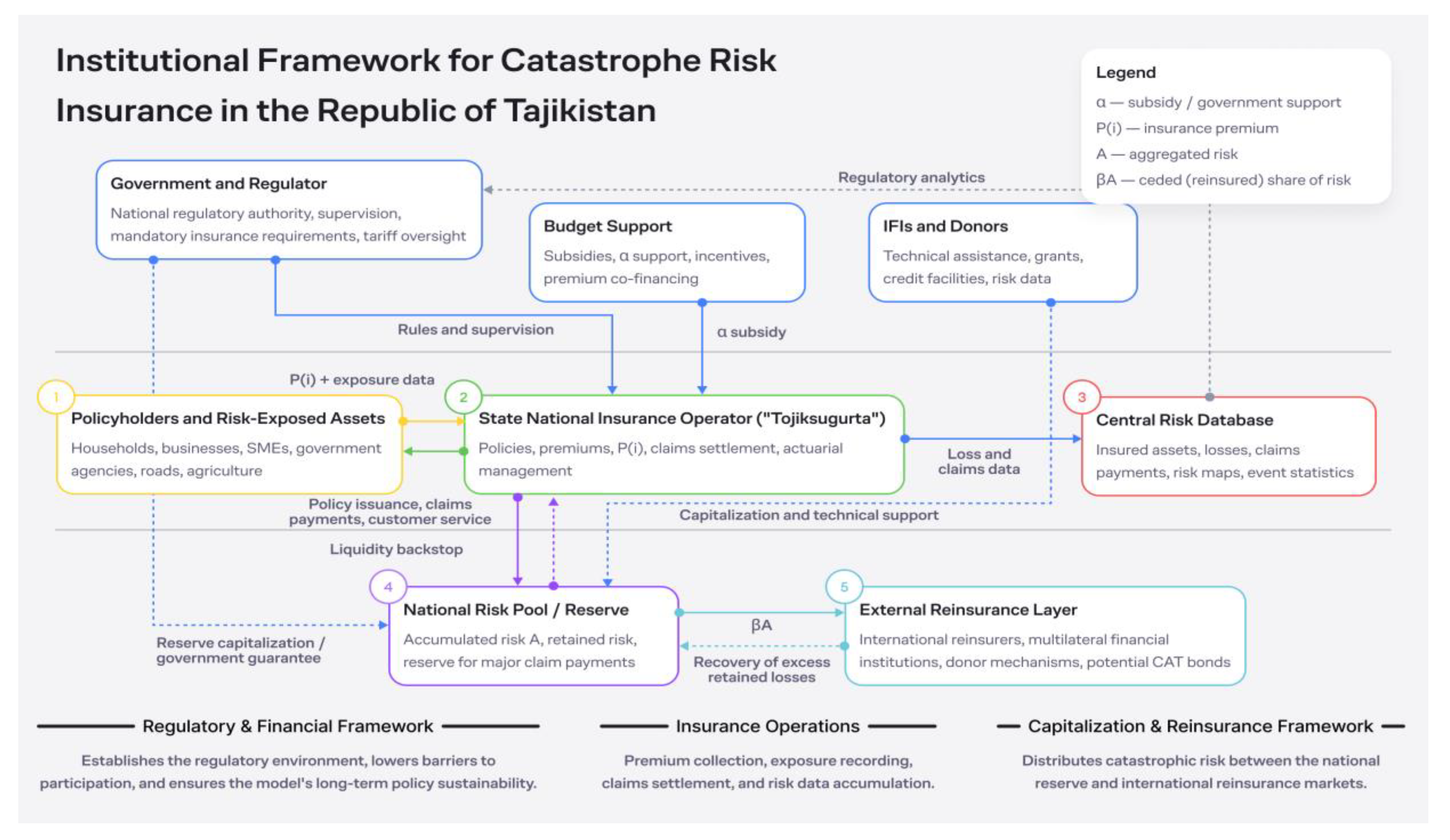

Table 1.
Comparative Logic of International Models of Catastrophe Risk Insurance [3,7,22,23,24,25,26].
| Model | Role of the state | Role of the market | Advantage | Limitation for Tajikistan |
|---|---|---|---|---|
| Market-based | Low or regulatory | High | Flexibility, innovation, reinsurance | Insufficient tariff affordability and weak demand |
| PPP/Pool | Medium or high | Operational Underwriting and claims settlement |
Burden-sharing and scalability | Requires a legal framework and trust among participants |
| Dirigiste | High | Embedded into mandatory frameworks |
Linking insurance with prevention and liability |
Cannot be copied without taking market capacity into account |
| Hybrid adaptation | Targeted, regulatory, subsidizing |
Products, data, reinsurance |
Combines resilience and feasibility |
Requires phased implementation |
Table 2.
Institutional Barriers to the Implementation of Catastrophe Risk Insurance in Tajikistan [29,38,39,40].
| Type of institutional barrier | Content | Consequence | Possible model response |
|---|---|---|---|
| Legal | No specialized catastrophe insurance framework |
Weak enforceability and fragmented responsibility |
Pilot regulations, limited compulsory requirements, linkage with safety |
| Financial | Low capitalization and solvency |
Insufficient coverage capacity |
Subsidies, pool, reinsurance, IFIs |
| Informational | Data and actuarial base deficit |
Difficulty of tariff setting | Data platform, GIS, loss standards |
| Behavioural | Low trust and insurance culture |
Weak demand | Simple products, transparent payouts, national operator |
Table 3.
Roadmap for Implementing the Nationally Contextualized Model.
| Horizon | Key actions | Participants | Expected outcome |
|---|---|---|---|
| 0–12 months | Working group, risk map, selection of pilots, subsidization rules |
Regulator, ministries, Tojiksugurta, IFIs | Preparation of the institutional launch |
| 1–3 years | Parametric insurance pilots, compulsory liability for hazardous industrial facilities, data platform |
Insurers, regulator, sectors, donors |
Testing of demand, tariffs, and payouts |
| 3–5 years | National pool, reinsurance, stress testing |
State, pool, reinsurers | Growth of financial resilience |
| 5+ years | Regional cooperation, CAT instruments, integration into climate budgeting | Central Asia, IFIs, capital markets |
Scaling of the model |
Disclaimer/Publisher’s Note: The statements, opinions and data contained in all publications are solely those of the individual author(s) and contributor(s) and not of MDPI and/or the editor(s). MDPI and/or the editor(s) disclaim responsibility for any injury to people or property resulting from any ideas, methods, instructions or products referred to in the content. |
© 2026 by the authors. Licensee MDPI, Basel, Switzerland. This article is an open access article distributed under the terms and conditions of the Creative Commons Attribution (CC BY) license (http://creativecommons.org/licenses/by/4.0/).
Copyright: This open access article is published under a Creative Commons CC BY 4.0 license, which permit the free download, distribution, and reuse, provided that the author and preprint are cited in any reuse.