
Submitted:
23 September 2026
Posted:
24 September 2026
You are already at the latest version
Abstract
Long-term tirzepatide treatment produces substantial weight loss that reliably decelerates and plateaus. A recent modeling analysis attributes this plateau to a progressive narrowing of the energy gap between intake and expenditure [1]. That explanation cannot be sustained. The model assigns a fixed tissue energy density of 7170 kcal/kg to all weight change, collapsing fat, lean tissue, glycogen and water into a single caloric equivalent. More critically, energy intake is not measured; it is calculated as the residual required to reconcile modeled expenditure with observed weight change. When weight change approaches zero, intake and expenditure must converge by definition. The reported convergence is therefore tautological. The same decelerating trajectory is the geometric signature expected when net mass outflow scales with retained mass. Once the body is treated as a mass reservoir whose clearance rate depends on the mass it still contains, the square-root relationship follows by mathematical necessity. No adaptive thermogenesis or other auxiliary construct is required. The plateau is the predictable behavior of a physical system, not evidence of emerging physiologic resistance.
Keywords:
GLP-1 receptor agonists
; tirzepatide
; weight-loss plateau
; mass balance
; Torricelli’s law
; energy balance
; body composition
1. The Clinical Fact and the Proposed Mechanism
Hubert et al. document a clear pattern: during prolonged tirzepatide treatment, weight loss is initially rapid, then progressively slows, and eventually plateaus [1]. Their description of the trajectory is useful. Their causal account is not.
They attribute the plateau to a narrowing energy gap. This interpretation rests on two structural features of the modeling framework that undermine the causal claim.
2. Fixed Energy Density Collapses Distinct Tissues
The analysis converts all weight change into energy units using a constant of 7170 kcal/kg [1]. This is a statistical average, not a physical constant. Fat, lean tissue, glycogen and associated water differ substantially in energy density. Lean-mass loss frequently accounts for 20–40% of total weight reduction under GLP-1 receptor agonist therapy [2,3]. Equating one kilogram of lean tissue with one kilogram of adipose tissue introduces systematic error into every derived energy-deficit estimate.
3. The Convergence Is True by Construction
The authors report that energy intake rose and eventually equaled energy expenditure [1]. Their methods section states that intake was estimated by balancing modeled expenditure against the caloric equivalent of observed weight change. Intake is therefore the residual required to make the equations balance. As weight change tends to zero, the residual must tend to zero.
The model does not observe a narrowing energy gap. It re-encounters the constraint built into its estimation procedure. A causal claim cannot be grounded in a relationship that is true by definition.
4. The Trajectory Is Required by Mass-Dependent Outflow
Regard the human body as a mass reservoir. Net mass outflow – the excretion of oxidation products – depends on the quantity of mass retained. When outflow rate scales with retained mass, the integrated trajectory of mass loss is necessarily decelerating: rapid at first, progressively slower, and asymptotic to a new steady state. This is Torricelli’s law applied to biological mass clearance [4].
Torricelli’s law itself is not in dispute. It is a direct consequence of mass conservation and Bernoulli’s principle. The present argument does not claim to have discovered a new biological law. It claims something more limited and more rigorous: once the body is treated as a mass reservoir whose net outflow depends on the mass still retained, the decelerating trajectory follows by mathematical necessity.
One may refine the quantitative details of human mass clearance, but the core premises – that the body is a mass reservoir and that net outflow depends on retained mass – are physically well-grounded. Once they are granted, the decelerating trajectory is required by the structure of the system. The same logic applies to an ordinary draining tank: we do not need experiments to know that the outflow slows as the level falls. The result is geometric, not optional.
This distinction – between an empirical regularity and a geometric necessity – is often blurred in biomedical discussion. Yet it is decisive. If the plateau is a necessary consequence of mass-dependent outflow, then invoking additional adaptive mechanisms to explain the same trajectory is redundant.
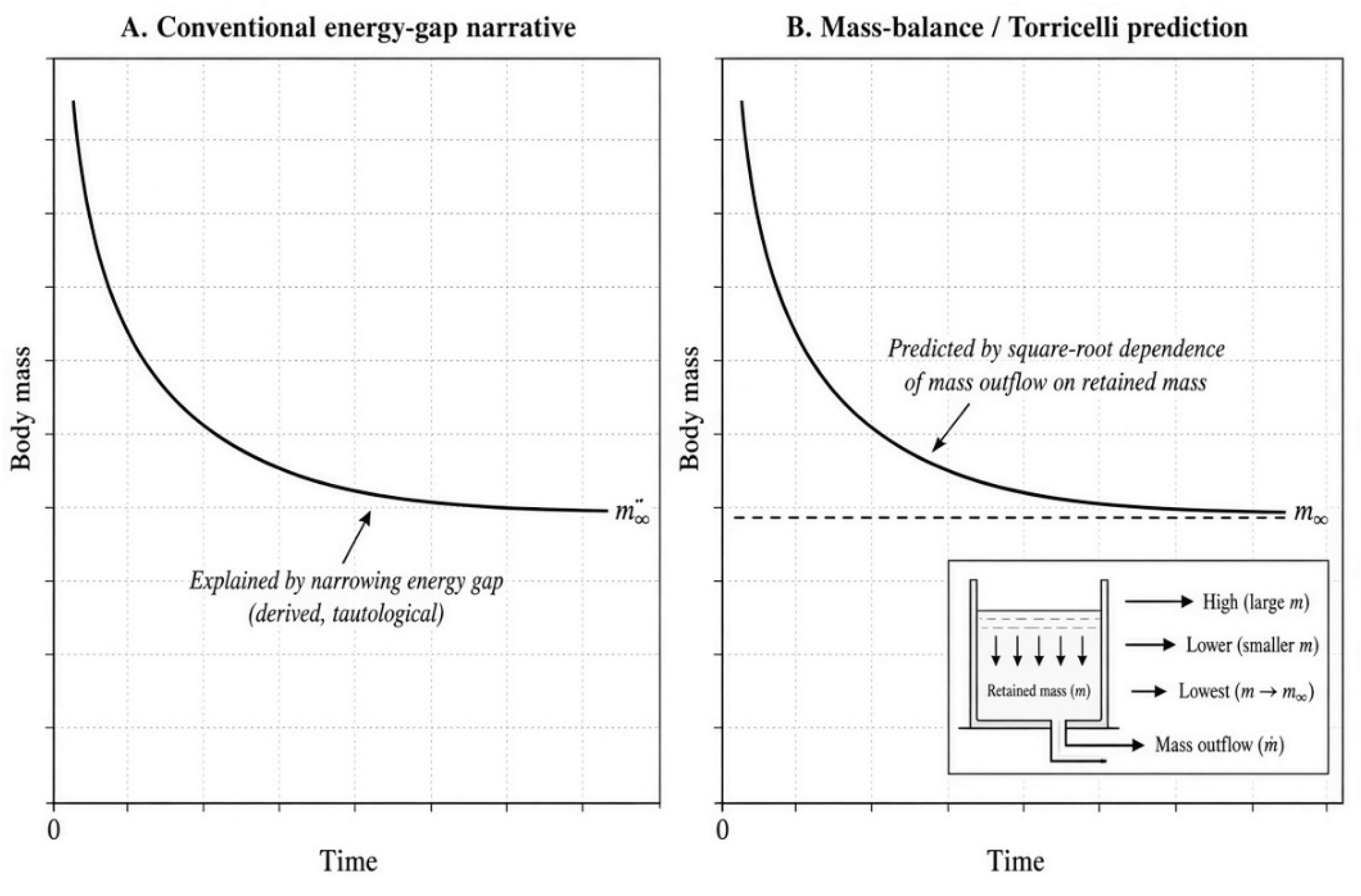
Figure 1 makes the contrast explicit. Panel A shows the conventional reading: the decelerating curve is attributed to a narrowing energy gap derived from the model itself. Panel B shows the mass-balance reading: the identical curve is the expected geometric consequence of mass-dependent outflow. The inset schematic of a draining reservoir renders the physical analogy concrete.
The qualitative match with the trajectory reported by Hubert et al. is exact [1]. The same decelerating pattern appears under caloric restriction and after bariatric surgery. One physical relationship accounts for all three.
If the plateau expresses mass-dependent outflow, the “narrowing energy gap” is not an independent cause. It is the same phenomenon restated in energetic units.
5. Post-Treatment Regain as Mass Restoration
After treatment cessation, intake rose above baseline and partial weight regain occurred [1]. The standard interpretation invokes appetite rebound. A more direct reading is that the system regulates mass. Once pharmacologic suppression is removed, intake increases to restore previously lost mass, including lean tissue. This is mass restoration, not energy compensation.
6. Clinical Implication
If the plateau is regarded as biologic resistance, the rational response is escalation – higher doses, additional agents, or intensified behavioral pressure. If the plateau is the expected behavior of a mass reservoir approaching equilibrium, the rational response is different: preserve lean mass, support function, and optimize health at the new mass.
In the era of highly effective incretin therapies, mistaking a geometric necessity for treatment failure risks unnecessary escalation and misdirected clinical effort. The plateau is not a signal that the drug is “losing efficacy.” It is information about the physical structure of the system being treated.
7. Conclusion
The weight-loss plateau under long-term tirzepatide is real. The claim that it is caused by a narrowing energy gap is not supported by independent measurement of intake and is, within the modeling framework used, true by definition. The same trajectory is the necessary consequence of mass outflow that depends on retained mass.
Energy accounting remains a convenient approximation. It is not the most precise description of why weight loss decelerates and plateaus.
Author Contributions
This is a single-authored paper.
Funding
This research did not receive any specific grant from funding agencies in the public, commercial, or not-for-profit sectors.
Ethics approval and consent to participate
Not applicable.
Consent for publication
Not applicable.
Availability of data
All data generated or analyzed during this study can be found in the sources cited in this article.
Acknowledgments
I would like to thank my family for their unwavering support and care, as well as my colleagues for many stimulating discussions.
Conflicts of Interest
The author declares no conflict of interest.
References
- Hubert, P.A.; Coleman, C.; Grosicki, G.J.; et al. Mind the Plateau: A Mathematical Modeling Analysis of Long-Term GLP-1 Receptor Agonist Treatment. J. Acad. Nutr. Diet. 2026, 126(8), 156366. [Google Scholar] [CrossRef] [PubMed]
- Prado, C.M.; Phillips, S.M.; Gonzalez, M.C.; Heymsfield, S.B. Muscle matters: the effects of medically induced weight loss on skeletal muscle. Lancet Diabetes Endocrinol. Epub. 2024, 12(11), 785–787. [Google Scholar] [CrossRef] [PubMed]
- Beavers, K.M.; Cortes, T.M.; Foy, C.M.; et al. GLP1Ra-based therapies and DXA-acquired musculoskeletal health outcomes: a focused meta-analysis of placebo-controlled trials. Obes. 2025, 33(2), 225–237. [Google Scholar] [CrossRef] [PubMed] [PubMed Central]
- Manninen, A.H. The Body as a Draining Tank: Torricelli’s Law Explains Metabolic Adaptation to Weight Loss. Preprints 2026, 2026051650. [Google Scholar] [CrossRef]
Figure 1.
Two Interpretations of the Same Weight-Loss Trajectory (A) Conventional energy-gap narrative. The decelerating curve is attributed to a progressive closing of the difference between energy intake and expenditure. In the modeling framework used, intake is derived from weight change, rendering the explanation tautological. (B) Mass-balance / Torricelli prediction. The same curve is the expected geometric consequence of net mass outflow scaling with retained mass. The inset shows a reservoir whose outflow declines as retained mass decreases.
Figure 1.
Two Interpretations of the Same Weight-Loss Trajectory (A) Conventional energy-gap narrative. The decelerating curve is attributed to a progressive closing of the difference between energy intake and expenditure. In the modeling framework used, intake is derived from weight change, rendering the explanation tautological. (B) Mass-balance / Torricelli prediction. The same curve is the expected geometric consequence of net mass outflow scaling with retained mass. The inset shows a reservoir whose outflow declines as retained mass decreases.
Disclaimer/Publisher’s Note: The statements, opinions and data contained in all publications are solely those of the individual author(s) and contributor(s) and not of MDPI and/or the editor(s). MDPI and/or the editor(s) disclaim responsibility for any injury to people or property resulting from any ideas, methods, instructions or products referred to in the content. |
© 2026 by the authors. Licensee MDPI, Basel, Switzerland. This article is an open access article distributed under the terms and conditions of the Creative Commons Attribution (CC BY) license (http://creativecommons.org/licenses/by/4.0/).
Copyright: This open access article is published under a Creative Commons CC BY 4.0 license, which permit the free download, distribution, and reuse, provided that the author and preprint are cited in any reuse.