

Submitted:
23 September 2026
Posted:
24 September 2026
You are already at the latest version
Abstract
Community-based ecosystem restoration is increasingly promoted to achieve ecological recovery and livelihood benefits, yet empirical evidence on factors influencing early restoration outcomes remains limited. This study examines seedling survival across restoration sites in sixteen villages in Seruyan and Kotawaringin Barat, Central Kalimantan, Indonesian Borneo, representing diverse ecosystem types, land cover, and tenure arrangements. Using field monitoring data, descriptive statistics and Pearson correlations were applied to assess associations between survival and governance, management, and biophysical factors. Survival rates varied substantially across sites, ranging from 3.8% to 95% (mean = 46%). Governance and management variables—particularly maintenance (r = 0.768), complementary livelihood-related activities (r = 0.742), stakeholder engagement (r = 0.575), land management (r = 0.530), and community participation (r = 0.497)—showed stronger associations with survival than biophysical factors (r < 0.30). These findings highlight the importance of sustained post-planting management, livelihood integration, and institutional capacity. The findings also suggest that meaningful participation requires not only community involvement but access to technical, ecological, and market information for informed restoration decisions. Overall, this study supports integrated, adaptive restoration approaches combining local engagement, knowledge exchange, livelihood incentives, and collaborative governance.
Keywords:
community-based restoration
; governance
; seedling survival
; participatory approach
; tropical landscapes
1. Introduction
Ecosystems are losing their ability to provide environmental services as native forests are converted for a range of development and land-use pressures, including infrastructure projects, expansion of agricultural plantations, and other resource-dependent production systems. As forests are degraded, they lose their capacity to regulate water, store carbon, and support biodiversity, making landscapes more vulnerable to environmental hazards such as fires, floods, and droughts, while contributing to increased greenhouse gas emissions. The United Nations Decade on Ecosystem Restoration (2021–2030) underscores an urgent global commitment to restore degraded ecosystems as a pathway to achieve the Sustainable Development Goals. It calls for effective, long-term ecosystem recovery that goes beyond tree planting to rebuild the ecological and social systems sustaining human well-being. This initiative emphasizes the need for self-sustaining and inclusive governance structures that integrate ecological integrity with local economic and social resilience [1,2,3,4]. In line with this, the Forest and Landscape Restoration (FLR) movement seeks to restore more than 350 million hectares of deforested and degraded landscapes by 2030 [5,6], prioritizing functional and enduring ecosystem recovery that benefits both people and nature.
Responding to these global challenges, the government of Indonesia has increasingly embedded restoration into its national development agenda. The recent medium-term development plan sets a target to rehabilitate 12 million hectares of degraded land and forest, supported by key legal frameworks such as the environmental protection and forest management laws. These are complemented by flagship initiatives including the social forestry program, which aims to empower communities to manage forests sustainably and equitably, and restoration-focused mandates for peatland and mangrove ecosystems. Despite these efforts, restoration outcomes in Indonesia remain uneven, often constrained by governance challenges such as limited coordination, unclear institutional roles, and insufficient support for local institutions [7,8].
At the local level, these challenges are reflected in Seruyan and Kotawaringin Barat districts, Central Kalimantan (Indonesian Borneo). In 2018, the Environmental Carrying Capacity Assessment, a government-mandatory spatial analysis tool designed to mitigate the negative effects of economic development, indicated that the remaining forest in these districts is highly fragmented and degraded. These degraded lands are distributed across three major ecosystems in the districts, i.e., dry lowlands, peatlands, and mangroves. To enhance ecosystem services values in these landscapes, restoration is required not only to rehabilitate forest cover, but also to strengthen governance, management systems, and community engagement that support long-term ecological and socio-economic outcomes [1,9].
Successful restoration, however, depends not only on ecological interventions but also on the enabling conditions under which they occur. Research shows that restoration outcomes are strongly shaped by governance arrangements, incentive systems, and land tenure clarity—factors that influence how interventions affect land-use decisions, equity, and community ownership [10,11]. Increasingly, restoration approaches are adopting agroforestry systems that combine fast-growing native tree species with agricultural crops. Such models have been shown to reduce costs, enhance soil fertility, and strengthen community participation through livelihood co-benefits [12,13]. Similarly, community-based restoration that integrates secure tenure, species diversity, and climate resilience is considered essential to ensure long-term sustainability across diverse landscapes [10,14]. Nevertheless, without robust governance systems, sustained incentives, and effective institutional coordination, restoration gains risk reversal, as reported in several tropical regions where newly regenerated forests were rapidly cleared [15].
Since 2019, a community-based ecosystem restoration initiative has been implemented across degraded forest, peatland, and mangrove ecosystems in Seruyan and Kotawaringin Barat. This initiative provides an empirical context to examine differences in restoration outcomes within community-managed landscapes, where governance arrangements, participation, management intensity, and biophysical conditions vary among sites. While community-based restoration is widely promoted as essential for achieving sustainable outcomes, empirical evidence on the factors influencing restoration performance during the establishment phase remains limited. This study addresses this gap by analyzing variation in seedling survival among restoration sites and examining how governance, management, and biophysical conditions are associated with early restoration outcomes.
2. Methods
2.1. Study Site
This study was conducted in Seruyan and Kotawaringin Barat, two adjacent districts in southern Central Kalimantan, covering approximately 27,163 km2. The landscape is predominantly lowland, with elevations ranging from near sea level to over 1,000 meters. Remaining forest cover is estimated at approximately 674,000 hectares, of which about 73% is located in the northern upstream areas, particularly in Seruyan, characterized by undulating terrain. Forest patches in the southern parts of both districts are largely concentrated within Tanjung Puting National Park, which comprises a mosaic of lowland forests, peat swamp, and mangroves. These forests are fragmented into more than 400 patches, with only about half exceeding 100 hectares, a threshold critical for maintaining ecological integrity and viable biodiversity populations, highlighting the highly fragmented nature of the landscape. The remaining forest landscapes still support important biodiversity, including endangered species such as the Bornean orangutan (Pongo pygmaeus wurmbii), proboscis monkey (Nasalis larvatus), clouded leopard (Neofelis nebulosa), and helmeted hornbill (Buceros vigil) [16,17]. However, increasing fragmentation has resulted in isolated habitat patches, raising concerns about long-term species viability [18].
Figure 1 shows the restoration sites for this study. The map illustrates the spatial distribution of restoration sites across Seruyan and Kotawaringin Barat districts, highlighting the fragmented nature of ecosystem cover, the proximity of human settlements to different land systems, and the complex spatial context in which restoration activities are carried out. Table 1 summarizes the characteristics of restoration sites across sixteen villages, highlighting variation in ecosystem types, land status, tenure arrangements, and land cover. The sample spans three main ecosystem types. Dryland ecosystems dominate the sample, particularly in both districts, and are commonly associated with oil palm plantations, shrub landscapes, and secondary forests. Peatland sites are concentrated in Seruyan and are typically linked to shrub swamp or dryland farming systems. Mangrove ecosystems are limited to coastal villages such as Sabuai and Sungai Undang, where land cover includes mixed farming and aquaculture. In terms of land status, most sites fall under non-forest estate, although several are located within convertible production forest and a smaller number within production forest areas. Land tenure is predominantly communal, although some sites, such as Batu Menangis and Pematang Panjang, are under individual ownership, and others fall under social forestry schemes, particularly in areas classified as convertible production forest. Land covers are equally heterogeneous, ranging from oil palm plantations and mixed dryland farming to shrub swamp and secondary forest ecosystems.
2.2. Data Collection and Analysis
This study examined the determinants of success in a community-based ecosystem restoration initiative, using seedling survival as a baseline measure of restoration performance. The program has been implemented since 2019 and involved local communities throughout the process, from planning and site selection to implementation and monitoring, thereby ensuring that restoration activities reflected local knowledge, institutional conditions, and socio-economic priorities. Initial engagement followed Free, Prior, and Informed Consent (FPIC) procedures and was complemented by village-level consultations. Site and species selection (Appendix A) were determined through a series of group discussions with local communities, taking into account land suitability, legal status, and local preferences. Restoration activities targeted degraded lands across a range of land-use systems, including oil palm plantations, mixed dryland farming areas, shrub swamps, and forests. Planting strategies emphasized multi-species and agroforestry systems, combining native, fast-growing, and economically valuable species to support both ecological recovery and livelihood outcomes. Seedlings were raised in semi-permanent nurseries to ensure quality and site adaptation, while land preparation and planting were scheduled in accordance with local biophysical conditions.
Monitoring was conducted regularly to track seedling performance, beginning within one month after planting, followed by quarterly assessments during the first three years and semi-annual monitoring thereafter. Data collection was carried out by trained community groups with technical oversight, reflecting a co-produced approach to monitoring. Survival rates were measured using a full census for smaller sites (less than 10 hectares), while larger sites rely on permanent sample plots with approximately 10% sampling intensity, supplemented in some cases by Line-Point Intercept methods. In this context, the survival rates were used as the approximation of the success of the restoration initiative. Seedling survival rate was defined as the proportion of living seedlings relative to the total number planted. A set of explanatory variables was used to account for variation in restoration outcomes.
The set of covariates comprised three broad categories: land characteristics, biophysical conditions, and governance and institutional factors. Data on land characteristics, including land cover and legal status, were obtained from the Ministry of Forestry 2023, while land tenure was derived from the Seruyan District Spatial Plan 2019–2039. Biophysical conditions were further divided into geophysical and climatic variables. Geophysical variables included ecosystem type, obtained from the Indonesian Land System; soil pH and soil organic carbon, obtained from OpenLandMap; and elevation and slope, calculated using the Digital Elevation Model Nasional (DEMNAS). Climatic variables included precipitation, wind speed, and humidity, obtained from the Famine Early Warning Systems Network Land Data Assimilation System (FLDAS), and temperature, obtained from the Moderate Resolution Imaging Spectroradiometer (MODIS) Land Surface Temperature dataset. Finally, governance and institutional factors were measured using assessments provided by field observers who closely monitored implementation and supported community restoration groups. These observers evaluated group performance along several dimensions, including maintenance frequency, stakeholder engagement, additional or complementary livelihood-related activities around restoration sites such as horticulture, member participation, and land management practices i.e., whether restoration sites were managed collectively or individually. Data for all three categories of covariates were provided in the Supplementary Information.
Table 2 presents summary statistics for the key variables used in the analysis, covering land characteristics, governance and institutional measures, seedling composition, and biophysical conditions. The average survival rate was 0.464, or approximately 46.4% of planted seedlings survive across the sampled sites. The standard deviation (0.321) pointed to substantial variation, suggesting that some sites perform markedly better than others. This was further reflected in the wide range of observed values, spanning from a minimum of 0.038 to a maximum of 0.95.
The average project area was 19.26 hectares, with a relatively large standard deviation (14.97), indicating substantial heterogeneity in plot size across observations. Governance and institutional indicators exhibited considerable variation. The mean score for maintenance was 0.52 (on a scale ranging from 0 to 2), suggesting that, on average, maintenance activities were present but not intensive. Stakeholder engagement had a lower mean of 0.18, although some sites reach higher engagement levels. The existence of additional or complementary livelihood-related activities averaged 0.58, reflecting moderate levels of additional assistance. Access scores (mean 1.06) were relatively higher, implying that most sites were reasonably accessible. Participation averaged 0.91, suggesting moderate involvement of group members, while land management had a relatively low mean (0.19). The composition of seedlings revealed a stronger emphasis on economic species. The share of economic seedlings averaged 0.59, compared to 0.31 for ecological species and 0.10 for social and cultural species. This distribution suggested that restoration activities were primarily oriented toward economic benefits.
Geophysical characteristics indicated that the study sites were relatively homogeneous. Soil pH averaged 4.88, indicating generally acidic conditions. Soil organic carbon showed greater variability, with a mean of 42.20% and a wide range, suggesting differences in soil fertility across sites. Elevation was 14.567 m asl on average, consistent with predominantly lowland areas, while slope was 3.555° on average, indicating relatively flat terrain. Climatic variables also displayed notable variation. The precipitation rate was low on average (9.35 x 10⁻⁵ kg m−2 s−1) with limited dispersion. In contrast, wind speed exhibited substantial variability, as reflected in a large standard deviation relative to its mean (2.656 m s−1). Humidity also varied considerably across sites, with a mean of 0.016 kg kg−1 (mass fraction). Temperature was relatively stable, averaging 25.62°C. Overall, the summary statistics highlighted substantial heterogeneity in governance, institutional performance, and certain environmental conditions, while other factors—such as temperature and soil pH—remained relatively consistent across sites.
Our empirical analysis proceeded in three complementary steps. First, we compared the distribution of seedling survival rates across land cover, land status, land tenure regimes, and ecosystem types using boxplots. These comparisons provided a descriptive assessment of heterogeneity in survival outcomes across restoration contexts [19,20]. Second, we used Principal Component Analysis (PCA) to summarize variation in governance- and biophysical-related attitudinal and management variables and to identify the principal dimensions distinguishing restoration groups [21]. Third, we estimated Pearson correlation coefficients to quantify the strength and direction of the association between seedling survival rates and the explanatory variables [22,23].
3. Results
3.1. Survival Rate Patterns Across Years and Field Assistance Intensity
Since 2021, restoration plant monitoring has been conducted across sixteen villages in Seruyan and Kotawaringin Barat. Survival rates were recorded at regular intervals for up to two years after planting following the established procedures.
Figure 2 illustrates the temporal changes in the Weighted Survival Rate (WSR) of planted seedlings from 2021 to 2025. The WSR exhibited an overall increasing trend throughout the monitoring period, despite a temporary decline in 2023. The survival rate was lowest in 2021 (3.81%), reflecting the poor establishment success immediately after planting. It increased substantially to 38.47% in 2022, representing a tenfold improvement from the previous year. In 2023, the WSR declined to 18.74%. However, the survival rate recovered markedly in 2024, increasing to 54.84%, and continued to rise to 85.36% in 2025, the highest value recorded during the study period. Overall, the WSR showed a net increase of more than 80 percentage points over the five-year period, suggesting progressive improvement in seedling establishment and stand persistence.
The increasing trend in the weighted survival rate over time may reflect the learning-by-doing process of the restoration field assistants as they gained experience in implementing restoration activities with local communities in Seruyan. This adaptive learning is represented by the Effort Index (EI), calculated by normalizing the annual weighted survival rate. Accordingly, the EI exhibits an inverse relationship with the WSR, where higher assistance effort corresponds to lower survival, while improved survival is associated with progressively lower assistance requirements.
3.2. Distribution of Survival Across Land Cover, Land Status, Land Tenure, and Ecosystem
The EI was highest in 2021 (100%), indicating the maximum level of assistance required during the initial restoration phase. The index declined to approximately 64% in 2022, increased temporarily to approximately 84% in 2023, and then decreased to approximately 47% in 2024 and 15% in 2025. The overall decline in the EI indicates that the intensity of assistance provided by the restoration field assistants decreased as restoration outcomes improved and the plantation became more established. The temporary increase in 2023 reflects the additional assistance required to address the decline in seedling survival during that year.
Figure 3(a) displays the distribution of seedling survival rates across land cover. Median survival is highest in mixed dryland systems (approximately 70%), followed by oil palm (approximately 25%) and shrub/swamp areas (approximately 18%). Shrub and swamp sites exhibit the greatest variability, with survival rates ranging from about 4% to 72%, indicating substantial heterogeneity in outcomes across restoration sites. Overall, the figure suggests that mixed dryland systems exhibit the most favorable conditions for seedling survival.
Figure 3(b) shows the distribution of seedling survival rates across land status categories: production forest, convertible production forest, and non-forest. Median survival is highest in non-forest areas (approximately 60%), with values extending to about 90%, indicating generally favorable. Convertible production forest exhibits a lower median (approximately 35%) and a wider interquartile range, suggesting greater dispersion in outcomes. In contrast, production forests have the lowest survival rates (around 20%). Overall, the figure indicates that restoration outcomes are more favorable in non-forest areas compared to forest-designated lands.
Figure 3(c) presents the distribution of seedling survival rates across land tenure categories: communal land, social forestry, and private land. Median survival is highest on private land (approximately 80%), with observations concentrated toward the upper end of the distribution (roughly 60% to near 100%), indicating relatively favorable and consistent conditions for establishment. Social forestry exhibits intermediate outcomes, with a median around 45% and a relatively wide interquartile range. In contrast, communal land shows the greatest dispersion, with survival rates ranging from very low values (about 5%) to high levels (approaching 90%), but with a lower median (approximately 35%). Overall, the figure indicates that private land is associated with the highest and most stable survival outcomes for restoration.
Figure 3(d) presents the distribution of seedling survival rates across ecosystem types: dryland, mangrove, and peatland. Median survival is highest in dryland systems (approximately 55%), with observations spanning a wide range (roughly 5% to 95%), indicating generally favorable but heterogeneous conditions. Peatland exhibits a similarly broad dispersion, with values ranging from about 100 to 80%, but a lower median (approximately 35%), suggesting less consistent performance. Mangrove systems show more moderate outcomes, with a median also around 35% and comparatively less spread. Overall, the figure indicates that dryland ecosystems tend to be associated with higher average survival.
Figure 4 presents the PCA ordination or positioning of variables which are governance, management, and seedling composition variables based on the first two principal components, which together explain 63.7% of the total variation (PC1 = 44.8%; PC2 = 18.9%). The distribution of variables across the four quadrants reveals distinct groupings and potential relationships among governance attributes, management practices, and seedling characteristics.
The upper-right quadrant (Quadrant 1) contains stakeholder participation, management, economy, and access. These variables are positively associated with both principal components, suggesting that they represent complementary aspects of effective restoration governance. Their close proximity indicates that villages with stronger stakeholder engagement also tend to exhibit better management capacity, greater economic support, and improved accessibility. This clustering implies that institutional and socioeconomic factors tend to reinforce one another and may be jointly associated with improved restoration performance.
The lower-left quadrant is occupied primarily by the seedling characteristics. These variables are separated from the governance-related variables located on the right side of the ordination, indicating that they represent a distinct dimension of variation. Their proximity suggests that ecological conditions and sociocultural characteristics vary together and are relatively independent of governance and management indicators.
A notable feature of the lower-right quadrant is the clustering of the variables of participation, maintenance, additional activities, and total area, indicating that these variables are closely associated and contribute similarly to the observed pattern in the dataset. These variables share positive loadings on PC1 but negative loadings on PC2, indicating that they are associated with governance performance while representing a different dimension from other governance variables located in Quadrant I, which is stakeholder. Their grouping suggests that villages characterized by stronger maintenance efforts and additional restoration activities may therefore differ from those whose strengths lie primarily in stakeholder engagement.
Overall, governance and management variables clustered in the positive region of PC1, corresponding to the area where villages with higher seedling survival were primarily distributed. These variables contrasted with the ecological, sociocultural, and seedling characteristic variables, which were positioned in the opposite quadrant. This separation indicates that governance and management variables were more closely associated with the distribution of villages exhibiting higher seedling survival, whereas ecological and sociocultural factors, together with seedling characteristics, were associated with the opposite pattern.
Figure 5 presents the principal component analysis (PCA) of biophysical variables in relation to seedling survival. The first two principal components explain 84.6% of the total variance (PC1 = 53.3%; PC2 = 31.3%). The upper-right quadrant was represented primarily by temperature, which was positioned away from the other variables, indicating a distinct pattern compared with the remaining biophysical factors. Although soil pH was also located on the positive side of PC1, it was positioned close to the horizontal axis, suggesting a weaker contribution to variation along PC2. The separation of temperature from the clustered variables indicates that it varied independently from most other environmental characteristics. The upper-left quadrant contained wind, humidity, and soil organic matter. These variables were located relatively close to one another, indicating similar patterns across the study villages. Their position suggests that sites with higher values for one of these variables also tended to have higher values for the others.
The lower-left quadrant included precipitation, slope, and elevation. These variables formed a relatively compact cluster, indicating that they shared similar patterns among the sampled villages. Elevation was positioned farther from the origin than precipitation and slope, suggesting that it contributed more strongly to the variation represented by the two principal components. The close grouping of these three variables indicates that they tended to vary together across the restoration sites. No variable was strongly associated with the lower-right quadrant. While temperature was located on the positive side of PC1, it remained above the horizontal axis, indicating that it was more strongly associated with positive PC2 values rather than this quadrant. Overall, the close clustering of the variables around the origin, together with their relatively weak correlations with seedling survival, suggests that the measured biophysical factors did not exhibit strong relationships with seedling survival in the restored sites.
Pearson correlations are computed to assess in detail the correlation between the categorical variables and seedling survival rates. Figure 6 reports the estimated correlation coefficients, along with their direction and magnitude.
Figure 6 reports Pearson correlation coefficients between seedling survival and a range of governance, biophysical, and contextual variables (n = 16), which can be grouped by strength of association. Among the strong correlations, maintenance (r = 0.768) and additional activities (r = 0.742) stand out as the most strongly and positively associated with survival, indicating that consistent upkeep and adequate support are key determinants of restoration success. The moderate correlations are also uniformly positive and include elevation (r = 0.597), stakeholder involvement (r = 0.575), land management (r = 0.530), participation (r = 0.497), and the share of economic species (r = 0.454). These results suggest that both governance quality and certain site characteristics—particularly elevation—are meaningfully associated with improved survival outcomes.
The weak positive correlations are observed for slope (r = 0.330), access (r = 0.197), wind speed (r = 0.197), precipitation (r = 0.191), humidity (r = 0.146), soil pH (r = 0.139), and total area (r = 0.095), indicating limited explanatory power. Weak negative correlations are found for ecological species composition (r = −0.397), social and cultural species (r = −0.353), temperature (r = −0.094), and soil organic content (r = −0.063), suggesting only marginal inverse associations. Both the fitted trends and the Pearson correlations indicate that strong and moderate associations are concentrated among governance and management variables, whereas biophysical and climatic factors display weaker and less consistent correlations with seedling survival.
4. Discussion
4.1. Governance and Management as the Foundation of Restoration Outcomes
The findings of this study suggest that governance and management-related variables, particularly maintenance, participation, stakeholder engagement, and additional or complementary livelihood-related activities, show the most consistent associations with seedling survival across restoration sites. This supports a well-established argument in forest landscape restoration (FLR) literature that restoration outcomes are fundamentally shaped by governance systems, including institutional coordination, incentive structures, and policy frameworks that influence land-use decisions [14,24,25]. The patterns observed in this study are especially notable because the strongest correlations with survival are concentrated among governance and management variables, while most biophysical and climatic factors display only weak associations. Maintenance emerged as the strongest factor (r = 0.768), closely followed by additional activities (r = 0.742), with stakeholder involvement (r = 0.575), land management (r = 0.530), and participation (r = 0.497) also showing positive relationships with survival. These findings suggest that early restoration success is linked not only to the planting activities themselves, but also to the extent to which restoration sites continue to receive sustained attention, coordination, and support after planting. Sites with more active maintenance, monitoring, and complementary activities tended to show higher survival rates, consistent with governance factors showing stronger correlations than biophysical variables in this sample. Collectively, the results indicate that post-planting management is not merely a supporting activity, but a central role in restoration performance during the early establishment phase.
This association can be interpreted through the role of governance in enabling or constraining continuous management. Maintenance activities such as weeding, protection, and site monitoring, require not only technical knowledge but also labor availability, coordination, and sustained commitment from local actors. In community-managed landscapes, these conditions are shaped by institutional coordination, clarity of responsibilities, and the presence of functioning local organizations. Empirical studies in Indonesia and Southeast Asia highlight that restoration efforts are often constrained by weak coordination across actors, limited monitoring capacity, and insufficient support for community institutions [26,27]. These governance gaps reduce the effectiveness of restoration interventions, even in sites with relatively similar ecological conditions.
Global evidence further reinforces the central role of governance in sustaining restoration outcomes. Community-based restoration initiatives across tropical regions show that projects with strong local institutions, active participation, and consistent stakeholder engagement achieve more stable and long-lasting ecological outcomes [28,29,30]. Conversely, restoration efforts that rely on short-term project cycle or centralized implementation often struggle to sustain outcomes beyond initial phases, particularly when long-term local engagement, institutional coordination, and adaptive governance mechanisms are lacking [31,32]. These findings suggest that governance should be understood not as a supporting or enabling factor, but as the foundation upon which restoration systems operate, shaping both the effectiveness of implementation and the sustainability of outcomes.
4.2. Participation, Livelihoods, and Incentives for Sustained Engagement
The positive relationships between participation, stakeholder engagement, and survival rates observed in this study highlight the importance of aligning restoration efforts with local socio-economic conditions. In many rural landscapes, restoration is embedded within livelihood systems where households prioritize income stability and food security, shaping their willingness to engage in restoration activities [33,34,35,36]. Without adequate incentives or livelihood integration, restoration initiatives risk low adoption and limited long-term impact. In this study, the strong association between additional activities and survival rates further reinforces this relationship. Indeed, additional activities exhibited a correlation strength nearly equivalent to maintenance and stronger than participation or stakeholder involvement, suggesting that restoration outcomes may be associated not only with community involvement itself, but also with the extent to which restoration is embedded within broader livelihood and support systems. Activities conducted around restoration sites, such as horticulture and other income-generating practices, may create tangible benefits for participating households, and involvement in such activities could plausibly be associated with more frequent site visits, continued maintenance, and regular monitoring. By linking restoration objectives with everyday livelihood activities, such approaches may help sustain engagement beyond initial planting efforts and strengthen local commitment to long-term restoration management. These findings suggest that restoration interventions are likely to be more effective when ecological objectives are integrated with community livelihood that provide clear and ongoing value for participating communities.
However, participation alone is insufficient, and the evidence points in two directions simultaneously. On one hand, top-down interventions that implement externally designed restoration programs often fail to achieve meaningful uptake, due to misalignment with local needs, insufficient technical follow-up, and weak market integration [31,37,38]. Similar challenges have been observed in restoration initiatives in Indonesia, where externally driven approaches often struggle to achieve sustained community engagement [27]. On the other hand, a purely bottom-up approach presents its own limitations, ones that this study’s findings in Central Kalimantan highlight directly. While communities may possess extensive local ecological knowledge and a strong understanding of local land-use systems, they often lack the technical knowledge, market awareness, or silvicultural experience needed to make ecologically and economically sound restoration decisions. In the sites studied here, species selection was largely guided by familiarity and local preferences rather than ecological suitability or market value, reflecting what might be understood as a knowledge gap in community-based restoration: participation quality depends not only on willingness to engage, but on their access to the necessary knowledge to make informed choices [39,40]. This finding aligns with critiques of the assumption that local actors possess complete and sufficient knowledge for restoration decision-making [41]. The evidence therefore suggests the value of a co-production approach, in which external actor contribute technical and market knowledge while communities retain a central role in decisions regarding land use, labor, and benefit distribution [1,14]. Participatory approaches that structure this knowledge exchange from the earliest stages including planning, species selection, and livelihood design have been shown to strengthen ownership and improve both ecological and social outcomes [8,9,29,42,43].
Worldwide studies affirm the necessity of integrating livelihood incentives into restoration systems. Approaches such as agroforestry, ecosystem service payments, and community-based enterprises have been shown to sustain long-term engagement and reduce restoration costs, particularly when designed in alignment with local knowledge and socio-economic conditions [44,45]. However, the design of such approaches must account for the knowledge gaps identified here: livelihood integration is most effective when accompanied by structured technical guidance that builds community capacity for informed species and management decisions, rather than assuming that local preferences alone are sufficient to guide restoration choices [46,47]. These findings underscore that restoration success depends not only on ecological design or community participation as independent factors, but on the quality of knowledge exchange between external technical actors and local communities, and on the extent to which restoration aligns with livelihood incentives while building informed, sustained community engagement over time.
4.3. Institutional Conditions: Tenure, Coordination, and Capacity
The influence of land tenure, land status, and management arrangements observed in this study reflects broader institutional conditions that shape restoration outcomes. Secure tenure is widely recognized as a key enabling condition, as it provides incentives for long-term stewardship and investment in restoration activities [48,49]. The patterns observed across restoration sites are consistent with this argument. Restoration sites located on private land exhibited the highest and most consistent survival rates, while communal lands showed substantially greater variability in outcomes. Social forestry sites displayed intermediate performance. These differences suggest that clarity of rights, responsibilities, and expected benefits may influence the willingness and capacity of local actors to invest in long-term maintenance and monitoring activities. Similarly, restoration outcomes tended to be more favorable in non-forest areas than in production forest or convertible production forest lands, indicating that institutional and regulatory contexts may shape restoration performance alongside ecological conditions. Taken together, these findings are consistent with clarity of land-use arrangements supporting more effective and sustained management.
At the same time, evidence from Indonesia and other tropical regions indicates that tenure security alone does not guarantee successful outcomes. Restoration initiatives often face challenges related to limited institutional coordination, complex governance arrangements, and constrained implementation capacity [50,51,52]. Community based forest management programs, for example, have shown mixed results due to unequal benefit distribution, limited market access, and institutional fragmentation. In addition, restoration programs frequently underestimate the social and institutional costs associated with coordination, community engagement, and conflict resolution. These indirect costs can represent a substantial portion of total restoration investment and are critical for sustaining long-term outcomes [28,53]. Strengthening institutional capacity and coordination mechanisms is therefore essential for improving restoration performance in multi-actor landscapes.
4.4. Biophysical Context Within Social–Ecological Restoration Systems
The relatively weak relationships between biophysical variables and survival rates observed in this study suggest that ecological conditions alone do not fully explain variation in restoration outcomes. Instead, variation appears to be more closely associated with governance and management factors. This supports a broader understanding of restoration as a social–ecological process, where outcomes emerge from interactions between environmental conditions and human management systems [54,55,56] .
In tropical landscapes, environmental risks such as fire, flooding, and soil conditions are well documented, but their impacts are often mediated by governance and management practices. For example, community-based fire management systems and landscape-level coordination have been shown to play a critical role in reducing environmental risks and supporting restoration outcomes [57,58,59]. This suggests that biophysical constraints should be understood as contextual factors that interact with governance systems, rather than as primary determinants of restoration success.
A systems framework further emphasizes that restoration is most effective when combining ecological interventions with social and institutional components. Evidence from multiple regions shows that integrated approaches, combining active restoration, natural regeneration, livelihood development, and institutional strengthening, produce more resilient and sustainable outcomes [2,15,60,61]. This perspective reinforces the need to move beyond tree planting toward adaptive, long-term restoration approaches that build resilient social–ecological systems capable of sustaining outcomes over time.
5. Conclusion
This study provides empirical evidence on the governance factors influencing early restoration performance in community-managed tropical landscapes, an area that remains underrepresented in restoration literature. The results show that governance and management variables including maintenance, complementary livelihood activities, stakeholder engagement, land management, and participation have stronger and more consistent associations with early survival outcomes than biophysical and climatic factors. These associations were observed across different ecosystem types, land tenure arrangements, and land cover, suggesting that governance is consistently associated with early restoration outcomes across a wide range of ecological conditions.
Beyond establishing the importance of governance, the study offers two additional contributions. First, complementary livelihood activities showed an association with survival comparable to maintenance and stronger than participation or stakeholder engagement, suggesting that livelihood integration may help sustain the labor and site presence needed to support post-planting survival. Second, land tenure was associated with differences in both survival rates and their consistency, with private land associated with the highest and most stable outcomes, followed by social forestry, while communal lands showed greater variation. These findings suggest that secure tenure is linked to both willingness to invest in restoration and the consistency of management over time. In addition, the study found that communities generally selected species based on familiarity and local preferences rather than ecological suitability or market value, highlighting the need for stronger technical support alongside participatory restoration approaches.
For practitioners and policymakers, the findings suggest that restoration investments should place greater emphasis on sustained post-planting governance, including maintenance, livelihood integration, and institutional coordination, rather than focusing primarily on planting activities. More broadly, the results reinforce the view that successful restoration is linked not only to ecological conditions but also to governance arrangements that support continued community engagement. Future research should examine how governance and knowledge-sharing mechanisms influence restoration outcomes beyond the establishment phase, and how livelihood strategies can be better integrated into restoration programs to sustain long-term community engagement.
Supplementary Materials
The following supporting information can be downloaded at the website of this paper posted on Preprints.org or at https://docs.google.com/spreadsheets/d/1CENq3xUE4HcuXVMamw8epJzfW6bugL-z/edit?usp=sharing&ouid=107382525139607949866&rtpof=true&sd=true. Table S1: Site-level data on land characteristics, including land cover, legal status, and land tenure; Table S2: Site-level data on biophysical conditions, including ecosystem type, soil pH, soil organic carbon, elevation, slope, precipitation, wind speed, humidity, and temperature; Table S3: Site-level data on governance and institutional factors, including maintenance frequency, stakeholder engagement, additional livelihood-related activities, member participation, and site management arrangements.
Author Contributions
MP: Conceptualization, Methodology, Original draft, Review and editing. MA: Investigation, Supervision, Validation. KP: Data curation, Formal analysis, Methodology. SI: Conceptualization, Original draft, Review and editing. JW: Conceptualization, Funding acquisition, Review and editing. RM: Data curation, Formal analysis, Visualization.
Funding
This work was supported by the Unilever (Protecting and Restoring the Seruyan-Bedaun Landscape in Central Kalimantan Project) and the Action for Sustainable Derivatives (The Mosaik Initiative: Finding New Models of Small-scale Rural Production Systems for Nature and Society Project).
Data Availability Statement
The publicly available datasets used for the land characteristics and biophysical variables in this study were obtained from the sources cited in the manuscript, including the Ministry of Forestry, Indonesian Land System, OpenLandMap, FLDAS, MODIS Land Surface Temperature, and DEMNAS. The site-level data underlying the analyses, including seedling survival rates, land characteristics, biophysical conditions, and governance and institutional factors, are provided in the Supplementary Materials. Additional data and supporting files are available from the corresponding author upon reasonable request.
Acknowledgments
The authors acknowledge Rizka Iwanda for her assistance with monitoring and data compilation. We thank Ana Khoirul Luthfia for her valuable contributions to the restoration activities. We are also grateful to the funding sponsors for supporting the restoration program and activities underlying this study. During the preparation of this manuscript, the authors used Claude 3.5 to search for and synthesize relevant literature, and ChatGPT for grammar and language refinement. After using these tools, the authors thoroughly reviewed and edited the content as needed and took full responsibility for the content of the final manuscript.
Conflicts of Interest
The authors declare no conflicts of interest. The funding sponsors had no role in the design of the study; in the collection, analysis, or interpretation of data; in the writing of the manuscript; or in the decision to publish the results.
Appendix A. List of Tree Species Planted in 16 Villages Selected by the Communities
| No | Vernacular Name | Common Name | Botanical Name |
| 1 | Alpukat | Avocado | Persea americana |
| 2 | Api-Api | Firethorn mangrove | Avicennia sp. |
| 3 | Api-Api | Grey mangrove | Avicennia marina |
| 4 | Aren | Sugar palm | Arenga pinnata |
| 5 | Asam Jawa | Tamarind | Tamarindus indica |
| 6 | Bakau | Red mangrove | Rhizophora sp. |
| 7 | Balsa | Corkwood | Ochroma grandiflorum |
| 8 | Bati-bati | Hyacinth bean | Lablab purpureus |
| 9 | Belangeran | Red balau | Shorea balangeran |
| 10 | Belimbing | Starfruit | Averrhoa carambola |
| 11 | Buta-Buta | Melky tree | Excoecaria agallocha |
| 12 | Cemara Udang | Australian pine | Casuarina equisetifolia |
| 13 | Cempedak | Cempedak | Artocarpus integer |
| 14 | Cendana | Sandalwood | Santalum album |
| 15 | Cengkeh | Clove | Syzygium aromaticum |
| 16 | Durian | Durian | Durio sp. |
| 17 | Durian | Durian | Durio zibethinus |
| 18 | Duwet | Java plum | Syzygium cumini |
| 19 | Eukaliptus | Eucalypt | Eucalyptus pellita |
| 20 | Gaharu | Agarwood | Aquilaria malaccensis |
| 21 | Galam | Cajuput tree | Melaleuca leucadendra |
| 22 | Jabon | Burflower tree | Neolamarckia cadamba |
| 23 | Jambu | Guava | Psidium guajava |
| 24 | Jambu Air | Water apple | Syzygium aqueum |
| 25 | Jambu Kristal | White guava | Psidium guajava |
| 26 | Jambu Mete | Cashew | Anacardium occidentale |
| 27 | Jelutung | Jelutong | Dyera costulata |
| 28 | Jengkol | Dogfruit | Archidendron pauciflorum |
| 29 | Jeruk | Orange | Citrus sp. |
| 30 | Karet | Rubber | Hevea brasiliensis |
| 31 | Kedondong | Ambarella | Spondias dulcis |
| 32 | Kelapa | Coconut | Cocos nucifera |
| 33 | Kelapa genjah | Dwarf coconut | Cocos nucifera |
| 34 | Kelengkeng | Longan | Dimocarpus longan |
| 35 | Kemiri | Candlenut | Aleurites moluccana |
| 36 | Ketapang kencana | Madagascar almond | Terminalia mantaly |
| 37 | Kopi | Coffee | Coffea canephora |
| 38 | Kwini | Saipan mango | Mangifera odorata |
| 39 | Langsat | Langsat | Lansium domesticum |
| 40 | Mahoni | Mahogany | Swietenia mahagoni |
| 41 | Mangga | Mango | Mangifera indica |
| 42 | Manggis | Mangosteen | Garcinia mangostana |
| 43 | Matoa | Fijian longan | Pometia pinnata |
| 44 | Meranti | Meranti | Shorea sp. |
| 45 | Nangka | Jackfruit | Artocarpus heterophyllus |
| 46 | Nangkadak | Jackfruit | Artocarpus integer |
| 47 | Petai | Stinky beans | Parkia speciosa |
| 48 | Pinang | Betel palm | Areca catechu |
| 49 | Pisang awak | Stone banana | Musa brachycarpa |
| 50 | Pisang kepok | Banana | Musa acuminata |
| 51 | Pulai | Pulai | Alstonia pneumatophora |
| 52 | Pulai | Milkwood | Alstonia scholaris |
| 53 | Rambai | Rambai | Baccaurea motleyana |
| 54 | Rambai | Mangrove apple | Sonneratia caseolaris |
| 55 | Rambutan | Rambutan | Nephelium lappaceum |
| 56 | Rambutan hutan | Sweet chestnut | Castanopsis argentea |
| 57 | Sawo | Sapodilla | Manilkara zapota |
| 58 | Sengon | Falcata tree | Paraserianthes falcataria |
| 59 | Sirsak | Soursop | Annona muricata |
| 60 | Tabebuya | Golden trumpet tree | Handroanthus chrysotrichus |
| 61 | Trembesi | Saman tree | Samanea saman |
| 62 | Ubar | Indonesian laurel | Syzygium polyanthum |
| 63 | Ulin | Bornean ironwood | Eusideroxylon zwageri |
References
- Mansourian, S. 2017. “Governance and Forest Landscape Restoration: A Framework to Support Decision-Making.” Journal for Nature Conservation 37: 21–30. [CrossRef]
- Gann, G.D., McDonald, T., Walder, B., Aronson, J., Nelson, C.R., Jonson, J., Hallett, J.G., Eisenberg, C., Guariguata, M.R., Liu, J., Hua, F., Echeverría, C., Gonzales, E., Shaw, N., Decleer, K. and Dixon, K.W. 2019. “International Principles and Standards for the Practice of Ecological Restoration. Second Edition.” Restoration Ecology 27(S1). [CrossRef]
- Fischer, R., Taubert, F., Müller, M.S., Groeneveld, J., Lehmann, S., Wiegand, T., and Huth, A. 2021. “Accelerated Forest Fragmentation Leads to Critical Increase in Tropical Forest Edge Area.” Science Advances 7(37): eabg7012. [CrossRef]
- Frietsch, M., Loos, J., Löhr, K., Sieber, S., and Fischer, J. 2023. “Future-Proofing Ecosystem Restoration through Enhancing Adaptive Capacity.” Communications Biology 6(1): 377. [CrossRef]
- Reij, C., and Winterbottom, R. 2017. Can We Restore 350 Million Hectares by 2030? https://www.wri.org/insights/can-we-restore-350-million-hectares-2030.
- Stanturf, J.A. and Mansourian, S. 2020. “Forest Landscape Restoration: State of Play.” Royal Society Open Science 7(12): 201218. [CrossRef]
- Januar, R., Sari, E.N.N., and Putra, S. 2021. “Dynamics of Local Governance: The Case of Peatland Restoration in Central Kalimantan, Indonesia.” Land Use Policy 102: 105270. [CrossRef]
- Toumbourou, T.D., Lestari, S., Yuwati, T.W., Treby, S., Winarno, B., Rachmanadi, D., Idrus, N.I., Sakuntaladewi, N., Budiningsih, K., Grover, S.P.P. and Rawluk, A. . 2024. “Principles for Equitable and Resilient Tropical Peatland Restoration in Central Kalimantan, Indonesia.” Restoration Ecology 32(7): e14221. [CrossRef]
- Reed, M.S. 2008. “Stakeholder Participation for Environmental Management: A Literature Review.” Biological Conservation 141(10): 2417–31. [CrossRef]
- Van Noordwijk, M., Gitz, V., Minang, P.A., Dewi, S., Leimona, B., Duguma, L., Pingault, N., and Meybeck, A. 2020. “People-Centric Nature-Based Land Restoration through Agroforestry: A Typology.” Land 9(8): 251. [CrossRef]
- Osborne, T., Brock, S., Chazdon, R., Chomba, S., Garen, E., Gutierrez, V., Lave, R., Lefevre, M., and Sundberg, J. 2021. “The Political Ecology Playbook for Ecosystem Restoration: Principles for Effective, Equitable, and Transformative Landscapes.” Global Environmental Change 70: 102320. [CrossRef]
- Vieira, D.L.M., Holl, K.D., and Peneireiro, F.M. 2009. “Agro-Successional Restoration as a Strategy to Facilitate Tropical Forest Recovery.” Restoration Ecology 17(4): 451–59. [CrossRef]
- Miccolis, A., Peneireiro, F.M., Vieira, D.L.M., Marques, H.R., and Hoffmann, M.R.M. 2019. “Restoration Through Agroforestry: Options for Reconciling Livelihood with Conservation in The Cerrado and Caatinga Biomes in Brazil.” Experimental Agriculture 55(S1): 208–25. [CrossRef]
- Erbaugh, J.T., Pradhan, N., Adams, J., Oldekop, J.A., Agrawal, A., Brockington, D., Pritchard, R., and Chhatre, A. 2020. “Global Forest Restoration and the Importance of Prioritizing Local Communities.” Nature Ecology & Evolution 4(11): 1472–76. [CrossRef]
- Suding, K., Higgs, E., Palmer, M., Callicott, J.B., Anderson, C.B., Baker, M., Gutrich, J.J., Hondula, K.L., LaFevor, M.C., Larson, B.M., Randall, A., Ruhl, J.B., and Schwartz, K.Z. 2015. “Committing to Ecological Restoration.” Science 348(6235): 638–40. [CrossRef]
- Manduell, K.L., Harrison, M.E., and Thorpe, S.K.S. 2012. “Forest Structure and Support Availability Influence Orangutan Locomotion in Sumatra and Borneo.” American Journal of Primatology 74(12): 1128–42. [CrossRef]
- Matsuda, I., Tuuga, A., and Higashi, S. 2009. “Ranging Behavior of Proboscis Monkeys in a Riverine Forest with Special Reference to Ranging in Inland Forest.” International Journal of Primatology 30(2): 313–25. [CrossRef]
- Gaston, K. and Fuller, R. 2008. “Commonness, Population Depletion and Conservation Biology.” Trends in Ecology & Evolution 23(1): 14–19. [CrossRef]
- Liu, M., Timmermans, E.J., Wagtendonk, A., Meijer, P., Grobbee, D.E., and Vaartjes, I. 2025. “Socio-Demographic and Socio-Economic Differences in the Availability of Green Space in the Netherlands.” Population and Environment 47(3): 26. [CrossRef]
- Pasaribu, K.N., Lambert, L.H., Lambert, D.M., English, B.C., Clark, C.D., Hellwinckel, C., Boyer, C.N., and Smith, S.A. 2021. “Profitability of Irrigating for Corn, Cotton, and Soybeans under Projected Drought Scenarios in the Southeastern United States.” Irrigation Science 39(3): 315–28. [CrossRef]
- Reiss-Woolever, V.J., Wakhid, W., Ikhsan, M., Caliman, J.P., Naim, M., Azmi, E.N., Shufiyan, S., Howes, J., Azmi, R., Ying Lim, Y., Abdul Jan, S.Z., Barrock, I., Azhar, B., Drewer, J., Ward, C., Jones, J.A., Luke, S.H., Turner, E.C., Hidayat, P., Buchori, D. 2025. “Private, Non-Profit, and Plantation: Oil Palm Smallholders in Management-Assistance Programs Vary in Socio-Demographics, Attitudes, and Management Practices” ed. Olutosin Ademola Otekunrin. PLOS ONE 20(1): e0304837. [CrossRef]
- Bayable, G. and Gashaw, T. 2021. “Spatiotemporal Variability of Agricultural Drought and Its Association with Climatic Variables in the Upper Awash Basin, Ethiopia.” SN Applied Sciences 3(4): 465. [CrossRef]
- Htay, T., Htoo, K.K., Røskaft, E., Ringsby, T.H., and Ranke, P.S. 2024. “Environmental Factors Affecting Spatio-Temporal Distribution of Crop-Exploiting Species: Implications for Coexistence Between Agricultural Production and Avifauna Conservation in Wetlands.” Environmental Management 74(4): 664–83. [CrossRef]
- Mansourian, S. and Vallauri, D. 2014. “Restoring Forest Landscapes: Important Lessons Learnt.” Environmental Management 53(2): 241–51. [CrossRef]
- Reed, M.S., Vella, S., Challies, E., De Vente, J., Frewer, L., Hohenwallner-Ries, D., Huber, T., Neumann, R.K., Oughton, E.A., Sidoli del Ceno, J., and van Delden, H. 2018. “A Theory of Participation: What Makes Stakeholder and Public Engagement in Environmental Management Work?” Restoration Ecology 26(S1). [CrossRef]
- Van Oosten, C., Gunarso, P., Koesoetjahjo, I., and Wiersum, F. 2014. “Governing Forest Landscape Restoration: Cases from Indonesia.” Forests 5(6): 1143–62. [CrossRef]
- Puspitaloka, D., Kim, Y.. Purnomo, H., and Fulé, P.Z. 2020. “Defining Ecological Restoration of Peatlands in Central Kalimantan, Indonesia.” Restoration Ecology 28(2): 435–46. [CrossRef]
- Baynes, J., Herbohn, J., Smith, C., Fisher, R., and Bray, D. 2015. “Key Factors Which Influence the Success of Community Forestry in Developing Countries.” Global Environmental Change 35: 226–38. [CrossRef]
- Sterling, E.J., Betley, E., Sigouin, A., Gomez, A., Toomey, A., Cullman, G., Malone, C., Pekor, A., Arengo, F., Blair, M.E., Filardi, C.E., Landrigan, K., and Porzecanski, A.L. 2017. “Assessing the Evidence for Stakeholder Engagement in Biodiversity Conservation.” Biological Conservation 209: 159–71. [CrossRef]
- Hajjar, R., Oldekop, J.A., Cronkleton, P., Newton, P., Russell, AJ.M., and Wen, Z. 2020. “A Global Analysis of the Social and Environmental Outcomes of Community Forests.” Nature Sustainability 4(3): 216–24. [CrossRef]
- Mansuri, G. and Rao, V. 2013. Localizing Development. Washington, DC: World Bank. [CrossRef]
- Hodge, I. and Adams, W. 2016. “Short-Term Projects versus Adaptive Governance: Conflicting Demands in the Management of Ecological Restoration.” Land 5(4): 39. [CrossRef]
- Angelsen, A., Jagger, P., Babigumira, R., Belcher, B., Hogarth, N.J., Bauch, S., Börner, J., Smith-Hall, C., and Wunder, S. 2014. “Environmental Income and Rural Livelihoods: A Global-Comparative Analysis.” World Development 64: S12–28. [CrossRef]
- Medrilzam, M., Smith, C., Aziz, A.A., Herbohn, J., and Dargusch, P. 2017. “Smallholder Farmers and the Dynamics of Degradation of Peatland Ecosystems in Central Kalimantan, Indonesia.” Ecological Economics 136: 101–13. [CrossRef]
- Fox, H. and Cundill, G. 2018. “Towards Increased Community-Engaged Ecological Restoration: A Review of Current Practice and Future Directions.” Ecological Restoration 36(3): 208–18. [CrossRef]
- Da Silva, H.T., Ceccon, E., Henrique, P.M.T., Nogueira, D.T.S., and Baldauf, C. 2025. “Association between Ecological and Social Outcomes and Their Links to Community Participation in Ecosystem Restoration: A Global Review.” Restoration Ecology 33(7): e70131. [CrossRef]
- Cleaver, F. 2017. Development Through Bricolage: Rethinking Institutions for Natural Resource Management. 1st ed. Routledge. [CrossRef]
- Mendham, D.S., Sakuntaladewi, N., Ramawati, Yuwati, T.W., Budiningsih, K., Prasetyo, B.D, and Handoyo. 2024. “Facilitating New Livelihoods to Promote Peatland Restoration in Indonesia - What Are the Challenges for Ensuring Sustainable and Equitable Livelihood Transitions?” Mires and Peat: 04. [CrossRef]
- Blaikie, P. 2006. “Is Small Really Beautiful? Community-Based Natural Resource Management in Malawi and Botswana.” World Development 34(11): 1942–57. [CrossRef]
- Forsyth, T. 2008. Critical Political Ecology: The Politics of Environmental Science. Reprinted. London: Routledge.
- Agrawal, A. and Gibson, C.C. 1999. “Enchantment and Disenchantment: The Role of Community in Natural Resource Conservation.” World Development 27(4): 629–49. [CrossRef]
- Stringer, L.C., Fleskens, L., Reed, M.S., De Vente, J., and Zengin, M. 2014. “Participatory Evaluation of Monitoring and Modeling of Sustainable Land Management Technologies in Areas Prone to Land Degradation.” Environmental Management 54(5): 1022–42. [CrossRef]
- Oldekop, J.A., Sims, K.R.E., Karna, B.K., Whittingham, M.J., and Agrawal, A. 2019. “Reductions in Deforestation and Poverty from Decentralized Forest Management in Nepal.” Nature Sustainability 2(5): 421–28. [CrossRef]
- Scherr, S.J., and McNeely, J.A. 2008. “Biodiversity Conservation and Agricultural Sustainability: Towards a New Paradigm of ‘Ecoagriculture’ Landscapes.” Philosophical Transactions of the Royal Society B: Biological Sciences 363(1491): 477–94. [CrossRef]
- Milder, J.C., Hart, A.K., Dobie, P., Minai, J., and Zaleski, C. 2014. “Integrated Landscape Initiatives for African Agriculture, Development, and Conservation: A Region-Wide Assessment.” World Development 54: 68–80. [CrossRef]
- Ceccon, E., Barrera-Cataño, J.I., Aronson, J., and Martínez-Garza, C. 2015. “The Socioecological Complexity of Ecological Restoration in Mexico.” Restoration Ecology 23(4): 331–36. [CrossRef]
- Brancalion, P.H.S. and Chazdon, R.L. 2017. “Beyond Hectares: Four Principles to Guide Reforestation in the Context of Tropical Forest and Landscape Restoration.” Restoration Ecology 25(4): 491–96. [CrossRef]
- Larson, A.M, Barry, D., and Dahal, G.R. 2010. “New Rights for Forest-Based Communities? Understanding Processes of Forest Tenure Reform.” International Forestry Review 12(1): 78–96. [CrossRef]
- Rakotonarivo, O.S., Rakotoarisoa, M., Rajaonarivelo, H.M., Raharijaona, S., Jones, J.P.G., and Hockley, N. 2023. “Resolving Land Tenure Security Is Essential to Deliver Forest Restoration.” Communications Earth & Environment 4(1): 179. [CrossRef]
- Sayer, J., Sunderland, T., Ghazoul, J., Pfund, J-L., Sheil, D., Meijaard, E., Venter, M., A.K. Boedhihartono, A.K., Day, M., Garcia, C., Van Oosten, C., and Buck, L.E. 2013. “Ten Principles for a Landscape Approach to Reconciling Agriculture, Conservation, and Other Competing Land Uses.” Proceedings of the National Academy of Sciences 110(21): 8349–56. [CrossRef]
- Arts, B., Behagel, J., Turnhout, E., De Koning, J., and van Bommel, S. 2014. “A Practice Based Approach to Forest Governance.” Forest Policy and Economics 49: 4–11. [CrossRef]
- Wiegant, D., Eshetu, G.Z., Muluken, A.M., Van Oel, P., and Dewulf, A. 2022. “Unravelling Cross-Scale and Cross-Level Challenges in Ethiopian Forest and Landscape Restoration Governance.” Ecology and Society 27(3): art30. [CrossRef]
- Bodin, B., Garavaglia, V., Pingault, N., Ding, H., Wilson, S., Meybeck, A., Gitz, V., d’Andrea, S., and Besacier, C. 2022. “A Standard Framework for Assessing the Costs and Benefits of Restoration: Introducing the Economics of Ecosystem Restoration.” Restoration Ecology 30(3): e13515. [CrossRef]
- Ostrom, E. 2009. A general framework for analyzing sustainability of social-ecological systems. Science 325(5939), 419–422. [CrossRef]
- Walker, B., Holling, C.S., Carpenter, S.R., and Kinzig, A.P. 2004. “Resilience, Adaptability and Transformability in Social-Ecological Systems.” Ecology and Society 9(2): art5. [CrossRef]
- Folke, C., Hahn, T., Olsson, P., and Norberg, J. 2005. “Adaptive Governance of Social-Ecological System.” Annual Review of Environment and Resources 30(1): 441–73. [CrossRef]
- Carmenta, R., Zabala, A., Trihadmojo, B., Gaveau, D., Salim, M.A., and Phelps, J. 2021. “Evaluating Bundles of Interventions to Prevent Peat-Fires in Indonesia.” Global Environmental Change 67: 102154. [CrossRef]
- Neger, C., Monzón-Alvarado, C.M., and Guibrunet, L. 2024. “Fire Governance Research in the Tropics: A Configurative Review and Outline of a Research Agenda.” Singapore Journal of Tropical Geography 45(2): 332–46. [CrossRef]
- Nurhidayah, L., Astuti, R., Hidayat, H., and Siburian, R. 2023. “Community-Based Fire Management and Peatland Restoration in Indonesia.” In Environmental Governance in Indonesia, Environment & Policy, eds. Annisa Triyanti, Mochamad Indrawan, Laely Nurhidayah, and Muh Aris Marfai. Cham: Springer International Publishing, 135–50. [CrossRef]
- Aronson, J. and Alexander, S. 2013. “Ecosystem Restoration Is Now a Global Priority: Time to Roll up Our Sleeves.” Restoration Ecology 21(3): 293–96. [CrossRef]
- Crouzeilles, R., Ferreira, M.S., Chazdon, R.L., Lindenmayer, D.B., Sansevero, J.B.B., Monteiro, L., Iribarrem, A., Latawiec, A.E., and Strassburg, B.B.N. 2017. “Ecological Restoration Success Is Higher for Natural Regeneration than for Active Restoration in Tropical Forests.” Science Advances 3(11): e1701345. [CrossRef]
Figure 1.
Distribution of villages where community-based ecosystem restoration implemented in Seruyan and Kotawaringin Barat districts.
Figure 1.
Distribution of villages where community-based ecosystem restoration implemented in Seruyan and Kotawaringin Barat districts.
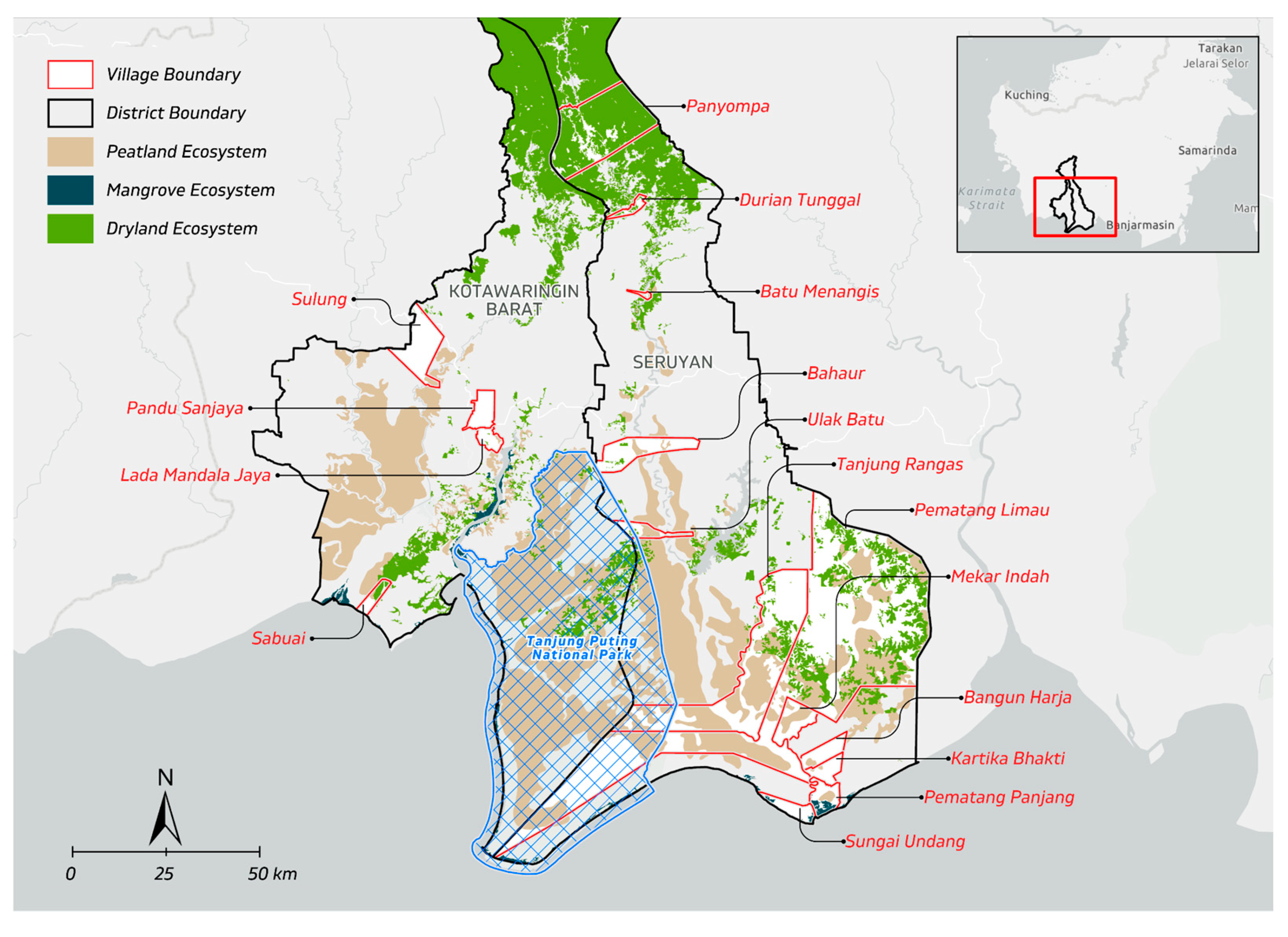
Figure 2.
Survival rate of tree seedlings and restoration effort index by planting year, 2021–2025. The solid green line represents the weighted survival rate (WSR), while the dashed blue line represents the restoration effort index for each planting year.
Figure 2.
Survival rate of tree seedlings and restoration effort index by planting year, 2021–2025. The solid green line represents the weighted survival rate (WSR), while the dashed blue line represents the restoration effort index for each planting year.
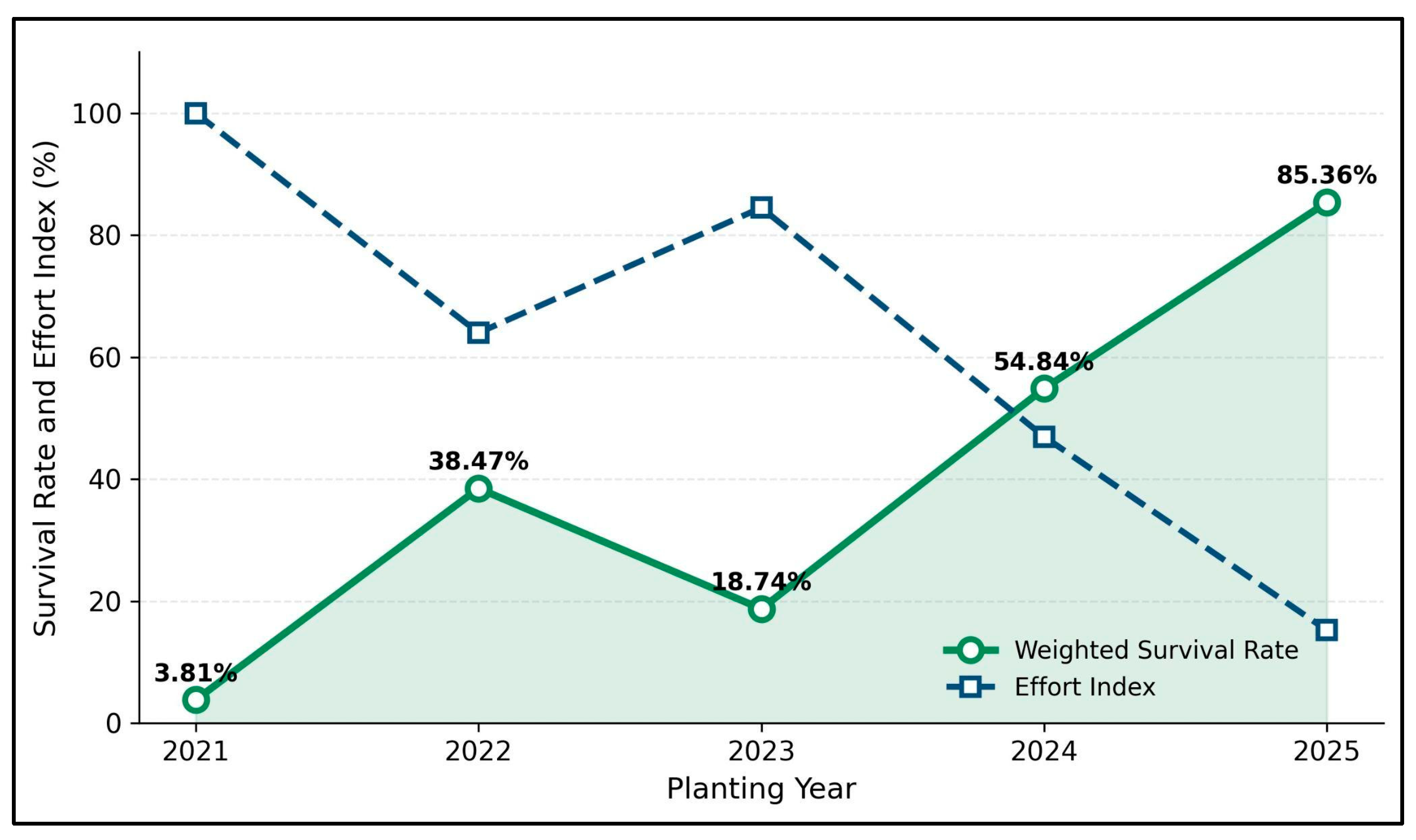
Figure 3.
Box plots showing the distribution of seedling survival rate (%) by (a) land cover, (b) land status, (c) land tenure, and (d) ecosystem type.
Figure 3.
Box plots showing the distribution of seedling survival rate (%) by (a) land cover, (b) land status, (c) land tenure, and (d) ecosystem type.
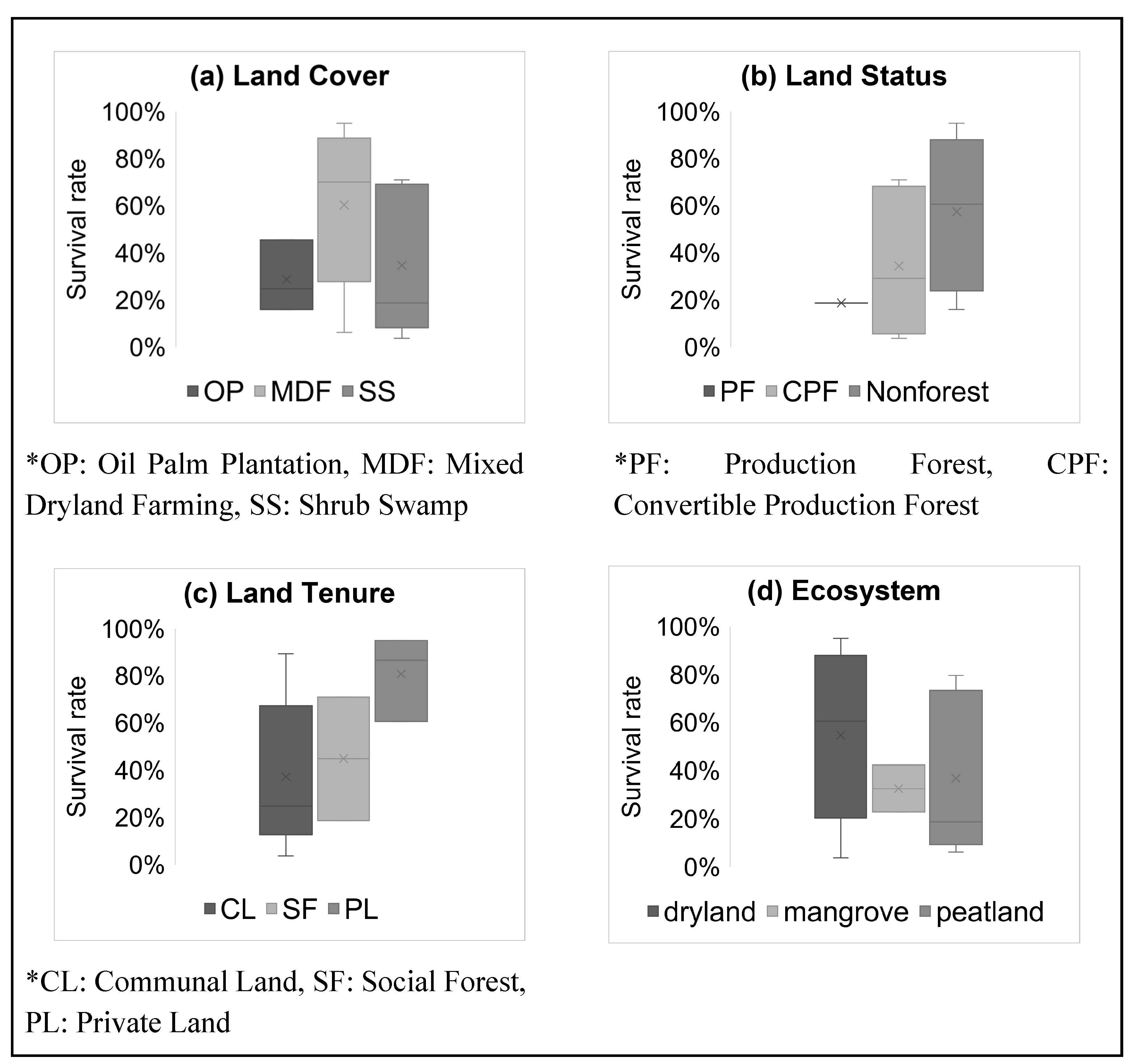
Figure 4.
PCA biplot of governance, management, and seedling characteristic variables in relation to seedling survival rate.
Figure 4.
PCA biplot of governance, management, and seedling characteristic variables in relation to seedling survival rate.
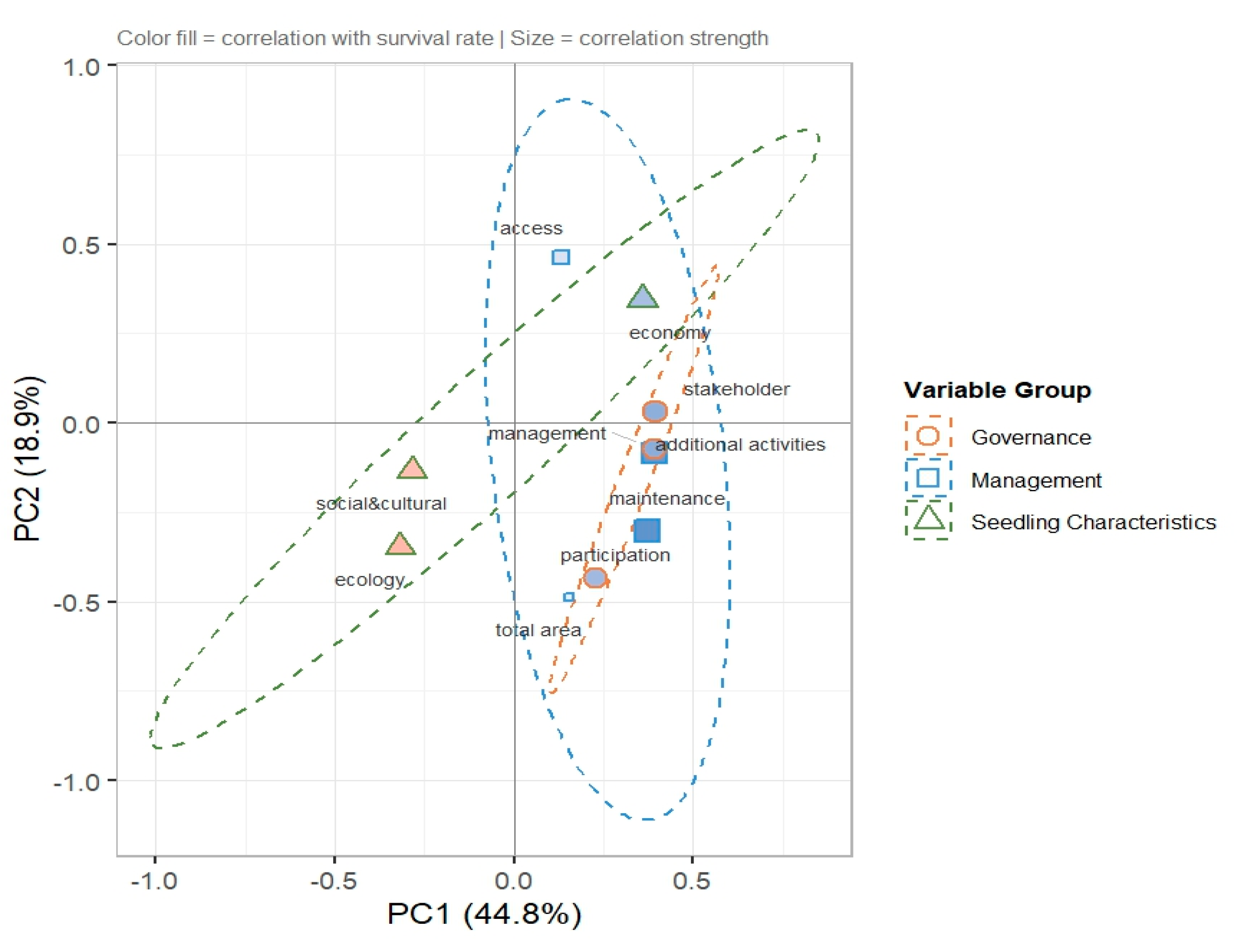
Figure 5.
PCA biplot of biophysical variables, including geophysical and climatic factors, in relation to seedling survival rate.
Figure 5.
PCA biplot of biophysical variables, including geophysical and climatic factors, in relation to seedling survival rate.
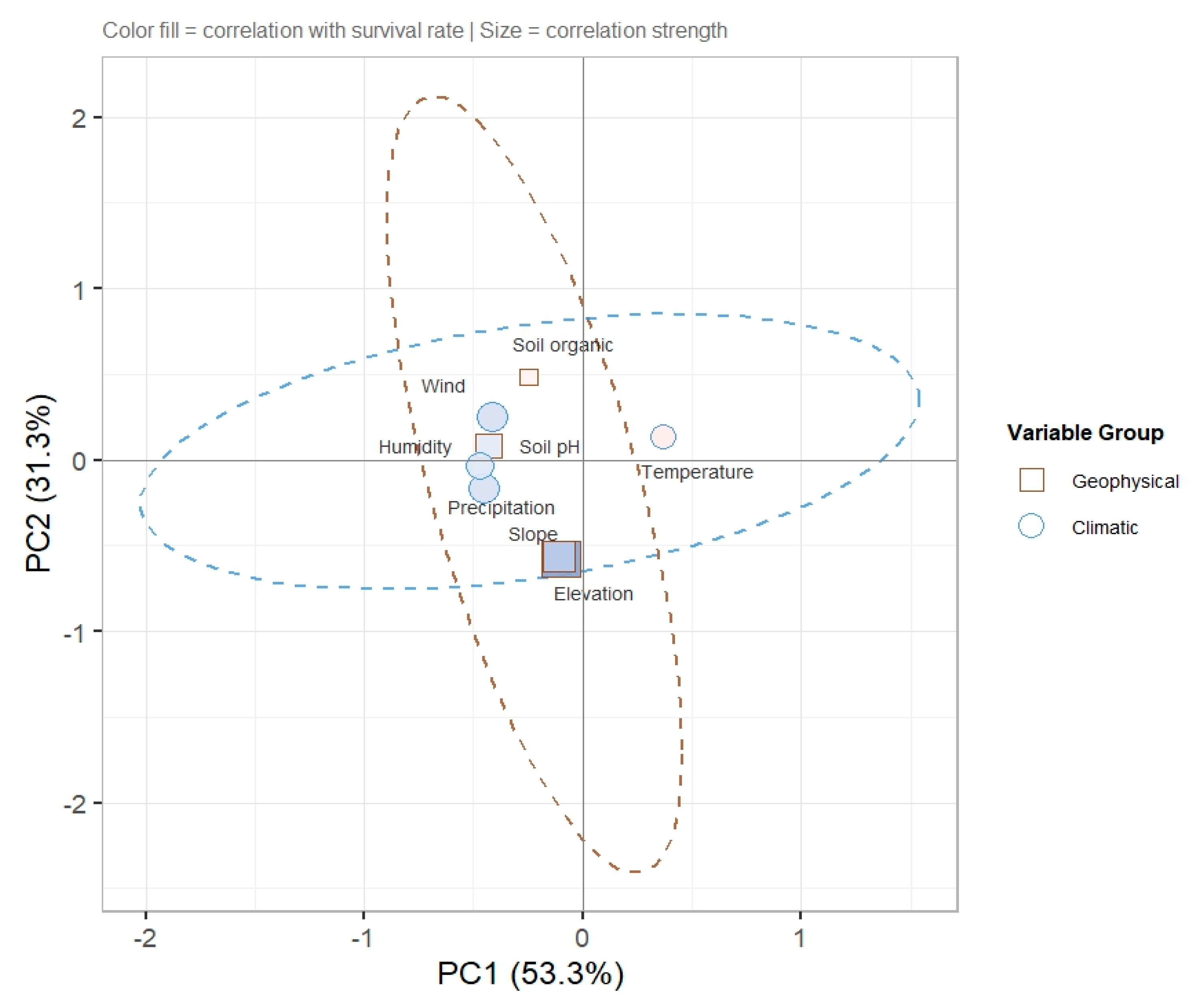
Figure 6.
Pearson correlation coefficients between seedling survival rate and key variables (n = 16).
Figure 6.
Pearson correlation coefficients between seedling survival rate and key variables (n = 16).
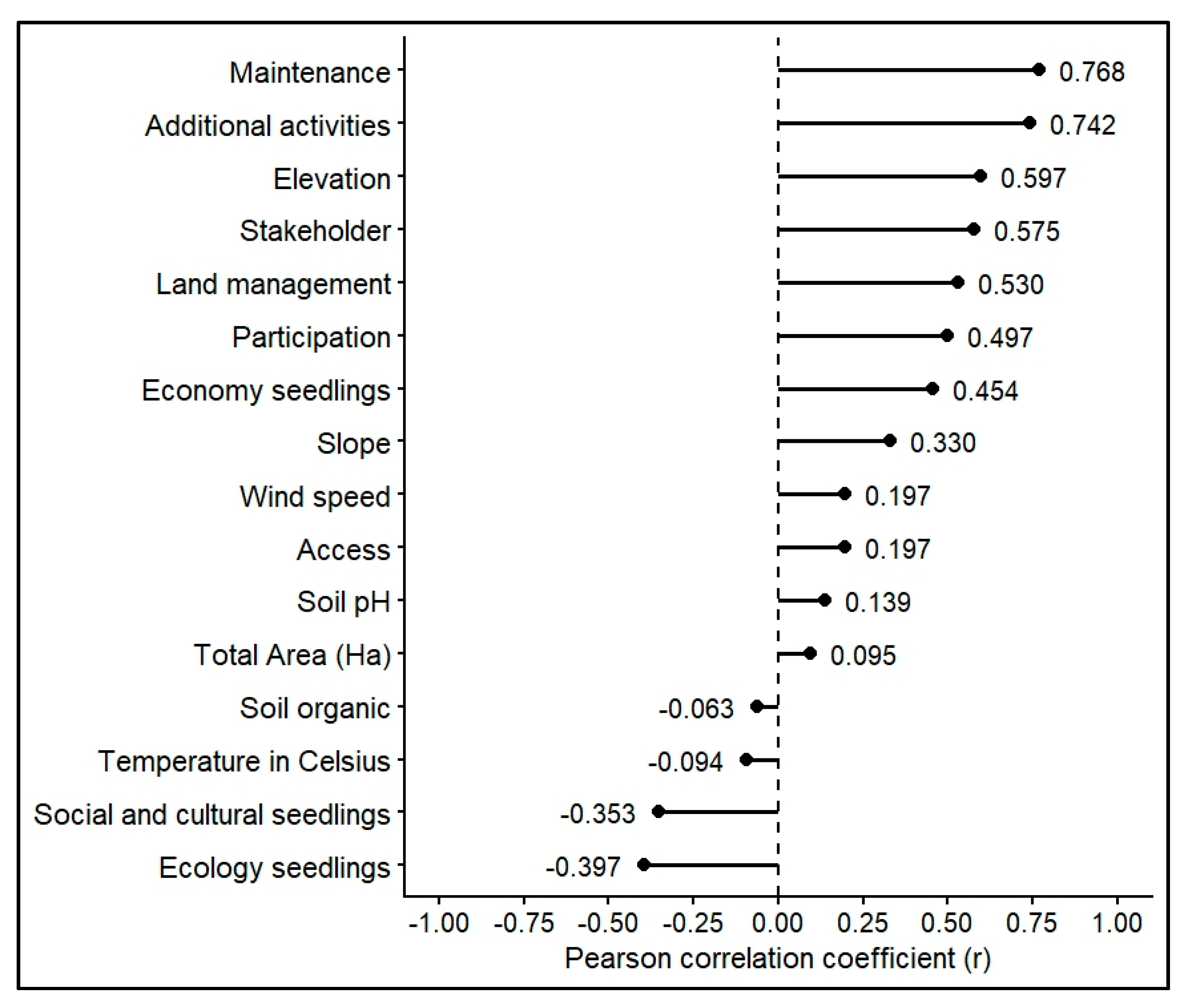

Table 1.
Villages where community-based restoration implemented in Seruyan and Kotawaringin Barat districts.
Table 1.
Villages where community-based restoration implemented in Seruyan and Kotawaringin Barat districts.
| Village | District | Ecosystem | Land status | Land tenure | Land cover |
| Lada Mandala Jaya | Kotawaringin Barat | Dryland | Non-forest Estate | Communal land | Oil Palm Plantation |
| Pandu Sanjaya | Kotawaringin Barat | Dryland | Non-forest Estate | Communal land | Oil Palm Plantation |
| Sabuai | Kotawaringin Barat | Mangrove | Non-forest Estate | Communal land | Mixed Dryland Farming |
| Sulung | Kotawaringin Barat | Peatland | Convertible Production Forest | Social Forestry | Mixed Dryland Farming; Oil Palm Plantation |
| Bahaur | Seruyan | Dryland | Convertible Production Forest | Communal land | Shrub Swamp |
| Bangun Harja | Seruyan | Dryland | Convertible Production Forest | Social Forestry | Secondary Swamp Forest |
| Batu Menangis | Seruyan | Dryland | Non-forest Estate | Individual land | Shrub Swamp |
| Durian Tunggal | Seruyan | Dryland | Non-forest Estate | Communal land | Shrub |
| Kartika Bhakti | Seruyan | Peatland | Non-forest Estate | Communal land | Dryland Farming |
| Mekar Indah | Seruyan | Peatland | Non-forest Estate | Communal land | Shrub Swamp |
| Panyompa | Seruyan | Dryland | Non-forest Estate | Communal land | Secondary Dryland Forest |
| Pematang Limau | Seruyan | Dryland | Production Forest | Communal land | Shrub Swamp |
| Pematang Panjang | Seruyan | Peatland | Non-forest Estate | Individual land | Dryland Farming |
| Sungai Undang | Seruyan | Mangrove | Non-forest Estate | Communal land | Mixed Dryland Farming; Aquaculture |
| Tanjung Rangas | Seruyan | Peatland | Convertible Production Forest | Communal land | Shrub Swamp |
| Ulak Batu | Seruyan | Dryland | Convertible Production Forest | Social Forestry | Oil Palm Plantation; Swamp |
Table 2.
Descriptive Statistics of Variables (n = 16).
| Variable | Mean | Standard Deviation | Maximum | Minimum |
| Survival rate (%) | 46.4 | 32.1 | 95 | 3.8 |
| Total Area (ha) | 19.26 | 14.966 | 55 | 1.6 |
| Maintenance | 0.518 | 0.652 | 2 | 0 |
| Stakeholder | 0.181 | 0.443 | 1.3 | 0 |
| Additional activities | 0.575 | 0.646 | 2 | 0 |
| Access | 1.062 | 0.770 | 2 | 0 |
| Participation | 0.906 | 0.560 | 2 | 0 |
| Land management | 0.187 | 0.403 | 1 | 0 |
| Economy seedlings | 0.585 | 0.294 | 1 | 0 |
| Ecology seedlings | 0.316 | 0.259 | 0.85 | 0 |
| Social and cultural seedlings | 0.095 | 0.0786 | 0.2 | 0 |
| Soil pH | 4.881 | 0.356 | 5.3 | 3.9 |
| Soil organic (%) | 42.201 | 16.351 | 67.222 | 13 |
| Elevation (m asl) | 14.567 | 20.996 | 75.196 | 0.873 |
| Slope (o) | 3.555 | 2.621 | 9.597 | 0.620 |
| Precipitation rate (kg/m2/s) | 9.35 x 10⁻⁵ | 3.24 x 10⁻⁵ | 1.21 x 10⁻⁴ | 0 |
| Wind speed (m/s) | 2.656 | 1.180 | 4.205 | 0 |
| Humidity (kg/kg) | 0.016 | 0.005 | 0.018 | 0 |
| Temperature (o C) | 25.62 | 1.114 | 28.25 | 24.04 |
Disclaimer/Publisher’s Note: The statements, opinions and data contained in all publications are solely those of the individual author(s) and contributor(s) and not of MDPI and/or the editor(s). MDPI and/or the editor(s) disclaim responsibility for any injury to people or property resulting from any ideas, methods, instructions or products referred to in the content. |
© 2026 by the authors. Licensee MDPI, Basel, Switzerland. This article is an open access article distributed under the terms and conditions of the Creative Commons Attribution (CC BY) license (http://creativecommons.org/licenses/by/4.0/).
Copyright: This open access article is published under a Creative Commons CC BY 4.0 license, which permit the free download, distribution, and reuse, provided that the author and preprint are cited in any reuse.