
Submitted:
23 September 2026
Posted:
24 September 2026
You are already at the latest version
Abstract
This study examines whether gender diversity in corporate leadership is associated with financial performance in the Serbian hotel sector. Drawing on the gender profitability paradox, it investigates whether female leadership serves as a strategic organizational resource or whether persistent structural barriers constrain its effects. The empirical analysis is based on a sample of 575 hotels operating in Serbia. Financial performance is assessed using Return on Equity (ROE), revenues, profitability margins, and asset turnover. Independent-samples t-tests examine differences between male- and female-led hotels, analysis of variance evaluates the association between female board representation and financial performance, and multiple regression analysis assesses the relationship between leadership gender and operational efficiency while controlling for hotel size, labor intensity, and hotel maturity. The results indicate that hotels headed by women achieve significantly higher ROE despite operating at a smaller revenue scale. Hotels with at least one female board member also exhibit significantly higher ROE. Regression analysis shows that leadership gender is not significantly associated with operational efficiency once firm characteristics are accounted for. Findings suggest that the relationship between gender diversity and hotel performance is multidimensional and context-dependent, emphasizing the importance of evaluating organizational performance through multiple complementary financial indicators.
Keywords:
corporate governance
; gender diversity
; hotel industry
; hotel performance
; operational efficiency
1. Introduction
Although women constitute the majority of the tourism workforce, a stark disparity persists between their statistical representation and their leadership authority. According to UN Tourism (World Tourism Organization), women account for about 54% of the global tourism workforce, and in many countries it exceeds the average observed in other economic sectors [1]. However, this numerical dominance does not translate into proportional representation in senior or decision-making positions. A substantial body of empirical research indicates that women in tourism are disproportionately concentrated in lower-level and less secure jobs, face limited career advancement opportunities, earn lower wages than their male counterparts, and are underrepresented in managerial and executive roles [1,2,3]. These patterns suggest that gender inequality in tourism is not the outcome of individual career preferences but rather reflects broader structural and institutional mechanisms that shape labor market segmentation. While tourism is often promoted as a sector with significant potential to foster women’s economic empowerment, employment within tourism does not operate independently from the wider labor market.
Consequently, the extent to which tourism can contribute to gender equality depends heavily on how deeply gender norms are embedded within a country’s social, political, and legal frameworks [4,5]. Even in highly developed economies, employment quality in tourism systematically differs by gender, with women more likely to experience inferior working conditions, reduced job security, and constrained access to leadership positions compared to men [6,7]. This persistent discrepancy between women’s strong presence in the operational workforce and their marginal representation in positions of authority highlights a central paradox within the tourism industry. It raises a critical question: whether gender disparities at the top of organizational hierarchies reflect strategic managerial choices or result from enduring structural constraints. This paradox provides the conceptual foundation for examining how gender diversity in leadership relates to firm performance in the hotel industry.
Existing evidence on the relationship between gender diversity and firm performance is highly speculative. While some studies find that female participation in corporate leadership relate to stronger monitoring mechanisms, improved decision quality, and superior financial outcomes [8], further studies report weak, insignificant, or context-dependent effects [9]. Systematic reviews likewise conclude that the relationship between gender diversity and firm performance remains highly heterogeneous, with results varying across institutional settings, governance structures, and performance measures [10]. These mixed findings imply that the economic consequences of gender diversity are likely to be context-dependent rather than universal.
This issue is particularly relevant in the hotel industry, where women constitute a substantial share of the workforce, which could be expected given that female employees tend to demonstrate a stronger customer focus, an important component of service orientation in the hospitality industry [11].
Still, neveretheless, women remain less visible in positions associated with strategic decision-making [12]. The coexistence of numerical dominance at the operational level and limited influence at the governance level creates a gender-profitability paradox. Greater female representation in leadership may enhance organizational performance through broader perspectives, improved stakeholder orientation, and more balanced decision processes [8,9]. However, deep-seated structural barriers and gender stereotypes can limit the organizational impact of female leaders, even after they secure official leadership capacities [13,14].
The Serbian hotel sector provides a particularly suitable setting for examining this paradox. As the industry enters a period of post-crisis stabilization, performance differences are less likely been motivated by extraordinary external shocks and more likely to reflect underlying organizational characteristics [15]. Although previous studies have documented persistent gender inequalities and barriers to women's career advancement in the Serbian hospitality industry [16], Little empirical attention has been paid to whether these structural inequalities are reflected in firm-level financial performance. By focusing on board leadership, female board representation, and organizational maturity, this study examines whether gender diversity contributes to superior organizational performance or whether deeper organizational and institutional structures continue to constrain its effects.
Unlike previous studies that have primarily examined leadership gender or board composition separately [8,9], this study jointly considers leadership gender, female board representation, and firm maturity within a single analytical framework. In doing so, it contributes to a more comprehensive understanding of how different dimensions of gender diversity relate to financial performance in the Serbian hotel sector.
Building on the theoretical arguments presented above, the following hypotheses are proposed.
Research Hypotheses
H1: Hotels with a female Head of the Board exhibit significantly higher profitability compared to male-led hotels.
H2: Hotels with at least one female board member exhibit significantly different financial performance from hotels with exclusively male boards.
H3: The impact of female leadership on hotel operational efficiency is contingent upon firm maturity, with female-led hotels exhibiting higher operational efficiency in younger hotels than in mature hotels.
2. Literature Review
This literature review examines the relationship between gender diversity and firm performance through three interrelated perspectives: the theoretical foundations of gender roles in leadership, the empirical evidence on financial performance, and the institutional and structural characteristics of the hospitality sector. Together, these perspectives provide the theoretical foundation for examining whether the relationship between gender diversity and firm performance is better explained by strategic leadership advantages or by persistent structural constraints.
2.1. Theoretical Framework of Gender Roles and Leadership
Gender role theory posits that societies ascribe distinct behavioral traits and expectations to individuals based on gender. These socially and culturally embedded stereotypes frequently portray women as primarily responsible for household and caregiving roles and as less capable than men of accumulating the human capital required for career advancement [17,18]. In addition, women are often perceived as having limited career aspirations and weaker access to the professional networks needed to reach senior leadership positions [19]. Such perceptions translate into tangible professional consequences. For example, drawing on data from more than 2,000 U.S.-based firms, Compton et al. [13] demonstrate that female directors are significantly less likely to be appointed in regions characterized by conservative social norms. This evidence suggests that regional cultural environments function as structural barriers that restrict women’s access to leadership roles, independent of individual qualifications.
Beyond barriers to entry, gender stereotypes also shape internal leadership dynamics. Pletzer et al. [20] argue that increased gender diversity on boards may intensify intergroup tensions, potentially impairing communication, reducing cohesion, and weakening strategic consensus. These challenges are particularly consequential in dynamic business environments that demand rapid, coordinated decision-making. These challenges may be further exacerbated when women work within male-dominated boards and confront role incongruity or role ambiguity, both of which can undermine perceived legitimacy and effectiveness [14].
At the same time, gender role theory does not imply that women merely face external constraints. The theory also suggests that men and women may develop different leadership styles due to socially reinforced expectations and professional experiences [21]. While such differences should not be interpreted as evidence of superior managerial capability, they may influence strategic priorities, risk preferences, communication patterns, and resource allocation decisions [22,23]. These potential differences provide a theoretical basis for examining whether leadership gender is associated with distinct organizational outcomes.
Accordingly, gender role theory does not predict a single directional effect of female leadership on organizational performance. Instead, it offers two competing explanations for performance differences associated with leadership gender. The first emphasizes structural constraints, suggesting that female leaders may face reduced authority, limited access to strategic networks, and greater scrutiny from stakeholders, potentially constraining organizational outcomes [13,14]. The second emphasizes strategic differentiation, proposing that women may develop distinct managerial approaches shaped by different professional experiences and social expectations. These approaches may influence financial discipline, stakeholder management, and resource allocation decisions [22,23]. These mechanisms are particularly relevant in board settings, where strategic decisions emerge through collective deliberation, monitoring activities, and resource allocation processes [9]. Consequently, any observed relationship between leadership gender and firm performance may reflect either persistent structural barriers or differences in strategic orientation. This theoretical perspective provides the conceptual foundation for the empirical analysis, which examines whether the relationship between gender diversity and hotel performance is better explained by strategic leadership advantages or by persistent structural constraints.
2.2. Gender Diversity on Boards of Directors and Financial Performance: Between Efficiency and Size
Building on gender role theory, empirical research has produced mixed evidence regarding the relationship between gender diversity and firm performance, as persistent stereotypes can directly or indirectly constrain women’s effectiveness in leadership roles. Several studies report negative associations between female board representation and firm performance across different national contexts, including the United States [9], Indonesia [24], and Spain [25]. However, these findings are far from universal. Eklund et al. [26], for instance, report that adverse effects may diminish in larger boards, indicating that firm structure and governance design play an important moderating role. These theoretical and empirical tensions are especially salient in service-oriented industries, where leadership identity, organizational scale, and performance metrics intersect most visibly [27].
One explanation for these divergent findings lies in the distinction between organizational scale and organizational efficiency. Recent evidence suggests that gender diversity is more strongly associated with efficiency-based indicators than with measures of absolute size or market dominance [22,28]. While male-led firms may outperform in terms of revenues, asset growth, or market expansion, female-led firms often demonstrate stronger performance when evaluated through indicators such as Return on Assets (ROA) or Return on Equity (ROE). This distinction is particularly relevant in capital-intensive industries, where profitability depends not only on revenue generation but also on the efficiency with which available resources are utilized. This distinction suggests that the relationship between leadership gender and performance may depend on the specific dimension of performance being evaluated.
Prior research further suggests that female leaders frequently adopt managerial approaches characterized by stronger financial discipline, lower risk tolerance, and more cautious resource allocation decisions [22,23]. These approaches may not necessarily maximize organizational scale, but they may contribute to more efficient resource utilization, potentially leading to stronger profitability outcomes. Consequently, any performance advantage associated with female leadership may be more visible through efficiency-oriented measures than through indicators of organizational size.
Beyond differences in managerial approaches, previous studies have also examined whether the effects of board gender diversity depend on how women are represented on corporate boards. While some authors argue that very limited female representation may result in symbolic participation with little influence on strategic decision-making [29], others suggest that greater representation strengthens women’s contributions to board deliberations and organizational outcomes [30]. However, empirical evidence remains inconclusive, suggesting that the relationship between female board representation and firm performance depends on organizational and institutional context rather than following a uniform pattern [10].
Evidence from the hospitality sector likewise suggests that the relationship between board gender diversity and firm performance is shaped by the institutional and organizational environment in which hotels operate [31]. For example, Chen et al. [27] report that the performance effects of board gender diversity vary across different organizational and institutional contexts. These findings further support the view that the relationship between gender diversity and firm performance cannot be assumed to be universally positive or negative.
In transition economies such as Serbia, these findings raise the question of whether the relationship between gender diversity and firm performance differs from that observed in more developed economies, particularly in asset-intensive industries such as hospitality [10]. This distinction may be particularly relevant in the hotel industry, where profitability is influenced not only by revenue generation but also by the efficiency with which capital-intensive assets are utilized [27]. As a transition economy characterized by persistent gender inequalities in leadership positions [16], Serbia provides a valuable setting for examining whether the relationship between gender diversity and firm performance follows patterns observed in more developed markets. In particular, the Serbian hotel sector offers an appropriate context for investigating whether female leadership and female board representation are associated with superior financial performance or whether persistent structural constraints continue to limit their organizational impact.
2.3. Institutional Context and Structural Determinants of Gender Inequality in the Hospitality Industry
The impact of gender diversity on financial outcomes is often shaped by broader environmental factors, making it necessary to examine how institutional and structural barriers manifest in different economic contexts [10]. The practical implications of these dynamics are particularly pronounced in transition economies, where traditional social roles frequently collide with modern entrepreneurial and managerial demands. Evidence from Slovenia indicates that female entrepreneurs’ identities remain deeply embedded in institutional and social contexts, balancing economic objectives with autonomy, family responsibilities, and community engagement [32]. These competing pressures often generate tensions between growth ambitions and caregiving roles, while support ecosystems remain fragmented and unevenly developed.
This interaction between institutional embedding and strategic choice is especially evident in the hospitality sector. An analysis of the Italian hotel industry by Menicucci et al. [33] provides a nuanced view of the gender–profitability paradox. While descriptive statistics may suggest weaker performance among women-managed hotels due to their smaller scale, controlling for demographic, financial, and family-related factors reveals that these establishments outperform male-led counterparts in terms of growth. Such findings suggest that at least part of the observed performance gap may reflect structural constraints rather than differences in managerial capability. This interpretation reinforces the argument that organizational outcomes should be evaluated within the broader institutional context in which firms operate.
Evidence from the Spanish hospitality sector further demonstrates that gender disparities are deeply rooted in wage distributions and occupational segregation [34,35]. While the sector offers competitive pay for unskilled labour, a significant wage gap persists in high-wage positions, largely driven by observable structural factors such as lower seniority, lack of supervisory responsibilities, and the concentration of women in low-wage firms. A critical finding across these studies is the existence of the glass ceiling effect, where highly qualified women are doubly penalized by both job segregation and unfavourable wage treatment. Even when comparing observationally identical employees within the same firm, a substantial portion of the pay gap remains unexplained, pointing to persistent gender discrimination as a primary structural constraint within the industry.
Collectively, these patterns suggest that observed performance differences often stem from institutional and structural constraints rather than differences in managerial competence. This underscores the importance of examining country-specific contexts where such constraints may be particularly influential.
This broader contextual perspective is consistent with tourism systems theory, which views tourism as an interconnected system in which organizational performance is shaped not only by internal resources but also by institutional conditions and destination-level characteristics [36,37]. From this perspective, differences between male-led and female-led hotels may reflect unequal access to resources, professional networks, and development opportunities embedded within the wider tourism system [38].
The systems perspective is particularly relevant in the Serbian tourism context, where destinations differ considerably in their levels of tourism development and institutional capacity. Recent evidence suggests that tourism development in Serbia remains uneven across destinations and is influenced by the effectiveness of planning and coordination mechanisms [39]. Consequently, hotels operate under heterogeneous market and institutional conditions, which may shape the relationship between leadership characteristics and organizational performance. This reinforces the argument that observed performance differences should be interpreted within the interaction of organizational and contextual factors rather than being attributed solely to leadership characteristics [38].
These considerations may be particularly relevant in transition economies, where institutional change often progresses faster than shifts in social norms and organizational practices. Despite the growing body of international evidence, limited empirical attention has been devoted to examining whether the structural barriers documented in the Serbian hospitality sector translate into measurable differences in firm-level financial performance. Evidence from the Serbian hospitality sector further reinforces these broader patterns. Research conducted in Vojvodina confirms the existence of glass ceiling barriers within the hotel industry, demonstrating that women face significant discrimination regarding both management positions and earnings, regardless of their level of education [16]. These findings are consistent with broader evidence from the Serbian tourism sector. Research involving more than 200 tourism professionals confirms that women continue to face systemic discrimination and the glass ceiling regardless of their educational attainment [40]. Taken together, these findings provide a strong rationale for examining whether the structural barriers documented in the Serbian hospitality sector are reflected in firm-level financial performance and patterns of gender diversity in corporate leadership.
The influence of leadership characteristics may also vary across different stages of organizational development. Younger hotels typically operate with less formalized structures, greater strategic flexibility, and stronger dependence on managerial decision-making [41,42]. In such settings, leadership characteristics may exert a stronger influence on resource allocation, strategic priorities, and operational efficiency [41]. By contrast, mature hotels rely more heavily on established routines, standardized procedures, and institutionalized governance mechanisms, potentially reducing the relative impact of individual leaders on organizational outcomes [43]. This distinction is particularly relevant in the hospitality sector, where organizational structures and governance mechanisms may differ substantially between newly established and mature hotels. Consequently, performance effects associated with leadership gender may be expected to emerge more clearly in younger hotels than in mature organizations.
Furthermore, limited attention has been devoted to whether the relationship between gender diversity and performance varies across stages of organizational development, particularly within the hotel industry. By moving beyond the analysis of individual attitudes and workplace experiences to the evaluation of firm-level financial indicators such as ROE, this study examines whether the structural barriers documented in the Serbian hospitality sector are reflected in organizational performance. It further investigates whether the presence of women in leadership positions is associated with differences in financial performance and whether these relationships vary across stages of organizational development within the Serbian hotel sector.
The theoretical perspectives and empirical evidence discussed in this literature review are synthesized into the conceptual model presented in Figure 1, which illustrates the proposed relationship between gender diversity and hotel performance and guides the empirical analysis.
2.4. Limitations of Existing Research and the Research Gap
While previous studies have extensively examined the relationship between gender diversity and firm performance, several important limitations remain [10]. First, although the hospitality sector provides a particularly relevant context for examining gender-related leadership dynamics, it has received considerably less attention than manufacturing, financial, and other corporate sectors [12]. Second, existing research has largely examined leadership gender and board gender diversity separately, while limited attention has been devoted to their joint relationship with firm performance. Third, little is known about whether these relationships vary across stages of organizational development, particularly within transition economies characterized by persistent structural barriers and gender inequalities. These limitations are particularly relevant in the Serbian hotel sector, where women constitute a half of the tourism workforce but remain underrepresented in leadership positions. This raises an important question as to whether their limited representation reflects the underutilization of valuable managerial resources or the persistence of structural constraints.
3. Research Methodology
The empirical analysis draws on a final sample of 575 hotels, which closely approximates a census of formally registered hotel establishments operating in Serbia in 2024. Financial and corporate governance data were obtained from the official site of the Business Register Agency (BRA), which provides publicly available financial statements and corporate governance information for registered firms.
The year 2024 was selected as the reference period to ensure that the analysis captures a phase of restored economic stability and normalized business activity. This choice is further supported by recent evidence from the Serbian luxury hotel sector, indicating that key profitability indicators, including Return on Assets (ROA) and Return on Equity (ROE), had recovered to positive levels following the post-pandemic period, although some operational cost pressures persisted [15]. Consequently, 2024 provides a stable and representative setting for examining the relationship between leadership characteristics and firm performance under normalized market conditions.
The comprehensiveness of the dataset enhances the external validity of the study, as the sample closely mirrors the overall population of hotels in the Serbian market. The reliance on administrative, firm-level data derived from officially reported financial statements substantially reduces common methodological concerns associated with survey-based research, including self-selection bias, non-response bias, and common method variance. The use of objectively reported financial and organizational information further minimizes measurement error and strengthens the reliability of the performance indicators employed in the analysis.
To account for heterogeneity in organizational structure and strategic behaviour across different stages of firm development, the sample is stratified according to firm maturity. Using the median age of establishments as a cutoff point, hotels are classified into younger (288) and older (287) firms. This stratification facilitates a balanced comparison between early-stage and mature hotels and allows the empirical analysis to assess whether the relationship between leadership attributes and performance outcomes varies across stages of the hotel life cycle.
Given that hotel boards in Serbia are typically very small, with a median board size usually of one member, the empirical analysis focuses on the presence of female board representation rather than on the proportion of women serving on the board.
The following section presents the variables employed in the empirical analysis and their operationalization.
3.1. Operationalization of Variables
The variables employed in the analysis are organized into two conceptually distinct groups. The first group comprises financial performance and organizational characteristics, including Revenue, Gross margin, Net margin, Net result, Equity, Return on Equity (ROE), Total assets, Number of employees, and Asset turnover. Together, these variables capture differences in hotel size, profitability, and operational efficiency. To reduce the influence of extreme values commonly observed in financial data, ROE was transformed into deciles prior to the analysis. This transformation mitigates the influence of extreme observations and highly skewed values while preserving the relative ranking of firms. Similarly, asset turnover was winsorized at the 1st and 99th percentiles prior to the regression analysis, following the same rationale applied to ROE.
The second group comprises governance and leadership variables, with particular emphasis on gender representation at the board level. It includes a location indicator distinguishing hotels operating in Belgrade from those located in other cities, the gender of the Head of the Board, board size, the number of female board members, and a binary indicator capturing the presence of at least one female board member. These variables enable the examination of whether leadership characteristics and board gender representation are associated with differences in hotel performance.
Table 1 summarizes the definitions and operationalization of all variables included in the empirical analysis.
3.2. Methodological Approach and Methods of Statistical Analysis
The empirical analysis is conducted in several steps. All statistical analyses were performed using the IBM SPSS Statistics, Version 27.0. First, descriptive statistics are used to provide an overview of the sample and to summarize the main characteristics of the variables employed in the study. Descriptive statistics are reported separately for financial performance variables and for governance-related and categorical variables, allowing for an initial assessment of differences in hotel size, profitability, efficiency, and leadership structure.
Second, independent-sample t-tests are applied to examine whether statistically significant differences in performance exist between hotels led by male and female Heads of the Board. This approach enables a direct comparison of average performance outcomes across leadership gender groups. Third, Analysis of Variance (ANOVA) is employed to examine whether financial performance differs according to female board representation. Hotels are classified into two groups based on the presence or absence of at least one female board member. This approach enables the assessment of whether board gender representation is associated with differences in financial performance across hotels.
Finally, multiple linear regression analysis is employed to examine the relationship between leadership gender and operational efficiency while controlling for firm-level characteristics. Operational efficiency is measured using asset turnover as the dependent variable, reflecting the ability of hotels to generate revenue relative to their asset base. While ROE serves as the primary indicator of financial performance throughout the study, asset turnover is used as a complementary measure of operational efficiency in the regression analysis. The key explanatory variable is the gender of the Head of the Board, while firm size and labor intensity are included as control variables, proxied by the logarithm of total assets and the number of employees, respectively. To account for differences across stages of organizational development, the regression models are estimated separately for younger and mature hotels. Multicollinearity among the explanatory variables is assessed using the Variance Inflation Factor (VIF), with all values remaining well below commonly accepted thresholds, indicating no evidence of problematic multicollinearity.
The following regression specification formalizes the empirical model used to examine the relationship between leadership gender and operational efficiency.
3.3. Specification of the Empirical Model
The regression model used to examine the determinants of operational efficiency is specified as follows:
where winsorized Asset Turnoverᵢ denotes asset turnover for hotel i, Female Leaderᵢ is a binary variable indicating whether the Head of the Board is female, Sizeᵢ is measured as the natural logarithm of total assets, Employeesᵢ denotes the number of employees, and εᵢ is the error term.
Asset Turnoverᵢ = β₀ + β₁(Female Leaderᵢ) + β2(Sizeᵢ) + β3(Employeesᵢ) + εᵢ
The model is estimated separately for younger and mature hotels to examine whether the relationship between leadership gender and operational efficiency differs across stages of organizational development.
4. Results
4.1. Descriptive Statistics
This section presents the descriptive statistics of the variables included in the empirical analysis and provides an initial overview of the characteristics of the sample. The results are presented in two parts. The first summarizes the financial performance and operational characteristics of the sampled hotels, including indicators of profitability, firm size, and operational efficiency. The second presents the descriptive statistics of the corporate governance variables, providing an overview of board structure, leadership characteristics, and female representation within the Serbian hotel sector.

Table 2.
Descriptive statistics of financial performance and operational variables.
| Revenue | Gross margin | Net margin | Net result | Equity | ROE | Total assets | Number of employees | Asset turnover | |
| N | 575 | 575 | 575 | 575 | 575 | 575 | 575 | 575 | 575 |
| Minimum | 89,066 | -1.90 | -4.27 | -3,872,678 | 0.00 | -390,110,000 | 418.75 | 1.00 | 0.01 |
| Maximum | 42,216,350 | 0.95 | 5.26 | 10,005,700 | 54,675,900 | 91,847,000 | 95,294,531 | 530.00 | 319.27 |
| Mean | 1,149,424 | 0.20 | 0.02 | 83,847 | 1,396,635 | −2,229,864 | 2,987,029 | 22.87 | 3.18 |
| Standard Deviation | 2,874,568 | 0.24 | 0.44 | 689,960 | 4,763,076 | 21,890,880 | 8,168,186 | 41.33 | 15.44 |
The financial and operational profile of the 575 hotels reveals substantial heterogeneity in firm size, profitability, and operational efficiency. Average revenue amounts to approximately EUR 1.15 million, while the standard deviation of approximately EUR 2.87 million indicates considerable variation in the size of hotel operations. Gross margins average approximately 20%, whereas net margins average only around 2%, indicating that overall profitability is substantially lower after accounting for operating and other business expenses.
The profitability measures likewise exhibit substantial variation across firms. Although the average net result is positive, Return on Equity (ROE) exhibits substantial variability, with both extremely negative and highly positive values observed within the sample. The wide dispersion of ROE values reflects pronounced differences in financial performance across hotels. To reduce the influence of extreme observations, ROE was transformed into deciles in the subsequent analyses. Specifically, hotels were ranked according to their raw ROE values and divided into ten equally sized groups, coded from 1 (lowest ROE decile) to 10 (highest ROE decile), so that a higher decile value indicates stronger relative financial performance. Asset turnover exhibited a small number of extreme values; for the regression analysis (Section 4.3), this variable was winsorized at the 1st and 99th percentiles to mitigate the influence of these observations, consistent with the treatment applied to ROE. This procedure was implemented using the Rank Cases function in IBM SPSS Statistics. Considerable variation is also observed in the operational characteristics of the hotels. The average hotel employs approximately 23 employees, although employment levels differ substantially across firms. Similarly, asset turnover exhibits considerable dispersion, indicating marked differences in the efficiency with which hotels utilize their asset base to generate revenue.
Overall, the descriptive statistics demonstrate substantial variation in hotel size, profitability, and operational efficiency across the sampled hotels. The following table summarizes the governance and leadership characteristics of the sampled hotels, providing an overview of board structure and female representation within the Serbian hotel sector.
Table 3.
Descriptive statistics of corporate governance variables.
| Belgrade -1, other cities - 0 | Gender of the head of the Board (1-male, 2 - female) | Board size | Number of female board members | At least 1 female on board | |
| N | 575 | 575 | 575 | 575 | 575 |
| Mean | 0.40 | 1.28 | 1.17 | 0.31 | 0.29 |
| Median | 0.00 | 1.00 | 1.00 | 0.00 | 0.00 |
| Mode | 0 | 1 | 1 | 0 | 0.00 |
| Standard Deviation | 0.49 | 0.45 | 0.72 | 0.53 | 0.46 |
| Minimum | 0 | 1 | 1 | 0 | 0.00 |
| Maximum | 1 | 2 | 9 | 5 | 1.00 |
| Sum | 230 | 735 | 673 | 180 | 168.00 |
With respect to governance characteristics, the sample is predominantly male-led and geographically dispersed outside the capital city. Approximately 40% of hotels operate in Belgrade, while the remaining firms are located in other cities. Boards are generally very small, with a median size of one member, indicating that governance structures in Serbian hotels are often highly concentrated and cantered around a single decision-maker. Female representation at the board level remains limited: female Heads of the Board account for approximately 28% of the sample, and fewer than one-third of firms report at least one female board member. On average, hotel boards include less than one female member (mean = 0.31), further highlighting the limited representation of women in corporate governance within the Serbian hotel sector. These descriptive patterns provide an initial overview of the governance structure of Serbian hotels and establish the basis for the subsequent inferential analyses, which examine whether differences in leadership characteristics and board gender composition are associated with variations in organizational performance.
Following the descriptive analysis, the empirical investigation proceeds through three complementary stages. First, independent-samples t-tests are employed to examine whether financial performance differs between hotels led by male and female Heads of the Board. Second, Analysis of Variance (ANOVA) is used to assess whether financial performance differs between hotels with and without female board representation. Finally, multiple regression analysis is performed to evaluate the relationship between leadership gender and operational efficiency while controlling for firm-level characteristics, with separate models estimated for younger and mature hotels.
Table 4.
Independent-samples t-test comparing financial performance by the gender of the head of the board.
Table 4.
Independent-samples t-test comparing financial performance by the gender of the head of the board.
| F | Sig. | t | df | Sig. (2-tailed) | Mean Difference | Std. Error Difference | 95% Confidence Interval of the Difference | |||
| Lower | Upper | |||||||||
| ROE decile | Equal variances assumed | 3.23 | 0.07 | -2.36 | 573.00 | 0.02 | -0.58 | 0.24 | -1.05 | -0.10 |
| Equal variances not assumed | -2.29 | 271.67 | 0.02 | -0.58 | 0.25 | -1.07 | -0.08 | |||
| Net margin | Equal variances assumed | 1.63 | 0.20 | 0.20 | 573.00 | 0.84 | 0.01 | 0.04 | -0.07 | 0.09 |
| Equal variances not assumed | 0.28 | 570.69 | 0.78 | 0.01 | 0.03 | -0.05 | 0.07 | |||
| Gross margin | Equal variances assumed | 1.92 | 0.17 | 0.34 | 573.00 | 0.73 | 0.01 | 0.02 | -0.04 | 0.05 |
| Equal variances not assumed | 0.40 | 393.28 | 0.69 | 0.01 | 0.02 | -0.03 | 0.05 | |||
| Revenues | Equal variances assumed | 8.89 | 0.00 | 2.12 | 573.00 | 0.03 | 565,463 | 266,688 | 41,658 | 1,089,269 |
| Equal variances not assumed | 2.75 | 524.85 | 0.01 | 565,463 | 205,589 | 161,585 | 969,342 |
Notes: F – F-statistic; Sig. – p-value; t – t-statistic; df – degrees of freedom; Sig. (2-tailed) – two-tailed p-value; Std. Error Difference – standard error of the difference.
A comparison of hotels according to the gender of the Head of the Board reveals statistically significant differences in revenue and return on equity, whereas no significant differences are observed for gross margin or net margin. Hotels headed by men report significantly higher average revenues (M = EUR 1.31 million) than hotels headed by women (M = EUR 0.74 million; p = 0.006), indicating that male-led hotels generally operate on a larger organizational scale. Given the cross-sectional nature of the data, the observed association may reflect selection effects in leadership appointment (e.g., a tendency to appoint men to larger, higher-revenue properties) rather than a causal effect of leader gender on hotel performance. In contrast, hotels headed by women achieve significantly higher average ROE deciles (M = 4.78) than hotels headed by men (M = 4.20; p = 0.019).
The absence of statistically significant differences in gross margin and net margin suggests that the two groups exhibit comparable operating profitability. At the same time, the coexistence of higher revenues among hotels headed by men and higher ROE among hotels headed by women indicates that organizational size and profitability relative to shareholders' equity do not necessarily follow the same pattern. These findings provide partial support to test the first hypothesis (H1), suggesting that hotels headed by women achieve higher profitability when measured by ROE despite operating at a smaller revenue scale. While the previous analysis compares hotels according to the gender of the Head of the Board, the following analysis shifts the focus to board composition by examining whether the presence of at least one female board member is associated with differences in financial performance.
Table 5.
ANOVA.
| Sum of Squares | df | Mean Square | F | Sig. | ||
| Revenues | Between Groups | 4,980,291,374,443 | 1 | 4,980,291,374,443 | 0.60 | 0.44 |
| Within Groups | 4,738,062,627,655,067 | 573 | 8,268,870,205,332 | |||
| Total | 4,743,042,919,029,510 | 574 | ||||
| Gross margin | Between Groups | 0.00 | 1 | 0.00 | 0.02 | 0.90 |
| Within Groups | 32.51 | 573 | 0.06 | |||
| Total | 32.51 | 574 | ||||
| Net margin | Between Groups | 0.00 | 1 | 0.00 | 0.00 | 0.98 |
| Within Groups | 112.48 | 573 | 0.20 | |||
| Total | 112.48 | 574 | ||||
| ROE decile | Between Groups | 30.80 | 1 | 30.80 | 4.48 | 0.04 |
| Within Groups | 3941.68 | 573 | 6.88 | |||
| Total | 3972.48 | 574 | ||||
| Net result | Between Groups | 228,085,375,695 | 1 | 228,085,375,695 | 0.48 | 0.49 |
| Within Groups | 273,021,804,041,343 | 573 | 476,477,843,004 | |||
| Total | 273,249,889,417,038 | 574 |
Notes: df – degrees of freedom; F – F-statistic; Sig. – p-value.
The ANOVA results indicate that hotels with and without female board representation differ significantly only in return on equity, whereas no statistically significant differences are observed for revenues, gross margin, net margin, or net result. Hotels with at least one female board member report significantly higher average ROE decile values (M = 4.72) than hotels with exclusively male boards (M = 4.21; F = 4.477, p = 0.035).
The absence of statistically significant differences for the remaining financial indicators indicates that the observed association with female board representation is limited to return on equity. Accordingly, these results provide empirical support to test the second hypothesis (H2).
The final stage of the empirical analysis builds on these findings by examining whether the relationship between leadership characteristics and operational efficiency differs across stages of firm maturity after controlling for organizational characteristics.
4.2. Regression
The regression results for asset turnover across firms at different stages of maturity are presented in Table 6.
Standard errors in parentheses. *** denotes statistical significance at the 1% level. All Variance Inflation Factor (VIF) values range between 1.0 and 1.5, indicating no evidence of problematic multicollinearity.
Multiple regression analysis was employed to examine the determinants of operational efficiency, measured by asset turnover, while controlling for firm size and labour intensity. Separate models were estimated for younger and mature hotels to assess whether the effects of leadership characteristics varied across stages of organizational development. Multicollinearity diagnostics based on the VIF indicated no evidence of problematic collinearity, with all values ranging between 1.0 and 1.5.
For younger hotels, the regression model is statistically significant and explains approximately 46% of the variation in asset turnover (Adjusted R² = 0.463). Asset turnover is negatively associated with total assets and positively associated with the number of employees, indicating that smaller hotels with a larger workforce relative to their asset base achieve higher operational efficiency. The estimated coefficient for the gender of the Head of the Board is positive but statistically insignificant. Therefore, no evidence is found that female leadership is associated with higher operational efficiency among younger hotels.
Unlike the model for younger hotels, the model for mature hotels explains a comparatively smaller share of the variation in asset turnover (Adjusted R² = 0.333). The direction of the control variables remains unchanged, with larger asset bases associated with lower asset turnover and employment positively related to operational efficiency. As in the younger subsample, the gender of the Head of the Board does not exhibit a statistically significant relationship with asset turnover, indicating that leadership gender is not a significant determinant of operational efficiency among mature hotels. Unlike the results obtained for profitability, the regression analysis indicates that leadership gender does not significantly influence operational efficiency once firm characteristics are taken into account. Consequently, the regression results do not provide empirical support to test the third hypothesis (H3). Taken together, the empirical findings provide different levels of support for the proposed hypotheses.
5. Discussion
The empirical evidence indicates that the relationship between gender diversity and hotel performance is more nuanced than a simple comparison between male and female leadership. These findings are broadly consistent with previous studies reporting that the relationship between gender diversity and firm performance is context-dependent rather than universally positive or negative [10,27]. Hotels headed by women achieve higher profitability when evaluated through return on equity despite operating at a smaller revenue scale, whereas no significant differences are observed in operational efficiency after firm characteristics are taken into account. Likewise, the influence of board gender diversity depends on the dimension of performance being examined rather than emerging consistently across all financial indicators. Taken together, these findings suggest that the gender profitability paradox cannot be explained solely by either strategic leadership advantages or persistent structural barriers. Instead, the evidence indicates that both mechanisms operate simultaneously within the Serbian hotel sector. This finding supports the theoretical perspective developed in the literature review, which proposed that strategic differentiation and structural constraints should be viewed as complementary rather than competing explanations of gender-related performance differences.
An additional insight emerges from the comparative explanatory power of the two regression models: the model estimated for younger hotels accounts for a substantially larger share of the variation in asset turnover (Adjusted R² = 0.463) than the model estimated for mature hotels (Adjusted R² = 0.333). While the gender of the Head of the Board remains statistically insignificant in both subsamples, this pattern is consistent with the theoretical expectation, outlined in Section 2, that younger, less institutionalized hotels are more directly shaped by structural characteristics such as size and labor intensity, whereas the operational performance of mature hotels is likely influenced by a broader set of factors embedded in established routines and organizational practices that fall outside the variables included in this model. This observation nuances, rather than contradicts, the rejection of Hypothesis 3. Namely, although leadership gender itself does not emerge as a significant driver of operational efficiency in either subgroup, the overall structure of the efficiency-generating process appears to differ meaningfully across stages of organizational maturity, consistent with the broader argument that governance and structural effects operate differently in younger versus mature organizations.
An important implication of these findings is that organizational performance cannot be adequately assessed through a single financial indicator. While hotels headed by men generate higher revenues, hotels headed by women achieve superior returns on equity, indicating that organizational scale and financial efficiency capture different dimensions of business success. Evaluating leadership effectiveness solely through indicators of organizational size may therefore overlook important differences in the efficiency with which available resources are managed. These findings underscore the importance of assessing financial performance through multiple complementary indicators rather than relying on a single measure of organizational success. The higher ROE observed among female-led hotels is consistent with previous studies suggesting that female executives tend to adopt more disciplined financial and risk management practices, which may translate into stronger efficiency-based financial outcomes rather than greater organizational scale [22,23].
The findings further suggest that the observed differences in profitability cannot be attributed exclusively to either strategic leadership choices or structural barriers. The higher profitability achieved by hotels headed by women may reflect more disciplined resource allocation and financial management, while the limited representation of women in leadership positions indicates that structural constraints continue to shape opportunities for advancement within the Serbian hotel sector. Rather than representing competing explanations, these mechanisms appear to complement one another. One possible interpretation is that women who attain leadership positions represent a highly selected group capable of achieving strong financial outcomes despite persistent organizational barriers. This interpretation is consistent with evidence documenting persistent glass-ceiling barriers within the Serbian hospitality sector, where women remain underrepresented in managerial positions despite their strong participation in the tourism workforce [16,40].
The absence of a statistically significant relationship between leadership gender and operational efficiency suggests that profitability and operational efficiency represent distinct dimensions of organizational performance. Although hotels headed by women achieve higher returns on equity, this advantage does not extend to asset turnover once firm characteristics are taken into account. This result also suggests that leadership gender may influence certain dimensions of organizational performance without necessarily affecting operational efficiency. Accordingly, financial performance should be evaluated using multiple complementary indicators rather than relying on a single performance measure.
Overall, these findings contribute to a more nuanced understanding of the gender profitability paradox in the hospitality industry. Rather than supporting a uniformly positive or negative relationship between gender diversity and firm performance, the results indicate that the effects of leadership gender depend on the performance dimension being evaluated and on the organizational context in which firms operate. Accordingly, future assessments of gender diversity should move beyond simple comparisons of financial outcomes and recognize that leadership effects may differ across distinct dimensions of organizational performance. Rather than resolving the gender-profitability paradox, the findings suggest that it should be understood as a multidimensional phenomenon whose effects depend on the interaction between leadership characteristics, organizational context, and the performance measures employed.
The findings also have practical implications for hotel owners, investors, and policymakers. The results suggest that increasing women's participation in leadership positions should not be viewed solely as a matter of social equality but also as a potential source of organizational value. At the same time, the limited representation of women on hotel boards indicates that structural barriers continue to restrict access to decision-making positions. Policies aimed at strengthening equal opportunities and transparent promotion practices may therefore contribute not only to greater gender equality but also to improved organizational performance. For hotel owners and investors, these findings suggest that leadership potential should be evaluated on the basis of managerial effectiveness rather than traditional assumptions regarding gender.
By integrating leadership gender, female board representation, and firm maturity within a single empirical framework, this study extends the existing literature by demonstrating that the relationship between gender diversity and hotel performance is multidimensional and contingent on the performance indicator being examined.
6. Conclusions
This study demonstrates that the relationship between gender diversity and hotel performance in Serbia cannot be reduced to a simple comparison between male and female leadership. While hotels headed by women exhibit higher profitability measured by return on equity, female leadership does not significantly influence operational efficiency once firm characteristics are taken into account. These findings suggest that the contribution of gender diversity to organizational performance is neither universal nor uniform but depends on the specific performance dimension being evaluated and the organizational context in which firms operate.
Several limitations should be acknowledged. First, the study relies on cross-sectional data from a single year, preventing the examination of causal relationships and changes in leadership structures and organizational performance over time. Second, the analysis focuses exclusively on formally registered hotels operating in Serbia, which may limit the generalizability of the findings to other tourism sectors or institutional settings. Finally, financial performance is measured using accounting-based indicators, while the inclusion of market-based measures could provide additional insights into organizational performance.
Future research could extend the analysis by employing longitudinal data and comparative designs across transition economies to examine how the relationship between gender diversity and firm performance evolves over time. In addition, future studies could investigate other categories of accommodation establishments and incorporate qualitative evidence on leadership practices and organizational culture to better understand the mechanisms through which gender diversity influences organizational outcomes.
Author Contributions
Conceptualization, V.M. and M.K.; methodology, V.M. and M.K.; software, V.M. and M.K.; validation, D.M., V.M. and M.K.; formal analysis, V.M. and M.K.; investigation, D.M., V.M. and M.K.; resources, V.M. and M.K.; data curation, V.M. and M.K.; writing—original draft preparation, V.M. and M.K.; writing—review and editing, D.M. and V.M.; visualization, M.K.; supervision, D.M. and V.M.; project administration, D.M.; funding acquisition, D.M., V.M. and M.K. All authors have read and agreed to the published version of the manuscript.
Funding
This research received no external funding.
Institutional Review Board Statement
Not applicable.
Informed Consent Statement
Not applicable.
Data Availability Statement
The dataset presented in this study is not publicly available due to an ongoing study. Requests to access the data can be directed to the corresponding author.
Conflicts of Interest
The authors declare no conflicts of interest.
Abbreviations
The following abbreviations are used in this manuscript:
| ROE | Return on Equity |
| UN Tourism | World Tourism Organization |
| UNWTO | World Tourism Organization |
| U.S. | United States |
| ROA | Return on Assets |
| BRA | Business Register Agency |
| SPSS | Statistical Package for the Social Sciences |
| ANOVA | Analysis of Variance |
| VIF | Variance Inflation Factor |
References
- Ferguson, L.; World Tourism Organization. Global Report on Women in Tourism—Second Edition; World Tourism Organization: Madrid, Spain, 2019. [Google Scholar] [CrossRef]
- Hutchings, K.; Moyle, C.; Chai, A.; Garofano, N.; Moore, S. Segregation of women in tourism employment in the APEC region. Tour. Manag. Perspect. 2020, 34, 100655. [Google Scholar] [CrossRef]
- Baum, T. International perspectives on women and work in hotels, catering and tourism. In ILO Working Papers; International Labour Office: Geneva, Switzerland, 2013; Volume 1, pp. 1–64. Available online: https://www.ilo.org/sites/default/files/wcmsp5/groups/public/@dgreports/@gender/documents/publication/wcms_209867.pdf (accessed on 16 September 2026).
- Jackman, M. The effect of tourism on gender equality in the labour market: Help or hindrance? Women’s Stud. Int. Forum 2022, 90, 102554. [Google Scholar] [CrossRef]
- Mooney, S. Jobs for the girls? Women’s employment and career progression in the hospitality industry. In Handbook of Human Resource Management in the Tourism and Hospitality Industries; Nickson, D., Ed.; Edward Elgar Publishing: Cheltenham, UK, 2018; pp. 184–215. [Google Scholar]
- Santero-Sanchez, R.; Segovia-Pérez, M.; Castro-Nuñez, B.; Figueroa-Domecq, C.; Talón-Ballestero, P. Gender differences in the hospitality industry: A job quality index. Tour. Manag. 2015, 51, 234–246. [Google Scholar] [CrossRef]
- Baum, T. Human resources in tourism: Still waiting for change?—A 2015 reprise. Tour. Manag. 2015, 50, 204–212. [Google Scholar] [CrossRef]
- Post, C.; Byron, K. Women on boards and firm financial performance: A meta-analysis. Acad. Manag. J. 2015, 58, 1546–1571. [Google Scholar] [CrossRef]
- Adams, R.B.; Ferreira, D. Women in the boardroom and their impact on governance and performance. J. Financ. Econ. 2009, 94, 291–309. [Google Scholar] [CrossRef]
- Nguyen, T.H.H.; Ntim, C.G.; Malagila, J.K. Women on corporate boards and corporate financial and non-financial performance: A systematic literature review and future research agenda. Int. Rev. Financ. Anal. 2020, 71, 101554. [Google Scholar] [CrossRef]
- Petrović, M.D.; Jovanović, T.; Marković, J.J.; Armenski, T.; Marković, V. Why should gender differences in hospitality really matter? A study of personnel’s service orientation and job satisfaction in hotels. Econ. Res.-Ekon. Istraž. 2014, 27, 799–817. [Google Scholar] [CrossRef]
- Im, J.; Eastham, R.; Kim, H.; Miao, L.; West, J.J. Women executives’ inclusion experience and strategies in the hospitality and tourism industry. Tour. Manag. 2025, 108, 105097. [Google Scholar] [CrossRef]
- Compton, Y.L.; Kang, S.-H.; Zhu, Z. Gender stereotyping by location, female director appointments and financial performance. J. Bus. Ethics 2019, 160, 445–462. [Google Scholar] [CrossRef]
- Eagly, A.H.; Karau, S.J. Role congruity theory of prejudice toward female leaders. Psychol. Rev. 2002, 109, 573–598. [Google Scholar] [CrossRef]
- Kljajić, M.; Knežević, G.; Mizdraković, V.; Hadrović-Zekić, B. The impact of COVID-19 on the financial performance of Serbian luxury hotels: A comparative analysis. FINIZ 2025 Importance Bus. Agil. Mod. Bus. Environ. 2025, 29–35. [Google Scholar] [CrossRef]
- Garača, V.; Vukosav, S.; Curaković, D.; Bradić, M. Gender inequality below the “glass ceiling” – case study: The hotel industry in Vojvodina (Serbia). Acta Geobalcanica 2021, 7, 131–136. [Google Scholar] [CrossRef]
- Eagly, A.H. Sex Differences in Social Behavior: A Social-Role Interpretation; Lawrence Erlbaum Associates: Hillsdale, NJ, USA, 1987. [Google Scholar] [CrossRef]
- Becker, G.S. Human Capital: A Theoretical and Empirical Analysis with Special Reference to Education, 3rd ed.; University of Chicago Press: Chicago, IL, USA, 1994. [Google Scholar] [CrossRef]
- Halldén, K.; Säve-Söderbergh, J.; Rosén, Å. Gender of the immediate manager and women's wages: The importance of managerial position. Soc. Sci. Res. 2018, 72, 115–133. [Google Scholar] [CrossRef]
- Pletzer, J.L.; Nikolova, R.; Kedzior, K.K.; Voelpel, S.C. Does gender matter? Female representation on corporate boards and firm financial performance—A meta-analysis. PLoS ONE 2015, 10, e0130005. [Google Scholar] [CrossRef]
- Eagly, A.H.; Johannesen-Schmidt, M.C.; van Engen, M.L. Transformational, transactional, and laissez-faire leadership styles: A meta-analysis comparing women and men. Psychol. Bull. 2003, 129, 569–591. [Google Scholar] [CrossRef]
- Faccio, M.; Marchica, M.-T.; Mura, R. CEO gender, corporate risk-taking, and the efficiency of capital allocation. J. Corp. Financ. 2016, 39, 193–209. [Google Scholar] [CrossRef]
- Huang, J.; Kisgen, D.J. Gender and corporate finance: Are male executives overconfident relative to female executives? J. Financ. Econ. 2013, 108, 822–839. [Google Scholar] [CrossRef]
- Darmadi, S. Board diversity and firm performance: The Indonesian evidence. Corp. Ownersh. Control 2011, 8, 450–466. [Google Scholar] [CrossRef]
- Mínguez-Vera, A.; Martin, A. Gender and management on Spanish SMEs: An empirical analysis. Int. J. Hum. Resour. Manag. 2011, 22, 2852–2873. [Google Scholar] [CrossRef]
- Eklund, J.E.; Palmberg, J.; Wiberg, D. Ownership structure, board composition and investment performance. Corp. Ownersh. Control 2009, 7, 120–130. [Google Scholar] [CrossRef]
- Chen, M.-H.; Chen, S.-J.; Kot, H.-W.; Zhu, D.; Wu, Z. Does gender diversity matter to hotel financial performance? Int. J. Hosp. Manag. 2021, 97, 102987. [Google Scholar] [CrossRef]
- Amo, D.; García-López, M.-J.; Hamoudi, H. Gender diversity on boards: A myth or a missed opportunity for financial performance? Adm. Sci. 2025, 15, 167. [Google Scholar] [CrossRef]
- Torchia, M.; Calabrò, A.; Huse, M. Women directors on corporate boards: From tokenism to critical mass. J. Bus. Ethics 2011, 102, 299–317. [Google Scholar] [CrossRef]
- Nielsen, S.; Huse, M. The contribution of women on boards of directors: Going beyond the surface. Corp. Gov. Int. Rev. 2010, 18, 136–148. [Google Scholar] [CrossRef]
- Song, H.J.; Yoon, Y.N.; Kang, K.H. The relationship between board diversity and firm performance in the lodging industry: The moderating role of internationalization. Int. J. Hosp. Manag. 2020, 86, 102461. [Google Scholar] [CrossRef]
- Klanšek, L.; Antončič, B. Identities of female entrepreneurs from different periods. Adm. Sci. 2026, 16, 24. [Google Scholar] [CrossRef]
- Menicucci, E.; Paolucci, G.; Paoloni, N. Does gender matter for hotel performance? Evidence from the Italian hospitality industry. Int. J. Tour. Res. 2019, 21, 625–638. [Google Scholar] [CrossRef]
- Casado-Díaz, J.M.; Driha, O.; Simón, H. The gender wage gap in hospitality: New evidence from Spain. Cornell Hosp. Q. 2022, 63, 399–417. [Google Scholar] [CrossRef]
- Oliver, X.; Sard, M. Gender wage gap in hospitality. J. Hosp. Tour. Res. 2021, 45, 345–372. [Google Scholar] [CrossRef]
- Baggio, R.; Sainaghi, R. Complex and chaotic tourism systems: Towards a quantitative approach. Int. J. Contemp. Hosp. Manag. 2011, 23, 840–861. [Google Scholar] [CrossRef]
- Leiper, N. The framework of tourism: Towards a definition of tourism, tourist, and the tourist industry. Ann. Tour. Res. 1979, 6, 390–407. [Google Scholar] [CrossRef]
- Hall, C.M.; Page, S. The contribution of Neil Leiper to tourism studies. Curr. Issues Tour. 2010, 13, 299–309. [Google Scholar] [CrossRef]
- Milovanović, M.; Pavlović, D.; Bratić, M.; Marić Stanković, A.; Golubović, N.; Vuletić, J.; Miletić, M.; Živković, J. Tourism and spatial planning for sustainable development: Tourists’ perceptions from Serbia. Land 2026, 15, 1045. [Google Scholar] [CrossRef]
- Curaković, D. The labor market in the tourism sector through the prism of gender equality. Oditor 2023, 9, 1–38. [Google Scholar] [CrossRef]
- Mosca, L.; Gianecchini, M.; Campagnolo, D. Organizational life cycle models: A design perspective. J. Organ. Des. 2021, 10, 3–18. [Google Scholar] [CrossRef]
- Lester, D.L.; Parnell, J.A.; Carraher, S. Organizational life cycle: A five-stage empirical scale. Int. J. Organ. Anal. 2003, 11, 339–354. [Google Scholar] [CrossRef]
- van Deun, M.; Corbey, M. Organizational life cycles and management control systems design. Maandbl. Voor Account. En. Bedrijfsecon. 2023, 97, 29–37. [Google Scholar] [CrossRef]
Figure 1.
Conceptual model of the impact of gender diversity on hotel business performance.
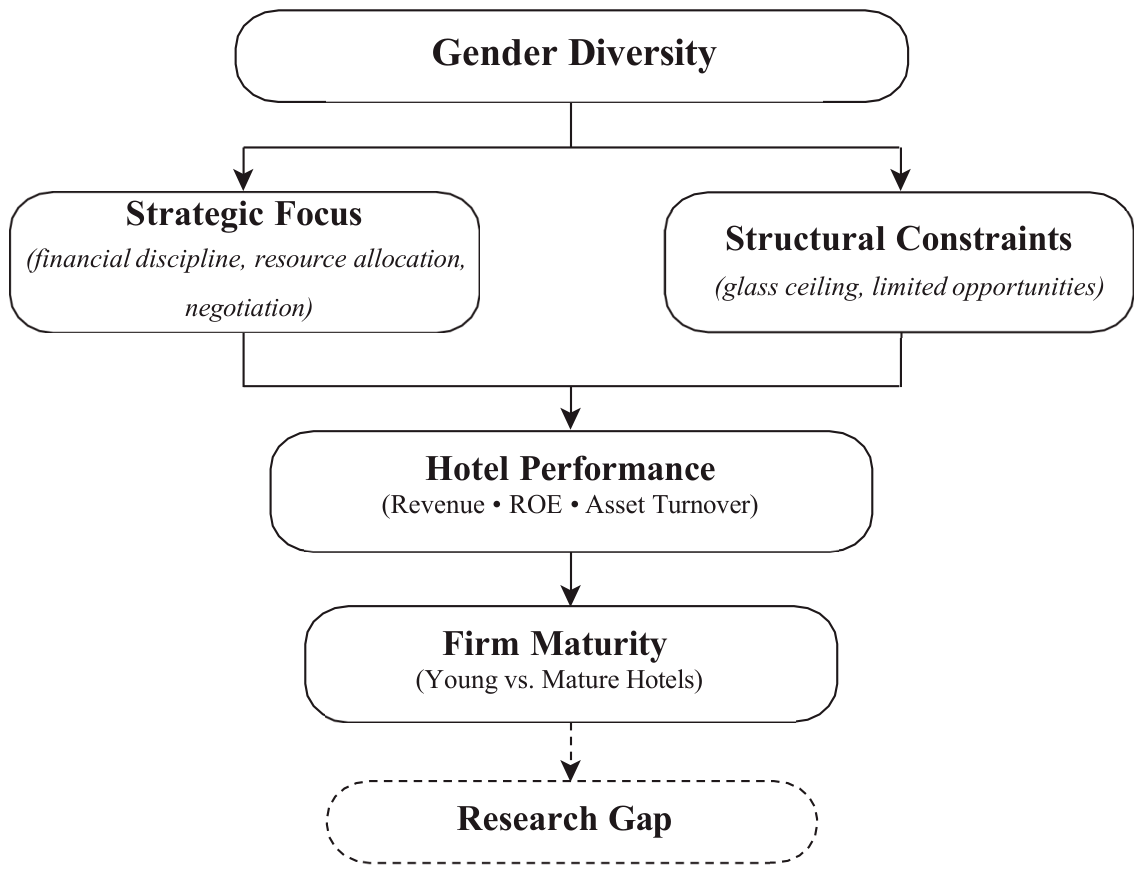
Table 1.
Definition and measurement of variables.
| Variable | Description | Measurement |
| Firm age | Sample split at median into younger vs. mature hotels | Days since establishment |
| Revenue | Total annual operating revenue | EUR, annual 1 |
| Gross margin | Gross profit / Revenue | Ratio (decimal, e.g. 0.02 = 2%) |
| Net margin | Net income / Revenue | Ratio (decimal, e.g. 0.02 = 2%) |
| Net result | Net income after taxes | EUR, annual |
| Equity | Book value of shareholders’ equity | EUR |
| ROE | Return on Equity | Net income / Equity |
| ROE decile | Decile rank of ROE (1 = lowest, 10 = highest), used to mitigate the influence of extreme values in ROE | Decile (1–10), derived from ROE |
| Total assets | Total asset value | EUR (log-transformed as firm-size proxy in regression models) |
| Number of employees | Average number of employees | Headcount |
| Asset turnover | Efficiency of asset utilization | Revenue / Total assets |
| Asset turnover (winsorized) | Asset turnover winsorized at the 1st and 99th percentiles | Values below the 1st percentile set to the 1st percentile; values above the 99th percentile set to the 99th percentile, derived from Asset turnover |
| Belgrade/Other cities | Hotel location | 1 = Belgrade, 0 = other cities |
| Gender of the Head of the Board | Gender of the Head of the Board | 1 = male, 2 = female |
| Board size | Size of the Board | Number of members |
| Female board members | Number of women on the Board | Count |
| At least one female | Presence of female Board member | 1 = yes, 0 = no |
Table 6.
Regression results for asset turnover by firm maturity.
| Variables | Younger hotels | Mature hotels |
| Log (Total assets) | −2.169*** | −1.154*** |
| (0.139) | (0.098) | |
| Number of employees | 0.039*** | 0.022*** |
| (0.007) | (0.005) | |
| Gender of Head of the Board | 0.353 | −0.148 |
| (0.552) | (0.335) | |
| R² | 0.468 | 0.340 |
| Adjusted R² | 0.463 | 0.333 |
| N | 288 | 287 |
Notes: Dependent variable is asset turnover, winsorized at the 1st and 99th percentiles (see Section 3.1); R² – coefficient of determination; Adjusted R² – adjusted coefficient of determination; N – number of observations.
| [1] | All monetary values are expressed in EUR. Original amounts, denominated in Serbian dinars (RSD) as reported in the financial statements, were converted using the official middle exchange rate of the National Bank of Serbia as of the date of preparation of the financial statements (December, 31st) , where 1 EUR = 117.0149 RSD. |
Disclaimer/Publisher’s Note: The statements, opinions and data contained in all publications are solely those of the individual author(s) and contributor(s) and not of MDPI and/or the editor(s). MDPI and/or the editor(s) disclaim responsibility for any injury to people or property resulting from any ideas, methods, instructions or products referred to in the content. |
© 2026 by the authors. Licensee MDPI, Basel, Switzerland. This article is an open access article distributed under the terms and conditions of the Creative Commons Attribution (CC BY) license.
Copyright: This open access article is published under a Creative Commons CC BY 4.0 license, which permit the free download, distribution, and reuse, provided that the author and preprint are cited in any reuse.