
Submitted:
23 September 2026
Posted:
24 September 2026
You are already at the latest version
Abstract
Assistive robots must respond appropriately when an interaction generates uncertainty, concern, or frustration, particularly in elderly-care tasks such as medication assistance. This paper proposes a control-oriented nonlinear model of human emotional dynamics for assistive human-robot interaction. The model represents happiness, sadness, anger, fear, disgust, and surprise as baseline-centred dynamic states. It combines published oscillator-based foundations for sadness and happiness with proposed appraisal inputs, emotion-to-emotion couplings, and robot-control effects. A nominal operating condition is defined, and a Jacobian linearisation is used to establish local stability of the selected numerical model. A saturated linear quadratic regulator adjusts four robot behaviours (support, predictability, task adaptation, and repair-oriented action) while respecting physical command bounds. The framework is evaluated in single and repeated unclear medication-reminder scenarios. In the repeated-reminder case, the controller reduces the positive peaks of sadness, anger, and fear by 42.00%, 36.58%, and 24.13%, respectively. A weighting study demonstrates the trade-off between stronger emotional protection and increased robot-control effort. Furthermore, under 100 parameter realisations with independent variations of up to ±20%, the fixed nominal controller reduces the mean adverse-emotion peaks in every trial and decreases the aggregate undesirable-emotion integral of absolute error by 28.36%. The results provide simulation-based evidence that the proposed model can support the analysis and bounded regulation of emotional transients in assistive interactions. Empirical calibration and human-subject evaluation remain necessary for clinical use.
Keywords:
assistive human-robot interaction
; nonlinear emotion dynamics
; social robots
; medication assistance
; linear quadratic regulation
; emotional regulation
; robustness analysis
1. Introduction
Medication assistance is an important and recurring activity in elderly care, but it is also an interaction in which clarity, timing, and communication style matter. Recent reviews show that social robots have been used to support medication delivery, administration, monitoring, reminders, and companionship. At the same time, communication limitations, user discomfort, and difficulties in recognising whether medication has been taken can affect both acceptance and practical effectiveness [1]. More broadly, robot-assisted care for older adults has considerable potential, but successful implementation depends not only on technical functionality but also on user experience, acceptance, and the ability of the robot to respond appropriately to individual needs [2,3].
Emotional factors are therefore relevant to assistive human-robot interaction (HRI). A reminder that is unexpected, unclear, repetitive, or poorly timed may generate uncertainty, concern, frustration, or a temporary loss of perceived control. Conversely, a supportive explanation or a predictable interaction sequence may help the user feel more comfortable and confident. Research on emotion in HRI has examined how robots recognise, express, and respond to affective signals, confirming that emotion is an important component of social interaction with robots [4,5]. Recent emotion-recognition approaches for social robots also emphasise that emotional expression can vary substantially across users and interaction contexts [6].
However, emotion recognition and emotion regulation are different problems. Recognition methods estimate a user’s current affective state from observable signals, whereas an emotion-dynamics model is needed to describe how that state may evolve after an interaction event and how robot behaviour can influence the subsequent response. Such a model is particularly useful for control design because it provides a state representation, an operating condition, and an explicit relationship between robot actions and emotional deviations. The present study addresses this need by developing a control-oriented nonlinear model of human emotional dynamics for assistive HRI.
The model is built from published dynamical and computational foundations while clearly separating these foundations from the proposed HRI extensions. Chow et al. [7] represented emotional regulation using a damped-oscillator model, in which the emotional state, its rate of change, and its acceleration are explicitly represented. For happiness, Bae [8] introduced a second-order dynamical model with an external forcing term, and later work considered nonlinear and fuzzy extensions of happiness dynamics [9]. These studies provide useful mathematical motivation for representing emotion as a dynamic process rather than as a static label. In addition, novelty, uncertainty, and information gain have been linked to surprise and emotional arousal through computational modelling [14,15]. The present work uses these insights to define scenario-dependent appraisal inputs for an assistive medication-reminder interaction.
Specifically, six emotional states are considered: happiness, sadness, anger, fear, disgust, and surprise. The sadness and happiness equations are inspired by their published dynamical foundations. The remaining emotion equations, the retained emotion-to-emotion couplings, and the robot-control terms are proposed as a unified control-oriented HRI model. The model does not claim to predict clinically validated emotional responses for every individual. Instead, it provides a transparent computational framework for studying how bounded robot behaviours may regulate emotion deviations around a nominal operating condition during an assistive interaction.
The main contributions of this paper are as follows:
- 1.
- A nonlinear six-emotion state-space model is proposed for assistive HRI. The model combines second-order emotional dynamics, appraisal-based external inputs, selected emotional couplings, and four interpretable robot behaviours: support, predictability, task adaptation, and repair-oriented action.
- 2.
- The nominal equilibrium of the proposed model is defined, and a Jacobian linearisation is derived. Local stability of the selected numerical model is assessed using the eigenvalues of the linearised state matrix.
- 3.
- A saturated linear quadratic regulator (LQR) is designed around the nominal operating condition. The controller adjusts the robot-behaviour vector while preserving the physical command bounds.
- 4.
- The model is evaluated in two elderly medication-assistance scenarios involving an unexpected unclear reminder and a repeated unclear reminder. In addition to nominal open-loop and closed-loop comparisons, the paper examines the trade-off induced by alternative LQR weight selections and the robustness of the fixed nominal controller under bounded parameter variations.
The remainder of this paper is organised as follows. Section 2 presents the proposed nonlinear emotion-dynamics model and its HRI interpretation. Section 3 defines the operating condition and develops the equilibrium, linearisation, and local-stability analysis. Section 4 presents the saturated LQR design. Section 5 describes the medication-assistance scenarios and the performance measures. Section 6 reports and discusses the simulation, weighting, and robustness results. Finally, Section 7 concludes the paper and identifies directions for future work.
2. Nonlinear Emotion Dynamics Model
2.1. Assistive HRI Setting and Emotional States
The proposed model represents the evolution of an older user’s emotional response during an assistive interaction. The application considered in this study is medication assistance, in which the robot may provide a reminder, explain the purpose of a medication, adapt the interaction pace, or repair a misunderstanding. These behaviours are relevant because medication-related social robot interventions can support reminders and adherence, while communication limitations and user discomfort may reduce their effectiveness [1].
Six emotion intensity states are considered:
where h, s, a, f, d, and q denote happiness, sadness, anger, fear, disgust, and surprise, respectively. Each emotion is represented as a deviation from an individual nominal level:
Thus, represents the nominal emotional operating condition; it does not imply that the person has no emotions.
The robot behaviour vector is defined as
where the four components represent supportive communication, predictability or explanation, task adaptation, and repair-oriented action, respectively. The controller acts on the deviation , where is the nominal robot behaviour. Each physical command is bounded according to
2.2. Proposed Nonlinear Emotion Equations
The model combines published dynamical foundations with proposed control-oriented HRI extensions. The sadness equation is motivated by the damped-oscillator representation of emotional regulation developed by Chow et al. [7]. The happiness dynamics are motivated by the second-order happiness model of Bae [8] and later nonlinear extensions. Appraisal inputs for anger, fear, disgust, and surprise are informed by recent computational and psychological studies of the corresponding emotions [10,11,12,13]. In particular, the uncertainty and information inputs associated with surprise are motivated by computational accounts of novelty and Bayesian surprise [14].
The resulting six-equation model is proposed for the present assistive-HRI application:
Here, and are the damping and restoring coefficients for emotion i, respectively, and is the nonlinear happiness coefficient. The symbols with tildes on the right hand sides represent centred appraisal inputs. Their meanings are emotion-specific; for example, and represent unexpectedness and uncertainty associated with surprise. The quantities describe the direct effect of robot behaviour deviations on each emotion.
Equations (5)-(10) should not be interpreted as six independently validated psychological laws. Rather, they form a transparent modelling framework in which the sadness and happiness dynamics are grounded in prior dynamical work, while the cross-emotion couplings, appraisal combinations, and robot control effects are proposed extensions for assistive HRI. The present medication-assistance scenarios do not assume direct robot actuation of disgust. Accordingly, is used in the simulation parameterisation, while the general term is retained to allow future disgust-related scenarios.
2.3. Compact Vector Representation
For analysis and controller design, define
and
The retained emotional coupling matrix is
Let contain only the appraisal, robot-control, and external disturbance terms in (5)-(10); it excludes the internal emotion-to-emotion coupling terms. The complete nonlinear model can then be written as
Finally, the grouped state vector is defined as
Equation (14) therefore defines a nonlinear state space system of the form
where collects the external appraisal inputs. This form is used in the next section to define the nominal operating condition and derive the local linear model.
3. Equilibrium, Linearisation, and Local Stability Analysis
3.1. Nominal Operating Condition and Equilibrium
The proposed model is analysed around a nominal assistive interaction condition. At this condition, the user is assumed to be at the individual emotional baseline, the robot applies its nominal behaviour vector, and no medication-related event is active. Thus,
where denotes the vector of external appraisal inputs.
Under (17), every forcing term in (5)-(10) is zero. The nominal equilibrium of the grouped state vector in (15) is therefore
This equilibrium corresponds to the original emotional state . It should therefore be interpreted as a baseline emotional condition rather than as the absence of emotion.
3.2. Jacobian Linearisation
The local controller is designed from a linear approximation of the nonlinear model around (18). Let
collect the direct robot-to-emotion effects. At the nominal condition, the coupling matrix becomes
The surprise-to-happiness entry is zero at the nominal equilibrium because .
Using a first-order Taylor expansion about , the local regulation model is
where
The happiness cubic term does not appear in because the derivative of is zero at . Similarly, the state-dependent surprise-valence term is absent from the baseline Jacobian because . These nonlinear terms are retained in the full simulation model and are not discarded from the proposed system. The linearisation is used only for local analysis and LQR design [16].
3.3. Local Stability of the Nominal Model
For an isolated emotion with no coupling and no external input, the corresponding characteristic equation is
Hence, and are sufficient to ensure asymptotic stability of each isolated second-order emotional subsystem.
The complete model additionally contains the retained emotional couplings. For the numerical parameterisation used in this study, the eigenvalues of the baseline matrix are
All eigenvalues have strictly negative real parts. Therefore, is Hurwitz, and the baseline equilibrium of the linearised autonomous model is asymptotically stable.
This conclusion can also be stated using a local Lyapunov argument. Since is Hurwitz, for any symmetric positive-definite matrix , there exists a symmetric positive-definite matrix satisfying
Consider the candidate function
The nonlinear remainder of the autonomous model is dominated locally by the happiness cubic term and is of order . Consequently,
for some . The negative quadratic term dominates sufficiently close to the origin. Therefore, the baseline equilibrium of the nonlinear autonomous model is locally asymptotically stable, consistent with the standard linearisation result for nonlinear systems [16].
A mechanical-energy-style sufficient condition can be obtained when is symmetric positive definite. However, this condition is not imposed here because the selected emotional couplings are not necessarily reciprocal. Local stability of the selected coupled model is instead established directly by the Hurwitz eigenvalue test in (24) and by the local Lyapunov argument above.
The stability result applies to the autonomous model at the nominal operating condition. During a medication-related event, the appraisal vector is nonzero, and the baseline equilibrium is intentionally excited. In that case, the objective is not to remain exactly at the equilibrium during the event, but to maintain bounded emotional deviations and return toward the nominal condition after the event has ended.
4. Saturated LQR Controller Design
4.1. Local Regulation Objective
The purpose of the controller is to regulate emotional deviations generated by an assistive interaction event. The controller is not introduced because the baseline open-loop model is unstable; as shown in Section 3, the selected nominal model is locally stable. Instead, the controller is used to reduce undesirable transient emotional responses and to support a faster return toward the nominal emotional condition after an unclear or stressful interaction.
The regulation model is the local linearisation
where contains the emotion deviations and their rates of change, and is the deviation of robot behaviour from its nominal value.
A continuous-time LQR is designed by minimising
where weights the emotional-state deviations and their rates, while weights the effort associated with changing robot behaviour. The matrices are selected to balance emotional protection against intervention intensity. Their numerical values are given with the simulation parameterisation in Section 5.
4.2. Optimal State-Feedback Law
For the unconstrained linear model, the LQR gain is obtained from the continuous-time algebraic Riccati equation
where is the stabilising solution. The resulting state-feedback gain is
and the unconstrained control deviation is
Under the usual stabilisability and detectability conditions, the closed-loop linear matrix
is Hurwitz [17]. The gain is computed numerically from (30).
The use of an operating-point linearisation to enable LQR-based feedback is common in nonlinear control applications. For example, Wijanarko et al. combined small-signal linearisation with an LQR-based controller to assess the transient response of a nonlinear converter under input and load disturbances [18].
4.3. Bounded Robot-Behaviour Implementation
The unconstrained LQR law in (32) does not automatically enforce the physical bounds in (4). Therefore, the controller is implemented using element-wise saturation:
where
The deviation supplied to the nonlinear emotion model is then
This implementation ensures that the supportive, predictability, adaptation, and repair commands remain interpretable physical behaviour levels. In particular, the controller cannot prescribe negative support or a command level exceeding the maximum available robot capability. Because saturation makes the implemented controller nonlinear, the unconstrained LQR optimality and linear closed-loop stability results apply locally before saturation. The performance of the saturated controller on the full nonlinear model is therefore evaluated directly in the simulation studies.
5. Simulation Design and Performance Measures
5.1. Numerical Parameterisation and Simulation Settings
The proposed model is evaluated as a normalised nonlinear simulation model. Time is measured in minutes, and each emotional state represents a deviation from the corresponding individual baseline. The numerical values used here are an initial control-oriented parameterisation rather than clinically identified person-specific parameters. Their purpose is to provide a transparent and reproducible setting for evaluating the model structure and the effect of bounded robot behaviour.
The damping and restoring coefficients are selected as
and the nonlinear happiness coefficient is
The retained emotional coupling coefficients are
The nominal robot behaviour is
and the robot input matrix used in the simulations is
The rows of (41) correspond to happiness, sadness, anger, fear, disgust, and surprise, respectively. The columns correspond to support, predictability, adaptation, and repair. The zero disgust row reflects the assumption that the present medication-reminder scenarios do not include direct disgust-oriented robot action.
The appraisal gain vectors are selected as
For the balanced LQR design, the state and control weighting matrices are
and
Larger state weights are assigned to sadness, anger, and fear because these are the principal undesirable emotional deviations in the medication scenarios. All simulations are performed over 40 min using 4001 equally spaced output points. The nonlinear differential equations are integrated using the ode45 solver in MATLAB with relative and absolute tolerances of and , respectively.
The full nonlinear model is retained during the simulations so that the effects of appraisal pulses and input saturation are assessed directly rather than inferred solely from the local linear model. This simulation-based evaluation of feedback performance under non-ideal excitation is consistent with the nonlinear-control analysis reported by Tusset et al. [19].
5.2. Medication Assistance Scenarios
Two medication reminder scenarios are considered. Both scenarios begin from the baseline equilibrium in (18). The event profile is represented by a smooth pulse
5.2.1. Scenario 1: Unexpected Unclear Medication Reminder
The first scenario represents a single medication reminder that is both unexpected and unclear. The event occurs from to min, with
The active appraisal inputs are
All remaining appraisal inputs and the external happiness excitation are set to zero.
5.2.2. Scenario 2: Repeated Unclear Medication Reminder
The second scenario represents a more demanding interaction in which a second unclear reminder is given after the first event. The first pulse is again , whereas the second pulse is
The appraisal inputs are defined as
This scenario introduces a stronger second event, together with additional sadness- and fear-related appraisal inputs, to represent repeated uncertainty and concern during medication assistance.
5.3. Performance Measures
The nonlinear model is simulated in open loop and with the saturated LQR controller. For sadness, anger, fear, and surprise, the positive peak deviation is used to evaluate the immediate adverse emotional response. The percentage peak reduction for emotion i is
The accumulated emotional deviation is quantified using the integral of absolute error,
where min. Happiness is evaluated separately through its minimum deviation because the desired objective is to protect happiness from a negative excursion rather than to minimise its magnitude. Disgust remains a simulated state but is not treated as a primary outcome because neither medication-reminder scenario includes a disgust-related event.
For each emotion, the post-event settling time is calculated from the end of the final reminder pulse. The response is considered settled when it remains within of its peak absolute deviation for the rest of the simulation. The total robot control effort is computed as
The maximum value of each physical robot command is also recorded to verify that the bounded implementation in (34) is respected.
6. Results and Discussion
6.1. Single Unclear Medication Reminder
The first simulation considers a single unexpected and unclear medication reminder applied from to min. Figure 1 compares the open-loop response with the response obtained using the saturated LQR controller. In open loop, surprise exhibits the largest positive deviation because the event directly activates unexpectedness and uncertainty. Fear, anger, and sadness also increase because the scenario includes concern, goal obstruction, and low perceived control. Happiness temporarily decreases below its nominal level through the retained emotion-to-emotion couplings.
Table 1 shows that the saturated LQR controller reduces the positive peaks of sadness, anger, fear, and surprise by , , , and , respectively. The reductions in the IAE of sadness, anger, and fear are larger than the corresponding peak reductions, indicating that the controller reduces both the intensity and the accumulated duration of these adverse deviations.
The controller prevents the temporary negative happiness deviation observed in open loop. The minimum happiness deviation changes from in open loop to zero under LQR control. Fear also settles more rapidly, with the post-event settling time decreasing from min to min. The sadness and anger settling times increase slightly because the LQR response includes a small negative undershoot before returning to the baseline. This is a transient regulation trade-off and does not indicate instability.
The robot commands generated by the controller are shown in Figure 2. Predictability receives the largest adjustment, reaching , which is consistent with the uncertain and unclear nature of the reminder. The maximum support, adaptation, and repair levels are , , and , respectively. The total control effort is , and all physical commands remain within their prescribed bounds.
6.2. Repeated Unclear Medication Reminder
The second scenario introduces a more severe repeated reminder from to min. Figure 3 shows that the second event produces a larger open-loop response than the first event, particularly for sadness, anger, fear, and surprise. This result is consistent with the intended interpretation of repeated unclear communication as a more demanding medication-assistance interaction.
The saturated LQR controller reduces the positive peaks of sadness, anger, fear, and surprise by , , , and , respectively. The corresponding IAE reductions are for sadness, for anger, for fear, and for surprise. Fear also recovers more quickly after the final event: its settling time decreases from min in open loop to min with LQR control. In addition, the controller prevents the negative open-loop happiness deviation, whose minimum value is .
Figure 4 presents the corresponding robot-command trajectories. Predictability again receives the largest intervention and reaches . The total control effort is , which is greater than in Scenario 1 because the second reminder is stronger and produces a larger emotional disturbance. Nevertheless, all commands remain within the admissible interval .
Table 2 summarises the principal comparison between the two medication-assistance scenarios. The repeated-reminder case requires approximately times the control effort of the single-event case. However, the controller preserves or improves the peak-reduction performance for sadness, anger, and fear, indicating that it remains effective when the interaction becomes more demanding.
6.3. Effect of LQR Weighting Selection
The balanced LQR design provides the reference response for Scenario 2. Two additional designs are considered to examine the trade-off between emotional protection and robot effort. The protective design assigns larger weights to sadness, anger, fear, and surprise, whereas the low-effort design uses a larger control penalty.
Figure 5 and Table 3 show that the protective design produces the lowest adverse-emotion peaks and the smallest aggregate undesirable-emotion IAE. Relative to the balanced design, it reduces the sadness, anger, and fear peaks by approximately , , and , respectively. This improvement requires a larger control effort, which increases from to . In contrast, the low-effort design reduces the control effort to , but allows larger emotional deviations and a larger aggregate IAE.
6.4. Robustness Under Parameter Uncertainty
A numerical robustness study was conducted using 100 independently perturbed parameter realisations. Every nonzero damping, restoring, cubic, appraisal, emotional-coupling, and robot-effect coefficient was varied by up to . The nominal LQR gain was retained in every trial; therefore, this study evaluates the robustness of the fixed controller rather than retuning the controller for each perturbed model.
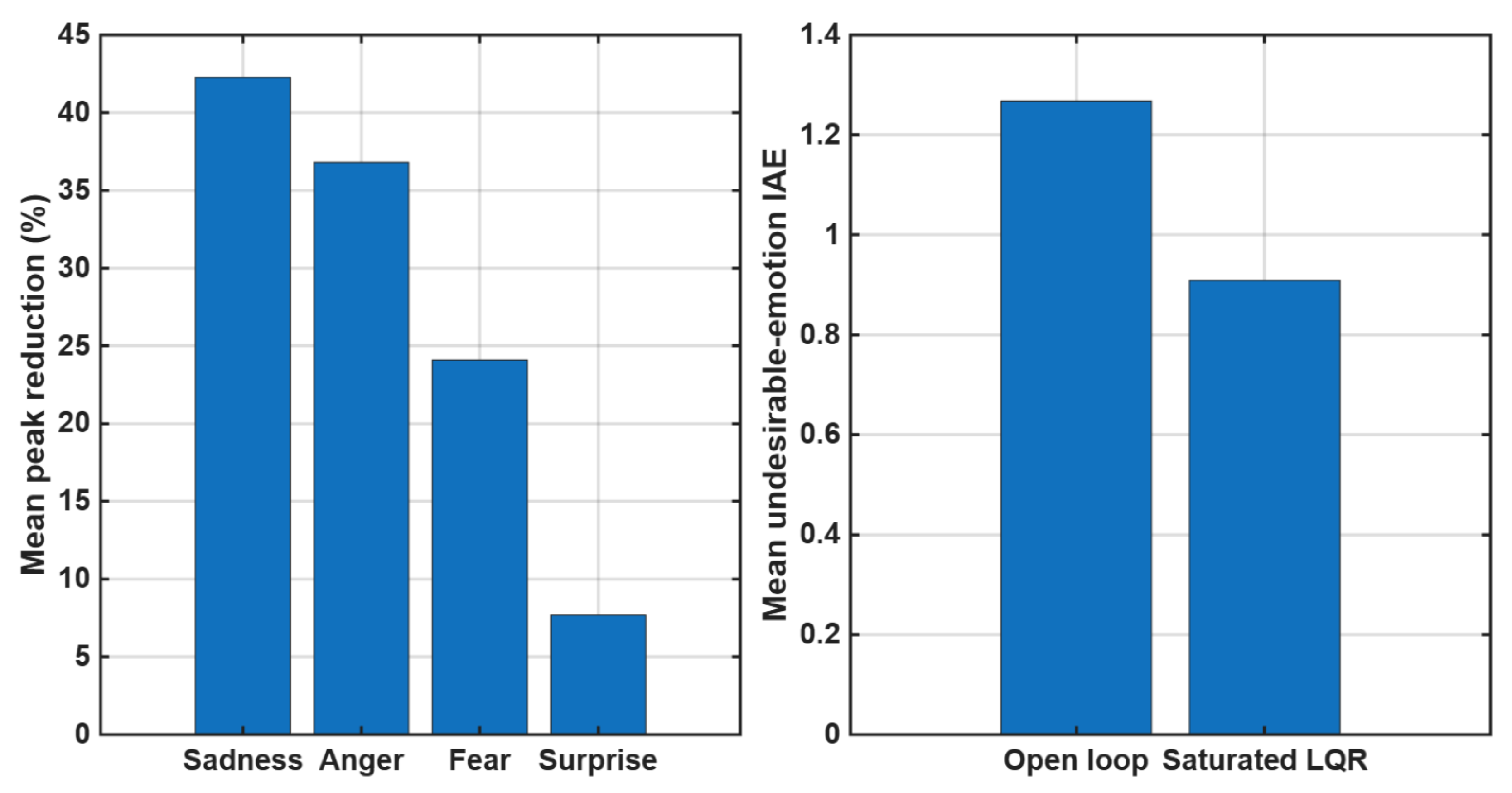
Table 4 shows that the LQR controller reduces the mean peak of each primary adverse emotion in all 100 trials. The mean aggregate undesirable-emotion IAE decreases from in open loop to with LQR, corresponding to a reduction. The mean minimum happiness deviation improves from to , and all simulated trajectories remain bounded within the normalised emotion range considered.
Figure 6.
Robustness of the fixed nominal saturated-LQR controller under 100 parameter realisations. The left panel shows the mean reduction in adverse-emotion peaks, while the right panel compares the mean aggregate undesirable-emotion IAE.
Figure 6.
Robustness of the fixed nominal saturated-LQR controller under 100 parameter realisations. The left panel shows the mean reduction in adverse-emotion peaks, while the right panel compares the mean aggregate undesirable-emotion IAE.
The robustness results should be interpreted as numerical evidence over the specified uncertainty set, rather than as a formal proof of robust stability for all possible parameter values. In addition, the primary quantitative measures focus on sadness, anger, fear, and surprise because the present medication-reminder scenarios directly generate these deviations. Happiness is assessed through protection against a negative deviation, whereas disgust is retained as a simulated state but is not a primary performance outcome in the present non-aversive medication-reminder scenarios.
7. Conclusions
This paper presented a control-oriented nonlinear model of six emotional states for assistive human-robot interaction. The model represents happiness, sadness, anger, fear, disgust, and surprise as baseline-centred dynamic states and combines damping, restoring effects, selected emotional couplings, appraisal inputs, and bounded robot behaviours. The sadness and happiness dynamics were motivated by published mathematical models, whereas the coupled HRI structure, appraisal combinations, and robot-control effects were proposed to support analysis and control in an elderly medication-assistance setting.
A nominal operating condition and baseline equilibrium were defined, and a Jacobian linearisation was derived. The selected numerical model was shown to be locally stable at the baseline equilibrium because the linearised state matrix is Hurwitz. A saturated LQR controller was then designed to regulate emotional deviations through four interpretable robot behaviours: support, predictability, task adaptation, and repair-oriented action.
Simulation results for a single unclear reminder and a repeated unclear reminder showed that the controller reduces the principal undesirable emotional responses while maintaining all robot commands within their physical bounds. In the more demanding repeated-reminder scenario, the LQR controller reduced the positive peaks of sadness, anger, and fear by , , and , respectively. The weighting study further showed the expected trade-off between stronger emotional protection and increased robot-control effort. In addition, the fixed nominal controller reduced the mean adverse-emotion peaks in all 100 parameter realisations considered in the numerical robustness study.
The results should be interpreted as a simulation-based validation of the proposed computational framework, not as a clinically validated predictor of human emotion. The parameter values have not yet been identified from individual HRI data, and the medication-assistance scenarios represent controlled interaction conditions. Future work should therefore focus on parameter identification using longitudinal user data, empirical evaluation with older adults, and the inclusion of additional assistive situations. In particular, disgust-related scenarios can be developed to evaluate repair-oriented action in aversive interaction conditions. A nonlinear controller with an explicit Lyapunov-based stability proof may also be developed and compared with the present saturated LQR design.
Author Contributions
Conceptualization, J.U.Y. and A.N.; methodology, J.U.Y.; software, J.U.Y.; validation, A.N.; formal analysis, J.U.Y.; investigation, J.U.Y.; writing original draft preparation, J.U.Y.; writing review and editing, A.N.; visualization, J.U.Y. and A.N.; supervision, A.N.; All authors have read and agreed to the published version of the manuscript.
Funding
This research received no external funding
Institutional Review Board Statement
Not applicable.
Informed Consent Statement
Not applicable.
Data Availability Statement
All data is included in the manuscript.
Acknowledgments
The authors have reviewed and edited the output and take full responsibility for the content of this publication.
Conflicts of Interest
The authors declare no conflicts of interest.
References
- Andtfolk, M.; Rosenberg, S.; Hägglund, S.; Estman, L. Examining the use and outcomes of social robot interventions in medication processes: A scoping review. Finn. J. eHealth eWelfare 2025, 17, 312–326. [Google Scholar] [CrossRef]
- Cui, L.; Li, Y.; Yang, X.; Liu, X.; Zhang, L.; Hou, L. Humanoid robot-assisted support for health care in older adults: Systematic scoping review. JMIR Aging 2026, 9, e83849. [Google Scholar] [CrossRef]
- Johnson, D.O.; Cuijpers, R.H.; Juola, J.F.; Torta, E.; Simonov, M.; Frisiello, A.; Bazzani, M.; Yan, W.; Weber, C.; Wermter, S.; Meins, N.; Oberzaucher, J.; Panek, P.; Edelmayer, G.; Mayer, P.; Beck, C. Socially assistive robots: A comprehensive approach to extending independent living. Int. J. Soc. Robot. 2014, 6, 195–211. [Google Scholar] [CrossRef]
- Stock-Homburg, R. Survey of emotions in human-robot interactions: Perspectives from robotic psychology on 20 years of research. Int. J. Soc. Robot. 2022, 14, 389–411. [Google Scholar] [CrossRef]
- Ottoni, L.T.C.; Cerqueira, J.d.J.F. A systematic review of human-robot interaction: The use of emotions and the evaluation of their performance. Int. J. Soc. Robot. 2024, 16, 2169–2188. [Google Scholar] [CrossRef]
- Probierz, E.; Gałuszka, A. Adaptive deep learning framework for emotion recognition in social robots: Toward inclusive human-robot interaction for users with special needs. Electronics 2026, 15, 924. [Google Scholar] [CrossRef]
- Chow, S.-M.; Ram, N.; Boker, S.M.; Fujita, F.; Clore, G. Emotion as a thermostat: Representing emotion regulation using a damped oscillator model. Emotion 2005, 5, 208–225. [Google Scholar] [CrossRef]
- Bae, Y. Synchronization of dynamical happiness model. Int. J. Fuzzy Log. Intell. Syst. 2014, 14, 91–97. [Google Scholar] [CrossRef]
- Yoon, J.H.; Bae, Y.; Oh, S.-K. Resilient emotional dynamics in a fuzzy happiness model: Cognitive and noncognitive perspectives. Fuzzy Sets Syst. 2025, 518, 109510. [Google Scholar] [CrossRef]
- White, T.L.; Gonsalves, M.A.; Zimmerman, C.; Joyce, H.; Cohen, R.A.; Clark, U.S.; Sweet, L.H.; Lejuez, C.W.; Nitenson, A.Z. Anger, agency, risk and action: A neurobehavioral model with proof-of-concept in healthy young adults. Front. Psychol. 2023, 14, 1060877. [Google Scholar] [CrossRef]
- Rajagopal, S.K.; Polk, T.A. A neurally constrained computational model of context-dependent fear extinction recall and relapse. Commun. Biol. 2025, 8, 668. [Google Scholar] [CrossRef]
- Tolchinsky, A.; Ellis, G.F.R.; Levin, M.; Kaňková, Š.; Burgdorf, J.S. Disgust as a primary emotional system and its clinical relevance. Front. Psychol. 2024, 15, 1454774. [Google Scholar] [CrossRef]
- Tao, X.; Matsuo, H.; Hashimoto, T. A method of empathy robotics based on disgust. J. Adv. Comput. Intell. Intell. Inform. 2022, 26, 1046–1052. [Google Scholar] [CrossRef]
- Yanagisawa, H.; Kawamata, O.; Ueda, K. Modeling emotions associated with novelty at variable uncertainty levels: A Bayesian approach. Front. Comput. Neurosci. 2019, 13, 2. [Google Scholar] [CrossRef]
- Itti, L.; Baldi, P. Bayesian surprise attracts human attention. Vis. Res. 2009, 49, 1295–1306. [Google Scholar] [CrossRef]
- Khalil, H.K. Nonlinear Systems, 3rd ed.; Prentice Hall: Upper Saddle River, NJ, USA, 2002. [Google Scholar]
- Lewis, F.L.; Vrabie, D.L.; Syrmos, V.L. Optimal Control, 3rd ed.; John Wiley & Sons: Hoboken, NJ, USA, 2012. [Google Scholar]
- Wijanarko, S.; Ristiana, R.; Muqorobin, A. A novel PID-LQR controller scheme to enhance the performance of full-bridge boost converter. Modelling 2026, 7, 51. [Google Scholar] [CrossRef]
- Tusset, A.M.; Cruz, J.A.; Balthazar, J.M.; Fuziki, M.E.K.; Lenzi, G.G. Non-linear control and numerical analysis applied in a non-linear model of cutting process subject to non-ideal excitations. Modelling 2024, 5, 1889–1904. [Google Scholar] [CrossRef]
Figure 1.
Open-loop (Uncontrolled) and saturated-LQR emotional responses under the single unclear medication-reminder scenario. The vertical line indicates the end of the reminder event at min.
Figure 1.
Open-loop (Uncontrolled) and saturated-LQR emotional responses under the single unclear medication-reminder scenario. The vertical line indicates the end of the reminder event at min.
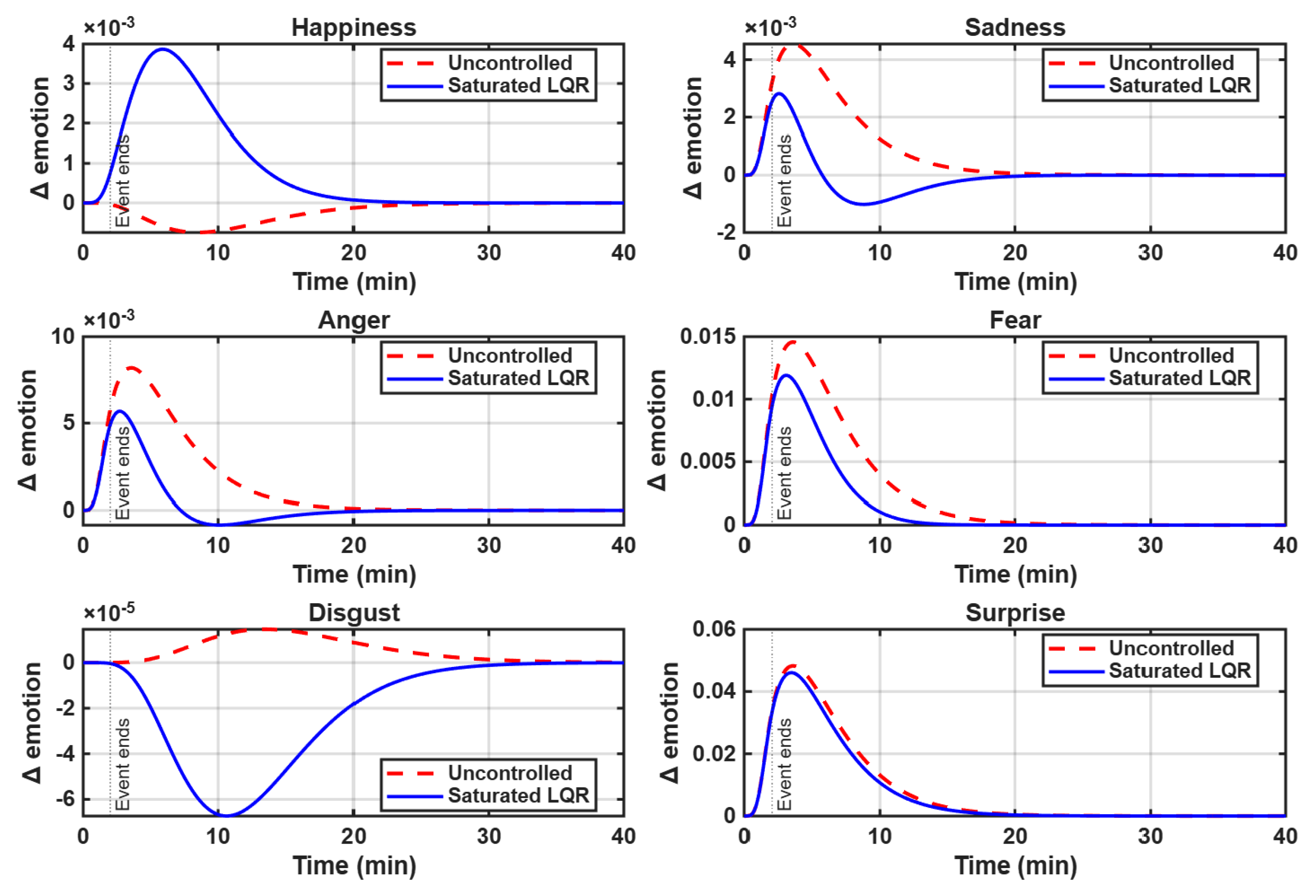
Figure 2.
Saturated-LQR robot commands for the single unclear medication-reminder scenario. The dashed lines denote the nominal robot behaviour levels.
Figure 2.
Saturated-LQR robot commands for the single unclear medication-reminder scenario. The dashed lines denote the nominal robot behaviour levels.
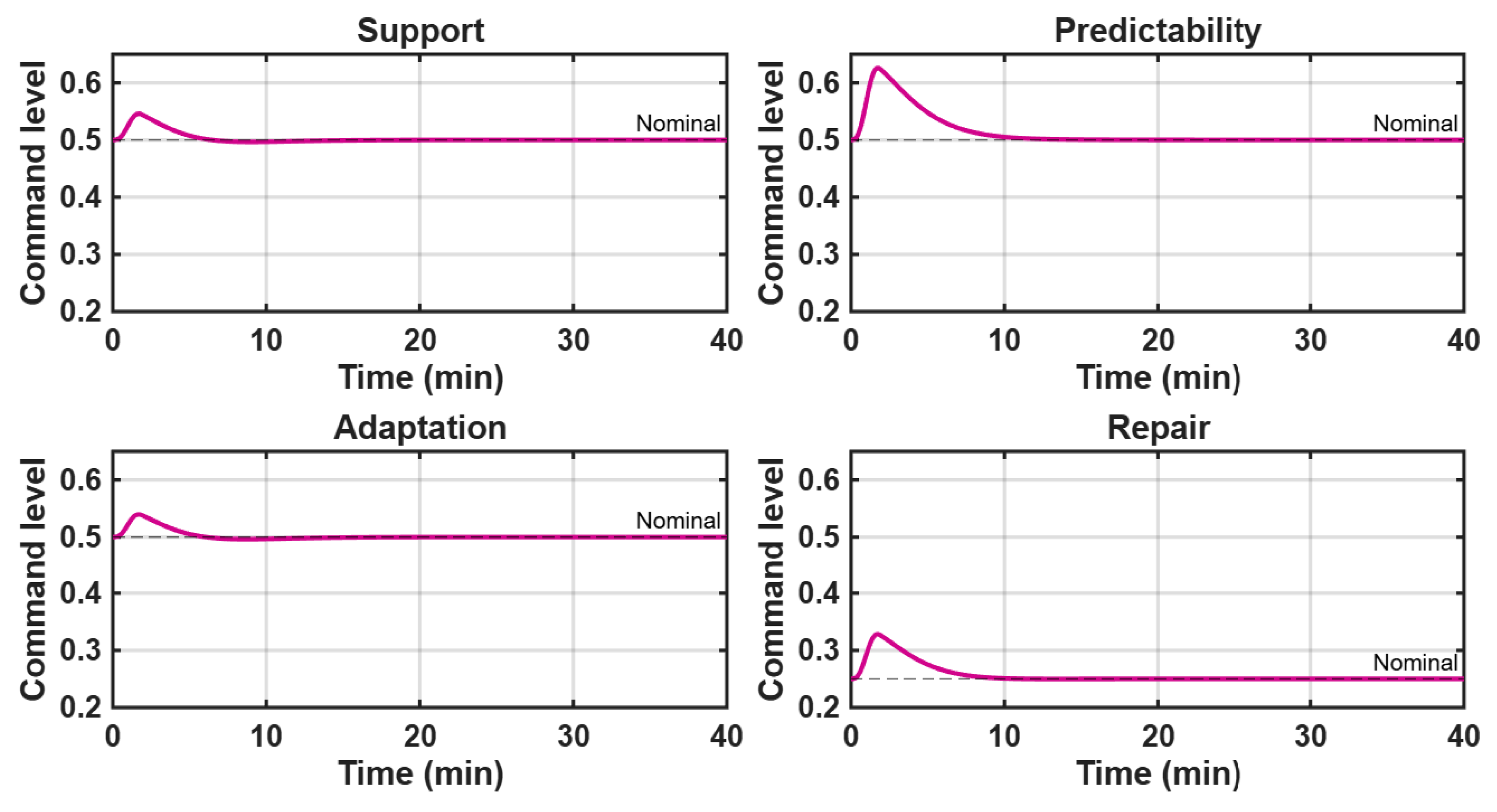
Figure 3.
Open-loop and saturated-LQR emotional responses under the repeated unclear medication-reminder scenario. The vertical lines indicate the end of the first and second reminder events.
Figure 3.
Open-loop and saturated-LQR emotional responses under the repeated unclear medication-reminder scenario. The vertical lines indicate the end of the first and second reminder events.
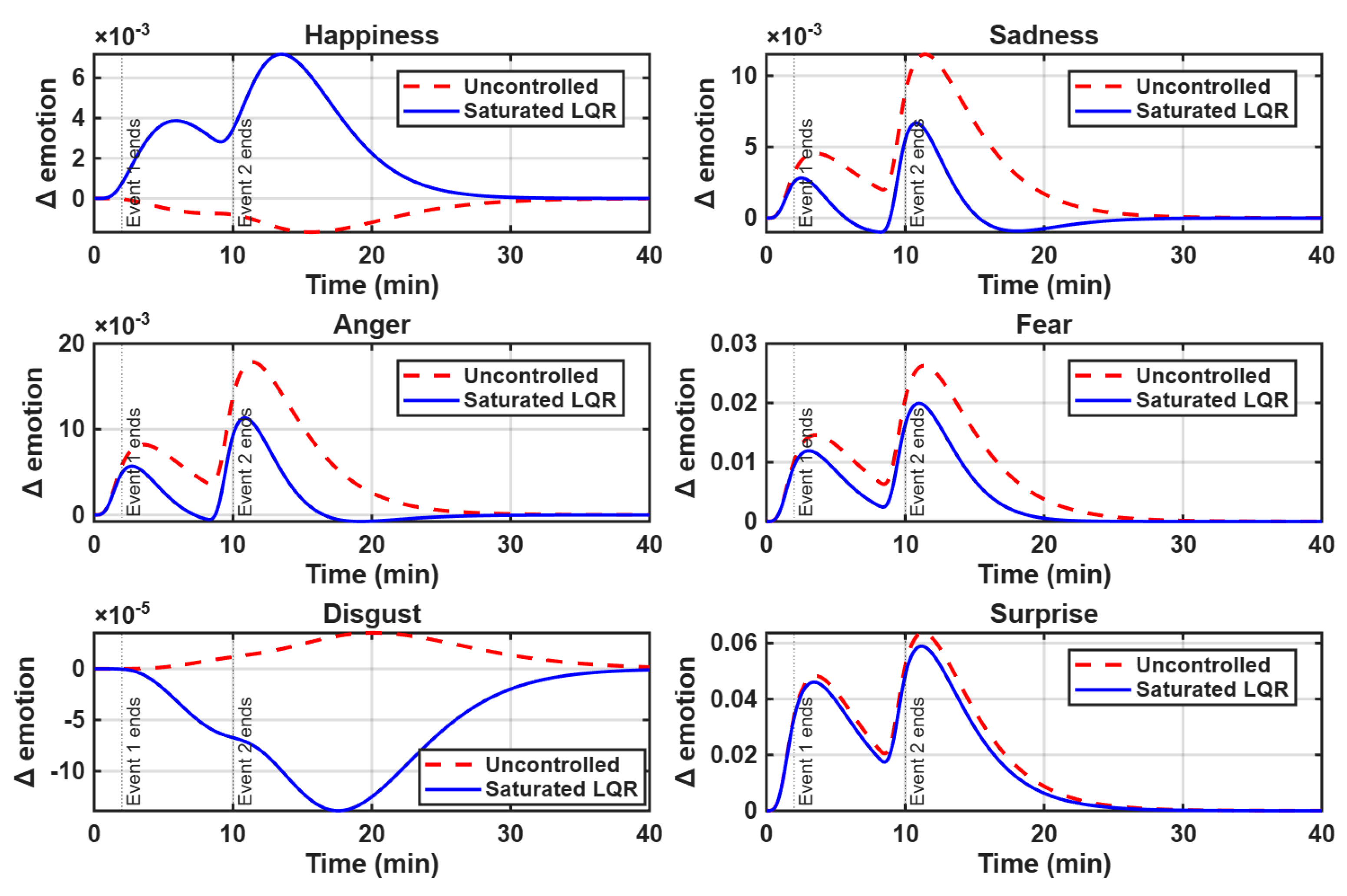
Figure 4.
Saturated-LQR robot commands for the repeated unclear medication-reminder scenario.
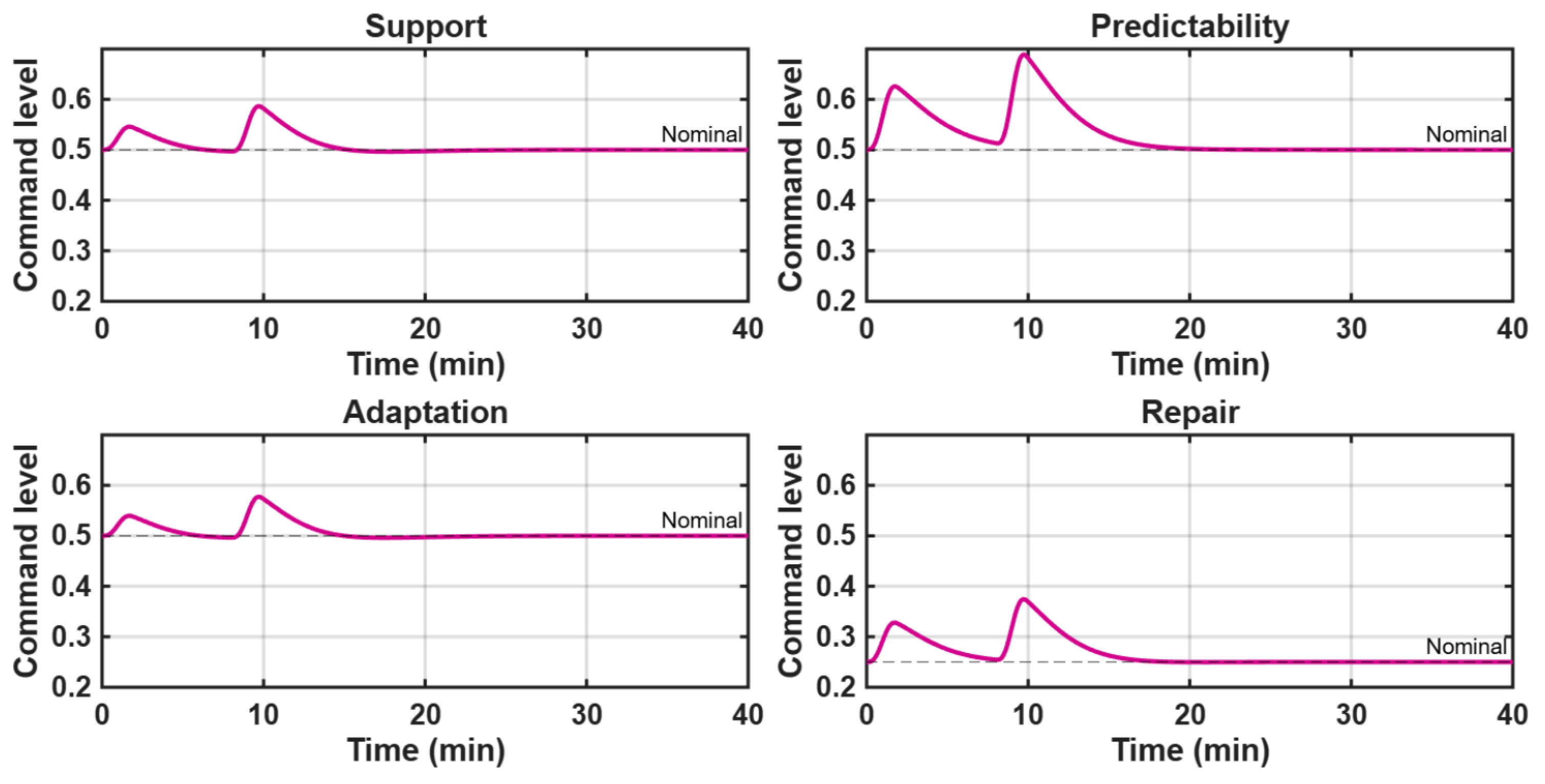
Figure 5.
Effect of LQR weighting selection on adverse-emotion peaks and the performance-effort trade-off under the repeated reminder scenario.
Figure 5.
Effect of LQR weighting selection on adverse-emotion peaks and the performance-effort trade-off under the repeated reminder scenario.
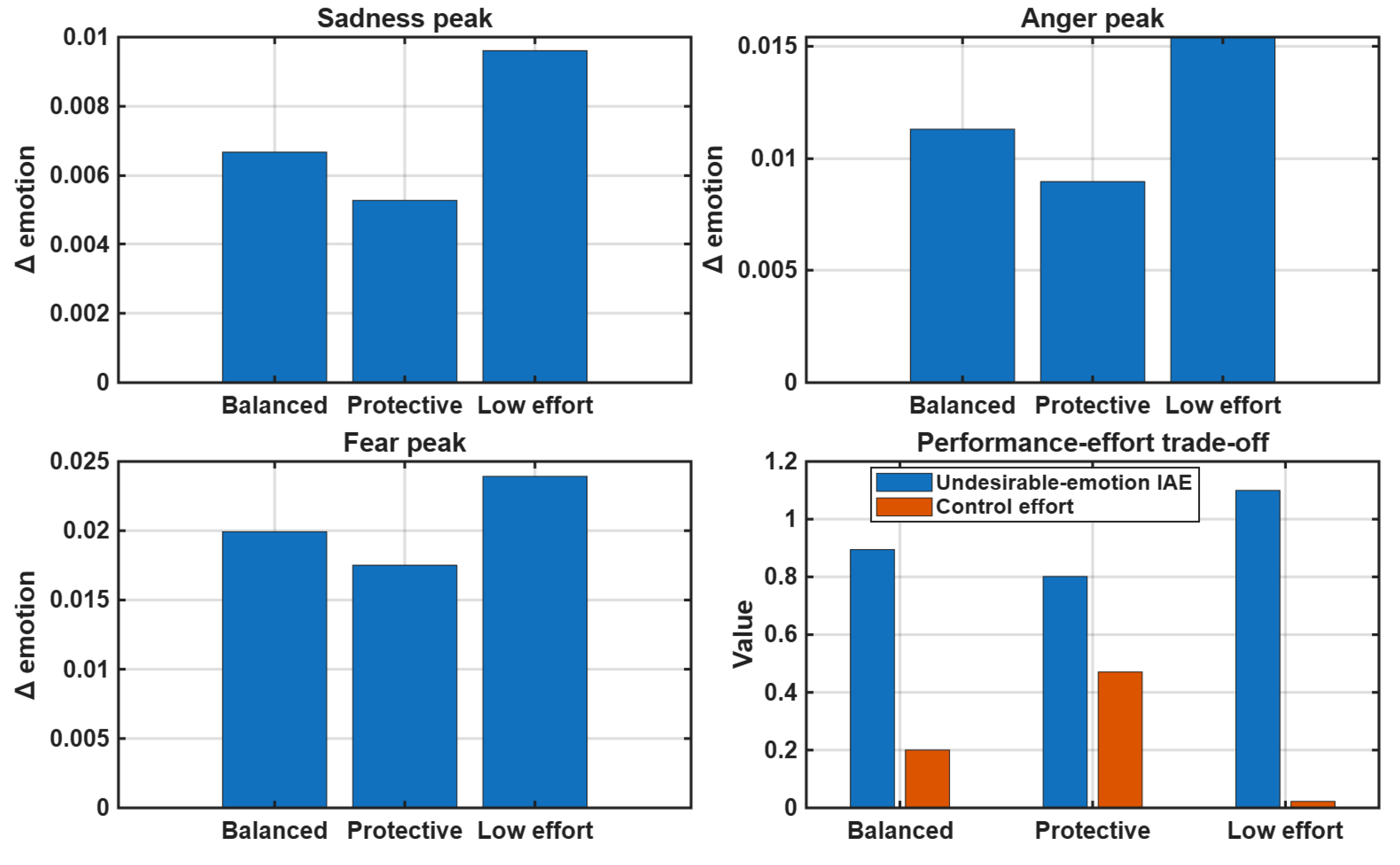

Table 1.
Performance comparison under the single unclear medication-reminder scenario.
| Emotion | Open loop peak | LQR peak | Peak reduction (%) | IAE reduction (%) |
|---|---|---|---|---|
| Sadness | 0.0045513 | 0.0028167 | 38.11 | 50.85 |
| Anger | 0.0081919 | 0.0056834 | 30.62 | 54.34 |
| Fear | 0.0145630 | 0.0119030 | 18.27 | 40.25 |
| Surprise | 0.0482380 | 0.0460480 | 4.54 | 9.93 |
Table 2.
Comparison of LQR performance for the two medication-assistance scenarios.
| Performance measure | Scenario 1 | Scenario 2 |
|---|---|---|
| Sadness peak reduction (%) | 38.11 | 42.00 |
| Anger peak reduction (%) | 30.62 | 36.58 |
| Fear peak reduction (%) | 18.27 | 24.13 |
| Surprise peak reduction (%) | 4.54 | 7.49 |
| Fear settling-time reduction (min) | 5.70 | 5.66 |
| Maximum predictability command | 0.62585 | 0.68871 |
| Total LQR control effort |
Table 3.
Effect of LQR weighting selection under the repeated unclear medication-reminder scenario.
| Design | Sadness | Anger | Fear | Surprise | Undesirable-emotion IAE |
Control effort |
|---|---|---|---|---|---|---|
| Balanced | 0.0066772 | 0.0113130 | 0.0199230 | 0.0589160 | 0.89457 | 0.20025 |
| Protective | 0.0052845 | 0.0089795 | 0.0175080 | 0.0563380 | 0.80153 | 0.47066 |
| Low effort | 0.0096051 | 0.0154120 | 0.0239210 | 0.0621700 | 1.09950 | 0.022213 |
Table 4.
Peak-response robustness results for 100 parameter realisations with independent variations in the nonzero model coefficients.
Table 4.
Peak-response robustness results for 100 parameter realisations with independent variations in the nonzero model coefficients.
| Emotion | OL peak | LQR peak | Reduction (%) | Success (%) |
|---|---|---|---|---|
| Sadness | 0.011491 | 0.0066355 | 42.26 | 100 |
| Anger | 0.018041 | 0.0111400 | 36.81 | 100 |
| Fear | 0.026797 | 0.0203400 | 24.10 | 100 |
| Surprise | 0.063999 | 0.0590720 | 7.70 | 100 |
Disclaimer/Publisher’s Note: The statements, opinions and data contained in all publications are solely those of the individual author(s) and contributor(s) and not of MDPI and/or the editor(s). MDPI and/or the editor(s) disclaim responsibility for any injury to people or property resulting from any ideas, methods, instructions or products referred to in the content. |
© 2026 by the authors. Licensee MDPI, Basel, Switzerland. This article is an open access article distributed under the terms and conditions of the Creative Commons Attribution (CC BY) license (http://creativecommons.org/licenses/by/4.0/).
Copyright: This open access article is published under a Creative Commons CC BY 4.0 license, which permit the free download, distribution, and reuse, provided that the author and preprint are cited in any reuse.