

Submitted:
23 September 2026
Posted:
24 September 2026
You are already at the latest version
Abstract
The cumulative distribution function (CDF) of the standard normal distribution plays a central role in statistical hypothesis testing, meta-analysis, and many applications involving the conversion of \(Z\)-scores into \(p\)-values. In this work, we introduce the normal-tanh coordinate \[ L(x)=\operatorname{atanh}\!\left(2\Phi(x)-1\right), \tag{1} \] where \(\Phi(x)\) denotes the standard normal cumulative distribution function. The normal-tanh coordinate transforms the bounded normal CDF into an unbounded odd function and provides a natural target for polynomial approximation. We derive cubic and quintic approximations of \(L(x)\) using two different approaches: a Taylor expansion and a structure-preserving approximation based on the differential equation satisfied by the Mills ratio. A striking result is that both approaches yield exactly the same cubic coefficient, \[ a_3=-\frac{1}{6}+\frac{2}{3\pi}, \tag{2} \] whereas they diverge at quintic order. Numerical experiments show that the ODE-preserving quintic approximation provides a better approximation over a wider range of \(x\), while the Taylor approximation remains optimal in the immediate neighborhood of the origin. Motivated by this representation, we introduce a logistic-type family of probability distributions defined by \[ F(x)=\frac{1}{2}+\frac{1}{2}\tanh\!\left(f(x)\right). \tag{3} \] Within this framework, both the logistic and the standard normal distributions arise naturally as special cases. The cubic approximation defines a valid member of this family and possesses closed-form expressions for its cumulative distribution function, probability density function, and quantile function. By contrast, the ODE-preserving quintic approximation improves approximation accuracy but does not satisfy the global conditions required for membership in the logistic-type family. The coefficient \(-\frac{1}{6}+\frac{2}{3\pi}\) is also remarkably close to the empirical cubic coefficient used in the GELU approximation, suggesting a possible connection between the local structure of the normal distribution and the empirical success of GELU-type transformations.
Keywords:
normal distribution
; logistic sigmoid function
; polynomial approximation
1. Introduction
The cumulative distribution function (CDF) of the standard normal distribution plays a central role in statistics. In hypothesis testing, meta-analysis, genome-wide association studies, and many other applications, it is often necessary to convert a Z-score into a p-value.
Although accurate numerical implementations of the normal CDF are widely available, analytical approximations remain of interest for at least two reasons. First, simple formulas may provide computational advantages in large-scale calculations. Second, analytical approximations often reveal structural relationships that are not obvious from the original definition of the normal distribution.
In the present study, rather than approximating the normal CDF directly, we consider the transformed coordinate
Rather than approximating the normal cumulative distribution function directly, we introduce the normal-tanh coordinate
This transformation maps the standard normal cumulative distribution function into an unbounded coordinate system. Moreover,
showing that the standard normal distribution can be represented in the same form as a logistic-type cumulative distribution function.
the function may be viewed as a coordinate that maps the standard normal distribution into the same representation naturally associated with the logistic distribution.
Equation (4) suggests a natural generalization. Let
where is a monotone increasing function whose image is . Under these conditions, satisfies
and
and therefore defines a cumulative distribution function. The familiar logistic distribution is obtained as the special case
The standard normal distribution also belongs to this family, since Equation (4) implies that it can be represented by
We investigate polynomial approximations of the normal-tanh coordinate. In particular, we consider approximations of the form
At cubic order, the coefficient
is obtained independently from two distinct principles: the Taylor expansion of the normal-tanh coordinate and a structure-preserving approximation based on the differential equation satisfied by the Mills ratio. Remarkably, these two approaches lead to exactly the same cubic coefficient.
At quintic order, however, the two approaches diverge. The Taylor expansion and the ODE-preserving construction yield different values of the quintic coefficient, making it possible to compare local approximation with structure-preserving approximation. Numerical experiments show that the ODE-preserving quintic model provides a more accurate approximation over a broader range of x, whereas the Taylor approximation remains optimal in the immediate neighborhood of the origin.
2. The Normal-Logit Coordinate
We define the normal-logit coordinate by
where denotes the cumulative distribution function of the standard normal distribution.
Using the identity
Equation (14) can be rewritten as
Equivalently,
Thus, the standard normal distribution can be represented in the same functional form as a logistic-type cumulative distribution function.
Unlike , which is bounded in the interval , the function maps onto . Furthermore,
so the normal-logit coordinate is an odd
3. A Logistic-Type Family of Probability Distributions
Equation (17) suggests a natural generalization of the standard normal distribution. Consider the family of functions
where
is a monotone increasing function satisfying
and
Under these conditions,
for all real x, and
Therefore, defines a cumulative distribution function.
The familiar logistic distribution appears as the special case
Indeed,
The standard normal distribution also belongs to the family defined by Equation (45). In particular, setting
recovers
4. Polynomial Approximations of the Normal-Tanh Coordinate
In this section, we derive polynomial approximations to the normal-tanh coordinate
Since is an odd function, its Taylor expansion around the origin contains only odd powers of x.
Therefore, the cubic approximation is
while the quintic approximation becomes
5. ODE-Preserving Approximation
A classical result states that the Mills ratio satisfies the ordinary differential equation
Rather than approximating the normal-tanh coordinate solely from its Taylor expansion, we seek polynomial approximations that preserve the structure implied by Equation (38).
To this end, consider the approximation
Substituting Equation (39) into the relations derived from the Mills-ratio equation yields
Remarkably, this is identical to the coefficient obtained from the Taylor expansion in Section 3.
At quintic order, the ODE-preserving approach yields
Unlike the cubic coefficient, the quintic coefficient does not coincide with that obtained from the Taylor expansion. Consequently, the cubic approximation represents a point of agreement between local approximation and structure-preserving approximation, whereas the quintic approximation reveals the difference between the two approaches.
In the following section, the Taylor and ODE-preserving approximations are compared numerically.
6. Comparison of Taylor and ODE Approximations
The results obtained in Section 3 and Section 4 reveal an interesting relationship between the Taylor expansion and the ODE-preserving approximation.
At cubic order, the two approaches lead to exactly the same coefficient,
This agreement is remarkable because the two coefficients are derived from fundamentally different principles. The Taylor expansion is determined entirely by the local behavior of the normal-tanh coordinate around the origin, whereas the ODE-preserving coefficient is obtained from the differential equation satisfied by the Mills ratio.
The Taylor expansion yields
whereas the ODE-preserving approach gives
Consequently, agreement between the two methods is a special feature of the cubic approximation and does not extend to higher orders.
The ODE-preserving quintic approximation improves the approximation accuracy of the normal-tanh coordinate over a wider interval. However, the resulting quintic polynomial has a negative leading coefficient and therefore does not satisfy the global monotonicity conditions required for membership in the logistic-type family introduced in Section 3. In contrast, the cubic model remains globally monotone and defines a valid probability distribution.
7. A Logistic-Type Family of Probability Distributions
The normal-tanh coordinate naturally motivates the following family of cumulative distribution functions:
where
is a monotone increasing function satisfying
and
Under these conditions,
for all real x, and
Therefore Equation (45) defines a valid cumulative distribution function.
The familiar logistic distribution appears as the special case
Indeed,
The standard normal distribution also belongs to this family. Using the normal-tanh coordinate,
gives
Thus, logistic and normal distributions may be regarded as members of a common family generated through Equation (45).
7.1. The Cubic Model
Consider
where
Its derivative is
Since
it follows that
for all real x. Therefore the cubic model is globally monotone and satisfies the requirements of Equation (45).
The corresponding cumulative distribution function is
Its probability density function is obtained by differentiation:
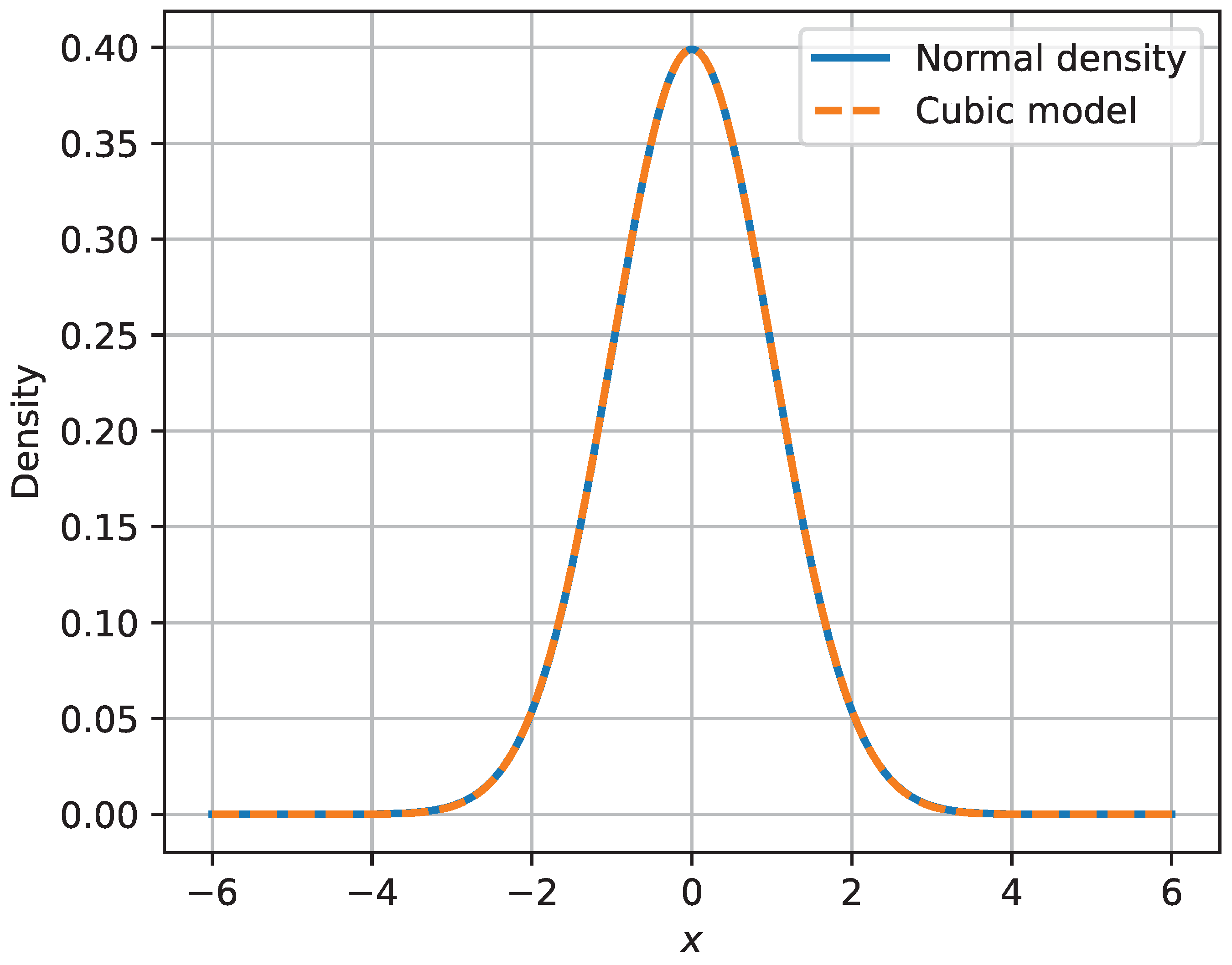
Figure 2 and Figure 3 compare the cubic model with the standard normal distribution. The agreement is remarkably good despite the simplicity of the cubic approximation.
The inverse cumulative distribution function of the cubic model can also be written in closed form. Let
Then
or equivalently
This cubic equation has an explicit solution expressible in terms of hyperbolic functions (or equivalently Cardano’s formula). Consequently, the cubic model possesses closed-form expressions for its cumulative distribution function, probability density function, and quantile function.
7.2. The Quintic Model
The ODE-preserving quintic approximation is
where
Because
the highest-order term dominates for sufficiently large positive and negative values of x. Consequently,
and
Therefore the ODE-preserving quintic approximation does not satisfy the defining conditions of the logistic-type family. Its primary role is thus as an approximation to the normal-tanh coordinate rather than as a probability distribution in its own right.
Figure 2 compares the cumulative distribution function of the standard normal distribution with the cubic logistic-type model. The two curves are nearly indistinguishable over a wide range of x values. This observation suggests that a simple cubic correction to the logistic model already captures a substantial part of the difference between the logistic and normal distributions.
The close agreement is particularly noteworthy because the cubic model is obtained from a low-order polynomial approximation of the normal-tanh coordinate. This motivates a more detailed examination of the coefficient and its derivation.
The comparison of probability density functions is shown in Figure 3. Despite its simple functional form, the cubic model reproduces the shape of the standard normal density with remarkable accuracy.
Unlike the normal distribution, the cubic model admits closed-form expressions for the cumulative distribution function, probability density function, and quantile function. The observed agreement therefore indicates that the cubic model may provide a useful analytical approximation while retaining mathematical simplicity.
8. Discussion
The principal result of this study is the introduction of the normal-tanh coordinate
together with polynomial approximations that relate the standard normal distribution to a broader logistic-type family of probability distributions.
A particularly interesting observation is that the cubic coefficient
arises independently from two conceptually distinct approaches. The first is the Taylor expansion of the normal-tanh coordinate around the origin. The second is a structure-preserving approximation derived from the differential equation satisfied by the Mills ratio. The coincidence of the two derivations suggests that the cubic coefficient reflects both local analytical behavior and global structural properties of the normal distribution.
At quintic order, the two approaches diverge. The Taylor expansion and the ODE-preserving construction produce different values of the quintic coefficient. Numerical experiments indicate that the ODE-preserving coefficient yields a more accurate approximation over a broader range of x, whereas the Taylor expansion remains optimal in the immediate neighborhood of the origin. This distinction highlights the difference between local approximation and structure-preserving approximation.
The cubic model possesses several attractive mathematical properties. In particular, it defines a valid member of the logistic-type family, remains globally monotone, and admits closed-form expressions for its cumulative distribution function, probability density function, and quantile function. By contrast, the ODE-preserving quintic approximation contains a negative leading coefficient. Consequently, it no longer satisfies the global monotonicity conditions required for membership in the logistic-type family. In this sense, the quintic model is best interpreted as an approximation to the normal-tanh coordinate rather than as a probability distribution in its own right.
An additional observation concerns the approximation used in the Gaussian Error Linear Unit (GELU) [2]. The cubic coefficient employed in the widely used GELU approximation is 0.044715, whereas the coefficient derived in the present work is
The two values differ by less than two percent. It should be emphasized that the present derivation is
Acknowledgments
This work was supported by JSPS KAKENHI Grant Numbers JP25K22410, JP26K10050 and Yokohama Foundation for Advancement of Medical Science (Medical Digitalization Grant). AI-assisted tools (Microsoft Copilot, 2026) were used solely for idea organization and for improving the clarity and fluency of the English text. All mathematical derivations, theoretical arguments, numerical experiments, and final scientific content were entirely produced and verified by the authors.
Conflicts of Interest
The author declares no conflicts of interest.
References
- J. P. Mills, “Table of the Ratio: Area to Bounding Ordinate, for Any Portion of Normal Curve,” Biometrika, vol. 18, no. 3–4, pp. 395–400, 1926.
- D. Hendrycks and K. Gimpel, “Gaussian Error Linear Units (GELUs),” arXiv preprint, arXiv:1606.08415, 2016.
Figure 1.
The normal-tanh coordinate . Unlike the cumulative distribution function itself, is an unbounded odd function and serves as a natural target for polynomial approximation.
Figure 1.
The normal-tanh coordinate . Unlike the cumulative distribution function itself, is an unbounded odd function and serves as a natural target for polynomial approximation.
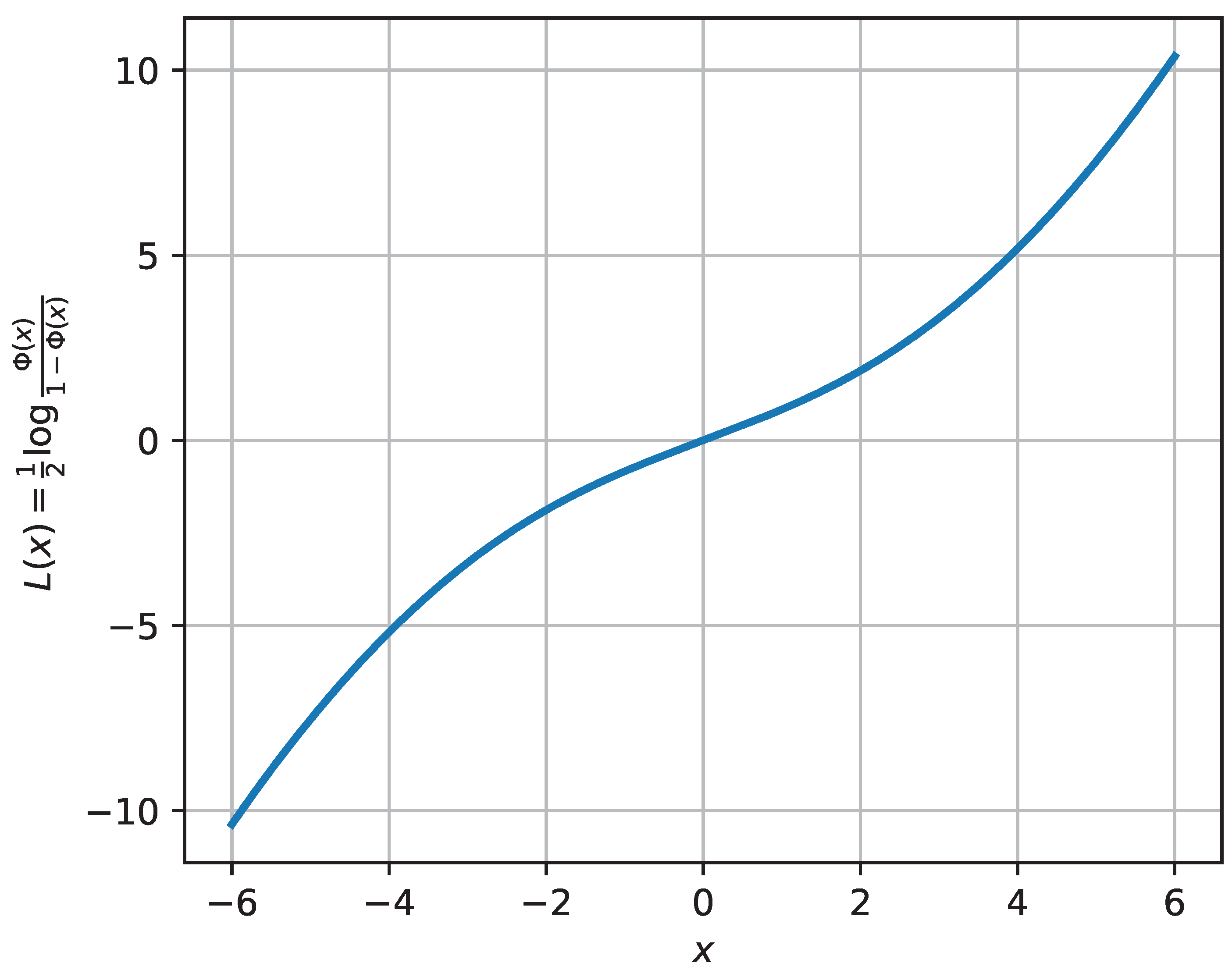
Figure 2.
Comparison between the standard normal cumulative distribution function and the cubic logistic-type model.
Figure 2.
Comparison between the standard normal cumulative distribution function and the cubic logistic-type model.
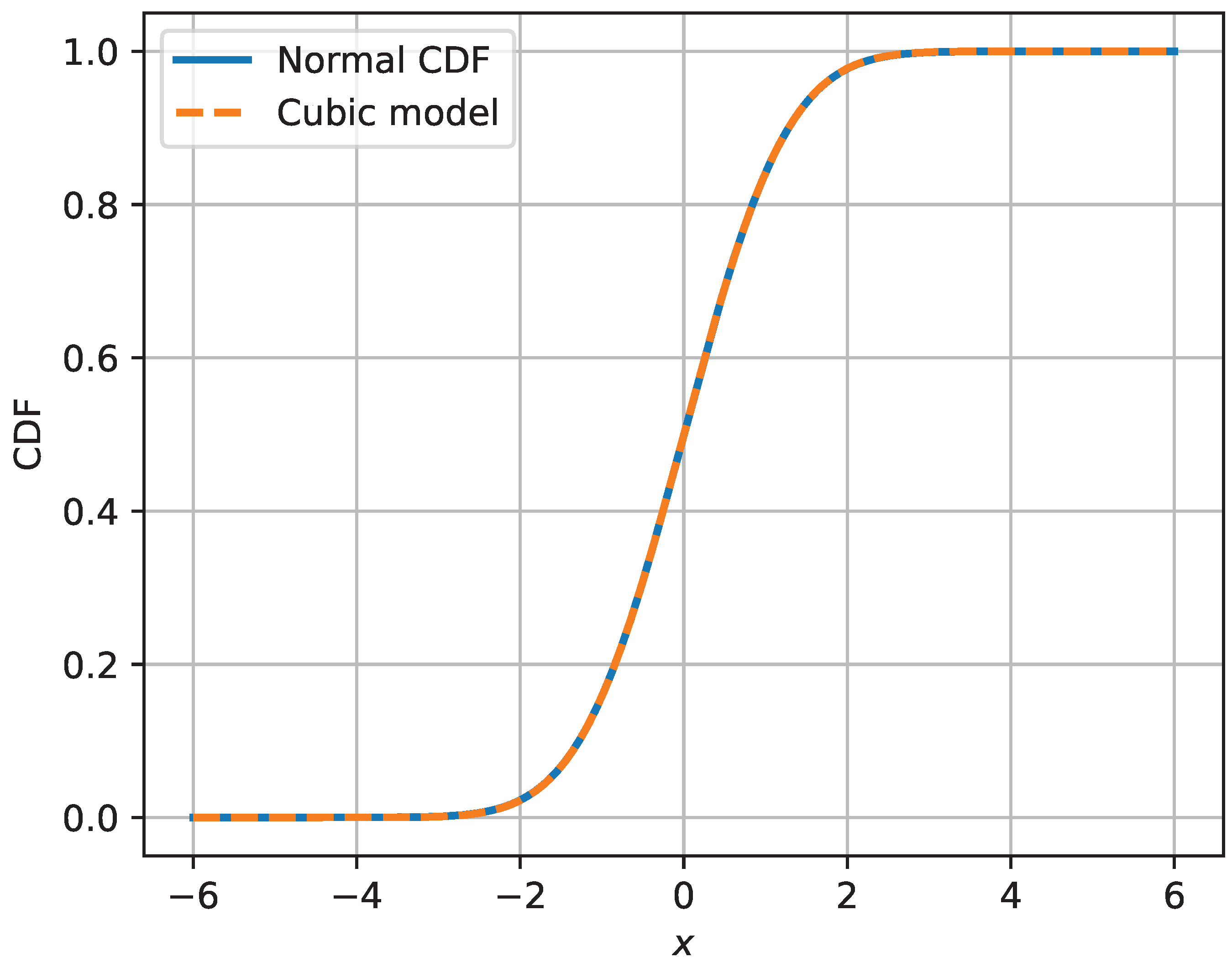
Figure 3.
Comparison between the standard normal probability density function and the density induced by the cubic logistic-type model.
Figure 3.
Comparison between the standard normal probability density function and the density induced by the cubic logistic-type model.
Disclaimer/Publisher’s Note: The statements, opinions and data contained in all publications are solely those of the individual author(s) and contributor(s) and not of MDPI and/or the editor(s). MDPI and/or the editor(s) disclaim responsibility for any injury to people or property resulting from any ideas, methods, instructions or products referred to in the content. |
© 2026 by the authors. Licensee MDPI, Basel, Switzerland. This article is an open access article distributed under the terms and conditions of the Creative Commons Attribution (CC BY) license (http://creativecommons.org/licenses/by/4.0/).
Copyright: This open access article is published under a Creative Commons CC BY 4.0 license, which permit the free download, distribution, and reuse, provided that the author and preprint are cited in any reuse.