

Submitted:
21 September 2026
Posted:
24 September 2026
You are already at the latest version
Abstract
Background/Objectives: Bladder cancer is a disease of the elderly population, who often undergo transurethral bladder tumor resections (TURBT). Data on whether cognitive decline occurs after TURBT are limited. This study examined changes in cognitive status after TURBT, as measured by the Montreal Cognitive Assessment (MoCA) and Mini-Mental State Examination (MMSE), and whether these changes were associated with frailty status, handgrip strength (HGS), and biomarkers. Methods: Biomarkers IL-4, IL-6, S100b, and NSE were measured preoperatively, at 2 hours, and at 24 hours after TURBT. MoCA, MMSE, and HGS were assessed preoperatively and at 24 and 48 hours postoperatively in 60 patients (51 male, 9 female; median age 70 (50-80 years); trial registration number: NCT07165236. Results: Both MMSE and MoCA declined significantly from preoperative 26 (26-27) to 24 (23-25) and 22 (21-23) at 24 and 48 h postoperatively (P<0.001). HGS decreased from 31.8 (27.2 – 32.9) to 27.2 (20.4 – 24.4) and 22.7 (20.4 – 24.4) kilograms at 24 and 48 h postoperatively (P<0.001). The biomarker change was statistically significant, but only IL-6 showed an association with MoCA 24 h after surgery (ρ=-0.419, P<0.001). Clinical frailty at admission showed the strongest correlation with MoCA (ρ=0.495, P<0.001) and MMSE (ρ=-0.520, P<0.001). Conclusion: Early cognitive decline occurs after TURBT in elderly patients with bladder cancer. Clinical frailty is the strongest predictor of postoperative cognitive impairment, while biomarker alterations provide limited prognostic information. Routine preoperative frailty assessment may improve risk stratification and perioperative care.
Keywords:
urology
; perioperative care
; anesthesia
; general
; transurethral resection of bladder
; cognitive dysfunction
; hand strength
1. Introduction
One of the most widespread tumors in the world is bladder cancer, which has a further tendency to increase and is one of the most common diseases of the urinary tract system [1,2]. The surgical procedure that patients with bladder tumors most often undergo is transurethral resection of the bladder tumor (TURBT). This common procedure is usually performed under general anesthesia via endoscopy, and understanding its impact on biomarkers and cognitive function is crucial for optimizing patient outcomes. Because the number of patients undergoing this type of procedure is increasing, some patients are undergoing it more than once [3,4,5].
Most patients with bladder tumors are elderly, are repeatedly exposed to surgical procedures, have numerous comorbidities, and have a high risk of postoperative complications and the development of perioperative cognitive deficits, which can further complicate the postoperative course and further treatment [6,7,8]. The concept of clinical frailty is becoming increasingly important and relevant in the provision of healthcare services. The use of the Clinical Frailty Scale (CFS) as a tool in clinical practice provides information on the adequate direction of care for patients [9]. Decreased muscle strength can limit the functioning of certain individuals. In recent years, muscle strength has become a very important component of health, regardless of a person’s age or clinical condition. Hand grip strength measures the maximum isometric strength of the hand and forearm muscles [10]. The Mini-Mental State Examination (MMSE) and MoCA are the most frequently used methods for detecting cognitive impairment in clinical research. They are intended to assist in the clinical examination of the cognitive component of mental status and are used as screening instruments for cognitive impairment over time [11,12].
Interleukin-6 (IL-6) is a potent cytokine that has diverse effects in the human body [13]. It is an inflammatory cytokine that has been studied as a biomarker of changes in cognitive function and memory related to brain health [14,15]. Conditions that have been studied in different patient populations and include dysregulation of IL-6 include Alzheimer’s disease, neurological damage, and the development of dementia; the dynamics of IL-6 changes after major surgery; and the association of IL-6 with traumatic brain injury, with neuroinflammation being one of the key mechanisms, i.e., involvement in the immune-brain axis [16,17,18].
Neuron-specific enolase (NSE) is an enzyme specific for glycolysis, present in neuronal and neuroendocrine tissues [19,20]. It is normally not detectable in the extracellular space, but it can appear there if a cell is damaged or killed. Accordingly, it has been studied as a biomarker of traumatic brain injury, and levels of NSE have been correlated with the risk of further damage and possible further recovery after injury [21].
Interleukin-4 (IL-4) is a cytokine known for its role in the immune system and has been extensively studied in this context, but increasing evidence shows that it also plays an important role in cognitive function and brain health [22]. IL-4 in the central nervous system seeks to maintain a balanced environment that supports neuronal health by promoting a protective rather than pro-inflammatory response. Studies in mice show that IL-4 deficiency leads to memory impairment, while normal levels improve cognitive performance [23].
The S100 calcium-binding protein B (S100B) belongs to the S100 protein multigene family and has a very short half-life. Primarily, it serves as a biomarker for blood-brain barrier disruption and astrocyte damage in traumatic brain injury (TBI), with elevated serum levels often linked to poorer outcomes. S100B has been studied in numerous research and clinical settings, including patients with dementia and those with type 2 diabetes, in which it was positively associated with cognitive changes [24,25,26].
Patients who undergo TURBT surgery mostly belong to an older patient population with numerous comorbidities. In some of them, the procedure is repeated several times, which is why they have an increased risk of developing complications in the early perioperative period, including changes in cognitive function. Cognitive dysfunction can last from a few days to several months. Perioperative cognitive decline may lead to poorer treatment outcomes, so identifying and correlating risk factors associated with changes in cognitive function in high-risk patients can improve outcomes with adequate management [5,7,27].
To date, there are no studies examining changes in cognitive function and circulating markers of neurological damage after TURBT in the postoperative period in bladder cancer patients. This study aimed to examine changes in cognitive function and hand-grip strength and to determine which circulating markers best correlate with cognitive dysfunction.
2. Materials and Methods
We conducted a prospective observational study (trial registration number: NCT07165236) approved by the Ethics Committee of the Osijek University Hospital (No. R1-6730/2024). All patients signed informed consent before being included in the study. All research was carried out in accordance with relevant guidelines. Research was performed in accordance with the Declaration of Helsinki. Adult patients of both sexes (>18 years - 80 years) with a diagnosis of bladder tumor who underwent an elective TURBT were included.
Patients who underwent emergency surgeries, those younger than 18 years, patients who were unconscious, patients with previously known neurodevelopmental deficits, those who could not give consent for the study, and those who could not understand the study protocol were also excluded. We also excluded patients with proven hypersensitivity to any study drug and those unable to write.
Assessment of cognitive functions was performed using the Mini-Mental State Examination (MMSE) and the Montreal Cognitive Assessment (MoCA). The tests were performed before surgery and at 24 and 48 hours after the operation, in the patients’ native language. A decline in MMSE and MoCA test scores of ≥3 points was considered as a decline in cognitive function during the observed period. Hand-grip strength was assessed using a Smedley dynamometer with a measuring range of 0-100 kilograms. The mean of three subsequent measurements of the dominant hand grip strength was calculated.
The clinical frailty score was determined using the Clinical Frailty Scale (CFS), which classifies patients into 9 categories based on their ability to function independently, from a completely independent, physically active patient (CFS 1) to an immobile patient completely dependent on assistance, with life expectancy less than 6 months (CFS 9) [28]. Preoperative anesthesiologic evaluation was performed according to the American Society of Anesthesiologists (ASA) classification before admission. Admission day was considered day one.
Blood samples were taken preoperatively, two hours after surgery, and 24 hours after surgery. Biomarkers S100B (pg/mL), NSE(µg/L), IL-6 (ng/L), and IL-4 (pg/mL) were analyzed. We determined IL-6 and NSE by electrochemiluminescence (ECLIA; Roche Cobas e801, Roche Diagnostics GmbH, Mannheim, Germany). The remaining serum was aliquoted and stored at -20 °C, and IL-4 and S100B concentrations were subsequently determined by manual enzyme-linked immunosorbent assay (ELISA) (Thermo Fisher Scientific Human S100 calcium binding protein B kit and Invitrogen Human IL-4 kit) when all patient samples were collected. Changes in circulating biomarker levels, cognitive status, and hand-grip strength after surgery were evaluated relative to preoperative values.
After the patient entered the operating room, a peripheral intravenous cannula was placed, and non-invasive blood pressure, pulse oximetry, and ECG were monitored continuously. General balanced anesthesia was maintained using propofol (Propofol 1% MCT Frasenius, Frasenius Kabi, Bad Homburg, Germany) 1,5 mg/kg, fentanyl (Fentanyl Janssen, Janssen Cilag, Beerse, Belgium) as per blood pressure and pulse values, vecuronium (Veculex, Inresa Arzneimittel GmbH, Freiburg) 0.1 mg/kg to 0.2 mg/kg IV, and an inhalation gas mixture of sevoflurane (Sevoflurane, Baxter Healthcare Ltd., Thetford, Norfolk, England) in oxygen and air. Blood pressure was maintained at normal values using ephedrine (Efedrinklorid Sintetica, Sintetica GmbH, Münster, Germany) or diluted norepinephrine (Sinora, Sintetica GmbH, Münster, Germany), while atropine (Monico spa, Bioindustria L.I.M., Laboratorio Italiano Medicinali S.p.A., Italy) was used for bradycardia (<50 beats/minute). After the surgery, paracetamol or metamizole was used for postoperative analgesia, or tramadol for VAS ≥4.
Statistical analysis
Categorical data are presented in absolute and relative frequencies. Continuous data are presented with medians and interquartile ranges. Differences in continuous variables between two related measurements were tested using the Wilcoxon test with the Hodges–Lehmann estimate of the median difference and its 95% confidence interval. Differences in continuous variables among the three dependent groups were tested using Friedman’s test, with post hoc Conover’s test. The association between variables was assessed using Spearman’s correlation coefficient (ρ). Logistic regression was performed to assess factors associated with early postoperative cognitive decline 24 hours after surgery. The outcome was defined as a binary variable (decrease in MMSE or MoCA score ≥3 points compared to the preoperative value). First, a basic model was constructed that included clinical variables for model adjustment (age, sex, preoperative cognitive score of MMSE, MoCA, and CFS). Biomarkers (IL-6, IL-4, NSE, S100B) were additionally included in separate models. Given the small number of events, the model included only a limited number of variables to avoid instability in the estimates. Since a drop in cognitive score of 3 or more points was observed at 48 hours after surgery in most patients, a multivariate linear regression analysis was performed at that time point. The change in cognitive score (ΔMMSE or ΔMoCA calculated as the difference between postoperative (24 h) and preoperative values was used as the dependent variable. Basic and extended models for predicting early postoperative cognitive decline were constructed in the same way as logistic regression, with the gradual inclusion of perioperative variables, biomarkers, and their changes. ROC (Receiver Operating Characteristic) analysis was used to determine the optimal cut-off value, the area under the ROC curve (AUC), and the sensitivity and specificity of individual factors in predicting worse cognitive status.
To detect a medium effect in the difference of continuous variables between two measurements, with a significance level of 0.05 and power of 0.95, with a medium effect (dz = 0.5), the minimum required sample size is 44 subjects. All P values are two-sided. The significance level was set at alpha = 0.05. The statistical package MedCalc® Statistical Software version 23.4.8 (MedCalc Software Ltd., Ostend, Belgium; https://www.medcalc.org; 2026) was used for statistical analysis. Microsoft Copilot was used to assist in the graphical abstract design and visual layout.
3. Results
Of the 71 patients who signed informed consent to participate in the study, 11 were excluded because they were discharged from the hospital earlier at their own request, and the scheduled tests could not be performed. Of the 60 patients (85%) included in the study, 9 were women, and 51 were men.
Patients had an average elevated body mass index, moderate clinical frailty on admission, and the most common ASA score was 3. Most often, the procedure was performed on day 2 after admission to the department (Table 1).
Handgrip test, MMSE, and MoCA scores decreased significantly at 24 and 48 hours after surgery compared to preoperative scores. Scores decreased gradually across all three measures, and differences between all time points were statistically significant (Friedman test, P < 0.001) (Figure 1).
In both cognitive tests, scores decreased by≥ 3 points at 24 and 48 hours after surgery (Wilcoxon test, P < 0.001), with the decrease more pronounced at 48 hours (Table 2).
The CFS was significantly negatively associated with MMSE and MoCA test scores at all measurement time points, with higher frailty scores associated with lower cognitive scores.
Hand grip strength showed a moderate positive correlation with cognitive test results at all measurement points (Table 3). Better muscle strength is accompanied by better cognitive status. The correlations are somewhat stronger with the MoCA questionnaire at preoperative and 48 h postoperative time points, whereas those with the MMSE are weaker but still significant. Changes in MMSE and MoCA are significantly related to hand grip strength (Table 3).
No significant differences in MMSE scores or changes in MMSE scores were found between patients who underwent TURBT for the first time and those who underwent TURBT more than once, either preoperatively or at 24 and 48 hours after surgery. The MoCA test scores did not differ significantly preoperatively or 24 hours after surgery. At 48 hours postoperatively, patients with more previous procedures had significantly lower MoCA scores (P = 0.04) (Table 4).
All circulating biomarkers, except NSE, were significantly higher after surgery than preoperatively (Figure 2). During the perioperative period, S100B concentration increased significantly at 2 hours after surgery compared with the preoperative value and further increased by 24 hours after surgery compared with 2 hours after awakening (Friedman’s test, P < 0.001). Interleukin-4 differed significantly between preoperative and 2 hours after awakening, as well as between preoperative and 24 hours after surgery, whereas the difference between 2 and 24 hours was not significant (Friedman test, P < 0.001). Interleukin-6 had a significant increase 2 hours after awakening compared to preoperative values and an additional significant increase 24 hours after surgery compared to 2 hours after awakening (Friedman test, P < 0.001). NSE did not change significantly between measurement points (Figure 2).
Stronger associations (ρ ≥ 0.40) were observed between biomarker concentrations and cognitive outcomes at different measurement points for IL-6 measured 24 hours after surgery. Higher IL-6 values were moderately to strongly negatively associated with preoperative MoCA scores (ρ = -0.473, P<0.001) and with MoCA scores 24 hours after surgery (ρ = -0.419, P<0.001). Other significant associations were weaker (ρ < 0.40), whereas no significant associations were found for the remaining combinations of biomarkers and cognitive tests (Table 5). A weak positive correlation (ρ = 0.271) of preoperative NSE with the preoperative hand-grip strength was recorded, while other associations were not significant.
Cognitive test scores did not differ between patients with elevated biomarkers at any time point and those with normal values. All patients showed a relatively similar, linear decline in cognitive test scores and HGS (Figure 1). ROC analysis showed that the investigated variables had low-to-moderate predictive ability for early postoperative cognitive decline.
For MMSE decline, ΔS100B showed significant predictive ability (AUC=0.686). It correlated with MMSE decline, with high sensitivity (92.3%) and lower specificity (34.2%). Other biomarkers did not significantly distinguish patients with and without cognitive decline.
An increase in NSE was significantly associated with MoCA decline (AUC=0.666), with a sensitivity of 80% and a specificity of 55%. Other biomarkers did not show a significant predictive value.
Comparison of the areas under the curve (AUC) for significant factors shows that MoCA and MMSE have similar discriminating ability, since their 95% confidence intervals overlap. Moderate values of the area under the curve (AUC) indicate limited clinical applicability (Table 6).
4. Discussion
This study confirmed that patients with greater handgrip strength and lower CFS have better preoperative cognitive function, as assessed by the MMSE and MoCA. The handgrip strength test is a noninvasive tool for assessing patients’ physical status [29]. Recent studies have shown that it correlates with treatment outcomes. Weaker handgrip strength is associated with worse outcomes and postoperative complications such as stroke, heart attack, infections, and delirium [30,31]. Arita et al. conducted a single-center, retrospective observational study demonstrating that grip strength is an independent predictor of postoperative delirium, along with age [32]. Kotani et al. examined the relationship between preoperative handgrip strength and postoperative delirium after cardiovascular surgery and concluded that low preoperative handgrip strength was associated with postoperative delirium [33].
Several factors may explain this observation. Shin and colleagues evaluated the correlation among sarcopenic indices, peripheral muscle strength, and respiratory muscle strength in healthy elderly individuals aged 60 years or older [34. In addition to comparing handgrip motor strength, the authors analyzed frailty and walking speed, administered the Short Physical Performance Battery, measured respiratory muscle strength with a spirometer, and specifically addressed maximal expiratory and maximal inspiratory pressures [34]. They confirmed the correlation between respiratory muscle strength, especially inspiratory muscle strength, and skeletal muscle mass and limb muscle strength. Due to the weaker motor power of the respiratory muscles, respiratory events, such as desaturation, could be more common in frail patients, with more frequent brain hypoxia and subsequent perioperative neurocognitive disorder in the postoperative period. The influence of medications, such as opioids or sedatives, potentially contributes to these perioperative neurocognitive disorders. A prospective clinical study by Moelman et al. examined frailty and nutrition as potential risks for postoperative delirium in a group of 421 surgical patients. The authors used a series of screening tools and confirmed that muscle weakness is associated with a 5.34-fold risk of postoperative delirium in frail patients [35].
In line with previous research, our study found a strong correlation between frailty, handgrip strength, and perioperative neurocognitive disorders [36].
Perioperative neurocognitive disorders in this research were confirmed using both the MMSE and MoCA questionnaires, which were equally sensitive in detecting cognitive decline, with no significant differences between the tests. These results suggest that cognitive decline was stronger in patients who underwent repeated surgical procedures. Possible causes include older age and the influence of environmental toxins that, in addition to carcinogenicity, also cause cognitive decline, such as smoking [37]. The systemic effects of locally applied cytostatics in this group remain unexplored. Given that the population of these patients is getting older and more frail, with numerous comorbidities, the assessment of cognitive function is important, as poorer cognitive status is associated with poorer postoperative outcomes. A harmonization of diagnostic methods should be an initial step toward better patient care and reduced postoperative complications [38,39].
To quantify possible neurological damage associated with cognitive changes after TURBT, we measured the biomarkers S100B, NSE, IL-6, and IL-4. These biomarkers were chosen because their association with brain tissue damage and neuroinflammation in Alzheimer’s disease, ischemic stroke, and traumatic brain injury has been confirmed [17,18,40]. Although differences between measurements were statistically significant, the circulating markers examined in this study did not show a linear relationship with cognitive function assessment. Measurement results also showed large variability, which may be related to factors such as cerebral circulation or other comorbidities (Figure 2). It is also important to note that the biomarkers used here were validated in patients with traumatic brain injury and so were not highly sensitive for these relatively subtle impairments. Therefore, using a high-sensitivity test may better confirm biomarker changes.
S100B has been widely studied as a predictor of the severity of traumatic brain injury, but also in Alzheimer’s disease, Parkinson’s disease, epilepsy, and inflammatory bowel disease [24,25,41]. Given its short half-life, we decided to measure it preoperatively, 2 hours after surgery, and 24 hours after surgery to assess its behavior in this patient group [24]. In our research, Δ S100B shows a strong correlation with cognitive decline on the MMSE, with very high sensitivity but lower specificity. A major disadvantage of this biomarker in the assessment of brain injury is that it is not brain-specific and is associated with overall trauma severity, tissue injury, different skin types, or even with sports activities [24].
Another biomarker in this study was IL-6, which increased significantly after surgery and anesthesia. In our research, IL-6 was strongly associated with MoCA, which is more sensitive to mild dementia and early postoperative neurocognitive disorders. Our results, which confirm that elevated IL-6 is associated with cognitive changes after TURBT, align with numerous other studies showing elevated IL-6 levels and their association with cognitive changes across numerous conditions, as well as with other surgical interventions. Wang and coworkers showed that elevated IL-6 levels were independently associated with a reduction in MoCA after ischemic stroke and TIA [18]. Zhang et al.l. note that cognitive changes after surgery are a common complication among patients undergoing coronary artery bypass grafting and that is associated with loss of independence and reduced quality of life. They also observed that IL-6 at six hours after surgery is a strong predictor of developing postoperative cognitive dysfunction [42]. Further research is needed to confirm whether some perioperative interventions may alleviate IL-6-mediated postoperative events.
NSE dynamics in our study group did not show significant deviations from preoperative values, while Δ NSE was strongly associated with MoCA decline (sensitivity of 80% and specificity of 55%). Several studies have examined the impact of NSE as a biomarker of neurological damage in relation to the occurrence of cognitive dysfunction after surgery. A positive correlation has been shown between NSE and the occurrence of cognitive impairment, but most studies differ in the timing of sample collection for biomarker measurement and in the tests used to assess neurophysiological cognitive status [43,44]. This observation confirms that postoperative neurocognitive disorder can be suspected based on the dynamics of NSE values. However, laboratory measurements here only confirm the subtle, clinically observed disorder.
The most significant result of the study, based on our observations, is the direct, highly significant relationship between physical status at admission and cognitive status across all measurements. Across all measurements, CFS correlated better with cognitive status than HGS, and MoCA, which traditionally excels in measuring attention, executive function, and visuospatial skills, performed better than MMSE. This observation confirms the old paradigm of holistic well-being (lat. Mens sana in corpore sano) [45,46].
Also, we confirmed here that in TURBT, even with smaller tumors, less invasive surgery, and shorter anesthesia, there is a significant cognitive decline. According to our results, special care should be taken for frail patients, for whom the preoperative condition should be optimized as much as possible and the invasiveness of the procedure adjusted accordingly. This may minimize operative risks and postoperative complications [47].
This study has some limitations. Our research was a prospective, single-center study with a small patient population; a larger patient population may yield more reliable results.
Furthermore, we used tests validated in patients with traumatic brain injury, in which increases in individual biomarkers in circulation are significantly greater, likely due to a disrupted blood-brain barrier. In elderly patients with bladder tumors, these tests may not be sensitive enough to confirm linearity in dynamics, and some patients’ results fell below the measurement threshold. Also, given that there was no statistically significant difference between the MMSE and MoCA tests, the next study could use another sensitive test, such as the Rapid Cognitive Screen [48].
A significant factor that may contribute to poorer postoperative cognitive test results is the patient’s extremely unfavorable postoperative position relative to the examiner. Before surgery, patients were freely mobile, upright, and able to perform the tests while sitting at a table. After surgery, most of the patients were bedridden, catheterized, and some of them had other invasive access such as intravenous lines, infusions, or bladder washout for clots. Although the patients received analgesic therapy for these unpleasant and painful procedures, the unfavorable position of the patient could have resulted in poorer performance when taking the tests. Therefore, future studies should first examine the extent to which this deprivation affects patients’ physical and psychological performance. Also, to compare changes in cognitive status, final cognitive tests should be performed in all patients when their level of mobilization is close to preoperative levels [49].
5. Conclusions
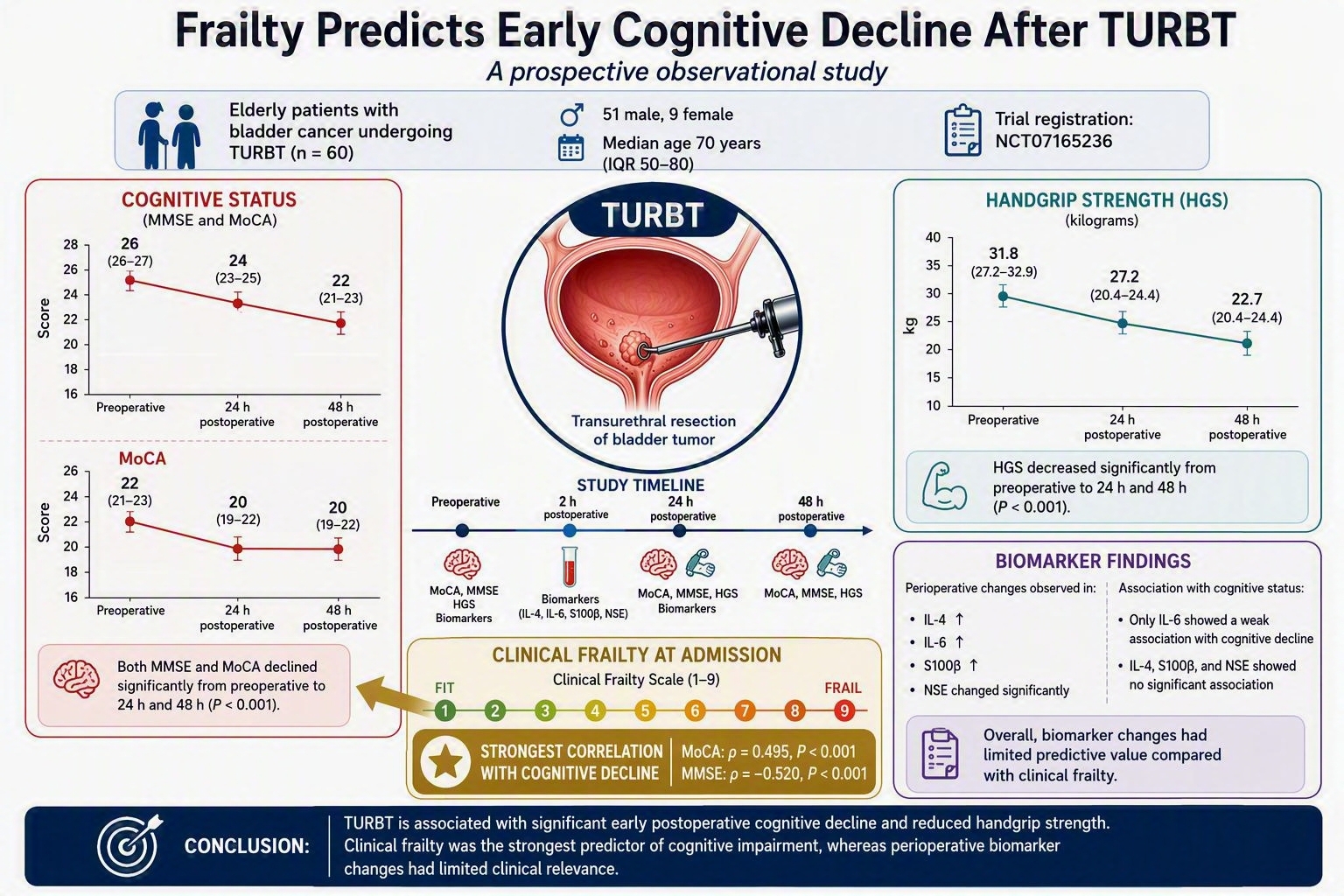
This study showed cognitive function changes in all patients, defined as a decline of 3 or more points in cognitive test scores from the initial measurement and changes in biomarker values (Figure 3). In the early perioperative period, hand grip strength also decreases, which is associated with a decline in cognitive function. Patients who performed better on the hand grip strength test also performed better on the MMSE and MoCA tests. This is a group of fragile patients who often undergo surgical procedures with a high risk of cognitive function decline in the early perioperative period. Given the results obtained, motor strength, which was obtained via the hand grip strength test, should be taken into account in the treatment of this group of patients, as it has shown a correlation with cognitive status, for the purpose of providing better care, reducing perioperative complications, and improving treatment outcomes for this group of patients. Although the inflammatory response can also be a therapeutic target, motor strength is another factor that can be improved and would contribute to each patient’s health status.
Author Contributions
AC, JGT, SK did the manuscript draft; OKT, AC, SK, TR, ID made protocols; AC, ID, NM, ABB collected data; TR, ID, AC did reading; AC, TR, SK did data checking and statistics; AC, JGT, SK wrote the manuscript; AC, JGT, TR, NM, OKT, ID, ABB, SK approved and critically reviewed the manuscript.
Funding
This study was supported by the project number IP2-2025; Josip Juraj Strossmayer University, Medical Faculty.
Institutional Review Board Statement
The study was evaluated and approved by the Ethics Committee of the Osijek University Hospital (No. R1-6730/2024). All research was carried out in accordance with relevant guidelines. Research was performed in accordance with the Declaration of Helsinki.
Informed Consent Statement
We obtained informed consent from all patients involved in the study.
Data Availability Statement
The data supporting the findings of this study are available from the corresponding author upon reasonable request.
Acknowledgments
Microsoft Copilot was used to assist in the graphical abstract design and visual layout. The authors reviewed, edited, and validated all content and take full responsibility for the final figure.
Conflicts of Interest
The authors declare no financial conflicts, institutional interests, professional involvements, or personal relationships that could have affected or influenced the planning, execution, analysis, interpretation, or dissemination of the present study.
References
- Halaseh, S. A.; Halaseh, S.; Alali, Y.; Ashour, M. E.; Alharayzah, M. J. A Review of the Etiology and Epidemiology of Bladder Cancer: All You Need To Know. Cureus 2022, 14(7), e27330. [Google Scholar] [CrossRef] [PubMed]
- Sung, H.; Ferlay, J.; Siegel, R. L.; Laversanne, M.; Soerjomataram, I.; Jemal, A.; Bray, F. Global Cancer Statistics 2020: GLOBOCAN Estimates of Incidence and Mortality Worldwide for 36 Cancers in 185 Countries. CA Cancer J. Clin. 2021, 71(3), 209–249. [Google Scholar] [CrossRef] [PubMed]
- Defidio, L.; Antonucci, M.; Castellani, D.; Civitella, A.; Esperto, F.; Scarpa, R. M. Transurethral Resection of Bladder Tumor: Electrosurgical and Laser. J. Endourol. 2021, 35(S2), S46–s51. [Google Scholar] [CrossRef] [PubMed]
- Demir, D. O.; Doluoglu, O. G.; Yildiz, A. K.; Kacan, T.; Yazar, V. M.; Demirbas, A.; Ozgur, B. C. Effect of Re-TUR time on recurrence and progression in high-risk non-muscle-invasive bladder cancer. Cir. Cir. 2022, 90(S2), 6–12. [Google Scholar] [CrossRef] [PubMed]
- Cui, H. W.; Turney, B. W.; Griffiths, J. The Preoperative Assessment and Optimization of Patients Undergoing Major Urological Surgery. Curr. Urol. Rep. 2017, 18(7), 54. [Google Scholar] [CrossRef] [PubMed]
- Cicvarić, A. Characteristics and Treatment Outcomes of Urologic Patients Admitted to the Intensive Care Unit, Osijek University Hospital Center. Acta Clin. Croat. 2023. [Google Scholar] [CrossRef] [PubMed]
- Ntalouka, M. P.; Arnaoutoglou, E.; Tzimas, P. Postoperative cognitive disorders: an update. Hippokratia 2018, 22(4), 147–154. [Google Scholar] [PubMed]
- Cicvaric, A.; Glavas Tahtler, J.; Pavlovic, O.; Dias, C.; Tot, O. K.; Bjelousov Baksa, A.; Kvolik, S. Perioperative cognitive dysfunction in bladder cancer patients, causal factors, and possible interventions. Front. Med. Mini Review. 2026, Volume 13 - 2026. [Google Scholar] [CrossRef] [PubMed]
- Rockwood, K.; Theou, O. Using the Clinical Frailty Scale in Allocating Scarce Health Care Resources. Can. Geriatr. J. 2020, 23(3), 210–215. [Google Scholar] [CrossRef] [PubMed]
- Huerta Ojeda, Á.; Fontecilla Díaz, B.; Yeomans Cabrera, M. M.; Jerez-Mayorga, D. Grip power test: A new valid and reliable method for assessing muscle power in healthy adolescents. PLoS ONE 2021, 16(10), e0258720. [Google Scholar] [CrossRef] [PubMed]
- Jia, X.; Wang, Z.; Huang, F.; Su, C.; Du, W.; Jiang, H.; Wang, H.; Wang, J.; Wang, F.; Su, W.; et al. A comparison of the Mini-Mental State Examination (MMSE) with the Montreal Cognitive Assessment (MoCA) for mild cognitive impairment screening in Chinese middle-aged and older population: a cross-sectional study. BMC Psychiatry 2021, 21(1), 485. [Google Scholar] [CrossRef] [PubMed]
- Arevalo-Rodriguez, I.; Smailagic, N.; Roqué, I. F. M.; Ciapponi, A.; Sanchez-Perez, E.; Giannakou, A.; Pedraza, O. L.; Bonfill Cosp, X.; Cullum, S. Mini-Mental State Examination (MMSE) for the detection of Alzheimer’s disease and other dementias in people with mild cognitive impairment (MCI). Cochrane Database Syst. Rev. 2015, 2015(3), Cd010783. [Google Scholar] [CrossRef] [PubMed]
- Tanaka, T.; Narazaki, M.; Kishimoto, T. IL-6 in inflammation, immunity, and disease. Cold Spring Harb. Perspect. Biol. 2014, 6(10), a016295. [Google Scholar] [CrossRef] [PubMed]
- Singh-Manoux, A.; Dugravot, A.; Brunner, E.; Kumari, M.; Shipley, M.; Elbaz, A.; Kivimaki, M. Interleukin-6 and C-reactive protein as predictors of cognitive decline in late midlife. Neurology 2014, 83(6), 486–493. [Google Scholar] [CrossRef] [PubMed]
- Bradburn, S.; Sarginson, J.; Murgatroyd, C. A. Association of Peripheral Interleukin-6 with Global Cognitive Decline in Non-demented Adults: A Meta-Analysis of Prospective Studies. Front Aging Neurosci. 2017, 9, 438. [Google Scholar] [CrossRef] [PubMed]
- Zhao, Z.; Zhang, J.; Wu, Y.; Xie, M.; Tao, S.; Lv, Q.; Wang, Q. Plasma IL-6 levels and their association with brain health and dementia risk: A population-based cohort study. Brain Behav. Immun. 2024, 120, 430–438. [Google Scholar] [CrossRef] [PubMed]
- Lyra, E. S. N. M.; Gonçalves, R. A.; Pascoal, T. A.; Lima-Filho, R. A. S.; Resende, E. P. F.; Vieira, E. L. M.; Teixeira, A. L.; de Souza, L. C.; Peny, J. A.; Fortuna, J. T. S.; et al. Pro-inflammatory interleukin-6 signaling links cognitive impairments and peripheral metabolic alterations in Alzheimer’s disease. Transl. Psychiatry 2021, 11(1), 251. [Google Scholar] [CrossRef] [PubMed]
- Wang, Y.; Li, J.; Pan, Y.; Wang, M.; Lin, J.; Meng, X.; Liao, X.; Wang, Y. Interleukin-6 as Predictor of One-Year Cognitive Function After Ischemic Stroke or TIA. Neuropsychiatr. Dis. Treat. 2022, 18, 391–399. [Google Scholar] [CrossRef] [PubMed]
- Thelin, E. P.; Jeppsson, E.; Frostell, A.; Svensson, M.; Mondello, S.; Bellander, B. M.; Nelson, D. W. Utility of neuron-specific enolase in traumatic brain injury; relations to S100B levels, outcome, and extracranial injury severity. Crit. Care 2016, 20, 285. [Google Scholar] [CrossRef] [PubMed]
- Mochetti, M. M.; Silva, E. G. P.; Correa, A. A. F.; Cabette, M. R.; Perissinotti, I. N.; LOJ, E. S.; Pessoa, A. S.; de Oliveira, R. C.; da Silva, L. F. F.; de Souza, H. P.; et al. Neuron-specific enolase at admission as a predictor for stroke volume, severity and outcome in ischemic stroke patients: a prognostic biomarker review. Sci. Rep. 2024, 14(1), 2688. [Google Scholar] [CrossRef] [PubMed]
- Cheng, F.; Yuan, Q.; Yang, J.; Wang, W.; Liu, H. The prognostic value of serum neuron-specific enolase in traumatic brain injury: systematic review and meta-analysis. PLoS ONE 2014, 9(9), e106680. [Google Scholar] [CrossRef] [PubMed]
- Boccardi, V.; Westman, E.; Pelini, L.; Lindberg, O.; Muehlboeck, J. S.; Simmons, A.; Tarducci, R.; Floridi, P.; Chiarini, P.; Soininen, H.; et al. Differential Associations of IL-4 With Hippocampal Subfields in Mild Cognitive Impairment and Alzheimer’s Disease. Front Aging Neurosci. 2018, 10, 439. [Google Scholar] [CrossRef] [PubMed]
- Gadani, S. P.; Cronk, J. C.; Norris, G. T.; Kipnis, J. IL-4 in the brain: a cytokine to remember. J. Immunol. 2012, 189(9), 4213–4219. [Google Scholar] [CrossRef] [PubMed]
- Oris, C.; Kahouadji, S.; Durif, J.; Bouvier, D.; Sapin, V. S100B, Actor and Biomarker of Mild Traumatic Brain Injury. Int. J. Mol. Sci. 2023, 24(7). [Google Scholar] [CrossRef] [PubMed]
- Lam, V.; Albrecht, M. A.; Takechi, R.; Giles, C.; James, A. P.; Foster, J. K.; Mamo, J. C. The Serum Concentration of the Calcium Binding Protein S100B is Positively Associated with Cognitive Performance in Older Adults. Front Aging Neurosci. 2013, 5, 61. [Google Scholar] [CrossRef] [PubMed]
- Yu, H.; Li, H.; Liu, X.; Du, X.; Deng, B. Levels of serum S100B are associated with cognitive dysfunction in patients with type 2 diabetes. Aging 2020, 12(5), 4193–4203. [Google Scholar] [CrossRef] [PubMed]
- Grunewald, C. M.; Feldmeier, V.; Supprian, T.; Albers, P.; Giessing, M.; Niegisch, G. Cognitive function in patients undergoing cystectomy for bladder cancer - results from a prospective observational study. Ther. Adv. Urol. 2022, 14, 17562872221087660. [Google Scholar] [CrossRef] [PubMed]
- Church, S.; Rogers, E.; Rockwood, K.; Theou, O. A scoping review of the Clinical Frailty Scale. BMC Geriatr. 2020, 20(1), 393. [Google Scholar] [CrossRef] [PubMed]
- Yu, R.; Ong, S.; Cheung, O.; Leung, J.; Woo, J. Reference Values of Grip Strength, Prevalence of Low Grip Strength, and Factors Affecting Grip Strength Values in Chinese Adults. J. Am. Med. Dir. Assoc. 2017, 18(6), 551.e559–551.e516. [Google Scholar] [CrossRef] [PubMed]
- Long, G.; Chao, C.; Ming-Sheng, T.; Ping, Y. Low Grip Strength Associated with Clinical Outcomes after Total Hip Arthroplasty - A Prospective Case-Control Study. Orthop. Surg. 2021, 13(5), 1488–1495. [Google Scholar] [CrossRef] [PubMed]
- Chang, C. M.; Lee, C. H.; Shih, C. M.; Wang, S. P.; Chiu, Y. C.; Hsu, C. E. Handgrip strength: a reliable predictor of postoperative early ambulation capacity for the elderly with hip fracture. BMC Musculoskelet. Disord. 2021, 22(1), 103. [Google Scholar] [CrossRef] [PubMed]
- Arita, A.; Takahashi, H.; Ogino, T.; Miyoshi, N.; Uemura, M.; Akasaka, H.; Sugimoto, K.; Rakugi, H.; Doki, Y.; Eguchi, H. Grip strength as a predictor of postoperative delirium in patients with colorectal cancers. Ann. Gastroenterol. Surg. 2022, 6(2), 265–272. [Google Scholar] [CrossRef] [PubMed]
- Kotani, T.; Ida, M.; Inoue, S.; Naito, Y.; Kawaguchi, M. Association between Preoperative Hand Grip Strength and Postoperative Delirium after Cardiovascular Surgery: A Retrospective Study. J. Clin. Med. 2023, 12(7). [Google Scholar] [CrossRef] [PubMed]
- Shin, H. I.; Kim, D. K.; Seo, K. M.; Kang, S. H.; Lee, S. Y.; Son, S. Relation Between Respiratory Muscle Strength and Skeletal Muscle Mass and Hand Grip Strength in the Healthy Elderly. Ann. Rehabil. Med. 2017, 41(4), 686–692. [Google Scholar] [CrossRef] [PubMed]
- Moellmann, H. L.; Alhammadi, E.; Boulghoudan, S.; Kuhlmann, J.; Mevissen, A.; Olbrich, P.; Rahm, L.; Frohnhofen, H. Risk of sarcopenia, frailty and malnutrition as predictors of postoperative delirium in surgery. BMC Geriatr. 2024, 24(1), 971. [Google Scholar] [CrossRef] [PubMed]
- Evered, L.; Atkins, K.; Silbert, B.; Scott, D. A. Acute peri-operative neurocognitive disorders: a narrative review. Anaesthesia 2022, 77 Suppl 1, 34–42. [Google Scholar] [CrossRef] [PubMed]
- Nooyens, A. C.; van Gelder, B. M.; Verschuren, W. M. Smoking and cognitive decline among middle-aged men and women: the Doetinchem Cohort Study. Am. J. Public Health 2008, 98(12), 2244–2250. [Google Scholar] [CrossRef] [PubMed]
- Pongraweewan, P.; Tornsatitkul, S.; Siriussawakul, A.; Krishnamoorthy, V.; Sangarunakul, N.; Jiraphorncharas, C.; Hemrungrojn, S.; Nupairoj, N. Incidence of postoperative cognitive dysfunction in older adults: a prospective cohort study using a web-based Montreal cognitive assessment application. Sci. Rep. 2025, 15(1), 31180. [Google Scholar] [CrossRef] [PubMed]
- Cheuk, E.; Yan, E.; Alhamdah, Y.; Saripella, A.; Campbell, S.; He, D.; Lovblom, L. E.; Wong, J.; Chung, F. The perioperative impact of frailty and cognitive impairment in older surgical patients: A multicentered longitudinal cohort study. J. Clin. Anesth. 2025, 107, 112015. [Google Scholar] [CrossRef] [PubMed]
- Pryzmont, M.; Kosciuczuk, U.; Maciejczyk, M. Biomarkers of traumatic brain injury: narrative review and future prospects in neurointensive care Review. Front. Med. 2025, Volume 12 - 2025. [Google Scholar] [CrossRef] [PubMed]
- Michetti, F.; Clementi, M. E.; Di Liddo, R.; Valeriani, F.; Ria, F.; Rende, M.; Di Sante, G.; Romano Spica, V. The S100B Protein: A Multifaceted Pathogenic Factor More Than a Biomarker. Int. J. Mol. Sci. 2023, 24(11). [Google Scholar] [CrossRef] [PubMed]
- Zhang, S.; Tao, X. J.; Ding, S.; Feng, X. W.; Wu, F. Q.; Wu, Y. Associations between postoperative cognitive dysfunction, serum interleukin-6 and postoperative delirium among patients after coronary artery bypass grafting: A mediation analysis. Nurs. Crit. Care 2024, 29(6), 1245–1252. [Google Scholar] [CrossRef] [PubMed]
- Cao, Y. H.; Chi, P.; Zhao, Y. X.; Dong, X. C. Effect of bispectral index-guided anesthesia on consumption of anesthetics and early postoperative cognitive dysfunction after liver transplantation: An observational study. Medicine 2017, 96(35), e7966. [Google Scholar] [CrossRef] [PubMed]
- Xie, Y.; Yao, Z. Relationships of serum VILIP-1, NSE, and ADP levels with postoperative cognitive dysfunction in elderly patients undergoing general anesthesia: a retrospective, observational study. J. Int. Med. Res. 2023, 51(5), 3000605231172447. [Google Scholar] [CrossRef] [PubMed]
- Fabrício, D. M.; Chagas, M. H. N.; Diniz, B. S. Frailty and cognitive decline. Transl. Res. 2020, 221, 58–64. [Google Scholar] [CrossRef] [PubMed]
- Bruni, F.; Borghesi, F.; Mancuso, V.; Riva, G.; Stramba-Badiale, M.; Pedroli, E.; Cipresso, P. Cognition Meets Gait: Where and How Mind and Body Weave Each Other in a Computational Psychometrics Approach in Aging. Front Aging Neurosci. 2022, 14, 909029. [Google Scholar] [CrossRef] [PubMed]
- Distler, A.; Salas Parra, R.; Huang, X.; Ahmed, H.; Barrera, R.; Patel, V.; Hansen, L. Minimally Invasive Surgery Benefits Frail Patients Undergoing Emergency Hernia Repairs. Jsls 2025, 29(1). [Google Scholar] [CrossRef] [PubMed]
- Tran, J.; Nimojan, T.; Saripella, A.; Tang-Wai, D. F.; Butris, N.; Kapoor, P.; Berezin, L.; Englesakis, M.; Chung, F. Rapid cognitive assessment tools for screening of mild cognitive impairment in the preoperative setting: A systematic review and meta-analysis. J. Clin. Anesth. 2022, 78, 110682. [Google Scholar] [CrossRef] [PubMed]
- Chen, W.; Wang, J.; Wang, L.; Hu, W.; Chen, X.; Jin, L. Effect of patient position on the EEG bispectral index and entropy index under general anaesthesia. Technol. Health Care 2025, 33(1), 311–319. [Google Scholar] [CrossRef] [PubMed]
Figure 1.
Changes in cognitive tests and hand-grip strength tests before and after surgery. Boxplots represent medians and interquartile ranges; whiskers represent the minimum and maximum range. MMSE - Mini-Mental State Examination; MoCA - Montreal Cognitive Assessment; Friedman’s test (post hoc Conover test); significant differences at P < 0.05: †(1) vs. (2, 3); *(2) vs. (3).
Figure 1.
Changes in cognitive tests and hand-grip strength tests before and after surgery. Boxplots represent medians and interquartile ranges; whiskers represent the minimum and maximum range. MMSE - Mini-Mental State Examination; MoCA - Montreal Cognitive Assessment; Friedman’s test (post hoc Conover test); significant differences at P < 0.05: †(1) vs. (2, 3); *(2) vs. (3).
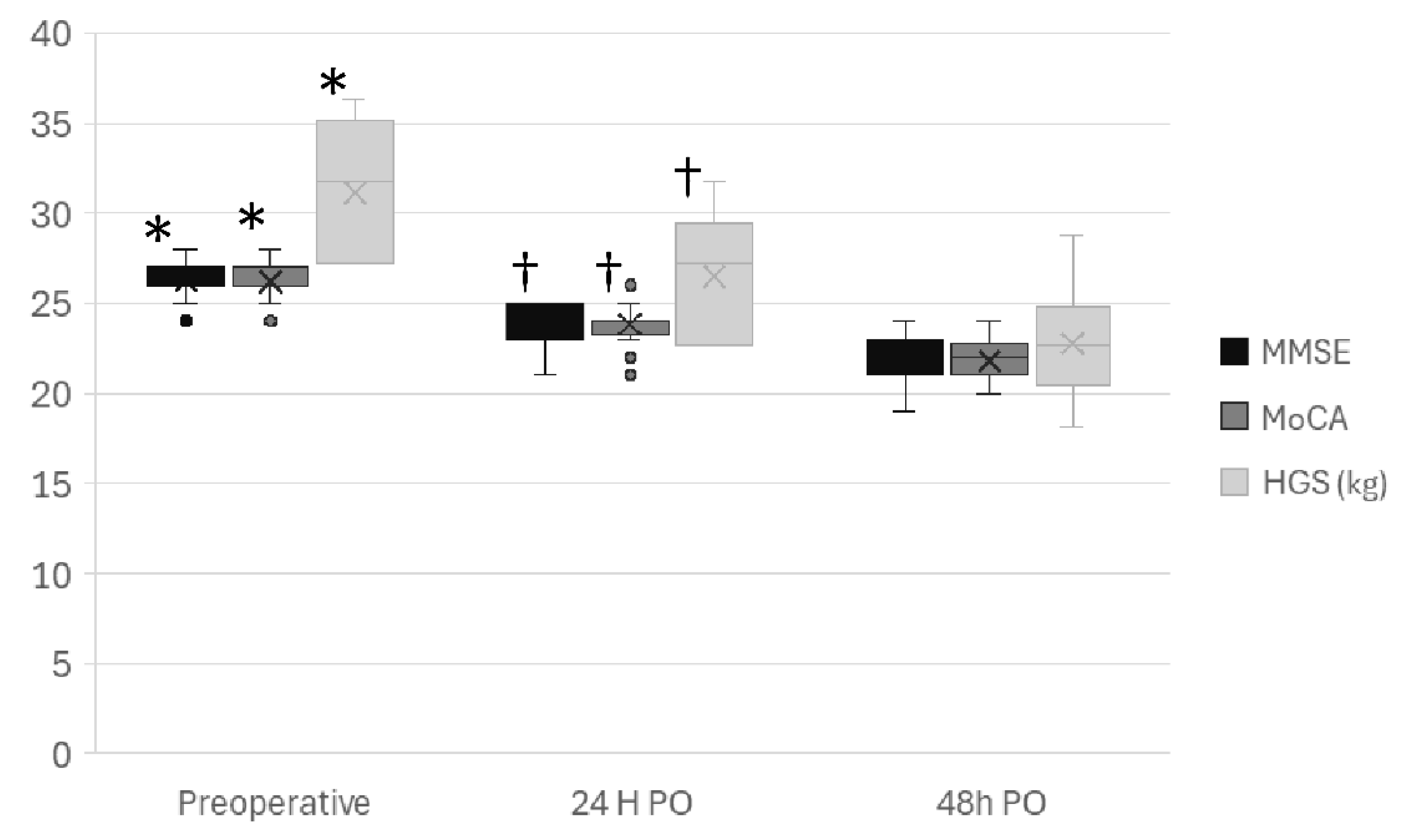
Figure 2.
Changes in biomarkers preoperatively, 2 hours after emergence from anesthesia, and 24 hours after surgery. Note. Median and interquartile ranges are shown; the lower whisker is 1.5 IQR from the Q1, the upper whisker is ≤1.5 x IQR from the Q3, and dots show outliers. *Friedman test (post hoc Conover test), †at the P < 0.05 level, the differences are significant: (2) vs. (1, 3), ‡at the P < 0.05 level, the differences are significant: (1) vs. (2, 3), §at the P < 0.05 level, the differences are significant: (1) vs. (2, 3); (2) vs. (3). S100B - S100 calcium-binding protein B, IL-4 - Interleukin 4, IL-6 - Interleukin 6, NSE – neuron-specific enolase.
Figure 2.
Changes in biomarkers preoperatively, 2 hours after emergence from anesthesia, and 24 hours after surgery. Note. Median and interquartile ranges are shown; the lower whisker is 1.5 IQR from the Q1, the upper whisker is ≤1.5 x IQR from the Q3, and dots show outliers. *Friedman test (post hoc Conover test), †at the P < 0.05 level, the differences are significant: (2) vs. (1, 3), ‡at the P < 0.05 level, the differences are significant: (1) vs. (2, 3), §at the P < 0.05 level, the differences are significant: (1) vs. (2, 3); (2) vs. (3). S100B - S100 calcium-binding protein B, IL-4 - Interleukin 4, IL-6 - Interleukin 6, NSE – neuron-specific enolase.
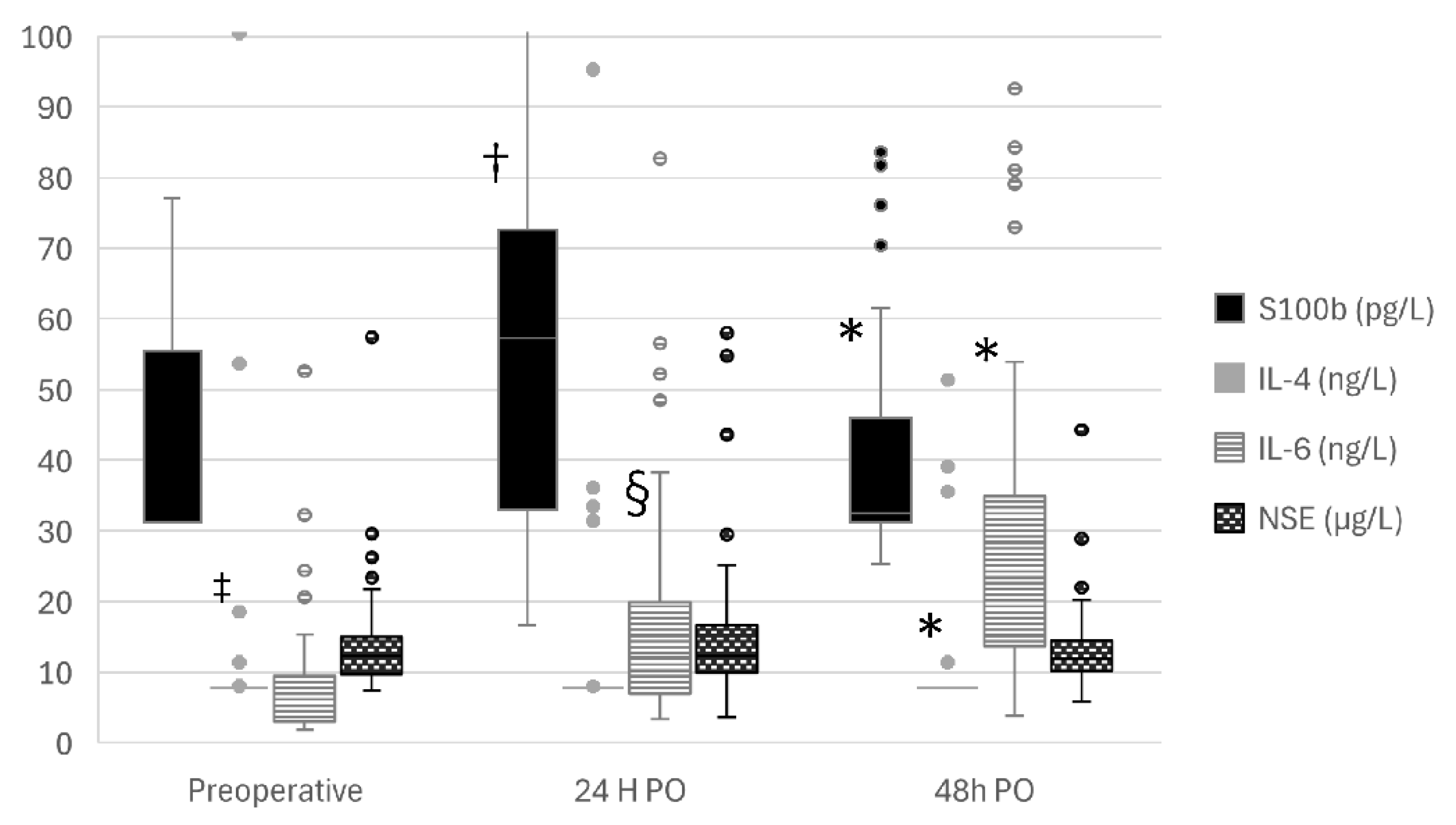
Figure 3.
Graphical abstract of the study and results.
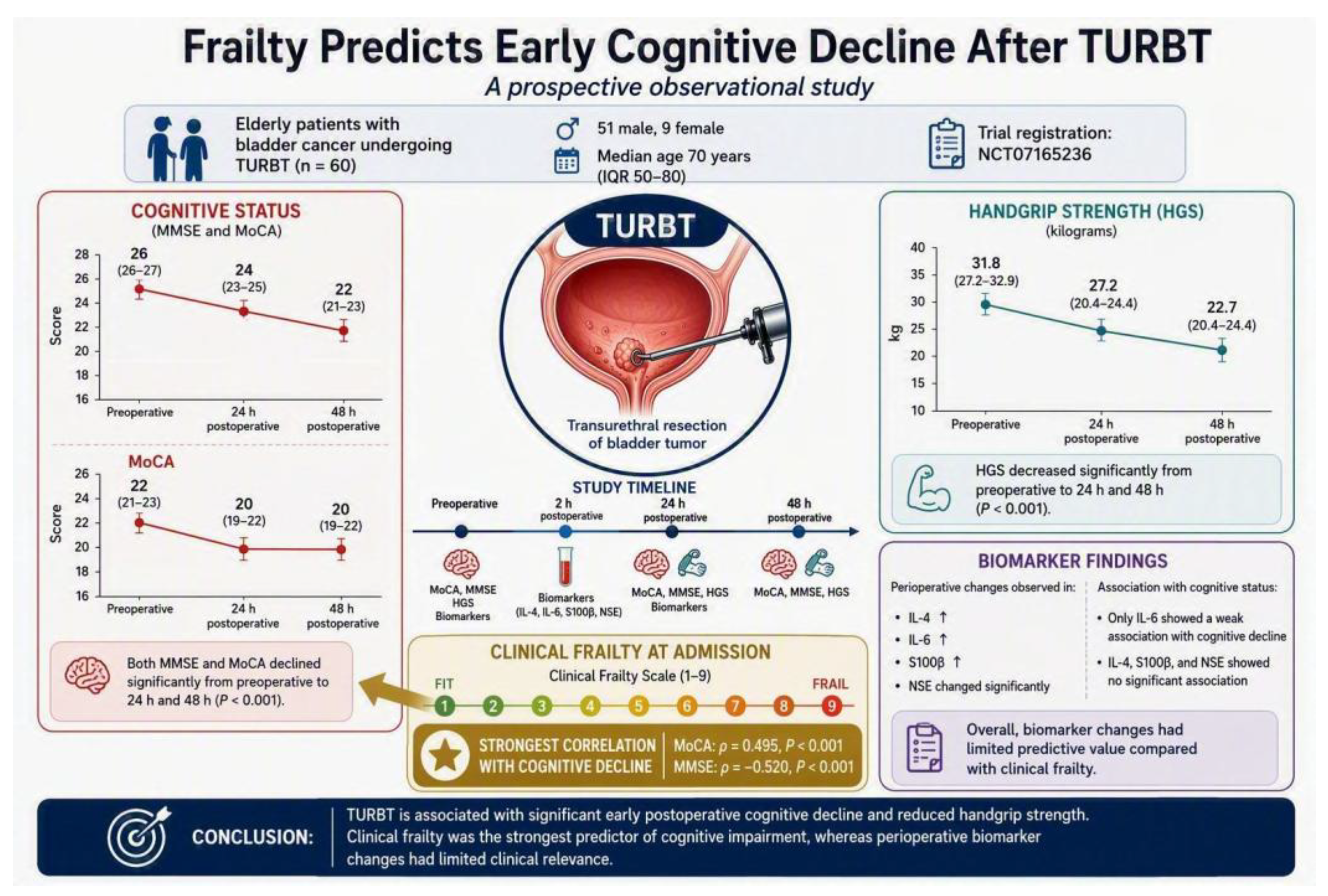

Table 1.
Clinical and demographic characteristics of patients with hospitalization data.
| Demographic data | Median (interquartile range) |
Range (minimum–maximum) |
|---|---|---|
| Age (years) | 70 years | 50 - 80 |
| Body mass index (kg/m2) | 26.5 (24.3 - 30.8) | 16.5 - 39.8 |
| Clinical Frailty Score | 5 (4 - 5) | 2 – 7 |
| ASA | 3 (3 - 3) | 2 – 3 |
| Days of surgery after admission | 2 (2 - 2) | 2 – 14 |
| Total number of hospital days | 4 (4 - 5) | 4 – 19 |
Note: ASA American Society of Anesthesiologists classification.
Table 2.
Incidence of cognitive decline (≥ 3 points) 24 and 48 hours after surgery.
| preoperatively vs. 24 h | preoperatively vs. 48 h | |
|---|---|---|
| Difference MMSE | ||
| decrease by less than 3 points | 47 (78.3) | 0 |
| decrease by 3 or more points | 13 (21.7) | 60 (100) |
| Difference MoCA | ||
| decrease by less than 3 points | 40 (66.7) | 0 |
| decrease by 3 or more points | 20 (33.3) | 60 (100) |
Note. Number of patients (%) is shown; MMSE - Mini-Mental State Examination); MoCA - Montreal Cognitive Assessment.
Table 3.
Association of clinical frailty at admission, hand-grip strength with MMSE and MoCA values at three measurement points.
Table 3.
Association of clinical frailty at admission, hand-grip strength with MMSE and MoCA values at three measurement points.
| Hand-grip strength before surgery |
Hand-grip strength 24 h after surgery |
Hand-grip strength 48 h after surgery |
Clinical frailty at admission | |
|---|---|---|---|---|
| MMSE | ||||
| Preoperative | 0,350 (0.01) | 0.351 (0.01) | 0.316 (0.01) | -0.533 (<0.001) |
| 24 h after surgery | 0.338 (0.01) | 0.327 (0.01) | 0.258 (0.05) | -0.566 (<0.001) |
| 48 h after surgery | 0.333 (0.01) | 0.365 (<0.001) | 0.332 (0.01) | -0.520 (<0.001) |
| MoCA | ||||
| Preoperative | 0.481 (<0.001) | 0.475 (<0.001) | 0.429 (<0.001) | -0.621 (<0.001) |
| 24 h after surgery | 0.261 (0.04) | 0.294 (0.02) | 0.203 (0.12) | -0.468 (<0.001) |
| 48 h after surgery | 0.416 (<0.001) | 0.457 (<0.001) | 0.411 (<0.001) | -0.495 (<0.001) |
Note. MMSE - Mini-Mental State Examination, MoCA - Montreal Cognitive Assessment, Spearman’s correlation coefficient ρ (P value).
Table 4.
Comparison of cognitive outcomes between patients undergoing TURBT for the first time and those who have undergone it multiple times.
Table 4.
Comparison of cognitive outcomes between patients undergoing TURBT for the first time and those who have undergone it multiple times.
| First time TURBT (n = 31) |
≥2 TURBT (n = 29) |
†Difference | 95% confidence interval | P* | |
|---|---|---|---|---|---|
| MMSE | |||||
| preoperatively | 26 (26 - 27) | 26 (26 - 27) | 0 | -1 - 0 | 0.68 |
| 24 h after | 24 (23 - 25) | 24 (23 - 25) | 0 | 0 - 1 | 0.83 |
| 48 h after | 22 (21 - 23) | 22 (21 - 23) | 0 | -1 - 0 | 0.40 |
| MoCA | |||||
| preoperatively | 26 (26 - 27) | 26 (25.5 - 27) | 0 | -1 - 0 | 0.21 |
| 24 h after | 24 (24 - 25) | 24 (23 - 24) | 0 | -1 - 0 | 0.32 |
| 48 h after | 22 (21 - 23) | 20 (20 - 22) | -1 | -1 - 0 | 0.04 |
*Mann-Whitney U test, medians (interquartile range); Note. MMSE - Mini-Mental State Examination, MoCA - Montreal Cognitive Assessment.
Table 5.
Correlation of biomarker concentrations with cognitive outcomes.
| Measurement/biomarker | MMSE preoperatively | MoCA preoperatively | MMSE after 24 h | MoCA after 24 h | MMSE after 48 h | MoCA after 48 h |
|---|---|---|---|---|---|---|
| Preoperatively | ||||||
| S100B | 0.059 (0.68) | 0.111 (0.44) | 0.063 (0.66) | 0.061 (0.67) | 0.048 (0.74) | 0.031 (0.83) |
| IL-4 | 0.019 (0.89) | 0.018 (0.90) | 0.132 (0.36) | -0.051 (0.72) | 0.107 (0.45) | 0.167 (0.24) |
| IL-6 | -0.118 (0.37) | -0.054 (0.68) | -0.178 (0.17) | -0.046 (0.73) | -0.189 (0.15) | -0.142 (0.28) |
| NSE | 0.258 (0.05) | 0.138 (0.29) | 0.161 (0.22) | 0.001 (>0.99) | 0.176 (0.18) | 0.106 (0.42) |
| 2h after surgery | ||||||
| S100B | -0.005 (0.97) | 0.056 (0.70) | -0.076 (0.59) | -0.065 (0.65) | 0.002 (0.99) | -0.127 (0.37) |
| IL-4 | -0.014 (0.92) | 0.086 (0.55) | 0.104 (0.47) | -0.003 (0.98) | -0.014 (0.92) | 0.040 (0.78) |
| IL-6 | -0.035 (0.79) | -0.127 (0.33) | -0.085 (0.52) | -0.203 (0.12) | -0.073 (0.58) | -0.101 (0.44) |
| NSE | -0.032 (0.81) | -0.200 (0.13) | -0.039 (0.77) | -0.197 (0.13) | -0.078 (0.55) | -0.112 (0.40) |
| 24 h after surgery | ||||||
| S100B | 0.274 (0.05) | 0.195 (0.17) | 0.150 (0.29) | 0.237 (0.09) | 0.206 (0.15) | 0.185 (0.19) |
| IL-4 | 0.091 (0.53) | 0.143 (0.32) | 0.165 (0.25) | 0.003 (0.98) | 0.086 (0.55) | 0.119 (0.41) |
| IL-6 | -0.253 (0.05) | -0.473 (<0.001) | -0.233 (0.07) | -0.419 (<0.001) | -0.287 (0.03) | -0.287 (0.03) |
| NSE | -0.211 (0.11) | -0.309 (0.02) | -0.196 (0.13) | -0.083 (0.53) | -0.287 (0.03) | -0.163 (0.21) |
Note. Spearman’s correlation coefficient ρ (P value), MMSE - Mini-Mental State Examination, MoCA - Montreal Cognitive Assessment, Units: S100B (pg/L), IL-4 (ng/L), IL-6 (ng/L), NSE (µg/L).
Table 6.
ROC analysis of clinical and laboratory indicators in the prediction of early postoperative cognitive decline (MMSE and MoCA ≥ 3 points, 24 hours after surgery).
Table 6.
ROC analysis of clinical and laboratory indicators in the prediction of early postoperative cognitive decline (MMSE and MoCA ≥ 3 points, 24 hours after surgery).
| AUC | 95% CI | Sensitivity | Specificity | Point of separation | Youden index |
P | |
|---|---|---|---|---|---|---|---|
| MMSE decrease (≥3) | |||||||
| Clinical frailty | 0.573 | 0.438 - 0.700 | 61.5 | 53.2 | > 4 | 0.147 | 0.40 |
| ΔS100B (start vs. 24 h) | 0.686 | 0.541 - 0.809 | 92.3 | 34.2 | > -0.96 | 0.265 | 0.02 |
| ΔIL-6 (start vs. 24 h) | 0.652 | 0.518 - 0.771 | 84.6 | 46.8 | ≤ 19.9 | 0.314 | 0.06 |
| ΔIL-4 (start vs. 24 h) | 0.591 | 0.445-0.727 | 92.3 | 26.3 | > -0.23 | 0.186 | 0.29 |
| ΔNSE (start vs. 24 h) | 0.569 | 0.434 - 0.696 | 30.8 | 93.6 | ≤ -6.2 | 0.244 | 0.48 |
| MoCA decrease (≥3) | |||||||
| Clinical frailty | 0.586 | 0.451-0.711 | 95 | 30 | ≤ 5 | 0.250 | 0.23 |
| ΔS100B (start vs. 24 h) | 0.635 | 0.488-0.765 | 47.1 | 85.3 | ≤ -3.3 | 0.324 | 0.13 |
| ΔIL-6 (start vs. 24 h) | 0.501 | 0.369-0.633 | 50 | 35 | > 9.2 | 0.150 | 0.98 |
| ΔIL-4 (start vs. 24 h) | 0.518 | 0.374-0.660 | 17.7 | 91.2 | ≤ 12.4 | 0.088 | 0.84 |
| ΔNSE (start vs. 24 h) | 0.666 | 0.533 - 0.783 | 80 | 55 | ≤ -0.1 | 0.350 | 0.03 |
Note. AUC: area under the curve; 95% CI: 95% confidence interval; NSE: neuron-specific enolase; IL-4: interleukin-4; IL-6: interleukin-6.
Disclaimer/Publisher’s Note: The statements, opinions and data contained in all publications are solely those of the individual author(s) and contributor(s) and not of MDPI and/or the editor(s). MDPI and/or the editor(s) disclaim responsibility for any injury to people or property resulting from any ideas, methods, instructions or products referred to in the content. |
© 2026 by the authors. Licensee MDPI, Basel, Switzerland. This article is an open access article distributed under the terms and conditions of the Creative Commons Attribution (CC BY) license (http://creativecommons.org/licenses/by/4.0/).
Copyright: This open access article is published under a Creative Commons CC BY 4.0 license, which permit the free download, distribution, and reuse, provided that the author and preprint are cited in any reuse.