
Submitted:
21 September 2026
Posted:
24 September 2026
You are already at the latest version
Abstract
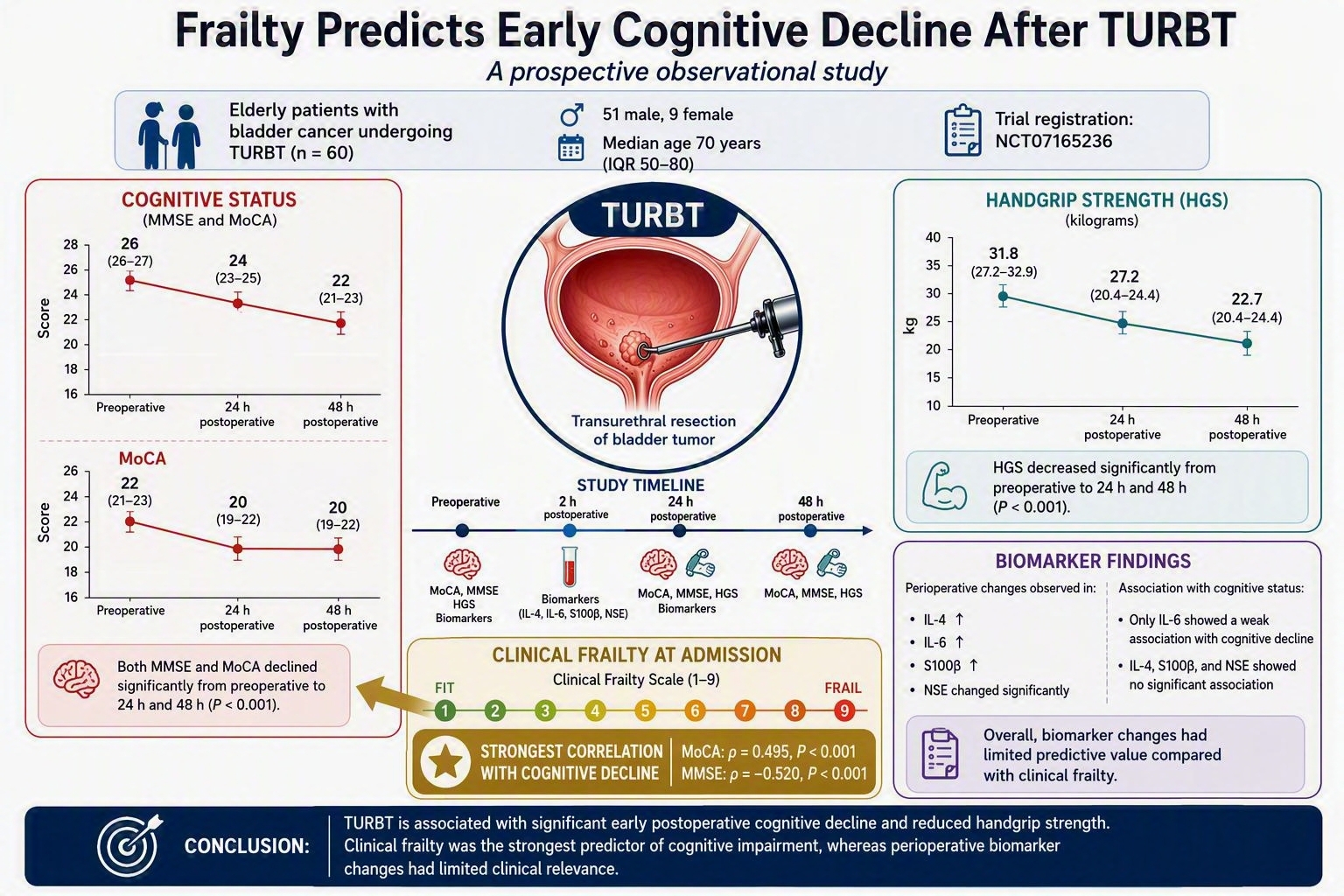
Background/Objectives: Bladder cancer is a disease of the elderly population, who often undergo transurethral bladder tumor resections (TURBT). Data on whether cognitive decline occurs after TURBT are limited. This study examined changes in cognitive status after TURBT, as measured by the Montreal Cognitive Assessment (MoCA) and Mini-Mental State Examination (MMSE), and whether these changes were associated with frailty status, handgrip strength (HGS), and biomarkers. Methods: Biomarkers IL-4, IL-6, S100b, and NSE were measured preoperatively, at 2 hours, and at 24 hours after TURBT. MoCA, MMSE, and HGS were assessed preoperatively and at 24 and 48 hours postoperatively in 60 patients (51 male, 9 female; median age 70 (50-80 years); trial registration number: NCT07165236. Results: Both MMSE and MoCA declined significantly from preoperative 26 (26-27) to 24 (23-25) and 22 (21-23) at 24 and 48 h postoperatively (P<0.001). HGS decreased from 31.8 (27.2 – 32.9) to 27.2 (20.4 – 24.4) and 22.7 (20.4 – 24.4) kilograms at 24 and 48 h postoperatively (P<0.001). The biomarker change was statistically significant, but only IL-6 showed an association with MoCA 24 h after surgery (ρ=-0.419, P<0.001). Clinical frailty at admission showed the strongest correlation with MoCA (ρ=0.495, P<0.001) and MMSE (ρ=-0.520, P<0.001). Conclusion: Early cognitive decline occurs after TURBT in elderly patients with bladder cancer. Clinical frailty is the strongest predictor of postoperative cognitive impairment, while biomarker alterations provide limited prognostic information. Routine preoperative frailty assessment may improve risk stratification and perioperative care.
Keywords:
urology
; perioperative care
; anesthesia
; general
; transurethral resection of bladder
; cognitive dysfunction
; hand strength
Copyright: This open access article is published under a Creative Commons CC BY 4.0 license, which permit the free download, distribution, and reuse, provided that the author and preprint are cited in any reuse.