
Submitted:
12 September 2026
Posted:
23 September 2026
You are already at the latest version
Abstract
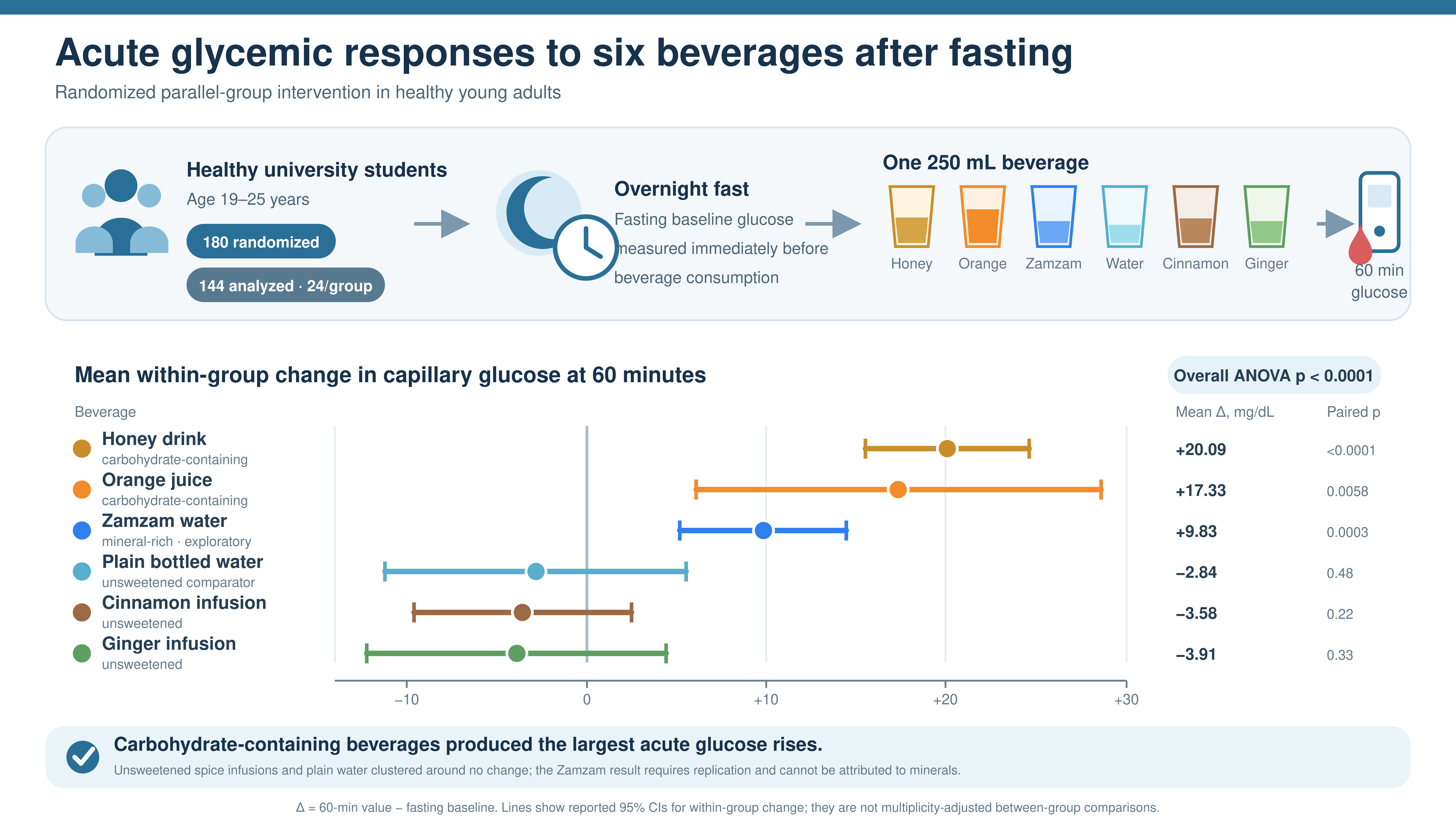
Beverage carbohydrate content is a major determinant of acute glycemia, whereas responses to unsweetened spice infusions and mineral-rich water remain uncertain. This randomized, controlled, parallel-group study compared six beverages in healthy university students aged 19–25 years after an overnight fast. In total, 180 participants were randomly assigned using permuted blocks with allocation concealment (30/group) to 250 mL of orange juice, a honey drink, ginger infusion, cinnamon infusion, Zamzam water, or plain bottled water; outcome assessors were blinded. A protocol analysis included 144 participants (24/group). Capillary glucose, based on triplicate readings, was assessed before and 60 min after consumption. Within-group changes were assessed using paired t-tests and compared across groups using one-way analysis of variance. Mean glucose increased after honey (+20.09 mg/dL; 95% CI, 15.50–24.68; p < 0.0001) and orange juice (+17.33 mg/dL; 95% CI, 6.10–28.56; p = 0.0058). Changes after cinnamon (−3.58 mg/dL), ginger (−3.91 mg/dL), and plain water (−2.84 mg/dL) were not statistically significant. Zamzam water produced a within-group increase (+9.83 mg/dL; 95% CI, 5.20–14.46; p = 0.0003), with a post-consumption mean of 89.00 mg/dL. Overall changes differed among groups (p < 0.0001). The Zamzam findings are exploratory and require confirmation using standardized beverage composition, repeated measurements, and direct between-group estimates.
Keywords:
blood glucose
; sugar-sweetened beverages
; cinnamon
; ginger
; mineral water
; fasting
1. Introduction
Type 2 diabetes and related metabolic disorders continue to impose a substantial global health burden [1]. Dietary carbohydrate quality and quantity influence glycemic exposure, and beverages are particularly relevant because liquid sugars can be consumed rapidly and provide limited satiety. Habitual intake of sugar-sweetened beverages has been associated with weight gain and cardiometabolic risk [2], while fruit juice has also been associated with incident type 2 diabetes in prospective evidence [3]. Acute glucose excursions are therefore relevant when comparing beverages, although a single post-consumption value should not be equated with a diagnostic glucose-tolerance test or long-term glycemic variability [4].
Cinnamon and ginger are commonly used in traditional and functional beverages. Experimental work suggests that cinnamon-derived compounds may influence insulin signaling and carbohydrate-digesting enzymes [5], and trials in people with type 2 diabetes have reported modest improvements in selected glycemic outcomes after sustained cinnamon supplementation [6]. Gingerols may promote glucose uptake in experimental models [7], and longer-term ginger supplementation has been studied in people with diabetes [8,9]. These findings, however, do not establish that a single serving of an unsweetened spice infusion lowers glucose in healthy fasting adults. In the absence of a carbohydrate challenge, a neutral response may simply reflect the lack of digestible sugar.
Mineral composition may also influence metabolic physiology, but evidence that drinking water acutely alters glucose regulation is limited [10]. Zamzam water is naturally mineral-rich groundwater obtained from the Zamzam well in Makkah, Saudi Arabia. Published analyses indicate that its mineral composition may vary according to the source and sampling conditions [11,12]. Any acute difference therefore requires direct compositional measurement and an appropriate mineral-matched comparator before it can be attributed to total dissolved solids or to an individual electrolyte.
This study compared the acute capillary glucose response to two carbohydrate-containing beverages (honey drink and orange juice), two unsweetened spice infusions (cinnamon and ginger), mineral-rich Zamzam water, and plain bottled water after an overnight fast. We expected the carbohydrate-containing beverages to produce the largest increases, while the responses to the unsweetened beverages would be smaller. The comparison involving Zamzam water was exploratory.
2. Materials and Methods
2.1. Study Design, Setting, and Ethics
This randomized, controlled, parallel-group, single-session intervention study was conducted at Jouf University, Saudi Arabia, between February and April 2020. The protocol was approved by the Bioethics Committee at Jouf University (Approval No. JU-LCBE-8-18-9-40). All participants provided written informed consent before study procedures. The study was conducted in accordance with the ethical principles stated in the Declaration of Helsinki.
2.2. Recruitment and Eligibility
Participants were recruited through public advertisements displayed across the Jouf University campus. Interested students contacted the study PI and underwent eligibility screening before providing written consent. Inclusion criteria were current enrollment at Jouf University; age 19-25 years; self-reported good health; ability to complete the required overnight fast; and willingness to consume any of the six study beverages. Students were excluded if they reported diabetes or impaired glucose regulation; a chronic endocrine, metabolic, renal, hepatic, or gastrointestinal disorder; an acute illness at the study visit; current use of medication or supplements known to affect glucose metabolism; or allergy or intolerance to any study-beverage ingredient. Participants who did not complete the required fasting period or either glucose measurement, or whose pre-consumption fasting glucose value was outside the prespecified normal range, were excluded from the analysis. A total of 144 eligible students were enrolled. Enrollment was feasibility-based, with participants allocated equally across six.
2.3. Randomization, Allocation Concealment, and Blinding
Before recruitment, an investigator who was not involved in enrollment, intervention delivery, or outcome measurement generated the allocation sequence with a computerized random-number generator. Randomly permuted blocks of six were used, with one assignment to each beverage group within every block, to maintain a 1:1:1:1:1:1 allocation ratio (n = 24 per group). The assignments were placed in sequentially numbered, opaque, sealed envelopes by the independent investigator. After written consent, eligibility confirmation, and baseline glucose measurement, the enrollment coordinator opened the next envelope in sequence and notified only the staff member preparing the assigned beverage. Outcome assessors who performed and recorded the capillary glucose measurements were blinded to group assignment, and participants were instructed not to disclose their beverage to the assessor. Participants and beverage-preparation staff could not be blinded because the beverages differed visibly and in taste.
2.4. Beverage Interventions
After an overnight fast and baseline glucose measurement, each participant consumed 250 mL of the beverage assigned to their group. The orange-juice intervention used a commercial 250 mL KDD Orange Juice pack (The Kuwaiti Danish Dairy Co. K.S.C.C., Kuwait; product code FJUQL6ORNGRP) [13]. The study record reported 50 g sugar for the orange-juice serving, although the interpretation and analytical verification of this value were unavailable. The honey drink contained approximately 50 g (two tablespoons) of Black Forest honey per 250 mL serving (200 g/L). The ginger infusion was prepared using approximately 12 g (two tablespoons) of fresh ginger in 250 mL water (48 g/L), whereas the cinnamon infusion contained 2.6 g cinnamon per 250 mL serving (10.4 g/L). The Zamzam-water intervention consisted of 250 mL of commercially bottled Zamzam water sourced from the Zamzam Well in Makkah (Al-Zamazemah Company, Saudi Arabia). The plain-water comparator consisted of 250 mL of Nova natural drinking water (Health Water Bottling Co. Ltd., Riyadh, Saudi Arabia. The interventions are summarized in Table 1.
2.5. Capillary Glucose Measurement and Outcomes
Capillary whole-blood glucose was measured using four Contour Next glucometers (Ascensia Diabetes Care, Parsippany, NJ, USA) and manufacturer-compatible test strips. A baseline measurement was obtained immediately before beverage consumption, and a second measurement was obtained 60 min after consumption. The post-consumption measurement was not considered an oral glucose tolerance test (OGTT) because such testing requires administration of a standardized oral glucose load. A total of 288 measurements were recorded (144 baseline and 144 post-consumption measurements). Six CONTOUR NEXT glucose meters and test strips lot 7308 were used. Meter performance was verified using CONTOUR® control solution according to the manufacturer’s instructions. Before capillary sampling, participants washed their hands with soap and water and dried them completely; when alcohol was used, the selected puncture site was allowed to air-dry fully. Each glucose measurement was performed in triplicate, and the mean of the three readings was used for analysis. Used test strips were discarded as clinical waste.
The primary outcome was the within-participant change in mean capillary glucose, calculated as the mean post-consumption value minus the mean fasting baseline value (Δ glucose, mg/dL). The mean post-consumption glucose value was treated as a secondary outcome. No clinical diagnostic classification was assigned because measurements were obtained at only one post-consumption time point following a non-standardized beverage challenge, which does not constitute an OGTT or another diagnostic procedure.
2.6. Statistical Analysis
Analyses were performed using GraphPad software (GraphPad Software, Prism, San Diego, CA, USA; version 11). Continuous results were summarized as mean ± standard deviation. Within each group, baseline and post-consumption glucose values were compared using a paired t-test, and mean changes were reported with 95% confidence intervals. A one-way analysis of variance was used to test whether change scores differed across the six groups. All tests were two-sided, and p < 0.05 was considered statistically significant. Model assumptions were assessed to verify exact F statistics, degrees of freedom, and p values, and pairwise comparisons. Enrollment was feasibility-based, with 144 participants allocated equally across six groups (24 per group). A sensitivity analysis for a fixed-effects one-way analysis of variance, assuming six groups, a two-sided α of 0.05, and 80% power, indicated that this sample could detect an omnibus effect of Cohen’s f ≥ 0.304, equivalent to η² ≈ 0.085.
3. Results
3.1. Participant Data and Baseline Glucose
Outcome data were obtained for 144 participants, with 24 participants in each of the six beverage groups. All participants were included in the analysis, and participant flow is presented in Figure 1. Group-level demographic characteristics and information regarding protocol deviations, and intervention adherence. Mean fasting capillary glucose ranged from 79.17 mg/dL in the Zamzam-water group to 91.33 mg/dL in the cinnamon-infusion group (Table 2).
3.2. Within-Group Changes in Capillary Glucose
The two carbohydrate-containing beverages produced the largest mean increases. Glucose increased by 20.09 mg/dL after the honey drink (95% CI, 15.50 to 24.68; p < 0.0001) and by 17.33 mg/dL after orange juice (95% CI, 6.10 to 28.56; p = 0.0058). In contrast, changes after cinnamon infusion (-3.58 mg/dL), ginger infusion (-3.91 mg/dL), and plain water (-2.84 mg/dL) were not statistically significant. The Zamzam-water group showed a mean within-group increase of 9.83 mg/dL (95% CI, 5.20 to 14.46; p = 0.0003), from 79.17 to 89.00 mg/dL.
3.3. Between-Group Comparison
The mean change in capillary glucose differed across the six beverage groups (one-way analysis of variance, p < 0.0001). The distribution of mean changes and reported 95% confidence intervals is shown in Figure 1. The largest positive changes occurred in the honey-drink and orange-juice groups, whereas the mean changes for plain water and the two unsweetened spice infusions clustered around zero. Although Zamzam water (Mineral-Rich Water) showed a statistically significant within-group increase, a paired within-group test alone does not establish that its response differed from plain water or from the other beverage groups.
4. Discussion
4.1. Principal Findings
In healthy young adults studied after an overnight fast, the two carbohydrate-containing beverages produced the largest acute increases in capillary glucose. Plain water and the unsweetened cinnamon and ginger infusions showed small, non-significant mean decreases. Mineral-rich Zamzam water was associated with a modest within-group increase, but the mean post-consumption value remained within the range observed across the study groups and the design does not identify a mineral-mediated mechanism.
4.2. Interpretation in Relation to Previous Evidence
The responses to the honey drink and orange juice are biologically plausible because both beverages supplied rapidly available carbohydrate. This acute experiment is consistent with the broader evidence linking sugar-containing beverages with adverse glycemic and cardiometabolic outcomes [2,3]. However, the post-consumption values in this study should not be described as prediabetic or pathological: diagnostic thresholds for fasting glucose or standardized oral glucose tolerance testing do not apply to a single capillary measurement after non-standardized beverages.
The neutral responses to cinnamon and ginger should also be interpreted conservatively. Prior research on cinnamon and ginger has generally evaluated standardized extracts or supplements over weeks or months in people with diabetes [6,8,9,15,16]. In the present study, the infusions were unsweetened and prepared with ginger at 16 g/L and cinnamon at 10.4 g/L; no carbohydrate challenge was co-administered. The results therefore show that these particular unsweetened drinks did not acutely raise glucose; they do not demonstrate active glucose lowering, enhanced insulin sensitivity, inhibition of intestinal carbohydrate digestion, or prevention of a glycemic spike.
The Zamzam-water (Mineral-Rich Water) observation is hypothesis-generating. Published studies confirm that Zamzam water may contain a distinct mineral profile, but the composition varies across samples [11,12]. The water consumed in this study was characterized only by a reported TDS value, and no mineral analysis was performed. Moreover, the Zamzam group had the lowest baseline mean glucose, which increases concern about baseline imbalance and regression to the mean. Biological and analytical variation in sequential capillary glucose measurements may also be important when interpreting a change of this magnitude [17]. Consequently, the data do not support attributing the increase to calcium, magnesium, bicarbonate, sodium, taste-triggered hormonal release, hepatic glucose output, or any other specific pathway. A crossover study with direct mineral analysis, a mineral-matched control, venous plasma glucose, insulin, and multiple post-consumption time points would be needed to test such mechanisms.
Acute human trials further show that beverage composition, comparator selection, and sampling schedule can materially influence observed glycemia. In healthy participants, glycemic responses differed among honey varieties even when available carbohydrate was standardized [18]. A randomized crossover trial found that adding orange-pomace fiber attenuated the acute glycemic response to sugar-matched orange juice [19]. Cinnamon consumed with a carbohydrate meal reduced postprandial glucose and delayed gastric emptying in a small crossover trial [20], whereas a randomized trial of a standardized ginger aqueous extract in nondiabetic adults used repeated postprandial measurements to evaluate the response [21]. These protocols are not directly comparable with the present single-dose, parallel-group experiment, but they illustrate why exact ingredient dose, beverage composition, comparator selection, and multiple sampling times should be documented.
4.3. Strengths and Limitations
Strengths of the study include concealed random allocation with equal group sizes, blinded outcome assessment, controlled beverage volume, inclusion of both carbohydrate-containing and unsweetened comparators, and paired measurement of glucose before and after consumption. The study also addresses a practical question about beverages commonly consumed in the region. This study is reported with reference to the CONSORT 2025 guidance. The completed checklist is provided as Supplementary File S1, and participant flow is presented in Figure 1. [22].
Several limitations should be considered when interpreting the findings. First, although outcome data were available for all 144 randomized participants, group-specific demographic and clinical characteristics, pretest standardization of diet and physical activity, intervention-adherence data, protocol deviations, systematic adverse-event monitoring, and prospective trial registration were not documented. Second, the exact cinnamon and ginger doses and the complete nutritional and mineral compositions of the beverages were not verified. Third, capillary glucose was measured at only one post-consumption time point using handheld glucose meters. Consequently, the study could not characterize the peak glycemic response, incremental area under the curve, glycemic variability, or insulin dynamics. User technique and variation among monitoring systems or test-strip lots may also affect capillary glucose measurements, emphasizing the importance of documented quality-control procedures and replicate measurements [23]. Fourth, baseline glucose differed descriptively among the groups; a baseline-adjusted analysis of covariance may have provided a more precise estimate of the intervention effect than an unadjusted comparison of change scores [24]. Fifth, the retained statistical output did not include complete model diagnostics, exact omnibus test statistics, or multiplicity-adjusted pairwise estimates, preventing independent verification of the model assumptions and effect estimates. Finally, the sample comprised healthy university students aged 19–25 years, limiting the generalizability of the findings to older adults, other populations, and individuals with impaired glucose regulation.
5. Conclusions
Following an overnight fast, the honey drink and orange juice showed the largest mean increases in capillary glucose at 60 minutes, whereas the unsweetened cinnamon and ginger infusions and plain bottled water produced smaller changes. These findings are consistent with differences in available carbohydrates but do not establish antihyperglycemic effects for the spice infusions. Zamzam water also showed a within-group glucose increase. Published analyses—not measurements of the water administered in this study—have reported Zamzam mineral concentrations reaching approximately 42 mg/L magnesium, 93 mg/L calcium, and 210 mg/L sodium [11,12]. Although magnesium may support insulin-mediated glucose uptake and calcium contributes to pancreatic β-cell insulin secretion, the observed Zamzam-water response cannot be attributed to these minerals because beverage composition, circulating minerals, and insulin were not measured. Given the modified per-protocol analysis and single post-consumption measurement, these findings should be considered preliminary and hypothesis-generating. Future preregistered studies should directly analyze beverage composition, use a crossover design or baseline-adjusted analysis, and measure venous glucose, insulin, and relevant mineral biomarkers at multiple time points.
Author Contributions
Conceptualization, H.A.; methodology, H.A.; software H.A.; validation, H.A.; formal Analysis, H.A.; investigation, H.A.; resources, H.A.; data curation, H.A.; writing—original draft preparation, H.A.; writing—review and editing, H.A.; visualization, H.A.; supervision, H.A.; project administration, H.A.; funding acquisition, H.A. Author has read and agreed to the published version of the manuscript.
Funding
This research was funded by AL JOUF UNIVERSITY, grant number JUDSR 827/39.
Institutional Review Board Statement
The study was conducted in accordance with the Declaration of Helsinki, and approved by the Bioethics Committee at JOUF UNIVERSITY (protocol code JU-LCBE-8-18-9-40 and date of approval 23 May 2019).
Informed Consent Statement
Informed consent was obtained from all subjects involved in the study.
Data Availability Statement
The data supporting the findings of this study are available from the corresponding author upon reasonable request. The completed CONSORT 2025 checklist is provided in the Supplementary Materials.
Acknowledgments
The author gratefully acknowledge Dr. Ziad Alenazi and the Department of Clinical Laboratory Sciences at Jouf University for their support. During the preparation of this manuscript, the authors used ChatGPT powered by GPT-5.6 Sol (OpenAI, San Francisco, CA, USA) for language editing and proofreading. The author reviewed and edited the output and takes full responsibility for the content of this publication.
Conflicts of Interest
The author declares no conflict of interest.
Abbreviations
The following abbreviations are used in this manuscript:
| Δ | mean |
| ANOVA | analysis of variance |
| CI | confidence interval |
| CONSORT | Consolidated Standards of Reporting Trials |
| CRediT | Contributor Roles Taxonomy |
| mg/dL | milligrams per deciliter |
| OGTT | Oral Glucose Tolerance Test |
| PI | Principal Investigator |
| ppm | parts per million |
| SD | Standard Deviation |
| TDS | Total Dissolved Solids |
References
- Saeedi, P.; Petersohn, I.; Salpea, P.; Malanda, B.; Karuranga, S.; Unwin, N.; Colagiuri, S.; Guariguata, L.; Motala, A.A.; Ogurtsova, K.; et al. Global and regional diabetes prevalence estimates for 2019 and projections for 2030 and 2045: Results from the International Diabetes Federation Diabetes Atlas, 9th edition. Diabetes Res. Clin. Pract. 2019, 157, 107843. [Google Scholar] [CrossRef] [PubMed]
- Malik, V.S.; Hu, F.B. Sugar-sweetened beverages and cardiometabolic health: An update of the evidence. Nutrients 2019, 11, 1840. [Google Scholar] [CrossRef] [PubMed]
- Imamura, F.; O’Connor, L.; Ye, Z.; Mursu, J.; Hayashino, Y.; Bhupathiraju, S.N.; Forouhi, N.G. Consumption of sugar-sweetened beverages, artificially sweetened beverages, and fruit juice and incidence of type 2 diabetes: Systematic review, meta-analysis, and estimation of population attributable fraction. BMJ 2015, 351, h3576. [Google Scholar] [CrossRef] [PubMed]
- Cavalot, F. Do data in the literature indicate that glycaemic variability is a clinical problem? Glycaemic variability and vascular complications of diabetes. Diabetes Obes. Metab. 2013, 15 (Suppl. 2), 3–8. [Google Scholar] [CrossRef] [PubMed]
- Qin, B.; Panickar, K.S.; Anderson, R.A. Cinnamon: Potential role in the prevention of insulin resistance, metabolic syndrome, and type 2 diabetes. J. Diabetes Sci. Technol. 2010, 4, 685–693. [Google Scholar] [CrossRef] [PubMed]
- Allen, R.W.; Schwartzman, E.; Baker, W.L.; Coleman, C.I.; Phung, O.J. Cinnamon use in type 2 diabetes: An updated systematic review and meta-analysis. Ann. Fam. Med. 2013, 11, 452–459. [Google Scholar] [CrossRef] [PubMed]
- Li, Y.; Tran, V.H.; Duke, C.C.; Roufogalis, B.D. Gingerols of Zingiber officinale enhance glucose uptake by increasing cell-surface GLUT4 in cultured L6 myotubes. Planta Med. 2012, 78, 1549–1555. [Google Scholar] [CrossRef] [PubMed]
- Khandouzi, N.; Shidfar, F.; Rajab, A.; Rahideh, T.; Hosseini, P.; Mir Taheri, M. The effects of ginger on fasting blood sugar, hemoglobin A1c, apolipoprotein B, apolipoprotein A-I, and malondialdehyde in type 2 diabetic patients. Iran. J. Pharm. Res. 2015, 14, 131–140. [Google Scholar] [PubMed]
- Carvalho, G.C.N.; Lira-Neto, J.C.G.; Araújo, M.F.M.; Freitas, R.W.J.F.; Zanetti, M.L.; Damasceno, M.M.C. Effectiveness of ginger in reducing metabolic levels in people with diabetes: A randomized clinical trial. Rev. Lat. Am. Enferm. 2020, 28, e3369. [Google Scholar] [CrossRef] [PubMed]
- Naumann, J.; Biehler, D.; Lüty, T.; Sadaghiani, C. Prevention and therapy of type 2 diabetes—What is the potential of daily water intake and its mineral nutrients? Nutrients 2017, 9, 914. [Google Scholar] [CrossRef] [PubMed]
- Zergui, A.; Aledeh, M.; Hamad, S. Metallic profile of Zamzam water: Determination of minerals, metals and metalloids by ICP-MS. J. Trace Elem. Miner. 2022, 2, 100031. [Google Scholar] [CrossRef]
- Al-Barakah, F.N.; Al-Jassas, A.M.; Aly, A.A. Water quality assessment and hydrochemical characterization of Zamzam groundwater, Saudi Arabia. Appl. Water Sci. 2017, 7, 3985–3996. [Google Scholar] [CrossRef]
- The Kuwaiti Danish Dairy Co. K.S.C.C. Orange Juice 250 ML (Promo) KDD product page. Available online. (accessed on 27 August 2026).
- Donia, A.F.; Mortada, W.I. Chemical composition of Zamzam water: A comparative study with international standards of drinking water. Heliyon 2021, 7, e06038. [Google Scholar] [CrossRef] [PubMed]
- Atta, M.; Jafari, S.; Moore, K. Complementary and alternative medicine: A review on the effects of ginger, cinnamon and Camellia sinensis leaf tea in diabetes. J. Diabetes Mellit. 2019, 9, 126–136. [Google Scholar] [CrossRef]
- Zhu, J.; Chen, H.; Song, Z.; Wang, X.; Sun, Z. Effects of ginger (Zingiber officinale Roscoe) on type 2 diabetes mellitus and components of the metabolic syndrome: A systematic review and meta-analysis of randomized controlled trials. Evid.-Based Complement. Altern. Med. 2018, 2018, 5692962. [Google Scholar] [CrossRef] [PubMed]
- Zanette, K.D.; Martinello, F. Biological variation of capillary blood glucose: A systematic review. Biomed. Rep. 2025, 22, 7. [Google Scholar] [CrossRef] [PubMed]
- Gourdomichali, T.; Papakonstantinou, E. Short-term effects of six Greek honey varieties on glycemic response: A randomized clinical trial in healthy subjects. Eur. J. Clin. Nutr. 2018, 72, 1709–1716. [Google Scholar] [CrossRef] [PubMed]
- Guzman, G.; Xiao, D.; Liska, D.A.; Mah, E.; Sanoshy, K.; Mantilla, L.; Replogle, R.; Boileau, T.W.; Burton-Freeman, B.M.; Edirisinghe, I. Addition of orange pomace attenuates the acute glycemic response to orange juice in healthy adults. J. Nutr. 2021, 151, 1436–1442. [Google Scholar] [CrossRef] [PubMed]
- Hlebowicz, J.; Darwiche, G.; Björgell, O.; Almér, L.-O. Effect of cinnamon on postprandial blood glucose, gastric emptying, and satiety in healthy subjects. Am. J. Clin. Nutr. 2007, 85, 1552–1556. [Google Scholar] [CrossRef] [PubMed]
- Diakos, A.; Silva, M.L.; Brito, J.; Moncada, M.; de Mesquita, M.F.; Bernardo, M.A. The effect of ginger (Zingiber officinale Roscoe) aqueous extract on postprandial glycemia in nondiabetic adults: A randomized controlled trial. Foods 2023, 12, 1037. [Google Scholar] [CrossRef] [PubMed]
- Hopewell, S.; Chan, A.-W.; Collins, G.S.; Hróbjartsson, A.; Moher, D.; Schulz, K.F.; Tunn, R.; Aggarwal, R.; Berkwits, M.; Berlin, J.A.; et al. CONSORT 2025 statement: Updated guideline for reporting randomized trials. JAMA 2025, 333, 1998–2005. [Google Scholar] [CrossRef] [PubMed]
- Freckmann, G.; Jendrike, N.; Baumstark, A.; Pleus, S.; Liebing, C.; Haug, C. User performance evaluation of four blood glucose monitoring systems applying ISO 15197:2013 accuracy criteria and calculation of insulin dosing errors. Diabetes Ther. 2018, 9, 683–697. [Google Scholar] [CrossRef] [PubMed]
- Vickers, A.J.; Altman, D.G. Analysing controlled trials with baseline and follow-up measurements. BMJ 2001, 323, 1123–1124. [Google Scholar] [CrossRef] [PubMed]
Figure 1.
Change from fasting baseline after beverage consumption at 60 min. Mean within-group change in capillary glucose 60 min after beverage consumption. Points show the mean change from fasting baseline, and horizontal error bars show the reported 95% confidence interval. Values below zero indicate a decrease. These estimates are within-group changes and are not multiplicity-adjusted between-group comparisons.
Figure 1.
Change from fasting baseline after beverage consumption at 60 min. Mean within-group change in capillary glucose 60 min after beverage consumption. Points show the mean change from fasting baseline, and horizontal error bars show the reported 95% confidence interval. Values below zero indicate a decrease. These estimates are within-group changes and are not multiplicity-adjusted between-group comparisons.
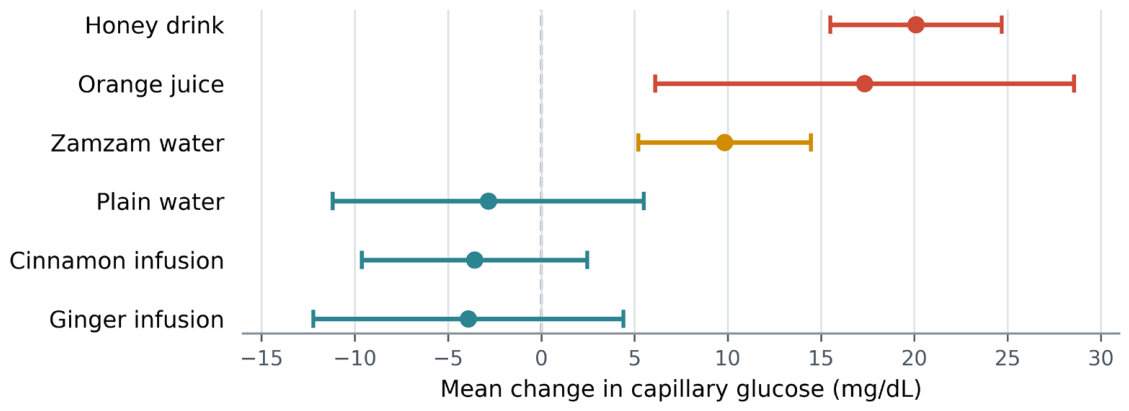

Table 1.
Beverage interventions used in the study (volume = 250 mL).
| Beverage | Preparation or reported composition | Reporting note |
|---|---|---|
| Orange juice | Orange Juice, commercial 250 mL; 50 g sugar. | KDD brand, product code FJUQL6ORNGRP), pack profile were reported in [13]. |
| Honey drink | Two tablespoons (approximately 50 g) of Black Forest honey dissolved in water (200 g/L). | Ingredient concentration was reported; total carbohydrate was not analytically verified. |
| Ginger infusion | Two tablespoons of fresh ginger (approximately 12 g) steeped in 250 mL hot water (48 g/L). | Botanical species/form, water temperature, steeping duration, source, and lot were verified. |
| Cinnamon infusion | Cinnamon at 10.4 g/L (2.6 g per 250 mL) steeped in hot water. | Species/form, water temperature, steeping duration, source, and lot were recorded. |
| Zamzam water 1 | Commercially bottled; TDS > 600 mg/L (ppm) [14]. | Bottle source; Al-Zamazemah Company, measured mineral profile were reported in [11,12]. |
| Plain water | Commercially bottled water; TDS = 120 mg/L (ppm). | Bottle source; Nova® Water. |
1 Note: The mineral composition of the administered Zamzam water was not analytically verified. Published studies have reported approximately 18.5–42 mg/L magnesium, 56.5–93 mg/L calcium, and 67.1–210 mg/L sodium, although concentrations vary according to sampling source and analytical method [11,12].
Table 2.
Capillary glucose before and after beverage consumption (n = 24 per group).
| Beverage 1 | Baseline, mg/dL | Post, mg/dL | Mean change | 95% CI of change | Paired p value |
|---|---|---|---|---|---|
| Honey drink | 89.83 ± 7.20 | 109.92 ± 9.79 | +20.09 | +15.50 to +24.68 | <0.0001 |
| Orange juice | 86.50 ± 9.42 | 103.83 ± 17.26 | +17.33 | +6.10 to +28.56 | 0.0058 |
| Zamzam water | 79.17 ± 6.09 | 89.00 ± 5.17 | +9.83 | +5.20 to +14.46 | 0.0003 |
| Plain water | 88.42 ± 10.45 | 85.58 ± 8.69 | -2.84 | -11.18 to +5.50 | 0.48 |
| Cinnamon infusion | 91.33 ± 6.88 | 87.75 ± 6.89 | -3.58 | -9.62 to +2.46 | 0.22 |
| Ginger infusion | 88.73 ± 9.73 | 84.82 ± 8.53 | -3.91 | -12.22 to +4.40 | 0.33 |
1 Values are mean ± SD. CI, confidence interval. Change = post-consumption minus baseline glucose.
Disclaimer/Publisher’s Note: The statements, opinions and data contained in all publications are solely those of the individual author(s) and contributor(s) and not of MDPI and/or the editor(s). MDPI and/or the editor(s) disclaim responsibility for any injury to people or property resulting from any ideas, methods, instructions or products referred to in the content. |
© 2026 by the authors. Licensee MDPI, Basel, Switzerland. This article is an open access article distributed under the terms and conditions of the Creative Commons Attribution (CC BY) license (http://creativecommons.org/licenses/by/4.0/).
Copyright: This open access article is published under a Creative Commons CC BY 4.0 license, which permit the free download, distribution, and reuse, provided that the author and preprint are cited in any reuse.