
Submitted:
23 September 2026
Posted:
23 September 2026
You are already at the latest version
Abstract
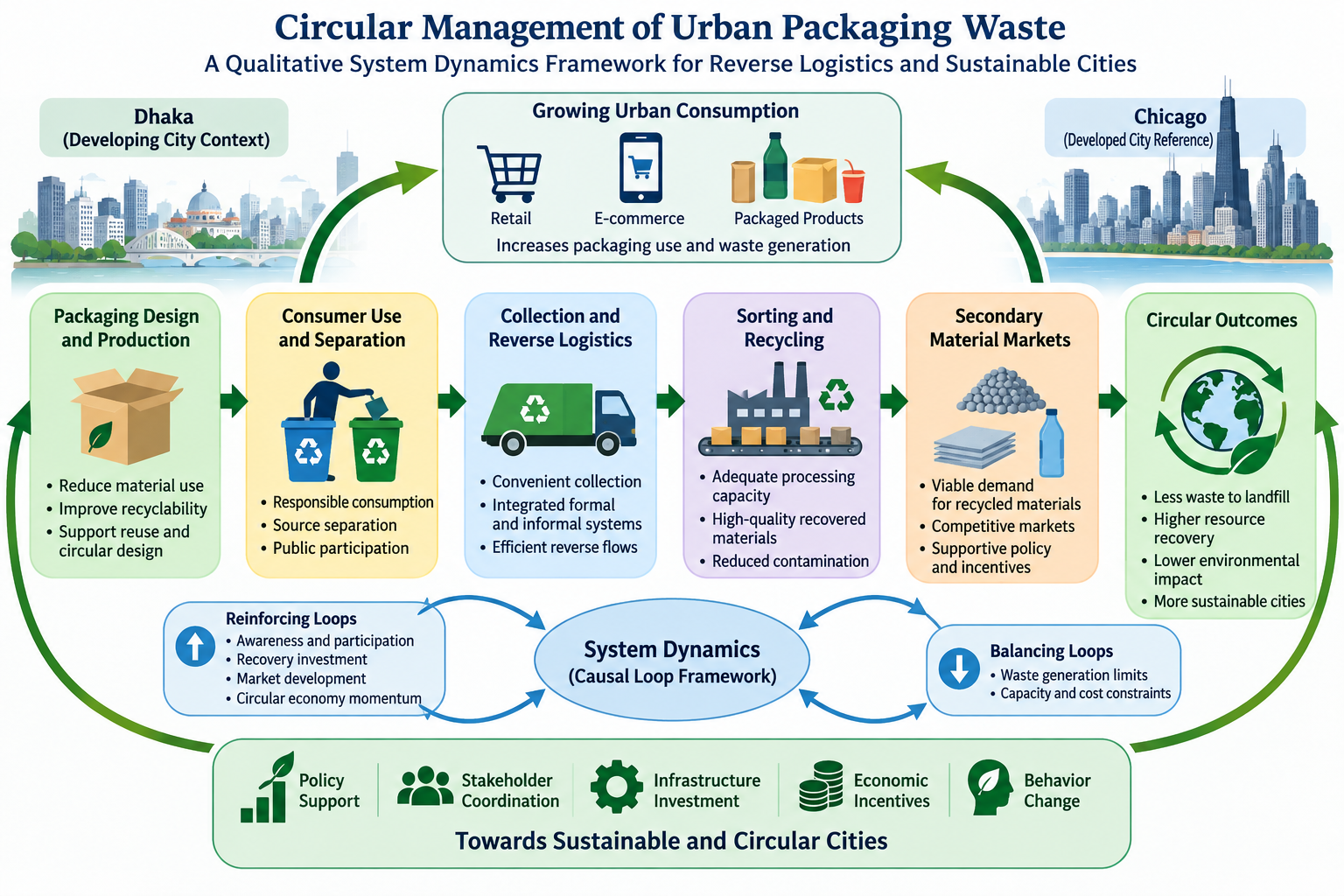
Growing consumption of packaged products through retail and e-commerce is increasing the amount and complexity of packaging waste entering urban waste systems. The challenge is especially important in rapidly growing cities where limited source separation, collection constraints, fragmented recovery activities, and dependence on informal recycling can restrict material circularity. This study develops a qualitative system dynamics framework for circular urban packaging waste management, using Dhaka, Bangladesh, as the principal developing-city context and Chicago, USA, as a limited structural reference. Published literature and secondary evidence are synthesized to characterize relationships among waste generation, consumer separation, collection, reverse logistics, recycling capacity, and secondary-material recovery. A causal loop framework identifies four reinforcing and two balancing feedback loops, and four structured what-if conditions—current trajectory, worst case, moderate transition, and best case—are examined qualitatively. The analysis indicates that isolated interventions may shift system bottlenecks rather than resolve them. A coordinated transition requires packaging prevention, reliable source separation, integration of formal and informal reverse flows, aligned sorting and recycling capacity, and viable demand for recovered materials. The framework provides a theoretical basis for coordinated urban circular-economy policy and future quantitative system dynamics modeling.
Keywords:
urban packaging waste
; circular economy
; reverse logistics
; system dynamics
; causal loop diagram
; recycling
; resource recovery
; sustainable cities
Copyright: This open access article is published under a Creative Commons CC BY 4.0 license, which permit the free download, distribution, and reuse, provided that the author and preprint are cited in any reuse.