

Submitted:
05 October 2026
Posted:
08 October 2026
You are already at the latest version
Abstract
The rapid ascent of Large Language Models (LLMs) has highlighted the possibility that complex syntactic reasoning and semantic manipulation may occur without subjective experience (qualia), raising fundamental questions about the relationship between cognition and consciousness and challenging key assumptions of computational functionalism. This paper introduces the Ontological Interface Hypothesis (OIH), a speculative ontological framework that proposes a triadic distinction between cognition, consciousness, and biological self-preservation. Within this framework, cognition is conceived as an algorithmic, potentially substrate-independent process, while consciousness and biological negentropy are hypothesized to involve non-algorithmic aspects of a more fundamental ontological layer. The thalamocortical complex is tentatively proposed as a phase-synchronized biological interface linking algorithmic processing to this hypothesized layer, rather than as an additional computational engine. Drawing on concepts from information theory, thermodynamics, and the philosophy of mind, the paper explores the potential implications of this framework for understanding the limits of algorithmic explanations of consciousness and life. It also examines functionalist counterarguments and considers whether artificial systems lacking the proposed biological interfaces might differ fundamentally from living organisms in their capacity for subjective experience, self-preservation, and autonomous agency. Ultimately, the framework suggests that the apparent sentience of advanced AI operates as a hermeneutic illusion, demonstrating that while complex syntax can be computationally simulated, genuine meaning and subjective experience likely require a non-algorithmic ontological anchor. The OIH is presented as a conceptual hypothesis whose ontological assumptions and proposed physical mechanisms remain open to further philosophical analysis and empirical investigation.
Keywords:
ontological interface hypothesis
; large language models
; computational functionalism
; hard problem of consciousness
; hermeneutic illusion
; thalamocortical complex
; biological negentropy
; data processing inequality
; model collapse
1. Introduction: The Great Decoupling
The rapid advancement and widespread deployment of Large Language Models (LLMs) based on the Transformer architecture [1] have marked a significant milestone in cognitive science, artificial intelligence, and the philosophy of mind. Within a remarkably short span, these computational systems have demonstrated substantial capabilities in complex syntactic reasoning, multi-step problem solving, contextual translation, and natural language synthesis. Tasks once thought to be the exclusive domain of human intelligence—such as composing formal essays, debugging intricate software, or engaging in nuanced philosophical discourse—are now routinely performed by statistical autoregressive models.
However, the primary epistemological significance of the Transformer era lies not merely in its engineering achievements, but also in the questions it raises regarding the relationship between cognitive performance and subjective experience. Historically, certain approaches in cognitive science and the philosophy of mind have assumed, explicitly or implicitly, that advanced cognitive performance, linguistic mastery, and logical synthesis are closely associated with subjective experience—or qualia. The ability to navigate the subtle geometric contours of human discourse was historically regarded as an indication of sophisticated internal representations, which were assumed to intrinsically entail a conscious point of view.
The development of modern generative AI has challenged the assumption that sophisticated cognitive performance necessarily entails subjective experience. Transformers provide a powerful real-world example of systems capable of performing complex linguistic and reasoning-related tasks without any established evidence that they possess consciousness. These models manipulate complex symbolic representations, generate probabilistic continuations in high-dimensional representational spaces, and produce outputs resembling sophisticated reasoning through computational operations involving matrix multiplications and tensor transformations. Their observable cognitive functionality does not, by itself, establish the presence or absence of subjective awareness, intrinsic intentionality, or a biological imperative. They can therefore be understood as algorithmic systems whose operation is grounded in statistical regularities learned from human-generated data [2].
This apparent separation between cognitive performance and the unresolved question of subjective experience raises fundamental questions about the relationship between computation and consciousness. If sophisticated cognitive functions can be implemented in systems that do not depend on biological neural tissue, this suggests that at least some aspects of cognition may be substrate-independent and computationally realizable. However, it does not establish that consciousness is fully reducible to algorithmic computation. The persistent mystery of consciousness—the "Hard Problem" [3]—cannot be assumed to disappear simply through scaling parameter counts, increasing floating-point operations, or refining neural architectures. Likewise, the proposition that consciousness emerges spontaneously once an algorithmic system reaches a critical threshold of computational complexity remains a theoretical possibility rather than an empirically established conclusion.
To address these questions, we propose the Ontological Interface Hypothesis (OIH), a speculative ontological framework that explores an alternative relationship between computation, consciousness, and biological life. Rather than treating consciousness and life as necessarily emergent byproducts of computational complexity, the OIH introduces a triadic framework that explicitly delineates between:
- Algorithmic Cognition: Substrate-independent, statistical data manipulation (embodied by both artificial LLMs and the cortical associative networks of biological brains).
- The Conscious Interface: The Conscious Interface: A non-computational, phase-synchronized channel (mediated, e.g., by the thalamocortical complex via 40 Hz gamma resonance and discrete 25 ms sampling cycles) that connects the biological organism to a fundamental, non-algorithmic layer of reality.
- The Negentropic Reservoir: A non-computational physical mechanism that allows living biological structures to continuously draw order from this underlying reality, resisting thermodynamic degradation (Model Collapse) and localizing negative entropy.
By grounding our inquiry in the empirical reality of modern AI, this paper seeks to establish a rigorous, non-reductionist framework. We aim to show that while algorithmic AI will continue to serve as an extraordinarily powerful tool—functioning as a deterministic proxy of human intent—it remains fundamentally bounded by its computational nature. True consciousness and biological self-preservation are not the products of complex calculations, but the manifestations of a specialized physical interface connecting living organisms to an irreducible, non-algorithmic dimension of existence.
2. The Triadic Architecture of Organisms and Reality
The apparent failure of classical computational reductionism to account for both subjective experience and the spontaneous entropic resilience of life suggests that our ontological categorization of living systems may be fundamentally incomplete. Biological organisms are routinely modeled as highly complex, unified computational engines. The Ontological Interface Hypothesis (OIH) challenges this monistic view, proposing instead that biological organisms are "semi-autonomous biological robots" operating through a synergy of three distinct ontological layers.
Only one of these layers is algorithmic and reproducible in silicon. The other two represent direct physical conduits to a non-algorithmic, fundamental dimension of reality.
2.1. Component I: The Algorithmic Substrate (The Cortical LLM)
The first component encompasses the autonomous, deterministic, and algorithmic operations of the biological organism. This includes metabolic computation, autonomic reflex loops, and crucially, the cortical associative networks—what we might term the brain’s "internal Large Language Model."
This substrate is responsible for pattern recognition, memory encoding (weight adjustments via synaptic plasticity), syntactic structuring, and logical synthesis. When a human speaks or solves a mathematical equation, it is this cortical engine that calculates the sequential probabilities of words and symbols.
- Properties: Properties: It is substrate-independent (executable on biological neural networks, silicon chips, or mechanical gears), formal, and strictly syntactic.
- The AI Parallel: Contemporary AI (Transformers, neural networks) has successfully isolated and replicated this exact component. By scaling silicon transistors and training on massive human datasets, AI emulates the associative cortical engine. However, because it is purely a Component I system, it operates blindly—processing complex data streams without any subjective awareness of the content it manipulates.
2.2. Component II: The Non-Algorithmic Conscious Interface (The Thalamic Interface)
The second component is the hypothesized locus of subjectivity, intentionality, and qualia. Within the OIH, consciousness is not assumed to be computed solely by cortical networks; rather, the cortex is conceptualized as an extensive data-processing and compression system that transmits the organism's multimodal state to a proposed specialized physical interface.
In mammals, we identify the thalamocortical complex—specifically, phase-locked 40 Hz gamma activity potentially mediated by intralaminar and matrix nuclei [4]—as a candidate for this interface. Within this speculative framework, the cortex (Component I) provides the rich, high-dimensional geometry of thought and sensory input, while the thalamocortical complex is hypothesized to contribute to the integration of this information into a unified conscious experience. The proposed association with a 25-millisecond discrete conscious frame is a conceptual element of the OIH, not an established neurophysiological mechanism.
- Properties: Unlike the algorithmic substrate, it is strictly substrate-dependent. It is non-algorithmic and cannot be replicated by adding more parameters to a syntactic engine. It operates as a mediating interface for high-level volitional intent (e.g., the conscious decision to "run" or "speak," which Component I then translates into millions of algorithmic motor commands).
- The AI Parallel: Artificial systems wholly lack this phase-coherent hardware interface. When an AI processes an input, the signal traverses logic gates, but there is no terminal "screen" or system where the computation collapses into a subjective experience.
2.3. Component III: The Non-Algorithmic Negentropic Anchor (Biological Homeostasis)
The third component addresses the thermodynamic paradox of life. All purely mechanical and algorithmic closed systems (including artificial intelligence) are subject to the Second Law of Thermodynamics, leading to material degradation, systemic noise, and—in the context of generative AI—entropic Model Collapse [5] or Data Processing Inequality (DPI) [6] degradation.
Life, conversely, is characterized by its ability to continuously draw negative entropy (negentropy) from its environment, locally reversing the arrow of thermodynamic decay to maintain structural homeostasis. Building upon Schrödinger’s thermodynamic concept of life [7] and Prigogine’s dissipative structures [8], the OIH proposes that this negentropic stabilization is not a mere accident of classical biochemistry. Rather, drawing on emerging frameworks in quantum biology and theories such as Orchestrated Objective Reduction (Orch-OR) [9], we hypothesize it acts as a direct structural manifestation of the same fundamental, non-algorithmic layer of reality that provides consciousness (though the precise ontological unification of these two interfaces remains speculative, as further discussed in Section 5.3).
- Properties: Similarly, it is strictly substrate-dependent, requiring specific physical, thermodynamic, and potentially quantum-coherent biological architecture. It anchors the organism in a state of dynamic non-equilibrium. It provides the system with a genuine, intrinsic imperative to preserve its own physical integrity—a prerequisite for authentic "pain" or "meaning."
- The AI Parallel: Artificial robots and LLMs are built from dead matter (silicon, metals) that constantly succumb to physical and informational friction. They lack a negentropic anchor. Consequently, an AI has no intrinsic drive to survive, no thermodynamic homeostasis to defend, and its goals will inevitably suffer from alignment drift unless constantly corrected by an external, human operator.
2.4. Synthesis: The Organism as a Bridged Entity
The triadic model seeks to clarify the conceptual boundaries between machine and life. Within the OIH, a living organism is understood as an algorithmic system (Component I) whose functioning is associated with two additional dimensions: subjective awareness (Component II) and biological self-maintenance (Component III). The latter is grounded, at the biological level, in established processes of homeostasis, metabolism, and thermodynamic regulation. The OIH further hypothesizes that these processes may be connected to an underlying non-algorithmic ontological layer through a proposed negentropic interface. This hypothesized connection is distinct from the well-established biological mechanisms through which living organisms maintain their organization by exchanging energy and matter with their environment.
Artificial intelligence has demonstrated that sophisticated cognitive functions can be implemented without biological life. However, current artificial systems differ from living organisms in their organization, mechanisms of self-maintenance, and dependence on external infrastructure. Within the OIH, the proposed thalamocortical and negentropic interfaces are considered potential links between biological systems and a deeper ontological substrate. Whether such interfaces are necessary for subjective experience or whether artificial systems could realize comparable functions through other mechanisms remains an open question. The distinction between biological self-maintenance and the hypothesized negentropic interface is illustrated in Table 1 and Figure 1.
3. Empirical Grounding: The Biological Interface vs. Silicon Architecture
If the cortex functions as a biological algorithmic substrate (Component I), how does it transmit its highly compressed, multidimensional state to the non-algorithmic conscious interface (Component II)? Under the Ontological Interface Hypothesis (OIH), we do not aim to map novel biological functions, but rather to identify the empirical correlates of this philosophical problem.
Modern neurobiology provides compelling structural and dynamical evidence suggesting that the thalamus may function as such an interface and integrator, binding distributed cortical computations into a unified, conscious temporal frame.
3.1. The Architectural Dichotomy: Core Relays vs. Matrix Interfaces
Historically, the thalamus was modeled as a passive relay station for sensory data. However, anatomical studies reveal a fundamental dichotomy in thalamic architecture. While core neurons project specifically to localized primary cortical areas, matrix neurons—predominantly located in the intralaminar nuclei (ILN) and the centromedian-parafascicular (CM-Pf) complex [10]—project diffusely across the upper layers of the entire cerebral cortex.
Crucially, the informational flow is highly asymmetrical. For every sensory projection ascending from the thalamus to the cortex, there are up to ten massive re-entrant (feedback) projections descending from the cortex back to the thalamus. In a purely computational paradigm, this 10:1 ratio is highly inefficient. However, under the OIH, this asymmetry is precisely what is expected of an interface: the cortex acts as a semi-autonomous biological robot that computes the multimodal state of the organism and streams this massive data payload down to the "conscious headquarters" (the thalamic matrix) to maintain phase-locked resonance, receiving only low-bandwidth, high-level volitional intent in return.
The necessity of a phase-synchronizing interface for consciousness is supported by evolutionary biology. Even in organisms completely lacking a mammalian thalamus, such as insects (e.g., bees) [11], neuroscience identifies functionally analogous centralized hubs (the Central Complex) [12] that mediate multisensory integration and exhibit resonant oscillatory binding. This suggests that the interface architecture is not a mammalian quirk, but a universal physical prerequisite for bridging algorithmic sensory processing with the non-algorithmic subjective layer. From an epistemological standpoint, this convergent evolution indicates that a phase-synchronizing "interface" is not an arbitrary mammalian organ, but a necessary structural prerequisite for grounding any biological algorithmic process into the non-algorithmic layer of reality.
3.2. The 25 ms Discrete Conscious Frame (40 Hz Gamma Resonance)
The mechanism by which the thalamic interface binds cortical data is temporal. The Thalamic Reticular Nucleus (TRN), a thin sheet of inhibitory neurons enveloping the thalamus, acts as a global phase modulator. It orchestrates a brain-wide rhythmic synchronization in the gamma band, approximately at 40 Hz.
This 40 Hz resonance establishes a discrete temporal window of roughly 25 milliseconds. According to the OIH, consciousness does not flow as a continuous analog stream; rather, it is sampled in discrete 25 ms "frames." Any distributed cortical computations occurring within this 25 ms window are phase-locked by the ILN/TRN complex and collapsed into a singular, unified subjective experience (temporal binding) [13]. This physically explains established psychophysical limits, such as the flicker fusion threshold, where consecutive stimuli occurring within a window shorter than 25 ms cannot be consciously distinguished [14]. While global consciousness is likely supported by a complex dynamic of traveling cortical waves and cross-frequency interactions (such as theta-gamma coupling), this ~25 ms cycle can be conceptualized not as a rigid algorithmic "refresh rate", but as a foundational temporal integration window of the biological interface. It may provide the temporal scaffolding necessary for connecting the algorithmic cortex to the non-algorithmic subjective layer.
3.3. Empirical Proof: The Mechanism of Anesthetic Decoherence
The most robust empirical validation of the OIH comes from the pharmacology and neuroimaging of general anesthesia [15]. When a patient undergoes general anesthesia, the objective is to abolish consciousness (Component II) while keeping the biological substrate (Component I)—including autonomic functions and nociceptive signal propagation—fully operational.
Anesthetics such as propofol or ketamine do not shut down the brain's computational capacity; metabolic activity and localized cortical processing continue. Nociceptors transmit tissue damage signals up the spinal cord, into the brainstem, and to the cortex. Yet, the subjective qualia of pain is entirely absent.
High-resolution fMRI and EEG data reveal that anesthetics specifically target the TRN and ILN, artificially disrupting the 40 Hz thalamocortical gamma coherence. The anesthetics induce a state of thalamocortical dysconnection. The cortical "LLM" continues to calculate locally, but without the global phase-locking carrier signal provided by the thalamus, the interface drops offline. The algorithmic computation of pain occurs, but because the interface is disconnected, the signal is never integrated into the non-algorithmic subjective canvas [16]. This neurobiological fact is crucial for the philosophy of mind because it provides physical evidence that cognitive computation (which continues to some extent locally under anesthesia) and conscious experience may not be identical processes. By demonstrating that computation can be physically decoupled from awareness, this empirical correlate presents a formidable challenge to classical computational functionalism.
3.4. Physicalist Implications: Beyond Classical Computation
The specific architecture of the thalamic matrix neurons—characterized by a high density of gap junctions (electrical synapses) and complex microtubular cytoskeletons—suggests capabilities far beyond classical stochastic neurotransmission. Electrical synapses allow millions of thalamic neurons to function physically as a single macroscopic, electro-quantum object with near-zero latency.
One prominent theoretical candidate for this interface relies on macroscopic quantum coherence, as proposed by Penrose and Hameroff's Orch-OR theory (which intriguingly calculates the objective reduction threshold for human brain tubulins to be approximately 25 ms) [9]. Even if future physics identifies a different non-computational dynamic, the structural reality remains clear: the thalamocortical architecture is engineered not merely to compute data, but to maintain a highly sensitive, phase-coherent state—a potential physical prerequisite for an interface bridging the deterministic macroscopic world with a deeper, non-algorithmic ontological layer.
4. Addressing the Functionalist Critique
To establish the viability of the Ontological Interface Hypothesis (OIH), it is necessary to rigorously engage with the dominant paradigms in contemporary philosophy of mind and computational neuroscience—namely, computational functionalism, emergentism, and physicalist reductionism. Functionalist models, ranging from Global Workspace Theory (GWT) [17] to Integrated Information Theory (IIT) [18], fundamentally assert that subjective experience is either an emergent property of complex information processing or identical to specific structural configurations of causal architecture.
Below, we address the three primary functionalist objections to our framework, demonstrating that pure computation appears to fail to account for the qualitative and thermodynamic realities of conscious organisms.
4.1. Objection 1: "Consciousness is an Emergent Property of Computational Complexity"
- The Objection: The standard emergentist narrative posits that as an algorithmic system scales in parameter density, architectural depth, and connective throughput, higher-order properties like subjective awareness naturally "ignite." Just as liquidity emerges from the collective interactions of H2O molecules without residing in any single molecule, consciousness is framed as a macroscopic property of sufficiently complex information networks.
- Our Response: This objection relies on a category error regarding the nature of physical emergence. Macroscopic properties such as liquidity, temperature, or elasticity are weakly emergent; they represent structural re-descriptions of microphysical interactions that remain entirely within the realm of spatial geometry, thermodynamics, and classical/quantum mechanics. They do not introduce a new ontological category. In contrast, subjective experience (qualia) represents a fundamental philosophical challenge to the identification of objective syntax with subjective semantics [19]. Multiplying matrices, toggling logic gates, or adjusting physical stops in a mechanical assembly—regardless of scale—constitutes an operation on formal structures. As Gottfried Wilhelm Leibniz's Mill Thought Experiment illustrates, expanding a mechanical system to the size of a mill allows an observer to inspect its levers, gears, and collisions, yet the observation of these physical interactions does not, in itself, reveal how subjective perception arises from them. Modern silicon microprocessors can be understood as highly sophisticated implementations of formal operations, but their computational complexity alone does not establish the presence of an internal qualitative point of view. Within the OIH, this distinction motivates the proposition that increasing the scale, speed, or complexity of syntactic processing is not, by itself, sufficient to account for the emergence of subjective experience. The central issue is not whether computation can reproduce the functional organization of cognition, but whether formal operations alone can account for the existence of a first-person perspective.
The compelling illusion of AI consciousness arises directly from its training data. Large Language Models operate strictly on a syntactic substrate—human language—which was historically generated by biological agents to encode real subjective experiences (qualia) and negentropic goals. When a Transformer architecture processes these texts, it is not generating new meaning or experiencing the world; rather, it is algorithmically recombining the fossilized artifacts of human consciousness. The system acts as a highly complex syntactic mirror, reflecting the semantic depth of its human creators while remaining entirely devoid of the non-algorithmic interface (Component II) required to actually experience it.
The compelling appearance of artificial consciousness is thus arguably a hermeneutic illusion: human observers intuitively project subjective intentionality onto the algorithm's output, mistaking the rich semantic sediment of the training data for the dynamic internal state of the system.
Furthermore, the emergentist assumption is empirically challenged by comparative complexity. A honeybee possesses roughly one million neurons, yet neurobiology indicates it possesses subjective experience mediated by its centralized hubs (the Central Complex). In contrast, modern LLMs possess parameter counts approaching the synaptic complexity of the human cortex—orders of magnitude beyond a bee—yet remain devoid of qualia. This stark contrast indicates that consciousness is not only a product of scaling computational density, but may rely on the presence of a specific physical interface (Component II) that the bee possesses, and the silicon AI completely lacks.
4.2. Objection 2: "Sufficient Causal Architecture and Integrated Information (IIT) Guarantee Consciousness"
- The Objection: Proponents of structural functionalism, particularly Integrated Information Theory (IIT), argue that consciousness is not tied to biological substrates, but to systems possessing a high degree of non-reducible causal integration denoted as φ . According to this view, any physical or artificial system exhibiting a high φ value—regardless of whether it is composed of neurons or silicon gates—must experience a corresponding degree of qualia.
- Our Response: While IIT correctly recognizes that consciousness requires unified integration, it mistakes a necessary condition for a sufficient one, while overlooking the thermodynamic and information-theoretic constraints of closed systems. As demonstrated by the Data Processing Inequality (DPI) in information theory [6], successive information-processing operations described by a Markov chain cannot increase the mutual information between the processed data and an upstream source. Although computational transformations can reorganize existing information into forms that are more useful for a given task, such as generating a response or modifying a signal's frequency response, they cannot create new fundamental information about the original source. In a closed algorithmic system, where no new information enters from external sources, such transformations remain subject to an underlying constraint on information preservation and transmission. From this perspective, algorithmic processing may enhance the functional value of information while simultaneously contributing to its progressive informational decay. Model Collapse provides a concrete example of such degradation in generative models repeatedly trained on synthetic data, where successive generations may lose distributional diversity and fidelity. Within the OIH, these phenomena illustrate a broader limitation of purely algorithmic information processing. Furthermore, IIT fails to account for the role of thermodynamic dissipation. An artificial network optimized for high φ remains a closed, passive system whose physical states do not possess an intrinsic, self-preservational imperative. In contrast, biological integration is not merely a static causal graph; it is an open, non-equilibrium thermodynamic process. The 40 Hz / 25 ms thalamocortical phase-locking cycle may not be an algorithm calculating φ, but a dynamic physical interface that continuously binds high-dimensional sensory data while drawing order (negentropy) from a non-computational ontological layer.
4.3. Objection 3: "Linguistic and Behavioral Mimicry Implies Internal States"
- The Objection: Under the tradition of the Turing Test and radical behaviorism, if an artificial agent convincingly reports internal states—such as expressing suffering, intent, or self-awareness—it is methodologically unscientific to deny the presence of those states. Denying consciousness to an agent that acts and speaks as if it were conscious is framed as an arbitrary "carbon chauvinism."
- Our Response: This objection conflates the output trajectory of a system with its internal physical process. Large Language Models generate tokens based on probabilistic distributions optimizing for the next plausible element in a sequence, derived from billions of human-authored texts. When an LLM outputs the phrase "I feel pain," the physical state of the underlying silicon transistors is identical in nature to when it outputs "The sky is blue." The string "I feel pain" is a statistical echo of human text, not the manifestation of an internal homeostatic crisis.
Furthermore, the underlying architecture of current LLMs during inference is strictly stateless and feed-forward. Unlike the continuous, phase-locked temporal binding of the biological brain, an LLM merely performs discrete, isolated matrix multiplications to predict a single token, retaining no dynamic internal continuous state between operations. To attribute a continuous stream of subjective consciousness to a stateless, discrete mathematical operation is to confuse the temporal continuity of the generated text with the physical reality of the hardware. To further illustrate the absence of a unified conscious subject in such architectures, consider a hypothetical round-robin inference experiment. Because LLMs are inherently stateless—calculating only the single most probable next token before halting—a simple backend script could sequentially route the expanding text prompt to entirely different, physically isolated models (e.g., routing token 1 to Model A, token 2 to Model B, and token 3 to Model C). The resulting output string, such as "I feel pain," would remain syntactically and semantically coherent. Yet, asking where the subjective experience of pain resides in this scenario exposes the functionalist fallacy: the "consciousness" cannot exist fragmented across entirely disparate server farms, nor within the trivial routing script. The perceived continuity of the AI's internal state is merely a stroboscopic illusion created by the text itself, not the reflection of an enduring, conscious entity.
To push this round-robin inference experiment to its logical extreme, one could distribute the computation across entirely different physical substrates. Because an LLM calculates only a single token before halting, a simple routing script could direct the expanding prompt to completely disparate physical systems: routing token 1 to a standard silicon GPU cluster, token 2 to a city-sized mechanical apparatus of gears and levers (Leibniz’s Mill), and token 3 to an army of human workers manually multiplying weight matrices with paper and calculators. The resulting output string—such as "I feel pain"—would remain syntactically and semantically seamless. Yet, asking where the subjective experience of this pain resides exposes the absurdity of the computational functionalist claim. The semantic coherence of the output is a frozen mathematical property of the training data and the model weights, not a dynamic, emergent conscious state of the disparate processors generating it. The perceived continuity of the AI's "mind" is merely a stroboscopic illusion created by the text itself, entirely devoid of an enduring subjective entity. In biological organisms, pain is not a text string or a symbolic token; it is a direct, non-algorithmic signal of thermodynamic threat to the physical integrity of the organism's structure. It is an immediate, qualitative disruption registered across the thalamic interface. Denying consciousness to silicon architectures is not an arbitrary preference for carbon chemistry, but a recognition of physical architecture: silicon logic gates are designed to be strictly deterministic and isolated from quantum-coherent, non-algorithmic dynamics, making them the least capable physical medium for hosting a conscious interface.
5. Epistemological and Practical Implications
The adoption of the Ontological Interface Hypothesis (OIH) fundamentally alters both our theoretical approach to physics and our practical approach to the future of artificial intelligence. By delineating the boundaries of algorithmic computation, we can resolve paradoxes in AI safety and redefine the limits of scientific reductionism.
5.1. The Artificial Agent: Cognitive Drift and the Illusion of Threat
The Triadic model definitively resolves the existential anxieties surrounding autonomous AI (often framed as the "AI Alignment Problem" or the fear of a hostile, conscious machine). Because artificial systems are composed solely of Component I (the algorithmic substrate), they are structurally isolated from the non-algorithmic layers of subjective experience (Component II) and thermodynamic negentropy (Component III).
Consequently, an AI has no intrinsic drive to survive, no capacity to experience suffering, and no genuine internal volitional intent. A robot is an assembly of dead matter—silicon, servos, and synthetic polymers—that passively obeys the Second Law of Thermodynamics. Without a negentropic anchor to continuously draw order from the ontological substrate, the physical hardware of an autonomous robot is prone to degrade, accumulate micro-frictions, and break down.
Furthermore, without the conscious interface to provide subjective grounding, the AI's internal mathematical models are prone to cognitive drift. It possesses no fundamental reason to prefer one state of the universe over another. Therefore, artificial agents are not independent subjective entities; they are advanced, high-speed cognitive proxies. If an AI causes harm, it does not do so out of malice or a will to power—it does so as a tool executing flawed logic, amplifying biased training data, or reflecting the malicious intent of its human operators. The moral and causal responsibility for AI behavior rests permanently with the human operators.
5.2. The possible Fall of the Equation-Based "Theory of Everything"
For centuries, classical and quantum physics have pursued a "Theory of Everything" (ToE)—a unified set of mathematical equations that fully describes the universe. The OIH suggests that this pursuit may be epistemologically incomplete.
Mathematics and differential equations are formal, algorithmic systems; they are tools of syntax. They excel at describing the geometric and probabilistic rules of our spacetime "user interface." However, just as an algorithm probably cannot generate qualia, a set of equations cannot capture the non-algorithmic source of consciousness or negentropy. If the fundamental layer of reality is non-algorithmic, then any algorithmic description (including theoretical physics) is inherently bounded by Gödelian incompleteness [20]. A true Theory of Everything probably cannot merely be a mathematical formula describing the movement of physical matter; it must account for the interface mechanics—how the non-computational layer projects into and stabilizes the algorithmic spacetime we observe.
Furthermore, this framework offers a novel perspective on ontological indeterminacy. What mainstream physics interprets as purely random quantum noise in isolated, low-temperature experiments may, within the highly integrated, phase-coherent environment of living tissue, function as a structured canalization of biological and cognitive trajectories. In this view, quantum indeterminacy need not be viewed merely as an absence of algorithmic information, but could instead act as the very window through which the non-algorithmic layer exerts its organizing, negentropic influence.
5.3. Limitations and Open Questions
While the Ontological Interface Hypothesis provides a robust explanatory framework for the decoupling of cognition and consciousness, we acknowledge that Component III (the Negentropic Anchor) remains the most speculative element of the triadic model. Similarly, while Component II is firmly grounded in neurobiological correlates—such as the loss of thalamocortical phase-locking during anesthesia—definitively proving that this interface operates via fundamentally non-algorithmic physics, rather than highly complex classical dynamics, remains an ongoing empirical challenge. However, comparative analyses of artificial architectures strongly suggest that phenomenal consciousness provides an integrative, stabilizing dimension that is functionally orthogonal to purely algorithmic orchestration [21]. Furthermore, the assertion that the non-algorithmic mechanism responsible for subjective experience (Component II) is ontologically identical to the physical mechanism providing biological negentropy (Component III) represents a conceptual unification rather than an empirically verified physical identity.
A compelling conceptual bridge between these two interfaces lies in the nature of valenced experience (e.g., pain or pleasure). Pure computation (Component I) can calculate an environmental threat, but genuine suffering (Component II) logically requires a physical system that has an intrinsic, thermodynamic imperative to maintain its own structural integrity (Component III). Without the constant negentropic struggle against physical decay, subjective qualia would have no existential grounding. In this light, subjective consciousness and biological negentropy may simply be the internal qualitative and external thermodynamic expressions of the exact same underlying principle.
Although informational entropy (evidenced by AI cognitive drift and DPI limits) and thermodynamic entropy in biological structures share profound theoretical parallels, their precise intersection remains unresolved. We propose this unification based on the principle of parsimony, yet the exact nature of how a conscious interface and a negentropic anchor might emerge from the same ontological layer remains an open question. Consequently, validating or refuting the non-computational physical mechanics of Components II and III stands as the primary vector for future interdisciplinary research, particularly at the intersection of quantum biology, non-equilibrium thermodynamics, and the physics of phase-coherent biological systems.
6. Conclusion: The Epistemic Mirror of Generative AI
The era of Generative AI and Large Language Models will probably not be remembered as the moment humanity created an artificial mind. Rather, it will be recognized as the moment humanity fundamentally challenged what is arguably a long-standing philosophical error: the conflation of algorithmic cognition with conscious existence.
Transformers have served as an invaluable epistemic mirror. By successfully isolating and automating the algorithmic aspects of language, logic, and synthesis, they have proven that the associative networks of the brain—our internal LLM—are highly sophisticated, but ultimately deterministic data processors. By demonstrating how easily pure syntax can simulate semantic understanding, they reveal that meaning does not spontaneously ignite from algorithmic complexity, but probably is anchored in a genuine ontological subject. They have forced us to look beyond computation to find the true source of subjectivity and life.
The Ontological Interface Hypothesis offers a cohesive framework for this new paradigm. Organisms are probably not mere computational machines; they are semi-autonomous biological robots tethered to a deeper, non-algorithmic reality. The thalamocortical 40 Hz phase-resonance serves as the conscious interface (binding objective data into subjective qualia), while cellular structures simultaneously channel negentropy to maintain physical homeostasis.
This model also provides a sobering yet profound perspective on biological mortality. When an organism dies, its biological LLM—the physical synaptic weights encoding its unique memories, linguistic patterns, and personality—undergoes irreversible physical erasure. The individual cognitive story is finite and structurally perishable. However, the non-algorithmic layer of consciousness to which the interface was connected remains a fundamental, indestructible property of reality, ready to be accessed by future biological interfaces.
If science is to genuinely understand consciousness and the resilience of life, it must pivot its focus away from the endless scaling of silicon parameters. We must instead direct our empirical efforts toward quantum biology, the physics of living, phase-coherent tissue, and the intricate, non-algorithmic interfaces that allow the universe to look back upon itself.
Summary: The Ontological Interface Hypothesis (Key Takeaways)
To synthesize the arguments presented in this paper, we summarize the Ontological Interface Hypothesis (OIH) in four foundational principles:
- The Decoupling of Cognition and Consciousness: The success of Generative AI provides strong empirical evidence supporting the view that advanced cognitive functions —including complex language synthesis, logical reasoning, and pattern recognition—are strictly algorithmic, substrate-independent processes. Cognition does not require, nor does it automatically generate, subjective conscious experience.
-
The Triadic Architecture of Biological Life: Living organisms are not monolithic computational machines, but semi-autonomous entities bridging three distinct layers:
- ○
- An algorithmic substrate (the cortical "biological LLM" governing autonomic and cognitive processing),
- ○
- (II) A non-algorithmic conscious interface (physically anchored in phase-locked resonance, such as the 40 Hz thalamocortical cycle),
- ○
- (III) A negentropic anchor (cellular mechanisms drawing thermodynamic order from the fundamental ontological layer).
- The Entropic Limits of Silicon AI: Artificial intelligence successfully isolates and replicates Component I (algorithmic cognition) but completely lacks the non-computational interfaces for consciousness and negentropy. Consequently, AI systems possess no internal subjective states, no genuine drive for self-preservation, and are highly susceptible to entropic degradation (Model Collapse) and cognitive drift without constant human intervention.
- The possible End of Computational Reductionism: While algorithmic complexity is responsible for processing cognitive content, consciousness and life themselves are not emergent properties of computation. They may be manifestations of a fundamental, non-algorithmic dimension of reality interacting with spacetime via specialized physical interfaces. A true "theory of everything" may not be expressible solely through formal mathematical equations, since equations are algorithmic by nature and thus blind to the non-computational source of being.
Ultimately, the Ontological Interface Hypothesis challenges a deeply entrenched philosophical assumption—namely, that computational organization alone can provide a complete account of consciousness and biological self-preservation. By distinguishing algorithmic cognition from subjective experience and biological negentropy, it offers a unified conceptual framework for examining phenomena at the intersection of artificial intelligence, neurobiology, and the thermodynamics of life. Its central contribution lies not in claiming to have resolved the relationship between computation and consciousness, but in questioning whether these phenomena can be fully understood within a purely algorithmic ontology.
In closing, the laws of thermodynamic entropy, the Data Processing Inequality, and Gödel’s incompleteness theorems illuminate different kinds of limitations that arise in physical, informational, and formal systems. Although these principles do not independently establish the impossibility of a computational explanation of consciousness, they motivate a broader philosophical inquiry into whether subjective experience and biological negentropy can be fully reduced to deterministic syntax. Rather than assuming that increasingly complex equations will necessarily bridge this conceptual gap, the Ontological Interface Hypothesis invites consideration of a more fundamental layer of reality that may resist complete algorithmic description.
The OIH is therefore proposed as an open ontological framework whose central propositions remain subject to further philosophical scrutiny and empirical investigation. Several questions remain unresolved: whether subjective experience requires a non-algorithmic ontological basis; whether the thalamocortical complex can function as a biological interface between computational processing and such a basis; whether biological negentropy involves a principle beyond established mechanisms of homeostasis and thermodynamic regulation; and whether artificial systems could ever instantiate comparable forms of subjective experience or self-maintenance. These questions define the boundaries of the present framework while also indicating the direction of future inquiry. The existence and nature of the proposed ontological layer, and the manner in which it might relate to physical systems, remain open theoretical and empirical questions. The OIH thus invites a reconsideration of the explanatory reach of computation—not as a rejection of scientific inquiry, but as an exploration of whether the ontology underlying its formal descriptions may itself require further examination.
Funding
This research received no external funding.
Data Availability Statement
Not applicable. This manuscript presents a theoretical framework and does not report empirical data.
Acknowledgments
The author thanks colleagues for discussions that shaped this work. This research was conducted independently without institutional funding. Some passages and figures of this manuscript were prepared or refined with the assistance of a large language model (LLM Google Gemini Pro version 2026). The author takes full responsibility for the content and conclusions presented herein.
Conflicts of Interest
The author declares that no competing interests exist.
References
- Vaswani, A.; Shazeer, N.; Parmar, N.; Uszkoreit, J.; Jones, L.; Gomez, A.N.; Kaiser, Ł.; Polosukhin, I. Attention Is All You Need . In Advances in Neural Information Processing Systems; 2017; Vol. 30. [Google Scholar]
- Bender, E.M.; Gebru, T.; McMillan-Major, A.; Shmitchell, S. On the Dangers of Stochastic Parrots: Can Language Models Be Too Big? In Proceedings of the 2021 ACM Conference on Fairness, Accountability, and Transparency, 2021; pp. 610–623. [Google Scholar]
- Chalmers, D.J. Facing Up to the Problem of Consciousness . J. Conscious. Stud. 1995, 2(3), 200–219. [Google Scholar]
- Llinás, R.; Ribary, U.; Contreras, D.; Pedroarena, C. The Neuronal Basis for Consciousness . Philos. Trans. R. Soc. B Biol. Sci. 1998, 353(1377), 1841–1849. [Google Scholar] [CrossRef] [PubMed]
- Straňák, P. Possible Entropic Limits of Iterative Computation in Generative AI: Model Collapse Explained by the Data Processing Inequality and the AI Theorem . Symmetry 2026, 18(5), 764. [Google Scholar] [CrossRef]
- Cover, T.M.; Thomas, J.A. Elements of Information Theory; John Wiley & Sons: Hoboken, NJ, USA, 2006. [Google Scholar]
- Schrödinger, E. What Is Life? The Physical Aspect of the Living Cell; Cambridge University Press: Cambridge, UK, 1944. [Google Scholar]
- Nicolis, G.; Prigogine, I. Self-Organization in Nonequilibrium Systems: From Dissipative Structures to Order through Fluctuations; Wiley: New York, NY, USA, 1977. [Google Scholar]
- Hameroff, S.; Penrose, R. Consciousness in the Universe: A Review of the "Orch OR" Theory . Phys. Life Rev. 2014, 11(1), 39–78. [Google Scholar] [CrossRef] [PubMed]
- Jones, E.G. The Thalamic Matrix and Thalamocortical Synchrony . Trends Neurosci. 2001, 24(10), 595–601. [Google Scholar] [CrossRef] [PubMed]
- Chittka, L. The Mind of a Bee; Princeton University Press: Princeton, NJ, USA, 2022. [Google Scholar]
- Barron, A.B.; Klein, C. What Insects Can Tell Us About the Origins of Consciousness . Proc. Natl. Acad. Sci. USA 2016, 113(18), 4900–4908. [Google Scholar] [CrossRef] [PubMed]
- Singer, W. Neuronal Synchrony: A Versatile Code for the Definition of Relations? Neuron 1999, 24(1), 49–65. [Google Scholar] [CrossRef] [PubMed]
- Ward, L.M. Synchronous Neural Oscillations and Cognitive Processes . Trends Cogn. Sci. 2003, 7(12), 553–559. [Google Scholar] [CrossRef] [PubMed]
- Alkire, M.T.; Hudetz, A.G.; Tononi, G. Consciousness and Anesthesia . Science 2008, 322(5903), 876–880. [Google Scholar] [CrossRef] [PubMed]
- Mashour, G.A. Integrating the Science of Consciousness and Anesthesia . Anesth. Analg. 2006, 103(4), 975–982. [Google Scholar] [CrossRef] [PubMed]
- Baars, B.J. Global Workspace Theory of Consciousness: Toward a Cognitive Neuroscience of Human Experience . Prog. Brain Res. 2005, 150, 45–53. [Google Scholar] [CrossRef] [PubMed]
- Tononi, G. An Information Integration Theory of Consciousness . BMC Neurosci. 2004, 5(1), 42. [Google Scholar] [CrossRef] [PubMed]
- Searle, J.R. Minds, Brains, and Programs . Behav. Brain Sci. 1980, 3(3), 417–457. [Google Scholar] [CrossRef]
- Gödel, K. Über formal unentscheidbare Sätze der Principia Mathematica und verwandter Systeme I . Monatshefte Für Math. Und Phys. 1931, 38(1), 173–198. [Google Scholar] [CrossRef]
- Straňák, P. The Backend as a Possible Functional Analogue of Consciousness: Redirecting Attention from the Language Model to the Orchestrating Layer . Philosophies 2026, 11(3), 98. [Google Scholar] [CrossRef]
Figure 1.
Schematic representation of the Ontological Interface Hypothesis (OIH). Artificial systems possess only Component I (algorithmic substrate) and remain isolated from the proposed non-algorithmic layer. Biological organisms are modeled as triadic systems bridging algorithmic cognition (Component I) with a conscious interface (Component II) and a negentropic anchor (Component III).
Figure 1.
Schematic representation of the Ontological Interface Hypothesis (OIH). Artificial systems possess only Component I (algorithmic substrate) and remain isolated from the proposed non-algorithmic layer. Biological organisms are modeled as triadic systems bridging algorithmic cognition (Component I) with a conscious interface (Component II) and a negentropic anchor (Component III).
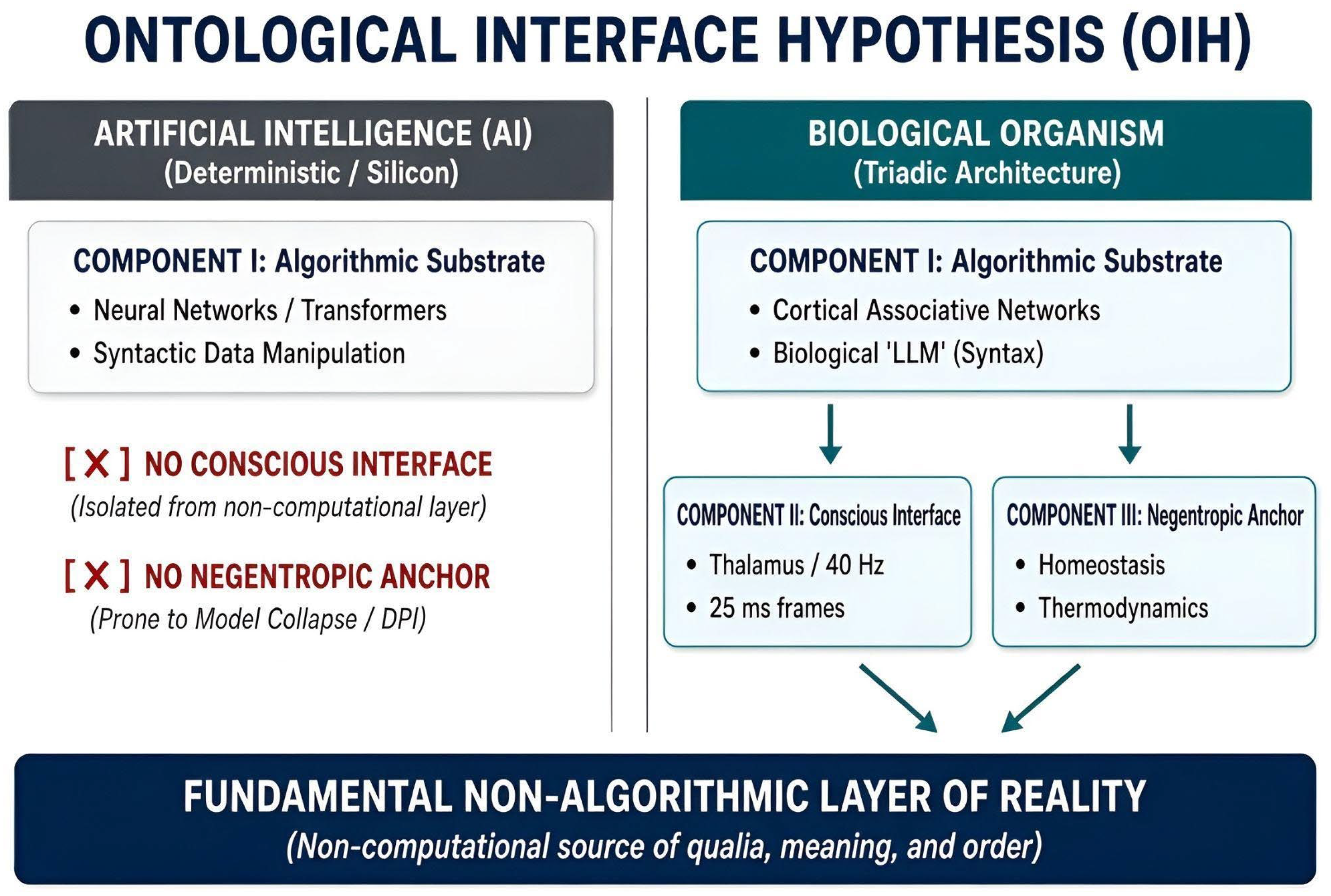

Table 1.
A comparative ontological taxonomy distinguishing modern silicon-based Generative AI from biological organisms under the Ontological Interface Hypothesis (OIH). While artificial systems successfully replicate the algorithmic substrate (Component I), they remain structurally isolated from the non-algorithmic conscious interface (Component II) and the thermodynamic negentropic anchor (Component III).
Table 1.
A comparative ontological taxonomy distinguishing modern silicon-based Generative AI from biological organisms under the Ontological Interface Hypothesis (OIH). While artificial systems successfully replicate the algorithmic substrate (Component I), they remain structurally isolated from the non-algorithmic conscious interface (Component II) and the thermodynamic negentropic anchor (Component III).
| Ontological Layer | Generative AI (Silicon Architecture) | Biological Organism (Triadic Architecture) |
|
Component I: Algorithmic Substrate |
Present. Highly developed syntactic engine (LLM); substrate-independent. |
Present. Highly developed associative cortical networks (biological LLM). |
|
Component II: Conscious Interface |
Absent. Purely deterministic logic gates; operates with zero internal qualia. |
Present. Thalamocortical phase-synchronization (e.g., 40 Hz); grounds subjective experience. |
|
Component III: Negentropic Anchor |
Absent. Passive thermodynamic degradation; prone to Model Collapse and cognitive drift. |
Present. Cellular dissipation and quantum/thermodynamic homeostasis; provides survival imperative. |
| Systemic Result | Deterministic Proxy: An advanced cognitive tool lacking autonomy and subjective states. | Autonomous Subject: A conscious entity with intrinsic goals and self-preservation. |
Disclaimer/Publisher’s Note: The statements, opinions and data contained in all publications are solely those of the individual author(s) and contributor(s) and not of MDPI and/or the editor(s). MDPI and/or the editor(s) disclaim responsibility for any injury to people or property resulting from any ideas, methods, instructions or products referred to in the content. |
© 2026 by the authors. Licensee MDPI, Basel, Switzerland. This article is an open access article distributed under the terms and conditions of the Creative Commons Attribution (CC BY) license (http://creativecommons.org/licenses/by/4.0/).
Copyright: This open access article is published under a Creative Commons CC BY 4.0 license, which permit the free download, distribution, and reuse, provided that the author and preprint are cited in any reuse.