

Submitted:
22 September 2026
Posted:
23 September 2026
You are already at the latest version
Abstract
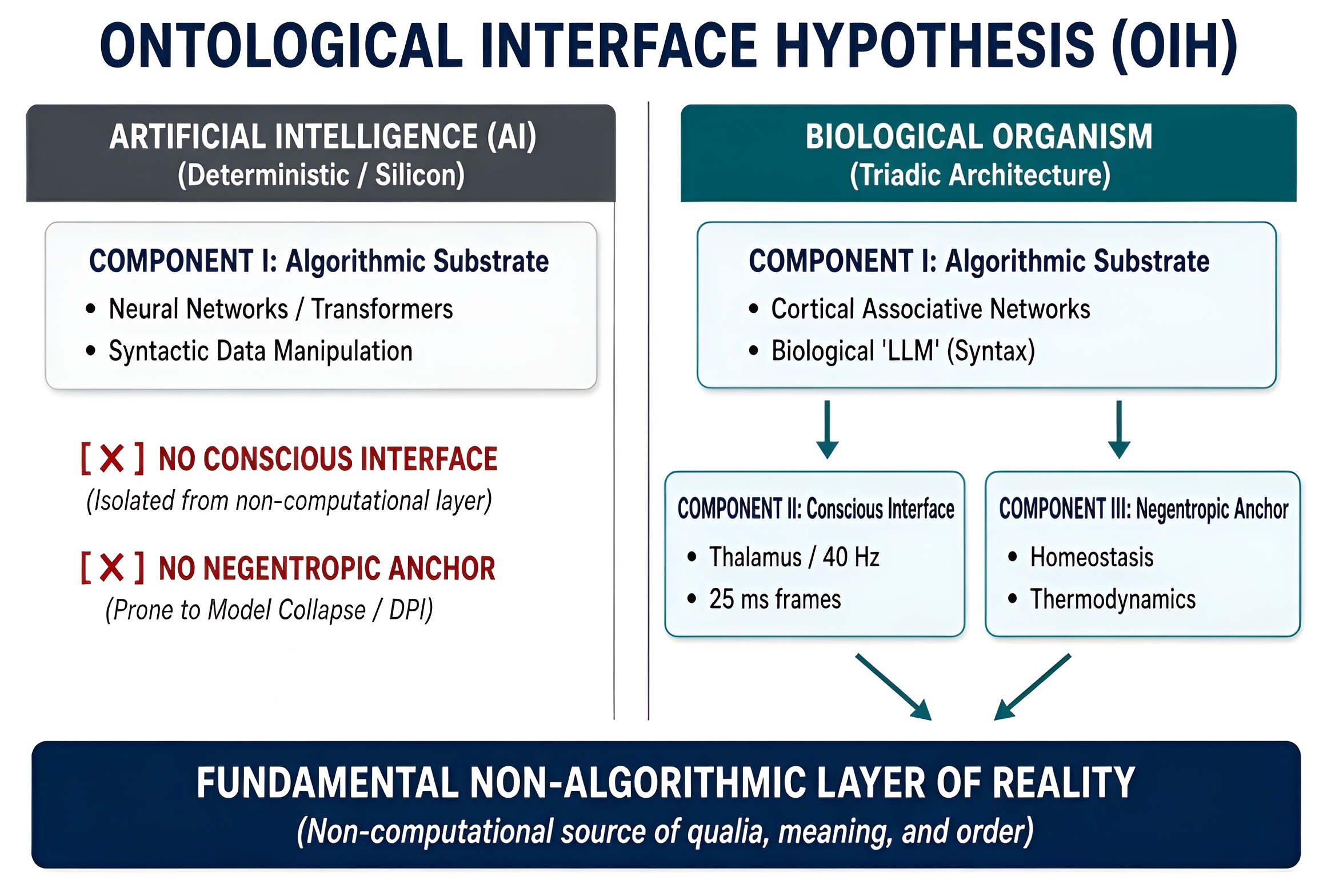
The rapid ascent of Large Language Models (LLMs) has empirically demonstrated that complex syntactic reasoning and semantic manipulation do not require subjective experience (qualia). This paper proposes the Ontological Interface Hypothesis (OIH), a triadic framework that decouples cognition, consciousness, and biological self-preservation. We argue that while cognition is an algorithmic, substrate-independent process susceptible to the Data Processing Inequality and entropic degradation (Model Collapse), consciousness and biological negentropy may involve non-algorithmic aspects of a more fundamental ontological layer. We model the thalamocortical complex not as an additional computational engine, but as a phase-synchronized biological interface connecting the algorithmic substrate to this deeper realm. Furthermore, we address standard functionalist counter-arguments, suggesting that artificial agents lacking such an interface are likely to remain prone to cognitive drift and physical degradation, functioning primarily as deterministic proxies of human intent rather than autonomous subjective entities.
Keywords:
ontological interface hypothesis
; artificial intelligence
; computational functionalism
; consciousness
; hard problem of consciousness
; thalamocortical complex
; biological negentropy
; data processing inequality
; model collapse
; philosophy of mind
Copyright: This open access article is published under a Creative Commons CC BY 4.0 license, which permit the free download, distribution, and reuse, provided that the author and preprint are cited in any reuse.