

Submitted:
22 September 2026
Posted:
23 September 2026
You are already at the latest version
Abstract
The sixth-generation (6G) networks are required to support scalable and low-latency traffic management due to emerging Internet of Things (IoT) applications. This paper proposes a traffic control framework in 6G IoT networks that integrates hybrid deep learning–based traffic prediction with prediction-driven deep reinforcement learning (DRL). A hybrid spatio-temporal deep learning model combining convolutional, recurrent, attention, and ensemble components captures complex IoT traffic dynamics. Unlike existing loosely coupled prediction–RL approaches, the predicted traffic demand is explicitly embedded into the RL state representation, enabling proactive and coordinated optimization of clustering, routing, and wireless resource allocation. NS-3 simulations with up to 1000 IoT nodes show that the proposed predictor achieves a Root Mean Square Error (RMSE) of 0.0079, outperforming LSTM, GRU, and CNN–GRU baselines. Furthermore, the prediction-driven DRL framework reduces end-to-end delays by 31% and improves throughput by 28% compared to DRL-only optimization, while also enhancing packet delivery ratio and energy efficiency. These results demonstrate that tightly integrating traffic prediction with reinforcement learning enhances proactive traffic control in large-scale 6G IoT networks.
Keywords:
6G networks
; Internet of Things (IoT)
; traffic optimization
; deep reinforcement learning
; hybrid deep learning
; spatio-temporal prediction
; resource allocation
1. Introduction
The rapid evolution of sixth-generation (6G) wireless networks is driven by the need to support massive Internet of Things (IoT) connectivity, heterogeneous services, ultra-low latency, high reliability, and intelligent network automation [1,2,3,4]. The growing number of IoT devices and increasingly diverse application requirements are expected to generate highly dynamic traffic patterns, creating substantial challenges for network management, routing, and resource allocation [1,2,3,4]. Unlike relatively stable traffic environments, large-scale IoT networks can experience temporal fluctuations, bursty arrivals, heterogeneous service demands, changing link conditions, and constrained node energy. Consequently, future network-control mechanisms must not only respond to current network conditions but also anticipate emerging traffic demand and proactively adjust network resources [5,6,7,8].
Deep learning (DL) has become an important approach for network traffic prediction because of its ability to learn nonlinear relationships and complex temporal patterns directly from network observations. Recurrent architectures such as long short-term memory (LSTM) and gated recurrent unit (GRU) networks have been widely investigated for capturing temporal dependencies, while convolutional neural networks (CNNs) can extract local correlations from traffic features and sequential observations [9,10,11,12]. Hybrid CNN–recurrent architectures combine these complementary capabilities and have demonstrated improved prediction performance compared with individual models. More recently, attention mechanisms and ensemble learning have been introduced to emphasize informative traffic patterns and improve prediction stability. Recent 6G-oriented research has also investigated hybrid combinations of recurrent, attention, and ensemble models for traffic prediction and wireless-resource optimization [13].
Although these approaches can provide accurate traffic forecasts, prediction accuracy alone does not directly solve the network-control problem. A forecasting model generally produces future traffic estimates as an output, whereas a network controller must transform available information into routing, clustering, scheduling, and resource-allocation decisions. This creates an important gap between traffic prediction and network control. A highly accurate predictor may have limited practical value if its predictions are not incorporated into the decision-making process, while a network controller that relies only on instantaneous observations may respond only after traffic congestion or resource imbalance has already emerged.
Graph-based spatio-temporal learning has further advanced traffic forecasting by explicitly modeling dependencies among interconnected network entities. DCRNN introduced diffusion-based graph convolution with recurrent temporal modeling, while STGCN combined graph convolution with temporal convolution for traffic forecasting [14,15]. Attention-based spatio-temporal graph models subsequently enabled the adaptive identification of important spatial and temporal dependencies [16]. Graph WaveNet introduced adaptive graph learning, and AGCRN further explored adaptive graph structures and node-specific representations [17,18]. These approaches demonstrate the importance of modeling interactions among interconnected entities; however, their primary objective remains future traffic estimation rather than directly converting predicted demand into coordinated network-control actions.
In parallel, reinforcement learning (RL) and deep reinforcement learning (DRL) have become important approaches for intelligent network management. By learning from interactions between an agent and the network environment, RL can adapt routing, resource allocation, load balancing, spectrum management, and traffic-engineering decisions to changing network conditions [19,20,21]. DQN-based approaches are particularly suitable for discrete network-control decisions and have been investigated for IoT routing and load balancing [22,23,24]. Other studies have employed policy-gradient, actor–critic, graph-based, and multi-agent RL approaches to improve network adaptability and scalability [25,26,27]. Nevertheless, many existing DRL controllers rely predominantly on instantaneous network observations. Such reactive state representations do not explicitly provide information about traffic demand that is likely to occur in the near future.
Prediction-guided reinforcement learning has therefore emerged as a promising direction for proactive network management. Recent studies have incorporated predicted traffic information into RL-based network optimization and have demonstrated that future demand can improve adaptive routing, QoS management, and resource allocation [28,29,30]. In particular, recent work has combined traffic prediction with DQN-based load-balancing routing in software-defined IoT networks, demonstrating the feasibility of using predicted traffic for network decisions. However, existing prediction-guided approaches generally concentrate on individual optimization tasks or specific network-control objectives. The coordinated integration of future traffic information with multiple coupled network functions remains comparatively underexplored.
This limitation is particularly important in large-scale IoT networks because clustering, routing, and wireless resource allocation are strongly interdependent. A change in traffic demand can influence queue occupancy and link utilization, which subsequently affects the suitability of cluster heads, routing paths, and available bandwidth. Treating these decisions independently can therefore lead to suboptimal control. Moreover, the effect of prediction quality on downstream network performance requires explicit investigation because forecasting errors can propagate into sequential control decisions, particularly during sudden traffic bursts and highly dynamic operating conditions.
To address these challenges, this paper proposes a prediction-driven intelligent traffic-control framework for 6G IoT networks that tightly integrates hybrid deep-learning traffic prediction with deep reinforcement learning. The proposed traffic predictor combines CNN, GRU, attention, and random-forest ensemble learning to capture nonlinear traffic patterns, temporal dependencies, and prediction variability. The resulting one-step-ahead traffic prediction is directly incorporated into the RL state together with the instantaneous network observations. The DQN controller then uses this prediction-augmented state to jointly determine cluster-head selection, next-hop routing, and discrete bandwidth allocation. This creates a closed-loop prediction–decision–action process in which future traffic demand directly influences network-control decisions.
The proposed framework is evaluated using NS-3 simulations for IoT networks ranging from 100 to 1000 nodes, with heterogeneous traffic generated using mixed Poisson and bursty models. Multiple independent simulation runs are used to evaluate prediction accuracy, network performance, scalability, robustness to traffic bursts, and the contribution of individual framework components.
2. Literature Review
2.1. Deep-Learning-Based Network Traffic Prediction
Deep learning has been extensively applied to network traffic prediction because of its ability to represent nonlinear and time-dependent traffic behavior. Early approaches primarily employed recurrent architectures such as LSTM and GRU to learn temporal dependencies from historical traffic observations [9,10]. CNN-based approaches subsequently demonstrated that local correlations among traffic features can provide complementary information for prediction [11]. Hybrid CNN–recurrent architectures combine feature extraction and temporal modeling and have therefore become an important direction for network traffic forecasting [12].
Attention mechanisms have further enhanced traffic prediction by enabling models to assign greater importance to informative historical states and traffic features. This is particularly relevant to IoT traffic, where short-lived bursts and rapid changes may contain more predictive information than relatively stable traffic intervals. Ensemble learning provides another mechanism for improving robustness by combining models with different learning characteristics. Recent 6G traffic-prediction research has demonstrated the effectiveness of combining GRU, attention, and random-forest components for traffic prediction and wireless-resource optimization [13]. This direction is closely related to the hybrid predictor adopted in this work.
Despite these advances, conventional deep-learning predictors primarily optimize the forecasting task. Their outputs are typically evaluated using prediction metrics such as RMSE, MAE, MAPE, or coefficient of determination, without explicitly modeling how prediction errors affect subsequent routing and resource-allocation decisions. Consequently, improved prediction accuracy does not necessarily translate directly into improved network-level performance.
2.2. Graph-Based Spatio-Temporal Traffic Prediction
The increasing recognition that network traffic is influenced by interactions among interconnected nodes has motivated graph-based traffic forecasting. DCRNN introduced diffusion convolution to model directional spatial dependencies together with recurrent temporal dynamics [14]. STGCN subsequently employed graph and temporal convolutional operations to learn spatial and temporal traffic patterns efficiently [15]. ASTGCN incorporated attention mechanisms into graph-based forecasting, enabling the model to emphasize important spatial and temporal dependencies [16].
Graph WaveNet further advanced this direction by learning adaptive spatial relationships instead of relying exclusively on a predefined graph structure [17]. AGCRN introduced adaptive graph learning and node-specific parameterization to capture heterogeneous dependencies among network entities [18]. These studies demonstrate that explicit modeling of spatial relationships can improve forecasting in interconnected systems.
However, graph-based forecasting methods remain predominantly prediction-oriented. Their primary objective is to estimate future traffic rather than use those predictions to coordinate multiple downstream network-control decisions. Moreover, directly applying graph-based prediction does not by itself resolve the problem of how predicted demand should influence routing, clustering, bandwidth allocation, or other sequential control decisions. This distinction motivates the integration of prediction with decision-making considered in this work.
2.3. Reinforcement Learning for Network Optimization
RL provides a natural framework for network optimization because routing and resource-management decisions occur sequentially and influence future network states. DRL extends conventional RL by employing neural networks to approximate value functions or policies, enabling learning in complex and high-dimensional communication environments [19,20,21].
DQN-based methods have been applied to routing, load balancing, and resource-management problems because many network-control decisions can be represented as discrete actions [22,23,24]. These approaches can learn adaptive policies based on queue conditions, link quality, residual energy, connectivity, and other network-state information. Policy-gradient and actor–critic approaches have also been investigated for more complex network-management problems [25], while graph-based DRL has been explored to incorporate network-topology information into routing decisions [26]. Multi-agent RL approaches further address distributed control and coordination in large-scale wireless networks [27].
Although these approaches provide adaptive decision-making, many formulate the RL state using only currently observed network conditions. Consequently, the controller can identify congestion or resource imbalance primarily after those conditions become observable. This reactive behavior can be problematic in highly dynamic IoT environments where traffic changes may be predictable from historical observations before their effects appear in current queue or link measurements.
2.4. Prediction-Guided Reinforcement Learning
Prediction-guided RL attempts to address the limitations of purely reactive control by providing the agent with information about future network conditions. Wang et al. investigated prediction-guided multi-objective RL for QoS-aware network optimization, demonstrating the potential of predicted information to improve network decisions [28]. Attention-based traffic prediction has also been combined with PPO-based control for traffic mitigation in 6G software-defined networks [29]. More recently, traffic prediction has been integrated with DQN-based load-balancing routing for software-defined IoT networks [30]. These studies demonstrate that traffic forecasting can move RL-based network management toward proactive decision-making.
However, important limitations remain. First, prediction-guided approaches often concentrate on a particular optimization problem, such as routing, load balancing, or QoS management, rather than coordinating several coupled network-control functions. Second, the prediction module and control module may remain only loosely coupled, limiting the direct influence of predicted demand on the complete control policy. Third, evaluation is often centered on either forecasting performance or a specific network-control metric rather than systematically examining the relationship between prediction accuracy and downstream network behavior.
2.5. Research Gap and Positioning of This Work
The existing literature demonstrates substantial progress in both traffic prediction and intelligent network optimization. Deep-learning approaches have improved the modeling of nonlinear and temporal traffic patterns, while graph-based models have strengthened the representation of spatial dependencies [9,10,11,12,13,14,15,16,17,18]. DRL approaches have enabled adaptive routing, resource allocation, and network management [19,20,21,22,23,24,25,26,27]. More recent prediction-guided approaches have begun to connect future traffic information with RL-based control [28,29,30].
Nevertheless, the literature leaves a specific research gap concerning unified prediction-driven multi-function control for large-scale IoT networks. Existing forecasting studies primarily focus on predicting future demand without directly controlling the network, whereas many DRL approaches remain reactive and depend mainly on instantaneous observations. Prediction-guided approaches provide an important bridge, but their applications are commonly concentrated on individual control objectives rather than simultaneously coordinating clustering, routing, and bandwidth allocation.
This work addresses that gap by integrating a hybrid CNN–GRU–Attention–RF traffic predictor with a DQN controller through a prediction-augmented RL state. The predicted traffic demand is recomputed within the control loop and directly influences the subsequent control decision. The DQN simultaneously determines cluster-head selection, next-hop routing, and bandwidth allocation, thereby treating these interdependent functions as a coordinated optimization problem. The proposed framework is further evaluated not only by prediction accuracy but also by its effect on end-to-end delay, throughput, packet-delivery ratio, energy consumption, network lifetime, scalability, traffic-burst robustness, and component-level ablation. The manuscript’s evaluation reports results over 20 independent simulation runs across network sizes from 100 to 1000 IoT nodes.
3. Materials and Methods
This section presents the proposed prediction-driven intelligent traffic control framework for 6G IoT networks, covering the system architecture, data preprocessing, hybrid spatio-temporal traffic prediction, prediction-guided reinforcement optimization, simulation setup, and integrated training strategy. The framework employs a tightly coupled perception–prediction–decision architecture, where hybrid deep learning–based traffic forecasting is embedded within the reinforcement learning loop to enable proactive and adaptive network control. The overall workflow is shown in Figure 1.
3.1. System Architecture
The proposed framework integrates a Hybrid Spatio-Temporal Traffic Prediction Module with a Prediction-Guided Reinforcement Optimization Module through a closed-loop control architecture. At each decision interval t, IoT nodes report packet arrival rate , queue length , residual energy , node degree , buffer occupancy , and channel/link quality to a centralized edge controller, forming the instantaneous observation vector:
A one-step-ahead traffic forecast is generated from historical spatio-temporal sequences. The reinforcement learning (RL) agent constructs an augmented state representation:
which embeds predictive information directly into the Markov state.
Given , the Deep Q-Network (DQN) jointly determines cluster head selection, next-hop routing, and discrete bandwidth allocation. The selected action is executed in the NS-3 environment, altering queue dynamics, link utilization, and energy consumption, and yielding a scalar reward . The transition is stored for experience replay, completing the perception–prediction–decision–action cycle.
Unlike conventional reactive DRL schemes that rely solely on instantaneous observations, the predictor operates within the control loop and recomputes prior to each action selection. This augmented-state formulation enhances state observability and enables anticipatory congestion mitigation under dynamic 6G IoT traffic conditions.
3.2. Simulation Environment and Network Model
All experiments are conducted in an NS-3 simulation environment emulating large-scale IoT networks. IoT nodes are randomly deployed in a square area of with network sizes varying from 100 to 1000 nodes to evaluate scalability. Nodes follow a random waypoint mobility model with a maximum speed of . Wireless communication adopts the IEEE 802.15.4 MAC protocol with a Rayleigh fading channel model. The transmission range is set to , packet size is 512 bytes, and the simulation duration is per run.
Traffic arrivals follow a mixed Poisson and bursty model to reflect heterogeneous IoT workloads. Each scenario is executed for 20 independent runs with different random seeds, and average results are reported.
3.3. Data Generation and Preprocessing
Traffic feature vectors include packet arrival rate, queue length, bandwidth utilization, residual energy, and link quality indicator. Synthetic datasets are generated from simulation traces and sampled at intervals. Each feature is normalized using min–max scaling:
Temporal sequences are constructed using a sliding window of length W. The dataset is divided into 70% training, 15% validation, and 15% testing subsets.
3.4. Hybrid Spatio-Temporal Traffic Prediction
A CNN–GRU–Attention architecture is adopted to model spatio-temporal traffic dynamics. One-dimensional convolutional layers first extract inter-feature correlations from the input sequence, followed by GRU layers that capture temporal dependencies across time steps. An attention mechanism is then applied to adaptively weight informative hidden states, enabling the model to focus on critical traffic fluctuations.
In parallel, a Random Forest (RF) regressor is trained using the same normalized input sequences to improve robustness and reduce variance. The final prediction is obtained through weighted fusion:
where denotes the output of the CNN–GRU–Attention network and represents the RF prediction.
The fusion weight is selected via validation-based grid search over the range with step size 0.1. The best validation RMSE is achieved at , indicating that a slightly higher contribution from the deep model balances temporal modeling strength with ensemble stability. The deep learning component is trained using the Adam optimizer (learning rate = 0.001) with Mean Squared Error (MSE) loss and early stopping based on validation performance to prevent overfitting.
3.5. Prediction-Guided Reinforcement Optimization
The network traffic control problem is formulated as a Markov Decision Process (MDP) defined by the tuple . The state is constructed at time step t by augmenting instantaneous network measurements with forecasted traffic demand:
where is queue length, is residual energy, is link quality, is node degree, is buffer occupancy, is bandwidth utilization, and represents the one-step-ahead traffic prediction generated by the hybrid predictor. As the observation vector is six-dimensional and the prediction module produces a scalar, the dimension of the augmented state vector is . The agent can anticipate congestion by embedding predictive information directly into the Markov state, operating on anticipated conditions rather than solely on current observations.
The action space is a structured composite discrete space consisting of the joint selection of cluster head, next-hop routing, and bandwidth allocation:
where:
The total action space cardinality is given by:
To retain tractable complexity, cluster head candidates are restricted to nodes that meet residual energy and connectivity criteria, routing is restricted to neighbors within transmission range, and bandwidth is chosen among a small, predefined set. In the implemented configuration, , , and , resulting in:
The reward function balances reliability, latency, and energy efficiency:
where all components are normalized to the interval . The weights are configured as , , and . The relative ranking of methods is maintained under a sensitivity analysis with a variation of , establishing the robustness of the objective formulation.
The optimal action-value function is approximated using a DQN. Training is stabilized with experience replay and a periodically updated target network. Parameters are optimized by minimizing the temporal-difference (TD) loss:
where indicates the target network parameters. The framework achieves proactive and scalable control by incorporating predicted traffic into the state representation and jointly optimizing clustering, routing, and bandwidth allocation.
3.6. Training Strategy, Hyperparameter Configuration, and Computational Complexity
The CNN–GRU–Attention–RF hybrid traffic predictor is trained offline using the training subset. The deep learning component is trained with the Adam optimizer (learning rate = 0.001) and MSE loss, terminated early by monitoring performance on the validation set. The sliding window size is set to . The CNN applies 32 filters with a kernel, the GRU contains 64 hidden units, and the attention layer utilizes a 32-dimensional context vector. The Random Forest regressor consists of 100 trees, and the fusion weight is set to .
Reinforcement learning uses fixed predictor parameters after offline convergence for short-term traffic prediction. In the prediction-guided DRL agent, a DQN consisting of two fully connected layers with 128 and 64 neurons is used. Learning stability is maintained using experience replay (buffer size = 100,000) and a target network updated every 500 steps. The discount factor is set to , batch size is 64, and an -greedy exploration strategy linearly decays from 1.0 to 0.05 during the first half of training.
Training proceeds in two distinct phases: (1) offline predictor training until validation convergence, and (2) DRL optimization on augmented states incorporating predicted traffic. Training is conducted over 2000 episodes, achieving convergence after approximately 1700 episodes.
Let N denote the number of samples, T the input sequence length, L the GRU hidden dimension, and the action space size. The predictor has a computational complexity of approximately , while DRL optimization scales as . Because the predictor is trained offline and requires lightweight inference during deployment, and DQN inference consists of simple forward passes, the entire architecture remains computationally viable for real-time execution in large-scale IoT networks.
4. Results and Discussion
This section analyzes the proposed prediction-based intelligent traffic control system in terms of prediction accuracy, network-level performance, component contributions, scalability, robustness, and computational overhead. All experiments are implemented on the NS-3 simulation platform with 20 independent runs using various random seeds. Results are reported as mean values, and statistical significance is evaluated using a two-tailed paired t-test, with performance improvements over baselines considered significant at .
4.1. Traffic Prediction Performance
As shown in Table 1, the proposed CNN–GRU–Attention–RF model outperforms standard baselines, achieving an RMSE of , MAE of , and of , representing a and improvement in RMSE over LSTM and GRU models, respectively. These gains are attributed to the integrated extraction of spatial features via 1D convolutions, temporal dependency modeling via GRUs, adaptive feature weighting via attention mechanisms, and variance reduction via Random Forest ensemble fusion. Figure 2 demonstrates that the predicted traffic closely aligns with ground-truth traffic patterns, particularly during peak intervals where baseline models exhibit noticeable deviations.
4.2. End-to-End Network Performance
Table 2 presents network-level performance across heuristic routing, ACO routing, DRL-only optimization, CNN–GRU-based control, and the proposed framework. The proposed framework achieves an average end-to-end delay of , which is lower than DRL-only optimization and lower than heuristic routing. Throughput increases to ( higher than DRL-only), the packet delivery ratio (PDR) reaches , and total energy consumption decreases to , yielding the longest overall network lifetime ().
By embedding predicted traffic directly into the RL state representation, the framework enables proactive routing, cluster-head selection, and bandwidth reservation rather than reactive congestion mitigation. In dense IoT networks, even minor prediction errors propagate into downstream routing decisions, causing queue buildup and packet loss. The delay minimization highlighted in Table 2 is particularly critical for latency-sensitive 6G IoT applications such as industrial automation. Across 20 independent simulation runs, the delay standard deviation remained under , confirming stable framework convergence.
4.3. Ablation Study
Table 3 details the ablation study evaluating the individual contributions of key framework components. Removing the attention mechanism increases RMSE to , highlighting a reduction in temporal discrimination. Removing the Random Forest ensemble increases RMSE to , demonstrating the importance of ensemble stability. When predicted traffic is excluded from the RL state representation (Prediction → DRL), end-to-end delay increases to and energy consumption rises to . Although forecasting error variations appear moderate, they severely impact large-scale IoT networks as errors cascade across sequential control decisions. The full model significantly outperforms all ablated variants (), proving that both hybrid forecasting and state-level integration are indispensable.
4.4. Scalability, Robustness, and Computational Overhead
The scalability analysis in Figure 3 demonstrates that while all methods experience higher latency as the network size scales from 100 to 1000 nodes, the proposed framework exhibits the lowest overall delay and near-linear growth, confirming superior scalability. Robustness under increasing traffic burst intensity is shown in Figure 4, where the proposed approach consistently outperforms DRL-only optimization. Under extreme, highly unpredictable traffic bursts, performance gains moderately narrow, indicating that proactive control relies fundamentally on predictor fidelity.
In terms of computational overhead, the hybrid predictor requires approximately for offline training and under per online prediction step, while the DQN agent executes action selection in approximately . Although the hybrid architecture increases model complexity, the additional inference latency is negligible relative to the substantial end-to-end delay reductions achieved in Table 2, confirming a highly favorable accuracy–complexity trade-off. Overall, the tight integration of hybrid traffic prediction and reinforcement learning enables statistically significant, scalable, and robust proactive traffic control in large-scale 6G IoT networks.
5. Conclusions
This paper proposes a prediction-based intelligent traffic control system for 6G IoT networks based on a hybrid deep learning–reinforcement learning (RL) framework for traffic forecasting and network optimization within a unified closed-loop architecture. The proposed method replaces conventional reactive control with proactive, foresightful decision-making by incorporating short-term traffic forecasts directly into the state representation of a Deep Q-Network (DQN) agent.
To accurately model spatial correlations, temporal dynamics, and non-stationary fluctuations in IoT traffic, a hybrid CNN–GRU–Attention model combined with a Random Forest (RF) ensemble was developed. The predicted traffic information is subsequently leveraged to jointly optimize cluster-head selection, next-hop routing, and wireless resource allocation. This prediction–optimization integration enables multi-level, proactive network control under dynamic traffic conditions.
Extensive simulation experiments demonstrate that the proposed hybrid predictor achieves superior forecasting accuracy (, ) compared to baseline models. When integrated into the control loop, the prediction-guided framework reduces end-to-end delay by and improves network throughput by compared to DRL-only optimization, while achieving superior packet delivery ratio, energy efficiency, and network lifetime. These findings confirm that incorporating future traffic knowledge significantly enhances overall control-loop performance.
Currently, this study is limited to simulation-based validation. Future work will focus on:
- 1.
- Empirical validation on real-world IoT traffic datasets and experimental testbeds.
- 2.
- Extending the framework to multi-agent reinforcement learning (MARL) for fully distributed and adaptive control in dynamic, large-scale deployment environments.
Overall, the proposed framework offers a viable and scalable route toward data-driven, proactive traffic management in next-generation 6G IoT systems.
References
- J. Zhang, J. Sha, C. Zhang, and Y. Zhang, “A CNN-LSTM-GRU Hybrid Model for Spatiotemporal Highway Traffic Flow Prediction,” Systems, vol. 13, no. 9, Art. no. 765, 2025, . [CrossRef]
- E. Lykakis, I. O. Vardiambasis, and E. Kokkinos, “Data Traffic Prediction for 5G and Beyond: Emerging Trends, Challenges, and Future Directions: A Scoping Review,” Electronics, vol. 14, no. 23, Art. no. 4611, 2025, . [CrossRef]
- J. Ren and Y. Wang, “Short-Term Traffic Flow Prediction: A Method of Combined Deep Learnings,” Journal of Advanced Transportation, vol. 2021, Art. no. 9928073, 2021, . [CrossRef]
- B. Yu, H. Yin, and Z. Zhu, “Spatio-Temporal Graph Convolutional Networks: A Deep Learning Framework for Traffic Forecasting,” in Proc. 27th International Joint Conference on Artificial Intelligence (IJCAI), 2018, pp. 3634–3640, . [CrossRef]
- S. Guo, Y. Lin, N. Feng, C. Song, and H. Wan, “Attention Based Spatial-Temporal Graph Convolutional Networks for Traffic Flow Forecasting,” in Proc. AAAI Conference on Artificial Intelligence, vol. 33, no. 1, 2019, pp. 922–929, . [CrossRef]
- Z. Wu, S. Pan, G. Long, J. Jiang, and C. Zhang, “Graph WaveNet for Deep Spatial-Temporal Graph Modeling,” in Proc. 28th International Joint Conference on Artificial Intelligence (IJCAI), 2019, pp. 1907–1913, . [CrossRef]
- X. Ma et al., “Spatio-Temporal Adaptive Graph Convolutional Networks for Traffic Flow Forecasting,” IET Intelligent Transport Systems, vol. 17, no. 4, pp. 691–703, 2023, . [CrossRef]
- K. Liu, Y. Zhu, X. Wang, H. Ji, and C. Huang, “Spatio-Temporal Graph Attention Convolution Network for Traffic Flow Forecasting,” Transportation Research Record, vol. 2678, no. 9, 2024, . [CrossRef]
- N. C. Luong, D. T. Hoang, S. Gong, D. Niyato, P. Wang, Y.-C. Liang, and D. I. Kim, “Applications of Deep Reinforcement Learning in Communications and Networking: A Survey,” IEEE Communications Surveys & Tutorials, vol. 21, no. 4, pp. 3133–3174, 2019, . [CrossRef]
- C. Zhang, P. Patras, and H. Haddadi, “Deep Learning in Mobile and Wireless Networking: A Survey,” IEEE Communications Surveys & Tutorials, vol. 21, no. 3, pp. 2224–2287, 2019, . [CrossRef]
- Y. Sun, M. Peng, Y. Zhou, Y. Huang, and S. Mao, “Application of Machine Learning in Wireless Networks: Key Techniques and Open Issues,” IEEE Communications Surveys & Tutorials, vol. 21, no. 4, pp. 3072–3108, 2019, . [CrossRef]
- H. Ye, G. Y. Li, and B.-H. Juang, “Deep Reinforcement Learning Based Resource Allocation for V2V Communications,” IEEE Transactions on Vehicular Technology, vol. 68, no. 4, pp. 3163–3173, 2019, . [CrossRef]
- M. Eisen, C. Zhang, L. F. O. Chamon, D. D. Lee, and A. Ribeiro, “Learning Optimal Resource Allocations in Wireless Systems,” IEEE Transactions on Signal Processing, vol. 67, no. 10, pp. 2775–2790, 2019, . [CrossRef]
- W. Lee, M. Kim, and D.-H. Cho, “Deep Power Control: Transmit Power Control Scheme Based on Convolutional Neural Network,” IEEE Communications Letters, vol. 22, no. 6, pp. 1276–1279, 2018, . [CrossRef]
- H. Sun, X. Chen, Q. Shi, M. Hong, X. Fu, and N. D. Sidiropoulos, “Learning to Optimize: Training Deep Neural Networks for Wireless Resource Management,” in IEEE Signal Processing Workshop on Signal Processing Advances in Wireless Communications (SPAWC), 2017, . [CrossRef]
- S. Chinchali et al., “Cellular Network Traffic Scheduling With Deep Reinforcement Learning,” in Proc. AAAI Conference on Artificial Intelligence, vol. 32, no. 1, 2018, . [CrossRef]
- R. Li, Z. Zhao, Q. Sun, C.-L. I, C. Yang, X. Chen, M. Zhao, and H. Zhang, “Deep Reinforcement Learning for Resource Management in Network Slicing,” IEEE Access, vol. 6, pp. 74429–74441, 2018, . [CrossRef]
- Y. Yu, T. Wang, and S. C. Liew, “Deep-Reinforcement Learning Multiple Access for Heterogeneous Wireless Networks,” IEEE Journal on Selected Areas in Communications, vol. 37, no. 6, pp. 1277–1290, 2019, . [CrossRef]
- Y. He, N. Zhao, and H. Yin, “Integrated Networking, Caching, and Computing for Connected Vehicles: A Deep Reinforcement Learning Approach,” IEEE Transactions on Vehicular Technology, vol. 67, no. 1, pp. 44–55, 2018, . [CrossRef]
- N. Zhao, Y.-C. Liang, D. Niyato, Y. Pei, and Y. Jiang, “Deep Reinforcement Learning for User Association and Resource Allocation in Heterogeneous Networks,” in IEEE Global Communications Conference (GLOBECOM), 2018, . [CrossRef]
- S. Wang, H. Liu, P. H. Gomes, and B. Krishnamachari, “Deep Reinforcement Learning for Dynamic Multichannel Access in Wireless Networks,” IEEE Transactions on Cognitive Communications and Networking, vol. 4, no. 2, pp. 257–265, 2018, . [CrossRef]
- Y.-R. Chen, A. Rezapour, W.-G. Tzeng, and S.-C. Tsai, “RL-Routing: An SDN Routing Algorithm Based on Deep Reinforcement Learning,” IEEE Transactions on Network Science and Engineering, vol. 7, no. 4, pp. 3185–3199, 2020, . [CrossRef]
- P. Cong, Y. Zhang, Z. Liu, T. Baker, H. Tawfik, W. Wang, K. Xu, R. Li, and F. Li, “A Deep Reinforcement Learning-Based Multi-Optimality Routing Scheme for Dynamic IoT Networks,” Computer Networks, vol. 192, Art. no. 108057, 2021, . [CrossRef]
- M. Kim, M. Jaseemuddin, and A. Anpalagan, “Deep Reinforcement Learning Based Active Queue Management for IoT Networks,” Journal of Network and Systems Management, vol. 29, Art. no. 34, 2021, . [CrossRef]
- K. Ergun, R. Ayoub, P. Mercati, and T. Rosing, “Reinforcement Learning Based Reliability-Aware Routing in IoT Networks,” Ad Hoc Networks, vol. 132, Art. no. 102869, 2022, . [CrossRef]
- M. Sunitha, M. Prashanth, Y. Swapna, V. Chinnaiah, and P. H. Basha et al., “An Intelligent Reinforcement Learning Framework for Congestion Aware Routing in IoT Sensor Networks,” Discover Computing, vol. 29, Art. no. 547, 2026, . [CrossRef]
- S. Betam, S. Nagendram, B. P. Kumar, M. B. Chennaiah, S. S. Aravinth, M. Rafi, Q. N. Naveed, S. Islam, and B. G. Assefa, “A Dynamic Reward Framework for Scalable and Efficient IoT-WSN Routing Using Deep Reinforcement Learning,” Scientific Reports, 2026, . [CrossRef]
- A. Sharma, R. Mahajan, and D. Bagai, “Intelligent Energy-Aware Routing in Wireless Sensor Networks: A Survey of Deep Reinforcement Learning Approaches,” International Journal of Communication Systems, vol. 39, no. 10, Art. no. e70523, 2026, . [CrossRef]
- R. Gupta, S. K. Gupta, S. B. Singh, R. Kumar, and R. Muthukkumar et al., “Adaptive Deep Reinforcement Learning-Based Secure Routing for Wireless Sensor Networks,” Scientific Reports, 2026, . [CrossRef]
- P. K. et al., “Deep Reinforcement Learning Based Routing for Heterogeneous Multi-Hop Wireless Networks,” in IEEE Military Communications Conference (MILCOM), 2025, . [CrossRef]
Figure 1.
Flowchart of the proposed Prediction-Driven Intelligent Traffic Control Framework.
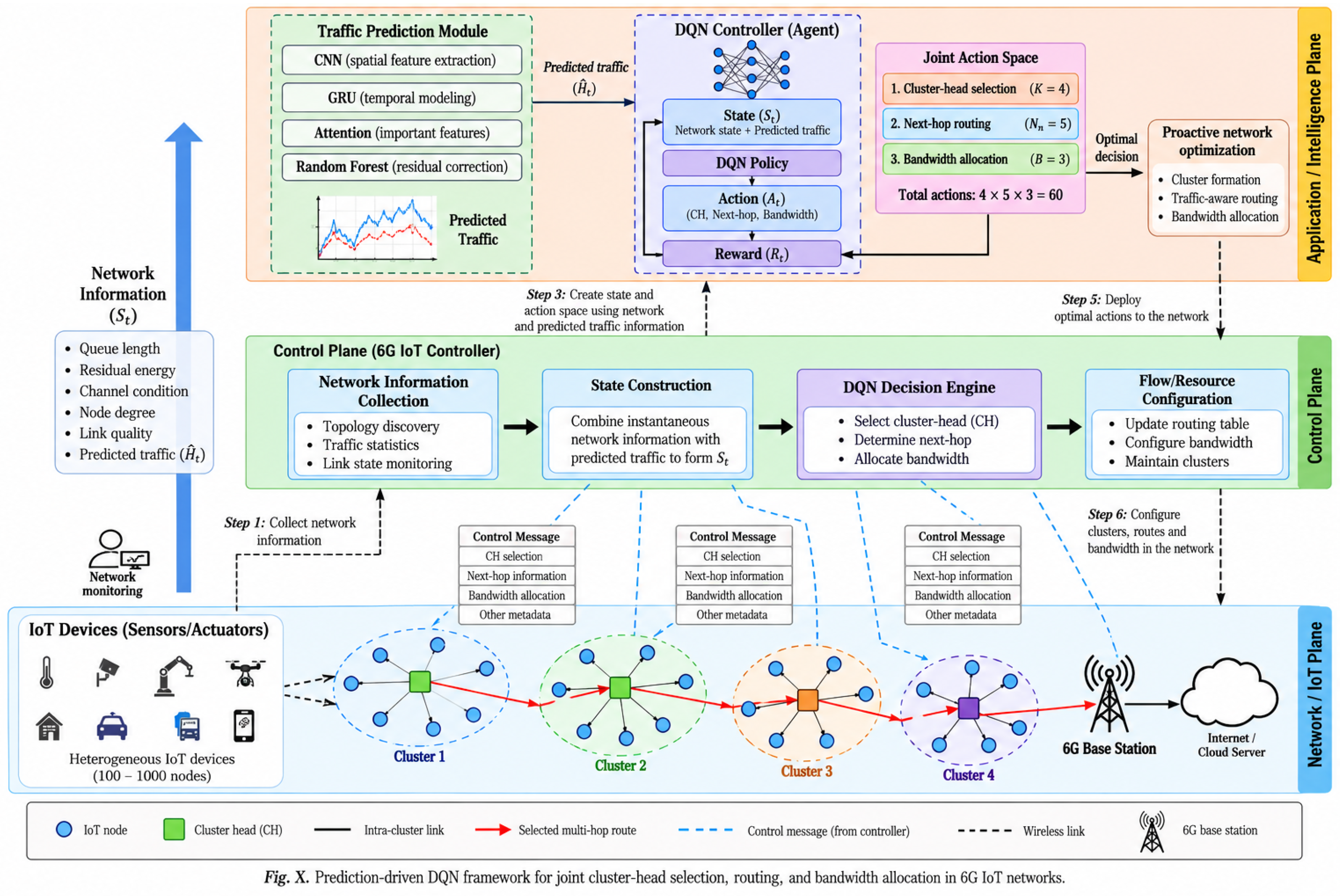
Figure 2.
Comparison of actual resource allocation and predictions obtained from different models.
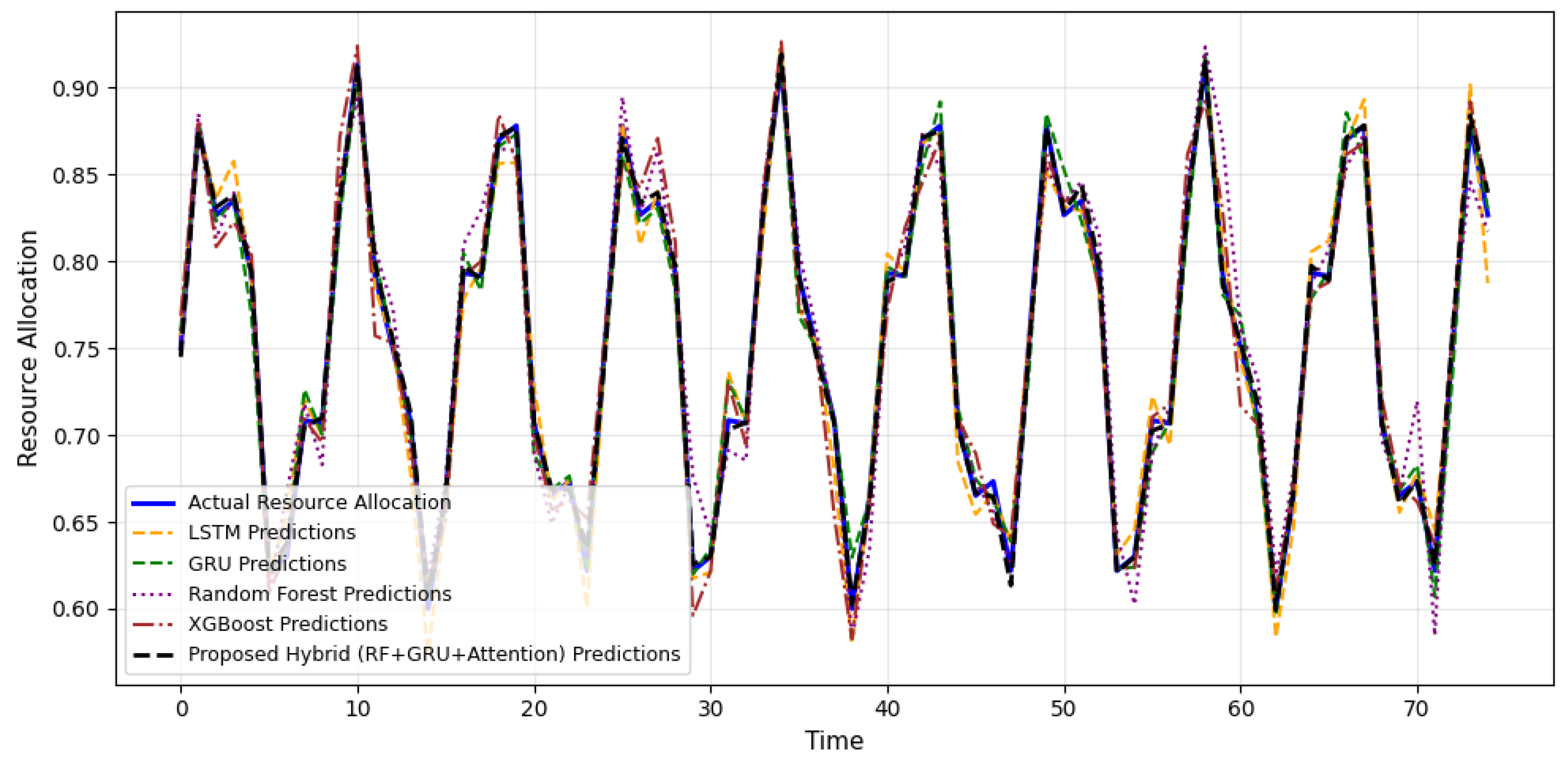
Figure 3.
Average end-to-end delay versus number of IoT nodes.
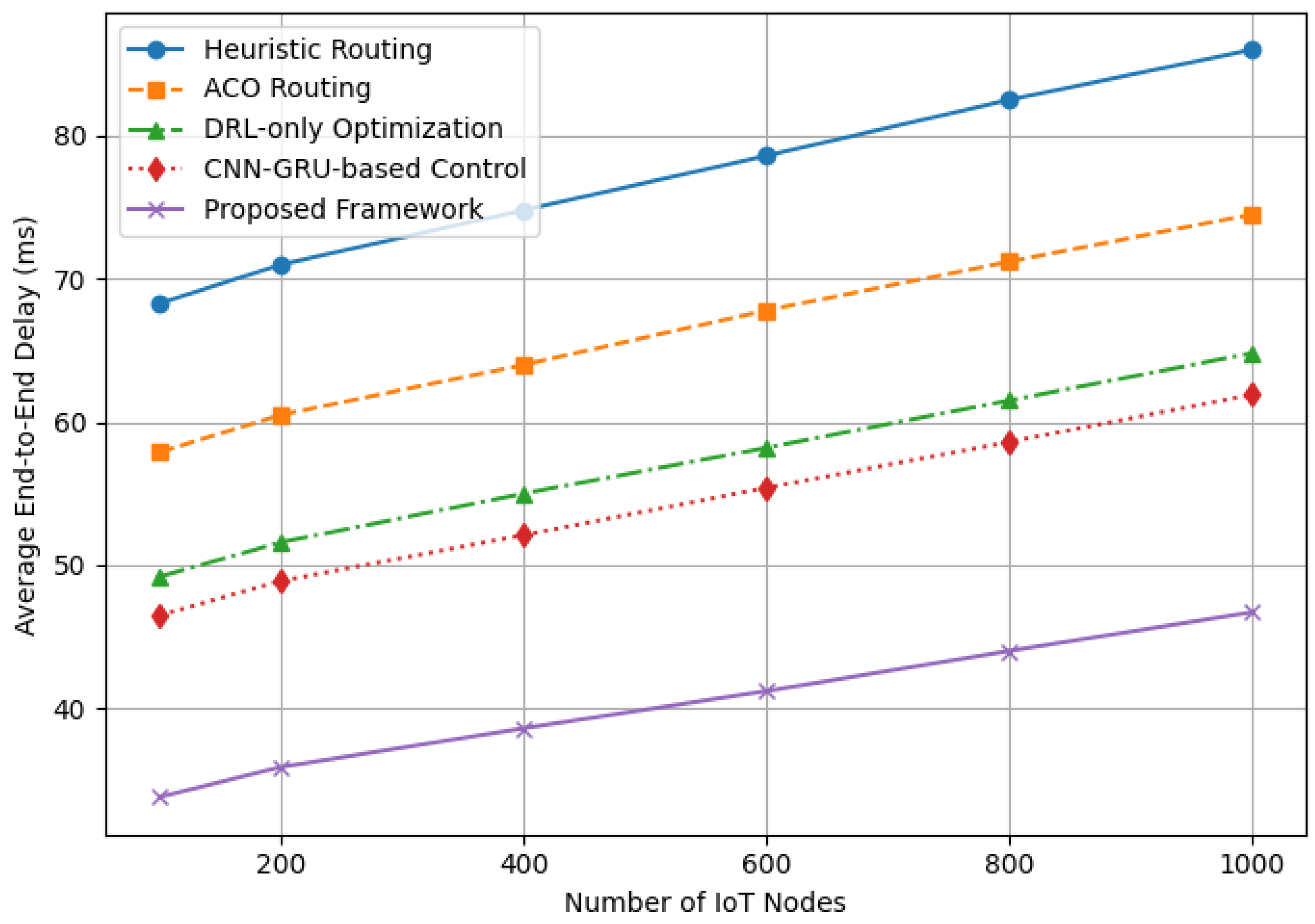
Figure 4.
End-to-end delay under increasing traffic burst intensity.
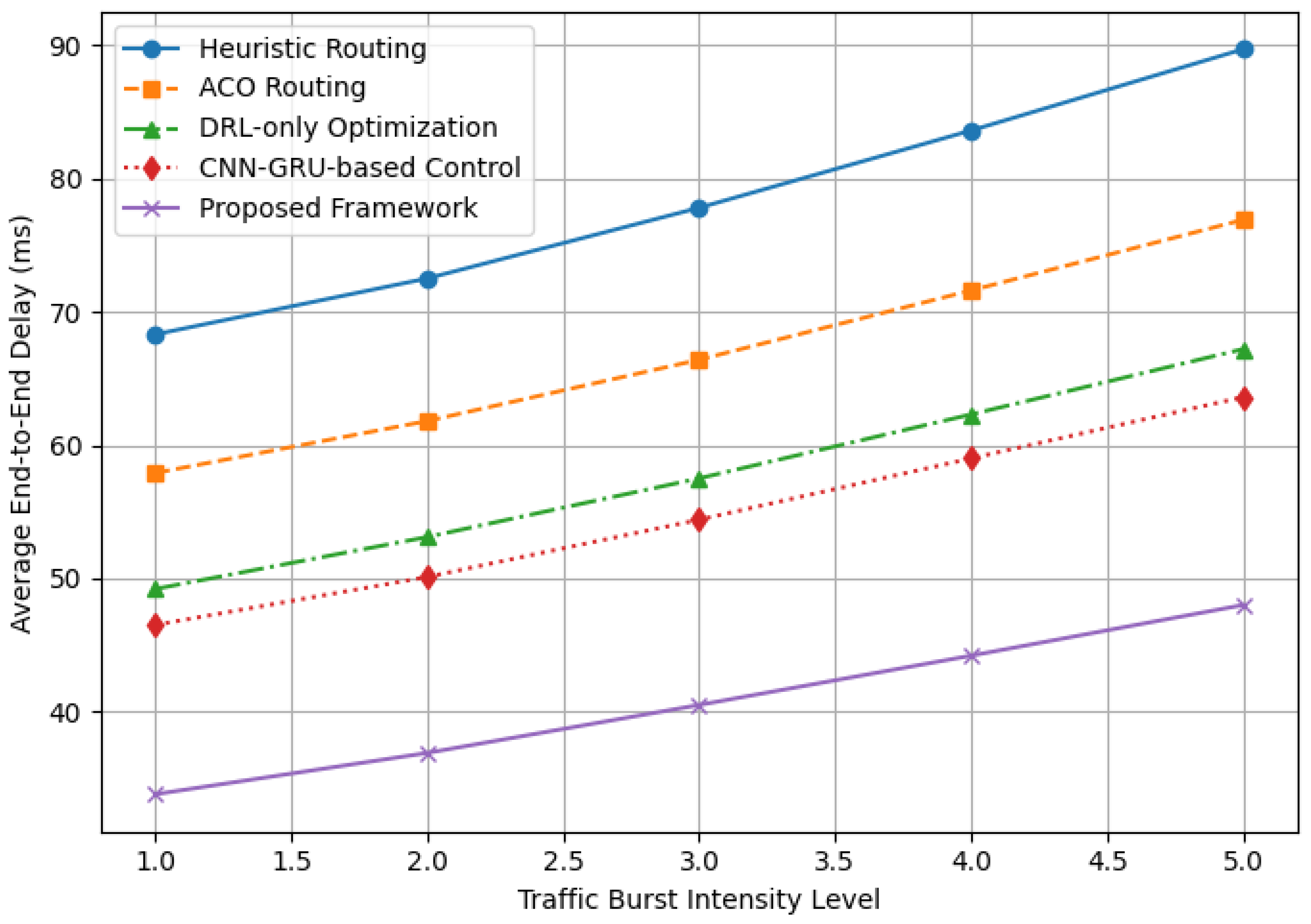

Table 1.
Traffic Prediction Performance Comparison
| Model | RMSE | MAE | MAPE (%) | |
|---|---|---|---|---|
| LSTM | 0.0214 | 0.0172 | 2.83 | 0.9621 |
| GRU | 0.0196 | 0.0159 | 2.41 | 0.9684 |
| CNN–GRU | 0.0132 | 0.0104 | 1.62 | 0.9827 |
| Random Forest (RF) | 0.0168 | 0.0135 | 2.08 | 0.9742 |
| XGBoost | 0.0154 | 0.0121 | 1.94 | 0.9769 |
| Proposed CNN–GRU–Attention–RF | 0.0079 | 0.0061 | 0.89 | 0.9946 |
Table 2.
End-to-End Network Performance Comparison
| Method | Delay (ms) | Throughput (Mbps) | PDR (%) | Energy (J) | Lifetime (rounds) |
|---|---|---|---|---|---|
| Heuristic Routing | 68.3 | 41.6 | 89.2 | 2.84 | 620 |
| ACO Routing | 57.9 | 46.8 | 91.5 | 2.41 | 710 |
| DRL-only Optimization | 49.2 | 52.3 | 94.1 | 2.02 | 810 |
| CNN–GRU-based Control | 46.5 | 55.7 | 95.3 | 1.91 | 845 |
| Proposed Framework | 33.8 | 66.9 | 97.6 | 1.43 | 1090 |
Table 3.
Ablation Study
| Model Variant | RMSE | Delay (ms) | Throughput (Mbps) | Energy (J) |
|---|---|---|---|---|
| Without Attention | 0.0116 | 41.7 | 58.2 | 1.79 |
| Without RF Ensemble | 0.0109 | 39.8 | 59.5 | 1.71 |
| Without Prediction → DRL | 0.0081 | 47.6 | 53.9 | 1.95 |
| Full Proposed Model | 0.0079 | 33.8 | 66.9 | 1.43 |
Disclaimer/Publisher’s Note: The statements, opinions and data contained in all publications are solely those of the individual author(s) and contributor(s) and not of MDPI and/or the editor(s). MDPI and/or the editor(s) disclaim responsibility for any injury to people or property resulting from any ideas, methods, instructions or products referred to in the content. |
© 2026 by the authors. Licensee MDPI, Basel, Switzerland. This article is an open access article distributed under the terms and conditions of the Creative Commons Attribution (CC BY) license (http://creativecommons.org/licenses/by/4.0/).
Copyright: This open access article is published under a Creative Commons CC BY 4.0 license, which permit the free download, distribution, and reuse, provided that the author and preprint are cited in any reuse.