
Submitted:
21 September 2026
Posted:
22 September 2026
You are already at the latest version
Abstract
Algorithmic management is embedded in distributed software development, yet its implications for shared cognition and technical outcomes remain unclear. Drawing on team cognition, this study examines algorithmic management, team mental models, supportive leadership, and technical delivery performance. Data were obtained from 324 professionals nested in 72 software development teams participating in Horizon Europe projects. Team-level path analyses linked survey measures to six GTmetrix indicators. Algorithmic management was positively associated with team mental models and associated with more favorable values on four of the six GTmetrix indicators; Total Size and First Contentful Paint were not significant. The interaction between algorithmic management and supportive leadership was statistically significant but opposite to H3: supportive leadership weakened the association between algorithmic management and team mental models. Team mental models did not significantly predict any technical indicator, and none of the bootstrapped indirect effects was significant; thus, H4 and H5 were unsupported. Theoretically, the findings delineate the limits of the proposed linear algorithmic management-team mental models-performance explanation rather than establish a new mechanism. Practically, algorithmic systems and supportive leadership should be configured as differentiated but jointly designed sources of coordination: systems provide visibility and standardized signals, whereas leaders provide interpretation, exception management, and relational support.
Keywords:
algorithmic management
; team mental models
; supportive leadership
; distributed software development
; team performance
1. Introduction
Distributed software development is no longer a peripheral arrangement of knowledge work; it has become a central organizing form in contemporary digital production. Yet the very structural conditions that make distributed software teams possible—geographic dispersion, temporal separation, digital mediation, and intensive task interdependence— also make coordination more fragile and performance more difficult to sustain. Research on global and distributed software development has consistently shown that dispersion complicates communication, weakens coordination, and undermines software quality and team effectiveness when shared understanding is difficult to establish and maintain [1,2]. In such settings, successful execution depends not merely on the technical competence of individual members, but on whether the team can develop and sustain a sufficiently common understanding of goals, priorities, roles, and workflow dependencies to coordinate action under conditions of distance and interdependence.
It is precisely this coordination problem that has made algorithmic management increasingly salient in distributed work environments. Algorithmic management refers to the use of software-based, data-driven systems to allocate work, monitor activities, evaluate performance, and shape behavior through rules, rankings, feedback loops, and predictive analytics [3,4]. In software development teams, these mechanisms are deeply embedded in everyday work through sprint dashboards, issue-tracking systems, code repositories, ticketing platforms, automated alerts, workflow analytics, and digitally mediated performance feedback. Although algorithmic management is often theorized primarily as a new terrain of surveillance and control, this framing is incomplete for team-based knowledge work. In distributed software teams, algorithmic systems may also function as coordination infrastructures by making work visible, rendering dependencies legible, standardizing cues, and creating shared reference points for collective action. Thus, the same systems that discipline work may also enable it.
This duality raises a consequential but insufficiently resolved theoretical question: under what conditions does algorithmic management enhance team performance rather than merely intensify digital control? Existing research has made significant progress in documenting the control-related tensions of algorithmic systems, but it has focused disproportionately on platform labor, individual-level outcomes, and monitoring dynamics, leaving team-level mechanisms in conventional organizational contexts less well specified [3,4]. This omission is especially problematic in distributed software development, where performance is inherently collective and where breakdowns in coordination often arise not from low effort, but from fragmented understanding across interdependent roles. If algorithmic management affects team performance in such settings, it is unlikely to do so only through direct control. Rather, its consequences should depend on whether algorithmic structures help teams build the shared cognitive architecture required for coordinated execution.
Team mental models provide a theoretically powerful lens for explaining this possibility. Team mental models are shared cognitive representations of tasks, roles, goals, interaction patterns, and the logic of coordinated action within a team [5]. Research in team cognition has long suggested that such shared representations improve team effectiveness because they reduce the need for constant explicit communication, increase predictability, and support implicit coordination under conditions of uncertainty and interdependence [6]. These advantages become even more consequential in virtual and distributed teams, where opportunities for spontaneous clarification, real-time adjustment, and informal sensemaking are structurally constrained [7]. In software development teams, where multiple specialized roles must synchronize contributions under time pressure, shared mental models can reduce misunderstanding, minimize rework, and support faster, more coherent execution by enabling members to interpret priorities and dependencies through a common frame.
From this perspective, algorithmic management may shape team performance not only as a control mechanism, but as a cognitive structuring device. Shared dashboards, standardized metrics, visible backlogs, workflow signals, and system-generated feedback may do more than track progress; they may align attention, structure interpretation, and stabilize expectations across dispersed members. When team members interpret such signals coherently, algorithmic management can strengthen shared understanding about what matters, how work is progressing, who is responsible for what, and where coordination is required. Theoretically, then, algorithmic management may influence team performance indirectly through team mental models. This perspective advances the literature by repositioning algorithmic management from a predominantly disciplinary apparatus to a sociotechnical architecture that may also facilitate collective sensemaking and coordinated execution.
Yet algorithmic systems do not produce shared meaning automatically. Visibility is not equivalent to interpretive convergence, and data transparency does not guarantee cognitive alignment. The extent to which algorithmic cues become coordinating resources rather than sources of pressure likely depends on the broader social context in which those cues are embedded. In this regard, supportive leadership should play a particularly important role. Supportive leaders help employees cope with demands, encourage communication, facilitate cooperation, and create conditions in which members are more willing to voice concerns, seek clarification, and resolve ambiguity [8,9]. Relatedly, research on team dynamics has shown that psychologically safer teams are better able to learn, coordinate, and perform effectively [10,11]. Taken together, these insights suggest that supportive leadership can strengthen the degree to which algorithmic management fosters shared team cognition. Put differently, leadership may determine whether algorithmic signals are interpreted as punitive monitoring devices or as developmental and coordination-enabling cues.
These unresolved questions define the empirical problem addressed in this study. Prior studies show how algorithmic systems monitor, allocate, and evaluate work [3,4], while team-cognition research explains how shared representations support coordination [5,6,7]. What they do not establish is whether algorithmically generated signals build shared cognition in distributed teams or whether technical delivery benefits operate through that cognitive pathway. This gap persists because control and team cognition have largely been examined in separate literatures; supportive leadership has likewise been treated as an external resource rather than a mechanism that may complement or substitute for algorithmic sensegiving. We therefore examine the associations of algorithmic management with team mental models and objective technical delivery outcomes, test the proposed indirect pathway, and assess supportive leadership as a boundary condition. The GTmetrix outcomes are deliberately narrow: they capture technical properties of web-based outputs, not the full domain of team effectiveness.
The intended contribution is therefore bounded. Rather than proposing a new general theory of coordination, the study places algorithmic management, shared cognition, and supportive leadership in the same team-level test and pairs survey measures with archival technical outcomes. This design allows us to examine which established coordination arguments carry into algorithmically structured, distributed software work and which do not. In particular, the model distinguishes the direct technical association from the proposed cognitive pathway, so that the latter can be evaluated rather than assumed.
2. Theoretical Background and Hypotheses
2.1. Distributed Work Environments and Team Performance Challenges
Distributed work environments not only alter the fundamental conditions under which team performance emerges, but also transform the very nature of coordination. Geographic dispersion, temporal separation, and technology-mediated interaction systematically reduce the visibility of team members into one another’s activities, progress, and decision-making processes [12]. This condition—often conceptualized as the “out of sight, out of sync” problem in distributed teams—undermines both coordination and the development of shared understanding [13]. In this context, dispersion introduces not merely physical distance but also cognitive and temporal discontinuities among team members, thereby structurally complicating synchronization.
Diminished visibility, particularly in contexts characterized by task interdependence, weakens team members’ capacity to accurately interpret workflow dynamics. This creates fertile ground for interpretive divergence and dependency-related errors. When team members are compelled to make decisions based on incomplete or delayed information regarding task priorities, role boundaries, and workflow dependencies, even minor interpretive discrepancies can accumulate over time, resulting in coordination breakdowns [12]. Consequently, performance challenges stem not only from a lack of communication, but more critically from the erosion of shared meaning-making processes, leading to delays, rework, and declines in output quality [12].
Under such conditions, while explicit communication remains a fundamental coordination mechanism, its inherently costly, fragmented, and asynchronous nature in distributed environments renders it insufficient on its own [6]. As a result, teams increasingly rely on implicit coordination mechanisms grounded in pre-aligned cognitive representations of tasks, roles, and interdependencies, rather than on continuous communication. Research on virtual teams similarly emphasizes the critical role of shared cognitive structures in sustaining coordination [14]. Shared cognition enables team members to anticipate one another’s actions even under conditions of incomplete information, align local decisions with system-level requirements, and minimize dependency-related errors [5,15].
Accordingly, the primary determinant of performance in distributed teams lies not in the frequency of communication, but in the extent to which these shared cognitive structures enable coordinated action. Therefore, explaining performance in distributed teams requires a framework that goes beyond communication intensity and instead elucidates how shared cognitive structures are formed. In this regard, the Team Mental Models (TMM) literature provides a robust analytical foundation.
2.2. Conceptualizing Algorithmic Management as a Coordination and Control Infrastructure
The literature has predominantly treated algorithmic management as a novel form of digital surveillance and control. However, this perspective remains incomplete, particularly in organizational contexts characterized by high task interdependence, digital mediation, and spatial dispersion. In distributed work environments, algorithmic systems do not merely observe labor; they actively structure it. A critical distinction must therefore be drawn: algorithmic management does not refer to digital tools per se (e.g., project management software), but rather to the condition in which the processes enacted through these tools—such as monitoring, evaluation, prioritization, and workflow direction—function as a form of managerial authority [3]. In this sense, algorithmic management emerges as a mode of governance that transcends technological infrastructure, shaping how work is coordinated, evaluated, and directed.
Within this framework, algorithmic systems produce a managerial order that renders dispersed actors visible to one another, translates priorities into actionable signals, and enables coordination to be sustained across distance, time, and functional specialization. These systems do not merely monitor labor; they operate as mechanisms that structure both the organization and execution of work [16]. Indeed, in platform-based work arrangements, algorithms function not only as facilitators of interaction, but also as mechanisms that coordinate work processes and, through this coordination, generate hierarchical authority relations [17]. Accordingly, algorithmic management should be understood not solely as a system of control, but as an infrastructure of coordination and control through which managerial authority is, at least in part, enacted via algorithmic processes [18].
For this reason, algorithmic management is conceptualized not as an aggregation of discrete practices, but as a unified managerial logic in which the visibility, evaluation, and direction of work are integratively organized. Within this perspective, processes such as visibility generation, metric-based evaluation, feedback loops, and workflow direction are not independent dimensions, but interdependent components of a single, cohesive managerial mechanism. This integrated structure creates a shared informational environment in distributed teams, thereby enabling the coordination of action. The metrics, feedback, and directives produced by such systems do not merely provide information; they establish binding reference points that guide behavior, align expectations, and shape coordination. In doing so, algorithmic management functions not only as a system that measures work, but also as an infrastructure that renders it visible, standardized, and interpretable [3].
In the present study, algorithmic management is conceptualized as a multidimensional higher-order construct. Monitoring, performance rating, and compensation are not modeled as separate predictors; rather, they are treated as related dimensions of team members’ overall perception of algorithmic management. Together, these dimensions reflect how team members experience algorithmically enabled work visibility, performance evaluation, and standardized evaluative and reward-related signals. This approach positions algorithmic management not merely as a set of technical tools but as a socio-technical governance arrangement that may influence how team members interpret and coordinate their work.
Consistent with the focal context, the empirical operationalization focused on monitoring, performance rating, and compensation. Goal setting and scheduling were not included because, in the participating software teams, these activities were shaped primarily by project requirements, client demands, sprint routines, leader coordination, and professional autonomy rather than by algorithmic systems. Accordingly, the findings concern the informational and evaluative coordination functions of algorithmic management and should not be generalized to algorithmic task allocation or scheduling.
2.3. Core Mechanism: Team Mental Models
Team mental models (TMM) refer to the shared or sufficiently overlapping cognitive representations that team members hold regarding goals, roles, tasks, interaction patterns, and task processes [19,20,21]. More specifically, TMM encompasses the collective cognitive structures related to task interdependencies, role expectations, workflow dependencies, prioritization, and temporal sequencing [5,15]. In the present study, TMM are conceptualized not as a generalized state of cognitive similarity, but as the extent to which tasks, roles, and interdependencies are represented in sufficiently overlapping ways across team members. In this sense, TMM constitutes the cognitive infrastructure of team coordination. When members develop a shared understanding of what needs to be done, who is responsible for what, how tasks are interconnected, and which priorities guide workflow execution, the communicative and cognitive costs of coordination decrease, predictability increases, and teams exhibit more consistent performance.
The importance of TMM becomes even more pronounced in distributed teams. Geographic dispersion, temporal discontinuities, and limited face-to-face interaction reduce team members’ capacity for real-time clarification, correction, and mutual adjustment. Under such conditions, TMM functions as an internalized shared frame of reference that partially substitutes for continuous direct interaction. When team members share sufficiently aligned understandings of tasks, timing, dependencies, and role expectations, they are able to coordinate more effectively despite communication constraints [21,22].
This study adopts TMM as its central construct because the research problem is not concerned with the question of “who knows what,” but rather with how tasks and their interdependencies are jointly represented within the team. While transactive memory systems [23] explain the distribution of knowledge and the structure of “who knows what,” TMM directly addresses how work is organized, how tasks are interconnected, and how team members collectively interpret this structure. Therefore, TMM provides a more direct and theoretically appropriate framework for explaining the coordination challenges examined in this study [5,15].
Accordingly, TMM are positioned in the model as the core cognitive mechanism explaining team performance, as well as the mediating process through which the effects of algorithmic management unfold. To the extent that algorithmic systems enhance visibility, clarify priorities, frame the interpretation of workflow, and provide shared reference points for team members, a substantial portion of their impact on performance is expected to occur through the development of more aligned mental models of the team’s collective work.
All variables in this study are conceptualized at the team level. Algorithmic management and supportive leadership are treated as contextual features collectively experienced by team members; TMM are inherently positioned as a shared cognitive structure; and team performance is conceptualized as a team-level outcome reflecting collective outputs. This approach is grounded in the assumption that, in distributed teams, performance emerges not from the simple aggregation of individual contributions, but from the quality of shared understanding and the team’s capacity for coordination.
2.4. Algorithmic Management and Team Performance
Algorithmic management can support team performance through a variety of mechanisms. By rendering goals measurable, it enhances clarity of priorities; by establishing feedback loops, it facilitates the early detection of deviations; and by increasing the visibility of tasks and workflows, it reduces coordination frictions [24]. At the same time, the literature acknowledges that such systems may also produce adverse outcomes, including perceptions of excessive monitoring, heightened pressure, and a narrowing focus driven by metrics [25].
However, the focus of the present study is on how the performance effects of algorithmic management vary depending on the context. In distributed teams, the primary determinant of performance is not individual effort per se, but the effective coordination of interdependent tasks [12]. Due to limited visibility, asynchronous interaction, and reduced situational awareness, distributed teams face structural challenges in coordination. In this context, the central performance issue is not a lack of motivation, but rather coordination fragility. Accordingly, the coordination-enabling functions of algorithmic management are expected to become predominant.
Algorithmic management plays a critical role in this regard by centralizing information related to tasks, statuses, deadlines, and interdependencies, thereby creating a shared informational environment that facilitates coordination among team members. These systems reduce reliance on individual communication efforts by enabling coordination to be conducted through a continuously updated and collectively accessible reference system. Research on virtual teams suggests that coordination and information sharing are critical to performance [7,14], and that algorithmic management can directly shape team processes [24]. Similarly, the structuring of tasks through algorithmic systems and the use of data-driven planning processes have the potential to reduce cognitive load and strengthen coordination [24].
Within this framework, the impact of algorithmic management on performance arises not primarily from direct control, but from its capacity to strengthen the coordination infrastructure. Particularly in distributed settings characterized by high task interdependence, functions such as enhancing visibility, clarifying priorities, and making dependencies traceable become critical for performance. Indeed, in distributed software development environments, algorithmic tools such as sprint boards, task tracking systems, and automated workflow signals are known to enhance intra-team visibility and synchronization [2,12].
Accordingly, in distributed and complex work environments, the performance-enhancing effects of algorithmic management are expected to predominate.
H1: Algorithmic management has a positive effect on team performance.
2.5. Algorithmic Management and Team Mental Models
Algorithmic management also shapes how team members collectively interpret and understand their work. Shared dashboards, standardized metrics, visible task statuses, and workflow signals can support the development of TMM by providing common reference points for team members [26]. Through task allocation policies that determine who does what and when, algorithmic management systems facilitate the development of shared representations regarding goals, competencies, and interdependencies [26,27].
However, increased visibility alone does not guarantee the emergence of shared meaning. The same information may be interpreted differently by different team members, allowing coordination problems to persist [28]. Therefore, the influence of algorithmic management on TMM stems not only from its capacity to provide information, but also from its ability to structure how that information is interpreted.
Algorithmic management influences TMM not merely by enhancing visibility, but by standardizing the meaning of task-related signals. By framing how metrics should be read, how task priorities should be evaluated, and what workflow signals signify, algorithmic systems enable team members to attribute similar meanings to the same information. This process constrains individual interpretive divergence and fosters a cognitive structure that guides the production of shared meaning [29].
In this sense, algorithmic management functions not only as a system that makes “what is happening” visible, but also as an interpretive infrastructure that shapes “how this information should be understood.” This structure enables team members to develop more aligned mental models regarding task relationships, role expectations, and dependency structures. Accordingly, TMM are strengthened not simply as a function of increased visibility, but as an outcome of standardized interpretive processes.
Particularly in distributed teams, shared understanding is often constructed not through face-to-face interaction, but through digital traces and system-generated signals. Therefore, what is critical in such environments is not merely the accessibility of information, but the consistency with which that information is interpreted across the team. In this regard, algorithmic management is conceptualized as a mechanism that supports the development of TMM by establishing shared frames of reference and aligning interpretive processes.
H2: Algorithmic management has a positive effect on team mental models.
2.6. Supportive Leadership as a Boundary Condition
The signals generated by algorithmic systems are not interpreted uniformly. The same performance indicators may be perceived as guiding by some teams, yet as coercive by others. Accordingly, the effect of algorithmic management on TMM is contingent upon the surrounding social context. Supportive leadership constitutes a critical boundary condition in this regard [26,30].
In this study, supportive leadership is conceptualized not as a generalized form of “good leadership,” but as a sensegiving mechanism that shapes how team members interpret algorithmic signals [31,32]. While algorithmic management generates indicators, metrics, and workflow signals, the interpretation of these signals is not inherently determined. At this juncture, leaders play a pivotal role by framing what these signals mean and how they should be evaluated in light of organizational priorities, thereby guiding the construction of shared meaning.
The critical importance of supportive leadership in this context lies in its capacity to reduce threat perceptions, foster psychological safety, and legitimize processes of questioning, discussing, and reinterpreting data. These characteristics facilitate the perception of algorithmic feedback not as a punitive monitoring tool, but as a developmental and coordination-oriented resource [26,33,34]. As a result, team members are more likely to interpret algorithmic signals within a consistent and shared framework.
From this perspective, the moderating effect emerges through leadership’s role in transforming how algorithmic signals are interpreted. Under conditions of high supportive leadership, algorithmic indicators evolve into shared reference points for team members, fostering consistent interpretive patterns and strengthening the development of TMM. In contrast, under low levels of supportive leadership, the same signals are more likely to be interpreted divergently, thereby weakening the formation of shared mental models.
Thus, supportive leadership does not determine the production of information by algorithmic management, but rather the extent to which this information is collectively interpreted across the team. In this sense, leadership functions as a catalyst that activates the capacity of algorithmic management to generate shared cognition.
In the present study, supportive leadership is positioned as a moderating variable in the relationship between algorithmic management and team mental models.
H3: Supportive leadership strengthens the positive effect of algorithmic management on team mental models.
2.7. Team Mental Models and Team Performance
Team mental models enhance coordination quality by enabling team members to develop a shared understanding of tasks, roles, and workflow relationships. This, in turn, reduces misunderstandings, delays, and rework, while facilitating the production of faster and higher-quality collective outputs [35]. Particularly in distributed teams, TMM function as a cognitive coordination mechanism that partially substitutes for limited direct interaction. In this sense, the contribution of TMM to performance lies less in individual accuracy than in enabling the timely and coherent integration of interdependent contributions.
In the present study, the effect of TMM on performance is examined not through a generalized assumption of “better outcomes,” but in terms of how effectively interdependencies within the team are managed and how seamlessly workflow continuity is maintained. In highly interdependent contexts such as software development, performance depends less on isolated task outputs and more on the degree of alignment and integration among these outputs. TMM facilitate this process by enabling team members to accurately understand not only their own tasks, but also the relationships, timing, and dependency structures linking their tasks to others. This, in turn, contributes to the early identification of bottlenecks and the prevention of workflow disruptions [15]. As a result, coordination becomes anticipatory rather than reactive, thereby supporting sustained workflow continuity.
Within this framework, the contribution of TMM to performance emerges primarily through effective dependency management and workflow continuity. Shared mental models enable team members to anticipate one another’s actions and adjust their own contributions accordingly, leading to outcomes such as shorter delivery times, reduced need for rework, and increased process efficiency. In this study, team performance is conceptualized in line with the software development context in terms of the technical delivery characteristics of the output that the team jointly produces, such as its speed, responsiveness, reliability, and transfer efficiency, rather than as a comprehensive measure of team effectiveness. Accordingly, TMM are not treated as a direct driver of performance per se, but as a fundamental coordination mechanism that enhances performance outcomes by enabling the seamless and aligned execution of interdependent tasks.
H4: Team mental models have a positive effect on team performance.
2.8. The Mediating Role of Team Mental Models
Algorithmic management may influence team performance not only directly, but also through indirect mechanisms. In the present study, this indirect effect is explained through the capacity of algorithmic management to generate shared interpretive cues, which in turn shape team mental models. By providing common metrics, visible workflows, and consistent performance signals, algorithmic systems establish shared reference points that inform how work is organized. These reference points facilitate the development of more overlapping mental representations among team members regarding tasks, roles, and interdependencies.
Such cognitive alignment reduces misunderstandings, delays, and misalignments that arise during coordination, thereby limiting coordination losses. Shared mental models enable team members to anticipate one another’s actions and adjust their own contributions accordingly. As a result, coordination shifts from a reactive to an anticipatory mode, leading to improved team performance [5,15].
Accordingly, TMM constitutes not merely a concomitant factor, but the core cognitive mechanism that explains the relationship between algorithmic management and team performance. While algorithmic management influences the formation and maintenance of TMM through governance signals, feedback loops, and standardized processes, TMM, in turn, enhances performance outcomes by reducing coordination losses and aligning action plans.
Therefore, the effect of algorithmic management on team performance is expected to occur largely through the development of more aligned mental models among team members, which subsequently reduces coordination losses.
H5: Team mental models mediate the relationship between algorithmic management and team performance.
In line with this reasoning, the proposed model posits that the effect of algorithmic management on team performance operates both directly and indirectly through team mental models, and that this cognitive process is further strengthened by supportive leadership. This integrative perspective offers a holistic framework for understanding the interplay among digital management systems, team cognition, and leadership.
3. Research Methodology
3.1. Sample and Data Collection
Data were collected from fully distributed software development teams. Using the official CORDIS Horizon Europe dataset available through data.europa.eu [36] as the primary sampling source, we identified private-sector organizations involved in 2025 projects that explicitly signaled a software-related focus. Projects were retained when the terms software, software engineering, or generative AI appeared in the project title, topic classification, or project description. This filtering procedure yielded an initial sampling pool of 158 firms.
Senior managers in these firms were first contacted, informed about the purpose of the study, and asked whether their organizations would be willing to participate. Of the 158 firms approached, 32 agreed to participate. With the support of these senior managers, we then contacted project directors to facilitate team-level participation. In total, 93 project directors initially responded positively; however, 19 subsequently withdrew because of project-schedule constraints, including workload pressures, shifting deadlines, and internal coordination difficulties. The surveys were administered online in July 2025. Because the survey responses were subsequently aggregated to the team level, respondents were asked to indicate their project names to enable the matching of members within the same project team. To reduce reliance on a single respondent, we required at least two members of each project team to complete the survey [37]. The average completion time was approximately 10 minutes per respondent. Two project teams were excluded because of excessive missing data. The final survey sample consisted of 324 members nested within 72 project teams drawn from 32 firms. Software-system performance was assessed six months later, in January 2026, using objective browser-based indicators generated through an automated performance-testing process integrated into GTmetrix. This temporal and source separation reduced concerns associated with contemporaneous and same-source measurement.
Scholars recommend several ex ante procedural remedies to mitigate common method bias [37]. Consistent with these recommendations, we used anonymous online questionnaires and requested only the project title for aggregation purposes, thereby minimizing social desirability concerns and improving response accuracy. To create psychological separation, the cover page clarified that no direct relationship existed among the different sets of items. Participants were further assured that there were no right or wrong answers. In addition, Harman’s single-factor test [38] was performed as a supplementary diagnostic, using an unrotated exploratory factor analysis including all study variables. Although this procedure remains a widely used diagnostic check [37], it is not treated here as definitive evidence that common method variance is absent; we assessed only whether a single factor accounted for the majority of covariance among the measures. The first unrotated factor accounted for 38.57% of the total variance, falling below the commonly accepted 50% threshold.
Note. Percentages were calculated within each variable using the relevant subtotal as the denominator. The number of team members was based on the team-level sample (N = 72), whereas experience, education, gender, and age were based on the individual-level sample (N = 324).
The descriptive statistics (see Table 1) indicate that the sample was composed primarily of relatively small teams, with most teams consisting of four members (69.4%), followed by five-member teams (18.1%); larger teams were comparatively uncommon. At the individual level, participants were predominantly male (61.1%) and largely held a bachelor’s degree (70.1%), while 25.3% held a master’s degree and 4.6% held a PhD. The age distribution was concentrated in the 26–33 (48.8%) and 34–39 (41.4%) brackets. In terms of professional experience, the largest group reported 4–7 years of experience (53.4%), followed by 1–3 years (27.2%), suggesting that the sample was composed mainly of early- to mid-career employees. Because the sampling frame was restricted to Horizon Europe projects and the participating teams operated in technologically advanced, multinational settings, the sample should not be treated as representative of small firms, less digitized organizations, or teams working in developing-country contexts.
3.2. Measures
We conducted a back-translation procedure to ensure the accuracy of the translation, as the original surveys were written in English [39]. All responses were recorded on a 5-point Likert-type scale, ranging from 1 (strongly disagree) to 5 (strongly agree).
3.2.1. Algorithmic Management
We measured algorithmic management using a contextually adapted version of the Algorithmic Management Questionnaire developed by Parent-Rocheleau et al. [40]. The original five-dimensional instrument was empirically developed and validated primarily among gig workers and measures perceived exposure to algorithmic monitoring, goal setting, scheduling, performance rating, and compensation. Although these functions may also occur outside gig work, some of the original dimensions and items did not directly correspond to the managerial arrangements experienced by project-based software development teams.
Before data collection, a practice-based contextual content review was conducted within ErpaSoftware, a software development company founded and managed by the first author. Three software team leaders and three software developers with experience in distributed project work reviewed the original dimensions and items for clarity, contextual relevance, and correspondence with the managerial practices encountered in software development teams. The assessment indicated that monitoring, performance rating, and compensation captured the most applicable forms of algorithmic observation and evaluation in the focal setting. By contrast, the original goal-setting and scheduling items primarily reflected platform-mediated work arrangements more characteristic of gig work. In the focal context, goals and schedules were determined predominantly through project requirements, client demands, sprint-planning routines, professional autonomy, and human leadership rather than through autonomous algorithmic systems. These two dimensions were therefore not retained. The individuals who participated in the contextual content review were not included in the main study sample.
Based on the contextual review, two monitoring items were added to capture forms of digitally mediated observation encountered in distributed software development, and one compensation item was removed because it did not correspond to the compensation arrangements in the focal setting. The resulting 12-item measure comprised monitoring (six items), compensation (three items), and performance rating (three items). Accordingly, the measure does not represent the complete content domain of the original five-dimensional AMQ. In this study, algorithmic management refers specifically to team members’ perceived exposure to these selected monitoring and evaluative functions.
This procedure constituted a practice-based contextual content assessment rather than an independent pilot study or a complete revalidation of the original AMQ. The team leaders and software developers provided direct knowledge of the focal work context, but the assessment was conducted within a company founded and managed by the first author. The psychometric evidence reported below therefore applies only to the adapted three-dimensional measure used in this study.
3.2.2. Supportive Leadership
Supportive leadership was measured using the supportive leadership subscale developed by Rafferty and Griffin [9]. The scale consists of three items and captures employees’ perceptions of the extent to which their leader provides emotional support, shows understanding, and encourages their development. Given the context of remote software development teams, this measure was particularly relevant for assessing leader behaviors that help sustain interpersonal support and developmental guidance despite the physical distance inherent in remote work arrangements.
3.2.3. Team Mental Models
Team mental models were measured using five items adapted from Kude, Mithas, Schmidt, and Heinzl [41]. This measure was developed in the context of software development teams and captures the extent to which team members share a common understanding of key task-related aspects of their work. More specifically, the scale reflects shared understandings regarding issues such as the software architecture, underlying technology, development procedures, and the broader project logic. Because the measure was originally developed for software development settings, it was well aligned with the context of the present study.
3.2.4. Team Performance
Team performance was measured objectively using six archival GTmetrix indicators: Speed Index, Service Failure Ratio, Total Blocking Time, Service Response Time, Total Size, and First Contentful Paint [42]. In distributed software development, team performance is ultimately reflected in the technical characteristics of the web-based output that team members jointly develop and deliver. The selected indicators capture the speed, responsiveness, reliability, and transfer efficiency of this collective output. Because these outcomes result from interdependent development and delivery activities for which the focal team is collectively responsible, they provide an objective, output-based operationalization of team performance in this context. This operationalization captures the technical task-output dimension of team performance rather than every possible dimension of broader team effectiveness. Higher values indicate poorer performance; accordingly, lower indicator values—and negative coefficients predicting them—represent better team performance. Each indicator was analyzed separately after natural-log transformation.
3.3. Data Analysis
Analyses were conducted in SPSS and AMOS at the team level. Individual responses from 324 participants were aggregated to form team-level scores for the 72 teams, following the assessment of within-team agreement and interrater reliability using r_wg, ICC(1), and ICC(2). The reliability and validity of the measures were evaluated using Cronbach’s alpha, composite reliability (CR), average variance extracted (AVE), and confirmatory factor analysis (CFA). The hypothesized direct, moderation, and bootstrapped indirect effects were subsequently examined through path analysis [43]. Algorithmic management, supportive leadership, and team mental models were measured using survey responses, whereas team performance was assessed independently through archival GTmetrix indicators. This separation of measurement sources reduced same-source concerns for the hypothesized relationships involving team performance. Harman’s single-factor test was also conducted as a supplementary diagnostic for common method variance.
3.4. Measurement Tests
Reliability and validity were assessed using standardized loadings, CR, AVE, and alpha [44]. One team-mental-model item was removed before estimating the final model. The preferred AVE benchmark is 0.50 [44]. Monitoring (0.478) and team mental models (0.494) fell slightly below it, whereas CR (0.844 and 0.795) and alpha (0.839 and 0.794) exceeded 0.70. Because AVE is more conservative than construct reliability, convergent validity may still be regarded as adequate when AVE is below 0.50 but CR is satisfactory [45]. The evidence therefore supports adequate, though marginal, convergent validity; both constructs were retained and interpreted cautiously.
A key feature of the measurement model is that algorithmic management was specified as a reflective higher-order construct composed of three first-order dimensions: monitoring, compensation, and performance rating. This specification is theoretically preferable because these dimensions are not independent managerial mechanisms; rather, they represent interrelated manifestations of a common algorithmic control architecture through which work is monitored, evaluated, and influenced. Modeling algorithmic management as a higher-order construct therefore captures the shared conceptual core underlying these practices, while preserving the substantive distinctiveness of each first-order dimension. This approach also provides a more parsimonious representation of the construct than modeling the three dimensions as isolated variables, which would risk fragmenting a concept that is theoretically broader and organizationally integrated. Empirically, the hierarchical structure was strongly supported, as the first-order dimensions loaded very highly on the overarching algorithmic management factor, with standardized loadings of 0.939 for monitoring, 0.979 for compensation, and 0.999 for performance rating. Taken together, these coefficients indicate that the three dimensions share substantial common variance and can be meaningfully represented under a single higher-order latent construct. Consistent with this interpretation, the higher-order algorithmic management construct also demonstrated very strong psychometric properties, with CR = 0.981, AVE = 0.946, and = 0.920.
Discriminant validity was assessed using both the Fornell and Larcker criterion [45] and the heterotrait-monotrait ratio (HTMT). As shown in Table 3, the square root of the AVE for each construct exceeded its correlations with the remaining constructs, indicating that each construct shared more variance with its own indicators than with other latent variables in the model. More specifically, the square roots of AVE were 0.973 for algorithmic management, 0.733 for supportive leadership, and 0.703 for team mental models, all of which exceeded the inter-construct correlations.
Note. SD = Standard deviation. Values in parentheses on the diagonal are the square roots of AVE.
Table 4 presents the HTMT ratios used to provide an additional assessment of discriminant validity. Following Henseler et al. [46], HTMT values below the recommended threshold indicate that the constructs are empirically distinct from one another. As shown in Table 4, all HTMT values ranged between 0.341 and 0.462, which are well below the commonly accepted cutoff values. These results provide further evidence that discriminant validity was established among algorithmic management, supportive leadership, and team mental models.
Note. HTMT = Heterotrait-Monotrait ratio of correlations.
Confirmatory factor analysis was conducted using AMOS to evaluate the fit of the proposed measurement model. The results indicated that the model fit the data well: CMIN/DF = 2.073, p < 0.001; TLI = 0.941; IFI = 0.950; CFI = 0.949; NFI = 0.907; and RMSEA = 0.055. Overall, these fit statistics suggest that the measurement model provides an acceptable to good representation of the observed data and offers a sound basis for proceeding to the structural analyses. Table 3 further shows that algorithmic management was positively and significantly correlated with supportive leadership (r = 0.334, p < 0.001) and team mental models (r = 0.353, p < 0.001), while supportive leadership was also positively and significantly associated with team mental models (r = 0.442, p < 0.001). These coefficients indicate moderate positive relationships among the focal constructs and are consistent with the theoretically expected direction of the associations. To provide a visual representation of the measurement model, Figure 1 displays the final confirmatory factor model estimated in AMOS, including the higher-order specification of algorithmic management and the retained indicators for each latent construct.
3.5. Aggregation Assessment
Because the theoretical model was specified at the software-development-team level, individual responses were aggregated to team means. We evaluated this decision using complementary indices of within-team agreement and between-team reliability. Specifically, r_wg was used to assess consensus within teams, whereas ICC(1) estimated the proportion of variance associated with team membership and ICC(2) estimated the reliability of team means [47,48]. ICCs were estimated from one-way random-effects ANOVAs with team as the grouping factor. The ICC analysis used the full sample of 324 respondents nested in all 72 teams. Table 5 reports the results.
The r_wg values indicated moderate to strong within-team agreement (0.69–0.84), supporting convergence among members. By contrast, ICC(1) values ranged from -0.001 to 0.042 and ICC(2) values from -0.006 to 0.161, indicating little between-team differentiation and low reliability of the team means. The negative estimates for supportive leadership are sampling estimates effectively at or below zero rather than evidence of negative true clustering. Thus, the agreement evidence supports within-team consensus, but the ICC evidence provides only limited support for treating the team means as reliable between-team measures. We retained the theoretically specified team-level analysis, while interpreting the structural results cautiously and treating the low ICCs as an important limitation.
Note. J=number of teams; N=number of respondents included in the ICC analysis; r_wg=within-team agreement; ICC(1)=proportion of variance attributable to team membership; ICC(2)=reliability of team means. ICC estimates were obtained from one-way random-effects ANOVAs. Negative estimates are reported as obtained.
3.6. Hypothesis Testing
To test the hypotheses, we employed structural equation modeling (SEM) using AMOS. Following the aggregation assessment reported in Section 3.5, the structural analyses used team-level composite scores for algorithmic management, supportive leadership, and team mental models.
Following aggregation, hypothesis testing was conducted using team-level composite scores rather than indicator-level latent interactions. More specifically, because the model included a moderating effect of supportive leadership on the relationship between algorithmic management and team mental models, the focal variables were represented by their aggregated mean scores. Given the study’s team-level focus and the use of aggregated construct means, the moderation effect was tested using an interaction term based on mean-centered composite scores. Specifically, algorithmic management and supportive leadership were mean-centered and multiplied to create the interaction term. This approach is consistent with conventional moderation procedures and is especially suitable when the analysis is conducted at the level of observed composite variables rather than indicator-level latent interactions. Mean-centering also improves the interpretability of regression coefficients and may reduce the nonessential correlation between the product term and its lower-order components [49,50,51]. The resulting composite variables and interaction term were subsequently entered into AMOS as observed variables for hypothesis testing. All analyses involving team performance were conducted using the natural log-transformed performance indicators. It is important to note that the hypothesis-testing stage differed analytically from the preceding measurement-model assessment. Whereas the measurement model was evaluated at the latent-variable level using CFA, the structural hypotheses were tested using aggregated team-level composite scores and an externally computed interaction term. Accordingly, the final model was estimated as a path model among observed variables rather than as a full latent SEM. In this setting, conventional global fit indices were not reported because the model did not include an indicator-level latent measurement structure, and fit indices are often of limited value, or may not be meaningfully interpreted, in saturated or just-identified path models [52].
Table 6 and Table 7 show mixed evidence. Algorithmic management was associated with more favorable Speed Index ( = -0.270, p = 0.018), Service Failure Ratio ( = -0.265, p = 0.020), Total Blocking Time ( = -0.250, p = 0.030), and Service Response Time ( = -0.262, p = 0.022). Total Size narrowly missed significance ( = -0.223, p = 0.055), and First Contentful Paint was nonsignificant ( = 0.042, p > 0.05). Because lower scores indicate better technical conditions, H1 was partially supported.
Algorithmic management was positively associated with team mental models across all specifications ( = 0.352, p < 0.001); H2 was supported.
Supportive leadership moderated the algorithmic-management-team-mental-models association ( = -0.305, p < 0.001), but in the opposite direction: it weakened rather than strengthened the association. H3 was not supported.
Team mental models were negatively associated with all six GTmetrix indicators: Speed Index ( = -0.064, p = 0.574), Service Failure Ratio ( = -0.073, p = 0.525), Total Blocking Time ( = -0.060, p = 0.604), Service Response Time ( = -0.063, p = 0.582), Total Size ( = -0.050, p = 0.664), and First Contentful Paint ( = -0.076, p = 0.521). Because lower GTmetrix values indicate better technical performance, all six coefficients were in the hypothesized performance-improving direction. However, none of the paths reached conventional statistical significance; H4 was therefore not supported.
Thus, the results show direct associations and an unexpected boundary condition. The coefficients for team mental models were uniformly in the favorable direction once the inverse scaling of the GTmetrix indicators was taken into account, but none was significant; H4 was not supported, and the proposed indirect cognitive mechanism was therefore not established.
3.7. Mediation
Table 7 reports the total, direct, and bootstrapped indirect effects across the six objective technical delivery indicators. The total effects were favorable and statistically significant for Speed Index ( = -0.292), Service Failure Ratio ( = -0.291), Total Blocking Time ( = -0.271), Service Response Time ( = -0.285), and Total Size ( = -0.240). The total effect for First Contentful Paint was nonsignificant ( = 0.015).
After team mental models were included, the direct effects remained statistically significant for Speed Index ( = -0.270), Service Failure Ratio ( = -0.265), Total Blocking Time ( = -0.250), and Service Response Time ( = -0.262). The direct effects for Total Size ( = -0.223, p = 0.055) and First Contentful Paint ( = 0.042, p = 0.726) were nonsignificant.
The standardized indirect effects were small, ranging from = -0.018 to = -0.027. More importantly, the 95% bias-corrected bootstrap confidence interval for each indirect effect included zero: Speed Index [-0.10, 0.06], Service Failure Ratio [-0.11, 0.05], Total Blocking Time [-0.09, 0.05], Service Response Time [-0.10, 0.06], Total Size [-0.09, 0.07], and First Contentful Paint [-0.11, 0.06]. Thus, none of the indirect effects was statistically significant. The results provide no evidence that team mental models mediated the relationship between algorithmic management and any of the six technical delivery indicators. H5 was therefore not supported.
Note. = standardized effect. Boot LLCI and Boot ULCI represent the lower and upper bounds of the 95% bias-corrected bootstrap confidence interval based on 5,000 bootstrap samples. An indirect effect is considered statistically significant when its bootstrap confidence interval does not include zero. All six bootstrap confidence intervals included zero; therefore, none of the indirect effects was statistically significant. AM = algorithmic management; TMMs = team mental models; TP = technical task-output performance; SI = Speed Index; SFR = Service Failure Ratio; TBT = Total Blocking Time; SRT = Service Response Time; TS = Total Size; FCP = First Contentful Paint.
4. Discussion
This study tested five hypotheses linking algorithmic management, team mental models, supportive leadership, and six objective technical indicators in remote software development teams. The hypothesis tests yielded a differentiated pattern of support. H1 was partially supported: algorithmic management was associated with more favorable values on four of the six GTmetrix indicators, whereas Total Size and First Contentful Paint were not significant. H2 was supported: algorithmic management was positively associated with team mental models. The interaction between algorithmic management and supportive leadership was significant but opposite to H3; consequently, H3 was not supported. Team mental models did not significantly predict any technical indicator, and none of the indirect effects through team mental models was significant; therefore, H4 and H5 were not supported. Taken together, the findings support a direct coordination association and identify an unexpected boundary condition, but they do not validate the proposed linear algorithmic management-team mental models-performance mechanism.
These findings suggest that algorithmic management should not be understood only as a mechanism of digital surveillance or managerial control. In distributed software development teams, algorithmic management also appears to operate as a coordination infrastructure. By making work visible, standardizing workflow signals, and providing shared reference points about progress, priorities, and performance, algorithmic systems may help teams coordinate even when members are geographically dispersed and interact primarily through digital tools [3,4,53]. This interpretation complements prior research emphasizing the control and monitoring functions of algorithmic management [3,4], while extending this literature by highlighting its potential coordination role in distributed knowledge work. This is especially important in software development, where distributed work often creates coordination difficulties, delays, misunderstandings, and quality problems [1,12]. Accordingly, the positive associations observed in this study are broadly consistent with research suggesting that digital coordination mechanisms can reduce information gaps and facilitate the organization of interdependent work in geographically dispersed teams [1,2].
At the same time, the results complicate a straightforward team cognition explanation. Although algorithmic management was positively associated with team mental models, these shared mental models were not significantly associated with objective technical performance. This result differs from studies that have reported positive relationships between shared mental models and team performance, particularly where tasks require high levels of implicit coordination and mutual anticipation [5,20]. This finding does not mean that team mental models are unimportant. Rather, it suggests that their performance value may depend on the nature of the work, the degree of task interdependence, and the availability of digital coordination systems. In remote software development teams, work may often be decomposed into modular tasks, allowing individuals to complete assigned components without requiring strong cognitive overlap across the entire team [54]. In such contexts, technical outcomes may depend more strongly on digitally supported task execution and workflow visibility than on deep shared cognition. This interpretation is consistent with prior work suggesting that the effects of shared mental models are contingent on task and coordination conditions and may operate through more proximal team processes rather than directly affecting performance [7,41,55].
The moderation result warrants cautious interpretation. Contrary to the proposed strengthening effect, the negative interaction indicates that the positive association between algorithmic management and team mental models becomes weaker as supportive leadership increases. One possible explanation is that algorithmic management and supportive leadership provide partly overlapping coordination resources. Algorithmically generated monitoring, feedback, and standardized evaluative signals may create common reference points, whereas supportive leaders provide interpretation, contextual judgment, exception management, and relational support. When leader-provided sensegiving is already salient, the incremental contribution of algorithmically generated signals to shared cognition may therefore be reduced. Conversely, when supportive leadership is less salient, teams may rely more heavily on common system-generated signals to structure their understanding of work. This pattern is consistent with a possible compensatory or functional-overlap explanation, but the present design does not directly establish substitution or identify the underlying mechanism. Accordingly, this interpretation should be regarded as a theoretically informed post hoc explanation that requires direct examination in future research.
4.1. Theoretical Contributions
The theoretical contribution is best framed as a bounded clarification of the proposed cognitive pathway and its limits, rather than as validation of a new general mechanism.
Primary contribution, limits of the linear cognition-mediated explanation. Algorithmic management was associated with team mental models and with four technical indicators, but team mental models did not predict any technical indicator and the indirect effects were nonsignificant. The evidence therefore separates the direct technical association from the proposed cognitive pathway and shows that an algorithmic-management-team-mental-model association does not automatically translate into a team-mental-model-performance relationship. This bounded conclusion refines, rather than replaces, established algorithmic-management and team-cognition arguments [3,4,5,6,7,20].
Boundary condition, the technical relevance of team mental models may depend on work design. Prior research indicates that shared mental models are especially valuable when tasks require mutual anticipation and implicit coordination [5,20]. In modular software work, digitally scaffolded task decomposition, visible dependencies, and standardized workflow signals may permit coordination without extensive full-team cognitive overlap [54]. Because modularity and proximal coordination processes were not directly measured, this interpretation is a theoretically informed boundary-condition proposition rather than a tested explanation. Future research should directly measure task modularity, task interdependence, knowledge utilization, backup behavior, and adaptive coordination [7,41,55].
Exploratory finding: possible functional overlap between human and algorithmic coordination. The significant negative interaction indicates that the positive association between algorithmic management and team mental models becomes weaker as supportive leadership increases. This pattern suggests that algorithmically generated visibility and evaluative signals and leader-provided sensegiving may offer partly overlapping or compensatory coordination resources [30,56]. When supportive leaders already provide interpretation, contextual guidance, and relational support, system-generated signals may make a smaller incremental contribution to shared cognition. However, the present evidence does not establish functional substitution or reveal the process underlying the interaction. The finding is therefore best understood as an unexpected and exploratory boundary condition that motivates direct examination of compensatory and complementary configurations in future research.
4.2. Practical Implications
The findings offer several practical implications for managers of remote software development teams.
First, organizations should consider algorithmic management systems not only as monitoring mechanisms but also as potential coordination tools. Tools such as Jira, GitHub, Slack, sprint dashboards, issue trackers, and CI/CD pipelines can help address the “out of sight, out of sync” problem by making work visible and dependencies easier to manage. When these systems are used primarily to monitor employees, they may create pressure, resistance, or distrust. However, when designed and implemented to support coordination, they may help team members understand who is doing what, where bottlenecks exist, and how individual tasks connect to broader project goals.
Second, managers should avoid treating all technical performance metrics as equally responsive to algorithmic management. The findings indicate stronger associations for some process-sensitive indicators, including service response time, service failure ratio, total blocking time, and speed index, while other indicators showed weaker or non-significant relationships. These differences suggest that dashboards and workflow analytics should not be expected to address every dimension of technical performance. Some outcomes may depend more strongly on architectural choices, technical debt, design decisions, or other system-level constraints that require expert judgment and human problem-solving.
Third, algorithmic systems and supportive leadership should be configured as differentiated but jointly designed sources of coordination. Systems are best suited to provide visibility, standardized signals, task-status information, and routine feedback; leaders add interpretation, exception management, contextual judgment, and relational support. This division does not imply simple complementarity or substitution. Rather, organizations should design the interface between digital and human coordination so that leaders do not merely duplicate system-generated information and systems do not displace relational work requiring human judgment. Clear role differentiation may reduce redundancy while preserving both coordination consistency and employee support.
Fourth, the non-significant TMM–performance relationship suggests that managers should not assume that deeper shared understanding will necessarily translate into stronger technical outcomes under all conditions. In modular software work, it may be useful to ensure that tasks are clearly decomposed, interfaces are well specified, dependencies are visible, and integration points are digitally monitored. The practical lesson is not that team cognition is unnecessary, but that the appropriate level and form of shared understanding may depend on how work is structured and coordinated.
Finally, managers should remain attentive to the balance between monitoring and trust. Algorithmic management may support coordination when it reduces uncertainty and coordination load. However, when experienced primarily as punitive surveillance, it may undermine autonomy, trust, and engagement [3,53]. Organizations should therefore communicate clearly what is measured, why it is measured, and how the data will be used. Algorithmic systems should support the coordination of work rather than function primarily as instruments for policing employees.
4.3. Limitations and Future Research
This study has several limitations that provide opportunities for future research.
First, the team-level sample size was modest. Although the use of objective technical performance indicators strengthens the design and reduces reliance on common-source performance measures, a larger team-level sample would provide greater statistical power, particularly for detecting moderation and indirect effects. In addition, although within-team agreement (r_wg) was acceptable, the low ICC(1) and ICC(2) values indicated limited between-team differentiation and reduced reliability of the aggregated team means. Accordingly, the team-level structural results should be interpreted with appropriate caution. Future research should replicate the model using larger multi-organizational team samples and further examine the conditions under which individual perceptions converge into reliable team-level constructs.
Second, although the technical performance indicators were obtained six months after the survey measures, the study remains observational and does not provide a fully longitudinal test of the proposed process. Algorithmic management, supportive leadership, and team mental models were measured in the same survey wave, and temporal separation alone does not establish causality. Although the later measurement of technical performance provides temporal ordering and reduces concerns associated with contemporaneous and same-source measurement, reciprocal relationships and unobserved confounding factors remain possible. For example, teams with a history of stronger technical performance may be more likely to adopt or effectively use algorithmic management systems. Future research should employ multiwave panel, longitudinal, quasi-experimental, or experimental designs to examine changes in algorithmic management and team mental models over time and establish the direction and temporal sequence of the proposed relationships more rigorously.
Third, algorithmic management was measured through team member perceptions. This is valuable because perceptions capture how algorithmic systems are actually experienced by employees. However, perceptions may differ from the technical features of the systems themselves. Although the technical performance indicators were obtained from a separate source, algorithmic management, supportive leadership, and team mental models were measured in the same survey wave; therefore, same-source measurement concerns remain relevant to the relationships among the survey-based constructs. Future research should combine perceptual measures with system audits, platform configuration data, or digital trace data to distinguish between the presence of algorithmic tools and the experienced intensity of algorithmic management. Moreover, the algorithmic management scale was adapted to the focal context through a practice-based contextual content review rather than an independent pilot validation. The review was conducted within a software development company founded and managed by the first author. Although the participating team leaders and software professionals provided direct practice-based knowledge of the focal work context, the assessment was not independent and may reflect organization-specific practices. The psychometric evidence reported in this study therefore applies only to the adapted three-dimensional measure and does not establish the validity of the complete original AMQ or the generalizability of the adapted measure beyond the focal setting. Future research should evaluate the adapted measure using independent expert panels, cognitive interviews, pilot samples, and broader software development settings.
Fourth, the study did not include proximal behavioral coordination mechanisms. Prior research suggests that team mental models may influence performance through knowledge utilization, backup behavior, communication quality, or adaptive coordination [41,55]. Future research should include these mediating processes to better explain when and how shared cognition translates into objective technical outcomes.
Fifth, the moderation effect of supportive leadership was modeled as linear. However, the possible functional-overlap explanation suggested by the negative interaction may be more complex. It is possible that supportive leadership and algorithmic management operate differently across varying levels and configurations. Future research could examine nonlinear effects, threshold effects, or response-surface models to better understand their joint relationship with team cognition.
Sixth, the study focused on remote software development teams participating in Horizon Europe projects. These teams operate within a European research and innovation environment and are likely to include highly skilled professionals with access to relatively advanced technical and collaborative infrastructures. This sampling context may limit the generalizability of the findings to smaller firms, teams operating with fewer technological resources, and organizations in developing or institutionally different contexts. The remote software development setting remains theoretically appropriate because software work is digital, distributed, and frequently supported by algorithmic coordination tools; however, the findings should not be assumed to generalize to all forms of teamwork. In teams characterized by high task interdependence, real-time collaboration, crisis response, or low task modularity, team mental models may play a stronger performance role. Future research should therefore replicate the study across organizational sizes, industries, technological environments, and developed and developing country contexts.
Finally, future research should examine the employee experience of algorithmic management more directly. The present study focused on team cognition and objective technical performance, but algorithmic management may also shape autonomy, stress, perceived fairness, trust, and resistance. Because algorithmic systems can both enable and constrain work [53], future studies should investigate when performance gains coexist with psychological or relational costs.
4.4. Conclusions
This study provides evidence that algorithmic management is associated with several dimensions of objective technical performance in remote software development teams and suggests that it may function as a coordination infrastructure in addition to its established control functions. At the same time, the findings challenge the assumption that shared cognition necessarily translates directly into technical performance across all work settings, indicating that its role may depend on the structure and coordination demands of the work. The results also suggest that supportive leadership and algorithmic management may provide partially overlapping coordination functions rather than operating as uniformly complementary mechanisms. Overall, the findings point toward a more context-dependent understanding of contemporary distributed teamwork, in which human interaction, shared cognition, leadership, and digital coordination infrastructures jointly shape how work is organized and executed.
Author Contributions
Conceptualization, O.P. and A.G.; methodology, O.P. and A.G.; software, O.P. and A.G.; validation, O.P.; formal analysis, O.P.; investigation, O.P.; resources, O.P. and A.G.; data curation, O.P.; writing—original draft preparation, O.P.; writing—review and editing, O.P., A.G. and S.B.; visualization, O.P.; supervision, A.G. and S.B.; project administration, O.P. and A.G.; funding acquisition, O.P. All authors have read and agreed to the published version of the manuscript.
Funding
This research received no external funding.
Institutional Review Board Statement
The study was conducted in accordance with the Declaration of Helsinki, and approved by the Ethics Committee of the Kocaeli University (protocol code E-37676358-100777548 and date of approval 16 May 2025).
Informed Consent Statement
Informed consent was obtained from all subjects involved in the study.
Data Availability Statement
The data presented in this study are available on request from the corresponding author. The data are not publicly available due to privacy restrictions.
Acknowledgments
This article is based in part on the doctoral dissertation of the first author, completed under the supervision of the second and third authors.
Conflicts of Interest
Author Ömür Paçacı is the founder and managing director of ERPASOFTWARE LLC. The company did not provide financial support for this study. Beyond facilitating the practice-based contextual content review of the adapted algorithmic management measure, ERPASOFTWARE LLC had no institutional role in the main study’s sampling, data collection, data analysis, interpretation of the results, manuscript preparation, or decision to submit the article for publication. The professionals who participated in the contextual content review were not included in the main study sample. Ömür Paçacı’s contributions to the research were undertaken in his capacity as an author and are reported in the Author Contributions statement. The remaining authors declare no commercial or financial relationships that could be construed as a potential conflict of interest.
References
- Nguyen-Duc, A.; Cruzes, D.S.; Conradi, R. The impact of global dispersion on coordination, team performance and software quality: A systematic literature review. Inf. Softw. Technol. 2015, 57, 277–294. [Google Scholar] [CrossRef]
- Stray, V.; Moe, N.B. Understanding coordination in global software engineering: A mixed-methods study on the use of meetings and Slack. J. Syst. Softw. 2020, 170, 110717. [Google Scholar] [CrossRef]
- Kellogg, K.C.; Valentine, M.A.; Christin, A. Algorithms at work: The new contested terrain of control. Acad. Manag. Ann. 2020, 14, 366–410. [Google Scholar] [CrossRef]
- Jarrahi, M.H.; Newlands, G.; Lee, M.K.; Wolf, C.T.; Kinder, E.; Sutherland, W. Algorithmic management in a work context. Big Data Soc. 2021, 8, 20539517211020332. [Google Scholar] [CrossRef]
- Mathieu, J.E.; Heffner, T.S.; Goodwin, G.F.; Salas, E.; Cannon-Bowers, J.A. The influence of shared mental models on team process and performance. J. Appl. Psychol. 2000, 85, 273–283. [Google Scholar] [CrossRef] [PubMed]
- Rico, R.; Sánchez-Manzanares, M.; Gil, F.; Gibson, C. Team implicit coordination processes: A team knowledge-based approach. Acad. Manag. Rev. 2008, 33, 163–184. [Google Scholar] [CrossRef]
- Maynard, M.T.; Gilson, L.L. The role of shared mental model development in understanding virtual team effectiveness. Group Organ. Manag. 2014, 39, 3–32. [Google Scholar] [CrossRef]
- Elsaied, M. Supportive leadership, proactive personality and employee voice behavior. Am. J. Bus. 2019, 34, 2–18. [Google Scholar] [CrossRef]
- Rafferty, A.E.; Griffin, M.A. Refining individualized consideration: Distinguishing developmental leadership and supportive leadership. J. Occup. Organ. Psychol. 2006, 79, 37–61. [Google Scholar] [CrossRef]
- Edmondson, A. Psychological safety and learning behavior in work teams. Adm. Sci. Q. 1999, 44, 350–383. [Google Scholar] [CrossRef]
- Kim, S.; Lee, H.; Connerton, T.P. How psychological safety affects team performance: Mediating role of efficacy and learning behavior. Front. Psychol. 2020, 11, 1581. [Google Scholar] [CrossRef] [PubMed]
- Espinosa, J.A.; Slaughter, S.A.; Kraut, R.E.; Herbsleb, J.D. Team knowledge and coordination in geographically distributed software development. J. Manag. Inf. Syst. 2007, 24, 135–169. [Google Scholar] [CrossRef]
- Hinds, P.J.; Bailey, D.E. Out of sight, out of sync: Understanding conflict in distributed teams. Organ. Sci. 2003, 14, 615–632. [Google Scholar] [CrossRef]
- Gilson, L.L.; Maynard, M.T.; Jones Young, N.C.; Vartiainen, M.; Hakonen, M. Virtual teams research: 10 years, 10 themes, and 10 opportunities. J. Manag. 2015, 41, 1313–1337. [Google Scholar] [CrossRef]
- Marks, M.A.; Mathieu, J.E.; Zaccaro, S.J. A temporally based framework and taxonomy of team processes. Acad. Manag. Rev. 2001, 26, 356–376. [Google Scholar] [CrossRef]
- Casilli, A.; Posada, J. The platformization of labor and society. In Society and the Internet: How Networks of Information and Communication Are Changing Our Lives, 2nd ed.; Graham, M., Dutton, W.H., Eds.; Oxford University Press: Oxford, UK, 2019; pp. 293–306. [Google Scholar]
- Fernández-Macías, E.; Urzì Brancati, C.; Wright, S.; Pesole, A. The Platformisation of Work: Evidence from the JRC Algorithmic Management and Platform Work Survey (AMPwork); Publications Office of the European Union: Luxembourg, 2023. [Google Scholar]
- Afzal, M.N.I.; Shohan, A.H.N.; Siddiqui, S.; Tasnim, N. Application of AI on human resource management: A review. J. HRM 2023, 26, 1. [Google Scholar] [CrossRef]
- Cooke, N.J.; Gorman, J.C.; Winner, J.L. Team cognition. In Handbook of Applied Cognition, 2nd ed.; Durso, F.T., Nickerson, R.S., Dumais, S.T., Lewandowsky, S., Perfect, T.J., Eds.; John Wiley & Sons: Chichester, UK, 2007; pp. 239–268. [Google Scholar]
- DeChurch, L.A.; Mesmer-Magnus, J.R. Measuring shared team mental models: A meta-analysis. Group Dyn. Theory Res. Pract. 2010, 14, 1–14. [Google Scholar] [CrossRef]
- Espinosa, J.A.; Lerch, F.J.; Kraut, R.E. Explicit versus implicit coordination mechanisms and task dependencies: One size does not fit all. In Team Cognition: Understanding the Factors That Drive Process and Performance; Salas, E., Fiore, S.M., Eds.; American Psychological Association: Washington, DC, USA, 2004; pp. 107–129. [Google Scholar] [CrossRef]
- Schmidtke, J.M.; Cummings, A. The effects of virtualness on teamwork behavioral components: The role of shared mental models. Hum. Resour. Manag. Rev. 2017, 27, 660–677. [Google Scholar] [CrossRef]
- Wegner, D.M. Transactive memory: A contemporary analysis of the group mind. In Theories of Group Behavior; Mullen, B., Goethals, G.R., Eds.; Springer: New York, NY, USA, 1987; pp. 185–208. [Google Scholar]
- Parent-Rocheleau, X.; Parker, S.K. Algorithms as work designers: How algorithmic management influences the design of jobs. Hum. Resour. Manag. Rev. 2022, 32, 100838. [Google Scholar] [CrossRef]
- Schweitzer, S.; De Cremer, D. When being managed by technology: Does algorithmic management affect perceptions of workers’ creative capacities? Acad. Manag. Discov. 2024, 10, 375–392. [Google Scholar] [CrossRef]
- Larson, L.; DeChurch, L.A. Leading teams in the digital age: Four perspectives on technology and what they mean for leading teams. Leadersh. Q. 2020, 31, 101377. [Google Scholar] [CrossRef] [PubMed]
- Iftikhar, R.; Chiu, Y.T.; Khan, M.S.; Caudwell, C. Human–agent team dynamics: A review and future research opportunities. IEEE Trans. Eng. Manag. 2024, 71, 10139–10154. [Google Scholar] [CrossRef]
- Weick, K.E. Sensemaking in Organizations; Sage: Thousand Oaks, CA, USA, 1995. [Google Scholar]
- Cornelissen, J.P.; Mantere, S.; Vaara, E. The contraction of meaning: The combined effect of communication, emotions, and materiality on sensemaking in the Stockwell shooting. J. Manag. Stud. 2014, 51, 699–736. [Google Scholar] [CrossRef]
- Kerr, S.; Jermier, J.M. Substitutes for leadership: Their meaning and measurement. Organ. Behav. Hum. Perform. 1978, 22, 375–403. [Google Scholar] [CrossRef]
- Gioia, D.A.; Chittipeddi, K. Sensemaking and sensegiving in strategic change initiation. Strateg. Manag. J. 1991, 12, 433–448. [Google Scholar] [CrossRef]
- Maitlis, S.; Christianson, M. Sensemaking in organizations: Taking stock and moving forward. Acad. Manag. Ann. 2014, 8, 57–125. [Google Scholar] [CrossRef]
- Trenerry, B.; Chng, S.; Wang, Y.; Suhaila, Z.S.; Lim, S.S.; Lu, H.Y.; Oh, P.H. Preparing workplaces for digital transformation: An integrative review and framework of multi-level factors. Front. Psychol. 2021, 12, 620766. [Google Scholar] [CrossRef] [PubMed]
- Yang, Y.; Chen, K.; Dong, J. Enhancing gig workers’ acceptance and mitigating algorithm aversion: Impact of algorithmic transparency from the cognitive appraisal theory perspective. Int. J. Hum. Resour. Manag. 2025, 36, 4100–4131. [Google Scholar] [CrossRef]
- Niler, A.A.; Mesmer-Magnus, J.R.; Larson, L.E.; Plummer, G.; DeChurch, L.A.; Contractor, N.S. Conditioning team cognition: A meta-analysis. Organ. Psychol. Rev. 2021, 11, 144–174. [Google Scholar] [CrossRef]
- Publications Office of the European Union. CORDIS—EU Research Projects under HORIZON EUROPE (2021–2027) [Data Set]. Available online: https://data.europa.eu/data/datasets/cordis-eu-research-projects-under-horizon-europe-2021-2027?locale=en (accessed on 23 March 2026).
- Podsakoff, P.M.; MacKenzie, S.B.; Lee, J.-Y.; Podsakoff, N.P. Common method biases in behavioral research: A critical review of the literature and recommended remedies. J. Appl. Psychol. 2003, 88, 879–903. [Google Scholar] [CrossRef] [PubMed]
- Harman, H.H. Modern Factor Analysis, 3rd ed.; University of Chicago Press: Chicago, IL, USA, 1976. [Google Scholar]
- Brislin, R.W. Back-translation for cross-cultural research. J. Cross-Cult. Psychol. 1970, 1, 185–216. [Google Scholar] [CrossRef]
- Parent-Rocheleau, X.; Parker, S.K.; Bujold, A.; Gaudet, M.-C. Creation of the algorithmic management questionnaire: A six-phase scale development process. Hum. Resour. Manag. 2024, 63, 25–44. [Google Scholar] [CrossRef]
- Kude, T.; Mithas, S.; Schmidt, C.T.; Heinzl, A. How pair programming influences team performance: The role of backup behavior, shared mental models, and task novelty. Inf. Syst. Res. 2019, 30, 1145–1163. [Google Scholar] [CrossRef]
- GTmetrix. GTmetrix: Website Performance Testing and Monitoring. Available online: https://gtmetrix.com/ (accessed on 7 April 2026).
- Shrout, P.E.; Bolger, N. Mediation in experimental and nonexperimental studies: New procedures and recommendations. Psychol. Methods 2002, 7, 422–445. [Google Scholar] [CrossRef]
- Hair, J.F.; Black, W.C.; Babin, B.J.; Anderson, R.E. Multivariate Data Analysis, 7th ed.; Pearson: Upper Saddle River, NJ, USA, 2010. [Google Scholar]
- Fornell, C.; Larcker, D.F. Evaluating structural equation models with unobservable variables and measurement error. J. Mark. Res. 1981, 18, 39–50. [Google Scholar] [CrossRef]
- Henseler, J.; Ringle, C.M.; Sarstedt, M. A new criterion for assessing discriminant validity in variance-based structural equation modeling. J. Acad. Mark. Sci. 2015, 43, 115–135. [Google Scholar] [CrossRef]
- James, L.R.; Demaree, R.G.; Wolf, G. Estimating within-group interrater reliability with and without response bias. J. Appl. Psychol. 1984, 69, 85–98. [Google Scholar] [CrossRef]
- Bliese, P.D. Within-group agreement, non-independence, and reliability: Implications for data aggregation and analysis. In Multilevel Theory, Research, and Methods in Organizations: Foundations, Extensions, and New Directions; Klein, K.J., Kozlowski, S.W.J., Eds.; Jossey-Bass: San Francisco, CA, USA, 2000; pp. 349–381. [Google Scholar]
- Aiken, L.S.; West, S.G. Multiple Regression: Testing and Interpreting Interactions; Sage: Newbury Park, CA, USA, 1991. [Google Scholar]
- Hayes, A.F. Introduction to Mediation, Moderation, and Conditional Process Analysis: A Regression-Based Approach; Guilford Press: New York, NY, USA, 2013. [Google Scholar]
- Iacobucci, D.; Schneider, M.J.; Popovich, D.L.; Bakamitsos, G.A. Mean centering, multicollinearity, and moderators in multiple regression: The reconciliation redux. Behav. Res. Methods 2017, 49, 403–404. [Google Scholar] [CrossRef] [PubMed]
- Kline, R.B. Principles and Practice of Structural Equation Modeling, 5th ed.; Guilford Press: New York, NY, USA, 2023. [Google Scholar]
- Meijerink, J.; Bondarouk, T. The duality of algorithmic management: Toward a research agenda on HRM algorithms, autonomy and value creation. Hum. Resour. Manag. Rev. 2023, 33, 100876. [Google Scholar] [CrossRef]
- Lim, J.Y.K. Shared mental models and task decomposition. Team Perform. Manag. 2022, 28, 367–381. [Google Scholar] [CrossRef]
- Hsu, J.S.-C.; Chang, J.Y.-T.; Klein, G.; Jiang, J.J. Exploring the impact of team mental models on information utilization and project performance in system development. Int. J. Proj. Manag. 2011, 29, 1–12. [Google Scholar] [CrossRef]
- Dionne, S.D.; Sayama, H.; Hao, C.; Bush, B.J. The role of leadership in shared mental model convergence and team performance improvement: An agent-based computational model. Leadersh. Q. 2010, 21, 1035–1049. [Google Scholar] [CrossRef]
Figure 1.
Confirmatory measurement model with the higher-order algorithmic management construct.
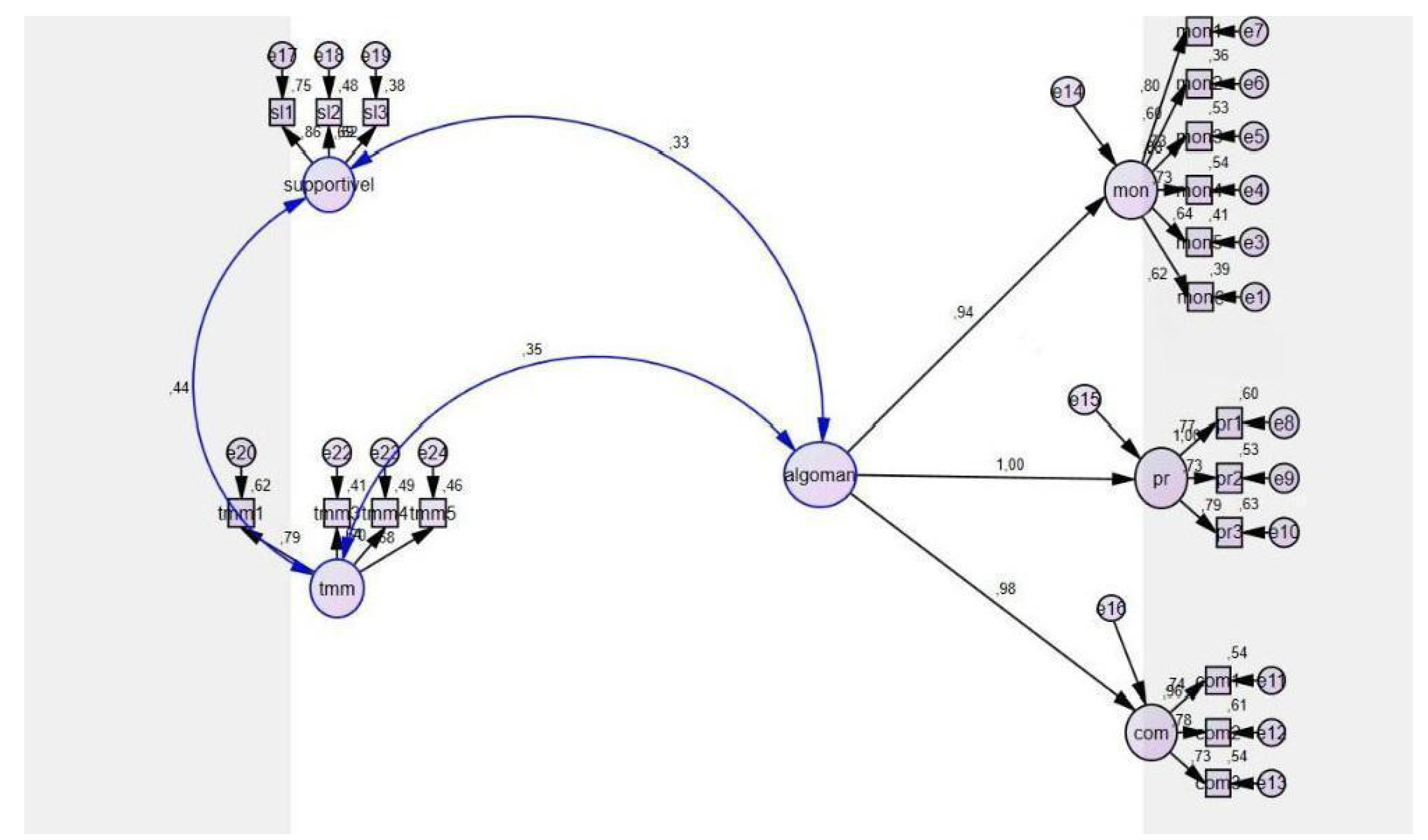

Table 1.
Sample Characteristics.
| Variable | Category | n (%) |
|---|---|---|
| Team size (number of members) | 4 | 50 (69.4%) |
| 5 | 13 (18.1%) | |
| 6 | 6 (8.3%) | |
| 7 | 2 (2.8%) | |
| 9 | 1 (1.4%) | |
| Total | 72 (100.0%) | |
| Experience | Less than 1 year | 11 (3.4%) |
| 1–3 years | 88 (27.2%) | |
| 4–7 years | 173 (53.4%) | |
| More than 7 years | 52 (16.0%) | |
| Total | 324 (100.0%) | |
| Education | Bachelor’s degree | 227 (70.1%) |
| Master’s degree | 82 (25.3%) | |
| PhD | 15 (4.6%) | |
| Total | 324 (100.0%) | |
| Gender | Male | 198 (61.1%) |
| Female | 126 (38.9%) | |
| Total | 324 (100.0%) | |
| Age | Less than 26 | 15 (4.6%) |
| 26–33 | 158 (48.8%) | |
| 34–39 | 134 (41.4%) | |
| 40 and above | 17 (5.2%) | |
| Total | 324 (100.0%) |
Table 2.
Reliability and Validity.
| Constructs | Items | Factor Loading | CR | AVE | |
|---|---|---|---|---|---|
| Algorithmic management (higher-order) | Monitoring | 0.939 | 0.981 | 0.946 | 0.920 |
| Compensation | 0.979 | ||||
| Performance rating | 0.999 | ||||
| Monitoring | mon1 | 0.802 | 0.844 | 0.478 | 0.839 |
| mon2 | 0.597 | ||||
| mon3 | 0.731 | ||||
| mon4 | 0.733 | ||||
| mon5 | 0.636 | ||||
| mon6 | 0.624 | ||||
| Compensation | com1 | 0.736 | 0.794 | 0.562 | 0.792 |
| com2 | 0.780 | ||||
| com3 | 0.732 | ||||
| Performance rating | pr1 | 0.772 | 0.809 | 0.585 | 0.806 |
| pr2 | 0.728 | ||||
| pr3 | 0.793 | ||||
| Supportive leadership | sl1 | 0.864 | 0.773 | 0.537 | 0.750 |
| sl2 | 0.693 | ||||
| sl3 | 0.619 | ||||
| Team mental models | tmm1 | 0.786 | 0.795 | 0.494 | 0.794 |
| tmm3 | 0.642 | ||||
| tmm4 | 0.700 | ||||
| tmm5 | 0.676 |
Table 3.
Descriptive Statistics, Correlation Matrix and Discriminant Validity.
| Mean | SD | 1 | 2 | 3 | |
|---|---|---|---|---|---|
| Algorithmic management | 4.691 | 0.372 | (0.973) | ||
| Supportive leadership | 4.866 | 0.287 | 0.334 *** | (0.733) | |
| Team mental models | 4.772 | 0.344 | 0.353 *** | 0.442 *** | (0.703) |
Table 4.
Heterotrait–Monotrait Ratio (HTMT).
| Constructs | 1 | 2 | 3 |
|---|---|---|---|
| 1. Algorithmic management | |||
| 2. Supportive leadership | 0.347 | ||
| 3. Team mental models | 0.341 | 0.462 |
Table 5.
Within-Team Agreement and Between-Team Reliability.
| Construct | J | N | r_wg | ICC(1) | ICC(2) |
|---|---|---|---|---|---|
| Algorithmic management | 72 | 324 | 0.72 | 0.037 | 0.144 |
| Supportive leadership | 72 | 324 | 0.84 | -0.001 | -0.006 |
| Team mental models | 72 | 324 | 0.69 | 0.042 | 0.161 |
Table 6.
Path Results.
| Hypothesis | Path | Outcome model | p | |
|---|---|---|---|---|
| Panel A. Models 1–3 | ||||
| H1 | AM → TP | Model 1: TP–SI | -0.270* | 0.018 |
| H2 | AM → TMMs | Model 1: TP–SI | 0.352** | |
| H3 | AM × SL → TMMs | Model 1: TP–SI | -0.305** | |
| H4 | TMMs → TP | Model 1: TP–SI | -0.064 | 0.574 |
| H1 | AM → TP | Model 2: TP–SFR | -0.265* | 0.020 |
| H2 | AM → TMMs | Model 2: TP–SFR | 0.352** | |
| H3 | AM × SL → TMMs | Model 2: TP–SFR | -0.305** | |
| H4 | TMMs → TP | Model 2: TP–SFR | -0.073 | 0.525 |
| H1 | AM → TP | Model 3: TP–TBT | -0.250* | 0.030 |
| H2 | AM → TMMs | Model 3: TP–TBT | 0.352** | |
| H3 | AM × SL → TMMs | Model 3: TP–TBT | -0.305** | |
| H4 | TMMs → TP | Model 3: TP–TBT | -0.060 | 0.604 |
| Panel B. Models 4–6 | ||||
| H1 | AM → TP | Model 4: TP–SRT | -0.262* | 0.022 |
| H2 | AM → TMMs | Model 4: TP–SRT | 0.352** | |
| H3 | AM × SL → TMMs | Model 4: TP–SRT | -0.305** | |
| H4 | TMMs → TP | Model 4: TP–SRT | -0.063 | 0.582 |
| H1 | AM → TP | Model 5: TP–TS | -0.223 | 0.055 |
| H2 | AM → TMMs | Model 5: TP–TS | 0.352** | |
| H3 | AM × SL → TMMs | Model 5: TP–TS | -0.305** | |
| H4 | TMMs → TP | Model 5: TP–TS | -0.050 | 0.664 |
| H1 | AM → TP | Model 6: TP–FCP | 0.042 | 0.726 |
| H2 | AM → TMMs | Model 6: TP–FCP | 0.352** | |
| H3 | AM × SL → TMMs | Model 6: TP–FCP | -0.305** | |
| H4 | TMMs → TP | Model 6: TP–FCP | -0.076 | 0.521 |
* p < 0.05, ** p < 0.01. AM = algorithmic management; TP = team performance; TMMs = team mental models; SL = supportive leadership; SI = Speed Index; SFR = Service Failure Ratio; TBT = Total Blocking Time; SRT = Service Response Time; TS = Total Size; FCP = First Contentful Paint.
Table 7.
Mediation Results.
| Outcome | Total effect | Direct effect | Indirect effect | Boot LLCI | Boot ULCI | Decision |
|---|---|---|---|---|---|---|
| Speed Index | -0.292 | -0.270 | -0.023 | -0.10 | +0.06 | Not supported |
| Service Failure Ratio | -0.291 | -0.265 | -0.026 | -0.11 | +0.05 | Not supported |
| Total Blocking Time | -0.271 | -0.250 | -0.021 | -0.09 | +0.05 | Not supported |
| Service Response Time | -0.285 | -0.262 | -0.022 | -0.10 | +0.06 | Not supported |
| Total Size | -0.240 | -0.223 | -0.018 | -0.09 | +0.07 | Not supported |
| First Contentful Paint | 0.015 | 0.042 | -0.027 | -0.11 | +0.06 | Not supported |
Disclaimer/Publisher’s Note: The statements, opinions and data contained in all publications are solely those of the individual author(s) and contributor(s) and not of MDPI and/or the editor(s). MDPI and/or the editor(s) disclaim responsibility for any injury to people or property resulting from any ideas, methods, instructions or products referred to in the content. |
© 2026 by the authors. Licensee MDPI, Basel, Switzerland. This article is an open access article distributed under the terms and conditions of the Creative Commons Attribution (CC BY) license (http://creativecommons.org/licenses/by/4.0/).
Copyright: This open access article is published under a Creative Commons CC BY 4.0 license, which permit the free download, distribution, and reuse, provided that the author and preprint are cited in any reuse.