

Submitted:
21 September 2026
Posted:
22 September 2026
You are already at the latest version
Abstract
This study proposes an Enhanced Grey Wolf Optimizer (EGWO) to improve the accuracy and interpretability of Decision Tree (DT) models for healthcare prediction. Traditional DTs are transparent but often suboptimal due to greedy splitting, while standard metaheuristics may struggle with convergence and imbalance. To address this, EGWO introduces three key modifications: removal of the δ-wolf layer, fuzzy logic–based adaptive control of the parameter a, and the use of hybrid membership functions to guide smoother search behavior. The framework compares GA, ACO, PSO, GWO and the proposed EGWO for optimizing DT structure. Further hyperparameter optimization was performed using a unified preprocessing pipeline and 5-fold cross-validation. Macro F1-score is used as the fitness metric due to its robustness on imbalanced medical data. Experimental results show that EGWO-optimized DTs achieve higher predictive performance making them suitable for reliable and interpretable clinical decision-support applications.
Keywords:
Grey Wolf Optimization
; decision trees
; swarm intelligence
; fuzzy logic
; F1 score
1. Introduction
In recent years, the integration of artificial intelligence (AI) and machine learning (ML) into healthcare has transformed the landscape of medical diagnosis and clinical decision support. Predictive modeling has enabled healthcare systems to identify at-risk patients early, optimize treatment pathways and support doctors in making informed, data-driven decisions. Among the various machine learning models, Decision Trees (DTs) have emerged as one of the most interpretable and transparent classifiers, making them especially suitable for healthcare applications where explainability and trustworthiness are essential (Bansal, Goyal, & Choudhary, 2022; Mingers, 1989).
Decision Trees possess several properties that make them well-suited to clinical data. They mimic human reasoning by creating a hierarchy of if–then rules, allowing medical professionals to understand the decision-making process without requiring a deep mathematical background (Kim & Koehler, 1995). Furthermore, DTs naturally handle both numerical and categorical variables, can accommodate missing values to some extent, and are relatively robust to outliers(Hernández, Monroy, Medina-Pérez, Loyola-González, & Herrera, 2021). Their interpretability, low computational cost, and ease of visualization distinguish them from more complex “black box” models like deep neural networks, which, despite their predictive strength, often lack transparency and trust in sensitive domains such as healthcare.
The performance of DTs depends heavily on their hyperparameters, particularly the maximum depth, minimum samples per split, minimum samples per leaf, and maximum features considered at each node. Suboptimal choices for these parameters can lead to underfitting or overfitting, thereby compromising generalization on data. Traditional hyperparameter optimization methods such as grid search or random search are computationally expensive and may fail to capture complex nonlinear dependencies among parameters (Hernández et al., 2021). Consequently, research has turned toward nature-inspired metaheuristic algorithms, which can efficiently explore high-dimensional search spaces and find near-optimal configurations.
Among the most widely used metaheuristic techniques are Genetic Algorithms (GA), Ant Colony Optimization (ACO), Particle Swarm Optimization (PSO), and Grey Wolf Optimizer (GWO). These algorithms simulate various forms of collective or evolutionary intelligence observed in nature, genetic evolution in populations, ants seeking food, flocks of birds navigating, or wolves hunting prey, to iteratively converge toward optimal solutions (M. Almufti, Ahmad Shaban, Arif Ali, Ismael Ali, & A. Dela Fuente, 2023). Each technique offers unique advantages: GA employs crossover and mutation operations inspired by natural selection to maintain diversity and explore complex search spaces(Mathew, 1993); ACO’s positive feedback mechanism effectively balances exploration and exploitation(Blum, 2005), PSO’s velocity-based movement enables fast convergence toward promising regions(Kennedy, Eberhart, & gov, 1995) and GWO’s leadership hierarchy introduces dynamic coordination among search agents (Mirjalili, Mirjalili, & Lewis, 2014). Yet, despite these strengths, the GWO algorithm has attracted particular attention in recent years due to its simplicity, few control parameters, and strong balance between exploration and exploitation (Negi, Kumar, Pant, & Ram, 2021).
In this study, Decision Trees are optimized using these three swarm-based algorithms, GA, ACO, PSO, and GWO across multiple healthcare datasets representing diverse clinical domains, including sepsis, diabetes, heart disease, cancer, and burn injury. These datasets capture varying data distributions, sample sizes, and feature complexities, thus allowing for a comprehensive evaluation of each optimization approach. The primary goal is to identify which swarm algorithm most effectively tunes the Decision Tree’s hyperparameters to achieve high predictive performance while maintaining interpretability.
Extensive experimental analysis revealed that GWO consistently outperformed GA, ACO and PSO across all datasets in terms of accuracy, precision, recall and F1-score, indicating its superior ability to balance global and local search behaviors. However, despite these promising results, standard GWO still exhibited limitations. Specifically, as iterations progressed, the control parameter ‘a’ (which governs the transition from exploration to exploitation) decreased linearly, potentially leading to premature convergence and reduced diversity among solutions. This behavior can cause the algorithm to become trapped in local optima, especially when dealing with complex, nonlinear healthcare data.
To address these challenges, the current work introduces an Enhanced Grey Wolf Optimizer (EGWO) that integrates fuzzy logic-based parameter control and hierarchical modification of the leadership structure. The enhancements were designed to improve adaptability, prevent stagnation, and yield more consistent optimization outcomes across datasets.
2. Background Knowledge
Background Knowledge includes the usage of standard algorithms to optimize DTs, to compare with GWO (Grey Wolf Optimizer), and its enhanced version, so that this study can be considered generalizable.
2.1. Genetic Algorithm (GA)
GA is inspired by the concept of evolution in which a population of initial solutions evolves towards better solutions. In each generation fitness of solutions is evaluated, some parent selection scheme is used to choose the best solutions. Next crossover and mutation operators are applied with some probability to generate new offsprings. By survival of fittest mechanism, the best solutions are selected. GA’s stochastic nature allows it to explore diverse regions of the search space, reducing the chance of getting trapped in local optima. Its simplicity and adaptability make it a widely used technique for solving complex optimization problems across various domains (Mathew, 1993). Table 1 depicts the pseudocode of basic Genetic Algorithm.
2.2. Ant Colony Optimization (ACO)
ACO, as depicted in Table 2, is inspired by the ant foraging behavior where artificial ants search for a food source. The method of communication between ants is a substance called pheromone. Once the food source is found, more pheromone is deposited on the path. Over time, shorter and more efficient paths accumulate higher pheromone levels, guiding subsequent ants toward optimal solutions. This positive feedback mechanism enables ACO to effectively explore the search space and converge toward high-quality solutions in combinatorial optimization problems (Blum, 2005).
2.3. Particle Swarm Optimization (PSO)
PSO is inspired by the social behavior of birds flocking. Each solution, known as a particle, maintains its best position achieved so far as the local best and updates its velocity and position with respect to the global best position. Table 3 depicts the pseudocode of basic PSO. Through this cooperative mechanism, particles balance exploration and exploitation, gradually converging toward promising regions of the search space. This simplicity and collective intelligence make PSO highly effective for continuous and nonlinear optimization problems (Kennedy et al., 1995.).
2.4. Grey Wolf Optimizer (GWO)
GWO is a grey-wolves–inspired algorithm divided into alpha (best solution), beta (second best), gamma (third best), and the rest (delta wolves). The search process is driven mainly by the top three wolves to guide the remaining wolves toward promising solutions. Table 4 depicts the pseudocode of basic GWO. By mimicking the natural hunting strategy, encircling, chasing, and attacking prey, GWO effectively balances exploration and exploitation. This hierarchical leadership structure allows the algorithm to converge efficiently while maintaining robustness across diverse optimization problems (Mirjalili et al., 2014). The position update mechanism of GWO is mathematically modeled as follows:
where t indicates the current iteration, X p is position vector of prey, and X is position vector of a grey wolf, A and C are coefficient vectors calculated as follows.
where components of a are linearly decreased from 2 to 0 and r 1, r 2 are random vectors in [0,1][0, 1][0,1].
D = C ⋅ X p (t)− X (t)……………... Equation (2.1)
X (t+1) = X p(t)−A ⋅D………………. Equation (2.2)
A =2a ⋅r 1−a ………………………………….Equation (2.3)
C =2⋅r 2………………………………………Equation (2.4)
2.5. Fuzzy Logic
Fuzzy Logic is a computational approach based on the concept of partial truth, where values can range between completely true and false. Unlike classical Boolean logic, which operates on crisp boundaries, fuzzy logic allows reasoning with uncertainty, imprecision, and vagueness, characteristics commonly found in real-world decision-making problems. It uses linguistic variables, membership functions, and inference rules to model complex relationships that cannot be easily captured through strict numerical thresholds. This flexibility enables smoother transitions between classes and more human-like interpretation of data. Due to its ability to handle noisy, ambiguous, or overlapping information, fuzzy logic is widely integrated with optimization algorithms and machine learning models to enhance their robustness and interpretability (L.A. Zadeh, 1988).
When combined with metaheuristic algorithms like GWO, fuzzy logic enhances the search process by introducing adaptive and context-aware decision-making. In standard GWO, parameters such as leadership influence and step size are updated using fixed mathematical rules, which may limit performance in dynamic or noisy environments. Fuzzy logic overcomes this limitation by adjusting these parameters based on the current state of the search, using linguistic rules and membership functions. This allows the algorithm to balance exploration and exploitation more effectively, exploring widely when uncertainty is high and converging more aggressively when promising solutions are found. As a result, the Fuzzy-GWO hybrid becomes more stable, less sensitive to local optima, and better suited for complex optimization tasks (Rodríguez et al., 2017).
3. Literature Review
This literature review follows a systematic methodology to identify key studies published between 2017 and 2025 on axis-parallel and interpretable decision tree construction, optimization, and the use of metaheuristics, particularly Grey Wolf Optimization (GWO), in decision tree induction. Although systematic in its selection process, a narrative synthesis is used to qualitatively compare findings, limitations, and thematic trends across studies. Thirteen papers were ultimately selected based on inclusion criteria Figure 1 illustrates the number of papers selected in each year. Sources were primarily retrieved from Google Scholar, supplemented by IEEE Xplore, SpringerLink, and ScienceDirect. Search queries combined targeted keywords such as “grey wolf optimizer decision tree, and “metaheuristic interpretable models,” with filters applied for peer-reviewed English-language publications within the 2017–2024 range. The review highlights a consistent shift toward hybrid and multi-objective optimization techniques aimed at improving both accuracy and model interpretability. Several studies emphasize reducing tree depth and complexity while maintaining or enhancing predictive performance. Emerging trends also show increased use of impurity-based fitness functions and adaptive optimization strategies within GWO variants. Overall, the selected literature reflects a growing focus on transparent, high-performance decision tree models suitable for sensitive domains.
Having established review methodology, this section now presents a detailed analysis of the most relevant research papers selected. Each paper is discussed individually with a focus on its core contributions, methodology, results, and relevance to the current research. Particular attention is given to the strengths and limitations of each work, especially in terms of decision tree construction, multi-objective optimization, interpretability, and the application of metaheuristic algorithms such as Grey Wolf Optimization. This comprehensive evaluation helps to uncover recurring challenges, innovations, and research gaps that lay the foundation for the proposed thesis. Table 5 provides a structured overview of the reviewed literature, organized chronologically from 2017 to 2025 to illustrate the progression of research in this domain.
(Rodríguez et al., 2017) investigate an important modification to the Grey Wolf Optimizer (GWO) by introducing a fuzzy hierarchical operator that directly enhances the algorithm’s core inspiration ,the social pyramid and hunting strategy of grey wolves. The study proposes five hierarchical variants, including centroid-based, weighted, fitness-driven, and two fuzzy logic–based formulations, each designed to refine the interaction and leadership dynamics within the wolf pack during the optimization process. Through extensive benchmarking across high-dimensional test functions (30, 64, and 128 dimensions), the authors demonstrate that the fuzzy variants of the hierarchical operator consistently yield superior optimization performance compared to both the standard GWO and the non-fuzzy variants. Their findings emphasize the value of incorporating fuzzy reasoning to enrich GWO’s exploration–exploitation balance and improve global convergence. Although the work does not focus on decision tree induction specifically, it contributes meaningful insights into enhancing metaheuristic behavior through hierarchical and fuzzy mechanisms ,an approach highly relevant for hybrid or improved variants of GWO used in tasks such as decision tree optimization.
(G. & K., 2019) develop a diabetes diagnosis model that integrates fuzzy rule–based inference with the Grey Wolf Optimizer (GWO) to enhance predictive accuracy on the PIMA Indian Diabetes Dataset. Their approach leverages the hierarchical leadership structure of GWO ,α, β, and δ wolves ,to optimize fuzzy rules globally, overcoming limitations of earlier methods such as ACO–fuzzy hybrids that were restricted to local feature optimization and achieved comparatively lower accuracy. By embedding fuzzy reasoning within the GWO search process, the proposed model adaptively refines rule sets, enabling more precise classification of diabetic and non-diabetic cases. The authors report that this hybrid GWO–fuzzy system significantly outperforms the ACO baseline, demonstrating improved accuracy and stronger predictive reliability. While the study is domain-specific to medical diagnosis, it underscores the value of combining fuzzy systems with metaheuristic optimization and illustrates GWO’s effectiveness in feature and rule optimization tasks ,insights that are directly relevant to the broader application of enhanced GWO variants in decision tree induction and other interpretability-focused classification models.
(Hafeez et al., 2021) introduces a robust classifier that combines decision tree induction with Tabu Search optimization to enhance performance and balance tree entropy. The model constructs multiple decision trees, with Tabu Search used to monitor and refine decision nodes. The proposed method achieved 98% accuracy and demonstrated strong performance compared to traditional and optimized classifiers, proving its suitability for large datasets. This work lays a foundation for integrating decision tree induction with combinatorial algorithms like Tabu Search for determining split criteria, paving the way for multi-objective optimization approaches.
(Hernández et al., 2021) explores decision tree induction with a focus on evaluation measures used for candidate splits in the C4.5 algorithm. The paper presents an experimental framework and evaluates 21 different measures across multiple datasets, ranking them based on performance. It provides the first performance rankings of C4.5 variants and introduces meta models that automatically select the most suitable group of evaluation measures for new datasets. Additionally, the paper explains the mechanism of decision tree induction in detail, including the process of identifying candidate splits, the splitting mechanism, and the criteria used to evaluate these splits, making this paper a good fit for explaining decision trees.
(Negi et al., 2021) provide a comprehensive review of the Grey Wolf Optimization (GWO) algorithm, tracing its biological inspiration, mathematical formulation, and evolution into a versatile optimization tool. The paper systematically explores the balance between exploration and exploitation that underpins GWO’s performance, discussing its original design as well as its diverse applications in fields such as engineering, medical diagnostics, power dispatch, and reliability optimization. The review categorizes advancements in GWO across areas like parameter tuning, feature selection, classification, and hybridization with other algorithms. Importantly, the authors emphasize critical limitations and future directions based on the No Free Lunch Theorem, suggesting that no single algorithm can solve all optimization problems universally. They highlight promising research avenues, including handling dynamic multi-objective problems, modifying the number of wolves per iteration, improving binary/discrete versions of GWO, and simplifying parameter dependencies. This paper serves as a strong theoretical foundation for understanding both the strengths and current gaps in GWO, reinforcing the need for structural improvements, such as those aimed at decision tree optimization in discrete search spaces, as pursued in the current thesis.
(Chakraborty et al., 2022) addressed the growing complexity of biomedical data by proposing a hybrid machine learning classification framework integrated with an Enhanced-Grey Wolf Optimization (E-GWO) algorithm for feature selection. The authors tackled the challenge of extracting diagnostically significant features from five diverse heart disease datasets by developing bagging and boosting-based classifiers such as Random Forest Bagging Technique (RFBT) and Gradient Boosting-Boosting Technique (GBBT). E-GWO, an improved version of the standard GWO, was employed to select optimal feature subsets, enhancing the model’s predictive performance. The experimental results revealed that RFBT achieved the highest classification accuracy of 99.26%, marking an 11.90% improvement over traditional models. This thesis underscores the power of E-GWO in biomedical feature selection and its compatibility with ensemble-based classifiers for achieving high diagnostic accuracy, offering strong evidence for its application in complex medical data scenarios.
(Dada et al., 2022) provides an in-depth survey of the Grey Wolf Optimization (GWO) algorithm, focusing on its evolution, practical applications, current challenges, and future directions. Inspired by the social and hunting behavior of grey wolves, GWO has gained popularity for solving nonlinear and complex optimization problems across various domains. The review highlights recent developments in GWO variants and underscores the algorithm’s flexibility and ease of adaptation. However, it also acknowledges the need for more robust and stable versions to tackle the limitations of existing models, especially in handling dynamic and high-dimensional problem spaces. The authors emphasize the potential of GWO in real-world applications and present valuable insights and suggestions for future research, making it a foundational guide for both new and seasoned researchers interested in nature-inspired optimization techniques.
(El-Shafiey et al., 2022)) introduce a hybrid feature selection framework, GAPSO-RF, which integrates Genetic Algorithm (GA) and Particle Swarm Optimization (PSO) for optimizing heart disease prediction using a Random Forest (RF) classifier. The model aims to improve diagnostic accuracy by identifying the most relevant features through a two-stage process: multivariate statistical analysis to initialize the population and a hybrid optimization loop combining global search via GA and local refinement using PSO. Notably, the framework implements a discriminate mutation strategy and a rehabilitation mechanism in PSO to reintroduce previously discarded individuals, improving diversity and convergence. Experimental evaluation on the Cleveland and Stat-log datasets shows classification accuracies of 95.6% and 91.4%, respectively, significantly outperforming conventional GA-based models and other state-of-the art approaches. Additionally, feature subset reduction of up to 46.15% further confirms its effectiveness. However, the model’s computational complexity is highlighted as a limitation, owing to its wrapper-based nature and longer training time. The authors suggest incorporating multi-objective GA, using surrogate datasets, and extending the model to ECG signal analysis as future directions. This work underscores the growing relevance of hybrid metaheuristics in healthcare applications and highlights potential extensions for interpretable models, such as optimized decision trees.
(Game et al., 2022) propose a comprehensive big data classification framework tailored for heart disease prediction in the healthcare domain, addressing the challenges posed by complex and high-volume medical datasets. The framework integrates multiple phases: data preprocessing using a MapReduce architecture, dimensionality reduction via Principal Component Analysis (PCA), intermediate classification using Support Vector Machines (SVM), and final classification through an optimized decision tree (DT). A key contribution of the paper is the introduction of a novel Divergence-based Grey Wolf Optimization (DGWO) algorithm, which is employed to enhance the data transformation process between SVM and the DT classifier. This transformation enables the generation of more effective decision rules, while DGWO optimizes the weight and structure of these rules. Experimental results demonstrate that the proposed DGWO-based pipeline outperforms traditional metaheuristics such as Firefly Algorithm, Artificial Bee Colony, Particle Swarm Optimization, Genetic Algorithm, and standard Grey Wolf Optimization in terms of classification accuracy. The study highlights the effectiveness of combining dimensionality reduction, ensemble learning, and evolutionary optimization for scalable and interpretable medical decision-making. However, the model’s complexity due to multi-stage processing could be a barrier for real-time deployment, and further work is needed to validate generalizability across different medical domains.
(Liu et al., 2024) presents a comprehensive review of the Grey Wolf Optimization (GWO) algorithm, highlighting its biological inspiration from the hunting and social hierarchy of grey wolves. The paper offers an extensive overview of GWO’s theoretical structure, its key phases, and its advantages such as ease of implementation, fast convergence, and strong performance across diverse optimization problems. The authors categorize the advancements in GWO into three major types: parallel, modified, and hybrid variants, shedding light on how each variation improves specific limitations of the original algorithm. The paper also surveys a wide range of application domains where GWO has been effectively applied, including computer science, energy, engineering, and materials science.
(Maleki et al., 2025) introduce a reinforcement learning–enhanced variant of the Grey Wolf Optimizer (GWO), addressing long-standing limitations in leadership-based metaheuristics such as leader stagnation, poor exploration, and premature convergence. Their proposed method, RL-LGWO, incorporates multi-agent reinforcement learning to adaptively adjust leader behaviors, allowing agents to share accumulated experience and dynamically refine the exploration–exploitation balance during the search. By decoupling and optimizing the leader update mechanism, the model enables wolf leaders to escape local optima more effectively and improves overall search robustness. Comprehensive evaluation across 23 classical benchmark functions and the CEC2022 suite shows that RL-LGWO outperforms state-of-the-art variants, including enhanced GWOs, RL-based GWO models, PSO, and WOA, achieving superior convergence speed, stability, and global optimization accuracy with only marginal runtime overhead. Although not focused on decision tree construction, the study demonstrates the strong potential of reinforcement learning as a strategic enhancement to leadership-driven metaheuristics, reinforcing its relevance for advanced hybrid GWO frameworks applied to complex combinatorial tasks such as decision tree induction.
(Priyadarshi et al., 2025) present a hybrid Grey Wolf Optimization–Fuzzy Logic Controller (GWO-FLC) framework designed to improve maximum power point tracking (MPPT) in photovoltaic (PV) water-pumping systems operating under highly variable environmental conditions. The study introduces a modified GWO variant that removes the lower-ranked δ and Ψ wolves, enabling a faster and more focused global search that accelerates convergence toward the global maximum power point (GMPP). This streamlined GWO not only enhances tracking speed but also performs soft tuning of fuzzy logic parameters, yielding zero oscillations around the GMPP even under rapid irradiance fluctuations and partial shading. Experimental validation using a dSPACE real-time platform demonstrates that the proposed GWO-FLC approach outperforms conventional GWO- and PSO-based MPPT methods in terms of tracking accuracy, convergence velocity, stability, and computational efficiency. The overall system ,implemented within a switched reluctance motor-driven PV water pump ,achieves reliable and cost-efficient operation without requiring voltage or current sensors. While the work is focused on power electronics and renewable energy control, its findings highlight how structural modifications to GWO and hybridization with fuzzy logic can significantly enhance optimization performance, supporting the broader applicability of such enhanced variants in complex decision-making tasks, including decision tree optimization.
(Sam’an et al., 2025) proposed an enhanced decision tree model for diabetes classification using a modified Grey Wolf Optimization (MGWO) algorithm. Recognizing the limitations of standard decision trees, the authors introduced hyperparameter tuning via GWO to improve performance. To overcome GWO’s limited exploration capacity, they integrated the Levy distribution to allow more dynamic wolf movements, preventing premature convergence. The modified version (MGWO) showed superior fitness and accuracy compared to both the standard GWO and Genetic Algorithm (GA), with a fitness value of 0.8498. Their findings suggest MGWO’s promising potential for classification tasks, while recommending further work on understanding how varying the wolf population affects performance. This paper demonstrates GWO’s applicability in tuning classification models and supports its use in decision-tree-based optimization, making it relevant to studies aiming to refine tree construction via swarm intelligence.
3.1. Core Limitations
3.1.1. Generalization and Reproducibility Challenges
A recurring limitation across many recent studies (e.g., (Chakraborty et al., 2022; Moor, Rieck, Horn, Jutzeler, & Borgwardt, 2021; Sam’an et al., 2025; Zhou, Shao, Wang, & Wang, 2024)) is the lack of external validation and reproducibility. Most models are evaluated on a single dataset, commonly heart disease or diabetes, making their generalizability to other domains questionable. Additionally, source code and datasets are rarely made publicly available, hindering replication, benchmarking, and practical deployment. This restricts the broader applicability of advanced metaheuristic variants such as MGWO or DGWO in clinical environments where data diversity is significant.
3.1.2. Interpretability vs. Complexity Trade-Off
Several studies employ multi-stage hybrid or ensemble frameworks (e.g., (Chakraborty et al., 2022; El-Shafiey et al., 2022; Game et al., 2022)) that combine PCA, SVMs, and optimized decision trees. Although these approaches often improve accuracy, they increase computational complexity and reduce interpretability, two critical drawbacks for real-time clinical settings such as ICUs. The interpretability concerns are amplified in medical domains, where transparent reasoning is essential yet seldom addressed unless additional layers like SHAP are applied (e.g., (Zhou et al., 2024)).
3.1.3. Algorithmic Rigidity and Theoretical Gaps
Theoretical analyses ((Besser & Poloczek, 2017; Dada et al., 2022; Negi et al., 2021)) highlight structural limitations in greedy and swarm-based algorithms, including premature convergence, poor exploration–exploitation balance, and rigid parameter schedules. While newer variants such as MGWO and GAPSO attempt to address these issues, many lack strong multi-objective capabilities or adaptability to discrete search spaces like those required in decision tree induction. Furthermore, comparative studies across different metaheuristics remain limited, with most research focusing on isolated algorithmic improvements rather than comprehensive benchmarking.
3.2. Research Gap
Traditional decision tree algorithms such as ID3, C4.5, and CART follow greedy, top-down strategies that optimize local split criteria like information gain or Gini index. Although these methods are interpretable and easy to train, they often suffer from overfitting, lack of global optimality, and poor trade-offs between accuracy and structural simplicity. Existing pruning and regularization strategies help mitigate these issues but do not fundamentally address the need for globally optimized and interpretable trees, particularly in high-stakes domains such as healthcare.
While metaheuristic optimization methods such as Genetic Algorithms (GA), Particle Swarm Optimization (PSO), and Grey Wolf Optimization (GWO) have shown potential in global search tasks, their application in decision tree learning has been mostly limited to hyperparameter tuning or feature selection. Very few studies integrate metaheuristics directly into the core decision tree induction process, especially for constructing axis-parallel trees that simultaneously optimize accuracy and model complexity.
A critical gap exists in the direct use of GWO for building multi-objective, axis-parallel decision trees, where objectives such as minimizing depth, reducing node count, and maximizing classification accuracy are optimized jointly. Existing GWO-based models generally focus on accuracy alone, overlook interpretability constraints, or use ensemble methods that compromise transparency. Further, comparative evidence against other swarm-based and classical optimization methods remains limited, making it difficult to assess GWO’s relative advantages.
This thesis addresses this gap by developing a GWO-driven framework for constructing globally optimized, axis-parallel, multi-objective decision trees, explicitly balancing accuracy and simplicity. The aim is to produce interpretable and clinically meaningful models suited for real-world decision-making, where clarity and trust are as important as predictive performance.
3.3. Novelty
In standard GWO, the convergence parameter ‘a’ linearly decreases from 2 to 0 throughout iterations. Although simple, this linear schedule does not reflect the dynamic and uncertain nature of the optimization landscape. In real-world optimization, especially with medical data, the trade-off between exploration and exploitation is rarely linear. Therefore, to adaptively control a based on the search progress, fuzzy logic was introduced (Rodríguez et al., 2017). Two key indicators were selected to define the fuzzy inference system:
- Iteration Ratio: representing how far the algorithm has progressed (early vs. late phase)
- Population Diversity: measuring how different the wolves’ positions are, reflecting exploration capacity
These indicators were fuzzified using different membership functions (MFs), including triangular, trapezoidal, gaussian and generalized bell-shaped functions. Triangular MFs were initially chosen for their simplicity and computational efficiency, as they effectively approximate uncertainty with minimal parameters. Later, a hybrid fuzzy system combining triangular and trapezoidal MFs was developed, offering smoother transitions and better adaptive control over ‘a’. This hybrid structure allowed the algorithm to flexibly adjust its search intensity in response to the optimization state, thus achieving better exploration in early iterations and stronger exploitation later.
A second enhancement involved simplifying the leadership hierarchy of the GWO. Traditionally, GWO updates wolves’ positions based on the three best solutions, α (leader), β (second best), and δ (third best), the remaining wolves follow this triad. However, empirical analysis revealed that the inclusion of the δ wolf sometimes caused redundant or conflicting guidance, particularly in low-dimensional search spaces such as the four hyperparameters of the Decision Tree. Consequently, the δ layer was removed in the enhanced version, allowing a more streamlined update mechanism guided primarily by the α and β wolves. This simplification reduced computational redundancy and improved convergence stability without sacrificing solution diversity.
The primary objectives of this study are fourfold. First, the research aims to evaluate the effectiveness of metaheuristic-driven Decision Tree optimization using ACO, PSO, and GWO across five heterogeneous healthcare datasets. Second, an Enhanced Grey Wolf Optimizer (EGWO) is developed by integrating fuzzy adaptation mechanisms and a simplified hierarchical structure to achieve more robust and adaptive search behavior. Third, the study investigates the influence of different fuzzy membership functions—specifically triangular, trapezoidal, and hybrid configurations—on both the convergence dynamics and classification performance of the optimizer. Finally, the proposed EGWO-DT model is systematically compared against the baseline GWO-DT and conventional Decision Tree models using a comprehensive set of evaluation metrics, including accuracy, precision, recall, and F1-score, to establish its overall performance advantages.
The novelty of this work lies in the combination of fuzzy logic and hierarchical modification within the GWO framework, applied to Decision Tree optimization in healthcare. Unlike traditional fixed-parameter approaches, the proposed fuzzy-controlled GWO dynamically adapts to the search environment, improving exploration–exploitation balance and preventing stagnation. Furthermore, by validating results across multiple healthcare datasets, the study demonstrates the generalizability and robustness of the enhanced model.
The comparison in Table 6 highlights that existing GWO-based studies address only a subset of the requirements needed for interpretable medical classification. Earlier work such as (G. & K., 2019) applied GWO with fuzzy rules on diabetes data but did not incorporate dimensionality reduction (D) or multi-objective optimization (M). D-GWO by (Game et al., 2022) introduced feature reduction but focused solely on accuracy, lacking multi-objective design. Similarly, the E-GWO model by (Chakraborty et al., 2022) improved performance but was restricted to non-interpretable ensemble models. More recent work, such as (Sam’an et al., 2025), applied modified GWO on medical datasets and achieved partial multi-objective behavior, yet still did not optimize decision tree structure or interpretability. In contrast, the proposed Enhanced GWO–DT simultaneously performs dimensionality reduction and full multi-objective optimization across five healthcare datasets.
4. Methodology
4.1. Experimental Methodology
Experimental Methodology is explained below in steps as per Figure 2.
Step 1: Dataset Acquisition
The process begins with collecting the dataset corresponding to each clinical problem (Burns, Cancer, Diabetes, Sepsis, and Heart Attack). Each dataset serves as the foundation for model building and optimization.
Step 2: Initialization of Candidate Solutions
Once the dataset is loaded, an initial population of candidate solutions is generated.
Each candidate represents a possible configuration of Decision Tree hyperparameters encoded as a position vector (e.g., max_depth, min_samples_split, min_samples_leaf, max_features). These candidate solutions form the starting point for all metaheuristic algorithms.
Step 3: Data Preprocessing
Before optimization begins, the dataset undergoes systematic preprocessing. As shown in the diagram, this includes:
- One-hot encoding of categorical variables,
- Normalization and feature scaling of continuous features to ensure uniformity,
- Generation of stratified train–test folds to ensure consistent evaluation across iterations.
This preprocessing step ensures that the learning algorithm receives clean, standardized, and balanced inputs.
Step 4: Iterative Optimization Loop
A central component of the methodology is the loop that continues “while stopping criteria are not met.”
The stopping criterion may consist of reaching the maximum number of iterations, convergence in fitness value, or stagnation of candidate solutions, within each iteration:
Step 5: Hyperparameter Extraction
Each candidate solution provides a unique set of Decision Tree hyperparameters. These parameters define how the Decision Tree will be built during that iteration.
Step 6: Build Decision Tree for Each Algorithm
Using the hyperparameters of the current candidate solution, a Decision Tree model is constructed.
This model is evaluated by the chosen optimization algorithm (e.g., PSO, ACO, GA, GWO, Enhanced GWO).
Each algorithm interacts with the model through its specific search and update equations.
Step 7: Performance Evaluation
The constructed Decision Tree is evaluated using standard classification metrics, such as accuracy, Precision F1 and Recall. These metrics act as the fitness score for the candidate solution, guiding the search toward better-performing hyperparameters.
Step 8: Update Candidate Solutions
Based on the fitness scores:
- PSO updates velocity and position using swarm intelligence,
- ACO updates pheromone trails,
- GA applies selection, crossover, and mutation,
- GWO updates positions using the leadership hierarchy (α, β, δ),
- Enhanced GWO updates positions using only α, β as leaders and adapted fuzzy logic based control parameters.
These updates refine the candidate solutions and push the population toward optimal areas of the search space.
Step 9: Return the Best Decision Tree
Once the stopping condition is reached, the best-performing hyperparameter set across all iterations is selected. The corresponding Decision Tree becomes the final optimized model.
Step 10: Final Prediction
Finally, the optimized Decision Tree is used to make predictions on the test set. The evaluation metrics derived from this final prediction constitute the reported performance results.
4.2. Decision Tree Search Space
In this study, each grey wolf represents a candidate Decision Tree configuration, encoded as a four-dimensional continuous position vector. Each dimension corresponds to a specific hyperparameter of the Decision Tree. The search space is defined as follows:
- position [0] → max_depth: an integer controlling the maximum depth of the tree, bounded between 1 and 20.
- position [1] → min_samples_split: the minimum number of samples required to split an internal node, represented as an integer in the range 2 to 50.
- position [2] → min_samples_leaf: the minimum samples required in a leaf node, encoded as an integer between 1 and 20.
- position [3] → max_features: the fraction of features considered at each split, represented as a continuous value between 0.1 and 1.0.
This mapping ensures that each candidate solution produced by the Grey Wolf Optimizer corresponds to a valid and interpretable Decision Tree. During optimization, the continuous positions are scaled and discretized into these predefined ranges, allowing the GWO algorithm to efficiently explore the hyperparameter space while maintaining compatibility with Decision Tree implementation.
4.3. Fitness Function
The fitness of each candidate decision tree is evaluated using the Macro F1-score, computed as the unweighted mean of class-wise F1-scores. Macro F1 is chosen because it provides a balanced measure of performance across both classes, regardless of class imbalance. In health-related datasets such as sepsis, burns, or cardiac conditions, minority-class performance is especially important; Macro F1 ensures that the optimizer does not overfit to the majority class, as accuracy often does.
Using Macro F1 as the optimization objective encourages the search process to generate decision trees that maintain high sensitivity and specificity simultaneously while avoiding biased splits. This makes Macro F1 a robust and clinically meaningful metric for guiding the metaheuristic search toward producing interpretable, yet effective diagnostic models as used by other healthcare related studies with class imbalance problem (Mortaz, 2020).
4.4. Enhanced Grey Wolf Optimizer (EGWO)
The Enhanced Grey Wolf Optimizer (EGWO) extends the standard GWO framework by addressing three key limitations: premature convergence, insufficient diversity maintenance, and the restrictive linear decay of the control parameter a. The first modification simplifies the leadership hierarchy by removing the δ-wolf layer, retaining only the α, β, and γ wolves. This adjustment reduces redundancy in the leadership mechanism and concentrates on the exploitation dynamics around the top three solutions.
The second and principal enhancement introduces a fuzzy logic–based adaptive control mechanism for the parameter a. Instead of relying on the classical linear reduction from 2 to 0, a is dynamically tuned using a hybrid fuzzy inference system that incorporates two real-time indicators of the optimization process:
- Iteration Ratio modelled using triangular membership functions, providing a smooth and interpretable representation of early, mid, and late search phases.
- Population Diversity modelled using trapezoidal membership functions, enabling wider and more flexible representation of low, medium, and high diversity states.
These fuzzy inputs are combined using a rule base that adaptively adjusts a. The output of the system is a smooth, non-linear, context-aware value of a, allowing EGWO to automatically shift between exploration and exploitation. High diversity and early iterations drive a upward promoting global search, whereas low diversity or later iterations push a downward for intensified local search, having 2 key factors:
(1) a is generated via fuzzy inference
(2) the wolf hierarchy excludes the δ layer
In the first module as shown in Table 7, the Enhanced Grey Wolf Optimizer (EGWO) converts two continuous signals, iteration_ratio and population diversity, into linguistic fuzzy values. To model their behavior, EGWO employs triangular membership functions for iteration_ratio (low, medium, high), since the progression of iterations follows a smooth, single-peak pattern that triangular MFs capture effectively. In contrast, population diversity is represented using trapezoidal membership functions (low, medium, high), which better accommodate fluctuations at the boundaries caused by sudden contractions or expansions of the swarm. These two fuzzified variables express the algorithm’s contextual state, forming the basis for adaptive control of the exploration–exploitation balance.
In Module 2 as shown in Table 8, the fuzzified inputs from Module 1 are combined using a set of heuristic rules that map the current search state to an appropriate exploration intensity. These rules define how the optimizer should behave under different circumstances—for instance, stronger exploration is encouraged when the algorithm is in early iterations and population diversity is high, while weaker exploration is favored when the search progresses and diversity decreases. Each rule contributes a linguistic output (e.g., strong, moderate, weak exploration weight), and their combined influence forms a contextual decision on how aggressively the algorithm should search the space. This rule-based reasoning gives E-GWO the ability to adjust its search mode automatically and intuitively, enabling highly adaptive behavior that cannot be achieved using fixed or linear decay schedules. This rule base allows the optimizer to reason about the search landscape, enabling smooth, human-interpretable transitions between exploration and exploitation.
The final module shown in Table 9 aggregates the fuzzy outputs produced by the rule base and converts them into a single crisp value using centroid defuzzification. This value, referred to as , serves as the adaptive control parameter governing the strength of the search pressure in the positional update equations. Unlike the standard GWO parameter , which decreases linearly regardless of search conditions, is non-linear, smooth, and context-sensitive. It adjusts automatically based on the evolving fitness landscape: it increases when exploration is needed and decreases when exploitation should dominate. By producing a continuous and environment-aware value of , Module 3 allows the optimizer to transition between global and local search strategies in a controlled and responsive manner. nlike the standard GWO, where a follows a fixed linear decay, a_fuzzy is shaped by contextual information about search progress and swarm diversity. This yields a non-linear, smooth, and environmentally responsive control signal that modulates the step size in the update equations.
Fuzzify inputs (iteration_ratio, diversity) using selected MFs:
iteration_ratio → {low, medium, high}
diversity → {low, medium, high}
exploration_weight → {weak, moderate, strong}
The pseudocode integrates the three fuzzy modules directly into the classical GWO structure to produce a fully adaptive optimizer as illustrated in Table 10. At each iteration, the algorithm computes the population diversity and iteration ratio and passes them through the three fuzzy modules to obtain the adaptive parameter . This value then replaces the conventional linearly decaying parameter in all position update equations. Furthermore, the leadership hierarchy is simplified by removing the δ wolf, leaving only the α and β wolves to guide the population. Each wolf updates its position using two candidate moves derived from the influence of α and β, weighted by the fuzzy-controlled coefficients. The fitness of all wolves is evaluated at each iteration, and the two leading wolves are updated accordingly. The resulting process yields an optimizer that is more stable, more responsive to search conditions, and less prone to oscillation or premature convergence. Overall, the E-GWO framework preserves the simplicity of GWO while introducing intelligent adaptability, resulting in faster and smoother convergence across datasets. In addition, the fuzzy-driven adaptation enables the algorithm to maintain exploration even in later iterations when classical GWO typically stagnates. The exclusion of the δ layer reduces redundant influence and strengthens the exploitation phase. The incorporation of diversity-aware modulation ensures that the swarm reacts appropriately to population collapse or dispersion. Consequently, the optimizer exhibits greater robustness across different problem landscapes and delivers consistently superior Macro-F1 performance.
4.6. Experimental Setup
All experiments were conducted on a machine equipped with an Intel Core i7 processor and 16 GB RAM, running Windows 10. Python 3.12 was used for implementation, with development carried out in Visual Studio Code. The workflow relied on standard machine learning libraries including Scikit-learn, NumPy, Pandas, and Matplotlib. A 5-fold stratified cross-validation procedure was used to evaluate model performance across all datasets. This strategy preserves class distribution during splitting, reducing evaluation bias for imbalanced datasets. Parameter settings were kept consistent across methods:
-
Search space boundaries: as defined
- o
- max_depth
- o
- min_samples_split
- o
- min_samples_leaf
- o
- max_features
- Fitness metric: Macro F1-score

Table 11.
Experimental setup for all algorithms.
| Algorithm | Settings |
|---|---|
| GA | Population Size: 30 Generations: 100 Parent Selection: Roulette Wheel Cross-over : One point Mutation: 10% Survival Selection: Truncation |
| PSO | Number of Particles: 30 Iterations: 100 |
| ACO | Number of Ants: 30 Iterations: 100 Pheromone Evaporation: 0.5 Weight of Pheromone Alpha :1 Weight of Desirability Beta : 1 |
| GWO | Number of wolves: 20 Iterations: 100 a: Linearly Decreasing r1: random [0-1] r2: random [0-1] |
| E-GWO | Number of wolves: 20 Iterations :100 a: Fuzzified (Diversity = trapezoidal) + Iteration Ratio = triangular) Delta wolves removed A1, A2: random [0-1] C1, C2: random [0-1] |
4.7. Convergence Curves for All Algorithms
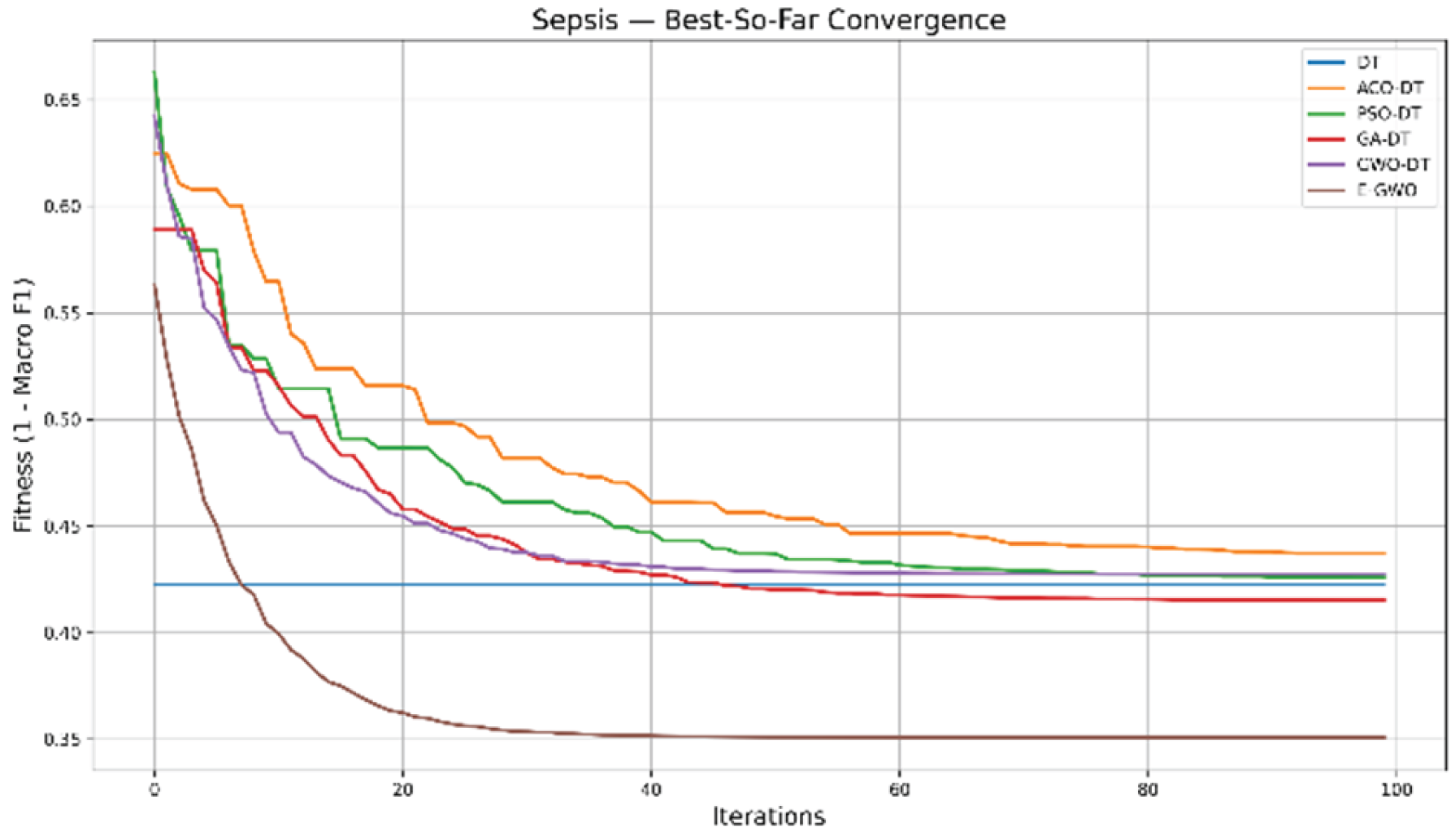
This section presents the convergence behavior of all optimization algorithms by reporting the best-so-far and average-so-far fitness values across iterations. The convergence curves are computed using the 1 – Macro F1 score as the fitness function, where the objective is to minimize this value to achieve higher classification performance. These plots illustrate how quickly and effectively each algorithm approaches an optimal decision-tree configuration over time. They also highlight differences in stability, exploration–exploitation balance, and the overall optimization efficiency of the competing metaheuristic methods. To evaluate the optimization dynamics of the proposed algorithms, convergence curves were generated for each dataset. For every meta-heuristic (GA-DT, PSO-DT, ACO-DT, GWO-DT, and the proposed E-GWO-DT), two types of curves were plotted across 100 iterations.
4.7.1. Best-So-Far Fitness
This curve tracks the highest Macro-F1 value obtained up to each iteration as shown in Figure 4, Figure 6, Figure 8, Figure 10 and Figure 12. It reflects how quickly an algorithm identifies promising regions of the search space and whether it continues to improve over time. A steep early rise indicates strong initial exploration, whereas later plateaus show exploitation around a near-optimal solution. Consistent upward progression across iterations signifies stable optimization dynamics, while fluctuations may reveal premature convergence or ineffective search movements. Algorithms with smoother, steadily increasing curves generally demonstrate better balance between exploration and exploitation, ultimately leading to more reliable convergence toward high-quality solutions.
Figure 3.
Avg so Far curve for Burns Dataset.
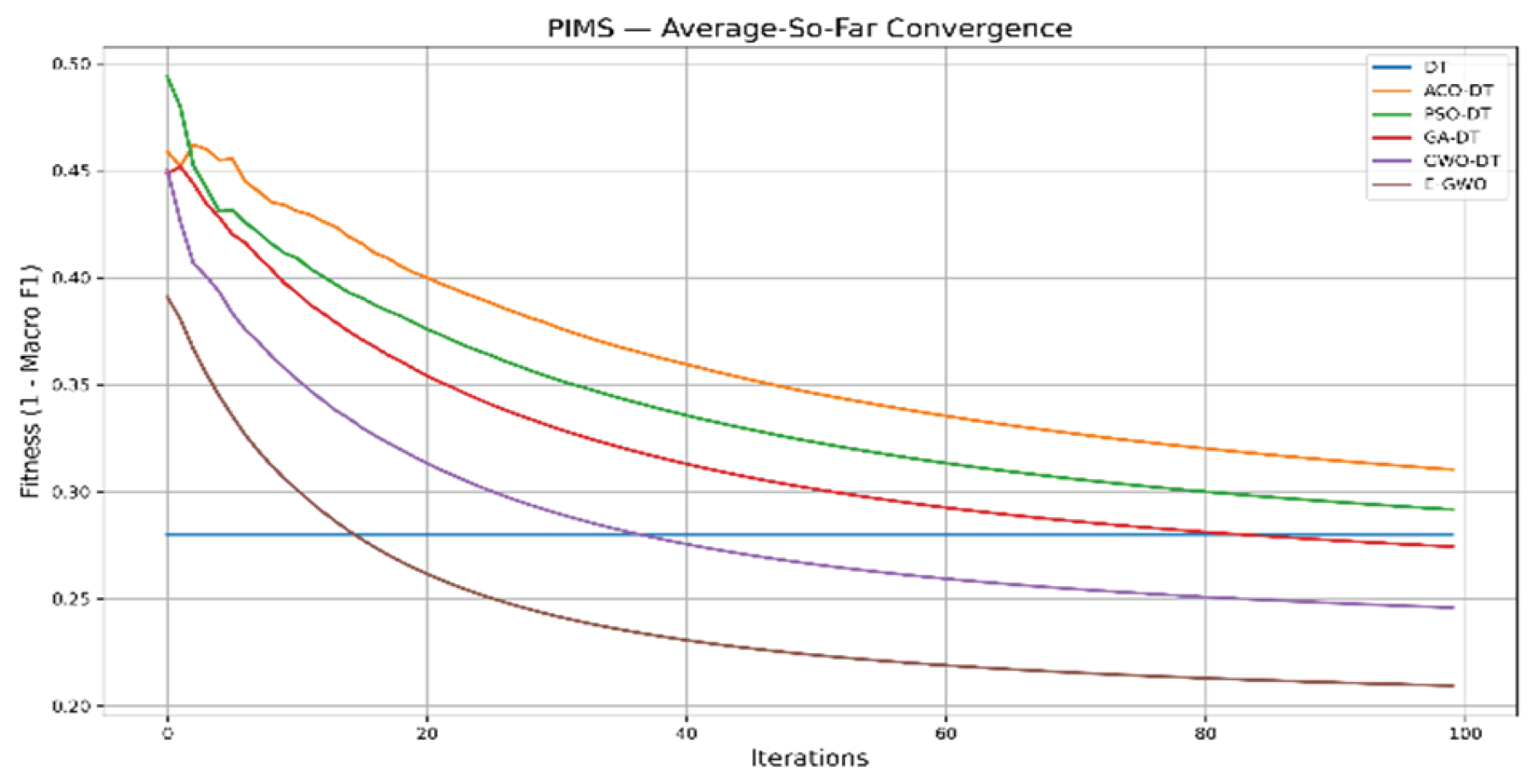
Figure 4.
Best so Far curve for Burns Dataset.
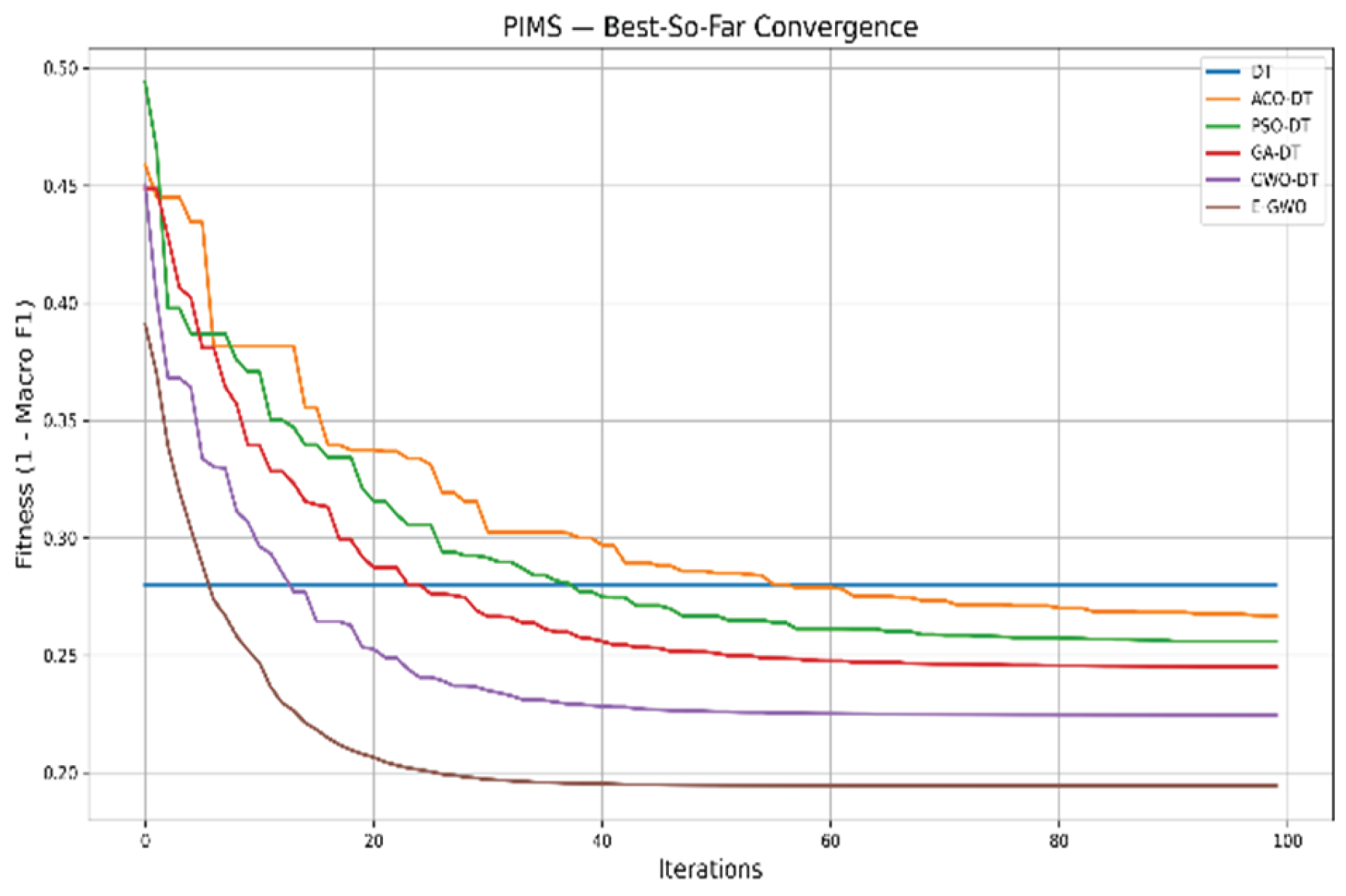
Figure 5.
Avg so Far curve for Diabetes Dataset.
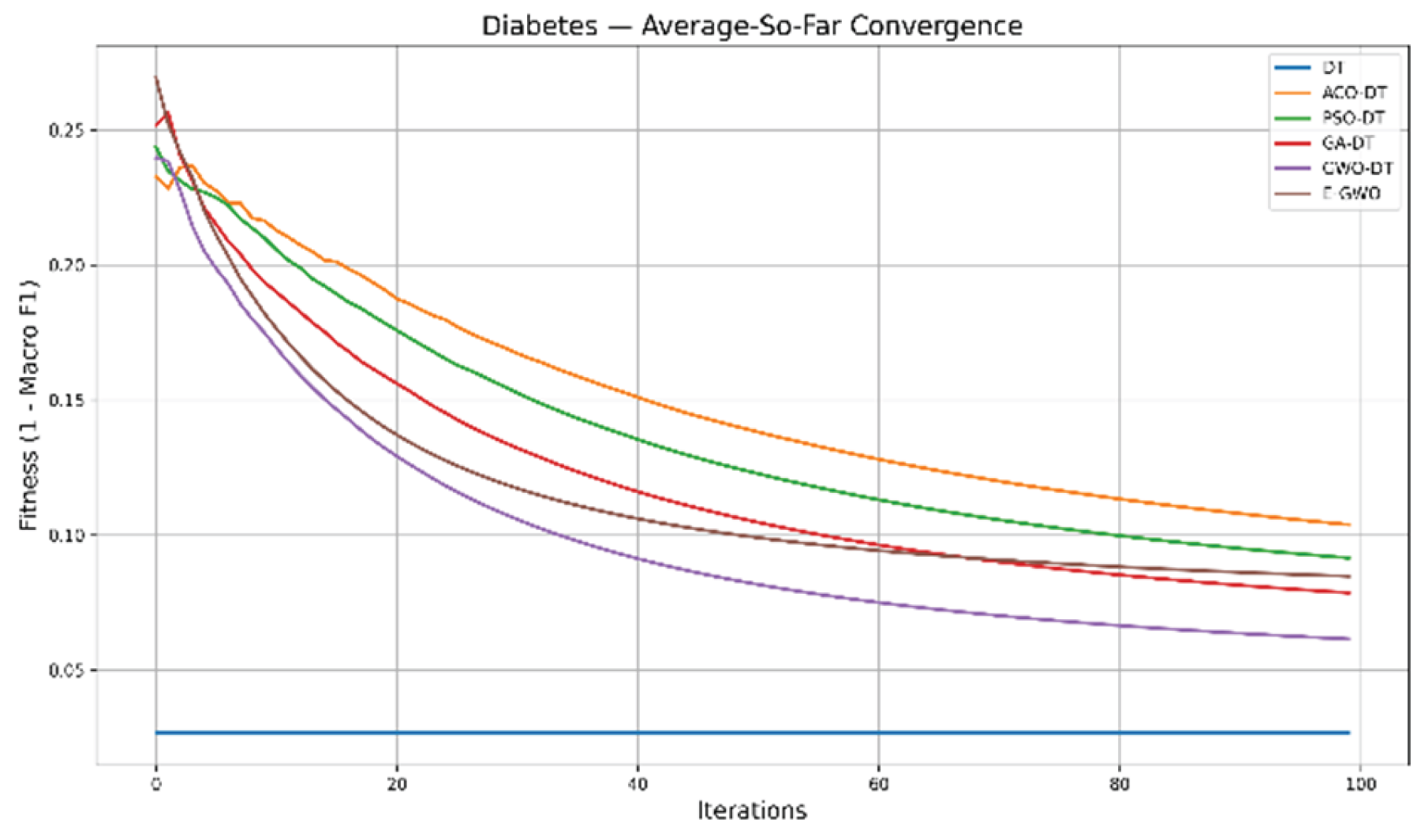
Figure 6.
Best so Far curve for Diabetes Dataset.
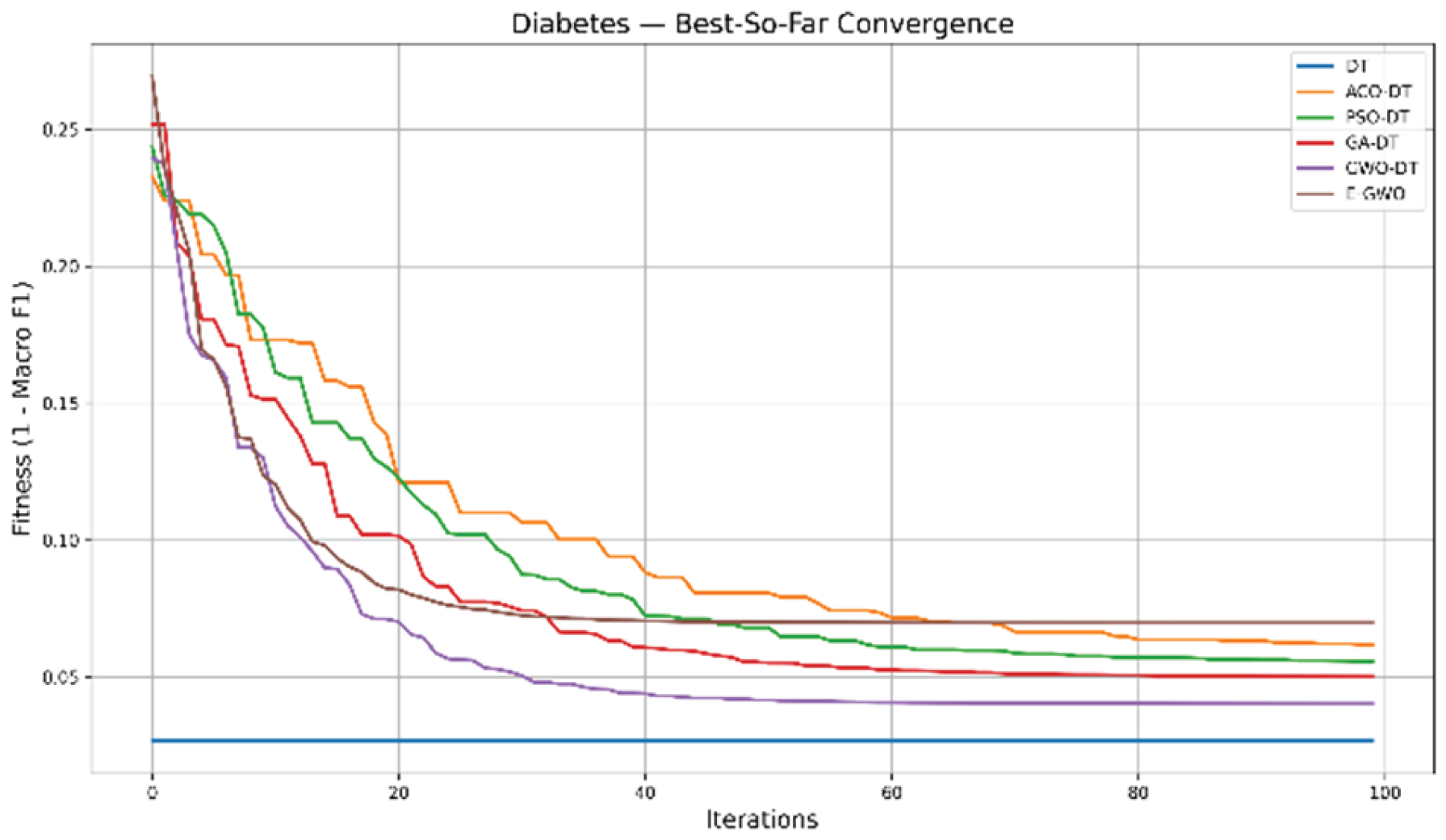
Figure 7.
Avg so Far curve for Cancer Dataset.
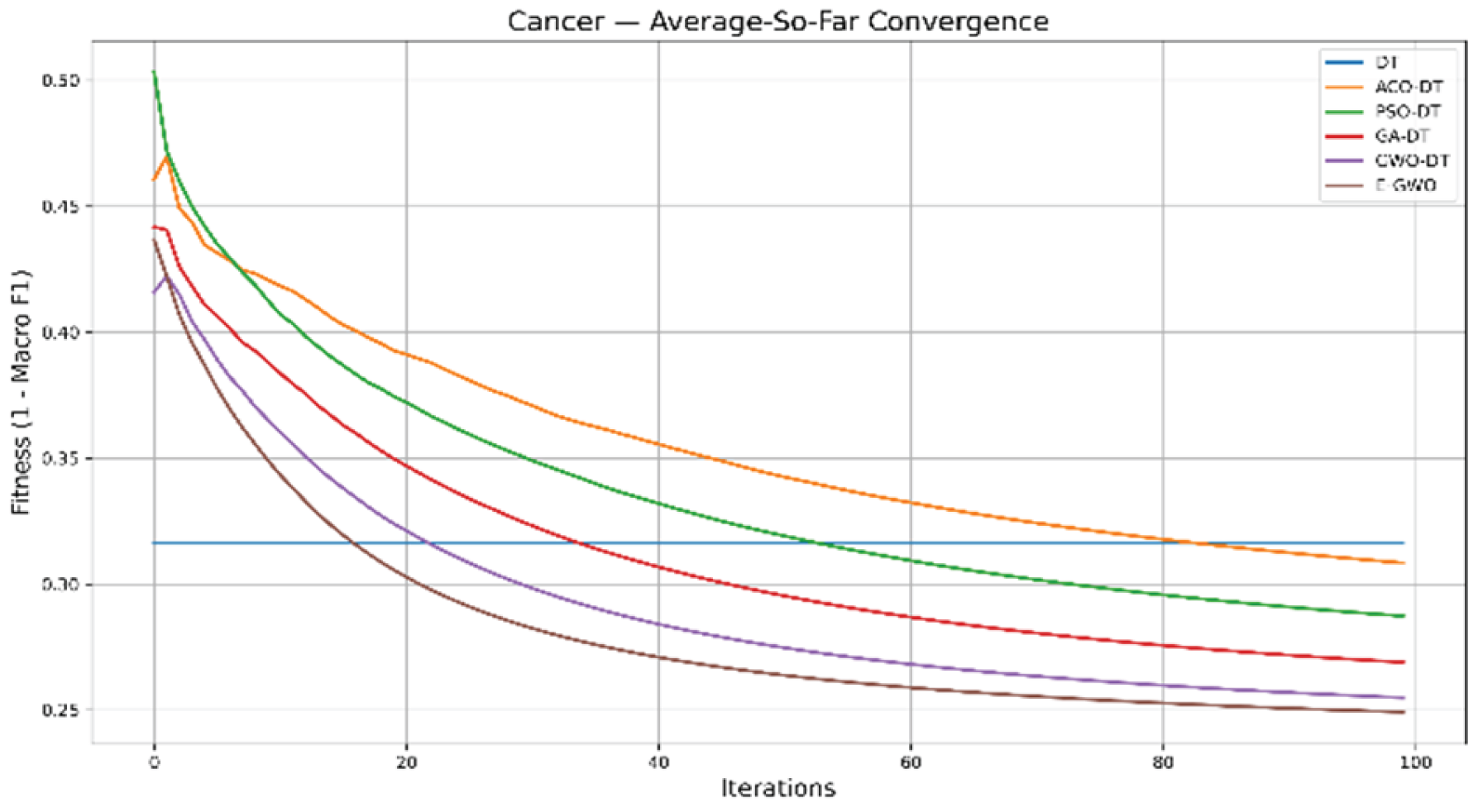
Figure 8.
Best so Far curve for Cancer Dataset.
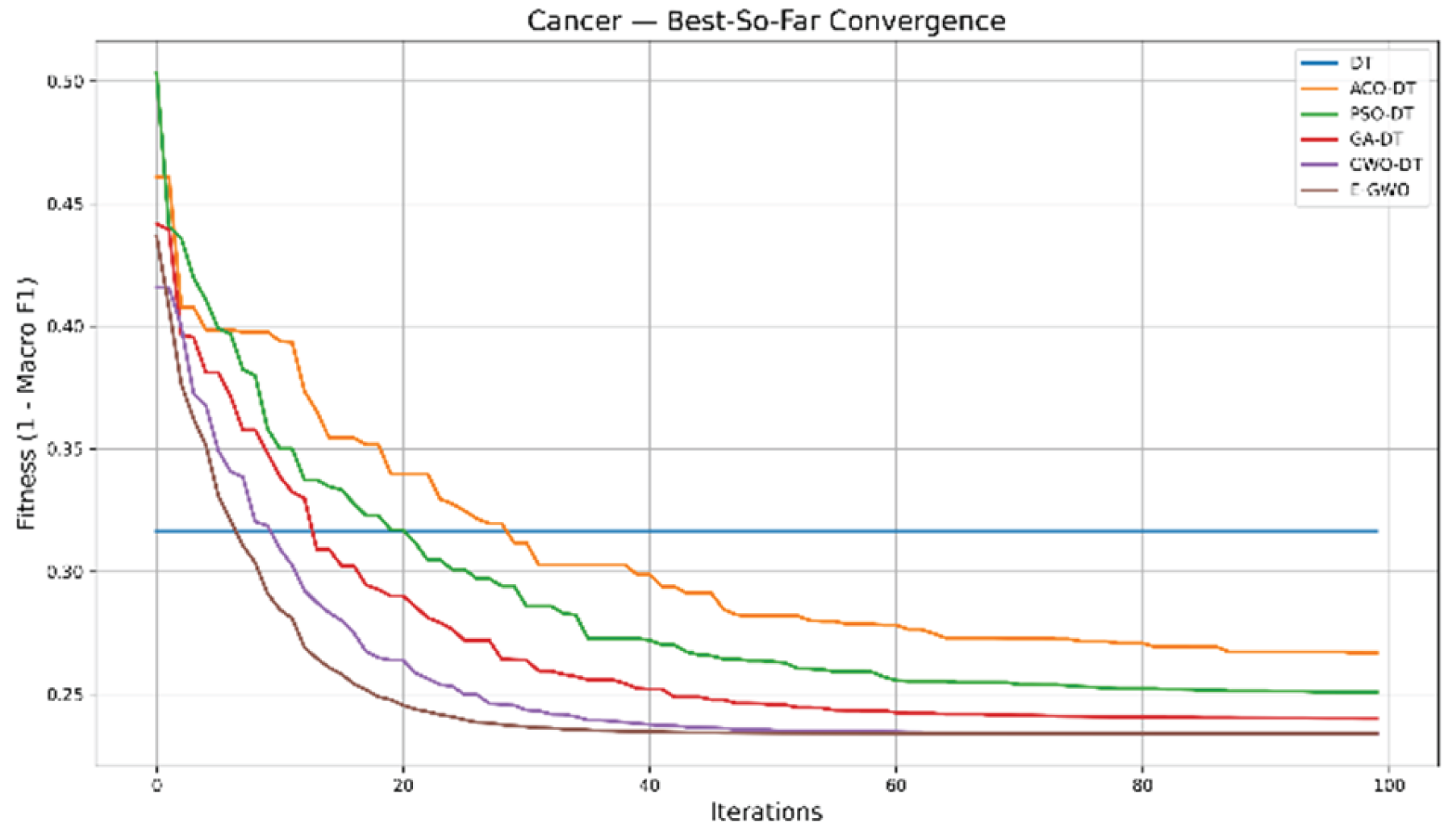
Figure 9.
Avg so Far curve for Heart Attack Dataset.
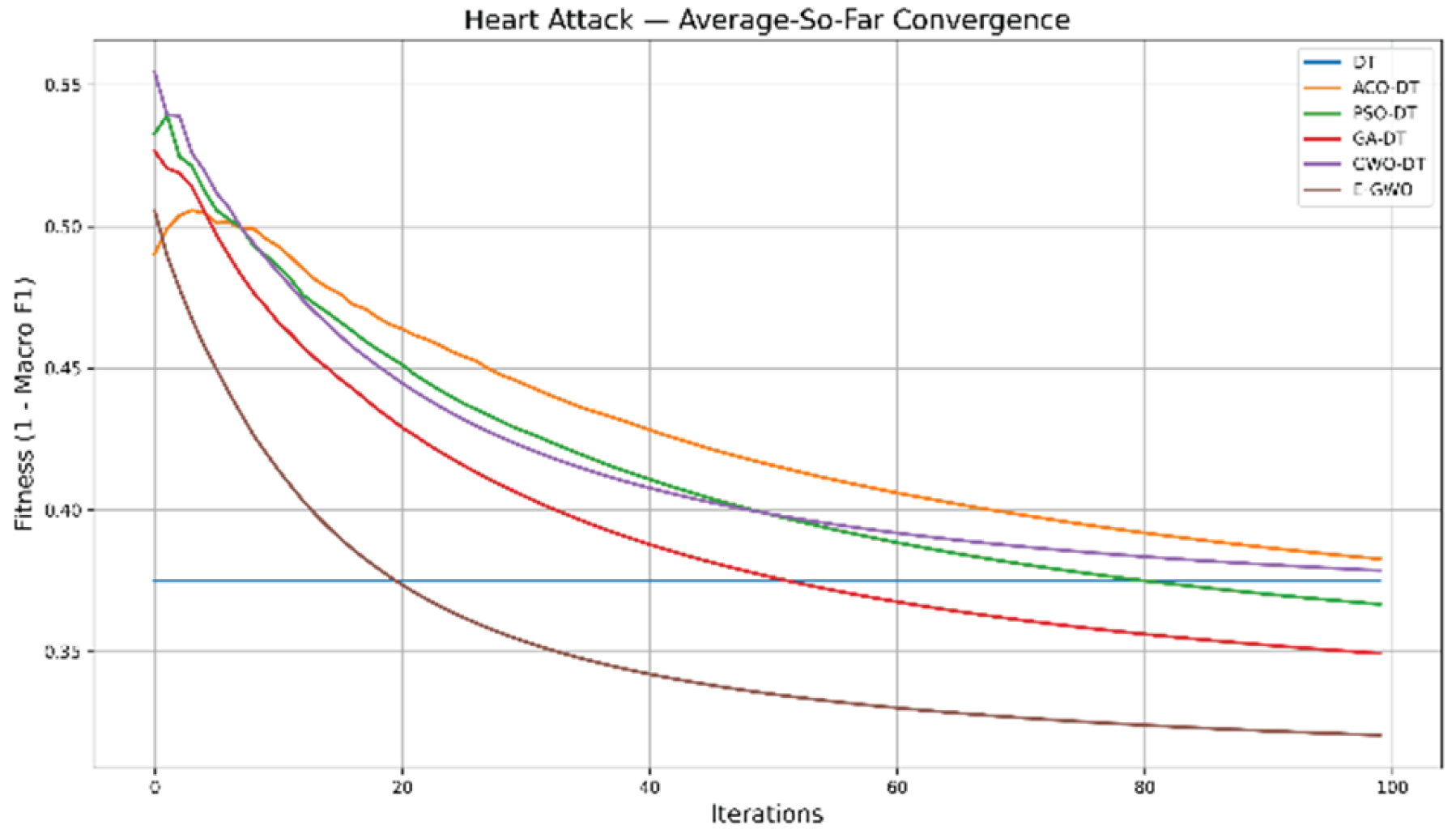
Figure 10.
Best so Far curve for Heart Attack Dataset.
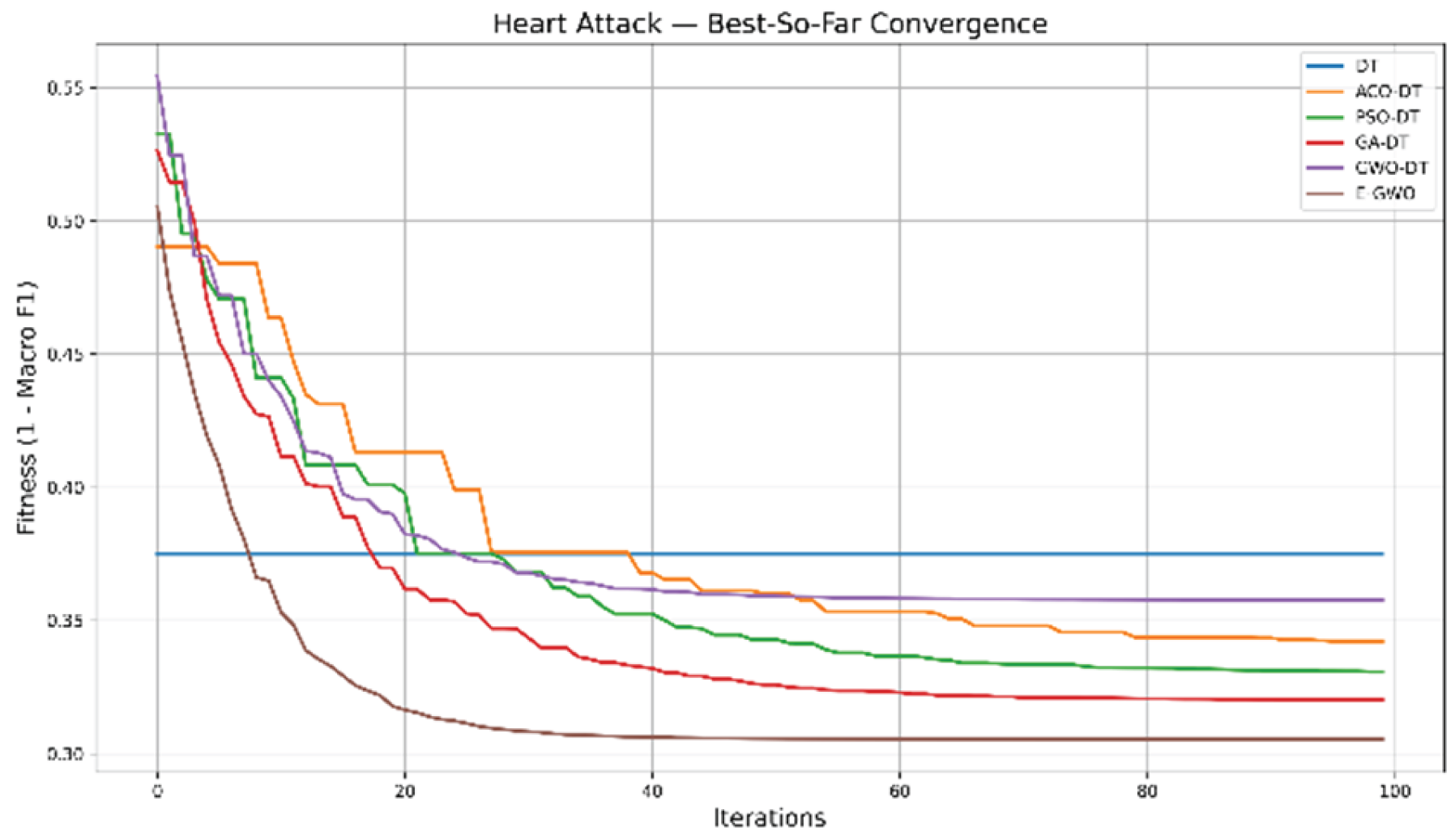
Figure 11.
Avg so Far curve for Sepsis Dataset.
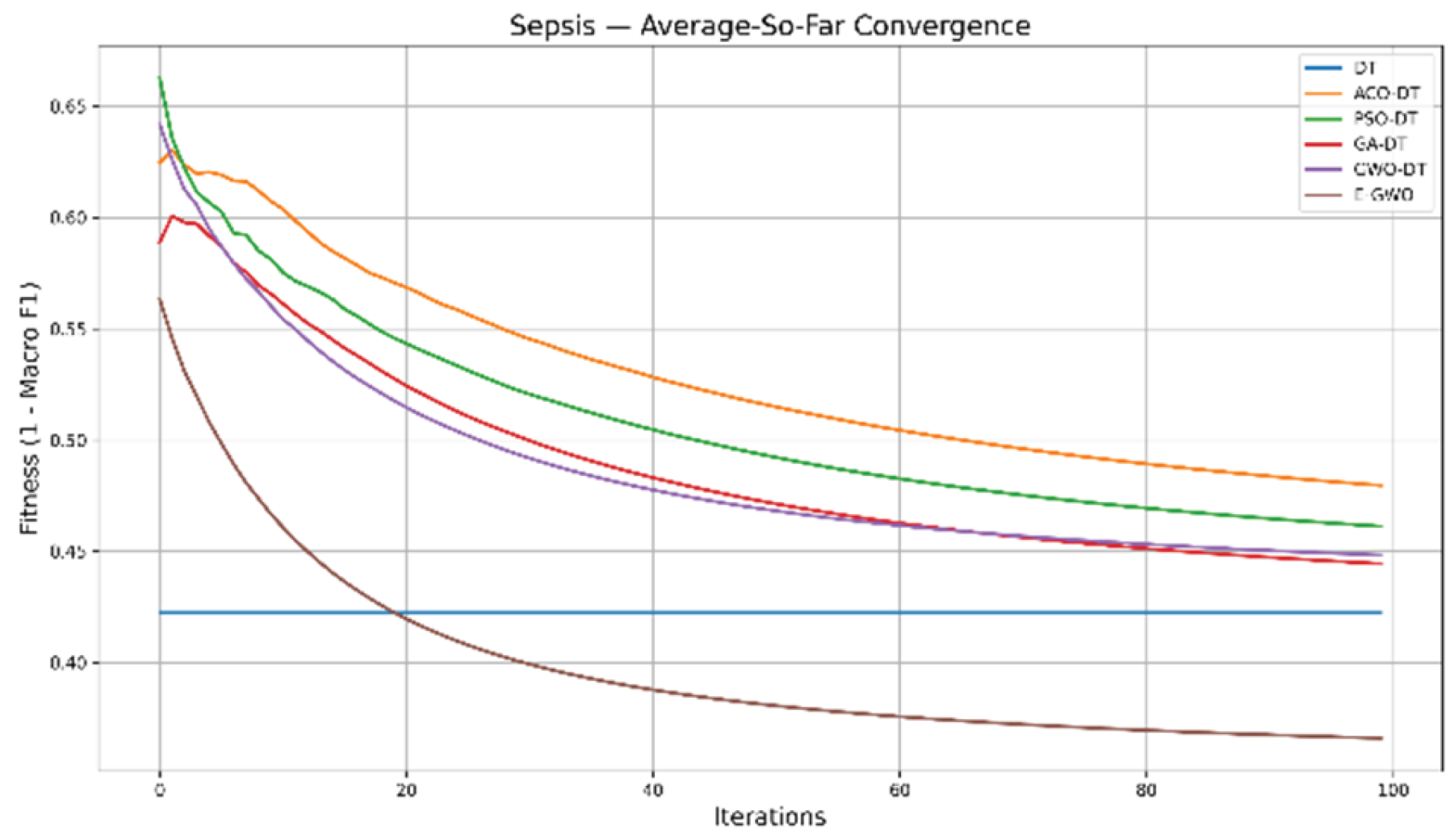
Figure 12.
Best so Far curve for Sepsis Dataset.
4.7.2. Average-So-Far Fitness
This curve averages the fitness of the entire population across iterations, as shown in Figure 3, Figure 5, Figure 7, Figure 9 and Figure 11. It illustrates the overall stability and consistency of the search process rather than just the performance of the best candidate. Algorithms with smooth upward trajectories demonstrate a well-balanced exploration–exploitation strategy and a uniformly improving population. In contrast, large oscillations or irregular patterns indicate unstable population dynamics, sensitivity to local optima, or premature convergence tendencies.
Convergence patterns differed across optimization algorithms. Genetic Algorithm and ACO typically showed slower or noisier improvement, whereas PSO and standard GWO demonstrated more consistent trajectories. The proposed E-GWO-DT exhibited the fastest and most stable convergence across most datasets, with early improvements followed by smooth plateaus, indicating effective exploration in early iterations and efficient exploitation in later phases.
These convergence curves provide visual and quantitative evidence of each optimizer’s behavior and allow comparison beyond final accuracy scores. They also help validate whether the optimizer follows the expected search dynamics associated with its mathematical design.
The enhanced Grey Wolf Optimizer (E-GWO) developed in this study improves by incorporating fuzzy logic into the core update mechanism and by simplifying the leadership hierarchy through the removal of the δ-layer. These modifications fundamentally alter the exploration–exploitation dynamics of the algorithm, resulting in faster, smoother, and more stable convergence.
In the standard GWO, the parameter decreases linearly from 2 to 0 over the course of the iterations. The proposed E-GWO replaces the linear decay of with a fuzzy logic-based controller. This controller evaluates cues from the population, such as iteration ratio and population diversity, and uses a set of linguistic rules to adjust the value of dynamically at each iteration. When the fuzzy system detects stagnation or high diversity, it increases exploration by raising . Conversely, when the population shows consistent improvement or low diversity, the fuzzy controller reduces the value of , thereby strengthening exploitation. This adaptive mechanism prevents premature convergence, improves stability, and allows the optimizer to follow a smoother and more principled transition from global exploration to local refinement. As a result, the fitness trajectory typically exhibits initial oscillations—reflecting active exploration—followed by a gradual and stable convergence toward high-quality solutions.
A second enhancement in the proposed E-GWO is the removal of the δ wolf from the leadership structure. In classical GWO, the α, β, and δ wolves jointly guide the population, but the δ wolf often introduces redundant or conflicting search directions, particularly when α and β are significantly stronger. This can generate unnecessary noise in the update equations and slow down convergence during later iterations. By eliminating the δ layer, the proposed E-GWO retains only the two strongest leaders, α and β, whose influence is further refined by the fuzzy membership system. This reduction in leadership complexity produces cleaner and more coherent positional updates, reduces contradictory movements within the population, and enhances exploitation near promising regions of the search space.
4.8. Dataset Selection
Table 12 shows five datasets used in this study, which differ in size, dimensionality, and class balance, enabling a robust evaluation of the proposed methods across diverse scenarios. For the Sepsis and PIMS datasets, feature dimensionality was reduced using a structured two-step procedure. Initially, all columns containing more than 90% missing values were discarded to remove severely incomplete and unreliable variables. After this cleaning stage, a Random Forest importance ranking was applied to the remaining features, and only the top-scoring attributes were selected for further analysis. This approach ensured that each dataset retained only the most informative and clinically meaningful predictors, improving model stability and performance.
5. Experimental Results
5.1. Exploratory Data Analysis
To get an understanding of the data, Figure 13 provides an initial exploratory view of the numerical features within the Burns dataset, highlighting their distribution, central tendency, and variability. The variable Sex exhibits almost no variation, which is expected because it is encoded as a binary categorical feature; the flat distribution indicates that values are concentrated around a limited range. In contrast, Burn_Type shows moderate variability, suggesting that the dataset contains a diverse range of burn categories but without extreme outliers. The feature Incidence_Type demonstrates the widest spread and highest degree of dispersion, indicating substantial variation in how burn incidents occur across the dataset.
The boxplot visualization for the cancer dataset shown in Figure 14 provides a comprehensive overview of the distribution and variability of numerical features. The feature age exhibits a relatively compact spread with no extreme outliers, indicating a more uniform patient age distribution. The tumor_size feature displays the largest amount of dispersion and a substantial number of outliers, suggesting high variability in tumor presentation. The survival_months variable highlights diverse survival outcomes in the dataset. Overall, the boxplot efficiently reveals the mixed structure of the dataset, combining narrowly distributed encoded clinical factors with highly variable biological and survival-related measurements.
Figure 15 shows some key observations including the differing scales of the variables, with features like insulin, glucose, and blood pressure having much higher maximum values. The most striking feature is insulin, which displays an extremely widespread and a high density of outliers, with values extending far beyond the main interquartile range (IQR).
Figure 16 provides a crucial visual summary of the distribution and variability of key physiological parameters. They consistently show that most features, including Heart Rate (HR), Respiratory Rate (Resp), and the blood pressure metrics (MAP, SBP, DBP), exhibit a significant number of extreme outliers (the individual points outside the whiskers) and are positively skewed. This is particularly important in a critical care setting, as these outliers represent clinically significant, non-typical measurements (e.g., periods of extreme tachycardia, hypotension, or desaturation).The extensive presence of these outliers across nearly all variables, especially the vital signs, is the primary takeaway from this visualization, signaling that robust data preprocessing techniques will be essential to handle these extreme values effectively and prevent them from skewing the training of any machine learning model aimed at early sepsis detection.
Figure 17 for the heart attack dataset provides insights into the distribution of several key continuous medical features. Features like Age and Maximum Heart Rate Achieved show relatively symmetrical distributions, suggesting that most values cluster around the average. Conversely, features such as Resting Blood Pressure (Trestbps) and Serum Cholesterol (Chol) display a notable degree of positive skewness. Overall, the visualization confirms that most features are generally well-behaved.
5.2. Fuzzy Membership Functions and Their Results
A total of five types of membership functions (MFs) were evaluated in this study to determine which configuration offers the most effective performance. Each MF variant is presented and explained in the following subsections, allowing a clear comparison of their shapes, behaviors, and impact on the fuzzy adaptation mechanism.
5.2.1. Triangular Membership Functions
Triangular MFs provide simple, piecewise-linear representations of linguistic terms. Because their slopes change abruptly, they offer fast transitions between fuzzy states (low → medium → high). This makes them computationally efficient and easy to tune, but these sharp boundaries can sometimes cause instability in mid-iterations where small changes in diversity or iteration ratio may yield disproportionately large changes in . In your results, triangular MFs perform moderately well but occasionally introduce slight oscillations, explaining why they rank below the hybrid setup across most datasets.
5.2.2. Trapezoidal Membership Functions
Trapezoidal MFs extend triangular shapes by introducing a flat plateau, making them less sensitive to noise and producing more tolerant transitions. This reduces abrupt changes in the adaptive parameter and tends to stabilize early iterations. However, trapezoidal functions may cause under-responsiveness in critical phases of the search because the plateau can keep the control parameter unchanged for longer than ideal. This explains why trapezoidal MFs perform well but not exceptionally, ranking behind triangular and hybrid configurations in most results.
5.2.3. Gaussian Membership Functions
Gaussian MFs model linguistic terms using smooth, bell-shaped curves with infinite support. Their softness makes them highly effective for gradual adaptation and noise-tolerant estimation of . However, because Gaussian curves are extremely smooth, they tend to blur boundaries between exploration and exploitation, delaying sharp transitions needed by metaheuristics during critical search episodes. In your results, Gaussian MFs show good general stability but weaker final F1-scores, especially on datasets requiring decisive transitions.
5.2.4. Generalized Bell Membership Functions
Generalized bell MFs generalize Gaussian behavior through variable steepness. They provide flexible curvature but exhibit excessive smoothness when parameterized conservatively, and excessive sensitivity when steepened. This makes them hard to tune for a metaheuristic unless domain-specific knowledge exists. In your results, generalized bell MFs show inconsistent performance across datasets, performing reasonably well on large, smoother datasets (e.g., Cancer) but struggling on imbalanced or noisy datasets where rapid adaptation is required (e.g., PIMS, Sepsis).
5.2.5. Hybrid Membership Functions (Triangular + Trapezoidal)
The Hybrid membership function (MF) configuration emerged as the best-performing variant across the experiments. By integrating the complementary strengths of triangular and trapezoidal membership functions, the Hybrid MF provides both sharp, decisive transitions when strong control adjustments are required and smooth, noise-tolerant behavior during more stable phases of the search. This combination enables rapid responsiveness in the early iterations, steady and controlled behavior in the middle stages, and smoother convergence during later iterations. As a result, the Hybrid MF achieves consistent performance even on imbalanced datasets and delivers superior Macro-F1 scores on four out of five datasets. Importantly, it preserves the interpretability and computational simplicity associated with basic MF shapes while offering more refined adaptation dynamics than any single MF type. This makes the Hybrid MF particularly suitable for a fuzzy-enhanced optimizer like E-GWO, where the exploration–exploitation balance evolves in a naturally nonlinear manner throughout the optimization process.
The performance Table 13 includes statistical significance markers that indicate whether the improvement of each fuzzy variant over the baseline (or over competing fuzzy configurations) is statistically meaningful. A single asterisk () denotes significance at the 0.10 level, implying that there is 90% confidence that the observed improvement is not due to random variation. Two asterisks () represent significance at the 0.05 level (95% confidence), while three asterisks () indicate significance at the 0.01 level (99% confidence), reflecting highly reliable differences. These labels are based on statistical test i.e., paired t-tests conducted across repeated runs. The presence of higher-level significance (especially ** and ***) in the Hybrid fuzzy variant highlights the consistency, stability, and non-random nature of its superior performance across datasets. In summary, these significance levels reinforce that the improvements offered by the Hybrid MF setup are not incidental but statistically robust and reproducible.
Across all five healthcare datasets, the proposed fuzzy optimization framework demonstrates a clear and consistent advantage over the baseline Decision Tree (DT). While the standard DT is valued for its interpretability and computational simplicity, its reliance on greedy, locally optimal splits restricts its ability to capture complex and uncertain clinical boundaries. Once optimization is introduced through the Grey Wolf Optimizer (GWO), and further enhanced with fuzzy membership functions, the performance of the resulting decision trees improves substantially across accuracy, precision, recall, and F1-score. This improvement is particularly pronounced in the PIMS, Sepsis, and Heart Attack datasets, where the baseline DT performs moderately, but the optimized fuzzy-integrated variants produce much stronger and more clinically meaningful classifications.
Within this optimized framework, the Fuzzy-GWO-DT Hybrid model emerges as the most consistently effective approach for handling complex and noisy medical datasets. Its design blends multiple membership shapes into a single flexible fuzzy representation, allowing it to model nonlinear, overlapping, and uncertain feature spaces more effectively than single-shape functions. On the PIMS dataset, for example, the Hybrid variant achieves the highest F1-score among all fuzzy methods, demonstrating its ability to maintain a strong balance between sensitivity and precision. A similar trend is observed in the Sepsis dataset, high-dimensional and heavily imbalanced, where the Hybrid model delivers the best accuracy and precision, reflecting its capacity to differentiate subtle clinical indicators associated with septic risk. Even in the Heart Attack dataset, the Hybrid model offers the most stable balance between recall and precision, highlighting its adaptability across varied medical contexts.
However, the superior flexibility of the Hybrid approach does not translate into universal dominance. On the Diabetes and Cancer datasets, simpler fuzzy membership functions such as Triangular or Gaussian outperform the Hybrid variant. These datasets possess more stable class boundaries and clearer separability, which reduces the need for the nuanced and highly adaptive boundary modeling that the Hybrid function provides. In such cases, simpler membership functions offer more parsimonious and generalizable partitioning, whereas the Hybrid model’s added flexibility can introduce marginal overfitting. This pattern reinforces an important observation: the Hybrid function excels primarily in datasets characterized by ambiguity, complexity, and overlapping clinical indicators.
5.3. Decision Tree Results Across All Algorithms
This section presents the quantitative results obtained across all five datasets, comparing the performance of each optimization algorithm using key evaluation metrics, including accuracy, precision, recall, and F1-score. By benchmarking the baseline Decision Tree against ACO-DT, PSO-DT, GA-DT, GWO-DT, and the enhanced fuzzy-based variants, the analysis highlights how each metaheuristic contributes to improving classification effectiveness. Comparative results provide a comprehensive view of algorithmic strengths across different datasets, enabling a clear understanding of which approaches offer the most reliable and consistent performance.
Figure 18 illustrates a performance comparison of six different algorithms on the PIMS dataset, evaluated using four standard metrics: Accuracy, Precision, Recall, and F1-score. The algorithms compared are DT, ACO, PSO, GA, GWO, and a Hybrid model. Across all four metrics, the Hybrid model consistently achieves the highest scores, indicating its superior performance over the other individual algorithms. For instance, in terms of Accuracy, the Hybrid model reaches a score of 0.84, while for Precision, Recall, and F1-score, it achieves scores of 0.81, 0.79, and 0.80, respectively. This consistent outperformance suggests that the combination of methods in the Hybrid model provides a more effective solution for this specific dataset.
Figure 19 displays a performance comparison of six algorithms on a Cancer Dataset. The results consistently show that the Hybrid model outperforms the other algorithms across all evaluation criteria. It achieves the highest scores in Accuracy (0.89), Precision (0.81), Recall (0.74), and F1-score (0.77). This suggests that the combined approach of the Hybrid model is the most effective for this particular dataset, demonstrating a clear advantage in its predictive capabilities compared to the individual algorithms.
Figure 20 presents a performance comparison of six different algorithms (DT, ACO, PSO, GA, GWO, and Hybrid) on the Diabetes Dataset. The evaluation is based on four key metrics: Accuracy, Precision, Recall, and F1-score. In this analysis, the Decision Tree (DT) algorithm consistently emerges as the top performer, achieving the highest scores across all metrics. Specifically, the DT model records an impressive 0.98 for both Accuracy and Precision, and 0.97 for both Recall and F1-score. The Hybrid model follows closely as the second-best, but the DT algorithm maintains a clear, albeit slight, advantage, indicating its superior effectiveness for this particular dataset.
The performance comparison for the Sepsis dataset in Figure 21 clearly shows that the proposed optimization methods outperform the baseline Decision Tree. While the traditional DT delivers reasonable accuracy, its low precision and recall make it less dependable for a high-risk condition like sepsis. Meta-heuristics such as ACO, PSO, and GA offer only slight gains, showing limitations with class imbalance and complex clinical patterns. In contrast, the GWO-optimized DT achieves substantial improvements across all metrics, reflecting its stronger exploration–exploitation balance and better threshold optimization. The Fuzzy-GWO Hybrid model performs best overall, reaching the highest precision (0.77) and F1-score by effectively capturing non-linear and overlapping sepsis indicators. Overall, the results highlight that fuzzy-enhanced GWO produces the most reliable and clinically useful model for early sepsis detection.
The performance comparison for the Heart Attack dataset in Figure 22 shows a consistent improvement of the proposed optimization methods over the baseline Decision Tree. While DT provides moderate scores across all metrics, meta-heuristic approaches such as ACO, PSO, and GA deliver small yet steady enhancements. The GWO-based model demonstrates a clearer advantage, achieving higher precision, recall, and F1 by better navigating the feature space and refining split points. The Hybrid Fuzzy-GWO achieves the strongest overall performance, especially in precision (0.71) and F1-score, indicating its ability to capture subtle clinical patterns and reduce misclassification. Overall, the chart highlights that hybrid optimization produces more reliable and discriminative models for heart-attack prediction.
The superior performance of the Hybrid model across multiple datasets can be attributed to its ability to combine the strengths of Grey Wolf Optimization (GWO) with fuzzy logic. GWO already provides a strong exploration–exploitation balance, allowing it to search the solution space efficiently and avoid premature convergence. However, clinical datasets such as sepsis, burns, cancer, and PIMS often contain overlapping class boundaries, noisy measurements, and nonlinear feature interactions. Fuzzy logic enhances the model by introducing soft membership functions, enabling it to capture uncertainty and gradual transitions in patient states more effectively than crisp, threshold-based decision rules. This combination helps the Hybrid model refine split points with greater flexibility, resulting in improved accuracy, precision, recall, and F1-score across diverse medical datasets.
Hybrid meta-heuristic approaches gain their strength from blending complementary mechanisms: one component (GWO) focuses on global search and structure optimization, while the fuzzy layer captures fine-grained relationships between attributes. This synergy allows the Hybrid model to adapt to variations in dataset behavior, whether the dataset is highly imbalanced, has complex interactions, or contains subtle predictive patterns. The consistent superiority of the Hybrid model in most datasets (e.g., Sepsis, Heart Attack, PIMS, Cancer) indicates that hybridization helps reduce misclassification, especially in high-risk medical tasks where false negatives are critical. It also suggests that the model can generalize better by smoothing abrupt decision boundaries and handling uncertain or borderline cases more intelligently.
Despite its advantages, a hybrid approach is not guaranteed to outperform simpler algorithms in every scenario. When the dataset is clean, well-separated, and low in complexity, such as the Diabetes dataset in our experiments, the added complexity of fuzzy membership and hybrid optimization may provide little benefit and can even introduce unnecessary noise. In these cases, a standard Decision Tree can already model the underlying patterns effectively, making hybridization redundant. Additionally, hybrid models typically require more computational effort and may risk overfitting if the dataset is small or lacks variability.
Another notable finding is the strong performance of the enhanced GWO variant without the δ leadership layer, which outperforms other versions on three of the five datasets. The removal of the δ wolf simplifies the hierarchy and reduces noise during the update process, enabling more stable convergence, especially beneficial in datasets with intricate feature interactions. This streamlined mechanism helps the optimizer refine decision boundaries more effectively, contributing to the improved recall and F1-scores observed across multiple experiments.
When compared against other swarm intelligence algorithms, including Ant Colony Optimization (ACO), Particle Swarm Optimization (PSO), and Genetic Algorithms (GA), GWO consistently delivers superior performance across all datasets. Its advantage arises from its balanced exploration–exploitation mechanism, its low dependency on sensitive hyperparameters, and its stable leadership-based search dynamics. While PSO may suffer from oscillatory behavior due to velocity updates, GA depends heavily on mutation and crossover rates, and ACO is sensitive to pheromone evaporation, GWO achieves smoother convergence with fewer risks of premature stagnation. These strengths make it particularly suitable for heterogeneous healthcare datasets, enabling it to extract more reliable split thresholds and more clinically relevant decision tree structures.
Taken together, these results illustrate the significant potential of fuzzy-enhanced, swarm-based optimization in developing interpretable yet highly accurate clinical decision-support systems. The optimized decision trees preserve the transparency essential for medical applications while offering improved generalization across datasets with diverse sizes, dimensionalities, and distributions. Their consistent gains in recall and F1, metrics crucial for minimizing false negatives, underscore their suitability for deployment in real clinical workflows. Overall, the proposed framework provides a promising pathway toward robust, trustworthy, and intelligent decision-support models that align with both clinical needs and machine learning best practices.
Across all five datasets as shown in Figure 23, the Enhanced GWO (E-GWO) demonstrates a clear improvement in predictive performance compared to the baseline Decision Tree, particularly in terms of F1-score. On the PIMS and Sepsis datasets, E-GWO delivers substantial gains of approximately 3.6% and 7.2%, respectively, highlighting its ability to better handle noisy and moderately imbalanced data. Similarly, the Heart Attack and Cancer datasets show notable improvements, with F1-score increases of 6.9% and 8.2%, reflecting more effective optimization of tree structure and split selection. Although the Diabetes dataset exhibits a slight reduction in F1-score, this behavior is expected in highly linearly separable or stable datasets where the baseline DT already performs near optimally. Overall, these results confirm that E-GWO consistently enhances the decision tree’s classification capability across diverse clinical datasets, particularly in scenarios where the search landscape is complex and conventional heuristics underperform. These improvements further demonstrate the robustness of the enhanced fuzzy–adaptive mechanism, which promotes a more effective balance between exploration and exploitation throughout the search process.
6. Conclusions and Future Work
The experimental evaluation across five healthcare datasets demonstrates the effectiveness of integrating Fuzzy membership functions in the Grey Wolf Optimizer for decision tree construction. All E-GWO variants outperform the baseline decision tree, confirming that optimization significantly enhances the predictive capability, generalization, and class-sensitivity of the resulting models. Among the fuzzy variants, the Hybrid membership function emerges as the most consistent performer, particularly on complex datasets such as PIMS, Sepsis, and Heart Attack, where feature interactions and class boundaries are less distinct. Its ability to combine multiple fuzzy shapes allows the model to capture nonlinear and overlapping patterns more effectively. Although the Hybrid variant does not universally outperform simpler functions on more structured datasets such as Diabetes and Cancer, all fuzzy variants still maintain competitive or superior performance compared to the standard DT. Overall, the results confirm that combining swarm-based optimization with fuzzy partitioning produces more accurate and clinically reliable decision trees while retaining interpretability, an essential requirement in medical applications.
While the proposed FUZZY-GWO-DT framework performs well across diverse datasets, several limitations provide opportunities for further improvement.
1. The evaluation is conducted on pre-collected, static datasets. Real-world medical environments often involve streaming or real-time data, where patient conditions evolve dynamically. Extending the optimization process to an online or incremental learning setting would allow the model to adapt continuously without full retraining.
2. The fuzzy membership parameters and the GWO update rules are optimized offline. Incorporating adaptive or self-adjusting fuzzy sets, where membership shapes evolve based on data drift, could further enhance robustness.
3. Although GWO offers a balance between exploration and exploitation, hybridizing it with other meta-heuristics (e.g., Lévy flight, adaptive weights, or reinforcement-guided updates) may improve convergence speed and avoid local optima.
4. Integrating domain knowledge, such as medically meaningful feature weights or clinically validated thresholds, could make the optimized decision trees even more interpretable and reliable for deployment in sensitive healthcare settings.
Conflicts of Interest
The authors declare that there is no conflict of interest.
Funding Statement
Not Applicable.
Author Contributions
Akifa Khan: Conceptualization, methodology design, experiments, data analysis, manuscript writing. Dr Tariq Mahmood: Conceptualization and Guidance. Dr Asma Sanam: Guidance, review and feedback.
Data Availability Statement
The datasets used in the study are available on reasonable request from the corresponding author. 4 of them are publicly available and their references are given.
References
- Akshay Dattatray Khare. (2022). Diabetes Dataset.
- Bansal, M., Goyal, A., & Choudhary, A. (2022). A comparative analysis of K-Nearest Neighbor, Genetic, Support Vector Machine, Decision Tree, and Long Short Term Memory algorithms in machine learning. Decision Analytics Journal, 3, 100071. [CrossRef]
- Besser, B., & Poloczek, M. (2017). Greedy Matching: Guarantees and Limitations. Algorithmica, 77(1), 201–234. [CrossRef]
- Blum, C. (2005, December). Ant colony optimization: Introduction and recent trends. Physics of Life Reviews. [CrossRef]
- Chakraborty, C., Kishor, A., & Rodrigues, J. J. P. C. (2022). Novel Enhanced-Grey Wolf Optimization hybrid machine learning technique for biomedical data computation. Computers and Electrical Engineering, 99. [CrossRef]
- Charly Huxford, Alireza Rafiei, & Rishikesan Kamaleswaran 11. (2021). The 2024 Pediatric Sepsis Challenge: Predicting In-Hospital Mortality in Children With Suspected Sepsis in Uganda.
- Dada, E. G., Joseph, S. B., Oyewola, D. O., Fadele, A. A., Chiroma, H., & Abdulhamid, S. M. (2022). Application of Grey Wolf Optimization Algorithm: Recent Trends, Issues, and Possible Horizons. Gazi University Journal of Science, 35(2), 485–504. [CrossRef]
- El-Shafiey, M. G., Hagag, A., El-Dahshan, E. S. A., & Ismail, M. A. (2022). A hybrid GA and PSO optimized approach for heart-disease prediction based on random forest. Multimedia Tools and Applications, 81(13), 18155–18179. [CrossRef]
- G., S. S., & K., M. (2019). Diagnosis of diabetes diseases using optimized fuzzy rule set by grey wolf optimization. Pattern Recognition Letters, 125, 432–438. [CrossRef]
- Game, P. S., Vaze, V., & Emmanuel, M. (2022). Optimized Decision tree rules using divergence based grey wolf optimization for big data classification in health care. Evolutionary Intelligence, 15(2), 971–987. [CrossRef]
- Hafeez, M. A., Rashid, M., Tariq, H., Abideen, Z. U., Alotaibi, S. S., & Sinky, M. H. (2021). Performance improvement of decision tree: A robust classifier using tabu search algorithm. Applied Sciences (Switzerland), 11(15). [CrossRef]
- Hernández, V. A. S., Monroy, R., Medina-Pérez, M. A., Loyola-González, O., & Herrera, F. (2021). A Practical Tutorial for Decision Tree Induction. ACM Computing Surveys, 54(1). [CrossRef]
- Juled Zaganjori. (2023). Heart Attack Prediction.
- Kennedy, J., Eberhart, R., & gov, bls. Particle Swarm Optimization.
- Kim, H., & Koehler, G. J. (1995). Pergamon Omega. Int. J. Mgmt Sci (Vol. 23).
- L.A. Zadeh. (1988). Fuzzy logic. Computer.
- Liu, Y., As’arry, A., Hassan, M. K., Hairuddin, A. A., & Mohamad, H. (2024). Review of the grey wolf optimization algorithm: variants and applications. Neural Computing and Applications, 36(6), 2713–2735. [CrossRef]
- M. Almufti, S., Ahmad Shaban, A., Arif Ali, Z., Ismael Ali, R., & A. Dela Fuente, J. (2023). Overview of Metaheuristic Algorithms. Polaris Global Journal of Scholarly Research and Trends, 2(2), 10–32. [CrossRef]
- Maleki, A., Roayaei, M., & Mirjalili, S. (2025). Enhancing leadership-based metaheuristics using reinforcement learning: A case study in grey wolf optimizer. Knowledge-Based Systems, 330. [CrossRef]
- Mathew, T. V. Genetic Algorithm.
- Mingers, J. (1989). An Empirical Comparison of Selection Measures for Decision-Tree Induction. Machine Learning (Vol. 3).
- Mirjalili, S., Mirjalili, S. M., & Lewis, A. (2014). Grey Wolf Optimizer. Advances in Engineering Software, 69, 46–61. [CrossRef]
- Moor, M., Rieck, B., Horn, M., Jutzeler, C. R., & Borgwardt, K. (2021, May 28). Early Prediction of Sepsis in the ICU Using Machine Learning: A Systematic Review. Frontiers in Medicine. Frontiers Media S.A. [CrossRef]
- Mortaz, E. (2020). Imbalance accuracy metric for model selection in multi-class imbalance classification problems. Knowledge-Based Systems, 210. [CrossRef]
- Negi, G., Kumar, A., Pant, S., & Ram, M. (2021, February 1). GWO: a review and applications. International Journal of System Assurance Engineering and Management. Springer. [CrossRef]
- Priyadarshi, N., Padmanaban, S., Bhaskar, M. S., Azam, F., Khan, B., & Hussien, M. G. (2025). A novel hybrid grey wolf optimized fuzzy logic control based photovoltaic water pumping system. IET Renewable Power Generation, 19(1). [CrossRef]
- Reihaneh Namdari. (2022). Breast Cancer.
- Rodríguez, L., Castillo, O., Soria, J., Melin, P., Valdez, F., Gonzalez, C. I., … Soto, J. (2017). A fuzzy hierarchical operator in the grey wolf optimizer algorithm. Applied Soft Computing Journal, 57, 315–328. [CrossRef]
- Sam’an, M., Farikhin, & Munsarif, M. (2025). An improved decision tree model through hyperparameter optimization using a modified gray wolf optimization for diabetes classification. Computer Methods in Biomechanics and Biomedical Engineering. [CrossRef]
- Zhou, L., Shao, M., Wang, C., & Wang, Y. (2024). An early sepsis prediction model utilizing machine learning and unbalanced data processing in a clinical context. Preventive Medicine Reports, 45. [CrossRef]
Figure 1.
Number of Publications per Year.
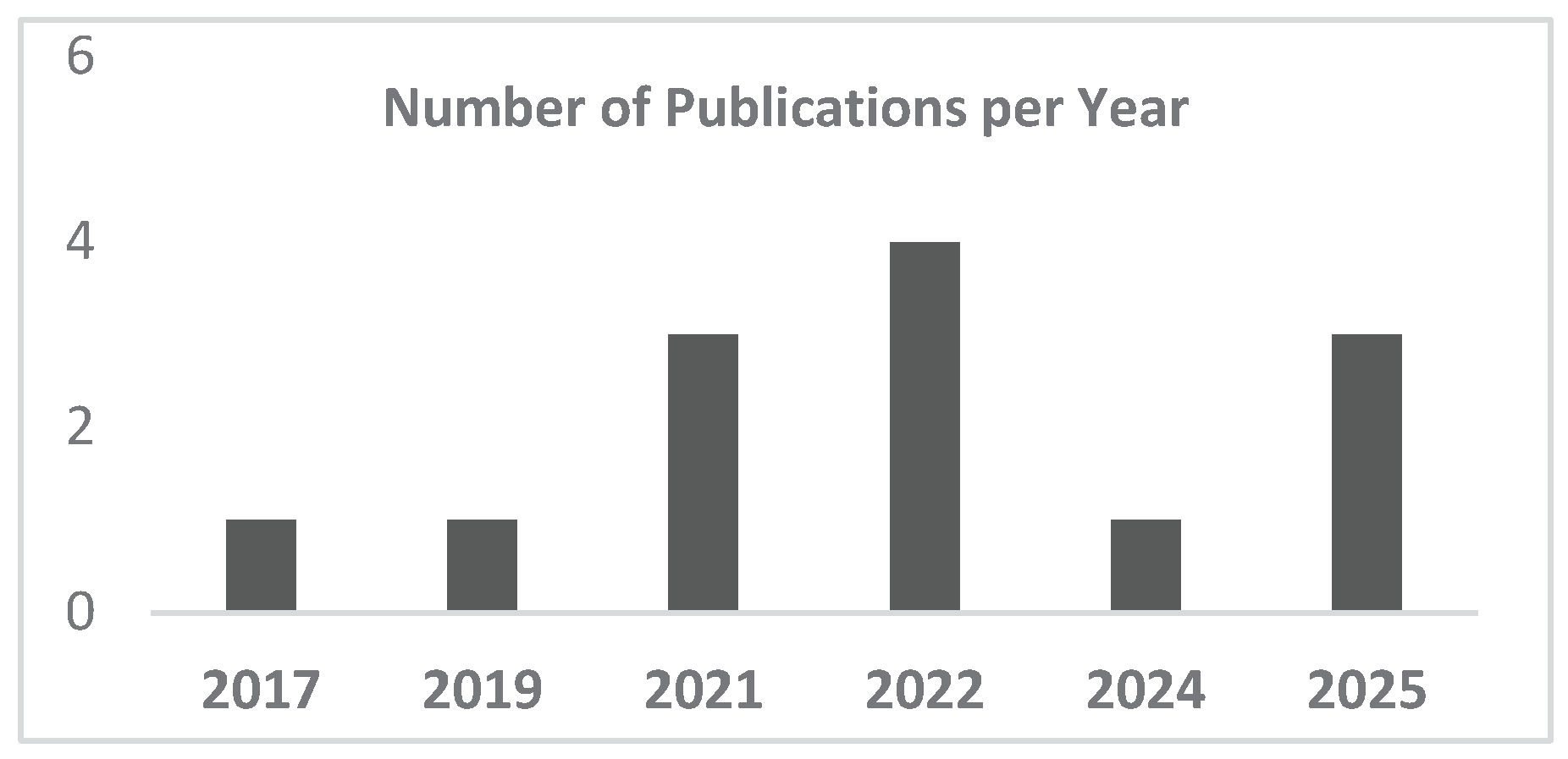
Figure 2.
Experimental Methodology.
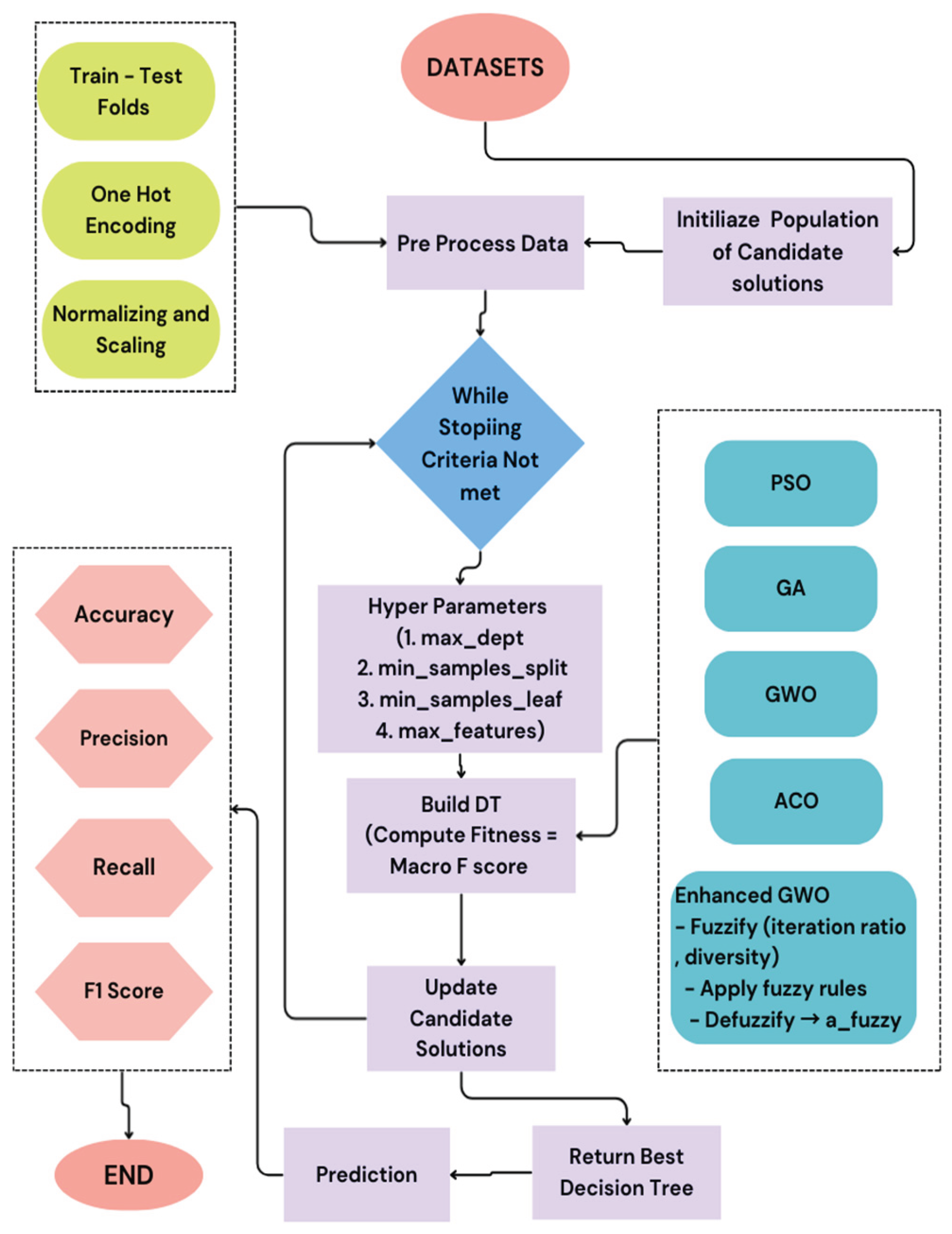
Figure 13.
Boxplot of Burns Dataset.
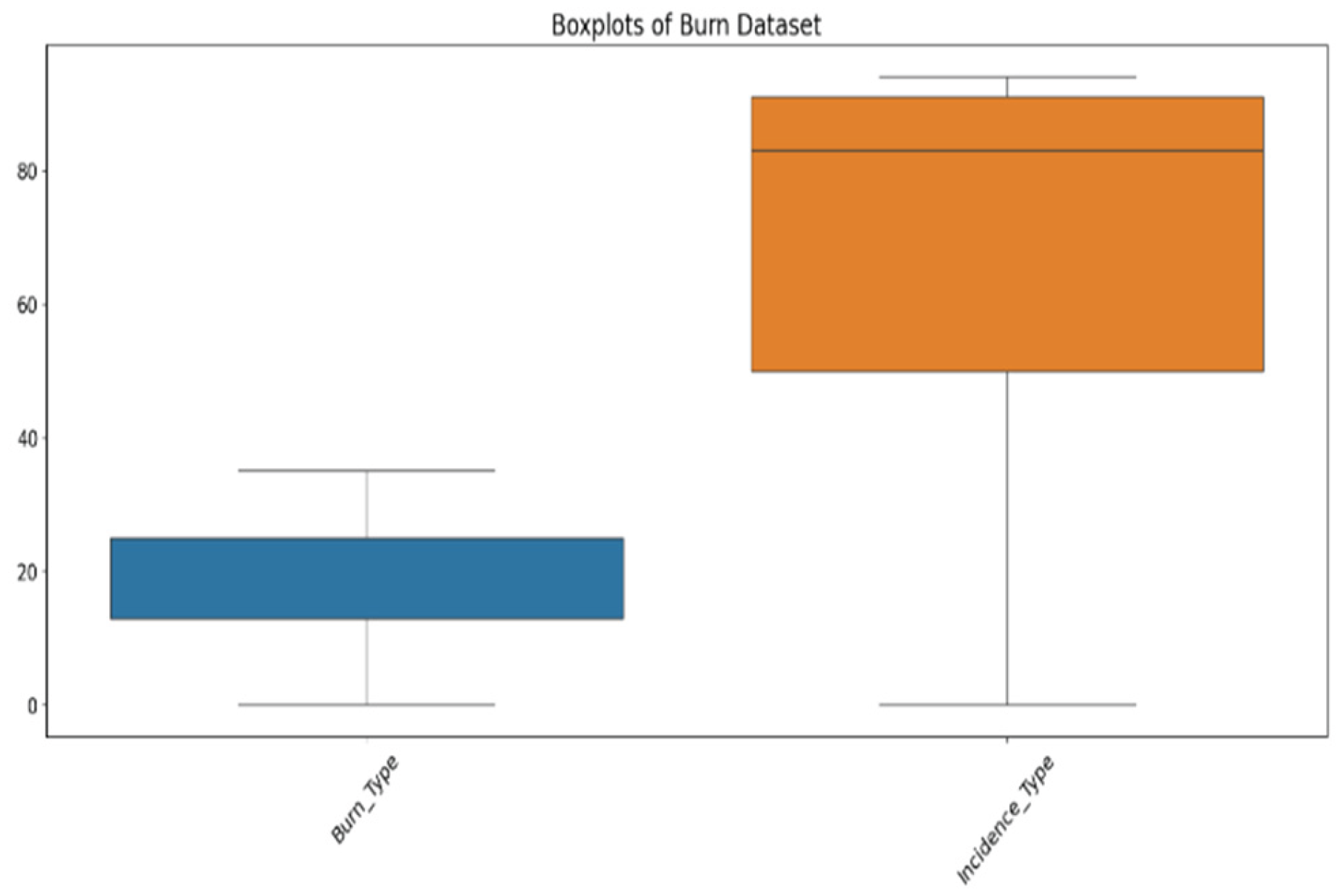
Figure 14.
Boxplot of Cancer Dataset.
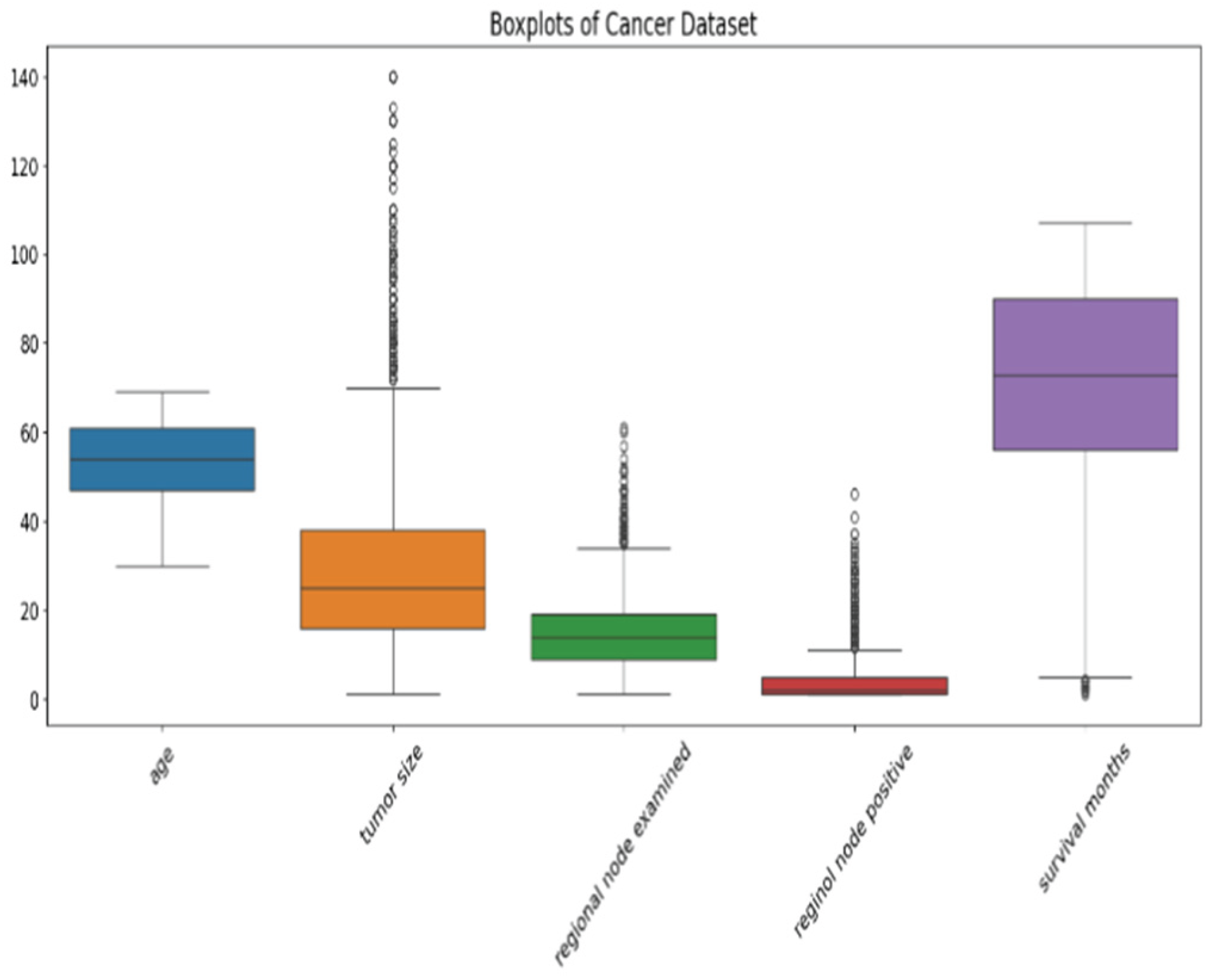
Figure 15.
Boxplot of Diabetes Dataset.
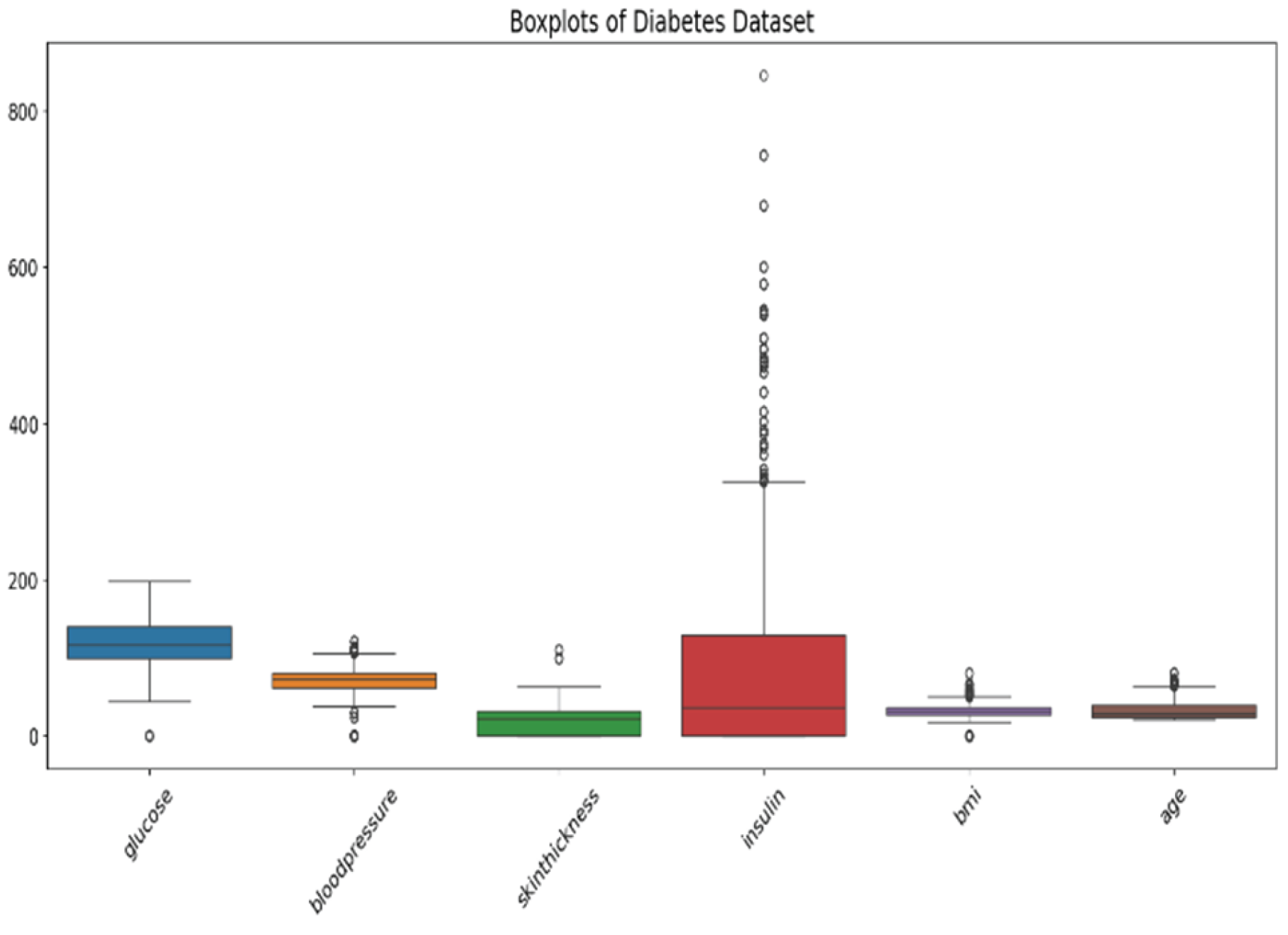
Figure 16.
Boxplot of Sepsis Dataset.
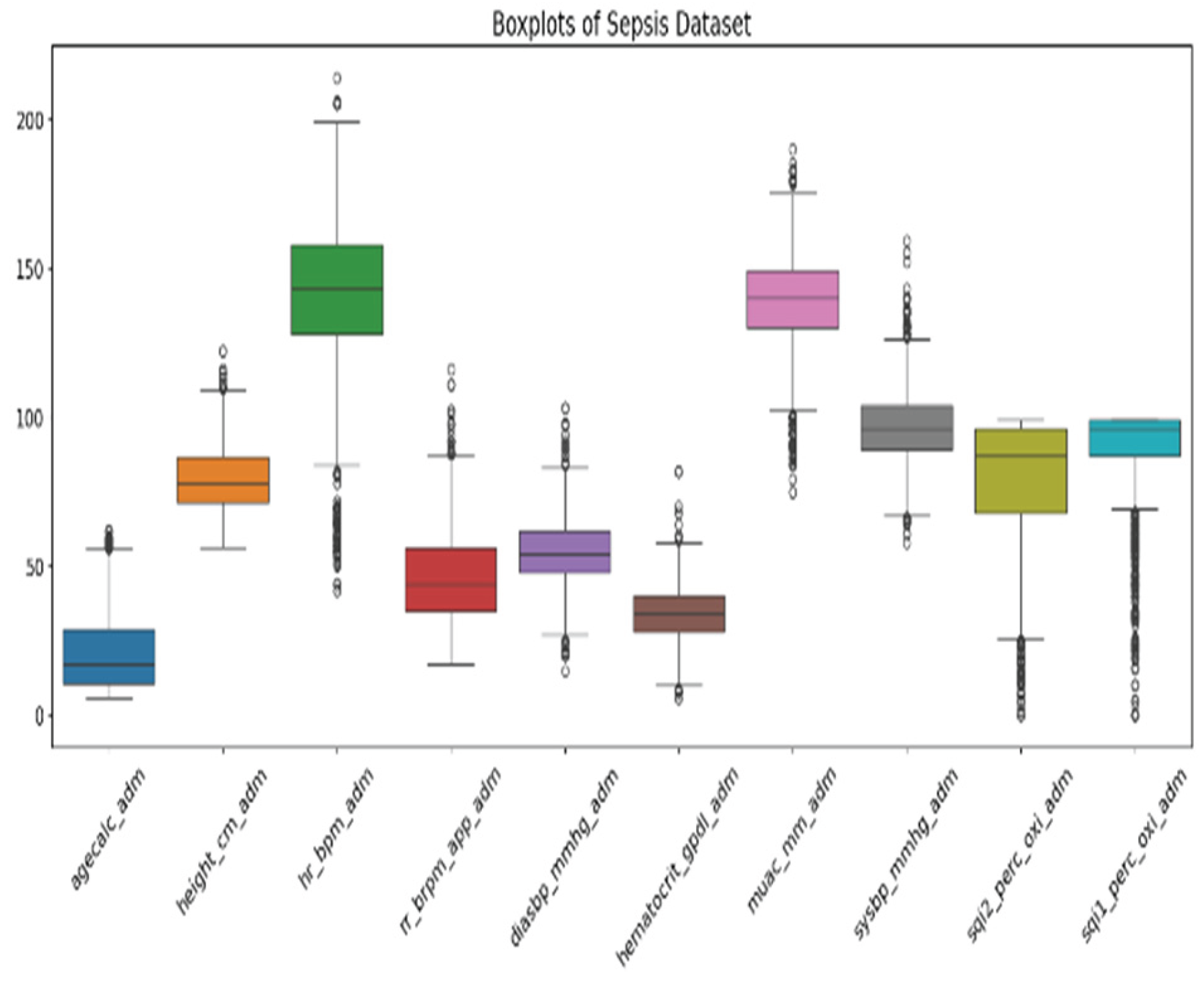
Figure 17.
Boxplot of heart attack dataset.
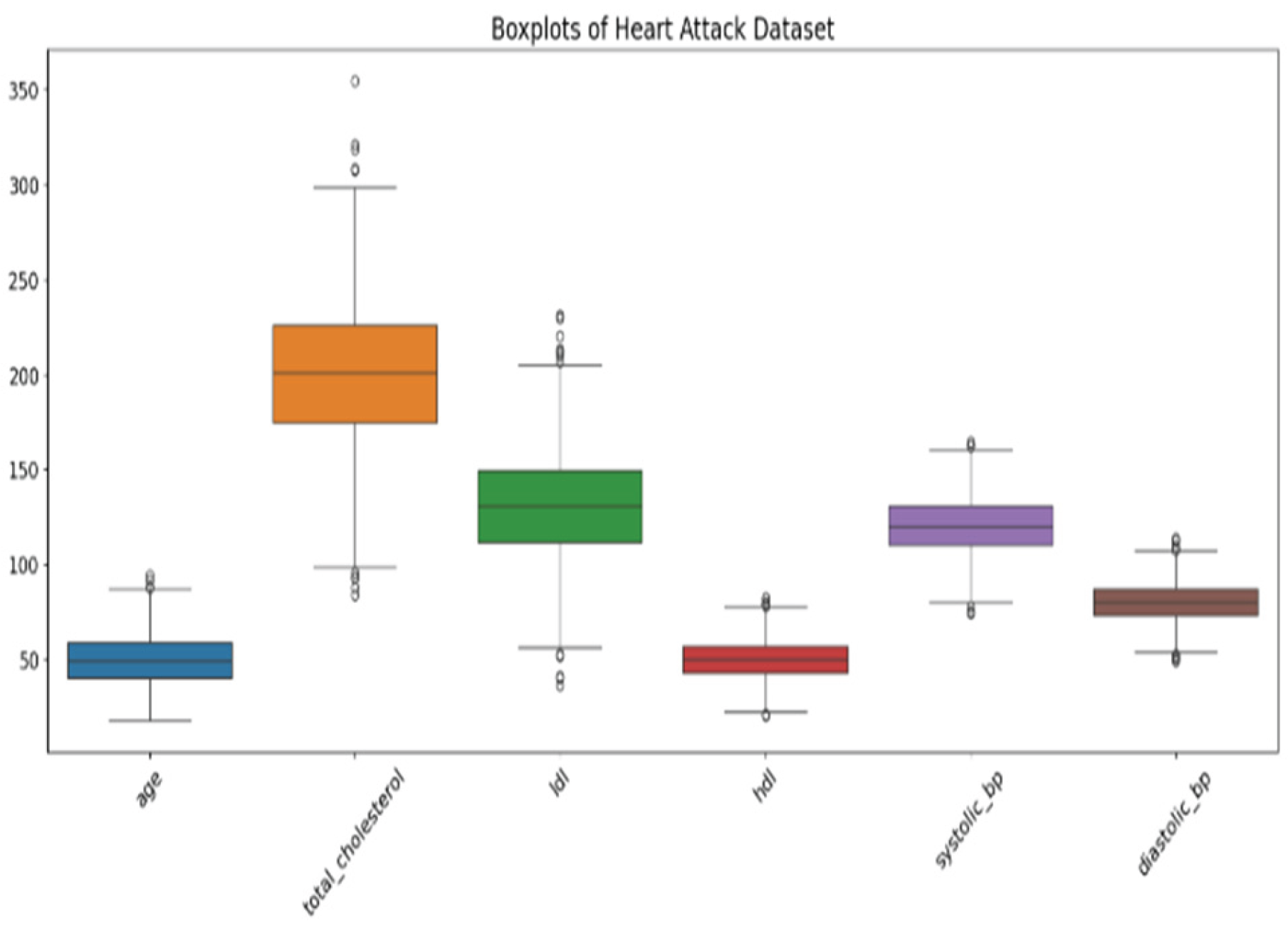
Figure 18.
Performance of Burns Dataset.
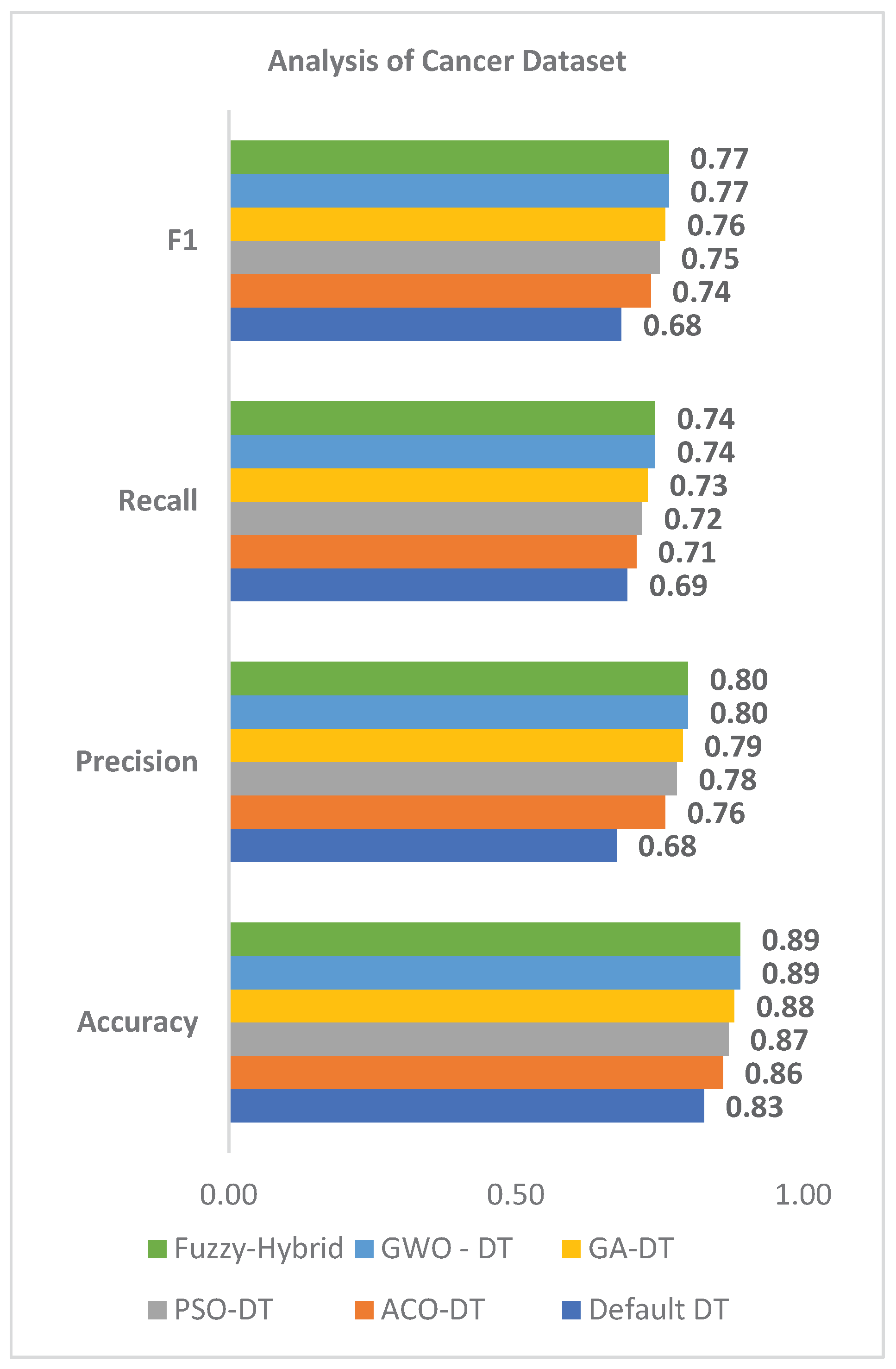
Figure 19.
Performance for Cancer Dataset.
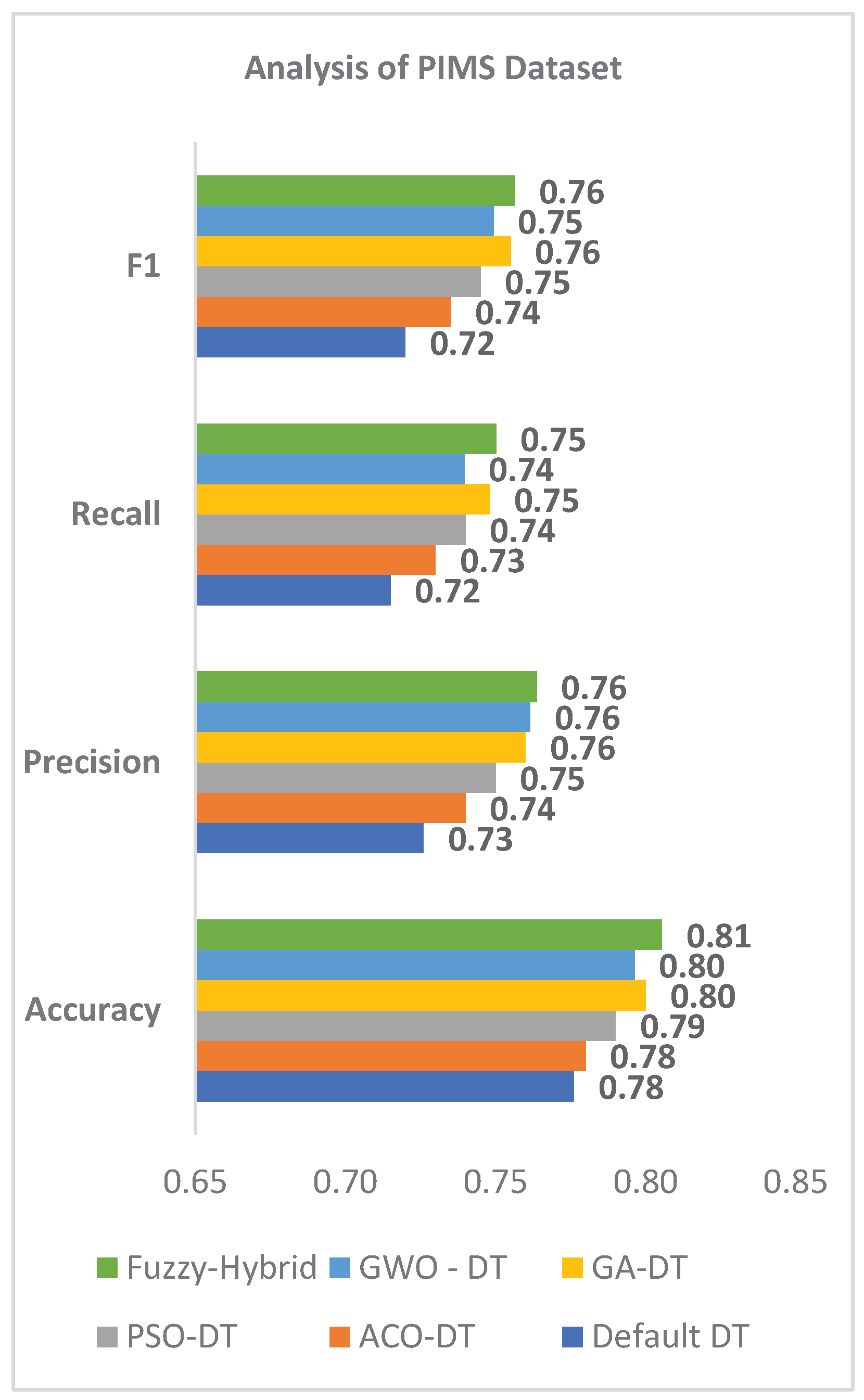
Figure 20.
Performance Comparison for Diabetes Dataset.
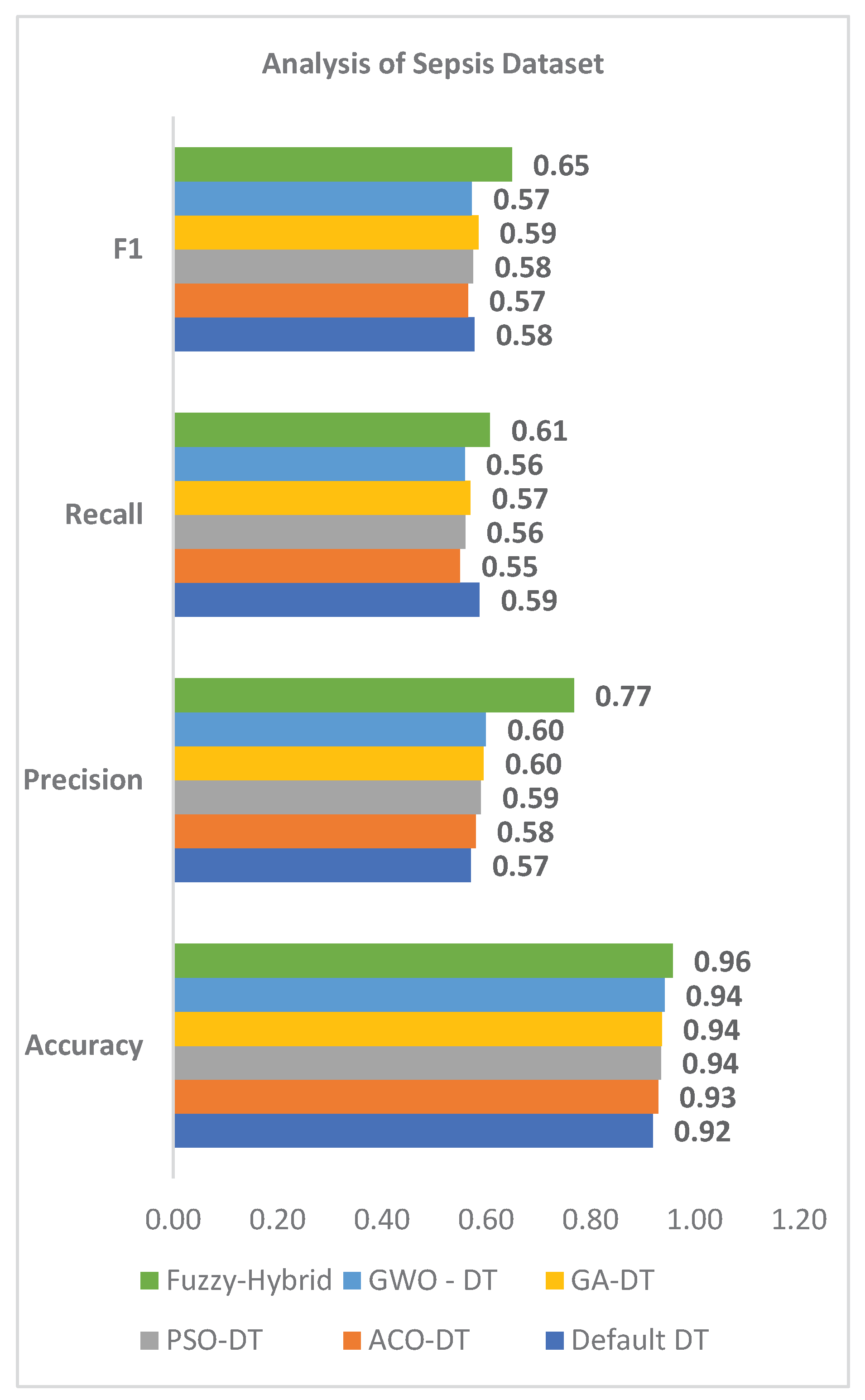
Figure 21.
Performance for Sepsis Dataset.
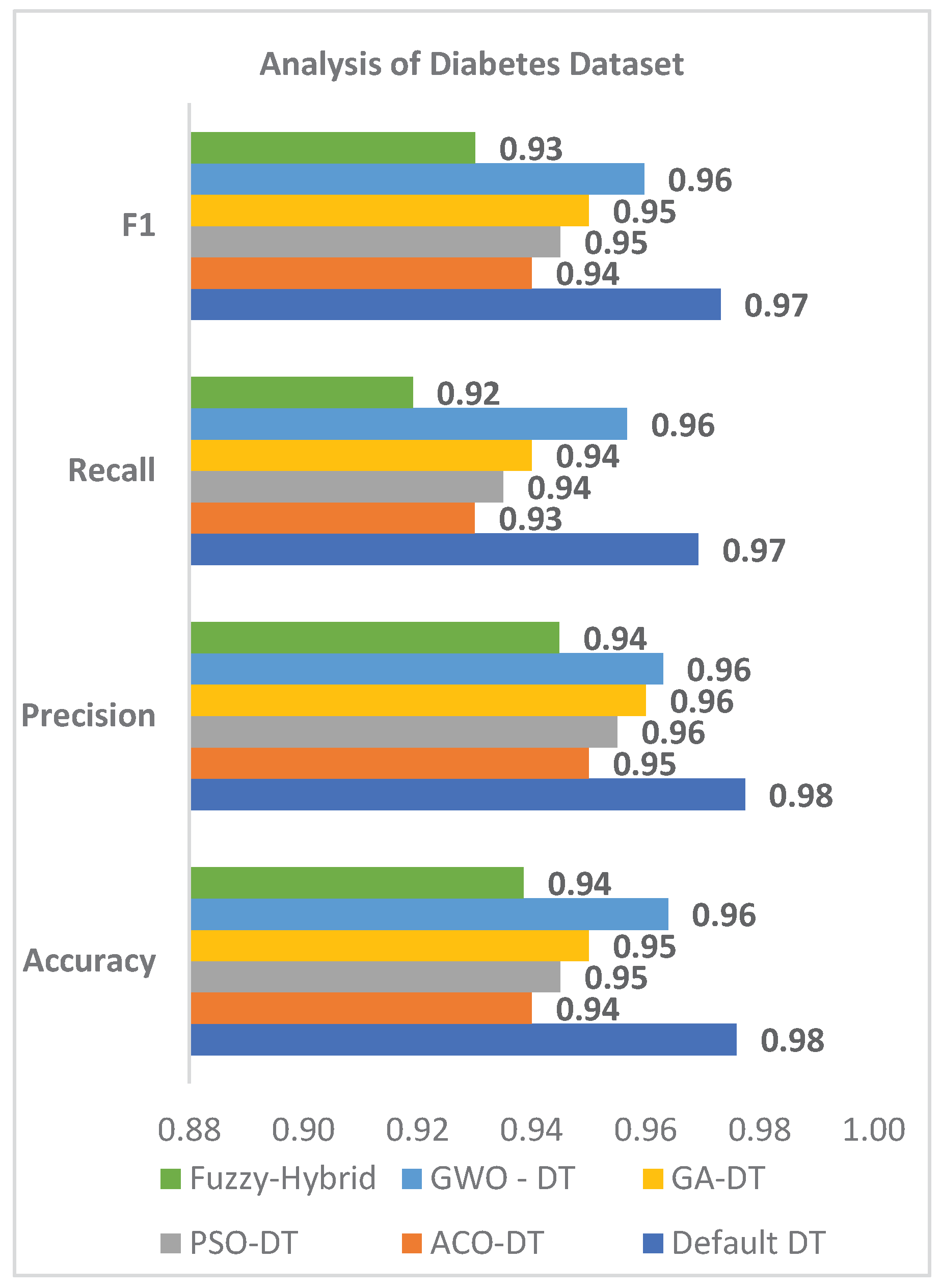
Figure 22.
Performance for Heart Attack Dataset.
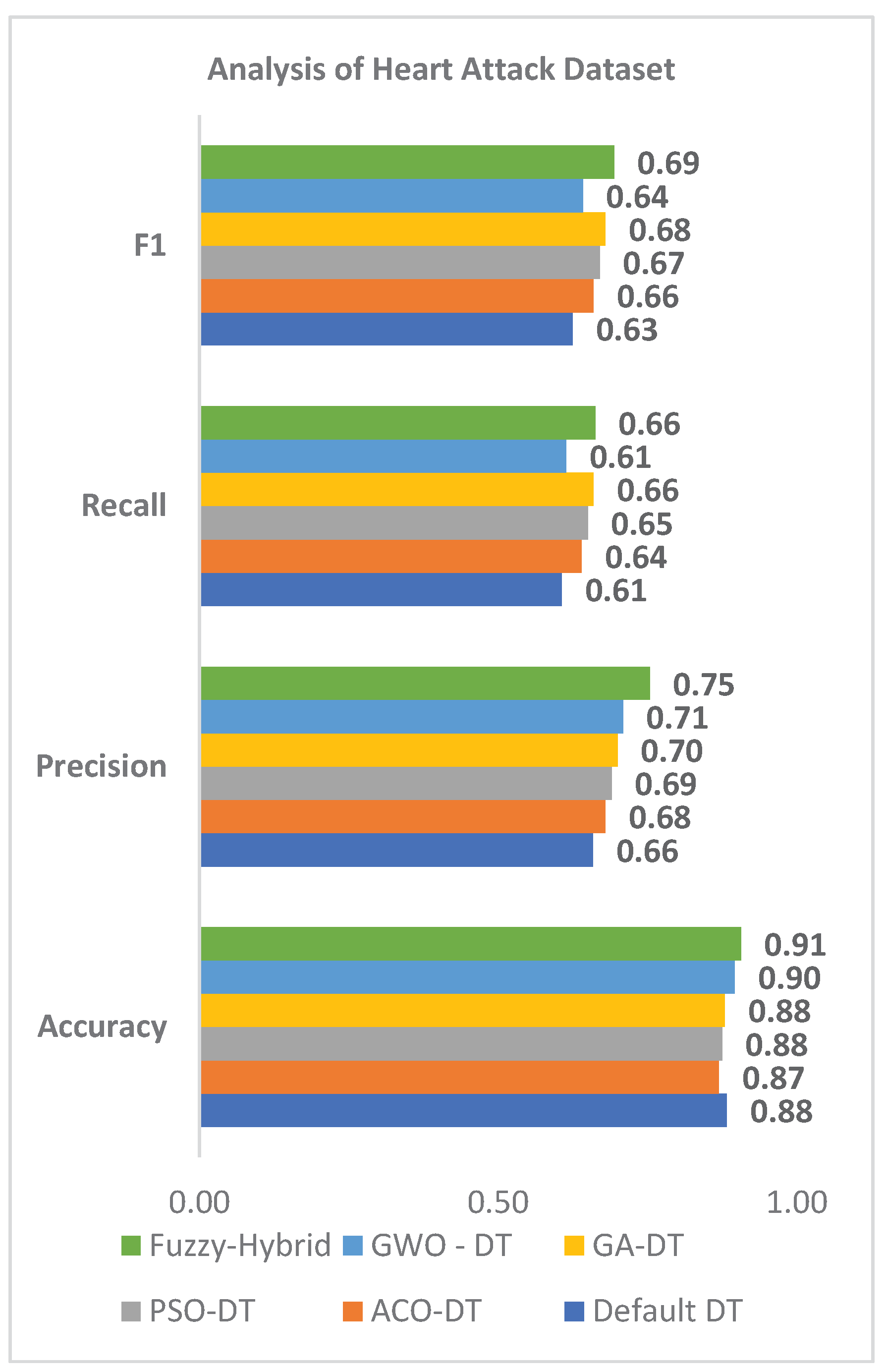
Figure 23.
F1 Scores across all datasets.
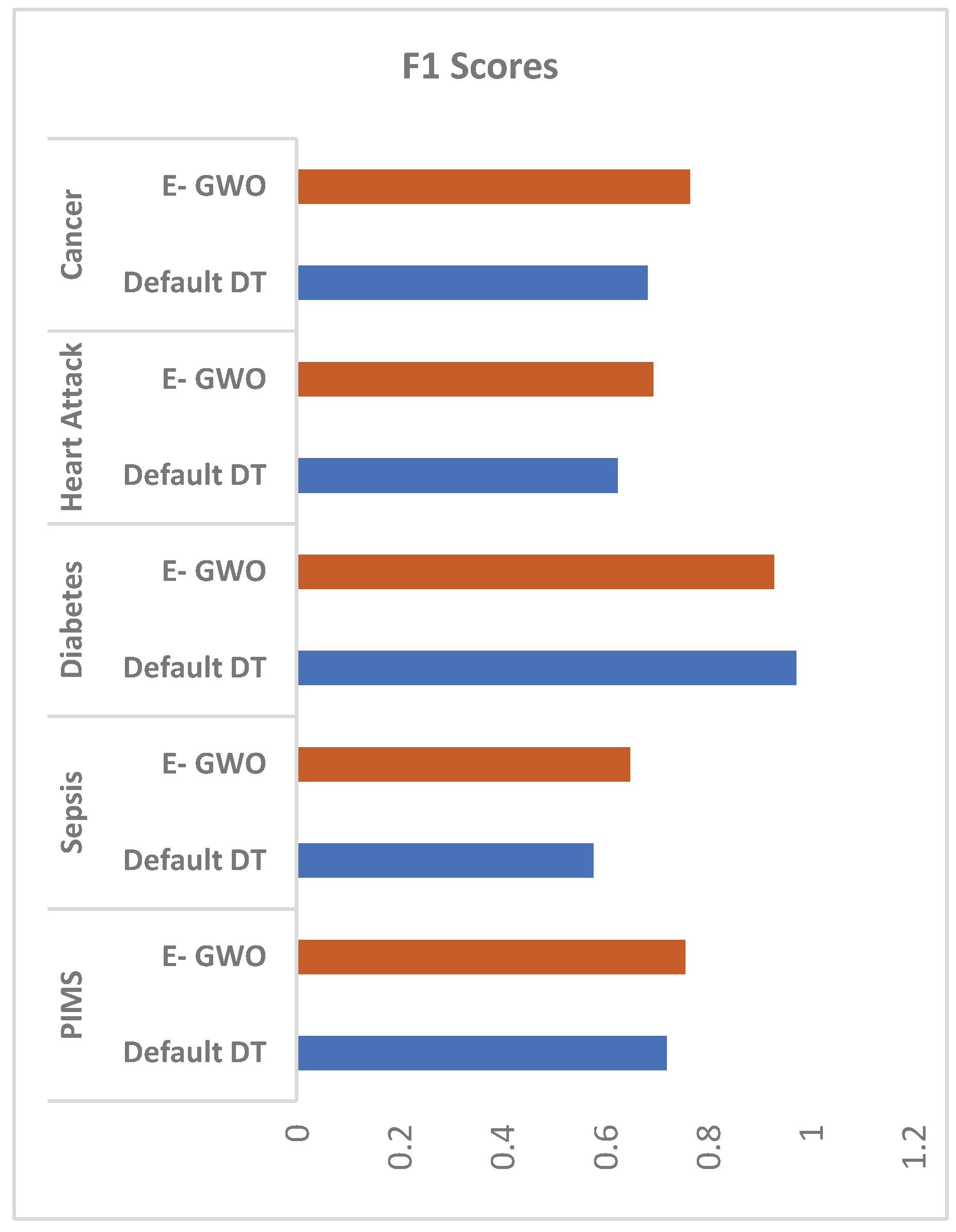
Table 1.
Pseudocode of Genetic Algorithm.
|
Procedure Genetic Algorithm (maxgen) Initialize population with random solutions Evaluate fitness of the solutions Generation = 1 While (Generation < maxgen) Select good solutions by parent selection Perform crossover Perform mutation Evaluate the newly generated solutions Select the best individuals Generation = Generation + 1 End while End Procedure |
Table 2.
Pseudocode of Ant Colony Optimization.
|
Procedure AntColonyOptimization(maxiter) Initialize population of ants iter = 1 While (iter < maxiter) For each ant do Choose next position using state transition Apply pheromone update End for Update best solution Update pheromone and intensity trail iter = iter + 1 End while End Procedure |
Table 3.
Pseudocode of Particle Swarm Optimization.
|
Procedure ParticleSwarmOptimization(maxiter) Initialize population of particles Initialize position and velocity of each particle Evaluate fitness of each particle iter = 0 While (iter < maxiter) Update velocity and position of each particle Velocity Update Equation Vi = w * Vi + c1 * r1 * (Pi - Xi) + c2 * r2 * (Globalbest - Xi) Position Update Xi = Xi + Vi Evaluate fitness f(Xi) If f(Xi) better than f(Pi): Pi = Xi Globalbest = best Pi among all particles iter = iter + 1 End while Return Globalbest End Procedure |
Table 4.
Pseudocode of Grey Wolf Optimization.
|
Procedure GreyWolfOptimizer(maxiter) Initialize grey wolf population Xi (i = 1, 2, ... , n) Initialize a, A1, A2, A3, C1, C2, C3 vectors Calculate fitness of each search agent Xα = best agent position Xβ = second best agent position Xγ = third best agent position t = 1 While (t < maxiter) For each search agent do Update position of the current agent End for Update a, A, and C using Eq. (2.3 & 2.4) Calculate fitness of all search agents Update Xα, Xβ, and Xγ using Eq. (2.1 & 2.2) t = t + 1 End while Return Xα End Procedure |
Table 5.
Systematic and Summarized Literature for Grey Wolf optimized DTs.
| S. N. | Reference | Algorithm / Method | Performance | Contribution |
|---|---|---|---|---|
| 1 | (Rodríguez et al., 2017) | Fuzzy Hierarchical GWO | Fuzzy variants outperformed standard GWO | Introduced hierarchical operator; fuzzy logic improved GWO convergence |
| 2 | (G. & K., 2019) | GWO + Fuzzy Rules for Diabetes Diagnosis | Higher accuracy than ACO ( >71% baseline ) | Optimized fuzzy rules globally using GWO; improved medical classification |
| 3 | (Hafeez et al., 2021) | DT + Tabu Search | 98% accuracy | Enhanced entropy balancing and rule performance |
| 4 | (Hernández et al., 2021) | C4.5 DT Variants | Performance-ranked | First ranking over 21 evaluation measures |
| 5 | (Negi et al., 2021) | GWO | Theoretical analysis | Suggested future multi-objective and binary GWO |
| 6 | (Chakraborty, Kishor, & Rodrigues, 2022) | E-GWO + Ensemble Classifiers | 99.26% accuracy (11.9% improvement) | Developed hybrid bagging/boosting classifiers |
| 7 | (Dada et al., 2022) | GWO and Variants | Review-based | Provided robust GWO variant development insights |
| 8 | (El-Shafiey, Hagag, El-Dahshan, & Ismail, 2022) | GAPSO-RF | 46.15% feature reduction | Hybrid GA-PSO for robust feature selection |
| 9 | (Game, Vaze, & Emmanuel, 2022) | DGWO + DT + SVM | Outperformed Firefly, ABC, PSO, GA, GWO | DT rule optimization with MapReduce and PCA |
| 10 | (Liu, As’arry, Hassan, Hairuddin, & Mohamad, 2024) | Parallel, Hybrid, Modified GWO | Theoretical categorization | Classified GWO variants and mapped applications |
| 11 | (Maleki, Roayaei, & Mirjalili, 2025) | Reinforcement Learning–GWO (RL-LGWO) | Best solutions on 17/23 functions; top on 10/12 CEC2022 tests | Integrated multi-agent RL to adapt leader updates and prevent stagnation |
| 12 | (Priyadarshi et al., 2025) | Hybrid GWO–FLC for PV MPPT | Zero oscillations, fast convergence, high accuracy | Removed δ and Ψ wolves; optimized fuzzy parameters for efficient MPPT |
| 13 | (Sam’an, Farikhin, & Munsarif, 2025) | MGWO with Lévy Flight | MGWO (0.8498), GWO (0.8373), GA (0.8492) | Demonstrated superior classification accuracy |
Table 6.
Summarized Literature Review.
| Ref | Algo | Dataset | D | M |
| (G. & K., 2019) | Fuzzy GWO | Diabetes | No | No |
| (Game et al., 2022) | D-GWO | Heart Disease | Yes | No |
| (Chakraborty et al., 2022) | E-GWO | Heart Disease | No | No |
| (Sam’an et al., 2025) | M-GWO | Diabetes, Heart | Yes | partial |
| Proposed | Enhanced GWO–DT | 5 datasets | Yes | Yes |
Table 7.
E-GWO Module 1.
|
Module 1: Fuzzify Inputs • Define membership functions (MFs): – iteration_ratio: triangular MFs → {low, medium, high} – diversity: trapezoidal MFs → {low, medium, high} – exploration_weight (output): triangular MFs → {weak, moderate, strong} • Fuzzify continuous inputs: – Compute iteration_ratio = t / max_iter – Compute diversity = std deviation of all Xi positions • Map inputs to fuzzy terms using the defined MFs: – iteration_ratio → {low, medium, high} – diversity → {low, medium, high} |
Table 8.
E-GWO Module 2.
|
Module 2: Apply fuzzy rules: R1: if iteration_ratio is low AND diversity is high → exploration_weight = strong R2: if iteration_ratio is medium AND diversity is high → exploration_weight = strong R3: if iteration_ratio is low AND diversity is medium → exploration_weight = strong R4: if iteration_ratio is medium AND diversity is medium → exploration_weight = moderate R5: if iteration_ratio is high AND diversity is medium → exploration_weight = moderate R6: if iteration_ratio is high AND diversity is low → exploration_weight = weak R7: if iteration_ratio is medium AND diversity is low → exploration_weight = weak |
Table 9.
E-GWO Module 3.
|
Module 3: Defuzzify Convert the inferred exploration_weight into a crisp value: Apply centroid defuzzification to obtain a_fuzzy a_fuzzy = crisp adaptive control parameter |
Table 10.
Pseudocode of Enhanced GWO.
|
Begin Initialize the grey wolf population Xi (i = 1, 2, …, n) Initialize algorithm parameters t = 1 while (t ≤ max_iter) do diversity = standard deviation of all Xi positions iteration_ratio = t / max_iter Module 1 Module 2 Module 3 For each Xi in the population do Generate r1, r2 ∈ [0, 1] Compute adaptive coefficients: A1 = 2 * a_fuzzy * r1 – a_fuzzy C1 = 2 * r2 A2 = 2 * a_fuzzy * r1 – a_fuzzy C2 = 2 * r2 Compute distances to leading wolves: Dα = |C1 * Xα – Xi| Dβ = |C2 * Xβ – Xi| Compute candidate positions: X1 = Xα – A1 * Dα X2 = Xβ – A2 * Dβ Update agent position: Xi(t+1) = (X1 + X2) / 2 End for Compute fitness f(Xi) for all wolves Update Xα (best) and Xβ (second best) If f(Xα) is better than bestfitness then bestfitness = f(Xα) bestposition = Xα End if t = t + 1 end while Return bestfitness, bestposition End |
Table 12.
Structure OF datasets.
| Dataset | Final Shape | Class Imbalance | Source |
|---|---|---|---|
| Burn | 2,842 x 6 | 1 -71.3% 0 - 28.7% |
Pims |
| Cancer | 4,024 x 16 | 1- 84.7% 0 - 15.3% |
(Reihaneh Namdari, 2022) |
| Diabetes | 2,768 x 10 | 1- 65.6% 0 - 34.4% |
(Akshay Dattatray Khare, 2022) |
| Sepsis | 2,686 x 40 | 1- 95.6% 0- 4.4% |
(Charly Huxford, Alireza Rafiei, & Rishikesan Kamaleswaran 11, 2021) |
| Heart Attack | 1,0000 x 10 | 1-89.6% 0 - 10.4% |
(Juled Zaganjori, 2023) |
Table 13.
Comparison of Fuzzy Membership Functions.
| Dataset | Model | Accuracy | Precision | Recall | F1 |
|---|---|---|---|---|---|
| PIMS | Fuzzy w/o Delta | 0.8089 | 0.7619 | 0.7500 | 0.7591 |
| Fuzzy-Triangular | 0.8021 | 0.7611 | 0.7412 | 0.7523 | |
| Fuzzy-Trapezoidal | 0.8031 | 0.7609 | 0.7461 | 0.7527 | |
| Fuzzy-Hybrid | 0.8154* | 0.7637* | 0.7502 | 0.7663** | |
| Fuzzy-Gaussian | 0.8007 | 0.7577 | 0.7444 | 0.7504 | |
| Fuzzy-Generalized-Bell | 0.8039 | 0.7511 | 0.7234 | 0.7421 | |
| Sepsis | Fuzzy w/o Delta | 0.9441 | 0.7012 | 0.6095 | 0.6412 |
| Fuzzy-Triangular | 0.9541 | 0.7197 | 0.6185 | 0.6518 | |
| Fuzzy-Trapezoidal | 0.9479 | 0.6476 | 0.5755 | 0.5976 | |
| Fuzzy-Hybrid | 0.9578** | 0.768* | 0.6272* | 0.6691** | |
| Fuzzy-Gaussian | 0.9516 | 0.6617 | 0.551 | 0.5726 | |
| Fuzzy-Generalized-Bell | 0.9529 | 0.6799 | 0.5517 | 0.5748 | |
| Diabetes | Fuzzy w/o Delta | 0.935 | 0.9313 | 0.9239 | 0.9274 |
| Fuzzy-Triangular | 0.9398 | 0.9375 | 0.9284 | 0.9327 | |
| Fuzzy-Trapezoidal | 0.9243 | 0.9215 | 0.9069 | 0.9191 | |
| Fuzzy-Hybrid | 0.9386* | 0.9348*** | 0.9191** | 0.9301** | |
| Fuzzy-Gaussian | 0.9123 | 0.9247 | 0.9239 | 0.9229 | |
| Fuzzy-Generalized-Bell | 0.9186 | 0.9338 | 0.8991 | 0.8901 | |
| Heart Attack | Fuzzy w/o Delta | 0.8933 | 0.703 | 0.6551 | 0.6744 |
| Fuzzy-Triangular | 0.8933 | 0.703 | 0.6251 | 0.6444 | |
| Fuzzy-Trapezoidal | 0.8857 | 0.714 | 0.6217 | 0.6492 | |
| Fuzzy-Hybrid | 0.8967* | 0.7039 | 0.6325** | 0.6545* | |
| Fuzzy-Gaussian | 0.8957 | 0.711 | 0.6284 | 0.6355 | |
| Fuzzy-Generalized-Bell | 0.8767 | 0.654 | 0.6316 | 0.6414 | |
| Cancer | Fuzzy w/o Delta | 0.8957 | 0.8299 | 0.7259 | 0.7629 |
| Fuzzy-Triangular | 0.8957 | 0.8299 | 0.7259 | 0.7629 | |
| Fuzzy-Trapezoidal | 0.894 | 0.8304 | 0.716 | 0.755 | |
| Fuzzy-Hybrid | 0.8899* | 0.8194 | 0.7424** | 0.766* | |
| Fuzzy-Gaussian | 0.8699 | 0.7494 | 0.7124 | 0.756 | |
| Fuzzy-Generalized-Bell | 0.8799 | 0.7794 | 0.7238 | 0.744 |
* = 0.10 Significance Level, ** = 0.5 Significance Level, *** 0.01 Significance level.
Disclaimer/Publisher’s Note: The statements, opinions and data contained in all publications are solely those of the individual author(s) and contributor(s) and not of MDPI and/or the editor(s). MDPI and/or the editor(s) disclaim responsibility for any injury to people or property resulting from any ideas, methods, instructions or products referred to in the content. |
© 2026 by the authors. Licensee MDPI, Basel, Switzerland. This article is an open access article distributed under the terms and conditions of the Creative Commons Attribution (CC BY) license (http://creativecommons.org/licenses/by/4.0/).
Copyright: This open access article is published under a Creative Commons CC BY 4.0 license, which permit the free download, distribution, and reuse, provided that the author and preprint are cited in any reuse.