

Submitted:
21 September 2026
Posted:
22 September 2026
You are already at the latest version
Abstract
Green energy vehicles (GEVs) are increasingly central to low-carbon energy transitions, but research remains fragmented across vehicle technologies, battery systems, critical materials, circularity, and sustainable supply chains. This bibliometric and thematic review maps the intellectual structure and evolution of GEV research using 904 English-language Scopus articles and reviews published during 2015–2025. Performance analysis, reference co-citation, author–keyword co-occurrence, longitudinal thematic analysis, and cluster-guided content synthesis were combined. The corpus accumulated 34,955 citations, and annual output rose from 13 publications in 2015 to 287 in 2025 (CAGR ≈ 36.3%). The intellectual base is strongly battery-centered, linking critical-material bottlenecks, recycling, second-life use, closed-loop systems, and circular business models. Six research streams were identified, spanning supply-chain and policy optimization, circular economy, critical-mineral security, battery life-cycle assessment, low-carbon mobility, and closed-loop recovery. Circular-economy and sustainable-supply-chain themes became markedly more prominent after 2019, while critical-mineral security regained attention in 2022–2025. The international dimension is framed primarily through material sourcing, battery value chains, resilience, and cross-border circularity. The study proposes a technology–resources–energy systems–governance–sustainability framework and priorities for integrating bibliometrics with energy-system, material-flow, trade, and geopolitical-risk data.
Keywords:
green energy vehicles
; energy transition
; battery systems
; critical minerals
; circular economy
; sustainable supply chains
1. Introduction
The global energy transition is increasingly intertwined with the electrification and decarbonization of transport. Electric vehicles, battery electric vehicles, fuel-cell vehicles, and other green energy vehicles (GEVs) are not merely substitutes for internal-combustion technologies; they are increasingly embedded within low-carbon energy systems that connect transport demand with electricity generation, energy storage, hydrogen pathways, critical-material supply, and infrastructure investment. As GEV deployment accelerates, the sustainability of this transition depends on interactions among vehicle technologies, upstream energy and material systems, and downstream recovery and circularity.
This transformation has generated a rapidly expanding but fragmented body of research. GEV scholarship spans energy systems, battery engineering, industrial ecology, transportation, operations and supply-chain management, environmental assessment, public policy, and international business. Consequently, vehicle technologies, battery and energy-storage systems, critical-mineral dependence, circular-economy strategies, sustainable supply chains, and energy-transition outcomes are frequently examined in isolation. The field therefore lacks an integrated account of how these dimensions constitute a shared knowledge structure and how their relative prominence has evolved over time.
Critical materials and sustainable supply chains are especially important from an energy-transition perspective. Olivetti et al. [1] demonstrated that battery expansion may be constrained by bottlenecks in critical metals, while Jones et al. [2] showed how electric-vehicle diffusion can reshape demand for critical raw materials. At the same time, recycling, second-life use, remanufacturing, and closed-loop systems have become increasingly important for reducing dependence on primary materials and mitigating life-cycle impacts. These interdependencies imply that GEV sustainability cannot be evaluated solely in terms of tailpipe emissions or vehicle efficiency; it must also account for energy inputs, battery-material security, circularity, and the resilience of the supply systems that enable electrified mobility.
Bibliometric analysis is well suited to this multidisciplinary and rapidly expanding domain because it combines performance indicators with science-mapping techniques to reveal productivity, influence, collaboration patterns, intellectual foundations, conceptual structures, and thematic change. When complemented by cluster-guided content synthesis, bibliometric analysis can move beyond descriptive publication counts to examine how technological, resource, energy-system, governance, and sustainability concerns become connected within a research field. This approach is therefore appropriate for assessing the evolution of GEV scholarship within the broader context of the global energy transition.
This study makes four contributions. First, it provides a reproducible bibliometric profile of GEV research at the intersection of energy transition, critical materials, sustainable supply chains, and circularity across the complete 2015–2025 publication window. Second, it identifies the field’s intellectual foundations through reference co-citation analysis and its contemporary conceptual structure through author–keyword co-occurrence mapping. Third, it traces longitudinal shifts in the relative prominence of major research streams, showing how circular-economy, supply-chain, and critical-material concerns have become increasingly central to the energy-transition agenda. Fourth, it develops an integrative technology–resources–energy systems–governance–sustainability framework and derives a future research agenda linking bibliometric evidence with energy-system, material-flow, geopolitical, and cross-border circularity research.
Accordingly, the study addresses the following research questions:
- RQ1. How did the publication and citation profile of GEV research at the intersection of energy transition, critical materials, sustainable supply chains, and sustainability evolve between 2015 and 2025?
- RQ2. Which journals, authors, countries/regions, and documents are the most prominent components of this research landscape?
- RQ3. Which intellectual and conceptual clusters structure the field according to reference co-citation and author–keyword co-occurrence analyses?
- RQ4. How have the major research themes evolved over time, and which research gaps emerge at the intersection of GEV technology, critical materials, energy systems, sustainable supply chains, and sustainability?
2. Materials and Methods
2.1. Research Design
This study adopts an integrated bibliometric-review design that combines performance analysis, science mapping, longitudinal thematic analysis, and cluster-guided content synthesis. Performance analysis quantifies scientific output and citation impact, whereas science mapping examines relational structures among countries, keywords, and cited references [3]. This two-layer design is extended through structured content interpretation so that network clusters are not treated as self-explanatory. Cluster labels and substantive implications are instead derived from dominant terms, highly cited documents, and frequently co-cited references, following the broader logic used by Qin et al. [4] to move from bibliometric mapping to thematic synthesis.
2.2. Data Source and Search Strategy
Scopus (Elsevier B.V., Amsterdam, The Netherlands) was selected because the analysis required standardized bibliographic metadata, cited-reference fields, author keywords, affiliations, document types, and citation counts across engineering, energy, environmental, transportation, and management journals. The final search was conducted on 2 September 2026. Restricting the publication window to 2015–2025 ensured coverage of complete publication years and avoided treating the incomplete 2026 publication year as directly comparable with earlier years. The retrieval protocol and dataset definition are summarized in Table 1.
Final Scopus query:
TITLE-ABS-KEY ((“electric vehicle*” OR “battery electric vehicle*” OR “plug-in hybrid electric vehicle*” OR “fuel cell vehicle*” OR “hydrogen vehicle*” OR “zero-emission vehicle*” OR “zero emission vehicle*” OR “green vehicle*” OR “clean energy vehicle*” OR “new energy vehicle*” OR “electric mobility” OR “e-mobility”) AND (“international trade” OR “global trade” OR “foreign trade” OR “cross-border trade” OR “trade polic*” OR “trade barrier*” OR “trade flow*” OR “trade pattern*” OR “trade competitiv*” OR “export market*” OR “export competitiv*” OR “global value chain*” OR “international value chain*” OR “global supply chain*” OR “international supply chain*” OR “supply chain*” OR “automotive supply chain*” OR “electric vehicle supply chain*” OR “battery supply chain*” OR export* OR import OR imports OR imported OR importing OR importation) AND (sustainab* OR decarbonization OR decarbonisation OR “energy transition” OR “low-carbon transition” OR “low carbon transition” OR “carbon emission*” OR “circular economy” OR “energy conservation”)) AND PUBYEAR > 2014 AND PUBYEAR < 2026 AND LIMIT-TO(LANGUAGE,”English”) AND (LIMIT-TO(DOCTYPE,”ar”) OR LIMIT-TO(DOCTYPE,”re”)).
The query comprises three concept blocks: (A) GEV technology and mobility terms; (B) trade, value-chain, and supply-chain terms; and (C) sustainability and energy-transition terms. This structure captures the international and supply-system dimensions of GEV research while maintaining a direct connection to low-carbon energy and sustainability. Accordingly, trade-related terms are interpreted as indicators of scholarship on value chains, sourcing, resilience, and cross-border organization rather than as direct measures of bilateral vehicle or battery trade.
2.3. Screening, Data Cleaning, and Reproducibility
The Scopus export contained 904 records. Data-integrity checks identified no duplicate Scopus EIDs, duplicate DOIs, or exact duplicate titles. All records contained abstracts; 16 lacked a DOI and six lacked cited-reference metadata. Because DOI availability was not an inclusion requirement, all 904 records were retained for performance and keyword analyses, while records without cited-reference fields did not contribute to the reference co-citation analysis. Author names were evaluated using Scopus full-name and author-ID strings to reduce ambiguity associated with initials. Country statistics were calculated using full counting, whereby a multinational publication contributes one publication to each represented country or region.
Author keywords were converted to lowercase, and spacing and punctuation were standardized. A limited thesaurus was then applied to unambiguous lexical variants; for example, “electric vehicle,” “EV,” and “EVs” were merged as “electric vehicles,” variants of “lithium ion battery” were merged as “lithium-ion batteries,” and “LCA” was merged as “life cycle assessment.” The thesaurus was deliberately restricted to lexical normalization and clear synonyms to avoid artificially combining conceptually distinct topics.
2.4. Performance Analysis and Science Mapping
Performance analysis used total publications (TP), total Scopus citations (TC), and average citations per publication (AC = TC/TP). Publication growth from 2015 to 2025 was summarized using the compound annual growth rate (CAGR). Because citation accumulation is strongly age-dependent, citation totals for recent publication years are interpreted as database-snapshot indicators rather than direct measures of research quality.
Science-mapping analyses were implemented in Python 3.13.5 using pandas 2.2.3, NetworkX 3.6.1 (open-source, [https://networkx.org] (https://networkx.org)), and Matplotlib 3.10.8 (open-source, [https://matplotlib.org] (https://matplotlib.org)). Country-collaboration links were created when at least two countries or regions appeared in the same publication. For author–keyword co-occurrence analysis, keywords occurring at least eight times were eligible for mapping, and links were retained when a pair co-occurred in at least two publications. Pairwise co-occurrence strength was normalized using an association-strength formulation based on observed joint occurrence relative to marginal occurrence frequencies, consistent with established bibliometric-mapping practice [5]. Louvain community detection was subsequently applied to identify densely connected keyword communities [6].
Reference co-citation analysis was constructed from the cited-reference field. References were standardized at the title level to reduce duplication arising from minor citation-format variations. The 40 most frequently cited references in the corpus were mapped, and co-citation links were retained when two references were cited together by at least three source documents. Community detection was then used to identify the principal intellectual foundations of the corpus. Cluster labels are interpretive and were assigned after examining the most frequently cited references within each community.
2.5. Longitudinal Thematic Analysis and Content Synthesis
To examine thematic evolution, the observation window was divided into three growth phases: 2015–2018, 2019–2021, and 2022–2025. These periods correspond to an early formation stage, an acceleration stage, and a recent high-growth stage evident in annual publication output. For each phase, the share of author–keyword occurrences assigned to each major keyword community was calculated. This procedure does not assume that themes are mutually exclusive at the document level; rather, it measures changes in the relative visibility of conceptual clusters within the vocabulary supplied by authors.
Finally, the quantitative clusters were interpreted through structured reading of dominant keywords, the most highly cited publications in the Scopus corpus, and the most frequently co-cited references. This content-synthesis layer is necessary because bibliometric maps reveal proximity and prominence but do not, on their own, explain causal mechanisms, policy relevance, or unresolved research questions [4].
2.6. Generative AI Assistance
OpenAI ChatGPT (GPT-5.6 Sol; OpenAI, San Francisco, CA, USA; accessed September 2026) was used as an assistive tool for manuscript language and structural editing, bibliographic-consistency checks, and drafting/checking the Python code used in data processing and visualization. The underlying Scopus bibliographic records were not generated or altered by generative AI. Analytical thresholds, numerical outputs, figures, and interpretations included in the manuscript were checked against the source dataset, and responsibility for the final analysis and text rests with the authors.
3. Results: Intellectual Landscape of GEV Research
3.1. Publication and Citation Dynamics
The final corpus comprises 904 publications with 34,955 citations recorded in Scopus, corresponding to an average of 38.67 citations per publication at the retrieval date of 2 September 2026. Annual publication output increased from 13 documents in 2015 to 287 in 2025, representing a CAGR of approximately 36.3% over the decade. Growth was nonlinear: output remained below 40 papers per year through 2020, increased to 74 in 2021 and 109 in 2022, and then accelerated to 123 in 2023, 186 in 2024, and 287 in 2025.
Citation totals exhibit a different temporal pattern because older publications have had more time to accumulate citations. Papers published in 2022 account for 6545 citations, whereas those published in 2025 account for 2618 citations despite a substantially larger publication volume. The lower average citation counts observed for the most recent years should therefore be interpreted primarily as a citation-window effect rather than evidence of declining research influence. Annual publication and citation trends are illustrated in Figure 1 and summarized in Table 2.
3.2. Leading Journals and Authors
The journal distribution confirms the field’s interdisciplinary character. Sustainability (Switzerland) published the largest number of papers in the corpus (52), followed by the Journal of Cleaner Production (47), Applied Energy (28), Resources, Conservation and Recycling (27), and Energies (27). Publication volume and citation impact, however, do not coincide. Among the ten most productive outlets, the International Journal of Hydrogen Energy records the highest average citation count (101.83), followed by Applied Energy (84.96), Renewable and Sustainable Energy Reviews (75.69), and Resources, Conservation and Recycling (69.11). The presence of environmental, energy, operations, and transportation journals indicates that GEV sustainability and supply-chain research spans multiple disciplinary communities. The ten most productive journals in the corpus are listed in Table 3.
At the author level, no individual scholar dominates the field by publication count, consistent with a broad multidisciplinary research front rather than a narrowly bounded specialty. Using Scopus full-name identifiers, Yuekuan Zhou is the most productive author in the dataset with six publications. Several authors—including Xianlai Zeng, Peng Wang, Alissa Kendall, Han Hao, Frank Schultmann, Murat Kucukvar, Yong Geng, Antonino Galati, and Maria Crescimanno—each contributed five publications. The relatively low maximum author output, despite rapid field-level growth, suggests that expansion has been driven by distributed participation across multiple research communities. The most productive authors based on Scopus full-name identifiers are presented in Table 4.
3.3. Country/Region Productivity and Collaboration
China is the largest contributor by publication volume, with 236 publications, followed by the United States (140), India (83), the United Kingdom (80), and Germany (66). Citation patterns differ from publication rankings: the United States accumulated 8414 citations, slightly exceeding China’s 8016 despite a smaller publication output, while the United Kingdom recorded the highest average citations per publication among the five most productive countries (60.65). These differences underscore the importance of distinguishing publication volume from accumulated citation influence. The top ten countries/regions by publication output are shown in Figure 2 and Table 5.
As depicted in Figure 3,the collaboration network indicates that the leading countries are connected through substantial international co-authorship rather than forming isolated national clusters. China, the United States, the United Kingdom, Germany, Australia, Canada, France, Italy, and several Asian economies are linked through multinational publications. Nevertheless, network centrality should not be interpreted as a proxy for merchandise trade: the map represents scientific collaboration among authors and institutions, not physical flows of vehicles, batteries, or minerals.
3.4. Highly Influential Documents
The most highly cited documents illuminate the problems that have shaped the field’s intellectual development. Olivetti et al.’s work [1], the leading document with 1415 citations, foregrounds potential critical-metal bottlenecks in lithium-ion battery supply chains. Hannan et al.’s work [7], with 922 citations, represents the battery-technology and energy-management stream, while Sovacool et al.’s work [8], with 732 citations, situates mineral and metal sustainability within the broader low-carbon transition. Baars et al. [9] link circular-economy strategies to reduced dependence on primary raw materials, whereas Ajanovic et al. [10] represent the hydrogen-economics stream. Collectively, these highly cited studies show that influential GEV research extends beyond vehicle adoption to connect technological performance with material constraints, environmental consequences, and system-level resource dependencies. The ten most highly cited documents in the Scopus corpus are listed in Table 6.
4. Knowledge Structure and Thematic Evolution
4.1. Intellectual Structure: Reference Co-Citation Analysis
Reference co-citation analysis identifies works that are repeatedly cited together and therefore constitute shared intellectual foundations. The network of the 40 most frequently cited references separates into three principal communities. The largest is centered on material bottlenecks, battery recycling, life-cycle effects, and circularity. Frequently co-cited works include the battery-recycling study by Harper et al. [16], the critical-metal supply-chain analysis by Olivetti et al. [1], and the circular-economy analysis by Baars et al. [9]. This community establishes the material and environmental foundation of the field.
A second community centers on closed-loop supply-chain design and policy mechanisms. Frequently co-cited studies examine government subsidies, remanufacturing, reward–penalty mechanisms, recycling collection modes, and pricing decisions. Its intellectual contribution is to shift attention from whether batteries can be technically recovered to how manufacturers, recyclers, consumers, and governments can be coordinated and incentivized across the recovery system.
The third community focuses on value-chain sustainability, reverse logistics, circular business models, and practical end-of-life strategies. It bridges environmental engineering with operations and management by emphasizing how collection, transport, reuse, recycling, and business-model choices affect the feasibility of circular battery systems. Taken together, the three communities indicate that battery circularity forms a central intellectual backbone of the corpus, linking materials science with supply-chain governance. The reference co-citation network of the 40 most frequently cited works is shown in Figure 4, and the most frequently cited references and their co-citation communities are summarized in Table 7.
4.2. Conceptual Structure: Author–Keyword Co-Occurrence
Author–keyword analysis reveals the contemporary conceptual vocabulary of the field. “Electric vehicles” is the dominant normalized keyword (257 occurrences), followed by “sustainability” (80), “circular economy” (69), “lithium-ion batteries” (67), “supply chain” (60), “recycling” (39), “energy transition” (34), “carbon emissions” (33), and “life cycle assessment” (32). The simultaneous prominence of technological, supply-chain, and circularity terms indicates that the corpus extends beyond EV adoption to encompass the material and organizational conditions of sustainable transport electrification.
Community detection identifies six principal research streams. Cluster 1 combines EVs, supply chains, carbon emissions, new-energy vehicles, logistics, game theory, and policy/optimization, indicating a stream concerned with EV supply chains and policy optimization. Cluster 2 combines sustainability, circular economy, recycling, material-flow analysis, sustainable supply chains, energy storage, batteries, and optimization, representing circular economy and sustainable energy-supply systems. Cluster 3 links energy transition with critical minerals, lithium, cobalt, nickel, China, industrial ecology, and rare-earth elements, highlighting critical-mineral and battery-material security. Cluster 4 centers on lithium-ion batteries, life-cycle assessment, battery recycling, environmental impacts, and critical raw materials, representing battery systems, life-cycle assessment, and environmental performance. Cluster 5 combines renewable energy, decarbonization, carbon neutrality, hydrogen, biofuels, and sustainable mobility, forming a low-carbon energy and mobility stream. Cluster 6 links sustainable development with closed-loop supply chains and echelon utilization, representing closed-loop recovery and secondary-use pathways. The author–keyword co-occurrence network is presented in Figure 5, and the main author–keyword communities are listed in Table 8.
4.3. Longitudinal Thematic Evolution
The longitudinal analysis indicates that the field has diversified rather than simply replaced one dominant topic with another. During 2015–2018, EV supply-chain and policy-optimization terms accounted for 47.4% of clustered author–keyword occurrences, while critical-mineral and material-security terms accounted for 21.1%. This early profile characterizes a formative period in which researchers simultaneously addressed vehicle diffusion, supply-chain organization, and the material implications of electrification.
During 2019–2021, the share associated with circular economy and sustainable supply chains increased sharply from 10.5% to 26.4% of clustered occurrences. This shift is consistent with the growing visibility of remanufacturing, second-life use, battery recycling, reverse supply chains, and circular business models documented by Baars et al. [9] and Alamerew and Brissaud [24]. The period therefore marks an important conceptual shift from linear material-demand concerns toward recovery, recirculation, and closed-loop strategies.
During 2022–2025, circular-economy and sustainable-supply-chain themes remained prominent at 25.6%, while critical-mineral and battery-material security increased to 12.1%. Low-carbon energy and sustainable mobility also remained visible. These patterns indicate that the most recent literature increasingly connects vehicle electrification with resource security, circularity, energy-system decarbonization, and resilient supply arrangements. The longitudinal evolution of the six major keyword communities is illustrated in Figure 6, and the relative thematic visibility across the three publication phases is reported in Table 9.
5. Discussion: The GEV Energy-Transition Nexus
5.1. From Vehicle Technology to Critical-Material and Energy-System Dependence
A central finding is the extent to which GEV scholarship now frames technological progress as contingent on material availability and energy-system conditions. The most highly cited paper in the corpus addresses critical-metal bottlenecks rather than a conventional vehicle-performance metric [1], while the co-citation base is dominated by battery materials, recycling, life-cycle assessment, and circularity. This pattern does not diminish the importance of battery engineering—Hannan et al.’s work [7] remains one of the most influential documents—but it demonstrates that technological progress cannot be interpreted independently of material availability, energy inputs, and end-of-life systems.
This interdependence is visible across analytical scales. At the cell and pack level, technology choices shape material intensity, lifetime, energy-storage performance, and recyclability. At the industrial level, those choices influence demand for lithium, cobalt, nickel, graphite, electricity, and processing capacity. At the macro level, mineral concentration, refining capacity, and the carbon intensity of upstream energy systems can affect the pace, cost, and environmental performance of transport electrification [2,8]. Accordingly, the technological evolution of GEVs is increasingly intertwined with changes in resource dependence, energy-system integration, and supply-chain architecture.
5.2. Circularity as an Energy and Supply-Chain Strategy
A second major finding is that circular-economy research has moved from a peripheral environmental concern to a central strategy for resource security and sustainable energy supply chains. Circular strategies can reduce demand for primary battery materials, retain embedded energy and material value, and alleviate some upstream pressures; however, implementation requires coordinated systems for collection, sorting, transport, testing, reuse, remanufacturing, and recycling [9]. The co-citation communities further show that the literature has developed a substantial governance dimension around these technical processes, including subsidies, reward–penalty mechanisms, producer responsibility, pricing decisions, and collection-system design.
This distinction matters because battery circularity is sometimes treated as though recycling technology alone determines sustainability outcomes. The bibliometric structure indicates a more complex system. Closed-loop performance also depends on reverse logistics, ownership and leasing arrangements, traceability, regulatory design, secondary-material prices, and coordination across firms. Alamerew and Brissaud [24], for example, model reverse supply chains as a system-level transition problem rather than as a single recycling process. The field is therefore increasingly concerned with how circularity is organized and governed, not merely with whether materials are technically recoverable.
5.3. Critical-Material and Supply-Chain Security as an Energy-Transition Issue
Within the 904-document corpus, the international dimension is conceptualized primarily through critical-material sourcing, global battery value chains, supply-chain resilience, and cross-border circularity. Although trade, export/import, value-chain, and supply-chain concepts are present, the dominant intellectual and keyword structures do not constitute direct observations of bilateral vehicle or battery trade. Rather, they show that access to materials, processing capacity, manufacturing networks, standards, and recovery systems has become part of the enabling infrastructure of the energy transition.
This distinction is substantively important. GEV competitiveness and decarbonization capacity depend on access to critical inputs, manufacturing scale, supplier networks, low-carbon processing, technology standards, and circular recovery systems. Supply-chain security is therefore not solely an industrial or trade concern; it is also an energy-transition issue because supply disruptions and concentration risks can affect the pace and cost of electrification. Evidence from India’s EV sector similarly identifies raw-material dependence, fragmented battery supply chains, production costs, environmental pressures, and geopolitical exposure as barriers to resilient EV development [27]. Future research should integrate bibliometric evidence with material-flow, energy-system, UN Comtrade, customs, patent, foreign-investment, and production data before drawing conclusions about export specialization, import dependence, trade-network centrality, or the energy-security consequences of resource concentration.
5.4. Policy, Market Formation, and Low-Carbon Energy-System Integration
The keyword clusters indicate that sustainable supply chains are closely connected with policy, market formation, and low-carbon energy-system integration. Game theory, government subsidies, carbon taxes, cap-and-trade policies, and optimization terms co-occur with new-energy vehicles and closed-loop supply chains, reflecting a literature in which public policy shapes both demand-side adoption and supply-side industrial organization. In parallel, hydrogen, renewable energy, carbon neutrality, energy policy, and sustainable mobility form a distinct low-carbon energy cluster. The coexistence of battery-electric and hydrogen pathways indicates that the field remains technologically plural and that GEV sustainability depends on the broader energy systems within which different propulsion technologies operate. At the electricity-system interface, vehicle-to-grid research highlights bidirectional charging, charging infrastructure, communication standards, and techno-economic coordination as important enablers of EV-grid integration [28].
Hydrogen research is particularly relevant to heavy-duty and difficult-to-electrify transport, although its sustainability depends strongly on production pathways and infrastructure economics. Ajanovic et al. [10] show that the environmental and economic characteristics of hydrogen vary substantially across production “colors,” while Li and Taghizadeh-Hesary [25] examine the economic feasibility of green hydrogen and fuel-cell electric vehicles in China. The broader implication is that vehicle-level sustainability depends on upstream energy systems as well as downstream use.
5.5. Implications for the Global Energy Transition and Sustainable Development Goals
Taken together, the findings position GEVs within integrated low-carbon energy systems rather than as stand-alone transport technologies. Battery systems connect transport electrification with energy storage, critical-resource security, renewable-energy integration, and circularity, while hydrogen vehicles connect mobility outcomes with hydrogen-production pathways and infrastructure. The literature is therefore relevant to several Sustainable Development Goals, although the present bibliometric analysis does not measure SDG achievement directly. Cleaner propulsion and renewable-energy integration relate to SDG 7 (Affordable and Clean Energy); battery, charging, hydrogen, and recycling infrastructures relate to SDG 9 (Industry, Innovation and Infrastructure); low-emission mobility relates to SDG 11 (Sustainable Cities and Communities); circular battery systems relate strongly to SDG 12 (Responsible Consumption and Production); and transport decarbonization relates to SDG 13 (Climate Action). At the same time, the knowledge structure reveals important trade-offs: decarbonization can increase dependence on mineral extraction and energy-intensive processing, while circular strategies may redistribute environmental burdens if collection, processing, or electricity systems are poorly designed [11,26].
5.6. GEV Energy-Transition Framework
Synthesizing the performance, co-citation, co-word, and longitudinal evidence yields a five-layer GEV energy-transition framework. The first layer comprises vehicle and energy technologies: batteries, fuel cells, charging, energy management, and vehicle architectures. The second comprises critical materials and energy inputs: lithium, cobalt, nickel, rare-earth elements, electricity, and hydrogen. The third comprises sustainable energy and material supply systems: sourcing, manufacturing, logistics, reuse, remanufacturing, recycling, and resilience. The fourth comprises governance and market formation: subsidies, carbon policy, standards, producer responsibility, business models, infrastructure, and demand conditions. The fifth comprises sustainability and energy-transition outcomes: emissions, life-cycle impacts, resource efficiency, circularity, energy security, and SDG-related outcomes. These layers are mutually dependent: technological choices alter resource and energy demand; resource constraints reshape supply-system strategies; governance modifies incentives for circularity, infrastructure, and adoption; and sustainability outcomes feed back into policy, technology, and energy-system choices. This integrative technology–resources–energy systems–governance–sustainability framework, derived from the bibliometric results, is summarized in Table 10.
6. Contributions and Implications
6.1. Theoretical Contribution
The principal theoretical contribution is to conceptualize GEV sustainability, as represented in the literature, not as a set of separate vehicle-technology, adoption, and environmental topics but as an interconnected socio-technical energy-transition system. The co-citation and co-word structures show that battery systems, critical materials, circularity, supply chains, policy, and low-carbon energy are not peripheral contextual variables; they form part of the field’s core knowledge structure. This perspective helps explain why otherwise promising vehicle technologies may encounter sustainability constraints when upstream energy and material supply, recovery infrastructure, grid conditions, or governance capacity are inadequate.
The framework also clarifies the international dimension of the energy transition. Bibliometric evidence can identify where scholarly attention, intellectual influence, and conceptual integration are concentrated and can show that supply-chain resilience, battery circularity, and critical-mineral security have become central to GEV scholarship. It cannot, however, establish trade causality or energy-system performance on its own. Maintaining this distinction avoids the category error of treating publication networks as trade or energy-flow networks while still allowing bibliometric evidence to generate theoretically grounded hypotheses for energy-security, supply-chain, and international-business research.
6.2. Policy Implications
For policymakers, the findings imply that EV and GEV promotion should extend beyond purchase subsidies. Policy portfolios need to connect demand incentives with electricity-system readiness, charging and hydrogen infrastructure, recycling standards, traceability, critical-material diversification, producer responsibility, secondary-material markets, and renewable-energy integration. The rise in closed-loop and circular-supply-chain research indicates that end-of-life governance is becoming part of energy and industrial strategy rather than a downstream waste-management issue. Policies that stimulate vehicle uptake without parallel investment in grid, infrastructure, and recovery capacity may increase material and electricity demand while delaying circularity and decarbonization benefits.
The international dimension also requires coordination across energy, industrial, and circular-economy policy. Critical-material sourcing, battery manufacturing, product standards, and waste-battery movements cross national boundaries. Divergent requirements for battery passports, recycled content, hazardous-material transport, extended producer responsibility, renewable-energy certification, and end-of-life classification can fragment circular value chains. Future governance therefore needs to align transport decarbonization with energy security, industrial development, resource efficiency, and cross-border circularity.
6.3. Managerial Implications
For firms, the findings identify energy- and supply-chain capabilities as potential sources of strategic resilience. Vehicle and battery producers increasingly need to assess upstream material exposure, supplier concentration, energy intensity, recycling partnerships, remanufacturing economics, and second-life opportunities alongside conventional cost and performance metrics. The prominence of digital transformation, blockchain, supply-chain resilience, and optimization within the keyword structure further suggests growing scholarly interest in traceability and data-enabled coordination. Managers should therefore integrate circularity, sourcing transparency, and energy performance into product, battery, and supply-system design rather than treating them as isolated environmental-compliance activities.
7. Limitations and Future Research Agenda
7.1. Limitations
Several limitations should be considered when interpreting the findings. First, the analysis relies exclusively on Scopus. This choice improves metadata consistency but may omit relevant records indexed only in Web of Science, regional databases, conference repositories, or industry sources. Second, the search protocol is intentionally concept-based and requires the simultaneous presence of GEV, trade/value-chain/supply-chain, and sustainability/energy-transition terms. The resulting corpus therefore prioritizes literature at the intersection of vehicle technology, international supply systems, and the sustainable energy transition and should not be interpreted as representing the entire EV or energy-storage literature.
Third, bibliometric results are sensitive to indexing practices, author–keyword choices, and database updates. Citation counts represent a Scopus snapshot taken on 2 September 2026 and consequently disadvantage the newest publications. Fourth, country statistics use full counting and therefore measure participation rather than fractional contribution. Fifth, network clustering depends on analytical thresholds and normalization choices. Alternative thresholds or community-detection parameters may produce somewhat different cluster boundaries, although batteries, circularity, critical minerals, and supply chains remain prominent across the descriptive indicators.
Finally, bibliometric data do not directly measure vehicle exports, import dependence, mineral trade, manufacturing capacity, electricity-system impacts, prices, or emissions outcomes. Accordingly, this study interprets the international dimension primarily through global value chains, critical-material sourcing, and supply-chain organization and does not treat bibliometric networks as substitutes for trade statistics, material-flow accounts, or energy-system models.
7.2. Future Research Agenda
Building on the bibliometric patterns, thematic evolution, identified research gaps, and the limitations discussed above, several directions are proposed for future research. As summarized in Table 11, these priorities extend beyond conventional bibliometric mapping by integrating energy-system and material-flow evidence, critical-mineral security, cross-border battery circularity, emerging-market transitions, propulsion-pathway comparisons, multi-level governance, and energy-justice considerations. These directions are intended to strengthen the empirical connection between the evolving GEV knowledge base and the broader technological, resource, policy, and sustainability challenges of the global energy transition.
8. Conclusions
This study mapped the technological evolution, critical-material dependence, sustainable supply-chain structure, and energy-transition orientation of GEV research using 904 Scopus-indexed articles and reviews published between 2015 and 2025. By combining performance analysis, science mapping, longitudinal thematic analysis, and cluster-guided content synthesis, the study provides a reproducible account of how GEV scholarship has expanded from vehicle-level technology and emissions questions toward a broader energy-transition agenda encompassing battery systems, resource security, circularity, supply resilience, and governance.
The field expanded rapidly, from 13 publications in 2015 to 287 in 2025, and accumulated 34,955 citations in Scopus. China leads in publication volume, whereas the United States records the highest citation total among the leading countries. The intellectual structure is dominated by battery supply chains, critical materials, recycling, circularity, and closed-loop governance. The conceptual structure likewise indicates that GEV research has evolved beyond vehicle technology and emissions to incorporate critical-mineral security, battery-system life-cycle assessment, circular business models, renewable-energy integration, sustainable supply chains, and policy design.
The central interpretive conclusion is that GEVs are increasingly studied as components of a coupled technology–resources–energy systems–governance–sustainability nexus. The international dimension of this literature is expressed primarily through critical-material sourcing, global battery value chains, supply-chain resilience, and cross-border circularity rather than conventional bilateral vehicle trade flows. Future research should therefore combine bibliometric analysis with energy-system modeling, material-flow and trade data, production and patent statistics, geopolitical-risk indicators, and emissions evidence. Such integration would provide a stronger empirical basis for understanding how technological innovation, critical-resource dependence, circular supply systems, and policy jointly shape whether the transition to GEVs is low-carbon, resilient, resource-efficient, and inclusive.
Author Contributions
Conceptualization, D.L.; Methodology, S.M.; Software, S.M.; Formal analysis, S.M.; Investigation, A.R.; Resources, A.R.; Data curation, S.M.; Writing–original draft, M.T. and S.M.; Writing–review & editing, S.M.; Visualization, W.L.; Supervision, A.R.; Project administration, M.T. and A.R.; Funding acquisition, M.T. and G.X. All authors have read and agreed to the published version of the manuscript.
Funding
This research was supported by the Faculty of Business and Communication, INTI International University, Nilai 71800, Malaysia.
Data Availability Statement
The bibliographic dataset used in this study was retrieved from the Scopus database (https://www.scopus.com) on 2 September 2026 using the search query provided in Section 2.2. The Scopus export records and Python code used for data processing and visualization are available from the corresponding author upon reasonable request.
Conflicts of Interest
The authors declare no conflict of interest.
References
- Olivetti, E.A.; Ceder, G.; Gaustad, G.G.; Fu, X. Lithium-ion battery supply chain considerations: Analysis of potential bottlenecks in critical metals. Joule 2017, 1, 229–243. [Google Scholar] [CrossRef]
- Jones, B.; Elliott, R.J.R.; Nguyen-Tien, V. The EV revolution: The road ahead for critical raw materials demand. Appl. Energy 2020, 280, 115072. [Google Scholar] [CrossRef] [PubMed]
- Donthu, N.; Kumar, S.; Mukherjee, D.; Pandey, N.; Lim, W.M. How to conduct a bibliometric analysis: An overview and guidelines. J. Bus. Res. 2021, 133, 285–296. [Google Scholar] [CrossRef]
- Qin, Y.; Xu, Z.; Wang, X.; Škare, M. Green energy adoption and its determinants: A bibliometric analysis. Renew. Sustain. Energy Rev. 2022, 153, 111780. [Google Scholar] [CrossRef]
- van Eck, N.J.; Waltman, L. Software survey: VOSviewer, a computer program for bibliometric mapping. Scientometrics 2010, 84, 523–538. [Google Scholar] [CrossRef] [PubMed]
- Blondel, V.D.; Guillaume, J.-L.; Lambiotte, R.; Lefebvre, E. Fast unfolding of communities in large networks. J. Stat. Mech. Theory Exp. 2008, 2008, P10008. [Google Scholar] [CrossRef]
- Hannan, M.A.; Hoque, M.M.; Hussain, A.; Yusof, Y.; Ker, P.J. State-of-the-art and energy management system of lithium-ion batteries in electric vehicle applications: Issues and recommendations. IEEE Access 2018, 6, 19362–19378. [Google Scholar] [CrossRef]
- Sovacool, B.K.; Ali, S.H.; Bazilian, M.; Radley, B.; Nemery, B.; Okatz, J.; Mulvaney, D. Sustainable minerals and metals for a low-carbon future. Science 2020, 367, 30–33. [Google Scholar] [CrossRef] [PubMed]
- Baars, J.; Domenech, T.; Bleischwitz, R.; Melin, H.E.; Heidrich, O. Circular economy strategies for electric vehicle batteries reduce reliance on raw materials. Nat. Sustain. 2021, 4, 71–79. [Google Scholar] [CrossRef]
- Ajanovic, A.; Sayer, M.; Haas, R. The economics and the environmental benignity of different colors of hydrogen. Int. J. Hydrogen Energy 2022, 47, 24136–24154. [Google Scholar] [CrossRef]
- Banza Lubaba Nkulu, C.; Casas, L.; Haufroid, V.; De Putter, T.; Saenen, N.D.; Kayembe-Kitenge, T.; Musa Obadia, P.; Kyanika Wa Mukoma, D.; Lunda Ilunga, J.-M.; Nawrot, T.S.; et al. Sustainability of artisanal mining of cobalt in DR Congo. Nat. Sustain. 2018, 1, 495–504. [Google Scholar] [CrossRef] [PubMed]
- Moro, A.; Lonza, L. Electricity carbon intensity in European Member States: Impacts on GHG emissions of electric vehicles. Transp. Res. Part D Transp. Environ. 2018, 64, 5–14. [Google Scholar] [CrossRef] [PubMed]
- Gunathilake, C.; Soliman, I.; Panthi, D.; Tandler, P.; Fatani, O.; Ghulamullah, N.A.; Marasinghe, D.; Farhath, M.; Madhujith, T.; Conrad, K.; et al. A comprehensive review on hydrogen production, storage, and applications. Chem. Soc. Rev. 2024, 53, 10900–10969. [Google Scholar] [CrossRef] [PubMed]
- Yang, S.; Wang, Y.; Pan, H.; He, P.; Zhou, H. Lithium extraction from low-quality brines. Nature 2024, 636, 309–321. [Google Scholar] [CrossRef] [PubMed]
- Miao, Y.; Liu, L.; Zhang, Y.; Tan, Q.; Li, J. An overview of global power lithium-ion batteries and associated critical metal recycling. J. Hazard. Mater. 2022, 425, 127900. [Google Scholar] [CrossRef] [PubMed]
- Harper, G.; Sommerville, R.; Kendrick, E.; Driscoll, L.; Slater, P.; Stolkin, R.; Walton, A.; Christensen, P.; Heidrich, O.; Lambert, S.; et al. Recycling lithium-ion batteries from electric vehicles. Nature 2019, 575, 75–86. [Google Scholar] [CrossRef] [PubMed]
- Rajaeifar, M.A.; Ghadimi, P.; Raugei, M.; Wu, Y.; Heidrich, O. Challenges and recent developments in supply and value chains of electric vehicle batteries: A sustainability perspective. Resour. Conserv. Recycl. 2022, 180, 106144. [Google Scholar] [CrossRef]
- Xu, C.; Dai, Q.; Gaines, L.; Hu, M.; Tukker, A.; Steubing, B. Future material demand for automotive lithium-based batteries. Commun. Mater. 2020, 1, 99. [Google Scholar] [CrossRef]
- Hawkins, T.R.; Singh, B.; Majeau-Bettez, G.; Strømman, A.H. Comparative environmental life cycle assessment of conventional and electric vehicles. J. Ind. Ecol. 2013, 17, 53–64. [Google Scholar] [CrossRef]
- Gu, X.; Zhou, L.; Huang, H.; Shi, X.; Ieromonachou, P. Electric vehicle battery secondary use under government subsidy: A closed-loop supply chain perspective. Int. J. Prod. Econ. 2021, 234, 108035. [Google Scholar] [CrossRef]
- Chen, M.; Ma, X.; Chen, B.; Arsenault, R.; Karlson, P.; Simon, N.; Wang, Y. Recycling end-of-life electric vehicle lithium-ion batteries. Joule 2019, 3, 2622–2646. [Google Scholar] [CrossRef]
- Mayyas, A.; Steward, D.; Mann, M. The case for recycling: Overview and challenges in the material supply chain for automotive Li-ion batteries. Sustain. Mater. Technol. 2019, 19, e00087. [Google Scholar] [CrossRef]
- Li, L.; Dababneh, F.; Zhao, J. Cost-effective supply chain for electric vehicle battery remanufacturing. Appl. Energy 2018, 226, 277–286. [Google Scholar] [CrossRef]
- Alamerew, Y.A.; Brissaud, D. Modelling reverse supply chain through system dynamics for realizing the transition towards the circular economy: A case study on electric vehicle batteries. J. Clean. Prod. 2020, 254, 120025. [Google Scholar] [CrossRef]
- Li, Y.; Taghizadeh-Hesary, F. The economic feasibility of green hydrogen and fuel cell electric vehicles for road transport in China. Energy Policy 2022, 160, 112703. [Google Scholar] [CrossRef]
- Abdelkareem, M.A.; Olabi, A.G.; AlMallahi, M.N.; Mahmoud, M.; Elgendi, M. Contributions of electric vehicles towards the sustainable development goals. Energy Convers. Manag. X 2025, 27, 101170. [Google Scholar] [CrossRef]
- Dhairiyasamy, R.; Gabiriel, D.; Bunpheng, W.; Chan, C.K. A comprehensive analysis of India’s electric vehicle battery supply chain: Barriers and solutions. Discov. Sustain. 2024, 5, 361. [Google Scholar] [CrossRef]
- Biswas, P.; Rashid, A.; Habib, A.K.M.A.; Mahmud, M.; Motakabber, S.M.A.; Hossain, S.; Rokonuzzaman, M.; Molla, A.H.; Harun, Z.; Khan, M.M.H.; et al. Vehicle to Grid: Technology, Charging Station, Power Transmission, Communication Standards, Techno-Economic Analysis, Challenges, and Recommendations. World Electr. Veh. J. 2025, 16, 142. [Google Scholar] [CrossRef]
Figure 1.
Annual publication and citation trends in the 904-document Scopus corpus, 2015–2025. Citation counts are a snapshot as of 2 September 2026.
Figure 1.
Annual publication and citation trends in the 904-document Scopus corpus, 2015–2025. Citation counts are a snapshot as of 2 September 2026.
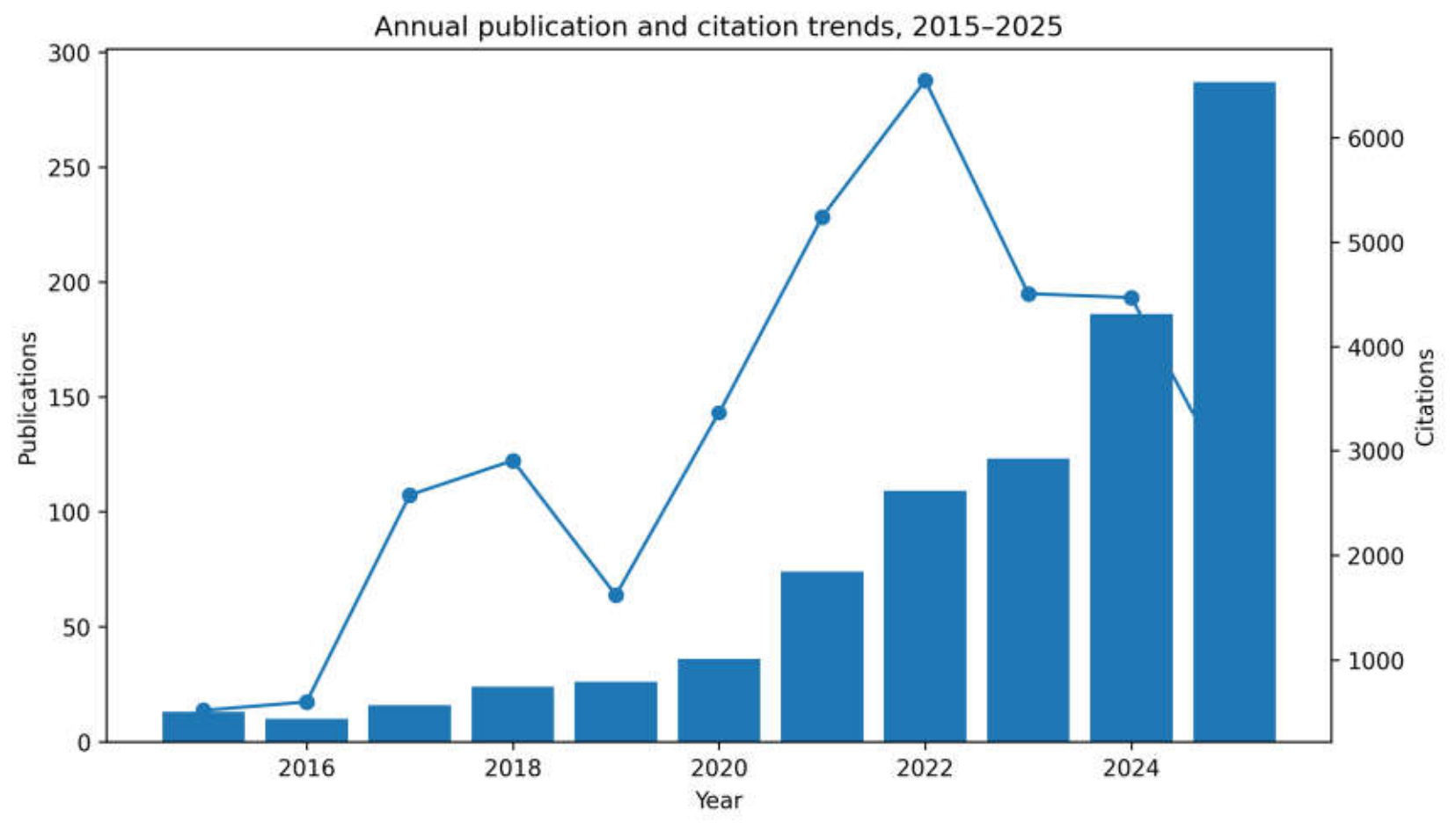
Figure 2.
Top ten countries/regions by publication output using full counting.
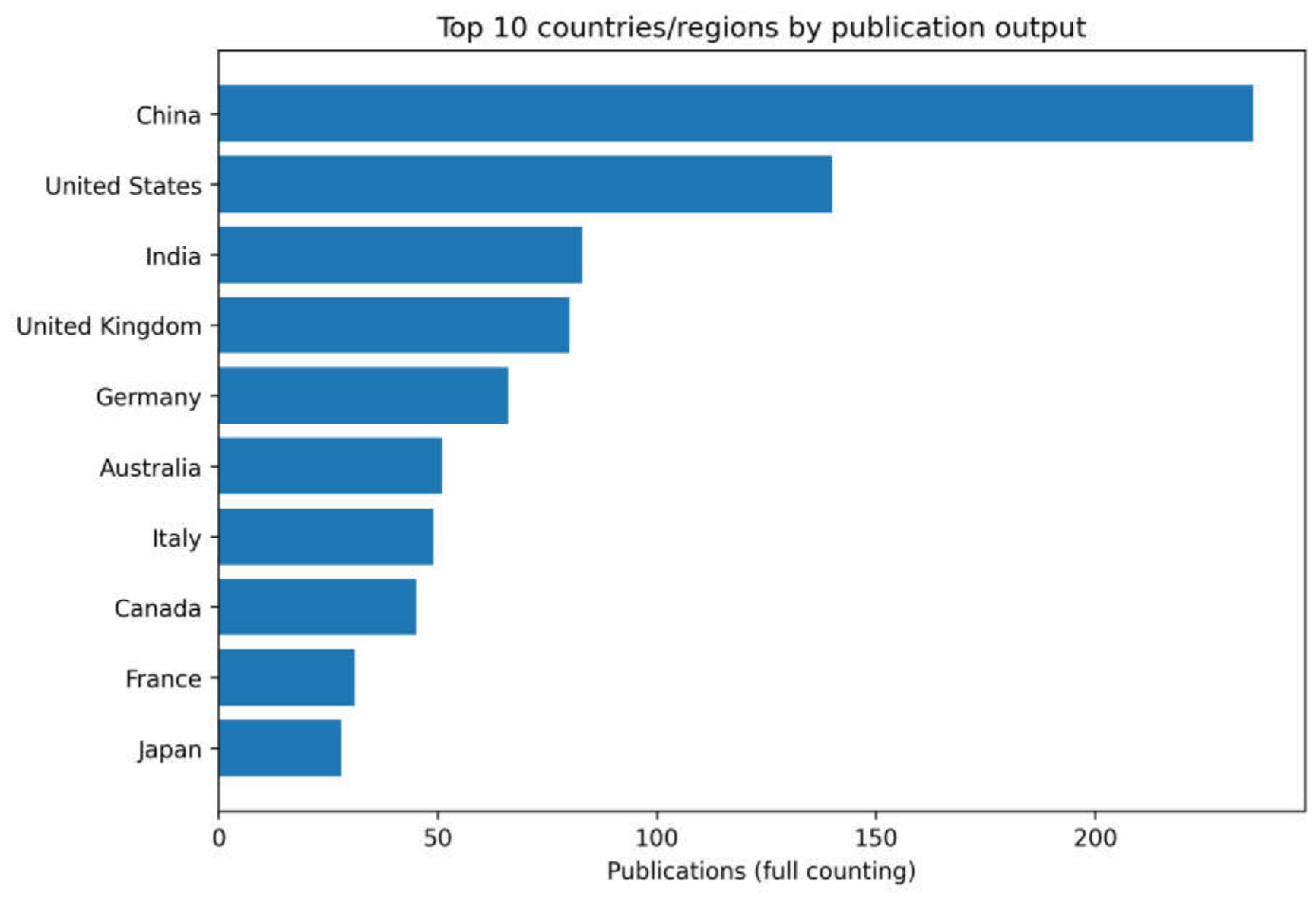
Figure 3.
International scientific collaboration network among the leading countries/regions. Node size reflects publication output and links represent co-authorship across countries.
Figure 3.
International scientific collaboration network among the leading countries/regions. Node size reflects publication output and links represent co-authorship across countries.
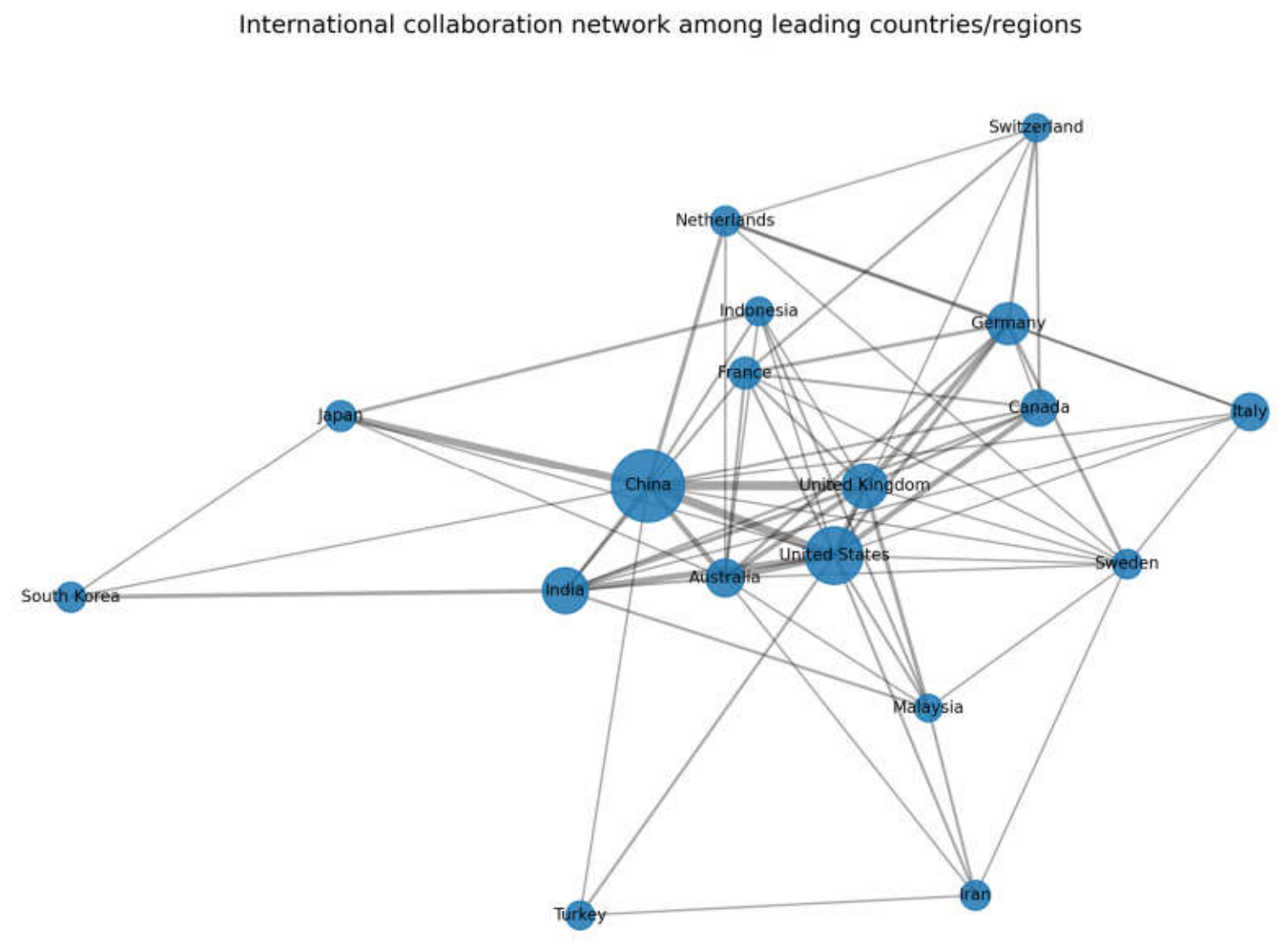
Figure 4.
Reference co-citation network of the 40 most frequently cited works. Labels are shortened for readability; node size reflects citation frequency within the corpus.
Figure 4.
Reference co-citation network of the 40 most frequently cited works. Labels are shortened for readability; node size reflects citation frequency within the corpus.
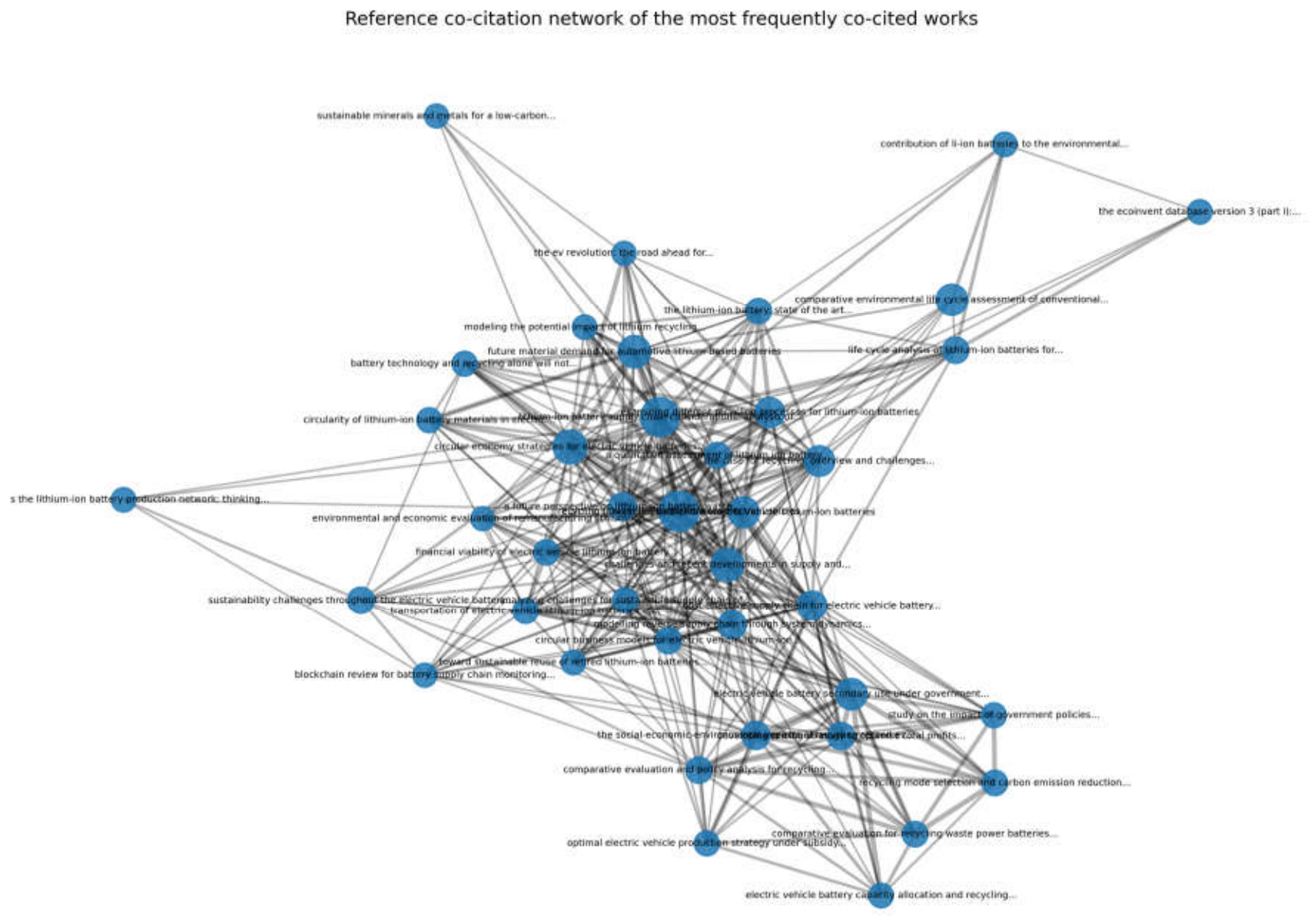
Figure 5.
Author–keyword co-occurrence network. Eligible keywords occur at least eight times; link construction uses normalized co-occurrence strength.
Figure 5.
Author–keyword co-occurrence network. Eligible keywords occur at least eight times; link construction uses normalized co-occurrence strength.
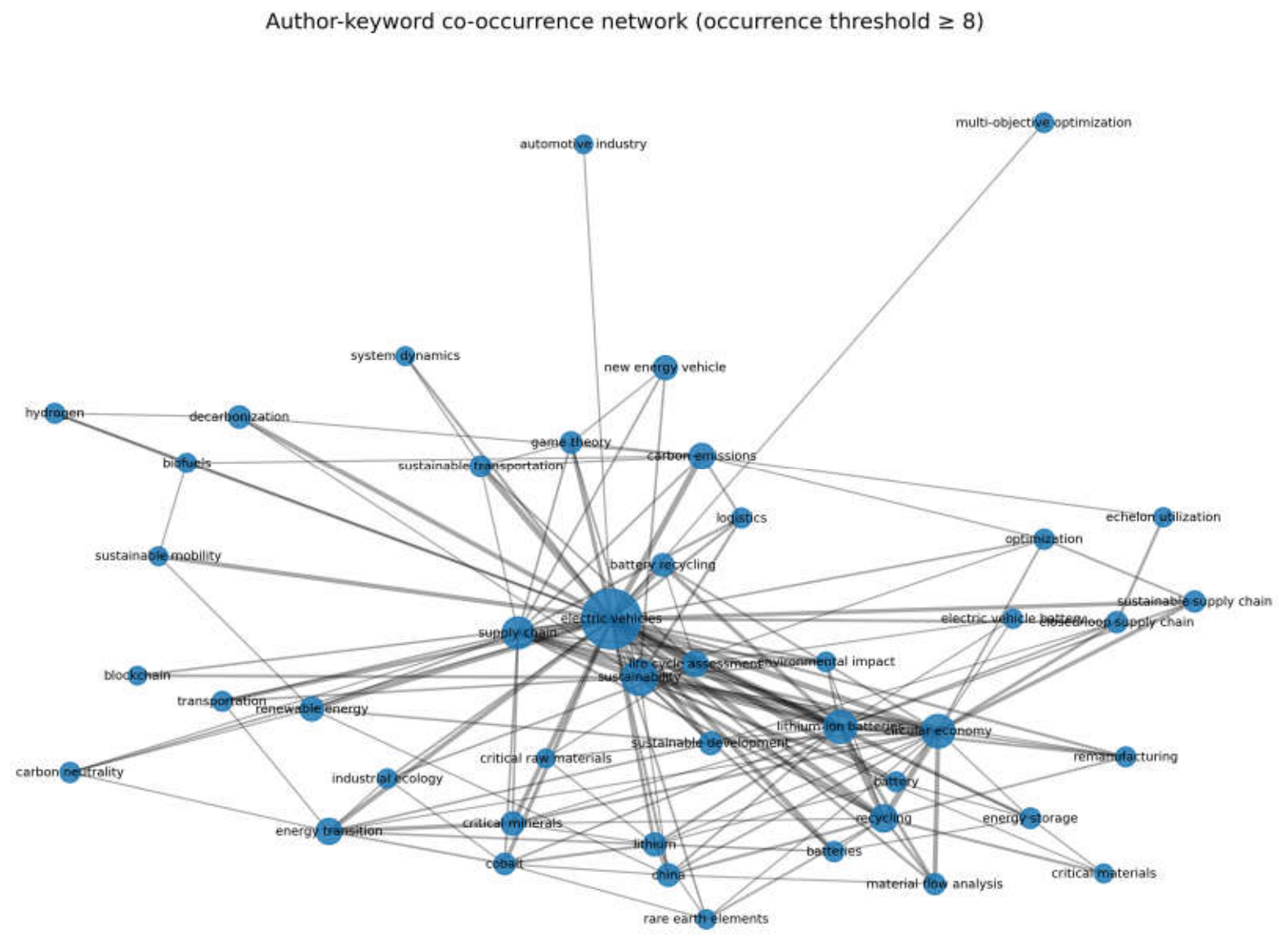
Figure 6.
Longitudinal evolution of the six major keyword communities. Percentages represent shares of clustered author–keyword occurrences within each period.
Figure 6.
Longitudinal evolution of the six major keyword communities. Percentages represent shares of clustered author–keyword occurrences within each period.
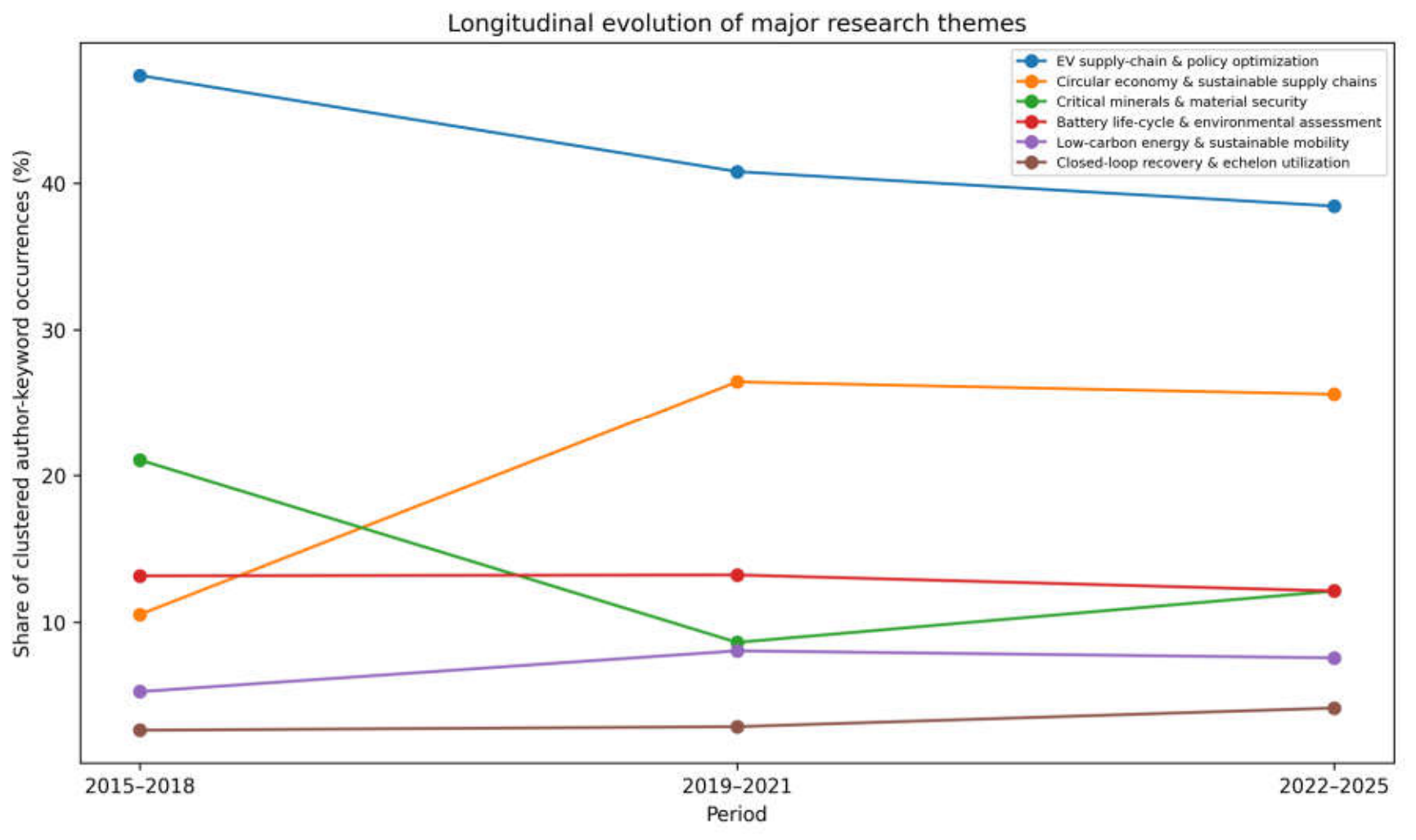

Table 1.
Retrieval protocol and dataset definition.
| Field | Specification |
|---|---|
| Database | Scopus |
| Search date | 2 September 2026 |
| Search field | TITLE-ABS-KEY |
| Publication years | 2015–2025 |
| Language | English |
| Document types | Article and Review |
| Final records | 904 (772 articles; 132 reviews) |
| Analytical unit | Scopus-indexed publication |
Table 2.
Annual publication and citation performance.
| Year | TP | TC | AC |
|---|---|---|---|
| 2015 | 13 | 520 | 40.00 |
| 2016 | 10 | 600 | 60.00 |
| 2017 | 16 | 2574 | 160.88 |
| 2018 | 24 | 2903 | 120.96 |
| 2019 | 26 | 1618 | 62.23 |
| 2020 | 36 | 3363 | 93.42 |
| 2021 | 74 | 5239 | 70.80 |
| 2022 | 109 | 6545 | 60.05 |
| 2023 | 123 | 4506 | 36.63 |
| 2024 | 186 | 4469 | 24.03 |
| 2025 | 287 | 2618 | 9.12 |
Table 3.
Ten most productive journals in the corpus.
| Source | TP | TC | AC |
|---|---|---|---|
| Sustainability (Switzerland) | 52 | 1099 | 21.13 |
| Journal of Cleaner Production | 47 | 2964 | 63.06 |
| Applied Energy | 28 | 2379 | 84.96 |
| Resources, Conservation and Recycling | 27 | 1866 | 69.11 |
| Energies | 27 | 686 | 25.41 |
| Renewable and Sustainable Energy Reviews | 16 | 1211 | 75.69 |
| Resources Policy | 16 | 652 | 40.75 |
| Computers and Industrial Engineering | 14 | 415 | 29.64 |
| Energy | 14 | 404 | 28.86 |
| International Journal of Hydrogen Energy | 12 | 1222 | 101.83 |
Table 4.
Most productive authors based on Scopus full-name identifiers.
| Author | TP | TC | AC |
|---|---|---|---|
| Zhou, Yuekuan | 6 | 390 | 65.00 |
| Zeng, Xianlai | 5 | 189 | 37.80 |
| Wang, Peng | 5 | 245 | 49.00 |
| Kendall, Alissa | 5 | 217 | 43.40 |
| Hao, Han | 5 | 401 | 80.20 |
| Schultmann, Frank | 5 | 258 | 51.60 |
| Kucukvar, Murat | 5 | 450 | 90.00 |
| Geng, Yong | 5 | 529 | 105.80 |
| Galati, Antonino | 5 | 132 | 26.40 |
| Crescimanno, Maria | 5 | 132 | 26.40 |
Table 5.
Top ten countries/regions by publication output.
| Country/Region | TP | TC | AC |
|---|---|---|---|
| China | 236 | 8016 | 33.97 |
| United States | 140 | 8414 | 60.10 |
| India | 83 | 1895 | 22.83 |
| United Kingdom | 80 | 4852 | 60.65 |
| Germany | 66 | 2760 | 41.82 |
| Australia | 51 | 2385 | 46.76 |
| Italy | 49 | 1816 | 37.06 |
| Canada | 45 | 1724 | 38.31 |
| France | 31 | 1330 | 42.90 |
| Japan | 28 | 794 | 28.36 |
Table 6.
Ten most highly cited documents in the Scopus corpus.
| Rank | Document | Year | Source | Citations |
|---|---|---|---|---|
| 1 | Lithium-Ion Battery Supply Chain Considerations: Analysis of Potential Bottlenecks in Critical Metals [1] | 2017 | Joule | 1415 |
| 2 | State-of-the-Art and Energy Management System of Lithium-Ion Batteries in Electric Vehicle Applications: Issues and Recommendations [7] | 2018 | IEEE Access | 922 |
| 3 | Sustainable minerals and metals for a low-carbon future [8] | 2020 | Science | 732 |
| 4 | The economics and the environmental benignity of different colors of hydrogen [10] | 2022 | International Journal of Hydrogen Energy | 610 |
| 5 | Circular economy strategies for electric vehicle batteries reduce reliance on raw materials [9] | 2021 | Nature Sustainability | 587 |
| 6 | Sustainability of artisanal mining of cobalt in DR Congo [11] | 2018 | Nature Sustainability | 449 |
| 7 | Electricity carbon intensity in European Member States: Impacts on GHG emissions of electric vehicles [12] | 2018 | Transportation Research Part D: Transport and Environment | 427 |
| 8 | A comprehensive review on hydrogen production, storage, and applications [13] | 2024 | Chemical Society Reviews | 396 |
| 9 | Lithium extraction from low-quality brines [14] | 2024 | Nature | 369 |
| 10 | An overview of global power lithium-ion batteries and associated critical metal recycling [15] | 2022 | Journal of Hazardous Materials | 367 |
Table 7.
Most frequently cited references and their co-citation communities.
| Rank | Frequently Co-Cited Reference (Title) | Corpus Citations | Intellectual Community |
|---|---|---|---|
| 1 | Recycling lithium-ion batteries from electric vehicles [16] | 59 | Material recovery, recycling, and circularity |
| 2 | Lithium-ion battery supply chain considerations: analysis of potential bottlenecks in critical metals [1] | 55 | Material recovery, recycling, and circularity |
| 3 | Circular economy strategies for electric vehicle batteries reduce reliance on raw materials [9] | 40 | Material recovery, recycling, and circularity |
| 4 | Challenges and recent developments in supply and value chains of electric vehicle batteries: a sustainability perspective [17] | 38 | Value-chain sustainability and reverse logistics |
| 5 | Future material demand for automotive lithium-based batteries [18] | 36 | Material recovery, recycling, and circularity |
| 6 | Comparative environmental life cycle assessment of conventional and electric vehicles [19] | 34 | Material recovery, recycling, and circularity |
| 7 | Electric vehicle battery secondary use under government subsidy: a closed-loop supply chain perspective [20] | 33 | Closed-loop governance and policy incentives |
| 8 | Recycling end-of-life electric vehicle lithium-ion batteries [21] | 32 | Material recovery, recycling, and circularity |
| 9 | The case for recycling: overview and challenges in the material supply chain for automotive Li-ion batteries [22] | 31 | Material recovery, recycling, and circularity |
| 10 | Cost-effective supply chain for electric vehicle battery remanufacturing [23] | 28 | Closed-loop governance and policy incentives |
Table 8.
Main author–keyword communities.
| Cluster | Interpretive Label | No. of Mapped Keywords | Representative Keywords (Occurrences) |
|---|---|---|---|
| 1 | EV supply chains and policy optimization | 13 | electric vehicles (257); supply chain (60); carbon emissions (33); new energy vehicle (26); game theory (17); sustainable transportation (17); logistics (12); transportation (12) |
| 2 | Circular economy and sustainable energy supply chains | 12 | sustainability (80); circular economy (69); recycling (39); material flow analysis (16); sustainable supply chain (16); energy storage (14); batteries (13); optimization (13) |
| 3 | Critical minerals and battery-material security | 8 | energy transition (34); critical minerals (24); lithium (23); China (21); cobalt (17); industrial ecology (11); rare earth elements (10); nickel (8) |
| 4 | Battery systems, life-cycle assessment, and environmental performance | 6 | lithium-ion batteries (67); life cycle assessment (32); battery recycling (21); environmental impact (11); electric vehicle battery (10); critical raw materials (9) |
| 5 | Low-carbon energy and sustainable mobility | 6 | renewable energy (26); decarbonization (20); carbon neutrality (13); hydrogen (12); biofuels (11); sustainable mobility (9) |
| 6 | Closed-loop recovery and echelon utilization | 3 | sustainable development (21); closed-loop supply chain (16); echelon utilization (10) |
Table 9.
Relative thematic visibility across the three publication phases.
| Period | EV Supply Chains & Policy | Circular Economy & Sustainable Supply Chains | Critical Minerals & Battery Materials | Battery Systems & Life-Cycle Assessment | Low-Carbon Energy & Mobility | Closed-Loop Recovery |
|---|---|---|---|---|---|---|
| 2015–2018 | 47.4% | 10.5% | 21.1% | 13.2% | 5.3% | 2.6% |
| 2019–2021 | 40.8% | 26.4% | 8.6% | 13.2% | 8.0% | 2.9% |
| 2022–2025 | 38.4% | 25.6% | 12.1% | 12.1% | 7.6% | 4.1% |
Table 10.
Integrative technology–resources–energy systems–governance–sustainability framework derived from the bibliometric results.
Table 10.
Integrative technology–resources–energy systems–governance–sustainability framework derived from the bibliometric results.
| Vehicle and Energy Technologies | Critical Materials and Energy Inputs | Sustainable Energy and Material SUPPLY Systems | Governance and Market Formation | Sustainability and Energy-Transition Outcomes |
|---|---|---|---|---|
| Batteries; fuel cells; charging; energy management; vehicle architectures | Lithium; cobalt; nickel; rare earths; electricity; hydrogen | Sourcing; manufacturing; logistics; reuse; remanufacturing; recycling; resilience | Subsidies; carbon policy; standards; producer responsibility; infrastructure; business models | Life-cycle emissions; circularity; resource efficiency; energy security; SDG relevance |
Table 11.
Future research agenda derived from the bibliometric and thematic synthesis.
| Priority | Research Gap | Suggested Empirical Direction |
|---|---|---|
| 1 | Integrate bibliometric evidence with energy-system and material-flow data | Link knowledge maps with electricity-system, material-flow, production, patent, UN Comtrade, customs, investment, and emissions datasets to test whether research attention corresponds to energy-system impacts, resource dependence, industrial specialization, and decarbonization outcomes. |
| 2 | Model critical-mineral and battery-material security | Combine measures of lithium, cobalt, nickel, graphite, and rare-earth supply concentration with scenario analysis of technology substitution, recycling, low-carbon processing, sourcing diversification, and energy-security exposure. |
| 3 | Develop cross-border battery-circularity research | Examine the legal, logistical, environmental, energy, and economic conditions governing international movements of used batteries, black mass, recycled materials, and second-life batteries, including traceability and renewable-energy requirements. |
| 4 | Expand evidence on emerging-market energy transitions | Investigate Southeast Asia, Africa, Latin America, and other rapidly motorizing regions where two-wheelers, grid conditions, charging availability, informal recycling, energy mixes, and income structures differ from those in mature automobile markets. |
| 5 | Compare propulsion pathways at the system level | Evaluate battery-electric, plug-in hybrid, and hydrogen pathways using integrated life-cycle, energy-system, infrastructure, resource-security, and supply-chain metrics rather than isolated vehicle-level indicators. |
| 6 | Examine multi-level energy and industrial governance | Analyze how electricity policy, industrial subsidies, carbon regulation, producer responsibility, infrastructure investment, trade rules, and consumer incentives interact rather than evaluating individual policy instruments in isolation. |
| 7 | Measure distributional and energy-justice effects | Assess how the social, environmental, and energy-system costs of mineral extraction, battery processing, recycling, electricity generation, and infrastructure deployment are distributed, and examine how the benefits of the GEV transition are shared across regions and social groups. |
Disclaimer/Publisher’s Note: The statements, opinions and data contained in all publications are solely those of the individual author(s) and contributor(s) and not of MDPI and/or the editor(s). MDPI and/or the editor(s) disclaim responsibility for any injury to people or property resulting from any ideas, methods, instructions or products referred to in the content. |
© 2026 by the authors. Licensee MDPI, Basel, Switzerland. This article is an open access article distributed under the terms and conditions of the Creative Commons Attribution (CC BY) license (http://creativecommons.org/licenses/by/4.0/).
Copyright: This open access article is published under a Creative Commons CC BY 4.0 license, which permit the free download, distribution, and reuse, provided that the author and preprint are cited in any reuse.