

Submitted:
21 September 2026
Posted:
22 September 2026
You are already at the latest version
Abstract
Space-based quantum key distribution (QKD) has emerged as the leading approach for establishing information-theoretically secure communication links beyond the reach of terrestrial fiber networks. Over the past decade, missions ranging from the 635 kg Micius satellite to 3U CubeSats such as SpooQy-1 have demonstrated satellite-to-ground QKD, entanglement distribution, and quantum teleportation across distances exceeding 1,200 km. However, existing reviews of these missions focus primarily on quantum protocols and link layer physics, leaving the system level engineering trade offs particularly those governing platform selection, SWaP budgets, and subsystem integration largely unexamined. This paper presents a systems engineering review of space based quantum communication missions developed between 2016 and 2025. Each mission is analyzed through a unified framework encompassing link budget decomposition, payload miniaturization trends, and Acquisition, Tracking, and Pointing (ATP) architectures. A comparative SWaP analysis reveals that payload mass has decreased by approximately one order of magnitude from ~230 kg (Micius) to ~23 kg (Jinan-1) while reported quantum bit error rates have remained below 5%. The analysis identifies three critical gaps: (i) the absence of formal Multidisciplinary Design Optimization (MDO) frameworks in quantum satellite design, (ii) the lack of standardized performance metrics for cross mission comparison, and (iii) the disconnect between constellation level network studies and subsystem level hardware constraints. Based on these findings, system-level design strategies and a technology roadmap are proposed to support the transition from single-link demonstrations to scalable, constellation-ready quantum communication infrastructures.
Keywords:
quantum key distribution (QKD)
; space-based quantum communications
; satellite quantum networks
; Acquisition
; Tracking
; and Pointing (ATP)
; SWaP optimization
; Multidisciplinary Design Optimization (MDO)
; Low Earth Orbit (LEO) constellations
1. The Techno-Economic Imperative: Bridging Quantum Physics and New Space Realities
While terrestrial optical fiber networks have successfully demonstrated short-to-medium range Quantum Key Distribution (QKD), they are fundamentally bottlenecked by exponential channel attenuation and the decoherence of fragile quantum states. With practical quantum repeaters still in their technological infancy and requiring cryogenic infrastructures, ground-based systems are physically precluded from achieving global-scale quantum entanglement. Consequently, transferring the quantum channel to the space domain—utilizing free-space optical links with near-vacuum propagation—has transitioned from an experimental luxury to an absolute architectural necessity for establishing a Global Quantum Internet. However, deploying a space segment is not a trivial substitution. Traditional monolithic, exquisite satellites in Geostationary Orbit (GEO) suffer from prohibitive free-space path loss and severe geometric spreading, drastically degrading the Secret Key Rate (SKR). Therefore, the design paradigm has inevitably shifted toward Low Earth Orbit constellations. The New Space philosophy—characterized by mass production, Commercial Off-The-Shelf (COTS) components, and distributed mission architectures—enables global coverage with favorable link budgets. Yet, the necessity of deploying tens or hundreds of quantum-equipped nodes introduces a formidable system-engineering challenge: the exponential escalation of capital expenditures (CAPEX). To comprehensively assess the economic trajectory of space-based quantum technologies, a concurrent examination of the commercial expansion in satellite constellations is essential. Analyzing the intersection of these two technological paradigms highlights their foundational role in shaping the future of secure global communication infrastructures.
As evidenced by the empirical projections in Figure 1, the global space enterprise is experiencing an unprecedented structural transition driven by the industrialization of Low Earth Orbit (LEO). Between 2020 and 2030, the total global space economy (V total) is projected to more than double, expanding from $423 B to $875 Bat a Compound Annual Growth Rate (CAGR) of 7.54%.
While aggressive market models anticipate LEO mega-constellations capturing up to a quarter of the global space economy by 2030, a more rigorous, conservative analytical framework introduces a bounding dynamic to this trajectory. As illustrated in Figure 2, the market penetration rate (LEO) initiates at a baseline of 2.8% in 2020 and undergoes a steady, quasi-linear expansion driven by initial constellation deployments. However, empirical market saturation models suggest an asymptotic behavior over time. The mathematical derivative of market growth, is projected to diminish as the sector approaches the end of the decade, effectively plateauing at a terminal share of 11.4% between 2029 and 2030. This saturation plateau implies that while LEO systems constitute a disruptive techno-economic imperative, their ultimate market footprint will be naturally constrained by the carrying capacity of orbital slots, regulatory bottlenecks, and the stabilization of terrestrial broadband alternatives.
While the industrialization of Low Earth Orbit (LEO) provides the physical substrate and logistical economies of scale, the commercial viability of mega-constellations is fundamentally catalyzed by the integration of high-value, mission-critical payloads. Foremost among these is space borne Quantum Key Distribution (QKD), which bridges the gap between orbital accessibility and the escalating demand for sovereign cryptographic security in the post-quantum era.
As illustrated in Figure 3, the global quantum technology ecosystem is experiencing an aggressive capital influx, expanding from $2.5Bin 2022 to $10.5Bby 2026 at a formidable Compound Annual Growth Rate of 43.17%. Within this rapidly maturing market, quantum communications and satellite-based QKD infrastructure constitute the second-largest sector, commanding a 25% market share (V QKD=$2.625B by 2026). This financial trajectory underscores a paradigm shift: satellite quantum communications is no longer merely an experimental physics curiosity, but a commercially primed orbital service. The convergence of decreasing launch costs per kilogram and the exponential surge in quantum cybersecurity investments establishes a fertile economic frontier, where multi-objective system optimization (MDO) becomes essential to balance stringent quantum link budgets against strict size, weight, power, and cost (Swap) constraints.
The quantum communications market is experiencing a profound transition from experimental verification to high-throughput commercial deployment. As illustrated in Figure 4, the global market valuation is projected to expand aggressively from $620 million in 2023 to $2,800 million by 2028, exhibiting a robust Compound Annual Growth Rate (CAGR) of35.2%. The acceleration profile reveals super-linear yearly incremental investments—rising from an annual addition of $230M (2023–2024) to over $700M (2027–2028)—underpinned by accelerating public-private capital inflows and urgent quantum-resilience mandates. A critical structural insight lies in the platform distribution projected for 2028. While terrestrial fiber-based infrastructure remains the primary backbone for metropolitan quantum key distribution (capturing 65% of the market, equivalent to $1.82 billion), space-based satellite platforms are forecasted to secure a substantial 35%market share, representing a valuation of $980 million. This structural shift underscores that terrestrial fiber architectures inherently suffer from exponential optical photon attenuation over medium-to-long distances (∼100–150 km without trusted repeaters), establishing space-based optical links as the indispensable enabler for transcontinental, low-latency, and sovereign quantum cryptographic networks.
The comparative macroeconomic trajectory presented in Figure 5 illuminates an impending structural inflection point in space mission architecture. As depicted in Figure 5A,C, the low Earth orbit (LEO) constellation market is transitioning from an aggressive capital-deployment phase (YoY≈40%in 2021) to an infrastructure maturation regime (YoY<7.5%by 2030, plateauing at a $100B valuation). This deceleration reflects standard network commoditization: once global orbital shell coverage is established, physical launch mass and raw RF/optical bandwidth yield diminishing Average Revenue Per User (ARPU). In stark contrast, the quantum communications market exhibits sustained, non-saturating exponential momentum, maintaining a consistent growth velocity of YoY≈32–35% through 2030, driven by sovereign cryptographic mandates and post-quantum cybersecurity imperatives.
The juxtaposition of these velocity curves (Figure 5(C)) proves that standalone development paradigms are economically sub-optimal for both sectors. For quantum communication architectures, constructing dedicated, single-purpose satellite constellations poses prohibitive capital expenditure (CAPEX) barriers. Conversely, for mature LEO operators facing bandwidth commoditization, integrating space-qualified Quantum Key Distribution (QKD) and entangled photon sources as Hosted Quantum Payloads (HQPs) represents a high-margin value multiplier. Under this symbiotic convergence, the mature LEO constellation serves as the commoditized “physical chassis “supplying redundant power, high-precision attitude determination and control systems (ADCS), and high-rate classical optical inter-satellite links (OISL) while the quantum subsystem functions as the high security cryptographic overlay. This technological fusion resolves the fundamental range limitations of terrestrial fiber networks while unlocking premium institutional revenue streams for next-generation multi-mission satellite networks.
2. Introduction
computers poses an existential threat to classical public-key cryptography. Algorithms such as Shor’s are poised to dismantle the computational hardness assumptions underpinning widely used public key cryptosystems like RSA and Elliptic Curve Cryptography (ECC) [1,2].Consequently, the transition from computational security to information-theoretic security guaranteed by the fundamental laws of quantum mechanics has become an urgent necessity. Quantum Key Distribution (QKD) has emerged as the most mature solution to this crisis, offering provable security based on quantum mechanics rather than unproven hardness assumptions [3,4].However, terrestrial QKD implementations face a fundamental bottleneck imposed by optical fiber attenuation. While classical signals can be amplified, the no-cloning theorem prohibits the amplification of unknown quantum states [5], fundamentally limiting fiber-based QKD links to a few hundred kilometers. This limitation is captured both by the repeater less secret-key capacity of a loss bosonic channel and by state-of-the-art field demonstrations over standard and ultralow-loss fibers [6,7]. Establishing intercontinental quantum links necessitates extending network topologies beyond the range constraints of terrestrial fiber systems. Space-based quantum communication, leveraging satellites as trusted nodes or entanglement distributors, offers a promising avenue to overcome these distance barriers [8,9]. By transmitting photons through the vacuum of space where attenuation and decoherence are negligible compared to silica fibers and only traversing the turbulent lower atmosphere over relatively short paths, satellite platforms such as Micius have already demonstrated the feasibility of space-to-ground QKD and entanglement distribution over thousands of kilometers [9,10]. Despite the rapid proliferation of experimental demonstrations and proof-of-concept missions in recent years, a comprehensive synthesis focusing on the system-level design methodology of quantum satellites remains scarce in the literature. Existing reviews often prioritize theoretical protocols or fundamental physics, leaving a gap in understanding the engineering intricacies of deploying sensitive quantum payloads into the harsh space environment. This paper aims to bridge the gap between quantum optics and space systems engineering. This paper provides a critical review of state-of-the-art space-based QKD missions, with a specific focus on developments since 2010 to distill underlying design philosophies and architectural choices. Unlike traditional surveys, the analysis delves into the technical integration of enabling technologies, examining how quantum sources, detection modules, and Acquisition, Tracking, and Pointing (ATP) systems are engineered to meet stringent Size, Weight, and Power (SWaP) constraints. Furthermore, trade-offs involving different constellation architectures and orbit selections are evaluated to provide a roadmap for future scalable quantum satellite networks.
3. Materials and Methods
To establish a comprehensive and technologically grounded baseline for space-based quantum communications, this review adopts a structured and multi-tiered systematic survey methodology. The primary objective is to bridge the existing gap between abstract quantum information theory and practical space systems engineering by focusing explicitly on operational architectures, physical link budgets, and flight-qualified payloads.
The literature search strategy was built around a targeted taxonomy of core keywords, categorizing technological dimensions into:
- ➢
- Quantum Payloads and Protocols: quantum satellite, space borne quantum payload, quantum key distribution (QKD), entangled photon source (EPS), single-photon transceiver, and decoy-state BB84;
- ➢
- Space Platform and Link Architecture: space-to-ground optical link, inter-satellite quantum link, CubeSat quantum communications, low Earth orbit (LEO) quantum node, and pointing, acquisition, and tracking (PAT/ATP);
- ➢
- Optomechanical and Subsystem Implementation: space-qualified optical terminal, telescope aperture constraints, fine-pointing mirror jitter, and size, weight, and power (SWaP) budgets.
To ensure comprehensive cross-disciplinary coverage spanning aerospace engineering, applied optics, and quantum physics, systematic queries were deployed across major international indexing databases, including IEEE Xplore, Scopus, Web of Science (Core Collection), NASA Astrophysics Data System (ADS), and AIAA Aerospace Research Central (ARC), supplemented by cutting-edge flight mission preprints from the arXiv repository.The accumulated literature underwent a multi-stage qualitative screening process. Studies were rigorously evaluated based on technological realism: papers focusing solely on terrestrial fiber networks, unconstrained quantum routing protocols, or purely theoretical models that treat satellite terminals as idealized “black boxes” were methodically excluded. Conversely, priority was assigned to peer-reviewed studies providing concrete physical parameters—such as optical link margins, telescope apertures, pointing accuracies, space-qualification environmental testing (e.g., thermal-vacuum and vibration profiles), and verified in-orbit telemetry from pioneering flight demonstrations. To establish a methodological, evidence-based, and systematic framework for evaluating the multidisciplinary field of space-based quantum communications, this review article employs a systematic protocol aligned with the PRISMA 2020 guidelines. Accordingly, by formulating a three-layer Boolean taxonomic search within authoritative science and technology citation databases (IEEE Xplore and Scopus), the gap between the fundamentals of quantum optics and aerospace systems engineering was bridged. The core of this search strategy involved retrieving a knowledge corpus comprising 2,293 authoritative scientific documents, which collectively garnered 37,103 academic citations reflecting an impressive citation density of 16.18 citations per paper. Of these, 1,232 works (representing 53.73% of the total articles) constitute the core of the citation network. Beyond scientific influence, the technology's tangible transition toward space-grade hardware and industrial applications is corroborated by patent data: 160 seminal papers directly underpin the development of 367 patent families, involving 527 industrial citations. This leap characterized by a patent transfer coefficient of Ψpatent ≈ 6.98%—demonstrates the technology's successful traversal of the TRL "Valley of Death" and its rapid progression from laboratory proofs-of-concept (TRL 3–4) to flight-ready payloads and operational orbital constellations (TRL 7–8).Subsequently, this rich knowledge base is refined using an inclusion/exclusion criteria (IC/EC) matrix. By filtering out purely theoretical papers, terrestrial fiber-optic networks, and models lacking considerations for Size, Weight, Power, and Cost (SWaP)as well as excluding Pointing, Acquisition, and Tracking (PAT) systems and optical link budgets in isolation the study proceeds to a comprehensive synthesis of satellite-based quantum architectures.
A longitudinal analysis of the harvested corpus (N=2,293, 1970–2025) reveals a distinct three-phase evolutionary trajectory (Figure 6). Following a prolonged theoretical incubation period (pre-2005, <10publications/year) and initial terrestrial free-space trials (2005–2015), the domain entered an exponential expansion phase initiated by the 2016 orbital demonstration of the Micius quantum satellite. Research output accelerated further post-2020, peaking at nearly 400 documents annually by 2025, primarily driven by CubeSat-scale missions (e.g., SpooQy-1, Jinan-1). The literature is dominated by peer-reviewed journal articles (>55%) and conference proceedings, highlighting an ongoing transition from fundamental quantum optics to flight-qualified, SWaP-constrained space systems engineering.
Figure 6.
Chronological distribution and document typology of global research in space-based quantum communications (1970–2026,N=2,293).
Figure 6.
Chronological distribution and document typology of global research in space-based quantum communications (1970–2026,N=2,293).
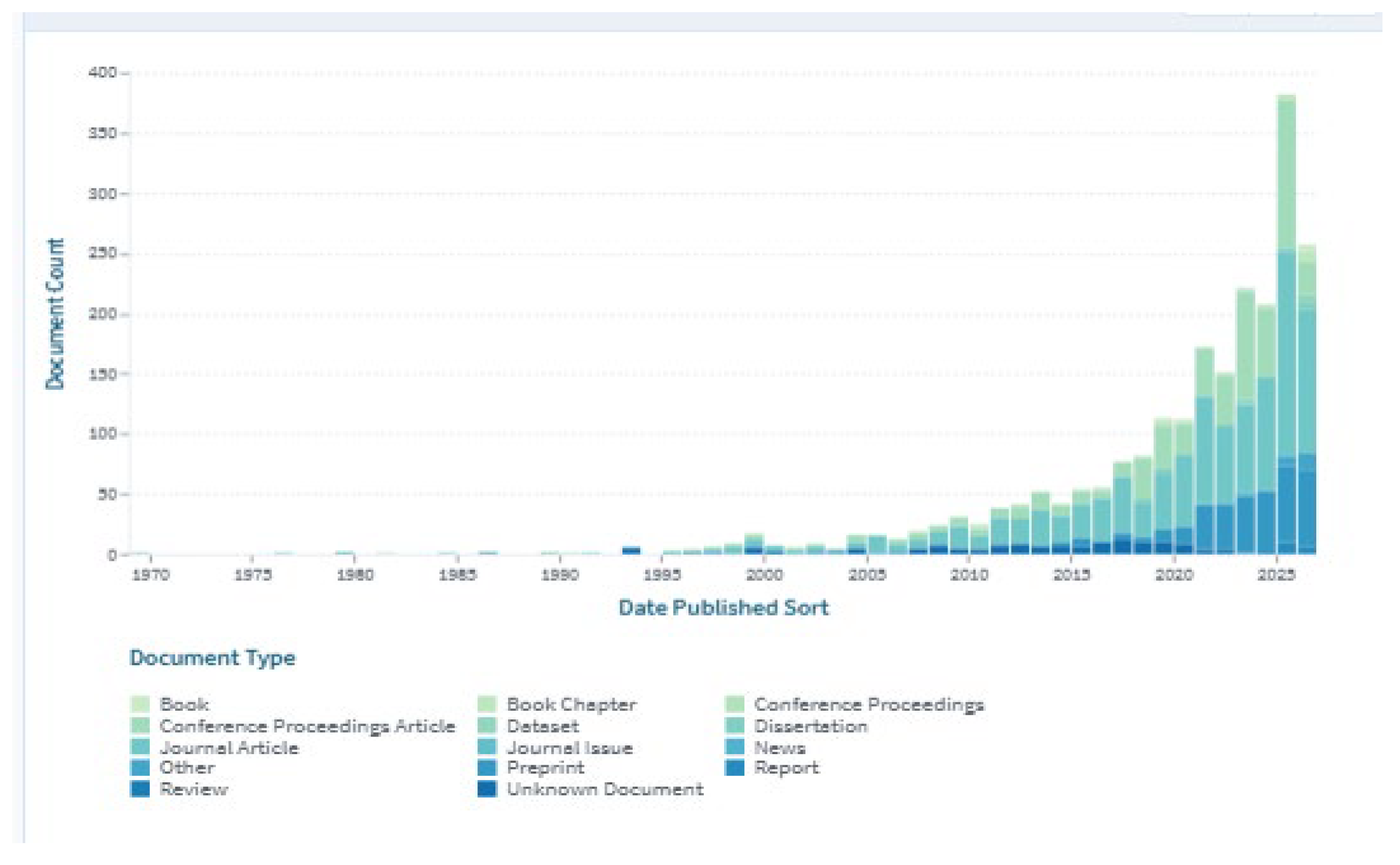
Figure 7.
Typological taxonomy of global literature in space-based quantum communications.
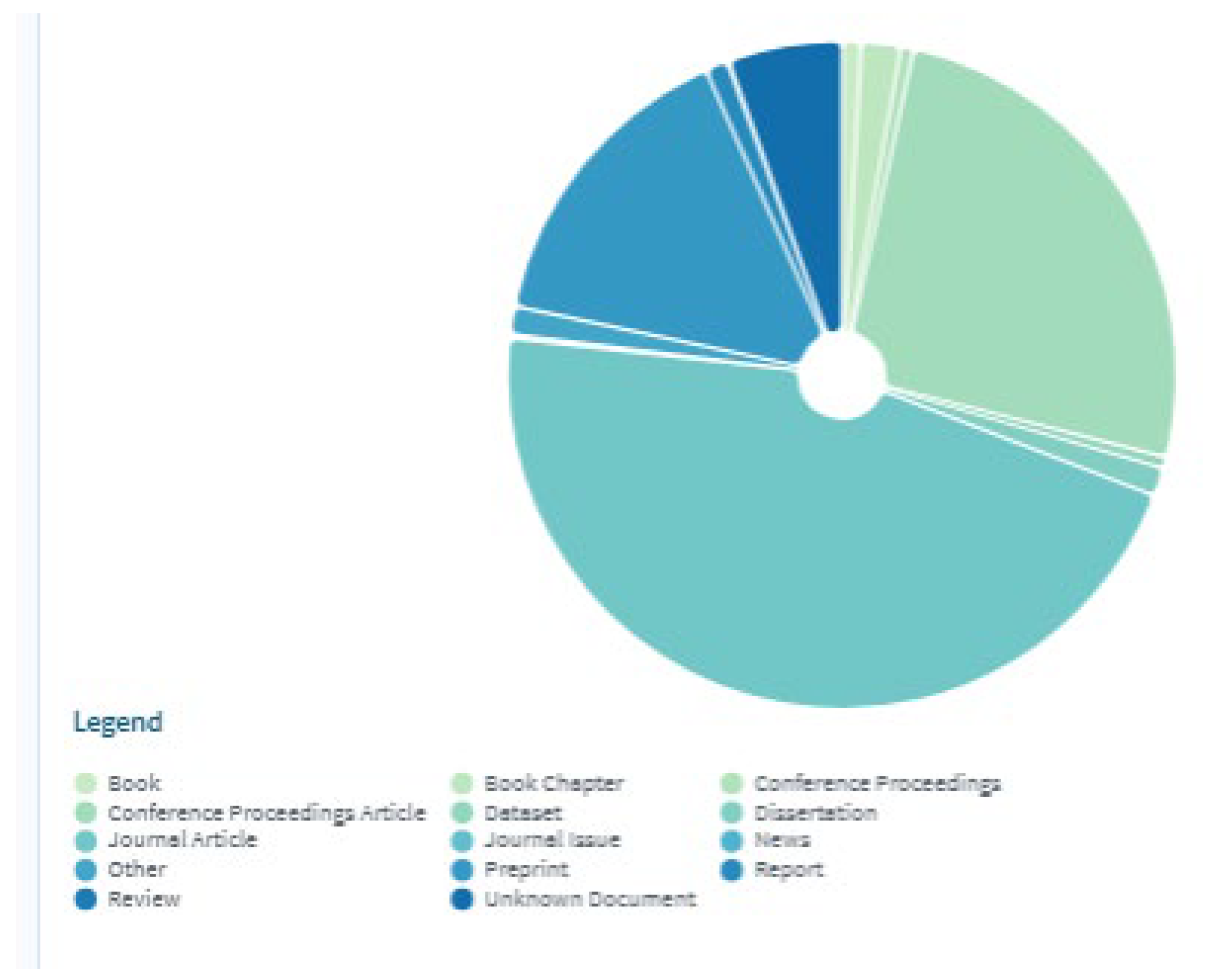
A breakdown of the analyzed corpus (N = 2,264) across publication venues and document types reveals a scholarly ecosystem strongly anchored in peer-reviewed literature, with a substantial secondary presence of rapid-dissemination preprint material. Peer-reviewed journal articles constitute the single largest category (46.5%, n = 1,052), consistent with the role of journals as the primary, citable record of research results. Conference proceedings articles form the second-largest segment (25.8%, n = 585), and when combined with standalone conference proceedings entries (n = 14), conference-related output accounts for 26.4% (n = 599) of the corpus. Taken together, formally published journal and conference literature comprises 72.3% (n = 1,637) of all analyzed records. Preprints represent 14.8% (n = 334), a considerable share that reflects the growing practice of early public dissemination of results through preprint repositories before formal peer review. The remaining categories are individually small but collectively informative: records of unknown or unassigned type account for 5.6% (n = 126), book chapters for 1.9% (n = 44), dissertations and theses for 1.4% (n = 32), technical reports for 1.1% (n = 25), monographs for 0.9% (n = 21), and other miscellaneous document types for 1.4% (n = 31).
An analysis of the top-producing researchers in the field of space-based quantum communications reveals a highly concentrated intellectual landscape, dominated by a select group of prolific investigators (Figure 8). Thomas Jennewein emerges as the most prominent contributor, with a research output significantly exceeding that of other peers, reflecting a sustained and deep-seated focus on satellite-based quantum key distribution (QKD) and optical transceiver instrumentation. The presence of other key researchers such as Cheng-Zhi Peng, Paolo Villoresi, and Jian-Wei Pan underscores the global nature of this pursuit, with notable clusters of expertise emerging from major quantum research hubs in China, Canada, and Europe. This distribution suggests that the current state-of-the-art is driven by long-standing collaboration networks and concentrated experimental efforts in orbital quantum channel characterization and link-budget optimization.
A keyword frequency and co-occurrence analysis reveals the strongly multidisciplinary nature of the space-based quantum communications literature (Figure 9). Core foundational domains are dominated by Computer Science (n=1,441) and Physics (n=1,389), alongside specific functional applications led by Quantum Key Distribution (QKD) (n=1,053) and Quantum Mechanics (n=643). Crucially for mission-level architecture, space systems infrastructure keywords such as Satellite (n=774), Optics (n=603), Electronic Engineering (n=474), and Telecommunications (n=464) form a secondary yet essential operational cluster. The explicit convergence of computational protocols, quantum channel physics, and aerospace engineering metrics (e.g., Aerospace Engineering, n=234); Quantum Network( n=444) validates the requirement for integrated Multidisciplinary Design Optimization (MDO) frameworks when developing constellation-scale quantum space networks.
4. Evolution of Space Quantum Communications
Before examining the architectural details of modern quantum satellites, it is necessary to survey the landscape of quantum protocols and the strategic design choices that define space-based implementations., one must first navigate the landscape of quantum protocols and the strategic architectural choices that define them. At the heart of space based quantum communications lies the distinction between discrete variable (DV) and continuous variable (CV) protocols [11]. The vast majority of current satellite missions including all operational systems to date rely on DV-QKD, primarily utilizing photon polarization or time-bin encoding. Among these, Prepare-and-Measure (PM) schemes, such as the decoy-state BB84 protocol, have become the de facto standard for early satellite deployments [12]. In a PM architecture, the sender (Alice) prepares a quantum state and transmits it to the receiver (Bob) [13]. This approach is particularly favored for satellite-to-ground links due to its relative hardware simplicity, requiring only a weak coherent laser source rather than a complex entanglement source on the satellite. However, extending QKD toward a global-scale Quantum Internet introduces Requirements such as device-independent security verification and multi party entanglement distribution that cannot be met by PM schemes alone. This has motivated increasing attention to entanglement-based protocols such as BBM92 and E91[14]. In this paradigm, a central source distributes entangled photon pairs to two spatially separated ground stations [15]. The key advantage lies in the associated security model: unlike PM schemes, where the satellite holds key material during relay operations, requiring physical and software integrity assurances equivalent to those of a classical trusted third party [16]. In this scenario, the satellite merely acts as a distributor of quantum correlations, and security can be certified through the observation of non-classical correlations, for instance via Bell inequality violations [17]. This architectural shift from trusted relays to entanglement based untrusted nodes is expected to define the security framework of next generation quantum constellations[18]. Paralleling the choice of protocol is the critical decision of link topology: uplink (ground-to-space) versus downlink (space-to-ground) [19]. This is not merely a logistical consideration but a fundamental engineering trade-off. A downlink configuration, where the satellite carries the quantum source, is generally preferred because the fragile quantum signal traverses the turbulent atmosphere only at the very end of its journey, thereby reducing beam wandering and wavefront distortion [20,21]. However, this choice imposes strict Size, Weight, and Power (SWaP) constraints on the satellite, as it must house the quantum source, high-precision pointing, acquisition and tracking (PAT) systems, and associated stabilization hardware [22]. Conversely, an uplink configuration allows the heavy and complex quantum source to remain on the ground, simplifying the satellite payload to a primarily passive receiver, at the price of requiring advanced adaptive optics and careful link budget design to compensate for the initial atmospheric turbulence [23,24,25]. A conceptual overview of a typical spaceborne pointing, acquisition, and tracking (PAT) architecture is shown in Figure 10, illustrating the interaction between coarse attitude control, beacon-based tracking, and fine steering mechanisms.
From a historical perspective, the trajectory of space-based quantum communications has been a steady progression from theoretical feasibility studies to increasingly complex networked demonstrations [26,27]. The field evolved from early proof-of-principle experiments using high-altitude balloons and aircraft to the landmark launch of the Micius satellite in 2016, which successfully demonstrated both trusted-node QKD and satellite-to-ground entanglement distribution [28,29]. This pivotal milestone catalyzed a new era of miniaturization, with recent years witnessing a surge in CubeSat-based missions aimed at lowering the entry barrier and democratizing access to quantum-secure space links [30,31]. As we move into the mid-2020s, the focus has unmistakably shifted from isolated scientific experiments to the systemic design of scalable constellations, integrating quantum payloads into commercial satellite platforms to realize resilient, continuous space–ground quantum networks [32,33].
Table 1 delineates a fundamental divide within contemporary space-based quantum communication efforts. On one side, protocols such as the decoy-state BB84 exhibit practical feasibility, benefiting from well-established and mature hardware. On the other, entanglement-based schemes continue to represent the theoretical frontier, driving the most advanced research in the field. Yet, the true efficacy of any protocol is ultimately constrained by the capabilities of the hardware supporting it. Having established the theoretical “software” foundations of these missions, the focus now shifts to the “hardware”the satellites themselves. The following section provides a detailed examination of recent mission architectures, evaluating how they confront key engineering challenges, including pointing, acquisition, and tracking (PAT), as well as size, weight, and power (SWaP) limitations, to enable the successful transmission of quantum states from orbit to ground.
5. System-Level Design Trade-offs in Space-Based Quantum Communication
While the protocol hierarchies discussed in the preceding section define the conceptual framework of quantum communication, their realization ultimately depends on the physical satellite platform that implements them. Translating quantum theoretic models into an operational spaceborne payload presents a fundamentally constrained engineering problem, governed by launch limitations and the operational requirements of Low Earth Orbit (LEO). In this regime, system performance is dictated not only by the successful transmission of quantum states, but by the ability to sustain that performance within strict Size, Weight, and Power (SWaP), thermal, and radiation constraints.Accordingly, this section shifts focus from the transmitted information to the satellite subsystems that physically enable quantum communication. Rather than surveying missions chronologically, a technology-centric and system-level perspective is adopted. The satellite platform is decomposed into its critical enabling subsystems, includi-qualified quantum light sources, high-precision pointingpointing.Before dissecting individual subsystems, it is crucial to understand the systems engineering methodology that dictates space-based QKD design[34]. The feasibility of any quantum satellite mission is governed by the Quantum Link Budget, which determines the final Secure Key Rate (SKR)[35].
Figure 11 provides an illustrative relationship between total channel loss and the achievable secure key rate, highlighting the strong sensitivity of space-based QKD performance to optical link efficiency.
Unlike classical communications, where amplifiers can compensate for loss, quantum signals cannot be amplified (due to the No Cloning Theorem)[36]. Therefore, the system design is a strict optimization problem minimizing the total channel loss (L total):
where Lgeom (geometric loss) is the dominant factor, driven by beam divergence (θ ∝λ/D Tx). The Micius mission [37] represents a “Performance-First” systems approach. To minimize geometric loss over a 500-1200 km link, engineers selected a large transmitter aperture (D Tx=300mm), resulting in a narrow beam divergence (μ~10rad). This decision, while maximizing photon collection efficiency at the ground station (D Rx=1m), imposed significant SWaP (Size, Weight, and Power) penalties on the satellite bus[39]. Furthermore, a critical architectural decision in Micius was the choice of a Downlink configuration (Satellite-to-Ground). Systems analysis shows that in an Uplink scenario, atmospheric turbulence occurs at the beginning of the propagation path, leading to catastrophic beam wandering[38]. By placing the transmitter in space (Downlink), the beam travels through vacuum for the majority of the path and only encounters turbulence in the final atmospheric layers, preserving the polarization states and beam quality significantly better[40]. Current trends in 2023-2024 are revisiting these trade-offs, aiming to reduce the satellite aperture (increasing Lgeom) while compensating with higher repetition rate sources and better detection efficiency to enable CubeSat-compatible QKD[41]. The design of space-based QKD systems is fundamentally a multivariable optimization problem governed by the quantum link equation. The primary objective is to maximize the Secure Key Rate (SKR) while adhering to stringent Size, Weight, and Power (SWaP) constraints imposed by the launch vehicle and satellite bus[42]. The foundational methodology adopted by the Micius mission [44]prioritized link margin maximization over SWaP minimization. Facing the inevitable geometric loss (L geom) caused by beam diffraction over 500–1200 km distances, engineers utilized a Downlink configuration to bypass initial atmospheric turbulence and selected a large 300 mm transmitter aperture[45]. This design choice was critical to achieving a narrow beam divergence ofμ ~10 rad, thereby optimizing the photon collection efficiency at the ground station[46]. However, modern systems engineering in the 2023-2024 era is shifting this optimization paradigm. Emerging CubeSat-based architectures (e.g., QEYSSat, SpooQy-1) employ a “SWaP-constrained” methodology. These designs accept higher geometric losses from smaller apertures (<10 cm) but aim to compensate through higher repetition-rate sources (GHz level) and advanced post-processing error correction[45]. This reflects a transition from early technology demonstrators, primarily optimized to maximize link performance, toward architectures designed with scalability and system-level efficiency in mind, enabling constellation-ready designs [47]. Precision Pointing and Control Strategies
Ltotal=Lgeom+Latm+Lopt+Ldet
To support the stringent divergence requirements defined by the link budget, the Acquisition, Tracking, and Pointing (ATP) system represents the most complex electro-mechanical subsystem. The core engineering challenge involves stabilizing a laser beam across hundreds of kilometers against satellite platform micro-vibrations (jitter) and rapid orbital velocity (~7.6 km/s).
The standard solution, validated by Micius, employs a Hierarchical Control Architecture.
This involves a two-stage closed-loop system:
Coarse Tracking: Utilizes satellite body kinematics and large-angle gimbals for initial alignment based on ephemeris data.
Fine Tracking: Driven by high-bandwidth Fast Steering Mirrors (FSM) and piezoelectric actuators to compensate for high-frequency jitter.
By locking onto dual-uplink/downlink beacons (typically 532 nm and 671 nm), this system achieves micro radian-level precision (approx. 1.2 μ rad). Recent literature suggests a move towards Body-Pointing methodologies for smaller satellites, utilizing reaction wheels for fine control to eliminate the need for heavy internal gimbals, albeit requiring more sophisticated control algorithms to manage the higher residual jitter. To quantitatively illustrate the impact of transmitter aperture and slant range on geometric loss in space-based quantum links, Figure 12 shows the expected geometric attenuation for representative optical terminal sizes.
Quantum Source Integration and Miniaturization The evolution of the quantum transmitter payload reflects a distinct shift from discrete optical assemblies to integrated solutions. The Micius payload utilized a redundant, multi-laser architecture (eight discrete laser diodes) to implement the decoy-state BB84 protocol. While this approach simplified the modulation electronics, it introduced significant challenges in thermal stabilization, optical alignment, and power consumption, contributing to a high payload mass (~600 kg total satellite mass).
Current state-of-the-art research (2023-2024) focuses on SWaP-C (Cost) optimization via Photonic Integrated Circuits (PICs). By integrating lasers, modulators, and attenuators onto a single chip (employing platforms like Indium Phosphide or Lithium Niobate), engineers can drastically reduce the optical footprint. This technological leap addresses the scalability bottleneck required for satellite constellations, although it introduces new challenges in coupling efficiency and maintaining high polarization extinction ratios compared to the free-space optics used in earlier missions.
The deployment of the Micius satellite (QUESS) stands as a historic milestone that fundamentally validated the feasibility of space-based quantum communications, proving that fragile quantum states, such as entanglement and single-photon polarization, could survive the decoherence effects of the atmospheric channel and the harsh space environment. However, Micius was designed primarily as a heavy scientific laboratory (>600 kg) to verify physical laws rather than to offer a scalable service architecture. Its reliance on discrete optical bench components and massive ground stations with meter-class apertures created significant engineering bottlenecks, particularly regarding Size, Weight, and Power (SWaP) constraints. Consequently, the post-demonstration era necessitated a paradigm shift from "scientific feasibility" to "industrial optimization," where the primary objective evolved from merely closing the link to achieving operational efficiency with minimized infrastructure.
Building upon the architectural lessons learned from Micius, the architectural metamorphosis from Micius to Jinan-1 was driven by a fundamental shift in the optical design methodology: replacing the "spatial multiplexing" paradigm with a compact "temporal modulation" scheme. Micius relied on a complex array of eight discrete laser diodes, where each polarization state was generated by a separate source and mechanically combined via beam splitters. This approach introduced significant thermal instability and required a heavy, rigid optical bench to maintain alignment. In contrast, the Jinan-1 microsatellite adopted a highly integrated Sagnac interferometer architecture powered by a single seed laser diode (LD) operating at 850 nm. By utilizing high-speed Lithium Niobate phase modulators within the Sagnac loop, the system dynamically encodes decoy states and polarization bases onto the pulses generated by the single source. This specific design choice eliminated the need for complex beam-combining optics, thereby reducing the payload mass from ~230 kg to approximately 23 kg while simultaneously increasing the source repetition rate to 625 MHz.
Systemic Optimization of the Uplink Channel: Trade-offs and Metrics.The transition to an uplink configuration in QEYSSat necessitates a rigorous re-evaluation of the optical link budget, primarily due to the immediate interaction of the quantum beam with atmospheric turbulence. Unlike downlink scenarios where vacuum propagation dominates, the uplink beam (typically at 780–810 nm signal wavelength) experiences severe wavefront distortions and beam wandering within the first few kilometers. Simulations and preliminary airborne tests indicate that the total channel loss in this configuration typically ranges between 40 dB and 50 dB for a standard LEO pass (approx. 500–600 km altitude). To compensate for this high attenuation, the ground source utilizes high- repetition-rate lasers (operating in the 100 MHz to 1 GHz regime) to ensure that despite the heavy losses, a sufficient number of photons reach the satellite’s receiver to establish a secure key rate, aiming for a Quantum Bit Error Rate (QBER) consistently below the 5%threshold required for effective error correction.
A critical systems engineering challenge in this architecture is the optimization of the ground transmitter aperture size. Contrary to intuitive large-telescope designs, QEYSSat’s ground segment optimization reveals a counter-intuitive trade-off: increasing the aperture size beyond a certain point exacerbates the effects of atmospheric scintillation. Detailed analysis suggests an optimal ground telescope aperture in the range of 15 cm to 25 cm. An aperture smaller than this limit incurs excessive diffraction loss (beam spreading), while an aperture larger than the atmospheric Fried parameter (r_0) fails to improve the link efficiency and instead suffers from increased beam breakup and fading. Consequently, the design employs a variable divergence mechanism, allowing the ground beam divergence to be dynamically adjusted (typically around 20–30 μrad) to match the atmospheric conditions and the pointing accuracy of the tracking system, which must maintain a precision better than 2 μrad.
On the satellite payload side, the "Receiver-Only" architecture has enabled a drastic reduction in SWaP (Size, Weight, and Power), compressing the payload mass to fit within a microsatellite bus (under 100 kg total wet mass)[47]. The onboard optics feature a compact Cassegrain telescope (approx. 30 cm aperture) coupled with polarization analysis modules. The detection system utilizes Single Photon Avalanche Diodes (SPADs) that are radiation-hardened and cooled to reduce dark count rates to fewer than 250 counts per second (cps)[48]. This specific optimization ensures that the Signal-to-Noise Ratio (SNR) remains viable even when the satellite is illuminated by the strong beacon lasers (typically 532 nm) used for fine-pointing[49]. By shifting the complex, high-power entangled sources or WCP (Weak Coherent Pulse) generators to the ground, the system complexity is effectively inverted, allowing for ground-based upgrades to source intensity and protocol types without altering the space segment[50].
From a systems engineering standpoint, EAGLE-1 abandons the polarization-encoding schemes of earlier missions in favor of a robust Phase-Encoded Decoy-State BB84 protocol, operating in the C-band to maximize compatibility with terrestrial fiber infrastructure[51]. The space segment utilizes an FPGA-driven transmitter that generates quantum states at a high symbol rate of 2.25 GigaSymbols/s (GS/s). To ensure unconditional security against photon-number-splitting (PNS) attacks, the system implements a three-intensity decoy method: a Signal state with a mean photon number of μ 1≈0.63 a Decoy state at μ 2≈0.14 and a Vacuum state (μ 3≈0.001(.A critical engineering innovation is the elimination of a dedicated synchronization laser; instead, the system performs clock recovery directly from the QKD signal using a specific frame structure, significantly reducing the payload’s SWaP (Size, Weight, and Power)[52].
The optical link architecture is designed to close the link budget under high-loss regimes (up to 60 dB). The quantum channel operates at 1565.49 nm, spectrally separated from the classical downlink/beacon at 1553.33 nm[53]. On the ground, the 80 cm Optical Ground Station (OGS-OP) employs a high-performance Adaptive Optics (AO) system featuring a Shack-Hartmann wavefront sensor and a deformable mirror operating at a multi-kHz update rate[54]. This control loop is mandatory to correct atmospheric turbulence and couple the photonic beam into Single-Mode Fiber (SMF) with minimal loss[55]. The receiver utilizes a passive basis selection scheme, directing photons randomly into two Mach-Zehnder interferometers (with phase shifts of π/2) to measure the X and Z bases, ensuring high-fidelity detection without active switching components[56].
While the Micius mission demonstrated scientific supremacy through massive optical payloads, the Singaporean approach, led by SpeQtral, addresses the critical barrier to market entry by optimizing SWaP-C (Size, Weight, Power, and Cost). This engineering roadmap began with SpooQy-1 (2019), a 3U CubeSat pathfinder that successfully demonstrated the first operational Entangled Photon Source (EPS) on a nanosatellite, maintaining the delicate optical alignment of nonlinear crystals under high-G launch vibrations and LEO thermal cycling without active thermal control[57]. Building on this heritage, the flagship SpeQtre mission, launched on November 28, 2025, via SpaceX Transporter-15, utilizes a 12U CubeSat platform to establish intercontinental QKD links between Singapore and the UK. This transition from “floating laboratories” to agile constellations represents a shift towards commercial viability, proving that quantum security can be achieved using ruggedized components in a significantly smaller form factor[58]. From a systems engineering perspective, SpeQtre employs a BBM92 entanglement-based protocol (removing the need for a trusted node) via a downlink transmission architecture [59,60]. A major technical trade-off in this miniaturization is the diffraction limit; the compact 8 cm (80 mm) aperture telescope—significantly smaller than Micius’s 300 mm class payload optics—results in wider beam divergence and a correspondingly higher expected channel loss [60]. To compensate for this link budget penalty, the mission relies on an advanced dual-stage Pointing, Acquisition, and Tracking (PAT) concept to maintain sufficiently low pointing error [61]. While the resulting key rates are lower than larger platforms, they are sufficient for periodic AES 256 key refreshment in hybrid classical–quantum security architectures [62]. This architecture paves the way for the future SpeQtral 1 (16U) mission, which aims to deploy a hybrid payload supporting both Weak Coherent Pulses (WCP) and entanglement, improving interoperability with diverse ground-station standards [60].
While recent trends focus on CubeSats, Japan’s National Institute of Information and Communications Technology (NICT) pioneered the validation of quantum communication on microsatellite platforms significantly earlier via the SOCRATES mission (launched May 2014) [63,64]. Unlike the heavy-lift scientific approach of China, the Japanese strategy prioritized extreme integration efficiency; the SOTA (Small Optical TrAnsponder) payload weighed only 6 kg and was designed for microsatellite compatibility as a technology demonstrator for space optical/quantum links [65]. This mission served as a critical proof-of-concept that space-to-ground links in the single-photon regime can be established without relying on 600 kg-class spacecraft resources [64].
Technically, SOTA introduced a novel solution to SWaP constraints by performing time synchronization and polarization reference-frame matching directly from the quantum signal (single-photon regime), rather than requiring a dedicated bright synchronization beacon [64]. Operating from a ~600 km sun-synchronous orbit with a compact optical terminal, SOTA successfully transmitted quantum signals to the NICT 1 m Optical Ground Station (Koganei) and validated the feasibility of small-satellite quantum/optical downlinks [64,65]. This achievement supported the broader feasibility argument for low-cost scalable architectures (including constellation concepts), albeit noting that SOTA primarily validated enabling technologies rather than executing a full end-to-end operational QKD service [65].

Table 2.
Comparison of quantum satellites.
| Feature / Mission | Micius (QUESS) | SOCRATES (SOTA | QEYSSat | EAGLE-1 | SpeQtre |
| Mission Class | Scientific Flagship | Tech Demo | Cost-Effective Science | Network Infrastructure | Commercial Pathfinder |
| Q-Architecture | Downlink Decoy-State BB84 & Entanglement (SPDC) | Downlink Polarization Encoding (Single Photon) | Uplink Quantum Receiver only (Source on Ground) | Downlink Phase-Encoded BB84 Decoy | Downlink Entanglement-based (BBM92) |
| Key Hardware (SWaP) | Mass: ~635 kg Tx Aperture: 300 mm Platform: Dedicated Bus | Mass: 50 kg (Payload 6kg) Tx Aperture: 5 cm Platform: Microsat Bus | Mass: ~100 kg Rx Aperture: ~30 cm Platform: Honeywell Bu | Mass: ~300 kg class Tx Aperture: Medium Platform: SES dedicated | Mass: ~10-12 kg (12U) Tx Aperture: 80 mm Platform: CubeSat COTS |
| Control & Software | Dual-Stage PAT: Coarse + Fine steering. Sync: Separate beacon laser required. | Algorithm: Q-Signal Synchronization (No beacon laser). PAT: Open-loop body pointing + Fine stage. | Logic: High-speed polarization analysis. Sync: GPS-aided + Optical beacon. | Net-Ops: Integration with EuroQCI SDN (Software Defined Network). Ground: Heavy use of Adaptive Optics. | Algorithm: AI-assisted thermal calibration. PAT: High-torque reaction wheels + MEMS mirrors. |
| Optimization Method | Performance-Driven: Maximize Link Efficiency regardless of cost/size. | Miniaturization: Extreme integration density. | Complexity Displacement: Move high-failure parts (Source/Detector) to Ground. | Standardization: Optimized for interoperability & diverse ground stations. | MDO (Multi-Disciplinary): Strict SWaP-C (Size, Weight, Power, Cost) optimization. |
| Cost Estimate | Very High (>$100M USD est.) | Low (<$10M USD est.) | Medium-Low (~$30M USD est.) | Medium-High (Funded by ESA/EC) | Very Low (Commercial/Startup scale) |
| Lifecycle Strategy | Extended Experimental: Designed for 2 years, pushed to limits via ground updates. | Short-Term Validation: Proof-of-concept for specific tech (SOTA). | Reliability Focus: Radiation-hardened receiver to extend mission life. | Service Oriented: Designed as a “Node” in a long-term network. | Agile/Disposable: Fast iteration (Launch Fail/Succeed Relaunch). |
Currently, the primary bottlenecks hindering the mass deployment of space-based QKD arise from a coupled set of physical-channel and system-engineering constraints. On the propagation side, atmospheric turbulence remains a dominant impairment in ground to space optical links, inducing beam wander, scintillation, and time-varying coupling losses that directly degrade the photon budget and increase the effective QBER in the finite-key regime [66]–[68]. In parallel, achieving reliable operation during daylight is still challenging because solar background photons elevate detector noise and reduce the achievable signal-to-noise ratio unless aggressive spectral/temporal/spatial filtering is employed [69,70].
On the engineering side, one of the most stringent requirements is PAT (Pointing, Acquisition, and Tracking) performance: maintaining a stable optical link requires micro-radian class pointing/tracking accuracy against fast apparent angular motion and structural thermal disturbances, which pushes opto-mechanical complexity and cost especially for SWaP-limited small satellites [71,72]. Consequently, CubeSat-class implementations must navigate hard trade-offs between aperture diameter (link margin) and extreme miniaturization, often compensating via higher repetition-rate sources, improved detector efficiency, and tighter filtering post-processing [66,72]. Despite the centrality of design trade-offs, a survey of the open literature indicates that holistic optimization frameworks including formal multi-objective optimization (MOO) and multidisciplinary design optimization (MDO) are still not widely adopted in end-to-end SatQKD system design. Much of the field remains dominated by mission-specific link analyses and subsystem demonstrations rather than unified system-level formulations that co optimize SKR, availability, SWaP, PAT performance, and operational constraints under realistic atmospheric statistical models [66,73].
Table 3.
Evolution of Design Philosophies and Optimization Approaches in the Development of Quantum Satellites.
Table 3.
Evolution of Design Philosophies and Optimization Approaches in the Development of Quantum Satellites.
| Mission | System Engineering Methodology | Design Philosophy | Simulation & Analysis Method | Optimization Type | MDO | Key References |
| Micius (QUESS) | Informal Systems Engineering | Performance-First Demonstrator | Analytical quantum link budget + parametric sweeps | No formal optimization | - | Liao et al., Science (2017); Pan et al. |
| Early Follow-ups (2017–2019) | Component-driven design | Link feasibility validation | Monte Carlo channel modeling | Single-objective (SKR maximization, implicit) | - | Acta Astronautica, Optics Express |
| SOTA (JAXA) | Classical satellite SE + payload-first | Link margin vs feasibility | End-to-end link simulations | Manual trade-off | - | JAXA Tech Reports |
| QEYSSat (CSA) | Semi-structured SE (Top-down constraints) | Uplink-focused, turbulence-aware | Wave-optics + turbulence models | Single-objective | - | Rideout et al. |
| SpooQy-1 | CubeSat-oriented SE | SWaP-constrained | Hardware-in-the-loop testing | - | - | NUS / SpeQtral |
| SpeQtral CubeSat | Requirement-driven engineering | SWaP-first | Co-simulation (optics + orbit) | Heuristic trade-offs | - | SpeQtral white papers |
| Constellation Studies (2020–2024) | Network-level SE | Scalability & coverage | System-of-systems simulation | Multi-objective (coverage, SKR) | Partial (network-level only) | Acta Astronautica |
| State-of-the-Art (Gaps) | No unified framework | — | — | Fragmented optimization | - | — |
Table 4.
Comparison of SWaP Specifications and Performance Metrics Across Different Classes of Quantum Satellites.
Table 4.
Comparison of SWaP Specifications and Performance Metrics Across Different Classes of Quantum Satellites.
| Micius | SOTA | SpooQy-1 | SpeQtral-1 | QEYSSat | |
| Class | Large Satellite | Microsatellite | CubeSat (3U) | CubeSat (16U) | Microsatellite |
| Mass | 635 kg | 48 kg | 2.6 kg | 20 kg | 30 kg |
| Payload Power | 80 - 100 W | 15 - 20 W | 2 - 3 W | 10 - 15 W | 25 W |
| Estimated Generation | >800 W | 50 - 70 W | 5 - 8 W | 30 - 40 W | 60 - 80 W |
| Orbit Altitude | 500 km | 600 km | 400 km | 500 - 600 km | 500 - 600 km |
| Source Type | Weak Coherent Pulse | Laser Diode (Simulated QKD) | SPDC (Entanglement) | Ground Source (High Power) | |
| Source Repetition Rate | 100 MHz | 10 MHz | 100,000 pairs/s | >100 MHz | |
| Secure Key Rate - SKR | 1.1 kbps | - | - | - | 1 - 3 kbps |
| QBER | 1.1%e | 3%−5% | <5% | <2% |
Despite significant advances in space-based QKD, none of the surveyed missions employ a formally structured Multidisciplinary Design Optimization (MDO) framework, highlighting a critical gap between quantum payload design and modern systems engineering practices.
6. Future Challenges
At the next level, technological and economic limits prevent fast commercial scaling. From a technical view, the current lack of efficient and space qualified quantum memories remains a key challenge for the industry. Without quantum memories, satellites cannot work as true quantum repeaters and must operate as trusted nodes. While this approach is secure, it does not provide full end to end security as required by strict theoretical models. From an economic view, the high capital cost of satellite launches and Optical Ground Station (OGS) infrastructure remains a major challenge.The industry is also still refining a business model that can competitively coexist with cheaper, software-based alternatives like Post-Quantum Cryptography (PQC) for general-purpose security.Space quantum technology will reach its true operational zenith when three key milestones are achieved:
Space-Based Quantum Repeaters: The deployment of onboard quantum memories enabling "Entanglement Swapping." This would eliminate the need to trust the satellite, facilitating fully private, device-independent communication.Hybrid Multi-Orbit Architectures: An integrated network where LEO satellites (providing global reach) and GEO satellites (providing continuous coverage) operate in harmony.Plug-and-Play Terminals: The commoditization of user hardware, where compact, affordable ground receivers (analogous to Starlink terminals) can easily receive quantum keys.Only then can the Quantum Internet move from a research concept to a useful commercial service.
Table 5.
Current Technological Bottlenecks and Proposed Solutions for Next-Generation QKD Missions.
| Challenge Domain | Specific Daemon (Issue) | Current Status (Where we are) | The Solution / Mitigation Strategy |
| Physical | Solar Background Noise (Daylight Operation) | Mostly limited to night-time operation (e.g., Micius). Daylight decreases SNR drastically due to detector saturation. | Triple Filtering: Spectral (<0.1 nm), Temporal (<1 ns gate), Spatial (μ rad FOV). High Orbit: Moving to GEO to avoid Earth albedo/scatter. Wavelength: Moving to 1550 nm (Telecom band) allows better filtering technology. |
| Physical | Atmospheric Turbulence (Beam Wander/Spread) | Causes fluctuating link loss (40–60dB). Without correction, effective link time is very short. | Adaptive Optics (AO): Real-time wavefront correction (e.g., EAGLE-1 OGS uses kHz-rate AO). Site Diversity: Using multiple ground stations to switch to the one with clear skies (O-GSDN). |
| Engineering | PAT Precision (Pointing, Acquisition, Tracking) | Achieved 1–3 μrad accuracy (Micius, QEYSSat). Requires complex, heavy gimbals and fast steering mirrors. | Two-Stage PAT: Coarse (Body/Gimbal) + Fine (FSM/Piezo). Beaconless Tracking: Extracting tracking info from the QKD signal itself (demonstrated by SOTA/NICT) to reduce hardware. |
| Engineering | SWaP Constraints (Size, Weight, Power) | Moving from Large Satellites (600+ kg Micius) to Microsats/CubeSats (50 kg SOCRATES, 12U SpeQtre). |
Complexity Displacement: Keeping complex source on Ground, simple detector on Space (QEYSSat Uplink). Integration: Using Photonic Integrated Circuits (PICs) to miniaturize optics. |
| Performance | Key Rate (SKR) | Currently kbit/s range (sufficient for AES update but not OTP). SOTA showed 10Mbit/s potential (classical) but QKD is slower. | Higher Repetition Rates: Moving from MHz to GHz sources. Multiplexing (WDM): Sending multiple quantum channels simultaneously.<br>3. Larger Apertures: Using bigger telescopes on the ground (e.g., 1+meter) to collect more photons. |
7. Conclusions
The era of questioning the feasibility of Space QKD is definitively over; As demonstrated by the pioneering successes of projects like Micius, SOTA, and SpeQtre, the technology has successfully graduated from quantum physics laboratories to aerospace engineering hangars. The narrative has shifted from the fundamental question of “Can we send a photon?” to the engineering challenge of “How efficiently, reliably, and cheaply can we secure a global network?”. While Micius validated the physical principles on a grand scale, the agile engineering of SOTA and QEYSSat has rewritten the rulebook, proving that intelligence on the ground and software-defined synchronization can drastically reduce the complexity in orbit, allowing us to move away from big sized satellites.
To navigate this new landscape effectively, future developments should prioritize the “Uplink” architecture exemplified by the QEYSSat model. By keeping the complex, sensitive, and heavy quantum sources on Earth and simplifying the space segment to a mere receiver, developers can significantly lower the barrier to entry and operational risk. This approach naturally aligns with a “CubeSat-first” philosophy, pushing for extreme SWaP optimization to fit QKD payloads into 12U platforms. Following the path of SpeQtre, this strategy leverages the economics of the “NewSpace” sector, enabling rapid iteration cycles and cost-effective constellation deployments rather than relying on monolithic, expensive spacecraft.However, the battle is not solely won in orbit To reduce the long term effects of atmospheric turbulence and to ensure high system availability, it is necessary to invest in a geographically distributed network of Optical Ground Stations (OGSs) equipped with reliable Adaptive Optics systems. Furthermore, the path to mass adoption lies in a hybrid security posture that does not view Post-Quantum Cryptography (PQC) as a rival, but as a symbiotic ally. A pragmatic future architecture will utilize Space QKD to secure critical backbone links and high-value strategic data the “Crown Jewels”while relying on PQC for general consumer applications. Ultimately, we stand on the precipice of a Quantum Internet where the stars are no longer just the limit, but the trusted nodes of tomorrow’s uncheckable infrastructure.
Author Contributions
Conceptualization, Arash Kosari; Methodology, Arash Kosari; Software, Amirreza Fathi; Validation, Arash Kosari and Amirreza Fathi; Resources, Amirreza Fathi; Writing – review & editing, Arash Kosari and Amirreza Fathi; Visualization, Amirreza Fathi; Supervision, Arash Kosari; Project administration, Arash Kosari. All authors have read and agreed to the published version of the manuscript.
Funding
This research received no external funding.
Data Availability Statement
The original contributions presented in this study are included in the article. Further inquiries can be directed to the corresponding author.
Conflicts of Interest
The authors declare no conflicts of interest.
References
- Shor, P. W. Algorithms for quantum computation: Discrete logarithms and factoring. Proceedings 35th Annual Symposium on Foundations of Computer Science, Santa Fe, NM, USA, 1994; pp. 124–134. [Google Scholar] [CrossRef]
- Bernstein, D. J.; Buchmann, J.; Dahmen, E. (Eds.) Post-Quantum Cryptography; Springer: Berlin, Germany, 2009. [Google Scholar]
- Bennett, C. H.; Brassard, G. Quantum cryptography: Public key distribution and coin tossing. Proc. IEEE International Conference on Computers, Systems and Signal Processing, Bangalore, India, 1984; pp. 175–179. [Google Scholar]
- Scarani, V.; et al. The security of practical quantum key distribution. Rev. Mod. Phys. 2009, vol. 81(no. 3), 1301–1350. [Google Scholar] [CrossRef]
- Wootters, W. K.; Zurek, W. H. A single quantum cannot be cloned. Nature 1982, vol. 299, 802–803. [Google Scholar] [CrossRef]
- Pirandola, S.; et al. Fundamental limits of repeaterless quantum communications. Nat. Commun. 2017, vol. 8, Art.(no. 15043). [Google Scholar] [CrossRef] [PubMed]
- Sasaki, T.; et al. Field test of quantum key distribution in the Tokyo QKD Network. Opt. Express 2011, vol. 19(no. 11), 10387–10409. [Google Scholar] [CrossRef] [PubMed]
- Hughes, R. J.; et al. Satellite quantum communications. Proc. SPIE 2005, vol. 5893. [Google Scholar] [CrossRef]
- Liao, S. K.; et al. Satellite-to-ground quantum key distribution. Nature 2017, vol. 549, 43–47. [Google Scholar] [CrossRef] [PubMed]
- Yin, J.; et al. Satellite-based entanglement distribution over 1200 kilometers. Science 2017, vol. 356(no. 6343), 1140–1144. [Google Scholar] [CrossRef] [PubMed]
- Grosshans, F.; et al. Quantum key distribution using Gaussian-modulated coherent states. Nature 2003, vol. 421, 238–241. [Google Scholar] [CrossRef] [PubMed]
- Lo, H.-K.; Ma, X.; Chen, K. Decoy state quantum key distribution. Phys. Rev. Lett. 2005, vol. 94(no. 23), Art. no. 230504. [Google Scholar] [CrossRef] [PubMed]
- Gisin, N.; Ribordy, G.; Tittel, W.; Zbinden, H. Quantum cryptography. Rev. Mod. Phys. 2002, vol. 74(no. 1), 145–195. [Google Scholar] [CrossRef]
- Ekert, K. Quantum cryptography based on Bell’s theorem. Phys. Rev. Lett. 1991, vol. 67(no. 6), 661–663. [Google Scholar] [CrossRef] [PubMed]
- Bennett, H.; Brassard, G.; Mermin, N. D. Quantum cryptography without Bell’s theorem. Phys. Rev. Lett. 1992, vol. 68(no. 5), 557–559. [Google Scholar] [CrossRef] [PubMed]
- Kimble, H. J. The quantum internet. Nature 2008, vol. 453, 1023–1030. [Google Scholar] [CrossRef] [PubMed]
- Bell, J. S. On the Einstein Podolsky Rosen paradox. Physics 1964, vol. 1(no. 3), 195–200. [Google Scholar] [CrossRef]
- Pirandola, S.; Braunstein, S. L. Physics of quantum teleportation. Nature 2016, vol. 532, 169–172. [Google Scholar] [CrossRef] [PubMed]
- Ursin, R.; et al. Free-space distribution of entanglement and single photons over 144 km. Nat. Phys. 2007, vol. 3, 481–486. [Google Scholar] [CrossRef]
- Bourgoin, J.-P.; et al. A comprehensive design and performance analysis of low Earth orbit satellite quantum communication. New J. Phys. 2013, vol. 15(no. 023006). [Google Scholar] [CrossRef]
- Bonato, C.; et al. Feasibility of satellite quantum key distribution. New J. Phys. 2009, vol. 11(no. 045017). [Google Scholar] [CrossRef]
- Toyoshima, M. Trends in satellite communications and the role of optical free-space communications. J. Opt. Netw. 2005, vol. 4(no. 6), 300–311. [Google Scholar] [CrossRef]
- Bourgoin, J. P.; et al. Experimental quantum key distribution with simulated ground-to-satellite photon losses. Phys. Rev. A 2015, vol. 92(no. 5), Art. no. 052339. [Google Scholar] [CrossRef]
- Yin, C.; et al. Adaptive optics for free-space quantum key distribution. Opt. Express 2016, vol. 24(no. 3), 2190–2204. [Google Scholar] [CrossRef]
- Hosseinidehaj, N.; et al. Satellite-based continuous-variable quantum communications: State-of-the-art and a predictive outlook. IEEE Commun. Surv. Tuts. 2019, vol. 21(no. 1), 881–919. [Google Scholar] [CrossRef]
- Hughes, R. J.; et al. Quantum key distribution over a 102 km free-space optical link. Phys. Rev. Lett. 2002, vol. 89(no. 5), Art. no. 057902. [Google Scholar] [CrossRef] [PubMed]
- Poppe, et al. Practical quantum key distribution with polarisation-entangled photons. Opt. Express 2004, vol. 12(no. 16), 3865–3871. [Google Scholar] [CrossRef] [PubMed]
- Fathi, R.; Kosari, A. R.; Kosari, A.; Abidi, H. Quantum system methods for next generation satellite design. Proc. 3rd Int. Conf. Mech. Aerosp. Eng. Students, Tehran, Iran, Dec. 2024. [Google Scholar]
- Bacco, D.; Guarda, G.; Cocchi, S.; Vigliar, C. Photonic integrated circuits for quantum communication. Proc. Opt. Fiber Commun. Conf. (OFC), San Diego, CA, USA, Mar. 2024; Paper W3K.1. [Google Scholar] [CrossRef]
- Anselmi, M.; et al. CubeSat quantum communications mission. EPJ Quantum Technol. 2017, vol. 4(no. 1, Art. no. 5). [Google Scholar] [CrossRef]
- Grice, W. P.; et al. Design of a nanosatellite mission for quantum communication experiments. Proc. SPIE 2014, vol. 8997. [Google Scholar] [CrossRef]
- Wehner, S.; Elkouss, D.; Hanson, R. Quantum internet: A vision for the road ahead. Science 2018, vol. 362(no. 6412), Art. no. eaam9288. [Google Scholar] [CrossRef] [PubMed]
- Van Meter, R. Quantum Networking; Wiley: Hoboken, NJ, USA, 2014. [Google Scholar]
- Al Hayali, A.; Al Delaimy, M.; Hadjimichael, A. System Engineering Methodology for Satellite Based QKD Architecture. IEEE Aerosp. Electron. Syst. Mag. Early Access 2024. [Google Scholar] [CrossRef]
- Bäcker, C.; Beyer, K.; Strunz, W. T. Local disclosure of quantum memory in non-Markovian dynamics. Phys. Rev. Lett. 2024, vol. 132(no. 6), Art. no. 060402. [Google Scholar] [CrossRef] [PubMed]
- Nande, S. S.; Lhamo, O.; Paul, M.; Bassoli, R. Quantum time synchronization for satellite networks. TechRxiv 2023. [Google Scholar] [CrossRef]
- Pan, J.-W.; et al. Micius quantum experiments in space. Rev. Mod. Phys. 2022, vol. 94(no. 3), Art. no. 035001. [Google Scholar] [CrossRef]
- van der Schoot, W.; Wezeman, R.; Eendebak, P. T.; Neumann, N. M. P.; Phillipson, F. Evaluating three levels of quantum metrics on Quantum-Inspire hardware. Quantum Inf. Process. 2023, vol. 22(no. 433). [Google Scholar] [CrossRef]
- Mehic, M.; et al. Quantum key distribution: A networking perspective. ACM Comput. Surv. 2020, vol. 53(no. 5), 1–41. [Google Scholar] [CrossRef]
- Dequal, D.; et al. Feasibility of satellite-to-ground continuous-variable quantum key distribution. npj Quantum Inf. 2021, vol. 7(no. 1, Art. no. 3). [Google Scholar] [CrossRef]
- Kosari, A.; Araghi, A. Optical Fiber Data Throughput in a Quantum Communication System. Int. J. Inf. Control Comput. Sci. 2018, vol. 11(no. 1). [Google Scholar] [CrossRef]
- Vallone, G.; Villoresi, P. Space based quantum communications. Contemp. Phys. 2016, vol. 57(no. 3), 393–417. [Google Scholar]
- Semenov, A. ; Vogel, W.; Henniger, H. Satellite based quantum communications: Challenges and applications. Proceedings of SPIE, 2013; vol. 8635. [Google Scholar]
- Rarity, J.; et al. Ground to satellite secure key exchange using quantum cryptography. New J. Phys. 2002, vol. 4. [Google Scholar] [CrossRef]
- Bedington, R.; Arrazola, J. M.; Ling, A. Progress in satellite quantum key distribution. npj Quantum Inf. 2017, vol. 3(no. 30). [Google Scholar] [CrossRef]
- Jennewein, T.; et al. Quantum key distribution payload for the QEYSSat mission. Proceedings of SPIE, 2017; vol. 10096. [Google Scholar]
- Kosari, A. Enhancing Ack QKD with Decoy States for Device Independent Security. J. Electr. Comput. Eng. Innov. (JECEI) 2025. [Google Scholar] [CrossRef]
- Wahl, M.; et al. A modular count rate meter for time-correlated single photon counting measurements. Rev. Sci. Instrum. 2013, vol. 84(no. 3), Art. no. 033106. [Google Scholar] [CrossRef] [PubMed]
- Bedington, B.; et al. Towards a spacelike quantum network: Quantum communications between satellites and ground stations. npj Quantum Inf. 2020, vol. 6(no. 1, Art. no. 89). [Google Scholar] [CrossRef]
- Rodin, A. Single-piston quantum engine. Phys. Rev. Res. 2024, vol. 6(no. 2), Art. no. 023174. [Google Scholar] [CrossRef]
- Fan, Z.-W.; Jia, L.-X.; Li, Z.-Y.; Zhou, J.-J.; Cong, Q.-Y.; Zeng, X.-F. Method for the simultaneous measurement of waveguide propagation loss and bending loss. Chin. Opt. 2022, Art. no. 2022-0027. [Google Scholar] [CrossRef]
- Gao, Y.; Song, G.; Zhu, T. Optimizing global quantum communication via satellite constellations. arXiv 2024, arXiv:2501.00280. [Google Scholar] [CrossRef]
- Xiong, Q.; Sydoruk, O.; Syms, R. R. A. Multi-wavelength Lissajous fibre scanner using photonic crystal fibres. Opt. Express 2025, vol. 33(no. 25), 53117–53127. [Google Scholar] [CrossRef] [PubMed]
- Barrios, R.; Mata Calvo, R. Adaptive optics for free space optical communications. In Handbook of Adaptive Optics; Jul 2024; pp. 196–209. [Google Scholar] [CrossRef]
- Moll, F.; Horwath, J.; Shrestha, A.; Brechtelsbauer, M. Demonstration of high-rate laser communications from a fast airborne platform. IEEE J. Sel. Areas Commun. 2015, vol. 33(no. 9), 1985–1995. [Google Scholar] [CrossRef]
- Calistro-Rivera, G.; et al. Building Europe's first space-based quantum key distribution system—The German Aerospace Center's role in the EAGLE-1 mission. presented at the 75th Int. Astronaut. Congr. (IAC), Milan, Italy, Oct. 2024; Available online: https://arxiv.org/abs/2412.03222.
- Villar, A.; et al. Entanglement demonstration on board a nano-satellite. Optica 2020, vol. 7(no. 7), 734–737. [Google Scholar] [CrossRef]
- Fitzpatrick, A.; et al. "The SPEQTRE optical delivery system. Proc. SPIE 2025, vol. 13699, Art. no. 1369972. [Google Scholar] [CrossRef]
- Liao, S.-K.; et al. Microsatellite-based real-time quantum key distribution. Nature 2025, vol. 638, 45–50. [Google Scholar] [CrossRef] [PubMed]
- F. E. M. et al. Constellation design and performance of future quantum satellite networks. CEAS Space J. 2024, vol. 16, 1–15. [CrossRef]
- Nguyen, T.; Riesing, K.; Kingsbury, R.; Cahoy, K. Development of a pointing, acquisition, and tracking system for a CubeSat optical communication module. Proc. SPIE 9354, Free-Space Laser Communication and Atmospheric Propagation XXVII, 2015; Art. no. 93540O. [Google Scholar] [CrossRef]
- National Institute of Standards and Technology (NIST). “Advanced Encryption Standard (AES),” FIPS PUB 197, Nov. 2001. Available online: https://nvlpubs.nist.gov/nistpubs/FIPS/NIST.FIPS.197.pdf.
- European Space Agency (eoPortal), “SOCRATES (Space Optical Communications Research Advanced Technology Satellite),” 2026. Available online: https://www.eoportal.org/satellite-missions/socrates (accessed on 21 February 2026).
- National Institute of Information and Communications Technology (NICT). “World’s First Demonstration of Space Quantum Communication Using a Microsatellite,” Press Release, Jul. 11, 2017. Available online: https://www.nict.go.jp/en/press/2017/07/11-1.html (accessed on 21 February 2026).
- Carrasco-Casado, A.; et al. “LEO-to-ground optical communications using SOTA (Small Optical TrAnsponder)—Payload verification results and experiments on space quantum communications—,” arXiv:1708.01592, 2017. Available online: https://arxiv.org/abs/1708.01592.
- Encarnação, J.; Siemes, C.; Daras, I.; Carraz, O.; Strangfeld, A.; Zingerle, P.; Pail, P. Towards a realistic noise modelling of quantum sensors for future satellite gravity missions. arXiv 2024. [Google Scholar] [CrossRef]
- Devitt, S.; Solntsev, A.; et al. Quantum entanglement distribution via uplink satellite channels. Phys. Rev. Res. 2024, vol. 6(no. 1), Art. no. 013145. [Google Scholar] [CrossRef]
- Exploring Satellite Quantum Key Distribution under Atmospheric Constraints. arXiv. 2025. Available online: https://arxiv.org/abs/2508.05235.
- Liu, J.; et al. Experimental filtering effect on the daylight operation of a free-space quantum key distribution system. Sci. Rep. 2018, vol. 8(no. 17474). [Google Scholar] [CrossRef] [PubMed]
- The ideal wavelength for daylight free-space quantum key distribution. AIP Advances / APL Quantum (preprint on arXiv). 2023. Available online: https://arxiv.org/abs/2303.02106.
- Zhang, Y.; et al. Experimental demonstration of deep-learning-enabled adaptive optics for daylight quantum key distribution. Phys. Rev. Appl. 2024, vol. 22(no. 3), Art. no. 034047. [Google Scholar] [CrossRef]
- Kim, S.; et al. Telecom-wavelength quantum radar prototype for atmospheric propagation. Optica 2023, 10(6), 789–796. [Google Scholar] [CrossRef]
- Azuma, K.; et al. Quantum repeaters: From quantum networks to the quantum internet. Rev. Mod. Phys. 2023, vol. 95(no. 4), Art. no. 045006. [Google Scholar] [CrossRef]
Figure 1.
Projections of the global space economy market capitalization and the expanding role of Low Earth Orbit (LEO) mega-constellations (2020–2030).
Figure 1.
Projections of the global space economy market capitalization and the expanding role of Low Earth Orbit (LEO) mega-constellations (2020–2030).
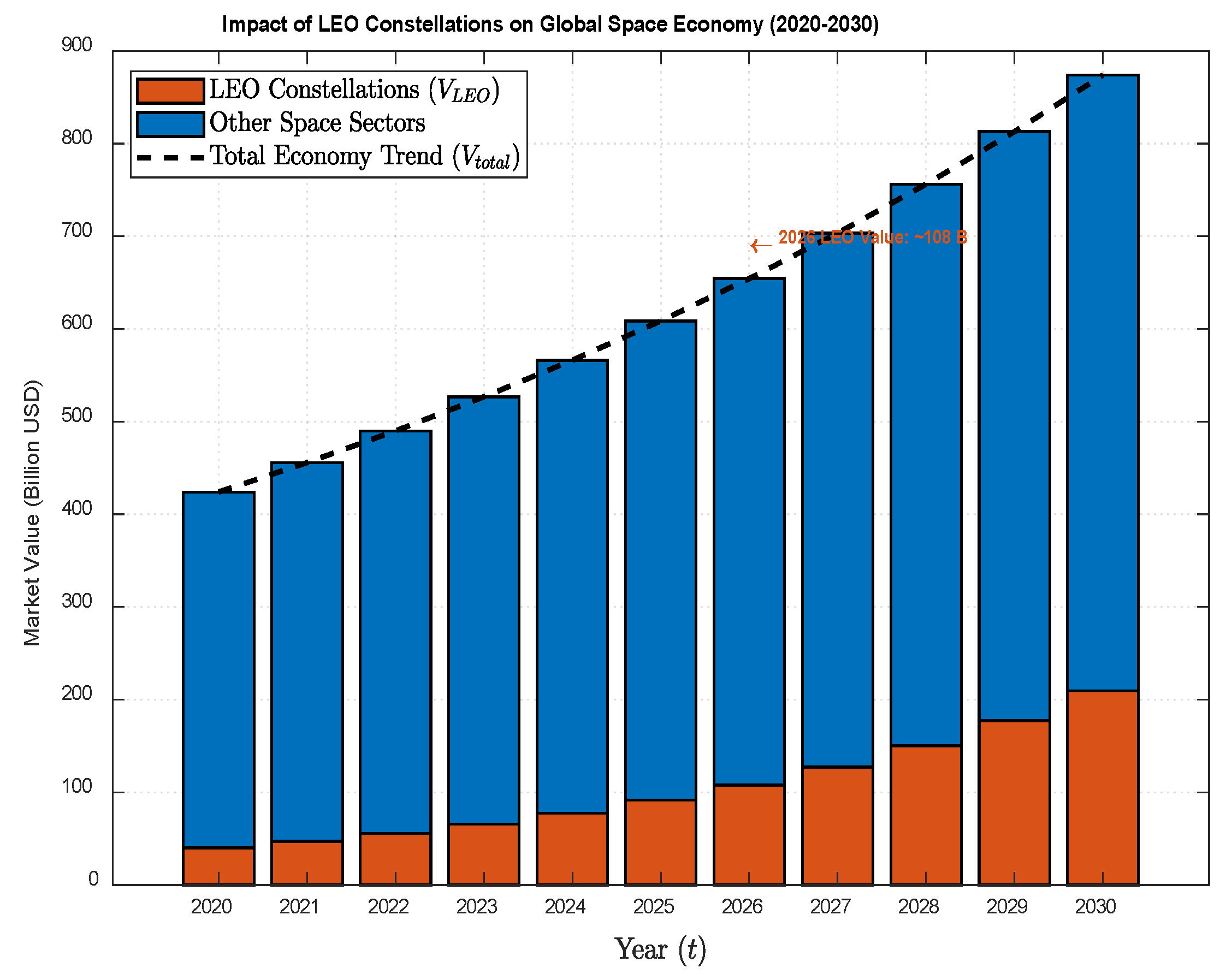
Figure 2.
Conservative projection of LEO constellations’ market penetration rate (2020–2030), illustrating an initial exponential adoption phase transitioning into a market saturation plateau at 11.4%.
Figure 2.
Conservative projection of LEO constellations’ market penetration rate (2020–2030), illustrating an initial exponential adoption phase transitioning into a market saturation plateau at 11.4%.
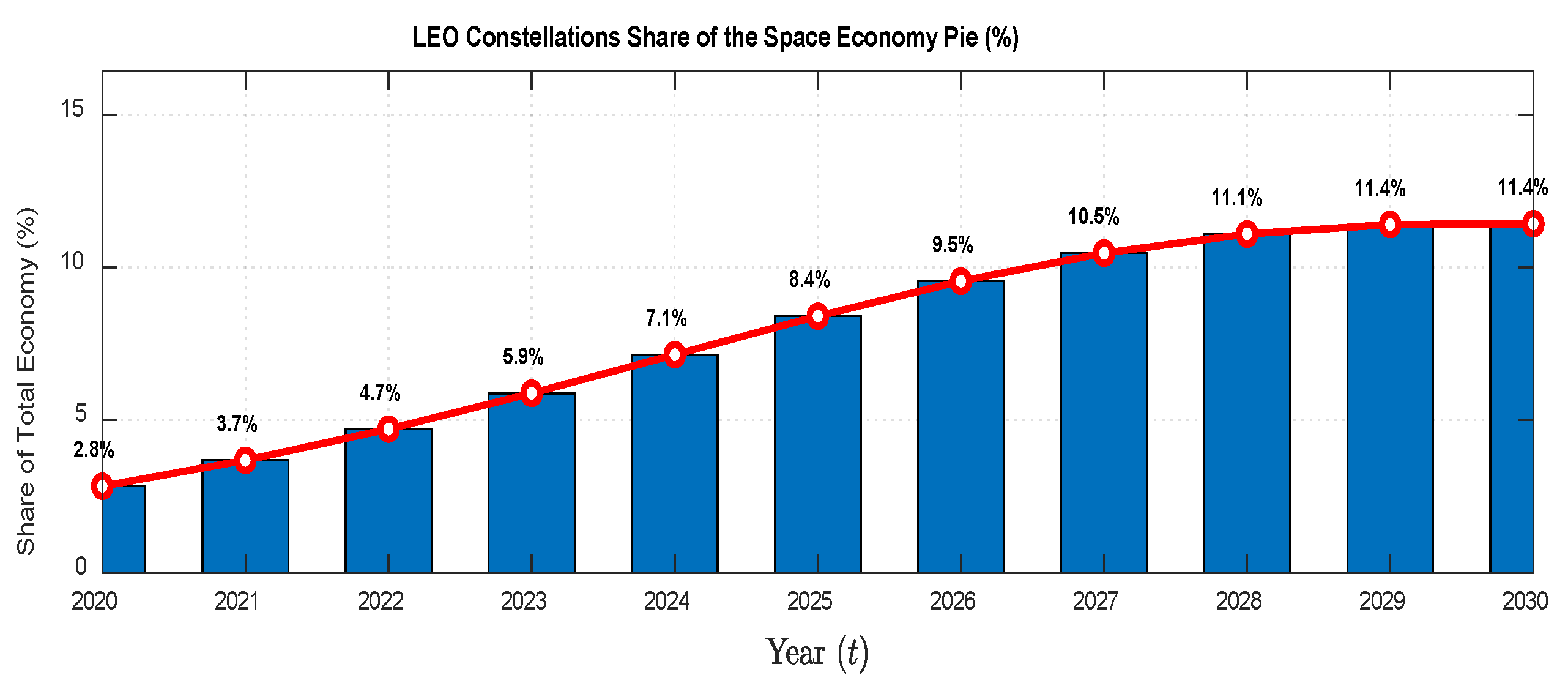
Figure 3.
Global quantum technology investment trajectory (2022–2026) exhibiting a compound annual growth rate (CAGR) of 43.17%,.
Figure 3.
Global quantum technology investment trajectory (2022–2026) exhibiting a compound annual growth rate (CAGR) of 43.17%,.
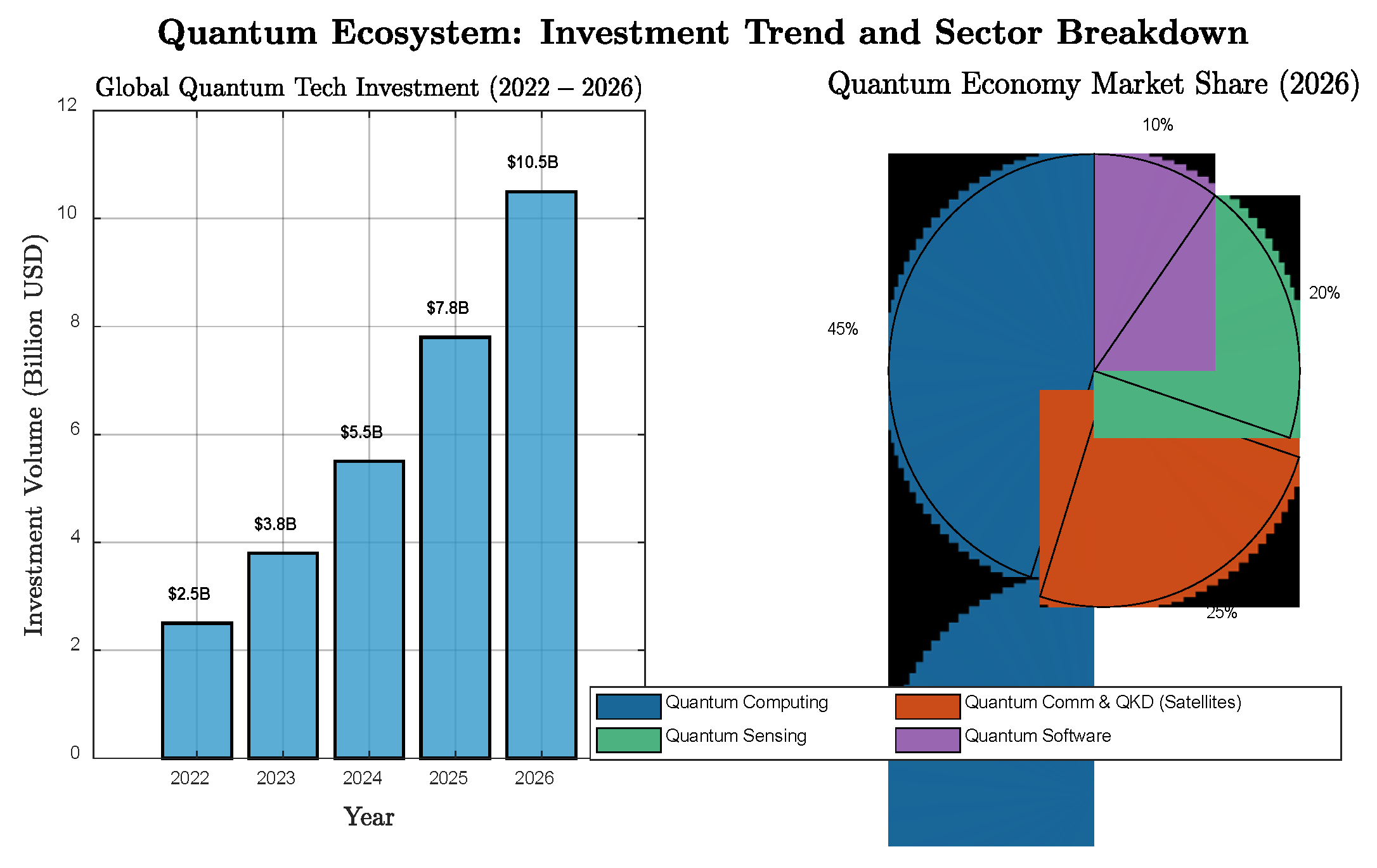
Figure 4.
Quantum Communications Market Trajectory and Platform Segmentation (2023–2028).
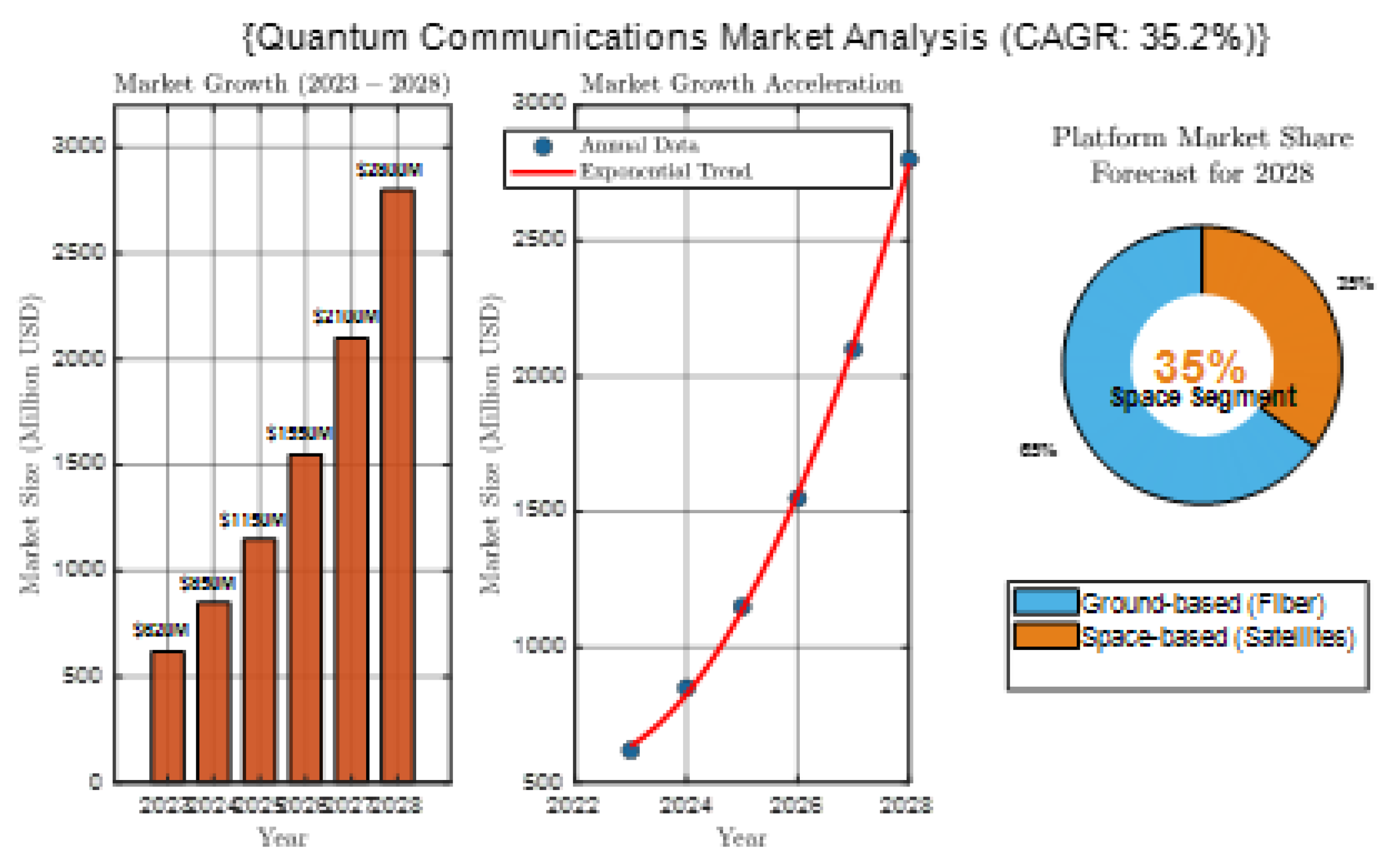
Figure 5.
Macro-economic dynamics and strategic growth decoupling between LEO constellations and the quantum communications market (2020–2030).
Figure 5.
Macro-economic dynamics and strategic growth decoupling between LEO constellations and the quantum communications market (2020–2030).

Figure 8.
Leading contributors in space-based quantum communications research by document count.
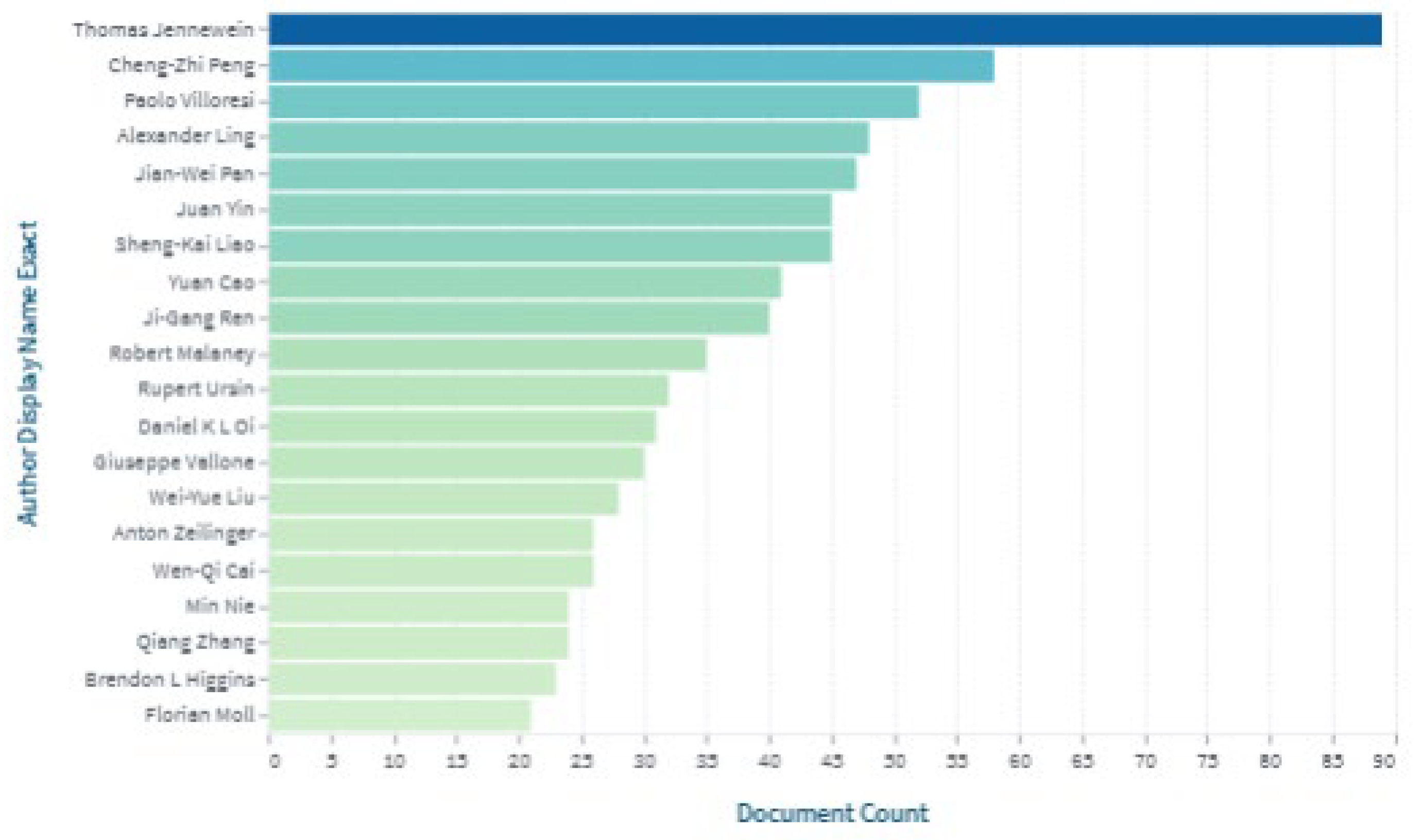
Figure 9.
High-frequency keywords and thematic domain cloud of the space-based quantum communications corpus.
Figure 9.
High-frequency keywords and thematic domain cloud of the space-based quantum communications corpus.
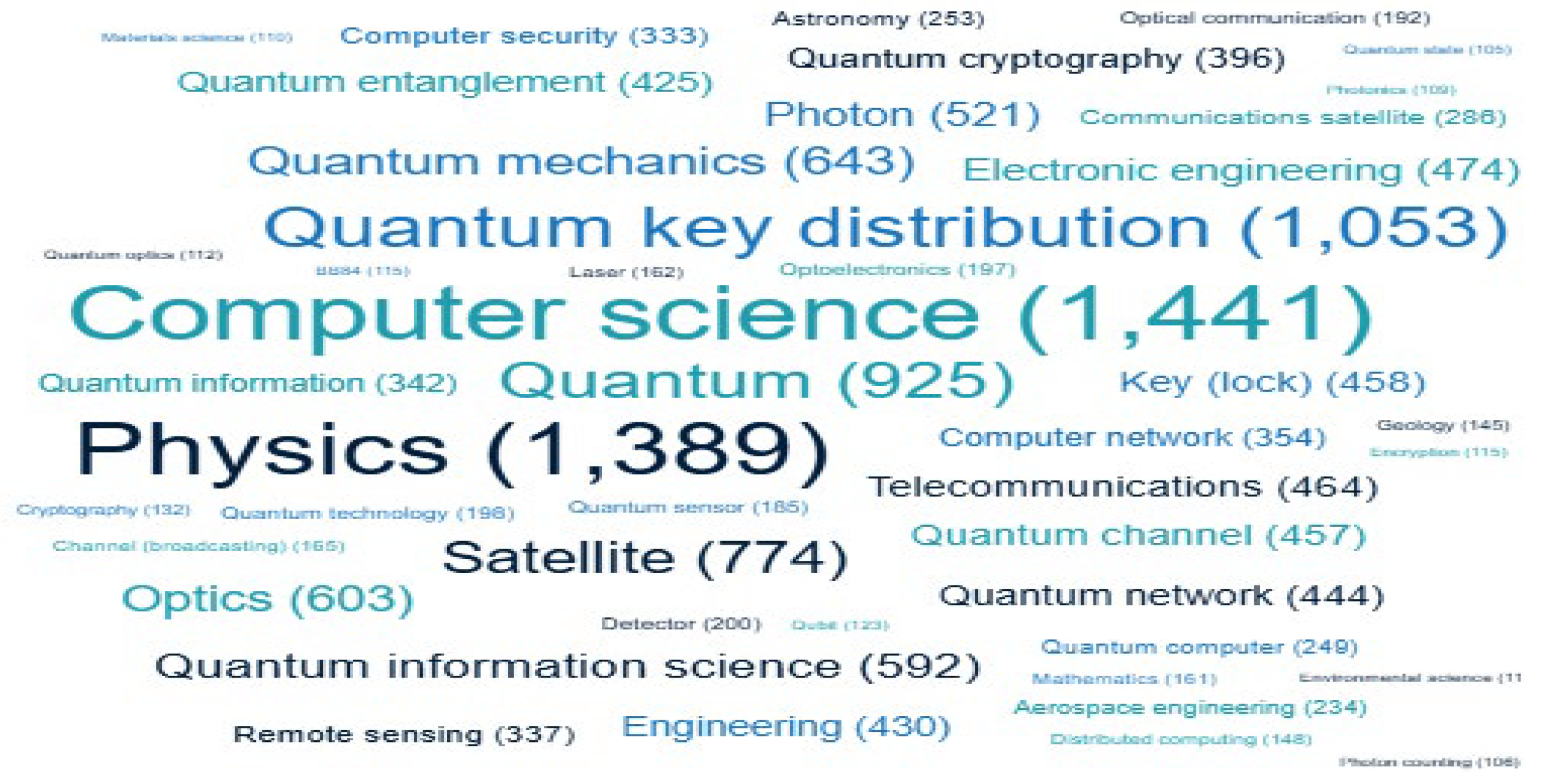
Figure 10.
Conceptual block diagram of a space optical Pointing–Acquisition–Tracking (PAT) system, illustrating the coarse and fine control loops.
Figure 10.
Conceptual block diagram of a space optical Pointing–Acquisition–Tracking (PAT) system, illustrating the coarse and fine control loops.
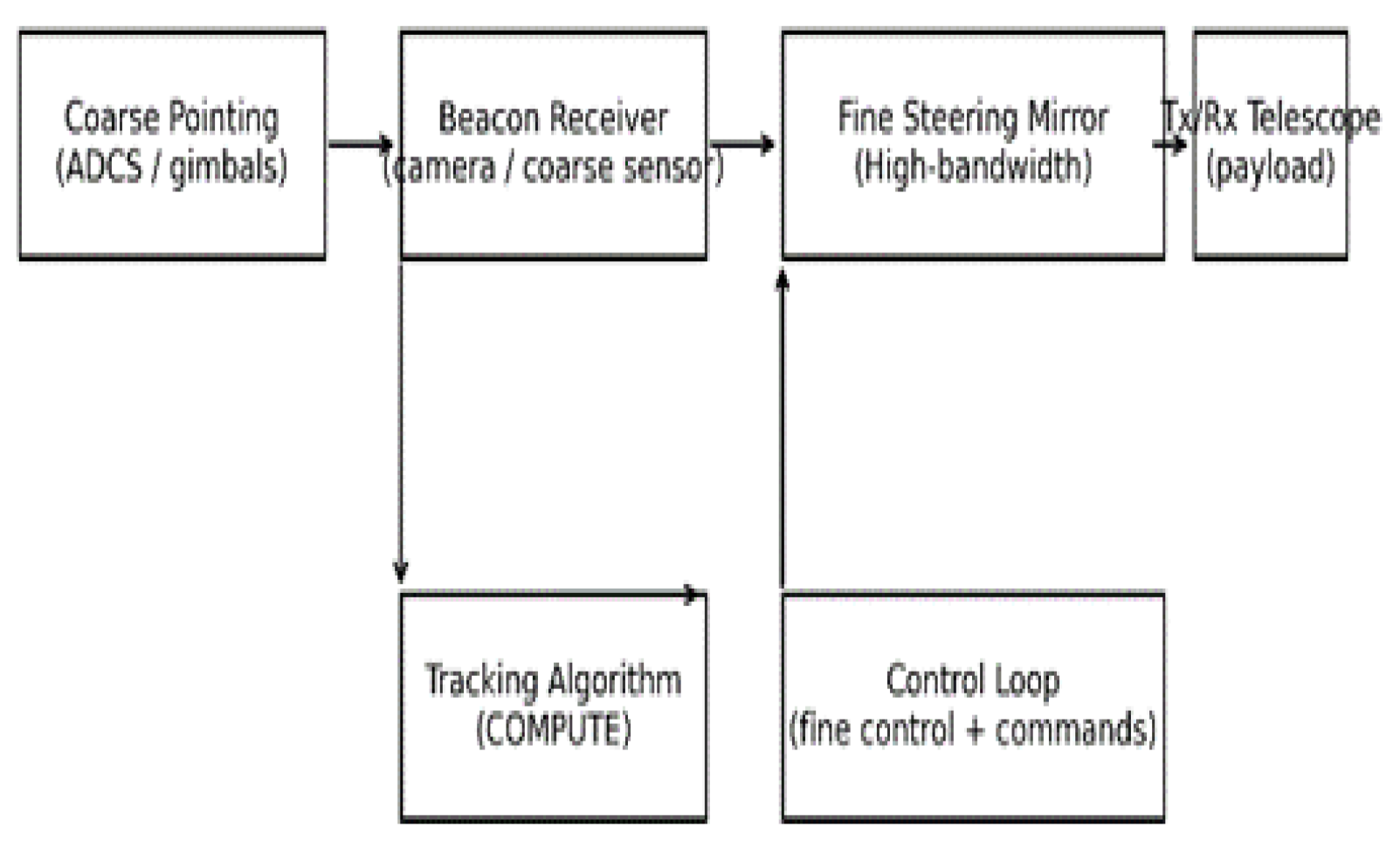
Figure 11.
Illustrative secure key rate (SKR) as a function of total channel loss under simplified assumptions (R_rep = 100 MHz, η_det = 0.6, QBER = 1%).
Figure 11.
Illustrative secure key rate (SKR) as a function of total channel loss under simplified assumptions (R_rep = 100 MHz, η_det = 0.6, QBER = 1%).
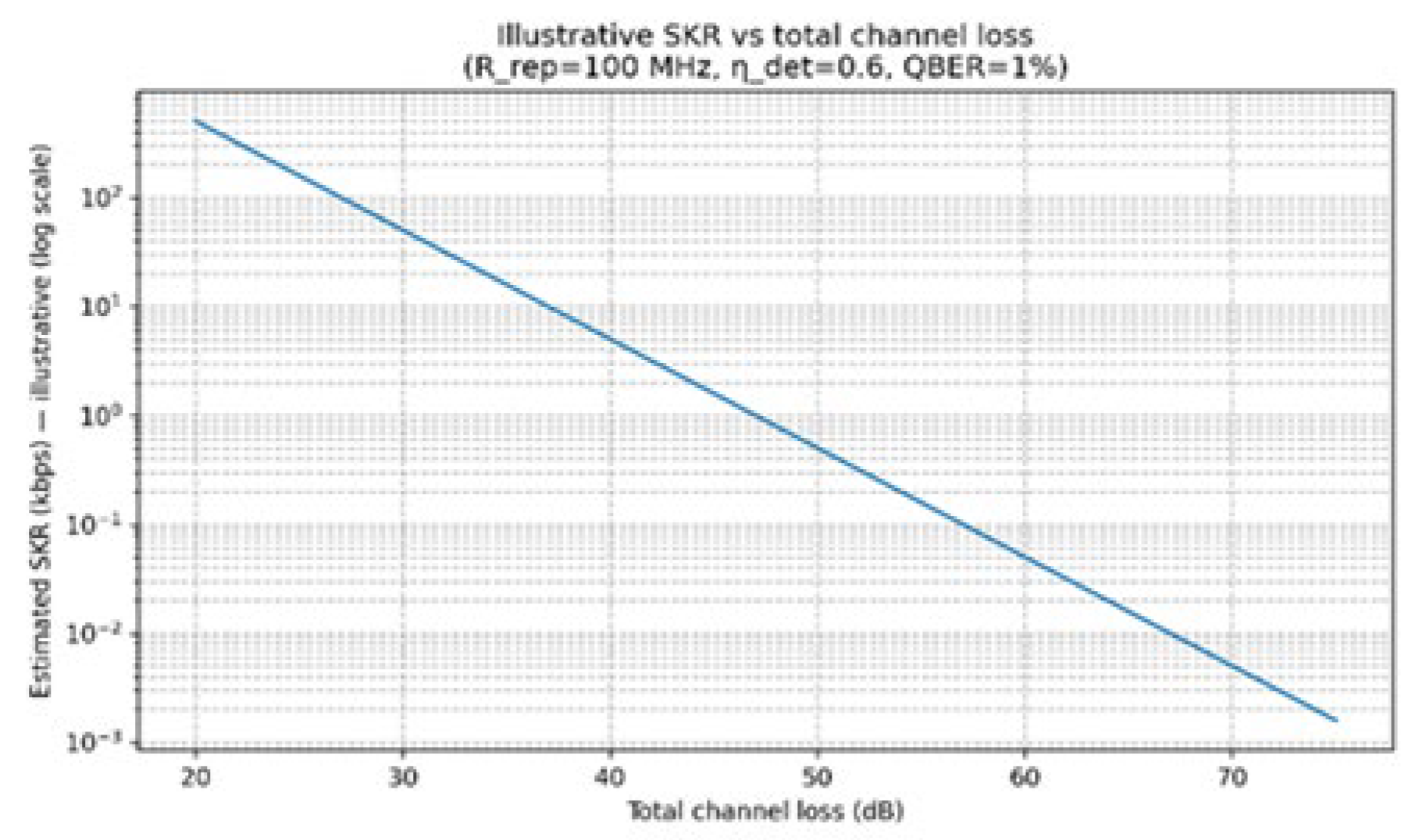
Figure 12.
Geometric channel loss versus slant range for different transmitter apertures at λ = 800 nm with a 1 m receiver telescope.
Figure 12.
Geometric channel loss versus slant range for different transmitter apertures at λ = 800 nm with a 1 m receiver telescope.
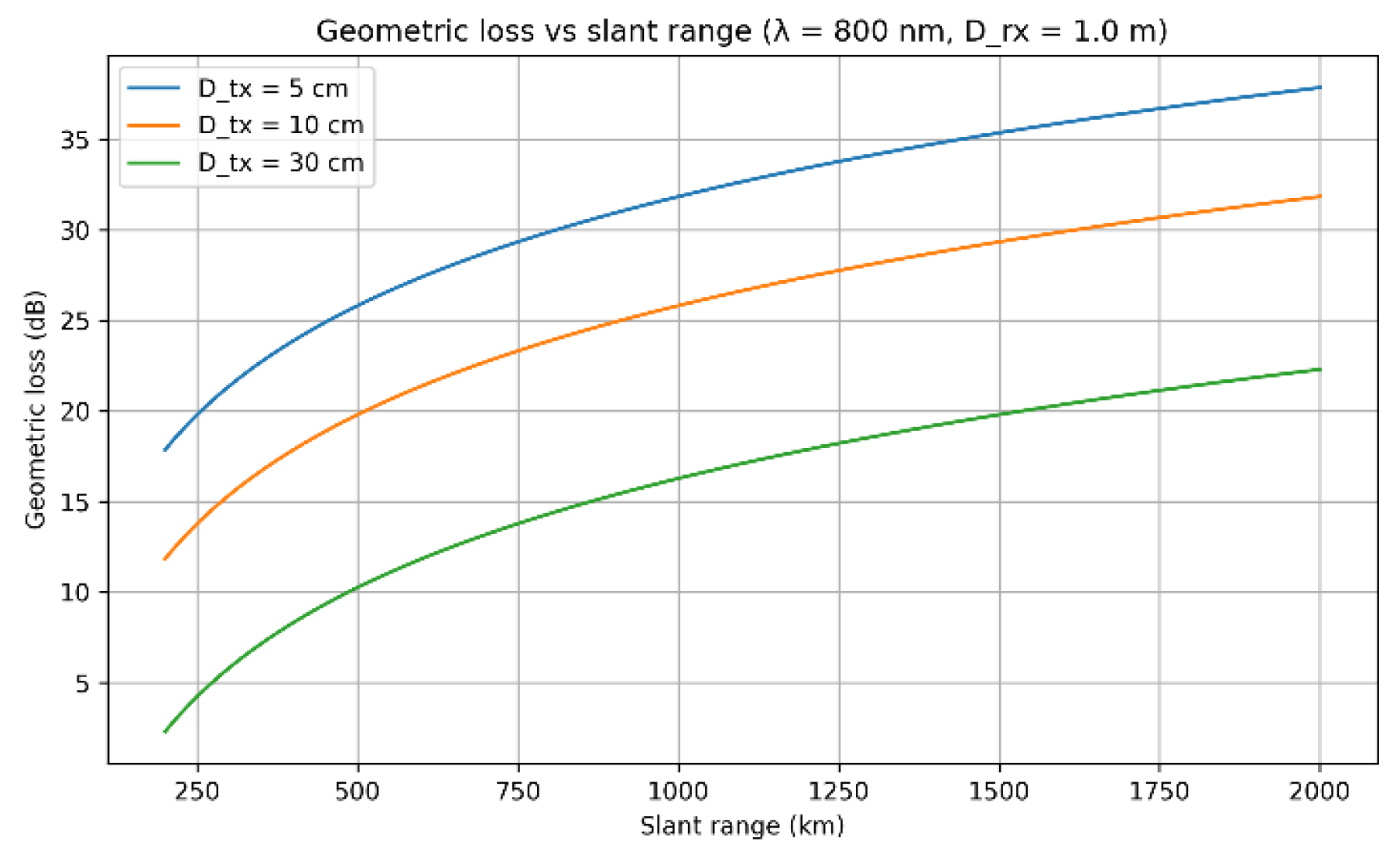
Table 1.
Comparative analysis of dominant QKD protocols in the context of space-based implementation.
Table 1.
Comparative analysis of dominant QKD protocols in the context of space-based implementation.
| Protocol Family | Prepare-and-Measure (PM) | Entanglement-based | Continuous Variable | Distributed Phase |
| Representative Protocol | Decoy-state BB84 | BBM92 / E91 | GG02 (Gaussian) | DPS / COW |
| Variable Type | Discrete Variable (DV) | Discrete Variable (DV) | Continuous Variable (CV) | Discrete Variable (DV) |
| Space Heritage (Status) | High (Standard for Micius, QEYSSat, most CubeSats | Medium (Demonstrated by Micius; upcoming SpooQy-1) | Low (Experimental/Feasibility studies) | Low to Medium (Studied for specific orbits) |
| Implementation Complexity (Space Segment) | Low to Medium: Requires weak coherent laser pulses; no entanglement source needed. | High: Requires a complex, power-hungry Entangled Photon Source (EPS) on board. | Low (Tx) / High (Link): Uses standard telecom components (Homodyne detection), but link budget is critical | Medium: Simpler receiver setup but requires precise phase coherence |
| Key Advantage | Robust against high channel loss; mature technology | Enables “Untrusted Node” architecture (highest security); foundation for Quantum Internet | High compatibility with existing classical telecom hardware; potential for daylight operation | Simplified receiver design (good for uplink). |
| Major Challenge | Security relies on the satellite being a “Trusted Node” (vulnerable if hacked | Low key rate due to strict pointing requirements for two simultaneous downlinks. | Extremely sensitive to channel loss and excess noise; harder to implement over long space-ground links. | Lower security bounds compared to Decoy-BB84; strict coherence requirements |
Disclaimer/Publisher’s Note: The statements, opinions and data contained in all publications are solely those of the individual author(s) and contributor(s) and not of MDPI and/or the editor(s). MDPI and/or the editor(s) disclaim responsibility for any injury to people or property resulting from any ideas, methods, instructions or products referred to in the content. |
© 2026 by the authors. Licensee MDPI, Basel, Switzerland. This article is an open access article distributed under the terms and conditions of the Creative Commons Attribution (CC BY) license (http://creativecommons.org/licenses/by/4.0/).
Copyright: This open access article is published under a Creative Commons CC BY 4.0 license, which permit the free download, distribution, and reuse, provided that the author and preprint are cited in any reuse.