

Submitted:
17 September 2026
Posted:
21 September 2026
You are already at the latest version
Abstract
We review what is known about finite-time singularity formation ("blow-up") in the unsteady Prandtl boundary-layer equations, from the numerical discovery of the van Dommelen--Shen singularity in 1980 to the rigorous description of its self-similar structure completed in 2018--2022. The survey is organized around five questions: (i) what the singularity is physically (unsteady separation and eruption of the boundary layer); (ii) where it is known to occur (the impulsively started cylinder, vortex-induced separation, colliding wall streams); (iii) what has been proved (the E--Engquist theorem, the Kukavica--Vicol--Wang theorem, the Collot--Ghoul--Ibrahim--Masmoudi description of the stable blow-up pattern, the classification of inviscid singularities); (iv) how blow-up relates to the ill-posedness of the Prandtl equations without monotonicity and to the inviscid limit of the Navier--Stokes equations; and (v) how the reduced one-dimensional system on the symmetry axis, which carries the rigorous theory, sits inside the recent similarity transformation of Sun [Phys.\ Fluids \textbf{36}, 083616 (2024)] as its \(m=1\) member. We also record the explicit affine blow-up solution \(u=-x/(t_*-t)\), \(v=y/(t_*-t)\), which is exact for both Prandtl and Navier--Stokes, and explain why Prandtl blow-up bears no relation to the finite-energy Navier--Stokes blow-up announced in September 2026. A list of open problems closes the survey.
Keywords:
finite-time singularities
; Prandtl’s boundary-layer equations
; Navier-Stokes equations
; blow-up solutions
1. Introduction
Prandtl’s equations [1] for a two-dimensional unsteady boundary layer beneath an outer Euler flow are
on , with at and as . They are parabolic in y but only hyperbolic in x, and this mixed character is the source of everything that follows. Two mathematical questions dominate the subject: whether smooth solutions exist for all time, and whether the equations are even well-posed for general data. Both have negative answers in general. Smooth solutions can develop a singularity in finite time—this is the subject of the present survey—and the Cauchy problem is ill-posed in Sobolev spaces unless the data are monotone in y or analytic in x.
The physical content of the singularity is unsteady separation. When an adverse pressure gradient or a colliding pair of wall streams decelerates the fluid near the wall, the boundary layer thickens, a region of reversed flow forms, and fluid is ejected upward in a narrow spike. In the Prandtl description this eruption terminates in a genuine singularity at a finite time : the displacement thickness and the wall-normal velocity become unbounded, while the streamwise velocity stays bounded but develops an infinite x-gradient. Beyond the boundary-layer approximation has broken down, the normal pressure gradient can no longer be neglected, and one must return to the Navier–Stokes equations, in which no singularity occurs in two dimensions.
This survey collects the literature on Prandtl blow-up in one place. Section 2 recounts the discovery; Section 3 presents the one-dimensional reduction on a symmetry axis, which carries most of the rigorous theory, and the explicit affine blow-up solution; Section 4 states the theorems; Section 5 summarizes the numerical and asymptotic work; Section 6 places blow-up in the wider context of ill-posedness and the inviscid limit; Section 7 relates the reduced system to Sun’s similarity transformation; Section 8 explains the relation to the Navier–Stokes question; Section 9 lists open problems. Table 1 gives a chronology.
2. Discovery: The Van Dommelen–Shen Singularity
The steady problem came first. Goldstein [2] showed in 1948 that the steady boundary-layer equations cannot be continued past the point of vanishing wall shear: the solution has a square-root singularity there, and the boundary-layer approximation fails. Stewartson [7] extended the analysis, and Dalibard and Masmoudi [28] proved the Goldstein singularity rigorously in 2019, for the stationary equations under an adverse pressure gradient, with a precise description of the profile at separation.
For unsteady flow the criterion of vanishing wall shear is not the right one, as Moore, Rott and Sears [3,4,5] argued in the 1950s: on a moving wall, or in an unsteady flow, separation occurs where the velocity and the shear vanish simultaneously at a point moving with the separation structure (the MRS criterion). Whether the unsteady Prandtl equations themselves develop a singularity remained open until van Dommelen and Shen [8] computed the boundary layer on an impulsively started circular cylinder in Lagrangian variables and found that the solution develops a singularity at a finite time (in units of ), at a point on the rear of the cylinder, before any steady state is reached. The Lagrangian formulation was essential: in Eulerian variables the singularity is masked by the extreme thinning of the layer in x, whereas in Lagrangian variables it appears as a vanishing of —fluid particles are compressed to zero streamwise extent—so that the normal velocity and the displacement thickness diverge while the tangential velocity stays finite. The singularity is not attached to the wall; it forms at a finite height inside the layer, at the MRS point.
Elliott, Smith and Cowley [9] gave the asymptotic structure of the singularity in the three settings of their title (moving surfaces, semi-similar unsteady flow, fully unsteady flow), and Cowley [10] confirmed the blow-up time by analytic continuation of the small-time series. Van Dommelen and Cowley [11] then developed the Lagrangian theory of unsteady separation in general, showing that the local structure near is universal: a fluid particle is squeezed in x as and stretched in y as , with a cubic-root profile in the Eulerian x-coordinate. Peridier, Smith and Walker [12] found the same singularity in vortex-induced separation, and Cassel, Smith and Walker [13] showed that it also occurs in the Lagrangian computation of the impulsively started cylinder with a moving wall. Cowley’s review [14] summarizes this body of work.
3. The Symmetry-Axis Reduction and the Affine Solution
Most of the rigorous theory concerns a one-dimensional reduction that isolates the mechanism. Consider Equations (1) and (2) with zero pressure gradient and data odd in x, so that two wall streams collide at . Near the axis , and with . Applying to Equation (1) and evaluating on the axis gives the closed system [15,24]
or, for A alone, . This is the equation that Kukavica, Vicol and Wang describe as the trace of the tangential derivative of the tangential velocity along the transversal axis, which solves a closed one-dimensional equation [24,25]. With an outer flow the term is added to the left of Equation (3).
Two features make Equation (3) the natural laboratory for blow-up.
The inviscid mechanism is a Riccati equation. With , along the paths one has , so . Wherever —a converging stream, —the strain rate blows up at , and the wall-normal velocity with it. Hong and Hunter [17] analysed this inviscid problem and its viscous perturbation and showed that viscosity delays but does not remove the blow-up. Wong [23] proved the analogous Riccati-type blow-up for the hydrostatic Euler equations, the inviscid Prandtl system, by freezing the solution with an invariant transformation and deriving a Riccati inequality.
The affine solution is exact. The y-independent member satisfies , so
is an exact solution of Equations (1) and (2) with zero pressure gradient, and—since and the y-momentum equation is satisfied by —an exact solution of the full Navier–Stokes equations as well. It describes a wall contracting as a shrinking sheet [43] with velocity diverging at , ejecting fluid upward; it is the collapsing-strain flow of Moffatt’s blow-up model [44] and the linear-in-x member of the dynamically stretched vortex class [45]. Any x-independent shear layer may be superposed, obeying , which Lundgren’s transformation [46] maps to the heat equation; its amplitude grows as and its vorticity as . The affine solution is a blow-up in the literal sense but of the infinite-energy, moving-wall type; the theorems below concern the stationary wall , for which y-dependence is essential.
4. Theorems
E and Engquist (1997). [15] For the zero-pressure-gradient Prandtl equations with data odd in x of converging type, smooth solutions blow up in finite time. The proof works with Equation (3), multiplies by a suitable weight vanishing at the wall to eliminate the unknown wall term , and derives a Riccati inequality for the weighted integral of a. This was the first rigorous finite-time singularity for Prandtl’s equations. Gargano et al. [19] later showed that the E–Engquist singularity and the van Dommelen–Shen singularity are the same object.
Kukavica, Vicol and Wang (2017). [24] With an outer flow of the form (a stagnation-type Euler flow), and for a class of data that need not be odd in x, they proved the existence of blow-up solutions by establishing that a quantity analogous to the tangential derivative on the axis blows up in finite time, and identified the singularity with that of van Dommelen and Shen. The paper also contains a careful treatment of the boundary condition at through a lift by an inhomogeneous heat equation.
Collot, Ghoul, Ibrahim and Masmoudi (2018–2022). [25] For the reduced problem on the axis they gave a precise description of singular solutions. A stable blow-up pattern was found in which the blow-up point is ejected to infinity in finite time and the solution forms a plateau of growing length. In the companion paper on Burgers’ equation with transverse viscosity [27] they showed that the same self-similar profile governs a broad class of problems; the Prandtl singularity is, in these variables, a generic Burgers-type shock formation regularized only transversally.
Collot, Ghoul and Masmoudi (2021). [26] For the inviscid Prandtl system they gave a sharp expression for the maximal existence time of regular solutions, showed that singularities occur only at the boundary or on the zero-vorticity set and correspond to separation, obtained Lagrangian formulae for backward self-similar profiles, and proved that the profile at the heart of the van Dommelen–Shen singularity appears generically—for an open dense set of blow-up solutions—for any prescribed outer flow. This is the rigorous counterpart of the universality claimed by Elliott, Smith and Cowley and by van Dommelen and Cowley.
Taken together, these results establish that (i) blow-up occurs for large classes of smooth data, (ii) the singular structure is self-similar and universal, (iii) it is stable, and (iv) it coincides with the numerically discovered van Dommelen–Shen singularity. The subject is, in this sense, mathematically mature.
5. Numerical and Asymptotic Work
Beyond the original Lagrangian computation, [8] the most informative numerical work uses complex-singularity tracking. Gargano, Sammartino and Sciacca [19] computed the impulsively started disk, followed the singularities of the solution in the complex x-plane, and classified the van Dommelen–Shen singularity as a cubic-root singularity, as the Lagrangian asymptotics predict. They also introduced a class of initial data, uniformly bounded in but with a dipole singularity in the complex plane, for which the blow-up time can be made arbitrarily short—numerical evidence of ill-posedness in —and showed that a small streamwise viscosity stops the singularities at a finite distance from the real axis. Gargano et al. [22] then applied the same analysis to Navier–Stokes solutions at high Reynolds number and found that the Navier–Stokes singularities approach the real axis as increases but never reach it, the flow instead undergoing a large-scale interaction of the kind Elliott, Smith and Cowley anticipated. Obabko and Cassel [39] had earlier compared Navier–Stokes and Prandtl solutions for vortex-induced separation. Della Rocca et al. [40] and Gargano et al. [41] extended the computations to rectilinear-vortex forcing.
For orientation, Figure 1 shows a computation of the reduced system (3) carried out for this survey. Two features of the rigorous picture are visible directly: viscosity delays the inviscid Riccati time but never prevents blow-up, and the singularity forms away from the wall and moves outward on the upward ejection , leaving a plateau behind—the ejection-to-infinity pattern of Collot et al. [25].
6. Context: Ill-Posedness and the Inviscid Limit
Blow-up must be distinguished from ill-posedness, although they share a mechanism. Oleinik [6] proved global existence for data monotone in y using the Crocco transformation, and Xin and Zhang [18] obtained global weak solutions for monotone data with favorable pressure gradient; Kukavica, Masmoudi, Vicol and Wong [29] treated data with several monotonicity regions. Without monotonicity the Cauchy problem is ill-posed in Sobolev spaces: Gérard-Varet and Dormy [20] exhibited, near a non-monotone shear flow, linearized solutions growing like in the tangential wavenumber k, and Gérard-Varet and Nguyen [21] extended this to the nonlinear problem. Well-posedness survives for analytic data (Sammartino and Caflisch [16]), Gevrey data (Gérard-Varet and Masmoudi, [30] Dietert and Gérard-Varet [31]), and in Sobolev spaces for monotone data by energy methods (Alexandre, Wang, Xu and Yang; [32] Masmoudi and Wong [33]). Ignatova and Vicol [34] proved almost-global existence for small analytic perturbations of a monotone shear flow. In three dimensions the situation is worse: Liu, Wang and Yang [35] showed ill-posedness even for monotone data unless the two tangential components are proportional, with well-posedness only under that structural condition [36].
The relation to the inviscid limit is the reason the subject matters. If Prandtl’s expansion is valid on , then the Navier–Stokes solution at high Reynolds number follows the boundary layer until the eruption, at which point the layer detaches, the vorticity leaves the wall, and Kato’s criterion [37] for convergence to Euler is tested. Gargano et al. [22] argued, on the basis of complex-singularity analysis, that the Navier–Stokes solution mimics the approach to the van Dommelen–Shen singularity and then undergoes a large-scale viscous–inviscid interaction; the energy dissipation during this interaction has been studied numerically by Nguyen van yen, Waidmann, Klein, Farge and Schneider, [42] who related it to the persistence of dissipation in the inviscid limit. The mathematical validity of the Prandtl expansion itself is established only for analytic data (Sammartino and Caflisch [16]) and is known to fail in the presence of instability (Grenier [38]).
7. The Reduced System in Sun’s Similarity Variables
Sun [47] introduced for Equations (1) and (2) with the variables , , , and obtained the reduced equation
with constants fixed by m. For the thickness is constant, , and is independent of x; Equation (5) becomes the unsteady Hiemenz equation . Dropping the constant term, which comes from , gives , which is exactly the A-form of Equation (3). The E–Engquist system is therefore the , zero-outer-flow member of Sun’s family, and a blow-up at a fixed time appears in the plane as a singular line . The Kummer-function solutions of Ref. [47] for , continued to , are the affine solution (4) with its superposed shear layer, singular as . For a singularity would have to propagate from the leading edge along ; whether Equation (5) with admits one is open (Section 9).
9. Open Problems
- 1.
- General data. The theorems of Section 4 cover odd-in-x data (E–Engquist), a class of data with a stagnation outer flow (Kukavica–Vicol–Wang), and the reduced problem on the axis (Collot et al.). Blow-up from general smooth data on a curved body with a prescribed outer flow—the impulsively started cylinder itself—has been established only numerically.
- 2.
- Viscous self-similar structure off the axis. The full two-dimensional self-similar structure of the viscous singularity, matching the Lagrangian asymptotics of van Dommelen and Cowley to the transverse-viscosity Burgers profile of Collot et al., has not been written down as a theorem.
- 3.
- Three dimensions. No rigorous blow-up result is known for the three-dimensional Prandtl equations; the ill-posedness results of Liu, Wang and Yang [35] suggest the problem is qualitatively different.
- 4.
- Inviscid limit through the singularity. Whether the Navier–Stokes solution converges to the Euler solution across the Prandtl blow-up time, and what replaces the boundary layer afterward, is open beyond analytic data; the numerical evidence of Refs. [22,42] points to a large-scale interaction whose mathematical description is missing.
- 5.
- Similarity singularities. Whether the reduced equation (5) with adverse power-law outer flow (, ) develops a singularity propagating from the leading edge, and what its structure would be in , has not been examined. It would be an unsteady analogue of the Goldstein–Stewartson separation singularity within a one-parameter family of similarity solutions.
- 6.
- Moving walls and the MRS criterion. A rigorous version of the Moore–Rott–Sears criterion, identifying the blow-up point with the point of simultaneous vanishing of velocity and shear in a moving frame, has been obtained only in the inviscid setting [26].
10. Summary
Finite-time singularity formation in the unsteady Prandtl equations is the mathematical form of unsteady boundary-layer separation and eruption. It was discovered numerically by van Dommelen and Shen in 1980, described asymptotically in Lagrangian variables through the 1980s and 1990s, proved rigorously in the symmetry-axis reduction by E and Engquist in 1997 and by Kukavica, Vicol and Wang in 2017, and characterized—self-similar profile, stability, ejection-to-infinity pattern, inviscid classification—by Collot, Ghoul, Ibrahim and Masmoudi between 2018 and 2022. The explicit affine solution exhibits the Riccati mechanism in closed form, and the reduced axis system is the member of Sun’s recent similarity transformation. The subject is closely tied to the ill-posedness of the Prandtl equations without monotonicity and to the inviscid limit of the Navier–Stokes equations, but it is independent of the finite-energy Navier–Stokes blow-up announced in 2026. What remains open lies mainly at the interfaces: general data on curved bodies, three dimensions, and the passage of the Navier–Stokes solution through the Prandtl singularity.
Author Contributions
Bo Hua Sun: Conceptualization (lead); Formal analysis (lead); Investigation (lead); Methodology (lead); Software (lead); Validation (lead); Visualization (lead); Writing—original draft (lead); Writing—review & editing (lead). All authors have read and agreed to the published version of the manuscript.
Data Availability Statement
The data that support the findings of this work are available from the corresponding author upon reasonable request.
Conflicts of Interest
The author has no conflicts to disclose.
References
- Prandtl, L. “Über Flüssigkeitsbewegung bei sehr kleiner Reibung,” in Verh. III. Int. Math.-Kongr., Heidelberg 1904 (Teubner, Leipzig, 1905). pp. 484–491.
- Goldstein, S. On laminar boundary-layer flow near a position of separation. Q. J. Mech. Appl. Math. 1948, 1, 43–69. [Google Scholar] [CrossRef]
- Moore, F.K. On the separation of the unsteady laminar boundary layer. In Boundary Layer Research; Görtler, H., Ed.; Springer: Berlin/Heidelberg, Germany, 1958; pp. 296–311. [Google Scholar]
- Rott, N. Unsteady viscous flow in the vicinity of a stagnation point. Q. Appl. Math. 1956, 13, 444–451. [Google Scholar] [CrossRef]
- Sears, W.R.; Telionis, D.P. Boundary-layer separation in unsteady flow. SIAM J. Appl. Math. 1975, 28, 215–235. [Google Scholar] [CrossRef]
- Oleinik, O.A. On the mathematical theory of boundary layer for an unsteady flow of incompressible fluid. J. Appl. Math. Mech. 1966, 30, 951–974. [Google Scholar] [CrossRef]
- Stewartson, K. On Goldstein’s theory of laminar separation. Q. J. Mech. Appl. Math. 1958, 11, 399–410. [Google Scholar] [CrossRef]
- van Dommelen, L.L.; Shen, S.F. The spontaneous generation of the singularity in a separating laminar boundary layer. J. Comput. Phys. 1980, 38, 125–140. [Google Scholar] [CrossRef]
- Elliott, J.W.; Smith, F.T.; Cowley, S.J. Breakdown of boundary layers: (i) on moving surfaces; (ii) in semi-similar unsteady flow; (iii) in fully unsteady flow. Geophys. Astrophys. Fluid Dyn. 1983, 25, 77–138. [Google Scholar] [CrossRef]
- Cowley, S.J. Computer extension and analytic continuation of Blasius’ expansion for impulsive flow past a circular cylinder. J. Fluid Mech. 1983, 135, 389–405. [Google Scholar] [CrossRef]
- Cowley, S.J.; van Dommelen, L.L.; Lam, S.T. On the use of Lagrangian variables in descriptions of unsteady boundary-layer separation. Philos. Trans. R. Soc. London Ser. A 1990, 333, 343–378. [Google Scholar] [CrossRef]
- Peridier, V.J.; Smith, F.T.; Walker, J.D.A. Vortex-induced boundary-layer separation. Part 1. The unsteady limit problem Re→∞. J. Fluid Mech. 1991, 232, 99–131. [Google Scholar] [CrossRef]
- Cassel, K.W.; Smith, F.T.; Walker, J.D.A. The onset of instability in unsteady boundary-layer separation. J. Fluid Mech. 1996, 315, 223–256. [Google Scholar] [CrossRef]
- Cowley, S.J. Laminar boundary-layer theory: A 20th century paradox? In Mechanics for a New Millennium; Aref, H., Phillips, J.W., Eds.; Kluwer: Dordrecht, The Netherlands, 2001; pp. 389–411. [Google Scholar]
- E, W.; Engquist, B. Blowup of solutions of the unsteady Prandtl’s equation. Comm. Pure Appl. Math. 1997, 50, 1287–1293. [Google Scholar] [CrossRef]
- Sammartino, M.; Caflisch, R.E. Zero viscosity limit for analytic solutions of the Navier–Stokes equation on a half-space. I, II. Commun. Math. Phys. 1998, 192, 433–461, 463–491. [Google Scholar] [CrossRef]
- Hong, L.; Hunter, J.K. Singularity formation and instability in the unsteady inviscid and viscous Prandtl equations. Commun. Math. Sci. 2003, 1, 293–316. [Google Scholar] [CrossRef]
- Xin, Z.; Zhang, L. On the global existence of solutions to the Prandtl’s system. Adv. Math. 2004, 181, 88–133. [Google Scholar] [CrossRef]
- Gargano, F.; Sammartino, M.; Sciacca, V. Singularity formation for Prandtl’s equations. Physica D. 2009, 238, 1975–1991. [Google Scholar] [CrossRef]
- Gérard-Varet, D.; Dormy, E. On the ill-posedness of the Prandtl equation. J. Am. Math. Soc. 2010, 23, 591–609. [Google Scholar] [CrossRef]
- Gérard-Varet, D.; Nguyen, T. Remarks on the ill-posedness of the Prandtl equation. Asymptot. Anal. 2012, 77, 71–88. [Google Scholar] [CrossRef]
- Gargano, F.; Sammartino, M.; Sciacca, V.; Cassel, K.W. Analysis of complex singularities in high-Reynolds-number Navier–Stokes solutions. J. Fluid Mech. 2014, 747, 381–421. [Google Scholar] [CrossRef]
- Wong, T.K. Blowup of solutions of the hydrostatic Euler equations. Proc. Am. Math. Soc. 2015, 143, 1119–1125. [Google Scholar] [CrossRef]
- Kukavica, I.; Vicol, V.; Wang, F. The van Dommelen and Shen singularity in the Prandtl equations. Adv. Math. 2017, 307, 288–311. [Google Scholar] [CrossRef]
- Collot, C.; Ghoul, T.-E.; Ibrahim, S.; Masmoudi, N. On singularity formation for the two-dimensional unsteady Prandtl system around the axis. J. Eur. Math. Soc. 2022, 24, 3703–3800. [Google Scholar] [CrossRef]
- Collot, C.; Ghoul, T.-E.; Masmoudi, N. Singularities and unsteady separation for the inviscid two-dimensional Prandtl system. Arch. Ration. Mech. Anal. 2021, 240, 1349–1430. [Google Scholar] [CrossRef]
- Collot, C.; Ghoul, T.-E.; Masmoudi, N. Singularity formation for Burgers equation with transverse viscosity. Ann. Sci. Éc. Norm. Supér. (4) 2022, 55, 1047–1133. [Google Scholar] [CrossRef]
- Dalibard, A.-L.; Masmoudi, N. Separation for the stationary Prandtl equation. Publ. Math. IHÉS 2019, 130, 187–297. [Google Scholar] [CrossRef]
- Kukavica, I.; Masmoudi, N.; Vicol, V.; Wong, T.K. On the local well-posedness of the Prandtl and hydrostatic Euler equations with multiple monotonicity regions. SIAM J. Math. Anal. 2014, 46, 3865–3890. [Google Scholar] [CrossRef]
- Gérard-Varet, D.; Masmoudi, N. Well-posedness for the Prandtl system without analyticity or monotonicity. Ann. Sci. Éc. Norm. Supér. (4) 2015, 48, 1273–1325. [Google Scholar] [CrossRef]
- Dietert, H.; Gérard-Varet, D. Well-posedness of the Prandtl equations without any structural assumption. Ann. PDE 2019, 5, 8. [Google Scholar] [CrossRef]
- Alexandre, R.; Wang, Y.-G.; Xu, C.-J.; Yang, T. Well-posedness of the Prandtl equation in Sobolev spaces. J. Am. Math. Soc. 2015, 28, 745–784. [Google Scholar] [CrossRef]
- Masmoudi, N.; Wong, T.K. Local-in-time existence and uniqueness of solutions to the Prandtl equations by energy methods. Comm. Pure Appl. Math. 2015, 68, 1683–1741. [Google Scholar] [CrossRef]
- Ignatova, M.; Vicol, V. Almost global existence for the Prandtl boundary layer equations. Arch. Ration. Mech. Anal. 2016, 220, 809–848. [Google Scholar] [CrossRef]
- Liu, C.-J.; Wang, Y.-G.; Yang, T. On the ill-posedness of the Prandtl equations in three-dimensional space. Arch. Ration. Mech. Anal. 2016, 220, 83–108. [Google Scholar] [CrossRef]
- Liu, C.-J.; Wang, Y.-G.; Yang, T. A well-posedness theory for the Prandtl equations in three space variables. Adv. Math. 2017, 308, 1074–1126. [Google Scholar] [CrossRef]
- Kato, T. Remarks on zero viscosity limit for nonstationary Navier–Stokes flows with boundary. In Seminar on Nonlinear Partial Differential Equations; Springer: New York, NY, USA, 1984; pp. 85–98. [Google Scholar]
- Grenier, E. On the nonlinear instability of Euler and Prandtl equations. Comm. Pure Appl. Math. 2000, 53, 1067–1091. [Google Scholar] [CrossRef]
- Obabko, A.V.; Cassel, K.W. Navier–Stokes solutions of unsteady separation induced by a vortex. J. Fluid Mech. 2002, 465, 99–130. [Google Scholar] [CrossRef]
- Della Rocca, G.; Lombardo, M.C.; Sammartino, M.; Sciacca, V. Singularity tracking for Camassa–Holm and Prandtl’s equations. Appl. Numer. Math. 2006, 56, 1108–1122. [Google Scholar] [CrossRef]
- Gargano, F.; Sammartino, M.; Sciacca, V. High Reynolds number Navier–Stokes solutions and boundary layer separation induced by a rectilinear vortex. Comput. Fluids 2011, 52, 73–91. [Google Scholar] [CrossRef]
- Nguyen van yen, R.; Waidmann, M.; Klein, R.; Farge, M.; Schneider, K. Energy dissipation caused by boundary layer instability at vanishing viscosity. J. Fluid Mech. 2018, 849, 676–717. [Google Scholar] [CrossRef]
- Miklavčič, M.; Wang, C.Y. Viscous flow due to a shrinking sheet. Q. Appl. Math. 2006, 64, 283–290. [Google Scholar] [CrossRef]
- Moffatt, H.K. The interaction of skewed vortex pairs: a model for blow-up of the Navier–Stokes equations. J. Fluid Mech. 2000, 409, 51–68. [Google Scholar] [CrossRef]
- Gibbon, J.D.; Fokas, A.S.; Doering, C.R. Dynamically stretched vortices as solutions of the 3D Navier–Stokes equations. Physica D. 1999, 132, 497–510. [Google Scholar] [CrossRef]
- Lundgren, T.S. Strained spiral vortex model for turbulent fine structure. Phys. Fluids 1982, 25, 2193–2203. [Google Scholar] [CrossRef]
- Sun, B.H. Similarity solutions of a class of unsteady laminar boundary layer. Phys. Fluids 2024, 36, 083616. [Google Scholar] [CrossRef]
- OpenAI. “Finite Time Blowup for Navier–Stokes,” Manuscript and Lean Formalization, Released 8 September 2026. Available online: https://openai.com/index/navier-stokes-solution/.
- Clay Mathematics Institute. statement of 11 September 2026; see also T. Buckmaster, statement of 7 September 2026.
Figure 1.
Illustration of blow-up in the reduced system (3) with and data (colliding wall streams). (a) Growth of for ; every case blows up, at , versus the inviscid estimates . (b) Profiles for : the minimum deepens and migrates outward while a plateau develops behind it, the pattern described in Ref. [25]. Backward-Euler diffusion, explicit nonlinearity, 1600 points on ; blow-up times are converged to a few percent.
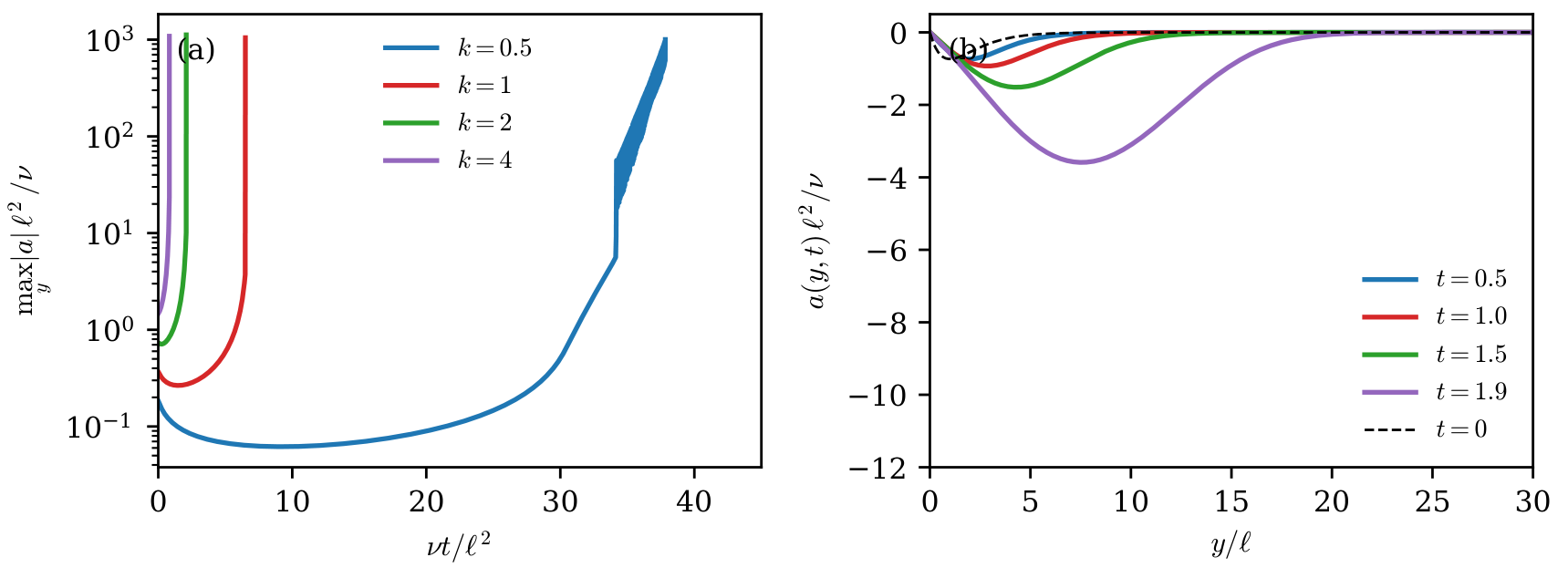

Table 1.
Chronology of the main results on singularity formation in the unsteady Prandtl equations.
| Year | Authors | Contribution |
|---|---|---|
| 1904 | Prandtl [1] | Boundary-layer equations; steady separation at |
| 1948 | Goldstein [2] | Square-root singularity of the steady equations at separation |
| 1956–58 | Moore, Rott, Sears [3,4,5] | MRS criterion for unsteady separation on moving walls |
| 1966 | Oleinik [6] | Global existence for monotone data (Crocco transformation) |
| 1980 | van Dommelen & Shen [8] | Lagrangian computation: finite-time singularity for the impulsively started cylinder, |
| 1983 | Elliott, Smith & Cowley; [9] Cowley [10] | Asymptotic structure of the singularity; series/analytic continuation |
| 1990 | Cowley, van Dommelen & Lam [11] | Lagrangian description of unsteady separation |
| 1991–96 | Peridier, Smith & Walker; [12] Cassel, Smith & Walker [13] | Vortex-induced separation; singularity in Lagrangian coordinates |
| 1997 | E & Engquist [15] | First rigorous proof of blow-up (zero pressure gradient, symmetry-axis reduction) |
| 1998 | Sammartino & Caflisch [16] | Local well-posedness for analytic data |
| 2003 | Hong & Hunter [17] | Singularity formation and instability, inviscid and viscous |
| 2004 | Xin & Zhang [18] | Global weak solutions for monotone data and favorable pressure gradient |
| 2009 | Gargano, Sammartino & Sciacca [19] | Complex-singularity tracking: VDS singularity is a cube-root singularity |
| 2010 | Gérard-Varet & Dormy [20] | Ill-posedness in Sobolev spaces without monotonicity |
| 2014 | Gargano et al. [22] | Complex singularities of Navier–Stokes solutions at high |
| 2015 | Wong [23] | Blow-up of the hydrostatic Euler equations (inviscid analogue) |
| 2017 | Kukavica, Vicol & Wang [24] | Rigorous van Dommelen–Shen blow-up for a class of data with outer flow |
| 2018–22 | Collot, Ghoul, Ibrahim & Masmoudi [25,26,27] | Self-similar structure, stability of the blow-up pattern, inviscid classification |
| 2019 | Dalibard & Masmoudi [28] | Rigorous Goldstein singularity for the steady equations |
Disclaimer/Publisher’s Note: The statements, opinions and data contained in all publications are solely those of the individual author(s) and contributor(s) and not of MDPI and/or the editor(s). MDPI and/or the editor(s) disclaim responsibility for any injury to people or property resulting from any ideas, methods, instructions or products referred to in the content. |
© 2026 by the authors. Licensee MDPI, Basel, Switzerland. This article is an open access article distributed under the terms and conditions of the Creative Commons Attribution (CC BY) license (http://creativecommons.org/licenses/by/4.0/).
Copyright: This open access article is published under a Creative Commons CC BY 4.0 license, which permit the free download, distribution, and reuse, provided that the author and preprint are cited in any reuse.