

Submitted:
21 September 2026
Posted:
21 September 2026
You are already at the latest version
Abstract
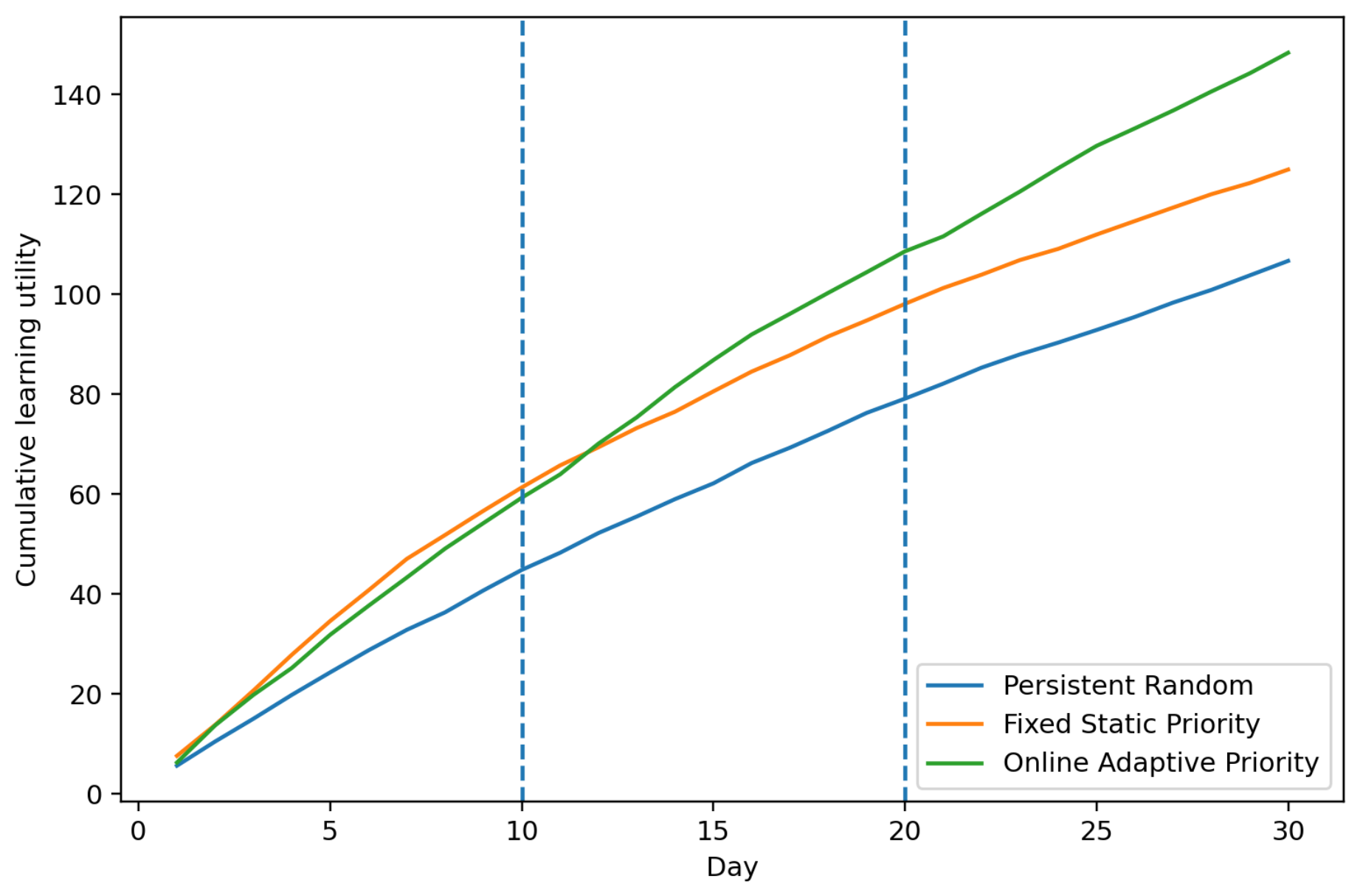
Autonomous robots should continuously extend what they can learn rather than remain limited to a fixed set of predefined tasks and skills. However, existing learning systems typically optimize within predetermined task, data, or capability spaces and provide limited mechanisms for making new learning opportunities themselves reachable. This paper proposes an autonomous reachable learning space expansion model in which newly acquired knowledge and skills progressively enlarge the space of future learnable knowledge. The model maintains persistent learning beyond individual tasks and expands learning along environmental, temporal, and thinking dimensions. Environmental interaction exposes previously inaccessible observations and opportunities, temporal accumulation enables delayed and long-term relations to be learned, and thinking generates new candidate problems through abstraction, transfer, combination, and variation. Newly acquired capabilities are recursively reused to unlock further learning opportunities, while an online learning process adapts which materials should receive priority. Experiments show that the full model increases structural diversity from 0.740 to 0.947, raises reachable scope from 19.70 to 29.60 over random exploration, and improves cumulative learning utility from 124.99 to 148.38 over a fixed priority strategy.
Keywords:
autonomous robot learning
; open-ended learning
; reachable learning space
; thinking-driven learning
1. Introduction
Autonomous robots are increasingly expected to operate for long periods in open and changing environments rather than execute only a fixed set of predefined tasks [1,2]. In such settings, it is not sufficient for a robot to learn a policy once or to adapt only when a new task is explicitly assigned. A more general autonomous system should continue to acquire knowledge from observation, interaction, internal feedback, and reasoning, even when no immediate task requires it. More importantly, what the robot learns should affect what it is able to learn later.
Existing continual, lifelong, and open-ended learning methods have made important progress toward long-term adaptation, knowledge retention, skill discovery, and autonomous exploration [3]. However, most of these methods mainly optimize learning within a set of experiences, tasks, states, or skills that are already available to the agent. In contrast, an embodied robot can change its own future learning conditions. Learning to move to a better viewpoint can reveal previously unseen objects; learning to open or manipulate an environmental structure can expose new materials or relations; long-term observation can make delayed effects learnable; and reasoning can generate new hypotheses that do not directly occur in current sensory input. Thus, new knowledge and skills can enlarge not only the robot’s competence, but also the set of future learning opportunities accessible to it.
This paper studies this process as reachable learning space expansion. We distinguish the knowledge and skills already possessed by the robot, denoted by , from the learning opportunities that are currently reachable, denoted by . The central idea is that learning should be recursive:
A newly acquired capability can expose new environments, sources, temporal relations, or reasoning possibilities; these in turn provide new learning materials and produce further knowledge or skills. This view shifts the objective from simply accumulating more experience to progressively enlarging the space from which future learning can occur.
To realize this idea, we propose an autonomous reachable learning space expansion model with persistent learning and three complementary expansion mechanisms. Environmental expansion uses sensing and physical interaction to access observations and situations that were previously unavailable. Temporal expansion accumulates evidence across time so that delayed, rare, or changing relations can become learnable. Thinking expansion uses existing knowledge to construct new candidate problems through operations such as abstraction, transfer, substitution, combination, and controlled variation. Candidate knowledge produced by thinking is treated as a hypothesis rather than as ground truth and must be validated through environmental or internal feedback. Newly learned capabilities are then recursively reused to open further learning opportunities. The model also allows the learning process itself to adapt by learning which materials should receive greater priority under changing conditions.
The main contributions of this work are threefold. First, we formulate robot learning in terms of the distinction between the current learned repertoire and the reachable learning space, making explicit how new capabilities can change what is learnable next. Second, we integrate environmental, temporal, and thinking expansion into a persistent learning process and allow acquired capabilities to recursively unlock later learning opportunities. Third, we provide controlled experimental verification of persistent autonomous learning, boundary-specific expansion, thinking-driven discovery, recursive scope growth, and online adaptation of the learning process. The results show that the proposed model increases structural diversity, expands reachable scope, and improves learning utility compared with fixed-task, random, and non-adaptive alternatives.
The remainder of this paper is organized as follows. Section 2 reviews continual robot learning, autonomous exploration and skill discovery, and foundation-model-based embodied reasoning. The proposed model is then introduced, followed by the verification experiments and analysis. Finally, the paper concludes with the main findings and directions for future real-robot validation.
2. Related Work
2.1. Continual and Lifelong Robot Learning
Continual and lifelong robot learning aim to enable an embodied agent to acquire knowledge or skills over an extended sequence of experiences rather than being trained once on a fixed dataset. Existing continual-learning research has developed mechanisms such as replay, regularization, modular representations, and selective adaptation to reduce catastrophic forgetting when the data distribution or task changes over time [4,5]. These approaches are important for autonomous robots because real environments do not present all relevant training data at once, and a robot must preserve previously acquired competence while adapting to new situations. Task-free formulations further reduce reliance on manually supplied task boundaries and are therefore closer to long-term autonomous operation.
Recent generalist robot-learning systems extend this direction by exploiting experience collected from many tasks and embodiments. RoboCat, for example, uses heterogeneous visual-action experience across robotic platforms and can adapt to new manipulation tasks with relatively limited target-task data; it also demonstrates a self-improvement loop in which the trained system can generate additional data for subsequent training [6]. Such work shows that the repertoire of a robot can become broader as its accumulated experience grows, and it provides an important basis for moving from isolated task learning toward persistent multi-task competence.
However, most continual and lifelong learning methods primarily ask how to retain, transfer, or adapt knowledge within a stream of encountered tasks or data. Even when task boundaries are removed, the set of experiences available to the learner is usually treated as externally given. In contrast, our work focuses on how learning can change the future learning space itself. A newly learned sensing, manipulation, navigation, or reasoning capability may expose observations, objects, relations, information sources, or hypotheses that were previously unreachable. We therefore distinguish the current learned repertoire from the reachable learning space , and study the recursive transition
This emphasis complements continual-learning mechanisms: retention and adaptation remain useful, but they do not by themselves explain how the range of possible future learning can expand.
2.2. Autonomous Exploration and Open-Ended Skill Discovery
A second closely related line of work studies autonomous exploration, intrinsic motivation, and reward-free skill discovery. DIAYN learns diverse skills without an external task reward by maximizing an information-theoretic objective, demonstrating that useful behaviors can emerge before a downstream task is specified [7]. Plan2Explore similarly uses a learned world model to seek expected future novelty and can subsequently adapt to multiple downstream tasks [8]. Benchmarking work such as URLB has further systematized the evaluation of unsupervised pretraining followed by downstream adaptation [9]. These methods are valuable because they weaken the assumption that all useful behavior must be specified in advance by an extrinsic reward.
Open-ended embodied agents extend exploration beyond low-level state coverage. Voyager combines an automatic curriculum, an expanding executable skill library, and iterative environment-feedback prompting so that an agent can continually explore, acquire skills, and make new discoveries in Minecraft [10]. This is particularly relevant to our work because it shows that accumulated skills can support later exploration and that an agent’s competence can grow without a fixed sequence of human-provided tasks. Such systems illustrate how curriculum generation, skill reuse, and environment feedback can produce long-horizon autonomous development.
Nevertheless, exploration and skill-discovery methods generally optimize where to visit, what behavior to diversify, or which skill to acquire inside an environment whose underlying opportunity structure is assumed to be available to interaction. Our objective is different: the robot should also learn capabilities that alter which learning opportunities are accessible at all. Moving to a new viewpoint can expose an unseen object; learning to open a container can reveal previously inaccessible contents; long-term monitoring can make delayed relations observable; and reasoning can generate hypotheses that do not directly appear in sensory experience. We therefore treat environmental, temporal, and thinking expansion as distinct mechanisms for enlarging . This shifts the emphasis from maximizing novelty within a fixed interaction space to recursively enlarging the space from which novelty and training material can subsequently arise.
2.3. Foundation Models for Embodied Reasoning and Robot Learning
Large language and vision-language models have recently become important components of embodied decision making. SayCan grounds language-model proposals with robot affordances so that high-level semantic knowledge is constrained by what a particular robot can execute [11]. ReAct interleaves reasoning and action, allowing an agent to update plans and gather external information through interaction [12]. These approaches demonstrate a useful separation between broad semantic reasoning and environment-grounded execution, and they motivate the use of language models as deliberative components rather than as unverified sources of physical truth.
Vision-language-action models move this integration closer to end-to-end robot control. RT-2 co-trains vision-language representations with robotic actions and demonstrates transfer of semantic knowledge from web-scale data to manipulation behavior [13]. OpenVLA further shows that a large VLA model trained on diverse real-robot demonstrations can be efficiently adapted to new manipulation settings [14]. Together with other generalist policies, these results show that foundation models can provide broad priors, semantic generalization, and reusable action representations that substantially reduce the amount of task-specific training required.
Our use of an LLM addresses a different role. The LLM is not treated as the robot’s final controller or as the authority that decides whether a newly proposed relation is true. Instead, thinking is one mechanism for expanding what may be learned next: previously acquired knowledge is abstracted, transferred, substituted, combined, or varied to generate new candidate problems and experiments. These candidates must subsequently be validated through environmental or internal feedback before they are added to the learned repertoire. Moreover, thinking is only one of three expansion routes in our model; physical interaction and long-term temporal accumulation can enlarge the learning space independently of language-model reasoning. Thus, foundation models provide a powerful source of semantic priors and hypothesis generation, whereas our main contribution concerns the recursive organization of these reasoning capabilities with environmental and temporal expansion so that newly acquired capabilities continually create further learning opportunities.
3. Autonomous Reachable Learning Space Expansion Model
The proposed model aims to enable a robot to progress from a small set of predefined basic capabilities toward increasingly broad knowledge and skills. To achieve this goal, the model contains three connected parts. First, a persistent autonomous learning process keeps learning active even when no external task is assigned, so that new materials and learning opportunities can continue to arise. Second, the robot expands the range of what can be learned through environmental, temporal, and thinking-based expansion. Third, newly acquired knowledge is validated and consolidated and may, in turn, improve the robot’s future ability to observe, act, think, and learn. Thus, the first part provides the persistent learning drive, whereas the second part constitutes the main mechanism for enlarging the robot’s reachable learning space.
Let
denote the knowledge and skill repertoire available to the robot at time t, where is the number of retained knowledge or skill items. The initial repertoire is intentionally small and contains only basic capabilities required for survival, sensing, action, learning, and thinking.
We further define the reachable learning space as
where represents the environments, objects, agents, and information sources currently accessible to the robot, represents the temporal extent of accumulated and monitorable experience, and represents the set of thinking or expansion operators currently available to generate new learning candidates. The purpose of the proposed model is therefore not merely to increase the number of items in , but to progressively enlarge and diversify , thereby making previously unreachable learning opportunities accessible.
The distinction between and is important. describes what the robot has already learned, whereas characterizes what the robot has become capable of learning next. A newly acquired skill may therefore have two effects: it may directly increase the current repertoire and, at the same time, enlarge the future learning space.
3.1. Persistent Autonomous Learning Process
A central design principle is that the learning process is predefined, whereas the learning content is not. The robot is initialized with a persistent internal process that repeatedly observes, collects, evaluates, thinks, experiments, and learns, but it is not initialized with a complete list of the knowledge or skills that should eventually be acquired. The learning process is therefore an internal long-term activity rather than a temporary procedure activated only by externally assigned tasks.
This process continues even when no external task is currently assigned. Completion of a task therefore does not terminate learning. Its role is to continuously create the conditions under which additional knowledge can be acquired and, when possible, to supply the materials required by the expansion mechanisms described in the next subsection.
The persistent learning process obtains materials from several sources:
where contains continuously collected observations, contains external outcome and environmental feedback, contains internal signals such as energy consumption, repeated failure, physical stress, or ineffective reasoning, contains materials generated or selected by internal thinking, contains materials obtained through active interaction, and contains information acquired from other agents, humans, or external knowledge sources.
Two complementary collection modes are maintained. First, the robot performs background collection without requiring a current learning objective. Such materials may appear unimportant when first observed but become useful after future events reveal a relation that was previously unknown. This allows the robot to preserve learning opportunities that were not anticipated when the material was collected. Second, thinking can identify missing, uncertain, or important information and increase the priority of corresponding material collection. Thus, broad weakly targeted collection coexists with focused reasoning-guided acquisition.
Feedback is treated broadly. A failed action, delayed environmental response, repeated unsuccessful idea, excessive energy cost, physical warning, or disagreement between information sources may all become learning material. Different feedback types may require different processing strategies, while unknown or complex cases can be forwarded to thinking for further interpretation rather than being ignored. Consequently, the robot is not restricted to learning only from explicit success labels or externally prepared training examples.
The learning process itself can also improve. The robot may learn better ways to collect materials, choose experiments, allocate attention, evaluate outcomes, use sensors, organize experience, or select learning algorithms. Such improvements do not merely add another task skill; they improve the process through which future learning opportunities are discovered and exploited. Learning therefore applies both to external knowledge and skills and to the mechanisms used for subsequent learning.
3.2. Expansion through Environment, Time, and Thinking
The central mechanism of the proposed model is to enlarge the reachable learning space . Even with a powerful learner, a robot cannot acquire substantially broader competence if it repeatedly observes the same environment, considers only the same types of problems, or reuses existing knowledge only under exactly the conditions in which it was first obtained. We therefore introduce three complementary expansion dimensions: environmental expansion, temporal expansion, and thinking expansion. They respectively enlarge where learning materials can be obtained, how far experience can extend across time, and what new learning candidates can be derived from existing knowledge.
3.2.1. Environmental Expansion
Environmental expansion increases the range of objects, states, interactions, agents, and information sources that can contribute learning materials. The robot is not restricted to passively receiving observations from a fixed location or sensor configuration. Its embodiment provides a mechanism for actively extending its accessible learning space. For example, when the current viewpoint is insufficient, the robot may move to another position; when an object’s property cannot be determined visually, it may manipulate the object and observe the resulting force, motion, sound, temperature, or other response. Opening a container, moving an obstacle, changing illumination, or using another sensing modality may similarly expose information that was previously unavailable.
Actions therefore have two roles. They may be used to achieve an immediate task, but they may also be performed primarily to acquire information or test existing knowledge. This second role enables the robot to actively produce learning materials rather than depending only on externally supplied data. An uncertain relation can therefore trigger an exploratory action whose outcome becomes a new training or validation sample.
Environmental expansion is not limited to the physical environment. Other robots, intelligent systems, documents, and humans may provide additional knowledge sources. Information obtained from these sources is treated as candidate material rather than automatically accepted knowledge and can later be checked against the robot’s own observations, actions, and outcomes.
Importantly, environmental expansion can itself be learned. A newly acquired sensing, locomotion, communication, or manipulation skill may expose situations that were inaccessible previously. For example, learning to open a drawer does not merely add an “open-drawer” skill; it also creates access to new objects and observations inside drawers. Thus, a learned capability can increase the range of future learning opportunities represented in .
3.2.2. Temporal Expansion
Knowledge acquisition is also expanded along time. Many properties cannot be reliably inferred from a single observation or a single execution. Some effects are delayed, some situations occur rarely, and some previously learned rules become inaccurate as the environment changes. The robot therefore maintains learning as a long-term internal activity rather than assuming that one observation or one execution is sufficient.
Repeated observations can confirm, weaken, or reject a tentative relation. Delayed outcomes can be associated with earlier states and actions, rare situations can gradually accumulate enough evidence for learning, and previously useful knowledge can be re-evaluated when new evidence becomes available. A candidate item may therefore pass through states such as newly observed, tentative, validated, revised, or invalidated instead of being permanently accepted after one observation.
Temporal expansion also makes learning history itself useful. Previous failures, successful executions, abandoned hypotheses, repeated uncertainties, delayed consequences, and changes in resource cost can all become materials for later reasoning. Therefore, the learning opportunities reachable at time t depend not only on the current observation but also on experience retained from earlier times.
An important consequence is that autonomous learning should be characterized as a process over time rather than only by a final repertoire. Starting from the small initial set , the robot should continuously accumulate new knowledge and skills over successive time periods. The amount learned in a day, week, month, or another interval can therefore reveal whether learning remains active or gradually stagnates. Temporal expansion is thus reflected not only in the availability of long-term evidence but also in the sustained growth of the learned repertoire.
3.2.3. Thinking Expansion
Environmental and temporal expansion enlarge what the robot can experience, whereas thinking expansion enlarges what the robot can derive from those experiences. Thinking is therefore used not only to solve the current problem but also to create new learning directions.
Suppose a method m was originally learned under conditions . Thinking may generate a candidate extension by changing the applicable conditions or the method itself:
where denotes the thinking-based expansion process, represents changes to the applicable conditions, represents changes to the action or method components, and represents controlled exploratory variation. The additional condition ensures that the candidate is not merely an exact repetition of the original method.
One important form of thinking expansion is partial abstraction. A previously learned method may contain several coupled properties although only some of them determine its effectiveness. By retaining relevant properties while removing incidental conditions, the robot can separate a useful principle from the particular situation in which it was first learned. This allows knowledge to be transferred to a new situation that is not identical to the original one but shares important properties.
A complementary mechanism is variation. The robot may intentionally change an object, environmental condition, parameter, action component, or action order and observe whether the expected outcome still holds. Such variation may be guided by prior knowledge, while controlled randomness helps avoid repeatedly exploring only familiar directions. Repeated variations can reveal applicability boundaries, unexpected relations, or improved methods.
Thinking can also generate extensions according to reusable structural patterns. Examples include transfer from part to whole or whole to part, substitution of functionally similar components, decomposition of an existing method, combination of independently learned methods, permutation of compatible operations, and application of a relation at another spatial or temporal scale. These operations do not guarantee useful discoveries; instead, they systematically enlarge the set of hypotheses that can subsequently be tested.
The range of discoverable problems is therefore constrained by the expansion operators currently available to the robot. A robot capable only of exact reuse has a narrow reachable learning space, whereas a robot that can abstract, decompose, substitute, combine, perturb, and transfer knowledge can generate a broader set of candidate problems. Moreover, these expansion operators may themselves be learned and improved, so the reachable learning space can expand not only because more knowledge is available, but also because the robot gains new ways to transform existing knowledge into future learning opportunities.
3.2.4. Coupling of the Three Expansion Dimensions
The three dimensions are not independent learning channels. Thinking may identify missing evidence and cause the robot to move, manipulate an object, or consult another information source, thereby producing environmental expansion. The resulting evidence may require repeated tests over time before a conclusion becomes reliable, producing temporal expansion. Accumulated experience may then reveal a pattern that stimulates a new abstraction or hypothesis, producing further thinking expansion.
Conversely, a newly learned skill can enlarge all three dimensions. A new locomotion skill can provide access to additional environments, a learned monitoring or memory mechanism can extend the effective temporal range of experience, and a newly acquired reasoning strategy can generate additional hypotheses from existing knowledge. The three dimensions therefore form a recursive expansion process:
3.3. Learning, Validation, and Recursive Scope Growth
Materials produced by the persistent learning process and the three expansion mechanisms are processed by an appropriate learner. The learner may be symbolic, statistical, machine-learning, deep-learning, or hybrid, depending on the type of knowledge being acquired. The framework does not require all knowledge to share one representation or one learning algorithm.
For each candidate knowledge or skill item , the robot accumulates supporting and contradicting evidence over time and estimates a validation score . A candidate is consolidated when sufficient evidence has been obtained:
where represents the current empirical support, confidence, or utility of candidate , and is the acceptance threshold. Previously learned knowledge may also be revised or weakened if later evidence contradicts it.
The accumulated learning outcome should be characterized from both quantity and diversity. Starting from the small initial repertoire , the robot is expected not only to increase the number of retained knowledge and skill items, but also to increase their diversity. Learning many nearly identical variants should not be interpreted as the same degree of expansion as acquiring capabilities that cover substantially different objects, conditions, functions, or problem types. Therefore, repertoire size and repertoire diversity provide complementary descriptions of what has actually been learned.
Their changes over successive time intervals provide an additional view of long-term autonomous learning. Rather than reporting only the difference between the initial and final repertoire, the learning process can be examined at multiple time scales, such as daily, weekly, or monthly growth. This allows evaluation of whether the robot continues to acquire new and diverse knowledge after its initial learning period or whether the process gradually saturates. Detailed definitions of the corresponding quantity, diversity, and temporal growth metrics are given in the experimental evaluation.
These measures describe accumulated learning outcomes in , whereas characterizes the potential for future learning. The important consequence is that learning results are not only outputs of the system; they can modify how future learning occurs. A new manipulation skill may expose previously inaccessible objects, a new sensing strategy may improve material collection, a new reasoning strategy may generate additional hypotheses, and a new learning strategy may improve the selection or organization of future training materials. Such changes can enlarge one or more components that determine in Equation (2).
The robot therefore does not operate inside a permanently fixed learning space. Its accumulated knowledge can change the mechanisms through which later knowledge is obtained. The overall objective is sustained growth of autonomous learning scope rather than only short-term task success. Evaluation should therefore consider the amount and diversity of learned knowledge and skills, their growth over time, the diversity of material sources, the breadth of the reachable learning space, and the proportion of newly acquired capabilities that were not explicitly predefined by the experimenter.
4. Verification
This section evaluates whether the proposed model can continuously acquire knowledge beyond a small initial repertoire, expand the kinds of learning opportunities that become reachable, use thinking to generate new learnable hypotheses, and improve the learning process itself from experience. The evaluation is intentionally separated into controlled experiments so that the contribution of persistent learning, environmental/temporal/thinking expansion, recursive reuse, and online adaptation can be examined individually. All experiments in this section are simulation-based. The simulator provides hidden ground truth only for outcome generation and evaluation; the proposed method does not directly observe latent importance, future graph descendants, or hidden validation rules.
4.1. Experimental Setting
4.1.1. General Scenario
The simulated robot starts from a small basic repertoire and encounters learning opportunities drawn from six knowledge/skill categories: perception, manipulation, navigation, self-maintenance, causal knowledge, and reasoning strategy. Learning materials may originate from observation, environmental feedback, the robot’s own state, thinking, active interaction, or social/external information. Opportunities are additionally classified by the boundary that must be crossed before they become learnable: direct opportunities are immediately accessible; environmental (E) opportunities require actions such as changing the viewpoint or opening a container; temporal (T) opportunities require longer-term monitoring; and thinking (H) opportunities require operations such as abstraction or combination. These labels are used by the simulator to construct controlled conditions; they are not equivalent to providing the robot with the correct future learning decision.
4.1.2. Implementation and Repeated Runs
Experiments 1, 2, and 4 use the v3/v3.1 implementation and ten random seeds. Experiment 1 runs for 30 simulated days with 24 learning events per day. Experiment 2 runs for 300 episodes. Experiment 4 runs for 42 learning steps. The robustness/adaptation experiments use the v4 targeted implementation: Experiment 1b uses 20 seeds and 30 days with 30 events per day, while Experiment 3 uses 20 seeds. Reported values are the mean and sample standard deviation over seeds.
The online learning components use an SGDRegressor. In Experiment 1, it receives only observable features—category, source, boundary type, noisy salience, noisy learnability, and whether the structural family is new—and is updated after an attempted learning event. Thus, latent opportunity importance is not directly available before selection. Experiment 1b uses a contextual form of the same online learner to adapt to changes in which types of materials are useful. Experiment 3 uses deepseek-v4-flash as the thinking model through an OpenAI-compatible interface, with temperature 0.4 and a maximum output length of 1800 tokens. The LLM proposes hypotheses; correctness is determined by the simulated environment rather than by the LLM itself.
4.1.3. Compared Methods
Fixed Task learns only a narrow predefined subset of direct perception/manipulation opportunities. Event Triggered reacts only to feedback or self-state materials. Persistent Random keeps learning without a fixed task list but chooses available material randomly. Full Model combines persistent learning, observable prioritization, exploration, and online value learning. In the dynamic adaptation test, Fixed Static Priority uses a non-learning weighted heuristic, whereas Online Adaptive Priority updates its material-value model from observed outcomes.
For thinking-driven discovery, Exact Reuse repeats the original method, Transfer Only changes only the object, and Random Mutation randomly modifies one or two method fields. The two thinking variants use the LLM to generate candidates; Thinking–No Feedback does not receive previous execution outcomes, while Thinking–Feedback receives them in later thinking cycles. In recursive scope expansion, No Recursive Reuse prevents newly acquired capabilities from becoming prerequisites for later learning, Static Scope Heuristic uses fixed observable scope cues, and the full model additionally learns scope-enabling value from actual unlock outcomes.
4.1.4. Metrics and Statistical Protocol
Skill growth is the number of newly acquired knowledge/skill items. Structural diversity is the fraction of distinct (category, boundary, source) families covered by learned items. Learning-curve AUC summarizes how quickly knowledge accumulates over time. Reachable-scope coverage is the fraction of boundary classes that can be reached under the enabled mechanisms. For thinking-driven discovery, a result counts as a valid novel discovery only when it differs from the original method and passes hidden environmental validation. Rule-family coverage measures how many different hidden validation mechanisms are discovered, avoiding the interpretation of many variants of one mechanism as broad discovery. For recursive expansion, maximum reachable depth measures how far the agent progresses along dependency chains, reachable scope counts learned plus currently reachable nodes, and secondary learning yield counts newly enabled opportunities. Seed-matched comparisons use the two-sided paired Wilcoxon signed-rank test. Selected tests are summarized in Table 6.
4.2. Experiment 1: Persistent Autonomous Learning
Purpose and Configuration
This experiment tests whether persistent learning without a complete predefined task list can accumulate a broader repertoire than fixed-task, event-only, or persistent-but-random learning. Each seed contains 600 opportunities. Opportunity difficulty is sampled from , and the hidden importance used only to generate post-attempt reward is sampled from . At each of 24 daily events, six currently available opportunities form the candidate batch. The full model retains random exploration and otherwise combines an observable priority cue with the online regressor. All methods use the same environmental learning-success function.
Figure 1 shows that persistent learning changes not only the final repertoire size but also the rate at which useful knowledge is accumulated. Table 1 quantifies this difference. Compared with Persistent Random, the full model increases final skill growth from to (), increases structural diversity from to (), and raises learning-curve AUC by . More importantly for open-ended learning, it reaches structural diversity 0.5 in days rather than days. The seed-matched tests in Table 6 confirm that these differences are not caused by a small number of favorable seeds. The result supports the hypothesis that persistent learning becomes substantially more effective when material selection is guided by observable cues and experience rather than being either task-restricted or random.
4.3. Experiment 1b: Adaptation of the Learning Process
Purpose and Configuration
Experiment 1 demonstrates persistent acquisition, but a fixed priority rule could still be sufficient in a stationary environment. Experiment 1b therefore tests the stronger hypothesis that the learning process itself can adapt when the value of learning materials changes. The experiment contains 600 opportunities and three consecutive 10-day regimes. During the first regime, feedback/self-state and temporal materials have high hidden utility; during the second, active/social and environmental-expansion materials become more useful; during the third, thinking/observation and thinking-expansion materials are favored. These phase-dependent utilities are used only after selection to generate reward and are not directly visible to the selector.
Persistent Random selects from a seven-item candidate batch without prioritization. Fixed Static Priority uses a fixed combination of salience, learnability, and family novelty. Online Adaptive Priority sees the same observable cues but also uses a contextual SGDRegressor updated from post-attempt reward. Twenty seeds are used.

Table 2.
Experiment 1b: adaptation when the value of learning materials changes every 10 days (20 seeds).
Table 2.
Experiment 1b: adaptation when the value of learning materials changes every 10 days (20 seeds).
| Method | Cumulative Utility | Useful Discoveries | Learned Items | Late Reward P1 | Late Reward P2 | Late Reward P3 |
|---|---|---|---|---|---|---|
| Persistent Random | ||||||
| Fixed Static Priority | ||||||
| Online Adaptive Priority |
The online method obtains cumulative utility, compared with for the fixed heuristic, an increase. It also produces useful discoveries versus , a increase, despite learning total items rather than . Thus, the gain is not explained by simply processing more material; the adaptive learner becomes more selective about what is worth learning. This interpretation is further supported by the regime transitions. During the first phase, the two priority-based methods have nearly identical late-phase reward ( versus ); after the utility structure changes, the online method rises to versus in Phase 2 and versus in Phase 3. The corresponding paired tests are significant only after the regime shifts (Table 6), which is consistent with adaptation rather than an initially privileged fixed scoring rule.
Figure 2.
Experiment 1b cumulative learning utility. Dashed vertical lines mark the two regime changes at days 10 and 20. The online learner increasingly separates from the fixed heuristic after the value structure changes.
Figure 2.
Experiment 1b cumulative learning utility. Dashed vertical lines mark the two regime changes at days 10 and 20. The online learner increasingly separates from the fixed heuristic after the value structure changes.
4.4. Experiment 2: Environmental, Temporal, and Thinking Expansion
Purpose and Configuration
This controlled ablation tests whether the three expansion mechanisms cross different kinds of learning boundary. The opportunity bank contains 64 items. Environmental items require either move_view or open_container; temporal items require monitor_long; thinking items require abstract or combine. Each run contains 300 episodes. The Persistent Only baseline has only the basic capability. The three ablations disable one boundary-crossing mechanism at a time, while the full model enables all three. The purpose of this experiment is mechanistic rather than to estimate real-world task frequency.
Table 3.
Experiment 2: controlled ablation of environmental (E), temporal (T), and thinking (H) expansion (10 seeds).
Table 3.
Experiment 2: controlled ablation of environmental (E), temporal (T), and thinking (H) expansion (10 seeds).
| Method | E Discovery Rate | T Discovery Rate | H Discovery Rate | Reachable-Scope Coverage | Learned Count |
|---|---|---|---|---|---|
| Persistent Only | |||||
| w/o Environment | |||||
| w/o Time | |||||
| w/o Thinking | |||||
| Full Model |
The key result is the boundary-specific failure pattern. Removing environmental expansion reduces E-discovery to zero while leaving non-zero T and H discovery; removing temporal expansion produces the corresponding zero only for T; removing thinking expansion produces zero only for H. Consequently, each single ablation covers 0.75 of the reachable scope, whereas Persistent Only covers 0.25 and the full model covers 1.00. Figure 3 makes this complementary structure visible. The experiment therefore verifies that the three mechanisms are not interchangeable labels for one generic exploration process: each enables a different class of otherwise inaccessible learning opportunity.
4.5. Experiment 3: Thinking-Driven Discovery
Purpose and Configuration
This experiment tests whether thinking can enlarge the candidate space beyond exact reuse, direct transfer, and unguided random variation. The starting method contains five fields: object, surface, force, speed, and operation order. Candidate values span four objects, four surfaces, three force levels, three speed levels, and two operation orders. Six hidden rule families define valid outcomes. They include object-specific, surface/force/speed-dependent, and cross-object relations. The hidden rules are available only to the simulated validator.
Each method receives 16 tested candidates per run. The two LLM variants use four cycles of four tested candidates. A larger proposal pool is generated only to remove duplicates and already-tested signatures; the physical test budget remains 16. The feedback variant supplies previous simulated execution outcomes to subsequent thinking cycles, whereas the no-feedback variant does not. Twenty seeds are used.
Table 4.
Experiment 3: thinking-driven discovery (20 seeds).
| Method | Valid Novel Discoveries | Rule-Family Coverage | Candidate Diversity | Mean Valid-Novel Novelty |
|---|---|---|---|---|
| Exact Reuse | ||||
| Transfer Only | ||||
| Random Mutation | ||||
| Thinking–No Feedback | ||||
| Thinking–Feedback |
Compared with Random Mutation, Thinking–Feedback increases valid novel discoveries from to () and rule-family coverage from to (). It also produces fully unique candidate sets ( diversity versus ) and more distant valid variations ( versus mean novelty). The corresponding paired tests for valid discoveries and rule-family coverage are significant (Table 6). These results support the central hypothesis that thinking can generate useful learning candidates beyond local random mutation.
Figure 4.
Experiment 3 coverage of distinct hidden rule families by valid novel discoveries. Both thinking variants explore substantially beyond exact reuse, direct transfer, and random mutation. Feedback does not consistently improve coverage over the no-feedback thinking variant.
Figure 4.
Experiment 3 coverage of distinct hidden rule families by valid novel discoveries. Both thinking variants explore substantially beyond exact reuse, direct transfer, and random mutation. Feedback does not consistently improve coverage over the no-feedback thinking variant.
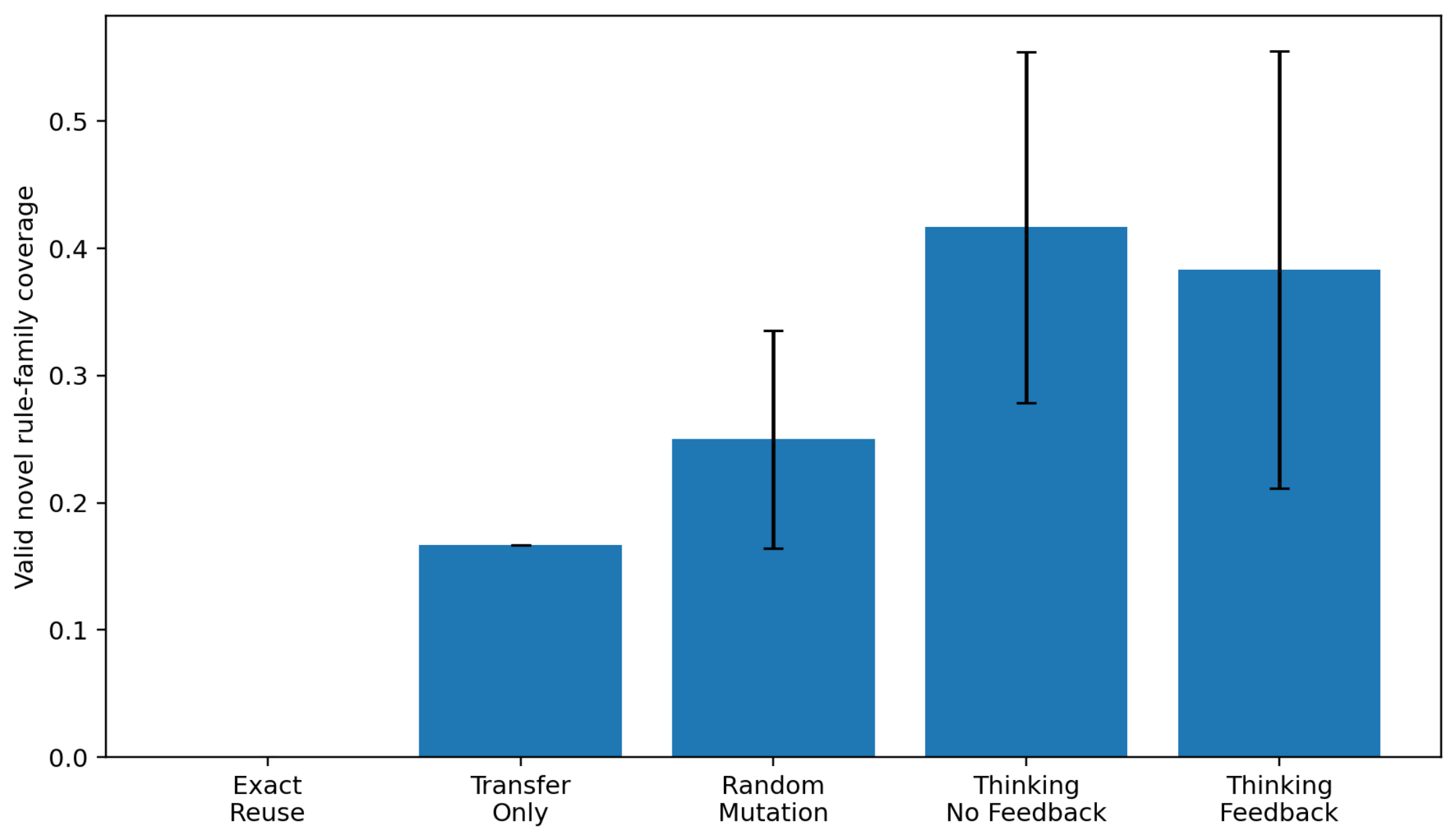
The comparison between the two thinking variants gives a more nuanced result. Thinking–Feedback obtains more valid discoveries on average ( versus ), but the difference is not significant; its rule-family coverage is also not higher than the no-feedback variant ( versus ). In addition, the no-feedback variant has higher mean valid-novel novelty. Therefore, the experiment does not support the stronger claim that raw execution feedback always improves LLM-based exploration. Instead, it supports thinking-driven expansion itself, while showing that feedback can bias subsequent reasoning toward exploitation of already promising regions. The separate dynamic adaptation experiment (Experiment 1b) is used to verify that outcome feedback can improve the learning process when it is incorporated into an explicit online learning mechanism.
4.6. Experiment 4: Recursive Expansion of Reachable Learning Space
Purpose and Configuration
The previous experiments test acquisition and individual expansion mechanisms. Experiment 4 tests the paper’s recursive claim: a learned capability should change what can be learned next. The hidden environment is a 32-node prerequisite graph containing two long branches, cross-branch combinations, and side skills/distractors. Example chains include
followed by tool substitution, access to a new zone, new sensing sources, and cross-modal rules. A second branch contains self-maintenance, delayed-cost, navigation, communication, procedure-learning, and long-term-validation skills.
The graph is hidden from the agent: candidate selection cannot inspect future descendants. Observable scope cues describe only access-changing potential, information gain, generality, long-horizon relevance, and skill category. The full model combines a fixed observable prior with an online regressor updated from the number of opportunities actually unlocked after successful learning. Ten seeds and 42 steps are used.
Table 5.
Experiment 4: recursive reachable-scope expansion (10 seeds).
| Method | Learned Count | Max. Depth | Reachable Scope | Scope Expansion Factor | Secondary Learning Yield |
|---|---|---|---|---|---|
| Fixed Task | |||||
| Persistent Only | |||||
| Random Exploration | |||||
| Static Scope Heuristic | |||||
| No Recursive Reuse | |||||
| Full Model |
The recursive mechanism is most clearly exposed by the No Recursive Reuse baseline. When a newly acquired skill is not allowed to unlock later learning, maximum depth remains , reachable scope remains , and the expansion factor is . By contrast, the full model reaches depth and scope . Relative to Random Exploration, the full model increases maximum depth by , reachable scope by , and secondary learning yield by ; all three seed-matched differences are significant. Figure 5 shows that this advantage is progressive: as earlier capabilities are learned, additional nodes enter the reachable set.
Static Scope Heuristic is a strong baseline because its observable cues already encode reasonable prior knowledge about access and information gain. It reaches a similar maximum depth () and a reachable scope of , and the difference in scope from the full model is not significant (). This result is useful for separating two claims. Experiment 4 strongly verifies the necessity of recursive reuse for scope expansion, but does not by itself establish a large advantage of online value learning over a well-designed static prior in a stationary graph. Experiment 1b addresses that latter question under changing learning utility and shows a clear advantage for online adaptation.
Table 6.
Selected seed-matched two-sided Wilcoxon signed-rank tests used in the text.
| Experiment | Method A | Method B | Metric | p |
|---|---|---|---|---|
| Exp. 1 | Full Model | Persistent Random | Skill growth | |
| Exp. 1 | Full Model | Persistent Random | Structural diversity | |
| Exp. 1 | Full Model | Persistent Random | Learning-curve AUC | |
| Exp. 1b | Online Adaptive | Fixed Static | Cumulative learning utility | |
| Exp. 1b | Online Adaptive | Fixed Static | Useful discoveries | |
| Exp. 1b | Online Adaptive | Fixed Static | Late reward, Phase 2 | |
| Exp. 1b | Online Adaptive | Fixed Static | Late reward, Phase 3 | |
| Exp. 3 | Thinking–Feedback | Random Mutation | Valid novel discoveries | |
| Exp. 3 | Thinking–Feedback | Random Mutation | Rule-family coverage | |
| Exp. 3 | Thinking–Feedback | Thinking–No Feedback | Rule-family coverage | |
| Exp. 4 | Full Model | Random Exploration | Maximum reachable depth | |
| Exp. 4 | Full Model | Random Exploration | Reachable scope | |
| Exp. 4 | Full Model | Static Scope Heuristic | Reachable scope |
4.7. Overall Findings
The experiments jointly support four aspects of the proposed model. First, persistent learning substantially increases both the amount and the structural breadth of learned knowledge, and online prioritization accelerates this growth. Second, environmental, temporal, and thinking expansion open different classes of learning opportunity, as shown by the boundary-specific ablation failures. Third, LLM-based thinking generates more diverse and more novel validated hypotheses than exact reuse, direct transfer, or random local variation, although raw feedback does not automatically improve exploratory thinking. Fourth, and most importantly, recursive reuse of newly acquired capabilities expands the set of future learnable items: disabling recursive reuse collapses reachable depth and secondary learning yield. Finally, the dynamic adaptation test shows that the learning process itself can improve when the value of learning materials changes, rather than relying on a fixed priority rule. Together, these results provide controlled evidence for the proposed progression from a small initial repertoire to a progressively larger reachable learning space.
5. Conclusions
This paper introduced an autonomous reachable learning space expansion model for robots that continuously enlarges not only what the robot knows, but also what it can learn next. The model combines persistent learning with environmental, temporal, and thinking expansion, and recursively reuses newly acquired capabilities to expose further learning opportunities. It also allows the learning process itself to adapt by learning which materials should receive higher priority under changing conditions. Experimental results showed that the proposed model increases structural diversity, expands reachable learning scope, supports more diverse thinking-driven discoveries, and improves cumulative learning utility over fixed, random, and non-adaptive alternatives. These results support the central idea that long-term autonomous learning should be viewed as a recursive process in which acquired knowledge changes the future learning space. Future work will investigate real-robot deployment, richer physical interaction, and longer-term operation in less controlled environments.
References
- Rayhan, A. Artificial intelligence in robotics: From automation to autonomous systems. IEEE Trans. Robot. 2023, 39, 2241–2253. [Google Scholar]
- Bonci, A.; Gaudeni, F.; Giannini, M.C.; Longhi, S. Robot operating system 2 (ros2)-based frameworks for increasing robot autonomy: A survey. Appl. Sci. 2023, 13, 12796. [Google Scholar] [CrossRef]
- Romero, A.; Bellas, F.; Duro, R.J. A perspective on lifelong open-ended learning autonomy for robotics through cognitive architectures. Sensors 2023, 23, 1611. [Google Scholar] [CrossRef]
- Lesort, T.; Lomonaco, V.; Stoian, A.; Maltoni, D.; Filliat, D.; Díaz-Rodríguez, N. Continual learning for robotics: Definition, framework, learning strategies, opportunities and challenges. Inf. Fusion 2020, 58, 52–68. [Google Scholar] [CrossRef]
- Yang, P.; Wang, X.; Zhang, R.; Wang, C.; Oliehoek, F.A.; Kober, J. Task-agnostic Lifelong Robot Learning with Retrieval-based Weighted Local Adaptation. arXiv 2024, arXiv:2410.02995. [Google Scholar]
- Bousmalis, K.; Vezzani, G.; Rao, D.; Devin, C.; Lee, A.X.; Bauzá, M.; Davchev, T.; Zhou, Y.; Gupta, A.; Raju, A.; et al. Robocat: A self-improving generalist agent for robotic manipulation. arXiv 2023, arXiv:2306.11706. [Google Scholar]
- Eysenbach, B.; Gupta, A.; Ibarz, J.; Levine, S. Diversity is all you need: Learning skills without a reward function. arXiv 2018, arXiv:1802.06070. [Google Scholar]
- Sekar, R.; Rybkin, O.; Daniilidis, K.; Abbeel, P.; Hafner, D.; Pathak, D. Planning to explore via self-supervised world models. In Proceedings of the International conference on machine learning. PMLR, 2020; pp. 8583–8592. [Google Scholar]
- Laskin, M.; Yarats, D.; Liu, H.; Lee, K.; Zhan, A.; Lu, K.; Cang, C.; Pinto, L.; Abbeel, P. Urlb: Unsupervised reinforcement learning benchmark. arXiv 2021, arXiv:2110.15191. [Google Scholar]
- Wang, G.; Xie, Y.; Jiang, Y.; Mandlekar, A.; Xiao, C.; Zhu, Y.; Fan, L.; Anandkumar, A. Voyager: An open-ended embodied agent with large language models. arXiv 2023, arXiv:2305.16291. [Google Scholar]
- Ahn, M.; Brohan, A.; Brown, N.; Chebotar, Y.; Cortes, O.; David, B.; Finn, C.; Fu, C.; Gopalakrishnan, K.; Hausman, K.; et al. Do as i can, not as i say: Grounding language in robotic affordances. arXiv 2022, arXiv:2204.01691. [Google Scholar]
- Yao, S.; Zhao, J.; Yu, D.; Du, N.; Shafran, I.; Narasimhan, K.; Cao, Y. React: Synergizing reasoning and acting in language models. arXiv 2022, arXiv:2210.03629. [Google Scholar]
- Brohan, A.; Brown, N.; Carbajal, J.; Chebotar, Y.; Chen, X.; Choromanski, K.; Ding, T.; Driess, D.; Dubey, A.; Finn, C.; et al. Rt-2: Vision-language-action models transfer web knowledge to robotic control. arXiv 2023, arXiv:2307.15818. [Google Scholar]
- Kim, M.J.; Pertsch, K.; Karamcheti, S.; Xiao, T.; Balakrishna, A.; Nair, S.; Rafailov, R.; Foster, E.; Lam, G.; Sanketi, P.; et al. Openvla: An open-source vision-language-action model. arXiv 2024, arXiv:2406.09246. [Google Scholar]
Figure 1.
Experiment 1 learning curves. Each curve is the mean over 10 seeds. Persistent Random continues learning after fixed or event-specific behavior would be insufficient, while the full model accumulates knowledge faster.
Figure 1.
Experiment 1 learning curves. Each curve is the mean over 10 seeds. Persistent Random continues learning after fixed or event-specific behavior would be insufficient, while the full model accumulates knowledge faster.
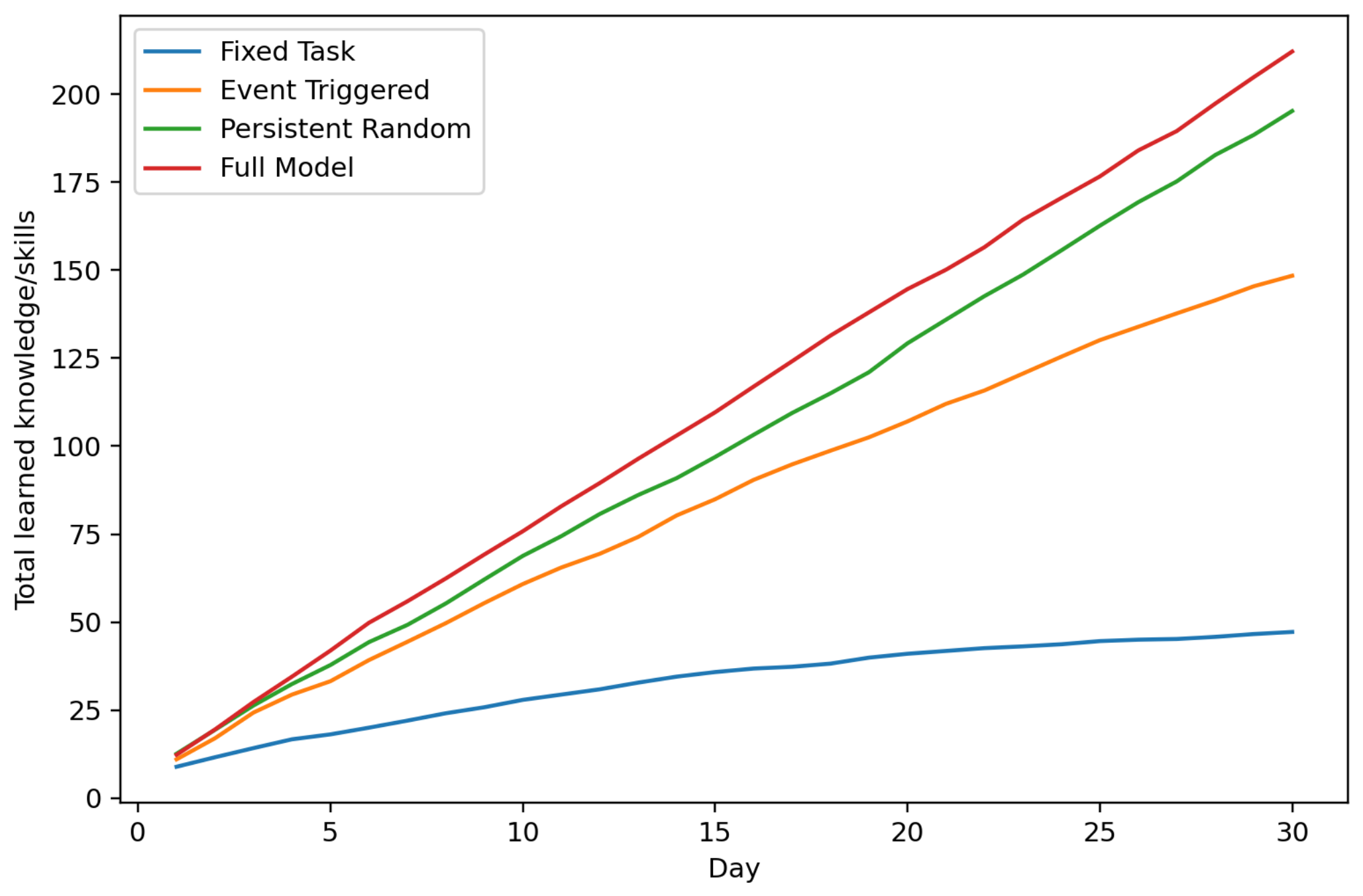
Figure 3.
Experiment 2 discovery rates under the three controlled boundary types. The zero-valued bar produced by each corresponding ablation shows which expansion mechanism is necessary for that class of opportunity.
Figure 3.
Experiment 2 discovery rates under the three controlled boundary types. The zero-valued bar produced by each corresponding ablation shows which expansion mechanism is necessary for that class of opportunity.
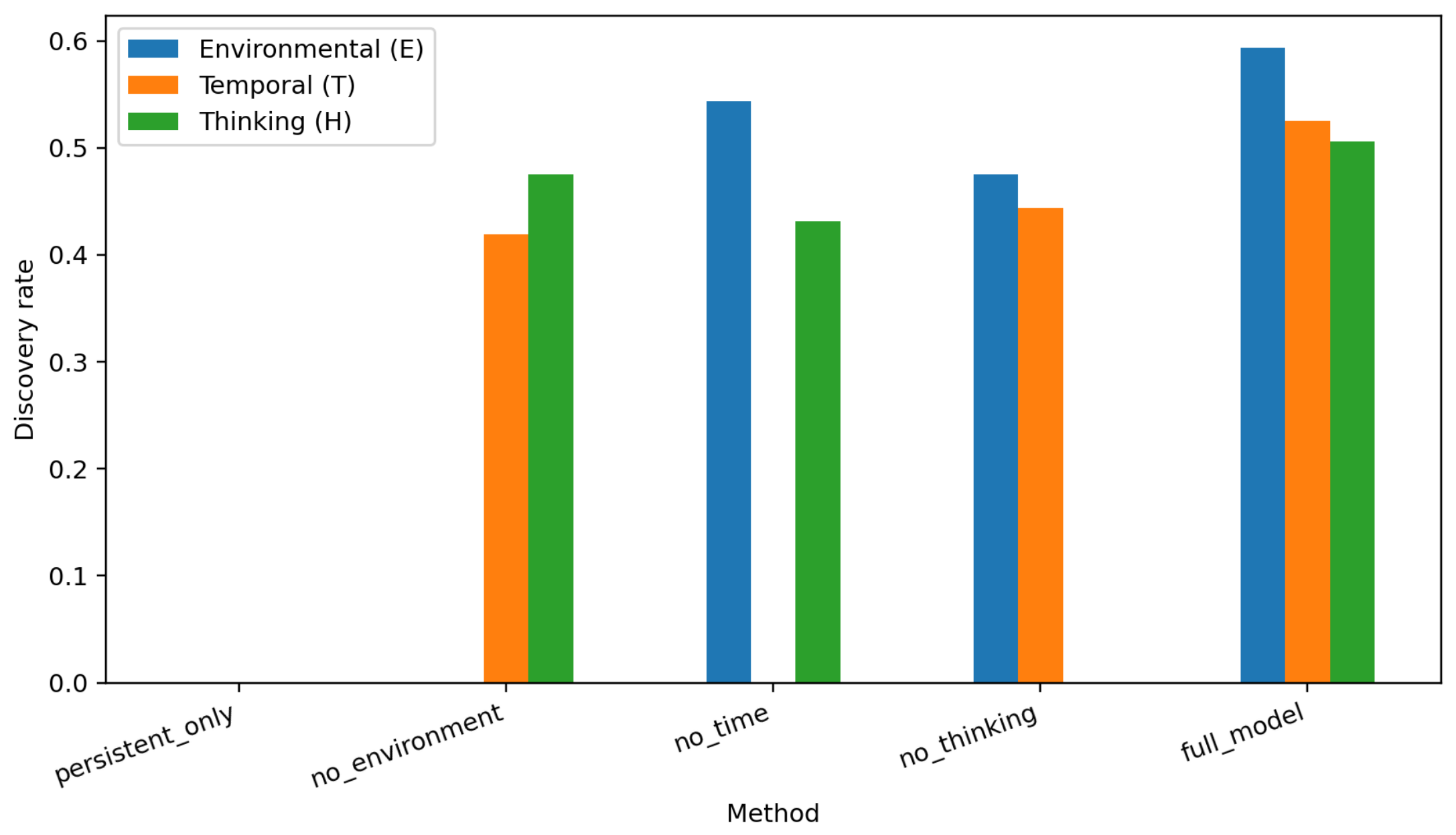
Figure 5.
Experiment 4 mean reachable scope over learning steps. Preventing recursive reuse stops scope growth near the initial frontier, whereas random exploration, a static scope heuristic, and the full model progressively expose new learnable nodes.
Figure 5.
Experiment 4 mean reachable scope over learning steps. Preventing recursive reuse stops scope growth near the initial frontier, whereas random exploration, a static scope heuristic, and the full model progressively expose new learnable nodes.
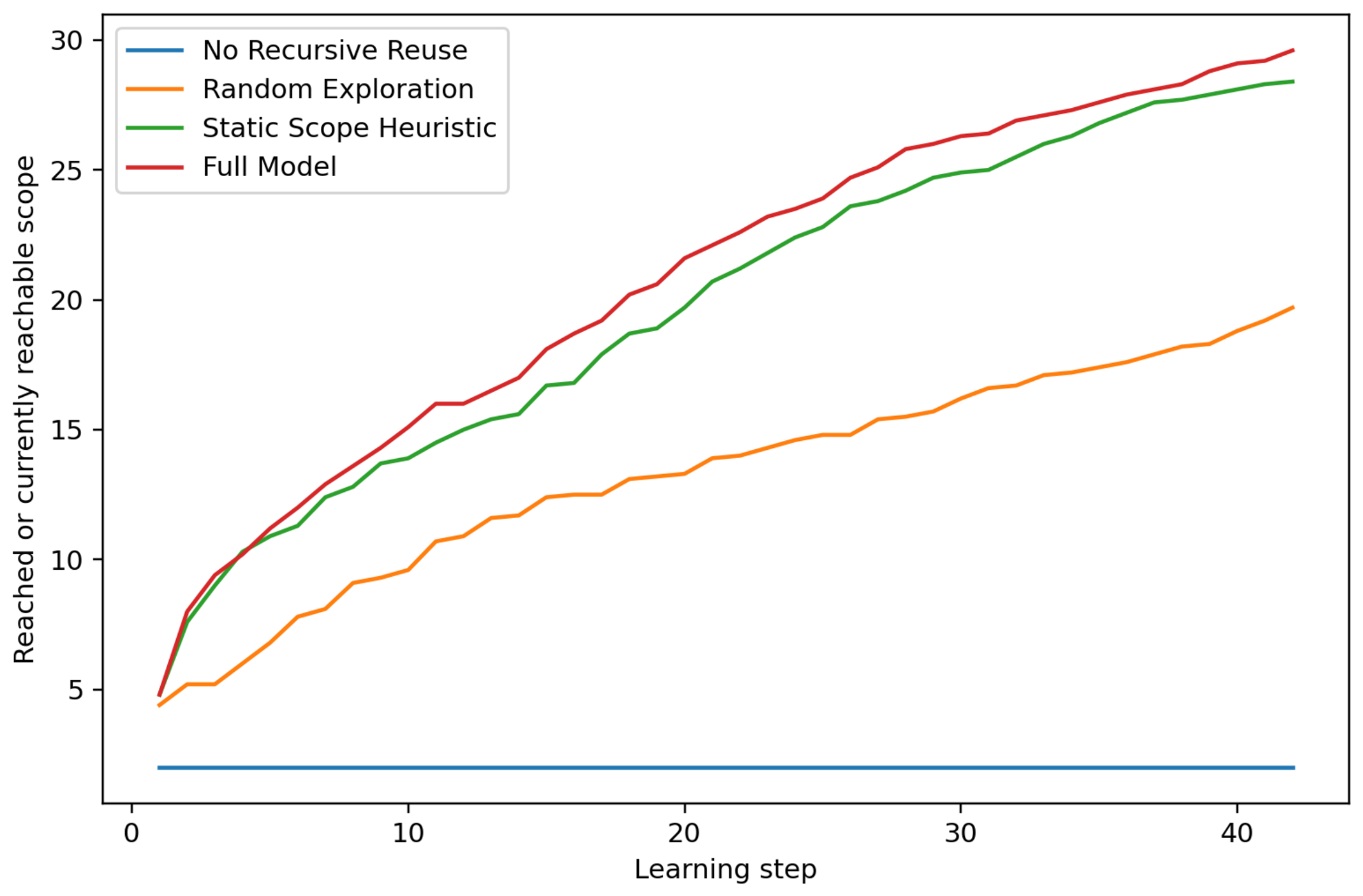
Table 1.
Experiment 1: persistent autonomous learning over 30 simulated days (10 seeds). A dash indicates that the structural-diversity threshold 0.5 was not consistently reached.
Table 1.
Experiment 1: persistent autonomous learning over 30 simulated days (10 seeds). A dash indicates that the structural-diversity threshold 0.5 was not consistently reached.
| Method | Skill Growth | Structural Diversity | Learning-Curve AUC | Days to Diversity |
|---|---|---|---|---|
| Fixed Task | – | |||
| Event Triggered | – | |||
| Persistent Random | ||||
| Full Model |
Disclaimer/Publisher’s Note: The statements, opinions and data contained in all publications are solely those of the individual author(s) and contributor(s) and not of MDPI and/or the editor(s). MDPI and/or the editor(s) disclaim responsibility for any injury to people or property resulting from any ideas, methods, instructions or products referred to in the content. |
© 2026 by the author. Licensee MDPI, Basel, Switzerland. This article is an open access article distributed under the terms and conditions of the Creative Commons Attribution (CC BY) license.
Copyright: This open access article is published under a Creative Commons CC BY 4.0 license, which permit the free download, distribution, and reuse, provided that the author and preprint are cited in any reuse.