

Submitted:
19 September 2026
Posted:
21 September 2026
You are already at the latest version
Abstract
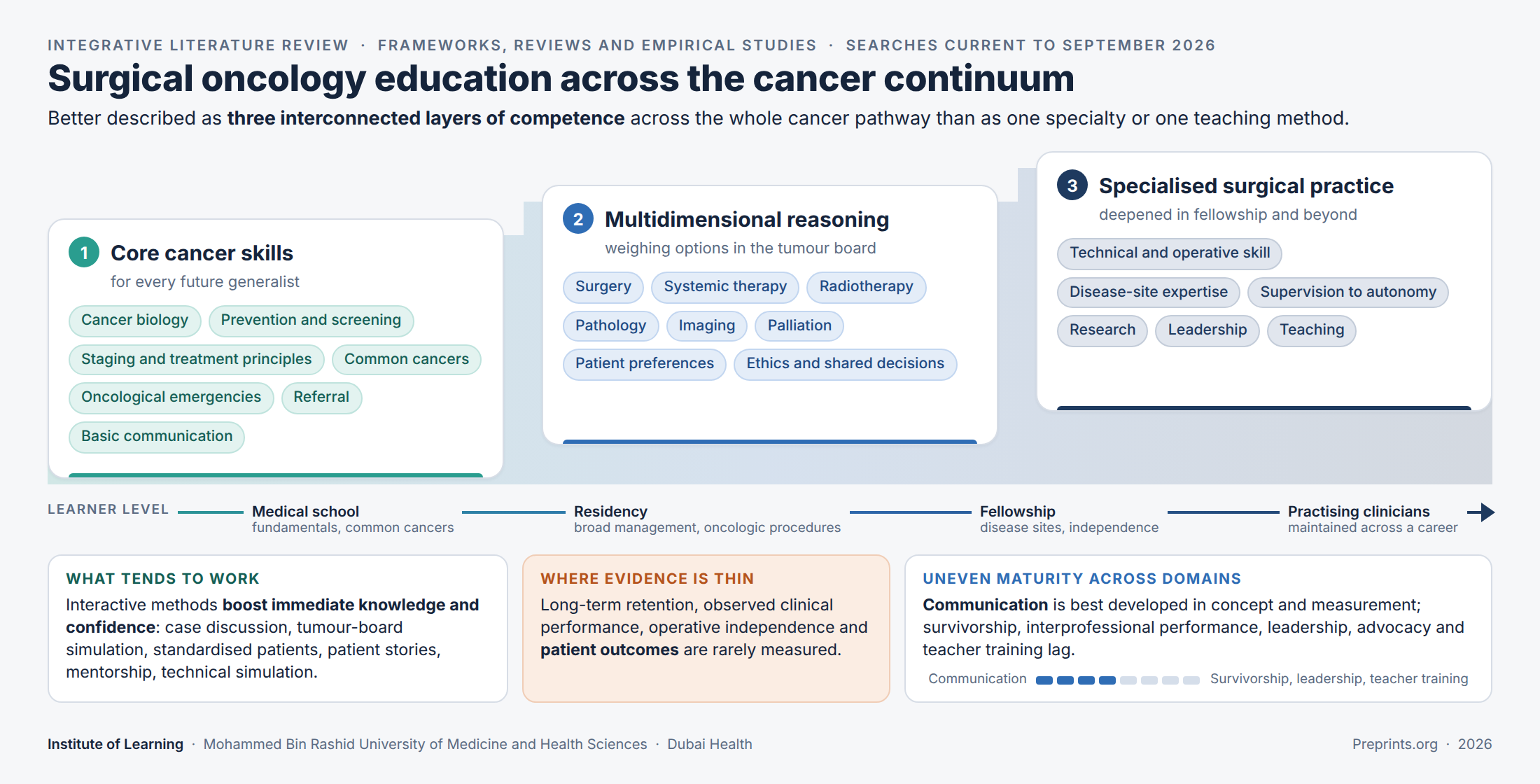
Background: Surgical oncology education covers a broad range of topics including general cancer knowledge, multidisciplinary clinical reasoning, operative skills, communication, survivorship, and career development. The literature is scattered across educational levels and disciplines, including undergraduate, postgraduate, surgical, medical oncology, interprofessional, and continuing education. This review provides an overview of how the field is structured, highlights key outcomes, and identifies gaps that should inform future research. Methods: An integrative narrative review with scoping features was conducted based on an extensive search of oncology education literature, complemented by targeted supplementary searches. These included undergraduate oncology, surgical oncology training, tumor board and multidisciplinary education, communication and ethics, survivorship, patient-partnered learning, career development, and competency frameworks. The review included peer-reviewed conceptual papers, curriculum frameworks, reviews, and empirical studies involving medical students, residents, fellows, practicing clinicians, or interprofessional learning transferable to other settings. The studies were organized by learner level, cancer site, educational approach, and outcome type. Due to significant variability in interventions, populations, and measures, no combined effect estimate was calculated. Results: The field comprises three interconnected layers: core cancer skills for future generalists; multidimensional reasoning involving surgery, systemic therapy, radiotherapy, pathology, imaging, palliation, and patient preferences; and specialized surgical practice, including technical skills, disease-site expertise, supervision, autonomy, research, and leadership. Undergraduate education typically focuses on fundamental principles and common cancers, while postgraduate surgical training centers on specific disease sites, procedures, and levels of responsibility. Interactive learning methods such as case discussions, tumor-board simulations, standardized patients, patient stories, mentorship, and technical simulations tend to boost immediate knowledge and confidence. However, evidence linking these methods to long-term knowledge retention, clinical performance, operative independence, and patient outcomes is limited. The literature on communication is most advanced in concept and measurement, whereas areas like survivorship, interprofessional performance, leadership, health advocacy, and teacher training are less developed. Conclusions: Surgical oncology education is better characterized by competencies across the entire cancer pathway than by a single specialty or method. Future research should connect curriculum exposure to outcomes such as objective reasoning, communication, technical skills, teamwork, and patient care. It should also assess delayed transfer and evaluate whether existing frameworks apply across health systems and cultural contexts.
Keywords:
surgical oncology
; cancer education
; medical education
; multidisciplinary team
; tumour board
; clinical reasoning
; operative training
; communication skills
; survivorship
; curriculum
Copyright: This open access article is published under a Creative Commons CC BY 4.0 license, which permit the free download, distribution, and reuse, provided that the author and preprint are cited in any reuse.