

Submitted:
20 September 2026
Posted:
21 September 2026
You are already at the latest version
Abstract
Optical (EO) collection from low Earth orbit fails when cloud opacity exceeds the sensor threshold, so an EO-only policy wastes access windows under partial cloud. We study a small mixed constellation (3 EO + 2 SAR) tasking three fixed areas of interest (AOIs) under a spatiotemporal cloud field. EO succeeds only when site opacity is below 0.35; SAR succeeds in weather at lower quality weight (0.55). On a MIXED preset, EO-only greedy achieves 3.6 successful collects per episode and 33.3% confirmed AOI coverage, while a phenomenology heuristic that collects with EO when predicted clear and with SAR when cloudy reaches 33.8 collects/episode and 100% coverage—about +30 collects/episode and +67 percentage points in coverage. An ablation shows that removing the discrete tip channel changes throughput by only ∼0.2 collects/episode; the operational content is dual-sensor tasking, not the tip bits. Shared-policy proximal policy optimization (PPO) with local observations and invalid-action masking learns from untrained performance (∼3 collects/episode) to about 42 collects/episode on MIXED, matching or exceeding the heuristic. Under partial cloud, EO-only tasking loses most successful collects; a dual-sensor policy that uses SAR when EO is blocked recovers on the order of +30 collects/episode and full AOI coverage in this simulation. The discrete tip channel is secondary; shared PPO can learn the dual-sensor rule. Results are from a controlled simulation, not flight data.
Keywords:
earth observation
; synthetic aperture radar
; electro-optical
; tip-and-cue
; cloud cover
; multi-agent reinforcement learning
; satellite tasking
; collection planning
1. Introduction
Maintaining useful Earth observation (EO) coverage from low Earth orbit (LEO) requires more than geometric access. Optical sensors are blocked by cloud; synthetic aperture radar (SAR) is weather-tolerant but typically offers different resolution, interpretability, and cost. Commercial and government operators increasingly describe multi-sensor tip-and-cue workflows in which one phenomenology identifies an opportunity and another is tasked for follow-up [3,4,5]. Much of the published literature on EO–SAR, however, addresses image fusion after collection rather than the closed-loop collection policy that decides which sensor should image under evolving cloud [6].
Cloud-aware optical scheduling has a substantial history, including offline/online frameworks that avoid cloudy targets for agile optical satellites [1] and multi-satellite planners that incorporate historical cloud statistics [2]. Reinforcement learning (RL) and multi-agent RL (MARL) have been applied to Earth-observation scheduling under resource and timing constraints [7,8,9]. What remains less quantified in a controlled mixed-sensor setting is the magnitude of the gap between EO-only greedy tasking and a dual-sensor rule when cloud opacity straddles the optical threshold—and whether a shared-policy learner with only local observations can recover that rule.
This paper isolates that question in a small simulation:
- 1.
- a mixed EO–SAR environment with honest optical failure under cloud;
- 2.
- empirical evidence that EO-only tasking collapses under partial cloud while a dual-sensor policy recovers on the order of collects per episode (the discrete tip channel is secondary);
- 3.
- shared-policy PPO that learns the dual-sensor rule and can exceed the hand-coded phenomenology heuristic on MIXED.
We do not claim flight readiness, numerical weather prediction fidelity, or identity custody under inter-satellite link clutter; those are out of scope.
2. Related Work
2.1. Cloud-Aware Optical Scheduling
Clouds are a first-order loss mechanism for optical collection. He et al. [1] proposed a two-phase cloud-avoidance scheduler for agile optical satellites using real-time cloud information and reported large savings in wasted observation capacity. Regional multi-satellite methods have incorporated historical cloud products to maximize observation success fraction under a prescribed success probability [2]. Related operational concepts use meteorological cloud products or onboard cloud detection to replan optical tasking. These works motivate weather-aware policies but typically optimize optical assets rather than joint EO–SAR collection rules.
2.2. Tip-and-Cue and Heterogeneous Constellations
Tip-and-cue denotes using one sensor or platform to designate a target or region for another [3,4]. Cudzilo et al. [3] described AIS and SAR tipping high-resolution EO for maritime domain awareness. Kim et al. [4] formulated heterogeneous SAR surveillance tipping EO emergency imaging as mixed-integer linear programs with GEO relay constraints. Automated tip-and-cue pipelines that generate tips from external data or prior imagery and schedule cues across satellites are an active topic [5]. Industry reports describe operator agreements for cross-constellation cueing between optical and SAR providers. Our focus is narrower: a closed-loop policy for which sensor collects under a live cloud field in a small mixed constellation, measured by collects and coverage—not post-hoc image fusion [6].
2.3. RL and MARL for Earth Observation Scheduling
Deep RL has been applied to EO acquisition scheduling under weather uncertainty and constellation interoperability [7]. MARL studies address multi-satellite Earth observation with energy, storage, and partial observability constraints, comparing algorithms such as PPO, IPPO, and MAPPO in near-realistic simulators [8]. Related work uses MARL for sequential satellite assignment and agile EO scheduling [9]. We use shared-policy PPO as one controller among several, with a strict separation between heuristic evaluation and RLlib evaluation, and we report iteration 0 as untrained weights.
3. Problem Formulation
Consider N LEO satellites (default , ) and K fixed AOIs (default ). Time is discrete with step s and horizon steps. Satellite i is in access of site k when the nadir angular separation is at most . Each site has cloud opacity . An EO collect at succeeds if and only if with . A SAR collect succeeds under cloud with quality weight and mild extra degradation proportional to opacity.
Primary metrics:
- successful collects per episode;
- quality-weighted collects (EO weight , SAR weight );
- confirmed coverage: fraction of AOIs successfully imaged at least once.
With only three AOIs, coverage saturates for any competent SAR user; throughput and quality are more informative on CLEAR.
4. Methods
4.1. Environment and Cloud Field
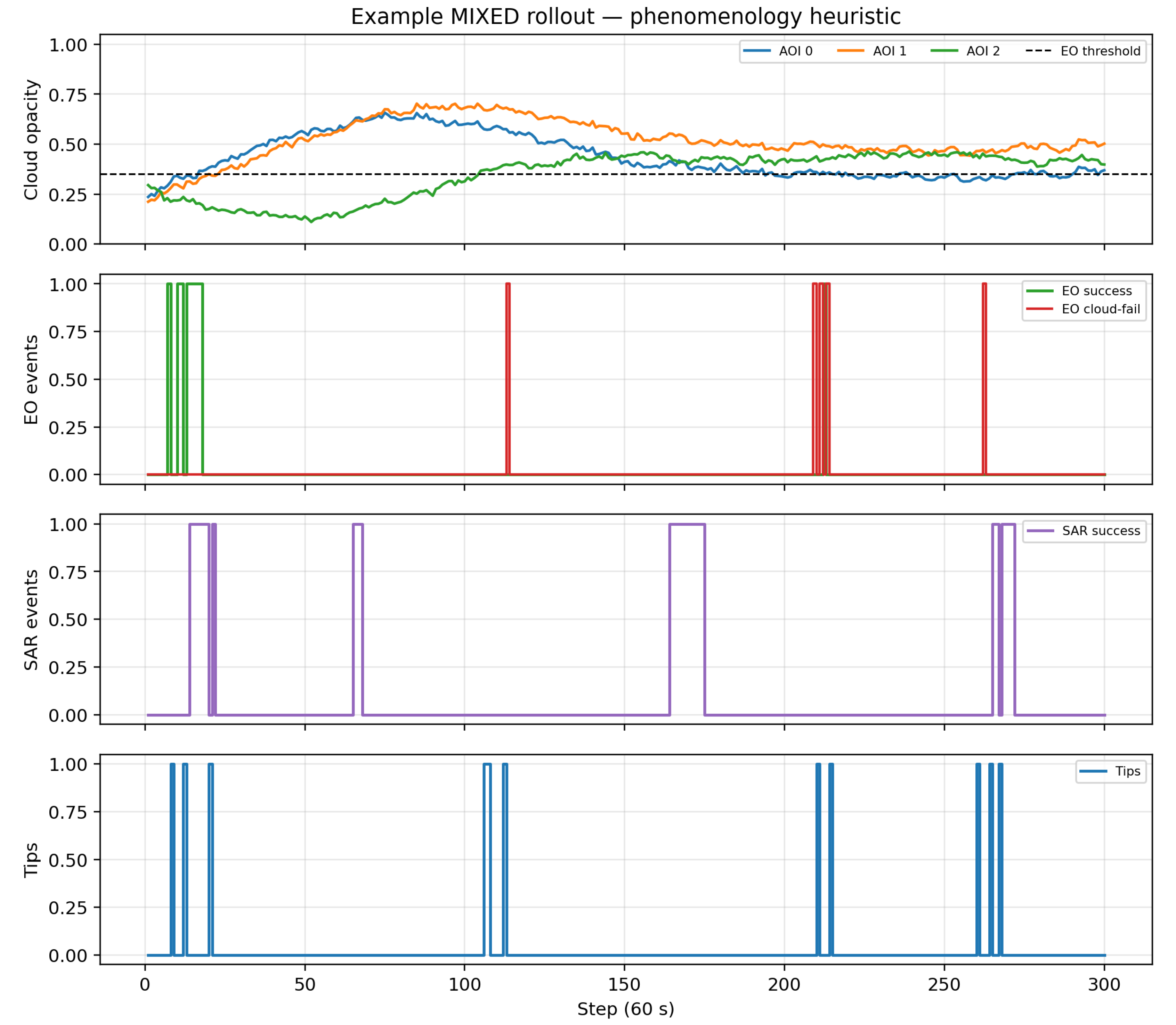
The environment is a PettingZoo ParallelEnv. Orbits are circular Keplerian at 550 km altitude and inclination with RAAN spread. AOIs are placed in a Mediterranean / North Africa theater (nominal locations near Tunis, Tripoli, and Antalya) with small jitter. Cloud opacity evolves on a latitude–longitude grid via an AR(1) temporal update, Gaussian spatial smoothing, eastward advection, and moment restoration so that the MIXED preset straddles . Local agents observe noisy cloud estimates only when in access (MIXED noise std. ). Privileged mode sees true opacity and is used only as an upper reference.
Presets: CLEAR (mean , std ), MIXED (, ), HEAVY (, ).
4.2. Actions, Observations, and Reward
Discrete actions: idle; collect site k with own sensor; tip partner sensor type for site k. Tips are short-lived partner cues (TTL 8 steps), not global cloud broadcasts. Local observations include identity, EO/SAR type, energy, last success/fail, and per-site access, local cloud estimate, recent collect, and pending tip flags. Training reward shapes successful collects, confirmations, and penalties for cloud-failed EO, idle-in-access, redundant collects, and SAR-when-clear. Paper metrics are collect counts, quality, and coverage—not training return. PPO masks collect actions without access; without masking and a wasted-access penalty, early training collapsed to idle (not reported as a result).
4.3. Controllers
Heuristics (dedicated evaluation path; never labeled as PPO):
- EO-only greedy: EO collects if access and predicted clear; SAR idles.
- SAR-only greedy: SAR collects whenever in access; EO idles.
- Phenomenology: predicted clear → EO; predicted cloud → SAR collect and/or tip; optional EO confirm.
- Both sensors, no tip: same sensor rules with tips disabled.
- Privileged oracle: true cloud with phenomenology structure (not deployable).
Shared-policy PPO: local observations, MLP, invalid-action masking. Iteration 0 is untrained weights on a separate RLlib path.
4.4. Experimental Protocol
Heuristic tables: seeds , 300 steps. PPO training evaluation: seeds . Primary scalars: successful collects/episode, quality-weighted collects/episode, confirmed coverage.
5. Results
5.1. Preset Comparison
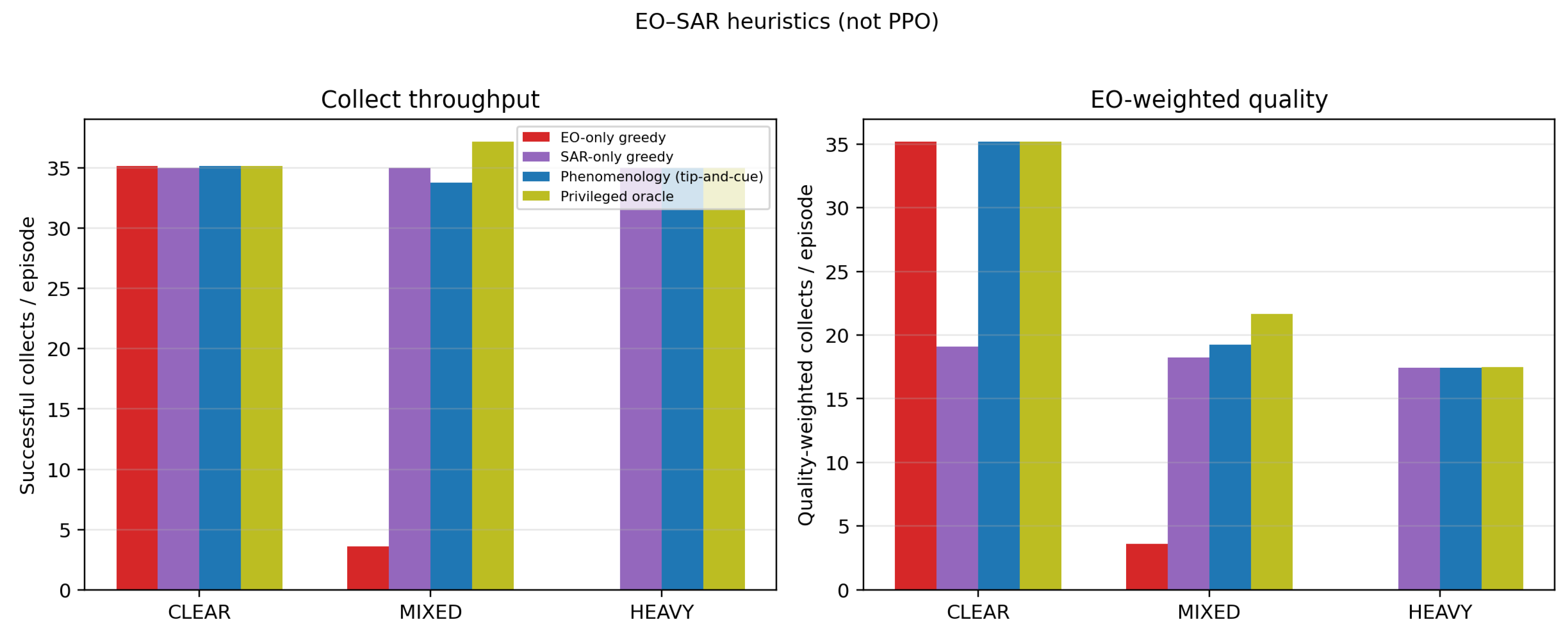
On CLEAR, EO-only, phenomenology, and oracle match on throughput; SAR-only matches count but scores lower quality (19.1 vs. 35.2 quality-weighted collects/episode). On MIXED, EO-only collapses to 3.6 collects/episode while phenomenology recovers 33.8 (+30.2 collects/episode; +66.7 percentage points coverage). On HEAVY, EO-only records zero successes; SAR-capable policies remain near 35 collects/episode.

Table 1.
Successful collects per episode (confirmed coverage in parentheses). Heuristics only; five seeds.
Table 1.
Successful collects per episode (confirmed coverage in parentheses). Heuristics only; five seeds.
| Method | CLEAR | MIXED | HEAVY |
|---|---|---|---|
| Random | 16.2 (100%) | 10.0 (86.7%) | 8.8 (86.7%) |
| EO-only greedy | 35.2 (100%) | 3.6 (33.3%) | 0.0 (0%) |
| SAR-only greedy | 35.0 (100%) | 35.0 (100%) | 35.0 (100%) |
| Phenomenology | 35.2 (100%) | 33.8 (100%) | 35.0 (100%) |
| Privileged oracle | 35.2 (100%) | 37.2 (100%) | 35.0 (100%) |
Figure 1.
Collect throughput and EO-weighted quality across CLEAR, MIXED, and HEAVY (heuristics only).
Figure 1.
Collect throughput and EO-weighted quality across CLEAR, MIXED, and HEAVY (heuristics only).
5.2. Cloud Sensitivity
EO-only records 35.2, 15.8, 3.6, and 0.0 collects/episode at mean opacities , , , and , respectively. Phenomenology remains near 34–39 across the sweep.
Figure 2.
Successful collects per episode versus mean cloud opacity. Vertical line: EO threshold . EO-only collapses past the threshold; phenomenology tracks SAR-capable policies.
Figure 2.
Successful collects per episode versus mean cloud opacity. Vertical line: EO threshold . EO-only collapses past the threshold; phenomenology tracks SAR-capable policies.
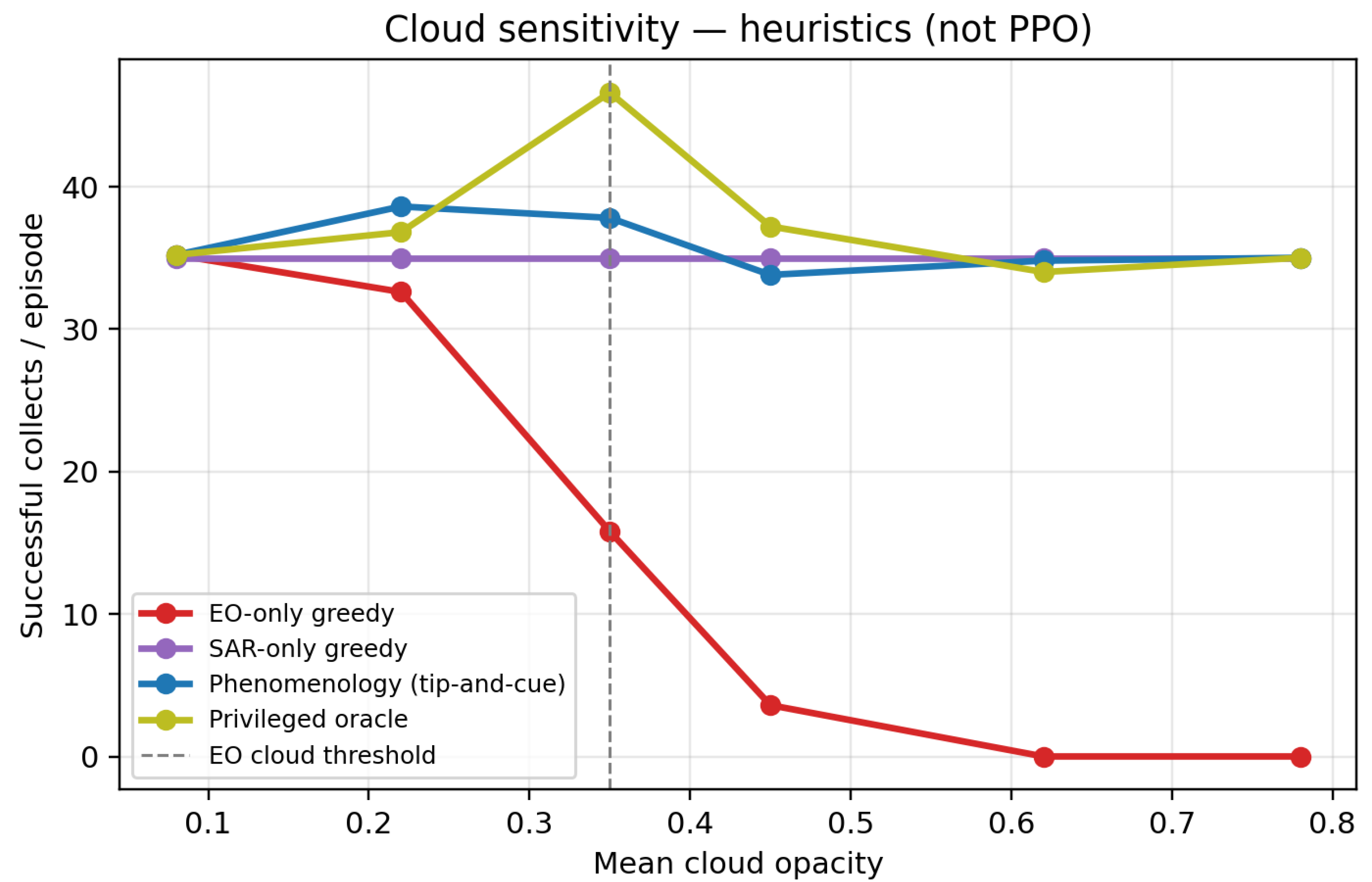
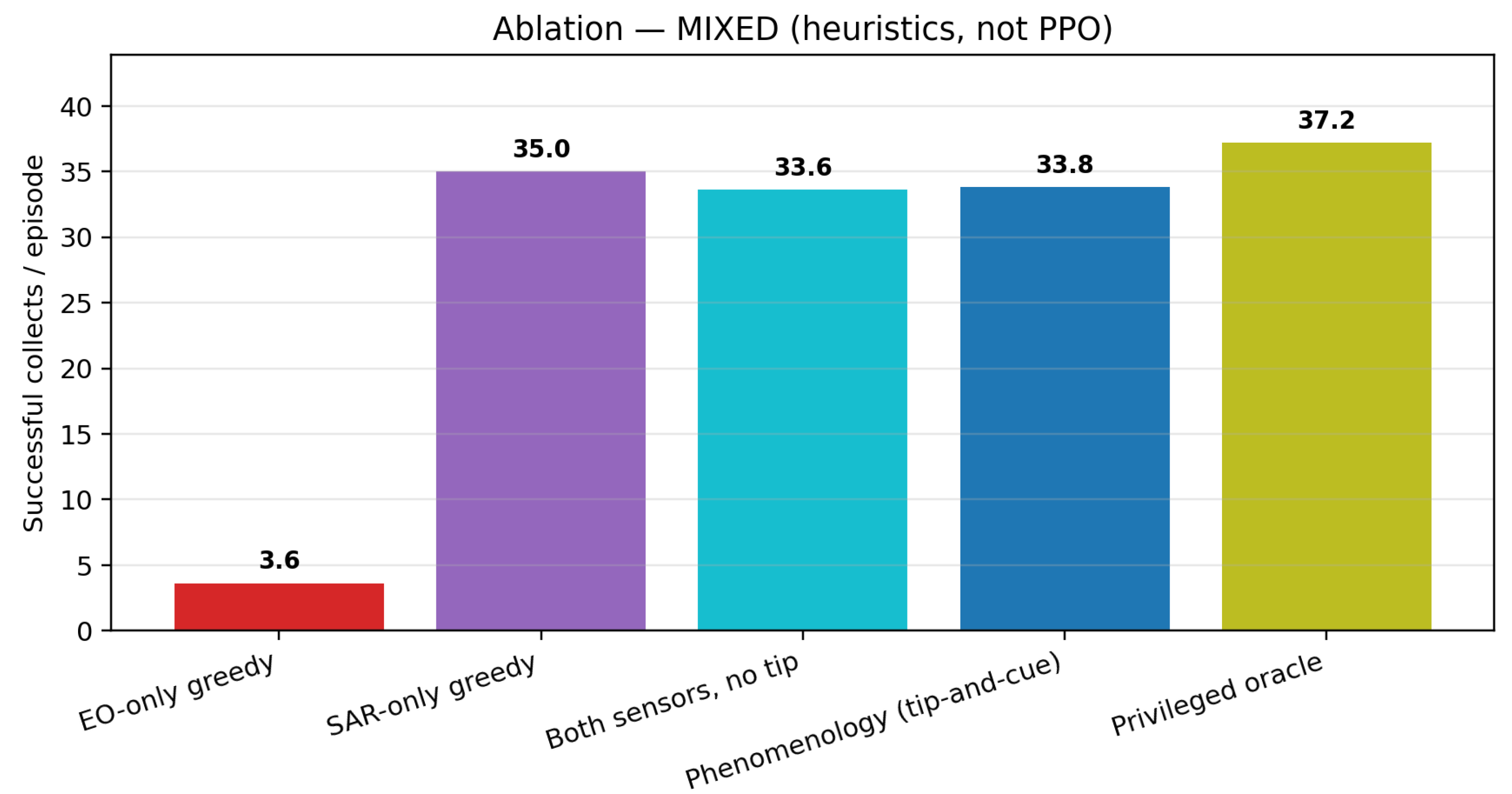
Figure 3.
MIXED ablation. Tips change throughput by ∼0.2 collects/episode; dual-sensor use explains the gap relative to EO-only.
Figure 3.
MIXED ablation. Tips change throughput by ∼0.2 collects/episode; dual-sensor use explains the gap relative to EO-only.
5.3. Ablation: Tips Versus Dual-Sensor Tasking
Removing tips costs about collects/episode. The large gap versus EO-only is explained by using SAR when EO is blocked, not by the discrete tip messages.
Table 2.
MIXED ablation (successful collects per episode).
| Method | Collects / episode |
|---|---|
| EO-only greedy | 3.6 |
| SAR-only greedy | 35.0 |
| Both sensors, no tip | 33.6 |
| Phenomenology (with tips) | 33.8 |
| Privileged oracle | 37.2 |
5.4. Shared-Policy PPO on MIXED
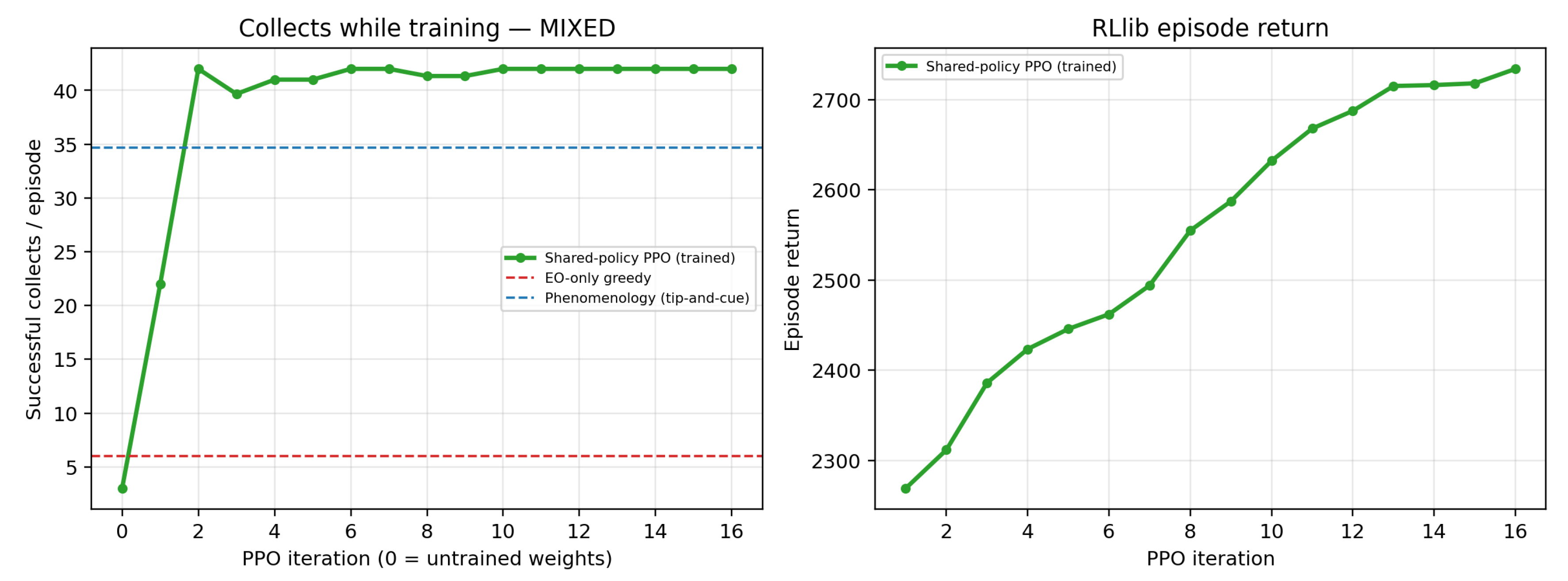
On the same three seeds, EO-greedy scored 6.0 and phenomenology 34.7 collects/episode. Trained PPO exceeds the heuristic on MIXED. Return continued to rise after collect count saturated.
Table 3.
Shared PPO on MIXED (evaluation seeds 11/22/33). Iteration 0 = untrained weights.
| Iteration | Collects / episode | Notes |
|---|---|---|
| 0 | untrained | |
| 1 | 22.0 | |
| 2 | 42.0 | coverage 100% |
| 16 | quality 25.1; return 2734 |
Figure 4.
PPO collects/episode and return versus iteration on MIXED. Iteration 0 is untrained. Dashed lines: EO-greedy and phenomenology.
Figure 4.
PPO collects/episode and return versus iteration on MIXED. Iteration 0 is untrained. Dashed lines: EO-greedy and phenomenology.
5.5. Example Rollout
6. Discussion
Under partial cloud, EO-only tasking loses most successful collects once opacity exceeds the optical threshold. A dual-sensor policy that uses SAR when EO is blocked recovers on the order of $+30$ collects/episode and full AOI coverage on MIXED in this simulation. The ablation shows phenomenology with tips (33.8) and both-sensors without tips (33.6) are nearly identical, so the operational content is cloud-aware sensor selection, not the tip channel alone. SAR-only matches raw counts on MIXED/HEAVY but forgoes high-quality EO collects on CLEAR (quality 19.1 vs. 35.2). Local cloud estimates are noisy: EO success when attempted is about 29% for local EO-greedy versus about 80% for the privileged oracle on MIXED. Shared PPO learns the dual-sensor structure from an untrained baseline near EO-greedy to about 42 collects/episode, modestly above the hand-coded heuristic on the reported seeds. This is a simulation result, not a flight claim.
7. Limitations and Reproducibility
The propagator is circular Keplerian with a access cone, not a full force model or sensor-specific FOV. Clouds are an AR(1) advecting field, not numerical weather prediction. SAR is a scalar all-weather quality weight, not NESZ or incidence geometry. There is no downlink, no airborne collector, and no real imagery. Heuristic tables use five seeds; PPO evaluation in the training loop uses three. Only shared-policy PPO is trained.
Reproducibility: package eosar_tip/. Heuristic tables and figures:
python -m eosar_tip.run_experiments --seeds 11 22 33 44 55 --steps 300
PPO:
python -m eosar_tip.train --preset mixed --iters 16
Smoke test:
python -m eosar_tip.smoke
Outputs under eosar_tip_results/.
8. Conclusion
Under partial cloud cover, EO-only tasking loses most successful collects once opacity exceeds the optical threshold. A dual-sensor policy that prefers EO when clear and SAR when cloudy recovers on the order of $+30$ successful collects per episode and full AOI coverage on MIXED in this simulation; the discrete tip channel is secondary to simply using both sensors. An ablation shows the discrete tip channel contributes little compared with simply using both sensors. Shared-policy PPO with local observations learns this structure and can exceed the hand-coded phenomenology heuristic on MIXED. The contribution is a controlled demonstration of cloud-aware EO–SAR collection policy, not a flight system or an image-fusion method.
Data Availability Statement
Code for the EO–SAR tip-and-cue environment is provided as the isolated package eosar_tip (Python 3.10+, PettingZoo, Ray RLlib, PyTorch). Public release via GitHub is planned upon acceptance; contact the author for details.
Conflicts of Interest
This work was supported by the University of Alaska Fairbanks Geophysical Institute. The author has no conflicts of interest to report.
References
- He, L.; Liu, X.; Xing, L.; Chen, Y. Cloud Avoidance Scheduling Algorithm for Agile Optical Satellites. In Bio-Inspired Computing – Theories and Applications; Springer: Berlin/Heidelberg, Germany, 2015; pp. 161–172. [Google Scholar]
- Wang, et al. Multi-satellite scheduling method based on a historical cloud coverage at regional scale. Prepr. J. Rec. To Be Confirmed From Publ. 2025. [Google Scholar] [CrossRef]
- Cudzilo, B.; Foley, K.C.; Smith, C. The Ability of a Small Satellite Constellation to Tip and Cue Other Commercial Assets. In Proceedings of the AIAA/USU Conference on Small Satellites, Logan, UT, USA, 2012. [Google Scholar]
- Kim, S.J.; Kim, M.; Choi, H.-L. Tip-and-cue mission scheduling in heterogeneous satellite constellations using mixed-integer linear programming. Acta Astronaut. 2026, 246, 921–940. [Google Scholar] [CrossRef]
- Weissman, G.; Ivry, A.; Cohen, I. An Automated Tip-and-Cue Framework for Optimized Satellite Tasking and Visual Intelligence. arXiv 2025, arXiv:2512.09670. [Google Scholar]
- Rabin, Z.; Scherreik, M.; Lewis, B.; Davis, J. Learning to fuse with side information for multi-sensor ATR. Proc. SPIE Def. Commer. Sens. 2024, Vol. 13032, 130320J. [Google Scholar]
- Hadj-Salah, A.; Verdier, R.; Caron, C.; Picard, M.; Capelle, M. Schedule Earth Observation satellites with Deep Reinforcement Learning. arXiv 2019, arXiv:1911.05696. [Google Scholar]
- Hady, M.A.; Hu, S.; Pratama, M.; Cao, J.; Kowalczyk, R. Multi-Agent Reinforcement Learning for Autonomous Multi-Satellite Earth Observation: A Realistic Case Study. arXiv 2025, arXiv:2506.15207. [Google Scholar]
- Holder, J.; Jaques, N.; Mesbahi, M. Multi Agent Reinforcement Learning for Sequential Satellite Assignment Problems. In Proceedings of the AAAI Conference on Artificial Intelligence, 2025; Vol. 39. [Google Scholar]
Disclaimer/Publisher’s Note: The statements, opinions and data contained in all publications are solely those of the individual author(s) and contributor(s) and not of MDPI and/or the editor(s). MDPI and/or the editor(s) disclaim responsibility for any injury to people or property resulting from any ideas, methods, instructions or products referred to in the content. |
© 2026 by the authors. Licensee MDPI, Basel, Switzerland. This article is an open access article distributed under the terms and conditions of the Creative Commons Attribution (CC BY) license (http://creativecommons.org/licenses/by/4.0/).
Copyright: This open access article is published under a Creative Commons CC BY 4.0 license, which permit the free download, distribution, and reuse, provided that the author and preprint are cited in any reuse.