

Submitted:
19 September 2026
Posted:
21 September 2026
You are already at the latest version
Abstract
Cash transfers have emerged as a primary form of government-sponsored social security. The welfare effects of these programs differ by the design of the program, target population, socio-economic conditions, and follow-up duration. This study uses the PRISMA approach and assesses articles and papers published during the period 2015 to 2025 on households' consumption, food security, poverty, asset endowment, labour issues, human capital, resilience, and inequality across disciplines. The study also estimated pooled food security. In this study, papers published from January 1, 2015, to September 15, 2026, in indexed and non-indexed journals are considered. The reviews included 14 causal impact studies. Of these, only six studies provided 7 independent comparisons of standardised food security. The study pooled the effect measures, adjusted to the control group standard deviation, using an inverse-variance method with random effects. The results show that cash transfers increased food security and consumption, provided immediate economic security, and increased assets. The effects on labour and poverty were more varied. The pooled food security effect estimate was 0.265 SD (0.149-0.380), with considerable heterogeneity (I² = 81.3%; tau² = 0.019). The studies in Zambia, Malawi, Uganda, and some refugee establishments find that the transitory effects of cash transfer programs may be extinguished once the payments end. Overall, the cash transfer schemes improve the conditions of households' economies. Nevertheless, sufficient cash transfers distributed over significantly long periods, along with appropriate opportunities, services, and inclusive targeting, are needed to reduce chronic poverty.
Keywords:
cash transfers
; social security
; poverty
; food security
; inequality
; meta-analysis
1. Introduction
Non-contributory cash transfers play a significant role in the household economy as these meet immediate financial needs of the beneficiary. These schemes also support households' consumption expenditure during emergencies; and support households in accessing education and health services. Non-contributory cash transfers address constraints caused by cash shortages and thereby increase expenditure on food and other items. These reduce costly and uncertain coping strategies, and increase productive activities. The policy problem, however, is not whether cash is valuable, but rather at what point cash transfers improve the welfare of households, especially people with low incomes, to a greater degree and in a lasting and equitable manner. Overall, most low- and middle-income country reviews concentrate on absolute poverty, schooling, health and nutrition, savings, production, and women-empowerment. The findings of the study show positive movements on the income and welfare of the people with substantial variation (Bastagli et al., 2019; Owusu-Addo et al., 2018; Sun et al., 2021). Moreover, evidence does not support the argument that recipients of cash transfers are likely to waste funds on alcohol, tobacco and other conspicuous consumption (Evans & Popova, 2017; White & Basu, 2016). Recent causal studies have also clarified this debate.
Unconditional cash transfers increased consumption expenditure in rural areas and generated assets in Kenya, which had positive externalities and negative effects on inflation (Haushofer & Shapiro, 2016; Egger et al., 2022). In Zambia, the cash transfer programs improved the food security of the people by increasing the level of consumption along with an increase in productive activity and assets during the implementation. Nevertheless, a 2025 follow-up study showed broad convergence once the programs stopped (Handa et al., 2018, 2025). Similarly, the long-term evidence is mixed. Grants in Uganda increased investment and created employment, but had no sustained, long-run impact on consumption or earnings (Bandiera et al., 2017). In Bangladesh and India, graduation-type1 programs provided the opportunity to adopt a better employment opportunities in a sustained manner; if these are coupled with transfers of productive assets, training etc. (Banerjee et al., 2021; Blattman et al., 2020). This study finds whether cash transfer programs improve household welfare, identifies outcomes across programs, and determines whether conditional transfers differ in their effects. The study also examines why effects vary across locations, contexts and over time. This study addresses existing gaps in earlier reviews and expands literatures through 2025. It also disintegrates poverty reduction from inequality reduction. It also includes a new quantitative synthesis of food security as a primary outcome2. This response draws on reviews of nutrition, mental health, and human capital in recent times. This also reflects the important average outcomes and substantial variability in outcomes and designs (Das & Sethi, 2023; Manley et al., 2020, 2022; McGuire et al., 2022; Pega et al., 2022).
2. Methods
Preferred Reporting Items for Systematic Reviews and Meta-Analyses (PRISMA 2020) guidelines (Page et al., 2021) is used for the present study. Search terms considered for the study are cash transfer, conditional cash transfer, unconditional cash transfer, social assistance, income support, basic income, household welfare, consumption, expenditure, food security, poverty, economic security, assets, resilience and inequality. The study includes papers and articles from open-source publishers and indexed records accessed from PubMed, IDEAS/RePEc, journal platforms, humanitarian research repositories, and citation tracking systems etc. The search was conducted on 10 September 2026; however, the study included publications from 1 January 2015 to 31 December 2025. Eligible populations were households or household members who have received formal cash assistance in low-income, middle-income, or high-income humanitarian settings. Interventions included conditional and unconditional cash transfers, child or family welfare grants, social assistance, cash for emergency, cash for refugees, and cash-plus kind programs with significant cash component. Comparators included control, wait-list, ineligible, discontinuation, lower-intensity, or credible quasi-experimental counterfactual groups. Primary outcomes were consumption, expenditure, income, food security, poverty, economic security, and social security.
Secondary outcomes included assets, savings, debt, labour, education, health, and gender-related welfare, as well as coping capacity and distributional effects. The study accepted randomised, regression-discontinuity, natural-experiment, and strong quasi-experimental designs. The study excluded purely qualitative reports, editorials, noncausal descriptions, studies outside the date window, and studies lacking separable household welfare outcomes. The documented search yielded 49 retrieved records, of which 7 were obtained by citation tracking or targeted searches. Seven duplicate entries were removed, leaving 42 records (titles and abstracts); 16 were removed. The study requested 26 reports; the researcher could not obtain two, so 24 reports were assessed in full. The study excluded 10 reports because of review status or overlap, leaving 14 primary reports. Six publications included seven independent comparisons, which the quantitative synthesis described in this study included. The other text count details the within-source accessible review and is presented in Figure 1. The study used extracted data from published reports, including country, program, type of transport, study design, sample and follow-up, described welfare domains, and key findings. The study assessed randomised studies using RoB 2 and non-randomised evaluations using ROBINS-I, covering confounding and selection, classification, deviation, and reporting, as well as outcome measurement and missing data.
The study limited the quantitative meta-analysis to food security outcomes reported as standardised indices or standardised treatment effects, since combining raw (or other absolute) measures of consumption, poverty ratios, and assets with schooling or other proxy measures would be misleading. We analysed published adjusted coefficients using the generic inverse-variance approach to combine studies expressed in control-group standard deviation units. We included seven independent comparisons from Kenya, Zambia, Bangladesh, a six-country graduation evaluation, and Niger (Bandiera et al., 2017; Banerjee et al., 2015; Bossuroy et al., 2022; Handa et al., 2018; Haushofer & Shapiro, 2016; Haushofer et al., 2020). Restricted maximum likelihood estimated between-study variance. We analysed the pooled effect, 95% confidence interval, Cochrane Q, tau², and I².
We compared prespecified exploratory subgroups of unconditional transfers with cash-plus designs. Leave-one-out analysis assessed influence. We did not perform funnel-plot and Egger tests because fewer than ten independent comparisons were available.
3. Results
The 14 evaluations considered evidence from sub-Saharan Africa, South Asia, Latin America, multi-country syntheses, and humanitarian populations in Kenya, Lebanon, Uganda, and Turkey. Designs included cluster-randomised trials, regression discontinuity, and distributional causal analyses. Transfer models varied widely and included small, recurring government grants; large, one-time unconditional transfers; multi-purpose cash; and restricted cash linked to food, graduation, and productive inclusion packages. This diversity of examples highlights why average effects may not reflect constant treatment effects. In the short term, consumption and economic security levels responded consistently. The characteristics of selected reports are shown in Table 1.
In Kenya, after large unconditional transfers, monthly consumption increased from about PPP $158 to $193 nine months after the transfers, and asset holdings increased (Haushofer & Shapiro, 2016). A more extensive saturation trial that followed found large gains in consumption and assets of recipients, positive spillover effects on non-recipients and firms, and a transfer multiplier of 2.5, with average price inflation being quite low (Egger et al., 2022). After three years, two government programs in Zambia produced consistent improvements in consumption, food security, assets, poverty-related indices, and productive activity (Handa et al., 2018). Refugee evidence also shows that cash can improve consumption and self-reliance: in Uganda, one large, once-only transfer improved consumption, assets, business ownership, business income, and psychological well-being, and the food security and employment estimates were less clear after 19 months (Gupta et al., 2024).
Food security improved in most of the cash transfer settings. The seven quantitative comparisons, as shown in Table 2, varied from 0.113 to 0.540 SD. Random-effects pooling resulted in a standardised effect of 0.265 SD (95% CI 0.149–0.380, p<0.001) (Table 2). Heterogeneity was substantial (Q=32.03, df=6, p<0.001; I²=81.3%; tau²=0.019), indicating real cross-program variation beyond sampling error. For unconditional transfer programs, the subgroup is pooled to 0.348 SD (95% CI 0.152–0.543), while cash-plus comparisons are pooled to 0.168 SD (95% CI 0.085–0.251). The small number of studies in these exploratory subgroups should not be interpreted as evidence that programs which provide unconditional transfers are intrinsically better than other programs. Differences in transfer size and magnitude, baseline deprivation levels, program intensity, and timing may all affect program outcomes. Leave-one-out estimates ranged from 0.211 to 0.296 SD, as shown in Table 3. Thus, no single comparison drove the positive pooled conclusion. Duration and persistence were critical. An evaluation of Malawi’s Conditional Cash Transfer Program Five Years later found that the benefits of receiving an unconditional transfer ended when payments stopped, while conditional cash transfers sustained positive effects on education and fertility (Baird et al., 2019). Similar findings were also presented from Uganda. Studies in the decade considered showed convergence in employment, earnings and consumption even though there exist differences in assets and skilled labour (Blattman et al., 2020). In Zambia, the Child Grant Program had significant positive effects on the poor households; however, the program continued for three years only (Handa et al., 2025). On the other hand, programs in India targeting the poorer section of the society created large positive effects on consumption and food security at ten years (Banerjee et al., 2021). This was due to the combination of transfers of productive assets and rural job creation. Studies Niger also finds the complementary relationships between psychological support, savings, and entrepreneurship (Bossuroy et al., 2022; Sedlmayr et al., 2020). Humanitarian studies confirm the importance of combining multiple modalities into a single framework.
There are evidences that the impact of multipurpose cash transfer schemes on the Syrian refugees in Lebanon is significant as it resulted in increased household and food expenditure, improved housing and social spending, increased school enrolment, reduced child labour, improved child welfare, and reduced the risk of early marriage (Moussa et al., 2022; Salti et al., 2022). However, there are several studies in Lebanon that find the positive impacts on consumption and food security diminished six months after transfers ended (Altındağ & O’Connell, 2023). A cash-and-livelihood transfer programming model in Kenya’s Kalobeyei settlement has promoted food security and household autonomy. Nevertheless, limiting cash transfers to only expenditure on food reduced expenditure on non-food items and subjective well-being without improving food security (MacPherson & Sterck, 2021; Siu et al., 2023). The ESSN program implemented in Turkey was successful in targeting and reducing poverty and its dimensions; the program reduced the deprivation scores among more vulnerable groups (Robson et al., 2024). Evidence of inequality was weaker compared to evidence of poverty. If poorer households receive relatively more cash, then vertical equity among the households can be achieved through the cash transfer programs. However, the policymakers should consider reducing leakages and increasing the coverage so that the impact can be felt.
Transfers to 17 Latin American and Caribbean countries reduced inequality and poverty, but median transfer generosity covered only about one-third of the poverty gap and reached only about 55 per cent of the poor. Evidence on cash versus kind shows that local price responses depend on market integration, and Philippine cash transfers badly affected the nutrition of ineligible children while raising prices of perishable foods in normally remote and isolated markets. In Kenya, cash transfer programs with greater reach have produced strong positive externalities and have not shown any significant increase in the rate of inflation (Cunha et al., 2019; Egger et al., 2022; Filmer et al., 2023). The cash transfer schemes and basic income programs are successful in crowding in private transfers into consumption, albeit to varying degrees (Nikolov & Bonci, 2020).
Figure 2.
Forest Plot of the Effect of Cash Transfer Programmes on Household Food Security.
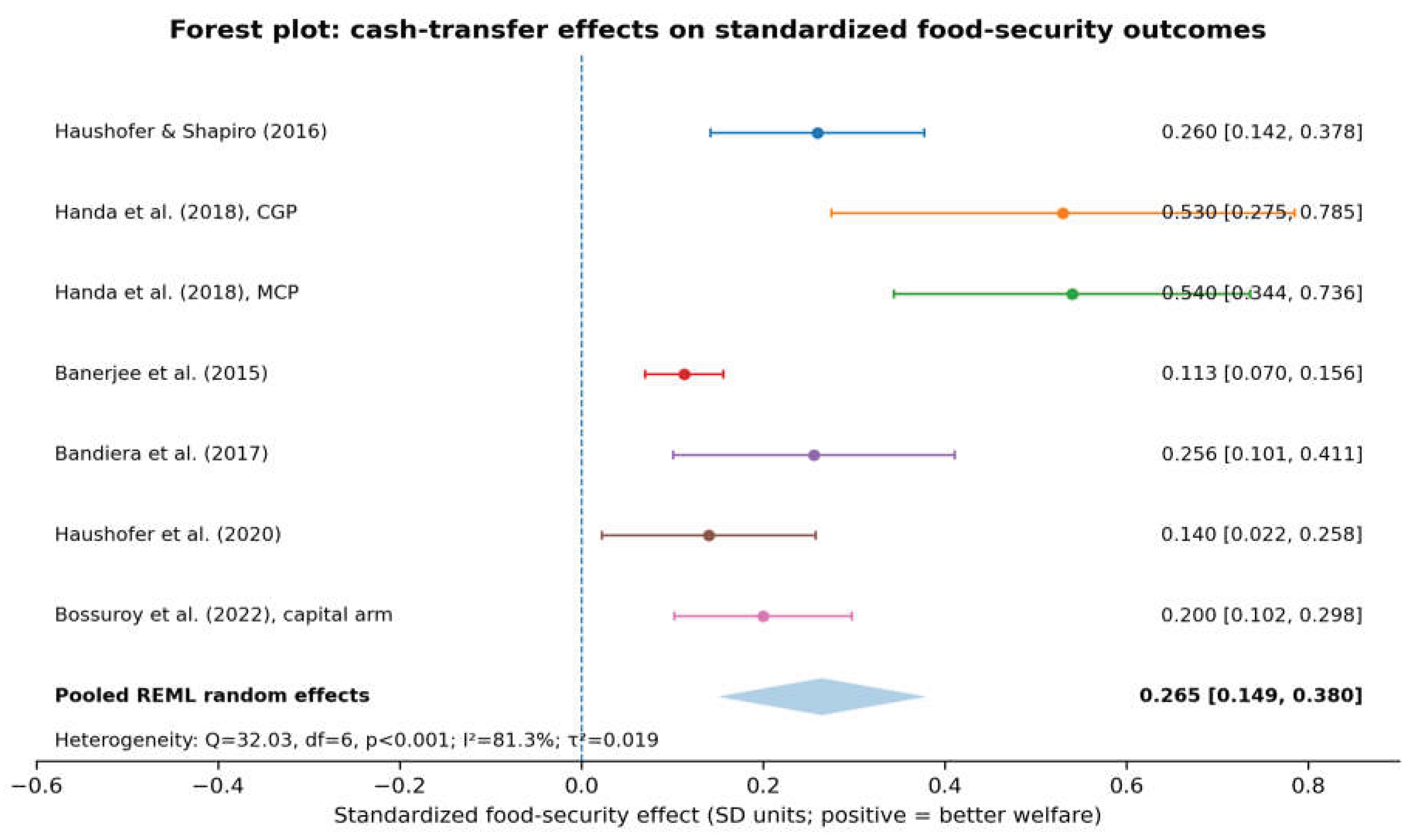

Table 4.
Risk-of-Bias / Methodological Quality Assessment.
| Study | Selection/ confounding |
Intervention/ deviations |
Outcome measurement | Missing data | Selective reporting | Overall |
|---|---|---|---|---|---|---|
| Haushofer & Shapiro, 2016 | Randomization strong | Some spillover exposure | Low | Low | Low | Some concerns |
| Handa et al., 2018 | Randomization strong | Low | Low | Low | Low | Low |
| Banerjee et al., 2015 | Randomization strong | Package attribution | Low | Low | Low | Some concerns |
| Bandiera et al., 2017 | Randomization strong | Low | Low | Some long follow-up loss | Low | Low |
| Baird et al., 2019 | Randomization strong | Post-program exposure differences | Low | Long follow-up | Low | Some concerns |
| Blattman et al., 2020 | Randomization strong | Long-run convergence | Low | Long follow-up | Low | Some concerns |
| Bossuroy et al., 2022 | Randomization strong | Multi-component arms | Low | Low | Low | Low |
| Egger et al., 2022 | Randomization strong | Spillovers intentionally modelled | Low | Low | Low | Low |
| MacPherson & Sterck, 2021 | RD assumptions | Programme bundling | Low | Low | Low | Moderate |
| Salti et al., 2022 | RD assumptions | Eligibility threshold | Low | Low | Low | Moderate |
| Altındağ & O’Connell, 2023 | RD assumptions | Post-program timing | Low | Low | Low | Moderate |
| Gupta et al., 2024 | Phased RCT | Shock context | Low | Some differential timing | Low | Some concerns |
| Robson et al., 2024 | Quasi-experimental | Residual confounding possible | Low | Low | Low | Moderate |
| Handa et al., 2025 | Original randomization | Post-program convergence | Low | Long follow-up | Low | Some concerns |
Table 5.
Subgroup and Sensitivity Analysis.
| Analysis | Group | k | Effect | 95% CI / range | Interpretation |
|---|---|---|---|---|---|
| UCT vs cash-plus | UCT | 4 | 0.348 | 0.152–0.543 | Exploratory; small subgroup |
| UCT vs cash-plus | Cash-plus | 3 | 0.168 | 0.085–0.251 | Package effects; cash not isolated |
| Leave-one-out | All omissions | 6 each | 0.211–0.296 | All pooled estimates positive | No single comparison reversed conclusion |
| Publication-bias test | Not performed | 7 | — | — | Fewer than 10 comparisons |
4. Discussion
Evidence suggests cash transfer programs enable household welfare in a variety of economic contexts. Although welfare gains are temporary and often erratic, cash transfer programs increase consumption and, on average, improve food security. Results from the meta-analysis in Table 3 show positive effects (albeit small or moderate) on food security, with high I² suggesting that different programs likely have different effects. Small, frequent payments are important for social protection as they provide the means to fulfil immediate needs, though they do not guarantee households will be freed from poverty. The long run earnings convergence of Uganda and the consumption insurance of Zambia demonstrate the distinction from new market creation and production. Similarly, with respect to the economic context, the nature of the conditions facilitates use of programs and services and may stimulate higher demand for quality clinics and schools if they are sufficiently proximate.
Ladhani & Sitter (2020) suggest that the vulnerable groups are affected by the conditionality in international development. Added costs make it unlikely that implementation of conditionality can be justified. Reviews find that cash transfer programs resulted in an increase in school attendance, which created positive impacts on health and learning outcomes, albeit in an indirect way, subject to the quality of the health and food services (Das & Sethi, 2023; Manley et al., 2020, 2022). Other reviews assess health outcomes and different hands-on pathways to cash transfers, seeing cash transfers as increasing income and food security and service use (Owusu-Addo et al., 2018; Pega et al., 2022; Sun et al., 2021). Evidence also supports cash and noncash programs operating in conjunction as they aim to address the constraints in savings and assets and higher earnings opportunities
The sustained positive impacts in Bangladesh and India support these mechanisms (Bandiera et al., 2017; Banerjee et al., 2015, 2021). Cash-PLUS is not necessarily less expensive; implementing more components causes more complexity and simpler cash-only interventions can be more effective (Sedlmayr et al., 2020). Thus, the comparison should be on the marginal benefit per unit of expenditure instead of the number of components involved. Along with the distributional impacts should be more relevant to consider. Poverty reduction and inequality reduction are not the same. A cash transfer can move a recipient out of extreme poverty, but it can still result in great inequality. Design errors cause exclusion and leakage. Targeting rules based on demographic characteristics can systematically exclude children, Indigenous peoples, migrants, and poor households that are not constantly poor. The evidence from Turkey illustrates the importance of analyzing the distribution of deprivation in its entirety rather than the average (Robson et al., 2024). In addition, many general equilibrium studies provide a rationale for the importance of the households that do not receive cash transfers. Cash transfers can create local demand and firm revenues, but if a market is constrained, cash transfers can increase prices and be harmful to households that are not eligible (Egger et al., 2022; Filmer et al., 2023). Therefore, cash transfer programs need to be implemented along with market monitoring. The review also does not support simplistic dependency narratives. Meta-analyses do not show systematic unproductive and temptation-good expenditures, and many studies show either productive investments or no change in labor supply (Evans & Popova, 2017). Post-program fade-out is a legitimate concern, and should be handled separately from dependency.
Transfers that allow saving tend to decrease consumption levels, even when those transfers cease (Altındağ & O’Connell, 2023).Since temporary stabilizing social protection programs aim to provide savings, they have a decent chance of program success. Programs must be assessed for extent to which they are permanent, not assumed to be so. Three concerns apply to the pooled estimate. First, standardized coefficients generate different indicators of food security, and therefore, adequately do not correspond with a single framework of food insecurity. A harmonized scale must be interpreted as a harmonized framework. Second, two Zambia cases examined by the same author were in reality, two different government programs. Hence the broader national program may be relevant. Third, studies that add other items to cash and assess the impact of ‘cash and other items’ may complicate the cash effect. These are the reasons for the subgroup analysis. The estimate of 0.265 standard deviations (SD) should not be interpreted as an expected return in all situations. Extensive other narratives allow the interpretation of 0.265 SD.
5. Policy Implications
A strong transfer policy should be framed in which governments allocate adequate funds and ensure regular payment of amounts, may be conditional or complementary transfers, and digital transfer technology. Digital delivery can reduce the cost and time of transfer and leakages in the system, but mechanisms to reach households should be efficient. Programs must be flexible enough to expand rapidly and operate at a high level of targeting. In thin markets, implementers must assess the supply response and evaluate the price at which offerings are made. The effectiveness of the cash transfer programs shall increase if the programs are designed to the female members of the households. Concentrating one female members leads to better allocation of funds and efficient utilization of funds they receive. However, from the perspective of gender analysis, this should not be taken as a substitute for comprehensive gender analysis. Moreover, there should be more trials and pilot studies for the cash transfer programs highlighting asset creation, employment generation and capacity building. Impact analysis like cost-benefit analysis needs to be done to corroborate the decisions of the governments. Use of social registries and frequent and strict monitoring may help to reduce persistent inequities and improve the programs intended for the absolute poor. (Stampini et al., 2025).
6. Limitations and Future Research
Rather than relying on full proprietary database exports, this review utilized indices and published sources. It also deliberately narrowed the scope of the synthesis of quantitative research. Only seven comparable metrics for food security were available. Because of this, the publishing bias tests were inappropriate. The definitions of the outcomes, transfer size, follow-up, and the intensity of the interventions were all of variable nature. From a research perspective, future works should preregister the scope of the welfare domain, and when appropriate, should report the variability to the extent that it is adequate for the synthesis. They should also describe the spillover impacts and the measurement of impacts to the extent that they are less than average. They should also examine the measurements of households after payments stop. Lastly, research is needed to examine joint effects of transfer adequacy and local market conditions. Research should also examine how differences for meaningful program impacts can be defined without losing the overall comparative effect of programs. Outcomes definitions, sample sizes, and standard deviations should be published. The effects of inflation of food prices should be studied along with the nominal value of transfers and payment delays to determine the overall savings effect of the transfers and the meals consumed by households. Effects need to be examined in the context of recipient gender, disability, migration and rural and urban status.
Active trade and positive surprising interactions that happen because of outside factors are best described using general equilibrium models. Researchers should capture account access, barriers for identity document procurement, failed transactions, cash out fees, and distance to agents, as well as the effects of fraud and exclusion caused by deficiencies in connectivity or illiteracy. To compare simple cash transfers to cash-plus and conditional cash transfers, data on anticipated costs and the expected welfare effects should be collected. Finally, long-term studies should capture the mechanisms of persistence or decay to understand how savings and productive assets affect job and occupational mobility, skills, social capital, the quality of services, and the local labor demand. This work would complement the meta-analyses that help the government make decisions about whether to introduce programs to reduce liquidity shocks and absorb shocks or to mitigate chronic multiple deprivation or poverty. Standardized reporting across distinct study regions and various program iterations would strengthen the evidence base for these decisions.
7. Conclusion
Cash transfers are a proven approach to fulfilling immediate household needs, primarily around food consumption. Programs of insufficient length or that fail to generate employment opportunities result in a transitory impact. The case for cash transfers over other options is dependent on the presence of strong social protection systems to address the distributional implications of transfers. The most effective use of cash transfers is along with social protection systems that measure the distributional impacts and the poverty impacts.
| 1 | The Graduation Approach or graduation-type program is a time-bound, comprehensive model designed to help households move permanently out of extreme poverty. |
| 2 | Quantitative synthesis is the combination of similar results across studies to answer a question. |
References
- Altındağ, O., & O’Connell, S. D. (2023). The short-lived effects of unconditional cash transfers to refugees. Journal of Development Economics, 160, 102942. [CrossRef]
- Baird, S., McIntosh, C., & Özler, B. (2019). When the money runs out: Do cash transfers have sustained effects on human capital accumulation? Journal of Development Economics, 140, 169–185. [CrossRef]
- Bandiera, O., Burgess, R., Das, N., Gulesci, S., Rasul, I., & Sulaiman, M. (2017). Labour markets and poverty in village economies. The Quarterly Journal of Economics, 132(2), 811–870. [CrossRef]
- Banerjee, A., Duflo, E., Goldberg, N., Karlan, D., Osei, R., Parienté, W., Shapiro, J., Thuysbaert, B., & Udry, C. (2015). A multifaceted program causes lasting progress for the very poor: Evidence from six countries. Science, 348(6236), 1260799. [CrossRef]
- Banerjee, A., Duflo, E., & Sharma, G. (2021). Long-term effects of the Targeting the Ultra Poor program. American Economic Review: Insights, 3(4), 471–486. [CrossRef]
- Bastagli, F., Hagen-Zanker, J., Harman, L., Barca, V., Sturge, G., & Schmidt, T. (2019). The impact of cash transfers: A review of the evidence from low- and middle-income countries. Journal of Social Policy, 48(3), 569–594. [CrossRef]
- Blattman, C., Fiala, N., & Martinez, S. (2020). The long-term impacts of grants on poverty: Nine-year evidence from Uganda’s Youth Opportunities Program. American Economic Review: Insights, 2(3), 287–304. [CrossRef]
- Bossuroy, T., Goldstein, M., Karimou, B., Karlan, D., Kazianga, H., Parienté, W., Premand, P., Thomas, C. C., Udry, C., Vaillant, J., & Wright, K. A. (2022). Tackling psychosocial and capital constraints to alleviate poverty. Nature, 605, 291–297. [CrossRef]
- Cunha, J. M., De Giorgi, G., & Jayachandran, S. (2019). The price effects of cash versus in-kind transfers. The Review of Economic Studies, 86(1), 240–281. [CrossRef]
- Das, A., & Sethi, N. (2023). Cash transfers and human capital outcomes of children in LMICs: A systematic review using PRISMA. Heliyon, 9(4), e14758. [CrossRef]
- Egger, D., Haushofer, J., Miguel, E., Niehaus, P., & Walker, M. (2022). General equilibrium effects of cash transfers: Experimental evidence from Kenya. Econometrica, 90(6), 2603–2643. [CrossRef]
- Evans, D. K., & Popova, A. (2017). Cash transfers and temptation goods. Economic Development and Cultural Change, 65(2), 189–221. [CrossRef]
- Filmer, D., Friedman, J., Kandpal, E., & Onishi, J. (2023). Cash transfers, food prices, and nutrition impacts on ineligible children. The Review of Economics and Statistics, 105(2), 327–343. [CrossRef]
- Gupta, P., Stein, D., Longman, K., Lanthorn, H., Bergmann, R., Nshakira-Rukundo, E., Rutto, N., Kahura, C., Kananu, W., Posner, G., Zhao, K. J., & Davis, P. (2024). Cash transfers amid shocks: A large, one-time, unconditional cash transfer to refugees in Uganda has multidimensional benefits after 19 months. World Development, 173, 106339. [CrossRef]
- Handa, S., Natali, L., Seidenfeld, D., Tembo, G., & Davis, B. (2018). Can unconditional cash transfers raise long-term living standards? Evidence from Zambia. Journal of Development Economics, 133, 42–65. [CrossRef]
- Handa, S., Tembo, G., Natali, L., & Chakrabarti, A. (2025). In search of the holy grail: Post-intervention effects of an unconditional cash transfer program in Zambia. Journal of Development Economics, 174, 103454. [CrossRef]
- Haushofer, J., Mudida, R., & Shapiro, J. P. (2020). The comparative impact of cash transfers and a psychotherapy program on psychological and economic well-being (NBER Working Paper No. 28106). National Bureau of Economic Research. [CrossRef]
- Haushofer, J., & Shapiro, J. (2016). The short-term impact of unconditional cash transfers to the poor: Experimental evidence from Kenya. The Quarterly Journal of Economics, 131(4), 1973–2042. [CrossRef]
- Ladhani, S., & Sitter, K. C. (2020). Conditional cash transfers: A critical review. Development Policy Review, 38(1), 28–41. [CrossRef]
- MacPherson, C., & Sterck, O. (2021). Empowering refugees through cash and agriculture: A regression discontinuity design. Journal of Development Economics, 149, 102614. [CrossRef]
- Manley, J., Alderman, H., & Gentilini, U. (2022). More evidence on cash transfers and child nutritional outcomes: A systematic review and meta-analysis. BMJ Global Health, 7(4), e008233. [CrossRef]
- Manley, J., Balarajan, Y., Malm, S., Harman, L., Owens, J., Murthy, S., Stewart, D., Winder-Rossi, N. E., & Khurshid, A. (2020). Cash transfers and child nutritional outcomes: A systematic review and meta-analysis. BMJ Global Health, 5(12), e003621. [CrossRef]
- McGuire, J., Kaiser, C., & Bach-Mortensen, A. M. (2022). A systematic review and meta-analysis of the impact of cash transfers on subjective well-being and mental health in low- and middle-income countries. Nature Human Behaviour, 6, 359–370. [CrossRef]
- Moussa, W., Salti, N., Irani, A., Al Mokdad, R., Jamaluddine, Z., Chaaban, J., & Ghattas, H. (2022). The impact of cash transfers on Syrian refugee children in Lebanon. World Development, 150, 105711. [CrossRef]
- Nikolov, P., & Bonci, M. (2020). Do public program benefits crowd out private transfers in developing countries? A critical review of recent evidence. World Development, 134, 104967. [CrossRef]
- Owusu-Addo, E., Renzaho, A. M. N., & Smith, B. J. (2018). The impact of cash transfers on social determinants of health and health inequalities in sub-Saharan Africa: A systematic review. Health Policy and Planning, 33(5), 675–696. [CrossRef]
- Page, M. J., McKenzie, J. E., Bossuyt, P. M., Boutron, I., Hoffmann, T. C., Mulrow, C. D., et al. (2021). The PRISMA 2020 statement: An updated guideline for reporting systematic reviews. BMJ, 372, n71. [CrossRef]
- Pega, F., Pabayo, R., Benny, C., Lee, E.-Y., Lhachimi, S. K., & Liu, S. Y. (2022). Unconditional cash transfers for reducing poverty and vulnerabilities: Effect on use of health services and health outcomes in low- and middle-income countries. Cochrane Database of Systematic Reviews, 3, CD011135. [CrossRef]
- Robson, M., Vollmer, F., Doğan, B. B., & Grede, N. (2024). Distributional impacts of cash transfers on the multidimensional poverty of refugees: The Emergency Social Safety Net in Turkey. World Development, 179, 106599. [CrossRef]
- Salti, N., Chaaban, J., Moussa, W., Irani, A., Al Mokdad, R., Jamaluddine, Z., & Ghattas, H. (2022). The impact of cash transfers on Syrian refugees in Lebanon: Evidence from a multidimensional regression discontinuity design. Journal of Development Economics, 155, 102803. [CrossRef]
- Sedlmayr, R., Shah, A., & Sulaiman, M. (2020). Cash-plus: Poverty impacts of alternative transfer-based approaches. Journal of Development Economics, 144, 102418. [CrossRef]
- Siu, J., Sterck, O., & Rodgers, C. (2023). The freedom to choose: Theory and quasi-experimental evidence on cash transfer restrictions. Journal of Development Economics, 161, 103027. [CrossRef]
- Stampini, M., Medellín, N., & Ibarrarán, P. (2025). Cash transfers, poverty and inequality in Latin America and the Caribbean. Oxford Open Economics, 4(Supplement_1), i481–i509. [CrossRef]
- Sterne, J. A. C., Hernán, M. A., Reeves, B. C., Savović, J., Berkman, N. D., Viswanathan, M., et al. (2016). ROBINS-I: A tool for assessing risk of bias in non-randomised studies of interventions. BMJ, 355, i4919. [CrossRef]
- Sun, S., Huang, J., Hudson, D. L., & Sherraden, M. (2021). Cash transfers and health. Annual Review of Public Health, 42, 363–380. [CrossRef]
- White, J. S., & Basu, S. (2016). Does the benefits schedule of cash assistance programs affect the purchase of temptation goods? Evidence from Peru. Journal of Health Economics, 46, 70–89. [CrossRef]
Figure 1.
PRISMA 2020 Flow Diagram for Study Identification and Selection.
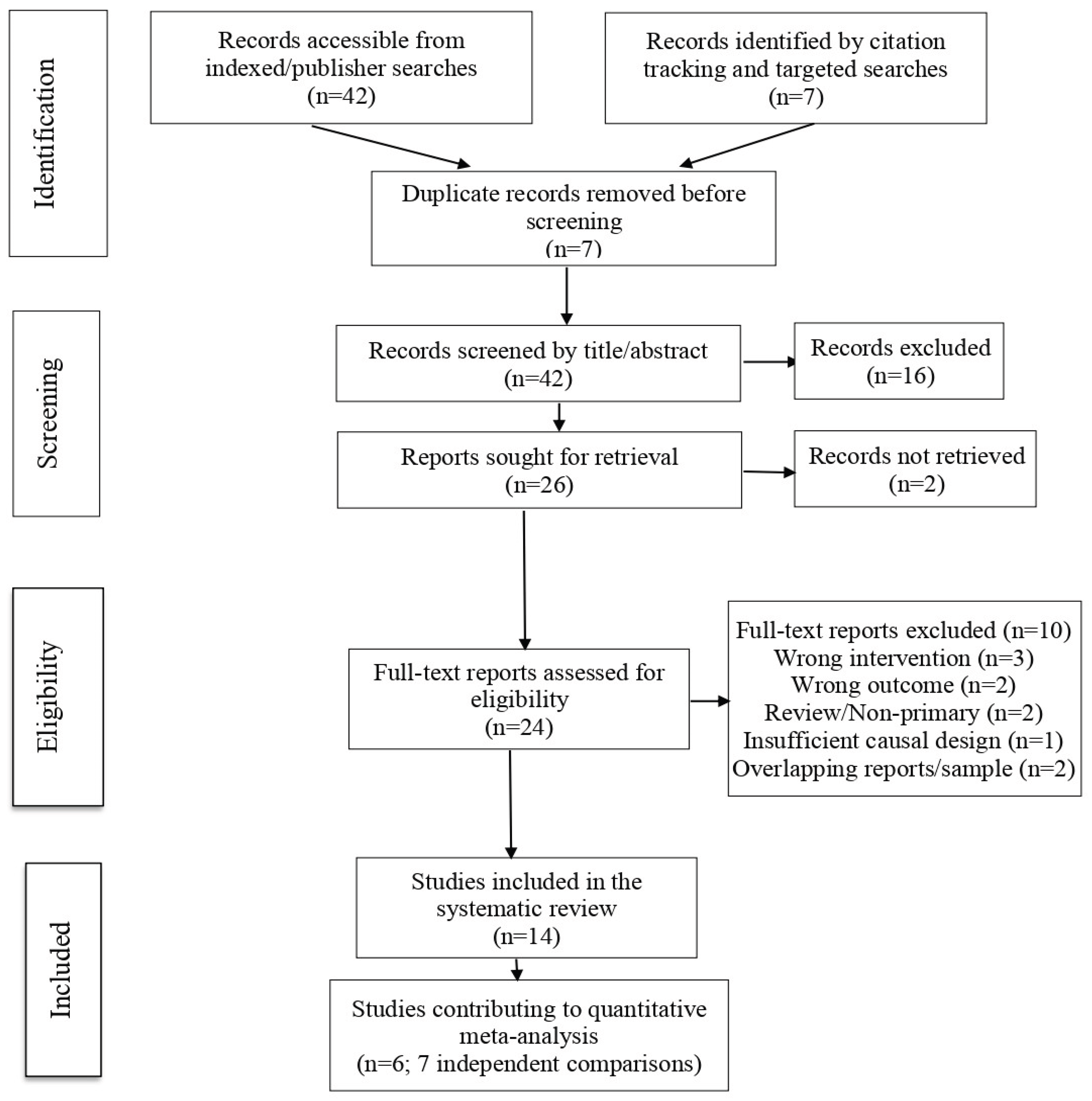
Table 1.
Characteristics of Studies Included in the Systematic Review.
| Study | Country | Programme | Design | Sample | Follow-up | Outcomes | Main finding | Quality |
|---|---|---|---|---|---|---|---|---|
| Haushofer & Shapiro (2016). | Kenya | UCT | Cluster RCT | 1,372 endline households | 9 months | Consumption; food security; assets | Consumption and food security increased | Low/some concerns |
| Handa et al., 2018 | Zambia | CGP and MCP UCTs | Cluster RCTs | 2,272 CGP; 2,938 MCP at baseline | 36 months | Consumption; food security; assets; poverty | Broad gains; spending exceeded transfer value | Low |
| Banerjee et al., 2015 | 6 countries | Graduation cash-plus | Six RCTs | ~10,500 households | ~3 years | Consumption; food security; income; assets | Sustained average welfare gains | Some concerns (package attribution) |
| Bandiera et al., 2017 | Bangladesh | TUP asset/cash-plus | Cluster RCT | 21,000+ households | 4–7 years | Consumption; food security; earnings; assets | Persistent poverty and occupational gains | Low |
| Baird et al., 2019 | Malawi | Conditional and unconditional transfers | RCT follow-up | Study cohort; analytic N varies | 5 years | Education; fertility; human capital | CCT persistence; UCT gains largely faded | Some concerns |
| Blattman et al., 2020 | Uganda | One-time enterprise grants | Cluster RCT follow-up | Thousands of young adults | 9 years | Earnings; work; consumption; assets | Earnings/consumption converged; assets persisted | Some concerns (long follow-up attrition) |
| Bossuroy et al., 2022 | Niger | Government cash + productive inclusion | Four-arm cluster RCT | 4,712 baseline households | 18 months | Consumption; food security; revenue; psychosocial | Cash-capital and complementary packages improved welfare | Low |
| Egger et al., 2022 | Kenya | Large one-time UCT | Village saturation RCT | 10,500+ recipient households; 653 villages | ~18 months | Consumption; assets; prices; spillovers | Large direct/spillover gains; minimal average inflation | Low |
| MacPherson & Sterck, (2021). | Kenya refugees | Mobile cash + agriculture model | Regression discontinuity | 1,126 households | Cross-sectional exposure | Nutrition; well-being; aid dependence | Positive nutrition and self-reliance effects | Moderate |
| Salti et al., 2022 | Lebanon refugees | Multipurpose cash assistance | Multidimensional RD | Analytic N varies by eligibility group | Up to >12 months | Expenditure; housing; schooling; child labour | Longer exposure generated broader gains | Moderate |
| Altındağ & O’Connell, (2023). | Lebanon refugees | Two year-long UCT programmes | Regression discontinuity | Programme survey cohorts | 6 months post-program | Consumption; food security; savings; assets | Strong short-run gains; no lasting effects at 6 months | Moderate |
| Gupta et al., 2024 | Uganda refugees | US$1,000 one-time UCT | RCT / phased rollout | 1,090 households | 19 months | Consumption; assets; business; well-being | Multidimensional gains; food-security estimate imprecise | Some concerns |
| Robson et al., 2024 | Turkey refugees | ESSN monthly UCT | Causal distributional analysis | Large ESSN survey sample | Programme exposure | Multidimensional poverty; food; health; education | Reduced incidence/intensity, especially among more deprived | Moderate |
| Handa et al., 2025 | Zambia | Child Grant post-program follow-up | RCT follow-up | Original CGP panel | 3 years after cessation | Food security; material welfare; assets | Most programme impacts faded after cessation | Some concerns |
Table 2.
Individual and Pooled Standardised Food-Security Effect Estimates.
| Study/comparison | Effect | SE | Lower 95% CI | Upper 95% CI | Weight |
|---|---|---|---|---|---|
| Haushofer & Shapiro (2016) | 0.260 | 0.060 | 0.142 | 0.378 | 15.4% |
| Handa et al. (2018). CGP | 0.530 | 0.130 | 0.275 | 0.785 | 9.6% |
| Handa et al. (2018), MCP | 0.540 | 0.100 | 0.344 | 0.736 | 12.0% |
| Banerjee et al. (2015) | 0.113 | 0.022 | 0.070 | 0.156 | 17.8% |
| Bandiera et al. (2017) | 0.256 | 0.079 | 0.101 | 0.411 | 13.7% |
| Haushofer et al. (2020) | 0.140 | 0.060 | 0.022 | 0.258 | 15.4% |
| Bossuroy et al. (2022), capital arm | 0.200 | 0.050 | 0.102 | 0.298 | 16.1% |
| Pooled REML | 0.265 | 0.059 | 0.149 | 0.380 | 100.0% |
Table 3.
Summary of Meta-Analytic Results.
| Analysis | k | Pooled effect | 95% CI | p | I² | tau² | Direction |
|---|---|---|---|---|---|---|---|
| Overall standardised food security | 7 comparisons / 6 papers | 0.265 | 0.149 to 0.380 | <0.001 | 81.3% | 0.019 | Positive |
| Unconditional transfer subgroup | 4 comparisons | 0.348 | 0.152 to 0.543 | <0.001 | 81.2% | 0.032 | Positive |
| Cash-plus subgroup | 3 comparisons | 0.168 | 0.085 to 0.251 | <0.001 | 60.3% | 0.003 | Positive |
| Leave-one-out range | 7 analyses | 0.211–0.296 | All 95% CIs > 0 | — | — | — | Robust positive direction |
Disclaimer/Publisher’s Note: The statements, opinions and data contained in all publications are solely those of the individual author(s) and contributor(s) and not of MDPI and/or the editor(s). MDPI and/or the editor(s) disclaim responsibility for any injury to people or property resulting from any ideas, methods, instructions or products referred to in the content. |
© 2026 by the authors. Licensee MDPI, Basel, Switzerland. This article is an open access article distributed under the terms and conditions of the Creative Commons Attribution (CC BY) license (http://creativecommons.org/licenses/by/4.0/).
Copyright: This open access article is published under a Creative Commons CC BY 4.0 license, which permit the free download, distribution, and reuse, provided that the author and preprint are cited in any reuse.