
Submitted:
18 September 2026
Posted:
20 September 2026
You are already at the latest version
Abstract
Background: Accurate field triage is a cornerstone of an inclusive trauma system, but paediatric undertriage remains poorly characterised outside North America. We aimed to estimate the rate of major trauma undertriage in a Spanish paediatric trauma centre, to identify patient factors associated with it, and to explore its relationship with early clinical outcomes. Methods: Retrospective cohort study (2016–2025) of children aged 0–14 years admitted to the paediatric intensive care unit (PICU) of the reference paediatric trauma centre for the province of Granada, Spain. Major trauma was defined using a composite of the Cribari Matrix (ISS > 15) and/or the Need for Trauma Intervention (NFTI) criteria. Undertriage was defined as delayed (> 2 hours) or non-direct transport to the trauma centre despite proximity (< 30 minutes). The primary outcomes were the undertriage rate and the patient factors associated with it, examined by bivariate analysis and by Firth-penalised logistic regression with intercept correction (FLIC). Clinical outcomes (Glasgow Outcome Scale, PICU and total hospital length of stay) were prespecified as exploratory and analysed with generalised linear models — binomial for binary outcomes and negative binomial for counts — and, as a sensitivity analysis, with targeted maximum likelihood estimation (TMLE). Results: Out of 1,716 PICU admissions during the study period, 131 (7.6%) were due to trauma and 93 children met major trauma criteria (median age 8.0 years; 73.1% male; 78.5% blunt trauma; median ISS 18.0). The undertriage rate was 23.7% (22/93; 95% CI 15.5–33.6). No patient characteristic differed significantly between undertriaged and correctly triaged children. Undertriaged children tended to be older (median 11.0 vs 7.0 years; p = 0.097) and heavier (36.5 vs 25.5 kg; p = 0.097), and the overall association between age category and undertriage did not reach significance in the FLIC model (p = 0.058). Two children (2.2%) died in PICU and 73 (78.5%) achieved a good functional recovery. Undertriage was not associated with functional outcome, PICU length of stay or total hospital length of stay in either unadjusted or adjusted analyses. Conclusions: Nearly one in four children with major trauma reaching this paediatric trauma centre had been undertriaged, a rate far above the 5% benchmark recommended by the American College of Surgeons. This rate is a lower bound, because children who died before transfer and those never transferred are structurally absent from the cohort. No patient characteristic identified undertriaged children, and no effect on early outcomes could be demonstrated in a cohort of this size. Multicentre studies are needed.
Keywords:
major trauma
; undertriage
; pediatric intensive care
Introduction
Trauma remains the leading cause of morbidity and mortality in children aged 1 to 14 years, accounting for more deaths and disabilities in this age group than all other causes combined [1].
An essential component of an inclusive trauma system is the accurate evaluation and timely triage of severely injured patients to optimize clinical outcomes [2]. Trauma systems categorize hospitals by their level of care based on guidelines established by the American College of Surgeons [3]. Level I centers provide the highest tier of comprehensive care and lead in education, research, and system planning. Level II centers offer an equivalent level of clinical care but are not mandated to maintain the same research and educational infrastructure. Level III centers possess the resources to stabilize and provide surgical or critical care for most trauma patients, while Level IV facilities focus on initial evaluation, stabilization, and basic diagnostic capabilities [4].
Appropriate triage relies on the fundamental principle of delivering “the right patient to the right place at the right time”. Directing a patient who does not require specialized resources to a major trauma center constitutes overtriage, which leads to resource exhaustion. Conversely, undertriage occurs when a patient who requires specialized trauma care is not transported to an appropriate center [5]. Recently, Moore et al. described that 50% of children with severe traumatic injuries in the United States are not attended in pediatric trauma centers [6].
While both forms of mistriage compromise system efficiency, undertriage is particularly critical as it directly correlates with increased mortality and worse functional recovery [5]. Studies in adult patients have demonstrated that severely injured patients cared for at Level I trauma centers experience significantly higher survival rates compared to those treated at non-specialized centers [7]. Nevertheless, in children, although some studies report better outcomes for patients treated in Level I trauma centers, robust evidence is still lacking [8].
In pediatric populations, undertriage is formally defined as the failure to directly transport a major trauma patient to a pediatric trauma center (PTC) when one is accessible within 30 minutes, or the failure to transfer the patient to a PTC within 2 hours of the initial injury [5,9].
Moreover, when evaluating pediatric trauma patients, healthcare providers must account for critical anatomical and physiological differences between adults and children, which directly influence injury patterns, screening indications, and the risks associated with radiation exposure [10]. Increased efforts are needed to develop highly sensitive and specific pediatric trauma triage tools to aid clinical decision-making [9].
Data on paediatric undertriage originate almost exclusively from North American systems, whose geography, prehospital organisation and hospital network differ substantially form those of European public health systemsts. To our knowledge, no Spanish study has quantified pediatric major trauma undertiage.
The aims of this study were threefold: i) to estimate the rate of undertriage among children with major trauma reaching a Spanish paediatric trauma centre; ii) to identify patient characteristics associated with undertriage; and iii) as an exploratory objective, to describe the relationship between undertriage and early clinical outcomes, with explicit attention to the structural limits of such an analysis in a single-centre cohort.
Methods
Study Design and Population
This retrospective cohort study utilized data from the Pediatric Trauma Registry of the Hospital Materno Infantil-Hospital Universitario Virgen de las Nieves (Granada, Spain) covering January 1, 2016, to December 31, 2025. This center serves as the primary Pediatric Trauma Center (PTC) for the province of Granada ( approximately 920,000 inhabitants, of whom around 130,000 are aged under 15 years), a territory that includes both a dense metropolitan area and mountainous districts, notably the Sierra Nevada ski resort.
Spain has no formal ACS verification programme; the ACS level nomenclature is therefore used descriptively throughout this manuscript. Our centre fulfils the functional attributes of a Level I pediatric trauma centre within the Andalusian Health Service-24-hour paediatric surgical , neurosurgical, orthopaedic and interventional radiology cover, a dedicated PICU and pediatric trauma registry [11].
Inclusion and Exclusion Criteria
Patients were eligible for inclusion if they were aged 0–14 years, had sustained trauma resulting from falls, sports accidents, traffic incidents, machinery accidents, or other mechanisms, and if this event represented their first traumatic experience. The registry routinely includes all trauma patients who required admission to the paediatric intensive care unit (PICU) or who died in the PICU.
Patients whose primary mechanism was burns, drowning, or acute poisoning/intoxication were excluded.
Definitions
Major trauma was defined as a composite outcome meeting the criteria of the Cribari Matrix (CM): Defined as an Injury Severity Score (ISS) greater than 15 (maximum 75), calculated from individual Abbreviated Injury Scale (AIS) data and/or the Need for Trauma Intervention (NFTI) criteria [12].
Need for Trauma Intervention (NFTI): Defined by the requirement of at least one of the following interventions:
o Administration of packed red blood cells (PRBC) or whole blood within 4 hours of hospital arrival (quantified as at least 300 mL of PRBC, 500 mL of whole blood, or 10 mL/kg of either).
o Transfer from the Emergency Department (ED) to the operating room within 90 minutes of arrival.
o Transfer from the ED to interventional radiology (including angiography) within 24 hours of arrival.
o Non-procedural mechanical ventilation initiated within 72 hours of hospital arrival.
o A PICU length of stay greater than 72 hours. Because the registry records length of stay in calendar days rather than hours, this criterion was operationalised as a recorded PICU stay of 3 days or more.
o Mortality within 60 hours of arrival (or greater than 3 days if hourly data were unavailable).
ISS values were calculated from the ICD-10 diagnosis codes for the encounter using the ICD Programs for Injury Categorization in R (ICDPIC-R) [13].
Triage Classification:
- Undertriage: Defined as a patient with major trauma who was not directly transported to the PTC despite being within a 30-minute transport radius, or who was not transferred to the PTC within 2 hours of the initial injury [5].
Ethical Considerations
This study was approved by the Biomedical Research Ethics Committee of Andalusia (SICEIA-2025-003136). Given the retrospective nature of the study and the minimal risk to participants, the requirement for written informed consent was waived by the Institutional Review Board (IRB). The study protocol adhered to the principles of the Declaration of Helsinki. The Strengthening the Reporting of Observational Studies in Epidemiology (STROBE) guidelines were followed.
Data Collection and Variables
- Demographic and clinical characteristics collected included age, sex, and weight. Injury mechanisms were categorized as sports-related (e.g., skiing, cycling), road traffic collisions, child physical abuse/assault, falls, stabs/cuts, animal attacks, or crushing injuries, and were further dichotomized into blunt versus penetrating trauma.
- Anatomical injury regions were classified as traumatic brain injury (TBI), abdominal-pelvic, thoracic, extremity, maxillofacial, spinal cord trauma, or multiple site injuries (polytrauma).
- Severity was assessed using the Injury Severity Score (ISS), Pediatric Trauma Score (PTS), and Glasgow Coma Scale (GCS) score at PICU admission.
- Discharge status ( mortality, transfer to another centre, or ward hospitalisation).
Outcomes
Outcomes. The primary outcomes were the undertriage rate and the patient characteristics associated with undertriage. Clinical outcomes were prespecified as exploratory and comprised the Glasgow Outcome Scale at discharge, PICU length of stay and total hospital length of stay. Because three exploratory outcomes were examined without a declared hierarchy, no adjustment for multiplicity was applied and none of the outcome contrasts should be read as confirmatory.
Statistical Analysis
Analyses were restricted to patients meeting major trauma criteria. Continuous variables were described as medians and interquartile ranges (Q1–Q3), and categorical variables as absolute and relative frequencies. Bivariate comparisons between patients with and without undertriage were performed using the Wilcoxon rank-sum test for continuous variables and Pearson’s chi-squared test of independence or Fisher’s exact test for categorical variables, as appropriate based on expected cell frequencies; for tables larger than 2 × 2 with sparse cells, Fisher’s exact p values were obtained by Monte Carlo simulation. Patient factors associated with undertriage were modelled with Firth-penalised logistic regression with intercept correction (FLIC), which yields finite estimates under sparse or separated data and returns predicted probabilities that are unbiased at the marginal level. Confidence intervals and p values were obtained from the penalised profile likelihood, and the overall contribution of age category from a penalised likelihood-ratio test.
For clinical outcomes, binary endpoints were modelled with generalised linear models with a binomial family. PICU and total hospital length of stay are counts with pronounced overdispersion — variance-to-mean ratios of 9.9 and 26.3 respectively — and were therefore modelled with negative binomial regression rather than Poisson regression, which would have understated the standard errors by a factor of approximately three to five. Overdispersion was quantified with the Pearson dispersion statistic and the estimated negative binomial dispersion parameter. Adjusted contrasts were obtained by marginal standardisation (g-computation) over the observed covariate distribution, with 95% confidence intervals from 4,000 non-parametric bootstrap resamples. As a sensitivity analysis, the effect of undertriage was also estimated by targeted maximum likelihood estimation (TMLE), a doubly robust, semiparametrically efficient estimator. The prespecified set of confounders comprised age, anatomical injury region and baseline Glasgow Coma Scale score. The outcome model (Q) and the treatment mechanism model (g) were fitted using SuperLearner, a meta-learner that combines candidate algorithms through cross-validation, over a library comprising the marginal mean (SL.mean), generalised linear models (SL.glm), penalised elastic-net regression (SL.glmnet) and generalised additive models (SL.gam). Given 22 exposed patients, cross-validation used 5 folds rather than 10, so that approximately four exposed patients were retained in each fold; results were essentially unchanged with 10 folds. The treatment mechanism was bounded within the interval [0.025, 0.975] to preserve weight stability. Positivity was assessed by inspecting the empirical support of the propensity score, the Crump rule (proportion of subjects with a score below 0.05 or above 0.95), the distribution of stabilised weights, and the effective sample size in each group. Because a propensity score concentrated around the marginal prevalence may arise either from a genuinely uninformative treatment model or from failure of the ensemble to converge, the SuperLearner weights and the cross-validated risk of each candidate learner were inspected explicitly.
All analyses were performed with Python 3.11 (pandas, statsmodels, SciPy and scikit-learn); the Firth-penalised regression, the SuperLearner ensemble and the TMLE estimator were implemented directly and verified against closed-form results where available. Given the sample size and the number of exposed patients, the outcome analyses are reported as exploratory and no causal interpretation is claimed. A two-sided p value below 0.05 was considered statistically significant.
Results
Description of Participants
Over a 10-year period, 1,716 paediatric patients were admitted to the PICU; 131 (7.6%) admissions were due to trauma. A total of 93 children met major trauma criteria and were included in the final analysis, of whom 22 (23.7%) were classified as undertriaged.
Demographic characteristics, injury features and clinical severity at admission are summarised in Table 1. The cohort had a median age of 8.0 years (Q1–Q3 2.0–12.0) with a male predominance (73.1%). Sports-related mechanisms, including falls from bicycles, scooters or skis, were the most frequent (34 children, 36.6%), followed by road traffic collisions (28, 30.1%) and falls from height (14, 15.1%). Traumatic brain injury was the predominant anatomical injury region (50.5%), and blunt trauma was the most prevalent type (78.5%). The median Injury Severity Score for the whole cohort was 18.0 (Q1–Q3 16.0–26.0), with 39 children (41.9%) scoring 25 or above; the median baseline Glasgow Coma Scale score was 15.0 (Q1–Q3 12.0–15.0) and the median Pediatric Trauma Score was 7.0 (Q1–Q3 5.0–9.0). For the cohort as a whole, the median PICU length of stay was 3.0 days (Q1–Q3 2.0–6.0) and the median total hospital length of stay was 7.0 days (Q1–Q3 5.0–13.0). Eighty-four children (90.3%) were discharged to a hospital ward, 7 (7.5%) were transferred to another centre and 2 (2.2%; 95% CI 0.3–7.6) died in hospital.
Undertriage Rate and Associated Factors
Twenty-two of the 93 children were classified as undertriaged, a rate of 23.7% (exact 95% CI 15.5–33.6). No patient characteristic differed significantly between groups. Undertriaged children tended to be older than correctly triaged children (median 11.0 vs 7.0 years; p = 0.097) and heavier (36.5 vs 25.5 kg; p = 0.097), consistent with the expected collinearity of these variables in children, but neither contrast reached conventional significance. Injury severity at admission was comparable between groups for the Glasgow Coma Scale score (median 14.0 vs 15.0; p = 0.329), the Injury Severity Score (25.0 vs 17.0; p = 0.164) and the Pediatric Trauma Score (8.0 vs 7.0; p = 0.579). The undertriage group included a higher proportion of boys (81.8% vs 70.4%; p = 0.436) and of penetrating injuries (22.7% vs 12.7%; p = 0.260), and a lower proportion of abdominal-pelvic injuries (4.5% vs 11.3%), none of which reached significance. The only contrast attaining conventional significance was transfer to interventional radiology within 24 hours (36.4% vs 8.5%; p = 0.004); because this is one of the NFTI criteria used to define the cohort and is simultaneously examined as a clinical outcome, it is reported for completeness but is not interpretable as an independent finding.

Table 1.
Demographic characteristics, injury features, clinical severity at admission and NFTI criteria met by the paediatric major trauma cohort, stratified by undertriage status.
Table 1.
Demographic characteristics, injury features, clinical severity at admission and NFTI criteria met by the paediatric major trauma cohort, stratified by undertriage status.
| Characteristic | Total N = 93 | No undertriage N = 71 | Undertriage N = 22 | p-value |
| Demographics | ||||
| Age, years | 8.0 (2.0, 12.0) | 7.0 (1.8, 11.0) | 11.0 (7.2, 12.8) | 0.097 |
| Age category | 0.051 | |||
| <=1 year | 22 (23.7%) | 17 (23.9%) | 5 (22.7%) | |
| 1-5 years | 12 (12.9%) | 12 (16.9%) | 0 (0.0%) | |
| 6-10 years | 27 (29.0%) | 22 (31.0%) | 5 (22.7%) | |
| 11-14 years | 32 (34.4%) | 20 (28.2%) | 12 (54.5%) | |
| Sex | 0.436 | |||
| Male | 68 (73.1%) | 50 (70.4%) | 18 (81.8%) | |
| Female | 25 (26.9%) | 21 (29.6%) | 4 (18.2%) | |
| Weight, kg | 27.9 (14.8, 42.0) | 25.5 (12.2, 40.0) | 36.5 (17.8, 48.8) | 0.097 |
| Trauma Characteristics | ||||
| Mechanism of injury | 0.751 | |||
| Sports-related (bicycle, scooter, skis) | 34 (36.6%) | 24 (33.8%) | 10 (45.5%) | |
| Road traffic collision | 28 (30.1%) | 22 (31.0%) | 6 (27.3%) | |
| Fall from height | 14 (15.1%) | 12 (16.9%) | 2 (9.1%) | |
| Other | 17 (18.3%) | 13 (18.3%) | 4 (18.2%) | |
| Type of trauma | 0.260 | |||
| Blunt | 73 (78.5%) | 56 (78.9%) | 17 (77.3%) | |
| Penetrating | 14 (15.1%) | 9 (12.7%) | 5 (22.7%) | |
| Mixed | 6 (6.5%) | 6 (8.5%) | 0 (0.0%) | |
| Anatomical injury region | 0.348 | |||
| Traumatic brain injury | 47 (50.5%) | 38 (53.5%) | 9 (40.9%) | |
| Polytrauma | 25 (26.9%) | 18 (25.4%) | 7 (31.8%) | |
| Abdominal-pelvic | 9 (9.7%) | 8 (11.3%) | 1 (4.5%) | |
| Maxillofacial | 6 (6.5%) | 3 (4.2%) | 3 (13.6%) | |
| Other | 6 (6.5%) | 4 (5.6%) | 2 (9.1%) | |
| Intention | 1.000 | |||
| Unintentional | 79 (84.9%) | 60 (84.5%) | 19 (86.4%) | |
| Other | 14 (15.1%) | 11 (15.5%) | 3 (13.6%) | |
| Severity At Admission | ||||
| Glasgow Coma Scale score | 15.0 (12.0, 15.0) | 15.0 (12.0, 15.0) | 14.0 (11.2, 15.0) | 0.329 |
| Glasgow Coma Scale category | 0.923 | |||
| <=8 (severe) | 18 (19.4%) | 13 (18.3%) | 5 (22.7%) | |
| 9-12 (moderate) | 9 (9.7%) | 7 (9.9%) | 2 (9.1%) | |
| 13-15 (mild) | 66 (71.0%) | 51 (71.8%) | 15 (68.2%) | |
| Injury Severity Score | 18.0 (16.0, 26.0) | 17.0 (16.0, 25.5) | 25.0 (16.0, 32.8) | 0.164 |
| ISS (Cribari) | 0.547 | |||
| <= 15 | 19 (20.4%) | 16 (22.5%) | 3 (13.6%) | |
| > 15 | 74 (79.6%) | 55 (77.5%) | 19 (86.4%) | |
| ISS category | 0.641 | |||
| 1-8 | 2 (2.2%) | 2 (2.8%) | 0 (0.0%) | |
| 9-15 | 17 (18.3%) | 14 (19.7%) | 3 (13.6%) | |
| 16-24 | 35 (37.6%) | 28 (39.4%) | 7 (31.8%) | |
| >= 25 | 39 (41.9%) | 27 (38.0%) | 12 (54.5%) | |
| Pediatric Trauma Score | 7.0 (5.0, 9.0) | 7.0 (5.0, 9.0) | 8.0 (3.8, 9.8) | 0.579 |
| Nfti Criteria Met | ||||
| Operating room within 90 min | 37 (39.8%) | 30 (42.3%) | 7 (31.8%) | 0.532 |
| Interventional radiology within 24 h | 14 (15.1%) | 6 (8.5%) | 8 (36.4%) | 0.004 |
| Emergency surgery or embolisation | 51 (54.8%) | 36 (50.7%) | 15 (68.2%) | 0.232 |
| Mechanical ventilation within 72 h | 25 (26.9%) | 19 (26.8%) | 6 (27.3%) | 1.000 |
| Blood transfusion within 4 h | 9 (9.7%) | 6 (8.5%) | 3 (13.6%) | 0.437 |
| PICU stay > 72 h | 57 (61.3%) | 44 (62.0%) | 13 (59.1%) | 1.000 |
| Number of NFTI criteria met | 1.0 (1.0, 2.0) | 1.0 (1.0, 2.0) | 2.0 (1.0, 2.0) | 0.307 |
1 Median (Q1, Q3); n (%). 2 Wilcoxon rank-sum test; Fisher’s exact test; Pearson’s chi-squared test. Abbreviations: ISS, Injury Severity Score; NFTI, Need for Trauma Intervention; PICU, paediatric intensive care unit; TBI, traumatic brain injury.
In the FLIC model, age category was not significantly associated with undertriage overall (penalised likelihood-ratio test, p = 0.058). Taking infants (≤ 1 year, predicted probability 22.6%; 95% CI 9.7–44.3) as reference, the predicted probability of undertriage was lowest among children aged 1–5 years (3.6%; 95% CI 0.2–43.8), intermediate at 6–10 years (18.5%; 95% CI 7.9–37.5) and highest at 11–14 years (36.2%; 95% CI 21.6–53.9). None of the individual contrasts relative to infants reached significance (1–5 years, OR 0.13, p = 0.089; 6–10 years, OR 0.78, p = 0.713; 11–14 years, OR 1.94, p = 0.266), and all confidence intervals were wide. The pattern is one of a gradient across school age and adolescence rather than a discrete effect in any single stratum, and it does not reach conventional significance in this cohort (Figure 1).
Exploratory Analysis of Clinical Outcomes
Sensitivity Analysis
- Positivity diagnostics. The propensity score estimated by SuperLearner ranged from 0.184 to 0.363 in undertriaged patients and from 0.168 to 0.348 in correctly triaged patients, values concentrated around the marginal prevalence of undertriage (22/93; 23.7%). No patient fell within extreme regions according to the Crump rule (PS < 0.05 or > 0.95). Stabilised weights were close to unity across the entire cohort (median 0.97; range 0.65 to 1.28; 99th percentile 1.18), with no influential observations, and the effective sample size was essentially identical to the nominal size in both groups (21.5 of 22 exposed and 70.8 of 71 unexposed). This narrow range does not reflect a failure of the ensemble to converge: half of the SuperLearner weight was allocated to the marginal mean (SL.mean, weight 50.3%), and SL.mean achieved a lower cross-validated risk (0.548) than the generalised linear model (0.662) and the elastic net (0.575), and was indistinguishable from the generalised additive model (0.549). No candidate learner using the confounders predicted undertriage better than predicting the overall prevalence for every child. The propensity score is therefore flat because age, anatomical injury region and baseline Glasgow Coma Scale score carry almost no information about who is undertriaged, which is consistent with the bivariate comparisons and with the FLIC model. Positivity is not in question, but the doubly robust estimator has very little covariate signal to exploit and the adjusted estimates below remain close to the unadjusted contrasts.
- Estimates of the association between undertriage and clinical outcomes are summarised in Table 2. None of the contrasts reached statistical significance in either unadjusted or adjusted analyses. A favourable functional outcome was recorded in 77.3% of undertriaged and 78.9% of correctly triaged children (adjusted risk difference +5.5 percentage points; 95% CI −16.5 to 22.5; p = 0.671). Undertriaged children had a non-significantly shorter PICU stay (adjusted difference −1.56 days; 95% CI −3.51 to 0.75; p = 0.182) and total hospital stay (−2.11 days; 95% CI −5.98 to 2.05; p = 0.380), and a non-significantly higher probability of emergency surgery or embolisation (adjusted risk difference +6.5 percentage points; 95% CI −16.1 to 33.3; p = 0.579). Under a Poisson model the unadjusted differences in PICU and total hospital stay would have appeared significant (p = 0.010 and p = 0.020 respectively); once the substantial overdispersion of both variables is modelled with a negative binomial distribution, the same point estimates carry p values of 0.227 and 0.380. The TMLE sensitivity analysis produced estimates consistent with the standardised regression estimates and equally non-significant.
Discussion
Severe trauma is a frequent cause of admission to intensive care units worldwide and remains a leading cause of mortality and disability in children. Nevertheless, a clear prognostic impact of undertriage in severe pediatric trauma has not been definitively established, nor have validated tools been deployed to reduce current pediatric undertriage rates [6].
The American College of Surgeons proposes that an undertriage rate below 5% is acceptable for both adult and pediatric populations [3]. Although these transport thresholds were originally established based on adult data, recent evidence suggests that minimizing time to definitive care is equally critical in pediatric populations due to their limited physiological reserve [14,15]. However, sociodemographic factors and local healthcare system characteristics limit the direct extrapolation of international findings.
In our setting, this is the first study to assess the impact of undertriage and its associated factors on outcomes in pediatric patients with severe trauma. We observed an undertriage rate of 23.7%, nearly five times the threshold recommended by the American College of Surgeons Committee on Trauma. Nevertheless, reported undertriage figures in the literature align closely with our findings. For instance, Xiang et al. found that 34% of severely injured adults were treated outside major centers [16], Peng et al. reported that 21.7% of severely injured children received definitive care at lower-level trauma centers [17], and Gorski et al. observed undertriage in 34.4% of major trauma encounters [12].
Our rate should moreover be read as a lower bound. Because the cohort comprises children admitted to the PICU, two groups are structurally invisible: those who died before reaching the centre and those who received definitive care at a lower-level hospital and were never transferred. Both groups are, by construction, undertriaged. The true provincial undertriage rate is therefore necessarily higher than 23.7%. This conditioning on arrival at the trauma centre is not merely a limitation on precision: selecting on survival to a downstream node is the classical mechanism by which a harmful exposure can appear protective, and it is the most parsimonious explanation for the direction of the length-of-stay estimates reported here.
In our cohort, undertriaged children tended to be older, but this association did not reach statistical significance (median 11.0 vs 7.0 years; p = 0.097), and the overall test for age category in the penalised model was likewise non-significant (p = 0.058). No other characteristic — sex, mechanism, anatomical injury region, type of trauma or any measure of injury severity — distinguished the two groups. Previous work has reported associations that we could not reproduce: an adjusted odds ratio of 2.47 for children aged 6 to 10 years, and abdominal trauma as an independent risk factor for undertriage [7,18]. Our estimates run in the opposite direction for both — the 6–10 year stratum was the one closest to the null in our model (OR 0.78; p = 0.713), and abdominal-pelvic injury was less rather than more frequent among undertriaged children (4.5% vs 11.3%). The gradient we observe, if real, is confined to adolescents (11–14 years, predicted probability 36.2%), for whom a plausible physiological explanation exists: older children compensate temporarily for severe haemodynamic or respiratory compromise better than infants, which can mask injury severity during initial field triage [4]. With 22 undertriaged children this study is not powered to confirm or refute such a gradient, and the question should be settled in a multicentre cohort rather than here.
In line with this assessment, Gorski et al. suggested that optimizing triage criteria requires shifting from purely mechanism-of-injury metrics to highly sensitive, pediatric-adjusted physiological parameters (such as real-time hemodynamic monitoring or the age-adjusted shock index) [12].
Undertriaged children had numerically shorter PICU and total hospital stays. Under a Poisson model these differences would have appeared statistically significant, but both length-of-stay variables are severely overdispersed, with variance-to-mean ratios of 9.9 and 26.3; a Poisson likelihood assumes a ratio of one and consequently understates the standard errors by a factor of three to five. Modelled with a negative binomial distribution, the same point estimates are compatible with no difference (−1.36 days for PICU stay, p = 0.227; −1.83 days for total stay, p = 0.380), and adjustment for prespecified confounders — whether by marginal standardisation or by TMLE — does not change this conclusion. We therefore do not interpret the shorter stays as a finding. Two structural features of the design would in any case preclude a causal reading. First, the composite case definition is partially circular with respect to the outcomes examined: the NFTI criteria include transfer to the operating room within 90 minutes, transfer to interventional radiology within 24 hours and a PICU stay exceeding 72 hours, so that emergency procedures and length of stay contribute to cohort membership and are then analysed as endpoints. Nineteen of the 93 children (20.4%) entered the cohort through NFTI criteria alone with an ISS of 15 or below. Second, as noted above, conditioning on arrival at the trauma centre selects on survival. Both mechanisms bias the length-of-stay contrast in the direction observed.
A further consideration specific to our setting is geography. The province of Granada combines a metropolitan core with mountainous districts, and the 30-minute accessibility criterion is met for only part of the territory. Sports-related mechanisms, which accounted for 45.5% of undertriaged children, occur disproportionately in the ski resort and in peripheral districts, and are also concentrated in older children. Distance from the scene is therefore a plausible common cause of both older age and undertriage, and its omission from the adjustment set in earlier analyses is a substantive limitation rather than a technical one; we recommend that transport isochrone data be incorporated in future work.
This study has several limitations. Its retrospective, single-centre design and the modest number of undertriaged children [22] limit statistical power, and the outcome analyses should be regarded as exploratory rather than as tests of effect; expanding this work into a nationwide multicentre registry is necessary. Selection bias persists because the registry cannot capture patients who suffered prehospital cardiac arrest or died in a referring emergency department before PICU admission. Distance and transport time from the scene, the most plausible common cause of both older age and undertriage in this territory, are not recorded in the registry and could not be included in the adjustment set. The prespecified confounders proved almost uninformative about undertriage status, so the adjusted estimates carry little more information than the crude ones. Finally, while ICD-10 codes are widely validated for trauma severity scoring, they exhibit lower accuracy for identifying specific paediatric injury subtypes.
Conclusions
Nearly one in four children with major trauma reaching this paediatric trauma centre had been undertriaged, a rate far above the 5% benchmark recommended by the American College of Surgeons and one that must be read as a lower bound on the true provincial figure. No routinely recorded patient characteristic distinguished undertriaged from correctly triaged children, and no effect of undertriage on functional outcome or length of stay could be demonstrated in a cohort of this size and with a design that conditions on arrival at the centre. These findings establish a baseline for paediatric undertriage in a Spanish trauma system and indicate that the problem is unlikely to be solved by refining patient-level triage criteria alone. Multicentre prospective studies, incorporating prehospital transport times and capturing children who never reach a trauma centre, are warranted to evaluate the clinical impact of undertriage and to refine field triage guidelines.
Institutional Review Board Statement
This study was approved by the Biomedical Research Ethics Committee of Andalusia (SICEIA-2025-003136).
Informed Consent Statement
Given the retrospective nature of the study and the minimal risk to participants, the requirement for written informed consent was waived by the Institutional Review Board (IRB).
Data Availability Statement
The original contributions presented in this study are included in the article. Further inquiries can be directed to the corresponding author.
References
- National Center for Injury Prevention and Control. CDC injury fact book . Atlanta: Centers for Disease Control and Prevention; 2006 . URL : https://stacks.cdc.gov/view/cdc/11438.
- Ting T, Wakeman DS, Arca MJ, Wilson NA. Prehospital factors predict outcomes in pediatric trauma: A principal component analysis. Journal of Trauma and Acute Care Surgery. 2022 Sep;93(3):291–8. [CrossRef]
- Optimal Resources for Children’s Surgical Care in the United States. J Am Coll Surg. 2014 Mar;218(3):479-487e4. [CrossRef]
- Davis J, Young T, Casteel C, Peek-Asa C, Torner J. Pediatric Unintentional Fall-Related Injuries in a Statewide Trauma Registry. Pediatr Emerg Care. 2022 Feb;38(2):e961–6. [CrossRef]
- Gurria JP, Haas L, Troutt M, Moody S, Hossain MdM, Bhuiyan MAN, et al. Pediatric trauma undertriage in Ohio. Journal of Trauma and Acute Care Surgery. 2017 Jun;82(6):1007–13. [CrossRef]
- Moore L, Yanchar NL, Tardif PA, Weiss M, Beaulieu E, Stang A, et al. Evidence-Informed Quality Indicators for Pediatric Trauma Care. JAMA Pediatr. 2025 Jun 1;179(6):666. [CrossRef]
- Scaife JH, Bryce JR, Iantorno SE, Yang M, McCrum ML, Bucher BT. Secondary Undertriage of Pediatric Trauma Patients Across the United States Emergency Departments. Journal of Surgical Research. 2024 Jan;293:37–45. [CrossRef]
- Sathya C, Alali AS, Wales PW, Scales DC, Karanicolas PJ, Burd RS, et al. Mortality Among Injured Children Treated at Different Trauma Center Types. JAMA Surg. 2015 Sep 1;150(9):874. [CrossRef]
- van der Sluijs R, van Rein EAJ, Wijnand JGJ, Leenen LPH, van Heijl M. Accuracy of Pediatric Trauma Field Triage. JAMA Surg. 2018 Jul 1;153(7):671. [CrossRef]
- Fylli C, Schipper IB, Krijnen P. Pediatric Trauma in The Netherlands: Incidence, Mechanism of Injury and In-Hospital Mortality. World J Surg. 2023 May 18;47(5):1116–28. [CrossRef]
- Consejería de Salud y Consumo. Atención al trauma grave en la infancia: proceso asistencial [Internet]. Sevilla: Junta de Andalucía; 2025 [consultado el 6 de septiembre de 2026]. Disponible en: https://www.juntadeandalucia.es/organismos/presidenciasanidadyemergencias/areas/sanidad/calidad/pai/paginas/pa-atenc-trauma-grave-infancia-2025.htm. 2025.
- Gorski J, Goldstein S, Zeineddin S, Ramgopal S. An Activation Failure: Factors Associated With Undertriage of Pediatric Major Trauma Victims. Journal of Surgical Research. 2025 Feb;306:68–76. [CrossRef]
- Clark DE, Black AW. ICDPIC-R Version 1.0.0. Injury. 2021 Nov;52(11):3545. [CrossRef]
- Bhatia MB, Keung CH, Hogan J, Chepkemoi E, Li HW, Rutto EJ, et al. Implementation of a pediatric trauma registry at a national referral center in Kenya: Utility and concern for sustainability. Injury. 2024 Jun;55(6):111531. [CrossRef]
- Hewes HA, Christensen M, Taillac PP, Mann NC, Jacobsen KK, Fenton SJ. Consequences of pediatric undertriage and overtriage in a statewide trauma system. Journal of Trauma and Acute Care Surgery. 2017 Oct;83(4):662–7. [CrossRef]
- Newgard CD, Fischer PE, Gestring M, Michaels HN, Jurkovich GJ, Lerner EB, et al. National guideline for the field triage of injured patients: Recommendations of the National Expert Panel on Field Triage, 2021. Journal of Trauma and Acute Care Surgery. 2022 Aug;93(2):e49–60. [CrossRef]
- Xiang H, Wheeler KK, Groner JI, Shi J, Haley KJ. Undertriage of major trauma patients in the US emergency departments. Am J Emerg Med. 2014 Sep;32(9):997–1004. [CrossRef]
- Peng J, Wheeler K, Groner JI, Haley KJ, Xiang H. Undertriage of Pediatric Major Trauma Patients in the United States. Clin Pediatr (Phila). 2017 Aug 18;56(9):845–53. [CrossRef]
- Sung J, Yao A, Antoniou G, Cooksey R, Winters J, Ee M, et al. Failure to initiate trauma team activation for patients who meet the criteria in a level 1 paediatric trauma centre: which patients are missing out? ANZ J Surg. 2022 Oct 14;92(10):2628–34. [CrossRef]
Figure 1.
Predicted probability of undertriage by age category in the paediatric major trauma cohort, estimated from a Firth-penalised logistic regression with intercept correction (FLIC). Points represent marginal predicted probabilities and error bars their 95% confidence intervals. The overall association between age category and undertriage was not statistically significant (penalised likelihood-ratio test, p = 0.058).
Figure 1.
Predicted probability of undertriage by age category in the paediatric major trauma cohort, estimated from a Firth-penalised logistic regression with intercept correction (FLIC). Points represent marginal predicted probabilities and error bars their 95% confidence intervals. The overall association between age category and undertriage was not statistically significant (penalised likelihood-ratio test, p = 0.058).
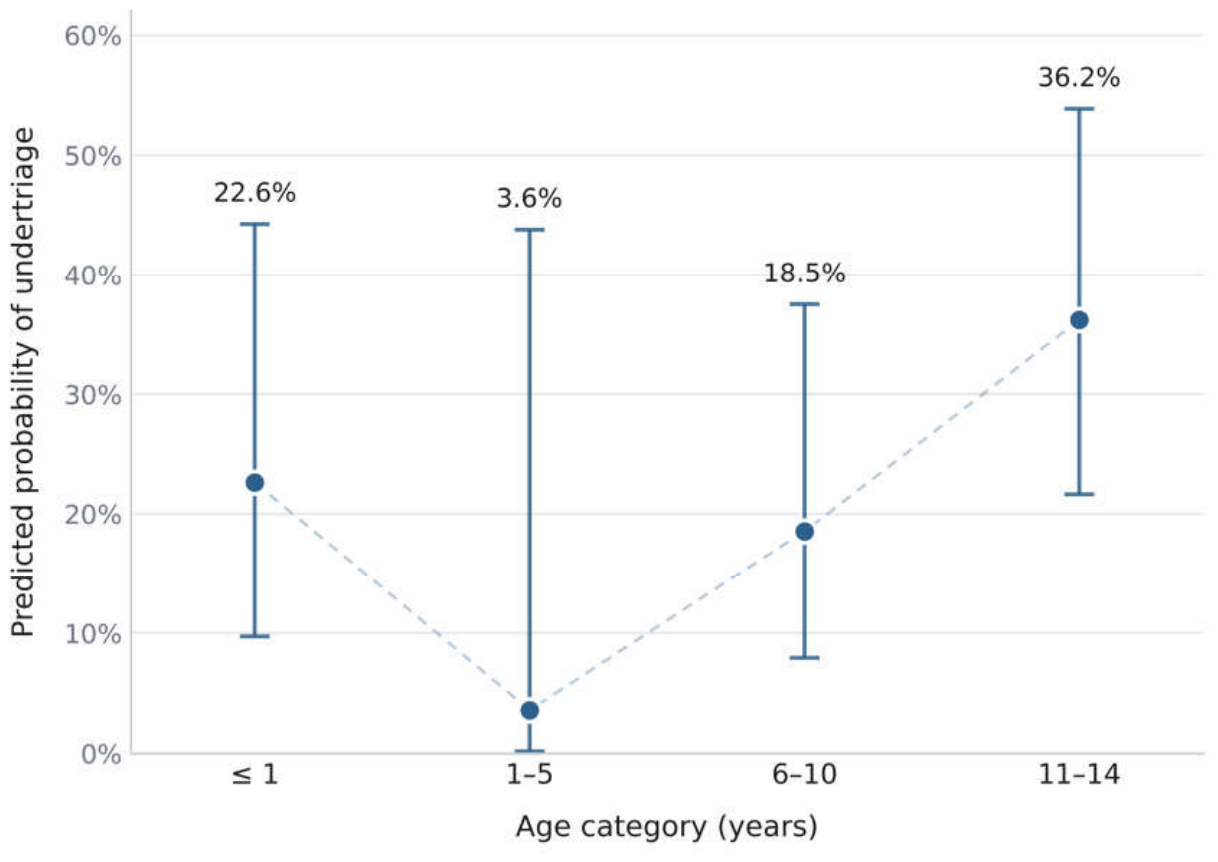
Table 2.
Association between undertriage and clinical outcomes in the paediatric major trauma cohort.
Table 2.
Association between undertriage and clinical outcomes in the paediatric major trauma cohort.
| Outcome | Model | No undertriage | Undertriage | Effect (95% CI) | p-value |
| Favourable outcome (GOS = 5) | Unadjusted | 78.9% | 77.3% | RD -1.6 pp (-22.3 to 17.7) | 0.906 |
| Adjusted | 77.0% | 82.5% | RD +5.5 pp (-16.5 to 22.5) | 0.671 | |
| Emergency surgery or embolisation | Unadjusted | 50.7% | 68.2% | RD +17.5 pp (-6.3 to 39.6) | 0.150 |
| Adjusted | 53.4% | 59.9% | RD +6.5 pp (-16.1 to 33.3) | 0.579 | |
| PICU length of stay (days) | Unadjusted | 5.68 | 4.32 | -1.36 days (-4.01 to 1.42) | 0.327 |
| Adjusted | 5.63 | 4.06 | -1.56 days (-3.51 to 0.75) | 0.182 | |
| Total hospital stay (days) | Unadjusted | 11.79 | 9.95 | -1.83 days (-7.81 to 3.22) | 0.536 |
| Adjusted | 11.63 | 9.53 | -2.11 days (-5.98 to 2.05) | 0.380 | |
| TMLE sensitivity analysis | |||||
| Favourable outcome (GOS = 5) | TMLE | 77.7% | 80.6% | RD +2.8 pp (-14.7 to 20.4) | 0.751 |
| Emergency surgery or embolisation | TMLE | 52.6% | 62.1% | RD +9.5 pp (-10.1 to 29.0) | 0.343 |
| PICU length of stay (days) | TMLE | 5.82 | 4.08 | -1.74 days (-3.68 to 0.20) | 0.079 |
| Total hospital stay (days) | TMLE | 12.02 | 9.42 | -2.59 days (-7.42 to 2.24) | 0.293 |
Binomial generalised linear models for binary outcomes and negative binomial models for counts; adjusted estimates obtained by marginal standardisation over age, anatomical injury region and baseline Glasgow Coma Scale score, with 95% confidence intervals from 4,000 bootstrap resamples. TMLE: targeted maximum likelihood estimation with SuperLearner (SL.mean, SL.glm, SL.glmnet, SL.gam), 5-fold cross-validation and bounding of g within [0.025, 0.975]. RD, risk difference; pp, percentage points; CI, confidence interval.
Disclaimer/Publisher’s Note: The statements, opinions and data contained in all publications are solely those of the individual author(s) and contributor(s) and not of MDPI and/or the editor(s). MDPI and/or the editor(s) disclaim responsibility for any injury to people or property resulting from any ideas, methods, instructions or products referred to in the content. |
© 2026 by the authors. Licensee MDPI, Basel, Switzerland. This article is an open access article distributed under the terms and conditions of the Creative Commons Attribution (CC BY) license (http://creativecommons.org/licenses/by/4.0/).
Copyright: This open access article is published under a Creative Commons CC BY 4.0 license, which permit the free download, distribution, and reuse, provided that the author and preprint are cited in any reuse.