
Submitted:
20 September 2026
Posted:
20 September 2026
You are already at the latest version
Abstract
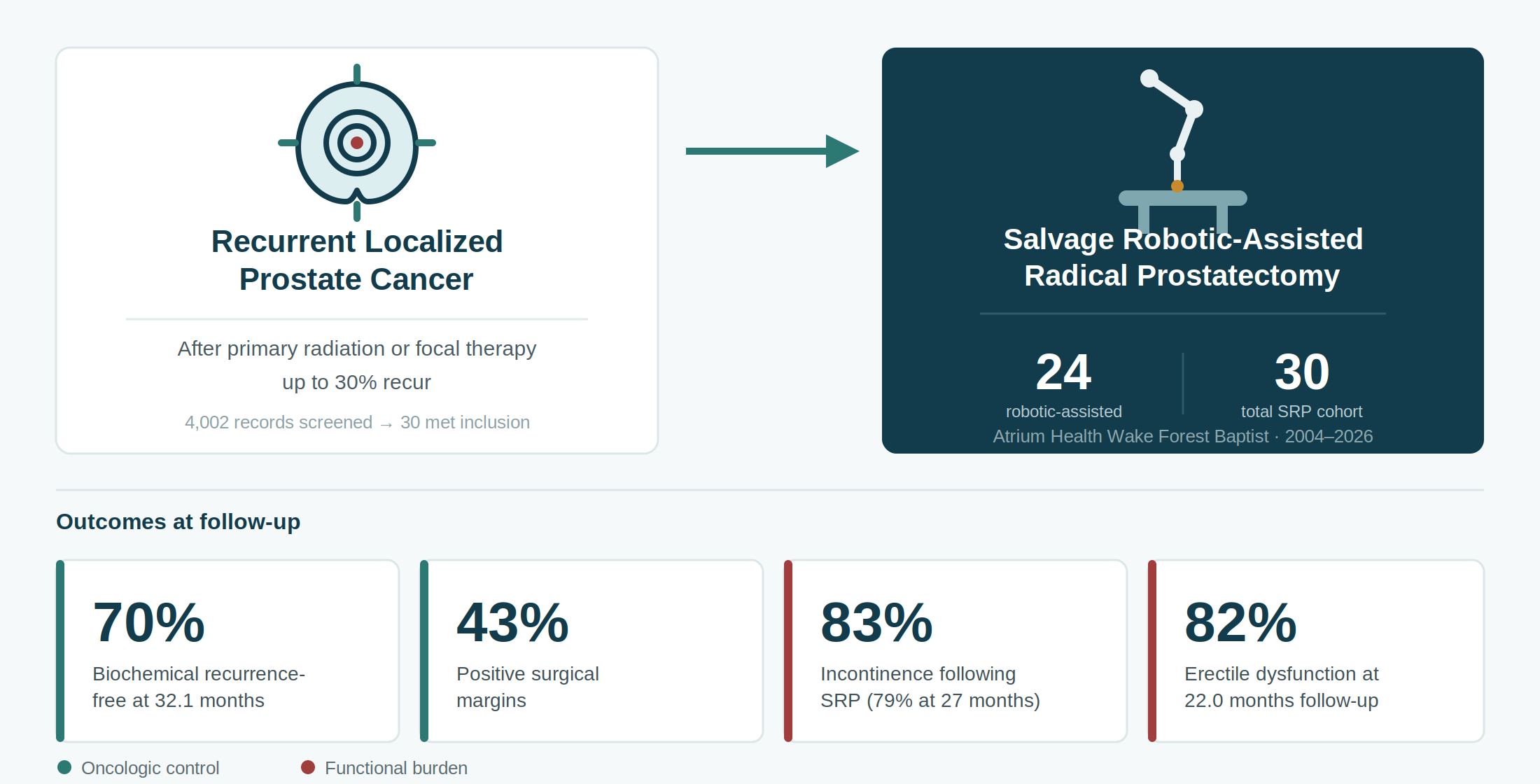
Background/Objectives: Salvage radical prostatectomy (SRP) is a potentially curative option for recurrent localized prostate cancer after primary radiation or focal therapy, historically limited by technical complexity and poor functional outcomes. Advances in robotic surgery have prompted re-evaluation of SRP. This study characterizes contem-porary perioperative, oncologic, and functional outcomes of salvage robotic-assisted radical prostatectomy (sRARP) at a single institution over two decades. Methods: We retrospectively reviewed patients undergoing SRP at our institution from 01/01/2004 to 06/30/2026, identified via combined institutional database query and natural language processing (NLP) keyword search with individual chart confirmation; analysis was re-stricted to the robotic-assisted subset. Clinicodemographic, perioperative, pathologic, and functional data were collected at diagnosis, recurrence, and following SRP, with conti-nence and erectile function also assessed at last follow-up. Descriptive statistics were reported as median (interquartile range, IQR) or n/N (%). Results: Of 4,002 records identified, 30 patients met inclusion criteria; 24 (80%) underwent sRARP. Extraprostatic disease was present in 54% (13/24) and positive margins in 43% (10/23). A postoperative complication occurred in 22% (4% Clavien-Dindo IIIa); bladder neck contracture devel-oped in 18% (4/22), and 8% (2/24) progressed to urinary diversion. At a median follow-up of 32.1 months, 70% (14/20) remained biochemically recurrence-free. Incontinence rose from 18% (3/17) at diagnosis to 83% (19/23) post-SRP; at longer-term follow-up (27.3 months), 79% (11/14) used ≥1 pad/day. Erectile dysfunction was present in 82% (14/17) at a median follow-up of 22.0 months. Additional cancer-control therapy, predominantly androgen deprivation therapy, was given in 33%. No deaths were attributed to an SRP-specific cause. Conclusions: In this study, sRARP achieved perioperative and high-grade complication rates comparable to the broader robotic salvage literature, with a 70% biochemical recurrence-free rate, supporting its role as a potentially curative option in selected patients. A substantial functional burden, particularly incontinence, and se-vere complications including urinary diversion underscore the need for refined patient selection, thorough counseling and further multi-institutional study.
Keywords:
salvage robotic-assisted radical prostatectomy
; recurrent localized prostate cancer
; robotic-assisted radical prostatectomy
; biochemical recurrence
; urinary incontinence
; erectile dysfunction
1. Introduction
Prostate cancer (PCa) is one of the most commonly diagnosed cancers in men and a leading cause of cancer-related deaths, with an estimated 2.9 million new cases projected worldwide by 2040 [1]. The majority of patients with newly diagnosed PCa present with localized disease. Management is guided by disease risk-stratification and patient characteristics and may include radiotherapy or focal therapy [2]. Despite effective primary treatment, up to 30% of patients develop biochemical or local recurrence [3].
Salvage radical prostatectomy (SRP) is a potentially curative treatment option for patients with recurrent localized PCa [4]. Historically, SRP is associated with significant technical complexity, high complication rates, and poor functional outcomes and therefore, rarely performed [5]. In recent years, surgical advancements with the incorporation of robotic instrumentation and greater surgeon experience underscore the need to re-evaluate the use of SRP for recurrent localized PCa [6,7].
SRP carries a well-documented risk of urinary and erectile dysfunction beyond what is seen with primary radical prostatectomy; hence, functional status is a central consideration in patient counseling and treatment selection, alongside oncologic control [8,9]. Characterization of continence status and erectile function from initial diagnosis through recurrence and following SRP reflects the cumulative functional burden patients experience across the disease course [10].
Currently, much of the existing evidence is derived from systematic reviews or multi-institutional cohorts with heterogeneous surgical technique, follow-up, and outcome reporting [11]. In this study, we performed a retrospective review at a single institution over a two-decade period to better characterize contemporary clinical and functional outcomes of patients undergoing salvage robotic-assisted radical prostatectomy (sRARP) for recurrent localized PCa.
2. Materials and Methods
This is an IRB-approved retrospective chart review study under protocols IRB00109136 and IRB00149571 of all patients who underwent SRP at Atrium Health Wake Forest Baptist (AHWFB) Medical Center from 1/1/2004 to 6/30/2026. Patients were identified using the Informatics for Integrating Biology and the Bedside (i2b2) institutional clinical data repository platform by creating a temporal query of patients with a history of prostate cancer who subsequently underwent primary treatment with radiation therapy (external beam or brachytherapy) or focal therapy (high-intensity focused ultrasound [HIFU] ablation, focal laser ablation, cryoablation, irreversible electroporation, or other focal modalities), followed by radical prostatectomy (open, laparoscopic, or robotic-assisted). Procedures were identified in i2b2 by their respective Current Procedural Terminology (CPT) codes. An additional search was completed in the institutional database using the SKAN Natural Language Processing (NLP) software for keywords of “salvage radical prostatectomy” and related nomenclatural variants. All identified charts were reviewed individually to confirm performance of salvage radical prostatectomy and exclude non-salvage prostatectomy procedures and/or cases performed at outside hospitals.
A variety of clinicodemographic, perioperative, clinical, and functional data were collected through patient charts from the electronic medical record (EMR) at AHWFB. Clinicodemographic variables include patient age, race, comorbidities, body mass index (BMI), smoking history, age and clinical Tumor, Node, Metastasis (TNM) staging at initial prostate cancer diagnosis, National Comprehensive Cancer Network (NCCN) risk stratification, and primary treatment option. Perioperative variables include years from primary therapy to recurrence, clinical TNM staging at recurrence, SRP surgical approach, surgery time, and any subsequent prostate cancer treatments. Functional outcomes were measured at initial diagnosis, at recurrence, and following salvage radical prostatectomy, and included International Prostate Symptom Score (IPSS), International Index of Erectile Function (IIEF) score, presence of incontinence, presence of erectile dysfunction, and number of pads used per day.
Recurrence was defined by rising prostate-specific antigen (PSA) levels and/or confirmatory prostate biopsy. Additionally, post-surgical factors were identified including the presence of bladder neck contracture, final pathologic tumor stage and surgical margin status, performance of pelvic lymph node dissection and lymph node status, postoperative complications graded according to the Clavien-Dindo classification system, remote complications defined as SRP related complications following hospital discharge, length of hospital stay, duration of surgical (Jackson-Pratt) drain placement, receipt of additional cancer-directed therapy following SRP (e.g., androgen deprivation therapy or radiation), postoperative PSA nadir and most recent PSA, and vital status at last follow-up.
Incontinence at initial diagnosis, at recurrence, and immediately following SRP was defined as any documented involuntary urinary leakage noted in the EMR. Continence at longer-term follow-up was defined more strictly by reported pad count (continent: 0 pads/day; incontinent: ≥1 pad/day), assessed among the subset of patients with a quantified pad count recorded at that visit.
Biochemical recurrence-free survival (bRFS) following SRP was defined as a most recent PSA <0.2 ng/mL; biochemical recurrence (BCR) was defined as a most recent PSA ≥0.2 ng/mL, measured as a single value given that serial, dated, confirmatory PSA measurements were not consistently available in the chart. This is distinct from the recurrence definition above, which pertains to disease recurrence following primary therapy that prompted SRP.
This study was designed as a descriptive characterization of a contemporary single-institution salvage radical prostatectomy cohort; no formal hypothesis testing or multivariable modeling was performed given the limited sample size. Continuous variables are reported as median with interquartile range (IQR), given the small sample size and expected non-normal distribution of several variables; categorical variables are reported as a count over the number of patients with a non-missing value for that variable (n/N) and the corresponding percentage. Because data completeness varied across variables and across the three functional assessment timepoints (initial diagnosis, recurrence, and post-SRP), the denominator (N) is reported alongside each value rather than assuming complete data for the full cohort (n = 24). Descriptive statistics were computed in Python (version 3.12.3; pandas) and organized into the summary tables presented as Table 1, Table 2, Table 3 and Table 4 using Microsoft Excel (Microsoft Corporation, Redmond, WA, USA).
Generative artificial intelligence (Claude Sonnet 5; Anthropic, San Francisco, CA, USA) was used during preparation of this manuscript to (1) calculate the descriptive summary statistics and generate the formatted tables in Table 1, Table 2, Table 3 and Table 4; (2) assist in drafting and revising portions of the manuscript text, including the Methods, Results, and Discussion sections, based on author-provided source data, prior manuscript drafts, and explicit author instructions. All artificial intelligence-assisted calculations, tables, and text were reviewed, verified against the source data, and edited by the author(s) prior to submission. The author(s) take full responsibility for the accuracy, integrity, and originality of the final published work.
3. Results
3.1. Patient Identification and Cohort
A total of 4,002 unique records were identified through the combined i2b2 temporal queries and SKAN NLP keyword search. The majority were excluded on individual chart review, predominantly duplicate records returned by the multiple search strategies, as well as records not meeting inclusion criteria (non-SRP and/or procedures performed at an outside hospital). After exclusion of 3,972 records, a total of 30 patients underwent SRP at AHWFB Medical Center between January 1, 2004 and June 30, 2026, and met inclusion criteria for this retrospective review. Of these 30 patients, 24 (80%) underwent a robotic-assisted approach, 5 (17%) underwent an open approach, and 1 (3%) had surgical approach not recorded. The analyses below focus on the robotic-assisted subset (n = 24) unless otherwise specified.
3.2. Baseline Clinicodemographic Characteristics (Table 1)
At initial diagnosis, baseline functional status was notable for a median IPSS of 3.0 (IQR 1.0–8.0; available in 13/24) and a median IIEF score of 17.0 (IQR 12.8–22.8; available in 6/24). Incontinence was present in 3/17 patients with data recorded (18%). Median PSA was 7.3 ng/mL (IQR 4.5–9.6; available in 21/24) and median Gleason score was 7 (IQR 7–7; available in 22/24). Clinical stage was most commonly cT1c (12/17 with staging recorded), and NCCN risk stratification was most often intermediate risk (13/17 with a risk group recorded), including 6 favorable-intermediate, 1 unfavorable-intermediate, and 6 classified as intermediate risk without a favorable/unfavorable sub-designation documented in the chart; 2 patients each were low- and high-risk.
Primary treatment was radiation therapy in 13 patients (54%; 7 brachytherapy, 3 EBRT, 3 unspecified subtype), cryotherapy in 10 patients (42%), and HIFU in 1 patient (4%). Concurrent ADT was administered alongside primary therapy in 2 patients (8%).
3.3. Recurrence and Perioperative Characteristics (Table 2)
Prior to SRP, a subset of patients received additional cancer-directed therapy following primary treatment, most commonly ADT (4/21 with data available, 19%), with radiation and cryotherapy each administered in 1 patient; these therapies were not mutually exclusive.
Median time from primary therapy to recurrence was 4.5 years (IQR 3.0–8.0), and median PSA at recurrence was 4.4 ng/mL (IQR 2.7–7.1). Median time from primary therapy to sRARP was 6.0 years (IQR 3.0–8.0). Functional status prior to SRP was notable for a median IPSS of 7.0 (IQR 2.0–13.5), median IIEF of 8.5 (IQR 5.0–13.2), and incontinence in 6/22 patients with data recorded (27%).
Median operative time was 169.0 minutes (IQR 150.5–194.0) and median estimated blood loss was 50 mL (IQR 50.0–100.0). One patient (4%) experienced an intraoperative complication.
3.4. Pathologic and Post-operative Outcomes (Table 3)
On final pathology, extraprostatic disease (pT3a or pT3b) was identified in 13/24 patients (54%), with pT2 disease in 7 (29%) and pT0 (no residual tumor) in 1. Surgical margins were positive in 10/23 patients with margin status recorded (43%). Pelvic lymph node dissection was performed in 23/24 patients (96%), with positive nodes identified in 4/23 patients who underwent dissection (17%).
Median length of hospital stay was 1.0 day (IQR 1.0–2.0). Bladder neck reconstruction was performed intraoperatively in 4 patients (17%). No patients died prior to discharge.
A postoperative complication occurred in 5/23 patients with data recorded (22%), graded as Clavien-Dindo I in 1, II in 3, and IIIa in 1. A remote complication was recorded in 9/23 patients (39%), and bladder neck contracture developed in 4/22 patients with data recorded (18%). Notably, 2 patients (8%) ultimately progressed to urinary diversion following SRP; one of these followed explantation of an artificial urinary sphincter for a necrotizing infection and subsequent cystectomy.
Following SRP, additional cancer-control therapy was administered in a subset of patients, most commonly ADT (8/24, 33%) and, less frequently, radiation (2/24, 8%). Median PSA nadir following SRP was 0.2 ng/mL (IQR 0.0–0.3). At a median PSA follow-up of 32.1 months (range 1.8–130.1; n=19 with a follow-up date), 14 of 20 patients with a most recent PSA value (70%) remained biochemically recurrence-free (bRFS), defined as a most recent PSA <0.2 ng/mL measured as a single value, given that serial confirmatory PSA measurements were not consistently available. As of the study’s chart-abstraction date (9/7/2026), 21/24 patients (88%) were alive; of the 3 deceased patients, none had a documented SRP-specific cause of death.
3.5. Functional Outcomes Over Time (Table 4)
Functional status was assessed at initial diagnosis, at the time of recurrence (immediately prior to SRP), and immediately following SRP. Median IPSS was 3.0 (IQR 1.0–8.0) at diagnosis, rising to 7.0 (IQR 2.0–13.5) prior to SRP and 11.0 (IQR 5.0–15.5) immediately following SRP, though data were available for a minority of patients at each timepoint (13, 15, and 8 of 24, respectively). Median IIEF was 17.0 (IQR 12.8–22.8) at diagnosis, 8.5 (IQR 5.0–13.2) prior to SRP, and 5.0 (IQR 5.0–5.0) immediately following SRP (6, 10, and 10 patients with values recorded, respectively), the latter reflecting a floor effect consistent with anticipated post-prostatectomy erectile dysfunction. Incontinence increased from 3/17 (18%) at diagnosis to 6/22 (27%) prior to SRP and 19/23 (83%) immediately following SRP.
At longer-term follow-up, distinct from the immediate postoperative assessment above, median follow-up specific to continence status was 27.3 months (range 2.1–69.0; n=10); among the 14 patients with a quantified pad count at that follow-up, 11 (79%) reported using 1 or more pads per day. Median follow-up specific to erectile function was 22.0 months (range 0.4–125.3; n=16); among the 17 patients with erectile function status documented, 14 (82%) reported erectile dysfunction.
4. Discussion
In this single-institution, two-decade retrospective review, 30 patients underwent SRP, of whom 24 (80%) underwent a robotic-assisted approach. We analyzed the robotic-assisted subset and found perioperative and pathologic outcomes that are broadly consistent with contemporary robotic-era series including a biochemical recurrence-free rate of 70% at a median follow-up of 32.1 months, and substantial functional burden (particularly urinary incontinence) across the disease and treatment course. These findings reinforce robotic-assisted SRP as a technically feasible option in appropriately selected patients while underscoring the importance of longitudinal functional counseling rather than a single postoperative estimate of risk.
Median operative time was 169.0 minutes and median estimated blood loss was 50 mL, figures that fall within the wide ranges reported across the salvage robotic-assisted radical prostatectomy (sRARP) literature (operative time 110–303 minutes; blood loss 50–745 mL) [12]. Our positive margin rate (10/23, 43%) was higher than the pooled rate reported in a large multicenter series and literature synthesis (26.1%), though within the broad range described across smaller single- and multi-institutional cohorts, where positive margins have been reported as high as 65.6% [12,13]. Similarly, our rate of extraprostatic disease (pT3a/pT3b, 13/24, 54%) exceeded the roughly 45% reported in a comparable single-institution cohort spanning a similar time period, and our lymph node positivity rate (4/23, 17%) was higher than the 6% reported in that same series [14]. These differences may reflect our modest sample size, in which small absolute numbers translate to wide swings in percentage terms, and possibly a case mix enriched for more advanced or higher-risk recurrent disease at the time of referral for SRP; they should be interpreted with appropriate caution given the width of the confidence intervals implied by our denominators.
A postoperative complication occurred in 5 of 23 patients with data recorded (22%), including 1 high-grade (Clavien-Dindo IIIa) event (4% of the robotic cohort). This high-grade complication rate is comparable to the 6.6% pooled estimate from a large multicenter synthesis of the sRARP literature, suggesting that although SRP continues to carry meaningfully more risk than primary radical prostatectomy, the introduction of robotic assistance and accumulated surgeon experience have brought major morbidity into a comparable range to other contemporary series [13]. Notably, 2 patients (8%) in our robotic cohort ultimately progressed to urinary diversion, one following explantation of an artificial urinary sphincter for a necrotizing infection and subsequent cystectomy. While uncommon, this finding underscores that the most severe functional morbidity after SRP can extend beyond incontinence and erectile dysfunction to include loss of the native lower urinary tract, and should be discussed with patients as part of comprehensive preoperative counseling.
At a median PSA follow-up of 32.1 months, 70% of our robotic cohort remained biochemically recurrence-free, using a pragmatic single-measurement definition of PSA <0.2 ng/mL given that serial confirmatory PSA values were not consistently available in the chart. This rate and follow-up duration are broadly consistent with oncologic outcomes reported in the sRARP literature, though direct comparison is limited by heterogeneity in BCR definitions and follow-up methodology across studies [10,12].
The most notable finding in our cohort was the magnitude of functional burden observed, both across the three assessed timepoints and at longer-term follow-up. Incontinence rose from 18% (3/17) at initial diagnosis to 27% (6/22) at recurrence to 83% (19/23) immediately following SRP. At a median continence-specific follow-up of 27.3 months, 79% of patients with a quantified pad count continued to report using 1 or more pads per day. Erectile dysfunction followed a similar pattern, present in 82% of patients at a median follow-up of 22.0 months, consistent with the near-universal erectile dysfunction described after SRP in prior literature [8,9]. As in our overall cohort, functional data were available for a minority of patients at each timepoint, and if patients with worse functional outcomes were more likely to have that outcome documented (e.g., through a subsequent urology visit for incontinence management), our reported rates may be inflated by informative missingness, a limitation inherent to retrospective chart review rather than prospectively administered, protocol-driven questionnaires.
This study benefits from a two-decade single-institution experience and, notably, granular functional data captured at three distinct timepoints in addition to longer-term, outcome-specific follow-up for continence, erectile function, and biochemical recurrence, rather than the single postoperative snapshot typical of much of the existing literature.
Several limitations warrant consideration. First, this is a retrospective, single-institution study; restricting to the robotic-assisted subset (n = 24) further limits statistical power and widens the confidence interval around every reported rate. Second, missing data were substantial and uneven across variables and timepoints, particularly for patient-reported functional measures (IPSS, IIEF), which were not administered on a fixed protocol schedule but rather captured opportunistically through the electronic medical record; this may introduce non-random missingness bias as discussed above. Third, biochemical recurrence-free survival was calculated using a single most-recent PSA value rather than serial, dated measurements with confirmatory testing, which may not precisely reflect the true timing of recurrence for patients who experienced BCR. Additionally, the relatively short median follow-up (32.1 months) limits our ability to capture late biochemical recurrences, which are well described in prostate cancer even beyond 5 years; longer follow-up is needed to confirm the durability of oncologic control observed in this cohort. Finally, as a single tertiary referral center, our case mix and surgical technique may not be generalizable to other practice settings.
5. Conclusions
This contemporary, single-institution cohort of patients who underwent salvage robotic-assisted radical prostatectomy, achieved perioperative and high-grade complication rates comparable to the broader sRARP literature, supporting its continued role as a potentially curative option for carefully selected patients with recurrent localized prostate cancer. The present utilization of multiparametric prostate magnetic resonance imaging and prostate-specific membrane antigen positron emission tomography scan may improve patient selection. However, the substantial and progressive functional burden observed, particularly urinary incontinence, reinforces the need for thorough, longitudinal preoperative counseling rather than reliance on a single postoperative risk estimate. Larger, prospective, multi-institutional studies with standardized, protocol-driven functional assessment are needed to better define predictors of outcome and to refine patient selection for this procedure.
Author Contributions
Conceptualization, E.Y., R.G.B., M.V., M.S., A.H., and A.R.R.,; methodology, E.Y., R.G.B., M.V., M.S., A.H., and A.R.R.,; validation, E.Y., R.G.B., M.V., M.S., A.H., and A.R.R.,; formal analysis, E.Y., R.G.B., M.V., M.S., A.H., and A.R.R.,; investigation, E.Y., R.G.B., M.V., M.S., A.H., and A.R.R.,; resources, E.Y., R.G.B., M.V., M.S., A.H., and A.R.R.,; data curation, E.Y., R.G.B., M.V., M.S., A.H., and A.R.R.,; writing—original draft preparation, E.Y., R.G.B., M.V., M.S., A.H., and A.R.R.,; writing—review and editing, E.Y., R.G.B., M.V., M.S., A.H., and A.R.R.,; visualization, E.Y., R.G.B., M.V., M.S., A.H., and A.R.R.,; supervision, A.H., and A.R.R.,; project administration, E.Y..; funding acquisition, E.Y., R.G.B., M.V., M.S., A.H., and A.R.R.,; All authors have read and agreed to the published version of the manuscript.
Funding
This research was funded by the Laura Scales Student Research Fellowship Fund through the Medical Student Research Program at Wake Forest University School of Medicine.
Institutional Review Board Statement
The study was conducted in accordance with the Declaration of Helsinki, and approved by the Institutional Review Board (or Ethics Committee) of Wake Forest Baptist Institutional Review Board (IRB00109136, 03/20/2024, and IRB00149571, 8/10/2026).
Informed Consent Statement
Patient consent was waived due to the retrospective nature of the study.
Data Availability Statement
The data in this study is not publicly available due to patient privacy but is available in de-identified format upon reasonable request to the corresponding authors.
Acknowledgments
During the preparation of this manuscript, the author(s) used Claude Sonnet 5 (Anthropic, San Francisco, CA, USA) to assist with data cleaning and descriptive statistical analysis, generation of summary tables (Tables 1–4), and drafting/revision of manuscript text. The author(s) have reviewed and edited the output and take full responsibility for the content of this publication.
Conflicts of Interest
The authors declare no conflicts of interest.
Abbreviations
The following abbreviations are used in this manuscript:
| PCa | Prostate Cancer |
| SRP | Salvage Radical Prostatectomy |
| sRARP | Salvage Robotic-Assisted Radical Prostatectomy |
| AHWFB | Atrium Health Wake Forest Baptist |
| i2b2 | Informatics for Integrating Biology and the Bedside |
| HIFU | High-Intensity Focused Ultrasound |
| CPT | Current Procedural Terminology |
| NLP | Natural Language Processing |
| EMR | Electronic Medical Record |
| BMI | Body Mass Index |
| TNM | Tumor, Node, Metastasis |
| NCCN | National Comprehensive Cancer Network |
| IPSS | International Prostate Symptom Score |
| IIEF | International Index of Erectile Function |
| PSA | Prostate-Specific Antigen |
| JP | Jackson-Pratt |
| bRFS | Biochemical Recurrence-Free Survival |
| BCR | Biochemical Recurrence |
| IQR | Interquartile Range |
| EBRT | External Beam Radiation Therapy |
| ADT | Androgen Deprivation Therapy |
| AUS | Artificial Urinary Sphincter |
References
- James, N.D.; Tannock, I.; N’Dow, J.; Feng, F.; Gillessen, S.; Ali, S.A.; Trujillo, B.; Al-Lazikani, B.; Attard, G.; Bray, F.; Compérat, E.; Eeles, R.; Fatiregun, O.; Grist, E.; Halabi, S.; Haran, Á.; Herchenhorn, D.; Hofman, M.S.; Jalloh, M.; Loeb, S.; MacNair, A.; Mahal, B.; Mendes, L.; Moghul, M.; Moore, C.; Morgans, A.; Morris, M.; Murphy, D.; Murthy, V.; Nguyen, P.L.; Padhani, A.; Parker, C.; Rush, H.; Sculpher, M.; Soule, H.; Sydes, M.R.; Tilki, D.; Tunariu, N.; Villanti, P.; Xie, L.P. The Lancet Commission on prostate cancer: planning for the surge in cases. Lancet Epub 2024 Apr 4. Erratum in: Lancet. 2024 Apr 27;403(10437):1634. doi: 10.1016/S0140-6736(24)00748-7. PMID: 38583453; PMCID: PMC7617369. 2024, 403(10437), 1683–1722. [Google Scholar] [CrossRef] [PubMed]
- Eastham, J.A.; Barocas, D.; Chu, C.; et al. Clinically Localized Prostate Cancer: AUA/ASTRO Guideline Amendment (2026). J. Urol. 0(0). Available online: https://www.auajournals.org/doi/10.1097/JU.0000000000005060. [CrossRef] [PubMed]
- Agarwal, P.K.; Sadetsky, N.; Konety, B.R.; Resnick, M.I.; Carroll, P.R. Treatment failure after primary and salvage therapy for prostate cancer†. Cancer 2008, 112, 307–314. [Google Scholar] [CrossRef] [PubMed]
- EAU Guidelines. In presented at the EAU Annual Congress London; Edn. 2026; ISBN 978-94-92671-32-5.
- Lee, M.S.; Karnes, R.J. Salvage prostatectomy for locally recurrent prostate cancer after radiation: a narrative review of indications, outcomes, and surgical advancements. World J. Urol. 2026, 44(1), 418. [Google Scholar] [CrossRef] [PubMed]
- Kaffenberger, S.; Smith, J. Salvage robotic radical prostatectomy. Indian J. Urol. 2014, 30(4), 429–433. [Google Scholar] [CrossRef] [PubMed]
- Thakker, P.U.; Sandberg, M.; Hemal, A.K.; Rodriguez, A.R. A Comprehensive Review of the Current State of Robot-assisted Laparoscopic Salvage Prostatectomy. Int. Braz. J. Urol. 2024, 50(4), 398–414. [Google Scholar] [CrossRef] [PubMed] [PubMed Central]
- Falkenbach, F.; Hagemann, J.; Ambrosini, F.; Karakiewicz, P.I.; Tian, Z.; Nagaraj, Y.; Beyer, B.; Mandel, P.; Preisser, F.; Tilki, D.; et al. Patient-Reported Outcome Measures and Decision Regret After Salvage Radical Prostatectomy for Recurrent Prostate Cancer Following Radiotherapy or Focal Therapy. Cancers 2025, 17, 396. [Google Scholar] [CrossRef] [PubMed]
- Abufaraj, M.; Siyam, A.; Ali, M.R.; Suarez-Ibarrola, R.; Yang, L.; Foerster, B.; Shariat, S.F. Functional Outcomes after Local Salvage Therapies for Radiation-Recurrent Prostate Cancer Patients: A Systematic Review. Cancers 2021, 13, 244. [Google Scholar] [CrossRef] [PubMed]
- Covas Moschovas, M.; Saikali, S.; Sandri, M.; Bravi, C.; Falagario, U.; Nathan, A.; Collins, J.; Balestrazzi, E.; de Naeyer, G.; Groote, R.; Chiara Sighinolfi, M.; Knipper, S.; Graefen, M.; Pose, R.; Ploussard, G.; Idais, H.; John, H.; Mottaran, A.; Schiavina, R.; Piazza, P.; Brunocilla, E.; Breda, A.; Rocco, B.; Harke, N.N.; Mottrie, A.; Nathan, S.; Patel, V.; Wiklund, P. Outcomes of Salvage Robotic-assisted Radical Prostatectomy: High-volume Multicentric Data from the European Association of Urology Robotic Urology Section Scientific Working Group. Eur. Urol. Epub. 2025, 88(1), 103–113. [Google Scholar] [CrossRef] [PubMed]
- Chade, D.C.; Eastham, J.; Graefen, M.; Hu, J.C.; Karnes, R.J.; Klotz, L.; Montorsi, F.; van Poppel, H.; Scardino, P.T.; Shariat, S.F. Cancer control and functional outcomes of salvage radical prostatectomy for radiation-recurrent prostate cancer: a systematic review of the literature. Eur. Urol. Epub. 2012, 61(5), 961–71. [Google Scholar] [CrossRef] [PubMed]
- Wenzel, M.; Nathan, A.; Covas Moschovas, M.; Wagner, C.; Calleris, G.; Di Maida, F.; Gomez Rivas, J.; Bravi, C.A.; De Groote, R.; Piramide, F.; Turri, F.; Kowalczyk, K.; Würnschimmel, C.; Sharma, G.; Andras, I.; Lambert, E.; Liakos, N.; Darlington, D.; Paciotti, M.; Sorce, G.; Mandel, P.; Galfano, A.; Nathan, S.; Marra, G.; Dell’Oglio, P.; Mottrie, A.; Chun, F.K.H.; Patel, V.; Breda, A.; Larcher, A. Oncological Outcomes After Robotic Salvage Radical Prostatectomy in Patients Primarily Treated With Focal Versus Radiation Therapy: A Junior ERUS/YAU Collaborative Study. Prostate 2025, 85(14), 1332–1341. [Google Scholar] [CrossRef] [PubMed] [PubMed Central]
- De Groote, R.; Nathan, A.; De Bleser, E.; Pavan, N.; Sridhar, A.; Kelly, J.; Sooriakumaran, P.; Briggs, T.; Nathan, S. Techniques and Outcomes of Salvage Robot-Assisted Radical Prostatectomy (sRARP). Eur. Urol. Epub. 2020, 78(6), 885–892. [Google Scholar] [CrossRef] [PubMed]
- Lama, D.J.; Thomas, K.; Ferenczi, B.; Okunowo, O.; Lau, C.S.; Yuh, B.E. Long-term Outcomes and Patient Satisfaction Following Salvage Robot-assisted Radical Prostatectomy: A Modern Perspective. Eur. Urol. Open Sci. 2023, 60, 1–7. [Google Scholar] [CrossRef] [PubMed] [PubMed Central]

Table 1.
Baseline clinicodemographic characteristics of patients undergoing sRARP (n = 24).
| Characteristic | n/N (%) or Median (IQR), n |
| Demographics | |
| Age at primary diagnosis, years | 63.0 (57.0-66.0), n=21 |
| Age at SRP, years | 68.1 (63.1-72.8), n=24 |
| Race | |
| White | 20/24 (83%) |
| African American | 4/24 (17%) |
| BMI, kg/m2 | 26.8 (24.9-28.9), n=24 |
| Normal weight | 7/24 (29%) |
| Overweight | 13/24 (54%) |
| Obesity Class I | 3/24 (13%) |
| Obesity Class II | 1/24 (4%) |
| Smoking | |
| Never | 11/24 (46%) |
| Current | 2/24 (8%) |
| Former | 11/24 (46%) |
| Comorbidities | |
| Comorbidity | |
| Diabetes | 5/24 (21%) |
| Hypertension | 9/24 (38%) |
| Hyperlipidemia | 6/24 (25%) |
| Coronary artery disease | 1/24 (4%) |
| Chronic obstructive pulmonary disease | 2/24 (8%) |
| Obstructive sleep apnea | 7/24 (29%) |
| Disease Characteristics at Initial Diagnosis | |
| PSA at diagnosis, ng/mL | 7.3 (4.5-9.6), n=21 |
| Gleason score at diagnosis | 7.0 (7.0-7.0), n=22 |
| Clinical Stage | |
| cT1c | 12/17 (71%) |
| cT2a | 2/17 (12%) |
| cT2c | 2/17 (12%) |
| cT3a | 1/17 (6%) |
| NCCN Risk Stratification | |
| Low | 2/17 (12%) |
| Intermediate, favorable | 6/17 (35%) |
| Intermediate, unfavorable | 1/17 (6%) |
| Intermediate, unspecified | 6/17 (35%) |
| High | 2/17 (12%) |
| Primary Treatment | |
| Radiation therapy | 13/24 (54%) |
| Brachytherapy | 7/13 (54%) |
| External beam radiation therapy | 3/13 (23%) |
| Unspecified | 3/13 (23%) |
| Cryotherapy | 10/24 (42%) |
| HIFU | 1/24 (4%) |
| Concurrent ADT with primary therapy | 2/24 (8%) |
| Functional Status at Initial Diagnosis | |
| IPSS | 3.0 (1.0-8.0), n=13 |
| IIEF | 17.0 (12.8-22.8), n=6 |
| Incontinence | 3/17 (18%) |
| Pads/day (if incontinent) | 0.0 (0.0-0.0), n=1 |
Continuous variables reported as median (IQR), n = number of patients with a value recorded. Categorical variables reported as n/N (%), where N = number of patients with a value recorded for that field (denominator varies by row). NCCN ‘Intermediate, unspecified’ = chart documented as intermediate risk without favorable/unfavorable sub-classification
Table 2.
Recurrence and perioperative characteristics of patients undergoing sRARP (n = 24).
| Characteristic | n/N (%) or Median (IQR), n |
| Additional Cancer-Control Therapy Prior to SRP | |
| ADT | 4/21 (19%) |
| Radiation | 1/21 (5%) |
| Cryotherapy | 1/21 (5%) |
| Years, primary therapy to additional therapy | 2.0 (0.8–4.5), n=4 |
| Recurrence Characteristics | |
| Years, primary therapy to recurrence | 4.5 (3.0-8.0), n=22 |
| PSA at recurrence, ng/mL | 4.4 (2.7-7.1), n=20 |
| Gleason score at recurrence | 7.0 (7.0-8.0), n=15 |
| Clinical Stage | |
| cT1c | 1/5 (20%) |
| cT2 | 1/5 (20%) |
| cT2c | 2/5 (40%) |
| cT3a | 1/5 (20%) |
| SRP Surgical Characteristics | |
| Time, primary therapy to SRP, years | 6.0 (3.0-8.0), n=23 |
| Operative time, minutes | 169.0 (150.5-194.0), n=23 |
| Estimated blood loss, cc | 50.0 (50.0-100.0), n=19 |
| Intraoperative complication | 1/23 (4%) |
Patients may appear in more than one row above if they received multiple concurrent salvage-directed therapies before SRP. Clinical T-stage at recurrence is reported among the small subset (n=5) with staging documented at the time of recurrence.
Table 3.
Pathologic and post-operative outcomes of patients undergoing sRARP (n = 24).
| Characteristic | n/N (%) or Median (IQR), n |
| Pathologic Findings | |
| Pathologic Stage | |
| pT0 | 1/24 (4%) |
| pT2 | 7/24 (29%) |
| pT2c | 2/24 (8%) |
| pT3 | 1/24 (4%) |
| pT3a | 8/24 (33%) |
| pT3b | 5/24 (21%) |
| Margin status - Positive | 10/23 (43%) |
| Margin status - Negative | 13/23 (57%) |
| Lymph node dissection performed | 23/24 (96%) |
| Lymph node positive | 4/23 (17%) |
| Prostate size, post-SRP, g | 36.0 (28.4-43.5), n=23 |
| Postoperative Course | |
| Length of hospital stay, days | 1.0 (1.0-2.0), n=23 |
| Length of JP drain, days | 1.0 (1.0-2.0), n=20 |
| Bladder neck reconstruction | 4/23 (17%) |
| Died before discharge | 0/24 (0%) |
| Complications | |
| Post-operative complication | 5/23 (22%) |
| Clavien-Dindo Grade | |
| Grade 1 | 1/5 (20%) |
| Grade 2 | 3/5 (60%) |
| Grade 3a | 1/5 (20%) |
| Remote complication | 9/23 (39%) |
| Bladder neck contracture | 4/22 (18%) |
| Additional Cancer-Control Therapy After SRP | |
| ADT | 8/24 (33%) |
| Radiation | 2/24 (8%) |
| Oncologic / Survival Outcomes | |
| PSA nadir post-SRP, ng/mL | 0.2 (0.0-0.3), n=14 |
| Median follow-up, months | 32.1 (1.8-130.1), n=19 |
| Biochemical recurrence-free survival (bRFS) | 14/20 (70%) |
| SRP-specific death (among deceased) | 0/3 (0%) |
Denominator (N) for each n/N (%) is the number of patients with a value recorded for that field, not always all 24 (e.g., pads/day is conditional on incontinence being present).
Table 4.
Functional outcomes at initial diagnosis, prior to robotic-assisted SRP (at recurrence), following robotic-assisted SRP, and median follow-up for key functional outcomes (n = 24).
Table 4.
Functional outcomes at initial diagnosis, prior to robotic-assisted SRP (at recurrence), following robotic-assisted SRP, and median follow-up for key functional outcomes (n = 24).
| Measure | At Initial Diagnosis | Prior to SRP (at Recurrence) | Following Salvage RP | |||
| IPSS, median (IQR) | 3.0 (1.0-8.0), n=13 | 7.0 (2.0-13.5), n=15 | 11.0 (5.0-15.5), n=8 | |||
| IIEF, median (IQR) | 17.0 (12.8-22.8), n=6 | 8.5 (5.0-13.2), n=10 | 5.0 (5.0-5.0), n=10 | |||
| Incontinence, n (%) | 3/17 (18%) | 6/22 (27%) | 19/23 (83%) | |||
| Pads/day (if incontinent), median (IQR) | 0.0 (0.0-0.0), n=1 | 0.0 (0.0-0.5), n=3 | 2.5 (1.0-4.8), n=14 | |||
| Median Follow-Up, Months (Range) | ||||||
| Incontinence | 27.3 (2.1-69.0), n=10 | |||||
| Erectile dysfunction | 22.0 (0.4-125.3), n=16 | |||||
Incontinence at diagnosis, at recurrence, and immediately following SRP reflects any documented involuntary urinary leakage noted in the chart. Incontinence at longer-term follow-up (≥1 pad/day) is defined more strictly by reported pad count, assessed only among patients with a quantified pad count recorded at that visit; these are not directly comparable measures.Follow-up duration reflects time from SRP to the most recent visit at which incontinence or erectile function, respectively, was documented, among patients with both the outcome and a corresponding follow-up date recorded
Disclaimer/Publisher’s Note: The statements, opinions and data contained in all publications are solely those of the individual author(s) and contributor(s) and not of MDPI and/or the editor(s). MDPI and/or the editor(s) disclaim responsibility for any injury to people or property resulting from any ideas, methods, instructions or products referred to in the content. |
© 2026 by the authors. Licensee MDPI, Basel, Switzerland. This article is an open access article distributed under the terms and conditions of the Creative Commons Attribution (CC BY) license.
Copyright: This open access article is published under a Creative Commons CC BY 4.0 license, which permit the free download, distribution, and reuse, provided that the author and preprint are cited in any reuse.