

Submitted:
18 September 2026
Posted:
20 September 2026
You are already at the latest version
Abstract
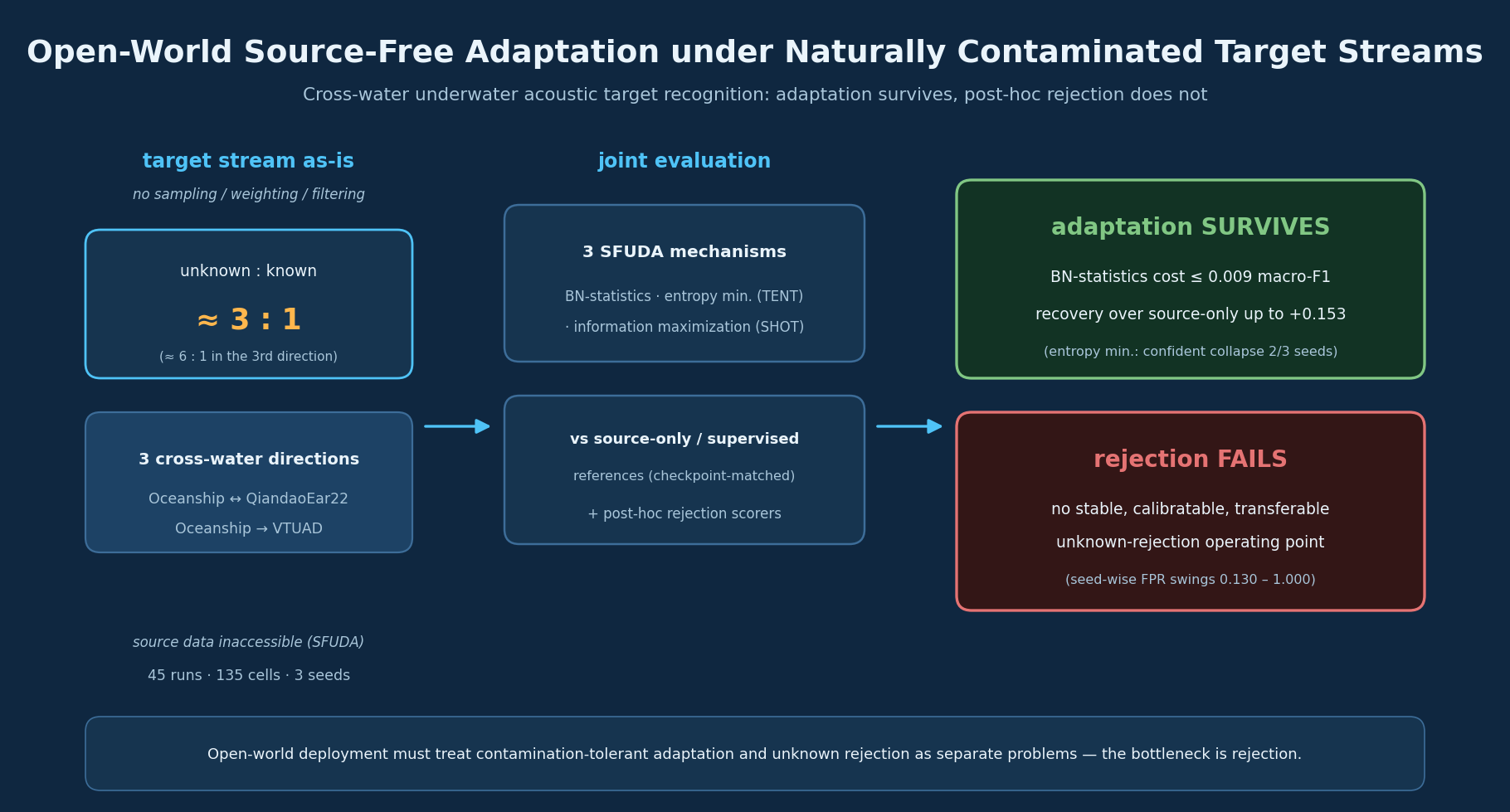
Deploying an underwater acoustic target recognition (UATR) model in a new water area combines two constraints that the literature has so far treated separately: source data may be inaccessible (privacy, security, or bandwidth), motivating source-free unsupervised domain adaptation (SFUDA) [3]; and the deployment area may contain vessel types never seen in training, motivating open-set recognition (OSR) [5]. We study their intersection — open-set source-free domain adaptation (OSFUDA) — and make the deployment reality the centerpiece: the adapting agent receives the unlabeled target stream as-is, naturally contaminated with unknown classes that outnumber the known ones roughly three to one — nearly six to one in the third direction — with no sampling, weighting, or filtering — the setting that curated open-set benchmarks abstract away. On three cross-water transfer directions (Oceanship ↔ QiandaoEar22 and Oceanship→VTUAD) in a shared two-class label space, re-using the exact source checkpoints of the UDA benchmark of [1], we evaluate three SFUDA mechanisms against source-only and target-known-oracle supervised references, jointly scoring known-class macro-F1 and unknown-rejection AUROC, FPR@95TPR (unknown acceptance at 95% known-class acceptance), and OSCR over three seeds. Three findings emerge. (1) Unknown-class contamination costs BN-statistics adaptation surprisingly little: its known-class macro-F1 changes by at most 0.009 relative to its clean-pool counterpart in [3] — practically negligible even where statistically distinguishable — while its recovery over the source-only lower bound remains large in the harder direction (+0.153 macro-F1) and stays positive but smaller and seed-unstable in the third (+0.073, n.s. at n = 3). (2) Entropy minimization exhibits reproducible confident collapse to a single class in 2 of 3 seeds in every direction tested — the majority class in four of the six collapsed runs — consistent with [3]; contamination neither cures nor substantially worsens it. (3) Under the tested two-known-class, closed-set ResNet-18 regime, the evaluated post-hoc logit- and source-prototype-based scores did not provide a stable, calibratable, transferable unknown-rejection operating point, while adaptation itself survives: pooled AUROC stays in a near-chance and non-operational range for every source-free adapted model and every post-hoc scoring rule — logit-based in all three directions (0.40–0.57 across adapted cells) and feature-space in the two Oceanship↔QiandaoEar22 directions where it is tested — and no adapted configuration comes anywhere near an operable threshold; the fully supervised target oracle, itself at chance in the two Oceanship↔QiandaoEar22 directions, ranks VTUAD unknowns only moderately (MSP/Energy AUROC 0.63–0.70) and still accepts 79–89% of unknown segments at an operating point accepting 95% of known traffic — no configuration in any direction, adapted or supervised, yields an operable rejection threshold. Contaminated target streams thus did not preclude recovery of known-class recognition, but no tested post-hoc score yielded a threshold that transferred safely across runs or domains. These results identify unknown-aware representation learning and calibration — not further closed-set adaptation — as the central unresolved requirement for deployable open-world UATR. Code and derived evaluation artifacts are released in an archival repository (Zenodo, DOI: 10.5281/zenodo.22832107), subject to the licenses of the underlying datasets.
Keywords:
underwater acoustic target recognition
; source-free domain adaptation
; open-set recognition
; open-world deployment
; test-time adaptation
; domain shift
Copyright: This open access article is published under a Creative Commons CC BY 4.0 license, which permit the free download, distribution, and reuse, provided that the author and preprint are cited in any reuse.