

Submitted:
19 September 2026
Posted:
20 September 2026
You are already at the latest version
Abstract
Longevity-medicine services are expanding rapidly, yet the field still lacks the quality infrastructure that mature health disciplines take for granted. The first gap is practical: practitioners have no public consensus on what competent service looks like, from inquiry to intervention review. The second is evidential: because typical clients are multi-morbid individuals receiving many interventions at once, the population-average evidence of conventional medicine answers their questions poorly, leaving individualized reasoning unregulated. We propose a working draft of Good Healthspan Practice (GHP), an open, product-neutral good-practice guide that addresses both gaps in one design. The draft is modular: five process guides cover the full service cycle (inquiry, multi-omics measurement, root-cause attribution, intervention and contribution review), with root-cause attribution as the hard requirement on which the others depend, anchoring individualized reasoning in the hallmarks of aging, the small set of mechanisms the whole field shares. A sixth guide, GHP-600, runs across all five and makes individualized causal inference itself checkable: causal claims must be registered, falsifiable and honestly reviewed, using tools regulators have already developed for N-of-1 trials, real-world evidence and learning health systems. Adoption is voluntary and by self-declaration, module by module, with no conformity assessment. Each adopted client loop yields a prediction–validation record that, aggregated across adopters, calibrates the guide itself over time. In the longer run, these records feed biomedical world models that predict how one person responds to one intervention; the guide is built to grow with them. GHP is not a standard under any national standardization law, not a certification and not an association; it is a public working document whose aim is to make competent practice definable, individualized reasoning verifiable, and the field's evidence base cumulative. The draft text (v0.2) is public at ghp-ai.com, offered as a starting point for community discussion and iteration rather than a finished code for adoption.
Keywords:
N-of-1 trials
; longevity medicine
; good practice guide
; individualized evidence
; causal inference
; capomics
1. Background
Longevity medicine has moved from the laboratory to the storefront. Consumer interest in biological-age measurement and anti-aging regimens is high, institutions offering these services are proliferating, and capital and franchises are following. What the sector lacks is what every mature health-adjacent industry acquired before it scaled: a public, verifiable definition of competent practice. Without such a definition, a consumer cannot tell a rigorous program from a supplement bundle with a biological-age number attached; an institution that invests in rigor cannot signal that investment; and regulators and payers are left without any reference against which to evaluate claims.
Other parts of medicine solved this problem through the GxP family: Good Manufacturing Practice (GMP) for pharmaceutical production, Good Clinical Practice (GCP) for trials, Good Laboratory Practice (GLP) for non-clinical studies, and Good Pharmacovigilance Practice (GVP) for drug-safety surveillance [1]. Every one of them emerged when an activity became safety-critical and trust-critical at scale, and longevity medicine has now reached exactly that point without a GxP of its own.
A second problem sits underneath the first: the people this field serves have three properties that conventional evidence tools were never built for. The typical client is multi-morbid, and the field's goal is health span, meaning function maintained across conditions rather than the cure of any single disease [2,3]. Practice, in addition, involves many interventions at once, with nutrition, exercise, supplementation and medical technologies running in parallel five to ten at a time, so even the best randomized controlled trials (RCTs) rarely disentangle their individual contributions. Nutritional and metabolic complexity, finally, varies so deeply between persons that no single model transfers intact from one individual to the next (Figure 1).
Evidence-based medicine handles heterogeneity by classification: patients are sorted into homogeneous diagnostic boxes, and a guideline derived from population statistics is applied box by box [4]. Longevity medicine breaks this pipeline at its first step, because multi-morbidity makes the boxes overlap and parallel interventions break the clean attribution on which box-level evidence rests. What remains for the practitioner is inference, from mechanism, from measurement, from response. Regulators have arrived at the same conclusion from the other side: the FDA's arrangements for single-patient (N-of-1) trials are an explicit accommodation to precisely this situation [5]. A second development makes this the right moment: biomedical world models, AI systems built to simulate and steer what happens inside one organism, have arrived as a serious scientific direction [6]. The result is a sector where inference is unavoidable but unregulated. Every program implicitly makes causal claims, and nothing requires those claims to be registered, falsifiable, or honestly reviewed. This article therefore takes a first step in that direction, proposing a working draft of Good Healthspan Practice (GHP), an open good-practice guide organized in modules, with root-cause attribution at its center. Under this draft, individualized causal claims become registered, falsifiable and honestly reviewed. The draft is released for community discussion and iteration, not as a finished code for adoption.
2. The Dual Gap
We formalize the sector's problem as two gaps (Figure 2).
Practice gap (what to do). No public document defines what a competent longevity-medicine service looks like. Clinical guidelines govern the diagnosis and treatment of diseases, not the conduct of a service, and wellness-industry quality certificates rarely reach scientific substance. An institution therefore has no public reference to check its practice against, and a consumer cannot tell a rigorous program from a loose one. What is missing is concrete: agreed expectations for inquiry, measurement, interpretation, intervention and review.
Evidence gap (how to reason for one person). Textbook evidence does not answer the questions this field faces. The typical client is multi-morbid and takes several interventions at once. Large trials enroll homogeneous patients and usually test one intervention at a time, so their average results extrapolate poorly to such a person. The practice must still decide, so reasoning from mechanism and individual data is unavoidable. Left unregulated, it becomes arbitrary inference dressed as care. What is missing is a disciplined version of that reasoning: the individualized evidence generation this guide proposes below.
Standards that address only the first gap would produce well-documented arbitrariness, and the field cannot wait for more trials to close the second gap, because the clients are here today.
3. The GHP Design
GHP (Good Healthspan Practice) is an open, product-neutral good-practice guide issued as a voluntary initiative. In its current form it is a public working document that institutions can use and check themselves against, distinct from formal standards, certifications and associations. Its v0.2 text organizes criteria along two tracks, one for each gap (Figure 3; Box 1): five process guides for the service cycle answer the practice gap, and GHP-600, which runs across all five, answers the evidence gap.
Box 1. The six guides (five process + one that runs across all of them).
| Code | Guide | Core requirement (summary) | Criteria |
| GHP-100 | Inquiry | Four-layer causal history (exposure → root cause → function → phenotype); structured family history; East–West integrated history-taking | 6 |
| GHP-200 | Multi-omics measurement | Integrated multi-omics with ≥1 molecular-level aging anchor (e.g., a DNA methylation clock); harmonized, lag-aware re-testing | 4 |
| GHP-300 | Root-cause attribution | Hard requirement: causal chains must reach the root-cause layer (first candidate: hallmarks of aging); stopping at functional imbalance does not qualify. Inference mandatory, method-free; hallmark measurement a bonus, never mandated | 5 |
| GHP-400 | Intervention | Root-first graded prescriptions; one theme per cycle; expectations and lag windows pre-registered; executable to dose and frequency | 5 |
| GHP-500 | Contribution review | Same-assay re-test alignment with significance gating; per-intervention contribution ranking with confidence grades; honest reporting of unexplained change | 5 |
| GHP-600 | Inference integrity (runs across all five) | Individualized causal inference that is registered, testable and open to audit | 7 |
Scope is bounded by design. GHP applies to the service practice of longevity-medicine and health-management institutions: the full cycle of inquiry, measurement, interpretation, intervention and review, or any single module thereof. Diagnosis-and-treatment guidelines belong to medical societies; pharmaceutical production and clinical trials belong to GMP, GCP, GLP and GVP. GHP stays within service practice and states this boundary in its front matter.
Four design decisions deserve emphasis.
Root-cause positioning as a hard requirement (GHP-300). Any interpretation of test data is, at bottom, an inference, and interpretations that stop at "functional imbalance" leave intervention surface-level, so GHP requires the causal chain to be positioned at the root-cause layer, with the hallmarks of aging as the first candidate set [7,8]. The logic is simple: a mechanism studied in many people by the whole field carries high consensus, while a mechanism seen only in one clinic visit carries little. The hallmarks are the first kind — a small set of shared mechanisms, built by decades of population research — so reasoning that runs through them is anchored to what the field already knows. The guide treats them as working candidates rather than settled causes, and individual predictions still decide. Interventions built around a few shared mechanisms are also easier to pre-register, monitor and review. The method is deliberately left open, and molecular measurement is treated as a bonus rather than a mandate. The guide must not become a sales channel for any assay.
One theme per cycle, with interventions in parallel (GHP-400). Real programs run five to ten interventions at once, and GHP does not forbid that. What it asks is that each cycle be organized around one dominant theme, that expectations for each intervention be pre-registered, and that at least one core intervention carry within-person control (criterion 600.4). Attribution then has a fighting chance even under parallel practice.
No lock-in to any test supplier (GHP-200). The criterion is at least one molecular-level biological-age measurement, for example a DNA methylation clock; any qualified third-party laboratory satisfies it. Re-testing windows follow biological lag rather than commercial convenience.
Process criteria are self-check documents with two reference tiers. Each of the five process guides carries an adoption tier and an advanced tier, both intended for institutional self-assessment rather than external grading. For example, GHP-400 adoption calls for goal binding, pre-registration and executability (criteria 400.2, 400.4 and 400.5); the advanced tier calls for all five. Adoption works by self-declaration: an institution checks its own practice against the guide, states publicly which modules it has adopted, and the secretariat records that statement in an open registry. Institutions may voluntarily share one complete client closed loop (inquiry → measurement → interpretation → intervention → re-test review) as a self-authored case story; the registry lists these stories so that others can read how the guide works in practice.
4. GHP-600: Making One-Person Inference Checkable
GHP-600 is, to our knowledge, the first practice guide whose object is the quality of individualized causal inference itself (Figure 4; Box 2). Its seven criteria translate the tools regulators have already developed for N-of-1 trials, real-world evidence and learning health systems [9,10,11] into routine longevity practice. What those tools share is a way of managing uncertainty: when a claim cannot wait for a population trial, the discipline moves to predicting, documenting and checking what happens in this one person. GHP-600 carries that same discipline into daily clinic work. Beneath all the criteria sits one question, the counterfactual: what would this marker have done without the intervention? A group trial answers it by averaging across randomized people; an N-of-1 design answers it by lending the person their own untreated periods as the comparison. Managing that uncertainty, honestly and in the open, is the bedrock of the whole guide. Like the five process guides, it applies to health-management services, to the records a service keeps and the reasoning behind them; it does not enter the exam room, where diagnosis and treatment remain with clinical medicine.
Box 2. GHP-600 criteria.
| # | Criterion |
| 1 | Hypothesis registry. At least three root-cause-layer hypotheses (hallmarks direction), each with two or more classes of prior sources (family and genetics, lifestyle, environment, prior testing, current testing, dynamic monitoring) and a counted confidence grade: A requires four or more independent sources, B exactly three, C two or fewer. Unresolved contrary evidence forces demotion or exclusion. Grading counts sources, not rhetorical confidence; the counting rules are public, while the exact thresholds will be fixed by platform data in later volumes. |
| 2 | Falsifiable predictions. Each hypothesis carries at least one prediction of the form "indicator X, within lag window W, direction D". Failed predictions demote the hypothesis. Post-hoc rationalization is prohibited. |
| 3 | Pre-registered lag windows. Expected effect windows are registered at issuance (for example, strength and cardiorespiratory outcomes 8–12 weeks; metabolic and weight outcomes 12–24 weeks; methylation clocks 12 weeks or longer; illustrative values, to be formalized in the next volume). Out-of-window re-tests are excluded from evaluation. |
| 4 | N-of-1 structure. At least one core intervention runs as a self-comparison for that client: measure at baseline, treat, measure again, and where safe, pause once to measure what returns. The client's own untreated state serves as the control, which is exactly what group trials cannot give. When pausing is unsafe, as with an essential nutrient, the dose is stepped or the intervention alternates on and off in a fixed rhythm. Analysis follows the N-of-1 methodological literature [9,12]: the person's on-treatment and off-treatment periods are compared within the same individual. |
| 5 | Inference transparency. Disclosure covers the input evidence set, the inference path, uncertainty quantification, and a three-tier evidence label: tier I population evidence (RCT or meta-analysis), tier II mechanistic prior plus individual evidence, tier III expert opinion. Tier III alone cannot support a root-cause hypothesis. Mixed chains declare the lowest tier. Tiers describe the kind of evidence, not which kind answers an individual question. Where population evidence is absent, claims must say "inferred" and never impersonate "evidence-based". |
| 6 | Multi-morbidity. With two or more coexisting conditions, a shared-root-cause analysis (root-to-phenotype mapping with coverage) is mandatory. Per-disease plan stacking is prohibited. |
| 7 | Honest review. Contribution decomposition carries confidence grades. The fraction of unexplained change must be reported. Shared improvement is not credited to any single intervention. Findings roll into the next cycle's hypothesis registry. |
The stance is deliberately two-sided. Against the view that only large trials count, GHP-600 asserts that heterogeneous, multi-morbid individuals cannot wait for extrapolable RCTs [13,14], and that mechanistic reasoning combined with individual data is legitimate evidence when labelled as such. Against unregulated guesswork, it asserts that inference without registration, falsifiability and honest review is not medicine but marketing. The one-sentence ethic: allow inference; forbid packaging.
Read deductively, the argument runs as follows. Because the object of care is multi-morbid and receives many interventions at once, evidence must be generated within the person. Because within-person evidence is inference, inference must be disciplined. Because disciplined inference must be verifiable by a third party, it must be registered, falsifiable and open to audit. GHP-600 is therefore not an arbitrary design choice; it is the shape that standardization tends to take once the object of care is what it is.
5. Governance and Neutrality
GHP is published as an open initiative: a public technical document, multi-party endorsement, and self-declaration-based adoption. Anyone can read the guide, comment on it and declare adoption; participation is free. Founding endorsement is structured across four sectors: one research institution; two to three clinical experts in personal capacity; one or two industry participants at deliberately low weight with disclosure; and three to five practice institutions. A secretariat holds text editorship on the W3C model (the World Wide Web Consortium, which maintains the web's public standards). A staged evolution path leads from the unincorporated initiative toward formal standards published by registered societies (in China, for example, the T/-numbered team standards) as adoption grows.
Neutrality is built into the structure. Guide texts describe what a practice should do; any product or laboratory that meets the requirement qualifies, and an implementations page lists tool paths and generic, product-free paths side by side. Adopting the guide costs nothing. The secretariat's own commercial interests are disclosed here and in the guide's front matter. All adopters appear in the registry on the same footing: a standing self-declaration, confirmed annually by the institution itself, and case stories are institution-authored and listed simply as examples of the guide in use.
6. Adoption Pathway and the Prediction–Validation Loop
GHP's unit of adoption is the module: an institution may declare GHP-100 alone and be listed as a GHP-100 adopter. GHP-600 follows the same one-module-at-a-time logic. Its obligations become effective when an institution offers interpretation (GHP-300) or review (GHP-500) services; adopters of inquiry-only modules may defer them. This keeps the entry barrier low without diluting the discipline where it matters most, which is wherever causal claims are made. The registry is honesty-gated: it lists only real declarers, and stays visibly empty until the first declaration is confirmed.
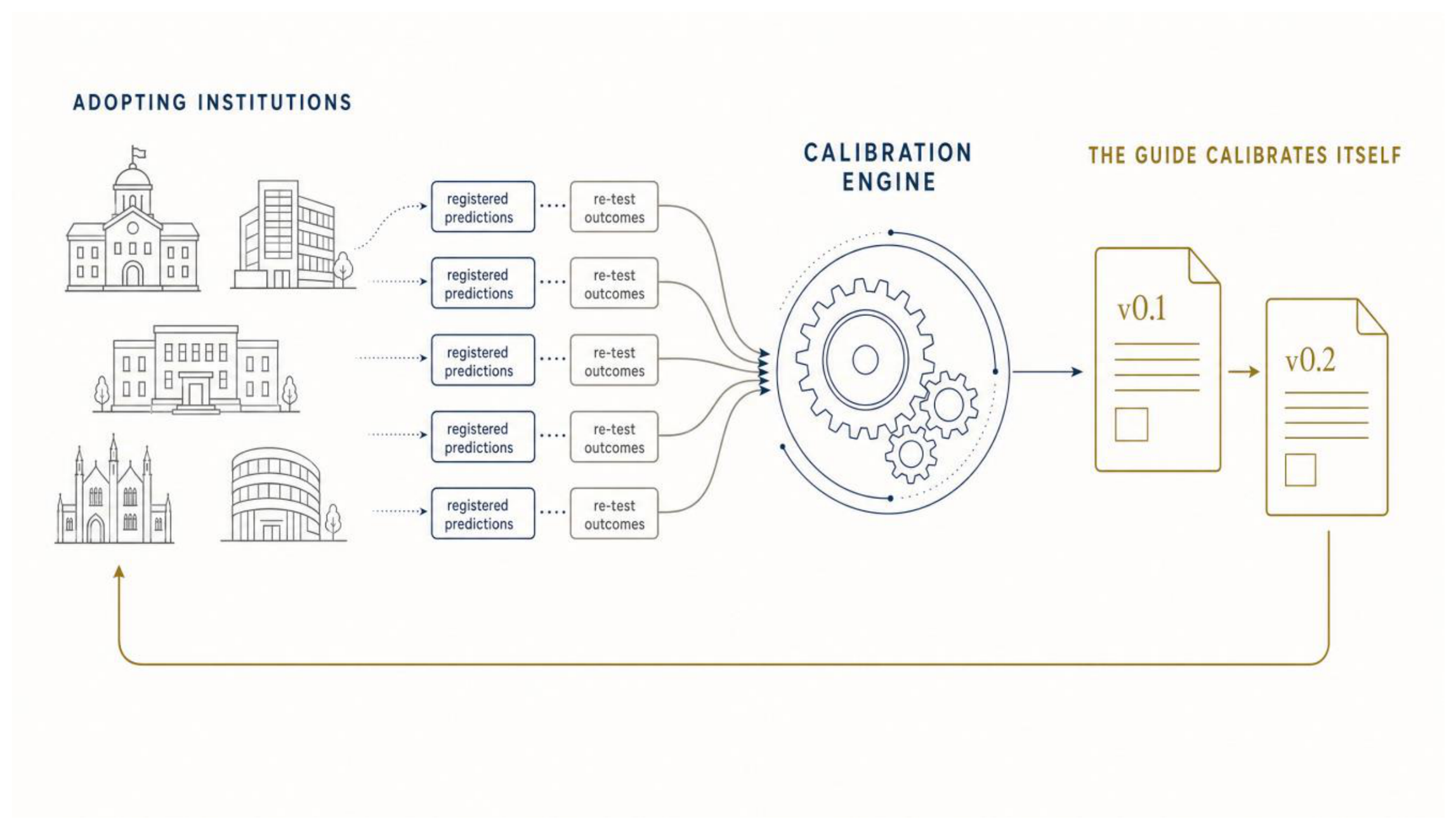
Every adopted closed loop produces a structured record: registered hypotheses and windows on one side, re-test outcomes on the other (Figure 5). Aggregated across adopters, these records form a shared body of prediction-and-outcome evidence that calibrates the guide itself: which measurements carry the most information, which phenotypes are hardest to trace, and which lag windows mis-specify. The guide thus becomes a learning system in the same sense it demands of its adopters [10]. How such individualized records aggregate across very different adopters, without flattening the individual differences that make them valuable, is a genuinely open question; the corpus is built to expose it rather than assume an answer. Data returned by adopters feeds under a consent-and-license framework, with the corpus treated as a trade-secret-protected asset of the initiative.
7. Relation to Prior Standards and Literature
GHP inherits the GxP pattern: practice codes issued when an activity becomes trust-critical [1]. It extends that pattern with a quality discipline that process codes historically lacked: the quality of the reasoning itself. The process track parallels international service-quality standards but grounds them in causal substance: four-layer inquiry, root-cause positioning and contribution review. The second track draws on four literatures. N-of-1 trial methodology treats the individual as their own control [9,15]. Real-world-evidence frameworks achieve rigor by design and documentation rather than by setting [11]. Preregistration culture, imported from clinical trials, disciplines individual care plans [16]. Learning health systems close the loop between practice and knowledge [10]. Within our own body of work, the root-cause requirement (GHP-300) rests on a layered architecture that traces exposures to root causes to functions to phenotypes. GHP-500 and criterion 600.7 rest on a methylome-scale audit asking when multi-intervention effects can be decomposed at all. The reasoning behind GHP-600 draws on our own work on steerable world models and N-of-1 intervention reasoning [17,18,19], and on the emerging science of biomedical world models at large [6]. GHP is meant to be an international, data-driven initiative built on these two lines: the N-of-1 line disciplines how one person's evidence is generated, and the world-model line gives today's records a future use. Counterfactual reasoning is the stone both lines stand on. Steerability, meaning the ability to ask a model what would happen if we intervened here instead and get an auditable answer, is what turns records into decisions [17].
8. Outlook: What Today's Records Become
For a longevity clinic, the most consequential change on the horizon is not a new assay or a new supplement. It is the arrival of models that can predict, before a treatment is given, how a specific person will respond. Research on such models now spans several biological levels [6], from single cells [20] to lab-grown tissue [21] to whole individuals [17,18,19]; for a clinic, only the last level matters, and it is usually called a virtual patient.
What do virtual patients have to do with a practice guide? Everything, because models of this kind are trained on exactly one thing: records of what was done to real people and what happened next. A clinic that follows GHP produces such records as a by-product of honest practice. Today those records discipline the clinic itself; accumulated across many adopters, they become the raw material from which the next generation of virtual patients will learn. One early instance from our own work reasons about N-of-1 interventions in a single person [18]. Early adopters are not merely complying with a code; they are compiling the corpus the future will be built on.
Two names describe that future. The raw material is intervention-response data: the accumulated records of which intervention moved which marker, in whom, and by how much. The goal such data makes possible we call capomics: for each individual, a measurable profile of what his or her biology can and cannot respond to. GHP is the bridge from today's practice to that goal, and its own criteria (600.1, 600.2, 600.7) already require the discipline the transition will demand.
An open ecosystem around a short shared list. GHP is built as an open interface, not a closed pipeline. Assay and laboratory vendors meet it wherever a molecular aging anchor is needed (GHP-200); data platforms and AI developers meet it in the prediction–validation records that every adopted loop produces; model builders meet it in the corpus those records accumulate into. What keeps this openness from dissolving into noise is the short shared list at the center: the hallmarks of aging, a common coordinate that clinics, vendors, laboratories and models can all organize around. The guide is meant to grow with the world models it feeds: as biomedical world models get better at counterfactual and steerable reasoning [6,17], the guide's thresholds and windows will be re-fixed against that capability, version by version.
GHP v0.2 remains a draft, and honestly so. Several numerical parameters are deliberately left open until platform data can fix them; the guide's effect on practice and client outcomes has not yet been evaluated; and the founding endorsement list is still in invitation. The draft is modular precisely so that the community can test, criticize and improve it module by module. We plan to evaluate the guide empirically as adoption accumulates, and to report the results under the same honesty rules the guide imposes on others. Public comment is open through 2026-12-31. We publish now, before everything is resolved, because a guide that waits for perfect evidence cannot shape how that evidence is generated.
The broader claim is simple. In longevity medicine the scarce resource is not enthusiasm, not assays, not even trials. It is trustworthy individualized inference. GHP is an attempt to make that inference a public, auditable craft: trace the cause, measure at the molecular level, read the story, treat the root, prove what worked, infer with integrity.
Author Contributions
J.X. conceived the GHP initiative, drafted the guide text and wrote the manuscript. J.Z. reviewed and approved the final manuscript. Both authors are accountable for all aspects of the work.
Funding
No external funding was received. The initiative secretariat is hosted by DeepoMe Limited, which provided staff time for this work (see Conflicts of interest).
Institutional Review Board Statement
Not applicable.
Informed Consent Statement
Not applicable.
Data Availability Statement
No new data were generated or analysed in this article. The GHP guide text (v0.2) is publicly available at ghp-ai.com.
Conflicts of interest
J.X. is the founder of DeepoMe Limited, which hosts the Secretariat of the GHP Initiative and develops reference-implementation tools for practices described in this guide. J.Z. declares no conflicts of interest. The GHP Initiative Consortium is a non-legal consensus body; its founding member list is maintained at ghp-ai.com.
References
- Bunn GP. Good Laboratory Practice for Nonclinical Studies. CRC Press; 2022. [CrossRef]
- Crimmins EM. Lifespan and healthspan: Past, present, and promise. J Gerontol A. 2015;70A:539-543. [CrossRef]
- Scott AJ, Ellison M, Sinclair DA. The economic value of targeting aging. Nat Aging. 2021;1:616-623. [CrossRef]
- Sackett DL, Rosenberg WM, Gray JA, Haynes RB, Richardson WS. Evidence based medicine: What it is and what it isn't. BMJ. 1996;312:71-72. [CrossRef]
- U.S. Food and Drug Administration. Expanded access to investigational drugs and biologics for single-patient use (institutional guidance). Silver Spring MD: FDA.
- Noori A, Fishman N, Fang A, Fesser L, Zitnik M. World models for biomedicine. Cell. 2026;189:5845–5869. [CrossRef]
- Lopez-Otin C, Blasco MA, Partridge L, Serrano M, Kroemer G. The hallmarks of aging. Cell. 2013;153:1194-1217. [CrossRef]
- Lopez-Otin C, Blasco MA, Partridge L, Serrano M, Kroemer G. Hallmarks of aging: An expanding universe. Cell. 2023;186:243-278. [CrossRef]
- Guyatt G, Sackett D, Taylor DW; et al. Determining optimal therapy: Randomized trials in individual patients. N Engl J Med. 1986;314:889-892. [CrossRef]
- Institute of Medicine. The Learning Healthcare System. Washington DC: National Academies Press; 2007. [CrossRef]
- U.S. Food and Drug Administration. Framework for the use of real-world evidence in regulatory decision-making. Silver Spring MD: FDA, 2018.
- Gabler NB, Duan N, Vohra S, Kravitz RL. N-of-1 trials in the medical literature: A systematic review. Med Care. 2011;49:1061-1068. [CrossRef]
- Rothwell PM. External validity of randomised controlled trials: To whom do the results of this trial apply? Lancet. 2005;365:82-93. [CrossRef]
- PATH Statement Collaborative Group. Predictive Approaches to Treatment effect Heterogeneity (PATH) Statement. Ann Intern Med. 2020;172:35-45. [CrossRef]
- Lillie EO, Patay B, Diamant J, Issell B, Topol EJ, Schork NJ. The n-of-1 clinical trial: The ultimate strategy for individualizing medicine? Pers Med. 2011;8:161-173. [CrossRef]
- Nosek BA, Ebersole CR, DeHaven AC, Mellor DT. The preregistration revolution. Proc Natl Acad Sci USA. 2018;115:2600-2606. [CrossRef]
- Xiong J. World Models for Biomedicine: A Steerability Framework. Preprints 2026, 202605.0366. [CrossRef]
- Xiong J. SteeraMed: A Biomedical World Model for N-of-1 Intervention Reasoning Across Chronic Diseases and Aging. Preprints 2026, 202605.1578. [CrossRef]
- Xiong J, Xia Q. Toward a Self-Learning AI Agent for Drug Repurposing: Building Human-Scale Representations for Virtual Patients. Preprints 2026, 202608.0998. [CrossRef]
- Callaway E. Can AI build a virtual cell? Scientists race to model life's smallest unit. Nature (news). 2025. [CrossRef]
- Lancaster MA, Knoblich JA. Organogenesis in a dish: Modeling development and disease using organoid technologies. Science. 2014;345:1247125. [CrossRef]
Figure 1.
Three properties that break the evidence-based pipeline. a, The object of care is multi-morbid and the goal is health span rather than single-disease cure; b, interventions run in parallel, entangling attribution; c, individuals no longer fit the homogeneous diagnostic boxes on which population guidelines rest.
Figure 1.
Three properties that break the evidence-based pipeline. a, The object of care is multi-morbid and the goal is health span rather than single-disease cure; b, interventions run in parallel, entangling attribution; c, individuals no longer fit the homogeneous diagnostic boxes on which population guidelines rest.
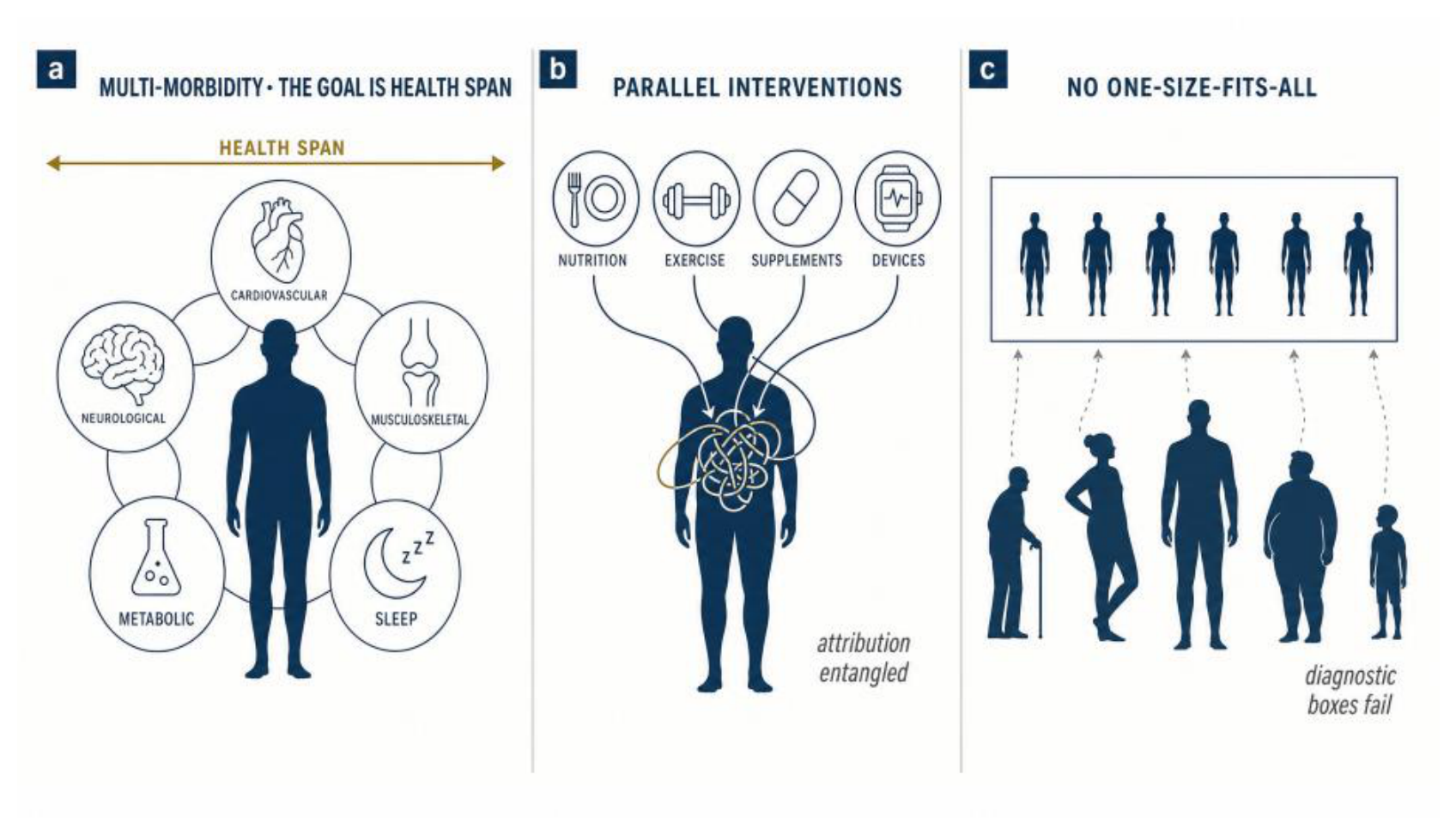
Figure 2.
The dual gap. No public consensus defines competent service practice (practice gap), while population-average evidence from homogeneous trial populations extrapolates poorly to the heterogeneous, multi-morbid individuals longevity medicine actually serves (evidence gap).
Figure 2.
The dual gap. No public consensus defines competent service practice (practice gap), while population-average evidence from homogeneous trial populations extrapolates poorly to the heterogeneous, multi-morbid individuals longevity medicine actually serves (evidence gap).
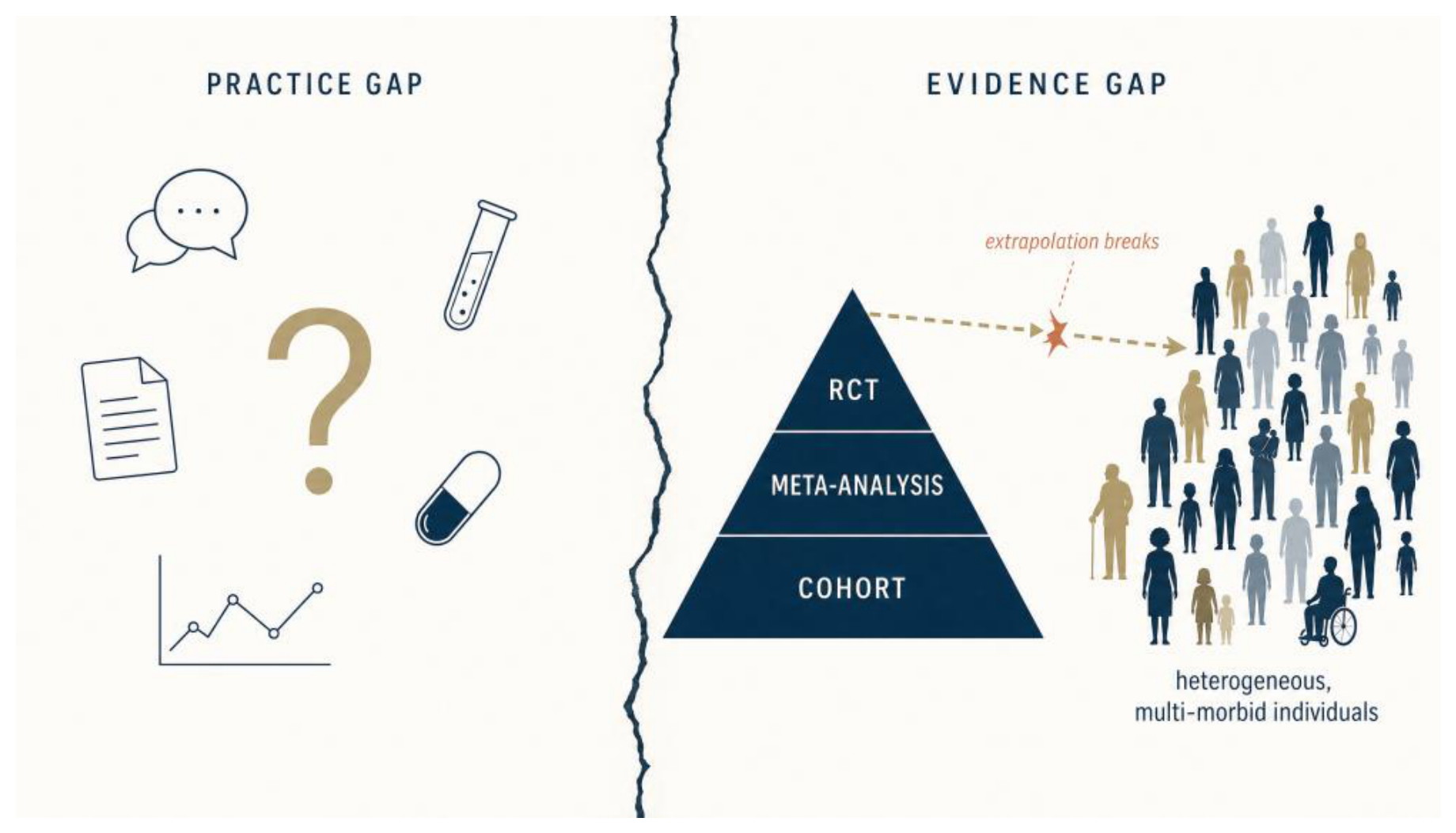
Figure 3.
The GHP design. Five process guides (GHP-100 to GHP-500) define the service cycle around one person; GHP-600 runs across all five, rendering every individualized causal claim registered, falsifiable and open to audit.
Figure 3.
The GHP design. Five process guides (GHP-100 to GHP-500) define the service cycle around one person; GHP-600 runs across all five, rendering every individualized causal claim registered, falsifiable and open to audit.
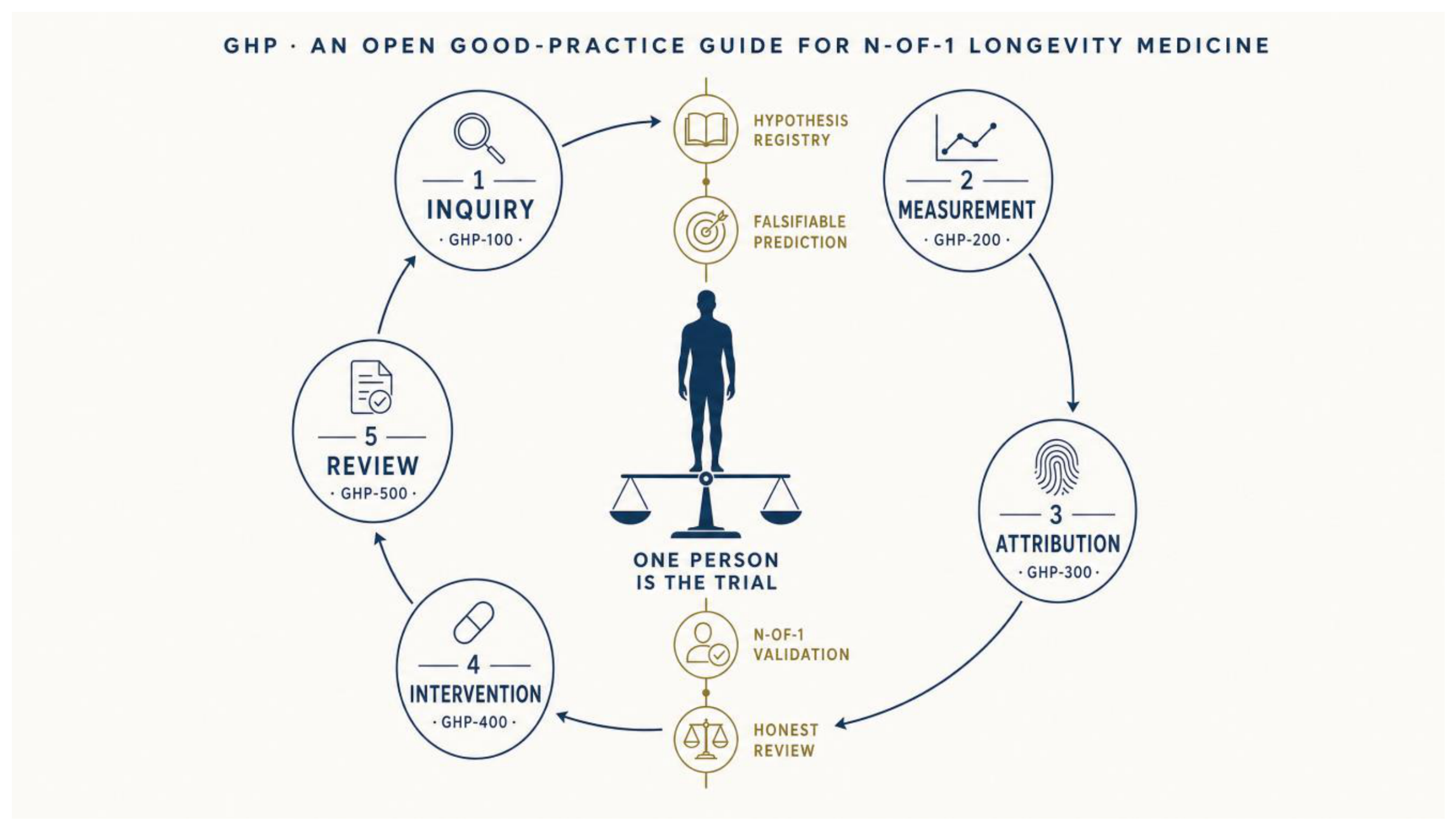
Figure 4.
Individualized evidence generation under GHP-600. Mechanistic priors and individual multi-omics measurement feed registered, pre-registered hypotheses; N-of-1 within-person designs validate them; contribution review closes the loop and must report the unexplained fraction.
Figure 4.
Individualized evidence generation under GHP-600. Mechanistic priors and individual multi-omics measurement feed registered, pre-registered hypotheses; N-of-1 within-person designs validate them; contribution review closes the loop and must report the unexplained fraction.
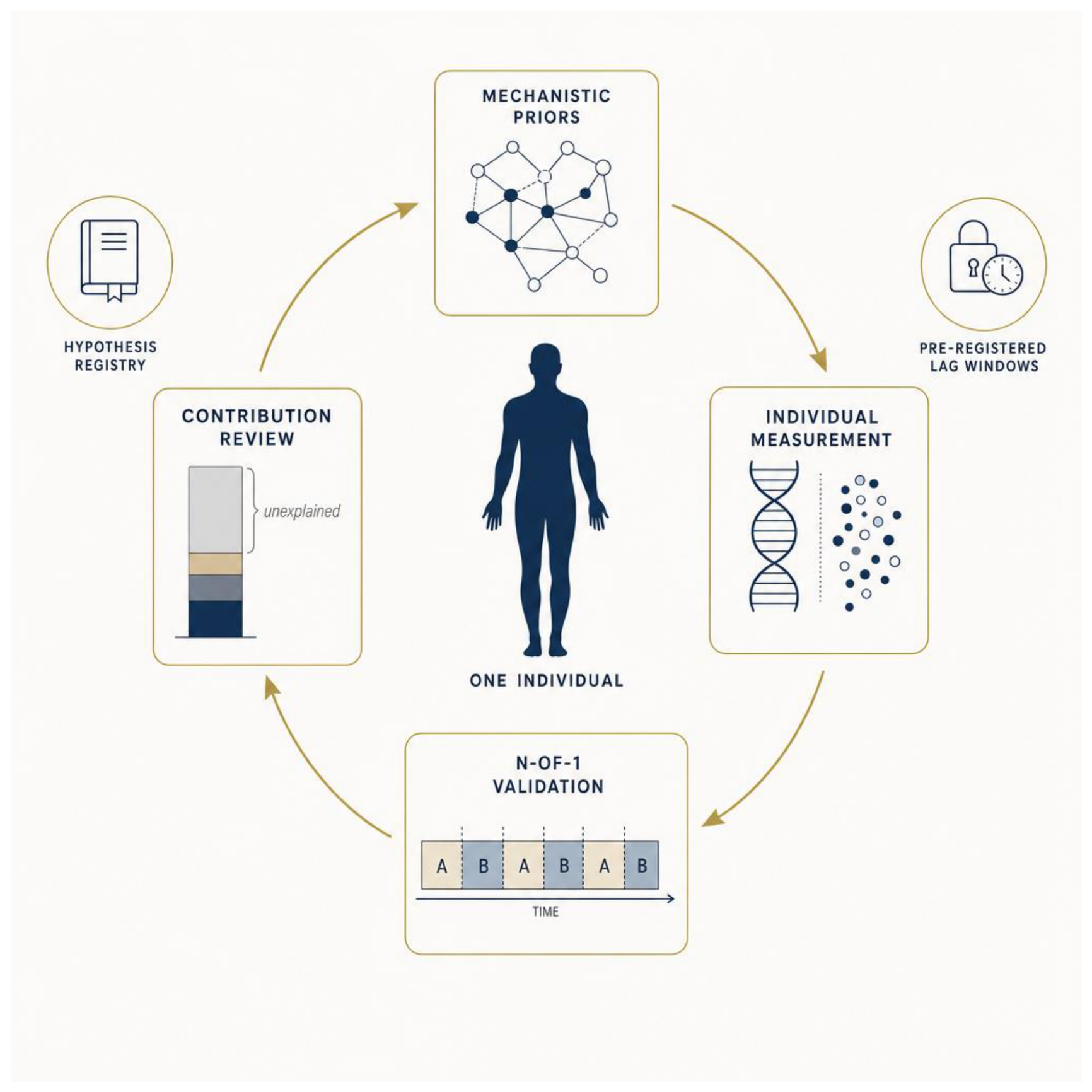
Figure 5.
The prediction–validation loop. Every adopted closed loop yields structured records of registered predictions and re-test outcomes; aggregated, they calibrate the guide itself, evolving it from v0.1 toward data-fixed parameters in later volumes.
Figure 5.
The prediction–validation loop. Every adopted closed loop yields structured records of registered predictions and re-test outcomes; aggregated, they calibrate the guide itself, evolving it from v0.1 toward data-fixed parameters in later volumes.
Disclaimer/Publisher’s Note: The statements, opinions and data contained in all publications are solely those of the individual author(s) and contributor(s) and not of MDPI and/or the editor(s). MDPI and/or the editor(s) disclaim responsibility for any injury to people or property resulting from any ideas, methods, instructions or products referred to in the content. |
© 2026 by the authors. Licensee MDPI, Basel, Switzerland. This article is an open access article distributed under the terms and conditions of the Creative Commons Attribution (CC BY) license (http://creativecommons.org/licenses/by/4.0/).
Copyright: This open access article is published under a Creative Commons CC BY 4.0 license, which permit the free download, distribution, and reuse, provided that the author and preprint are cited in any reuse.