
Submitted:
18 September 2026
Posted:
20 September 2026
You are already at the latest version
Abstract
Wide-cut heavy disc harrows are widely used for tillage of perennial grass sod, summer fallow, and stubble fields; however, imported implements commonly used in Kazakhstan are not always sufficiently adapted to local soil and operating conditions, which may re-sult in incomplete sod undercutting, uneven crop residue incorporation, and increased draft resistance. This study aimed to substantiate the configuration, design parameters, and operating conditions of a wide-cut heavy disc harrow for traction class 5–6 tractors under the soil and field conditions of Northern Kazakhstan. Field experiments were conducted to evaluate the effects of disc arrangement, disc angle, operating speed, and support and finishing elements on tillage quality, draft resistance, and energy consump-tion. The developed configuration consisted of a central frame with folding side wings, eight disc sections arranged in two rows, support and transport wheels, an adjustable hitch, and a rear rod roller, with a 7.0 m working width, 660 mm notched discs, and 210 mm disc spacing. Under the investigated conditions, the harrow operated at speeds of up to 11.5 km h⁻¹ and, at disc section angles of 12°, 15°, and 18°, achieved a surface roughness of 3–5 cm, eliminated clods larger than 100 mm, and required 63.8–78.3 MJ ha⁻¹ of specific energy. The results provide experimental evidence for the suitability of the investigated structural configuration and operating parameters for heavy disc harrowing under the field conditions of Northern Kazakhstan.
Keywords:
heavy disc harrow
; disc sections
; rod roller
; draft resistance
; agronomic performance
; energy efficiency
1. Introduction
Under current agricultural production conditions in countries with continental climates, including the Republic of Kazakhstan, improving resource efficiency, preserving soil fertility, and reducing the energy requirements of field operations have become major priorities [1]. The grain-producing regions of Northern Kazakhstan are characterized by a sharply continental climate, limited soil moisture availability, and uneven precipitation distribution, all of which accelerate soil degradation processes within agricultural landscapes [2]. The arable soils of the region are predominantly medium and heavy loams with a high content of fine clay particles (up to 70-80%), making them highly susceptible to compaction and deterioration of the soil water–air regime [3].
Previous studies [4] have shown that a decline in soil organic matter (humus) content to 3–5% is indicative of progressive soil fertility degradation, which is further aggravated by the reduced application of organic fertilizers. Under these conditions, conservation and resource-efficient tillage systems based on the incorporation of crop residues have become increasingly important. The incorporation of crop residues into the upper soil layer enhances soil physical properties, improves soil moisture retention, and mitigates erosion processes [5].
Recent studies have demonstrated that the shape and design of tillage implements significantly influence soil–tool interaction processes. In particular, optimization of the geometry of disc and rotary tillage implements has been shown to reduce draft resistance while improving furrow formation quality [6]. Furthermore, redesigned disc implements with enhanced cutting-edge geometry have been reported to improve the cutting efficiency of crop residues and reduce the energy requirements of soil tillage operations [7]. Heavy disc harrows are among the principal implements used to implement these conservation tillage technologies. However, existing designs are characterized by relatively high draft resistance, limited operational stability, and insufficient incorporation of crop residues, particularly when operating on dry soils and perennial grass sod with soil penetration resistance ranging from 3 to 6 MPa [8]. Previous studies [9] have demonstrated that the operating parameters of disc tillage implements, including the disc angle of attack, forward speed, and tillage depth, have a decisive influence on the degree of crop residue fragmentation and incorporation.
Current trends in agricultural machinery development are directed toward the design of wide-cut tillage implements compatible with 350–550 hp tractors, thereby increasing field capacity while reducing the number of field passes required [10]. Nevertheless, the adaptation of such implements to the soil and climatic conditions of Northern Kazakhstan remains limited [11]. Experimental studies have demonstrated that optimizing the operating parameters of disc tillage implements can reduce draft resistance by 10–20% while improving the quality of shallow soil tillage [12].
An analysis of state-of-the-art designs indicates that further development of heavy disc harrows is primarily associated with novel arrangements of disc sections and the integration of combined working elements [13,14]. Particular emphasis has been placed on achieving stable furrow formation and enhancing soil–tool interaction, as demonstrated by studies investigating the influence of rotary and cutting elements on tillage performance [15].
Accordingly, the development and scientific justification of the structural and technological configuration and design parameters of a wide-cut heavy disc harrow capable of efficient crop residue incorporation while minimizing energy requirements represents an important research and engineering challenge.
The aim of this study was to justify the structural and technological configuration and design parameters of a wide-cut heavy disc harrow intended for the incorporation of perennial grass sod and the tillage of fallow and stubble fields under the soil and climatic conditions of Northern Kazakhstan. In addition, the agronomic, energy, and operational performance of the proposed implement was evaluated under field conditions.
The specific objectives of the study were as follows:
- to justify the structural and technological configuration and design parameters of a wide-cut heavy disc harrow;
- to determine the operating conditions and evaluate the influence of the selected working element parameters;
- to conduct field experiments and evaluate the agronomic and energy performance of the implement.
2. Materials and Methods
2.1. Study Object and Description of the Heavy Disc Harrow
The study was conducted using a wide-cut heavy disc harrow designed for operation with tractors of traction classes 5–6.
The investigated implement is classified as a heavy disc harrow based on its construction, mass, working depth, and draft requirement. In accordance with the terminology and classification principles used in ASABE standards for agricultural tillage implements [ASAE S414.2], a disc harrow is an implement consisting of one or more gangs of concave discs arranged to cut, lift, and partially invert the soil during forward movement. In this study, the term “heavy disc harrow” [ASAE S290.2] refers to a large, high-draft disc harrow designed for primary and intensive surface tillage and operated with a high-traction-class tractor.
The implement has a working width of 7.0 m and is equipped with 72 disc working elements. The diameter of the notched discs is 660 mm, whereas the plain discs have a diameter of 500 mm. The disc spacing is 210 mm. The angle of attack of the disc sections is adjustable to 12°, 15°, and 18° [16,17]. The angle of attack (α) of the disc section is defined as the angle between the longitudinal axis of the disc section and the horizontal direction of travel of the implement, measured in the horizontal plane. It characterizes the inclination of the disc section relative to the direction of forward movement. In the present study, three angles of attack (α = 12°, 15°, and 18°) were investigated, Figure 1. The selected angle was verified using a MEMS-based angular displacement sensor with an accuracy of ±0.1°.The 210 mm disc spacing was adopted as a fixed structural parameter of the disc sections to provide the required overlap of adjacent disc trajectories and continuous soil cutting across the working width. It was not considered as an independently optimized variable in the present study.
The structural configuration of the implement is shown in Figure 2 and comprises a frame (1), a rod roller (2), deflector shields (3), disc sections (4), support wheels (5), support-transport wheels (6), and a hitch assembly (7).
During operation, the weight of the implement forces the disc working elements into the soil, where they cut and incorporate crop residues while forming the tilled soil layer. The two-row arrangement of the disc sections, together with the deflector shields, provides stable implement operation and ensures uniform leveling of the soil surface.
2.2. Analytical Model and Mathematical Formulation
The theoretical investigation was carried out using mathematical modeling techniques.
For the development of the analytical model, the origin of the coordinate system was located at the hitch point connecting the implement to the tractor. The equilibrium equations were formulated by resolving the forces along the X and Y coordinate axes and by considering the sum of moments about the hitch point. The analysis accounted for the soil reaction forces acting on the support wheels, the rod roller, and the disc working elements [18].
The input parameters included the working widths of the harrow and the rod roller, tillage depth, forward speed, implement mass, draft resistance of the working elements, rolling resistance coefficients of the support wheels and the rod roller, as well as the geometric parameters defining the arrangement of the working elements and the supporting components of the implement.
To simplify the analytical model, and following the assumptions adopted in previous studies [19], the implement was assumed to follow the field microrelief under the combined action of the active forces (tractive force and implement weight) and the constraint reactions generated by the support wheels, the rod roller, and the disc sections. The origin of the coordinate system was located at the hitch point, after which the forces and moments were resolved along the coordinate axes [20].
For the analytical formulation, a computational model of the heavy disc harrow was developed, incorporating the external forces and constraint reactions acting on the implement under steady-state operating conditions. The structural configuration of the developed harrow is shown in Figure 1, while the computational model used for the force and moment equilibrium analysis is presented in Figure 3. The soil reaction forces were represented by their horizontal and vertical components. It was assumed that the support wheels were aligned along a common axis, whereas the support-transport wheels did not contact the soil surface during operation. Under the adopted quasi-static assumption, inertial forces associated with acceleration of the implement were not explicitly considered.
The quasi-static equilibrium equations of the implement can be expressed as follows:
(3)
The relationships between the reaction forces associated with rolling resistance can be expressed as follows:
= = (4)
where µk represents the rolling resistance coefficient of the support wheels;
µр represents the rolling resistance coefficient of the rod roller.
After algebraic manipulation of the moment equilibrium equation, the following expression was obtained for determining the vertical reaction force acting on the support wheels:
The system of Eqs. (1)–(5) was solved numerically using MATLAB to determine the draft resistance of the implement and the vertical reaction force acting on the support wheels under the specified operating conditions.
2.3. Software
The numerical evaluation of the model parameters and the solution of the system of Eqs. (1–5) were performed using MATLAB R2024a. Statistical analysis of the experimental data was carried out using Microsoft Excel and STATISTICA 13.0. Data visualization and the generation of graphs were performed using Microsoft Excel and MATLAB.
The input parameters used in the numerical calculations are summarized in Table 1.
The rolling resistance of the rod roller and the support wheels was determined experimentally during the field tests by direct measurement of the corresponding resistance forces. The rolling resistance coefficients were determined as the ratio of the measured rolling resistance force to the corresponding normal load acting on the rod roller and support wheels, respectively. The measurements were performed repeatedly under the same experimental conditions. The obtained results were statistically processed by determining the arithmetic mean and standard deviation, with a confidence probability of 0.95. The measurement procedure and uncertainty assessment were based on the calibrated strain-gauge measuring system used during the field experiments.
2.4. Experimental Setup and Measurement Procedure
Field experiments were conducted using a Kirovets K-735 Standard tractor of traction class 6. According to the manufacturer’s documentation and the tractor operating manual, the tractor is equipped with a TMZ 8481.10 engine with a rated power of 257 kW (350 hp), has a recommended operating mass of 15,250 kg, and is equipped with 710/70 R38 tires. For harrowing operations at a speed of approximately 11 km/h, the manufacturer specifies a required drawbar pull of 5.5 t (approximately 53.9 kN). Tire inflation pressure was selected according to the axle load, tire type, and operating speed in accordance with the manufacturer's recommendations. Wheel slip was not directly measured during the field trials; therefore, no estimated value was introduced.

Table 2.
Main technical characteristics of the Kirovets K-735 Standard tractor used in the field experiments.
Table 2.
Main technical characteristics of the Kirovets K-735 Standard tractor used in the field experiments.
| Parameter | Value |
|---|---|
| Tractor model | Kirovets K-735 Standard |
| Traction class | 6 |
| Recommended operating mass | 15,250 kg |
| Rated engine power | 257 kW (350 hp) |
| Engine | TMZ 8481.10 |
| Tire size | 710/70 R38 |
| Reference drawbar pull for harrowing at 11 km/h | 5.5 t (≈53.9 kN) |
| Tire inflation pressure | According to axle load, tire type and operating speed |
Field experiments were conducted using a dedicated experimental test rig (Figure 3) to determine the force characteristics of the disc working elements and the rod roller. Draft resistance was measured using a CAS SBA-5000 strain-gauge load cell installed in the hitch assembly between the tractor and the implement. Tillage depth was measured using an STS-300 soil depth gauge with an accuracy of ±1 mm. Measurements were taken at several points within the treated area after a single pass of the disc harrow. The measurement points were distributed across the working width to account for spatial variation in tillage depth. The mean value of the measurements was used as the experimental tillage depth for each treatment. The forward speed of the implement was monitored using a Garmin GPSMAP 64 GPS receiver (accuracy: ±0.1 m s⁻¹). The angular and spatial displacements of the implement components were recorded using MEMS-based sensors with an angular measurement accuracy of ±0.1°. The angle of attack of the disc sections was verified from the measured angular position of the disc-section assembly relative to the direction of travel. Draft resistance was measured using a CAS SBA-5000 strain-gauge load cell installed in the hitch assembly between the tractor and the implement. Tillage depth was measured using an STS-300 soil depth gauge with an accuracy of ±1 mm. Measurements were taken at several points within the treated area after a single pass of the disc harrow. The measurement points were distributed across the working width to account for spatial variation in tillage depth. The mean value of the measurements was used as the experimental tillage depth for each treatment. The forward speed of the implement was monitored using a Garmin GPSMAP 64 GPS receiver (accuracy: ±0.1 m s⁻¹). The angular and spatial displacements of the implement components were recorded using MEMS-based sensors with an angular measurement accuracy of ±0.1°. The angle of attack of the disc sections was verified from the measured angular position of the disc-section assembly relative to the direction of travel.
The experimentally determined force characteristics of the disc working elements and the rod roller were used as input parameters for the quasi-static mechanical model. The measurements were conducted under the field conditions investigated in this study, including disc section angles of attack of 12°, 15°, and 18°, operating speeds of 9.0–11.5 km h⁻¹, and tillage depths of approximately 7–10 cm. The corresponding soil conditions were characterized by a moisture content of 14.4%, penetration resistance of 3.9 MPa, and bulk density of 1.4 g cm⁻³ on heavy loam soil. Soil moisture content remained relatively stable during the experimental trials. Therefore, no systematic trend in the measured response variables associated with changes in soil moisture content was observed or evaluated.
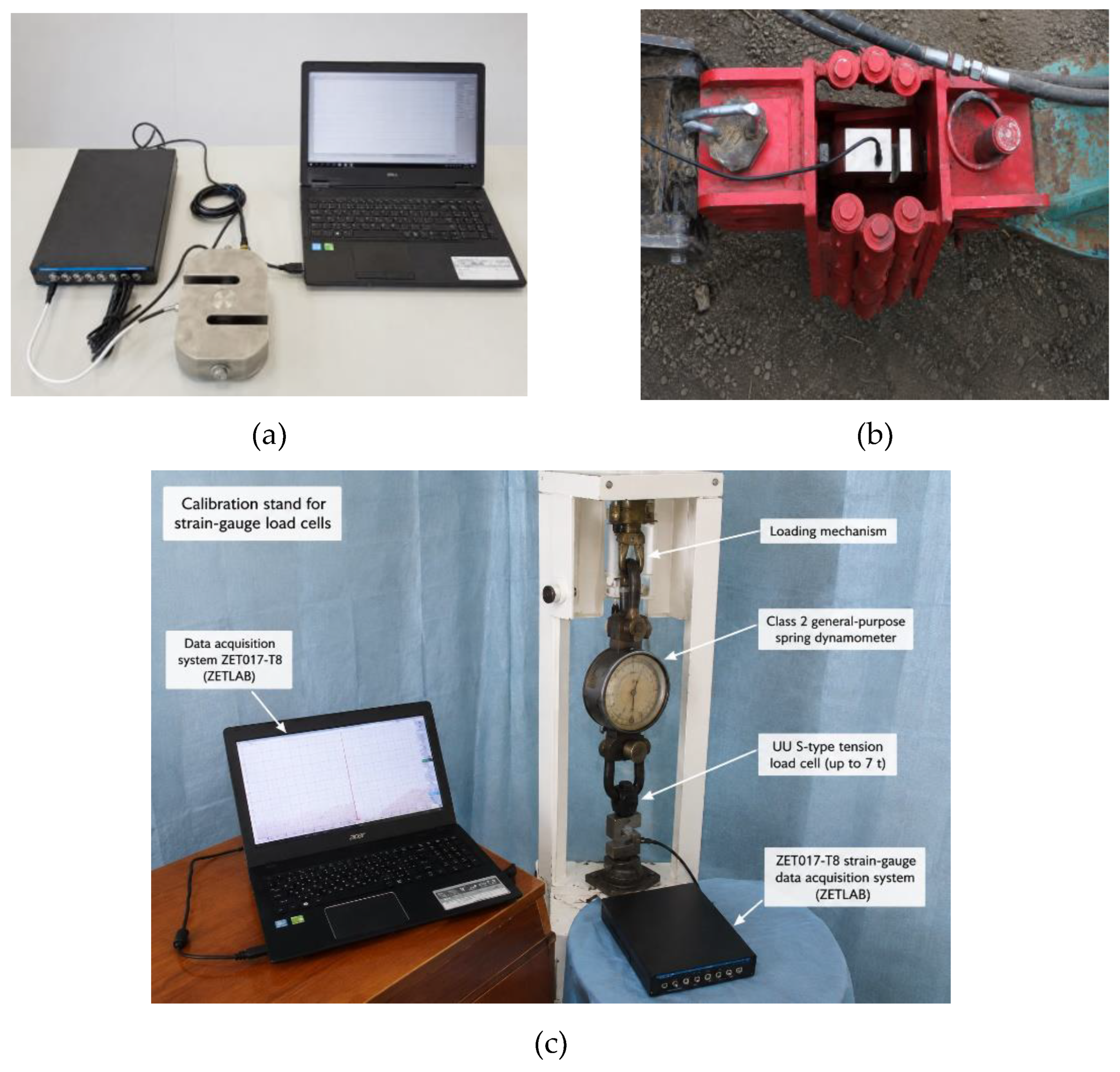
The energy performance evaluation was conducted concurrently with the agronomic assessment in accordance with the requirements of GOST R 52777. During the tests, the draft resistance of the implement, the distance travelled, and the test duration were determined. Draft resistance was measured using a strain-gauge measurement system comprising a UU S-type tension load cell with a measuring capacity of up to 7 t and a ZET017-T8 strain-gauge data acquisition system (ZETLAB), which provided real-time acquisition and processing of the experimental data (Figure 4).
Figure 5.
Strain-gauge measurement equipment: (a) strain-gauge measurement system; (b) drawbar dynamometer test equipment; (c) calibration stand for strain-gauge load cells.
Figure 5.
Strain-gauge measurement equipment: (a) strain-gauge measurement system; (b) drawbar dynamometer test equipment; (c) calibration stand for strain-gauge load cells.
Statistical analysis was performed after verifying the repeatability of the experimental data [21]. Each treatment combination was evaluated using three independent experimental replicates. Within each replicate, four measurement passes were performed, including two forward and two reverse passes. The forward and reverse passes were treated as repeated measurement passes within the same experimental replicate and were not considered statistically independent replicates. The results are presented as mean ± standard deviation (Mean ± SD). The standard error of the mean (SE) and 95% confidence intervals (95% CI) were also calculated for all measured variables. Differences between treatment means were assessed using Student’s t-test at a significance level of p < 0.05. Statistical calculations were performed using Microsoft Excel. For comparative validation of the measured draft resistance, the experimental values were additionally compared with the draft force predicted using the ASABE D497.7 standard model. The draft force was calculated according to D=Fi(A+BS+CS2)WT, where Fi is the soil-texture adjustment factor, A, B, and C are implement-specific coefficients, S is the operating speed, W is the working width, and T is the tillage depth. For the present comparison, the soil was classified as medium textured, corresponding to Fi=0.88, and the coefficients for a tandem disk harrow used for primary tillage were adopted as A=309, B=16, and C=0.
Signal acquisition was performed continuously for at least 20 s during each measurement pass, while the travelled distance and test duration were recorded for the corresponding measurement section. Before and after the tests, the strain-gauge measurement system was calibrated on a dedicated calibration stand using a stepwise loading–unloading procedure with a Class 2 general-purpose spring dynamometer. During calibration, the applied force measured by the dynamometer and the corresponding output of the S-type load cell, acquired by the ZET017-T8 strain-gauge data acquisition system and displayed on a laptop computer, were recorded. The operational performance evaluation of the prototype was carried out in accordance with the requirements of GOST 34055.
2.5. The Experimental Procedure Comprised Agronomic, Energy, and Operational Performance Evaluations
The field tests were conducted in accordance with the requirements of GOST 20915-2011 [22], ST RK 1559-2006 [23], and GOST R 52777-2007 [24]. The evaluated performance indicators included tillage depth, soil fragmentation quality, crop residue incorporation efficiency, soil surface roughness, draft resistance, field capacity, fuel consumption, and specific energy consumption. To determine the content of erosion-prone soil particles, soil samples were collected from the 0–5 cm surface layer before and after tillage. The samples were dried under laboratory conditions and sieved through a sieve with 1 mm openings. The content of particles smaller than 1 mm was determined as a percentage of the total mass of the analyzed soil sample. The obtained values were used to assess changes in the proportion of erosion-prone soil particles in the surface layer after tillage. Crop residue and weed cutting efficiency was determined after a single pass of the disc harrow by comparing the amount of crop residues and weeds present before and after tillage within the selected measurement areas. The number of uncut weeds and the amount of uncut crop residues remaining on the soil surface after the pass were recorded. Cutting efficiency was expressed as the percentage reduction in the initial amount of crop residues and weeds.
Field efficiency (ηf) was determined as the ratio of effective field capacity to theoretical field capacity:
where ηf is the field efficiency coefficient;
We is the effective field capacity, ha h⁻¹;
Wt is the theoretical field capacity, ha h⁻¹.
For the operational performance evaluation, field efficiency was calculated using the measured field capacity and the corresponding theoretical field capacity under the test conditions. The resulting experimental field efficiency was ηf = 0.87.
The field experiments were conducted under the following soil conditions: soil moisture content of 14.4%, soil penetration resistance of 3.9 MPa, and bulk density of 1.4 g cm⁻³. The soil was classified as a heavy loam, the field surface was level, and the weed density was 23 plants m⁻².
3. Results
Based on the analysis performed, a structural and technological configuration of the harrow was proposed, featuring a staggered two-row arrangement of the disc sections mounted on a flat frame. The implement is equipped with height-adjustable front support wheels and a rear-mounted rod roller. This configuration provides effective control of tillage depth under different soil hardness conditions, improves field surface levelling, and promotes the formation of a tilled layer with enhanced resistance to wind erosion [25,26].
Operational performance was evaluated using time-motion observations and instrumental measurements. Each treatment combination was evaluated using three independent experimental replicates, with four measurement passes performed within each replicate. The results are presented as mean ± standard deviation (Mean ± SD). Statistical analysis was conducted using Student’s t-test at a significance level of p < 0.05, with the forward and reverse passes treated as repeated measurements within the same experimental replicate rather than as independent replicates.
Figure 6 and Figure 7 illustrate the effect of the distance between the hitch point and the axis of the support wheel on the soil reaction acting on the support wheel and the draft resistance of the harrow, as well as the effect of hitch length on the soil reaction acting on the support wheel and the draft resistance of the harrow.
Increasing the distance from the hitch point to the support wheel axis reduces the vertical reaction acting on the support wheel because of load redistribution between the disc sections and the rod roller. At the same time, the draft resistance of the harrow increases owing to the greater moment arm of the resultant soil resistance forces.
The relationships presented in Figure 6 and Figure 7 were obtained from the numerical solution of Equations (1) - (5) using experimentally determined input parameters, providing good agreement between the theoretical predictions and the experimental results. The experimental data were used as input parameters for the mathematical model.
3.1. Agronomic Performance Evaluation of the Wide-Cut Heavy Disc Harrow
Field tests of the wide-cut heavy disc harrow coupled with a class 6 tractor were conducted during the tillage of perennial grass sod to evaluate its agronomic performance and to assess the influence of operating conditions on tillage quality. The experiments were carried out at forward speeds ranging from 9.0 to 11.5 km h⁻¹ and at different angles of attack of the disc sections. The prototype harrow was operated in combination with the Kirovets K-735 tractor (Figure 8).
The experiments were conducted at disc section angles of attack of 12°, 15°, and 18° over the range of operating speeds specified by the applicable standards.
The results obtained during the tillage of perennial grass sod (Table 3) demonstrated stable operation of the implement under all operating conditions without clogging or soil adhesion to the working elements. At a disc section angle of attack of 12° and an operating speed of 9.5–11.5 km h⁻¹, the average tillage depth ranged from 7.0 to 7.6 cm. Increasing the angle of attack to 15° at operating speeds of 9.2–11.3 km h⁻¹ increased the tillage depth to 8.5–8.8 cm. At the maximum investigated angle of attack of 18° and operating speeds of 9.0–11.1 km h⁻¹, the tillage depth reached 9.4–9.6 cm. In all test conditions, the forward speed remained below the maximum permissible value of 12 km h⁻¹, confirming compliance of the operating conditions with the applicable standard requirements.
The main soil tillage quality indicators obtained from the field experiments and reported in Table 3 are presented graphically in Figure 9, illustrating the effect of the disc section angle of attack on soil fragmentation, crop residue incorporation, weed cutting efficiency, and the content of erosion-prone soil particles.
The analysis of the experimental data demonstrated that the agronomic performance of the wide-cut heavy disc harrow was affected by the disc section angle of attack. Within the tested operating conditions, the mean tillage depth remained within 8.5–9.6 cm and generally complied with the specified agrotechnical requirements. A more pronounced effect of the disc section angle of attack was observed for soil fragmentation. At an angle of attack of 12°, the proportion of soil particles smaller than 50 mm ranged from 80.1% to 83.1%; at 15°, it ranged from 81.4% to 90.5%; and at 18°, it ranged from 81.6% to 94.5%. The maximum soil fragmentation value of 94.5% was obtained at an angle of attack of 18°. These results demonstrate that increasing the disc section angle of attack generally improved soil fragmentation under the tested field conditions.
Surface roughness remained below 5 cm under all operating conditions, confirming the stability of the tillage process. The angle of attack had the greatest influence on the cutting and incorporation of crop residues. At an angle of attack of 12°, the crop residue and weed cutting efficiency ranged from 80.6% to 95.4%. Increasing the angle to 15° resulted in a cutting efficiency of 95.5–100%, with complete cutting (100%) achieved at one of the tested operating speeds. At an angle of attack of 18°, complete cutting of crop residues and weeds was achieved throughout the entire range of operating speeds. In addition, the content of erosion-prone soil particles (<1 mm) decreased by 2–7 percentage points after tillage, indicating a lower proportion of soil particles susceptible to wind erosion. These findings are consistent with those reported in [27], where field performance tests of an implement equipped with actively driven rotary working elements also demonstrated improved crop residue and weed cutting efficiency with increasing soil-working intensity and optimized operating conditions.
No clogging or soil adhesion of the working elements was observed under any of the test conditions, while the content of erosion-prone soil particles after tillage was lower than that measured before the passage of the implement. These results indicate that the developed wide-cut heavy disc harrow provided stable and effective tillage performance during the tillage of perennial grass sod. The performance of the implement is associated with the integrated interaction of the disc sections, support wheels, rod roller, and hitch assembly. The screw tie rod connecting the hitch assembly to the frame contributes to the redistribution of vertical reactions between the working and supporting elements, thereby supporting stable tillage depth under the investigated soil conditions. This design is expected to contribute to the redistribution of vertical load toward the front row of disc sections, thereby facilitating stable tillage depth under dense soil conditions.
For perennial grass sod, an angle of attack of 18° provided the greatest tillage depth, the maximum recorded soil fragmentation value of 94.5%, and complete crop residue and weed cutting across the tested operating speeds. However, the increase in the angle of attack was accompanied by higher draft resistance and specific energy consumption, which should be considered when selecting the optimum operating mode.
3.2. Energy Performance of the Wide-Cut Heavy Disc Harrow Coupled with a Class 6 Tractor
The energy performance evaluation of the prototype was conducted concurrently with the agronomic tests. The results of the energy performance evaluation of the wide-cut heavy disc harrow coupled with the Kirovets K-735 tractor are presented in Table 4.
To evaluate the effect of the disc section angle of attack on this parameter, experimental studies were conducted, and the results are presented in Figure 10.
Specific energy consumption is one of the key indicators of the performance of a tillage implement, as it characterizes the energy required to perform the tillage operation.
The analysis of the energy performance results (Figure 10) revealed a consistent increase in the specific energy consumption of the implement with increasing disc section angle of attack. At an angle of attack of 12° (tillage depth of 7.0 cm and operating speed of 11.5 km h⁻¹), the specific energy consumption was 69.6 MJ ha⁻¹. Increasing the angle of attack to 15° increased the tillage depth to 8.5 cm and the specific energy consumption to 72.9 MJ ha⁻¹, while the operating speed decreased slightly to 11.3 km h⁻¹. The maximum value of 78.3 MJ ha⁻¹ was recorded at an angle of attack of 18°, a tillage depth of 9.4 cm, and an operating speed of 11.1 km h⁻¹. The coefficient of determination (R² = 0.97) confirms a strong relationship between the specific energy consumption and the disc section angle of attack over the investigated range. The increase in energy consumption is attributed to the larger contact area between the discs and the soil and the greater volume of soil subjected to deformation, resulting in higher draft resistance of the harrow. In addition, greater tillage depth requires more mechanical work per unit area, producing an almost linear increase in the energy demand of the tillage process.
To further assess the measured draft resistance, the experimental results were compared with the values calculated according to the ASABE D497.7 draft prediction model. At representative operating conditions, the experimental draft resistance was 49 kN at an angle of attack of 12°, 51 kN at 15°, and 55 kN at 18°. The corresponding ASABE-predicted values were 21.3, 25.7, and 28.2 kN, respectively. Thus, the experimental draft resistance was approximately 2.31, 1.99, and 1.95 times higher than the values predicted by the ASABE model. The observed difference may be associated with the specific configuration and operating conditions of the developed heavy disc harrow, including the use of large-diameter discs, relatively high disc section angles of attack, and operation in heavy loam soil. These results indicate that the generalized ASABE model provides a useful reference estimate but does not fully capture the draft requirements of the investigated heavy disc harrow under the tested field conditions.
Despite the increase in energy consumption with increasing disc section angle of attack, the maximum measured value of 78.3 MJ ha⁻¹ was obtained at an angle of attack of 18°. Within the experimental conditions investigated in this study, this value represents the upper level of specific energy consumption of the developed heavy disc harrow. These results demonstrate that the developed implement provided the required soil tillage performance within the investigated operating conditions, while the specific energy consumption remained within the range of 63.8–78.3 MJ ha⁻¹.
3.3. Operational Performance Evaluation of the Wide-Cut Heavy Disc Harrow Coupled with a Class 6 Tractor
The operational performance evaluation of the wide-cut heavy disc harrow coupled with the Kirovets K-735 tractor was conducted under field conditions at JSC «Zarya» in Kostanay Region. The results of the operational performance evaluation are presented in Table 5.
The operational performance evaluation was carried out during the tillage of perennial grass sod at a disc section angle of attack of 18° and an average tillage depth of 9.4 cm. During the evaluation, the machine unit consisting of the wide-cut heavy disc harrow and the Kirovets K-735 tractor operated stably without clogging and soil adhesion of the working elements or disruption of the technological process. The average operating speed was 10.8 km h⁻¹, and the effective field capacity was 7.6 ha h⁻¹. The calculated field efficiency was ηf = 0.87. The specific fuel consumption during shift time was 8.4 kg ha⁻¹, and the shift time utilization coefficient was 0.82.
The obtained results demonstrate that the developed wide-cut heavy disc harrow provides high field capacity with rational fuel consumption and efficient utilization of shift time. This confirms its technological and energy performance, as well as its suitability for primary soil tillage when coupled with traction class tractors.
4. Discussion
The obtained results confirm that the design and technological parameters of the heavy wide-cut disc harrow have a decisive influence on the agronomic, energy, and operational performance of the machine unit. Among the factors considered, the disc section angle of attack has the greatest effect. Its variation leads to the redistribution of interaction forces in the «disc–soil–frame–support elements» system, which directly affects soil tillage quality and energy consumption.
It was established that increasing the disc section angle of attack from 12° to 18° results in an increase in tillage depth, soil fragmentation, and crop residue incorporation. At the same time, an increase in draft resistance of the harrow and specific energy consumption is observed. The obtained relationships are consistent with the results reported by Zhang et al. (2020), who noted an almost linear increase in the draft resistance of disc implements with increasing disc installation angle and tillage depth. Similar conclusions were presented by Kushwaha and Zhang (2019), who demonstrated that increasing the angle of attack increases the horizontal component of resistance due to the larger interaction area between the disc and the soil medium and the higher intensity of soil layer deformation.
The study by Ahmadi (2018) also provides important insights into the interpretation of the obtained results, demonstrating that the draft resistance of disc implements is determined not only by operating parameters (angle of attack and tillage depth) but also by the structural layout of the machine, including the position of the center of mass and load distribution among support elements. The data obtained in the present study confirm this conclusion: changes in the geometry of the hitch assembly and the arrangement of support wheels lead to the redistribution of vertical reactions and, consequently, to changes in the draft resistance of the harrow. This indicates the necessity of simultaneous optimization of both technological and structural parameters.
The structural features of the proposed harrow were further evaluated by comparison with representative commercial disc harrows (Table 6). The comparison was intended not to claim novelty for individual structural elements, but to identify the specific combination of design features and operating parameters investigated in the present study.
The comparison shows that two-row disc arrangements, individual disc supports, depth-control systems, support wheels, and rear rollers are established design solutions used in modern heavy and compact disc harrows. Therefore, these individual elements are not considered independent innovations in the present study. The distinguishing feature of the proposed design is their integrated interaction within a 7.0-m-wide implement and the quantitative substantiation of load redistribution between the disc sections, support wheels, rod roller, and hitch assembly. In particular, the proposed configuration was investigated using mathematical modelling of the vertical reactions and experimentally evaluated under the soil and operating conditions of Northern Kazakhstan.
The good agreement between the experimental results and the mathematical modelling results confirms the correctness of the adopted calculation scheme. The developed model adequately describes the redistribution of loads between the working elements and support elements, as well as changes in the draft resistance of the harrow when varying the design parameters. This result is consistent with approaches used in studies on the modelling of tillage machines, particularly in research based on discrete–continuum models of soil–working element interaction, where the importance of considering multipoint contact and nonlinear properties of the soil medium is emphasized.
The influence of the rod roller also deserves particular attention. The obtained results show that its application ensures the formation of a more uniform surface microrelief (surface roughness of 3–5 cm) and contributes to a reduction in the proportion of erosion-prone soil fractions. Similar conclusions were reported by Blanco-Canqui and Lal (2009), who noted that surface soil compaction within rational limits contributes to reducing erosion processes and improving the stability of soil agrophysical properties in conservation agriculture systems.
The high level of crop residue incorporation at an angle of attack of 18° (up to 92.7%) and complete crop residue cutting (100%) meet the modern requirements of resource-saving agriculture. According to Xu et al. (2023), effective fragmentation and uniform distribution of crop residues within the soil profile are key factors in preserving organic matter and increasing soil biological activity. The obtained results confirm the high efficiency of the developed design for tillage of perennial grass sod and stubble fields.
An additional advantage of the proposed design scheme is the rational load distribution achieved through the arrangement of eight disc sections in two rows, the use of adjustable support wheels, and the screw tie-rod of the hitch assembly. This layout ensures stable tillage depth and reduces the probability of overloading individual sections, which is particularly important when operating on heavy soils with high hardness.
It should be noted that the studies were conducted under the conditions of heavy loamy soils of Northern Kazakhstan, which limits the direct extrapolation of the results to light or waterlogged soils. Under different soil and climatic conditions, the optimal values of the disc section angle of attack and tillage depth may differ, requiring additional adaptation of the machine unit parameters.
A promising direction for further research is the development of the mathematical model considering the spatial dynamics of the machine unit, elastic deformations of the frame, and stochastic heterogeneity of the soil profile. The application of multi-objective optimization methods is also relevant for the simultaneous consideration of agronomic indicators, energy consumption, and stability of machine unit movement under various operating conditions.
Thus, the obtained results confirm that the rational combination of the design and technological parameters of the heavy wide-cut disc harrow makes it possible to achieve high soil tillage quality with reduced specific energy consumption. The proposed design and technological scheme can be recommended for the development and improvement of next-generation heavy disc harrows aimed at resource-saving tillage technologies in arid regions.
5. Conclusions
1. As a result of the conducted research, the design and technological scheme and structural parameters of the heavy wide-cut disc harrow intended for tillage of perennial grass sod, summer fallow fields, and stubble fields were substantiated. It was established that the developed design ensures stable performance of the technological process under the soil and climatic conditions of Northern Kazakhstan at an operating speed of up to 11.5 km h⁻¹ without exceeding the permissible draft force of the traction class 6 tractor (Kirovets K-735), confirming its energy compatibility with the applied traction means.
2. The significant influence of the disc section angle of attack on the agronomic performance of soil tillage was experimentally confirmed. Increasing the angle of attack from 12° to 18° resulted in an increase in tillage depth from 7.0–7.6 to 9.4–9.6 cm, an increase in crop residue cutting efficiency to 100%, and an improvement in the structure of the cultivated soil layer. At the same time, soil fragmentation above 80% was achieved, while surface roughness did not exceed 3–5 cm, which complies with the requirements of resource-saving agricultural technologies.
3. It was established that an increase in the disc section angle of attack, while improving the agronomic effect, simultaneously leads to an increase in draft resistance of the harrow and specific energy consumption. The specific energy consumption ranged from 63.8 to 78.3 MJ ha⁻¹, while the specific fuel consumption was 8.4 kg ha⁻¹, indicating a rational energy intensity of the process and confirming the possibility of efficient operation of the machine unit coupled with traction class 6 tractors. In addition, specific fuel consumption was expressed in L/(kW·h) to provide a standardized indicator for evaluating the fuel and energy efficiency of the disc harrow. This indicator was included as an additional parameter in the assessment of the harrow's operational performance.
4. According to the results of the operational performance evaluation, the machine unit provided an average operating speed of 10.8 km h⁻¹, an effective field capacity of 7.6 ha h⁻¹, and a shift time utilization coefficient of 0.82. The obtained indicators characterize high field capacity, technological stability, and operational reliability of the machine unit under production conditions, which is an important factor determining its practical applicability.
5. The developed heavy wide-cut disc harrow can be recommended for implementation in resource-saving tillage technologies under the conditions of Northern Kazakhstan. The research results can be used for further improvement of tillage machine designs, as well as for the development of energy-efficient technological solutions for agricultural systems aimed at minimizing energy consumption while preserving soil fertility.
6. Patents
The results presented in this study led to the registration of the following patent in the Republic of Kazakhstan:
- Patent for Invention No. 37969, Wide-Cut Disc Harrow. Application No. 2024/1036.1, filed on 3 December 2024. International Patent Classification (IPC): A01B 21/00 (2006.01); A01B 7/00 (2006.01). Patent holder: Scientific and Production Center of Mechanical Engineering LLP (Kazakhstan). Inventors: Yuriy V. Polishchuk, Artyom P. Komarov, Aleksey I. Derepaskin, Pavel G. Ivanchenko, Anton N. Kuvayev, Maxim A. Plokhotenko, and Rashid M. Mazitov. Published in Official Bulletin No. 14 on 10 April 2026. Valid until 3 December 2027.
- Industrial Design Patent No. 4471, Wide-Cut Disc Harrow. Application No. 2025375.3, filed on 11 November 2025. Locarno Classification: 15-03. Patent holder: Scientific and Production Center of Mechanical Engineering LLP (Kazakhstan). Inventors: Yuriy V. Polishchuk, Aleksey I. Derepaskin, Nikolay V. Laptyev, Artyom P. Komarov, Anton N. Kuvayev, Ivan V. Tokarev, and Aleksandr F. Dyadyuchenko. Published in Official Bulletin No. 29 on 24 July 2026. Valid until 11 November 2027.
Author Contributions
Conceptualization, A.K. and Y.P.; methodology, Y.P. and Y.B.; software, N.L.; validation, A.D. and A.K.; formal analysis, R.K..; investigation, A.D. and A.K.; resources, Y.B. and Y.P.; data curation, A.K.; writing—original draft preparation, N.L. and R.K.; writing—review and editing, R.K. and N.L.; visualization, R.K. and N.L.; supervision, Y.P. and A.D.; project administration, Y.P.; funding acquisition, Y.B. and Y.P. All authors have read and agreed to the published version of the manuscript.
Funding
This research was funded by the Industrial Development Committee of Industry of the Ministry of Industry and Construction of the Republic of Kazakhstan (Grant №. BR23992300).
Institutional Review Board Statement
Not applicable.
Informed Consent Statement
Not applicable.
Data Availability Statement
All data used in this study are publicly accessible at the following link: https://zenodo.org/uploads/20621233(accessed on 23 July 2026).
Conflicts of Interest
The authors declare no conflicts of interest.
Abbreviations
The following abbreviations are used in this manuscript:
| ASABE | American Society of Agricultural and Biological Engineers |
| CI | Confidence interval |
| GPS | Global Positioning System |
| MEMS | Micro-Electro-Mechanical Systems |
| SD | Standard deviation |
| SE | Standard error of the mean |
| ST RK | State Standard of the Republic of Kazakhstan |
| GOST | State Standard (Russian: Gosudarstvennyi Standart) |
| R² | Coefficient of determination |
References
- Rietra, R.P.J.J.; Heinen, M.; Oenema, O. A review of crop husbandry and soil management practices using meta-analysis studies: Towards soil-improving cropping systems. Land 2022, 11, 255. [Google Scholar] [CrossRef]
- Baisholanov, S.; Akshalov, K.; Mukanov, Y.; Zhumabek, B.; Karakulov, E. Agro-climatic zoning of the territory of Northern Kazakhstan for zoning of agricultural crops under conditions of climate change. Climate 2025, 13, 3. [Google Scholar] [CrossRef]
- Funakawa, S.; Yanai, J.; Takata, Y.; Akshalov, K.; Kosaki, T. Dynamics of water and soil organic matter under grain farming in Northern Kazakhstan—Toward sustainable land use both from the agronomic and environmental viewpoints. In Climate Change and Terrestrial Carbon Sequestration in Central Asia; Lal, R., Suleimenov, M., Stewart, B.A., Hanson, J.D., Doraiswamy, P., Eds.; Taylor & Francis: London, UK, 2007; pp. 279–331. [Google Scholar]
- Trevini, M.; Tosti, G.; Benincasa, P. Agronomic performance of disc chain harrow as a conservation agriculture tool for a one-step cover crop termination and seedbed preparation. Exp. Agric. 2024, 60, 11–25. [Google Scholar] [CrossRef]
- Blanco-Canqui, H.; Lal, R. Crop residue removal impacts on soil productivity and environmental quality. Crit. Rev. Plant Sci. 2009, 28, 139–163. [Google Scholar] [CrossRef]
- Xu, G.; Xie, Y.; Peng, S.; Liang, L.; Ding, Q. Performance evaluation of vertical discs and disc coulters for conservation tillage in an intensive rice–wheat rotation system. Agronomy 2023, 13, 1336. [Google Scholar] [CrossRef]
- Zeng, Z.; Thoms, D.; Chen, Y.; Ma, X. Comparison of soil and corn residue cutting performance of different discs used for vertical tillage. Sci. Rep. 2021, 11, 2537. [Google Scholar] [CrossRef] [PubMed]
- ASABE. Agricultural Machinery Design Guidelines; ASABE: St. Joseph, MI, USA, 2022. [Google Scholar]
- Damanauskas, V.; Janulevičius, A. Effect of tillage implement (spring tine cultivator, disc harrow), soil texture, forward speed, and tillage depth on fuel consumption and tillage quality. J. Agric. Eng. 2022, 53, 1371. [Google Scholar] [CrossRef]
- McLaughlin, N.B.; Campbell, A.J.; Owen, G.T. Performance of hoe and triple disc furrow openers on no-till grain drills in a fine sandy loam soil. Soil Tillage Res. 2019, 195, 104373. [Google Scholar] [CrossRef]
- Okunev, G.A.; Astafiev, V.L.; Kuznetsov, N.A. Reduction of aftereffect of machine units on the soil. Trakt. I Sel’khozmashiny 2016, 83, 43–47. [Google Scholar] [CrossRef]
- Tarasenko, B.F.; Khav’yarimana, E.; Drobot, V.A.; Rudnev, S.G. Field testing of a disk-chisel harrow. Trakt. I Sel’khozmashiny 2023, 90, 225–232. [Google Scholar] [CrossRef]
- Troyanovskaya, I.P.; Tarasenko, B.F.; Kuzmin, V.V.; Partko, S.A.; Voinash, S.A. Harrow with turning disc section. Eng. Technol. Syst. 2023, 33, 10–20. [Google Scholar] [CrossRef]
- Ahmadi, I. A draught force estimator for disc harrow using the laws of classical soil mechanics. Biosyst. Eng. 2018, 171, 52–62. [Google Scholar] [CrossRef]
- Benyukh, O.A.; Kravchenko, R.I. Features of furrow formation with rotary and arrow-headed working bodies. Trakt. I Sel’khozmashiny 2023, 90, 179–186. [Google Scholar] [CrossRef]
- Kushwaha, R.L.; Zhang, Z.X. Draft and vertical forces of concave disk tools in soil. Biosyst. Eng. 2019, 183, 34–45. [Google Scholar]
- Bentaher, H.; Ibrahmi, A.; Hamza, E. Experimental evaluation of tillage implements and soil disturbance. Agriculture 2021, 11, 615. [Google Scholar]
- Jakasania, R.G.; Yadav, R.; Mohnot, P. Soil-tillage tool interaction using numerical methods—A review. Acta Sci. Agric. 2018, 2, 63–70. [Google Scholar]
- Karkee, M.; Steward, B.L. Study of the open and closed loop characteristics of a tractor and a single axle towed implement system. J. Terramech. 2010, 47, 379–393. [Google Scholar] [CrossRef]
- Bentaher, H.; Hamza, E.; Kantchev, G.; Maalej, A.; Arnold, W. Three-point hitch-mechanism instrumentation for tillage power optimization. Biosyst. Eng. 2008, 100, 24–30. [Google Scholar] [CrossRef]
- Montgomery, D.C. Design and Analysis of Experiments, 10th ed.; Wiley: Hoboken, NJ, USA, 2020. [Google Scholar]
- GOST 20915-2011; Agricultural Machinery Testing. Methods for Determining Test Conditions. Standartinform: Moscow, Russia, 2013.
- ST RK 1559-2006; Testing of Agricultural Machinery and Implements for Surface Tillage Methods for Evaluating Functional Indicators. State System of Technical Regulation of the Republic of Kazakhstan: Astana, Kazakhstan, 2006.
- GOST R 52777-2007; Agricultural Machinery. Methods of Energy Assessment. Standartinform: Moscow, Russia, 2008.
- Zheng, E.; Zhong, X.; Zhu, R.; Xue, J.; Cui, S.; Gao, H.; Lin, X. Investigation into the vibration characteristics of agricultural wheeled tractor–implement system with hydro-pneumatic suspension on the front axle. Biosyst. Eng. 2019, 186, 14–33. [Google Scholar] [CrossRef]
- Zhang, X.; Chen, Y.; Kushwaha, R.L. Effect of disc angle and operating speed on soil disturbance and draft force of disk harrows. Soil Tillage Res. 2020, 198, 104547. [Google Scholar]
- Kravchenko, R.I. The results of the operational test of a mock-up sample of the tool with an active drive of rotary working bodies with an assessment of agrotechnical indicators. Trakt. I Sel’khozmashiny 2023, 90, 515–522. [Google Scholar] [CrossRef]
Figure 1.
Definition and measurement of the angle of attack (α) of the disc section: (a) schematic definition; (b) measurement of the angle of attack using the angular displacement sensor.
Figure 1.
Definition and measurement of the angle of attack (α) of the disc section: (a) schematic definition; (b) measurement of the angle of attack using the angular displacement sensor.
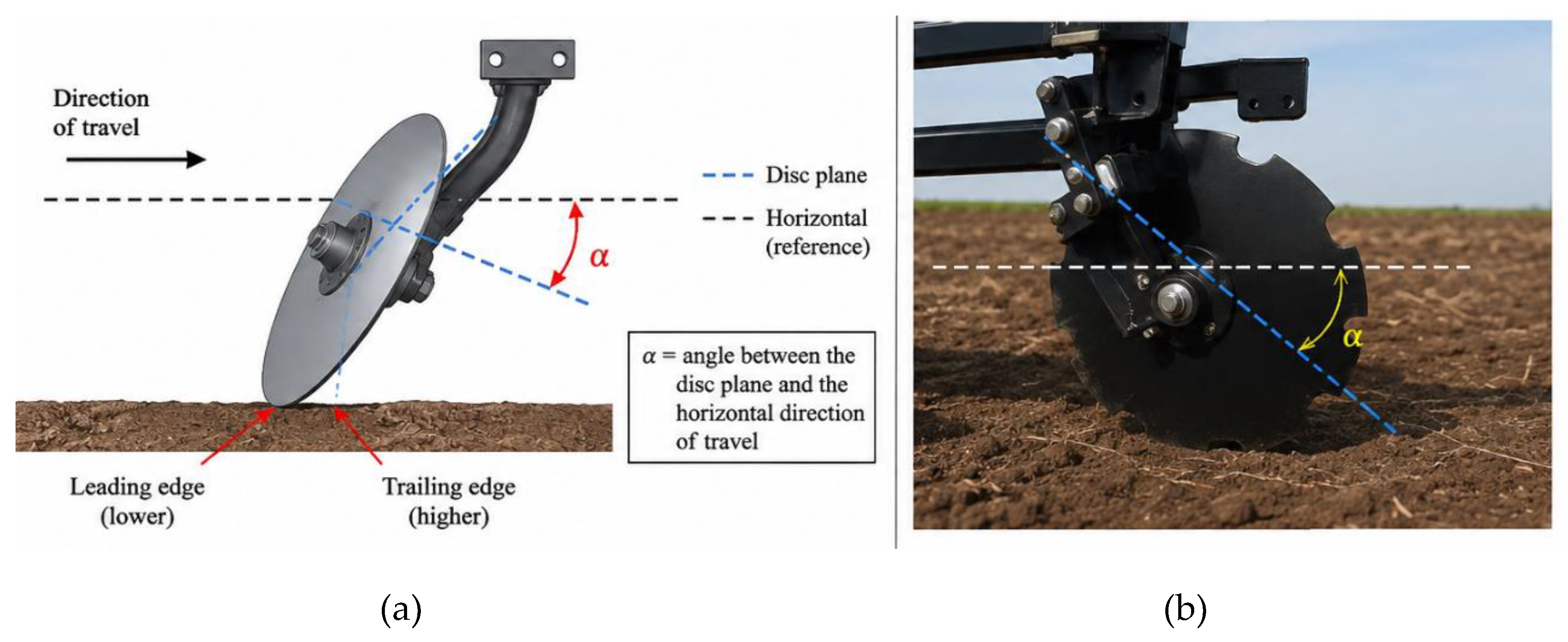
Figure 2.
Structural configuration of the wide-cut heavy disc harrow designed for operation with tractors of traction classes 5–6: 1 – frame; 2 – rod roller; 3 – deflector shields; 4 – disc sections; 5 – support wheels; 6 – support-transport wheels; 7 – hitch assembly.
Figure 2.
Structural configuration of the wide-cut heavy disc harrow designed for operation with tractors of traction classes 5–6: 1 – frame; 2 – rod roller; 3 – deflector shields; 4 – disc sections; 5 – support wheels; 6 – support-transport wheels; 7 – hitch assembly.
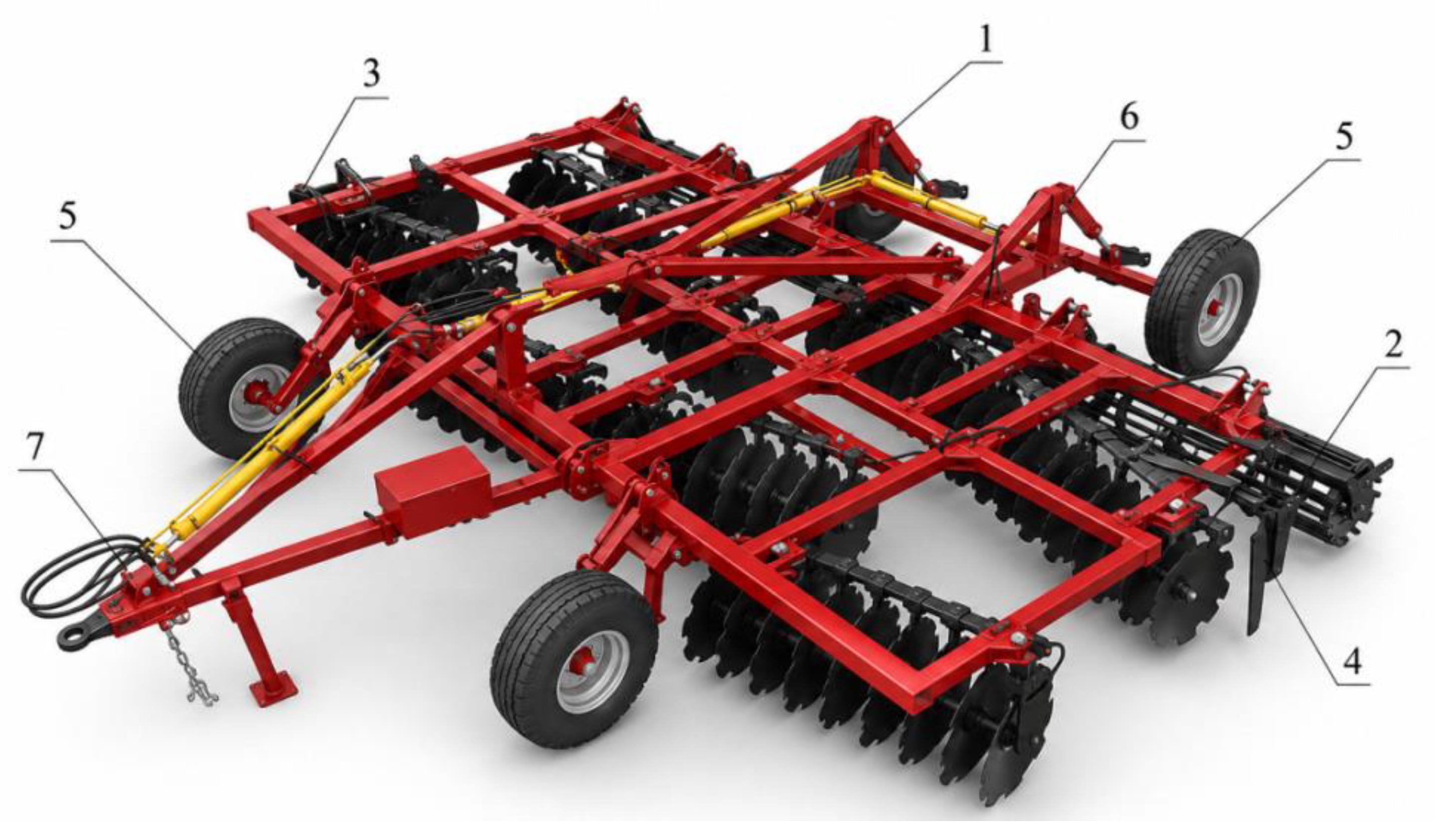
Figure 3.
Computational model of the wide-cut heavy disc harrow for operation with tractors of traction classes 5–6.
Figure 3.
Computational model of the wide-cut heavy disc harrow for operation with tractors of traction classes 5–6.
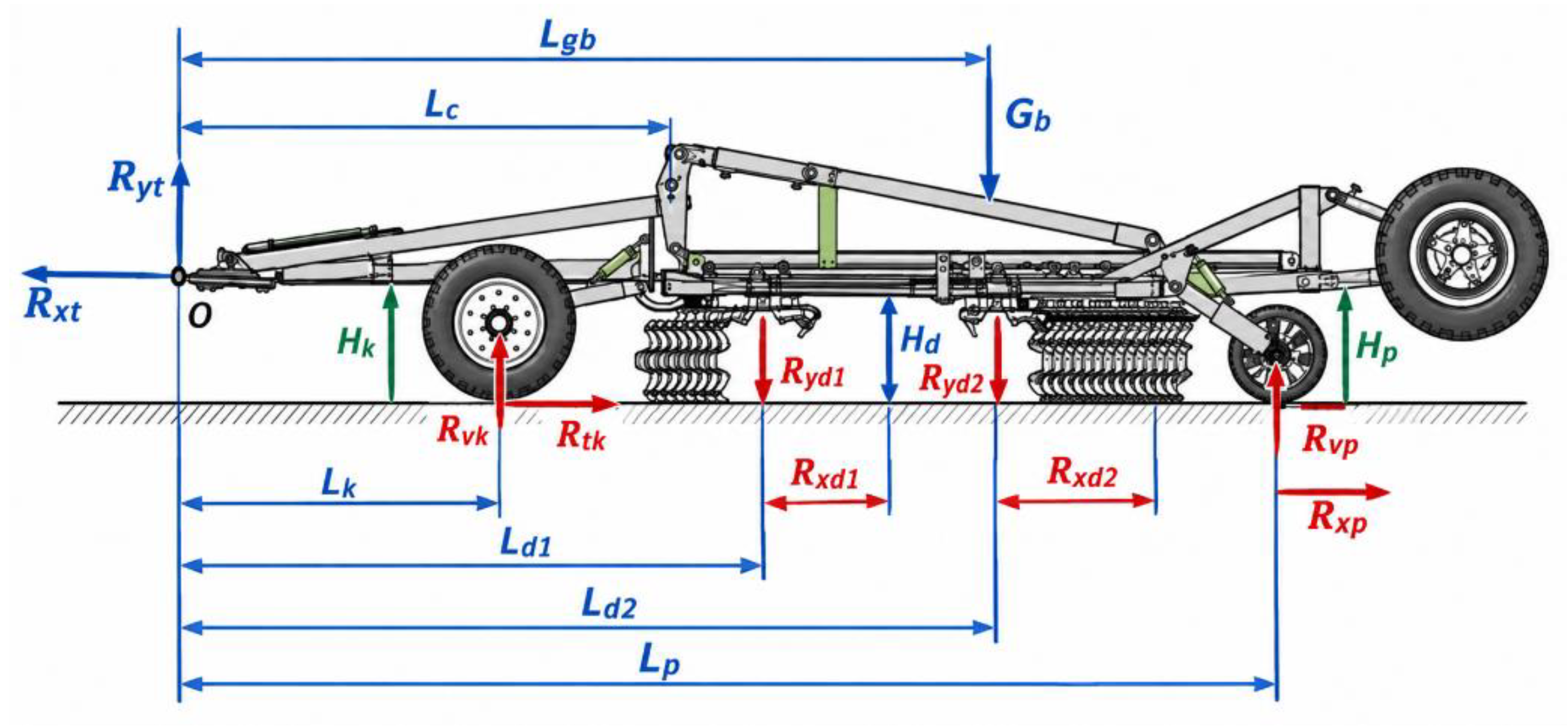
Figure 4.
Experimental setup for measuring the horizontal and vertical components of the draft resistance of the disc working elements and the rod roller.
Figure 4.
Experimental setup for measuring the horizontal and vertical components of the draft resistance of the disc working elements and the rod roller.
Figure 6.
Effect of the distance from the hitch point to the support wheel axis on the soil reaction acting on the support wheel and the draft resistance of the harrow: a – soil reaction acting on the support wheel; b – draft resistance of the harrow.
Figure 6.
Effect of the distance from the hitch point to the support wheel axis on the soil reaction acting on the support wheel and the draft resistance of the harrow: a – soil reaction acting on the support wheel; b – draft resistance of the harrow.
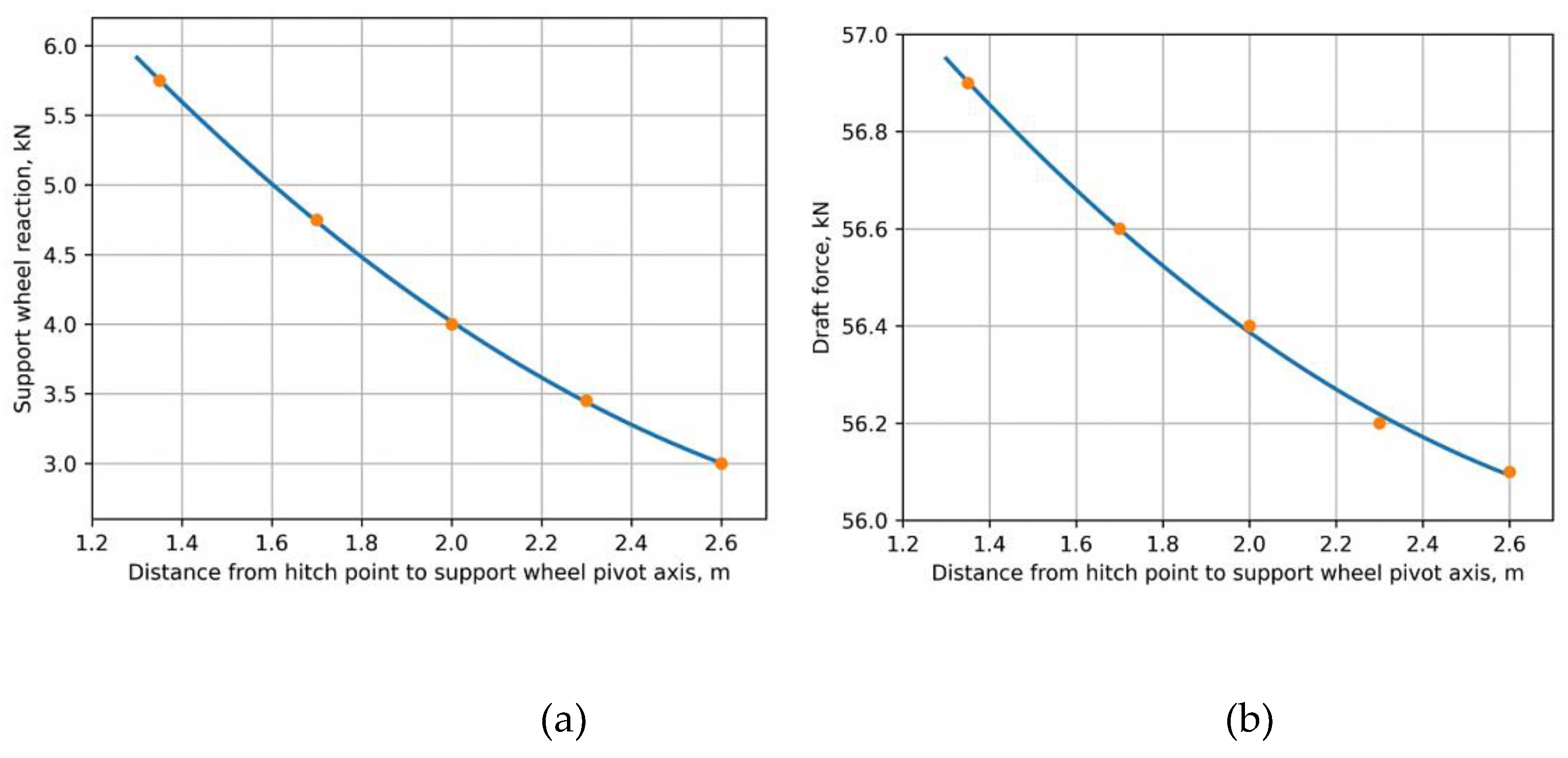
Figure 7.
Effect of hitch length on the soil reaction acting on the support wheel and the draft resistance of the harrow: а – soil reaction acting on the support wheel; b – draft resistance of the harrow
Figure 7.
Effect of hitch length on the soil reaction acting on the support wheel and the draft resistance of the harrow: а – soil reaction acting on the support wheel; b – draft resistance of the harrow
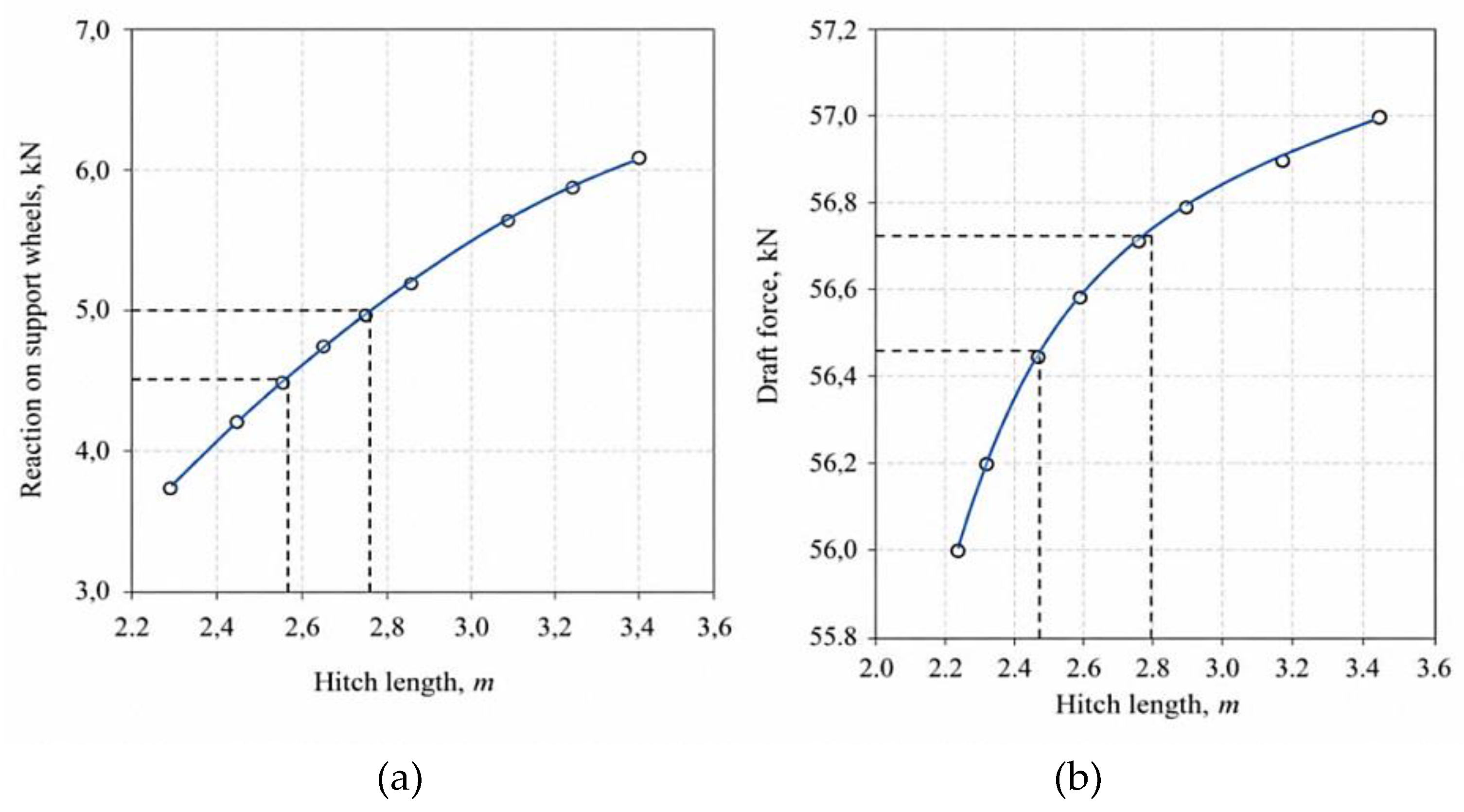
Figure 8.
Prototype of the wide-cut heavy disc harrow coupled with the Kirovets K-735 tractor: а – side view; b– rear-side view.
Figure 8.
Prototype of the wide-cut heavy disc harrow coupled with the Kirovets K-735 tractor: а – side view; b– rear-side view.
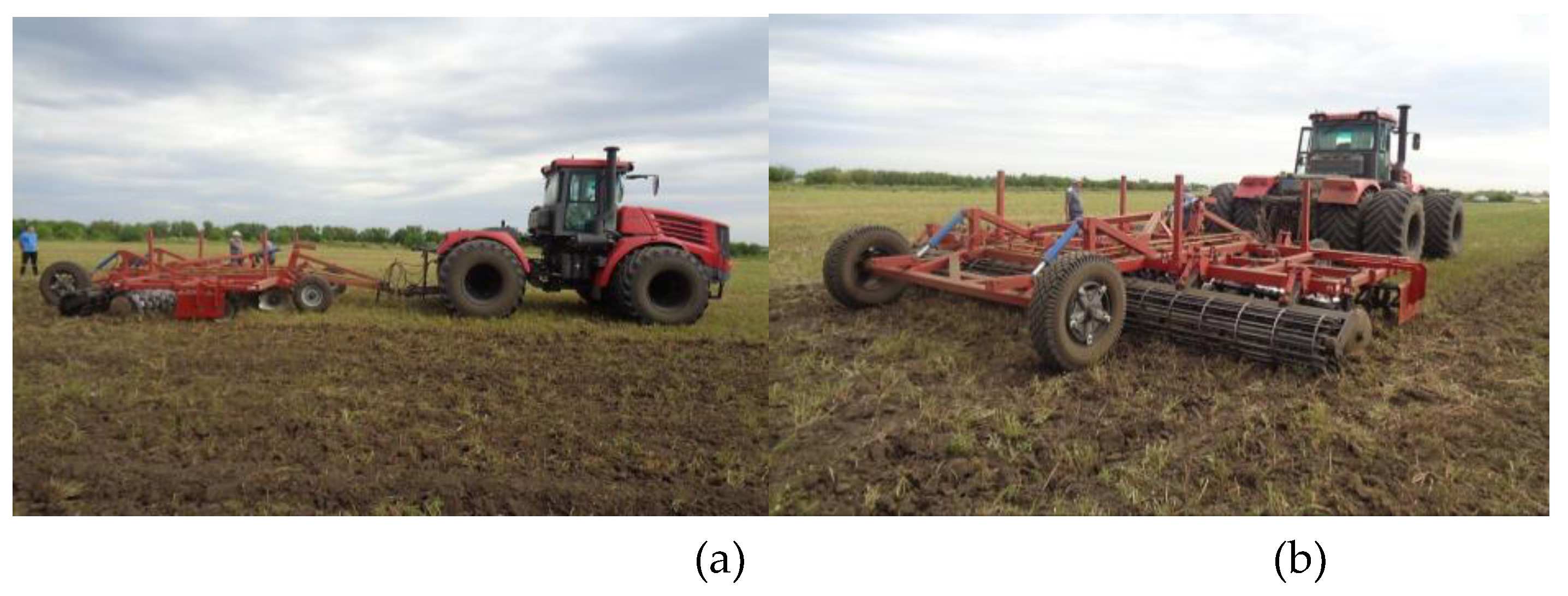
Figure 9.
Effect of the disc section angle of attack α (12°, 15°, and 18°) on the main soil tillage quality indicators: (a) proportion of soil particles smaller than 50 mm, (b) crop residue incorporation, (c) weed cutting efficiency, and (d) content of erosion-prone soil particles.
Figure 9.
Effect of the disc section angle of attack α (12°, 15°, and 18°) on the main soil tillage quality indicators: (a) proportion of soil particles smaller than 50 mm, (b) crop residue incorporation, (c) weed cutting efficiency, and (d) content of erosion-prone soil particles.
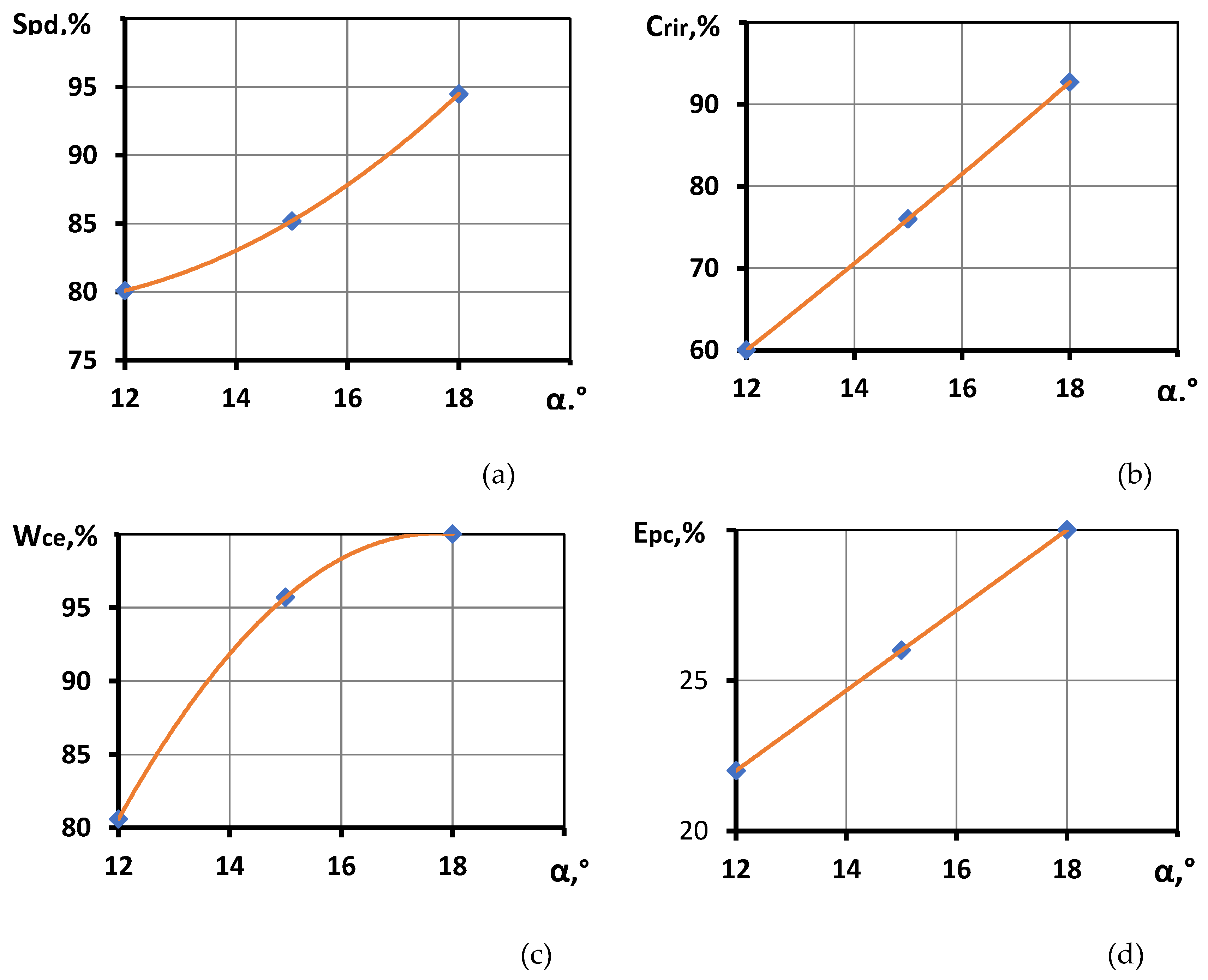
Figure 10.
Effect of the disc section angle of attack on the specific energy consumption of the harrow.
Figure 10.
Effect of the disc section angle of attack on the specific energy consumption of the harrow.
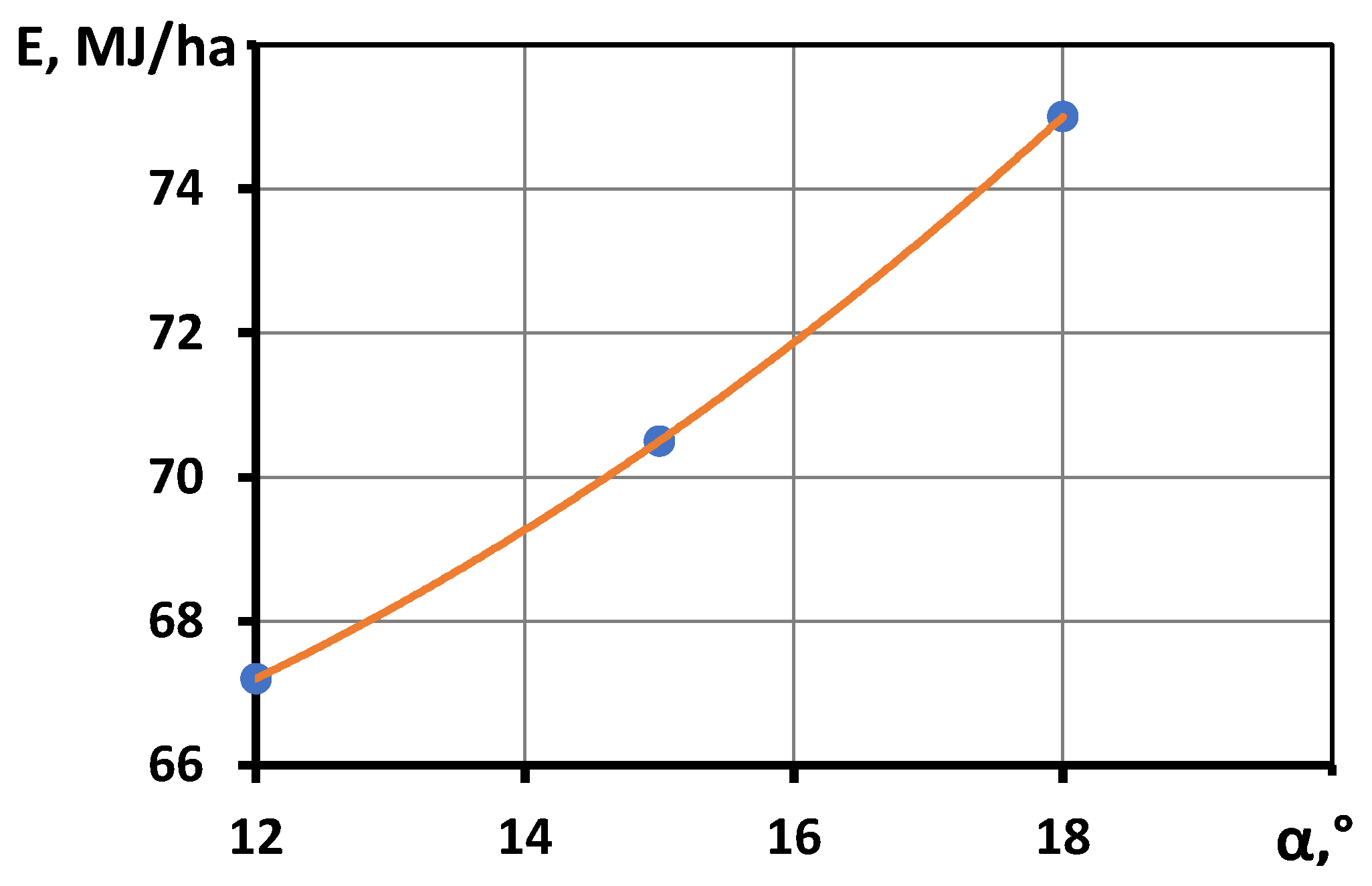
Table 1.
Input parameters used in the numerical analysis, including experimentally determined force characteristics.
Table 1.
Input parameters used in the numerical analysis, including experimentally determined force characteristics.
| Parameter | Symbol | Unit | Value |
|---|---|---|---|
| Working width of the harrow | В | m | 7.0 |
| Working width of the rod roller | Вк | m | 7.0 |
| Working width of a disc section | Вр | m | 1.0 |
| Tillage depth | H | m | 0.10 |
| Forward speed | V | m s⁻¹ | 2.7 |
| Number of disc section rows | Пу | pcs | 2 |
| Implement mass | Gb | N | 74000 |
| Experimentally determined draft resistance of the disc working elements | Rxd | N | 46000 |
| Experimentally determined vertical component of the draft resistance of the disc working elements | Ryd | N | 47000 |
| Experimentally determined rolling resistance of the rod roller | Rxр | N | 9000 |
| Rolling resistance coefficient of the support wheels | µk | - | 0.15 |
| Rolling resistance coefficient of the rod roller | µp | - | 0.25 |
| Lever arm of Rxd1 and Rxd2 disc sections | Hd | m | 0.78 |
| Lever arm of Rxp rod roller | Hp | m | 0.68 |
| Lever arm of Ryk support wheels | Hk | m | 0.68 |
| Lever arm of Rxd1 front disc section | Ld1 | m | 3.1 |
| Lever arm of Rxd2 rear disc section | Ld2 | m | 4.2 |
| Lever arm of Gd implement weight | LGd | m | 4.1 |
| Lever arm of Rxp rod roller | Lp | m | 5.9 |
| Lever arm of Rxk support wheels | Lk | m | 1.7 |
Note: The force parameters Rxd, Ryd, and Rxp were obtained experimentally under the field conditions described in Section 2.4 and used as input parameters for the quasi-static mechanical model.
Table 3.
Agronomic performance of the wide-cut heavy disc harrow coupled with the Kirovets K-735 tractor during the tillage of perennial grass sod.
Table 3.
Agronomic performance of the wide-cut heavy disc harrow coupled with the Kirovets K-735 tractor during the tillage of perennial grass sod.
| Performance indicator | Standard requirement |
Values | |||||||||||
|---|---|---|---|---|---|---|---|---|---|---|---|---|---|
| Experimental results | |||||||||||||
| Tillage of perennial grass sod | |||||||||||||
| 12, 15, 18 | 12 | 15 | 18 | ||||||||||
| Operating speed, km h⁻¹ | ≤ 12 [23] | 9.5 | 10.8 | 11.5 | 9.2 | 10.8 | 11.3 | 9.0 | 10.8 | 11.1 | |||
| Working width, m | 7 ±0.3 [23] | 7.0 | 7.0 | 7.0 | 7.0 | 7.0 | 7.0 | 7.0 | 7.0 | 7.0 | |||
| Tillage depth, cm: - mean; - standard deviation |
≤ 10 [23] ± 3 |
7.6 2.0 |
7.2 2.8 |
7.0 2.9 |
8.8 2.1 |
8.6 2.6 |
8.5 2.6 |
9.6 2.0 |
9.4 2.4 |
9.4 2.7 |
|||
| Soil fragmentation, %: - soil particles <50 mm |
≥ 80 [23] |
80.1 |
81.4 |
82.1 |
83.1 |
85.2 |
90.5 |
81.6 |
89.8 |
94.5 |
|||
| Surface roughness, cm: - mean; - standard deviation |
≤ 5 [23] no data |
3 3 |
4.2 3 |
4.2 3 |
4 3 |
4.3 3 |
4.4 3 |
4.0 3 |
4.3 4 |
5.0 4 |
|||
| Crop residue and weed cutting efficiency after a single pass, % | 100 | 80.6 | 82.3 | 95.4 | 95.5 | 95.7 | 100 | 100 | 100 | 100 | |||
| Crop residue incorporation, % | ≥ 60 [23] | 60.0 | 63.2 | 69.8 | 72 | 76 | 78.2 | 87.5 | 89.3 | 92.7 | |||
| Content of erosion-prone soil particles (<1 mm) in the 0–5 cm soil layer, % - before tillage - after tillage |
no data same |
27 22 |
28 24 |
30 28 |
28 21 |
30 26 |
34 29 |
26 20 |
32 27 |
34 30 |
|||
| Clogging and soil adhesion of the working elements | - // - | none | none | none | none | none | none | none | none | none | |||
Note: Values are presented as mean ± SD. Each treatment combination was evaluated using three independent experimental replicates (n = 3); four measurement passes were performed within each replicate (two forward and two reverse passes).
Table 4.
Energy performance of the Kirovets K-735 tractor coupled with the wide-cut heavy disc harrow.
Table 4.
Energy performance of the Kirovets K-735 tractor coupled with the wide-cut heavy disc harrow.
|
Performance indicator |
Reference value according to ASABE D497.7 | Values | ||||||||||
|---|---|---|---|---|---|---|---|---|---|---|---|---|
| Experimental results | ||||||||||||
| Tillage of perennial grass sod | ||||||||||||
| Disc section angle of attack, ° | 12, 15, 18 | 12 | 15 | 18 | ||||||||
| Operating speed, km h⁻¹ | 6-12 [24] | 9.5 | 10.8 | 11.5 | 9.2 | 10.8 | 11.3 | 9.0 | 10.8 | 11.1 | ||
| Working width, m | 7 ±0,3 [24] | 7.0 | 7.0 | 7.0 | 7.0 | 7.0 | 7.0 | 7.0 | 7.0 | 7.0 | ||
| Tillage depth, cm | 8-12 [24] | 7.6 | 7.2 | 7.0 | 8.8 | 8.6 | 8.5 | 9.6 | 9.4 | 9.4 | ||
| Field capacity, ha h⁻¹ | 4,2-8,4 [24] | 6.7 | 7.6 | 8.1 | 6.4 | 7.6 | 7.9 | 6.3 | 7.6 | 7.8 | ||
| Fuel consumption, kg h⁻¹ | 50.6 | 49.5 | 51.9 | 52.2 | 49.7 | 51.9 | 52.4 | 50.1 | 51.9 | 53.2 | ||
| Draft resistance of the harrow, kN | ≤ 65 [24] | 45 | 48 | 49 | 47 | 50 | 51 | 50 | 53 | 55 | ||
| Power requirement of the harrow, kW | 110.5-214.5 [24] | 118 | 144 | 156 | 122 | 150 | 155 | 125 | 159 | 169 | ||
| Specific energy consumption of the harrow, MJ ha⁻¹ | ≤ 95 [24] | 63.8 | 68.2 | 69.6 | 67.5 | 71.0 | 72.9 | 71.4 | 75.3 | 78.3 | ||
Note: Values are presented as mean ± SD. Each treatment combination was evaluated using three independent experimental replicates (n = 3); four measurement passes were performed within each replicate (two forward and two reverse passes).
Table 5.
Operational performance evaluation results of the wide-cut heavy disc harrow coupled with the Kirovets K-735 tractor.
Table 5.
Operational performance evaluation results of the wide-cut heavy disc harrow coupled with the Kirovets K-735 tractor.
| Performance indicator | Values | |
|---|---|---|
| ASABE-estimated value | experimental values | |
| Evaluation period | - | 18.08-20.08.2025 |
| Evaluation site | Kostanay Region | JSC «Zarya», Kostanay Region |
| Machine combination | Traction class 5–6 tractor + wide-cut heavy disc harrow | Kirovets K-735 tractor + wide-cut heavy disc harrow |
| Field operation | Tillage of perennial grass sod, shallow tillage of fallow land, and seedbed preparation on summer fallow fields | Tillage of perennial grass sod |
| Operating conditions: – Forward speed, km h⁻¹ – Working width, m |
≤ 12 [23] 7 ±0,3 [23] |
10.8 7.0 |
| Tillage depth, cm | ≤ 15 [23] | 9.4 |
| Disc section angle of attack, ° | 12, 15, 18 [23] | 18 |
| Field capacity, ha h⁻¹ – Effective field capacity – Operational field capacity – Field capacity per work shift |
4.2-8.4 3.7-7.5 [23] 3.4-6.9 [23] |
7.6 6.8 6.2 |
| Specific fuel consumption during the work shift, kg ha⁻¹ | not specified ASABE-estimated value [ASABE D497.7] |
8.4 |
| Operational performance coefficients: – Field efficiency, ηf – Technical service coefficient – Operational reliability coefficient – Utilization coefficient of operational time – Work shift utilization coefficient |
not specified not specified ≥ 0.99 [23] not specified ≥ 0.8 [23] |
0.87 1.00 1.00 0.89 0.82 |
| Number of operators | not specified | 1 |
Note: Operational performance indicators were determined from time-motion observations and instrumental measurements obtained during the field evaluation period.
Table 6.
Comparison of the main structural and operational characteristics of the proposed heavy disc harrow with representative commercial machines.
Table 6.
Comparison of the main structural and operational characteristics of the proposed heavy disc harrow with representative commercial machines.
| Machine / design | Working width, m | Disc diameter, mm | Disc arrangement |
Disc angle, ° | Tillage-depth adjustment | Load-supporting and finishing elements | Specific energy consumption, MJ ha⁻¹ |
|---|---|---|---|---|---|---|---|
| Proposed heavy disc harrow | 7.0 | 660 | Two rows, 8 disc sections | 12-18 | Adjustable support wheels | Support wheels, rod roller, adjustable hitch assembly | 63.8–78.3 |
| APD-7.5M-1, Bobruyskagromash, Belarus | 7.5 | 560 | Two rows, individual disc stands | 15 | Adjustable | Support and rolling system | Not reported |
| AMAZONE Certos 7002-2TX, Germany | 7.0 | 660 | Two rows, V-shaped arrangement | 22/17 | 7–20 cm | Running gear and roller | Not reported |
| HORSCH Joker 7 RT+, Germany | 7.15 | 520-580 | Disc elements arranged in pairs on arms | 17 | Adjustable | Support/transport wheels and packer | Not reported |
| LEMKEN Rubin 10 TF/700, Germany | 7.0 | 645 | Two rows | Not specified | Hydraulic | Self-adjusting depth-control wheels and optional roller | Not reported |
Disclaimer/Publisher’s Note: The statements, opinions and data contained in all publications are solely those of the individual author(s) and contributor(s) and not of MDPI and/or the editor(s). MDPI and/or the editor(s) disclaim responsibility for any injury to people or property resulting from any ideas, methods, instructions or products referred to in the content. |
© 2026 by the authors. Licensee MDPI, Basel, Switzerland. This article is an open access article distributed under the terms and conditions of the Creative Commons Attribution (CC BY) license (http://creativecommons.org/licenses/by/4.0/).
Copyright: This open access article is published under a Creative Commons CC BY 4.0 license, which permit the free download, distribution, and reuse, provided that the author and preprint are cited in any reuse.