

Submitted:
18 September 2026
Posted:
20 September 2026
You are already at the latest version
Abstract
This study examines how closely the English curriculum for Diploma in Engineering students in Bangladesh aligns with the communication competencies associated with skilled migration and international technical employment. A sequential two-phase framework was developed to distinguish curriculum-level alignment from student-level readiness. Phase I, reported in this paper, integrates systematic curriculum analysis, competency mapping, benchmark comparison, assessment analysis, and sensitivity testing. BTEB English-I (25712) and English-II (25722) were evaluated across ten competency domains informed by English for Occupational Purposes, engineering employability research, International Labour Organization guidance, and relevant national policy. Curriculum emphasis was coded using a transparent 0–5 ordinal rubric and quantified through the Domain Alignment Ratio (DAR), Curriculum Readiness Alignment Index (CRAI), and Readiness Deficit Score (RDS). The CRAI was 44.5% under equal weighting, 38.0% under migration-priority weighting, and 32.3% under a safety-critical scenario. Technical English, safety/procedural communication, workplace communication, and career communication together accounted for 66.7% of the total positive deficit. The assessment structure also showed limited emphasis on oral performance, with listening and speaking representing 10% of total marks compared with 60% allocated to the final examination. Overall, the findings reveal a curriculum that is comparatively strong in foundational English but less explicitly aligned with occupational and workplace communication demands. These results describe curriculum structure rather than individual student proficiency. Phase II is therefore proposed to validate student-level readiness through multi-polytechnic performance assessment, stakeholder evidence, reliability analysis, confirmatory factor analysis, and multilevel modelling. The study offers a transparent framework for linking curriculum evidence with subsequent empirical validation and evidence-informed reform of English communication education for international technical employability.
Keywords:
skilled migration
; English communication
; diploma in engineering
; TVET
; international employability
; English for occupational purposes
; BTEB
1. Introduction
Bangladesh’s participation in international labour markets increasingly depends on whether workers possess skills that are relevant, recognizable, and transferable across national boundaries. International Labour Organization (ILO) studies on Bangladesh have highlighted continuing challenges related to skills matching, qualification recognition, international comparability, labour-market responsiveness, and the governance of overseas employment. The ILO has also emphasized destination-specific language preparation, stronger links between training institutions and industry, recognition and accreditation of skills, and closer alignment of TVET provision with international requirements [1,2]. Within this wider framework, communication competence is an important part of migration preparation, but it should not be treated as a substitute for technical competence, recognized qualifications, work experience, or effective labour-market matching.
Diploma in Engineering graduates are particularly relevant in this context because their education prepares them for technical occupations across construction, manufacturing, electrical and mechanical systems, computing, maintenance, and related industries. In these workplaces, technical knowledge is rarely applied in isolation from communication. Workers may need to interpret manuals and work instructions, understand safety briefings, participate in toolbox talks and shift handovers, explain equipment faults, seek clarification, document incidents, and communicate with supervisors, clients, and colleagues from different linguistic and cultural backgrounds. Evidence from engineering workplaces further suggests that English is used differently across occupations and workplace activities rather than being equally important in every situation [3]. Consequently, international employability cannot be adequately understood through a general measure of English proficiency alone; attention must also be given to the specific communication tasks through which technical work is performed.
This task-oriented perspective is increasingly reflected in engineering-employability research. Recent systematic evidence has emphasized the need for clearer construct definitions, discipline-sensitive measures, explicit operationalization, and empirical validation when assessing employability-related competencies [4]. Research in English for Occupational Purposes (EOP) points in a similar direction, arguing that occupational communication needs should be identified through the demands of actual workplace tasks and, where possible, through evidence from multiple stakeholders, including learners, educators, employers, and industry representatives [5]. Together, these perspectives suggest that a meaningful assessment of communication readiness should examine not simply whether English is included in a curriculum, but what kinds of communication students are given opportunities to learn, practise, and demonstrate.
Within the Bangladesh Technical Education Board (BTEB) Diploma in Engineering curriculum, English-I and English-II provide an important foundation in reading, writing, listening, speaking, grammar, and composition. The courses also contain employment-relevant elements such as CV and cover-letter writing, presentations, report writing, and interpretation of graphs and charts. Nevertheless, the curriculum is concentrated in the early stages of the Diploma programme, while much of its content remains oriented toward general, academic, social, or literary English. This raises an important question about the relationship between the English taught within Diploma Engineering education and the communication demands graduates may encounter in technical workplaces, particularly when seeking international employment.
Evaluating that relationship requires careful attention to the level of inference. The presence or absence of a competency in a syllabus does not establish whether individual students can actually perform it. Curriculum documents indicate intended learning opportunities, whereas student readiness requires direct evidence of performance. Treating the two as equivalent could lead to unsupported conclusions about students' capabilities or their preparedness for skilled migration.
The present study addresses this problem through a transparent, two-phase research framework. Phase I, reported in this paper, systematically maps the intended BTEB English curriculum against a multidimensional benchmark of communication competencies relevant to skilled migration and international technical employment. Curriculum alignment is quantified through domain-specific and composite indicators and examined through assessment and sensitivity analyses. Phase II is designed as the subsequent empirical validation stage, in which student performance, stakeholder evidence, measurement reliability, and construct validity can be directly investigated.
The study therefore makes two related contributions. Substantively, it identifies areas in which the existing English curriculum is comparatively well aligned and areas where stronger occupational contextualization may be warranted. Methodologically, it establishes a clear boundary between curriculum-level evidence and student-level readiness, providing a pathway from documentary curriculum analysis to direct empirical validation. In doing so, the study seeks to support evidence-informed English curriculum development without assuming that curriculum coverage alone represents student proficiency or that English communication by itself determines successful skilled migration.
2. Literature Review
International labour migration has become an important part of Bangladesh’s employment and development landscape, yet overseas employment does not automatically provide access to skilled, secure, or higher-value occupations. Persistent challenges include mismatches between training and labour-market demand, limited international recognition of qualifications, uneven portability of skills, and the concentration of many migrant workers in low- and semi-skilled employment [1,2]. These concerns are also connected to the wider international debate on qualifications frameworks, where transparency, comparability, recognition, and the relationship between qualifications and actual occupational competence remain central issues [3]. Within Bangladesh’s TVET system, effective skills development additionally depends on coordination among government agencies, educational institutions, industry, employers, and other stakeholders [4]. English communication should therefore be understood within this larger skills ecosystem: it can facilitate international employability where occupationally relevant, but it cannot substitute for technical competence, recognized qualifications, professional experience, or favourable labour-market conditions.
Language preparation nevertheless matters because international technical work frequently requires employees to understand information, exchange instructions, document activities, and communicate across linguistic and cultural boundaries. Policy-oriented evidence for Bangladesh emphasizes not only skills development but also destination-sensitive language preparation, stronger links between training providers and industry, alignment with international occupational expectations, and improved recognition of competencies [1,2,3,4]. Research conducted within Bangladeshi TVET institutions also shows that English learning is associated with learners’ participation, aspirations, and perceptions of future opportunity [5]. Taken together, this literature suggests that the relevant question is not simply whether English appears in a technical curriculum, but whether students are given meaningful opportunities to develop communication abilities that can be transferred to authentic educational, professional, and international contexts.
This question is particularly important for Diploma in Engineering graduates because technical work is rarely performed through technical knowledge alone. Engineering employees may need to read manuals and specifications, understand spoken instructions, explain faults, discuss solutions, participate in handovers, communicate safety concerns, prepare workplace documentation, and coordinate with colleagues and supervisors. Evidence from engineering workplaces indicates that English use varies according to task, communicative function, and professional context, reinforcing the need to examine language competence in relation to actual workplace activities rather than treating English as a single undifferentiated skill [6]. The broader engineering-employability literature reaches a similar conclusion: employability is multidimensional and involves the interaction of disciplinary knowledge with communication, teamwork, problem solving, professional practice, and the capacity to apply knowledge in context [7,9].
These findings have important implications for how communication readiness is conceptualized and measured. Contemporary engineering-employability research emphasizes clearly defined constructs, discipline-sensitive indicators, transparent operationalization, and empirical validation [7]. Research on readiness for outcome-based engineering education likewise demonstrates that formal curriculum intentions and actual student readiness are related but distinct constructs [12]. Evidence concerning polytechnic curriculum and assessment in Bangladesh has also drawn attention to the relationship among intended learning outcomes, curriculum organization, instructional practice, and assessment [15]. A curriculum may therefore contain English-language activities without necessarily providing sufficient depth, recurrence, authenticity, or assessment to support occupational communication. This distinction is central to the present study.
English for Occupational Purposes (EOP) offers an appropriate theoretical foundation because it approaches language learning through the communicative demands of professional contexts. Existing EOP research shows the importance of defining professional communication competencies more precisely and of incorporating perspectives from learners, teachers, employers, and other stakeholders when identifying workplace needs [8]. This is particularly relevant to technical education, where merely including a “presentation,” “report,” “dialogue,” or “conversation” does not establish occupational relevance. What matters is what the learner must accomplish through the task—for example, communicating accurately, selecting appropriate technical terminology, extracting essential information, requesting clarification, organizing a message coherently, or interacting effectively with others. Stakeholder-based curriculum research involving Diploma Engineering education similarly points to the importance of reducing the distance between academic communication instruction and employability requirements [10]. Broader TVET research also emphasizes closer correspondence between training provision and the changing requirements of employment and industry [11].
From this perspective, occupational communication is better represented through observable performances than through isolated language components. A graduate may be expected to interpret a work order, understand a toolbox briefing, clarify an ambiguous instruction, explain equipment failure, provide a shift handover, prepare an incident report, or communicate with members of a multicultural team. Each task combines language with purpose, context, and professional knowledge. This does not diminish the importance of grammar, vocabulary, reading, or writing. Rather, foundational language resources become more professionally meaningful when students learn to mobilize them within realistic communicative situations [6,7,8,9,10].
The educational context in which these competencies are developed also requires attention. Learners entering tertiary and technical programmes in Bangladesh may have substantially different previous experiences of English, and difficulties encountered in introductory English courses have been documented in the national higher-education context [13]. Educational participation itself is shaped by wider institutional, cultural, and social conditions [14]. Consequently, the same prescribed curriculum should not be assumed to produce identical learning experiences or outcomes for every student. This further strengthens the need to distinguish what a curriculum offers from what learners ultimately achieve.
The relationship between curriculum intentions and practical competence is not unique to engineering or English education. Research in other professional disciplines illustrates the importance of examining the relationship among formal knowledge, practical skills, perceived competence, and educational needs rather than assuming that curriculum exposure is equivalent to performance [16]. This principle is directly relevant to the present study because curriculum documents can provide evidence of intended learning opportunities, but student competence ultimately requires empirical demonstration.
At the same time, the meaning of communication competence is expanding. Recent research in English-language education highlights AI literacy, multiliteracies, multimodal communication, and the influence of changing technological and social environments on language learning [17,18]. Studies of diverse teaching contexts further demonstrate that language education needs to respond to learner characteristics, accessibility, teacher preparation, and contextual demands rather than relying on a single instructional model [19]. Technology-supported language learning is also creating new possibilities for personalized practice, feedback, and interaction [20], while emerging work on English curricula cautions against reducing learning to narrow forms of “technical doing” detached from interpretation, creativity, judgment, and meaningful communication [21]. Multimodal learning systems similarly illustrate how text, visual information, contextual cues, and digital interaction can be integrated within specialized language education [22]. Although these studies address different populations and settings, collectively they underline a broader point: contemporary communication competence is increasingly contextual, multimodal, interactive, and performance-oriented.
These developments are especially relevant when examining the English provision within the BTEB Diploma in Engineering curriculum. Under Probidhan-2022, English forms part of the formal Diploma in Engineering curriculum, with English-I and English-II positioned in the early stages of the programme [23,24,25]. The syllabi provide a valuable foundation through reading, writing, grammar, listening, speaking, composition, presentation, and selected career-related activities [23,24,25]. Such foundational competencies should not be underestimated. However, their relevance to international technical employment depends partly on whether students are subsequently able to apply them to occupational situations. Technical vocabulary, workplace instructions, manuals and specifications, safety communication, handovers, incident reporting, professional interaction, interviews, and intercultural communication introduce demands that may not be adequately captured by conventional general-English activities alone [6,7,8,9,10,23,24,25].
This issue is also closely connected to assessment. What appears in a syllabus and what carries meaningful assessment weight are not necessarily the same. If a curriculum formally recognizes listening or speaking but allocates comparatively limited opportunities for students to demonstrate these competencies, assessment may signal a different set of priorities from the stated learning objectives. Research on curriculum, student readiness, professional competence, and technical education collectively supports the importance of examining this alignment between intended outcomes and assessment practices [7,8,12,15]. For occupationally oriented English, the issue is particularly significant because competencies such as listening to instructions, clarifying meaning, explaining technical information, and responding to safety situations are inherently performance-based.
The concept of skilled-migration English communication readiness therefore requires a deliberately bounded definition. In this study, it refers to the extent to which English communication competencies, when relevant to a particular occupation and destination, can support recruitment-related communication, interpretation of technical information and instructions, workplace interaction, safety communication, documentation, task coordination, and communication across linguistic and cultural contexts. It is not treated as equivalent to overall employability or migration readiness. International employment is influenced by a wider combination of technical competence, occupational experience, qualifications, recognition arrangements, destination-country language requirements, recruitment systems, migration regulations, and labour-market conditions [1,2,3,4]. English communication is consequently conceptualized as an enabling professional competency within this broader system rather than as an independent predictor of migration success.
An equally important distinction is made between curriculum readiness and student readiness. Curriculum readiness concerns the extent to which the intended curriculum represents competencies considered relevant to international technical communication. Official curriculum and syllabus documents can show what is prescribed, how learning activities are organized, and how competencies are formally assessed [23,24,25]. They cannot demonstrate what individual students can actually understand, produce, or perform. Student readiness requires direct evidence from appropriately designed listening, speaking, reading, writing, technical, safety, and interactive performance tasks. This distinction is methodologically important because it prevents curriculum-level observations from being interpreted as measured deficiencies in students.
Against this background, the present study develops an operational competency model for examining the alignment of BTEB English-I and English-II with communication demands associated with skilled international employment. Rather than relying only on qualitative statements that a particular competency is “present” or “missing,” the framework evaluates the relative emphasis of different domains, quantifies alignment and deficit patterns, examines the influence of alternative weighting assumptions, and considers whether formal assessment reflects the performance-oriented nature of occupational communication. In doing so, the study brings together perspectives from migration and skills policy [1,2,3,4], Bangladesh TVET and English education [5,13,14,15], engineering workplace communication and employability [6,7,9,10,12], EOP [8], broader professional-skills research [16], emerging language-education research [17,18,19,20,21,22], and the official BTEB curriculum framework [23,24,25]. The uploaded reference compilation also confirms the inclusion of Bangladesh-focused TVET English research, including the study on learners’ perception, participation, and aspiration in English learning at TVET institutions.
Accordingly, four research questions guide the analysis.
RQ1 asks which English communication competencies are explicitly represented in BTEB English-I and English-II.
RQ2 examines the magnitude and distribution of curriculum-alignment deficits relative to the skilled-migration communication benchmark.
RQ3 investigates whether the overall curriculum-alignment estimate remains reasonably stable when different assumptions are made about the relative importance of competency domains.
RQ4 examines the extent to which the existing assessment structure provides opportunities to evaluate oral, interactive, technical, and performance-based communication alongside conventional written performance.
The curriculum analysis constitutes Phase I of the research and is intended to establish a curriculum-based baseline rather than a direct measure of student proficiency. Phase II therefore introduces two testable hypotheses. H1 proposes that Diploma Engineering students will perform more strongly on general written-language tasks than on authentic technical and safety-related communication tasks. H2 proposes that direct measures of listening, interaction, and technical communication will account for additional variation in employer-rated workplace readiness beyond that explained by conventional written English examination scores. Testing these hypotheses across multiple institutions and with appropriate stakeholder evidence would determine whether the curriculum-level patterns identified in Phase I are also observable in student performance. In this way, the framework moves from documentary evidence to empirical validation while preserving a clear boundary between what the curriculum intends to develop and what students can actually demonstrate.
3. Methodology
This study employed a sequential two-phase measurement-development framework to evaluate the alignment between the English curriculum of the Bangladesh Technical Education Board (BTEB) Diploma in Engineering programme and the communication competencies associated with skilled migration and international technical employment. The methodological architecture was deliberately designed to distinguish curriculum-level readiness from student-level competence. As illustrated in Figure 1, Phase I constitutes the current study and establishes a curriculum-based readiness baseline through systematic document analysis, competency mapping, quantitative scoring, benchmark comparison, assessment-alignment analysis, and robustness testing. Phase II represents the subsequent empirical validation stage in which the curriculum-derived construct can be tested directly using student performance, stakeholder evidence, and psychometric/statistical validation. This separation is methodologically important because the presence or absence of a competency in a curriculum cannot, by itself, establish whether individual students have acquired that competency.
The framework shown in Figure 1 follows a sequential logic in which evidence generated during Phase I determines the constructs, competency domains, measurement priorities, and hypotheses to be examined in Phase II. The first phase therefore functions not simply as a descriptive syllabus review but as a measurement-development stage. It identifies what communication capabilities are explicitly represented in the intended curriculum, determines the extent to which these capabilities correspond to an externally informed skilled-migration competency profile, and quantifies the magnitude and concentration of observed alignment deficits. Phase II is subsequently designed to determine whether these curriculum-level patterns are reproduced in actual student performance and whether the proposed readiness construct demonstrates acceptable reliability, construct validity, and criterion-related validity. Such a staged approach is consistent with contemporary recommendations that employability constructs should be explicitly defined, discipline-sensitive, operationally measurable, and empirically validated [4].
3.1. Data Sources, Competency Framework, and Curriculum Coding
The primary documentary corpus consisted of the BTEB Probidhan-2022 Diploma in Engineering English-I (25712) and English-II (25722) curricula. The analysis covered course rationales, learning outcomes, prescribed content, grammar and composition components, instructional periods, learning activities where explicitly stated, and the formal distribution of assessment marks. The official Probidhan-2022 framework and the relevant first- and second-semester syllabus documents were treated as the principal evidence for determining the intended curriculum [7,8,9].
The curriculum evidence was interpreted against an external reference framework derived from several complementary sources. ILO publications concerning skills development, overseas employment, destination-country language preparation, international comparability of technical qualifications, and industry–training institution linkages provided the migration-policy perspective [1,2]. Engineering-employability research was used to establish the importance of integrating disciplinary and professional competencies [4,6], while English for Occupational Purposes (EOP) literature informed the identification of workplace-oriented language competencies and the need for stakeholder triangulation [5]. Engineering-workplace English research was additionally considered when identifying communicative functions that arise in authentic technical environments [3]. This evidence hierarchy ensured that the benchmark was not constructed exclusively from the existing BTEB syllabus, thereby reducing circularity between the object being evaluated and the criteria used to evaluate it.
A structured competency matrix was subsequently developed. Ten domains were selected to represent the continuum from foundational language competence to occupationally specific communication. Their operational definitions are presented in Table 1.
As shown in Table 1, the framework does not treat English competence as a single undifferentiated construct. D1–D3 primarily capture foundational language resources; D4 and D5 capture receptive and productive oral communication; and D6–D10 extend the framework toward occupational, technical, recruitment, intercultural, and safety-critical communication. This multidimensional organization is particularly important for technical education because strong performance in general grammar or writing cannot be assumed to compensate for the absence of technical or safety communication.
Each domain was evaluated using a six-point ordinal curriculum-emphasis scale ranging from 0 to 5. A score of 0 indicated that the competency was absent from identifiable learning outcomes, content, tasks, or assessment; 1 represented incidental reference; 2 indicated limited explicit coverage; 3 represented moderate and recurring coverage; 4 indicated substantial coverage supported by clear curricular attention; and 5 represented a central or recurrent competency accompanied by explicit opportunities for assessment. Coding decisions considered four forms of evidence simultaneously: explicit learning outcomes, recurrence within course content, the presence of identifiable communicative tasks, and visibility within formal assessment.
This scoring procedure estimates curriculum exposure and emphasis, rather than student ability. Consequently, a score of 5 does not imply that students have achieved a high level of proficiency; it indicates that the curriculum provides strong and explicit opportunities for developing and accessing that domain. Conversely, a score of 0 indicates that a competency is not systematically visible in the analyzed curriculum documents, not that no student possesses the competency.
The coding system also provides a basis for replication. Because the present Phase I analysis establishes an initial documentary baseline, its numerical scores should be regarded as structured analytical judgments rather than psychometrically calibrated measurements. Independent replication should therefore employ at least two trained coders, followed by calculation of weighted Cohen's κ or Krippendorff's α, with corresponding confidence intervals, to quantify agreement beyond chance. Discrepant classifications should then be resolved through documented consensus procedures. This would strengthen the reproducibility of the curriculum-coding component before national-level implementation.
3.2. Quantitative Alignment, Assessment, and Robustness Analysis
Following curriculum coding, alignment was quantified using a set of complementary indicators rather than relying on a single overall score. For each competency domain , the observed curriculum emphasis was represented by , while the skilled-migration benchmark was represented by . The first indicator, the raw domain gap, was calculated as:
where positive values indicate that benchmark expectations exceed current curriculum emphasis. Because an exceptionally high score in general English should not mathematically compensate for the absence of an occupational competency, a second measure—the Domain Alignment Ratio (DAR) was defined as:
The ratio is bounded between 0 and 1. A value of 1 represents complete or greater-than-required curriculum alignment for that domain, whereas values approaching zero represent progressively weaker alignment. Capping the ratio at unity prevents excess emphasis in one competency from offsetting deficits elsewhere.
To summarize the multidimensional profile while retaining flexibility in domain importance, the Curriculum Readiness Alignment Index (CRAI) was calculated as:
where represents the normalized weight assigned to competency domain , with . CRAI therefore ranges theoretically from 0 to 100%, with higher values indicating greater overall curriculum-to-benchmark alignment. Importantly, CRAI is not a percentage of students who are ready for migration, nor is it a proficiency score. It is a composite indicator describing the structure of the intended curriculum.
A fourth measure, the Readiness Deficit Score (RDS), was used to quantify the cumulative positive deficit:
Unlike CRAI, which expresses proportional alignment, RDS measures the absolute volume of unmet benchmark emphasis. Using DAR and RDS together makes it possible to distinguish between the degree of alignment and the concentration of curriculum deficits.
No universally established weighting structure currently exists for English communication competencies associated with skilled migration. The study therefore avoided presenting a single set of weights as objectively correct. Instead, three theoretically meaningful scenarios were evaluated, as summarized in Table 2.
The three estimates in Table 2 were not interpreted as alternative measurements of student readiness. Rather, they functioned as a deterministic sensitivity analysis examining whether the substantive interpretation changed when different theoretical assumptions were made about the importance of particular competencies. The reduction from 44.5% under equal weighting to 32.3% under the safety-critical specification indicates that the estimated curriculum alignment becomes lower when greater analytical importance is assigned to occupational communication domains. Stability of the broader interpretation across these specifications was therefore considered evidence that the observed alignment pattern was not solely an artifact of equal weighting.
The weighting problem was examined further through probabilistic uncertainty analysis. A Monte Carlo procedure generated 20,000 plausible weight vectors from a Dirichlet distribution centered on the migration-priority specification. CRAI was recalculated for every generated vector, producing a distribution of possible curriculum-alignment estimates rather than a single deterministic value. These simulations quantify uncertainty associated with the choice of weights. They are not sampling confidence intervals because no population of students was sampled during Phase I, and they do not simulate student performance.
Robustness was also examined from several complementary perspectives. A competency-alignment heatmap was used to visualize the joint structure of current emphasis, benchmark expectations, domain deficits, and DAR values. Radar geometry was employed to compare the multidimensional shape of the observed and target competency profiles. A Pareto deficit analysis ranked domains according to their contribution to total positive RDS and calculated cumulative deficit concentration. A leave-one-domain-out analysis recalculated weighted CRAI after sequentially excluding each competency and renormalizing the remaining weights, allowing the influence of individual domains on the composite index to be evaluated. Finally, an importance–alignment matrix combined migration-priority weights with observed DAR values to distinguish high-importance/low-alignment domains from competencies that were already comparatively well represented. Together, these analyses provide complementary evidence regarding magnitude, concentration, dimensional structure, and sensitivity rather than repeatedly presenting the same comparison in different graphical forms.
Curriculum-content alignment was examined separately from assessment alignment. According to the published assessment scheme, 5 marks are allocated to attendance, 6 to listening, 4 to speaking, 5 to presentation/assignment, 20 to the midterm examination, and 60 to the final examination. From this structure, the Oral Assessment Share was calculated as:
while the Explicit Performance Share, incorporating presentation/assignment, was:
These measures were compared descriptively with the importance assigned to oral and interactive communication within the skilled-migration competency framework. The analysis does not assume that a higher written-examination weight necessarily causes weaker communication performance. Instead, it evaluates whether the formal assessment architecture provides proportionate opportunities for students to demonstrate the competencies emphasized by the proposed benchmark.
3.3. Phase II Validation, Statistical Analysis, and Research Integrity
The second phase shown in Figure 1 is essential for moving from curriculum-level evidence to defensible statements about students. Phase II is therefore designed as a multi-institutional empirical validation study involving Diploma in Engineering students from public and private polytechnic institutes. A stratified multistage sampling strategy should be used to capture variation by engineering technology, semester, institution type, and geographical context. The required sample size should be determined a priori from the complexity of the planned latent-variable and multilevel models rather than selected through convenience sampling.
Direct assessment should mirror authentic communication events relevant to technical employment. The proposed performance battery should include comprehension of a toolbox or safety briefing, oral shift handover, clarification and confirmation of an ambiguous instruction, interpretation of a technical work order or manual, preparation of a professional email or incident report, participation in a simulated employment interview, and response to an intercultural workplace scenario. Each constructed-response or oral task should be evaluated using analytic rubrics and, where practicable, independently scored by two trained raters.
Phase II analysis should proceed from measurement quality to explanatory modelling. Internal consistency of multi-item scales should be evaluated using coefficient omega and, where appropriate, Cronbach's α, while rater-based tasks should be examined through intraclass correlation coefficients. The proposed competency structure should then be tested using confirmatory factor analysis (CFA). A unidimensional model, correlated-domain model, and theoretically defensible higher-order model can be compared to determine whether skilled-migration communication readiness is better represented as a general factor, a collection of related competencies, or a hierarchical construct.
Where sample size permits, measurement invariance should be examined across major engineering technologies, gender, and other theoretically relevant groups before interpreting group differences. Student observations will also be nested within institutions; consequently, multilevel regression modelling should be used where intraclass correlations indicate meaningful institutional clustering. These models can estimate the contributions of prior English achievement, technical discipline, internship exposure, communication practice, and institutional characteristics while appropriately separating student-level and institution-level variance.
Criterion-related validity should subsequently be examined against external indicators such as internship-supervisor evaluations, employer assessments, or suitable standardized language measures. Of particular importance is incremental validity: listening, interaction, technical communication, and safety communication scores should be tested to determine whether they explain additional variation in workplace-readiness ratings beyond conventional written English examination marks. This analysis would provide an empirical test of whether occupationally contextualized communication assessment contributes information that conventional academic assessment does not capture.
Missing-data patterns should be examined before model estimation. Where missingness assumptions are defensible, multiple imputation or appropriate full-information estimation should be preferred to simple listwise deletion. Statistical inference should report effect sizes and 95% confidence intervals alongside p-values, and model assumptions, fit indices, reliability estimates, and sensitivity analyses should be reported transparently. If a redesigned English curriculum is subsequently piloted, a controlled pretest–posttest or cluster-aware quasi-experimental design would provide substantially stronger evidence than an uncontrolled before-and-after comparison.
The methodological boundary between the two phases is fundamental to the interpretation of the study. Phase I contains no human-participant performance data and therefore makes no claim about the proportion of Diploma Engineering students who are individually ready for skilled migration. Its numerical results describe curriculum structure, benchmark alignment, deficit concentration, assessment weighting, and model sensitivity. Phase II requires institutional ethical approval or exemption, informed consent, confidentiality safeguards, and secure data management before student, instructor, alumni, or employer data are collected.
Accordingly, the analytical workflow presented in Figure 1 establishes a deliberate progression from documentary evidence to empirical validation. The current phase identifies where the intended curriculum appears aligned or misaligned; the subsequent phase determines whether those curriculum characteristics correspond to actual student competencies and workplace-relevant outcomes. The continuous feedback pathway incorporated into Figure 1 then allows empirical findings to inform curriculum refinement, teacher development, assessment reform, policy implementation, and subsequent monitoring. This design provides a stronger basis for evidence-informed reform while avoiding the methodological error of converting curriculum-level indicators into unsupported claims about individual students.
4. Results and Discussions
The curriculum analysis reveals a clear and consistent pattern: the existing BTEB English curriculum provides comparatively strong coverage of general English literacy and grammatical accuracy, but this strength does not extend evenly to the communication competencies most closely associated with technical workplaces and skilled migration. This distinction is visible in the domain-level comparison presented in Figure 2 and quantified in Table 3. General reading (D1) records a current-emphasis score of 4 against a target of 4, while general writing (D2) and grammar/accuracy (D3) each score 5 against a target of 4. Because the Domain Alignment Ratio (DAR) is capped at unity, all three foundational domains achieve a DAR of 100%. In contrast, listening (D4) and speaking/presentation (D5) each receive a current score of 2 against a target of 5, producing a three-point deficit and a DAR of only 40%. The divergence becomes larger for explicitly occupational domains: workplace communication (D6) and career communication (D8) achieve only 20% alignment, intercultural communication (D9) reaches 25%, and both technical English (D7) and safety/procedural communication (D10) record no explicit alignment under the adopted coding rules.
The domain profile in Table 3 should not be interpreted as evidence that Diploma Engineering students lack technical or safety communication ability. Rather, it shows that these competencies are not sufficiently visible as explicit, recurring, and assessable components of the analyzed English curriculum. This is an important distinction. Curriculum exposure, classroom implementation, and individual competence represent different levels of evidence. The present analysis addresses the first of these levels.
The contrast between the foundational and occupational domains is made more visible by Figure 3, which presents the DAR values independently of the original 0–5 coding scale. Reading, writing, and grammar occupy the upper end of the alignment distribution, whereas the remaining domains fall substantially below the descriptive 80% reference line. Listening and speaking each achieve 40%, workplace and career communication 20%, intercultural communication 25%, and technical and safety/procedural English 0%.
This polarized profile is educationally meaningful because the three strongest domains are primarily concerned with conventional language knowledge and written communication, while the weakest domains involve communication in authentic occupational settings. A technically trained employee may need to interpret a work instruction, clarify an ambiguous direction, report an unsafe condition, participate in a shift handover, describe equipment malfunction, or communicate with colleagues from different linguistic backgrounds. These tasks require language to function alongside technical judgment and workplace interaction. The observed curriculum structure therefore suggests not an absence of English education, but a mismatch between where curriculum emphasis is concentrated and where occupational communication demands are likely to arise. This interpretation is consistent with Winberg et al. [6], who emphasize the interdependence of engineering knowledge and professional capabilities, and with EOP research that calls for closer correspondence between language instruction and target workplace tasks [5].
The composite analysis provides a second perspective on the same structural issue. As shown in Figure 4 and summarized in Table 4, the Curriculum Readiness Alignment Index (CRAI) varies according to the assumptions made about the relative importance of the ten domains. Under equal weighting, the CRAI is 44.5%. When greater importance is assigned to oral, workplace, and technical communication, it decreases to 38.0%; under the safety-critical specification, it decreases further to 32.3%.
The decrease in CRAI as occupationally important domains receive greater weight is particularly informative. If the overall result were driven primarily by an arbitrary weighting decision, markedly different assumptions might have produced contradictory interpretations. Instead, all three scenarios produce the same broad pattern, with the lowest CRAI occurring when technical and safety-related competencies are given greater importance. Table 4 and Figure 4 therefore indicate robustness in the direction of the result, rather than establishing a single “correct” readiness percentage. CRAI should consequently be read as a curriculum-alignment index. A value of 38%, for example, does not mean that 38% of students are ready for international employment.
The distribution of the deficit provides further insight into where the misalignment originates. Figure 5 shows the positive Readiness Deficit Score (RDS) for each domain. The total positive deficit is 27 points. Technical English and safety/procedural communication contribute five points each, while workplace and career communication contribute four points each. These four domains therefore account for 18 of the 27 deficit points, or 66.7% of the total positive RDS. Listening, speaking, and intercultural communication account for the remaining nine points.
This concentration has direct implications for curriculum redesign. The findings do not support removing the existing reading, writing, or grammar foundation; those areas represent strengths that should be retained. Instead, Figure 5 suggests that a relatively focused expansion of technical English, safety communication, workplace interaction, and career communication could address a substantial proportion of the measured deficit. In other words, the reform problem appears to be one of rebalancing and contextualization rather than wholesale curriculum replacement.
The assessment structure introduces another dimension of the alignment problem. As illustrated in Figure 6, the published 100-mark assessment scheme allocates 5 marks to attendance, 6 to listening, 4 to speaking, 5 to presentation/assignment, 20 to the midterm examination, and 60 to the final examination. Consequently, listening and speaking together account for only 10% of the total assessment, while listening, speaking, and presentation/assignment collectively account for an Explicit Performance Share of 15%. The final examination alone carries 60% of the available marks.
The assessment distribution does not demonstrate that students have poor oral proficiency, nor does it establish that written examinations are inappropriate. Written examinations remain useful for assessing reading, writing, grammar, and aspects of technical interpretation. The issue is instead one of constructive alignment. Real-time clarification, intelligibility, listening under workplace conditions, oral handover, interactional repair, and safety communication are difficult to evaluate adequately through a conventional written examination. Where these abilities are considered important curriculum outcomes, their limited direct assessment may reduce opportunities for students to demonstrate them. Phase II should therefore test whether conventional examination performance and authentic communication-task performance represent distinguishable constructs and whether the latter provides additional explanatory value for employer-rated readiness.
The convergence of these analyses is summarized in Table 5.
The findings in Table 5 are strengthened by the multidimensional analyses rather than depending on a single composite index. Figure 7, for example, combines current emphasis, benchmark scores, positive deficits, and rescaled DAR values in a competency-alignment heatmap. The resulting pattern reveals two broad blocks: reading, writing, and grammar form a high-alignment foundational cluster, whereas listening, speaking, workplace, technical, career, intercultural, and safety communication form a substantially weaker occupationally oriented cluster.
The value of Figure 7 lies in demonstrating that the observed gaps are not scattered randomly across unrelated competencies. They occur mainly where English must be used interactively or in technical and workplace contexts. This systematic structure provides a stronger rationale for targeted redesign than would a simple overall average. Because the benchmark weights are normative rather than empirically estimated, additional uncertainty analysis was conducted.
Figure 8 presents the distribution obtained from 20,000 Dirichlet-generated weighting vectors centered on the migration-priority specification. The median CRAI is 37.9%, with an interquartile range of 34.8–41.0% and a 95% model-based simulation interval of 29.5–47.5%. Across these plausible weighting configurations, 67.7% of simulated CRAI values fall below 40%.
These intervals should not be described as statistical confidence intervals for a population parameter. They quantify uncertainty arising from the weighting model, not sampling variability among students. Their contribution is nevertheless important: even when the precise allocation of importance across domains is allowed to vary, the distribution remains centered well below complete curriculum alignment. This supports the conclusion that the observed pattern is not dependent on one narrowly specified weight vector.
The multidimensional geometry in Figure 9 reinforces this interpretation. The radar profile shows a comparatively complete general-language core but a sharply contracted profile for technical, safety, workplace, and career communication. The largest distances between current and target emphasis occur for technical English and safety/procedural communication, followed by workplace and career communication. Rather than viewing each domain as an isolated deficit, Figure 9 demonstrates how the curriculum's overall competency shape differs from the proposed target profile. This matters because international technical work rarely requires one communication skill at a time. A safety briefing, for example, may simultaneously require listening comprehension, technical vocabulary, clarification, interaction, and procedural understanding. The multidimensional imbalance therefore provides a stronger argument for integrated occupational tasks than for adding disconnected vocabulary lists or isolated grammar exercises.
The concentration of the deficit is examined formally in Figure 10. The Pareto analysis shows that technical English, safety/procedural communication, workplace communication, and career communication together generate 66.7% of the total positive deficit, confirming the concentration already evident in Figure 5.
From an implementation perspective, this result is useful because curriculum reform operates under practical constraints. Additional contact hours, instructor development, materials preparation, and assessment capacity are finite. Figure 10 therefore identifies a defensible starting point: authentic technical reading and vocabulary, workplace interaction, safety/procedural communication, and employment-oriented communication could be prioritized while existing foundational English remains embedded within those tasks.
A potential concern with any composite indicator is whether its interpretation is disproportionately controlled by one variable. The leave-one-domain-out analysis in Figure 11 addresses this issue by removing each competency in turn and recalculating the migration-priority CRAI after renormalizing the remaining weights. The recalculated index ranges from 32.6% to 44.2%. No single domain exclusion produces a reversal of the broader interpretation of incomplete occupational alignment.
The pattern in Figure 11 also helps explain the internal behavior of the index. Excluding a very weak but highly weighted domain, such as technical English, increases the recalculated CRAI because one major source of deficit has been removed. In contrast, excluding a strongly aligned foundational domain decreases the index. This behavior is mathematically expected and highlights why the composite score should always be interpreted alongside its domain-level components.
Finally, Figure 12 combines each domain's migration-priority weight with its observed DAR. This importance–alignment matrix separates competencies that are relatively well represented from those that combine high assumed occupational importance with weak curriculum alignment. Technical English and workplace communication occupy the clearest high-importance/low-alignment positions; safety/procedural communication is also characterized by complete observed deficit, while speaking and listening occupy intermediate positions with 40% alignment.
Taken together, Figure 2, Figure 3, Figure 4, Figure 5, Figure 6, Figure 7, Figure 8, Figure 9, Figure 10, Figure 11 and Figure 12 and Table 3, Table 4 and Table 5 tell a coherent story. The BTEB English curriculum examined in this study is not generally deficient in English instruction; rather, its competency distribution is uneven in relation to the proposed skilled-migration benchmark. General reading, writing, and grammatical accuracy are strongly represented, whereas oral interaction is less prominent and explicitly technical, workplace, safety, career, and intercultural communication receive substantially less curricular emphasis. The deterministic weighting analysis, Monte Carlo uncertainty analysis, Pareto decomposition, multidimensional profile, and leave-one-domain-out test all point in the same direction, although each addresses a different analytical question.
This finding also clarifies the relationship between the present study and engineering-employability research. Zhan et al. [4] caution against treating employability as a vague or universal construct and emphasize discipline-sensitive operationalization and empirical validation. The ten-domain framework adopted here follows that principle by separating general language ability from occupational communication rather than combining all English-related outcomes into a single undifferentiated measure. Winberg et al. [6] similarly argue that professional competencies should be developed in relation to engineering knowledge. In practical curriculum terms, this supports learning activities built around work orders, technical explanations, troubleshooting exchanges, toolbox talks, safety briefings, handovers, incident documentation, and engineering-related professional communication rather than relying solely on generic conversational practice.
The results also support the stakeholder-oriented perspective found in EOP scholarship. Ahmad Kamil and Muhammad [5] identify insufficient triangulation among learners, employers, teachers, and other stakeholders as a recurring limitation in occupational English needs analysis. Phase I cannot resolve that limitation because its evidence is documentary. Instead, the present findings provide testable priorities for Phase II. Students can demonstrate current performance; employers and internship supervisors can evaluate the workplace relevance and adequacy of those competencies; graduates can report communication demands encountered after entering employment; and instructors can assess pedagogical feasibility. Agreement or disagreement among these sources will provide stronger evidence than any one perspective alone.
The migration-policy interpretation should likewise remain proportionate to the evidence. ILO guidance emphasizes destination-specific language preparation alongside qualification recognition, accreditation, technical training quality, labour-market information, and effective job matching [1,2]. Consequently, strengthening English communication cannot by itself ensure overseas employment. Its more defensible role is as an enabling component of international technical employability. The results therefore support embedding occupational English reform within a broader system that connects technical competence, recognized qualifications, industry engagement, migration preparation, and destination-specific requirements.
Most importantly, none of the numerical results reported in this section should be converted into statements such as “Bangladeshi Diploma Engineering students are 32–45% ready for skilled migration.” The unit of analysis in Phase I is the curriculum, not the individual student. CRAI, DAR, and RDS describe curriculum-to-benchmark alignment; the Monte Carlo results describe uncertainty arising from alternative weighting assumptions; and the assessment indicators describe the formal distribution of marks. Direct claims about student competence require the performance-based, multi-institutional validation specified in Phase II. Maintaining this inference boundary makes the findings both more scientifically defensible and more useful: the present analysis identifies where curriculum reform should be investigated and tested, while the next phase determines whether those curriculum gaps correspond to measurable differences in students' workplace communication performance.
5. From Curriculum Evidence to Reform and Empirical Validation
The Phase I findings suggest that reform of the BTEB Diploma in Engineering English curriculum should be approached as targeted rebalancing rather than wholesale replacement. The existing emphasis on reading, writing, and grammatical accuracy provides a useful linguistic foundation; the principal weakness lies in the limited curricular visibility of communication as it is used in technical, safety-critical, employment, and multicultural workplace settings. This interpretation follows directly from the domain analysis: technical English and safety/procedural communication produced the largest individual deficits, workplace and career communication were also substantially underrepresented, and these four domains together accounted for 66.7% of the total positive Readiness Deficit Score. At the same time, listening and speaking each achieved only 40% alignment, while the formal assessment structure devoted 10% of marks to explicitly identified oral assessment and 15% to the broader set of explicitly identified performance components. These findings provide an empirical rationale for retaining general English while embedding it more systematically within occupationally meaningful tasks.
A redesigned curriculum should therefore move from teaching language largely as decontextualized knowledge toward using language as a resource for completing authentic technical and professional activities. Grammar, for example, remains important, but its relevance can be strengthened when students use grammatical resources to describe processes, report faults, document incidents, or explain completed work. Reading can extend from general passages to manuals, specifications, work orders, safety notices, and technical instructions. Writing can include professional email, inspection notes, handover logs, and incident reports. Listening and speaking can be developed through briefings, toolbox talks, clarification exchanges, troubleshooting, meetings, and simulated shift handovers. In this model, occupational tasks do not replace language learning; they provide the context in which language knowledge becomes usable professional communication. This approach is also consistent with the study's broader finding that the curriculum profile is comparatively strong in foundational language domains but contracts markedly when technical and workplace communication is considered.
Table 6 translates the identified competency gaps into curriculum strands, representative tasks, and observable indicators of performance. The purpose is to make curriculum outcomes assessable rather than simply adding broad statements such as “students will communicate effectively.”
The performance indicators in Table 6 are deliberately observable. This is important because an outcome such as “understands workplace English” is difficult to assess consistently, whereas identifying critical information from a toolbox talk, accurately confirming an instruction, or producing a complete incident report can be evaluated using explicit criteria. Technology-specific materials could then contextualize the common competencies for civil, electrical, mechanical, computer, electronics, power, and other Diploma Engineering programmes without requiring an entirely separate English curriculum for every technology.
Curriculum redesign should also be accompanied by assessment reform. The Phase I results show a structural difference between the importance assigned to oral and occupational communication in the proposed benchmark and their visibility in the existing assessment architecture. Increasing the number of workplace-oriented topics without changing how students are assessed would therefore represent only partial alignment. Listening, speaking, technical writing, safety communication, and interactive tasks should be evaluated through performance-based assessment using analytic rubrics. For high-stakes speaking and other constructed-response tasks, double rating of a representative sample or all performances where feasible would permit estimation of scoring reliability and help distinguish genuine differences in student performance from rater inconsistency.
The quantitative results also provide a basis for sequencing reform. The importance–alignment analysis identifies high-importance but weakly represented domains as the most immediate redesign targets, particularly technical and workplace communication. The Pareto analysis reaches a compatible conclusion, showing that a limited group of occupational domains accounts for most of the observed positive deficit. Accordingly, reform can begin with a manageable number of high-priority strands and subsequently expand on the basis of pilot evidence rather than attempting simultaneous nationwide modification of every component.
The following Table 7 summarizes the principal recommendations and links each recommendation to the analytical evidence or methodological requirement that motivates it.
The recommendations in Table 7 should be viewed as an interconnected reform package rather than independent additions to an already crowded syllabus. Technical and safety communication require suitable teaching materials; authentic communication tasks require appropriate assessment; performance assessment requires instructor and rater development; and curriculum relevance requires continuing input from industry and graduates. Reform should therefore combine curriculum content, pedagogy, assessment, teacher capacity, and labour-market feedback.
An important qualification concerns destination language. International employment is heterogeneous, and English is not equally important in every occupation or destination country. The curriculum should therefore develop transferable international workplace communication while allowing destination-specific modules to be introduced where migration patterns and employer evidence justify them. Such an approach is more defensible than presenting English proficiency as universally sufficient for overseas employment. The broader migration literature similarly emphasizes that language preparation operates alongside technical competence, recognition of qualifications, accreditation, recruitment systems, and job matching [1,2].
5.1. Phase II: Empirical Validation and Evaluation of Curriculum Effectiveness
The next stage of the research should test whether the curriculum-level patterns identified in Phase I are reflected in actual student performance. This distinction is essential because the present CRAI, DAR, and RDS results characterize curriculum alignment rather than individual competence. The proposed Phase II should therefore be designed as a preregistered, multi-institutional validation study in which hypotheses, primary outcomes, sampling procedures, exclusion criteria, scoring rules, and principal statistical analyses are specified before confirmatory analysis begins.
A multistage stratified sampling strategy would provide a stronger basis for generalization than convenience recruitment. Polytechnic institutions could first be sampled to represent relevant institutional and geographical variation, followed by student sampling within institutions across major engineering technologies and semesters. The final sample size should be determined from the requirements of the proposed confirmatory factor and multilevel models, taking institutional clustering and anticipated attrition or incomplete responses into account.
Instrument development should begin before large-scale data collection. Expert review can establish whether the proposed tasks adequately represent the intended competency domains, while cognitive interviewing with students can identify ambiguous instructions or unrealistic scenarios. A pilot study can then evaluate task difficulty, response distributions, administration time, scoring procedures, and rubric functioning. Raters should receive standardized training using benchmark performances before operational scoring begins.
The assessment battery should reproduce plausible communication demands rather than merely replicate conventional English examination questions. Tasks could include interpreting technical instructions, listening to a simulated toolbox briefing, confirming or clarifying a work instruction, explaining a fault, completing a shift handover, writing an incident report, responding to a professional email, participating in a structured interview, and managing a workplace interaction involving linguistic or cultural differences. Where informed consent and institutional approval permit, oral performances should be audio- or video-recorded so that blind rescoring, adjudication, and reliability analysis are possible.
Psychometric evaluation should proceed from the quality of individual scores to the validity of the broader readiness construct. Internal consistency of multi-item scales should preferably be reported using coefficient omega, supplemented by other reliability indices where appropriate. For performance tasks involving human judgment, intraclass correlation coefficients or weighted agreement statistics should quantify rater consistency.
The proposed latent structure should then be evaluated using confirmatory factor analysis (CFA). A correlated-domain model can be compared with plausible alternatives, including a general-factor, higher-order, or where theoretically justified bifactor model. Model selection should not rely on one fit statistic or mechanical cutoff. Instead, fit indices, factor loadings, residual patterns, theoretical coherence, factor reliability, and model parsimony should be considered jointly. Robust maximum likelihood or an estimator appropriate for ordinal indicators should be selected according to the measurement properties of the observed variables.
Because the framework is intended for different engineering technologies and student groups, measurement invariance becomes important before direct group comparisons are interpreted. Configural, metric, and scalar invariance can be evaluated sequentially where sample size and data quality permit. If invariance is not supported, apparent differences between groups may partly reflect differences in measurement rather than differences in the underlying communication construct.
Students will also be clustered within polytechnic institutions. Phase II should therefore estimate the intraclass correlation before treating observations as statistically independent. Where meaningful clustering exists, multilevel modelling can partition variance into student- and institution-level components and examine whether readiness varies with individual characteristics, programme exposure, instructional opportunities, internship experience, or institutional context.
Criterion validity represents a particularly important test of the framework. Internship-supervisor ratings, employer assessments, standardized external English measures, or other defensible workplace-related criteria can be used to examine whether the proposed competency measures relate to external performance. Hierarchical or multilevel regression can then determine whether occupational communication measures explain additional variance after conventional English examination results have been entered. Such incremental validity would directly test the Phase II proposition that listening, interaction, technical communication, and safety communication contain information about workplace readiness that is not adequately captured by traditional written English marks.
The major validation questions and the corresponding analytical requirements are summarized in Table 8.
The analyses in Table 8 would move the research from descriptive curriculum alignment to empirical construct validation. Cross-validation or a development/validation split should also be considered for predictive models to reduce optimism in estimated predictive performance. Where multiple hypotheses are tested simultaneously, appropriate control of multiplicity should be considered, and effect sizes and uncertainty intervals should accompany significance tests.
If the redesigned curriculum is piloted, the strongest feasible evaluation should include a comparison condition rather than relying on a single-group before-and-after design. Where institutions introduce the intervention at different times or where randomization is not feasible, a cluster-aware difference-in-differences design or multilevel ANCOVA may provide a more credible estimate of change, provided its assumptions are examined. Baseline adjustment, institutional clustering, attrition, missing-data mechanisms, and implementation fidelity should all be incorporated into interpretation. The objective should not merely be to demonstrate a statistically significant post-test difference, but to establish whether any improvement is educationally meaningful, reproducible, and attributable with reasonable confidence to the redesigned learning experience.
5.2. Limitations and Boundaries of Interpretation
Several limitations define the scope of the present findings. First, Phase I examines the intended curriculum represented in official documents. It does not observe how teachers interpret the syllabus, how much time is actually spent on different activities, what supplementary materials are used, or how students experience classroom instruction. The enacted curriculum may therefore differ from the documentary profile reported here.
Second, the 0–5 domain-emphasis scores constitute a structured analytical coding system but have not yet undergone independent double coding. Inter-rater reliability is consequently not claimed in the present study. The scoring framework is transparent and reproducible in principle, but replication by independent coders is required before stronger claims about coding reliability can be made.
Third, the benchmark values and domain weights are evidence- and theory-informed rather than empirically calibrated population parameters. The deterministic weighting scenarios, Monte Carlo analysis, and leave-one-domain-out procedure reduce dependence on any one specification, and the latter showed CRAI values ranging from 32.6% to 44.2% without overturning the general interpretation. Nevertheless, robustness analysis cannot convert normative weights into empirically validated weights. Employer, graduate, instructor, and student evidence is required in Phase II to refine their relative importance.
Fourth, the assessment analysis concerns the formal allocation of marks, not the quality of individual examination items or the fidelity with which assessment is implemented across institutions. The finding that oral assessment represents 10% and explicitly identified performance components 15% of the published allocation identifies a structural feature of the assessment design; it does not establish the validity or reliability of particular examinations.
Fifth, no student, graduate, employer, or instructor performance data are analyzed in Phase I. The study therefore cannot estimate the prevalence of English communication readiness among Diploma Engineering students, determine causal effects of the existing curriculum, establish predictive relationships with overseas employment, or conclude that particular communication deficits cause unsuccessful migration. These questions require the empirical design specified in Table 8.
Finally, international employability depends on substantially more than English. Qualification recognition, technical competence, occupational experience, destination-country language requirements, recruitment pathways, immigration regulations, wages, employer demand, and wider labour-market conditions may all affect migration outcomes. The proposed framework should therefore be interpreted as an assessment of one enabling component of skilled-migration readiness, not as a comprehensive model of migration success.
Within these boundaries, the Phase I analysis provides a defensible basis for the next stage of research. Its main contribution is not an individual “readiness score,” but the identification of a reproducible pattern: the analyzed curriculum is comparatively strong in foundational English while explicit technical, safety, workplace, and career communication remain substantially less represented. The appropriate response is therefore to pilot, measure, and validate a more occupationally contextualized curriculum rather than assume that curriculum reform will automatically improve employment outcomes. Phase II provides the mechanism for determining whether the gaps identified at curriculum level are reproduced in student performance and whether addressing them results in meaningful improvements in communication relevant to technical workplaces and international employment.
6. Conclusions
This study provides a structured assessment of how well the current BTEB Diploma in Engineering English curriculum corresponds to the communication demands associated with skilled migration and international technical employment. The findings should not be interpreted as evidence that Diploma Engineering students themselves are inadequately prepared for overseas work. Rather, they indicate that the intended curriculum is unevenly aligned with the communication competencies expected in occupational settings. General reading, writing, and grammatical accuracy are comparatively well represented, whereas technical English, safety and procedural communication, workplace interaction, career communication, and oral communication receive substantially less explicit curricular emphasis.
This pattern remains consistent across the different analytical approaches used in the study. The Curriculum Readiness Alignment Index (CRAI) is 44.5% under equal-domain weighting, 38.0% under the migration-priority model, and 32.3% when greater importance is assigned to safety-critical communication. The deficit analysis further shows that technical English, safety/procedural communication, workplace communication, and career communication together account for 66.7% of the total positive readiness deficit. These findings suggest that the central issue is not an absence of English education, but an imbalance between a relatively strong general-English foundation and the more specialized communication demands graduates may encounter in technical workplaces.
The assessment structure reinforces this concern. Although listening and speaking are recognized within the curriculum, they account for a comparatively small proportion of formal assessment, while the final written examination carries most of the available marks. A future curriculum should therefore retain the existing foundation in language accuracy, reading, and writing while providing greater opportunities for students to demonstrate English through authentic tasks such as interpreting technical instructions, participating in toolbox talks and handovers, clarifying workplace directions, reporting incidents, explaining technical problems, and communicating across culturally diverse work environments. Such reform would represent a contextualization of existing English education rather than its replacement.
A major contribution of the study is the distinction it establishes between curriculum-level alignment and student-level readiness. The DAR, RDS, CRAI, sensitivity analyses, and related indicators developed in Phase I describe the structure of the curriculum; they are not measures of individual English proficiency and should not be used to classify students as ready or unready for migration. This boundary is particularly important when translating research findings into educational or migration policy.
The proposed two-phase framework provides a pathway for addressing this limitation. Phase I identifies and quantifies the areas in which curriculum emphasis differs from the skilled-migration communication benchmark. Phase II should determine whether these curriculum-level patterns are reflected in students' actual performance through multi-institutional testing, authentic communication tasks, stakeholder evidence, reliability analysis, construct validation, and criterion-related evaluation. It should also establish whether a redesigned curriculum produces meaningful improvements in workplace-oriented communication rather than assuming that curricular change will automatically generate better employment outcomes.
The broader implication is that English communication should be treated as one enabling component of international employability, not as a stand-alone explanation of migration success. Technical competence, occupational experience, recognition of qualifications, destination-country language requirements, recruitment systems, and labour-market conditions remain equally important parts of the pathway to skilled employment. Within that wider system, however, a curriculum that connects English more closely with technical practice, safety, workplace interaction, and professional communication can provide Diploma Engineering graduates with more relevant opportunities to develop the communication capabilities required in contemporary workplaces.
Overall, the study moves the discussion beyond the question of whether Diploma Engineering students simply “need more English.” The more meaningful question is what kind of English communication they need, how those competencies should be taught and assessed, and whether students can demonstrate them in realistic technical contexts. By combining curriculum analysis with a transparent quantitative alignment framework and a clearly defined pathway for subsequent empirical validation, the study provides an evidence-informed foundation for curriculum reform while preserving the distinction between what the curriculum intends to teach and what students can ultimately demonstrate.
Author Contributions
Mahmudul Hasa: Conceptualization, methodology, formal analysis, investigation, data curation, visualization, validation, writing original draft, and writing review and editing. Md Tawhid Hasan: Conceptualization, curriculum analysis, investigation, validation, interpretation of English-language and TVET curriculum components, and writing review and editing. Both authors reviewed and approved the final manuscript. Sree Pradip Kumer Sarker: Conceptualization, methodology, formal analysis, investigation, data curation, visualization, validation, writing original draft, and writing review and editing.
Funding
This research received no external funding.
Informed Consent Statement
Not applicable. The present study is based on curriculum and documentary analysis and does not involve human participants.
Data Availability Statement
The evidence used in this study was obtained from publicly available curriculum documents and related official materials, particularly the Diploma in Engineering English-I and English-II curriculum and syllabus documents published by the Bangladesh Technical Education Board (BTEB). The curriculum coding framework, domain-level scores, and derived analytical results required to understand the findings are reported within the article, tables, figures, and appendices. No student-level or personally identifiable data were collected or analyzed.
Acknowledgments
The authors gratefully acknowledge the Bangladesh Technical Education Board (BTEB) for making the Diploma in Engineering curriculum, including the English-I and English-II syllabi, publicly available. These official curriculum documents provided the primary documentary basis for the present study. The authors also acknowledge their respective institutions/department, Barisal Polytechnic Institute, Barisal, Education Engineering Department (EED) and Ahsanullah University of Science and Technology (AUST), Dhaka, for providing an academic environment supportive of research and scholarly work.
Conflicts of Interest
The authors declare no conflicts of interest.
Appendix A. Curriculum-Emphasis Coding Rubric

Table A1.
Coding rubric for curriculum emphasis.
| Score | Level | Operational criterion |
|---|---|---|
| 0 | Absent | No identifiable coverage or assessment. |
| 1 | Incidental | Mentioned briefly without systematic development. |
| 2 | Limited | Some explicit coverage but little recurrence or assessment. |
| 3 | Moderate | Repeated coverage with partial assessment. |
| 4 | Substantial | Strong recurring coverage with clear assessment. |
| 5 | Central | Core outcome with repeated practice and explicit assessment. |
Scores represent curriculum emphasis, not student proficiency.
Appendix B. Proposed Phase II Performance Battery
Table A2.
Performance tasks for student-level validation.
| Task | Example | Main scoring criteria |
|---|---|---|
| Safety listening | Toolbox briefing | Accuracy; hazard/action comprehension |
| Shift handover | Technical-log handover | Completeness; sequencing; intelligibility |
| Clarification | Ambiguous instruction | Clarification; confirmation; accuracy |
| Technical reading | SOP/manual/work order | Extraction; inference; terminology |
| Workplace writing | Email/incident report | Purpose; organization; language control |
| Job interview | Technical experience | Relevance; fluency; professional interaction |
| Intercultural scenario | Workplace teamwork | Appropriateness; clarity; professionalism |
Phase II should use analytic rubrics, trained raters, reliability testing, and pilot validation to establish actual student-level communication readiness.
Appendix C
DIPLOMA IN ENGINEERING COURSE STRUCTURE (PROBIDHAN-2022)
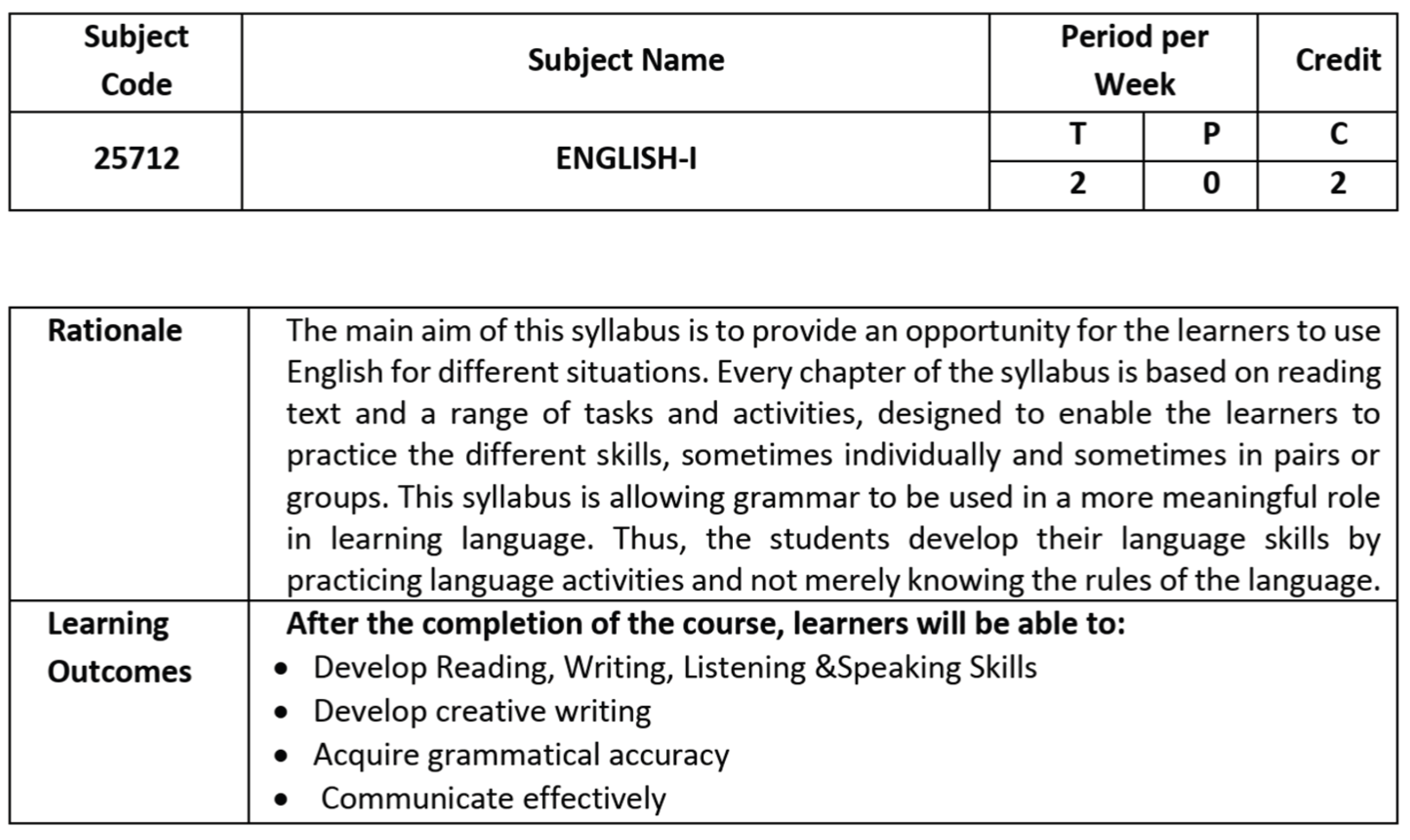
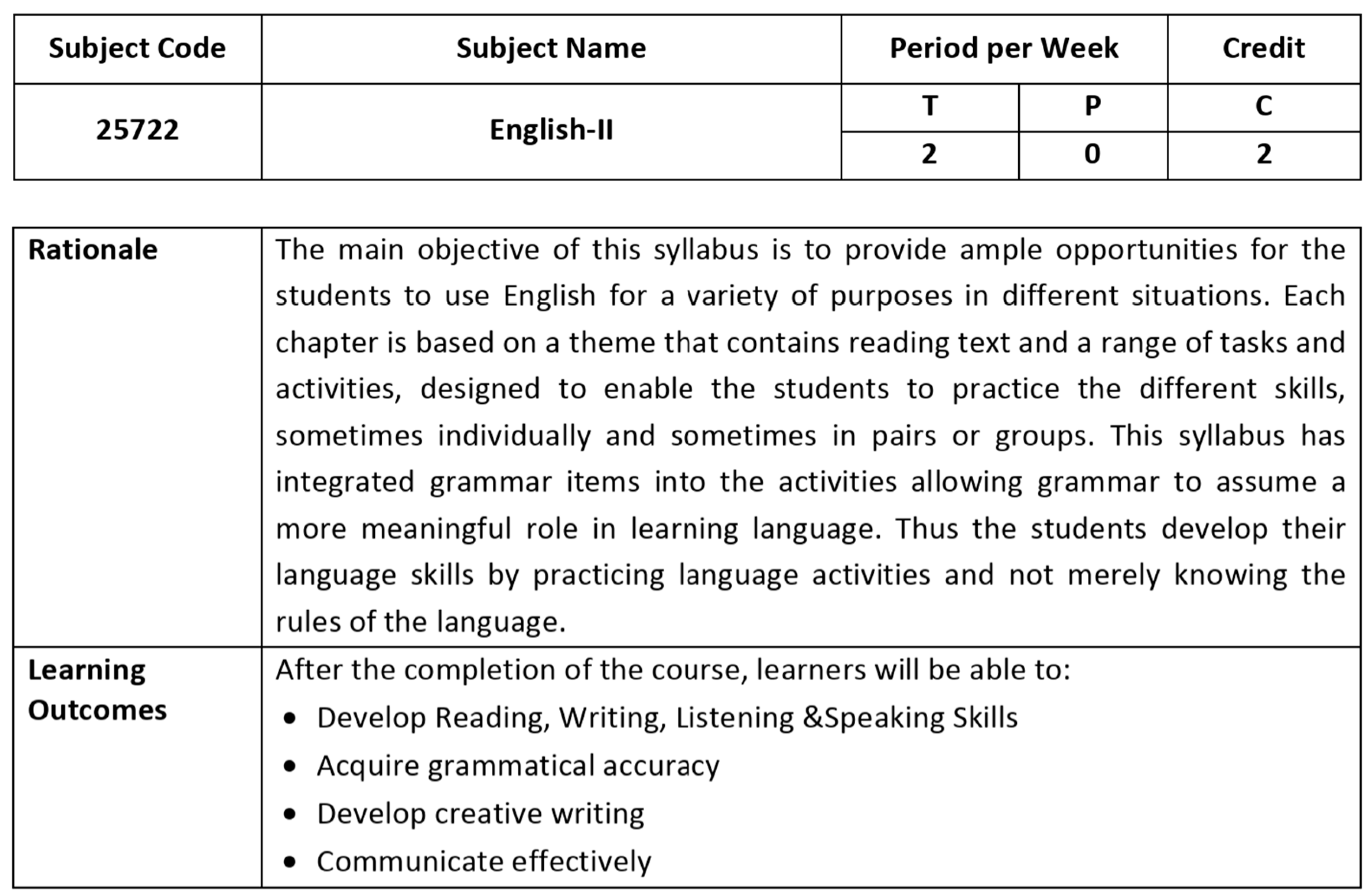
References
- International Labour Organization. (2015). Skills for the international labour market: Bangladesh country report. ILO.
- International Labour Organization. (2020). Skills development for overseas employment. ILO Country Office for Bangladesh.
- Allais, S. (2010). The implementation and impact of National Qualifications Frameworks: Report of a study in 16 countries. International Labour Office, Skills and Employability Department.
- Ullah, M. S., & Jabber, M. A. (2024). The Role of Stakeholders in Bangladesh’s TVET and Apprenticeship Systems: A Comprehensive Analysis. Friedrich-Ebert-Stiftung Bangladesh & SME Foundation.
- Habib, M. A., Rahman, S., Kabir, M. M. N., & Rahman, R. (2020). English Language Learning at TVET Institutes of Bangladesh: Women’s Perception, Participation and Aspiration. NAEM Journal, 15(2), 102-113.
- Use of English in engineering workplace: Frequency, skill hierarchy, and functions. (2025). Ampersand, Article 100252. [CrossRef]
- Zhan, S., Chapman, E., Valentine, A., & Male, S. (2026). Enhancing the measurement of employability in engineering: Insights from a systematic literature review. European Journal of Engineering Education, 51(1), 172-191. [CrossRef]
- Ahmad Kamil, M., & Muhammad, A. M. (2021). Professional communication competence in English for occupational purposes (EOP) courses: A systematic literature review and proposal of a framework. Journal of Teaching and Learning for Graduate Employability, 12(2), 260-278. [CrossRef]
- Winberg, C., Bramhall, M., Greenfield, D., Johnson, P., Rowlett, P., Lewis, O., Waldock, J., & Wolff, K. (2020). Developing employability in engineering education: A systematic review of the literature. European Journal of Engineering Education, 45(2), 165-180. [CrossRef]
- Patel, J., & Patel, M. (2026). Bridging the Gap between Academia and Industry: A Stakeholder-Based Evaluation of English Communication Skills Curriculum for Enhancing Employability among Diploma Engineering Students. International Journal of Computer Information Systems and Industrial Management Applications, 18(8s), 457-464. [CrossRef]
- Altaf, H., & Shabir, Q. A. (2024). Systematic Evaluation of Existing Policies and Practices in Technical and Vocational Education and Training (TVET) and their Implications for Employment and Industrial Growth in Pakistan. International Research Journal of Management and Social Sciences, 5(2), 140-156.
- Khan, M. S. H., Salele, N., Hasan, M., & Abdou, B. O. (2023). Factors affecting student readiness towards OBE implementation in engineering education: Evidence from a developing country. Heliyon, 9(10), e20905. [CrossRef]
- Akteruzzaman, M., & Sattar, S. B. (2020). The Struggles of Attending Introductory English Courses in Bangladeshi Universities. International Journal of Linguistics, Literature and Translation, 3(7), 223-231. [CrossRef]
- Roy, S., Huq, S., & Binte Abdur Rob, A. (2020). Faith and education in Bangladesh: A review of the contemporary landscape and challenges. International Journal of Educational Development, 79, 102290. [CrossRef]
- Haolader, F. A., & Paul, D. K. (2013). The Present Status of Polytechnic Curriculum and Student Assessment Approach in Bangladesh. Asian Journal of Management Sciences and Education, 2(1), 125-136.
- Lazarova, I., Balieva, G., & Fossati, P. (2026). Knowledge, Practical Skills, and Educational Needs of Veterinary Students in Wildlife Management: A Comparative Survey in Bulgaria and Italy. Conservation, 6(3), 106. [CrossRef]
- Peng, Y., Awang, M. M., & Yaccob, N. S. (2026). AI Literacy in English Language Education: A Systematic Review from a Social Ecological Perspective. Education Sciences, 16(8), 1182. [CrossRef]
- Nabhan, S., & Habók, A. (2026). Assessing Multiliteracies in English Language Teacher Education: The Perceived Levels of Multiliteracies and the Impact of Demographic Factors. Education Sciences, 16(7), 1104. [CrossRef]
- Gross, K., Kellner, M., & Urbann, K. (2026). Challenges and Professionalization in Teaching English to Deaf and Hard-of-Hearing Students: A Qualitative Study of Teacher Perspectives. Education Sciences, 16(4), 635. [CrossRef]
- EL Arid, A., Al-Khatib, O., Osman, R., Nassreddine, G., & EL Chakik, A. (2026). AI-Assisted Learning Systems for Enhancing English as a Foreign Language Outcomes in Lebanese High Schools. Education Sciences, 16(4), 517. [CrossRef]
- Smith, M. D. (2026). Beyond “Technical Doing”: Reimagining Artistry in the English Curriculum. Education Sciences, 16(3), 420. [CrossRef]
- Chen, Y., Huang, C., Gao, S., Lyu, Y., Chen, X., Liu, S., Bao, D., & Lv, C. (2025). A Multimodal Deep Learning Approach for Legal English Learning in Intelligent Educational Systems. Sensors, 25(11), 3397. [CrossRef]
- Bangladesh Technical Education Board. (2022). Diploma in Engineering Curriculum, Probidhan-2022.
- Bangladesh Technical Education Board. (2022). Diploma in Engineering first-semester syllabus, Probidhan-2022.
- Bangladesh Technical Education Board. (2022). Diploma in Engineering second-semester syllabus, Probidhan-2022.
Figure 1.
Two-phase methodological framework.
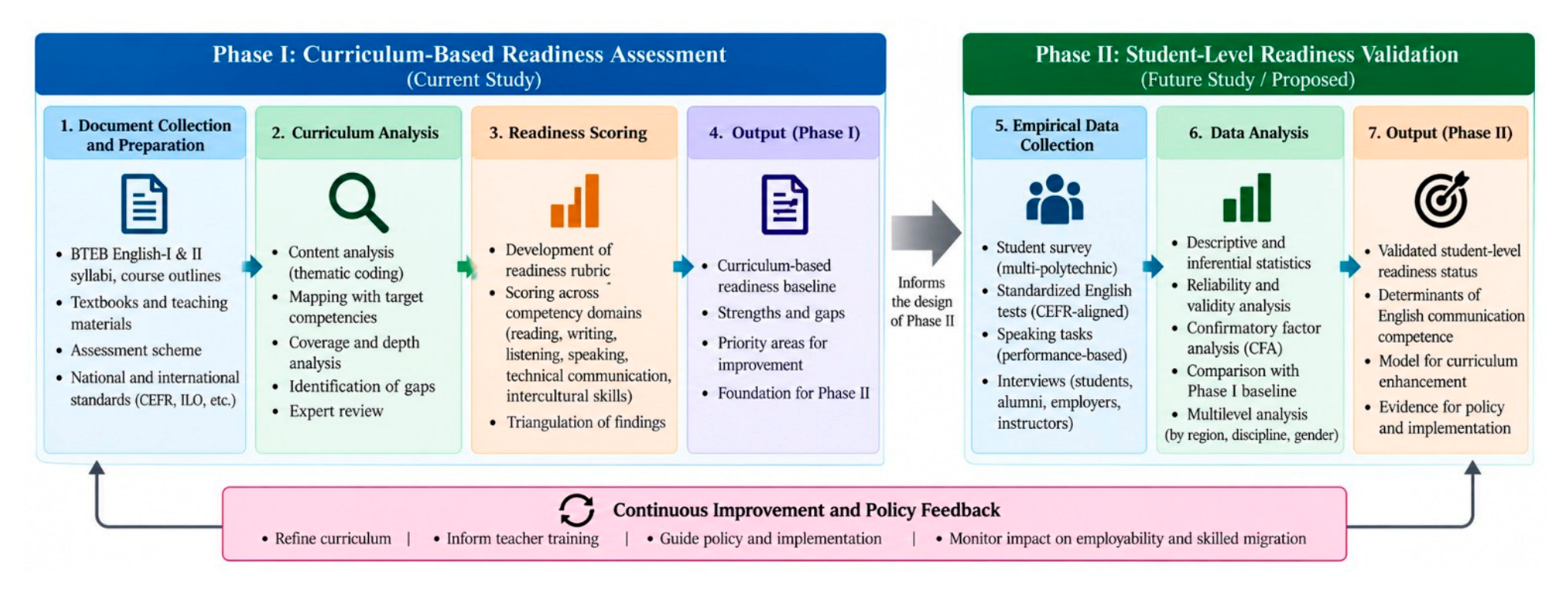
Figure 2.
Observed curriculum emphasis versus the skilled-migration benchmark across ten communication domains.
Figure 2.
Observed curriculum emphasis versus the skilled-migration benchmark across ten communication domains.
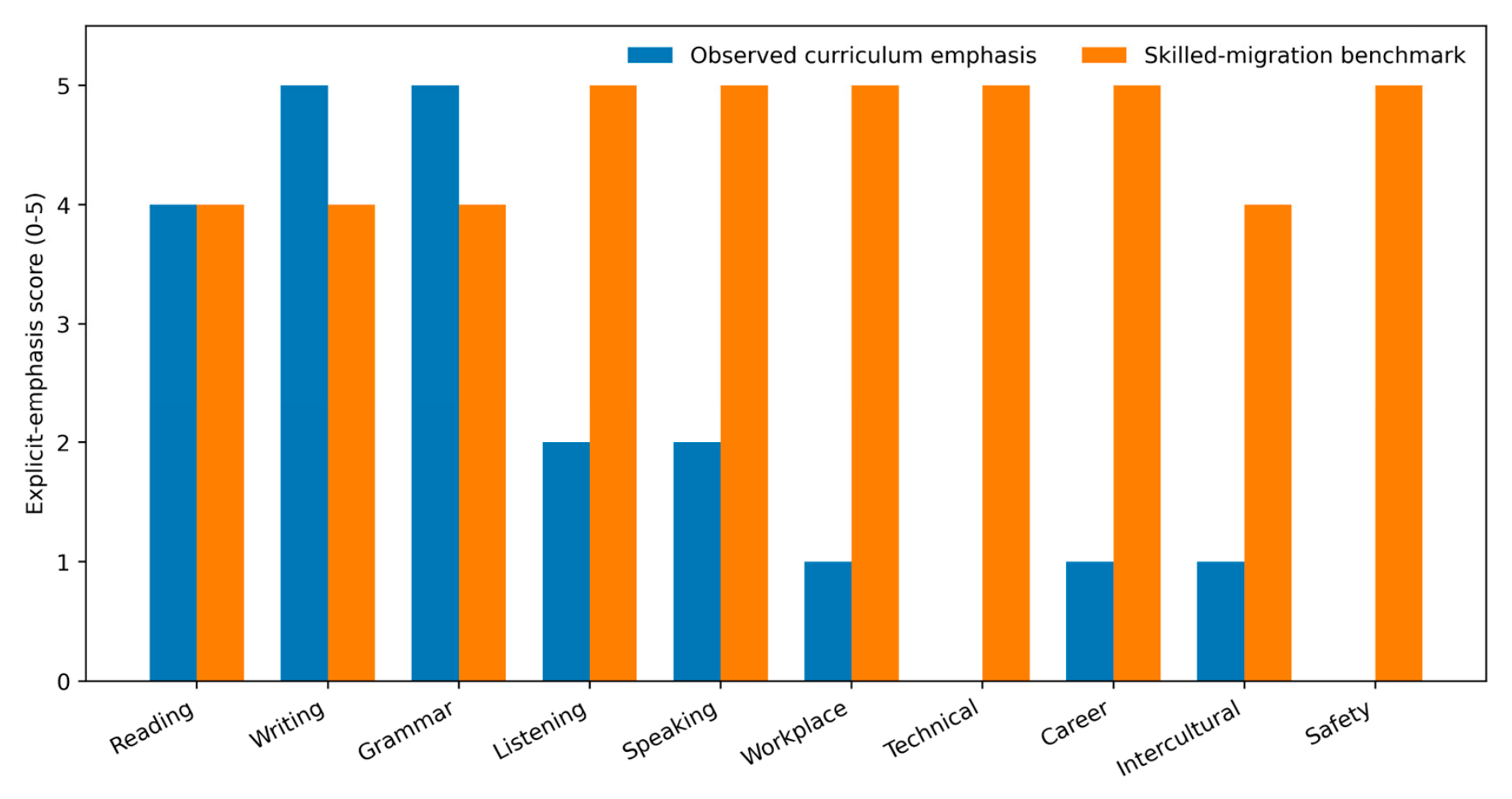
Figure 3.
Domain Alignment Ratio (DAR) by competency. The dashed line is an 80% descriptive alignment reference, not a validated cut score.
Figure 3.
Domain Alignment Ratio (DAR) by competency. The dashed line is an 80% descriptive alignment reference, not a validated cut score.
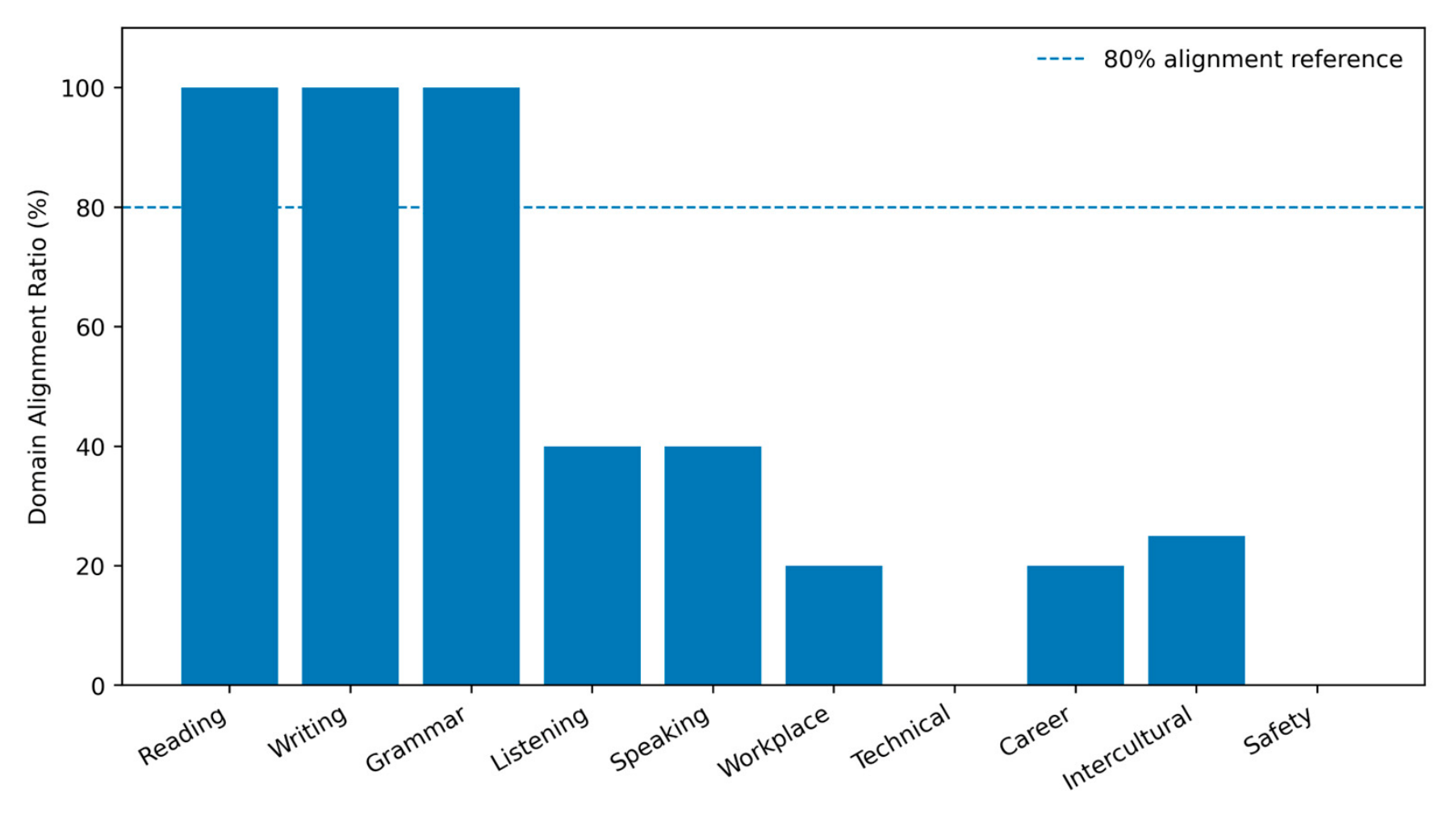
Figure 4.
Sensitivity of the Curriculum Readiness Alignment Index (CRAI) to alternative domain-weighting assumptions.
Figure 4.
Sensitivity of the Curriculum Readiness Alignment Index (CRAI) to alternative domain-weighting assumptions.
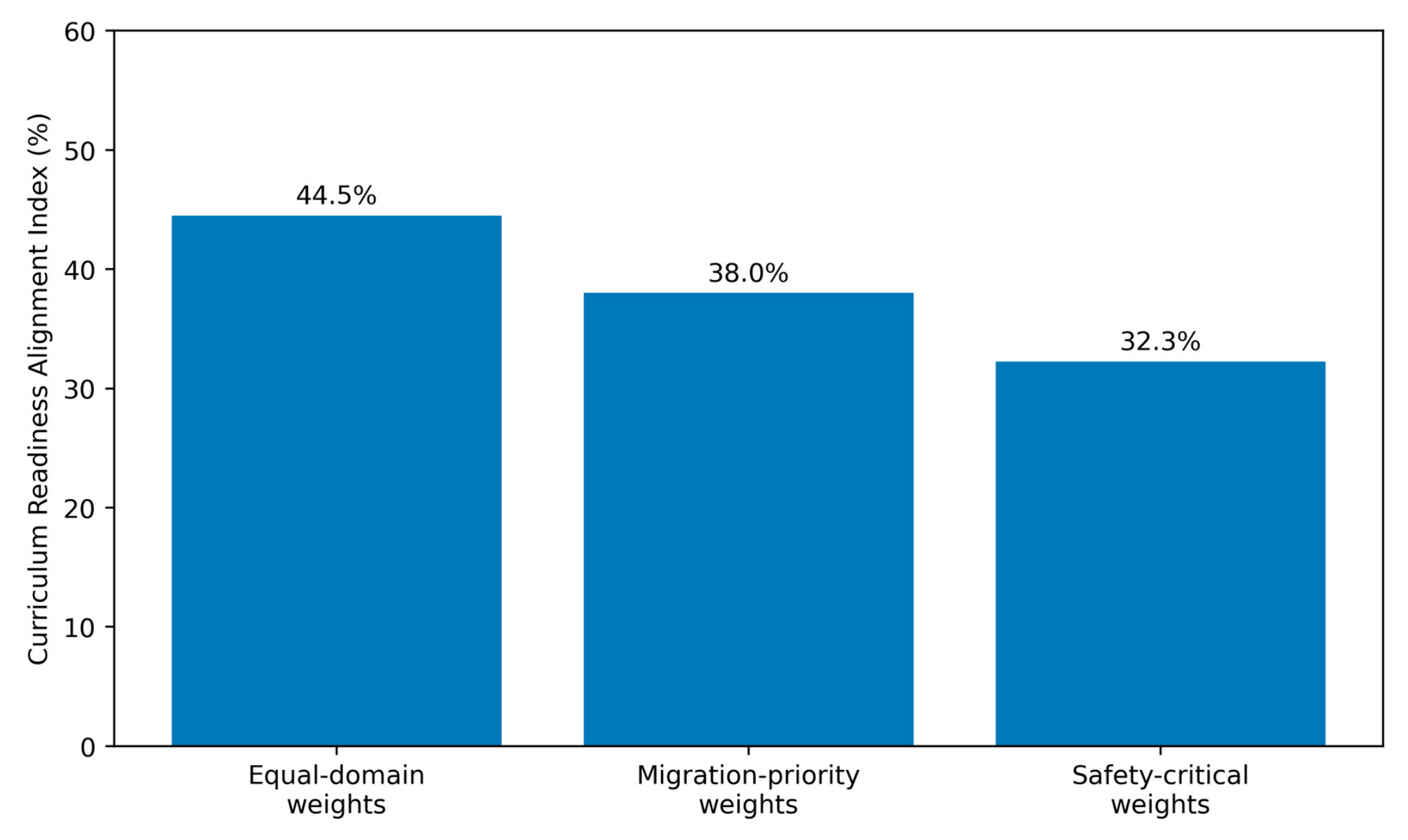
Figure 5.
Positive Readiness Deficit Scores by domain. Domains at zero have no positive benchmark deficit under the coding model.
Figure 5.
Positive Readiness Deficit Scores by domain. Domains at zero have no positive benchmark deficit under the coding model.
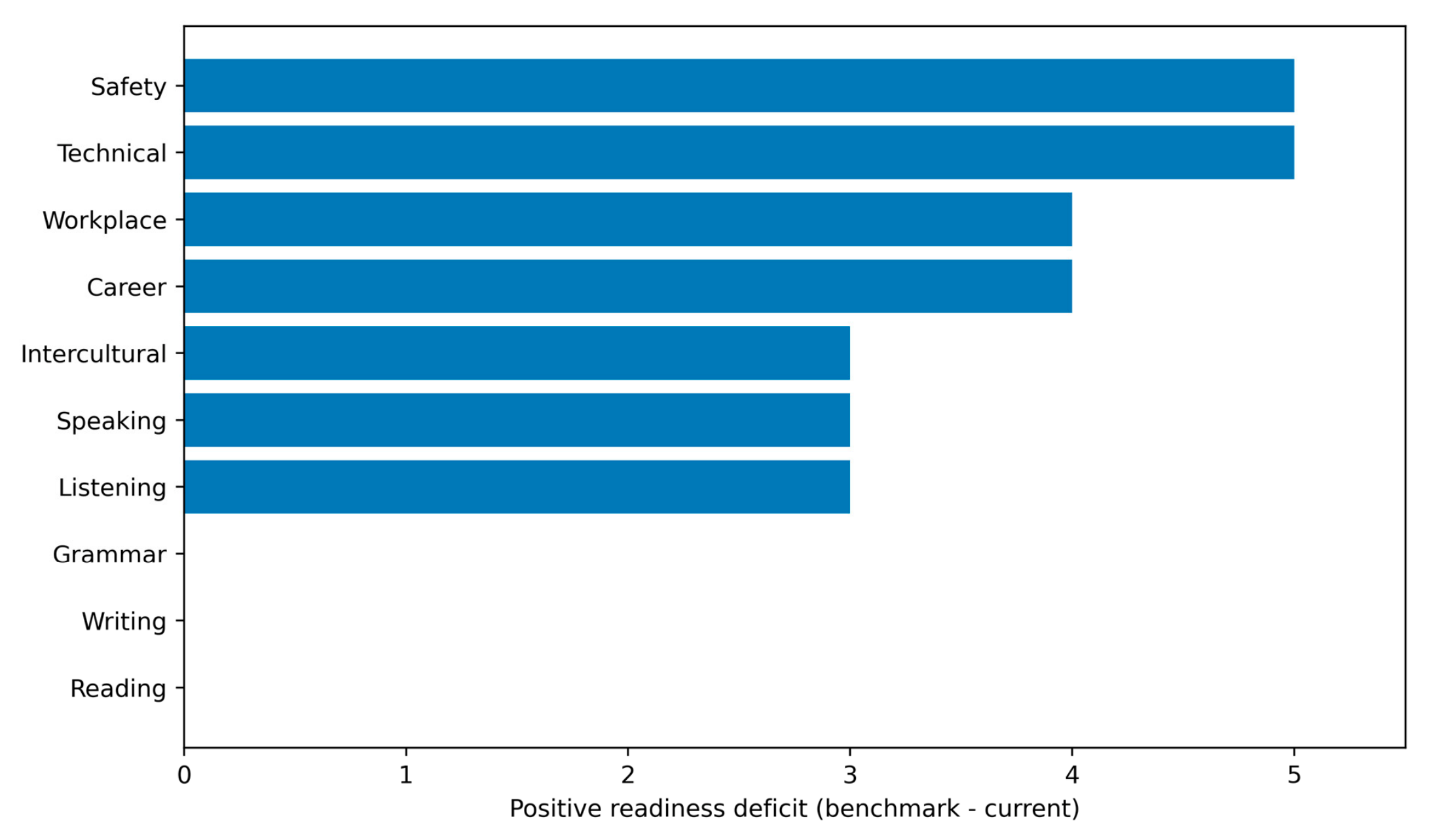
Figure 6.
Published BTEB English assessment allocation used for assessment-alignment analysis.
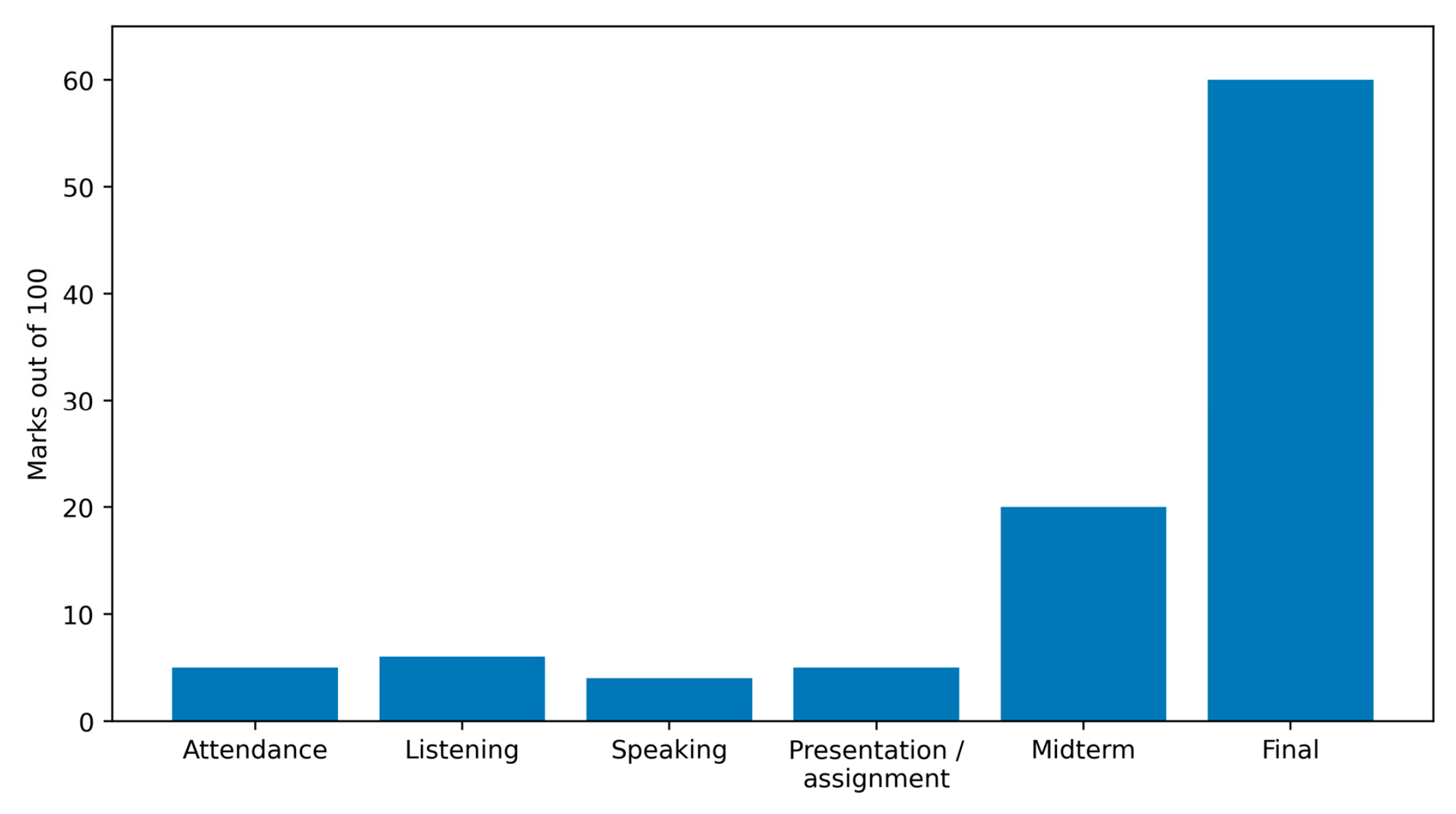
Figure 7.
Competency-alignment heatmap integrating current emphasis, benchmark, positive deficit and domain alignment ratio.
Figure 7.
Competency-alignment heatmap integrating current emphasis, benchmark, positive deficit and domain alignment ratio.
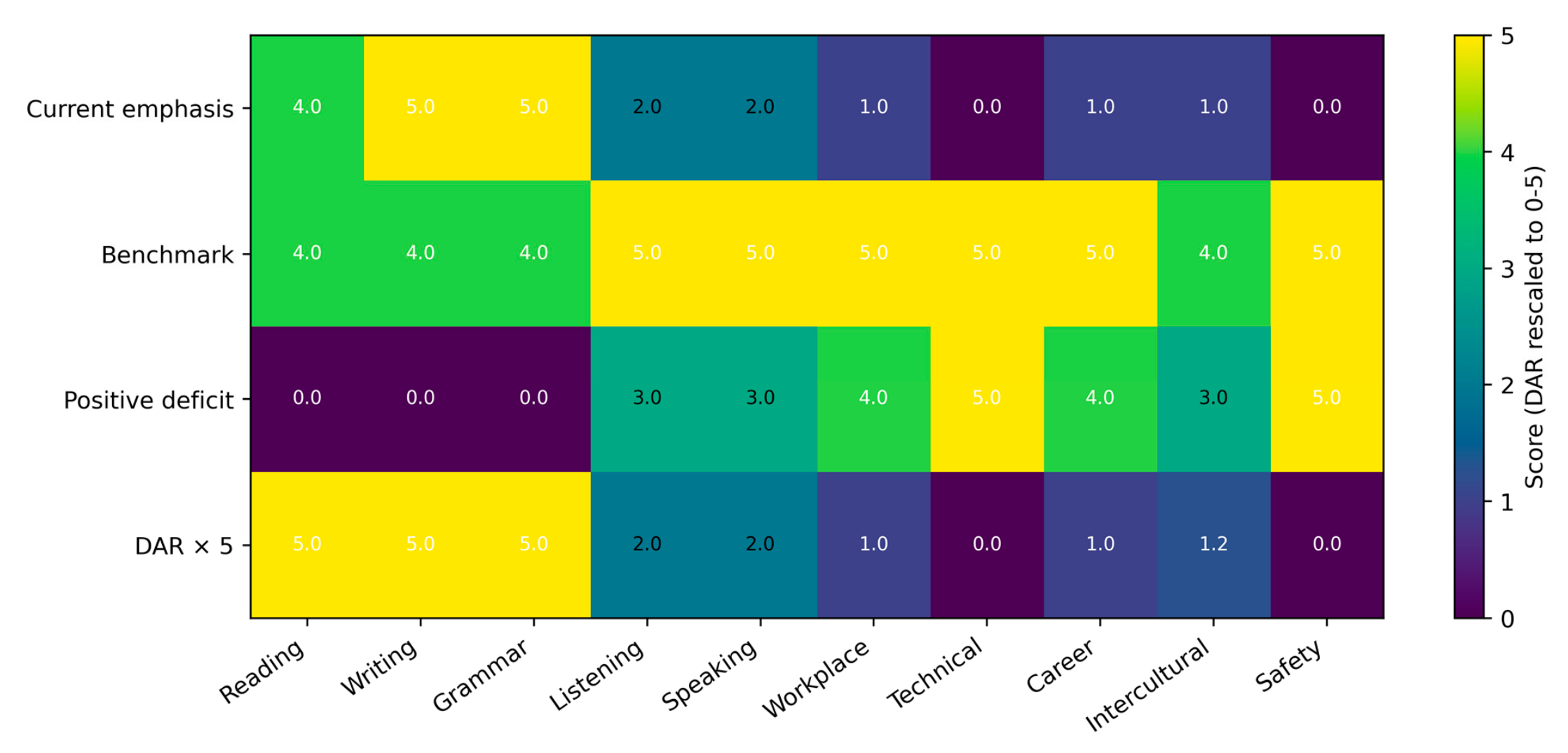
Figure 8.
Monte Carlo uncertainty analysis of CRAI under 20,000 plausible domain-weight vectors drawn from a Dirichlet distribution centered on the migration-priority weighting scheme.
Figure 8.
Monte Carlo uncertainty analysis of CRAI under 20,000 plausible domain-weight vectors drawn from a Dirichlet distribution centered on the migration-priority weighting scheme.
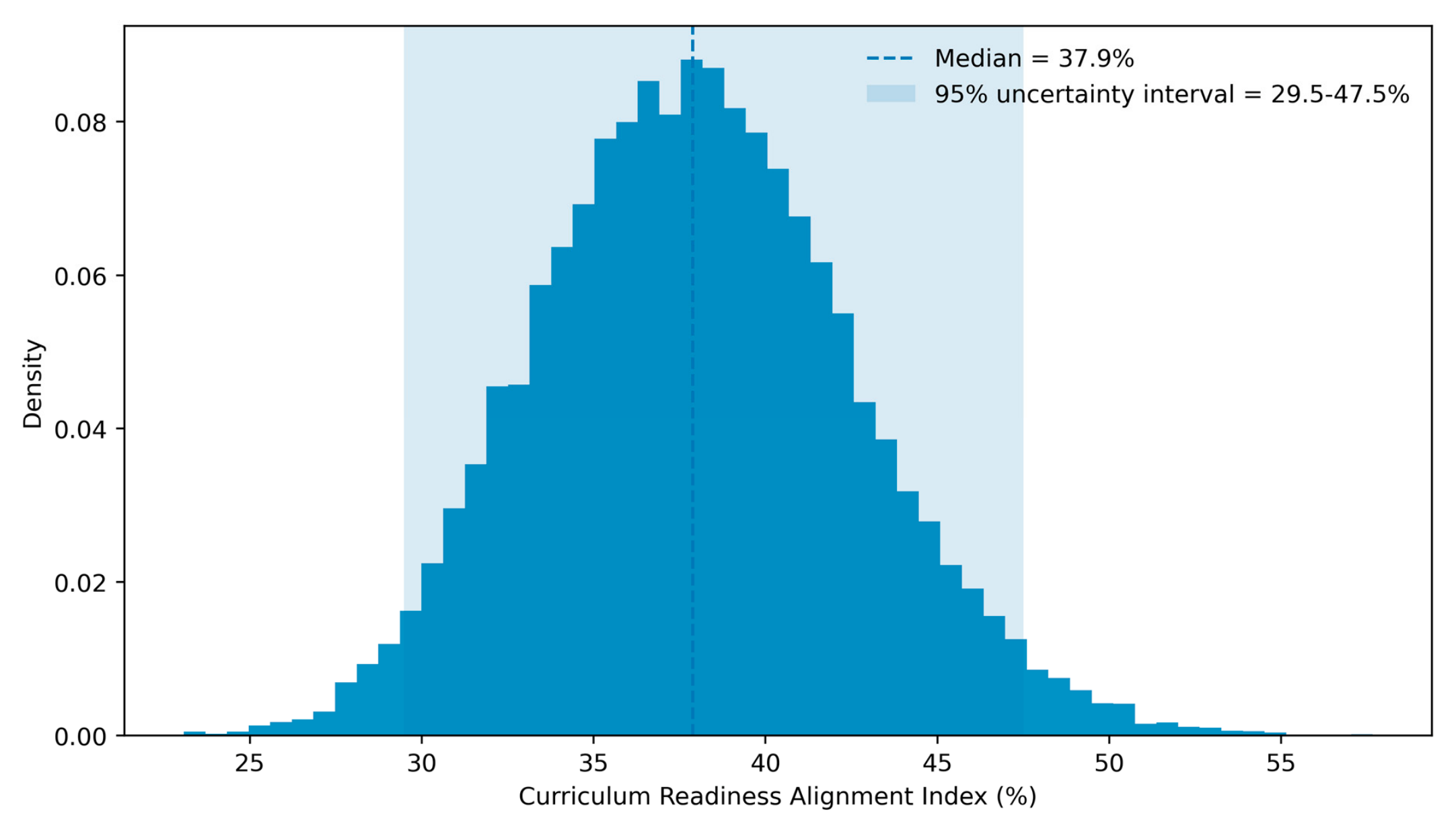
Figure 9.
Radar representation of the multidimensional curriculum profile and skilled-migration benchmark.
Figure 9.
Radar representation of the multidimensional curriculum profile and skilled-migration benchmark.
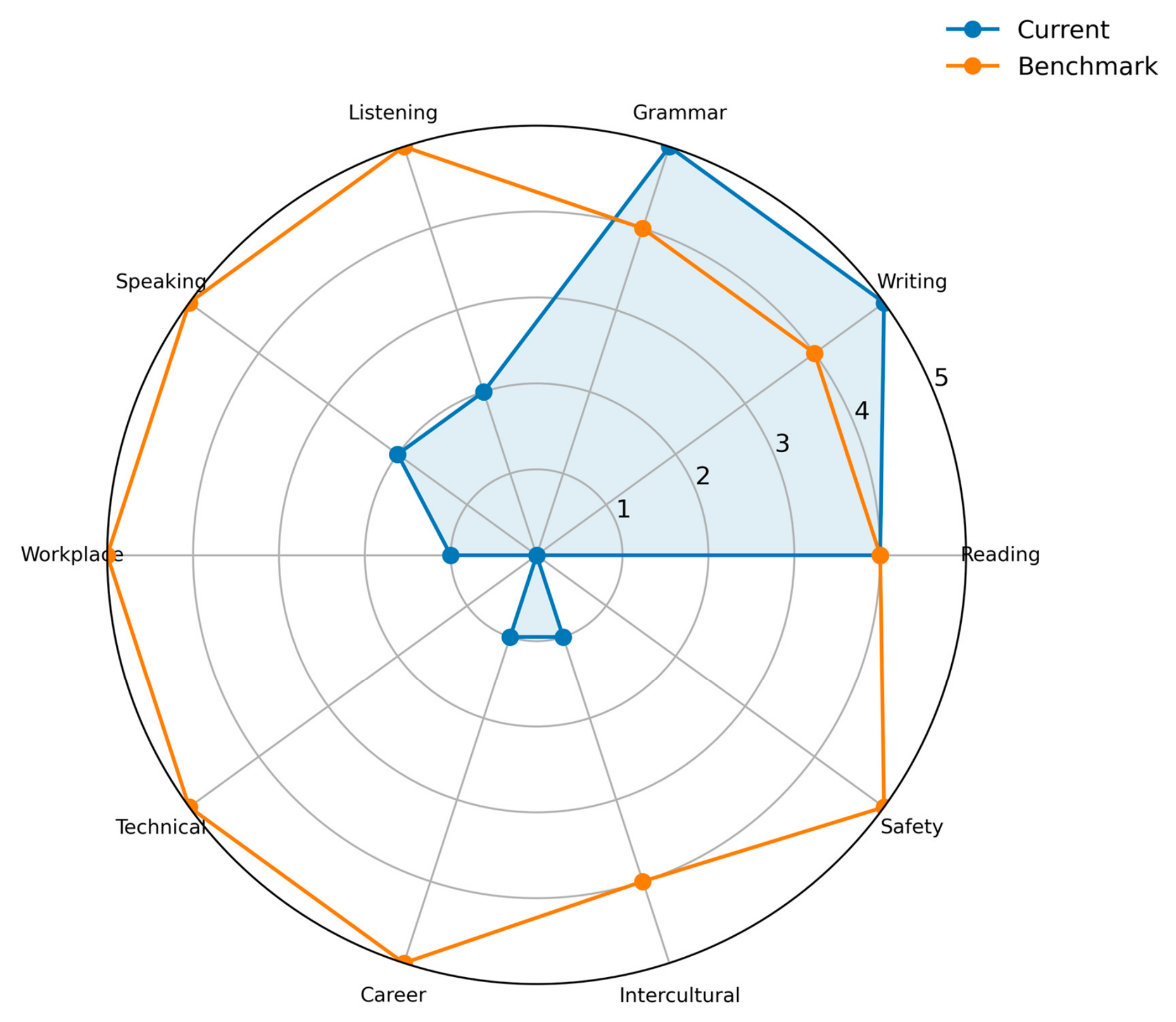
Figure 10.
Pareto analysis of positive readiness deficits. The cumulative curve identifies the small set of domains responsible for most measured misalignment.
Figure 10.
Pareto analysis of positive readiness deficits. The cumulative curve identifies the small set of domains responsible for most measured misalignment.
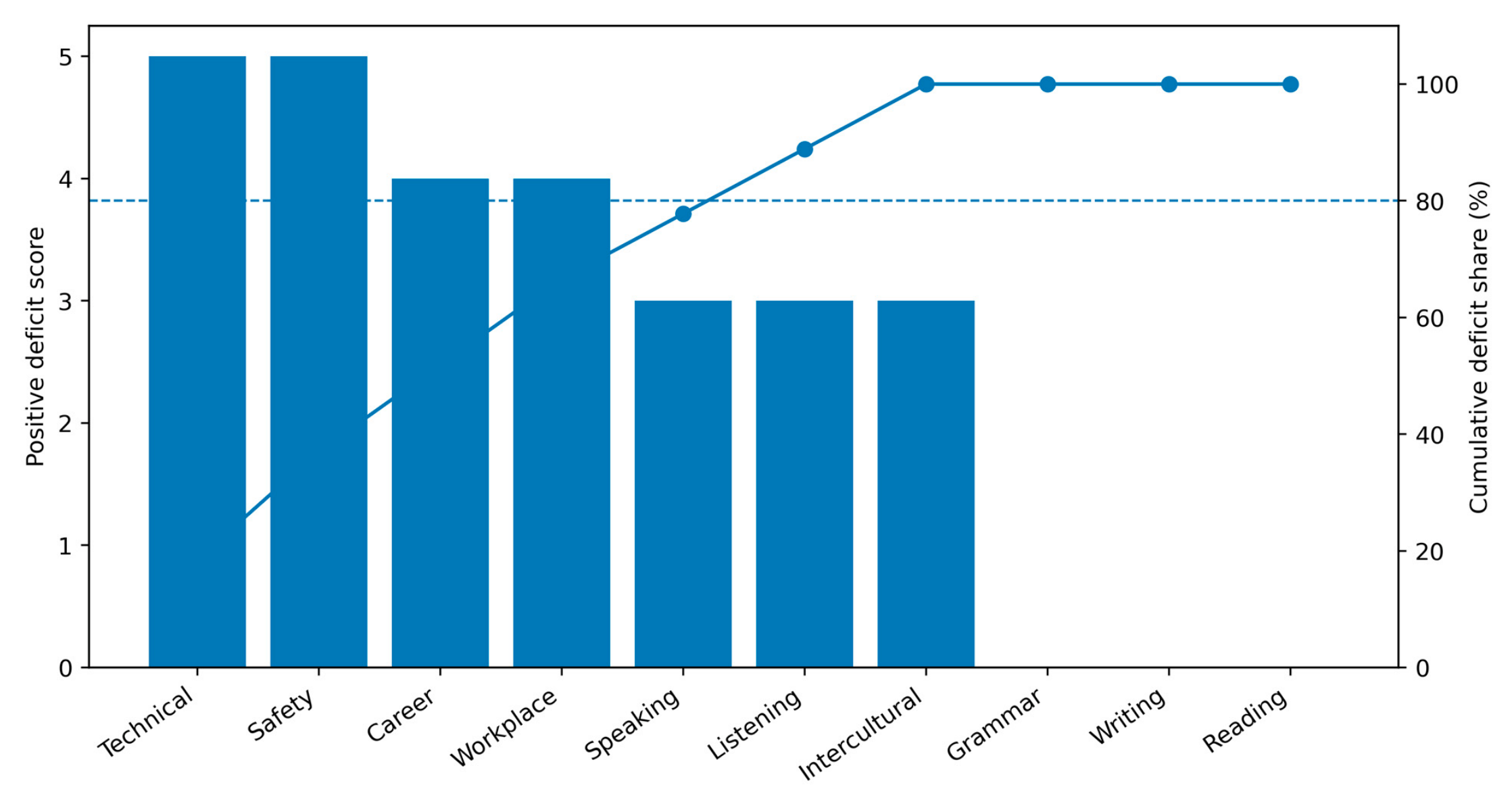
Figure 11.
Leave-one-domain-out sensitivity of the migration-priority CRAI. The dashed reference indicates the full weighted CRAI of 37.9%.
Figure 11.
Leave-one-domain-out sensitivity of the migration-priority CRAI. The dashed reference indicates the full weighted CRAI of 37.9%.
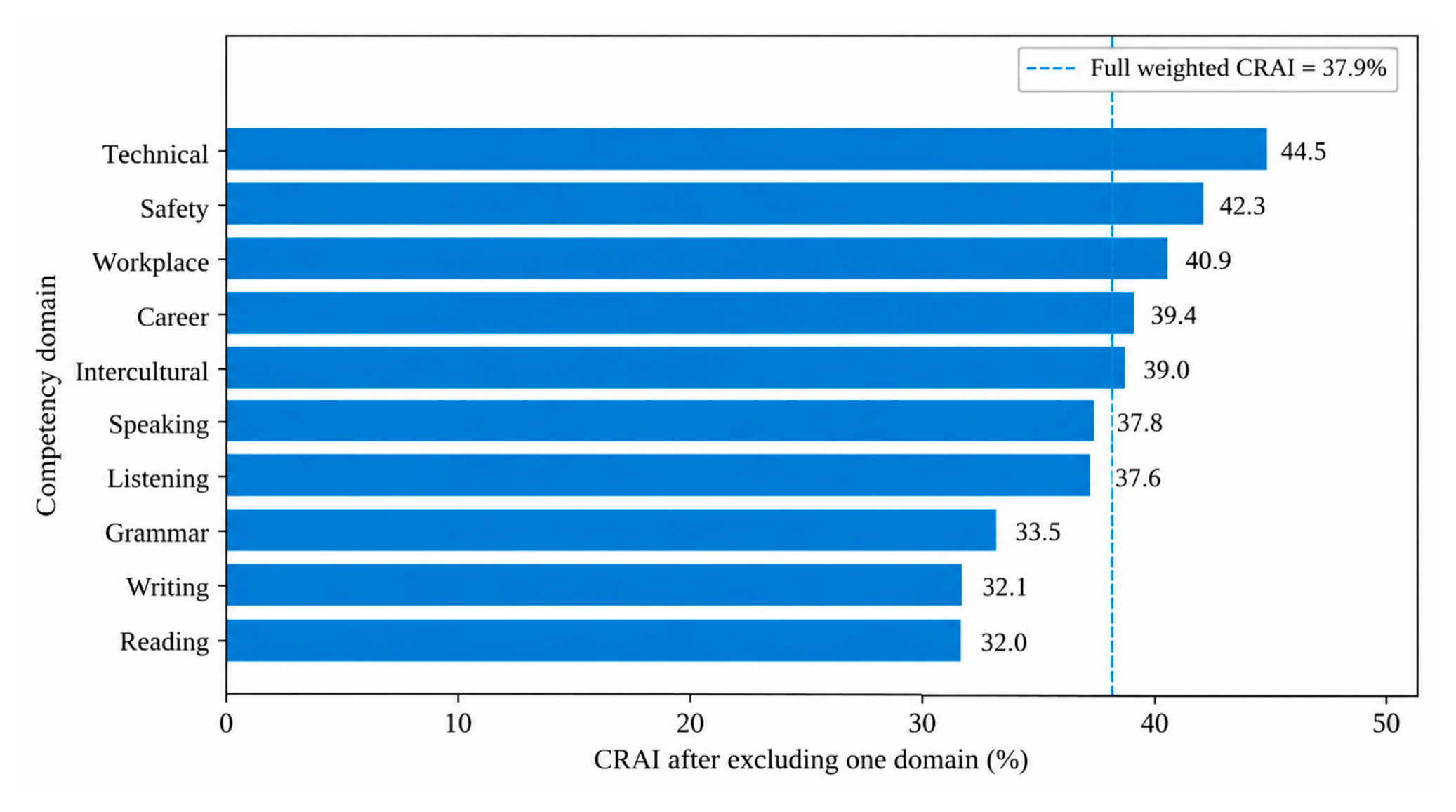
Figure 12.
Importance–alignment priority matrix based on migration-priority weights and observed Domain Alignment Ratios.
Figure 12.
Importance–alignment priority matrix based on migration-priority weights and observed Domain Alignment Ratios.
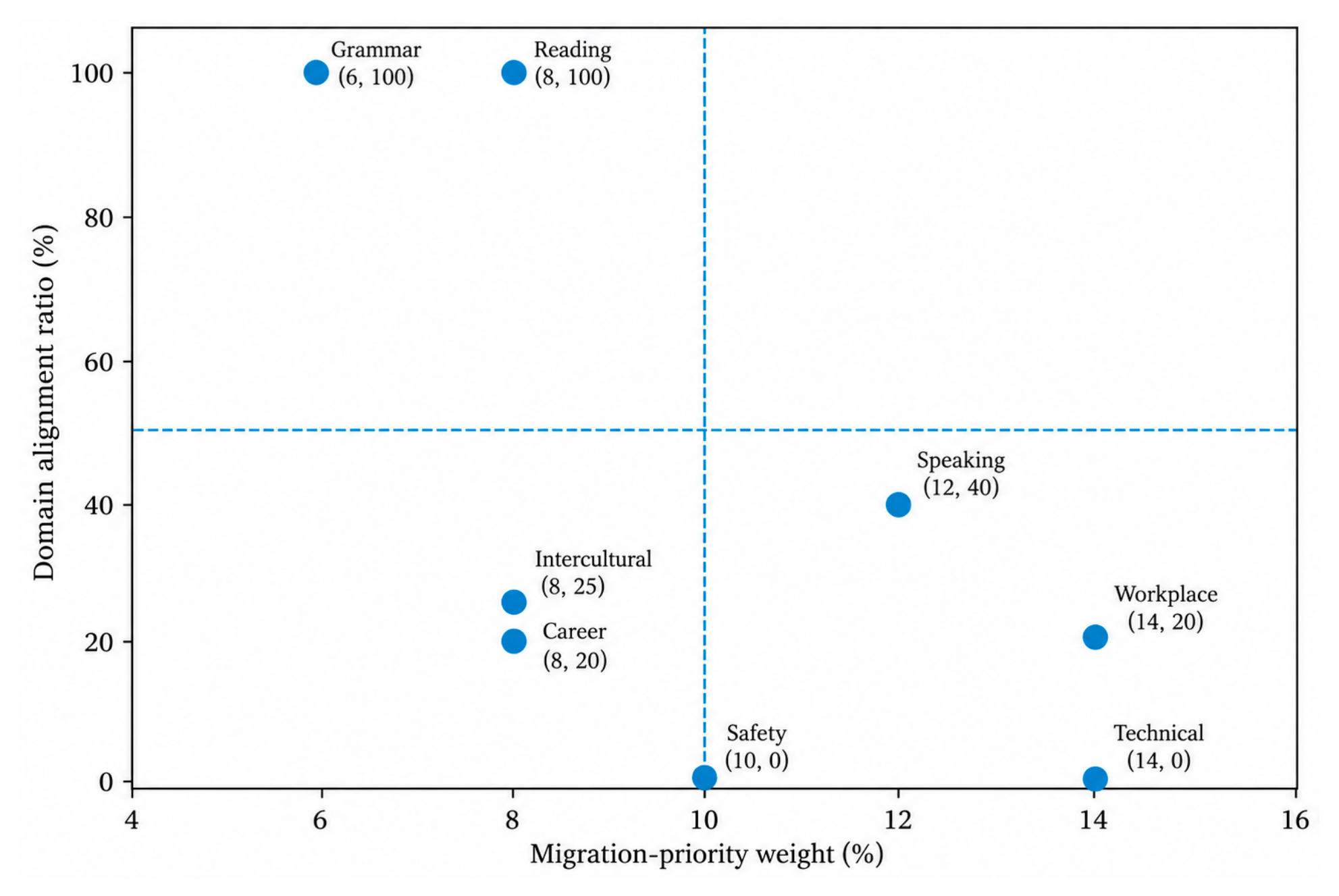
Table 1.
Operational framework for coding English communication competencies relevant to skilled-migration readiness.
Table 1.
Operational framework for coding English communication competencies relevant to skilled-migration readiness.
| Code | Competency domain | Operational definition |
|---|---|---|
| D1 | General reading/comprehension | Ability to interpret general and semi-technical written information accurately. |
| D2 | General writing/composition | Ability to produce coherent and appropriately organized general or academic written texts. |
| D3 | Grammar and language accuracy | Appropriate and intelligible use of grammatical and linguistic resources. |
| D4 | Listening | Ability to understand spoken information, instructions, explanations, and workplace interaction. |
| D5 | Speaking and presentation | Ability to explain information, present ideas, respond appropriately, and participate in oral interaction. |
| D6 | Workplace communication | Ability to participate in meetings, teamwork, briefings, handovers, clarification exchanges, and supervisor–employee interaction. |
| D7 | Technical English | Ability to use technical terminology and interpret manuals, specifications, work instructions, processes, measurements, and related technical information. |
| D8 | Career communication | Ability to prepare employment documents and participate effectively in applications, interviews, and professional self-presentation. |
| D9 | Intercultural communication | Ability to communicate appropriately across linguistic, cultural, professional, and organizational differences. |
| D10 | Safety and procedural communication | Ability to understand and communicate hazards, warnings, procedures, safety requirements, emergency information, and required actions. |
Table 2.
Alternative weighting scenarios used for CRAI sensitivity analysis.
| Scenario | Weighting rationale | CRAI |
|---|---|---|
| A: Equal-domain | All ten competency domains receive equal weight (10% each). | 44.5% |
| B: Migration-priority | Greater weight is assigned to oral, workplace, and technical communication. | 38.0% |
| C: Safety-critical | Greater weight is assigned to listening, speaking, workplace, technical, and safety/procedural communication. | 32.3% |
Table 3.
Domain-level curriculum alignment with the skilled-migration English communication benchmark.
Table 3.
Domain-level curriculum alignment with the skilled-migration English communication benchmark.
| Code | Competency domain | Current | Target | Gap | DAR | Analytical priority |
|---|---|---|---|---|---|---|
| D1 | General reading | 4 | 4 | 0 | 100% | Aligned |
| D2 | General writing | 5 | 4 | −1 | 100% | Aligned/excess |
| D3 | Grammar/accuracy | 5 | 4 | −1 | 100% | Aligned/excess |
| D4 | Listening | 2 | 5 | 3 | 40% | High |
| D5 | Speaking/presentation | 2 | 5 | 3 | 40% | High |
| D6 | Workplace communication | 1 | 5 | 4 | 20% | Critical |
| D7 | Technical English | 0 | 5 | 5 | 0% | Critical |
| D8 | Career communication | 1 | 5 | 4 | 20% | Critical |
| D9 | Intercultural communication | 1 | 4 | 3 | 25% | High |
| D10 | Safety/procedural communication | 0 | 5 | 5 | 0% | Critical |
Table 4.
Sensitivity of CRAI to alternative competency-weighting assumptions.
| Weighting scenario | Analytical rationale | CRAI |
|---|---|---|
| Equal-domain | Each of the ten domains receives 10% weight | 44.5% |
| Migration-priority | Greater emphasis on oral, workplace, and technical communication | 38.0% |
| Safety-critical | Greater emphasis on oral, workplace, technical, and safety communication | 32.3% |
Table 5.
Principal quantitative findings from the Phase I curriculum-readiness analysis.
| Analytical dimension |
Quantitative evidence | Interpretation |
|---|---|---|
| Foundational alignment | Reading, writing, grammar DAR=100% | Strong representation of general-language foundations |
| Oral communication | Listening and speaking DAR = 40% each | Oral/interactive opportunities remain below the benchmark |
| Occupational communication | Workplace = 20%; technical = 0%; career = 20%; safety = 0% | Largest structural gaps occur in workplace-oriented communication |
| Deficit concentration | Four largest domains = 66.7% of positive RDS | Misalignment is concentrated rather than evenly distributed |
| Weighting robustness | CRAI = 32.3–44.5% | Broad interpretation persists under three weighting assumptions |
| Assessment structure | Oral = 10%; explicit performance = 15%; final examination = 60% | Direct communicative performance receives comparatively limited formal weighting |
Table 6.
Proposed competency strands, authentic learning tasks, and observable performance indicators for a redesigned Diploma Engineering English curriculum.
Table 6.
Proposed competency strands, authentic learning tasks, and observable performance indicators for a redesigned Diploma Engineering English curriculum.
| Curriculum strand | Representative authentic tasks | Observable performance indicators |
|---|---|---|
| Technical literacy | Manuals, work orders, specifications, quantities, diagrams and process descriptions | Accurate information extraction; appropriate technical vocabulary; correct interpretation and explanation of processes |
| Workplace listening | Instructions, toolbox talks, briefings, telephone/radio messages | Identification of key details; inference of required action; accurate confirmation and clarification |
| Technical speaking and interaction | Shift handover, troubleshooting, briefing, meeting and supervisor interaction | Intelligibility; logical sequencing; technical accuracy; responsiveness; interactional effectiveness |
| Workplace writing | Professional email, inspection note, incident report and handover log | Clear purpose; completeness; concision; organization; appropriate terminology and language control |
| Safety and procedural communication | Hazards, PPE instructions, permits, warnings and emergency communication | Unambiguous risk communication; procedural accuracy; confirmation/read-back; appropriate urgency |
| Career communication | Job advertisements, CVs, cover letters and interviews | Evidence-based self-presentation; explanation of qualifications and experience; appropriate interaction |
| Intercultural workplace communication | Hierarchy, disagreement, clarification and multicultural teamwork scenarios | Appropriateness; politeness; interactional repair; professional tone; sensitivity to communicative context |
Table 7.
Evidence-informed recommendations for curriculum development, assessment, and implementation.
Table 7.
Evidence-informed recommendations for curriculum development, assessment, and implementation.
| Priority | Recommendation | Rationale |
|---|---|---|
| 1 | Pilot a competency-based ESP/EOP curriculum before national implementation | Allows feasibility and effectiveness to be evaluated before large-scale adoption |
| 2 | Increase authentic listening, speaking, and interactive assessment | Responds to the 40% DAR for listening/speaking and the limited formal weighting of oral performance |
| 3 | Establish technical English and safety/procedural communication as explicit, assessed strands | Directly addresses the two largest domain deficits |
| 4 | Develop technology-specific task banks within common national competency outcomes | Preserves national comparability while increasing disciplinary authenticity |
| 5 | Introduce analytic performance rubrics, rater training, and reliability checks | Supports transparent and reproducible interpretation of performance scores |
| 6 | Triangulate evidence from students, instructors, technical teachers, employers, recruiters, and migrant graduates | Strengthens target-situation validity and reduces dependence on a single stakeholder perspective |
| 7 | Report effect sizes, uncertainty intervals, reliability, validity, and measurement invariance in subsequent evaluation | Improves the statistical and psychometric defensibility of Phase II findings |
| 8 | Incorporate destination-specific language and cultural preparation when labour-market evidence supports it | Avoids assuming that English alone satisfies the communication requirements of every destination |
| 9 | Link periodic curriculum review with employer feedback and graduate tracer evidence | Creates an evidence loop between training provision and subsequent workplace experience |
| 10 | Restrict CRAI to curriculum-level monitoring rather than individual certification | CRAI measures curriculum-to-benchmark alignment and is not a student proficiency or migration-readiness test |
Table 8.
Proposed Phase II validation framework and minimum statistical reporting requirements.
| Validation question | Recommended analysis | Minimum reporting |
|---|---|---|
| Are performance ratings reproducible? | Weighted κ and/or ICC | Estimate and 95% CI; rater design and scoring procedure |
| Do tasks measure the intended competency domains? | CFA and factor reliability analysis | Standardized loadings, omega, model-fit indices and residual diagnostics |
| Is the construct comparable across relevant groups? | Measurement-invariance analysis | Configural, metric and scalar results with changes in fit |
| Is there meaningful institution-level variation? | Multilevel modelling | ICC, fixed effects, random effects and uncertainty intervals |
| Does communication readiness relate to external workplace performance? | Criterion-validity regression | Standardized coefficients, incremental , effect sizes and 95% CI |
| Does the redesigned curriculum improve performance? | Controlled pre–post multilevel model/ANCOVA or appropriate quasi-experimental model | Baseline-adjusted difference, standardized effect size, 95% CI and sensitivity analysis |
Disclaimer/Publisher’s Note: The statements, opinions and data contained in all publications are solely those of the individual author(s) and contributor(s) and not of MDPI and/or the editor(s). MDPI and/or the editor(s) disclaim responsibility for any injury to people or property resulting from any ideas, methods, instructions or products referred to in the content. |
© 2026 by the authors. Licensee MDPI, Basel, Switzerland. This article is an open access article distributed under the terms and conditions of the Creative Commons Attribution (CC BY) license (http://creativecommons.org/licenses/by/4.0/).
Copyright: This open access article is published under a Creative Commons CC BY 4.0 license, which permit the free download, distribution, and reuse, provided that the author and preprint are cited in any reuse.