

Submitted:
18 September 2026
Posted:
20 September 2026
You are already at the latest version
Abstract
Static stretching is widely used in sports medicine, rehabilitation, and exercise science to improve joint range of motion (ROM) and flexibility. However, its effects on human movement remain incompletely understood because biomechanical out-comes—including ROM, passive mechanical properties, force production, power output, stretch–shortening cycle function, jumping performance, landing biomechanics, and postural stability—have often been examined separately. Consequently, the relation-ships among tissue-level responses, neuromechanical responses, and task-specific func-tional outcomes remain incompletely integrated. This integrative review synthesizes current evidence across these biomechanical domains and proposes a framework for interpreting their relationships without assuming a fixed causal or sequential pathway. Current evidence indicates that static stretching consistently increases ROM, whereas changes in passive mechanical properties are more tissue- and protocol-dependent. Acute static stretching may transiently reduce maximal force and power, particularly following longer stretching durations, whereas repeated stretching generally produces neutral or modestly beneficial effects on strength-related outcomes. Effects on power and stretch–shortening cycle function, jumping performance, landing biomechanics, and postural stability are more heterogeneous and vary according to stretching exposure, participant characteristics, task demands, and testing conditions. Importantly, responses observed within one biomechanical domain do not necessarily correspond proportion-ally to changes in another, indicating that functional transfer may be complete, partial, or absent. The proposed integrative biomechanical framework therefore conceptualizes static stretching as a mechanical stimulus associated with interacting tissue-level, neu-romechanical, and task-specific functional responses. Neuromuscular and sensorimotor regulation operates across these domains, while contextual and methodological factors may moderate their functional expression. Overall, static stretching should be under-stood not solely as an intervention for increasing flexibility but as a biomechanical stimulus whose effects on human movement depend on the interaction of mechanical, neural, task-specific, and contextual factors. This perspective provides a framework for interpreting heterogeneous findings while avoiding assumptions of causal or sequential functional transfer across biomechanical domains.
Keywords:
static stretching
; human movement
; range of motion
; passive mechanical properties
; neuromechanics
; stretch–shortening cycle
; functional performance
; landing biomechanics
; postural stability
; sensorimotor regulation
1. Introduction
Improving joint range of motion (ROM) and flexibility is a common objective in sports, rehabilitation, and exercise settings, and static stretching remains a widely used strategy for this purpose [1]. Despite its established capacity to increase ROM, however, its effects on neuromuscular performance and functional movement are less uniform. Contemporary meta-analytic evidence indicates that acute responses vary according to stretching dose and the performance outcome assessed, with small reductions in maximal strength occurring particularly after longer stretching durations, while effects on more complex athletic performance are substantially smaller or inconsistent [1,2]. This contrast between relatively consistent flexibility gains and more context-dependent functional responses provides an important rationale for examining static stretching within a broader biomechanical framework.
Stretching research has progressively moved beyond its traditional focus on flexibility and ROM toward the mechanical and functional consequences of stretching-related changes in the neuromusculoskeletal system. Contemporary systematic reviews and meta-analyses indicate that static stretching can modify passive tissue mechanics, force- and power-related outcomes, and aspects of complex movement performance; however, the magnitude and even direction of these responses vary according to exposure duration, stretching dose, the tissue or outcome assessed, and task demands [3,4,5]. Thus, the literature increasingly points not to a uniform functional effect of static stretching, but to a heterogeneous pattern of responses across tissue, neuromechanical, and task-specific levels.
Importantly, the pattern of these responses differs between acute and chronic stretching exposures. Acute static stretching can produce small transient reductions in maximal strength, particularly when individual stretching bouts last ≥60 s, whereas effects on more complex athletic performance are generally smaller and less consistent [2]. In contrast, chronic static-stretching interventions have been associated with trivial-to-small improvements in strength and power, while effects on jumping and sprinting performance appear limited and are not consistently functionally meaningful [4,5]. Evidence for balance-related outcomes is similarly variable and remains less certain, partly because available syntheses frequently combine different stretching modalities [6]. Collectively, these findings suggest that apparently conflicting functional responses should not be interpreted as a simple beneficial-versus-detrimental effect of static stretching, but rather in relation to exposure characteristics, outcome selection, and task demands.
A key limitation of the current evidence base is not the absence of data within individual biomechanical domains, but the limited integration of findings across them. ROM, passive tissue mechanics, force- and power-related outcomes, and task-specific performance have largely been synthesized in separate bodies of literature [2,3,4,5,6]. Consequently, although the effects of static stretching within individual domains are increasingly well characterized, it remains unclear to what extent changes observed at the tissue level are associated with, contribute to, or predict changes in neuromechanical function and complex movement performance. Addressing these cross-domain relationships therefore requires an integrative framework that distinguishes established associations from plausible mechanistic links and relationships that remain hypothetical.
From a biomechanical perspective, the effects of static stretching can be considered across interrelated levels of biomechanical organization rather than as isolated physiological responses. At the tissue level, changes in ROM and passive mechanical properties characterize alterations in the mechanical state of the neuromusculoskeletal system, whereas neuromechanical outcomes include changes in force- and power-related characteristics and SSC function [2,3,4]. At the task level, these responses may coexist with changes in complex movement outcomes such as jumping and balance, although evidence that tissue-level changes directly mediate or predict such functional responses remains limited [5,6]. Accordingly, the proposed integrative perspective should be regarded as an evidence-informed framework for examining potential cross-level relationships rather than as an established sequential pathway from tissue adaptation to functional performance.
The aim of the present review is to critically synthesize the current evidence on the biomechanical and functional consequences of static stretching and to integrate these findings within a conceptual framework encompassing tissue-level mechanical responses, neuromechanical function, and task-specific movement performance. Particular emphasis is placed on identifying consistent and conflicting findings, sources of heterogeneity, methodological limitations, and unresolved cross-domain relationships. Rather than assuming a sequential transfer of adaptations across these levels, the review evaluates the extent to which available evidence supports their integration, distinguishes established findings from plausible mechanistic links and remaining hypotheses, and identifies priorities for future research.
2. Methods
2.1. Review Design and Scope
This study was designed as an integrative narrative review with a structured literature search and evidence-mapping approach. Rather than constituting a systematic review or meta-analysis, the review combined transparent and reproducible literature identification with critical synthesis across biomechanical, neuromechanical, and functional levels relevant to static stretching.
The review addressed both acute and chronic effects of static stretching in humans across seven predefined evidence domains: (D1) range of motion (ROM) and flexibility; (D2) passive tissue mechanics; (D3) force and strength; (D4) power and stretch–shortening cycle (SSC) function; (D5) jump performance; (D6) landing biomechanics; and (D7) balance and postural control. Acute and chronic exposure were treated as temporal characteristics within each domain rather than as separate evidence domains.
The evidence-mapping approach was used to characterize the breadth and structure of the literature and to provide a transparent basis for subsequent domain-level critical synthesis. Evidence mapping was therefore distinguished from exhaustive study-by-study numerical data extraction.
2.2. Review Questions
The review was guided by five questions:
- What tissue-level mechanical adaptations are associated with acute and chronic static stretching?
- How does static stretching influence force production, power, and SSC function?
- To what extent do tissue-level and neuromechanical responses translate into changes in jump performance, landing biomechanics, and balance or postural control?
- Which intervention-, participant-, measurement-, and task-related factors may explain heterogeneity in the reported effects of static stretching?
- What methodological limitations, unresolved controversies, and evidence gaps currently restrict stronger causal conclusions regarding the translation of static-stretching adaptations into human movement?
2.3. Information Sources and Search Strategy
A structured literature search was conducted in PubMed, Scopus, and Web of Science Core Collection. Seven predefined evidence domains were searched separately in each database, resulting in 21 database–domain searches. PubMed searches were conducted on 11 September 2026, and Scopus and Web of Science searches were conducted on 12 September 2026.
Searches were performed within title and abstract fields using database-specific syntax. No publication-date or language restrictions were applied at the search stage. Domain-specific strategies combined terms identifying static stretching with terms representing the principal concepts and outcomes within each evidence domain. Acute and chronic exposure were not searched as independent domains but were classified subsequently during evidence mapping.
Across the 21 searches, 6253 records were retrieved before within-database deduplication (PubMed, n = 1772; Scopus, n = 2469; Web of Science, n = 2012). After removal of duplicates within each database, 3510 records remained (PubMed, n = 976; Scopus, n = 1395; Web of Science, n = 1139). Subsequent cross-database deduplication resulted in 1554 unique records for eligibility screening.
Complete database-specific Boolean search strategies, search fields, search dates, restrictions, and domain-level retrieval counts are provided in Supplementary Table S1.
2.4. Eligibility Criteria and Evidence Relationship
Studies involving human participants were considered for inclusion when they examined static stretching and reported biomechanical, neuromechanical, or functional outcomes relevant to at least one of the seven predefined evidence domains. Both acute single-session exposure and chronic or repeated static-stretching interventions were considered. No restrictions based on participant sex or age were imposed at the search stage.
Original human studies constituted the principal source of study-level evidence. Systematic reviews and meta-analyses were retained to inform higher-level synthesis, including pooled effects, consistency of findings, sources of heterogeneity, and potential moderators. Narrative and methodological reviews were retained selectively when they contributed relevant conceptual or methodological context.
Studies investigating exclusively dynamic stretching or proprioceptive neuromuscular facilitation without a static-stretching component, non-human experimental models, and publications without outcomes relevant to the predefined biomechanical, neuromechanical, or functional scope were excluded.
Inclusion in the evidence corpus was distinguished from classification as direct evidence of a static-stretching effect. Publications in which static stretching was sufficiently identifiable or separable to inform an eligible review question were classified as Direct evidence. Publications in which static stretching formed part of a multicomponent intervention and its independent contribution could not be isolated, or in which pooled or conceptual evidence was not sufficiently specific to permit a static-stretching-specific inference, could be retained as Contextual evidence when they contributed meaningfully to interpretation of the relevant domain. Contextual evidence was not used to attribute causal effects specifically to static stretching.
2.5. Screening, Deduplication, and Study Selection
All retrieved records were consolidated and deduplicated across evidence domains and databases before eligibility screening. Following within- and cross-database deduplication, 1554 unique records underwent title/abstract screening and eligibility assessment. Of these, 1199 records were initially retained and 355 were excluded, with no unresolved eligibility decisions remaining.
Subsequent publication-level quality control identified four records that did not belong to the final eligible database-derived corpus: three non-human records resulting from keyword collisions and one duplicate publication. The final database-search-derived evidence corpus therefore comprised 1195 unique publications.
The reference list of the existing manuscript was subsequently reconciled against the mapped evidence corpus to ensure that publications used to support manuscript claims were appropriately represented. Three additional eligible publications that were not present in the database-search-derived corpus were identified and added following publication-level verification. The final evidence map therefore comprised 1198 unique publications.
Literature screening, eligibility assessment, evidence mapping, and targeted publication-level verification were conducted by a single reviewer (G.R.).
2.6. Evidence Mapping and Classification
All eligible publications were entered into a unified publication-level evidence map (Supplementary Table S2). Each publication was represented once, while assignment to more than one evidence domain was permitted when multiple relevant outcomes were addressed. Domain-specific counts were therefore not mutually exclusive.
For each publication, the evidence map recorded the evidence-base identifier, citation/title, publication year, DOI where available, applicable evidence domain(s), population, static-stretching protocol or stimulus, time course, outcome category or measurement, principal finding, evidence/study type, evidence relationship, quality-control status, and extraction or verification source.
Acute and chronic evidence remained explicitly distinguished during mapping and synthesis. Positive, negative, null, mixed, and conflicting findings were retained irrespective of their direction, magnitude, statistical significance, or consistency with the proposed conceptual framework.
The final evidence map contained 1198 unique publication-level records, of which 1104 were classified as Direct and 94 as Contextual evidence.
2.7. Domain-Level Critical Synthesis
Following completion of evidence mapping, the literature was synthesized separately within each of the seven domains. The synthesis was conducted at the domain level rather than through exhaustive numerical extraction of every individual study.
For each domain, critical synthesis focused on: (1) findings that were consistent across the evidence base; (2) conflicting or heterogeneous findings; (3) potential sources of heterogeneity related to stretching dose, intensity, duration, population characteristics, measurement method, study design, or task characteristics; (4) limitations on interpretation and causal inference; and (5) the biomechanical or functional implications of the available evidence.
Systematic reviews and meta-analyses were used primarily to inform higher-level estimates, consistency, heterogeneity, and moderators, whereas original human studies were used to examine study-level biomechanical and functional findings, mechanistic relationships, boundary conditions, and important exceptions. Individual studies were examined in greater detail when required to interpret conflicting evidence, clarify cross-domain relationships, or evaluate specific mechanistic or functional claims.
Particular attention was given to whether changes observed at tissue or isolated neuromechanical levels were accompanied by corresponding changes in complex movement outcomes. Lack of functional transfer was retained as an informative finding rather than interpreted as absence of a biological or biomechanical response.
2.8. Targeted Verification and Quality Control
Detailed full-text or publication-level verification was not performed routinely for every mapped publication. Instead, a risk-based targeted-verification procedure was applied when information available from the mapped record was insufficient for reliable classification or when a publication was particularly relevant to a major review question, conflicting finding, source of heterogeneity, cross-domain relationship, or specific manuscript claim.
Verification focused on the fields or claims requiring clarification unless broader examination of the publication was necessary. This procedure was intended to preserve comprehensive publication-level evidence mapping without converting the integrative review into exhaustive study-by-study data extraction.
Following evidence mapping and domain-level synthesis, cross-domain and content-level quality-control procedures were performed to identify duplicate publications, inconsistent classifications, unsupported domain assignments, and discrepancies among study characteristics, outcomes, evidence relationships, and interpretation. Bibliographic reconciliation was additionally performed against the references used in the manuscript.
The finalized evidence map contained no duplicate evidence-base identifiers, no duplicate DOI records, and no unresolved Direct/Contextual classifications.
No new meta-analysis was performed, and exhaustive study-level risk-of-bias assessment was not undertaken. Evidence derived from different biomechanical levels was not treated as interchangeable, and associations between tissue-level, neuromechanical, and task-level outcomes were not automatically interpreted as evidence of causal mediation or sequential functional transfer.
Generative artificial intelligence (ChatGPT, OpenAI) was used during manuscript preparation to assist with language refinement, manuscript organization, and editorial revision. It was not used as an independent source of scientific evidence or for autonomous scientific interpretation. Literature selection, evidence evaluation, verification of cited sources, scientific interpretation, and final editorial decisions were performed by the authors.
3. Tissue Mechanical Adaptations
3.1. Changes in Range of Motion
Increased joint range of motion (ROM) is one of the most consistently reported responses to static stretching across both acute and chronic exposures [7,8]. However, the mechanisms underlying these improvements are not uniform. Contemporary meta-analytic evidence indicates that ROM gains may be accompanied by reductions in passive stiffness and, particularly following chronic exposure, increased stretch tolerance, whereas structural changes in muscle architecture are generally small and appear more evident under higher-volume or higher-intensity stretching conditions [8,9].
Acute Adaptations
A single bout of static stretching consistently increases joint range of motion (ROM), although the magnitude of this response is influenced by the characteristics of the stretching exposure. Meta-analytic dose–response evidence indicates that acute flexibility gains increase with stretching volume up to approximately 4 min per session, with little additional benefit beyond this volume [7]. At the mechanistic level, acute static stretching is generally associated with reductions in passive stiffness, whereas consistent changes in muscle fascicle length have not been demonstrated [8].
Importantly, however, improvements in ROM do not require a uniform mechanical response. Individual mechanistic studies show that increased ROM may occur together with both greater stretch tolerance and reduced musculotendinous stiffness, whereas other protocols increase ROM without detectable reductions in the measured muscle stiffness [10,11]. These divergent responses indicate that reduced passive stiffness is neither a uniform correlate nor, on the available evidence, an established mediator of acute ROM improvement. Instead, acute flexibility gains appear to reflect variable contributions of mechanical and sensory factors whose relative expression depends on stretching dose and intensity, the tissue examined, and the method and timing of measurement [7,8,10,11].
Chronic Adaptations
Repeated static-stretching interventions consistently improve joint range of motion (ROM), although the magnitude of adaptation varies across interventions and populations [7,8]. Dose–response evidence indicates that chronic flexibility gains increase with cumulative stretching volume up to approximately 10 min per week, with limited additional benefit at greater volumes [7]. However, the determinants of this response remain incompletely resolved. Meta-analytic evidence confirms a moderate overall improvement in ROM, while most examined training variables do not consistently moderate the magnitude of adaptation, suggesting that differences between protocols cannot be explained by stretching dose alone [12].
The mechanisms underlying chronic ROM gains are similarly heterogeneous. At the synthesis level, improvements are associated with reductions in passive stiffness and increased stretch tolerance, whereas consistent increases in muscle fascicle length have not been demonstrated [8]. Importantly, these responses may follow different temporal trajectories: during a four-week static-stretching intervention, increases in ROM and passive torque preceded detectable reductions in muscle stiffness [13]. This temporal dissociation suggests that chronic flexibility adaptation cannot be attributed to a single mechanical change and that the relative contribution of sensory and mechanical mechanisms may vary across the course of an intervention [8,13].
Sensory, Mechanical, and Structural Contributions
Current evidence does not support a simple distinction between sensory, mechanical, and structural mechanisms underlying improvements in joint range of motion (ROM). Rather, flexibility adaptations appear to reflect overlapping sensory and mechanical responses whose relative contribution varies with exposure characteristics and time course. Meta-analytic evidence indicates that both acute and chronic static stretching can reduce passive stiffness, while increased stretch tolerance is more consistently demonstrated following chronic interventions; in contrast, consistent increases in muscle fascicle length have not been established [8]. These findings suggest that changes in sensory tolerance and passive mechanical properties may contribute concurrently to ROM adaptation rather than representing mutually exclusive mechanisms.
Structural adaptation appears more conditional. Meta-analytic evidence indicates only trivial-to-small increases in fascicle length following static-stretch training, with larger effects more apparent under higher-volume or higher-intensity protocols, while overall changes in fascicle angle and muscle thickness are not consistently demonstrated [9]. Accordingly, increased ROM should not be interpreted as direct evidence of muscle elongation or hypertrophic remodeling. Instead, the available evidence supports a model in which flexibility emerges from interacting sensory and mechanical adaptations, with structural remodeling representing a possible but protocol-dependent component rather than a necessary mechanism of ROM improvement [8,9].
3.2. Changes in Passive Stiffness
Passive stiffness describes the resistance of biological tissues to passive deformation and represents an important mechanical component of joint mobility. In stretching research, however, stiffness is not a uniform property of the muscle–tendon unit: measurements may reflect skeletal muscle, tendon, or the combined muscle–tendon unit (MTU), and these components do not necessarily respond similarly to static stretching. Meta-analytic evidence indicates that static stretching can reduce passive stiffness, but the magnitude and consistency of this response depend on the tissue assessed, the duration and characteristics of the stretching exposure, and whether the response is examined acutely or following repeated training [3,8,14]. Importantly, although reductions in stiffness may accompany improvements in ROM, the available evidence does not establish reduced passive stiffness as a necessary or universal mediator of flexibility gains [8].
Acute Adaptations
A single bout of static stretching can acutely reduce passive stiffness, although the magnitude and consistency of this response vary across protocols and the mechanical property assessed. Meta-analytic evidence indicates a moderate reduction in muscle–tendon unit stiffness following acute static stretching, with larger reductions associated with greater total stretching duration [3]. More recent critical synthesis similarly indicates that longer-duration static stretching produces more pronounced reductions in stiffness, supporting stretching dose as an important source of variability [14]. However, acute mechanical responses should not be regarded as uniform across tissues or protocols, as the magnitude of stiffness reduction depends on the tissue assessed and the characteristics of the stretching exposure [3,14].
Experimental evidence further indicates that the acute stiffness response is influenced not only by stretching duration but also by the mechanical load imposed during stretching. Comparative intensity protocols show that muscle–tendon unit stiffness may decrease following moderate- and high-intensity static stretching while remaining unchanged after lower-intensity exposure, indicating that the presence and magnitude of the mechanical response depend on the applied stretching stimulus [15]. This primary evidence is consistent with broader synthesis-level findings showing greater acute stiffness reductions with longer or more substantial stretching exposures [3,14]. Thus, stretching dose appears to modify the acute mechanical response, although the relative contribution of intensity, duration, and total applied load remains difficult to separate across heterogeneous protocols and measurement approaches [3,14,15].
Collectively, the available evidence indicates that acute reductions in passive stiffness are dose-dependent but not uniform across stretching protocols or mechanical outcomes. Although greater stretching exposures generally produce larger reductions in stiffness, heterogeneity in tissue selection, stiffness assessment, and protocol characteristics limits direct comparison across studies [3,14,15].
Chronic Adaptations
Repeated static-stretching interventions can modify passive mechanical properties, but chronic reductions in stiffness are not uniformly observed across tissues or measurement approaches. Meta-analytic evidence indicates that chronic ROM improvements may coexist with reductions in passive stiffness and increases in stretch tolerance, although these responses do not necessarily occur concurrently or to the same extent [8,14]. Temporal evidence further shows that improvements in ROM may precede detectable reductions in muscle stiffness, indicating that chronic flexibility gains cannot be attributed solely to progressive changes in passive mechanical properties [13].
At the tissue level, chronic static stretching appears to affect skeletal muscle stiffness more consistently than tendon or whole muscle–tendon unit mechanical properties. Meta-analytic evidence demonstrates a moderate reduction in muscle stiffness following long-term static-stretching interventions [16], whereas corresponding changes in whole muscle–tendon unit stiffness are less consistently demonstrated [3]. Critical re-evaluation of the available evidence further indicates that chronic stretching can reduce muscle stiffness, while changes in tendon stiffness remain less clearly established [14]. This divergence across mechanical outcomes suggests that chronic adaptations should not be interpreted as a uniform reduction in “passive stiffness” across the muscle–tendon system. Rather, the observed response depends substantially on the tissue or mechanical component assessed, which may partly explain inconsistencies between studies reporting long-term changes in passive mechanical properties [3,14,16].
Structural adaptations observed under high-volume or high-intensity stretching provide an additional boundary condition when interpreting chronic changes in passive stiffness. Meta-analytic evidence suggests that increases in fascicle length are more evident with higher stretching volumes and intensities, while increases in muscle thickness appear primarily under high-intensity conditions [9]. However, these structural effects are generally small and are not consistently observed across outcomes or protocols, nor should they be assumed to correspond directly to changes in passive stiffness. Accordingly, prolonged or high-load stretching may induce structural remodeling under specific loading conditions, but such adaptations should not be considered representative of the mechanical responses expected from conventional flexibility training [9].
The tissue- and measurement-specific nature of passive stiffness responses should also be considered when interpreting the effects of static stretching on subsequent neuromuscular and performance outcomes. Changes in force production, power, and stretch–shortening cycle performance therefore cannot be inferred directly from changes in passive stiffness but should be evaluated alongside the broader neuromechanical response to stretching.
4. Neuromechanical Adaptations
4.1. Adaptations in Force Production
Force production is a fundamental determinant of human movement and athletic performance, making its response to static stretching an important component of the broader functional effects of stretching. Current evidence indicates that these responses are not uniformly beneficial or detrimental but vary according to the temporal context and duration of stretching, participant characteristics, and the specific force-related outcome assessed [1,2,4,17].
A clear distinction is therefore required between acute and chronic responses. Acute static stretching can transiently reduce maximal force production, with larger impairments generally observed following longer stretching exposures [1,2]. In contrast, repeated static-stretching interventions can produce small improvements in maximal strength, although the magnitude of adaptation varies across populations, strength outcomes, and characteristics of the stretching intervention [4,17]. These contrasting findings indicate that the immediate response to a single stretching exposure should not be extrapolated to the adaptations produced by repeated stretching over time.
Acute Force Deficit
The transient reduction in maximal force production following static stretching, commonly referred to as the stretch-induced force deficit, has historically been considered an important limitation of pre-performance stretching. Earlier evidence associated acute static stretching with impaired muscular performance, particularly following prolonged stretching exposures [1]. More recent multilevel meta-analytic evidence, however, indicates that this effect is smaller and more outcome-specific than previously assumed: maximal strength can be transiently reduced, especially following longer stretching durations, whereas broader athletic performance outcomes are substantially less consistently impaired [2].
Contemporary evidence further indicates that the magnitude of the acute force deficit is both dose- and outcome-dependent. Multilevel meta-analytic evidence shows greater reductions in maximal strength following longer-duration static stretching, particularly when stretching duration reaches or exceeds approximately 60 s per muscle group [2]. Importantly, this response is not equally expressed across performance outcomes: maximal strength is more consistently impaired, whereas effects on explosive strength and complex athletic tasks, including sprinting and jumping, are generally smaller or less consistent [2]. Thus, the stretch-induced force deficit should not be interpreted as a uniform reduction in neuromuscular performance but as an outcome-specific response whose magnitude depends substantially on the characteristics of the stretching exposure.
Collectively, these findings indicate that the acute effects of static stretching are both dose- and task-dependent. Longer stretching exposures are more likely to reduce maximal force production, whereas shorter exposures and complex functional performance outcomes generally show smaller or less consistent impairments [1,2]. The practical significance of the acute stretch-induced force deficit therefore depends not simply on whether static stretching is performed, but on the duration of the stretching exposure, the subsequent activity, and the performance outcome being evaluated [1,2].
Mechanisms of the Acute Force Deficit
Despite extensive investigation, the acute stretch-induced force deficit cannot be attributed to a single established physiological mechanism. Neural and mechanical alterations have both been proposed as contributors, while their relative importance appears to vary with the characteristics of the stretching exposure and the subsequent motor task [18]. Accordingly, current evidence is more consistent with a multifactorial response than with a single dominant mechanism [18].
Neural mechanisms have historically been proposed as important contributors to acute reductions in force production, partly on the basis of reductions in voluntary muscle activation reported following prolonged stretching [18]. However, direct mechanistic evidence does not demonstrate a uniform neural response: reductions in maximal force and voluntary electromyographic activity can occur without corresponding changes in corticospinal excitability or intracortical inhibition [19]. Thus, altered neural regulation may contribute to the stretch-induced force deficit, but generalized neural inhibition alone is unlikely to provide a sufficient explanation for the observed reduction in force production [18,19].
Beyond changes in neural drive, acute static stretching may also modify the temporal organization of muscle activation during subsequent movement. Following a 60-s static-stretching intervention, changes in the timing and weighting of lower-limb muscle activation were observed during squat jumping, including reduced early-phase activation and compensatory increases later in the movement [20]. These findings provide targeted evidence that acute stretching may modify task-specific patterns of muscle contribution, although evidence remains too limited to characterize such changes as a general mechanism of the stretch-induced force deficit.
Mechanical alterations may also contribute to the acute force deficit, but their role is not straightforward. As discussed in the preceding section, acute static stretching can reduce passive muscle or muscle–tendon unit stiffness [3]. However, reductions in stiffness are not necessarily accompanied by reductions in maximal force production. Direct experimental evidence demonstrates that musculotendinous stiffness can decrease following static stretching without a corresponding reduction in peak torque, while rapid force production may respond differently depending on stretching duration [21]. This dissociation indicates that altered passive mechanical properties may contribute to the acute response but cannot, on the available evidence, be considered a sufficient or established mediator of the stretch-induced force deficit [18,21].
Fatigue-related processes have also been proposed as a potential contributor to the acute force deficit. In a randomized cross-over study, 30 min of static plantar-flexor stretching and fatiguing resistance exercise produced comparable reductions in maximal isometric strength, whereas shorter stretching exposures did not significantly reduce strength [22]. Together with synthesis-level evidence comparing stretching with other fatigue-inducing activities [2], these findings raise the possibility that part of the force loss observed after prolonged stretching may reflect nonspecific fatigue-related effects rather than a response unique to static stretching. However, this interpretation remains preliminary and does not establish fatigue as a causal mechanism of the stretch-induced force deficit [2,22].
Collectively, the available evidence supports an interpretation of the acute stretch-induced force deficit as a transient and multifactorial phenomenon rather than the consequence of a single inhibitory mechanism. Neural alterations, changes in passive mechanical properties, task-specific modifications in muscle activation, and fatigue-related processes have each been proposed as potential contributors, but their relative contributions remain incompletely established and may vary with stretching duration, intensity, and the mechanical demands of the subsequent task [18,19,20,21,22]. Importantly, none of these mechanisms alone appears sufficient to account for the variability in force responses observed across stretching protocols and performance outcomes. The mechanisms underlying an acute response to a single stretching exposure should therefore not be assumed to represent the adaptive processes associated with repeated static stretching over time.
Chronic Adaptations
In contrast to the transient reductions in force production that may occur immediately after static stretching, repeated static-stretching interventions can produce small improvements in maximal strength [4,17]. This distinction is important because acute responses to a single stretching exposure do not predict the direction or magnitude of adaptations observed after repeated stretching over time. Meta-analytic evidence indicates that chronic strength responses are generally modest and heterogeneous, with their magnitude varying according to participant characteristics and characteristics of the stretching intervention [4,17]. Accordingly, acute and chronic effects should be considered as temporally distinct responses rather than interpreted along a single continuum.
Synthesis-level evidence supports small positive effects of chronic static stretching on maximal strength, but the magnitude of these adaptations is heterogeneous across populations and intervention characteristics [4,17]. In the multilevel meta-analysis by Arntz et al., strength gains were greater in sedentary and older populations, whereas smaller effects were generally observed in more physically active or trained participants [4]. These findings suggest that participant characteristics may moderate the magnitude of chronic strength adaptation, although they do not establish the physiological mechanisms responsible for these differences.
Evidence for chronic strength adaptation is accompanied by evidence of modest hypertrophic responses, suggesting that repeated static stretching can, under some conditions, influence both functional and structural outcomes [17]. Meta-analytic evidence indicates that larger strength effects are associated particularly with longer stretching exposures, while small hypertrophic effects have been observed more consistently in higher-dose and longer-duration intervention subgroups [17]. However, these dose-related associations should not be interpreted as evidence of a specific causal mechanism, and their generalizability across stretching protocols remains uncertain.
The mechanisms underlying chronic improvements in force production remain less clearly established than the adaptations themselves. Although acute and chronic responses occur over different time scales, this distinction does not demonstrate that they arise from entirely separate physiological mechanisms. Structural adaptations, including changes in muscle size or architecture, have been reported following some repeated static-stretching interventions and may contribute to chronic increases in strength [9,17]. However, the extent to which these adaptations mediate the observed strength gains remains uncertain, particularly because some of the clearest structural responses have been reported following relatively high-volume stretching protocols. Mechanotransduction and subsequent tissue remodeling therefore represent plausible biological pathways rather than established causal mechanisms linking repeated static stretching to increased force production.
Importantly, chronic improvements in maximal strength do not necessarily translate into meaningful improvements in more complex athletic tasks. Meta-analytic evidence indicates only a trivial overall improvement in jumping performance following chronic static stretching, with no clear effects within specific stretch–shortening cycle subgroups and no significant improvement in sprint performance [5]. These findings suggest that adaptations in maximal force capacity alone may be insufficient to enhance performance in tasks that additionally depend on rapid force development, intermuscular coordination, and stretch–shortening cycle function. However, the limited number and methodological heterogeneity of the available studies constrain the strength of this conclusion [5]. Accordingly, current evidence does not support chronic static stretching as an equivalent alternative to training methods specifically designed to improve explosive athletic performance.
Long-Duration Stretching
An important boundary condition in the chronic stretching literature is the use of exceptionally high-volume protocols that differ substantially from conventional flexibility training. Experimental work employing approximately 60 min of daily plantar-flexor stretching for several weeks has reported concurrent increases in maximal strength, muscle thickness, and flexibility [23]. These findings are consistent with synthesis-level evidence showing small chronic improvements in maximal strength and hypertrophy, with larger strength effects associated with greater stretching duration [17]. However, the structural adaptations observed under such conditions should not be interpreted as evidence that passive mechanical loading itself is the established causal mechanism of strength development.
From a mechanobiological perspective, the structural and functional adaptations observed following prolonged static stretching are consistent with the possibility that sustained passive mechanical loading can provide an adaptive stimulus to skeletal muscle. However, the available human evidence does not establish that passive stretching and resistance exercise act through equivalent mechanobiological pathways, nor does it demonstrate that the observed strength adaptations are mediated directly by structural remodeling. Moreover, the exceptionally high stretching volumes used in many of these interventions limit their practical applicability and distinguish them from conventional flexibility training. Accordingly, prolonged high-volume stretching protocols are better interpreted as experimental models defining the adaptive potential of sustained passive loading than as established training recommendations for athletic or clinical practice [17,23].
Collectively, current evidence indicates that the effects of static stretching on force production are strongly dependent on temporal context, stretching dose, participant characteristics, and the specific force-related outcome assessed [1,2,4,17]. Acute static stretching can transiently reduce maximal force production, particularly following longer stretching exposures, whereas repeated stretching interventions can produce small chronic improvements in maximal strength [1,2,4,17]. Importantly, these acute and chronic responses should not be interpreted as opposite manifestations of a single dose-dependent mechanism, because the physiological processes linking stretching exposure to changes in force production remain incompletely established. This distinction provides an important basis for examining whether adaptations in force capacity are accompanied by corresponding changes in power output and stretch–shortening cycle performance.
4.2. Power Output
Muscular power reflects the capacity to generate force at high contraction velocities and is a key determinant of explosive movement performance. Unlike maximal strength, which represents the greatest force that can be produced irrespective of the time required to develop it, power depends on the interaction between force and movement velocity and is further influenced by the coordination and timing of neuromuscular activation. Consequently, changes in maximal force capacity do not necessarily produce proportional changes in power or explosive task performance. This distinction is particularly relevant to static stretching, because synthesis-level evidence indicates that acute effects are more consistently expressed in maximal-strength outcomes than in explosive or complex athletic tasks [1,2].
Acute Adaptations
Acute static stretching has historically been associated with impaired explosive performance, particularly following prolonged or high-volume stretching exposures [1]. However, the broader evidence base indicates substantial heterogeneity across power- and performance-related outcomes, with studies reporting reductions, negligible changes, or context-dependent responses according to stretching dose and the task subsequently performed. Contemporary synthesis-level evidence therefore does not support a uniform detrimental effect of static stretching on explosive performance; impairments are more consistently observed in maximal-strength outcomes and following longer stretching exposures, whereas effects on explosive and complex athletic tasks are generally smaller and more variable [1,2].
Comparative synthesis-level evidence further indicates that the acute effects of static stretching should be interpreted relative to the broader warm-up strategy. Recent meta-analytic evidence in soccer players suggests that static stretching produces generally trivial, inconsistent, or occasionally unfavorable effects on explosive performance, whereas dynamic stretching is more consistently associated with improvements in selected explosive outcomes [24]. However, heterogeneity across protocols and methodological limitations reduce the certainty of these comparative effects, reinforcing the need to interpret acute responses in relation to the specific stretching protocol and subsequent performance task [24].
The magnitude of acute changes in power-related performance appears to depend substantially on the characteristics of the stretching protocol and the subsequent performance context. Multilevel meta-analytic evidence indicates that longer static-stretching exposures are more likely to produce performance impairments, whereas shorter stretching durations are generally associated with smaller effects [2]. Importantly, subsequent dynamic or sport-specific activity may attenuate impairments observed immediately after stretching, indicating that the functional consequences of static stretching cannot be interpreted independently of the broader warm-up sequence [1,2]. Thus, stretching duration and the activity performed between stretching and performance testing represent important contextual factors when evaluating acute effects on explosive performance.
Chronic Adaptations
The chronic effects of static stretching on muscular power appear less consistent than those observed for maximal strength. Although repeated static-stretching interventions can produce small improvements in strength and power-related outcomes under some conditions [4], these adaptations do not translate consistently to complex explosive performance. Meta-analytic evidence indicates only a trivial overall improvement in jumping performance, with no clear effects within specific stretch–shortening cycle subgroups and no significant improvement in sprint performance following chronic static-stretching interventions [5]. Thus, chronic increases in force-generating capacity should not be assumed to produce corresponding improvements in muscular power or explosive task performance.
Direct longitudinal evidence further illustrates this dissociation at the level of jump biomechanics. Following an eight-week static-stretching intervention in adolescent basketball players, changes were observed in several braking and propulsive characteristics of the countermovement jump, including braking power, while jump height and absolute peak power remained unchanged and relative peak power decreased [25]. Although the absence of a non-stretching control group limits causal interpretation, these findings provide an example of how adaptations in specific biomechanical components of an explosive task may occur without a corresponding improvement in overall power output or performance [25].
Several factors may contribute to the limited transfer from chronic strength adaptation to power-related performance. Maximal force capacity represents only one determinant of explosive performance, which additionally depends on the velocity and timing of force production, neuromuscular coordination, and task-specific movement characteristics. Consequently, increases in maximal strength following repeated static stretching may not provide sufficient adaptation in the additional determinants required for substantial improvements in explosive performance. However, the relative contribution of these factors has not been established directly and should therefore be regarded as a plausible explanation for the observed dissociation rather than a demonstrated mechanism.
Mechanical Interpretation
Collectively, the available evidence indicates that changes in maximal force capacity following static stretching do not translate predictably into corresponding changes in muscular power [1,2,4,5]. Acute responses vary according to stretching dose, warm-up context, and the subsequent performance task [1,2,24], whereas chronic adaptations may be expressed in specific biomechanical components without producing parallel improvements in overall explosive performance [5,25]. This limited transfer provides a basis for examining stretch–shortening cycle function, in which force generation must be integrated with rapid eccentric–concentric transitions and the mechanical behavior of the muscle–tendon unit.
4.3. Stretch–Shortening Cycle Function
The stretch–shortening cycle (SSC) is a fundamental neuromechanical mechanism in which rapid eccentric muscle action is followed by concentric action, allowing elastic energy to be stored and reutilized while supporting rapid force production. SSC performance therefore depends on the coordinated interaction of contractile function, tendon behavior, musculotendinous mechanical properties, and neural regulation rather than on any single biomechanical determinant [26].
Because static stretching can influence several mechanical and neuromuscular determinants relevant to SSC function, including maximal force production, power output, passive stiffness, musculotendinous compliance, and neural regulation, its potential effects on SSC-dependent performance have long been debated. Earlier evidence frequently associated acute static stretching with reductions in explosive performance; however, more recent meta-analytic evidence indicates that such impairments are primarily evident in isolated maximal-strength outcomes and are strongly dependent on stretching duration and performance context. In contrast, complex athletic tasks, including jumping, show little evidence of meaningful acute impairment [2].
Neuromechanical Determinants of Stretch–Shortening Cycle Function
The relative contribution of mechanical and neural determinants to SSC performance varies with movement characteristics, including the magnitude and velocity of stretch, transition time between eccentric and concentric actions, and the time available for force development [27]. Experimental evidence further indicates that SSC performance enhancement reflects contributions from both increased preload and stretch-induced history-dependent mechanisms, reinforcing the view that SSC function cannot be attributed to a single determinant [28]. Accordingly, changes in any single determinant cannot be assumed to predict the direction or magnitude of change in SSC-dependent performance.
Maximal force-generating capacity provides an important mechanical basis for explosive movement, but maximal force alone does not determine SSC performance. In rapid SSC tasks, force must be developed within a limited time window, increasing the functional relevance of the rate of force development (RFD). The relative contribution of maximal force and RFD therefore depends on the temporal demands of the task, with rapid force production becoming particularly important when the available time for force generation is insufficient to reach maximal force [29].
The mechanical behaviour of the muscle–tendon unit further influences SSC performance by affecting force transmission and the storage and reutilization of elastic energy. Musculotendinous stiffness and tendon compliance can influence how mechanical energy is transmitted and temporarily stored during the eccentric phase and subsequently returned during concentric action. However, the functional consequences of altered stiffness are task-dependent, and neither greater stiffness nor greater compliance can be assumed to universally enhance SSC performance. Acute static stretching can reduce muscle or musculotendinous stiffness, although tendon responses are less consistent and appear to depend on the stretching protocol [3]. Importantly, changes in passive mechanical properties do not necessarily parallel changes in force production: duration-dependent evidence shows that passive stiffness may decrease across stretching conditions while rapid torque development is impaired only after longer stretching exposure [21]. Whether such mechanical and neuromuscular changes directly mediate alterations in SSC performance therefore remains insufficiently established.
Neural regulation represents an additional determinant of SSC performance. Efficient motor-unit recruitment, intermuscular coordination, and the temporal organization of muscle activation patterns contribute to the coordination of eccentric and concentric actions. Acute static stretching does not appear to produce a uniform suppression of neuromuscular function; rather, its effects vary across neural and performance outcomes [18,19]. Recent task-specific evidence indicates that static stretching can modify the timing and weighting of muscle activation during explosive movement, including reduced early-phase activation accompanied by compensatory increases later in the movement [20]. These findings suggest that changes in SSC-dependent performance may reflect altered neuromechanical coordination rather than generalized neural inhibition.
Acute Adaptations
Acute static stretching has historically been associated with impaired SSC-dependent performance, particularly when prolonged stretching was performed immediately before explosive activity [1,2]. However, direct synthesis of SSC-dependent outcomes indicates considerable variability across tasks, with acute static stretching producing inconsistent low-to-moderate effects and with task characteristics and subsequent dynamic activity identified as important moderators [30]. More recent quantitative synthesis similarly indicates that acute effects depend substantially on stretching duration and the performance outcome assessed. Prolonged stretching is more consistently associated with reductions in isolated maximal-strength outcomes, whereas complex athletic tasks, including jumping and sprinting, generally show trivial or non-significant changes [2]. This dissociation indicates that acute reductions in force-generating capacity do not necessarily translate into comparable impairments in SSC-dependent performance.
Considerable heterogeneity nevertheless remains across the literature, reflecting differences in stretching protocols, participant characteristics, subsequent activity, and the SSC-dependent performance outcomes assessed [2,30]. Accordingly, acute reductions in SSC-dependent performance should not be regarded as a universal response to static stretching. Rather, their magnitude and functional expression appear to depend on the interaction between stretching dose, subsequent activity, and the specific neuromechanical demands of the task [1,2,30].
Chronic Adaptations
Unlike the transient responses observed following a single stretching session, repeated static stretching can produce modest improvements in maximal strength and, under some conditions, muscle hypertrophy [4,17]. However, these adaptations do not consistently translate into enhanced explosive performance. Direct synthesis of SSC-dependent outcomes has also identified the chronic evidence base as limited [30]. A multilevel meta-analysis specifically examining jumping and sprinting reported only small overall effects, with no consistent evidence of meaningful improvement across SSC-dependent performance outcomes [5]. Thus, chronic adaptations in strength or muscle morphology should not be assumed to produce corresponding improvements in integrated SSC performance.
Integrated Mechanical Interpretation
Taken together, the evidence indicates that static-stretching-induced changes in individual mechanical or neuromuscular determinants do not necessarily translate into proportional changes in SSC-dependent performance [2,4,5]. This incomplete functional transfer is evident both acutely, where reductions in isolated force production may occur without comparable impairment in complex explosive tasks [2], and chronically, where modest strength adaptations are not consistently accompanied by improvements in jumping or sprinting performance [4,5]. SSC-dependent performance should therefore be interpreted as an integrated, task-specific functional outcome rather than as the direct expression of any single biomechanical adaptation. This perspective provides the basis for examining whether and how static-stretching-induced adaptations are expressed during jump performance.
5. Movement Adaptations
5.1. Jump Performance
Jump performance represents an integrated functional expression of the biomechanical adaptations associated with static stretching. Unlike isolated measures of flexibility, passive stiffness, maximal strength, or power output, vertical jump tasks require the coordinated interaction of joint mobility, musculotendinous mechanical behaviour, force production, rapid force development, stretch–shortening cycle (SSC) function, and neuromuscular coordination. Consequently, jump performance provides a useful functional model for examining whether tissue-level mechanical and neuromuscular adaptations are expressed during dynamic movement.
Different jump tasks impose distinct mechanical and neuromuscular demands on the lower extremities. Countermovement jumps (CMJ) incorporate an eccentric–concentric transition and therefore involve substantial stretch–shortening cycle (SSC) contribution, whereas squat jumps (SJ) minimize the preceding eccentric countermovement and place greater emphasis on concentric force production. In contrast, drop jumps (DJ) typically involve brief ground-contact times and rapid eccentric–concentric transitions, increasing the importance of reactive strength, rapid force development, and effective musculotendinous energy storage and return [26,27]. These task-specific differences provide an important basis for interpreting why the effects of static stretching may not be expressed uniformly across jump outcomes.
Earlier evidence contributed to the long-standing assumption that static stretching impairs explosive performance. Contemporary systematic reviews and meta-analyses, however, indicate that acute performance effects are generally small and strongly dependent on stretching dose and testing conditions, with more pronounced impairments associated with prolonged stretching exposures [1,2]. Evidence specific to lower-limb explosive performance further demonstrates that the response varies according to the warm-up strategy and performance outcome, supporting interpretation of static stretching within the broader warm-up context rather than as a uniformly performance-impairing stimulus [31].
From a biomechanical perspective, jump performance should therefore be interpreted as an integrated functional outcome rather than as a direct consequence of changes in any single mechanical or neuromuscular variable. The following sections examine the effects of static stretching on countermovement, squat, and drop jump performance before integrating these findings within a unified neuromechanical framework.
Countermovement Jump
The countermovement jump (CMJ) provides an integrated assessment of explosive lower-limb performance in which eccentric braking is followed by rapid transition to concentric propulsion. This combination makes the CMJ particularly useful for examining whether adaptations associated with static stretching are reflected not only in overall jump performance but also in the underlying force–time characteristics and movement strategy.
Evidence from chronic static-stretching interventions indicates that adaptations in isolated mechanical and neuromuscular outcomes do not necessarily translate into meaningful improvements in jump performance. A systematic review with multilevel meta-analysis reported a statistically positive but trivial overall effect of chronic static stretching on jumping performance, while subgroup analyses according to stretch–shortening cycle characteristics showed no significant effects [5]. These findings suggest that the adaptations associated with repeated static stretching are not consistently expressed as improvements in external jump performance and reinforce the need to distinguish changes in jump outcome from adaptations in the underlying movement strategy.
Comparative synthesis-level evidence further supports the context-dependent nature of acute jump responses, with static stretching showing generally trivial, inconsistent, or occasionally unfavorable effects on explosive performance relative to more consistently favorable responses following dynamic stretching, although substantial heterogeneity and methodological limitations reduce the certainty of these comparisons [24]. Individual experimental studies further illustrate the context-dependent nature of acute jump responses. Static stretching has been associated with reduced vertical-jump performance when performed immediately before explosive testing, despite concurrent improvements in flexibility [32]. However, this response is not uniform across stretching configurations. In flexibility-trained athletes, intermittent static stretching followed by a brief recovery period enhanced subsequent CMJ performance, whereas an equivalent continuous protocol produced an acute reduction in jump height [33]. Similarly, prolonged static stretching increased hip range of motion without impairing CMJ performance in young female gymnasts [34], demonstrating that performance decrements are not inevitable even after relatively prolonged stretching exposure. The muscles selected for stretching may also modify the response, as antagonist static stretching has been associated with small improvements in jump height and power [35]. Collectively, these findings indicate that acute jump responses to static stretching are strongly context-dependent, with protocol configuration, recovery interval, training context, and muscle selection contributing to the observed variability.
Although CMJ performance is frequently evaluated through changes in jump height, this outcome alone may not fully capture adaptations in the underlying movement strategy. In adolescent male basketball players, an eight-week static-stretching program was accompanied by increases in braking force, braking power, braking velocity, braking impulse, propulsive impulse, and countermovement depth, whereas jump height, absolute peak power, and maximal rate of force development remained unchanged [25]. These findings illustrate that changes in CMJ force–time characteristics can occur without corresponding improvements in jump height. However, because the study lacked a non-stretching control group, these adaptations cannot be attributed exclusively to the stretching intervention. Accordingly, force–time characteristics and movement mechanics may provide complementary information to jump height when evaluating biomechanical adaptations associated with chronic static-stretching programs.
Collectively, the available evidence indicates that static stretching does not exert a uniform effect on CMJ performance. Acute responses vary according to stretching configuration, recovery interval, training context, and muscle selection, whereas chronic adaptations are not consistently expressed as improvements in external jump performance. Importantly, unchanged jump height does not necessarily imply an absence of biomechanical adaptation, as changes in force–time characteristics and movement strategy may occur without corresponding improvements in the final performance outcome. CMJ should therefore be interpreted as an integrated functional measure in which performance outcome and underlying movement mechanics provide complementary, rather than interchangeable, information.
Squat Jump
In contrast to the CMJ, the squat jump (SJ) minimizes the contribution of a preceding eccentric countermovement and therefore places greater emphasis on concentric force production. This characteristic makes the SJ a useful functional model for examining whether adaptations associated with static stretching are expressed in explosive performance when the contribution of eccentric preloading is reduced.
Current evidence indicates that chronic static stretching has limited effects on squat-jump performance. A multilevel meta-analysis reported a statistically positive but trivial overall effect on jumping performance, while subgroup analyses according to stretch–shortening cycle characteristics, including jumps without a preceding SSC, showed no significant effects [5]. This contrasts with evidence that chronic static stretching can produce small but significant improvements in maximal strength [17], suggesting that gains in maximal force-generating capacity do not necessarily translate into enhanced concentric explosive performance.
Individual experimental studies further demonstrate that squat-jump responses to static stretching are variable rather than uniformly detrimental or beneficial. Acute static stretching has been associated with reductions in SJ height, force, and peak power under some testing conditions [36], whereas chronic stretching has increased flexibility and isolated rate of force development without producing corresponding improvements in jump performance [37]. More detailed biomechanical analyses indicate that the external performance outcome may remain relatively stable despite changes in the underlying movement mechanics. Static stretching did not reduce average or peak SJ power in one study but altered the force–velocity contribution at a specific knee starting angle, with lower peak ground reaction force and force contribution accompanied by greater peak velocity [38]. Similarly, another investigation reported no significant change in jump height despite alterations in lower-limb muscle-synergy weighting and increased ground-contact time [39].
Taken together, the available evidence suggests that static stretching has a limited and context-dependent influence on squat-jump performance but may modify aspects of the neuromechanical strategy underlying concentric propulsion. The occurrence of changes in force transmission, force–velocity characteristics, and motor coordination without proportional changes in jump height supports the interpretation that concentric explosive performance emerges from the coordinated interaction of multiple mechanical and neural factors rather than from isolated changes in flexibility or maximal force-generating capacity.
Drop Jump
The drop jump (DJ) places particularly high demands on stretch–shortening cycle (SSC) function because rapid eccentric braking must be followed by immediate concentric propulsion within a brief ground-contact period. Compared with the CMJ and SJ, the DJ places greater emphasis on reactive strength, rapid force development, neuromuscular coordination, and effective storage and return of elastic energy. These characteristics make the DJ a useful functional model for examining whether adaptations associated with static stretching are expressed during rapid eccentric–concentric transitions.
Despite these theoretical considerations, current evidence indicates that static stretching has limited and context-dependent effects on reactive jump performance. A multilevel meta-analysis of chronic static-stretching interventions reported only a trivial overall improvement in jumping performance, while subgroup analyses according to stretch–shortening cycle characteristics showed no significant effects [5]. This contrasts with the small but significant improvements in maximal strength reported following chronic static stretching [17], suggesting that gains in maximal force-generating capacity do not necessarily translate into enhanced reactive performance. Direct synthesis of SSC-dependent outcomes has likewise shown heterogeneous acute responses to static stretching across tasks, with task characteristics and subsequent activity contributing to the observed variability [30]. Acute evidence including drop-jump outcomes has also reported reductions in jump performance following pre-exercise static stretching [40]. These findings indicate that reactive-performance responses cannot be inferred from changes in isolated physical capacities and require consideration of the stretching protocol and the mechanical demands of the subsequent task.
Individual experimental studies further demonstrate the context-dependent nature of reactive jump responses to static stretching. In well-trained athletes, different volumes of acute static stretching improved flexibility without significantly altering reactive strength index or reactive leg stiffness [41]. More recent evidence similarly indicates that improvements in range of motion can occur without corresponding changes in drop-jump performance. Plantar-flexor static stretching increased ankle dorsiflexion range of motion while leaving unilateral drop-jump performance unchanged [42], and acute static stretching of the knee extensors or knee flexors increased local range of motion without impairing subsequent single-leg drop-jump performance [43]. Together, these findings suggest that stretching-induced increases in flexibility do not necessarily compromise reactive performance and that the functional response depends on the stretching stimulus, the muscles exposed, and the specific mechanical demands of the subsequent jump task.
From a biomechanical perspective, the preservation of reactive performance in several studies despite stretching-induced increases in range of motion suggests that changes in flexibility do not necessarily translate into impaired SSC-dependent function. Reactive performance appears to reflect the integrated contribution of musculotendinous mechanical properties, rapid force production, and neuromuscular coordination rather than changes in any single determinant. Accordingly, the available evidence does not support a uniform effect of static stretching on SSC-dependent performance; instead, the functional response appears to depend on the stretching stimulus, recovery and subsequent activity, and the mechanical demands of the reactive task.
Neuromechanical Interpretation
The evidence presented throughout this section indicates that the effects of static stretching on jump performance cannot be attributed to changes in any single biomechanical determinant. Stretching-induced adaptations in joint range of motion, musculotendinous mechanical properties, force-generating capacity, rapid force production, and neuromuscular regulation may occur concurrently, yet their functional expression varies across countermovement, squat, and drop jump tasks. Importantly, changes in these underlying determinants do not consistently produce proportional changes in jump height or other external performance outcomes. Jump performance should therefore be understood as an emergent functional outcome arising from the task-specific integration of multiple mechanical and neural processes rather than as the direct consequence of an isolated physiological adaptation.
This framework helps reconcile the mechanical adaptations described in the preceding sections with the relatively small changes in jump performance observed following chronic static stretching. Although repeated stretching can produce modest improvements in maximal strength and muscle morphology [17], its overall effect on jumping performance appears trivial [5]. This divergence suggests that adaptations in isolated components of the neuromusculoskeletal system are insufficient, by themselves, to enhance explosive performance. Successful jumping additionally requires rapid force development, appropriate musculotendinous mechanical behaviour, effective SSC function where relevant, intermuscular coordination, and task-specific motor control. Functional performance therefore depends not simply on the magnitude of adaptation within individual components, but on how effectively these adaptations are integrated within the mechanical and temporal constraints of the specific jump task.
Furthermore, the experimental evidence synthesized in this section suggests that static stretching may influence how a jump is performed even when the external performance outcome remains unchanged. Alterations in braking and propulsive force–time characteristics, force–velocity characteristics, ground-contact time, and muscle coordination have been reported without corresponding improvements in jump height [25,38,39]. These observations highlight the distinction between performance outcome and the neuromechanical strategy through which that outcome is achieved. Accordingly, evaluations of stretching-induced functional adaptation may benefit from complementing conventional measures such as jump height with force–time characteristics, movement mechanics, and neuromuscular coordination, thereby providing a more comprehensive representation of how the neuromusculoskeletal system responds to static stretching.
From a biomechanical perspective, jump performance should therefore be regarded as the functional expression of an integrated neuromusculoskeletal system rather than as the consequence of isolated muscular adaptations. This integrative perspective provides a framework for interpreting the heterogeneous performance responses reported across the static-stretching literature and highlights the importance of examining functional adaptation beyond conventional outcome measures alone. This concept provides a logical basis for the following section, which considers whether and how static stretching is associated with changes in movement strategy during landing.
5.2. Landing Biomechanics
Landing biomechanics represent a critical component of athletic performance because they determine how mechanical loads are absorbed, distributed, and controlled following ground contact. Unlike jump performance, which primarily reflects the outcome of explosive movement, landing mechanics provide insight into movement quality by evaluating joint kinematics, impact attenuation, and neuromuscular control during deceleration. Consequently, landing tasks provide an important functional model for examining whether and how biomechanical adaptations associated with static stretching are expressed during dynamic movement.
Efficient landing depends on the coordinated interaction of joint mobility, eccentric muscle function, musculotendinous mechanical behavior, sensorimotor regulation, and intermuscular coordination. Rather than being determined by the mechanical properties of individual tissues, landing mechanics emerge from the integrated function of the neuromusculoskeletal system, which coordinates impact absorption while maintaining lower-limb stability [44,45].
From the perspective of static stretching, alterations in tissue mechanical behavior could theoretically influence landing mechanics by modifying joint motion, force attenuation, and movement coordination. However, the available evidence does not indicate a uniform effect on landing biomechanics; instead, predominantly acute studies demonstrate selective and task-dependent responses across kinematic, kinetic, and neuromuscular outcomes [46,47]. Evidence for chronic adaptations is considerably more limited, although repeated static stretching may also modify mechanical characteristics related to load absorption during landing [48]. This heterogeneity suggests that the functional expression of stretching-related adaptations reflects the interaction among passive tissue mechanics, neuromuscular regulation, and movement strategy rather than changes in any single biomechanical characteristic.
The following sections examine the current evidence regarding the effects of static stretching on joint kinematics, dynamic knee valgus, and movement strategy to provide an integrated interpretation of whether and how tissue-level mechanical and neuromuscular adaptations are functionally expressed during landing.
Joint Kinematics
Joint kinematics describe the coordinated motion of the hip, knee, and ankle during landing and play a fundamental role in impact attenuation and movement efficiency. Adequate lower-limb flexion allows impact forces to be distributed across multiple joints, facilitating load attenuation and controlled deceleration [45]. Consequently, joint kinematics represent one of the principal functional expressions of the neuromechanical mechanisms underlying effective landing.
Theoretically, the acute increase in joint range of motion and reduction in passive musculotendinous stiffness associated with static stretching could influence lower-limb kinematics by increasing the available movement excursion. However, these mechanical adaptations do not appear to translate uniformly into changes in dynamic movement patterns. Experimental evidence indicates that stretching-induced increases in ankle range of motion can modify selected landing characteristics, including knee flexion and loading, whereas corresponding neuromuscular responses may remain unchanged [46,47]. Thus, the translation of tissue-level adaptations into landing kinematics appears to depend on the specific biomechanical outcome and task rather than reflecting a uniform change in movement strategy.
Recent biomechanical evidence further supports this outcome-specific interpretation. Coordinated load distribution across the hip, knee, and ankle contributes to impact attenuation during landing, emphasizing the importance of multi-joint rather than isolated-joint mechanics [45]. Experimental evidence further indicates that static stretching can modify selected lower-limb kinematic characteristics during dynamic jumping and landing tasks without necessarily producing corresponding changes in overall performance [49]. Together, these findings suggest that stretching-related adaptations may be expressed through selective adjustments in lower-limb kinematics rather than through uniform alterations in gross landing mechanics.
Collectively, the available evidence indicates that static stretching does not produce uniform changes in lower-limb joint kinematics during landing; rather, its effects appear to be selective and dependent on the specific biomechanical outcome and task [46,49]. Landing mechanics therefore emerge from the coordinated interaction of joint mobility, eccentric muscle function, sensorimotor regulation, and task-specific neuromuscular control. This integrated perspective provides the foundation for examining one of the most extensively investigated aspects of landing biomechanics—dynamic knee valgus.
Dynamic Knee Valgus
Dynamic knee valgus (DKV) is one of the most extensively investigated biomechanical characteristics of landing because it reflects the interaction of lower-limb alignment, neuromuscular control, and impact attenuation during dynamic tasks. Rather than representing excessive motion at the knee alone, DKV reflects the combined multiplanar motion of the hip, knee, ankle, and trunk and is therefore better interpreted as a whole-limb movement pattern than as an isolated joint deviation [44,50].
Early prospective evidence identified greater knee valgus loading and altered neuromuscular control during landing as biomechanical characteristics associated with subsequent non-contact anterior cruciate ligament injury risk [44]. Subsequent video analyses demonstrated that ACL injury mechanisms involve complex multiplanar movement patterns rather than isolated frontal-plane knee motion, further emphasizing the integrated nature of landing biomechanics [50].
From the perspective of static stretching, alterations in joint mobility and musculotendinous mechanical behavior could theoretically influence lower-limb alignment during landing. Direct evidence, however, remains limited and does not support a uniform effect on valgus-related mechanics. Increased ankle range of motion following stretching-related interventions has been associated with greater knee flexion and reduced anterior knee loading during landing [46], while static stretching has also been shown to modify selected frontal-plane kinematics, including reduced peak hip adduction, without corresponding changes in overall jump performance [49]. Importantly, comparative evidence indicates that greater restoration of range of motion following static stretching does not necessarily translate into more favorable dynamic alignment, as slow dynamic stretching has produced more favorable countermovement-jump mechanics, including lower knee valgus, despite a smaller flexibility response [51]. Other evidence indicates that static stretching may reduce selected injury-relevant kinetic variables, such as peak anterior knee shear force during stop-jump performance [52]. Collectively, these findings suggest that stretching-related effects on injury-relevant landing mechanics are selective and outcome-specific rather than reflecting a consistent shift toward either more or less favorable lower-limb alignment.
Across the mapped evidence, the effects of static stretching on landing biomechanics are heterogeneous and strongly outcome-dependent. Acute interventions have been associated with selective changes in joint kinematics, ground-reaction forces, knee loading, neuromuscular responses, and post-landing stability, but these adaptations do not occur consistently across outcomes or tasks [46,47,49,51,52]. Moreover, comparative evidence indicates that dynamic stretching may produce more favorable responses than static stretching for selected measures of landing mechanics and reactive performance [51]. Evidence for chronic adaptations remains substantially more limited, although repeated static stretching may modify stiffness and load-absorption characteristics during landing [48].
Movement Strategy
The evidence presented throughout this section indicates that the influence of static stretching on landing biomechanics cannot be explained by changes in isolated kinematic variables. Although stretching may modify tissue mechanical properties and joint range of motion, these adaptations do not consistently translate into predictable alterations in lower-limb alignment during landing. Instead, the available evidence suggests that landing mechanics emerge from the coordinated interaction of joint mobility, eccentric muscle function, sensorimotor regulation, and task-specific neuromuscular control.
This interpretation helps explain why improvements in tissue flexibility or reductions in passive stiffness are not necessarily accompanied by measurable changes in landing biomechanics or dynamic knee alignment. Rather than being determined by fixed joint positions or isolated mechanical characteristics, landing may involve adjustments in intermuscular coordination and segmental movement patterns that vary according to the mechanical and neuromuscular demands of the task. Consequently, similar functional outcomes may be achieved through different movement strategies depending on the interaction between mechanical constraints and neural regulation.
Evidence from chronic stretching interventions further supports this interpretation by indicating that static stretching may modify the mechanical strategy used to absorb landing loads. Following repeated static stretching, changes in leg stiffness, vertical ground-reaction force, and joint work and energy absorption have been observed during landing, suggesting that adaptations may be expressed through altered load-absorption mechanics rather than through changes in a single kinematic variable [48]. More broadly, contemporary biomechanical evidence indicates that landing involves coordinated load distribution across multiple lower-limb joints rather than the mechanical behavior of individual structures in isolation [45]. Together, these findings suggest that stretching-related adaptations may influence how mechanical loads are managed during landing, even when changes in gross performance or individual kinematic outcomes are limited.
From a biomechanical perspective, landing should therefore be regarded as the functional expression of an integrated neuromusculoskeletal system rather than the consequence of individual joint mechanics. This integrative framework provides a logical transition to the following section, which examines postural stability and balance as higher-level manifestations of sensorimotor regulation during human movement.
5.3. Balance and Postural Stability
Postural stability represents a higher-order functional expression of neuromusculoskeletal integration because it requires the continuous coordination of sensory information, central nervous system processing, and motor output to maintain or restore equilibrium. Unlike isolated biomechanical variables, balance performance reflects the combined interaction of the visual, vestibular, somatosensory, and musculoskeletal systems during both static and dynamic tasks. Consequently, postural control provides an important functional model for examining how the biomechanical and neuromuscular adaptations induced by static stretching may be expressed in whole-body movement regulation.
Efficient balance depends on the coordinated interaction of joint mobility, musculotendinous mechanical behavior, proprioceptive feedback, sensorimotor integration, and task-specific neuromuscular control. Rather than being determined by the mechanical properties of individual tissues, postural stability emerges from the integrated function of the neuromusculoskeletal system, which continuously adapts motor output to changing environmental and mechanical demands.
From the perspective of static stretching, acute alterations in passive tissue mechanics and proprioceptive input could theoretically influence postural control through changes in sensorimotor regulation. However, contemporary evidence indicates that balance responses are generally small and heterogeneous, with their magnitude and direction influenced by stretching duration, participant characteristics, sensory conditions, and the specific balance task being evaluated. Systematic evidence suggests that acute stretching produces predominantly trivial-to-small changes in static postural control, while chronic interventions may provide modest benefits for some static balance outcomes; effects on dynamic balance are less consistent [6]. Comparative evidence further suggests a small advantage of dynamic over static stretching for some measures of acute static balance, whereas differences in dynamic balance are not consistently observed [53].
The following sections examine current evidence on the effects of static stretching on static balance, dynamic balance, and sensorimotor regulation to provide an integrated interpretation of how biomechanical and neuromuscular adaptations are functionally expressed during postural control.
Static Balance
Static balance describes the ability to maintain the body’s center of mass within the base of support during quiet standing through continuous sensorimotor regulation. Although assessed under relatively stationary conditions, maintaining postural stability requires ongoing integration of sensory information with neuromuscular adjustments that regulate body sway. Static balance therefore provides a useful functional model for examining whether biomechanical and neuromuscular adaptations induced by static stretching are reflected in postural regulation.
Current evidence indicates that stretching exerts only limited effects on static balance. A systematic review with multilevel meta-analysis found predominantly trivial-to-small acute effects on measures of static postural control, while chronic stretching interventions were associated with modest improvements in selected static balance outcomes; however, the overall certainty of evidence was very low [6]. These findings suggest that changes in postural control are heterogeneous and cannot be attributed solely to improvements in flexibility. Comparative evidence further indicates a small advantage of dynamic over static stretching for some measures of acute static balance, whereas the magnitude of this difference appears to depend partly on stretching duration [53]. This dose dependence is further illustrated by recent experimental evidence showing that single-leg postural responses varied across different static-stretching volumes, with increased center-of-pressure displacement and velocity after two 30-s sets but not after one or four sets [54].
From a biomechanical perspective, these findings are consistent with the interpretation that static postural control can remain relatively stable despite transient alterations in passive tissue mechanics. The integration of proprioceptive, visual, and vestibular information with ongoing neuromuscular adjustments may limit the functional consequences of modest changes in joint mobility or passive musculotendinous stiffness, consistent with evidence that changes in ankle range of motion following stretching may occur independently of changes in postural stability [55]. Consequently, improvements in flexibility should not be interpreted as direct predictors of enhanced static balance.
Collectively, the available evidence indicates that static stretching has only a modest influence on static postural control. Rather than being determined by isolated changes in passive mechanical properties, static balance appears to reflect the coordinated interaction of sensory integration, neuromuscular regulation, and task-specific postural demands.
Dynamic Balance
Dynamic balance describes the ability to maintain postural stability while the body is in motion or when responding to external perturbations. Unlike static balance, which is assessed under relatively stable conditions, dynamic balance requires the continuous integration of sensory feedback, anticipatory and reactive neuromuscular control, and coordinated whole-body movement. Consequently, dynamic balance represents a higher-level functional expression of sensorimotor regulation during athletic and everyday activities.
Current evidence indicates that static stretching has limited and heterogeneous effects on dynamic balance performance. Systematic evidence suggests that changes in dynamic balance following stretching are less consistent than those observed for static postural control, with substantial variability across intervention characteristics and balance tasks [6]. Comparative evidence likewise indicates no consistent advantage of dynamic over static stretching across measures of dynamic balance [53]. Primary studies further illustrate this variability. In recreationally active adults, acute static stretching did not produce improvements in Y-Balance Test performance comparable to those observed following dynamic stretching [56], whereas a four-week plantar-flexor static stretching intervention was associated with improved dynamic postural stability [57]. Taken together, these findings suggest that the influence of static stretching on dynamic balance is not uniform but may depend on the time course of exposure, stretching protocol, and the specific sensorimotor demands of the balance task [6,53,56,57].
From a biomechanical perspective, these findings suggest that dynamic balance depends predominantly on the coordinated interaction of sensorimotor integration, anticipatory and reactive postural adjustments, and task-specific neuromuscular coordination rather than on isolated changes in passive tissue mechanics. Although static stretching may modify joint mobility and musculotendinous mechanical behavior, such adaptations do not appear to translate directly or consistently into changes in dynamic postural control. Instead, their functional expression is likely to depend on how these mechanical adaptations are integrated within the broader sensorimotor demands of the specific balance task.
Collectively, the available evidence indicates that static stretching has limited and context-dependent effects on dynamic balance. Rather than reflecting changes in flexibility or passive stiffness alone, dynamic postural control emerges from the integrated interaction of sensory feedback, motor coordination, and movement-specific neuromuscular regulation. The functional consequences of static stretching therefore appear to depend on how stretching-induced adaptations interact with the specific sensorimotor demands of the balance task.
Sensorimotor Regulation
Sensorimotor regulation represents the physiological process through which the central nervous system integrates sensory information with coordinated motor responses to maintain or restore postural stability. During both static and dynamic balance tasks, proprioceptive information is continuously integrated with visual and vestibular inputs to regulate postural adjustments in response to changing task and environmental demands. Consequently, balance performance reflects not only the mechanical properties of the musculoskeletal system but also the efficiency with which sensory information is integrated into task-appropriate neuromuscular responses.
From the perspective of static stretching, acute alterations in passive tissue mechanics, muscle tension, and stretch perception may influence proprioceptive input and postural regulation. However, these mechanical and sensory changes do not appear to produce a uniform neural response. Evidence indicates that reductions in force production following acute stretching are not necessarily accompanied by changes in corticospinal excitability [19], while prolonged static stretching may involve a combination of neural and peripheral mechanisms [18]. More direct sensorimotor evidence further demonstrates that static stretching can alter neuromuscular responses involved in joint stabilization [58], although changes in postural control may occur without corresponding changes in proprioceptive accuracy [59]. Collectively, these findings suggest that the sensorimotor effects of static stretching are component-specific rather than reflecting generalized neural inhibition.
Importantly, this dissociation also extends across mechanical and functional levels of adaptation. Although static stretching reliably increases joint range of motion [7,8], its effects on balance are generally small and heterogeneous [6]. More direct evidence demonstrates that acute changes in ankle range of motion may occur independently of changes in postural stability, with no significant association between changes in range of motion and center-of-pressure measures [55]. These findings suggest that postural control cannot be explained by alterations in passive mechanical behavior alone but instead reflects the integrated interaction of sensory feedback, central motor processing, and task-specific neuromuscular coordination.
From a biomechanical perspective, sensorimotor regulation provides the functional link between the tissue-level adaptations discussed throughout the preceding sections and their expression during postural control. Accordingly, balance should be regarded as an emergent property of the integrated neuromusculoskeletal system rather than as the direct consequence of isolated changes in flexibility or passive tissue mechanics.
6. Sources of Heterogeneity and Methodological Limitations
6.1. Stretching Protocol and Dose Characteristics
Stretching protocol characteristics represent a major source of heterogeneity in the reported biomechanical and functional effects of static stretching. Duration, intensity, cumulative volume, frequency of exposure, and the context in which stretching is performed can modify the magnitude and, in some cases, the direction of the observed response. Importantly, these variables do not appear to operate uniformly across outcome domains. A stretching dose that is sufficient to increase range of motion or modify passive musculotendinous properties may have different consequences for force production, explosive performance, or postural control. Protocol characteristics should therefore be interpreted in relation to the specific outcome examined and the temporal context of the intervention rather than as universal determinants of the static-stretching response [1,2,3,7].
Across outcome domains, stretching duration and cumulative volume show clear but non-uniform dose–response relationships. For flexibility, meta-analytic evidence indicates that larger static-stretching volumes generally produce greater improvements in range of motion, although the additional benefit diminishes beyond approximately 4 min per session for acute exposure and 10 min per week for chronic training [7]. Passive mechanical properties show a related but distinct pattern, with greater stretching duration generally associated with larger acute reductions in musculotendinous stiffness [3], while experimental evidence demonstrates that the magnitude of stiffness reduction can depend jointly on stretching duration and intensity [15]. In contrast, increasing the duration of acute static stretching may become detrimental to force production, particularly when prolonged stretching is performed without an adequate subsequent warm-up [2,18,21]. Thus, greater stretching volume cannot be interpreted as uniformly beneficial or detrimental: its functional significance depends on the outcome being targeted and on whether the response is assessed at the level of mobility, passive tissue mechanics, or active force production.
Stretching intensity and the temporal context in which a given dose is applied further complicate this relationship. Higher-intensity stretching can amplify acute changes in passive mechanical properties, but the magnitude of this response depends on the duration of the stretch and does not necessarily predict an equivalent change in functional performance [15]. Similarly, the performance consequences of static stretching depend not only on the stretching stimulus itself but also on the subsequent activity: impairments associated with prolonged stretching are substantially attenuated when stretching is incorporated into a comprehensive warm-up rather than performed as an isolated intervention immediately before performance [18,24]. Task-specific findings further demonstrate that increasing or modifying stretching exposure does not necessarily produce proportional functional responses. Different stretching durations and volumes have yielded heterogeneous effects on jumping and reactive performance [32,33,41], while acute postural responses may vary non-linearly across stretching volumes [54]. Collectively, these findings indicate that stretching dose interacts with intensity, warm-up context, and task demands, making simple linear dose–response assumptions inappropriate for interpreting functional outcomes.
Taken together, the available evidence does not support a single universally optimal static-stretching dose. Instead, the relevance of a given protocol depends on the intended outcome, the acute or chronic nature of the exposure, and the context in which the resulting adaptation is expressed. Doses that effectively increase range of motion or reduce passive stiffness may be neutral, beneficial, or detrimental to subsequent functional performance depending on stretching duration and intensity, warm-up composition, and task demands [2,7,15,17,18]. This outcome-specificity provides a plausible explanation for part of the heterogeneity observed across the literature and highlights the importance of reporting and interpreting static-stretching protocols as multidimensional exposures rather than reducing them to duration or volume alone.
6.2. Participant and Tissue-Specific Factors
Participant characteristics and the properties of the targeted musculotendinous structures represent potential sources of variability in the response to static stretching. Factors such as age, sex, training status, baseline flexibility, and the muscle group or joint examined may influence the mechanical and functional context in which a stretching stimulus is applied. However, evidence that these characteristics consistently moderate stretching-induced adaptations remains limited and, in some cases, conflicting. Meta-analytic findings indicate that many participant- related variables do not systematically explain the variability in chronic range-of-motion adaptations, although sex-related differences have been reported in some analyses [12]. Similarly, chronic reductions in muscle stiffness appear to occur without a consistent moderating effect of sex [16]. Participant and tissue characteristics should therefore be regarded as potential modifiers of responsiveness rather than established determinants of the direction or magnitude of static-stretching adaptations.
Baseline functional status and training background may contribute to interindividual variability, although their moderating influence is not consistently demonstrated. Meta-analytic evidence indicates that training status does not significantly modify chronic range-of-motion adaptations, with comparable improvements reported across trained, recreationally active, and sedentary individuals [12,60]. The role of baseline flexibility is less consistent. One large meta-analysis reported greater flexibility improvements in individuals with poor baseline flexibility [7], whereas a more recent synthesis restricted to randomized controlled trials found no significant moderating effect of baseline flexibility [60]. Interpretation of this discrepancy requires caution because baseline flexibility was not consistently reported across the available studies [60]. Thus, baseline functional status may contribute to individual responsiveness, but current evidence does not support treating either initial flexibility or training background as universal determinants of chronic static-stretching adaptation.
Age and sex have likewise shown inconsistent moderating effects across outcome domains. In chronic flexibility interventions, one meta-analysis reported greater range-of-motion improvements in women than in men, while age did not significantly moderate the response [12]. More recent evidence based exclusively on randomized controlled trials, however, found no significant moderating effects of either age or sex on chronic flexibility adaptations [60]. A similar absence of consistent sex-related moderation has been reported for chronic changes in muscle stiffness [16]. These findings suggest that demographic characteristics may influence the biomechanical context in which stretching adaptations occur, but current evidence does not support age or sex as robust, generalizable predictors of responsiveness across flexibility and passive mechanical outcomes.
Muscle- and tissue-specific characteristics may further shape the expression of static-stretching adaptations, although evidence for systematic moderation remains limited. A recent meta-analysis found no significant moderating effect of the target lower-limb muscle group on chronic flexibility gains [60], suggesting that improvements in range of motion are not consistently dependent on the specific musculotendinous structure stretched. However, comparable changes in flexibility do not necessarily imply equivalent changes in passive mechanical properties or task-level performance. Evidence across the preceding outcome domains indicates that adaptations in range of motion, musculotendinous stiffness, force production, and functional performance do not necessarily occur in parallel and may differ in magnitude [3,7,16]. Thus, anatomical site and tissue characteristics may influence how a local stretching response is expressed, but current evidence does not support a simple muscle-specific hierarchy of responsiveness or a predictable transfer from local adaptation to functional performance.
6.3. Outcome Measurement and Task Dependency
The interpretation of static-stretching effects is strongly influenced by the outcome selected and the task in which that outcome is assessed. Measures that are sometimes treated as indicators of the same underlying adaptation may reflect distinct biomechanical or neuromuscular processes. Increases in range of motion, for example, can reflect changes in stretch tolerance as well as alterations in passive mechanical properties and therefore do not necessarily indicate proportional reductions in musculotendinous stiffness [3,8]. Similar dissociations are evident at the functional level: improvements in flexibility may occur without corresponding changes in reactive strength or leg stiffness [41], and increases in range of motion may coexist with unchanged drop-jump performance [43]. Consequently, differences in outcome selection and measurement can contribute substantially to apparently inconsistent findings across static-stretching studies.
Jump performance provides a clear example of this measurement dependency. Jump height is frequently used as the principal indicator of performance, yet it represents the final outcome of a movement strategy rather than the mechanical processes through which that outcome is achieved. Following chronic static stretching, jump height may remain unchanged despite alterations in force-time characteristics and countermovement strategy. In adolescent basketball players, for example, an eight-week static-stretching intervention increased countermovement depth and several braking- and propulsive-phase variables while jump height remained unchanged [25]. Similarly, acute stretching studies have reported protocol-dependent effects on jump performance that vary according to stretching volume, protocol characteristics, and the jump task assessed [32,33,41]. These findings indicate that an unchanged jump height should not be interpreted as evidence of an unchanged biomechanical response and highlight the importance of distinguishing task outcome from the kinetic and kinematic strategies used to achieve it.
Landing and postural-control outcomes are similarly dependent on the task and measurement approach used. Landing biomechanics can vary with task configuration and mechanical demand, meaning that joint angles, loading patterns, and neuromuscular responses obtained under one landing condition cannot necessarily be generalized to another [45]. Likewise, balance represents a multidimensional construct, and static and dynamic balance tasks may capture different aspects of postural regulation. Meta-analytic evidence indicates that the effects of stretching on balance are generally small and heterogeneous [6,53], while individual studies demonstrate that stretching-induced increases in ankle range of motion may occur without corresponding changes in center-of-pressure measures of postural stability [55]. Thus, the apparent effect of static stretching on landing or balance depends partly on which component of movement control is assessed and under what task constraints, limiting direct comparison across studies that use different biomechanical endpoints.
Methodological differences in outcome definition and assessment further complicate comparisons across studies. Even within the same functional domain, findings may depend on the measurement technique, the specific variable selected as the primary endpoint, and the degree to which testing procedures reproduce the mechanical demands of the target task. Consequently, apparently divergent findings may reflect differences in what component of the response was measured rather than genuinely opposing effects of static stretching. Interpretation should therefore distinguish between changes in isolated mechanical properties, intermediate neuromuscular or biomechanical variables, and task-level performance outcomes, without assuming that adaptations at one level will be proportionally expressed at another. Greater standardization of outcome definitions and testing procedures, together with concurrent assessment across multiple biomechanical levels, would improve comparability between studies and clarify the extent to which tissue-level adaptations are associated with changes in functional movement.
6.4. Methodological Limitations and Causal Inference
The interpretation of static-stretching research is constrained by substantial methodological heterogeneity across the available evidence. Studies differ in intervention duration and volume, participant characteristics, comparator conditions, outcome definitions, and the timing of post-stretch assessments, limiting direct comparison of effect estimates across protocols and functional domains. This variability is reflected in contemporary evidence syntheses, in which substantial between-study heterogeneity can persist despite moderator analyses [4,8,60]. Similar concerns apply to balance-related evidence, where differences in stretching modality, intervention characteristics, and assessment procedures complicate the attribution of pooled effects specifically to static stretching [6]. Consequently, variability between studies should not be interpreted solely as biological inconsistency but also as a consequence of differences in experimental design, intervention implementation, and outcome assessment.
The certainty of the available evidence and the methodological limitations identified in existing syntheses also vary across outcome domains. Some contemporary syntheses have identified limitations related to risk of bias, imprecision, heterogeneity, or the composition of the pooled evidence. For example, evidence concerning stretching and balance has been rated as very low certainty, while meta-analytic findings for selected explosive-performance outcomes have also been limited by methodological quality and between-study heterogeneity [6,24]. In chronic flexibility research, substantial heterogeneity and evidence of potential small-study effects have been reported even when analyses were restricted to randomized controlled trials [60]. These limitations do not invalidate the observed effects but reduce confidence in their precise magnitude and generalizability. Accordingly, conclusions should be weighted according to the strength and consistency of evidence within each outcome domain rather than assuming an equivalent level of certainty across the static-stretching literature.
Causal inference across biomechanical levels remains particularly limited. Although static stretching can modify range of motion, passive mechanical properties, force-production characteristics, and selected functional outcomes, evidence that changes at one level directly mediate changes at another is scarce. Improvements in range of motion, for example, do not necessarily parallel reductions in musculotendinous stiffness [3,8], while changes in flexibility or force-related variables may occur without corresponding alterations in jump or balance performance [25,41,43,55]. Such dissociations indicate that associations observed across outcome domains should not be interpreted as evidence of a sequential causal pathway from tissue-level adaptation to functional performance. Establishing mediation would require studies that concurrently assess mechanical, neuromuscular, and task-level outcomes within the same participants and explicitly test the relationships among their changes over time. Accordingly, the cross-domain relationships synthesized in this review should be interpreted as evidence-informed associations and plausible mechanistic links rather than established causal transitions.
The present review also has methodological limitations that should be considered when interpreting the synthesis. Database searching, screening, eligibility assessment, and publication-level evidence mapping were conducted by a single reviewer (G.N.R.), without independent duplicate assessment, which may have increased the possibility of selection or classification error. Structured eligibility criteria, cross-domain quality-control procedures, bibliography reconciliation, and targeted verification of key or potentially conflicting evidence were used to improve consistency; however, these procedures cannot fully substitute for independent duplicate assessment. In addition, the review employed publication-level evidence mapping followed by domain-level critical synthesis rather than exhaustive study-level data extraction, and a formal risk-of-bias assessment was not performed for every included publication. No new quantitative meta-analysis was conducted. The resulting synthesis and proposed framework should therefore be interpreted as an evidence-informed integration of relationships across biomechanical domains rather than as a quantitative estimate or demonstration of causal pathways between them.
7. Knowledge Gaps and Future Research Priorities
7.1. Knowledge Gaps and Unresolved Controversies
A central unresolved question is the extent to which adaptations observed at one biomechanical level causally contribute to changes at another. Static stretching can modify range of motion, stretch tolerance, passive mechanical properties, and selected neuromechanical outcomes [3,8], and individual studies have concurrently assessed variables spanning mechanical and functional domains. However, the coexistence of such changes does not establish that tissue-level adaptations mediate subsequent changes in force production or task-level movement. Indeed, improvements in flexibility or alterations in mechanical and force-related variables may occur without proportional changes in reactive strength, jump performance, or other functional outcomes [25,41,43]. The available evidence therefore supports associations and plausible mechanistic links between biomechanical levels more strongly than it supports a sequential causal pathway. Establishing whether changes in passive tissue mechanics constitute mediators of functional adaptation remains an important unresolved question and will require longitudinal designs that quantify changes across multiple biomechanical levels within the same participants and formally test mediation or temporal relationships among those changes.
A related gap concerns the factors that determine whether mechanical and neuromuscular adaptations are expressed as improvements in explosive movement performance. Chronic static stretching can produce small improvements in maximal strength and power, whereas its effects on flexibility are generally more pronounced and changes in jumping performance are typically trivial or inconsistent [4,5,7]. This dissociation is also evident at the study level, where increased flexibility or altered force-production characteristics may coexist with unchanged reactive strength, leg stiffness, or jump height [25,41]. Such findings suggest that functional transfer cannot be inferred from the magnitude of adaptation in any single mechanical variable. In particular, the stiffness–compliance characteristics that may best support stretch–shortening cycle function after static stretching remain insufficiently defined, because SSC performance depends on the coordinated interaction of active muscle behavior, tendon mechanics, eccentric force production, and task-specific movement strategy [26,27,28,29,30]. Future studies should therefore assess tissue mechanics, force–time characteristics, and SSC performance concurrently and use task-specific measures of CMJ, SJ, and DJ rather than treating explosive performance as a single interchangeable outcome.
Evidence gaps are more pronounced for complex movement outcomes, particularly landing biomechanics and the chronic regulation of postural stability. Compared with flexibility, passive tissue mechanics, strength, and jumping, relatively few studies have examined the effects of static stretching on landing-specific kinematics, kinetics, or neuromuscular control, and chronic evidence remains especially limited. Existing biomechanical evidence indicates that joint mobility and task configuration can influence selected landing variables [45,46], whereas the available static-stretching studies do not establish whether tissue-level adaptations associated with stretching systematically translate into altered multijoint landing strategies [47,48,49]. The evidence base for balance is broader, yet it is dominated by acute interventions and remains heterogeneous across static and dynamic tasks, stretching protocols, and postural-control outcomes [6,53,54,55]. Consequently, whether repeated static stretching can produce meaningful and persistent changes in dynamic postural control, and through which mechanical or sensorimotor pathways such adaptations might occur, remains unresolved. Addressing these questions will require longitudinal studies that combine standardized stretching exposure with task-specific kinematic, kinetic, and neuromuscular measures of landing and dynamic balance.
7.2. Future Research Priorities
A primary research priority is to move beyond the parallel measurement of biomechanical outcomes toward study designs capable of testing relationships among adaptations across levels. Although static-stretching studies increasingly assess combinations of range of motion, passive mechanical properties, force-production characteristics, and functional performance, concurrent changes in these variables cannot by themselves establish causal transfer. Future longitudinal investigations should therefore quantify tissue-level, neuromuscular, and task-level outcomes within the same participants at multiple time points and examine whether the magnitude and temporal sequence of changes at one level predict adaptations at another. Where appropriate, mediation analyses or other longitudinal modelling approaches could be used to test whether changes in variables such as musculotendinous stiffness or stretch tolerance contribute to subsequent alterations in force production or movement performance. Such designs would allow the proposed relationships between biomechanical levels to be evaluated as testable pathways rather than inferred from parallel or cross-sectional associations.
A second priority is to improve the characterization and comparability of static-stretching exposure across studies. The current literature encompasses protocols ranging from conventional short-duration stretching to prolonged, high-volume interventions that differ substantially in the magnitude and duration of the applied mechanical stimulus [7,23]. Treating these approaches as a single intervention category may obscure dose-dependent responses and complicate comparisons across acute and chronic studies. Future investigations should therefore report stretching duration, intensity, frequency, cumulative volume, intervention length, and the context in which stretching is performed using sufficiently standardized definitions. Particular attention should be given to distinguishing conventional flexibility-oriented protocols from prolonged or high-volume stretching protocols involving substantially greater cumulative exposure. Direct comparisons across clearly defined exposure categories, together with prospective dose–response designs, would help determine whether observed differences reflect a continuum of the same adaptive process or qualitatively different responses to distinct stretching stimuli.
A third priority is to strengthen the task specificity and biomechanical resolution of functional outcome assessment. Future studies should combine conventional performance measures with task-specific kinetic, kinematic, and neuromuscular variables capable of identifying changes in movement strategy that may occur without alterations in the final performance outcome. In jumping research, CMJ, SJ, and DJ should be treated as mechanically distinct tasks, with assessment extending beyond jump height to force–time characteristics, countermovement strategy, reactive strength, and stretch–shortening cycle behavior [25,26,29]. Similar multilevel approaches are particularly needed for landing biomechanics, where chronic static-stretching evidence remains limited, and for dynamic postural control, where findings are sensitive to task characteristics and the outcome selected [6,53]. Greater consistency in task definition and testing procedures, combined with simultaneous assessment of mechanical, neuromuscular, and functional variables, would improve comparability across studies and clarify the conditions under which adaptations associated with static stretching are expressed in complex human movement.
8. Integrative Biomechanical Model
8.1. From Tissue Mechanics to Functional Movement
The evidence synthesized throughout this review indicates that the biomechanical consequences of static stretching cannot be understood by examining individual adaptations in isolation. Changes in joint range of motion, passive stiffness, force production, power output, and movement performance represent interrelated but not necessarily sequential levels of biomechanical response. Their integration therefore requires consideration of both the relationships among these levels and the extent to which adaptations observed at one level are—or are not—expressed in functional human movement.
At the tissue level, static stretching consistently increases joint range of motion, whereas changes in passive stiffness are more tissue- and protocol-dependent, with adaptations particularly evident within skeletal muscle. These mechanical changes modify the conditions under which force is generated and transmitted, but available evidence does not establish that they directly determine subsequent functional performance. Their functional relevance must therefore be evaluated in relation to the neuromuscular and task-specific context in which movement is performed.
At the functional level, the consequences of static stretching vary according to the mechanical and coordinative demands of the task. Maximal force production, power output, jumping performance, landing biomechanics, and postural stability represent progressively more integrated manifestations of neuromusculoskeletal function. As task complexity increases, isolated mechanical variables become less sufficient to explain functional outcomes, while coordinated neuromuscular regulation, sensorimotor integration, and task-specific movement organization assume greater importance.
Accordingly, the functional consequences of static stretching are better interpreted within an integrative multilevel framework than as either independent biomechanical outcomes or a fixed sequential pathway from tissue adaptation to movement performance. This perspective accommodates both functional transfer and its absence and provides the conceptual basis for integrating the mechanical, neuromuscular, and sensorimotor evidence synthesized throughout the present review.
8.2. Interaction Between Mechanical and Neural Adaptations
The evidence synthesized throughout the present review indicates that the functional consequences of static stretching cannot be attributed to mechanical or neural adaptations in isolation. Although static stretching consistently increases joint range of motion and may modify passive tissue stiffness in a tissue- and protocol-dependent manner, these mechanical responses alone do not account for the variability observed in force production, power output, jump performance, landing biomechanics, or postural stability. Their functional expression must therefore be considered in relation to concurrent neuromuscular and sensorimotor regulation.
This interaction becomes particularly relevant when biomechanical adaptations are considered across different functional tasks. Mechanical changes may modify the conditions under which movement is performed, whereas neuromuscular and sensorimotor processes contribute to task-specific movement execution. Consequently, similar tissue-level responses need not be accompanied by equivalent functional outcomes, particularly when tasks differ in their mechanical and coordinative demands.
Evidence of incomplete correspondence between mechanical and functional responses further supports this interpretation. Improvements in flexibility can occur without corresponding reductions in passive stiffness, indicating that changes in joint range of motion cannot be attributed uniformly to alterations in passive mechanical properties [3,8]. Similar dissociations are apparent at the task level, where explosive performance, landing control, and postural stability may remain relatively unchanged despite measurable alterations in tissue-level or neuromechanical variables [5,25,47,56]. These findings suggest that adaptations at one biomechanical level do not necessarily translate proportionally into changes in complex movement performance.
Accordingly, the biomechanical consequences of static stretching should not be interpreted as the direct outcome of isolated tissue adaptations. Rather, functional performance reflects the combined influence of passive mechanical properties, neuromuscular regulation, sensorimotor processes, and task-specific demands operating across multiple levels of biological organization. This integrative perspective provides a framework for interpreting why comparable adaptations associated with static stretching may be accompanied by different functional responses across movement tasks, without implying a fixed causal pathway from tissue-level change to performance.
8.3. Task-Specific Functional Expression
The evidence synthesized throughout the present review indicates that the functional consequences of static stretching are strongly task-dependent. Although stretching consistently increases joint range of motion and may modify passive mechanical properties, the functional expression of these adaptations varies according to the biomechanical, neuromuscular, and coordinative demands of the movement being performed. Consequently, comparable tissue-level responses may be accompanied by different functional outcomes across distinct motor tasks.
Task specificity is particularly relevant when considering the transfer of stretching-related adaptations across different movement outcomes. Improvements in joint mobility or other relatively isolated biomechanical variables should not be expected to translate directly into changes in force production, power, jumping performance, landing control, or postural stability, because each task imposes distinct mechanical, neuromuscular, and sensorimotor demands. Functional transfer should therefore be evaluated in relation to the specific requirements of the task rather than inferred from adaptations observed at another biomechanical level.
This perspective also provides a framework for interpreting the heterogeneous findings reported throughout the stretching literature. Variability in functional responses may reflect differences in task demands, participant characteristics, stretching protocols, and testing conditions, as well as genuine differences in the responses elicited by different stretching exposures. Accordingly, the effects of static stretching should be interpreted within the specific biomechanical and methodological context in which they are observed rather than generalized uniformly across different forms of human movement.
From an integrative biomechanical perspective, static stretching should therefore be regarded as a stimulus that modifies the conditions under which movement is performed rather than as an intervention that directly determines functional performance. This task-dependent perspective provides the conceptual basis for the unified biomechanical model presented in the following section.
8.4. Integrative Biomechanical Framework
The evidence synthesized throughout this review supports an integrative biomechanical framework in which stretching-related effects are considered across tissue-level responses, neuromechanical responses, and task-specific functional outcomes. These domains are interrelated, but the available evidence does not support their interpretation as a fixed causal or sequential pathway in which change in one domain necessarily produces change in another.
At the tissue level, static stretching consistently increases joint range of motion, whereas changes in passive mechanical properties vary according to tissue, protocol, and exposure characteristics. Force production, power output, and stretch–shortening cycle function represent neuromechanical responses shaped by both mechanical and neural factors, whereas jumping, landing, and postural stability represent task-specific functional outcomes requiring increasingly integrated neuromusculoskeletal regulation. Responses across these domains may therefore coexist without proportional functional transfer.
Neuromuscular and sensorimotor regulation provides an important context for interpreting these cross-domain relationships. Neural activation and excitability, proprioceptive and sensorimotor processing, intermuscular coordination, and task-specific movement organization may influence how stretching-related mechanical and neuromechanical responses are expressed during functional movement. Their expression may also vary according to stretching dose and protocol, participant characteristics, task demands, and testing conditions. Accordingly, heterogeneity in functional outcomes should not be interpreted solely as inconsistency in the effects of static stretching, but also in relation to the biomechanical and methodological context in which these effects are assessed.
Figure 1 summarizes this framework by representing static stretching as a mechanical stimulus associated with responses across interacting biomechanical domains. The connections between tissue-level, neuromechanical, and task-specific functional responses indicate conceptual relationships rather than established causal or sequential pathways. The framework therefore accommodates both correspondence and dissociation across domains, recognizing that functional transfer may be complete, partial, or absent depending on the interaction of mechanical, neural, task-specific, and contextual factors.
9. Conclusions
Static stretching has traditionally been regarded primarily as a flexibility intervention, yet the evidence synthesized in this review indicates that its biomechanical effects extend across multiple domains of human movement. Increases in joint range of motion represent the most consistent response, whereas changes in passive mechanical properties, force production, power output, stretch–shortening cycle function, and task-specific functional outcomes are more dependent on stretching exposure, participant characteristics, and assessment conditions. These responses should therefore be considered as interrelated but distinct components of neuromusculoskeletal function rather than as manifestations of a single uniform adaptation.
The integrative biomechanical framework developed in this review conceptualizes stretching-related effects across tissue-level responses, neuromechanical responses, and task-specific functional outcomes without assuming a fixed causal or sequential pathway between them. Changes in passive mechanical properties may accompany improvements in joint range of motion, but the magnitude and consistency of these responses vary according to tissue and protocol characteristics. Likewise, alterations in force production, power output, and stretch–shortening cycle function do not necessarily predict corresponding changes in jumping, landing biomechanics, or postural stability. Functional expression depends on the interaction of mechanical properties with neuromuscular and sensorimotor regulation and the specific demands of the movement task.
This perspective provides a basis for interpreting the heterogeneity observed across the static-stretching literature. Acute responses may differ from those associated with repeated stretching, and functional effects vary with stretching dose and protocol, participant characteristics, task demands, and testing conditions. Importantly, changes observed within one biomechanical domain should not be assumed to mediate or determine responses in another. Functional transfer may be complete, partial, or absent, emphasizing the need to interpret stretching-related effects within the specific biomechanical and methodological context in which they are assessed.
Overall, static stretching is better understood as a mechanical stimulus associated with responses across interacting biomechanical domains than solely as an intervention for increasing flexibility. Its effects on human movement reflect the combined influence of tissue-level responses, neuromechanical processes, neuromuscular and sensorimotor regulation, and task-specific demands. By integrating these domains while explicitly recognizing heterogeneity, incomplete functional transfer, and the limits of causal inference, the framework proposed in this review provides a more coherent basis for interpreting the role of static stretching in human movement and for guiding its application and future investigation in sport, rehabilitation, and exercise contexts.
Supplementary Materials
The following supporting information can be downloaded at the website of this paper posted on Preprints.org. Supplementary Table S1: Complete database search strategies and retrieval summary; Supplementary Table S2: Unified publication-level evidence map of the included literature (N = 1198).
Author Contributions
Conceptualization, G.R. and I.M.I.; methodology, G.R.; investigation, G.R.; data curation, G.R.; writing—original draft preparation, G.R.; writing—review and editing, G.R. and I.M.I.; visualization, G.R.; supervision, I.M.I. All authors have read and agreed to the published version of the manuscript.
Funding
This research received no external funding.
Institutional Review Board Statement
Not applicable.
Informed Consent Statement
Not applicable.
Data Availability Statement
All data supporting the findings of this review are derived from published sources and are provided within the article and its Supplementary Materials.
Acknowledgments
During the preparation of this manuscript, the authors used ChatGPT (OpenAI; web-based service; accessed from July to September 2026; https://chatgpt.com/) to assist with language refinement, manuscript organization, and editorial revision. ChatGPT was not used as an independent source of scientific evidence or for autonomous scientific interpretation. All literature selection, evidence evaluation, scientific interpretation, verification of cited sources, and final editorial decisions were performed by the authors. The authors reviewed and edited all AI-assisted output and take full responsibility for the content of this publication.
Conflicts of Interest
The authors declare no conflicts of interest.
References
- Behm, D.G.; Blazevich, A.J.; Kay, A.D.; McHugh, M. Acute effects of muscle stretching on physical performance, range of motion, and injury incidence in healthy active individuals: A systematic review. Appl. Physiol. Nutr. Metab. 2016, 41, 1–11. [Google Scholar] [CrossRef] [PubMed]
- Warneke, K.; Lohmann, L.H. Revisiting the stretch-induced force deficit: A systematic review with multilevel meta-analysis of acute effects. J. Sport Health Sci. 2024, 13, 805–819. [Google Scholar] [CrossRef] [PubMed]
- Takeuchi, K.; Nakamura, M.; Fukaya, T.; Konrad, A.; Mizuno, T. Acute and Long-Term Effects of Static Stretching on Muscle–Tendon Unit Stiffness: A Systematic Review and Meta-Analysis. J. Sports Sci. Med. 2023, 22, 465–475. [Google Scholar] [CrossRef] [PubMed]
- Arntz, F.; Markov, A.; Behm, D.G.; Behrens, M.; Negra, Y.; Nakamura, M.; Moran, J.; Chaabene, H. Chronic Effects of Static Stretching Exercises on Muscle Strength and Power in Healthy Individuals Across the Lifespan: A Systematic Review with Multi-Level Meta-Analysis. Sports Med. 2023, 53, 723–745. [Google Scholar] [CrossRef] [PubMed]
- Warneke, K.; Freundorfer, P.; Plöschberger, G.; Behm, D.G.; Konrad, A.; Schmidt, T. Effects of Chronic Static Stretching Interventions on Jumping and Sprinting Performance: A Systematic Review with Multilevel Meta-Analysis. Front. Physiol. 2024, 15, 1372689. [Google Scholar] [CrossRef] [PubMed]
- Lohmann, L.H.; Zech, A.; Plöschberger, G.; Oraže, M.; Jochum, D.; Warneke, K. Acute and Chronic Effects of Stretching on Balance: A Systematic Review with Multilevel Meta-Analysis. Front. Med. 2024, 11, 1451180. [Google Scholar] [CrossRef] [PubMed]
- Ingram, L.A.; Tomkinson, G.R.; d’Unienville, N.M.A.; Gower, B.; Gleadhill, S.; Boyle, T.; Bennett, H. Optimising the Dose of Static Stretching to Improve Flexibility: A Systematic Review, Meta-Analysis and Multivariate Meta-Regression. Sports Med. 2025, 55, 597–617. [Google Scholar] [CrossRef] [PubMed]
- Ingram, L.A.; Tomkinson, G.R.; d’Unienville, N.M.A.; Gower, B.; Gleadhill, S.; Boyle, T.; Bennett, H. Mechanisms Underlying Range of Motion Improvements Following Acute and Chronic Static Stretching: A Systematic Review, Meta-Analysis and Multivariate Meta-Regression. Sports Med. 2025, 55, 1449–1466. [Google Scholar] [CrossRef] [PubMed]
- Panidi, I.; Donti, O.; Konrad, A.; Dinas, P.C.; Terzis, G.; Mouratidis, A.; Gaspari, V.; Donti, A.; Bogdanis, G.C. Muscle Architecture Adaptations to Static Stretching Training: A Systematic Review with Meta-Analysis. Sports Med. Open 2023, 9, 47. [Google Scholar] [CrossRef] [PubMed]
- Saito, A.; Mizuno, T. Effects of Patterned Electrical Sensory Nerve Stimulation and Static Stretching on Joint Range of Motion and Passive Torque. Front. Neurosci. 2023, 17, 1205602. [Google Scholar] [CrossRef] [PubMed]
- Železnik, P.; Jelen, A.; Kalc, K.; Behm, D.G.; Kozinc, Ž. Acute Effects of Static and Proprioceptive Neuromuscular Facilitation Stretching on Hamstrings Muscle Stiffness and Range of Motion: A Randomized Cross-Over Study. Eur. J. Appl. Physiol. 2024, 124, 1005–1014. [Google Scholar] [CrossRef] [PubMed]
- Konrad, A.; Alizadeh, S.; Daneshjoo, A.; Hadjizadeh Anvar, S.; Graham, A.; Zahiri, A.; Goudini, R.; Edwards, C.; Scharf, C.; Behm, D.G. Chronic Effects of Stretching on Range of Motion with Consideration of Potential Moderating Variables: A Systematic Review with Meta-Analysis. J. Sport Health Sci. 2024, 13, 186–194. [Google Scholar] [CrossRef] [PubMed]
- Nakamura, M.; Ikezoe, T.; Umegaki, H.; Kobayashi, T.; Nishishita, S.; Ichihashi, N. Changes in Passive Properties of the Gastrocnemius Muscle-Tendon Unit During a 4-Week Routine Static-Stretching Program. J. Sport Rehabil. 2017, 26, 263–268. [Google Scholar] [CrossRef] [PubMed]
- Warneke, K.; Lohmann, L.H.; Plöschberger, G.; Konrad, A. Critical Evaluation and Recalculation of Current Systematic Reviews with Meta-Analysis on the Effects of Acute and Chronic Stretching on Passive Properties and Passive Peak Torque. Eur. J. Appl. Physiol. 2024, 124, 3153–3173. [Google Scholar] [CrossRef] [PubMed]
- Takeuchi, K.; Akizuki, K.; Nakamura, M. Acute Effects of Different Intensity and Duration of Static Stretching on the Muscle–Tendon Unit Stiffness of the Hamstrings. J. Sports Sci. Med. 2022, 21, 528–535. [Google Scholar] [CrossRef] [PubMed]
- Takeuchi, K.; Nakamura, M.; Konrad, A.; Mizuno, T. Long-Term Static Stretching Can Decrease Muscle Stiffness: A Systematic Review and Meta-Analysis. Scand. J. Med. Sci. Sports 2023, 33, 1294–1306. [Google Scholar] [CrossRef] [PubMed]
- Warneke, K.; Lohmann, L.H.; Behm, D.G.; Wirth, K.; Keiner, M.; Schiemann, S.; Wilke, J. Effects of Chronic Static Stretching on Maximal Strength and Muscle Hypertrophy: A Systematic Review and Meta-Analysis with Meta-Regression. Sports Med. Open 2024, 10, 45. [Google Scholar] [CrossRef] [PubMed]
- Behm, D.G.; Kay, A.D.; Trajano, G.S.; Blazevich, A.J. Mechanisms Underlying Performance Impairments Following Prolonged Static Stretching without a Comprehensive Warm-Up. Eur. J. Appl. Physiol. 2021, 121, 67–94. [Google Scholar] [CrossRef] [PubMed]
- Pulverenti, T.S.; Trajano, G.S.; Kirk, B.J.C.; Blazevich, A.J. The Loss of Muscle Force Production after Muscle Stretching Is Not Accompanied by Altered Corticospinal Excitability. Eur. J. Appl. Physiol. 2019, 119, 2287–2299. [Google Scholar] [CrossRef] [PubMed]
- Guo, W.; Kim, Y.; Wang, J.; Dong, T.; Tang, X.; Kim, S. 60-Second Static Stretching of Lower Limb Muscles Disrupts Muscular Performance and Control in Active Male Adults. J. Sports Sci. Med. 2025, 24, 195–204. [Google Scholar] [CrossRef] [PubMed]
- Palmer, T.B.; Pineda, J.G.; Cruz, M.R.; Agu-Udemba, C.C. Duration-Dependent Effects of Passive Static Stretching on Musculotendinous Stiffness and Maximal and Rapid Torque and Surface Electromyography Characteristics of the Hamstrings. J. Strength Cond. Res. 2019, 33, 717–726. [Google Scholar] [CrossRef] [PubMed]
- Warneke, K.; Turau, K.; Lohmann, L.H.; Hillebrecht, M.; Behm, D.G.; Konrad, A.; Schmidt, T. Resistance Training Causes the Stretch-Induced Force Deficit: A Randomized Cross-Over Study. Sports 2024, 12, 145. [Google Scholar] [CrossRef] [PubMed]
- Warneke, K.; Keiner, M.; Wohlann, T.; Lohmann, L.H.; Schmitt, T.; Hillebrecht, M.; Brinkmann, A.; Hein, A.; Wirth, K.; Schiemann, S. Influence of Long-Lasting Static Stretching Intervention on Functional and Morphological Parameters in the Plantar Flexors: A Randomized Controlled Trial. J. Strength Cond. Res. 2023, 37, 1993–2001. [Google Scholar] [CrossRef] [PubMed]
- Hernandez-Martínez, J.; Cid-Calfucura, I.; Perez-Carcamo, J.; Vásquez-Carrasco, E.; Herrera-Valenzuela, T.; Guzmán-Muñoz, E.; Méndez-Cornejo, J.; Valdés-Badilla, P. Effect of Warm-Up Using Different Types of Stretching on Physical Performance in Soccer Players: A Systematic Review with Meta-Analysis. Appl. Sci. 2026, 16, 7407. [Google Scholar] [CrossRef]
- Rusimova, G.; Ivanov, I.M. Changes in Countermovement Jump Biomechanics Following an Eight-Week Static Stretching Program in Adolescent Male Basketball Players. J. Appl. Sports Sci. 2026, 10, 112–126. [Google Scholar] [CrossRef]
- Seiberl, W.; Hahn, D.; Power, G.A.; Fletcher, J.R.; Siebert, T. Editorial: The Stretch-Shortening Cycle of Active Muscle and Muscle-Tendon Complex: What, Why and How It Increases Muscle Performance? Front. Physiol. 2021, 12, 693141. [Google Scholar] [CrossRef] [PubMed]
- Groeber, M.; Reinhart, L.; Kornfeind, P.; Baca, A. The Contraction Modalities in a Stretch-Shortening Cycle in Animals and Single Joint Movements in Humans: A Systematic Review. J. Sports Sci. Med. 2019, 18, 604–614. [Google Scholar] [PubMed]
- Goecking, T.; Holzer, D.; Hahn, D.; Siebert, T.; Seiberl, W. Unlocking the Benefit of Active Stretch: The Eccentric Muscle Action, Not the Preload, Maximizes Muscle-Tendon Unit Stretch-Shortening Cycle Performance. J. Appl. Physiol. 2024, 137, 394–408. [Google Scholar] [CrossRef] [PubMed]
- Maffiuletti, N.A.; Aagaard, P.; Blazevich, A.J.; Folland, J.; Tillin, N.; Duchateau, J. Rate of Force Development: Physiological and Methodological Considerations. Eur. J. Appl. Physiol. 2016, 116, 1091–1116. [Google Scholar] [CrossRef] [PubMed]
- Kallerud, H.; Gleeson, N. Effects of Stretching on Performances Involving Stretch-Shortening Cycles. Sports Med. 2013, 43, 733–750. [Google Scholar] [CrossRef] [PubMed]
- Li, F.Y.; Guo, C.G.; Li, H.S.; Xu, H.R.; Sun, P. A Systematic Review and Net Meta-Analysis of the Effects of Different Warm-Up Methods on the Acute Effects of Lower Limb Explosive Strength. BMC Sports Sci. Med. Rehabil. 2023, 15, 106. [Google Scholar] [CrossRef] [PubMed]
- Islamoglu, I.; Atan, T.; Ünver, Ş.; Cavusoglu, G. Effects of Different Durations of Static Stretching on Flexibility, Jumping, Speed and Agility Performance. Anthropologist 2016, 23, 454–461. [Google Scholar] [CrossRef]
- Bogdanis, G.C.; Donti, O.; Tsolakis, C.; Smilios, I.; Bishop, D.J. Intermittent but Not Continuous Static Stretching Improves Subsequent Vertical Jump Performance in Flexibility-Trained Athletes. J. Strength Cond. Res. 2019, 33, 203–210. [Google Scholar] [CrossRef] [PubMed]
- Papia, K.; Bogdanis, G.C.; Toubekis, A.; Donti, A.; Donti, O. Acute Effects of Prolonged Static Stretching on Jumping Performance and Range of Motion in Young Female Gymnasts. Sci. Gymnast. J. 2018, 10, 217–226. [Google Scholar] [CrossRef]
- Sandberg, J.B.; Wagner, D.R.; Willardson, J.M.; Smith, G.A. Acute Effects of Antagonist Stretching on Jump Height, Torque, and Electromyography of Agonist Musculature. J. Strength Cond. Res. 2012, 26, 1249–1256. [Google Scholar] [CrossRef] [PubMed]
- La Torre, A.; Castagna, C.; Gervasoni, E.; Cè, E.; Rampichini, S.; Ferrarin, M.; Merati, G. Acute Effects of Static Stretching on Squat Jump Performance at Different Knee Starting Angles. J. Strength Cond. Res. 2010, 24, 687–694. [Google Scholar] [CrossRef] [PubMed]
- Ikeda, N.; Ryushi, T. Effects of 6-Week Static Stretching of Knee Extensors on Flexibility, Muscle Strength, Jump Performance, and Muscle Endurance. J. Strength Cond. Res. 2021, 35, 715–723. [Google Scholar] [CrossRef] [PubMed]
- Li, M.; Meng, X.; Guan, L.; Kim, Y.; Kim, S. Comparing the Effects of Static Stretching Alone and in Combination with Post-Activation Performance Enhancement on Squat Jump Performance at Different Knee Starting Angles. J. Sports Sci. Med. 2023, 22, 769–777. [Google Scholar] [CrossRef] [PubMed]
- Li, M.; Dong, M.; Wang, T.; Lu, Y.; Bum, C.-H.; Kim, S. Effects of Static Stretching and Its Combination with Conditioning Contractions on Lower Limb Muscle Synergy and Squat Jump Performance at Two Initial Knee Joint Angles. J. Men’s Health 2024, 20, 101–110. [Google Scholar] [CrossRef]
- Ullman, Z.J.; Fernandez, M.B.; Klein, M. Effects of Isometric Exercises versus Static Stretching in Warm-Up Regimens for Running Sport Athletes: A Systematic Review. Int. J. Exerc. Sci. 2021, 14, 1204–1218. [Google Scholar] [CrossRef] [PubMed]
- Kurtdere, İ.; Kurt, C.; Özsu Nebioğlu, İ. Acute Static Stretching with Different Volumes Improves Hamstring Flexibility but Not Reactive Strength Index and Leg Stiffness in Well-Trained Judo Athletes. J. Hum. Sport Exerc. 2021, 16, 765–777. [Google Scholar] [CrossRef]
- Thomas, E.; Scardina, A.; Pinto, G.; Serafini, S.; Nakamura, M.; Konrad, A.; Campa, F.; Bellafiore, M.; Bianco, A. Determinants of Acute Effects of Stretching vs. Foam Rolling: Morphological, Sensory and Fluid Responses. J. Bodyw. Mov. Ther. 2025, 43, 130–136. [Google Scholar] [CrossRef] [PubMed]
- Scardina, A.; Nakamura, M.; Rossi, C.; Bellafiore, M.; Bianco, A.; Thomas, E. Acute Non-Local Effects on Range of Motion and Drop Jumping Performance Following Static Stretching of the Knee Extensors and Knee Flexors. J. Bodyw. Mov. Ther. 2026, 47, 191–198. [Google Scholar] [CrossRef] [PubMed]
- Hewett, T.E.; Myer, G.D.; Ford, K.R.; Heidt, R.S., Jr.; Colosimo, A.J.; McLean, S.G.; van den Bogert, A.J.; Paterno, M.V.; Succop, P. Biomechanical Measures of Neuromuscular Control and Valgus Loading of the Knee Predict Anterior Cruciate Ligament Injury Risk in Female Athletes: A Prospective Study. Am. J. Sports Med. 2005, 33, 492–501. [Google Scholar] [CrossRef] [PubMed]
- Toussaint, T.D.; Schepens, B. Biomechanical Behavior of the Lower Limbs and of the Joints When Landing from Different Heights. J. Biomech. 2024, 165, 112014. [Google Scholar] [CrossRef] [PubMed]
- Schroeder, L.E.; Tatarski, R.L.; Weinhandl, J.T. Increased Ankle Range of Motion Reduces Knee Loads During Landing in Healthy Adults. J. Appl. Biomech. 2021, 37, 333–342. [Google Scholar] [CrossRef] [PubMed]
- Moss, W.R.; Feland, J.B.; Hunter, I.; Hopkins, J.T. Static Stretching Does Not Alter Pre- and Post-Landing Muscle Activation. Sports Med. Arthrosc. Rehabil. Ther. Technol. 2011, 3, 9. [Google Scholar] [CrossRef] [PubMed]
- Jing, L.; Yang, G. Effects of Two Kinds of Stretch Training on Lower Limb Kinetics and Energy Absorption Pattern during Cushioning Period. Chin. J. Appl. Mech. 2021, 38, 2432–2440. [Google Scholar] [CrossRef]
- Gao, Z.X.; Song, Y.; Yu, P.M.; Zhang, Y.; Li, S.D. Acute Effects of Different Stretching Techniques on Lower Limb Kinematics, Kinetics and Muscle Activities during Vertical Jump. J. Biomim. Biomater. Biomed. Eng. 2019, 40, 1–15. [Google Scholar] [CrossRef]
- Krosshaug, T.; Nakamae, A.; Boden, B.P.; Engebretsen, L.; Smith, G.; Slauterbeck, J.R.; Hewett, T.E.; Bahr, R. Mechanisms of Anterior Cruciate Ligament Injury in Basketball: Video Analysis of 39 Cases. Am. J. Sports Med. 2007, 35, 359–367. [Google Scholar] [CrossRef] [PubMed]
- Iranmanesh, M.; Hosseini, E.; Bigtashkhani, R.; Sabouri, A.; Alghosi, M.; Alimoradi, M.; Saki, F.; Behm, D.G. The Role of Stretching Protocols in Post-Fatigue Performance and Flexibility among Soccer Players. Sci. Rep. 2026, 16, 2499. [Google Scholar] [CrossRef] [PubMed]
- Shamsehkohan, P.; Sarshin, A.; Mimar, R. The Effects of Static and Ballistic Stretching on ACL Shear Forces. Middle-East J. Sci. Res. 2012, 12, 598–602. [Google Scholar] [CrossRef]
- Guo, W.; Kim, Y.; Wu, C.; Kim, S. The Biomechanical Impact of Static or Dynamic Stretching on Balancing Ability: A Systematic Review and Meta-Analysis. Mol. Cell. Biomech. 2025, 22, 347. [Google Scholar] [CrossRef]
- Mizuno, T. Acute Effects of Static Stretching Duration on a Single-Leg Balance Task. Sports 2025, 13, 188. [Google Scholar] [CrossRef] [PubMed]
- Szafraniec, R.; Klich, S.; Koźlenia, D. Acute Effects of Static and Proprioceptive Neuromuscular Facilitation Stretching on the Ankle’s Range of Motion and Postural Stability. J. Funct. Morphol. Kinesiol. 2026, 11, 179. [Google Scholar] [CrossRef] [PubMed]
- Wang, B.; Wu, B.; Yang, Y.; Cai, M.; Li, S.; Peng, H. Neuromuscular and Balance Adaptations Following Acute Stretching Exercise: A Randomized Control Trial. Front. Physiol. 2024, 15, 1486901. [Google Scholar] [CrossRef] [PubMed]
- Sasadai, J.; Maeda, N.; Sakai, S.; Tashiro, T.; Arima, H.; Urabe, Y. Effect of a 4-Week Static Stretching Program for Plantar Flexor Muscles on Physical Performance and Muscle Properties. Isokinet. Exerc. Sci. 2023, 31, 149–155. [Google Scholar] [CrossRef]
- Cerqueira, A.S.O.; Soares, R.J.; Corrêa, R.A.A.; Mezêncio, B.; Amadio, A.C.; Serrão, J.C. Muscle Stretching Changes Neuromuscular Function Involved in Ankle Stability. Physiother. Theory Pract. 2020, 36, 1130–1136. [Google Scholar] [CrossRef] [PubMed]
- Romero-Franco, N.; Párraga-Montilla, J.A.; Molina-Flores, E.M.; Jiménez-Reyes, P. Effects of Combining Running and Practical Duration Stretching on Proprioceptive Skills of National Sprinters. J. Strength Cond. Res. 2020, 34, 1158–1165. [Google Scholar] [CrossRef] [PubMed]
- Oba, K.; Matsuo, S.; Nakamura, M.; Nakao, G.; Fukaya, T.; Mizuno, T.; Takeuchi, K. Moderating Effects of Individual Characteristics and the Target Lower Limb Muscle Group on Flexibility Adaptations to Chronic Static Stretching in Healthy Individuals: A Systematic Review and Meta-Analysis of Randomized Controlled Trials. Sports Med. Open 2026, 12, 95. [Google Scholar] [CrossRef] [PubMed]
Figure 1.
Integrative biomechanical framework of static stretching. The framework represents tissue-level responses, neuromechanical responses, and task-specific functional outcomes as interacting but not necessarily causal or sequential domains. Neuromuscular and sensorimotor regulation operates across these domains, while stretching dose and protocol, participant characteristics, task demands, and testing conditions may moderate their functional expression. Connections between domains represent conceptual relationships rather than established causal pathways. Functional transfer across biomechanical domains may be complete, partial, or absent, reflecting interactions among mechanical, neural, task-specific, and contextual factors.
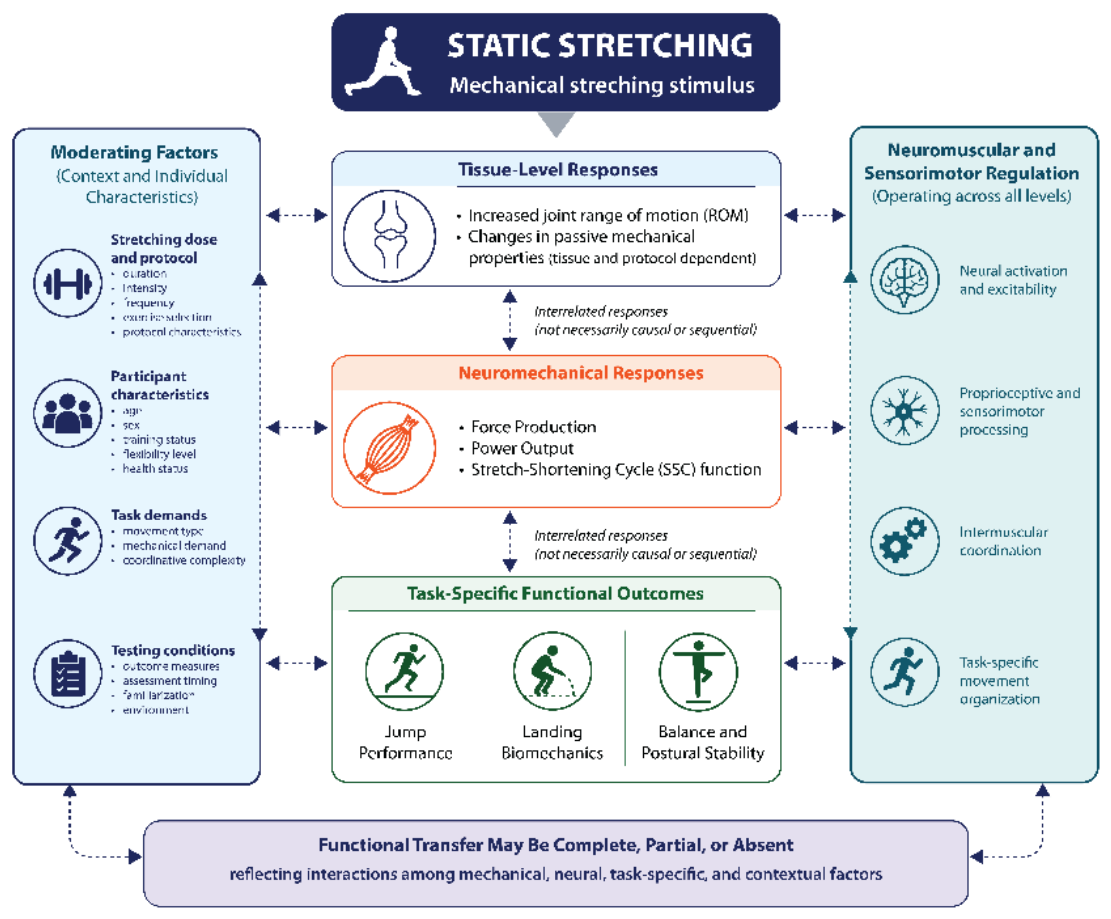
Disclaimer/Publisher’s Note: The statements, opinions and data contained in all publications are solely those of the individual author(s) and contributor(s) and not of MDPI and/or the editor(s). MDPI and/or the editor(s) disclaim responsibility for any injury to people or property resulting from any ideas, methods, instructions or products referred to in the content. |
© 2026 by the authors. Licensee MDPI, Basel, Switzerland. This article is an open access article distributed under the terms and conditions of the Creative Commons Attribution (CC BY) license (http://creativecommons.org/licenses/by/4.0/).
Copyright: This open access article is published under a Creative Commons CC BY 4.0 license, which permit the free download, distribution, and reuse, provided that the author and preprint are cited in any reuse.