

Submitted:
18 September 2026
Posted:
20 September 2026
You are already at the latest version
Abstract
New-onset atrial fibrillation (NOAF) is a frequent complication among patients with non-ST-elevation myocardial infarction (NSTEMI) and is associated with adverse outcomes, making early identification of predictors essential for risk stratification and management. This retrospective cohort study evaluated the prognostic value of the Clinical SYNTAX Score (CSS) compared with the anatomical SYNTAX Score (SS), GRACE, and CHA2DS2-VASc scores in predicting in-hospital NOAF and long-term outcomes among 979 NSTEMI patients undergoing coronary angiography. Predictors of NOAF, all-cause mortality, and major adverse cardiovascular events (MACE: death, myocardial infarction, stroke) were identified using logistic and Cox regression models, with receiver operating characteristic (ROC) analysis used to compare the discriminative power of CSS against SS, GRACE, and CHA2DS2-VASc over a median follow-up of 86 months (IQR: 0.1–144). NOAF developed in 80 patients (8.2%), with age, female gender, left atrial diameter, left ventricular diastolic dysfunction, and CSS (p=0.014) identified as independent predictors. CSS demonstrated superior discriminative ability (AUC: 0.724; 95% CI: 0.673–0.775) compared with SS (AUC: 0.644; 95% CI: 0.588–0.699), and a CSS threshold ≥17.77 predicted NOAF with 75% sensitivity and 65% specificity. In Cox regression analysis, in-hospital NOAF, age, hypertension, reduced ejection fraction (<60%), and CSS independently predicted long-term all-cause mortality, while NOAF, EF<60%, age, early AF recurrence, hypertension, and CSS independently predicted MACE; SS was not a significant predictor in either model. These findings indicate that CSS outperforms SS in predicting in-hospital NOAF and long-term outcomes in NSTEMI patients, offering a practical and comprehensive tool for early rhythm monitoring and risk-guided management.
Keywords:
clinical SYNTAX score
; NOAF
; atrial fibrillation
; NSTEMI–ACS
1. Introduction
Despite improvements in early diagnosis and prevention, coronary artery disease remains the leading global cause of death, largely due to its increasing incidence. Acute coronary syndrome typically results from coronary thrombosis triggered by plaque rupture or erosion [1,2]. Atrial fibrillation (AF) is the most common persistent arrhythmia in the adult population, accounting for approximately 33% of hospital admissions due to cardiac arrhythmias. Its prevalence has increased over the years, driven by extended life expectancy and intensified diagnostic efforts for previously undiagnosed AF.
NOAF in ACS patients has declined from approximately 18% in 1990 to 7–12% in recent years, largely due to advancements in thrombolytic, interventional, and pharmacological therapies [3,4,5]. AF is important not only because of its symptoms but also its effects. It increases the risk of stroke five times, doubles the risk of death and cognitive decline, and is linked to worsening heart failure and sudden death [6]. Given these risks, early identification of patients prone to NOAF has gained importance. However, current risk stratification tools specific to NOAF are limited, especially in the context of NSTEM [7,8]. In such patients, relying solely on the anatomical SYNTAX (Synergy Between Percutaneous Coronary Intervention with Taxus and Cardiac Surgery) score to guide revascularization may be insufficient, as it neglects clinical factors that influence both arrhythmic and long–term outcomes. Comorbidities like hypertension, diabetes, and hyperlipidemia, which can accelerate coronary artery disease progression and its recurrence after revascularization, are essential considerations. Studies have shown that risk scores incorporating clinical parameters, rather than relying solely on anatomical data, provide a more robust prediction of long–term outcomes [9,10,11]. Among these, the ACEF score—which includes age, creatinine, and ejection fraction—has gained popularity as a rapid bedside risk stratification tool. In a multicenter study involving patients with cardiogenic shock, an ACEF score ≥2.24 predicted in–hospital mortality with 74% sensitivity and 77% specificity [12]. However, anatomical scoring tools like the original SYNTAX score, while useful in assessing coronary lesion complexity, lack clinical context, which may limit their prognostic accuracy—especially in patients with multiple comorbidities. To overcome these limitations, the SYNTAX II and Clinical SYNTAX Score (CSS) systems were developed, integrating detailed anatomical information with clinical risk indices such as ACEF. In patients with STEMI complicated by cardiogenic shock, the SYNTAX II score was shown to be an independent predictor of in–hospital mortality, with patients in the highest tertile exhibiting significantly higher risk [13]. The SYNTAX II and CSS models have since been validated in various clinical settings as more comprehensive and individualized tools for decision–making in coronary artery disease [14].
Inflammation is increasingly recognized as a key pathophysiological mechanism underlying the development of NOAF and its association with major adverse cardiovascular events (MACE). The uric acid/albumin ratio (UAR), a composite marker reflecting both oxidative stress and nutritional status, has been shown to independently predict AF recurrence after cryoballoon ablation [15] and to outperform traditional biomarkers in forecasting NOAF in patients with ST–elevation myocardial infarction [16]. These findings suggest that atrial remodeling driven by inflammation may help explain the strong prognostic link between NOAF and adverse cardiovascular outcomes. Identifying high–risk patients for NOAF in NSTEMI–ACS could help guide prophylactic antiarrhythmic treatment and management of modifiable risk factors to reduce long–term mortality. Therefore, assessing predictors of in–hospital NOAF and the impact of the Clinical SYNTAX score, which incorporates clinical parameters, on patient outcomes would be crucial.
2. Materials and Methods
2.1. Study Design
Our study is a single–center, retrospective cohort study. The study was approved by the Cerrahpaşa Non–Interventional Clinical Research Ethics Committee, as deemed ethically appropriate, under approval number 2023/159, dated 23/11/2023, with reference number E74555795–050.01.04–842099–. The study protocol was prepared in accordance with the Declaration of Helsinki. The study included a review of patient records from the Istanbul University–Cerrahpaşa Cardiology Institute, focusing on those diagnosed with NSTEMI who met the 4th Universal Myocardial Infarction Diagnostic Criteria between January 2011 and December 2019 [17].
2.2. Data Acquisition, Exclusion Criteria Implementation, and Follow–Up
2.2.1. Inclusion Criteria
- Age ≥18 years;
- Admission for NSTEMI fulfilling 4th Universal MI criteria with symptom onset <24 h;
- Diagnostic coronary angiography ≤48 h after admission;
- Transthoracic echocardiography and full laboratory panel within 48 h;
- Baseline GFR > 15 mL/min/1.73 m2;
- Complete electronic data for predefined variables.
2.2.2. Exclusion Criteria
- Documented AF/flutter or long–term anti–arrhythmic use;
- Prior CABG or valve surgery, or moderate–severe valvular disease;
- Non–atherosclerotic culprit (spasm, embolism, dissection);
- Dialysis or GFR < 15 mL/min/1.73 m2;
- Active infection, systemic inflammatory disease, malignancy, or thyroid dysfunction;
- Severe hepatic impairment (Child–Pugh C);
- Hemodynamic instability precluding standard monitoring/telemetry;
- Missing key clinical, angiographic, or follow–up data.
2.3. Patient Enrollment and Flowchart
A total of 1,355 patients diagnosed with NSTEMI were identified through the data system of Istanbul University–Cerrahpaşa Cardiology Institute.
- 197 patients were excluded due to prior CABG surgery.
- 27 patients did not undergo coronary angiography and were excluded.
- 147 patients had a documented history of AF or had undergone prior valve surgery and were excluded.
- Five patients were excluded due to inaccessible data.
- Patients with normal coronary arteries were excluded from the study due to potential confusion with Type 2 Myocardial Infarction.
Thus, 979 patients were included in the final analysis. The patient selection process is detailed in Figure 1. To enhance external validity and reflect real–world NSTEMI management practices, the cohort intentionally included patients who underwent PCI, CABG, or conservative medical treatment following angiographic evaluation. The inclusion of CABG patients was methodologically justified, as the SYNTAX and Clinical SYNTAX Scores—key components of this study—are routinely used to guide revascularization decisions. Their inclusion enabled a comprehensive assessment of these scores across the full spectrum of clinical management strategies. Post-CABG NOAF may arise through partly distinct mechanisms (e.g., cardiopulmonary bypass, atriotomy) compared with PCI- or medically managed patients; a treatment-stratified sensitivity analysis addressing this heterogeneity is reported in Section 3.2 and discussed as a limitation of the pooled NOAF model.
2.4. Clinical Data Collection and Scoring Methods
Vital signs, ECG recordings, and laboratory values were collected from the hospital automation system.
- GFR was calculated using the Cockcroft–Gault formula.
- Anemia was defined based on WHO criteria (Hb <13 g/dL in men and <12 g/dL in women).
- GRACE scores were recorded or retrospectively calculated based on available data, using the original GRACE risk model as described by Fox et al. [35]; the GRACE 2.0 model was not used in this study.
- Coronary angiograms were reviewed in the catheterization lab, and SYNTAX scores were calculated via a web–based tool [18], from the baseline diagnostic angiogram prior to percutaneous intervention. Scores were calculated independently by two cardiologists blinded to clinical outcomes, with discrepancies resolved by consensus.
- CSS was computed by multiplying the modified ACEF score (Age, Creatinine, Ejection Fraction) with the anatomical SYNTAX score [19].
2.5. Monitoring and Follow–Up
- All patients were continuously monitored during their initial 24–hour stay in the coronary intensive care unit (CICU).
- Daily ECGs were obtained after transfer to the ward, with additional ECGs ordered for symptomatic patients.
- Based on progress notes and discharge summaries, patients were categorized according to the occurrence of in–hospital arrhythmic events.
- NOAF was defined as AF detected during hospitalization in patients without a prior diagnosis of AF. NOAF was defined as atrial fibrillation or flutter lasting ≥30 seconds, confirmed by two cardiologists. Patients with prior paroxysmal AF identified only by implantable devices were excluded. Atrial flutter was included due to its similar pathophysiology, clinical course, and treatment strategies
- Atrial flutter was included due to its similar pathophysiology, clinical course, and treatment strategies.
2.6. Prognostic Evaluation
The predictive value of the Clinical SYNTAX Score in identifying in–hospital NOAF was compared against conventional scoring systems (SYNTAX, GRACE, CHADS–VASc).For long–term prognostic analysis, events such as mortality, recurrent MI, and ischemic cerebrovascular events, along with their durations, were recorded using a combination of the national health system database and the hospital information system. All-cause mortality was ascertained through the national health system database, ensuring complete nationwide capture regardless of the location of death. Non-fatal events (MI and cerebrovascular events) were similarly ascertained using the combination of the national health system database and hospital records. Patients who died during the index hospitalization, including within the first 24 hours of admission, were included in the follow-up analysis as an event. These outcomes were analyzed in relation to CSS and conventional scoring tools.
2.7. Statistical Modelling Strategy
To identify independent predictors of in–hospital NOAF and long–term outcomes, a structured multivariable modeling approach was used. All variables with a p–value <0.10 in univariate analyses or established biological plausibility were entered into the multivariable models. Multicollinearity was assessed using the variance inflation factor (VIF), and all included variables had VIF <2.
For the prediction of in–hospital NOAF, a forward likelihood–ratio logistic regression model was used. For long–term outcomes (including all–cause mortality and the composite endpoint of death, myocardial infarction, and stroke), Cox proportional–hazards models with stepwise backward elimination were employed. The proportional hazards assumption was tested using Schoenfeld residuals and found to be met.
Missing data, which accounted for less than 5% of the dataset overall and were confined to variables not entered into the multivariable models (e.g., HbA1c, triple antithrombotic therapy), were addressed using multiple imputation where relevant. All covariates and outcomes entered into the multivariable regression models (Tables 3, 4, 6, and 7) had complete data (0% missing); the corresponding point estimates and p-values therefore reflect complete-case analysis rather than pooled multiply-imputed estimates.
2.8. Statistical Analysis
The statistical analysis of our study was performed using SPSS version 22 (SPSS Inc, Chicago, Illinois). Normality of the data was assessed using the Shapiro–Wilk (W) test. Continuous variables that exhibited normal distribution were analysed using Student’s t–test, while those that did not follow a normal distribution were analysed using the Mann–Whitney test. Categorical data were analysed using Pearson’s Chi–Square test. Continuous variables with normal distribution are reported as mean ± standard deviation (SD), while those without normal distribution are reported as median (range). Categorical data are presented as percentages. Predictors of in–hospital new–onset atrial fibrillation were evaluated using logistic regression analysis. Variables were selected for multivariable models if they had p < 0.10 in univariate analysis or were supported by previous evidence (e.g., age, LA diameter, EF, hypertension), consistent with TRIPOD guidelines. For primary outcomes, MACE and all–cause mortality predictors were assessed using Cox regression modelling. To evaluate the role of SYNTAX, Clinical SYNTAX, CHA2DS2–VASc, and GRACE scores in predicting in–hospital new–onset atrial fibrillation, cut–off values were analysed using Receiver Operating Characteristic (ROC) curve analysis. Sensitivity and specificity calculations were performed where significant threshold values were found. A p–value < 0.05 was considered statistically significant. Multivariable regression tables display all covariates entered into each model, including those that did not reach statistical significance, to provide transparency regarding model construction; these represent adjusted associations, and only variables with p < 0.05 were interpreted as independent predictors.
3. Results
3.1. Patient Characteristics and Follow–Up
A total of 979 patients diagnosed with NSTEMI who met the inclusion criteria were included in the final analysis. The demographic and clinical characteristics of the overall study population are presented in Table 1. Laboratory parameters revealed a hemoglobin level of 13.6 g/dL (7.6–19.7 g/dL), a leukocyte count of 9.3 (3.4–22.8), and a creatinine level of 0.89 mg/dL (0.39–3.5 mg/dL). The LDL cholesterol level was 123 mg/dL, with a total cholesterol level of 187 mg/dL. The median HbA1c level was 6.1% (4–16.4%), and the median troponin level was observed to be 0.179 ng/mL (0.014–10 ng/mL). The median follow–up duration for the included patients was 86 (0.1–144) months. Clinical follow–up data were available for 947 patients (96.7%), while 32 patients (3.3%) were lost to follow–up due to missing records.
Regarding the baseline angiographic characteristics, 104 (10.6%) patients had no significant stenosis, 388 (39.6%) had single–vessel disease, 278 (28.4%) had double–vessel disease, and 209 (21.3%) had triple–vessel disease, with a median SYNTAX score of 10 (0–46.5). After angiographic assessment, 537 (54.9%) patients underwent PCI, 193 (19.7%) underwent CABG surgery, and 249 (25.4%) were managed with medical follow–up based on angiographic and clinical evaluation.
3.2. Evaluation of New–Onset Atrial Fibrillation
Among the 979 patients included in the study, 80 (8.2%) were diagnosed with new–onset atrial fibrillation/flutter. When the patients were evaluated in two groups, their baseline demographic and clinical characteristics are presented in Table 1, with additional comparisons summarized below.
Examining the baseline angiographic characteristics and management strategies of patients, it was observed that among those with in–hospital new–onset atrial fibrillation (AF), the proportion of patients with multivessel disease was higher, whereas in patients without AF, there was a higher proportion of those with either no significant coronary artery disease or single–vessel disease (p<0.001). Consistent with these findings, the proportion of patients undergoing coronary artery bypass grafting (CABG) was higher in the AF group, while the number of patients in the non–AF group receiving percutaneous coronary intervention (PCI) and medical management was greater (p<0.001). Overall, the average SYNTAX score for patients with new–onset AF was 16 (2–33), whereas it was 10 (0–46.5) for those without, showing a significant difference (p<0.001). It was observed that hemoglobin (12.9 vs. 13.6 g/dL), lymphocyte count (1.85 vs. 2.3 x 10³/mm3), and triglyceride levels (129 vs. 153 mg/dL) were significantly lower in the group with atrial fibrillation (AF) (p = 0.006, p < 0.001, p = 0.007, respectively). Additionally, the neutrophil–to–lymphocyte ratio and fasting blood glucose levels were found to be significantly higher in the AF group (p = 0.001, p = 0.025, respectively). In patients with in–hospital AF, the risk scores were significantly higher compared to those without in–hospital AF (p<0.001) (Table 1).
The primary outcomes and their components were analysed in a comparative manner between the general population and the groups with and without NOAF, and the detailed results are presented in Table 2.
Two separate models were used to identify independent predictors of in–hospital NOAF in NSTEMI patients, as shown in Table 3. The first model identified age (p < 0.001) and left atrial diameter (p < 0.001) as independent predictors of AF, while the SYNTAX score alone was found to be insufficient for predicting AF (p = 0.059). Due to the heterogeneity of the patient population, exploratory, post-hoc analyses were performed with 875 patients, excluding those with a SYNTAX score >22 and those with a SYNTAX score of 0; these cutoffs were data-derived rather than pre-specified, and results should be interpreted as hypothesis-generating. In these analyses, the SYNTAX score still did not predict in–hospital AF (p = 0.138, p = 0.280, respectively).
In the same model, when age and GFR were excluded from the components of the Clinical SYNTAX score and the analysis was done using the Clinical SYNTAX score alone, it was found that left atrial diameter (p < 0.001), left ventricular diastolic diameter (LVDD) (p = 0.012), female sex (p = 0.007), and the Clinical SYNTAX score (p = 0.014) were parameters that could be used for independent prediction (Table 3).
The ROC curve analyses performed to evaluate the predictive power of risk scores for in–hospital NOAF are shown in Figure 2. The analysis revealed that risk scores were significantly positively correlated with predicting in–hospital AF. It was observed that the Clinical SYNTAX score had higher sensitivity for prediction compared to other risk scores, including the SYNTAX score (SYNTAX AUC 95% CI 0.644 (0.588–0.699) p < 0.001, Clinical SYNTAX score AUC 95% CI 0.724 (0.673–0.775) p < 0.001). In the predictive value analysis for detecting in–hospital new–onset atrial fibrillation using the Clinical SYNTAX score, a threshold value of Clinical SYNTAX ≥17.77 was observed to predict in–hospital atrial fibrillation with 75% sensitivity and 65% specificity.
Given that CABG, PCI, and medically managed patients may differ in the underlying mechanism of NOAF, a treatment-stratified sensitivity analysis was performed. In-hospital NOAF incidence differed by revascularization strategy: 15.0% (29/193) after CABG, 6.0% (32/537) after PCI, and 7.6% (19/249) with medical therapy. A formal likelihood-ratio test for interaction between the Clinical SYNTAX score and treatment strategy was significant (χ2 = 16.24, df = 2, p < 0.001), indicating that the association between CSS and NOAF is not uniform across strategies. CSS discriminated NOAF status within the PCI subgroup (median CSS 21.7 vs. 9.9 in NOAF(+) vs. NOAF(–), p < 0.001) but not within the CABG subgroup (median CSS 36.4 vs. 36.4, p = 0.79), where CSS was uniformly elevated regardless of NOAF status, consistent with CABG candidacy itself requiring a high anatomical burden. When the primary multivariable model (Table 3, Model 2) was re-fitted excluding CABG patients (PCI and medical therapy only, n = 786), the Clinical SYNTAX score remained an independent predictor of NOAF (OR 1.010, 95% CI 1.000–1.019, p = 0.042), indicating that the overall association is not solely attributable to the CABG subgroup, though its predictive value should not be extrapolated to CABG-managed patients specifically.
3.3. Evaluation for All–Cause Mortality
To identify independent predictors of all–cause mortality as a primary endpoint, Cox regression analysis was performed, including variables found to be significant in univariate analyses. The regression analysis revealed that in–hospital atrial fibrillation (p = 0.035), older age (p < 0.001), hypertension (p = 0.010), low GFR (p = 0.002), and EF <60% (p = 0.004) were independent parameters associated with long–term all–cause mortality in NSTEMI patients. However, the SYNTAX score and GRACE score above 140, as well as atrial fibrillation within the first 12 months of follow–up, were not found to be significant independent predictors of long–term mortality (p = 0.059, p = 0.288, p = 0.065, respectively) (Table 4 Model 1). When the Clinical SYNTAX score, which showed correlation with the SYNTAX score, was used instead of the SYNTAX score, it was found to significantly predict all–cause mortality (p = 0.04), with other significant variables maintaining their significance. The continued significance of the Clinical SYNTAX score, when used alongside the SYNTAX score, is shown in Model 2 in Table 4 (p = 0.013, p = 0.794, respectively).
Due to the heterogeneity of the patient population and the high number of patients with SYNTAX scores <22 (75.7%), an exploratory, post-hoc analysis was conducted using a data-derived rather than pre-specified cutoff. In this analysis, a SYNTAX score >22 emerged as an independent predictor of all–cause mortality (HR = 1.351, p = 0.018, 95% CI 1.053–1.734). Additionally, in a further exploratory analysis excluding patients with a SYNTAX score of 0, using the same parameters in the 875 patients, the SYNTAX score was also identified as an independent predictor of all–cause mortality (HR = 1.011, p = 0.048, 95% CI 1.000–1.023). These post-hoc findings were not corrected for multiple comparisons and should be considered hypothesis-generating rather than confirmatory.
3.4. Evaluation of Patients for MACE (Death / MI /CVA)
Baseline Angiographic Characteristics and Revascularization Strategies in Patient Groups with and Without MACE shown in the Table 5. To identify the independent predictors of the composite primary endpoint of Death/MI/CVA, Cox regression analyses were performed in two separate models, including variables found significant in univariate analyses (Table 6 Model 1). The analysis identified NOAF (p = 0.034), EF<%60 (p = 0.032), hypertension (p = 0.019), age (p = 0.002), detection of atrial fibrillation within the first 12 months (p = 0.002), and clinical SYNTAX score (p = 0.026) as independent predictors, while a GRACE score >140 was not found to be an independent predictor (p = 0.950). In a separate analysis with the correlated SYNTAX score, SYNTAX was not identified as an independent predictor (p = 0.178) (Table 6 Model 2). Due to the heterogeneity of the patient population, in an exploratory, post-hoc analysis using a data-derived cutoff, SYNTAX score >22 was not found to be an independent predictor for the composite primary endpoint of Death/MI/CVA (p = 0.126, 95% CI 0.953–1.478).
Due to the correlation of parameters such as hypertension, gender, age, and previous MI with the CHA2DS2–VASc score in the model, an exploratory, post-hoc analysis excluding age was performed. This analysis demonstrated that the CHA2DS2–VASc score is an independent predictor for both all–cause mortality and the composite primary endpoint of Death/MI/SVO (p = 0.001 and p = 0.002, respectively); this exploratory model, which was not a pre-specified primary analysis, is presented in Table 7.
4. Discussion
The incidence of new–onset AF in patients diagnosed with acute coronary syndrome (ACS) has decreased from 5–23% to 7–10% due to advancements in ACS management and increased access to early revascularization [20]. Over the years, numerous studies have focused on understanding the relationship between AF and ACS, providing valuable insights into its clinical significance and contributing to the development of more comprehensive management strategies for this patient population. One such study, TRACE [21] reported a 21% incidence of AF/flutter in ACS patients, with 3.9% having pre–existing AF. While chronic AF did not affect in–hospital mortality, new–onset AF significantly increased in–hospital (18% vs. 9%) and five–year mortality (56% vs. 34%). In our study, the AF/flutter incidence was lower at 8.2%, likely due to differences in patient selection and the exclusion of STEMI cases. Similar to TRACE, we found higher in–hospital mortality in patients with AF (5% vs. 1.6%) and confirmed in–hospital AF as an independent predictor of long–term mortality. These findings suggest that excluding STEMI patients may yield a lower AF incidence but still allow meaningful risk stratification using clinical variables such as CSS.
In the OACIS (Osaka Acute Coronary Insufficiency) study [22], new–onset AF occurred in 12% of PCI–treated ACS patients and was independently associated with age, male sex, tachycardia, and advanced Killip class. Although in–hospital mortality was unaffected, one–year mortality was significantly higher in patients with AF. In our NSTEMI–only cohort, the incidence of in–hospital AF was lower (8.2%), likely due to younger age, exclusion of STEMI, and restriction to patients with angiographically confirmed coronary disease. Similar to OACIS, our AF subgroup was older and more tachycardic. However, we identified additional predictors—such as female sex, reduced GFR, increased neutrophil–to–lymphocyte ratio, and diastolic dysfunction—highlighting the importance of non–hemodynamic contributors in this population. Notably, while both SYNTAX and GRACE scores were elevated in AF patients, only the Clinical SYNTAX Score independently predicted AF in multivariate analysis. This finding reinforces the clinical utility of combining anatomical and functional markers for early risk stratification in NSTEMI. The association between coronary artery disease severity and new–onset AF is biologically plausible. Advanced atherosclerosis and impaired myocardial perfusion can lead to increased left atrial pressure, atrial stretch, ischemia–related autonomic imbalance, and systemic inflammation—each of which contributes to atrial remodeling and arrhythmogenesis. These mechanisms are particularly relevant in the NSTEMI setting, where subacute ischemia and diastolic dysfunction often coexist. Prior studies have highlighted this connection: one study reported that high SYNTAX scores were associated with a greater likelihood of NOAF after AMI [23], while another found that left atrial enlargement and increased anatomical burden were significant predictors of AF in post–ACS patients [24]. Our findings align with this biological rationale and extend it by showing that the Clinical SYNTAX Score, incorporating both anatomical and functional parameters, provides superior predictive value.
In a study by Braga et al. [25], the incidence of new–onset atrial fibrillation (AF) in acute coronary syndrome (ACS) patients was 10.1%, with predictors including age, hypertension (HT), valvular heart disease, CABG surgery, resting heart rate, LA diameter, and LVEF <40%. AF was associated with higher long–term mortality. In our study, the incidence was lower (8.2%) due to the exclusion of valvular heart disease and STEMI patients. Similar to Braga et al., we identified HT, reduced LVEF, and larger LA diameters as risk factors, along with diastolic dysfunction. Independent predictors of in–hospital AF in our cohort included age, LA diameter, female gender, LVDD, and clinical SYNTAX score. Gender differences may reflect the exclusion of STEMI and older, more comorbid female patients in our study. Despite a longer follow–up, in–hospital AF remained a significant predictor of mortality in ACS patients.
In a retrospective analysis by Karasu and colleague [26] involving 670 NSTEMI patients who underwent PCI, the incidence of in–hospital new–onset atrial fibrillation (NOAF) was found to be 12.5%. NOAF patients were compared to those without AF, revealing that NOAF patients had higher age, CRP levels, left atrial volume index (LAVI), peak troponin levels, and CHA2DS2–VASc scores. Logistic regression analysis identified CHA2DS2–VASc score, post–PCI TIMI flow grade <3, and hemoglobin levels as independent predictors of NOAF, while the SYNTAX score was not significant. ROC curve analysis showed that CHA2DS2–VASc score ≥2.5 could be used to predict NOAF with moderate sensitivity and specificity. In our study, all NSTEMI treatment strategies were considered, and CHA2DS2–VASc scoring included the index event. This inclusion likely contributed to a lower median SYNTAX score in the non–AF group, although the difference in SYNTAX scores between groups was preserved. Similar to the Karasu study, we found age to be an independent predictor of in–hospital AF, with female gender also being more prevalent among AF patients. Inflammatory markers like the neutrophil/lymphocyte ratio did not show significance in multivariate analysis, similar to Hs–CRP in the Karasu study. The SYNTAX score was again not significant in predicting in–hospital AF. Our ROC analysis showed that the clinical SYNTAX score and CHA2DS2–VASc score were superior to the GRACE and SYNTAX scores in predicting AF, with a cut–off of ≥3.5 providing reasonable sensitivity and specificity.
When considering the impact of in–hospital NOAF on long–term mortality, conflicting studies exist. For example, an older study by Goldberg and colleagues [27] found an NOAF incidence of 9.1% in MI patients, with increased mortality observed in univariate analysis but not in multivariate analysis when confounding factors like heart failure and cardiogenic shock were considered. This discrepancy may be due to the indirect identification of in–hospital AF and the lack of detailed revascularization strategies in their study. Unlike our study, the Goldberg study had a higher proportion of women with AF and included a significant number of STEMI cases, which accounted for 60% of their study population.
In a study by Arslan et al., which followed STEMI patients for a median of 44 months, the incidence of new–onset atrial fibrillation (AF) was found to be 6.1%, with an average patient age of 58.6 years. The difference in AF incidence compared to our study, where we observed an 8.1% incidence, could be attributed to factors such as the higher representation of female patients in our study, early revascularization in STEMI patients reducing ischemic triggers for AF, and the inclusion of only patients discharged in sinus rhythm. In the Arslan study, independent predictors of in–hospital AF included a CHA2DS2–VASc score >2, LA diameter, and Killip class >2. In contrast, our study identified CHA2DS2–VASc score, alongside LA diameter and other factors, as independent predictors of in–hospital AF. While the Arslan study did not find a significant difference in long–term MACE between patients with and without in–hospital AF, our study found in–hospital AF to be an independent predictor of both long–term MACE and overall mortality. The focus on STEMI patients in the Arslan study, where ischemic AF was more prevalent, might explain the reduced long–term impact of AF following successful revascularization. However, in our study, the inclusion of NSTEMI patients, along with a longer follow–up period, the presence of comorbidities, and higher CHA2DS2–VASc scores, likely contributed to the observed differences in mortality and MACE.
In the study by Oktay et al. [28] which included 123 patients undergoing CABG surgery, postoperative atrial fibrillation developed in 31.7%. Age, SYNTAX score, and clinical SYNTAX score emerged as independent predictors, with the clinical SYNTAX score demonstrating superior prognostic value. In our study, similar predictors of in–hospital AF were identified; however, the SYNTAX score alone did not reach statistical significance. This discrepancy may stem from our inclusion of both medically treated and PCI patients, the presence of individuals without significant coronary artery disease, and a broader range of SYNTAX scores. The incidence of in–hospital AF among CABG patients in our cohort was 15%, notably lower than in Oktay et al.’s study. This may reflect differences in study design, monitoring intensity, frequency of ECG evaluation, and premedication use such as statins or beta–blockers. In our analysis, a clinical SYNTAX score >17.7 predicted in–hospital AF with 75% sensitivity and 65% specificity.
In the CREDO–Kyoto AMI registry by Obayashi et al. [29] in–hospital new–onset AF occurred in 7.9% of 6,228 AMI patients, predominantly with STEMI and multivessel disease. Patients with AF had more advanced age, higher comorbidity burden, and elevated CHA2DS2–VASc scores, consistent with worse long–term outcomes. Despite this, only 28% of patients with new–onset AF were discharged on oral anticoagulation (OAC), and 23.7% received triple antithrombotic therapy. During 5.5 years of follow–up, new–onset AF was associated with significantly higher cardiovascular and all–cause mortality, stroke, and heart failure hospitalization. In our NSTEMI–focused cohort, in–hospital AF similarly predicted long–term adverse outcomes, including death, MI, and stroke. However, the impact of AF–related stroke was difficult to quantify due to limited event numbers and unknown OAC adherence during follow–up. These findings emphasize the prognostic significance of in–hospital AF and highlight a persisting treatment gap regarding anticoagulation initiation, warranting more individualized post–discharge strategies in NSTEMI patients with new–onset AF.
Current ACC/AHA guidelines recommend anticoagulation for AF patients with a CHA2DS2–VASc score ≥2, but do not provide specific guidance for in–hospital NOAF. In contrast, ESC guidelines recommend anticoagulation with a class IIa level of evidence for patients with new–onset AF during STEMI if their CHA2DS2–VASc score is ≥2 [30,31]. Management of antithrombotic therapy in ACS patients with new–onset AF should consider thromboembolic and bleeding risks, as these patients are underrepresented in major studies. Observational data suggest that anticoagulation is administered in 30–40% of patients with AMI and new–onset AF.
In a study by Hofer et al. [32] involving ACS patients monitored with 72–hour telemetry, new–onset atrial fibrillation (AF) was detected in 10.9% of cases, with a long–term cardiovascular mortality rate of 63.4% in this group. The study found that while TAT (triple antithrombotic therapy) reduced mortality in new–onset AF patients, DAT (dual antithrombotic therapy) did not. In contrast, our study, which reported a lower AF incidence of 8.1% due to the absence of telemetry and fewer STEMI cases, also identified AF as an independent predictor of long–term mortality, but with lower usage rates of OAC and TAT. Unlike Hofer et al., we observed no significant impact of OAC or TAT on long–term mortality, possibly due to higher bleeding risks and poor adherence to OAC therapy in our patient population.
Several studies have evaluated the effect of the Clinical SYNTAX Score on long–term outcomes in patients, In the ARTS II study, Scot Garg et al. [33] analysed outcomes in 512 patients with multivessel disease who underwent either PCI or CABG, finding that higher clinical SYNTAX scores (median 20.5) were associated with increased MACE and mortality over a five–year follow–up. Specifically, patients with a clinical SYNTAX score >27.5 had significantly worse outcomes. In their multivariate analysis, clinical SYNTAX score, incomplete revascularization, diabetes, and peripheral arterial disease were independent predictors of adverse events, while the SYNTAX score alone was not significant. In comparison, our study found that while the clinical SYNTAX score remained a significant predictor of long–term mortality and MACE, the SYNTAX score alone did not reach statistical significance. Subgroup analysis in our population, specifically among PCI–treated patients, revealed that in–hospital AF, hypertension, and clinical SYNTAX score were significant predictors of mortality, consistent with the ARTS II findings.
The SIRTAX study [34], which investigated the impact of Clinical SYNTAX (CSS) and SYNTAX scores on long–term MACE and mortality in PCI patients, the Clinical SYNTAX score demonstrated a significantly higher predictive value for cardiovascular mortality and all–cause after a five–year follow–up. However, the advantage of the Clinical SYNTAX score diminished when predicting MACE. In this study, similar to the SIRTAX findings, the Clinical SYNTAX score remained a significant predictor of all–cause mortality (p=0.013), even when considering related factors such as SYNTAX score, age, and GFR. However, when the model excluded the Clinical SYNTAX score, the SYNTAX score alone did not reach statistical significance (p=0.059). This suggests that while the Clinical SYNTAX score maintains its prognostic value for mortality, the SYNTAX score alone may be less reliable in predicting long–term outcomes. Due to the correlation between the Clinical SYNTAX and SYNTAX scores, two separate Cox regression analyses were conducted for MACE. The Clinical SYNTAX score was found to be an independent predictor of MACE, while the SYNTAX score was not (p=0.026 vs. p=0.178). When considering a SYNTAX score >22, it was predictive of all–cause mortality but not MACE. Overall, similar to the SIRTAX study, the Clinical SYNTAX score was more effective than the SYNTAX score in predicting both all–cause mortality and MACE, with a stronger impact on mortality. The SYNTAX score’s lack of effectiveness in predicting outcomes in our study may be due to the inclusion of NSTEMI patients without significant coronary artery disease, as well as those treated with CABG or medical therapy, compared to the SIRTAX study, which included chronic coronary syndrome patients.
Several additional sensitivity analyses were performed to address the modest events-per-variable ratio (6.7–8.0) of the NOAF logistic models. Firth’s penalized (bias-corrected) logistic regression confirmed that the Clinical SYNTAX score remained an independent predictor of NOAF (OR 1.009, 95% CI 1.002–1.016, p = 0.012), indicating this finding is robust to overfitting concerns. Calibration was satisfactory (Hosmer–Lemeshow χ2 = 6.25, df = 6, p = 0.396), and bootstrap resampling (200 iterations) showed only modest optimism (0.024), yielding an optimism-corrected AUC of 0.764 (apparent AUC 0.788). For the CSS ≥17.77 cutoff specifically, bootstrap resampling (500 iterations) confirmed stable discrimination (AUC 0.725, 95% CI 0.674–0.773) and stable sensitivity/specificity (75%/65%) at this threshold, although the optimal cutoff itself varied across resamples (95% CI 12.8–25.0), suggesting it should be treated as an approximate, internally-derived threshold pending external validation.
A treatment-stratified sensitivity analysis further showed that the association between CSS and NOAF differs significantly by revascularization strategy (interaction p < 0.001): CSS discriminated NOAF status well among PCI- and medically-managed patients, but not among CABG-managed patients, where CSS was uniformly elevated regardless of NOAF status. This is consistent with post-CABG AF arising through mechanisms distinct from the atherosclerotic burden captured by CSS, such as cardiopulmonary bypass, atriotomy, and the surgical inflammatory response. Importantly, the overall association between CSS and NOAF remained significant even after excluding CABG patients (OR 1.010, 95% CI 1.000–1.019, p = 0.042), confirming that our principal finding is not driven solely by this subgroup. Taken together, these analyses suggest that CSS is a robust and reasonably well-calibrated predictor of NOAF in PCI- and medically-managed NSTEMI patients, while its application to CABG-managed patients specifically warrants caution.
5. Limitations
- 1The retrospective nature of the study, which limited the ability to adequately monitor patients’ medication adherence and follow–up on their medical treatments throughout the study period, thereby preventing an assessment of the impact of medical therapy on outcomes.
- The effectiveness of the SYNTAX score is primarily validated in patients with multivessel disease and is calculated in those with significant stenosis. In our study, 10.6% of the population had no significant stenosis, resulting in a SYNTAX score of 0, which could affect the score’s effectiveness; in patients presenting with a totally occluded infarct-related artery, baseline SYNTAX scoring may also under-assess lesion complexity distal to the occlusion.
- The possibility of including patients with undiagnosed asymptomatic paroxysmal AF who may have been incidentally identified during their index hospitalization for AMI, which might have impacted the study population.
- The study’s start date in 2011 means that some patient groups did not have access to newer antiplatelet agents (prasugrel, ticagrelor), which could have influenced outcomes.
- Current guidelines recommend the use of novel oral anticoagulants (NOACs) over warfarin in AF patients due to their positive impact on outcomes. However, in our study population, the usage rate of NOACs was only 14.7%.
- The early invasive treatment strategies for acute coronary syndrome during the initial period of our study may differ from current guideline recommendations, potentially affecting outcomes.
- The study period coincided with the COVID–19 pandemic, which may have led to an increase in mortality due to some deaths being related to COVID–19, potentially impacting the overall mortality rate.
- The association of the CHA2DS2-VASc and GRACE scores with NOAF may partly reflect shared underlying risk factors, such as age, rather than mechanisms specific to each score; a formal incremental predictive value analysis (e.g., net reclassification or integrated discrimination improvement) comparing CSS against these scores was not performed and is recommended for future prospective studies.
- Long-term follow-up combined national and hospital records, and AF within the first 12 months was modeled as a fixed rather than time-dependent covariate; the NOAF logistic models also had a modest events-per-variable ratio (6.7–8.0), and the Clinical SYNTAX Score was retained alongside individual components (e.g., EF) in some models by design (VIF < 2 for all variables), so these estimates should be interpreted with this overlap in mind. Sensitivity analyses addressing the immortal time bias and events-per-variable concerns (Firth’s regression, calibration, and bootstrap validation) are reported in the Discussion, where the core findings were robust to these concerns.
- Formal inter-observer reproducibility of SYNTAX scoring was not quantified, and differential length of stay between NOAF groups raises the possibility of surveillance bias. In addition, the predictive value of CSS for NOAF varies by revascularization strategy, with reduced utility in CABG-managed patients specifically; this treatment-stratified analysis is detailed in the Discussion.
6. Conclusions
In NSTEMI patients, long–term mortality rates are observed to be high due to accompanying comorbidities. New–onset in–hospital atrial fibrillation, independent of these comorbidities, has been shown to be an independent predictor of long–term prognosis, affecting both all–cause mortality and the primary composite endpoint of death/MI/stroke.
The Clinical SYNTAX score, which combines anatomical assessment of coronary artery disease with clinical parameters, provides better prognostic value for all–cause mortality and the composite endpoint of death/MI/stroke across the entire NSTEMI population compared to the SYNTAX score alone. Additionally, factors directly associated with these endpoints—such as age, left atrial diameter, female gender, and left ventricular diastolic dysfunction—along with the Clinical SYNTAX score, have been shown to be independent predictors of in–hospital atrial fibrillation. When comparing risk scores for predicting new–onset in–hospital atrial fibrillation, the Clinical SYNTAX score and CHA2DS2–VASc score were found to be the most effective models. Moreover, while our study did not demonstrate the effectiveness of oral anticoagulation (OAC) in reducing stroke (SVO) due to the low number of events, the high rate of SVO in patients with new–onset AF during long–term follow–up suggests that, in line with other studies, OAC use should be considered based on the patient’s bleeding and ischemic stroke risk.
In conclusion, given the pathophysiology of NSTEMI patients and the high prevalence of comorbidities, it may be more effective to use risk scores that combine clinical factors with coronary anatomy, rather than relying solely on coronary anatomy–based risk assessment, for predicting both long–term outcomes and in–hospital new onset atrial fibrillation.
Author Contributions
Conceptualization, Z.B. and V.O.; methodology, Z.B., V.O. and Ş.A.; formal analysis, Z.B. and Ş.A.; investigation, Z.B., M.E.G., M.E.B., M.H.G., M.F.D., S.B., Ü.Y.S. and A.Ö.E.; data curation, Z.B., M.E.G., M.E.B., M.H.G., M.F.D., S.B., Ü.Y.S. and A.Ö.E.; writing—original draft preparation, Z.B.; writing—review and editing, V.O., Ş.A., M.E.G., M.E.B., M.H.G., M.F.D., S.B., Ü.Y.S. and A.Ö.E.; visualization, Z.B.; supervision, V.O.; project administration, V.O. All authors have read and agreed to the published version of the manuscript.
Funding
This study was not funded by any external sources. The authors declare that there are no financial conflicts of interest related to the funding of this study.
Institutional Review Board Statement
This study was conducted in accordance with the ethical standards outlined in the Declaration of Helsinki and relevant national guidelines for research involving minors. The study was approved by the Cerrahpaşa Non–Interventional Clinical Research Ethics Committee, as deemed ethically appropriate, under approval number 2023/159, dated 23 November 2023, with reference number E74555795–050.01.04–842099–.
Informed Consent Statement
Patient consent was waived by the Institutional Ethics Committee (Approval No. 2023/159, November 23, 2023) because this retrospective observational study used anonymized clinical data collected during routine care, and obtaining informed consent from all participants was impracticable.
Data Availability Statement
The data presented in this study are available from the corresponding author upon reasonable request. The data are not publicly available due to ethical and patient privacy restrictions, as the dataset contains patient-level clinical information. The relevant de-identified data can also be provided to the Editorial Office upon request for internal evaluation.
Acknowledgments
The authors would like to thank Cerrahpaşa Cardiology Institute for providing the necessary resources and facilities for this study. There were no sponsors or financial support for this study. We also appreciate the contributions of the patients who participated in this research.
Conflicts of Interest
The authors declare no conflicts of interest.
Abbreviations
The following abbreviations are used in this manuscript:
| ACEF | Age, Creatinine, Ejection Fraction |
| ACS | Acute Coronary Syndrome |
| AF | Atrial Fibrillation |
| AMI | Acute Myocardial Infarction |
| ANC | Absolute Neutrophil Count |
| AUC | Area Under the Curve |
| BMS | Bare-Metal Stent |
| CABG | Coronary Artery Bypass Grafting |
| CAD | Coronary Artery Disease |
| CHA2DS2-VASc | Congestive Heart Failure, Hypertension, Age ≥75, Diabetes, Stroke/TIA/Thromboembolism, Vascular Disease, Age 65-74, Sex Category (Female) |
| CI | Confidence Interval |
| CKD | Chronic Kidney Disease |
| COVID-19 | Coronavirus Disease 2019 |
| CRP | C-Reactive Protein |
| CSS | Clinical SYNTAX Score |
| DAT | Dual Antithrombotic Therapy |
| DES | Drug-Eluting Stent |
| DM | Diabetes Mellitus |
| ECG | Electrocardiography |
| EF | Ejection Fraction |
| GRACE | Global Registry of Acute Coronary Events |
| GFR | Glomerular Filtration Rate |
| HbA1c | Hemoglobin A1c |
| HR | Hazard Ratio (or Heart Rate) |
| HT | Hypertension |
| ICH | Intracerebral Hemorrhage |
| ICU | Intensive Care Unit |
| LA | Left Atrium |
| LAVI | Left Atrial Volume Index |
| LDL-C | Low-Density Lipoprotein Cholesterol |
| LMCA | Left Main Coronary Artery |
| LVDD | Left Ventricular Diastolic Dysfunction |
| MACE | Major Adverse Cardiovascular Events |
| MI | Myocardial Infarction |
| MR | Mitral Regurgitation |
| MS | Mitral Stenosis |
| NSTEMI | Non-ST-Elevation Myocardial Infarction |
| NOAF | New-Onset Atrial Fibrillation |
| NOAC | Non-Vitamin K Oral Anticoagulant |
| OAC | Oral Anticoagulation |
| OACIS | Osaka Acute Coronary Insufficiency Study |
| PAD | Peripheral Artery Disease |
| PCI | Percutaneous Coronary Intervention |
| PLT | Platelet |
| PVC | Premature Ventricular Contraction |
| ROC | Receiver Operating Characteristic |
| SAH | Subarachnoid Hemorrhage |
| SBP | Systolic Blood Pressure |
| SIRTAX | Sirolimus-Eluting Stent Compared with Paclitaxel-Eluting Stent for Coronary Revascularization |
| SIRTAX II | Second SIRTAX Study |
| SVO | Stroke or Systemic Vascular Occlusion |
| SYNTAX | Synergy Between PCI With Taxus and Cardiac Surgery |
| T2DM | Type 2 Diabetes Mellitus |
| TAT | Triple Antithrombotic Therapy |
| TC | Total Cholesterol |
| TIA | Transient Ischemic Attack |
| TIMI | Thrombolysis in Myocardial Infarction |
| TLF | Target Lesion Failure |
| TnI | Troponin I |
| TR | Tricuspid Regurgitation |
| VG | Ventricular Geometry |
| VT | Ventricular Tachycardia |
| WBC | White Blood Cell |
References
- Tomaniak, M.; Katagiri, Y.; Modolo, R.; de Silva, R.; Khamis, R.Y.; Bourantas, C.V.; Torii, R.; Wentzel, J.J.; Gijsen, F.J.H.; van Soest, G.; et al. Vulnerable plaques and patients: state-of-the-art. Eur. Heart J. 2020, 41(31), 2997–3004. [CrossRef]
- Crenshaw, B.S.; Ward, S.R.; Granger, C.B.; Stebbins, A.L.; Topol, E.J.; Califf, R.M. Atrial fibrillation in the setting of acute myocardial infarction: The GUSTO-I experience. J. Am. Coll. Cardiol. 1997, 30(2), 406–413. [CrossRef]
- Schmitt, J.; Duray, G.; Gersh, B.J.; Hohnloser, S.H. Atrial fibrillation in acute myocardial infarction: a systematic review of the incidence, clinical features and prognostic implications. Eur. Heart J. 2009, 30(9), 1038–1045. [CrossRef]
- Kinjo, K.; Sato, H.; Sato, H.; Ohnishi, Y.; Hishida, E.; Nakatani, D.; Mizuno, H.; Fukunami, M.; Koretsune, Y.; Takeda, H.; et al.; Osaka Acute Coronary Insufficiency Study (OACIS) Group. Prognostic significance of atrial fibrillation/atrial flutter in patients with acute myocardial infarction treated with percutaneous coronary intervention. Am. J. Cardiol. 2003, 92(10), 1150–1154. [CrossRef]
- Rathore, S.S.; Berger, A.K.; Weinfurt, K.P.; Schulman, K.A.; Oetgen, W.J.; Gersh, B.J.; Solomon, A.J. Acute myocardial infarction complicated by atrial fibrillation in the elderly: prevalence and outcomes. Circulation 2000, 101(9), 969–974. [CrossRef]
- Benjamin, E.J.; Virani, S.S.; Callaway, C.W.; Chamberlain, A.M.; Chang, A.R.; Cheng, S.; Chiuve, S.E.; Cushman, M.; Delling, F.N.; Deo, R.; et al. American Heart Association Council on Epidemiology and Prevention Statistics Committee and Stroke Statistics Subcommittee. Heart Disease and Stroke Statistics-2018 Update: A Report From the American Heart Association. Circulation 2018, 137(12), e67–e492. [CrossRef]
- Hindricks, G.; Potpara, T.; Dagres, N.; Arbelo, E.; Bax, J.J.; Blomström-Lundqvist, C.; Boriani, G.; Castella, M.; Dan, G.A.; Dilaveris, P.E.; et al.; ESC Scientific Document Group (2021). 2020 ESC Guidelines for the diagnosis and management of atrial fibrillation developed in collaboration with the European Association for Cardio-Thoracic Surgery (EACTS): The Task Force for the diagnosis and management of atrial fibrillation of the European Society of Cardiology (ESC) Developed with the special contribution of the European Heart Rhythm Association (EHRA) of the ESC. Eur. Heart J. 2021, 42(5), 373–498. [CrossRef]
- Joglar, J.A.; Chung, M.K.; Armbruster, A.L.; Benjamin, E.J.; Chyou, J.Y.; Cronin, E.M.; Deswal, A.; Eckhardt, L.L.; Goldberger, Z.D.; Gopinathannair, R.; et al. 2023 ACC/AHA/ACCP/HRS Guideline for the Diagnosis and Management of Atrial Fibrillation: A Report of the American College of Cardiology/American Heart Association Joint Committee on Clinical Practice Guidelines. J. Am. Coll. Cardiol. 2024, 83(1), 109–279. [CrossRef]
- Windecker, S.; Kolh, P.; Alfonso, F.; Collet, J.P.; Cremer, J.; Falk, V.; Filippatos, G.; Hamm, C.; Head, S.J.; Jüni, P.; et al. 2014 ESC/EACTS Guidelines on myocardial revascularization: The Task Force on Myocardial Revascularization of the European Society of Cardiology (ESC) and the European Association for Cardio-Thoracic Surgery (EACTS)Developed with the special contribution of the European Association of Percutaneous Cardiovascular Interventions (EAPCI). Eur. Heart J. 2014, 35(37), 2541–2619. [CrossRef]
- Lawton, J.S.; Tamis-Holland, J.E.; Bangalore, S.; Bates, E.R.; Beckie, T.M.; Bischoff, J.M.; Bittl, J.A.; Cohen, M.G.; DiMaio, J.M.; Don, C.W.; et al. 2021 ACC/AHA/SCAI Guideline for Coronary Artery Revascularization: Executive Summary: A Report of the American College of Cardiology/American Heart Association Joint Committee on Clinical Practice Guidelines. Circulation 2022, 145(3), e4–e17. [CrossRef]
- Sianos, G.; Morel, M.A.; Kappetein, A.P.; Morice, M.C.; Colombo, A.; Dawkins, K.; van den Brand, M.; Van Dyck, N.; Russell, M.E.; Mohr, F.W. et al. The SYNTAX Score: an angiographic tool grading the complexity of coronary artery disease. EuroIntervention 2005, 1(2), 219–227. Available: https://europepmc.org/article/MED/19758907.
- Çinar, T.; Hayiroğlu, M.İ.; Şeker, M.; Doğan, S.; Çiçek, V.; Öz, A.; Uzun, M.; Lütfullah Orhan, A. The predictive value of age, creatinine, ejection fraction score for in-hospital mortality in patients with cardiogenic shock. Coron. Artery Dis. 2019, 30(8), 569–574. [CrossRef]
- Hayıroğlu, M.İ.; Keskin, M.; Uzun, A.O.; Bozbeyoğlu, E.; Yıldırımtürk, Ö.; Kozan, Ö.; Pehlivanoğlu, S. Predictive value of SYNTAX score II for clinical outcomes in cardiogenic shock underwent primary percutaneous coronary intervention; a pilot study. Int. J. Cardiovasc. Imaging. 2018, 34(3), 329–336. [CrossRef]
- Takahashi, K.; Serruys, P.W.; Fuster, V.; Farkouh, M.E.; Spertus, J.A.; Cohen, D.J.; Park, S.J.; Park, D.W.; Ahn, J.M.; Kappetein, A.P.; et al.; SYNTAXES, FREEDOM, BEST, and PRECOMBAT trial investigators. Redevelopment and validation of the SYNTAX score II to individualise decision making between percutaneous and surgical revascularisation in patients with complex coronary artery disease: secondary analysis of the multicentre randomised controlled SYNTAXES trial with external cohort validation. Lancet 2020, 396(10260), 1399–1412. [CrossRef]
- Karataş, M.B.; Durmuş, G.; Zengin, A.; Gökalp, M.; Hayıroğlu, M.İ.; Çınar, T.; Gürkan, K.; Çam, N. Association of Uric Acid Albumin Ratio with Recurrence of Atrial Fibrillation after Cryoballoon Catheter Ablation. Medicina (Lithuania) 2022, 58(129), 1872. [CrossRef]
- Selçuk, M.; Çınar, T.; Şaylık, F.; Akbulut, T.; Asal, S.; Çiçek, V.; Hayıroğlu, M.İ.; Tanboğa, İ.H. Predictive value of uric acid/albumin ratio for the prediction of new-onset atrial fibrillation in patients with ST-Elevation myocardial infarction. Rev. Invest. Clin. 2022, 74(3), 156–164. [CrossRef]
- Thygesen, K.; Alpert, J.S.; Jaffe, A.S.; Chaitman, B.R.; Bax, J.J.; Morrow, D.A.; White, H.D.; Executive Group on behalf of the Joint European Society of Cardiology (ESC)/American College of Cardiology (ACC)/American Heart Association (AHA)/World Heart Federation (WHF) Task Force for the Universal Definition of Myocardial Infarction. Fourth Universal Definition of Myocardial Infarction (2018). Circulation 2018, 138(20), e618–e651. [CrossRef]
- Available online: https://syntaxscore.org/ (accessed on 21 August 2024).
- Garg, S.; Sarno, G.; Garcia-Garcia, H.M.; Girasis, C.; Wykrzykowska, J.; Dawkins, K.D.; Serruys, P.W.; ARTS-II Investigators. A new tool for the risk stratification of patients with complex coronary artery disease: the Clinical SYNTAX Score. Circ. Cardiovasc. Interv. 2010, 3(4), 317–326. [CrossRef]
- Jabre, P.; Roger, V.L.; Murad, M.H.; Chamberlain, A.M.; Prokop, L.; Adnet, F.; Jouven, X. Mortality associated with atrial fibrillation in patients with myocardial infarction: a systematic review and meta-analysis. Circulation 2011, 123(15), 1587–1593. [CrossRef]
- Pedersen, O.D.; Bagger, H.; Køber, L.; Torp-Pedersen, C. The occurrence and prognostic significance of atrial fibrillation/-flutter following acute myocardial infarction. TRACE Study group. TRAndolapril Cardiac Evalution. Eur. Heart J. 1999, 20(10), 748–754. [CrossRef]
- Kinjo, K.; Sato, H.; Sato, H.; Ohnishi, Y.; Hishida, E.; Nakatani, D.; Mizuno, H.; Fukunami, M.; Koretsune, Y.; Takeda, H.; et al.; Osaka Acute Coronary Insufficiency Study (OACIS) Group. Prognostic significance of atrial fibrillation/atrial flutter in patients with acute myocardial infarction treated with percutaneous coronary intervention. Am. J. Cardiol. 2003, 92(10), 1150–1154. [CrossRef]
- Biccirè, F.G.; Pastori, D.; Torromeo, C.; Acconcia, M.C.; Capone, S.; Ferrari, I.; Pannarale, G.; Paravati, V.; Gaudio, C.; Tanzilli, G.; et al. Acute atrial ischemia associates with early but not late new-onset atrial fibrillation in STEMI patients treated with primary PCI: relationship with in-hospital outcomes. J. Cardiol. 2021, 78(5), 368–374. [CrossRef]
- Rencuzogullari, I.; Çağdaş, M.; Karakoyun, S.; Yesin, M.; Gürsoy, M.O.; Artaç, İ.; İliş, D.; Efe, S.C.; Tanboga, I.H. Propensity score matching analysis of the impact of Syntax score and Syntax score II on new onset atrial fibrillation development in patients with ST segment elevation myocardial infarction. Ann. Noninvasive Electrocardiol. 2018, 23(2), e12504. [CrossRef]
- Galvão Braga, C.; Ramos, V.; Vieira, C.; Martins, J.; Ribeiro, S.; Gaspar, A.; Salgado, A.; Azevedo, P.; Alvares Pereira, M.; Magalhães, S.; et al. New-onset atrial fibrillation during acute coronary syndromes: predictors and prognosis. Rev. Port. Cardiol. 2014, 33(5), 281–287. [CrossRef]
- Karasu, M.; Yildirim, E.; Karaca, Y.; Kobat, A. CHA 2 DS 2-VASc score as a predictor of new onset atrial fibrillation in patients with non-ST segment elevation myocardial infarction who underwent percutaneous coronary intervention. Ann. Med. Res. 2023, 30(10), 1250–1256. [CrossRef]
- Goldberg, R.J.; Seeley, D.; Becker, R.C.; Brady, P.; Chen, Z.Y.; Osganian, V.; Gore, J.M.; Alpert, J.S.; Dalen, J.E. Impact of atrial fibrillation on the in-hospital and long-term survival of patients with acute myocardial infarction: A community-wide perspective. Am. Heart J. 1990, 119(5), 996–1001. [CrossRef]
- Oktay, V.; Çıralı, İ.Ç.; Sinan, Ü.Y.; Yıldız, A.; Ersanlı, M.K.; Özsoy, D.; Mert, A.M. Validation of SYNTAX and clinical SYNTAX scores in predicting atrial fibrillation following on-pump coronary artery bypass grafting. Turk. J. Thorac. Cardiovasc. Surg. 2017, 25(3), 333–339. [CrossRef]
- Obayashi, Y.; Shiomi, H.; Morimoto, T.; Tamaki, Y.; Inoko, M.; Yamamoto, K.; Takeji, Y.; Tada, T.; Nagao, K.; Yamaji, K.; et al. Newly Diagnosed Atrial Fibrillation in Acute Myocardial Infarction. J. Am. Heart Assoc. 2021, 10(18), e021417. [CrossRef]
- Ibanez, B.; James, S.; Agewall, S.; Antunes, M.J.; Bucciarelli-Ducci, C.; Bueno, H.; Caforio, A.L.P.; Crea, F.; Goudevenos, J.A.; Halvorsen, S.; et al.; ESC Scientific Document Group. 2017 ESC Guidelines for the management of acute myocardial infarction in patients presenting with ST-segment elevation: The Task Force for the management of acute myocardial infarction in patients presenting with ST-segment elevation of the European Society of Cardiology (ESC). Eur. Heart. J. 2018, 39(2), 119–177. [CrossRef]
- Joglar, J.A.; Chung, M.K.; Armbruster, A.L.; Benjamin, E.J.; Chyou, J.Y.; Cronin, E.M.; Deswal, A.; Eckhardt, L.L.; Goldberger, Z.D.; Gopinathannair, R.; et al. 2023 ACC/AHA/ACCP/HRS Guideline for the Diagnosis and Management of Atrial Fibrillation: A Report of the American College of Cardiology/American Heart Association Joint Committee on Clinical Practice Guidelines. J. Am. Coll. Cardiol. 2024, 83(1), 109–279. [CrossRef]
- Hofer, F.; Kazem, N.; Hammer, A.; El-Hamid, F.; Koller, L.; Niessner, A.; Sulzgruber, P. Long-term prognosis of de novo atrial fibrillation during acute myocardial infarction: the impact of anti-thrombotic treatment strategies. Eur. Heart J. Cardiovasc. Pharmacother. 2021, 7(3), 189–195. [CrossRef]
- Garg, S.; Sarno, G.; Garcia-Garcia, H.M.; Girasis, C.; Wykrzykowska, J.; Dawkins, K.D.; Serruys, P.W.; ARTS-II Investigators. A new tool for the risk stratification of patients with complex coronary artery disease: the Clinical SYNTAX Score. Circ. Cardiovasc. Interv. 2010, 3(4), 317–326. [CrossRef]
- Girasis, C.; Garg, S.; Räber, L.; Sarno, G.; Morel, M.A.; Garcia-Garcia, H.M.; Lüscher, T.F.; Serruys, P.W.; Windecker, S. SYNTAX score and Clinical SYNTAX score as predictors of very long-term clinical outcomes in patients undergoing percutaneous coronary interventions: a substudy of SIRolimus-eluting stent compared with pacliTAXel-eluting stent for coronary revascularization (SIRTAX) trial. Eur. Heart J. 2011, 32(24), 3115–3127. [CrossRef]
- Fox, K.A.A.; Goodman, S.G.; Klein, W.; Brieger, D.; Steg, P.G.; Dabbous, O.; Avezum, A. Rationale and design of the GRACE (Global Registry of Acute Coronary Events) Project: A multinational registry of patients hospitalized with acute coronary syndromes. Am. Heart J. 2001, 141(2), 190–199. [CrossRef]
Figure 1.
Trial flowchart.
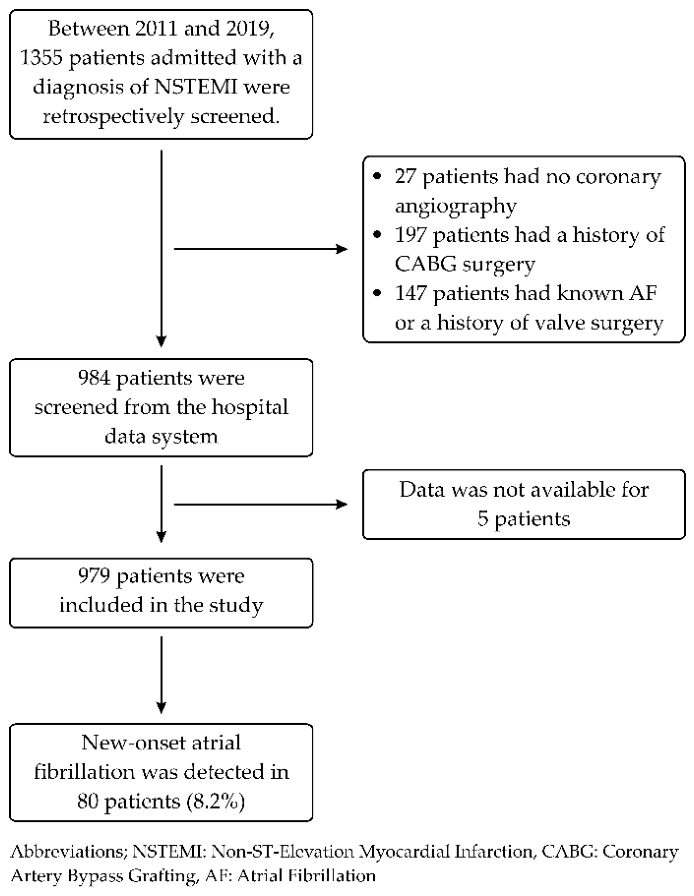
Figure 2.
ROC–Curve analysis conducted to evaluate the predictive power of risk scores in forecasting NOAF.
Figure 2.
ROC–Curve analysis conducted to evaluate the predictive power of risk scores in forecasting NOAF.
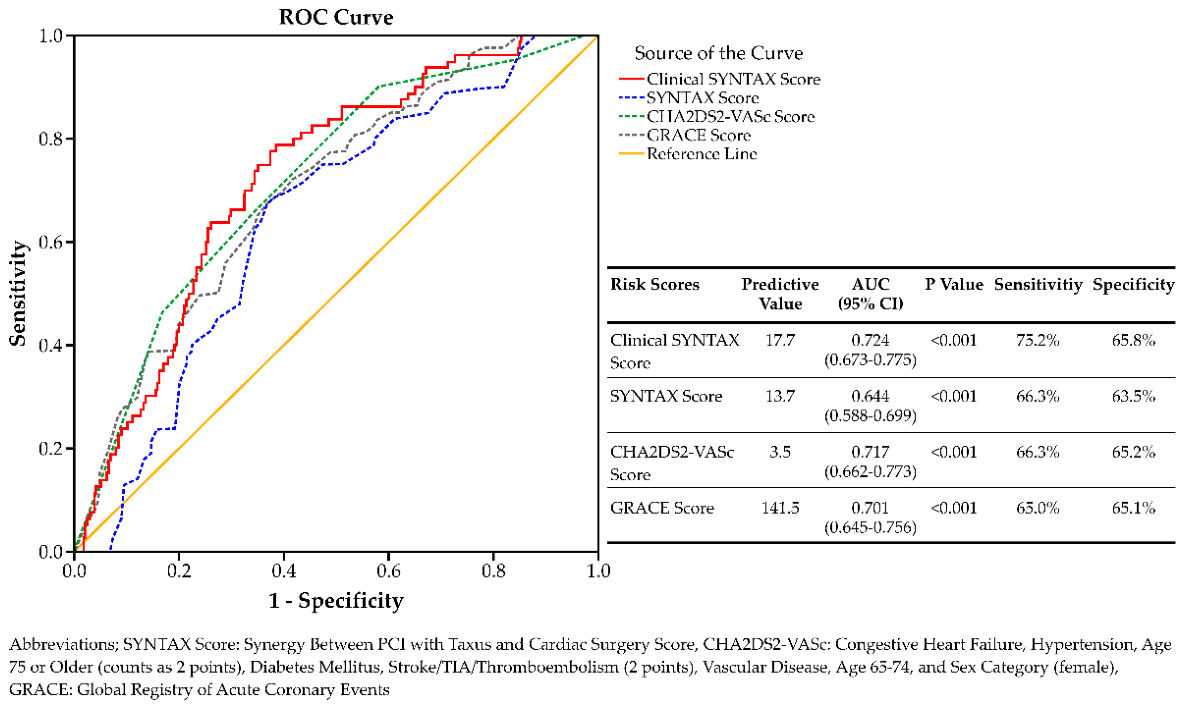

Table 1.
The baseline demographic and clinical characteristics of the whole population and the groups with and without NOAF.
Table 1.
The baseline demographic and clinical characteristics of the whole population and the groups with and without NOAF.
| Variables | Total, n=979 | NOAF (+), n=80 (8.2%) | NOAF (–), n=899 (91.8%) | P Value |
| Age, (years)* | 59 (24–92) | 71 (44–86) | 59 (24–92) | <0.001 |
| Male, n (%) | 698 (71.3) | 44 (55) | 654 (72.7) | 0.001 |
| Previous MI, n (%) | 198 (20.2) | 18 (22.5) | 180 (20) | 0.597 |
| Previous PCI, n (%) | 262 (26.8) | 25 (31.3) | 237 (26.4) | 0.344 |
| HT, n (%) | 572 (58.4) | 58 (72.5) | 514 (57.2) | 0.008 |
| DM, n (%) | 351 (35.9) | 33 (41.3) | 318 (35.4) | 0.294 |
| Medications Used at Discharge, n (%) | ||||
| ASA | 928 (94.8) | 74 (92.5) | 854 (95) | 0.336 |
| Clopidogrel | 466 (47.6) | 38 (47.5) | 397 (44.1) | n/a |
| Ticagrelor | 266 (27.2) | 4 (5) | 262 (29.1) | n/a |
| P2y12 inhibitor | 737 (75.3) | 47 (58.8) | 690 (76.8) | <0.001 |
| DAPT | 706 (72.1) | 42 (52.5) | 664 (73.9) | <0.001 |
| Beta Blocker | 895 (91.4) | 75 (93.8) | 820 (91.2) | 0.437 |
| RAAS inhibitor | 845 (86.3) | 68 (85) | 777 (86.4) | 0.722 |
| Statin | 867 (88.6) | 65 (81.3) | 802 (89.2) | 0.032 |
| Oral Anticoagulant therapy | 86 (8.7) | 34 (42.5) | 52 (5.8) | <0.001 |
| Triple antithrombotic therapy (TAT) | 19 (23.7) | n/a | n/a | |
| In–hospital arrhythmia, n (%) | 120 (12.3) | 80 (100) | 40 (4.3) | n/a |
| Ventricular arrhythmia, n (%) | 45 (4.6) | 6 (7.5) | 39 (4.3) | n/a |
| 12–month follow–up Atrial Fibrillation, n (%) | 23 (2.3) | n/a | n/a | n/a |
| Length of stay, (days)* | 5 (1–45) | 7 (2–45) | 5 (1–45) | <0.001 |
| ACEF score* | 1.13 (0.40–6.62) | 1.6 (0.7–5.8) | 1.1 (0.4–6.6) | <0.001 |
| SYNTAX score* | 10 (0–46.5) | 16 (2–33) | 10 (0–46.5) | <0.001 |
| Clinical SYNTAX score* | 12.3 (0–230) | 27.5 (2.5–124) | 11.3 (0–230) | <0.001 |
| CHA2DS2–VASc score* | 3 (0–7) | 4 (1–7) | 3 (0–7) | <0. 001 |
| GRACE score * | 131 (31–260) | 153 (92–260) | 128 (31–248) | <0.001 |
| LA diameter (mm)* | 38 (23–63) | 43 (32–54) | 38 (23–63) | <0.001 |
| LA ≥40 mm, n (%) | 388 (39.6) | 54 (67.5) | 334 (37.2) | <0.001 |
| LVDD, n (%) | 537 (54.9) | 62 (77.5) | 475 (52.8) | <0.001 |
| EF (%)* | 60 (18–60) | 50 (25–60) | 60 (18–60) | 0.010 |
| EF ≤ %40, n (%) | 123 (12.6) | 17 (21.3) | 106 (11.8) | 0.014 |
| EF <%60, n (%) | 469 (47.9) | 47 (58.8) | 422 (46.9) | 0.043 |
| GFR ≥ 90, n (%) | 499 (51) | 25 (31.3) | 474 (52.7) | <0.001 |
| GFR :60–89,n (%) | 343 (35) | 27 (33.8) | 316 (35.2) | 0.801 |
| GFR<60, n (%) | 137 (14) | 28 (35) | 109 (12.1) | <0.001 |
Abbreviations; MI: Myocardial Infarction, PCI: Percutaneous Coronary Intervention, HT: Hypertension, DM: Diabetes Mellitus, ASA: Aspirin, DAPT: Dual Antiplatelet Therapy, RAAS Inhibitor: Renin–Angiotensin–Aldosterone System Inhibitor, SYNTAX Score: Synergy Between PCI With Taxus and Cardiac Surgery Score, CHA2DS2–VASc: Congestive heart failure, Hypertension, Age 75 or older (counts as 2 points), Diabetes mellitus, Stroke/TIA/thromboembolism (2 points), Vascular disease, Age 65–74, and Sex category (female), GRACE: Global Registry of Acute Coronary Events, LA: Left Atrium, LVDD: Left Ventricular Diastolic Dysfunction, EF: Ejection Fraction, GFR: Glomerular Filtration Rate It is calculated using the Cockcroft–Gault formula. *median (minimum–maximum)
Table 2.
The primary outcomes and their components were analysed in a comparative manner between the general population and the groups with and without NOAF.
Table 2.
The primary outcomes and their components were analysed in a comparative manner between the general population and the groups with and without NOAF.
| Primary Endpoints | General Population | NOAF (+), n=80 (8.2%) | NOAF (–), n=899 (91.8%) | P Value |
| Death, n (%) | 297 (30.3) | 48 (60) | 249 (27.7) | <0.001 |
| In hospital death | 18 (1.8) | 4 (5) | 14 (1.6) | 0.028 |
| MI, n (%) | 168 (17.2) | 11 (13.8) | 157 (17.5) | 0.399 |
| SVA (Ischemic), n (%) | 27 (2.8) | 8 (10) | 19 (2.1) | <0.001 |
| MACE (Death/MI/SVA), n (%) | 412 (42.1) | 53 (66.3) | 359 (39.9) | <0.001 |
| Cardiovascular hospitalization (%) | 276 (28.2) | 33 (41.3) | 243 (27) | 0.007 |
Abbreviations; MI: Myocardial Infarction, MACE: Major Adverse Cardiovascular Events (Death / Myocardial infarction / Ischemic stroke).
Table 3.
Two separate regression analyses conducted to identify independent predictors of NOAF.
| Independent Predictors model 1 | HR | 95% CI | P value | Independent Predictors model 2 | HR | 95% CI | P value |
| Male Sex | 0.581 | 0.323–1.042 | 0.069 | Male Sex | 0.467 | 0.267–0.816 | 0.007 |
| LVDD | 1.790 | 0.986–3.248 | 0.056 | LVDD | 2.120 | 1.182–3.802 | 0.012 |
| HT | 0.789 | 0.431–1.446 | 0.444 | HT | 0.952 | 0.530–1.709 | 0.869 |
| Hemoglobin | 1.092 | 0.941–1.267 | 0.244 | Hemoglobin | 1.050 | 0.907–1.217 | 0.512 |
| SYNTAX Score | 1.022 | 0.999–1.045 | 0.059 | Clinical SYNTAX score | 1.009 | 1.002–1.016 | 0.014 |
| LDL | 0.999 | 0.993–1.005 | 0.786 | LDL | 0.998 | 0.992–1.004 | 0.551 |
| Age | 1.077 | 1.043–1.113 | <0.001 | ||||
| Neutrophil–to–Lymphocyte Ratio | 1.033 | 0.990–1.077 | 0.135 | Neutrophil–to–Lymphocyte Ratio | 1.023 | 0.984–1.063 | 0.253 |
| EF | 1.006 | 0.980–1.032 | 0.669 | EF | 1.011 | 0.985–1.038 | 0.421 |
| Fasting Blood Glucose | 1.004 | 1.000–1.007 | 0.070 | Fasting Blood Glucose | 1.002 | 0.999–1.006 | 0.216 |
| LA diameter | 1.126 | 1.072–1.184 | <0.001 | LA diameter | 1.144 | 1.091–1.200 | <0.001 |
| GFR | 1.004 | 0.992–1.016 | 0.486 |
Abbreviations; LVDD: Left Ventricular Diastolic Dysfunction, HT: Hypertension, SYNTAX Score: Synergy Between PCI with Taxus and Cardiac Surgery Score, LDL: Low–Density Lipoprotein, EF: Ejection Fraction, LA: Left Atrium.
Table 4.
Two separate Cox regression models conducted to identify independent predictors of all–cause mortality.
Table 4.
Two separate Cox regression models conducted to identify independent predictors of all–cause mortality.
| Independent Predictors (Model 1) | HR | 95% CI | P Value | Independent Predictors (Model 2) | HR | 95% CI | P Value |
| New onset atrial fibrillation | 1.421 | 1.024–1.971 | 0.035 | New onset atrial fibrillation (NOAF) | 1.464 | 1.054–2.034 | 0.023 |
| LVDD | 1.269 | 0.968–1.664 | 0.085 | LVDD | 1.262 | 0.961–1.656 | 0.094 |
| HT | 1.463 | 1.097–1.950 | 0.010 | HT | 1.445 | 1.082–1.930 | 0.013 |
| Previous MI | 1.146 | 0.869–1.511 | 0.334 | Previous MI | 1.105 | 0.835–1.462 | 0.484 |
| Smoking History | 1.164 | 0.895–1.513 | 0.259 | Smoking History | 1.167 | 0.897–1.516 | 0.250 |
| Male Sex | 1.184 | 0.898–1.562 | 0.232 | Male Sex | 1.199 | 0.910–1.580 | 0.197 |
| LDL | 1.001 | 0.998–1.003 | 0.739 | LDL | 1.001 | 0.998–1.004 | 0.542 |
| Age | 1.037 | 1.021–1.054 | <0.001 | Age | 1.035 | 1.018–1.051 | <0.001 |
| HDL | 1.002 | 0.992–1.013 | 0.672 | HDL | 1.002 | 0.992–1.013 | 0.665 |
| SYNTAX Score | 1.010 | 1.000–1.021 | 0.059 | SYNTAX Score | 0.998 | 0.982–1.014 | 0.794 |
| EF <60% | 1.439 | 1.124–1.842 | 0.004 | EF <60% | 1.398 | 1.089–1.794 | 0.009 |
| GRACE Score >140 | 1.157 | 0.884–1515 | 0.288 | GRACE >140 score | 1.157 | 0.882–1518 | 0.292 |
| GFR | 0.990 | 0.985–0.996 | 0.002 | GFR | 0.993 | 0.987–0.999 | 0.021 |
| Anemia | 1.259 | 0.968–1.612 | 0.068 | Anemia | 1.268 | 0.990–1.625 | 0.060 |
| NOAF at 12–month follow–up | 1.700 | 0.968–2.984 | 0.065 | NOAF at 12–month follow–up | 1.723 | 0.980–3.030 | 0.059 |
| Clinical SYNTAX Score | 1.006 | 1.001–1.011 | 0.013 |
Abbreviations; LVDD: Left Ventricular Diastolic Dysfunction, HT: Hypertension, MI: Myocardial Infarction LDL: Low–Density Lipoprotein, HDL: High Density Lipoprotein, SYNTAX Score: Synergy Between PCI with Taxus and Cardiac Surgery Score, EF: Ejection Fraction, GRACE: Global Registry of Acute Coronary Events, GFR: Glomerular Filtration Rate It is calculated using the Cockcroft–Gault formula, NOAF: New–Onset Atrial Fibrillation.
Table 5.
Baseline angiographic characteristics and revascularization strategies in patient groups with and without MACE.
Table 5.
Baseline angiographic characteristics and revascularization strategies in patient groups with and without MACE.
| Variables | MACE (+), n=412 (42.1%) | MACE (–), n=567 (57.9%) | P Value |
| Number of diseased vessels (≥50% stenosis), n (%) | |||
| No disease | 27 (6.6) | 77 (13.6) | <0.001 |
| Single–vessel disease | 142 (34.5) | 246 (43.4) | |
| Two–vessel disease | 128 (31.1) | 150 (26.5) | |
| Three–vessel disease | 115 (27.9) | 94 (16.6) | |
| Revascularization strategy, n (%) | |||
| Medical management | 114 (27.7) | 135 (23.8) | 0.303 |
| PCI | 215 (52.2) | 322 (56.8) | |
| CABG | 83 (20.1) | 110 (19.4) | |
| SYNTAX score* | 12 (0–46.5) | 9 (0–45) | <0.001 |
Abbreviations; MACE: Major Adverse Cardiovascular Events (Death / Myocardial infarction / Ischemic stroke), PCI: Percutaneous Coronary Intervention, CABG: Coronary Artery Bypass Grafting, SYNTAX Score: Synergy Between PCI with Taxus and Cardiac Surgery Score.
Table 6.
Two separate Cox regression models conducted to identify independent predictors of MACE (Death/MI/CVA).
Table 6.
Two separate Cox regression models conducted to identify independent predictors of MACE (Death/MI/CVA).
| Independent Predictors (Model 1) | HR | 95% CI | P Value | Independent Predictors (Model 2) | HR | 95% CI | P Value |
| NOAF | 1.389 | 1.025–1.883 | 0.034 | NOAF | 1.371 | 1.012–1.858 | 0.042 |
| LVDD | 1.189 | 0.950–1.489 | 0.130 | LVDD | 1.188 | 0.949–1.486 | 0.133 |
| HT | 1.327 | 1.048–1.680 | 0.019 | HT | 1.336 | 1.056–1.690 | 0.016 |
| Previous MI | 1.232 | 0.972–1.560 | 0.084 | Previous MI | 1.252 | 0.989–1.585 | 0.062 |
| Smoking History | 1.059 | 0.850–1.319 | 0.609 | Smoking History | 1.056 | 0.847–1.316 | 0.627 |
| Male Sex | 1.080 | 0.850–1.374 | 0.528 | Male Sex | 1.077 | 0.846–1.372 | 0.546 |
| LDL | 1.000 | 0.998–1003 | 0.727 | LDL | 1.000 | 0.998–1003 | 0.861 |
| Age | 1.021 | 1.008–1.035 | 0.002 | Age | 1.023 | 1.009–1.036 | 0.001 |
| HDL | 0.995 | 0.986–1004 | 0.300 | HDL | 0.995 | 0.986–1004 | 0.291 |
| Clinical SYNTAX Score | 1.004 | 1.000–1.007 | 0.026 | SYNTAX Score | 1.006 | 0.997–1.016 | 0.178 |
| EF <60% | 1.254 | 1.019–1.543 | 0.032 | EF <60% | 1.282 | 1.043–1.575 | 0.018 |
| GRACE Score >140 | 1.007 | 0.802–1.265 | 0.950 | GRACE Score >140 | 1.011 | 0.806–1.268 | 0.926 |
| GFR | 0.996 | 0.991–1.001 | 0.105 | GFR | 0.995 | 0.991–1.000 | 0.033 |
| Anemia | 1.201 | 0.967–1.491 | 0.097 | Anemia | 1.203 | 0.970–1.494 | 0.093 |
| NOAF at 12–month follow–up | 2.154 | 1.331–3.485 | 0.002 | NOAF at 12–month follow–up | 2.149 | 1.328–3.479 | 0.002 |
Abbreviations; LVDD: Left Ventricular Diastolic Dysfunction, HT: Hypertension, MI: Myocardial Infarction LDL: Low–Density Lipoprotein, HDL: High Density Lipoprotein, SYNTAX Score: Synergy Between PCI with Taxus and Cardiac Surgery Score, EF: Ejection Fraction, GRACE: Global Registry of Acute Coronary Events, GFR: Glomerular Filtration Rate It is calculated using the Cockcroft–Gault formula, NOAF: New–Onset Atrial Fibrillation.
Table 7.
Exploratory Cox regression models substituting the CHA2DS2-VASc score for age, given the correlation between age and CHA2DS2-VASc score in the primary models.
Table 7.
Exploratory Cox regression models substituting the CHA2DS2-VASc score for age, given the correlation between age and CHA2DS2-VASc score in the primary models.
| Independent Predictors (Mortality) | HR | 95% CI | P Value | Independent Predictors (MACE) | HR | 95% CI | P Value |
| New onset atrial fibrillation | 1.500 | 1.082–2.080 | 0.015 | New onset atrial fibrillation (NOAF) | 1.439 | 1.063–1.947 | 0.019 |
| LVDD | 1.284 | 0.978–1.686 | 0.072 | LVDD | 1.203 | 0.961–1.505 | 0.107 |
| HT | 1.084 | 0.773–1.520 | 0.641 | HT | 1.061 | 0.800–1.408 | 0.681 |
| Previous MI | 1.103 | 0.836–1.454 | 0.489 | Previous MI | 1.205 | 0.952–1.526 | 0.121 |
| Smoking History | 1.138 | 0.876–1.477 | 0.333 | Smoking History | 1.052 | 0.845–1.308 | 0.651 |
| Male Sex | 1.605 | 1.152–2.236 | 0.005 | Male Sex | 1.359 | 1.021–1.811 | 0.036 |
| LDL | 1.001 | 0.998–1.004 | 0.613 | LDL | 1.001 | 0.998–1.003 | 0.614 |
| CHA2DS2-VASc Score | 1.313 | 1.134–1.521 | <0.001 | CHA2DS2-VASc Score | 1.230 | 1.084–1.397 | 0.001 |
| HDL | 1.006 | 0.996–1.017 | 0.225 | HDL | 0.998 | 0.988–1.007 | 0.601 |
| SYNTAX Score | 1.009 | 0.998–1.020 | 0.111 | Clinical SYNTAX Score | 1.003 | 1.000–1.007 | 0.047 |
| EF <60% | 1.057 | 0.794–1.408 | 0.703 | EF <60% | 0.988 | 0.773–1.264 | 0.925 |
| GRACE Score >140 | 1.226 | 0.942–1.594 | 0.129 | GRACE Score >140 | 1.024 | 0.819–1.282 | 0.832 |
| GFR | 0.987 | 0.981–0.992 | <0.001 | GFR | 0.994 | 0.990–0.999 | 0.010 |
| Anemia | 1.248 | 0.974–1.601 | 0.080 | Anemia | 1.190 | 0.958–1.480 | 0.116 |
| NOAF at 12–month follow–up | 1.691 | 0.959–2.982 | 0.069 | NOAF at 12–month follow–up | 2.104 | 1.296–3.417 | 0.003 |
Abbreviations; LVDD: Left Ventricular Diastolic Dysfunction, HT: Hypertension, MI: Myocardial Infarction, LDL: Low–Density Lipoprotein, HDL: High Density Lipoprotein, CHA2DS2-VASc: Congestive heart failure, Hypertension, Age, Diabetes, Stroke, Vascular disease, Sex category score, SYNTAX Score: Synergy Between PCI with Taxus and Cardiac Surgery Score, EF: Ejection Fraction, GRACE: Global Registry of Acute Coronary Events, GFR: Glomerular Filtration Rate, NOAF: New–Onset Atrial Fibrillation. Models otherwise match the covariate set of Table 4 Model 1 (mortality) and Table 6 Model 1 (MACE), with age removed and CHA2DS2-VASc score added.
Disclaimer/Publisher’s Note: The statements, opinions and data contained in all publications are solely those of the individual author(s) and contributor(s) and not of MDPI and/or the editor(s). MDPI and/or the editor(s) disclaim responsibility for any injury to people or property resulting from any ideas, methods, instructions or products referred to in the content. |
© 2026 by the authors. Licensee MDPI, Basel, Switzerland. This article is an open access article distributed under the terms and conditions of the Creative Commons Attribution (CC BY) license (http://creativecommons.org/licenses/by/4.0/).
Copyright: This open access article is published under a Creative Commons CC BY 4.0 license, which permit the free download, distribution, and reuse, provided that the author and preprint are cited in any reuse.