
Submitted:
17 September 2026
Posted:
18 September 2026
You are already at the latest version
Abstract
The Tethyan tectonic domain exerted significant impacts on the tectonic evolution of China. However, magmatic‑petrological records of the Neo‑Tethys in southeastern South China are still poorly constrained. To better understand the formation and evolutionary characteristics of the Neo‑Tethyan tectonic domain in South China. Petrography, zircon U‑Pb geochronology, as well as elemental‑isotopic geochemical analyses were carried out on the magmatic rocks from Hainan Island. Geochronological results show that two mafic rock samples yield crystallization ages of 99 ± 1 Ma and 98 ± 1 Ma, respectively, and three granite samples give ages of 97 ± 2 Ma, 98 ± 1 Ma and 102 ± 2 Ma. The mafic samples have SiO₂ contents ranging from 49.98% to 51.26 %, belonging to the calc‑alkaline series. They are enriched in large‑ion lithophile elements, depleted in high‑field‑strength elements, and characterized by enriched light rare‑earth elements. Their εHf(t) values range from −5.26 to −3.19. The granite samples have SiO₂ contents of 73.01 %–76.31 %, and are classified as peraluminous high‑K calc‑alkaline rocks with pronounced negative Nb‑Ta anomalies. Their εHf(t) values vary from −5.47 to −2.84, with two‑stage Hf model ages of 1109–1209 Ma. Synthesis of the above data indicates that the mafic rocks were mainly derived from partial melting of enriched lithospheric mantle metasomatized by subduction‑zone fluids/melts. The granites originated from remelting of Mesoproterozoic crustal materials, with the addition of mantle‑derived materials. Combined with the previously identified Cretaceous EW‑trending subduction zone along the northern margin of the South China Sea, we propose that the subduction of Neo‑Tethyan oceanic crust represents the principal geodynamic mechanism for the extensive Cretaceous magmatism on Hainan Island.
Keywords:
Neo-Tethys
; Cretaceous
; magmatic rocks
; zircon U-Pb dating
; South China Block
1. Introduction
Mesozoic magmatic rocks and associated mineralization are widely distributed in the South China Block [1,2,3,4]. Magmatic activities in this region are mainly divided into the Indosinian and Yanshanian episodes. The Yanshanian magmatism is further subdivided into the Early Yanshanian stage (Jurassic) and the Late Yanshanian stage (Cretaceous), with high-K I-type and A-type granites as well as related igneous rocks predominantly developed in Southeast China[5,6,7]. The chronological framework, magmatic genesis, tectonic setting and metallogenesis of Yanshanian magmatic rocks in South China have long constituted key scientific issues attracting extensive attention from the geological community[8,9,10]. Previous studies have revealed two distinct distribution patterns for Cretaceous (107–80 Ma) felsic intrusions and volcanic rocks in South China: one strikes NE–SW and is chiefly exposed along the eastern coastal zone; the other extends E–W from Guangdong to Yunnan. With regard to the NE–SW trending magmatism, numerous researchers have carried out petrological, major-trace elemental geochemical, isotopic geochemical and geochronological investigations. Multiple rock types have been identified, including A-type granites, highly fractionated I-type granites, adakites and bimodal volcanic rocks[11,12,13]. Meanwhile, diverse dynamic models have been proposed to interpret the petrogenesis of Yanshanian magmatic rocks and the tectonic evolutionary history of southeastern China[14,15,16].
Hainan Island is located at the junction of the Eurasian Plate, Indian Plate and Paleo-Pacific Plate, and connects with the South China mainland via the Qiongzhou Strait. Controlled by this special geotectonic location, Hainan Island has been reconstructed by multi-phase tectonic movements from the Proterozoic to the Cenozoic. It acts as a key region for deciphering the tectonic evolution of the Indochina Block and South China Block, and also serves as an ideal research area for exploring some major scientific issues such as the evolution of the Paleo-Pacific tectonic domain and Tethyan tectonic domain. For this reason, it has received great attention from the geologists[17]. Previous studies have extensively investigated Mesozoic magmatism in Hainan Island and its surrounding areas and preliminarily constrained the petrogenesis and geodynamic regime of these magmatic rocks. Nevertheless, the tectonic setting remains controversial, with three prevailing interpretations: (1) an active continental margin volcanic arc system triggered by the subduction of the Paleo-Pacific Plate[13,18]; (2) an intraplate extensional rifting setting[19]; (3) a geodynamic setting associated with mantle plume activity[20].
In recent years, integrated geochemical and geophysical studies on the southeastern China coast and the South China Sea have led some researchers to hypothesize that the tectonic evolution of this region may be coupled with the Neo-Tethys tectonic system[21,22,23]. Accordingly, two key scientific questions emerge: what controls the geodynamic mechanism of Mesozoic magmatism on Hainan Island, and whether such magmatism is linked to the evolution of the Neo-Tethys Ocean. Addressing these scientific issues is critical for unraveling the Mesozoic tectonic evolution of South China. Given the above research status, this paper selects magmatic rocks from the Zhubijiang and Lingshui areas of Hainan Island to constrain their crystallization ages, petrogenesis and tectonic settings, thereby providing new constraints for understanding the Mesozoic tectonic framework of South China.
2. Regional Geological Background
Strata on the island have generally experienced greenschist-facies metamorphism and intense superimposed tectonic reworking, rendering early structural fabrics difficult to recognize. Two major structural systems are developed in Hainan Island: the nearly NE–NNE-trending system and the nearly EW-trending system. The NE–NNE structural system is mainly composed of the Baisha Fault and the Gezhen Fault (a ductile shear zone). From north to south, the EW structural system consists of the Wangwu–Wenjiao Fault, Changjiang–Qionghai Fault, Jianfeng–Diaoluo Fault and Jiusuo–Lingshui Fault (Figure 1). These faults were likely generated during the Paleozoic–Mesozoic or even earlier periods.
The strata exposed on the Hainan Island contain the Proterozoic, Cambrian, Ordovician, Silurian, Carboniferous, Permian, Triassic, Cretaceous and Quaternary. The total outcrop area of these strata accounts for approximately 36% of the entire land area of Hainan Island. The Baoban Group represents the oldest stratigraphic unit in Hainan Island, which predominantly outcrops in Changjiang and Dongfang in the northwestern part of the island, as well as the Wuzhi Mountain area in central Hainan. Cretaceous strata are widely distributed across Hainan Island, hosting a series of sedimentary basins of varying sizes concentrated in the central and northeastern segments of the island. Major basins include the Baisha Basin, Leiming Basin, Yangjiang Basin, Jialai Basin, Wenchang Basin, Laoyangdi Basin (Changjiang) and Sanya Basin. These basins generally strike northeast–southwest and are characterized by inland red clastic sedimentary sequences, yielding fossil assemblages of plants, charophytes and ostracods.
Intense magmatism prevailed in Hainan Island, resulting in widespread magmatic rocks formed principally during the Jinningian, Variscan-Indosinian and Yanshanian. The outcrop area of intrusive rocks within the island reaches 16624 km², accounting for approximately 49% of the total land area of Hainan Island. Their lithologies are dominated by monzogranite, syenogranite, tonalite, diorite and gabbro. Volcanic rocks exhibit a smaller outcrop extent compared with intrusive rocks. Mesoproterozoic–Neoproterozoic volcanic rocks are chiefly intermediate-acid volcanic lithologies hosted within the Gezhencun Formation and Shilu Group. Paleozoic volcanic rocks display wide lithological variations, including ultrabasic to acidic rocks. Mesozoic volcanic rocks are mainly composed of intermediate and acid lavas. Cenozoic volcanic rocks consist predominantly of basic lavas, tuffs and sedimentary volcanic breccias, and are concentrated in the northern part of Hainan Island.
3. Results
3.1. Petrological and Geochemical Characteristics
In this study, geochronological analyses were carried out on two mafic rock samples (16DZ-33A and 17LS-50B) and three granite samples (17LS-49A, 17LS-49B and 17LS-50A) from Hainan Island. The petrographic descriptions of the samples are given below.
Sample 16DZ-33A is a diabase. The rock shows no surface weathering, and its fresh surface is overall gray-black with fine-grained texture and massive structure (Figure 2a). Microscopically, the rock is mainly composed of pyroxene, plagioclase and hornblende (Figure 2b). Pyroxene occurs as anhedral granular grains with grain sizes mostly ranging from 100 to 500 μm, accounting for 40%–50% of the rock. Plagioclase is medium-fine-grained, with grain sizes of 100–300 μm and contents of 20%–30%. Hornblende is subhedral spindle-shaped, with long axes of 50–200 μm and contents of 10%–20%.
Sample 17LS-50B is a diabase. Without surface weathering, the rock has a gray-black fresh surface, medium-fine-grained texture and massive structure (Figure 2c). It is mainly composed of plagioclase, K-feldspar, pyroxene and biotite (Figure 2d). Plagioclase occurs as euhedral-subhedral tabular crystals with long axes of 100–1000 μm. Pyroxene is subhedral short-prismatic, with long axes of 50–500 μm. Quartz mostly appears as anhedral grains filling interstices among earlier-formed minerals.
Sample 17LS-49A is medium-grained biotite granite. The rock exhibits no surface weathering; its fresh surface is light flesh-red in general, with porphyritic texture and massive structure (Figure 3a). It mainly consists of plagioclase, K-feldspar, quartz and biotite (Figure 3b). Light-gray plagioclase is euhedral-subhedral, and some grains display zoning, with grain sizes of 100–2000 μm and contents of 20%–30%. Colorless and transparent quartz has smooth surfaces, with grain sizes of 100–1000 μm and contents of 20%–30%. Dark-brown banded biotite is distributed among quartz and feldspar grains; partial biotite grains show weak sericitization along margins, with grain sizes of 100–1200 μm and contents of 10%–20%. K-feldspar develops perthite texture, with grain sizes of 100–2000 μm and contents of 10%–15%. Accessory minerals include zircon, thorite and cordierite.
Sample 17LS-49B is leucogranite. The rock has an overall gray-white fresh surface, fine-grained texture and massive structure (Figure 3c). Microscopic observations reveal that it is dominated by plagioclase, K-feldspar, quartz and biotite (Figure 3d). Euhedral-subhedral plagioclase has grain sizes of 100–700 μm and modal contents of 20%–30%. Quartz shows low positive relief, is colorless-transparent with smooth surfaces, and has grain sizes of 100–700 μm and modal contents of 20%–30%. K-feldspar exhibits perthite texture, with grain sizes of 100–300 μm and modal contents of 10%–15%. Main accessory minerals are zircon and cordierite.
Sample 17LS-50A is granite. A small amount of weathering occurs on the rock surface. Its fresh surface is generally gray-white, with porphyritic texture and massive structure (Figure 3e). Microscopically, the rock is composed mainly of plagioclase, K-feldspar, quartz and biotite (Figure 3f). Euhedral-subhedral plagioclase has grain sizes of 100–2000 μm and contents of 20%–30%. Smooth quartz lacks cleavage, with grain sizes of 100–1200 μm and contents of 20%–30%. Dark-brown tabular biotite has grain sizes of 100–500 μm and contents of 10%–20%. Subhedral K-feldspar shows both Carlsbad twin and perthite texture, with grain sizes of 100–2000 μm and contents of 10%–15%. The principal accessory mineral is cordierite and zircon.
3.2. Zircon U-Pb Geochronological Results
Zircon grains selected for dating are mostly transparent to semi-transparent, with pale brown (Figure 4). The zircon crystals are predominantly prismatic to long-prismatic, ranging from 70 to 270 μm in length. They are euhedral and exhibit well-developed broad oscillatory zoning. The zircons have relatively high Th/U ratios, mostly greater than 0.2 (Table 1), showing typical characteristics of magmatic zircons. All analytical spots fall on or near the concordia line, indicating that the U-Pb isotopic system remained closed after zircon crystallization, with negligible loss or addition of U and Pb isotopes.

Table 1.
Zircon U-Pb isotope results of the magmatic rocks from the Zhubijiang-Lingshui areas.
| Spots | Th/U | Element ratios | Age/Ma | ||||||
| 207Pb/235U | ±1σ | 206Pb/238U | ±1σ | 207Pb/235U | ±1σ | 206Pb/238U | ±1σ | ||
| Diabase sample 16DZ-33A | |||||||||
| 1 | 0.48 | 0.2757 | 0.0083 | 0.0392 | 0.0004 | 247 | 7 | 248 | 3 |
| 2 | 0.86 | 0.1084 | 0.0084 | 0.0156 | 0.0004 | 104 | 8 | 100 | 2 |
| 3 | 0.56 | 0.279 | 0.0106 | 0.0404 | 0.0005 | 250 | 8 | 255 | 3 |
| 4 | 1.31 | 0.0986 | 0.0046 | 0.0151 | 0.0004 | 96 | 4 | 97 | 2 |
| 5 | 1.36 | 0.1045 | 0.0044 | 0.0154 | 0.0002 | 101 | 4 | 99 | 1 |
| 6 | 1.25 | 0.1045 | 0.0132 | 0.0156 | 0.0007 | 101 | 12 | 100 | 4 |
| 7 | 1.41 | 0.1026 | 0.0045 | 0.0153 | 0.0002 | 99 | 4 | 98 | 1 |
| 8 | 1.43 | 0.1126 | 0.0137 | 0.0159 | 0.0004 | 108 | 12 | 102 | 3 |
| 9 | 1.25 | 0.0982 | 0.0057 | 0.0153 | 0.0005 | 95 | 5 | 98 | 3 |
| 10 | 0.16 | 2.8651 | 0.0981 | 0.2381 | 0.007 | 1373 | 26 | 1377 | 37 |
| 11 | 1.46 | 0.0983 | 0.004 | 0.0155 | 0.0005 | 95 | 4 | 99 | 3 |
| 12 | 1.31 | 0.1032 | 0.0072 | 0.0153 | 0.0004 | 100 | 7 | 98 | 2 |
| 13 | 1.12 | 0.1009 | 0.007 | 0.0152 | 0.0003 | 98 | 6 | 97 | 2 |
| 14 | 1.12 | 0.1001 | 0.0066 | 0.0153 | 0.0005 | 97 | 6 | 98 | 3 |
| 15 | 1.28 | 0.0992 | 0.0151 | 0.0155 | 0.0007 | 96 | 14 | 99 | 4 |
| 16 | 1.31 | 0.0972 | 0.0126 | 0.0152 | 0.0014 | 94 | 12 | 97 | 9 |
| 17 | 1.44 | 0.1147 | 0.0038 | 0.0156 | 0.0002 | 110 | 3 | 100 | 1 |
| 18 | 0.11 | 0.4937 | 0.0121 | 0.0651 | 0.001 | 407 | 8 | 407 | 6 |
| 19 | 1.44 | 0.0961 | 0.0052 | 0.0153 | 0.0002 | 93 | 5 | 98 | 2 |
| 20 | 1.44 | 0.106 | 0.0064 | 0.0154 | 0.0003 | 102 | 6 | 99 | 2 |
| Diabase sample 17LS-50B | |||||||||
| 1 | 0.91 | 0.1017 | 0.0113 | 0.0153 | 0.0006 | 98 | 10 | 98 | 4 |
| 2 | 0.76 | 0.1031 | 0.0128 | 0.0157 | 0.0005 | 100 | 12 | 101 | 3 |
| 3 | 0.75 | 0.1063 | 0.0141 | 0.0153 | 0.0007 | 103 | 13 | 98 | 5 |
| 4 | 0.65 | 0.1017 | 0.0075 | 0.0155 | 0.0003 | 98 | 7 | 99 | 2 |
| 5 | 0.62 | 0.1055 | 0.0079 | 0.0152 | 0.0003 | 102 | 7 | 98 | 2 |
| 6 | 0.62 | 0.1023 | 0.0122 | 0.0154 | 0.0006 | 99 | 11 | 98 | 4 |
| 7 | 0.61 | 0.1028 | 0.0044 | 0.0152 | 0.0002 | 99 | 4 | 97 | 1 |
| 8 | 0.77 | 0.1059 | 0.0157 | 0.0152 | 0.0006 | 102 | 14 | 97 | 4 |
| 9 | 0.64 | 0.0993 | 0.0079 | 0.015 | 0.0005 | 96 | 7 | 96 | 3 |
| 10 | 0.68 | 0.1076 | 0.0085 | 0.0155 | 0.0004 | 104 | 8 | 99 | 2 |
| 11 | 0.53 | 0.0951 | 0.0178 | 0.0147 | 0.0007 | 92 | 16 | 94 | 4 |
| 12 | 0.72 | 0.0985 | 0.0085 | 0.0152 | 0.0007 | 95 | 8 | 97 | 4 |
| 13 | 0.85 | 0.1022 | 0.0077 | 0.0154 | 0.0003 | 99 | 7 | 99 | 2 |
| 14 | 0.69 | 0.0963 | 0.0105 | 0.0152 | 0.0007 | 93 | 10 | 97 | 4 |
| 15 | 0.82 | 0.1043 | 0.0089 | 0.0151 | 0.0004 | 101 | 8 | 97 | 2 |
| 16 | 0.79 | 0.0975 | 0.023 | 0.0158 | 0.0021 | 95 | 21 | 101 | 13 |
| 17 | 0.72 | 0.1048 | 0.006 | 0.0154 | 0.0002 | 101 | 6 | 99 | 2 |
| 18 | 0.53 | 0.1528 | 0.0123 | 0.0223 | 0.0008 | 144 | 11 | 142 | 5 |
| 19 | 1.01 | 0.1058 | 0.0046 | 0.0153 | 0.0002 | 102 | 4 | 98 | 1 |
| 20 | 1.06 | 0.107 | 0.0139 | 0.0156 | 0.0009 | 103 | 13 | 100 | 6 |
| 21 | 0.61 | 0.0973 | 0.0051 | 0.0154 | 0.0002 | 94 | 5 | 98 | 1 |
| 22 | 0.98 | 0.0982 | 0.0207 | 0.0149 | 0.0012 | 95 | 19 | 95 | 7 |
| 23 | 1.05 | 0.1144 | 0.0151 | 0.016 | 0.001 | 110 | 14 | 102 | 6 |
| 24 | 0.82 | 0.1039 | 0.0129 | 0.0154 | 0.0004 | 100 | 12 | 99 | 3 |
| 25 | 1.86 | 0.1005 | 0.0042 | 0.0153 | 0.0002 | 97 | 4 | 98 | 1 |
| Granite sample 17LS-49A | |||||||||
| 1 | 0.84 | 0.1012 | 0.0118 | 0.0149 | 0.001 | 98 | 11 | 95 | 6 |
| 2 | 0.8 | 0.098 | 0.0115 | 0.015 | 0.0007 | 95 | 11 | 96 | 5 |
| 3 | 1.44 | 0.1273 | 0.0297 | 0.0196 | 0.0019 | 122 | 27 | 125 | 12 |
| 4 | 0.52 | 0.1018 | 0.0096 | 0.0149 | 0.0008 | 98 | 9 | 95 | 5 |
| 5 | 0.73 | 0.1036 | 0.0417 | 0.0157 | 0.0018 | 100 | 38 | 101 | 12 |
| 6 | 0.77 | 0.1016 | 0.0125 | 0.015 | 0.001 | 98 | 12 | 96 | 6 |
| 7 | 0.9 | 0.0999 | 0.0116 | 0.0151 | 0.0008 | 97 | 11 | 97 | 5 |
| 8 | 0.67 | 0.0994 | 0.0106 | 0.0149 | 0.0008 | 96 | 10 | 95 | 5 |
| 9 | 0.7 | 0.0967 | 0.0122 | 0.0151 | 0.0006 | 94 | 11 | 97 | 4 |
| 10 | 1.35 | 0.0996 | 0.0123 | 0.0151 | 0.0006 | 96 | 11 | 97 | 4 |
| 11 | 0.81 | 0.1 | 0.0183 | 0.0148 | 0.0016 | 97 | 17 | 95 | 10 |
| 12 | 0.87 | 0.0979 | 0.0151 | 0.015 | 0.0012 | 95 | 14 | 96 | 8 |
| 13 | 1.09 | 0.11 | 0.0147 | 0.0152 | 0.0007 | 106 | 13 | 97 | 4 |
| 14 | 0.68 | 0.1046 | 0.0094 | 0.0151 | 0.0005 | 101 | 9 | 97 | 3 |
| 15 | 0.81 | 0.1019 | 0.0117 | 0.0151 | 0.0007 | 99 | 11 | 97 | 4 |
| 16 | 0.76 | 0.0974 | 0.0148 | 0.0149 | 0.0005 | 94 | 14 | 96 | 3 |
| 17 | 1.1 | 0.0954 | 0.0188 | 0.0149 | 0.0018 | 93 | 17 | 95 | 12 |
| 18 | 0.78 | 0.0992 | 0.0078 | 0.0152 | 0.0004 | 96 | 7 | 97 | 2 |
| 19 | 0.7 | 0.0983 | 0.0052 | 0.0151 | 0.0004 | 95 | 5 | 97 | 2 |
| 20 | 0.76 | 0.0978 | 0.011 | 0.0151 | 0.0005 | 95 | 10 | 96 | 3 |
| Granite sample 17LS-49B | |||||||||
| 1 | 0.81 | 0.0981 | 0.0017 | 0.0139 | 0.0001 | 95 | 2 | 89 | 1 |
| 2 | 0.42 | 0.1075 | 0.0021 | 0.0151 | 0.0002 | 104 | 2 | 96 | 1 |
| 3 | 0.75 | 0.1435 | 0.0281 | 0.0195 | 0.0019 | 136 | 25 | 125 | 12 |
| 4 | 0.77 | 0.1056 | 0.004 | 0.015 | 0.0002 | 102 | 4 | 96 | 1 |
| 5 | 0.97 | 0.102 | 0.0033 | 0.0153 | 0.0002 | 99 | 3 | 98 | 1 |
| 6 | 1.51 | 0.1053 | 0.0033 | 0.0153 | 0.0002 | 102 | 3 | 98 | 2 |
| 7 | 0.25 | 0.1085 | 0.0039 | 0.0153 | 0.0004 | 105 | 4 | 98 | 3 |
| 8 | 1.29 | 0.1046 | 0.0078 | 0.0152 | 0.0003 | 101 | 7 | 97 | 2 |
| 9 | 0.8 | 0.1038 | 0.0035 | 0.0154 | 0.0002 | 100 | 3 | 98 | 1 |
| 10 | 0.48 | 0.0984 | 0.0035 | 0.0152 | 0.0002 | 95 | 3 | 97 | 1 |
| 11 | 0.75 | 0.1042 | 0.0043 | 0.0154 | 0.0002 | 101 | 4 | 99 | 1 |
| 12 | 1.65 | 0.1093 | 0.0055 | 0.0154 | 0.0002 | 105 | 5 | 98 | 1 |
| 13 | 1.6 | 0.1037 | 0.0074 | 0.0157 | 0.0002 | 100 | 7 | 100 | 1 |
| 14 | 0.65 | 0.1009 | 0.0027 | 0.0154 | 0.0002 | 98 | 3 | 99 | 1 |
| 15 | 1.12 | 0.1059 | 0.0073 | 0.0154 | 0.0004 | 102 | 7 | 99 | 3 |
| 16 | 0.96 | 0.1054 | 0.0031 | 0.0158 | 0.0002 | 102 | 3 | 101 | 1 |
| 17 | 0.99 | 0.1021 | 0.0058 | 0.0153 | 0.0003 | 99 | 5 | 98 | 2 |
| 18 | 0.78 | 0.1043 | 0.0092 | 0.015 | 0.0004 | 101 | 8 | 96 | 2 |
| 19 | 1.1 | 0.1109 | 0.0095 | 0.0157 | 0.0003 | 107 | 9 | 101 | 2 |
| 20 | 0.92 | 0.1031 | 0.0033 | 0.015 | 0.0002 | 100 | 3 | 96 | 1 |
Twenty zircon analytical spots were performed on sample 16DZ-33A. Their Th/U ratios vary between 0.11 and 1.46, indicating typical magmatic-zircon signatures. All analytical spots plot near the concordia line (Figure 4a). A weighted-mean age of 99 ± 1 Ma (n = 16, MSWD = 0.70) was obtained (Figure 4b), which represents the crystallization age of the sample.
Twenty-five zircon spots were analyzed for sample 17LS-50B. Their Th/U ratios range from 0.53 to 1.86, consistent with typical magmatic zircons. All spots lie close to the concordia line (Figure 4c). The weighted-mean age is 98 ± 1 Ma (n = 23, MSWD = 0.28) (Figure 4d), interpreted as the crystallization age of this sample.
Twenty zircon analytical spots were carried out on sample 17LS-49A. The zircons have Th/U ratios ranging from 0.52 to 1.44. All analytical spots plot on the concordia line (Figure 5a), yielding a 206Pb/238U weighted-mean age of 97 ± 2 Ma (n = 19,MSWD = 0.034) (Figure 5b), which represents the crystallization age of the sample.
Twenty zircon analytical spots were conducted on sample 17LS-49B. Zircon Th/U ratios are between 0.25 and 1.65. All analyses fall on the concordia line (Figure 5c). The 206Pb/238U weighted-mean age is 98 ± 1 Ma (n = 18,MSWD = 1.4) (Figure 5d), which is interpreted as the crystallization age of the sample.
Twenty zircon analytical spots were performed on sample 17LS-50A. Zircon U contents vary from 349 to 2598 ppm, Th contents from 271 to 2613 ppm, and Th/U ratios from 0.63 to 1.34. All spots lie on the concordia line (Figure 5e), with a 206Pb/238U weighted-mean age of 102 ± 2 Ma (n = 20,MSWD = 0.53) (Figure 5f), representing the crystallization age of the sample.
3.3. Zircon Hf Isotopic Compositions
In-situ zircon Hf-isotopic analytical results are listed in Table 2. For granite sample 17LS-50A, the 176Yb/177Hf ratios range from 0.013461 to 0.043443, 176Lu/177Hf ratios from 0.000432 to 0.001354, and 176Hf/177Hf ratios from 0.282557 to 0.282601. Its εHf(t) values vary from −5.47 to −2.84 (t = 102 Ma), with two-stage Hf model ages (TDM2) of 1094–1222 Ma (Figure 6).
For diabase sample 17LS-50B, the 176Yb/177Hf ratios are 0.010556–0.025208, 176Lu/177Hf ratios are 0.000342–0.000809, and 176Hf/177Hf ratios are 0.282564–0.282622. The εHf(t) values range from −5.26 to −3.19 (t = 98 Ma), and the two-stage Hf model ages (TDM2) are 1109–1209 Ma.
3.4. Whole-Rock Geochemical Characteristics
3.4.1. Major-Element Geochemical Characteristics
The diabase samples have SiO₂ contents of 49.98–51.26 wt% (average = 50.59 wt%) (Table 3; Figure 7a), TiO₂ of 1.15–1.28 wt% (average = 1.24 wt%), Al₂O₃ of 15.80–16.99 wt% (average = 16.17 wt%), total Fe (Fe₂O₃T) of 7.88–8.24 wt% (average = 8.08 wt%), MgO of 4.04–5.29 wt% (average = 5.02 wt%), CaO of 6.12–6.70 wt% (average = 6.28 wt%), total alkalis (K₂O + Na₂O) of 4.94–7.14 wt% (average = 6.19 wt%), K₂O/Na₂O ratios of 0.33–0.77, MnO of 0.10–0.13 wt% (average = 0.13 wt%), and P₂O₅ of 0.35–0.64 wt% (average = 0.59 wt%). On the AFM diagram, all samples plot within the sub-alkaline series field (Figure 7b).
The Lingshui granites show geochemical features of high SiO2 (72.49–76.31 wt%, average = 74.09 wt%) (Figure 8a) and K₂O (3.76–4.92 wt%, average = 4.49 wt%), low CaO (0.73–2.09 wt%, average = 1.45 wt%), MgO (0.23–0.66 wt%, average = 0.51 wt%), P₂O₅ (0.02–0.08 wt%, average = 0.06 wt%) and TiO₂ (0.06–0.24 wt%, average = 0.17 wt%). The rocks yield low Mg# values varying from 48.46 to 52.41 (average = 50.95) and high Al₂O₃ contents (12.69–14.35 wt%, average = 13.60 wt%). Their A/CNK ratios are 1.00–1.32 (average = 1.13), suggesting peraluminous characteristics (Figure 8b). The K₂O/Na₂O ratios of the samples range from 1.03 to 1.43, with an average of 1.27. They have relatively high total-alkali contents (K₂O + Na₂O = 7.38–8.36 wt%, average = 8.03 wt%) and belong to high-K calc-alkaline series (Figure 8c).
3.4.2. Trace-Element Geochemical Characteristics
On the chondrite-normalized REE distribution patterns (Figure 9a), the diabase samples show total REE (ΣREE) contents of 141.47–256.78 μg/g, with light REE (ΣLREE) of 125.03–246.18 μg/g and heavy REE (ΣHREE) of 16.44–19.77 μg/g. The samples exhibit obvious LREE-HREE fractionation, with ΣLREE/ΣHREE ratios ranging from 7.60 to 13.17, and insignificant Eu anomalies (δEu = 0.89–1.00). In the primitive-mantle-normalized trace-element spider diagram (Figure 9b), the samples are enriched in large-ion lithophile elements (Rb, Ba) and relatively depleted in high-field-strength elements (Zr, Hf), with pronounced negative Nb-Ta anomalies. The samples yield high Th/Ta (5.56–9.30) and Th/Nb (0.31–0.43) ratios, as well as high Nb/Ta (17.13–22.32) and Zr/Hf (40.08–43.06) ratios.
The granite samples have ΣREE contents of 52.59–158.63 μg/g, with ΣLREE of 49.84–149.32 μg/g and ΣHREE of 2.76–9.32 μg/g. They show prominent LREE-HREE fractionation, with ΣLREE/ΣHREE ratios of 16.03–18.07 (Figure 9c). On the trace-element spider diagram (Figure 9d), the samples are enriched in Rb, Th and U, relatively depleted in high-field-strength elements Nb and Ta, and exhibit distinct negative Eu anomalies (δEu = 0.62–0.74).
4. Discussion
4.1. Petrogenesis and Source Characteristics
4.1.1. Petrogenesis and Source Characteristics of the Diabases
The diabases in this study exhibit ocean-island-like trace-element geochemical signatures, characterized by enrichment of LREE and LILE, and depletion of Nb, Ta, Ti and Hf (Figure 9a,b). All diabase samples plot within the field of intraplate basalt in the Zr/Y-Zr discrimination diagram (Figure 10a). Such geochemical signatures can be attributed either to crustal contamination or metasomatism by subduction-related fluids. Crustal contamination can be divided into two types: contamination induced by magma underplating, which mainly occurs beneath the asthenosphere; and contamination arising during magma ascent through the crust[29]. The Nb/Ta ratios of the samples range from 17.13 to 22.32, broadly consistent with the primitive-mantle value (17.5 ± 2.0), indicating limited crustal contamination of the primary magma. The diabases show comparable Sr (average 730 ppm) and Ba (average 600 ppm) concentrations, implying bulk distribution coefficients close to unity during magmatic evolution. This suggests that partial melting, rather than fractional crystallization, dominated the magmatic process (Figure 10b).
The Zr/Hf ratios of the diabase samples vary from 40.08 to 42.67, higher than the primitive-mantle value (36.27 ± 2.0) [30]. Elevated Zr/Hf ratios are interpreted as a response to subduction-fluid metasomatism[30]. The Th/Zr-Ba/Zr diagram is effective for distinguishing the roles of altered oceanic-crust-derived fluids versus crustal materials in source evolution[29,31]. On this diagram (Figure 10c), diabase samples follow an evolutionary trend controlled by altered oceanic-crust fluid metasomatism, demonstrating that their mantle sources were modified by ancient subduction-zone fluids/melts released by dehydration of a subducting oceanic slab.
For the Lingshui diabases, the fLu/Hf values range from −0.99 to −0.98, distinctly lower than those of mafic crust (−0.34) and sialic crust (−0.72) [32,33]. Accordingly, their two-stage Hf model ages (TDM2) can represent the timing when source materials were extracted from the depleted mantle, or the average crustal residence age of the source components. The initial 176Hf/177Hf ratios of the samples cluster around 0.2826, with εHf(t) values of −5.26 to −3.19 (average −4.21), showing an enriched Hf-isotopic signature. Considering the low degree of crustal contamination inferred above, this enriched Hf-isotopic signature indicates magma generation via partial melting of enriched lithospheric mantle.
In summary, the diabase samples were predominantly generated by partial melting of enriched lithospheric mantle, with overprinting metasomatism from subduction-zone fluids and melts.
4.1.2. Petrogenesis and Source Characteristics of the Granites
Based on petrogenesis and source characteristics, granites are classified into four types: S-, I-, A- and M-type[34,35,36]. M-type granites are generally mantle-derived and relatively rare. I-type granites are mainly sourced from igneous protoliths or the lower crust, typically with A/CNK < 1.1 and characteristic minerals of amphibole and pyroxene. A-type granites mostly form in post-orogenic or anorogenic tectonic settings, commonly contain alkaline minerals, and are marked by high FeOT/MgO (> 16), high 10000×Ga/Al (> 2.5) and high Nb+Y+Ce+Zr concentrations (> 350 ppm). S-type granites are dominantly generated by partial melting of sedimentary or upper-crustal materials, show peraluminous signatures and contain Al-rich minerals such as cordierite and garnet, with A/CNK > 1.1.
Chondrite-normalized REE patterns of the Lingshui granites exhibit distinct right-inclined trends with weak Eu negative anomalies, which differ from the typical seagull-shaped REE patterns and prominent Eu anomalies of A-type granites. Zircon saturation temperatures calculated from whole-rock major-element and Zr contents yield an average value of 749 °C. This value is lower than the temperature for A-type granites[37,38] (> 800 °C), and comparable to the formation temperatures of I- and S-type granites[39]. The granite samples have Nb+Y+Ce+Zr values of 155-435 ppm (mean = 275 ppm), lower than the A-type graites (> 350 ppm). Their FeOT/MgO ratios range from 2.86 to 15.12 (mean = 6.81), less than 16, which is also inconsistent with A-type granite signatures. None of the samples fall into the A-type granite field in the Nb+Y+Ce+Zr versus FeOT/MgO discrimination diagram (Figure 11a), precluding an A-type affinity for the studied granites. The samples have Al₂O₃ contents of 12.69%-14.35% and A/CNK ratios of 1.00-1.32 (mean > 1.1), which are distinct from I-type granites (Figure 11b). The rocks display peraluminous features (A/CNK = 1.00-1.32, mean > 1.1; Figure 8b), and cordierite can be observed under the microscope. All samples plot within the S-type granite domain (Figure 11b). Collectively, petrographic and geochemical data suggest that the Lingshui granites belong to S-type granite.
Zircon contains high Hf and extremely low Lu concentrations, and negligible radiogenic Hf accumulates after its crystallization. Accordingly, the measured 176Hf/177Hf ratios can approximately represent the isotopic composition of the system at the time of zircon formation. Therefore, zircon Hf isotopes provide critical constraints on petrogenesis and the nature of magma sources. Positive zircon εHf(t) values indicate mantle-derived or juvenile-crustal sources, or significant input of mantle/juvenile crustal materials during magma generation; by contrast, negative εHf(t) values suggest predominant crustal contributions[32]. For granitic rocks, if the Hf model age is much older than the crystallization age, the magma is interpreted to originate from partial melting of ancient crust. If the Hf model age is close to the crystallization age, the source corresponds to juvenile crust[40].
Zircon fLu/Hf values of the Lingshui granites in this study range from −0.99 to −0.96, distinctly lower than the reference values for mafic crust (−0.34) and sialic crust (−0.72) [32,33]. Their initial 176Hf/177Hf ratios cluster around 0.2826, with εHf(t) values of −5.47 to −2.84 (average = −4.02), indicating that crustal materials dominate the magma source. The two-stage Hf model ages (TDM2) vary from 1094 Ma to 1222 Ma, implying derivation from re-melting of Mesoproterozoic crustal materials. The Mg# value is widely used to trace source characteristics of granitic magmas. Crust-derived granites commonly have Mg# < 40, whereas anomalously high Mg# suggests the involvement of mantle components. The studied granites yield Mg# of 48.46–52.41, all higher than 40, implying minor contributions from mantle-derived materials in their source region.
Collectively, the granite samples originated from the remelting of Mesoproterozoic crustal materials, with minor mantle-derived components incorporated during magmatic evolution.
4.2. Geotectonic Implications
Tethys tectonic evolution represents a key stage in Earth’s evolutionary history and can be roughly divided into three major stages[41]. The first stage is the Proto-Tethys, which occurred approximately from the Sinian to the Silurian. The second stage is the Paleo-Tethys, spanning the Devonian to Middle Triassic. The third stage is the Neo-Tethys, ranging from the Late Triassic to the Eocene.
Late-Cretaceous A-type and highly fractionated I- and S-type granitoids are widely developed along the southeastern coastal margin of the South China Block, accompanied by minor mafic dykes and bimodal volcanic rocks. These rocks mostly strike NE, and their genesis is commonly attributed to subduction of the Paleo-Pacific Plate[42]. Nevertheless, the geodynamic mechanism for EW-trending magmatism, particularly magmatic events in southern Vietnam and western Yunnan (>1000 km away from the southeast coast), remains controversial. Granites with ages of 118–85 Ma occur around Da Lat, Nha Trang and Da Nang in southern Vietnam, alongside ~120 Ma EW-trending magmatism[43,44]. The Philippine Block also contains voluminous 100 Ma and 120 Ma EW-trending magmatic rocks, which are generally interpreted to result from collision between the Philippine Block and the East Asian continental margin[45,46,47]. Accordingly, previous studies proposed that Cretaceous magmatism in southern Vietnam and the Philippine Block was geodynamically linked to Neo-Tethyan evolution, rather than being produced by Paleo-Pacific Plate subduction[48].
Hainan Island is situated on the southern margin of the South China Block, in the northwestern South China Sea, occupying the transitional zone between the Paleo-Pacific and Tethyan tectonic domains. Previous studies proposed that the evolution of the Paleo-South China Sea and the South China Sea was related to two phases of back-arc extension induced by Neo-Tethyan plate subduction. The Neo-Tethys Ocean formed via rifting and seafloor spreading of the Argo Abyssal Plain, which separated the Burma Block from the margin of Gondwana[48]. Northward subduction of the Neo-Tethyan oceanic crust initiated at 125–130 Ma. The collision between the Indochina Block and the southern margin of the Eurasian Plate occurred at 45–65 Ma and ultimately led to the closure of this ocean[49,50,51].
Geophysical evidence, inferred from gravity-and-magnetic anomalies of the South China Sea Basin, indicates the presence of a paleo-subduction zone beneath the South China Sea[52]. Using gravity, magnetic and seismic data, Zhou et al. (2006) inferred a high-magnetic-anomaly volcanic-arc belt in the northeastern South China Sea[53]. Shao et al. (2007) identified marine Mesozoic strata within the Chaoshan Depression, northeastern South China Sea, and interpreted its depositional setting as an arc-basin system[54]. To constrain the precise location of the paleo-subduction zone in the northern South China Sea, Min et al. (2010), based on gravity, magnetic and deep-reflection seismic data, suggested that this paleo-subduction zone extends from southwestern Taiwan to the Yitong-Ansha Uplift[55]. Drill-hole data indicate that the subduction zone was active from the Late Jurassic to the Early Cretaceous.
In addition, based on geochemical data of Mesozoic magmatic rocks from Vietnam, Hainan, Guangxi and Guangdong, previous studies proposed an EW-trending subduction zone along the northern margin of the South China Sea. The Paleo-South China Sea on the northern South China Sea margin constituted part of the Tethyan tectonic domain during the Mesozoic, and its northward subduction in the Cretaceous triggered extensive regional magmatism[21,44,56,57]. This is consistent with the viewpoint of Tapponnier et al. (1982), who suggested that the India-Asia collision induced ~700 km southeastward extrusion of the Indochina Peninsula along the Ailaoshan-Red River Fault Zone[58], such that Hainan Island and Vietnam were situated exactly within the EW-trending structural belt of the Tethyan domain during the Cretaceous.
Metallogenic studies reveal that 104-107 Ma adakitic rocks and associated Cu-Mo deposits occur in the Yangchun Basin, western Guangdong within the Cathaysia Block. Their lithological and ore-forming features are comparable with those of the ~100 Ma adakitic rocks and related deposits along the southern Gangdese margin, Tibet. Collectively they form a EW-trending magmatic-metallogenic belt, which is interpreted to be related to Neo-Tethys Ocean subduction[22]. Mesozoic Sn-W deposits in the South China Block are predominantly distributed along its southern margin and exhibit an EW-oriented mineralization trend [59]. Genesis studies on Cretaceous Mo-bearing granitoids (90–110 Ma) in Hainan Island indicate that Mo mineralization migrated distinctly from northeast to southwest from the late Early Cretaceous to the early Late Cretaceous, with metal sources evolving from mantle-dominated to crust-dominated[11].
Synthesizing the above datasets, this paper argues that the Cretaceous tectonic regime of Hainan Island was mainly controlled by Neo-Tethyan evolution. The Neo-Tethyan oceanic crust subducted beneath the South China Block and gave rise to intensive magmatism in this region, generating the Late-Cretaceous diabases and granites investigated in this study. These diabases and granites can be correlated with coeval magmatic rocks of the Indochina Block, jointly constituting a NW-SE-trending arc magmatic belt.
5. Conclusions
This study presents systematic field geological investigations, petrography, zircon U-Pb geochronology and whole-rock geochemistry on magmatic rocks from Hainan Island, and the main conclusions are drawn as follows:
(1) LA-ICP-MS zircon U-Pb ages of diabases and granites from the Zhubijiang and Lingshui areas of Hainan Island are 99 ± 1 Ma, 98 ± 1 Ma and 97 ± 2 Ma, 98 ± 1 Ma, 102 ± 2 Ma, respectively. These ages indicate coeval Cretaceous mafic and silicic magmatism in Hainan Island.
(2) The diabases show high contents of total Fe₂O₃ and MgO with Mg# values ranging from 54 to 60, belonging to the calc-alkaline series. The rocks are relatively enriched in Rb, Ba and depleted in Nb, Ta, Zr, Hf. They exhibit high Th/Ta and Th/Nb ratios. Their εHf(t) values vary from −5.26 to −3.19, with corresponding two-stage Hf model ages of 1094–1222 Ma. The diabases were mainly derived from partial melting of enriched lithospheric mantle, which was metasomatized by subduction-related fluids/melts.
(3) The granites are peraluminous. They are relatively enriched in Rb, Ba and depleted in high field strength elements, displaying typical geochemical signatures of S-type granites. Their εHf(t) values range from −5.47 to −2.84, with two-stage Hf model ages of 1109–1209 Ma. The granites originated from partial melting of Mesoproterozoic crustal materials, with the involvement of mantle-derived components during magma evolution.
(4) Cretaceous tectonic evolution of Hainan Island was predominantly controlled by the Neo-Tethyan tectonic domain. During this period, Neo-Tethyan oceanic crust subducted beneath the South China Block and triggered extensive Cretaceous magmatism in this region, producing the Late-Cretaceous diabases and granites. These rocks can be correlated with coeval magmatic rocks of the Indochina Block, forming a NW-SE-trending magmatic belt that represents a Neo-Tethyan arc magmatic belt.
Supplementary Materials
The following supporting information can be downloaded at Preprints.org, Supplementary: Analytical methods.
Author Contributions
Conceptualization, H.L. and B.L.; methodology, B.L.; software, H.L. and B.L; validation, H.L. and B.L; formal analysis, H.L.; investigation, Y.F. and Y.Z.; resources, X.X.; data curation, H.L. and B.L.; writing—original draft preparation, H.L. and B.L.; writing—review and editing, Y.F.; visualization, Y.F.; supervision, Y.Z.; project administration, Y.Z. and Y.F.; funding acquisition, Y.Z. All authors have read and agreed to the published version of the manuscript.
Funding
This research was funded by the National Natural Science Foundation of China, grant number 42372102, and the Third Guangxi Zhuang Autonomous Region “Bagui Young Scholars” Program grant to Yun Zhou.
Data Availability Statement
The original contributions presented in this study are included in the article/Supplementary Materials. Further inquiries can be directed to the corresponding author.
Acknowledgments
Constructive comments and suggestions from the anonymous reviewers are sincerely appreciated.
Conflicts of Interest
The authors declare no conflicts of interest.
References
- Ding, T.; Jiang, X.F.; Pan, B.; Yao, L. Li-Hf isotope and geochronology constraints on Mesozoic granite type lithium deposit in southern Jiuling batholith in the eastern segment of Jiangnan orogeny, South China. Ore Geology Reviews. 2026, 192, 107222.
- Zhou, S.D.; Wu, B.J.; Wang, X.L. Secular lithospheric delamination controls Late Mesozoic magmatism and basin evolution in South China. Earth and Planetary Science Letters. 2025, 671, 119660.
- Di, H.F.; Shao, Y.J.; Xiong, Y.Q.; Matthew J.; Brzozowski.; Wang, D.; Liu, L.; Fan, Z.W.; Fang, W.J. The formation and recycling of Neoproterozoic granitoids in the Jiangnan Orogen, South China: Implications for Mesozoic rare metal mineralization. Ore Geology Reviews. 2024, 174, 106332.
- Tao, J.H.; Yang, Y.G.; Su, X.Y.; Leng, C.B.; Li, K.X.; Chen, X.L.; Xu, Z.T. Petrogenesis of U-rich two-mica granite from the Mesozoic Reshui pluton (Nanling Range, South China) with implications for uranium mineralization. Journal of Asian Earth Sciences. 2025, 277, 106400.
- Yu, Y.S.; Zhou, Y.; Niu, Z.J.; An, Z.H.; Huang, X.K.; Zhang, Z.Z.; Yang, Q.D.; Luo, Z. Late Jurassic magmatism and tungsten mineralization in the Caledonian Penggongmiao granite batholith, Nanling Range, South China. Journal of Geochemical Exploration. 2026, 287, 108058.
- Wu, F.Y.; Liu, X.C.; Ji, W.Q.; Wang, J.M.; Yang, L. Highly fractionated granites: Recognition and research. Science China Earth Sciences. 2017, 60 (7), 1201-1219.
- Sun, W.D.; Yang, X.Y.; Fan, W.M.; Wu, F.Y. Mesozoic large scale magmatism and mineralization in South China: Preface. Lithos. 2012, 150, 1-5.
- Zhou, X.M.; Li, W.X. Origin of Late Mesozoic igneous rocks in Southeastern China: implications for lithosphere subduction and underplating of mafic magmas. Tectonophysics. 2000, 326(3-4), 269-287.
- Qin, Z.W.; Li,X.Y.; Wolfgang S.; Fu, J.M.; Li, S.Z.; Lu, Y.Y.; Yao, Y.X.; Yu, Y.S.; Bao, B. Petrogenesis of the middle Jurassic Luorong syenite and Xishan A-type granite in the southern Qin-Hang belt, South China: Implications for contrasting mixed sources and divergent differentiation pathways. Journal of Asian Earth Sciences. 2026, 311, 107233.
- Liu, W.H.; Liu, X.D.; Yu, C.D.; Jiang, H.A.; Wang, K.X.; Sun, L.Q.; Tian, J.J.; Cao, Y.; Guo, Z.K. Late Jurassic S-type Granites and Paleogene uranium mineralization in the Mufushan area: Resolving the temporal link and its geodynamic implications for South China. Ore Geology Reviews. 2026, 196, 107483.
- Xu, D.R.; Wu, C.J.; Hu, G.C.; Chen, M.L.; Fu, Y.R.; Wang, Z.L.; Chen, H.Y.; Hollings, P. Late Mesozoic molybdenum mineralization on Hainan Island, South China: Geochemistry, geochronology and geodynamic setting. Ore Geology Reviews. 2016, 72, 402-433.
- Li, C.; Hao, X.; Liu, J.; Ling, M.; Ding, X.; Zhang, H.; Sun, W. The formation of Luoboling porphyry Cu–Mo deposit: Constraints from zircon and apatite. Lithos. 2017, 272, 291-300.
- Wang, X.C.; Li, Z.X.; Li, X.H.; Li, J.; Liu, Y.; Long, W.G.; Zhou, J.B.; Wang, F. Temperature, pressure, and composition of the mantle source region of Late Cenozoic basalts in Hainan Island, SE Asia: a consequence of a young thermal mantle plume close to subduction zones?. Journal of Petrology. 2012, 53(1), 177-233.
- Li, Z.X.; Wartho, J.A.; Occhipinti, S.; Zhang, C.L.; Li, X.H.; Wang, J.; Bao, C. Early history of the eastern Sibao Orogen (South China) during the assembly of Rodinia: new mica 40Ar/39Ar dating and SHRIMP U–Pb detrital zircon provenance constraints. Precambrian Research. 2007, 159(1-2), 79-94.
- Wang, F.Y.; Ling, M.X.; Ding, X.; Hu, Y.H.; Zhou, J.B. Mesozoic large magmatic events and mineralization in SE China: oblique subduction of the Pacific plate. International Geology Review. 2011, 53(5-6), 704-726.
- Wang, S.; Cao, K.; Zhang, D.; Yi, J.J.; Hu, B.J.; Yang, J.; Cai, M.Y.; Zhang, Y.Y.; Yuan, Y.; Pan, T.W. Mineralization age and genesis of the makeng-style iron deposits in the Paleo-Pacific tectonic domain of South China: In situ LA-ICPMS garnet U-Pb chronological and geochemical constraints. Frontiers in Earth Science. 2023, 10, 1027620.
- Zhou, Y.; Zhao, Y.S.; Du, Y.J.; Cai, Y.F.; Feng, Z.H.; Liu, X.J.; Song, H.X. Identification of Early Paleozoic Andesite in Northwestern Hainan Island and Its Geotectonic Significances. Earth Science. 2021, 46(11), 3850-3860.
- Zhou, Y.; Liang, X.Q.; Kröner A.; Cai, Y.F.; Shao, T.B.; Wen, S.N.; Jiang, Y.; Fu, J.G.; Wang, C.; Dong, C.G. Late Cretaceous lithospheric extension in SE China: Constraints from volcanic rocks in Hainan Island. Lithos. 2015, 232, 100-110.
- Gilder, S.A.; Keller, G.R.; Luo, M.; Goodell, P.C. Eastern Asia and the western Pacific timing and spatial distribution of rifting in China. Tectonophysics. 1991, 197(2-4), 225-243.
- Yu, M.M. Formation and demise of the South China Sea: Geochemical constraints from Cenozoic igneous rocks of the South China Sea and its surrounding areas. University of Chinese Academy of Sciences (Guangzhou Institute of Geochemistry, Chinese Academy of Sciences), Beijing. 2018.
- Fang, N.Q. Construction of the “Hainan continental-margin arc” system and identification of the “Tethyan South China Sea”: A discussion on a new evolutionary model for the “Paleo-South China Sea”. Earth-Science Frontiers. 2016, 23(6), 107-119.
- Zhang, L.P.; Hu, Y.B.; Liang, J.L.; Ireland, T.; Chen, Y.L.; Zhang, R.Q.; Sun, S.J.; Sun, W.D. Adakitic rocks associated with the Shilu copper–molybdenum deposit in the Yangchun Basin, South China, and their tectonic implications. Acta Geochimica. 2017, 36, 132-150.
- Liu, Y.M.; Fan, W.M.; Peng, T.P.; Shi, R.D.; Chen, S.S.; Huangfu, P.P. Reconstruction of Cretaceous-Eocene arcs along the southern Asian margin under Neo-Tethyan subduction. Lithos. 2025, 500–501, 107995.
- Tang, L.M.; Chen, H.L.; Dong, C.W.; Shen, Z.Y.; Cheng, X.G.; Fu, L.L. Late Mesozoic tectonic extension in SE China: Evidence from the basic dike swarms in Hainan Island, China. Acta Petrologica Sinica. 2010, 26(4), 1204-1216.
- Ge, X.Y.; Li, X.H.; Zhou, H.W. Geochronology, elemental geochemistry and Sr-Nd isotopic study of Late Cretaceous mafic dike swarms in southern Hainan. Geochimica. 2003, 32(1), 11-20.
- Chen, M.L.; Ma, C.Q.; Lü, Z.Y.; Yun, P.; Liu, Y.Y. Zircon U-Pb geochronology and geological significance of the Qianjia composite pluton in Hainan Island. Geological Science and Technology Information. 2014, 33(6), 1-10.
- Sun, W.D. Initiation and evolution of the South China Sea: an overview. Acta Geochimica. 2016, 35, 215-225.
- Sun, S.S.; McDonough, W.F. Chemical and Isotopic Systematics of Oceanic Basalts: Implications for Mantle Composition and Processes. Geological Society, London, Special Publications. 1989, 42(1), 313–345.
- Xuan, Y.F.; Liu, J.; Liu, Z.H.; Ding, W.; Liu, L.Q. Late Mesoarchean crustal reworking/recycling and magma underplating process: Insights from the petrogenesis of 3.0–2.9 Ga potassic granitoids in the Anshan area, North China Craton. Geochemistry. 2025, 85(4), 126361.
- Stolz, A.J.; Jochum, K.P.; Spettel, B.; Hofmann, A.W. Fluid- and melt-related enrichment in the subarc mantle: Evidence from Nb/Ta variations in island-arc basalts. Geology. 1996, 24(7), 587-590.
- Tsygankov, A.A.; Burmakina, G.N.; Ashchepkov, I.V. Lower crust of the Baikal rift zone (Transbaikalia, Russia): Testing a model of late Paleozoic mafic underplating. Lithos. 2026, 532–533, 108519.
- Amelin, Y.; Lee, D.C.; Halliday, A.N.; Pidgeon, R.T. Nature of the Earth’s earliest crust from hafnium isotopes in single detrital zircons. Nature. 1999, 399(6733), 252-255.
- Vervoort, J.D.; Patchett, P.J. Behavior of hafnium and neodymium isotopes in the crust: constraints from Precambrian crustally derived granites. Geochimica et cosmochimica acta. 1996, 60(19), 3717-3733.
- Loiselle, M.C. Characteristics and origin of anorogenic granites. Geol. Soc. Am. 1979, 11, 468.
- Chappell, B.W.; White, A.J.R. Two contrasting granite types: 25 years later. Australian journal of earth sciences. 2001, 48(4), 489-499.
- Bonin, B. A-type granites and related rocks: evolution of a concept, problems and prospects. Lithos. 2007, 97(1-2), 1-29.
- Watson, E.B.; Wark, D.A.; Thomas, J.B. Crystallization thermometers for zircon and rutile. Contributions to mineralogy and petrology. 2006, 151 (4), 413-433.
- Watson, E.B.; Harrison, T.M. Zircon saturation revisited: temperature and composition effects in a variety of crustal magma types. Earth and planetary science letters. 1983, 64(2), 295-304.
- Li, A.; Yang, W.B.; Li, N.B.; Xue, S.; Niu, H.C.; Shan, Q. Paleo-Pacific slab break-off revealed by Cretaceous I-type and peralkaline A-type granite associations in the Cathaysia Block, SE China. Journal of Asian Earth Sciences. 2026, 299, 106949.
- Wu, F.Y.; Li, X.H.; Zheng, Y.F.; Gao, S. Lu-Hf isotopic systematics and their applications in petrology. Acta Petrologica Sinica. 2007, 23(2), 185-220.
- Pan, G.T.; Chen, Z.L.; Li, X.Z.; Xu, Q.; Jiang, X.S. Evolution model of multi-arc-basin system in eastern Tethys. Sedimentary Facies and Palaeogeography. 1996, 16(2), 52-65.
- Zhang, X.B. Apatite geochemical study on origin, evolution and fluid activity of Cretaceous granites along the southeast coastal area of China. University of Chinese Academy of Sciences (Guangzhou Institute of Geochemistry, Chinese Academy of Sciences), Beijing. 2020.
- Shellnutt, J.G.; Lan, C.Y.; Van Long, T.; Usuki, T.; Yang, H.J.; Mertzman, S.A.; Iizuka, Y. Formation of Cretaceous Cordilleran and post-orogenic granites and their microgranular enclaves from the Dalat zone, southern Vietnam: Tectonic implications for the evolution of Southeast Asia. Lithos. 2013, 182-183, 229-241.
- Dong, H.L. Petro-geochemical characteristics of Cretaceous granites in southern Hainan-Vietnam and tectonic evolution of the Paleo-South China Sea. China University of Geosciences, Beijing. 2014.
- Faure, M.; Marchadier, Y.; Rangin, C. Pre-Eocene synmetamorphic structure in the Mindoro-Romblon-Palawan area, West Philippines, and implications for the history of southeast Asia. Tectonics. 1989, 8(5), 963-979.
- Li, J.; Zhang, Y.; Dong, S.; Johnston, S.T. Cretaceous tectonic evolution of South China: A preliminary synthesis. Earth-Science Reviews. 2014, 134, 98-136.
- Deng, J.H.; Yang, X.Y.; Zartman, R.E.; Qi, H.S.; Zhang, L.P.; Liu, H.; Zhang, Z.F.; Mastoi, A.S.; Berador, A.E.G.; Sun, W.D. Early cretaceous transformation from Pacific to Neo-Tethys subduction in the SW Pacific Ocean: Constraints from Pb-Sr-Nd-Hf isotopes of the Philippine arc. Geochimica et Cosmochimica Acta. 2020, 285, 21-40.
- Sun, W.D. Initiation and evolution of the South China Sea: an overview. Acta Geochimica. 2016, 35, 215-225.
- Cai, F.; Ding, L.; Yue, Y. Provenance analysis of upper Cretaceous strata in the Tethys Himalaya, southern Tibet: implications for timing of India–Asia collision. Earth and Planetary Science Letters. 2011, 305, (1-2), 195-206.
- Huang, W.; van Hinsbergen, D.J.J.; Maffione, M.; Orme, D.A.; Dupont-Nivet, G.; Guilmette, C.; Ding, L.; Guo, Z.J.; Kapp, P. Lower Cretaceous gaze ophiolites formed in the Gangdese forearc: Evidence from paleomagnetism, sediment provenance, and stratigraphy. Earth and Planetary Science Letters. 2015, 415, 142-153.
- Wang, C.; Ding, L.; Liu, Z.C.; Zhang, L.Y.; Yue, Y.H. Early Cretaceous bimodal volcanic rocks in the southern Lhasa terrane, south Tibet: Age, petrogenesis and tectonic implications. Lithos. 2017, 268, 260-273.
- Taylor and Hayes 1983Taylor, B.; Hayes, D.E. Origin and history of the South China Sea basin. In: Hayes, D.E. (Ed.), The Tectonics and Geologic Evolution of Southeast Asian Seas and Islands, Part 2. Geophysical Monograph, 27. American Geophysical Union, Washington, DC. 1983. pp. 23-56.
- Zhou, D.; Wang, W.; Wang, J.; Pang, X.; Cai, D.S.; Sun, Z. Mesozoic subduction-accretion zone in northeastern South China Sea inferred from geophysical interpretations. Science in China Series D. 2006, 49, 471-482.
- Shao, L.; You, H.Q.; Hao, H.J.; Wu, G.X.; Qiao, P.J.; Lei, Y.C. Petrology and depositional environments of Mesozoic strata in the Northeastern South China Sea. Geological Review. 2007, 53(2), 164-169.
- Min, H.; Ren, J.Y.; Gao, J.Y.; Zuo, Y.S. Location of the ancient subduction zone in the Northern South China Sea and its constrains on the spreading of the South China Sea Basin. Geotectonica et Metallogenia. 2010, 34(4), 599-605.
- Qiang, M.L. Basic characteristics of Cretaceous andesites on the northern continental margin of the South China Sea and their comparison with andesites from the southeast coastal area. China University of Geosciences, Beijing. 2016.
- Wei, W.; Liu, C.Z.; Yan, W.; Feng, Y.X.; Zhong, L.F. Mesozoic-Cenozoic tectonic evolution of the southern South China Sea constrained from in situ UPb geochronology and strontium isotope stratigraphy of syn-tectonic calcite veins. Lithos. 2026, 542–543, 108721.
- Tapponnier, P.; Peltzer, G.; LeDain, A.Y.; Armijo, R.; Cobbold, P.R. et al. Propagating extrusion tectonics in Asia: New insights from simple experiments with plasticine. Geology. 1982, 10(12), 611-616.
- Cheng, Y.; Mao, J.; Liu, P. Geodynamic setting of Late Cretaceous Sn–W mineralization in southeastern Yunnan and northeastern Vietnam. Solid Earth Sciences. 2016, 1(3), 79-88.
Figure 1.
Simplified geological map of Hainan Island (modified from [17])
Figure 1.
Simplified geological map of Hainan Island (modified from [17])
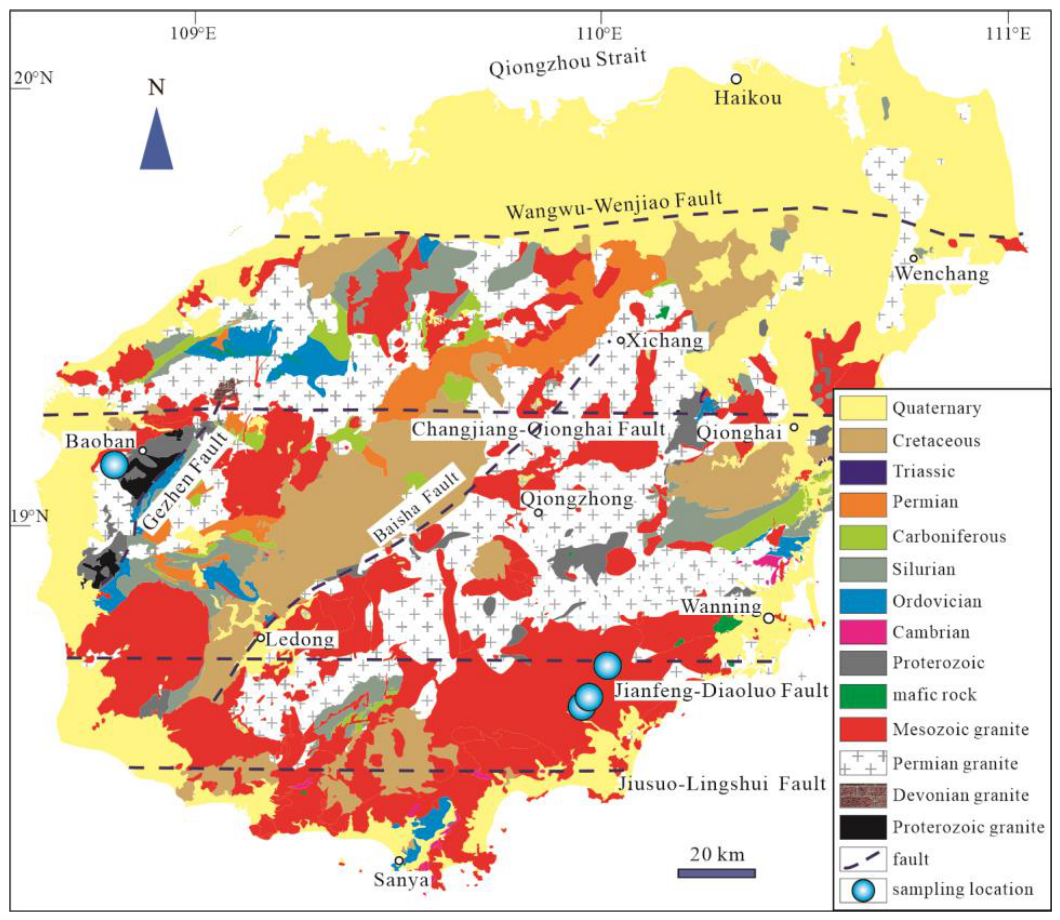
Figure 2.
Field photos and micrographs of the diabases from the Zhubijiang-Lingshui areas. Pl-plagioclase; Kfs-potassium feldspar; Bi-biotite; Px-pyroxene; Hbl-hornblende.
Figure 2.
Field photos and micrographs of the diabases from the Zhubijiang-Lingshui areas. Pl-plagioclase; Kfs-potassium feldspar; Bi-biotite; Px-pyroxene; Hbl-hornblende.
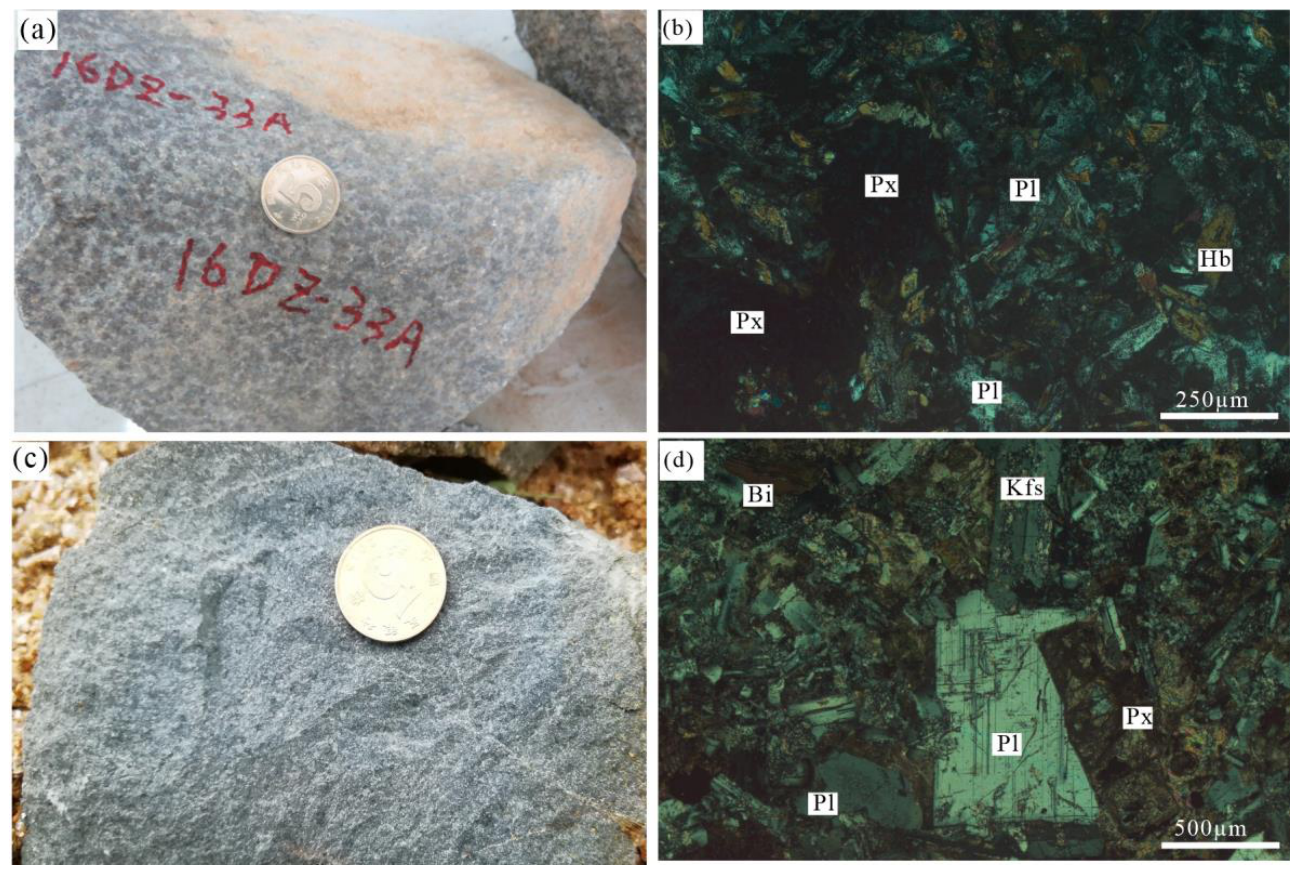
Figure 3.
Field photos and micrographs of the granites from the Lingshui area. Pl-plagioclase; Kfs-potassium feldspar; Qtz-quartz; Bi-Biotite.
Figure 3.
Field photos and micrographs of the granites from the Lingshui area. Pl-plagioclase; Kfs-potassium feldspar; Qtz-quartz; Bi-Biotite.
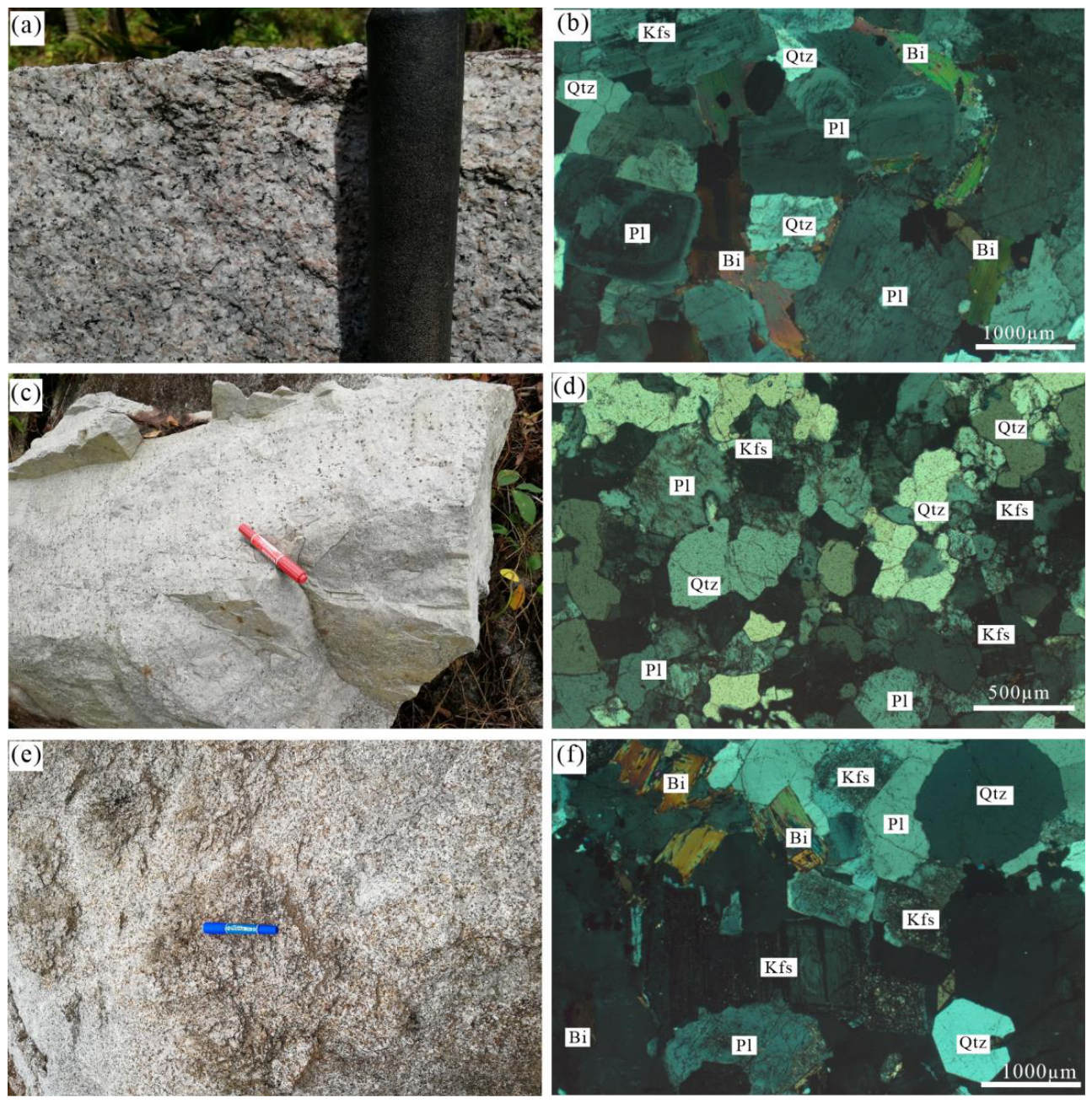
Figure 4.
Zircon U-Pb age concordance and weighted average age of the diabases from the Zhubijiang-Lingshui areas.
Figure 4.
Zircon U-Pb age concordance and weighted average age of the diabases from the Zhubijiang-Lingshui areas.
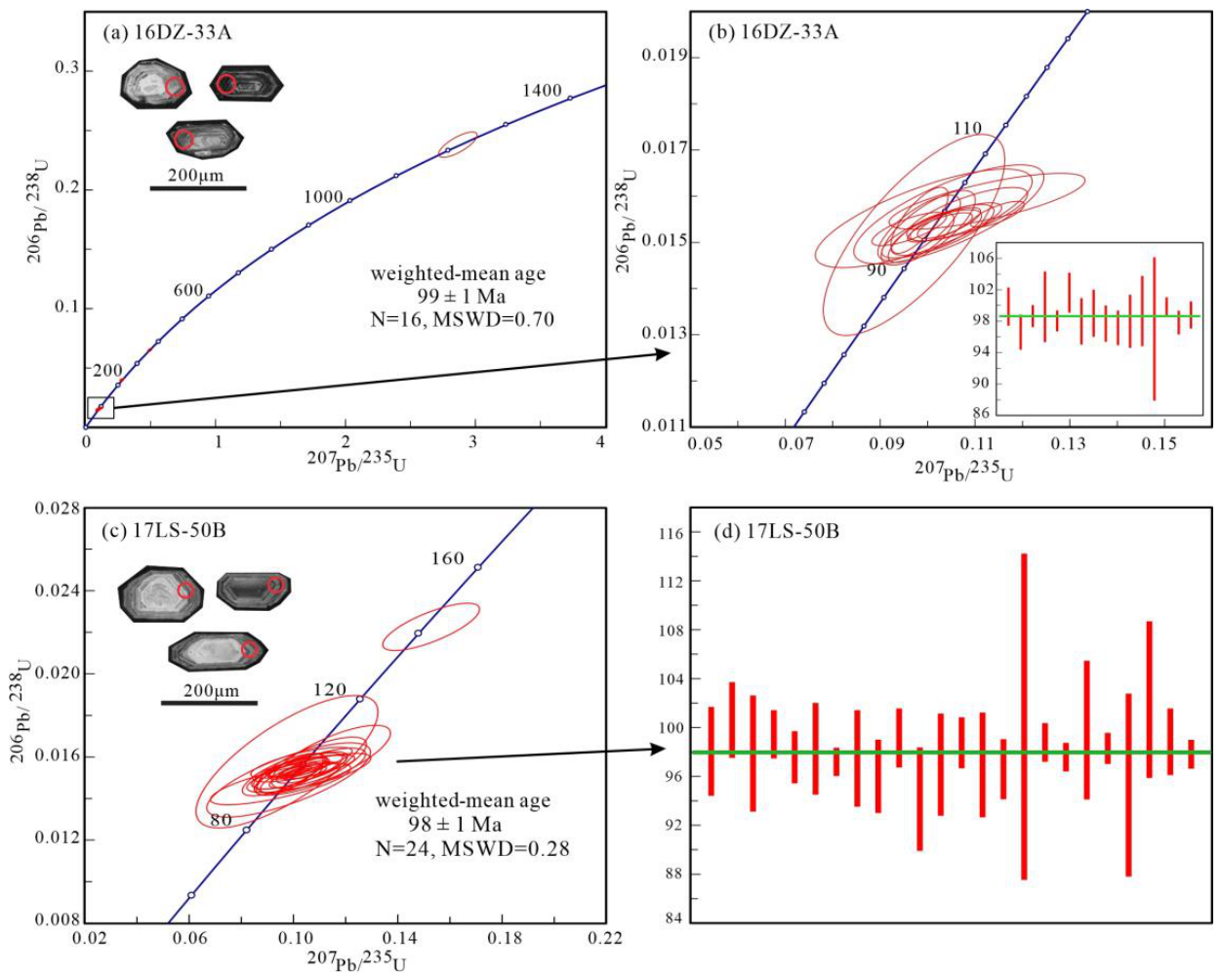
Figure 5.
Zircon U-Pb age concordance and weighted average age of the granites from the Lingshui area.
Figure 5.
Zircon U-Pb age concordance and weighted average age of the granites from the Lingshui area.
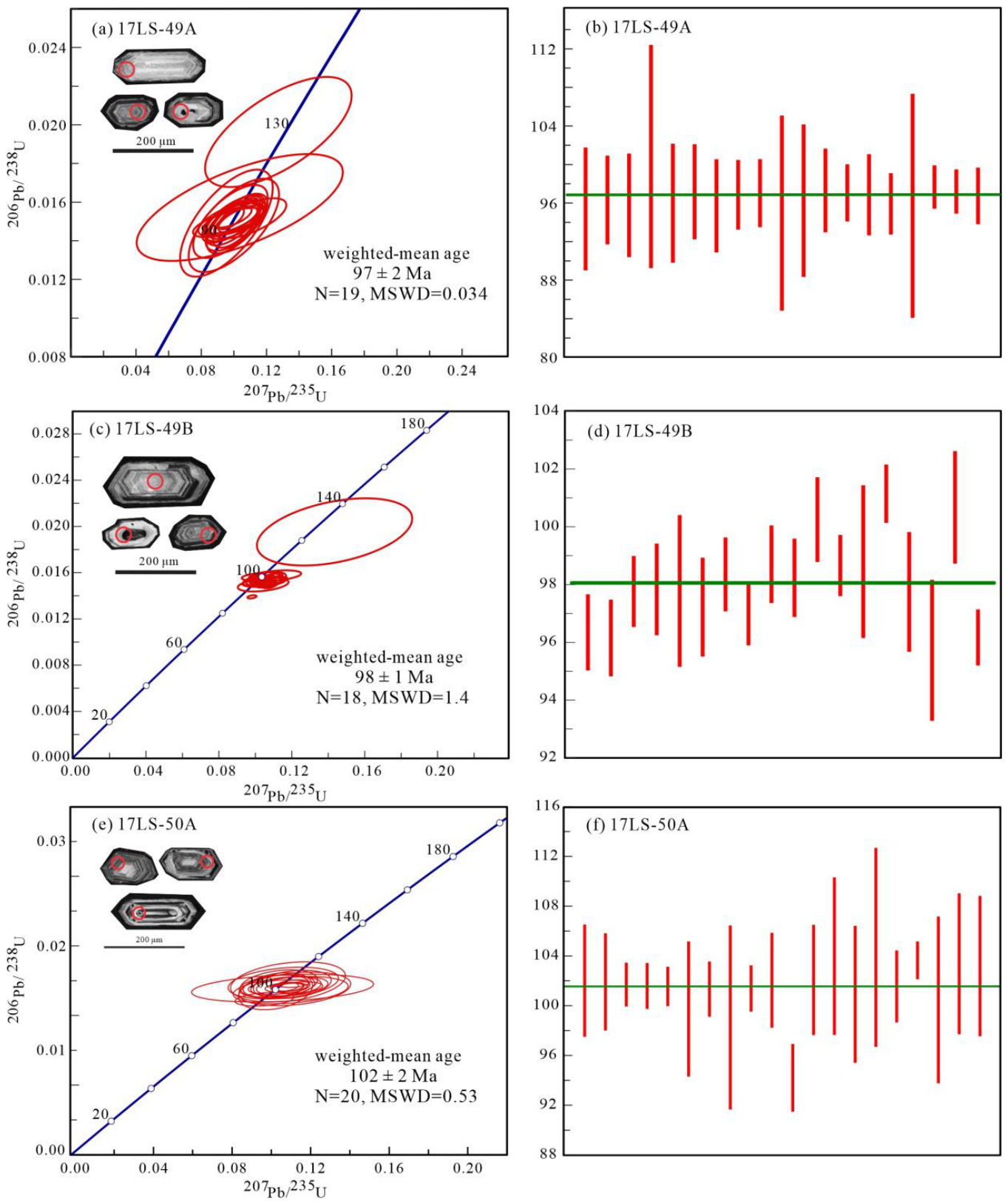
Figure 6.
Plot of εHf(t) versus age of the magmatic rocks from the Zhubijiang-Lingshui areas.
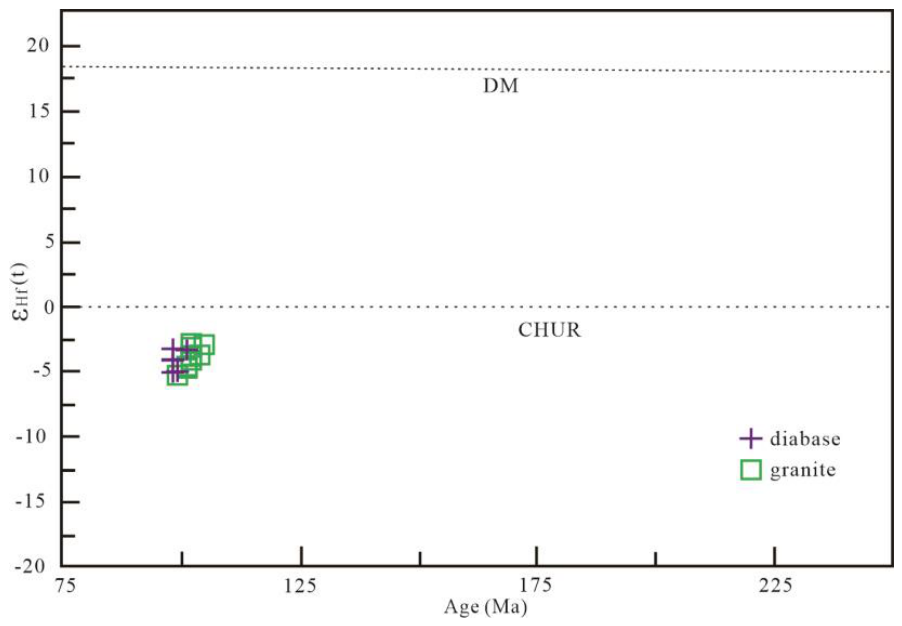
Figure 7.
Plots of (a) Na2O + K2O versus SiO2 and (b) FeOT-Na2O + K2O-MgO of the mafic rocks from the Zhubijiang-Lingshui areas. Data sources are from [24,25].
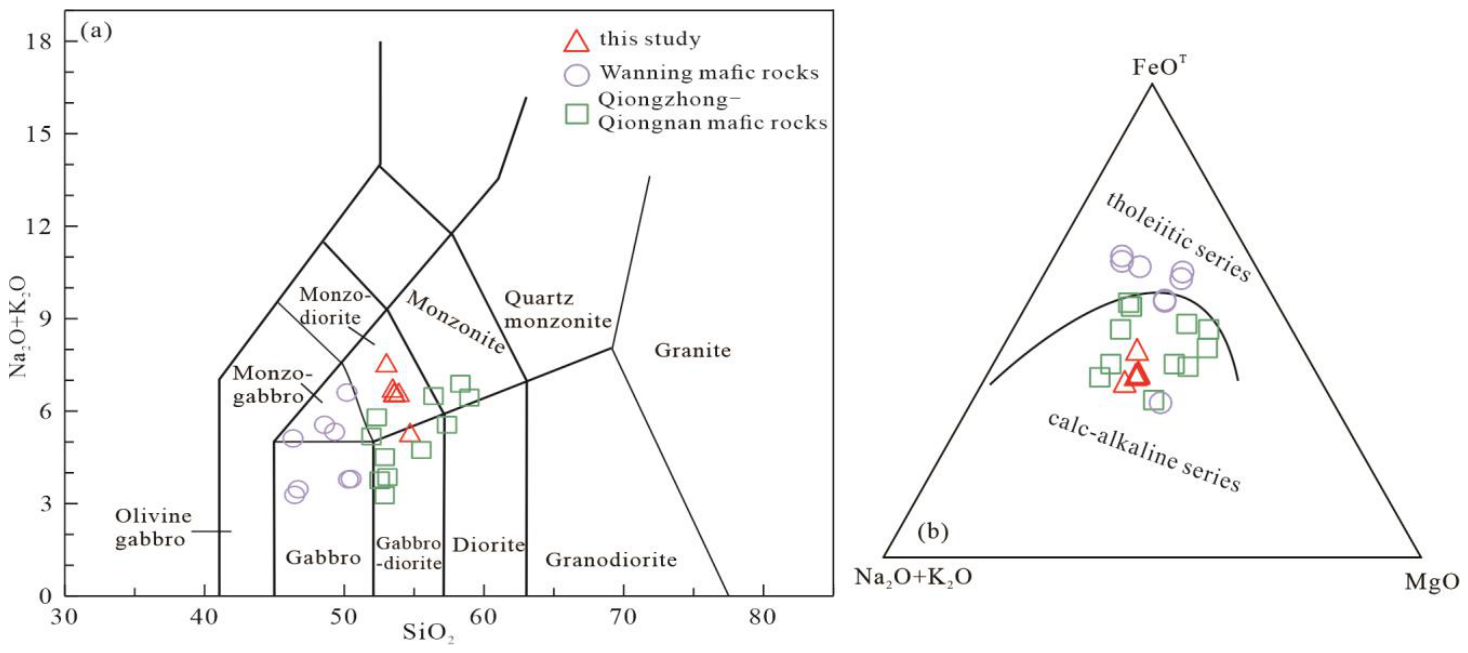
Figure 8.
Plots of (a) Na2O + K2O versus SiO2, (b) A/NK versus A/CNK, and (c) K2O versus SiO2 of the granites from the Lingshui area. Data sources are from [11,13,24,26,27].
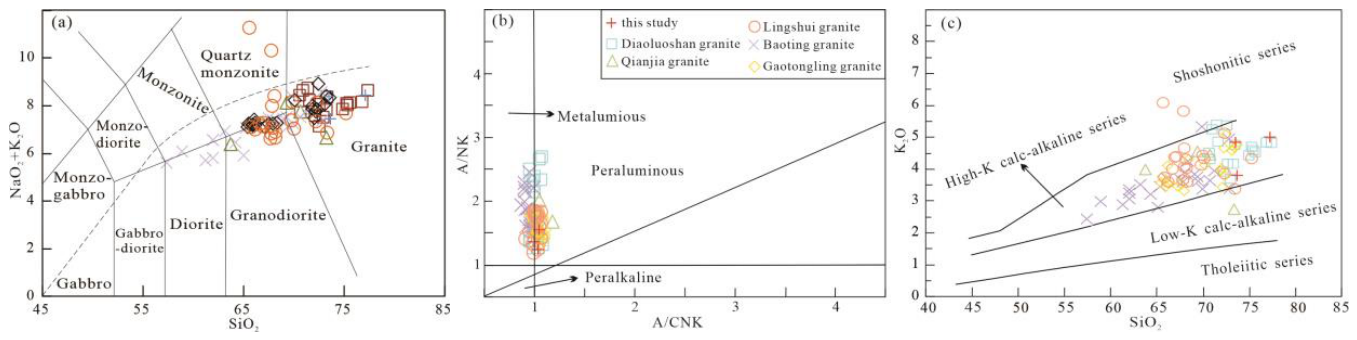
Figure 9.
Chondrite-normalized REE pattern (a, c) and primitive mantle-normalized trace element spidergrams (b, d) of the diabases and granites from the Zhubijiang-Lingshui areas. Data source is the same as in Figure 7,8; the normalized values are from [28].
Figure 9.
Chondrite-normalized REE pattern (a, c) and primitive mantle-normalized trace element spidergrams (b, d) of the diabases and granites from the Zhubijiang-Lingshui areas. Data source is the same as in Figure 7,8; the normalized values are from [28].
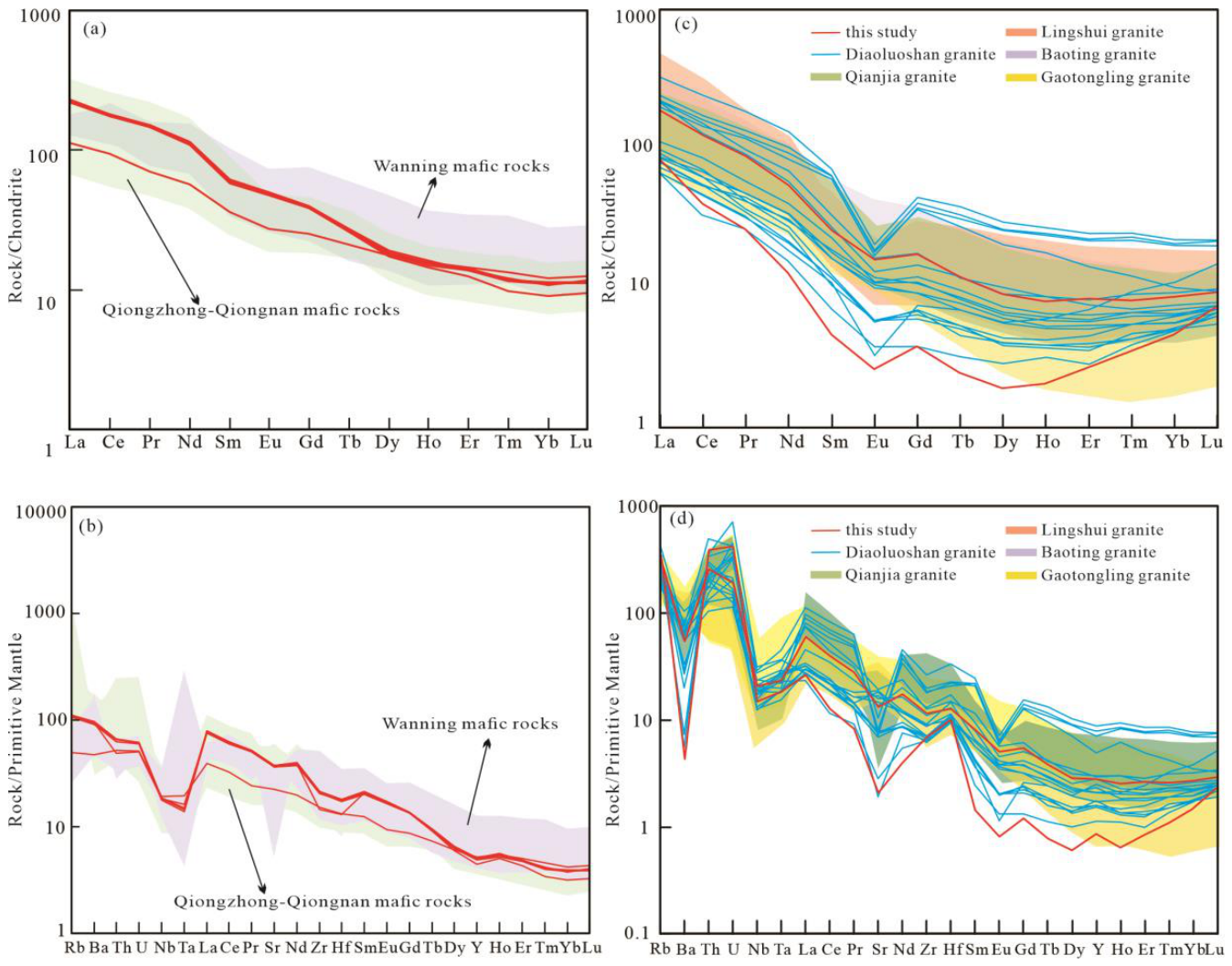
Figure 10.
Plots of (a) Zr/Y versus Zr, (b) La/Sm-La, and (c) Ba/Zr versus Th/Zr of the diabases from the Zhubijiang-Lingshui areas. Data source is the same as in Figure 7.
Figure 10.
Plots of (a) Zr/Y versus Zr, (b) La/Sm-La, and (c) Ba/Zr versus Th/Zr of the diabases from the Zhubijiang-Lingshui areas. Data source is the same as in Figure 7.
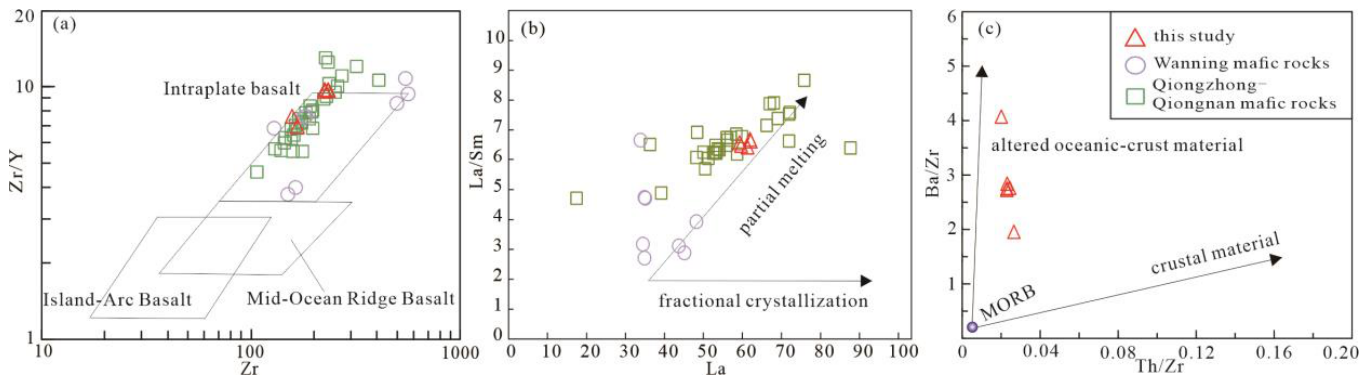
Figure 11.
Plots of (a) Al2O3-(Na2O + K2O)–CaO–FeOT+MgO and (b) Nb + Y + Ce + Zr versus FeOT/MgO of the granites from the Lingshui area. Data source is the same as in Figure 8.
Figure 11.
Plots of (a) Al2O3-(Na2O + K2O)–CaO–FeOT+MgO and (b) Nb + Y + Ce + Zr versus FeOT/MgO of the granites from the Lingshui area. Data source is the same as in Figure 8.
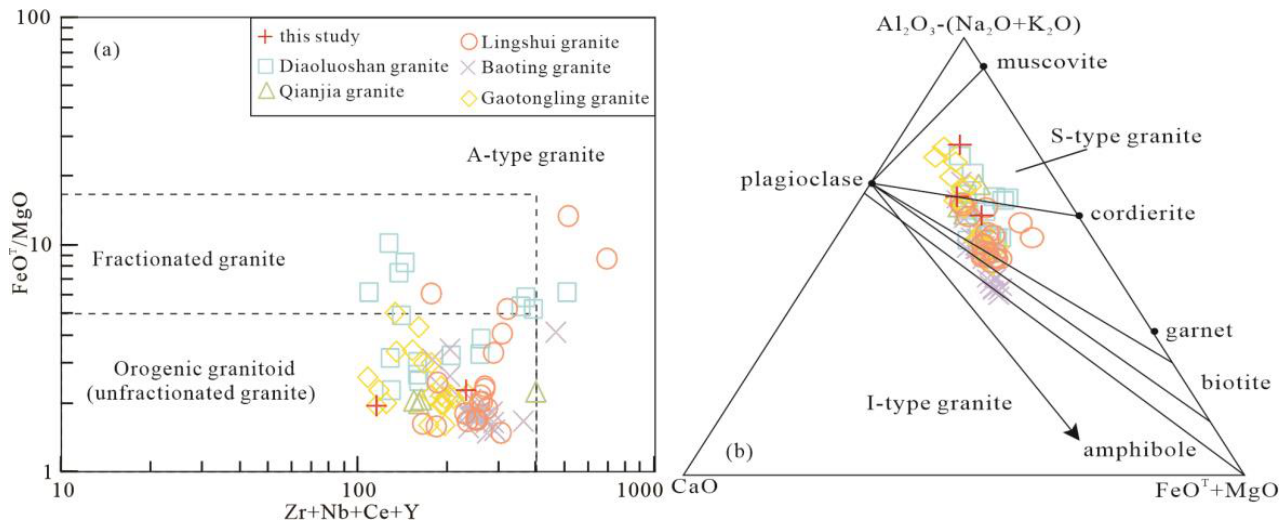
Table 2.
Zircon Hf isotopic compositions of the magmatic rocks from the Zhubijiang-Lingshui areas.
| Spots | t(Ma) | 176Yb/177Hf | 176Lu/177Hf | 176Hf/177Hf | 2s | 176Hf/177Hfi | εHf(t) | ±2σ | TDM1(Ma) | TDM2(Ma) | fLu/Hf |
| Granite sample 17LS-50A | |||||||||||
| 2 | 102 | 0.028101 | 0.000922 | 0.282601 | 0.000012 | 0.282599 | -3.87 | 0.42 | 921 | 1145 | -0.97 |
| 3 | 102 | 0.023871 | 0.00077 | 0.282586 | 0.000011 | 0.282585 | -4.39 | 0.39 | 938 | 1171 | -0.98 |
| 5 | 102 | 0.020373 | 0.000676 | 0.282588 | 0.000012 | 0.282587 | -4.32 | 0.42 | 933 | 1168 | -0.98 |
| 7 | 101 | 0.043443 | 0.001354 | 0.282574 | 0.000017 | 0.282571 | -4.88 | 0.6 | 970 | 1193 | -0.96 |
| 8 | 99 | 0.016045 | 0.000502 | 0.282557 | 0.000014 | 0.282556 | -5.47 | 0.49 | 972 | 1222 | -0.98 |
| 9 | 101 | 0.021913 | 0.000719 | 0.282575 | 0.000012 | 0.282574 | -4.80 | 0.42 | 952 | 1191 | -0.98 |
| 10 | 102 | 0.029686 | 0.000855 | 0.28263 | 0.000013 | 0.282628 | -2.84 | 0.46 | 878 | 1094 | -0.97 |
| 12 | 104 | 0.018722 | 0.000602 | 0.282604 | 0.000013 | 0.282603 | -3.70 | 0.46 | 909 | 1141 | -0.98 |
| 13 | 102 | 0.013461 | 0.000432 | 0.282623 | 0.000016 | 0.282622 | -3.06 | 0.56 | 878 | 1107 | -0.99 |
| 15 | 105 | 0.0173 | 0.000533 | 0.282626 | 0.000014 | 0.282625 | -2.90 | 0.49 | 876 | 1101 | -0.98 |
| Diabase sample 17LS-50B | |||||||||||
| 1 | 98 | 0.024723 | 0.000809 | 0.282564 | 0.000013 | 0.282563 | -5.26 | 0.46 | 970 | 1209 | -0.98 |
| 2 | 101 | 0.025208 | 0.000761 | 0.282616 | 0.000013 | 0.282615 | -3.35 | 0.46 | 896 | 1119 | -0.98 |
| 3 | 98 | 0.018467 | 0.000613 | 0.282593 | 0.000012 | 0.282592 | -4.22 | 0.42 | 924 | 1159 | -0.98 |
| 4 | 99 | 0.017937 | 0.000557 | 0.282568 | 0.000011 | 0.282567 | -5.08 | 0.39 | 958 | 1204 | -0.98 |
| 5 | 98 | 0.010556 | 0.000342 | 0.282594 | 0.000013 | 0.282593 | -4.17 | 0.46 | 916 | 1158 | -0.99 |
| 6 | 98 | 0.014778 | 0.000458 | 0.282622 | 0.000014 | 0.282621 | -3.19 | 0.49 | 880 | 1109 | -0.99 |
Table 3.
Analysis results of major (wt %) and trace elements (ppm) of the magmatic rocks from the Zhubijiang-Lingshui areas.
Table 3.
Analysis results of major (wt %) and trace elements (ppm) of the magmatic rocks from the Zhubijiang-Lingshui areas.
| Sample | 16DZ33A | 17LS50B | 17LS50B01 | 17LS50B02 | 17LS50B03 | 17LS50B04 | 17LS49A | 17LS49B | 17LS50A |
| SiO2 | 50.92 | 51.25 | 51.26 | 50.13 | 50.02 | 49.98 | 73.01 | 76.31 | 72.97 |
| TiO2 | 1.15 | 1.28 | 1.28 | 1.24 | 1.25 | 1.24 | 0.24 | 0.06 | 0.20 |
| Al2O3 | 16.99 | 16.25 | 16.26 | 15.90 | 15.80 | 15.86 | 13.77 | 12.69 | 14.35 |
| Fe2O3 | 7.88 | 8.24 | 8.24 | 8.06 | 8.06 | 8.03 | 1.63 | 0.49 | 1.36 |
| MgO | 4.04 | 5.29 | 5.29 | 5.19 | 5.14 | 5.18 | 0.66 | 0.23 | 0.63 |
| CaO | 6.70 | 6.28 | 6.26 | 6.14 | 6.16 | 6.12 | 1.54 | 0.73 | 2.09 |
| K2O | 1.23 | 2.72 | 2.73 | 2.68 | 2.71 | 2.67 | 4.79 | 4.92 | 3.76 |
| Na2O | 3.71 | 3.53 | 3.58 | 3.65 | 4.43 | 3.50 | 3.57 | 3.42 | 3.62 |
| MnO | 0.10 | 0.13 | 0.13 | 0.13 | 0.13 | 0.13 | 0.06 | 0.03 | 0.03 |
| P2O5 | 0.35 | 0.64 | 0.64 | 0.63 | 0.63 | 0.63 | 0.08 | 0.02 | 0.07 |
| LOI | 6.23 | 3.92 | 3.94 | 5.29 | 4.78 | 5.88 | 0.46 | 0.41 | 0.90 |
| Total | 99.30 | 99.52 | 99.61 | 99.04 | 99.11 | 99.22 | 99.82 | 99.31 | 99.98 |
| Mg# | 54.44 | 59.96 | 59.95 | 60.02 | 59.77 | 60.07 | 48.46 | 52.41 | 51.99 |
| V | 147 | 143 | 147 | 134 | 142 | 149 | 21.52 | 3.28 | |
| Cr | 40.0 | 110 | 112 | 115 | 108 | 116 | 5.87 | 0.02 | |
| Ga | 19.3 | 58.95 | 61.13 | 61.55 | 59.83 | 63.6 | 39.88 | 19.9 | |
| Rb | 31.4 | 68.7 | 70.3 | 70.3 | 67.6 | 70.5 | 197 | 222 | |
| Sr | 475 | 767 | 794 | 789 | 763 | 794 | 285 | 44.3 | |
| Y | 23.5 | 22.4 | 23.0 | 20.2 | 22.1 | 22.9 | 12.9 | 3.96 | |
| Zr | 170 | 230 | 238 | 162 | 231 | 239 | 131 | 78.0 | |
| Nb | 13.70 | 13.07 | 13.27 | 13.12 | 12.60 | 13.30 | 14.93 | 10.67 | |
| Cs | 3.64 | 0.62 | 0.63 | 0.64 | 0.60 | 0.65 | 3.67 | 2.79 | |
| Ba | 333 | 638 | 675 | 660 | 638 | 659 | 385 | 30.6 | |
| La | 26.9 | 52.7 | 54.1 | 54.5 | 52.3 | 54.8 | 41.5 | 18.4 | |
| Ce | 57.6 | 109 | 111 | 108 | 107 | 111 | 71.6 | 22.9 | |
| Pr | 6.73 | 13.98 | 14.43 | 14.29 | 13.85 | 14.31 | 7.80 | 2.30 | |
| Nd | 26.7 | 51.9 | 53.6 | 52.6 | 50.9 | 53.8 | 23.8 | 5.5 | |
| Sm | 5.52 | 9.12 | 9.45 | 9.14 | 8.91 | 9.27 | 3.65 | 0.65 | |
| Eu | 1.58 | 2.84 | 2.90 | 2.84 | 2.75 | 2.90 | 0.86 | 0.14 | |
| Gd | 5.18 | 7.93 | 8.17 | 8.00 | 7.94 | 8.13 | 3.32 | 0.72 | |
| Tb | 0.79 | 1.01 | 1.03 | 0.98 | 0.98 | 1.01 | 0.42 | 0.08 | |
| Dy | 4.47 | 4.68 | 4.84 | 4.38 | 4.57 | 4.72 | 2.11 | 0.45 | |
| Ho | 0.89 | 0.87 | 0.92 | 0.82 | 0.85 | 0.90 | 0.42 | 0.11 | |
| Er | 2.40 | 2.29 | 2.30 | 2.07 | 2.28 | 2.35 | 1.28 | 0.41 | |
| Tm | 0.34 | 0.31 | 0.30 | 0.25 | 0.29 | 0.30 | 0.19 | 0.08 | |
| Yb | 2.05 | 1.85 | 1.92 | 1.55 | 1.86 | 1.90 | 1.35 | 0.73 | |
| Lu | 0.32 | 0.30 | 0.29 | 0.24 | 0.29 | 0.29 | 0.22 | 0.17 | |
| Hf | 4.10 | 5.46 | 5.59 | 4.03 | 5.29 | 5.56 | 4.00 | 3.16 | |
| Ta | 0.80 | 0.66 | 0.61 | 0.59 | 0.57 | 0.60 | 0.98 | 0.77 | |
| Th | 4.45 | 5.54 | 5.66 | 4.13 | 5.34 | 5.57 | 21.97 | 33.42 | |
| U | 1.08 | 1.28 | 1.30 | 1.06 | 1.25 | 1.30 | 4.03 | 8.94 | |
| ∑REE | 141 | 258 | 265 | 259 | 255 | 266 | 159 | 52.6 | |
| δEu | 0.89 | 1.00 | 0.99 | 0.99 | 0.98 | 1.00 | 0.74 | 0.62 | |
| δCe | 1.02 | 0.96 | 0.95 | 0.92 | 0.95 | 0.95 | 0.91 | 0.73 |
Disclaimer/Publisher’s Note: The statements, opinions and data contained in all publications are solely those of the individual author(s) and contributor(s) and not of MDPI and/or the editor(s). MDPI and/or the editor(s) disclaim responsibility for any injury to people or property resulting from any ideas, methods, instructions or products referred to in the content. |
© 2026 by the authors. Licensee MDPI, Basel, Switzerland. This article is an open access article distributed under the terms and conditions of the Creative Commons Attribution (CC BY) license (http://creativecommons.org/licenses/by/4.0/).
Copyright: This open access article is published under a Creative Commons CC BY 4.0 license, which permit the free download, distribution, and reuse, provided that the author and preprint are cited in any reuse.