

Submitted:
17 September 2026
Posted:
18 September 2026
You are already at the latest version
Abstract
Background. Occupational contact dermatitis (OCD) is a significant occupational health concern among healthcare workers (HCWs) due to frequent exposure to irritants and allergens, impacting their quality of life and work performance. Objective. The study aimed to determine the prevalence, clinical presentation, sensitization profile and associated factors of OCD among HCWs in a tertiary hospital, Northern Tanzania. Methodology. A cross-sectional study was conducted from February 2025 to May 2025 at Kilimanjaro Christian Medical Centre (KCMC). A total of 368 HCWs were screened using a pre-tested, validated, interview questionnaire adapted from Nordic Occupational Skin Questionnaire (NOSQ-2002). Patch test baseline series was done for participants with occupational contact dermatitis. Data were analyzed using SPSS version 28. Results. A 12- month prevalence of OCD was 25.5%. The most common clinical presentations of self-reported skin symptoms were dry skin with scaling (67.0%), itching (35.1%), and papules (18.1%). Factors significantly associated with OCD included frequent hand washing, occasional moisturizer use, and history of allergy. The most frequent patch test positive reactions were nickel (26.1%) followed by methyl dibromo glutaronitrile, and fragrance mix II. Conclusion. OCD is an issue that requires attention and resolution and Patch test should performed for HCW with suspected cases of contact dermatitis.
Keywords:
occupational contact dermatitis
; health care workers
; patch test
1. Introduction
OCD is the most prevalent work-related skin disorders in both developed and developing nations, representing 70–90% of all cases and having a considerable impact on quality of life. [1,2,3,4,5,6] OCD is comprised of two types; allergic contact dermatitis (ACD) and irritant contact dermatitis (ICD) with the irritant type which is responsible for 80% of the cases.[7]
OCD with healthcare workers (HCWs) is the most frequently reported and recognized globally for work-related skin conditions.[8] Hand eczema, a major subtype OCD, is especially common among HCWs because of repeated contact with irritants and allergens at work place. [1,3,4,9,10] Prolonged wet work, such as frequent hand washing to prevent nosocomial infections, doubles the risk of hand dermatitis compared to dry office work. [1,11,12,13] Additional risk factors include glove use, especially powdered gloves, and intrinsic factors like atopic dermatitis, which impair skin barrier function. [3,14,15] Despite global studies reporting OCD prevalence among HCWs ranging from 31.5% to 62%, data from sub-Saharan Africa, particularly Tanzania, remain limited. This study aimed to investigate the prevalence, clinical presentation, sensitization profile and associated factors of OCD among HCWs in a tertiary consultant, research and teaching hospital, Northern Tanzania.
2. Materials and Methods
A cross-sectional study was conducted from February 2025 to May 2025 to the HCWs working at KCMC who consented to participate in the study.
The study utilized a multistage sampling design that was later stratified into various professional groups. Participants diagnosed to have OCD and willing to do patch test were scheduled for the procedure.
European baseline series S-1000 (Chemotechnique Diagnostic) was used. Patches were applied to the lateral sides on both left and right arms and removed after 48 hours, and final results were read 48–72 hours later. Reactions were graded according to the guidelines of the International Contact Dermatitis Research Group guidelines, where a positive reaction, at least +, was defined by homogenous erythema and infiltration (Ref ESCD guideline).
Analysis Plan
Data were entered, cleaned, and analyzed using SPSS version 28. Categorical variables were summarized with frequencies and percentages, while continuous variables were described with medians and interquartile ranges (IQR). Univariable and multivariable logistic regression assessed factors associated with OCD, with adjusted odds ratios (AOR) and 95% confidence intervals (CI) reported. A p-value <0.05 was considered significant.
Ethical approval for this study was obtained and informed consents were obtained from the respondents prior to data collection and patch test procedure.
3. Results
Socio-Demographic Characteristics
A total of 368 participants were included in this study. The median age (IQR) was 32 (27, 39) whereby, majorities were aged 30 to 39 years (39.4%). Most were female (56.5%), Nurses were majority 43.8%, followed by doctors (25.5%).
Occupational and Dermatological Characteristics
From the 368 participants, 37.0% were exposed to wet environment in their daily activities. Most reported to have wash hands 10 times or less in a day (42.9%), and great majority applying alcohol-based hand sanitizer (92.7%). Most of the participants reported to use gloves in two hours or less daily 38.3%, and change gloves more than ten times a day 54.1%. The types of glove reported were powdered (59.8%), and majority did not use moisturizer after hand hygiene (72.8%). History of atopy was reported in 40.5% and 32.9% participants had history of allergy.
Prevalence of Skin Symptoms
From 368 study participants included in this study, 94 (25.5%) had OCD. The prevalence of OCD was significantly higher among female 63 (30.3%), participants with frequently hand washing for more than 20 times per day 29 (34.5%), participants who change gloves more than 10 times a day 60 (30.2%), who use moisturizer occasionally after hand hygiene 31 (38.8%), with previous history of any allergy 44 (36.4%), and those who use 2 hours or more in cleaning or washing 35 (35.0%).
Clinical Presentation
Of 94 study participants with OCD, the most reported clinical presentation was dry skin with scaling or flaking 63 (67.0%), itching 33 (35.1%), papule 17 (18.1%), and fissures/cracks 13 (13.8%) (Figure 1). The most affected body part was palm 49 (52.1%) and dorsum of the hand 34 (36.2%), the remaining 11 persons had symptoms from the palms, forearm and face.
Sensitization Profile of Occupational Contact Dermatitis Among Study Participants
Of 94 study participants with OCD, 44 consented to undergo patch testing. Patch test findings showed that majority of the study participants had allergic contact dermatitis 23 (52.3%), and the rest had irritant contact dermatitis 21 (47.7%). From 23 allergic contact dermatitis (positive patch test), the most allergen was nickel (II) sulfate hexahydrate 6 (26.1%) followed by methyl dibromo glutaronitrile 4(17.4%) and fragrance mix II 3(13%) (Figure 2). Almost half of participants 12 (52.2%) had more than 1 allergens. However clinical relevance was not assessed.
Factors Associated with Skin Symptoms Among Study Participants
Univariable and multivariable logistic regression was used to assess factors associated with self-reported skin symptoms. In the univariable analysis, sex, profession, frequency of hand washing, daily gloves use, gloves changing frequency, moisturizer use after hand hygiene, history of any allergy, and duration used for preparing food per week was significantly associated with skin symptoms. In the final multivariable analysis, only frequency of hand washing, occasional moisturizer uses after hand hygiene, and history of allergy as significantly associated with skin symptoms. Participants who washed hands 11 to 20 times per day had 2.01 times higher odds of having OCD compared to those washing hands 10 times or less per day (AOR=2.01, 95%CI (1.01-4.01)). Participants who use moisturizer occasionally after hand hygiene had 2.12 times higher odds of having OCD compared to those who do not use moisturizer (AOR=2.12, 95%CI (1.16-3.86)). Participants with previous history of allergy had 2.08 times higher odds of having OCD compared to those with no history of allergy (AOR=2.08 (1.18-3.66) (Table 1).

Table 2.
Factors associated with OCD among study participants (N=368).
| Variables | OCD | Univariable analysis | Multivariable analysis | |||
| No | Yes | COR | p-value | AOR | p-value | |
| Type of gloves used | ||||||
| Powdered | 165 (75.0) | 55 (25.0) | Ref | |||
| Non-powdered | 15 (68.2) | 7 (31.8) | 1.40 (0.54-3.61) | 0.486 | ||
| Any that is available | 85 (74.6) | 29 (25.4) | 1.02 (0.61-1.72) | 0.930 | ||
| I don’t use | 9 (75.0) | 3 (25.0) | 1.0 (0.26-3.83) | 0.992 | ||
| Moisturizer use after hand hygiene | ||||||
| None | 209 (78.0) | 59 (22.0) | Ref | Ref | ||
| Occasionally | 49 (61.2) | 31 (38.8) | 2.24 (1.31-3.83) | 0.003 | 2.12 (1.16-3.86) | 0.015 |
| Always | 16 (80.0) | 4 (20.0) | 0.89 (0.29-2.75) | 0.886 | 0.87 (0.26-2.93) | 0.826 |
| History of atopy | ||||||
| No | 170 (77.6) | 49 (22.4) | Ref | |||
| Yes | 104 (69.8) | 45 (30.2) | 1.50 (0.94-2.41) | 0.092 | ||
| History of any allergy | ||||||
| No | 197 (79.8) | 50 (20.2) | Ref | Ref | ||
| Yes | 77 (63.6) | 44 (36.4) | 2.25 (1.39-3.65) | 0.001 | 2.08 (1.18-3.66) | 0.011 |
| Caring for children under 4 years old/week | ||||||
| No | 207 (76.7) | 63 (23.3) | Ref | |||
| <2 hours | 52 (66.7) | 26 (33.3) | 1.64 (0.95-2.84) | 0.076 | ||
| ≥ 2 hours | 15 (75.0) | 5 (25.0) | 1.10 (0.38-3.13) | 0.865 | ||
| Prepare food/week | ||||||
| No | 56 (84.8) | 10 (15.2) | Ref | Ref | ||
| <2 hours | 190 (73.1) | 70 (26.9) | 2.06 (1.0-4.27) | 0.051 | 1.47 (0.63-3.43) | 0.373 |
| ≥ 2 hours | 28 (66.7) | 14 (33.3) | 2.80 (1.11-7.09) | 0.030 | 1.87 (0.62-5.60) | 0.264 |
| Cleaning or washing/week | ||||||
| No | 18 (85.7) | 3 (14.3) | Ref | |||
| <2 hours | 191 (77.3) | 56 (22.7) | 1.76 (0.50-6.19) | 0.379 | ||
| ≥ 2 hours | 65 (65.0) | 35 (35.0) | 3.23 (0.89-11.73) | 0.075 | ||
4. Discussion
The observed a quarter (25.5%) prevalence of OCD in this study may be attributed to the occupational demands of HCWs, which involve frequent handwashing, use of liquid soaps, and powdered gloves, as well as limited moisturizer use and exposure to unidentified allergens. These factors likely contribute to cumulative irritant contact dermatitis. This prevalence is lower than rates reported in other studies, such as 31.5% in Ethiopia[6] and 62% in Sweden. [16] Variations in prevalence may stem from differences in study design, diagnostic criteria, or sample sizes.
Conversely, the 25.5% prevalence in our study is notably higher than the 9.1% reported in South India and 9.6% in China.[4,17] This could be explained by frequency hand washing of 11-20 time. The lower prevalence in India may reflect the study’s focus on latex gloves allergy, which likely limited the scope of dermatitis cases, while in China, factors such as improved workplace conditions, hypoallergenic materials, stricter occupational health protocols, and enhanced preventive measures may have contributed to lower rates. To address OCD among HCWs, intervention program on skin care is recommended.
Dryness and itching were the most frequent clinical presentations in our study, likely due to frequent handwashing, which is crucial for infection control but disrupts the skin barrier by removing natural oils through prolonged exposure to water, soaps, and detergents. These findings align with an Iranian study reporting dryness in 84.1% of participants,[10] attributed to similar skin barrier disruption. In contrast, an Ethiopian study noted redness and burning as dominant symptoms,[6] indicating that the type of irritant influences clinical manifestations. Substituting handwashing with alcohol-based hand sanitizers and frequent moisturizer use has been shown to reduce OCD prevalence.
Frequent handwashing, a history of atopy, and other allergies were significantly associated with OCD in this study, likely because frequent handwashing exacerbates skin barrier disruption, while atopy predisposes individuals to contact dermatitis. These findings are consistent with studies in Malaysia,[1], Ethiopia,[6]and China [4] suggesting universal risk factors across diverse settings. The lack of moisturizer use after handwashing was also strongly linked to OCD in the current study. These shared risk factors emphasize the importance of preventive strategies, such as regular emollient application and alcohol base hand rub gel use, to reduce OCD among HCWs globally, despite variations in specific allergens or occupational practices.
In the present study, nickel was the most frequently identified allergen causing allergic contact dermatitis, followed by methyldibromo glutaronitrile and fragrance mix II. Globally, nickel is recognized as the most common contact allergen, largely due to its widespread use in numerous consumer and medical products, including jewelry, dental materials, medical devices, and household utensils.[18] In healthcare settings, exposure to nickel is particularly common, likely as a result of direct and repeated contact with nickel-containing instruments and equipment. Healthcare workers are therefore at increased risk because of their frequent handling of such devices. [19] This observation is supported by a study conducted in the United States, which detected nickel in various medical devices used in operating theatres, including surgical instruments and operating room equipment.[20] Our findings are consistent with a study from Italy and Denmark conducted among healthcare workers, where nickel was also identified as the most prevalent allergen. [19,21,22]
In the present study, methyl dibromo glutaronitrile and fragrance mix II were among the most frequently identified allergens. This finding is consistent with a study conducted in New Zealand,[23] which also reported preservatives and fragrances as common sensitizers. In hospital environments, these allergens are commonly present in products such as face mask, liquid soaps, hand sanitizers, and medical adhesives. In contrast to several previous studies, none of the participants in this study showed sensitization to rubber accelerator products such as thiuram mix. Similar studies conducted in Italy, Colombia, and Denmark reported reactions to rubber accelerators. [21,22,24] Despite the widespread use of latex gloves among participants in the present study, the absence of thiuram mix sensitization suggests that skin symptoms may be more attributable to irritant reactions from latex glove use rather than true allergic contact dermatitis.
Limitation
This study exhibits various limitations, such as response bias and recall bias.
5. Conclusion
OCD affects 25.5% of HCWs at KCMC hospital, with dry skin with scaling, itching, and papules as primary presentations, methyldibromo glutaronitrile and fragrance mix II were among the most prevalent identified allergens Frequent hand washing, occasional moisturizer use, and allergy history significantly increase OCD risk. Targeted interventions skin care program is crucial to reduce OCD burden among HCWs.
Acknowledgments
The authors would like to thank Jeanne Duus Johansen, Charlotte Menne Bonefeld, Julie Weber, Jakob Ferløv Baselius Schwensen, HCWs who participated in this study, KCMC hospital, Regional Dermatology Training Centre staff and KCMC University for their skillful assistance and cooperation. All patch material which were used in this study was supplied under support of LEO foundation.
Conflicts of Interest
The authors declare no potential conflict of interests.
References
- Of, P.; Hand, O.; Associated ITS; Among, F.; Nurses, S.; Public OFA; et al. PREVALENCE OF OCCUPATIONAL HAND CONTACT. 2019, 6(1), 118–30. [Google Scholar] [CrossRef]
- Quaade, A.S.; Thyssen, J.P.; Simonsen, A.B.; Johansen, J.D. Prevalence, incidence, and severity of hand eczema in the general population – A systematic review and meta-analysis; 2021; Volume (January), pp. 361–74. [Google Scholar]
- Schütte, M.G.; Groene, G.J.; De. Work-related and personal risk factors for occupational contact dermatitis : A systematic review of the literature with meta-analysis. 2023;(August 2022, 171–87. [Google Scholar] [CrossRef] [PubMed]
- Huang, D.; Tang, Z.; Qiu, X.; Liu, X.; Guo, Z.; Yang, B.; et al. Hand eczema among healthcare workers in Guangzhou City: a cross-sectional study. Ann. Transl. Med. 2020, 8(24), 1664–1664. [Google Scholar] [CrossRef] [PubMed]
- Zeerak, S. S.I.; Akhtar, S.; Bashir, Y.; Bhat, M.A.; Jeelani, S.; et al. Patch testing in hand eczema at a tertiary care center A study of erythroderma : Clues from eosinophilia and elevated lactate dehydrogenase levels. Indian Dermatol. Online J. 2021, 74(5), 12:72–7. [Google Scholar]
- Mekonnen, T.H.; Yenealem, D.G.; Tolosa, B.M. Self-report occupational-related contact dermatitis : prevalence and risk factors among healthcare workers in Gondar town, Northwest Ethiopia, 2018 — a cross-sectional study. 2019, 0, 1–9. [Google Scholar] [CrossRef] [PubMed]
- Enggalhardjo, M.; Setiawan, A.D.; Niko, P.; Oceano, L. Prevalence and Risk Factors of Occupational Contact Dermatitis in Healthcare Workers. [CrossRef]
- Ibler, K.S.; Jemec, G.B.E.; Garvey, L.H.; Agner, T. Prevalence of delayed-type and immediate-type hypersensitivity in healthcare workers with hand eczema. 2016, (6), 1–7. [Google Scholar]
- Editor, D. Association between skin hygiene habits and the intensity of itch as well as pain in hand eczema : A cross-sectional study. 2024;(July 2023, 394–6. [Google Scholar]
- Kadiru, R.A.; Upadya, G.M.; Mohammed, N. Prevalence of contact dermatitis among healthcare workers during the Covid-19 pandemic: a cross-sectional investigation. Iran. J. Dermatol. 2024, 27(4), 207–16. [Google Scholar]
- Hamnerius, N.; Svedman, C.; Bergendorff, O.; Björk, J.; Bruze, M.; Engfeldt, M.; et al. Hand eczema and occupational contact allergies in healthcare workers with a focus on rubber additives. 2018, (May), 1–8. [Google Scholar]
- Nichol, K.; Copes, R.; Kersey, K.; Eriksson, J.; Holness, D.L. Screening for hand dermatitis in healthcare workers : Comparing workplace screening with dermatologist photo screening 2019, (January), 374–81.
- Sawada, Y. Occupational Skin Dermatitis among Healthcare Workers Associated with the COVID-19 Pandemic: A Review of the Literature. Int. J. Mol. Sci. 2023, 24(3). [Google Scholar] [CrossRef] [PubMed]
- Sonday, Z.; Baatjies, R.; Mwanga, H.H. Prevalence of work-related skin symptoms and associated factors among tertiary hospital workers exposed to cleaning agents in Southern Africa. 2023, (June), 178–89. [Google Scholar] [CrossRef] [PubMed]
- Tesfaye, A.H.; Engdaw, G.T. Prevalence and risk factors of work- related contact dermatitis symptoms among healthcare cleaners during the 19 pandemic in Northwest Ethiopia : a multicentre cross- sectional survey. 2022. [Google Scholar] [CrossRef] [PubMed]
- Hamnerius, N.; Svedman, C.; Bergendorff, O.; Björk, J.; Bruze, M.; Engfeldt, M.; et al. Hand eczema and occupational contact allergies in healthcare workers with a focus on rubber additives. Contact Dermat. 2018, 79(3), 149–56. [Google Scholar] [CrossRef] [PubMed]
- Article, O. Prevalence and Patterns of Latex Glove Allergy among Healthcare Workers in a Tertiary Care Center In South India - A Cross - Sectional Study. 2022; pp. 475–9. [Google Scholar]
- Duarte, A.; Tavares, M.B.; Barbosa, R.M.; Dias, A.; Duarte, R.G.; Coutinho, J.; et al. Clinical Studies & Medical Case Reports Mini Review Nickel Allergy : Epidemiology, Sources of Exposure, Risk Factors, Clinic and Diagnosis, Prevention and Treatment. Occup. Dis. 2025, 3–6. [Google Scholar]
- Ferrari, C.; Somma, G.; Giovinazzo, V.; Iarossi, M.; Treglia, M.; Pallocci, M.; et al. The Influence of Occupational Factors on Contact Dermatitis in Symptomatic Healthcare Workers : A Patch Test Study †. 2025, (Cd), 1–9. [Google Scholar]
- Anne, H. Nickel release from surgical instruments and operating room equipment. Dermatol. Line Joural 2018, 24(4), 3. [Google Scholar] [CrossRef]
- Prodi, A.; Rui, F.; Fortina, A.B.; Corradin, M.T.; Filon, F.L.; Unit, D.; et al. H ealthcare workers and skin sensitization : north-eastern Italian database. 2016;(October 2015, 72–4. [Google Scholar] [CrossRef] [PubMed]
- Ibler, K.S.; Jemec, G.B.E.; Garvey, L.H.; Agner, T. Prevalence of delayed-type and immediate-type hypersensitivity in healthcare workers with hand eczema. Contact Dermat. 2016, 75(4), 223–9. [Google Scholar] [CrossRef] [PubMed]
- Huang, C.; Greig, D.; Cheng, H. Allergic contact dermatitis in healthcare workers. 2021, (August), 294–7. [Google Scholar] [CrossRef] [PubMed]
- Kadivar, S.; Belsito, D. V. Occupational Dermatitis in Health Care Workers Evaluated for Suspected Allergic Contact Dermatitis; 2015; pp. 177–83. [Google Scholar]
Figure 1.
Clinical presentation of self-reported skin symptoms among study participants, past 12 months (N=94).
Figure 1.
Clinical presentation of self-reported skin symptoms among study participants, past 12 months (N=94).
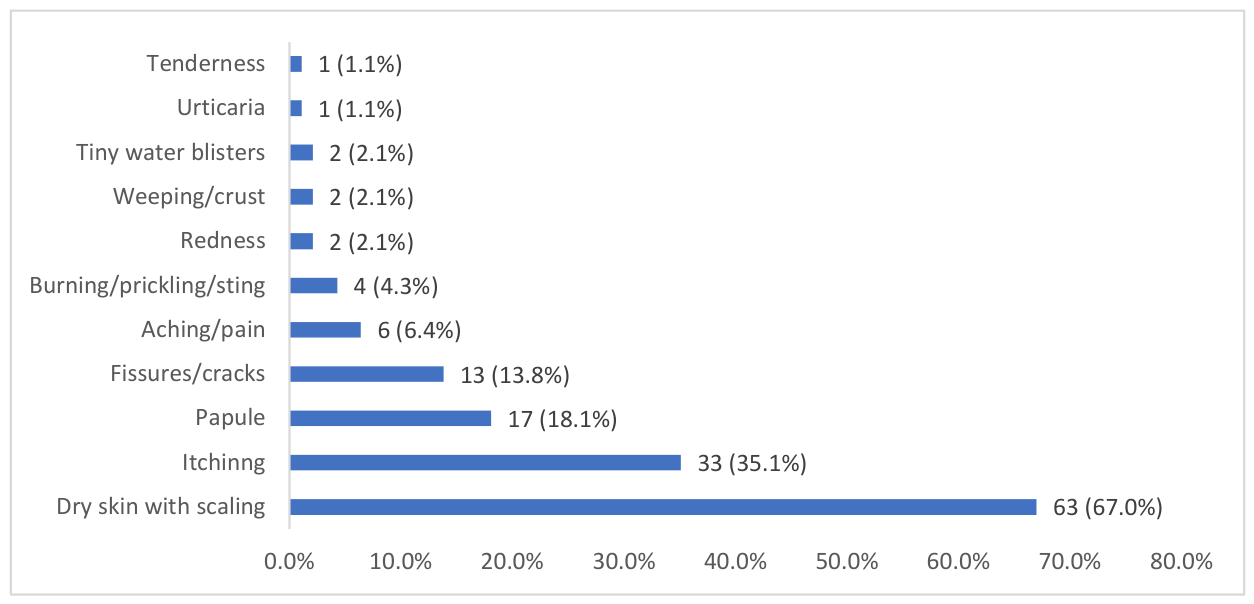
Figure 2.
Sensitization profile of OD among study participants with positive patch test (N=23).
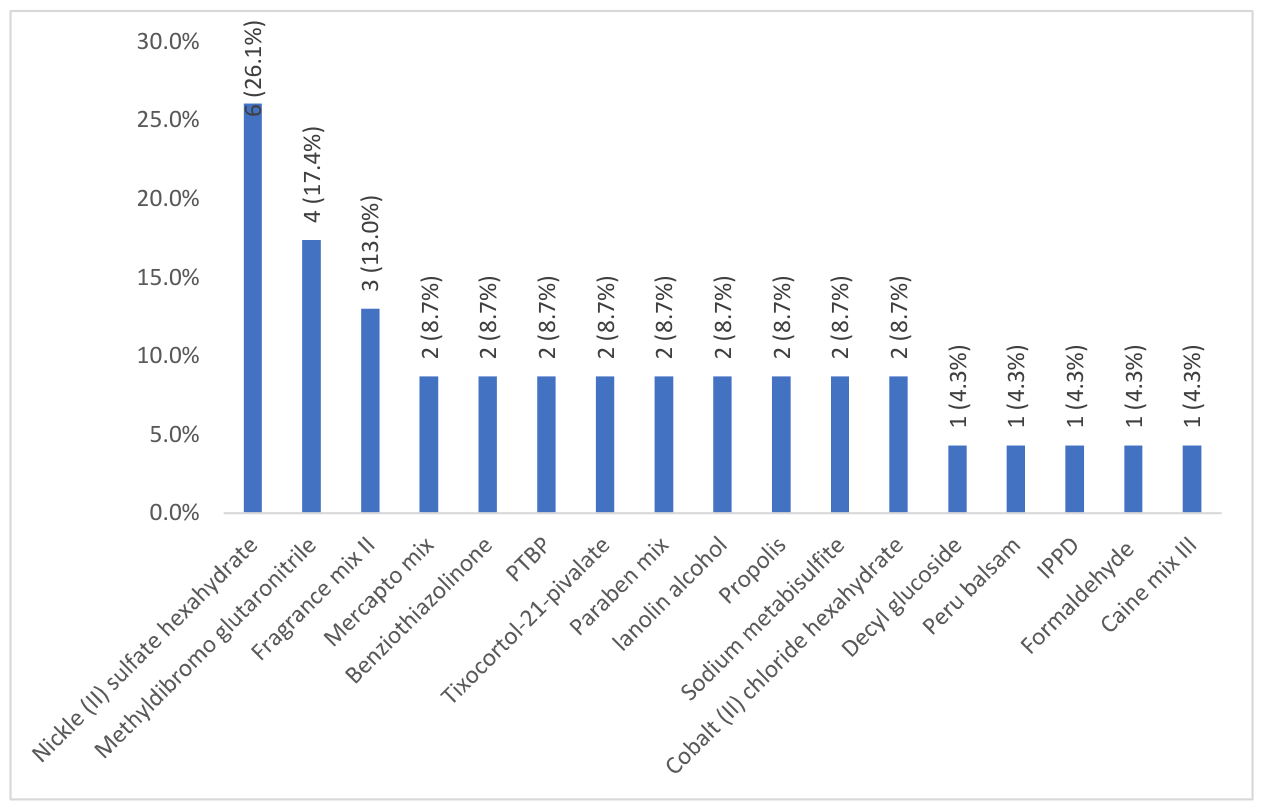
Table 1.
Occupational and dermatological characteristics of the participants (N=368).
| Variables | Case (%) |
| Working experience (years) | |
| < 5 | 179(48.6) |
| 5-10 | 93(25.3) |
| >10 | 96(26.1) |
| Median (IQR) | 5 (2, 11.7) |
| Exposed to wet environment | |
| No | 232(63.0) |
| Yes | 136(37.0) |
| Frequency of daily hand washing | |
| ≤10 | 158(42.9) |
| 11-20 | 126(34.3) |
| >20 | 84(22.8) |
| Use of alcohol-based hand sanitizer | |
| No | 27(7.3) |
| Yes | 341(92.7) |
| Daily gloves use hours/day | |
| ≤ 2 | 141(38.3) |
| 3-5 | 109(29.6) |
| > 5 | 118(32.1) |
| Gloves change frequency per day | |
| ≤ 5 | 98(26.6) |
| 6-10 | 71(19.3) |
| >10 | 199(54.1) |
| Type of gloves used | |
| Powdered | 220(59.8) |
| Non-powdered | 22(6.0) |
| Any type according to availability | 114(31.0) |
| I don’t use gloves | 12(3.2) |
| Moisturizer use after hand hygiene | |
| None | 268(72.8) |
| Occasionally | 80(21.8) |
| Always | 20(5.4) |
| History of atopy | |
| No | 219(59.5) |
| Yes | 149(40.5) |
| History of any allergy | |
| No | 247(67.1) |
| Yes | 121(32.9) |
| Caring for children under 4 years old/week | |
| No | 270(73.4) |
| <2 hours | 78(73.4) |
| ≥ 2 hours | 20(5.4) |
| Prepare food/week | |
| No | 66(19.9) |
| <2 hours | 260(70.7) |
| ≥ 2 hours | 42(11.4) |
| Cleaning or washing/week | |
| No | 21(5.7) |
| <2 hours | 247(67.1) |
| ≥ 2 hours | 100(27.2) |
Disclaimer/Publisher’s Note: The statements, opinions and data contained in all publications are solely those of the individual author(s) and contributor(s) and not of MDPI and/or the editor(s). MDPI and/or the editor(s) disclaim responsibility for any injury to people or property resulting from any ideas, methods, instructions or products referred to in the content. |
© 2026 by the authors. Licensee MDPI, Basel, Switzerland. This article is an open access article distributed under the terms and conditions of the Creative Commons Attribution (CC BY) license (http://creativecommons.org/licenses/by/4.0/).
Copyright: This open access article is published under a Creative Commons CC BY 4.0 license, which permit the free download, distribution, and reuse, provided that the author and preprint are cited in any reuse.