

Submitted:
02 October 2026
Posted:
06 October 2026
You are already at the latest version
Abstract
Planck units represent the fundamental scale at which physics, biology, and consciousness converge. This article develops the model in which time-invariant superfluid quantum space is the primary physical reality, composed of Planck quanta. Duration and past-future are emergent, not fundamental. Gravity is derived as a pushing effect of the variable energy density of this space, not as spacetime curvature. We introduce consciousness as a fundamental, non-created physical field, denoted \( \Phi_{C^n} \), composed of complex Planck quanta and characterized by Planck frequency. The wave function is not consciousness itself, but its mathematical description. This distinction provides a physical mechanism for the measurement problem that the Copenhagen interpretation lacks. In this model, wave function collapse occurs because the excitation of superfluid quantum space receives a coherent energy kick from the consciousness field \( \Phi_{C^n} \). This energy transfer promotes a virtual bio-photon to a real bio-photon with defined spin, enabling binary information transmission in brain microtubules. Gravity plays no role in quantum superposition. The consciousness field \( \Phi_{C^n} \) and the coherent bio-photon field play a decisive role, mediating coupling between consciousness and biological matter.
Keywords:
consciousness field
; superfluid quantum space
; Planck units
; wave function collapse
; measurement problem
; Penrose OR
; bio-photon
; microtubules
; quantum biology
1. Introduction
Planck time , Planck mass , and Planck length are the fundamental units for expressing time as the duration of motion in space and mass as a structure composed of the energy that constitutes space itself. We will develop a mathematical formalism for the famous Max Planck quote: “As a man who has devoted his whole life to the most clear headed science, to the study of matter, I can tell you as a result of my research about atoms this much: There is no matter as such. All matter originates and exists only by virtue of a force which brings the particle of an atom to vibration and holds this most minute solar system of the atom together. We must assume behind this force the existence of a conscious and intelligent mind. This mind is the matrix of all matter”, and for the Ervin Schrödinger famous quote: “What we observe as material bodies and forces are nothing but shapes and variations in the structure of space”.
We propose to replace the spacetime model—in which time is treated as the fourth dimension of space and gravity is mediated by its curvature—with a model of time-invariant space endowed with physical properties, in which gravity originates from variations in its energy density. While spacetime is mathematically well-defined, the conception of time as the fourth dimension of space lacks experimental evidence. We therefore return to the Newtonian notion of time as a purely mathematical entity describing motion—that is, material change in Euclidean space composed of Planck quanta. A single Planck quantum is endowed with its Planck volume and Planck energy. We refer to this space as superfluid quantum space, which exists in a dynamic relationship with physical objects; namely, its energy density diminishes in the presence of physical objects. We extend the mass-energy equivalence principle to space endowed with physical properties.
Light propagates in space. For example, when a photon moves through space from point A to point B, advancing from one Planck length to the next, its motion generates a numerical order in which Planck time constitutes the fundamental unit of motion, corresponding to the transition from one Planck distance to the next. The sum of these Planck times yields duration, as shown in the equation below [1]:
Duration is a man-made physical quantity. itself is time-invariant. There is neither a physical past nor a physical future [2].
The velocity of light is expressed by Planck units:
The velocity of a given physical object can also be expressed in terms of Planck units. Any distance between points, A and B, in space can be discretized on Planck distances:
The duration of motion is the sum of Planck times, cf. Eq. (1), and the velocity is thus given by:
thus – velocity is quantized,
Where is the number of Planck lengths comprising the distance between A and B, and is the number of Planck times comprising the duration of motion.
In one cubic meter of intergalactic there are approximately of Planck quanta. A physical object with a mass of corresponds to approximately Planck quanta. Consider a object placed in intergalactic space. This object diminishes the number of Planck quanta by approximately, predominantly in its central region. The density of Planck quanta increases with distance from the object. Every stellar object diminishes the density of Planck quanta in proportion to its mass. Gravity is a vector force of directed from regions of higher density to regions of lower density of Planck quanta. In this manner, every stellar object in the universe is gravitationally related to every other stellar object.
The Planck energy density is obtained by dividing the product of the Planck mass and the square of the speed of light by the Planck volume:
Planck energy density is the energy density of intergalactic space. In a region of space occupied by an object of mass m, the energy density of diminishes at its center in exact accordance with its mass and volume V [2]:
In the presence of a physical object, the density of Planck quanta decreases in proportion to the mass of the object. We express mass m of the physical object by rearranging Eq. (6), and we get [2]:
Eq. (7) is the mathematical formulation of Max Planck and Erwin Schrödinger’s vision: every physical object from the photon to the black hole is the structured energy of space.
Every massive object diminishes the energy density of , and this generates gravitational force. Gravity force between two massive objects is as follows:
Gravity is a pushing force of , directed from regions of higher energy density toward regions of lower energy density, see Figure 2:
We can express gravitational constant G as follows [3]:
Eq. (9) we develop:
We combine Eq. (8) and (10) and we get:
The distance between the centers of two massive objects can be expressed as an integer multiple of the Planck length (, (, yielding:
where is the energy density of space in the centre of the first object and the is the energy density of space in the center of the second object. is the volume of the first object, is the object of the second object, and is the number of Planck distances between the centres of the objects. Taking in account Eqs. (7) and (10), Eq. (12) yields:
= = . Thus,
Newton’s law of gravitation is recovered.
2. Introduction of the Schrödinger–Einstein Now into Physics and Biology
Using Planck units, we have developed a detailed mathematical formulation in which fundamental time is defined as the numerical order of physical events and emergent time as the duration of physical events, mass as a structure of the energy of time-invariant space, and gravity as a force generated by the variable energy density of time-invariant . The space-time model is thereby replaced by a model of time-invariant space, in which time exists solely as a mathematical quantity. The paradigm shift is as follows: there is no physical past and no physical future. Nothing ever occurred in a remote physical past, because no physical past exists. Universal change unfolds exclusively within time-invariant .
The Wheeler-DeWitt equation is timeless because time has no physical existence. The universe does not exist in time; it exists in time-invariant . The common misinterpretation of the Wheeler-DeWitt equation is that the universe is frozen in time: “Assuming that everything, including the Universe, is ‘quantum’, led to promoting the dynamics of the classical Universe to a quantum mechanical problem. The gold standard of Quantum Cosmology is the timeless Wheeler-DeWitt (WDW) equation. The evolution in cosmic time has disappeared in the underlying mathematical framework. The solutions of the WDW equation, the wave equations of the Universe, describe a Universe frozen in time” [4]. The universe is not frozen in time because there is no physical time. Experimental evidence confirms that irreversible universal changes occur in time-invariant . The existence of a physical past lies beyond experimental evidence and should therefore be abandoned. Once this empirically irrefutable fact is accepted, the notion that the universe began in a distant physical past ceases to be scientific [2].
Rovelli presented different notions of time: “For a particle physicist or a black-hole researcher, for instance, it is obvious that the time elapsed between two events depends on the path taken, while for the train-station master this is inconceivable and for the biologist it may be conceivable, but it remains totally irrelevant. The time in Newton equations does not distinguish past from future, the time of biology needs to. And so on. None of these “times” is false. None of them is “illusory” or “not real”. They are all, each of them, appropriate concepts for organizing phenomena at some scale, in some domain. But they are only valid on some scales, for different regimes, and in different contexts. Some connections between these times are obvious. For instance, the subtleties of relativistic time become negligible, irrelevant, when relative velocities are small. Other connections are more complicated, they have required centuries of scientific investigations to be sorted out. Some nodes of the overall story are not fully clear yet” [5].
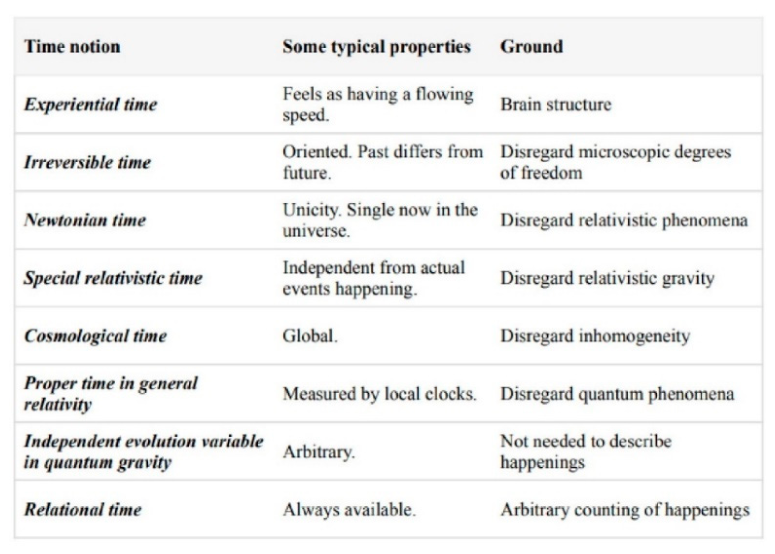
Figure 2.
Different notions of time presented by Rovelli [5].
Figure 2.
Different notions of time presented by Rovelli [5].
- -
- Experiential time has its origin in the neuronal activity of the brain [6].
- -
- Irreversible time exists only as the irreversible numerical order of events.
- -
- In the Newtonian framework, true time exists solely as a mathematical construct: “Absolute, true and mathematical time, of itself, and from its own nature flows equably without regard to anything external, and by another name is called duration: relative, apparent and common time, is some sensible and external (whether accurate or unequable) measure of duration by the means of motion, which is commonly used instead of true time ...” [7]. Mathematical time is the numerical order of events, whereas emergent time, as duration, comes into existence in the act of measurement [1].
- -
- There is no relativistic time; there is only a relativistic velocity of clocks and relativistic velocity of events [8]
- -
- Cosmological time is a persistent scientific illusion [2].
- -
- We can only talk about proper velocity in general relativity. The rate of clocks on the Moon is faster than on the Earth and is valid for all observers [8].
- -
- Independent evolution variable in quantum gravity: as time does not exist, gravity is immediate, generated by the variable energy density of Gravity is time-invariant [2].
- -
- Relational time is a philosophical term and has no application in physics: “Motion is the measure of time rather than time being the measure of motion: we truly came to know duration through motion rather than conversely. Although they both measure each other, no time is the measure of motion unless previously some motion was the measure of time” [9]. We show in this article that motion does not occur in time; it occurs only in time-invariant space. Motion has no duration per se. Duration is the result of measurement. Schuster introduced internal and external relational time: “There are two possible forms of the relational theory of time, both of which has been recognized but neither of which has received a special name. They will be referred to below as internal and external relational time. The purpose of this paper is to analyse critically the latter form, through our first consideration will be to set forth the general features of the relational theory itself by comparing it with the absolute theory of time” [10]. There is no experimental evidence that relational time has physical existence or that time in the absolute theory of time has physical existence. Clocks are mechanisms tuned to the rotation of the Earth around its axis. In one rotation, a clock ticks 86,400 seconds. One second is approximately
Planck times. Fundamentally, when we measure the velocity of a physical object in space, i.e., the velocity of material changes, we compare its velocity to the rate of the clock. The idea of the absolute theory of time, which assumes that time flows by itself, has no scientific evidence and should be replaced by the fact that clocks tick in time-invariant space. Velocity of motion in space is defined by the duration (v = s/t), where time t is the duration and s the distance.
Loop quantum gravity (LQG) [11] has a highly developed mathematical formalism; its weak point is that it cannot be used to calculate the gravitational force between two stellar objects. The same is valid for General Relativity (GR); it describes gravity mathematically but lacks predictive power for calculation. This is a serious problem in contemporary physics, where mathematics has become merely a descriptive tool; the aim of mathematics should be calculation.
The geometrization of gravity was an attempt that has not yielded satisfactory results. Experimental data confirm that space has a Euclidean shape, while geometrization employs curved space. We replace curvature with variable energy density. Gravity is a pushing force from higher energy density toward lower energy density. This model works well inside black holes; it replaces gravitational collapse with electromagnetic collapse. In the center of a black hole, the density of Planck quanta decreases drastically, which reduces the energy density of . Consequently, the reduced Planck constant diminishes, altering electromagnetic properties and rendering atoms unstable [12].
In 1964, Shapiro measured that the velocity of light diminishes in a strong gravitational field. His experiment is known as the fourth test of General Relativity and is referred to as gravitational time dilation [13]. It is not the case that time, as the fourth dimension of space, dilates and that light requires more time to propagate from point A to point B. What occurred in the Shapiro experiment is that light undergoes a minimal reduction in velocity due to the decreased energy density of space. Light does not propagate in space-time; it propagates in time-invariant .
The model is also applicable in the relativistic regime. A physical object in motion interacts with the energy of and integrates it, thereby acquiring relativistic mass. Within the framework, relativistic mass arises as a result of the motion of elementary particles and holds for all observers. In addition, stellar objects rotate the local , which corresponds to what is termed the frame-dragging effect in general relativity [8].
The era of “space-time” is coming to its end. There is no experimental evidence that motion occurs in time or that the universe exists in some physical time, so it is time to abandon this model and replace it with a model of “time-invariant superfluid quantum space” that is evidence-based and states that nothing could have happened in a remote physical past because it is non-existent. In Erwin Schrödinger’s view, the only real physical reality is Now: “For eternally and always there is only now, one and the same now; the present is the only thing that has no end” [14].
In mainstream physics, we imagine the present moment (Now) as a point on an infinite timeline, which is a fundamental misunderstanding. Now exists in the entire Euclidean space. Time symmetry is a persistent scientific illusion, see Figure 3.
In this model, the entire universe is entangled via time-invariant space. This view aligns with the idea that time emerges from entanglement, as proposed by Page and Wootters [15]. EPR-type experiments occur in time-invariant space, which serves as the medium of entanglement [16].
In Einsteinian physics, space has been stripped of its physical attributes and rendered empty, possessing only geometric properties, with time as its fourth dimension. With the introduction of a time-invariant space endowed with physical attributes in the form of variable energy density, the time-reversal symmetry—T-symmetry—of Einsteinian physics has no physical correspondence in the physical world. The equation of time symmetry thus has no physical meaning [17]:
There is no negative Planck time , Planck time has only absolute value:
The duration of every motion and every material change can be dissected into Planck times. When comes into existence, no longer exist. When comes into existence, no longer exists. Motion and maternal change occur in time-invariant . The physical past and physical future constitute stubbornly persistent illusions within scientific thought. By conceptualizing time as the numerical ordering of events occurring in a time-invariant space, we have incorporated the present—the Now—into the formal framework of physics. This would have been a source of delight for Einstein, who considered the Now to reside beyond the domain of scientific inquiry. As Rudolf Carnap wrote in his autobiography: “Once Einstein said that the problem of the Now worried him seriously. He explained that the experience of the Now means something special for man, something essentially different from the past and the future, but that this important difference does not and cannot occur within physics. That this experience cannot be grasped by science seemed to him a matter of painful but inevitable resignation” [18].
Albert Einstein, Erwin Schrödinger, and Ernst Mach were deeply aware that linear physical time is a persistent scientific illusion. Their well-known quotations attest to this view.
People like us, who believe in physics, know that the distinction between past, present and future is only a stubbornly persistent illusion. Albert Einstein
For eternally and always there is only now, one and the same now; the present is the only thing that has no end. Ervin Schördinger
It is utterly beyond our power to measure the changes of things by time. Quite the contrary, time is an abstraction at which we arrive by means of the changes of things; made because we are not restricted to any one definite measure, all being interconnected. Ernst Mach
Today, the leading physicists advocating this view, albeit with sometimes slightly different emphases, are Carlo Rovelli, Julian Barbour, and Davide Fiscaletti.
The evolution of life on planet Earth is reconsidered from a new perspective in which life develops in time-invariant space, and not in physical time. In the conventional view, the entropy of the universe increases, while the evolution of life represents a negentropic process in which the entropy of living systems is lower than that of the physical environment.
Here we propose an alternative view in which the evolution of life unfolds in time-invariant space, and the notion that evolution is an accidental process driven by random mutations over a long period of time is no longer tenable. The origin of life is dated to 3,800 million years ago. From the perspective of time-invariant space, this datum possesses only a mathematical meaning, denoting the numerical order of the evolution of life that occurs in time-invariant space [19].
In this framework, the driving force of the evolution of life is constituted by hidden variables as proposed by David Bohm. Hidden variables are the organizing structures that maintain the negative entropy (negentropy) of living organisms and render quantum coherence in living systems possible. In this perspective, DNA constitutes the hardware that is guided by the software represented by hidden variables [20,21].
This view is consistent with the position of Erwin Schrödinger, Herbert Fröhlich, Fritz-Albert Popp and Kenneth Denbigh, who argued that the scientific description of life extends beyond determinism. As geneticist Mae-Wan Ho notes: “The Rainbow and the Worm set out to answer the question, what is life?, that Schrödinger asked. Most people thought he provided the answer by postulating DNA as the genetic material. That was only part of the answer. The other part he suggested was quantum coherence, a state of being whole that involves molecules acting in perfectly correlated ways, and a special thermodynamics of life, which he referred to a `negentropy’, or ‘negative entropy’. Following these leads, I extended conventional quantum physics and non-equilibrium thermodynamics to provide the tentative answer, drawing on the work especially of Herbert Froehlich, Fritz Albert Popp and Kenneth Denbigh, and empirical evidence from the scientific literature and my own research” [22].
The introduction of the Now into physics and biology necessitates the introduction of hidden variables. Consciousness is posited as such a hidden variable. It cannot be observed as an object, yet its existence is affirmed through the conscious experience of mental activity. Consciousness pertains to a higher ontological order than the mind. The functioning of the mind can be observed, whereas the mind cannot experience consciousness; it can only conceptualize it [23].
3. The Model of Consciousness and Epistemological Weakness of Orchestrated Objective Reduction (Orch OR) Model of Consciousness
In the framework proposed by Hameroff and Penrose, consciousness is regarded as a temporal phenomenon: “Consciousness has often been argued to be a sequence of discrete moments. William James described the “specious present, the short duration of which we are immediately and incessantly sensible” (though James was vague about duration, and also described a continual ‘stream of consciousness’). The “perceptual moment” theory of Stroud described consciousness as a series of discrete events, like sequential frames of a movie (modern film and video present 24 to 72 frames per second, 24 to 72 Hertz, ‘Hz’). Consciousness is also seen as sequences of discrete events in Buddhism, trained meditators describing distinct “flickerings” in their experience of pure undifferentiated awareness [24].
Furthermore, within their framework, quantum superposition is regarded as a phenomenon occurring in space-time: “In the DP scheme for OR, the superposition reduces to one of the alternatives in a timescale τ that can be estimated (for a superposition of two states each of which is assumed to be taken to be stationary on its own) according to the formula . An important point to make about τ, however, is that it represents merely a kind of average time for the state reduction to take place. It is very much like a half-life in a radioactive decay. The actual time of decay in each individual state-reduction event, according to DP (in its current form), is taken to be a random process. Such an event would involve the entire (normally entangled) state, and would stretch across all the superposed material that is involved in the calculation of EG. According to DP (in its current form), the actual time of decay in a particular state-reduction event occurs simultaneously (in effect) over the entire state involved in the superposition, and it is taken to follow the formula on the average (in a way similar to radioactive decay). Here is Dirac’s form of Planck’s constant h and EG is the gravitational self-energy of the difference between the two (stationary) mass distributions of the superposition. (For a superposition for which each mass distribution is a rigid translation of the other, EG is the energy it would cost to displace one component of the superposition in the gravitational field of the other, in moving it from coincidence to the quantum-displaced location” [24]. Considering that time is not the fourth dimension of space and that the spacetime model has no counterpart in the existing universe, we propose a model of consciousness described as an n-dimensional complex space where ℂⁿ = {(z₁, z₂, ..., zₙ) | zᵢ ∈ ℂ}. This complex space represents a form of energy that lies outside the known electromagnetic spectrum. Is composed of complex Planck quanta . Consciousness is postulated as a vibration of this complex energy field, oscillating at the Planck frequency (). The time-invariant superfluid quantum space is embedded in . In a state of superposition, consciousness acts such that the observed superposition state is realized within the domain, see Figure 4.
The debate as to whether real numbers are sufficient to describe quantum mechanics, remains unresolved [25,26]. Otte argues that complex numbers are a necessity if we are to advance the scientific description of consciousness: “According to the humanities, there is intentional and phenomenal consciousness. This paper deals with the physical aspects of phenomenal consciousness. It may sound unusual, but such consciousness must have a physical background if it exists objectively. This article therefore attempts to describe states of phenomenal consciousness mathematically as so-called hypercomplex system states in order to give them an objective scientific treatment” [27].
Since the phenomenon of quantum superposition is produced by the human being—a conscious living organism—it can be argued that a complete description of quantum mechanics, in which the human being is fully implicated, will require the use of complex numbers. Quantum mechanics of inanimate reality can be formulated using only real numbers, whereas when life is considered, complex numbers become a necessary descriptive tool.
In the ‘Orch OR’ model, quantum gravity acting on the microtubules of the brain is posited to generate consciousness [24]. The introduction of consciousness as the frequency of an n-dimensional complex space provides a clearer account of the ‘Orch OR’ framework. The vibration of , which constitutes consciousness, is entangled with the superfluid quantum space , whose variable energy density carries gravity. Consciousness thus acts on the microtubules via . The presented model provides a mathematical framework for the further integration of consciousness into quantum mechanics. Mass-energy equivalence principle is also extending on . The preliminary experiments carried out in 1987-90 at University of Lubiana in Slovenia show that the energy of is concentrated in a living organism and that this causes the increase of gravity according to the Eq. (15).
Superfluid quantum space interacts with the concentrated energy of consciousness in living organisms, which diminishes its energy density within the organism in proportion to the concentrated energy of thereby increasing their weight. A 5 g sample of living earthworms was observed to decrease in weight by 5µg within 15 minutes post-mortem in a mass closed system [28].
Preliminary results of these experiments were first reported in 1997 in Newsletter No. 18-19 of the Monterey Institute for the Study of Alternative Healing Arts, California. On March 3rd, 1998, Dr. Shiuji Inomata (Japan) informed the editor, S. Savva, that Dr. Kaoru Kawada had obtained comparable results using rats as the experimental organism in a closed system (personal communication).
In 2019, the experiment using 5 g of Lumbricus terrestris was repeated on a high-accuracy Mettler-Toledo AX107H Comparator balance (readability 0.1 µg, repeatability 0.2 µg) in a research institution in Slovenia. At the request of the host institution, which provided access to the instrument, its identity remains anonymous. Two experimental test tubes containing the organisms and two control test tubes containing distilled water were weighed simultaneously to compensate for environmental fluctuations (Figure 7). The results were consistent with the earlier measurements: the mass of 1 g of deceased worms was approximately 1 µg lower than the mass of the same sample when alive.
In 1907, American physician Duncan MacDougall measured the body weight of patients at the time of death in an attempt to detect a weight change, reporting a loss of 21 grams [29]. His experiments were also preliminary and did not receive sufficient scientific attention, as he claimed to have measured the weight of the soul. However, in light of contemporary advances in the scientific understanding of consciousness, his work can be viewed more favourably.
The reported mass difference between the living and deceased organism should be regarded as preliminary. Independent replication in at least two laboratories under controlled conditions is required before any definitive conclusions can be drawn.
In a complementary closed-system experiment, we observed a measurable increase in total mass during the anaerobic growth of yeast, where non-living organic substrate is converted into living biomass. The system was sealed to prevent mass exchange with the environment, and the increase was recorded with a high-precision balance.
These experiments are not the primary focus of the present article. They are presented as preliminary empirical indications consistent with the proposed model. The central contribution of this work is the embedding of the Orch OR framework within a broader theoretical model in which gravity functions as an intermediary between the universal complex consciousness field and the physical substrate of microtubules in .
The prevailing deterministic view in biology is not conducive to the concept of hidden variables and to a non-deterministic worldview, to which both the Orch-OR model of consciousness and the model of consciousness belong: “A lot of attention was focused over the last 50 years on quantum effects in biological systems. The main focus has been given to the quantum interference (QI; coherence/decoherence) effects in the brain, and to the propagation of the ATP hydrolysis energy along a polypeptide chain. The latter effect is also dependent on quantum interference. The signal exchange between neurons is typically described as a classical electrochemical process of ion transport through the cell membranes. However, Penrose, Stapp and others proposed that quantum effects may play a significant role in the interactions between neurons. Thus, neural networks should be described as quantum communication networks. Several authors considered that brain activity may only be understood as a consequence of quantum effects operating in it. Wigner proposed that consciousness was linked to the quantum measurement problem, the same idea was later further developed by Penrose. It was also proposed that consciousness is a macroscopic quantum effect, involving superconductivity, superfluidity, electromagnetic fields, Bose condensation, superfluorescence or some other mechanisms. However, presently we find no physical evidence for any of these proposed mechanisms” [30]. The difference in weight between a living and a dead organism constitutes experimental evidence for the existence of hidden variables [28]. Their presence in the living organism causes a stronger action of the gravitational field on the same living mass than on the same dead mass. A living organism contains the same atoms as the same dead organism. The only difference is that in the dead organism the field of consciousness that organizes the functioning of the living organism is weakened, and thus the dead mass is no longer able to maintain negentropy.
In general, in cosmology the role of entropy is overestimated. Only 5% of the ordinary energy of the universe in the form of matter is entropic. 95% percent of the ordinary energy is in the form of the superfluid quantum space , which has no entropy. And finally, the complex energy of consciousness is negentropic. The destiny of the universe is not thermal death; the universe is a system in permanent dynamic equilibrium in which black holes are rejuvenating systems of the universe [2]. They transform old matter with high entropy into fresh energy in the form of jets and winds that possess low entropy [12].
The cosmological principle states that the universe is physically homogeneous. Physical homogeneity implies biological homogeneity. The conditions for the evolution of life are equivalent throughout the entire universe. The basic molecules that compose life are found throughout universal space [31,32]. The entire universe is in a phase of chemical evolution that, on planets similar to Earth, develops into life. The integration of biology and consciousness into cosmology constitutes a necessary condition for the unification of the natural sciences and the science of consciousness.
A key strength of the Orch-OR model of consciousness is that it anchors consciousness in gravity—the only field that is universally pervasive throughout the cosmos. All biological and physical systems, from macromolecular assemblies to galactic structures, are coupled through the gravitational field. In this sense, the Orch-OR model implicitly suggests a form of panpsychism in which the universe itself possesses the fundamental properties from which biological consciousness emerges.
A principal limitation of the Orch-OR model of consciousness is that it postulates that consciousness emerges when gravity acts upon neuronal microtubules, without providing an explanation for how a gravitational interaction could give rise to subjective experience of being conscious. From a biological perspective, microtubules are not merely structural scaffolds; they are dynamic cytoskeletal polymers that regulate intracellular transport, synaptic plasticity, and the organization of signalling cascades essential for neuronal function. The Orch-OR model does not clarify how gravitational field couples to these biological processes to produce a conscious state. The aim of this article is therefore to reframe the Orch-OR model within a broader theoretical architecture in which the superfluid quantum space field , as the carrier of gravity, functions as a biophysical interface. In this framework, serves as the intermediary that transduces information from the consciousness field to the microtubule network of the brain.
The model proposes that consciousness constitutes a complex energy field which interacts with microtubules via pilot photons. In this framework, consciousness is interpreted as an excitation of the energy field, characterized by the Planck frequency . Conceptually, consciousness can be modelled as a photon existing in complex space.
The space and field space are interwoven such that the propagation of the consciousness photon induces a corresponding motion of the bio-photon within , which serves as a reservoir of virtual photons [33]. Upon absorption of an energy impulse, the virtual photon transitions from a latent to a manifest state. Energized by the impulse originating from the consciousness photon, the resulting bio-photon propagates through the microtubule with either left-handed or right-handed spin. In the model, photons are interpreted as excitations of and possess intrinsic spin [34,35]. As the photon traverses the microtubule, it assumes one of two distinct spin states, thereby transmitting information via a binary code. This is consistent with the widely accepted premise that biological systems operate on the basis of binary coding [36,37,38].
In the model, the superfluid quantum space is intrinsically non-entropic. The photon, as an excitation of , possesses a theoretically infinite lifetime and carries no entropy. The field of consciousness constitutes a syntropic type of energy. The syntropic properties of consciousness were first discussed by the Italian mathematician Luigi Fantappiè [39], and further developed by the Italian statistician Ulisse Di Corpo and the Italian cognitive psychologist Antonella Vannini: “Fantappiè noted that retarded waves are governed by the law of entropy whereas advanced waves are governed by a law opposite to entropy which leads to concentration of energy, differentiation, complexity, order and growth of structures. Fantappiè named this law syntropy and noted that its properties coincide with the qualities of living systems, arriving in this way at the conclusion that life and consciousness are a consequence of advanced waves [40].
In model, the photon modes constituting the consciousness field undergo a transition to a synchronous, phase-locked waving regime. The establishment of this coherent collective oscillation leads to a constructive, syntropic concentration of energy. This coherent energy domain subsequently provides a resonant energy transfer to the vacuum fluctuations of the superfluid quantum space . As a result, a virtual photon, understood as an off-shell excitation of where receives a coherent energy kick from field and is promoted to an on-shell state (, thereby becoming a real, observable bio photon with a given spin.
is not a random thermal kick. It is a coherent, syntropic energy injection from the consciousness field. When the field enters synchronous waving where all its photon modes oscillate with identical phase. The energy density then scales. This is an energy concentration that acts on the and makes virtual photon real, see Figure 5.
model provides an explicit model of how consciousness act on microtubule that the original Orch-OR model does not contain. In Orch-OR, the conscious moment corresponds to objective reduction (OR). In the model, OR corresponds to the moment of phase transfer from to carried by the biophoton spin acting on microtubule.
Hameroff proposed that loss of consciousness under general anaesthesia does not result primarily from synaptic suppression, but from the action of anaesthetics on quantum London dispersion forces within non-polar hydrophobic pockets of dendritic proteins—the same sites postulated to support consciousness [42]. In the model, this mechanism is reframed. General anesthetics do not abolish consciousness by suppressing neuronal firing, but by decoupling the consciousness field from the microtubule substrate via biochemical alteration of the quantum waveguide. At the biochemical level, anaesthetic molecules—in accordance with the Meyer-Overton correlation—bind to hydrophobic pockets in tubulin dimers formed by non-polar residues such as tryptophan and phenylalanine. This interaction is classical: London dispersion forces within the hydrophobic core. At the quantum biological level, binding increases the local relative permittivity , and the lattice polarizability α. The microtubule interior, which in the physiological state functions as a low-loss cavity for bio-photon propagation (), is converted into a high-loss medium (). Consequently, bio-photon transition is quenched, and coherent information transfer ceases. The field itself remains present—consciousness as such is not annihilated—but its functional connection to the biological substrate is severed. Subjective experience is thus decoupled from microtubule computation.
In conclusion, the Orch OR model establishes a direct link between gravity and consciousness, which represents an ad hoc assumption. In the Orch OR model, consciousness is posited to emerge from the coupling of the gravitational field with microtubule dynamics. The brain, however, remains immersed in the same gravitational field before and after the administration of anaesthesia, with the gravitational force acting on microtubules remaining effectively unchanged. The disappearance of consciousness under anaesthesia therefore cannot be attributed to a failure of Objective Reduction, as anaesthetic molecules do not alter the mass distribution and thus do not modify the gravitational self-energy or the reduction timescale . Rather, in the model , consciousness vanishes because binary bio-photon transmission, within the microtubule waveguide is quenched. Consequently, gravitationally-induced OR is not plausible as the mechanism of anaesthetic loss of consciousness, see Figure 6.
Max Planck would not have endorsed the view that consciousness is a byproduct of gravity-microtubule interaction. He would appreciate model. His ontological position is unambiguous: “I regard consciousness as fundamental. I regard matter as derivative from consciousness. We cannot get behind consciousness. Everything that we talk about, everything that we regard as existing, postulates consciousness [43].
4. The Model of Consciousness and Quantum Mechanics: An Ontological Reformulation
In the model, consciousness is assigned a foundational role in quantum mechanics. The model posits that consciousness is not an emergent epiphenomenon but a fundamental, time-invariant field denoted . This model provides an ontological basis for the Copenhagen interpretation of quantum mechanics (QM). It replaces the conventional assumption of spacetime as a fundamental arena with two interwoven, time-invariant fields: the consciousness field and the three-dimensional super quantum space .
- -
- The Planck Photon and the Mechanism of Superposition
Within this framework, the collapse or actualization of a superposition is mediated by an energy exchange with the field. The observed state receives an energy kick from a quantum of the field, defined by the frequency where is the Planck time of consciousness. We designate this quantum as the “Planck photon.” The Planck photon does not propagate through the field; it is intrinsically non-local. This non-locality provides the mechanism for Einstein-Podolsky-Rosen (EPR) type quantum entanglement, which is understood as an immediate correlation within the field rather than a superluminal signal through space.
In the model, model, space is understood as a fundamental, time-invariant superfluid quantum structure . Within this ontology, time is not a primary physical entity. It does not exist as a fourth dimension of space, nor does it exist as an independent duration in which material changes occur. Every material change, i.e., motion on both the macro and micro scales, is an immediate process occurring in . Such a process can be formally dissected into a discrete numerical order whose elementary interval corresponds to the Planck time, . The sequence does not represent movement in time, but rather the numerical order of successive configurations of. Duration is therefore not fundamental; it is an emergent quantity resulting from the act of measurement, specifically from comparing the numerical order of a given change with the numerical order of a chosen clock-system.
This ontological position has direct consequences for dynamical collapse models that presuppose spacetime as a fundamental background. In particular, time-dependent collapse models are considered ontologically misplaced, as they attribute physical reality to a parameter that has no independent existence outside of measurement. A specific case is the Penrose Objective Reduction (OR) model, which postulates a collapse time of a quantum superposition given by relation , where is the gravitational self-energy of the difference between the two mass distributions in superposition, and ℏ is the reduced Planck constant. Within the ontology, this relation is considered to have no physical meaning. Since there is no fundamental time in which a superposition could persist and then collapse after a duration , the concept of a gravitationally induced temporal threshold for collapse is incompatible with the model. The superposition is a change of structure that occurs is an immediate reconfiguration of itself, not an event that occurs after a period of time. Consequently, cannot generate a physical collapse time, as time as duration does not exist in the framework.
In the model, the concept of a fundamental spacetime is abandoned and replaced by the time-invariant, interwoven dual-field structure of and . Consequently, standard quantum phenomena are ontologically redefined. Quantum measurement, superposition, and entanglement are not processes evolving in spacetime, but are immediate processes occurring within this dual-field structure. Their actualization does not unfold in time, but corresponds to a discrete reconfiguration in the numerical order of , defined by Planck times. In this framework, the non-local Planck photon is postulated as the mediator of actualization, facilitating the immediate transition from a superposed to a definite state within and without recourse to a fundamental temporal parameter.
Einstein was correct in his assertion that “God does not play dice” and that quantum mechanics, in its standard formulation, does not constitute a complete theory. We demonstrate that quantum mechanics can be rendered as a complete model through the introduction of the complex space as the fundamental ontological arena of the universe.
Following the line of argument first formalized in the Einstein-Podolsky-Rosen [EPR] paper [44], we argue that the wave function in Hilbert space does not provide a complete description of an individual system. Indeterminacy is not an intrinsic feature of nature, but an artifact of an insufficient mathematical structure. We propose that this incompleteness is resolved by constructing physical models that are bijective: every element of physical reality must have a counterpart in the physical theory, and conversely, every element of the theory must have a counterpart in physical reality. This satisfies the bijective methodology, which requires a bijective function between the elements of the model and the elements of physical reality [45].
Let X denote universe and the Y denotes the model of the universe, with:
We define:
In the model, the element of consciousness exists in both set X and set Y. In the Penrose-Hameroff model, no such element exists in set X; consciousness is modelled as the result of the interaction between gravity and microtubules.
In the standard Copenhagen formalism, the superposition state is projected onto a real observable space, which necessarily discards phase-correlation information. By embedding quantum dynamics in , the theory regains determinism. In this extended space determinism is restored; what appears as irreducible randomness in corresponds to a deterministic trajectory in . The Born rule, , is thus reinterpreted not as an axiom of intrinsic probability, but as a measure of the projection from onto the observable subspace In the Copenhagen view - developed by Niels Bohr and Werner Heisenberg in 1927-1930 - the wave function Ψ is not a physical wave in space. The wave function is a mathematical object in Hilbert space , that encodes the maximal knowledge we can have about an individual quantum system. The introduction of does not alter the formalism if quantum mechanics; it completes it. The wave function is not consciousness. is the mathematical formalism that describes the consciousness energy field which IS consciousness. The model resolves the measurement problem. In the Copenhagen interpretation, wave function collapses without a physical mechanism. In the model, is the excitation of the field and collapses because it receives an energy kick from the consciousness energy field . The cause of wave function collapse is energy kick from not from orchestrated objective reduction OR as predicted by Penrose [46]. Gravity does not play any role in quantum superposition; the decisive role here is played by the consciousness field and coherent bio-photon field [47] that mediates between field and field The consciousness field plays an active role in the behavior of elementary particles. It induces order and symmetry. In the EPR experiment, both particles propagate in , which preserves the symmetry between them. Upon measurement of the spin of the first particle, the second particle assumes the opposite spin. In the double-slit experiment, electrons propagate through the upper slit, but they also propagate in the field , which, in response to the motion of the electrons, generates waves in the field . These waves pass through the lower slit and give rise to the interference pattern.
is not a propagating excitation on a pre-existing background. It constitutes the ontologically fundamental arena,, within which is embedded as a subspace. non-local correlations therefore do not require superluminal propagation. is omnipresent throughout entire universe. The formulation of consciousness as a non-local complex field does not violate Bell’s theorem.
The model provides a clear explanation of the DNA phantom effect. Poponin and Gariaev reported that a DNA sample in a quartz cuvette illuminated by a laser produces a characteristic dynamic pattern in the scattered light. When the DNA is removed, the pattern does not disappear immediately but persists for minutes to hours [48]. In standard quantum mechanics, there is nothing that can preserve the organization of the DNA pattern once the DNA is removed from the chamber. The source is gone, so the effect must also be gone. In the model, the DNA information is imprinted in the field and remains there even after the DNA is removed.
The results of this research are consistent with the view of the physicist and mathematician Eugene Wigner on quantum mechanics: “It was not possible to formulate the laws of quantum mechanics in a fully consistent way without reference to the consciousness” [49].
Quantum biology also indicates that consciousness is an indispensable element for the description of life and is non-classical in the sense that it does not belong to the known types of energy: “Our findings suggest that we may have witnessed entanglement mediated by consciousness-related brain functions. Those brain functions must then operate non-classically, which would mean that consciousness is non-classical” [50]. model is non-classical in the sense that it introduces consciousness a complex energy field Keppler argues that conscious states are not produced by neurons alone, but by a resonant coupling of the brain to the zero-point field (ZPF)—the fluctuating vacuum field of quantum electrodynamics (QED) [51]. We encounter here the same problem as in the Penrose-Hameroff model of consciousness: neurons are not conscious, the ZPF is not conscious, and the gravitational field is not conscious. How the interaction between neurons and gravity, or between neurons and the ZPF, could produce consciousness as an epiphenomenon of that interaction cannot be explained.
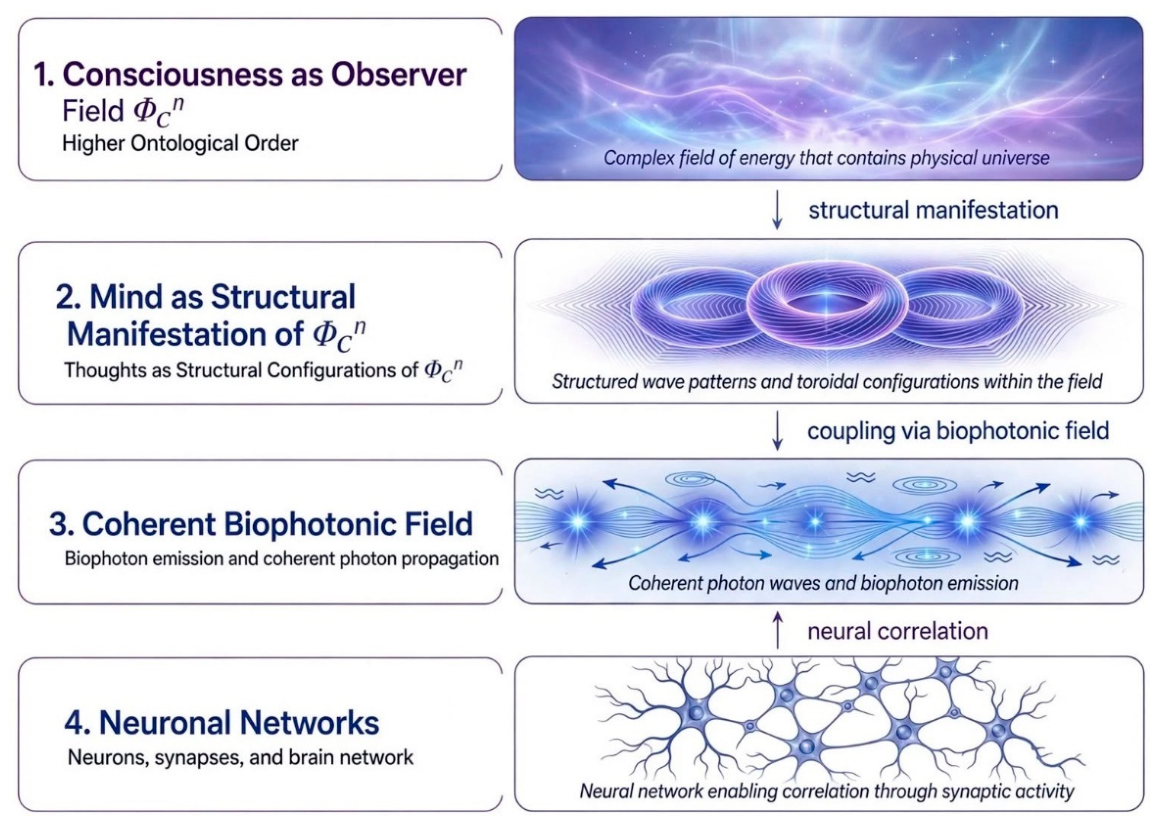
It is a fundamental premise of the von Neumann-Wigner interpretation of quantum measurement theory that consciousness operates as the observer and causes the collapse of the wave function [52]. The capacity to observe one’s own mental activity is itself a direct manifestation of consciousness. The same consciousness field, , functions as the observer in every scientist. The observation of mind activity constitutes an everyday, first-person experience common to all researchers. While our minds construct novel models of the world, it is the observer that witnesses this constructive process. Arievitch shows there is no one-to-one correspondence between mental states and neural processes [53]. The model proposes that mental activity constitutes a manifestation of the field, wherein thoughts correspond to structural configurations of that are coupled to neuronal networks via a coherent biophotonic field. In this model, the consciousness that functions as the observer is of a higher ontological order than the mind, which constitutes its structural manifestation, see Figure 8.
To postulate that the consciousness emerges from the interaction between the gravitational field and microtubules, or from the interaction between the zero-point field (ZPF) and microtubules, lacks grounding in scientific empiricism, as no experimental evidence currently substantiates such models. Conversely, the direct experience of observing the functioning of the mind possesses an empirical validity that cannot be denied.
Ontologically, consciousness is subjective and should therefore be investigated primarily through subjective introspection. This process brings awareness that the observer is not the mind and enables the scientist to construct the most appropriate models of consciousness, while being aware that the model of consciousness is not consciousness itself, but only points the way to discovering consciousness through individual introspective research. The assumption that consciousness could be the result of interactions between objective physical entities—for example, between the gravitational field and microtubules—constitutes an ontological reductionism that leads research in the wrong direction. The introduction of consciousness as a field with independent existence—in which thoughts constitute its structural forms and which interacts with neurons via biophotons—is crucial for advancing our understanding of human functioning and of life itself.
As argued by Penrose via Gödel’s incompleteness theorem, human mathematical understanding is non-algorithmic and consciousness cannot be modelled as computable, implying the need for a new physics [54]. Penrose is an explicit Platonist: “Every one of our conscious brains is woven from subtle physical ingredients that somehow enable us to take advantage of the profound organization of our mathematically underpinned universe-so that we, in turn, are capable of some kind of direct access, through that Platonic quality of ‘understanding’, to the very ways in which our universe behaves” [55]. The author of the present article likewise adopts a Platonist position and proposes that objective reduction (OR) is neither deterministic nor random. It is time-invariant. It manifests as a non-computable selection of an integrated whole, quantified as It is essential to note that both determinism and randomness presuppose linear time. Determinism presupposes a temporal ordering in which a past state () fixes a future state () via invariant laws. Randomness likewise presupposes linear time, insofar as an outcome that was not fixed before time becomes actual at time with a given probability. Both categories are therefore intelligible only within a framework that posits time as a fundamental physical parameter. In a time-invariant space, where there is no physical past and no physical future and events occur exclusively in the Now, neither determinism nor randomness obtains. What appears as deterministic or random when projected onto linear time is, in the present model, guided by the implicate order manifesting as a non-computable selection of an integrated whole . This view posits the Bohm’s implicate order as the central mechanism governing the universe and life.
5. Conclusions
Science is an evolving enterprise, and persistence in models devoid of empirical corroboration obstructs progress. The Orch OR model posits consciousness as an emergent byproduct of gravity acting upon microtubules. Yet gravity possesses no phenomenological attribute of consciousness, nor do microtubules. Consequently, the appearance of subjective experience in Orch OR remains unexplained—a deus ex machina (see Figure 7). In the present framework, we invert this ontology: consciousness is not created by the gravity acting on the brain, but is a non-created universal field , of which the brain is a resonant receiver, in analogy to a radio tuned to pre-existing electromagnetic waves. The microtubule network functions as a waveguide and transduction interface, not as a generator.
References
- Fiscaletti, D., Sorli, A. Perspectives of the Numerical Order of Material Changes in Timeless Approaches in Physics. Found Phys 45, 105–133 (2015). [CrossRef]
- Sorli, A., Fiscaletti D. Newtonian Analysis of the Big Bang Model and Time-Invariant Cosmology, Int. J. Fundam. Phys. Sci, Vol. 16 No. 3 (2026). [CrossRef]
- Niko Gorjup, Rado Gorjup, Amrit Srecko Sorli, Planck’s energy density of intergalactic space and gravitational constant G, Advanced Studies in Theoretical Physics, Vol. 18, 2024, no. 4, 163-172 https://www.m-hikari.com/astp/astp2024/astp1-4-2024/92135.html.
- David Vasak, Setting free the cosmic time in Quantum Universe, (2025). [CrossRef]
- Carlo Rovelli, The layers that build up the notion of time, (2021). [CrossRef]
- Buhusi, C. V., & Meck, W. H. (2005). What makes us tick? Functional and neural mechanisms of interval timing. Nature Reviews Neuroscience, 6, 755–765. [CrossRef]
- Newton, Isaac; Chittenden, N. W. Life of Sir Isaac Newton; Adee, Daniel; Motte, Andrew; Hill, Theodore Preston Early American mathematics books CU-BANC (1846). Newton’s Principia : the mathematical principles of natural philosophy. University of California Libraries. New-York : Published by Daniel Adee.
- Sorli, A. (2025). Einstein legacy: Ether relativity and cosmology. International Journal of Quantum Foundations, 11(4), 527–559. https://ijqf.org/archives/758338.
- Bruno, G. (1976). Hesitations between Absolute and Relational Theory of Time. In: Čapek, M. (eds) The Concepts of Space and Time. Boston Studies in the Philosophy of Science, vol 22. Springer, Dordrecht. [CrossRef]
- Schuster, Melvin M. “An Analysis of Relational Time.” The Review of Metaphysics 15, no. 2 (1961): 209–24. http://www.jstor.org/stable/20123875.
- Abhay Ashtekar, Eugenio Bianchi, A Short Review of Loop Quantum Gravity (2021) https://arxiv.org/abs/2104.04394.
- D. Fiscaletti and A. Sorli, Region of instability of matter as an alternative to gravitational collapse inside black holes, Annals of Physics 489, 170430 (2026). [CrossRef]
- Irwin I. Shapiro (1964). “Fourth Test of General Relativity”. Physical Review Letters. 13 (26): 789–791. [CrossRef]
- Amrit Sorli, Rado Gorjup, Niko Gorjup, Davide Fiscaletti, Non-physicality of time and introduction to time-invariant cosmology, Advanced Studies in Theoretical Physics, Vol. 20, 2026, no. 1, 29-44 https://www.m-hikari.com/astp/astp2026/astp1-4-2026/92340.html.
- Favalli, T. (2024). Page and Wootters Theory. In: On the Emergence of Time and Space in Closed Quantum Systems. Springer Theses. Springer, Cham. [CrossRef]
- Fiscaletti, D., Sorli, A. Searching for an adequate relation between time and entanglement. Quantum Stud.: Math. Found. 4, 357–374 (2017). [CrossRef]
- Sorli, Celan, Inconsistency of time-symmetry model, Physics Essays, Volume 34, Number 4, December 2021, pp. 470-471(2). [CrossRef]
- Kokoszyńska M. Rudolf Carnap. Intellectual autobiography. The philosophy of Rudolf Carnap, edited by Paul Arthur Schilpp, The library of living philosophers, vol. 11, Open Court, La Salle, III., and Cambridge University Press, London, 1963, pp. 1–84. Journal of Symbolic Logic. 1971;36(1):178-179. [CrossRef]
- Mojzsis, S., Arrhenius, G., McKeegan, K. et al. Evidence for life on Earth before 3,800 million years ago. Nature 384, 55–59 (1996). [CrossRef]
- David Bohm, A Suggested Interpretation of the Quantum Theory in Terms of “Hidden” Variables. I, Phys. Rev. 85, 166 – Published 15 January, 1952. [CrossRef]
- David Bohm, A Suggested Interpretation of the Quantum Theory in Terms of “Hidden” Variables. II, Phys. Rev. 85, 180 – Published 15 January, 195. [CrossRef]
- Hunt T. The rainbow and the worm: Establishing a new physics of life. Commun Integr Biol. 2013 Mar 1;6(2):e23149. [CrossRef]
- Amrit Sorli, Štefan Čelan, Temporal and timeless cognition in physics, Physics Essays, Volume 35, Number 3, September 2022, pp. 305-308(4). [CrossRef]
- Hameroff S, Penrose R. Consciousness in the universe: a review of the ‘Orch OR’ theory. Physics of Life Reviews. 2014 Mar;11(1):39-78. [CrossRef]
- Renou, MO., Trillo, D., Weilenmann, M. et al. Quantum theory based on real numbers can be experimentally falsified. Nature 600, 625–629 (2021). [CrossRef]
- Pedro Barrios Hita et al., Quantum Mechanics Based on Real Numbers: A Consistent Description, Phys. Rev. Lett. 136, 240202, – Published 18 June, 2026,. [CrossRef]
- Otte, R.—On a Heuristic Approach to the Description of Consciousness as a Hypercomplex System State—Advances in AI and Machine Learning 4(4), 2024 https://www.oajaiml.com/uploads/archivepdf/747944175.pdf.
- Amrit Sorli, Bio-cosmology. Integration of life and consciousness into cosmology, Advanced Studies in Theoretical Physics, Vol. 17, 2023, no. 1, 9-20 https://www.m-hikari.com/astp/astp2023/astp1-4-2023/91969.html.
- MacDougall, Duncan, “. Journal of the American Society for Psychical Research. 1 (5): 237. (1907) ISSN 0093-0318.
- Igor Khmelinskii, Vladimir I. Makarov, Analysis of quantum coherence in biology, Chemical Physics, Volume 532, 2020, 110671, ISSN 0301 0104,. [CrossRef]
- M.P. Callahan, K.E. Smith, H.J. Cleaves, J. Ruzicka, J.C. Stern, D.P. Glavin, C.H. House, & J.P. Dworkin, Carbonaceous meteorites contain a wide range of extraterrestrial nucleobases, Proc. Natl. Acad. Sci. U.S.A. 108 (34) 13995-13998 (2011). [CrossRef]
- Oba, Y., Takano, Y., Furukawa, Y. et al. Identifying the wide diversity of extraterrestrial purine and pyrimidine nucleobases in carbonaceous meteorites. Nat Commun 13, 2008 (2022). [CrossRef]
- Fiscaletti, D., Sorli, A. (2020). A three-dimensional non-local quantum vacuum as the origin of photons. Ukrainian journal of physics, 65 (2), 106-119. https://jnas.nbuv.gov.ua/article/UJRN-0001127939.
- Dragoman D. On the photon-classical electromagnetic field relationship. Ann N Y Acad Sci. 2025 Jul;1549(1):11-21. [CrossRef]
- RUO PENG WANG, THE SPINOR FIELD THEORY OF THE PHOTON, Romanian Reports in Physics, Vol. 66, No. 2, P. 319–335, 2014 https://rrp.nipne.ro/2014_66_2/A7.pdf.
- Petoukhov, S. V. (2008). The degeneracy of the genetic code and Hadamard matrices. Symmetry: Culture and Science, 19(2-3), 129-142. https://arxiv.org/pdf/0802.3366v2.
- Jenuwein, T., & Allis, C. D. (2001). Translating the histone code. Science, 293(5532), 1074–1080. [CrossRef]
- Turner, B. M. (2002). Cellular memory and the histone code. Cell, 111(3), 285–291. [CrossRef]
- Fantappiè Luigi, Sull'interpretazione dei potenziali anticipati della meccanica ondulatoria e su un principio di finalità che ne discende. Rendiconti della Reale Accademia d'Italia, Classe di Scienze Fisiche, Matematiche e Naturali, Serie 7, Vol. 4, No. 7, pp. 81-86. Rome (1942).
- Vannini, A., & Di Corpo U., Quantum Physics, Advanced Waves and Consciousness. Journal of Cosmology, 14, (2011)Retrieved from http://journalofcosmology.com/Consciousness101.html.
- Di Corpo U., Vannini A., A Syntropic Model of Consciousness - Syntropy Journal, ISSN 1825-7968 (2024).
- Hameroff, S.R.The entwined mysteries of anesthesia and consciousness: Is there a common underlying mechanism? Anesthesiology, 105(2), 400-412. (2006) https://journalpsyche.org/articles/0xc12a.pdf.
- Planck, M. Interview in The Observer, 25 January 1931. Cited in: Planck, M. Das Weltbild der neuen Physik (1929) and W. Hebbel, Max Planck: Leben und Werk. https://www.newspapers.com/article/the-observer-the-observer-sunday-janua/121386587/.
- Einstein, Podolski, Rosen, Can Quantum-Mechanical Description of Physical Reality Be Considered Complete?, Phys. Rev. 47, 777 – Published 15 May, 1935. [CrossRef]
- Fiscaletti, D., Sorli, A. Bijective Epistemology and Space–Time. Found Sci 20, 387–398 (2015). [CrossRef]
- Penrose, R. On Gravity's role in Quantum State Reduction. Gen Relat Gravit 28, 581–600 (1996).10.1007/BF02105068.
- Popp FA. Properties of biophotons and their theoretical implications. Indian J Exp Biol. 2003 May;41(5):391-402. PMID: 15244259. https://nopr.niscpr.res.in/bitstream/123456789/17031/1/IJEB%2041%285%29%20391-402.pdf.
- Chan, W. S. H., The DNA Phantom Effect in Medicine: Unraveling the Mysteries of Non-Physical DNA Interactions. Universal Library of Medical and Health Sciences, 1(1), 65-73. (2023). [CrossRef]
- Wigner, E.P., Remarks on the Mind-Body Question. In: Mehra, J. (eds) Philosophical Reflections and Syntheses. The Collected Works of Eugene Paul Wigner, vol B / 6. Springer, Berlin, Heidelberg. (1995). [CrossRef]
- Kerskens, C. M., & López Pérez, D. (2022). Experimental indications of nonclassical brain functions. Journal of Physics Communications, 6, 105001. (2022). [CrossRef]
- Keppler, J., Macroscopic quantum effects in the brain: New insights into the fundamental principle underlying conscious processes. Frontiers in Human Neuroscience, 19, 1676585. (2025). [CrossRef]
- Gao, Shan (Ed.). Consciousness and Quantum Mechanics. Oxford University Press. (2022) https://www.amazon.com/Consciousness-Quantum-Mechanics-Philosophy-Mind/dp/0197501664.
- Arievitch, I. M., Beyond the Brain: An Agentive Activity Perspective on Mind, Development, and Learning. Rotterdam/Boston: Sense Publishers https://www.sensepublishers.com/catalogs/bookseries/bold-visions-in-educational-research/beyond-the-brain/.
- Penrose, R., The emperor's new mind: Concerning computers, minds, and the laws of physics. Oxford University Press (1989) https://academic.oup.com/book/40643?login=false.
- Penrose, Roger, Shadows of the Mind: A Search for the Missing Science of Consciousness (New York, NY, 1996; online edn, Oxford Academic, 31 Oct. 2023), Chapter 8: "The Platonic viewpoint". [CrossRef]
Figure 2.
Gravity as a pushing force of superfluid quantum space
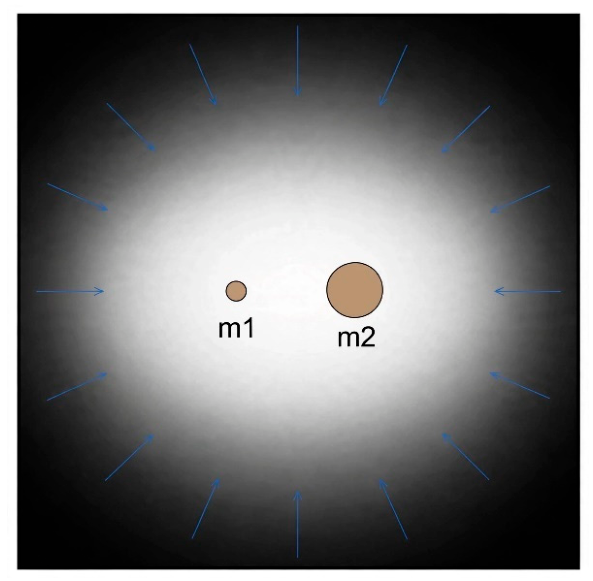
Figure 3.
Conventional vs. Revised Conception of Now.
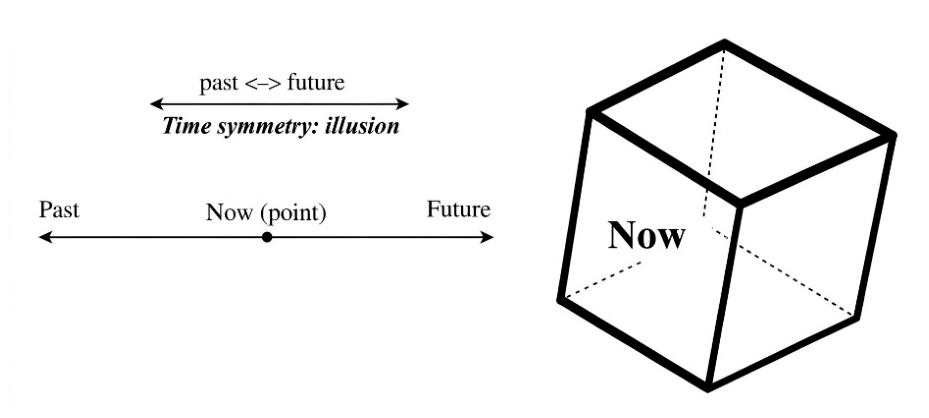
Figure 4.
Consciousness as vibration in and realization of superposition in
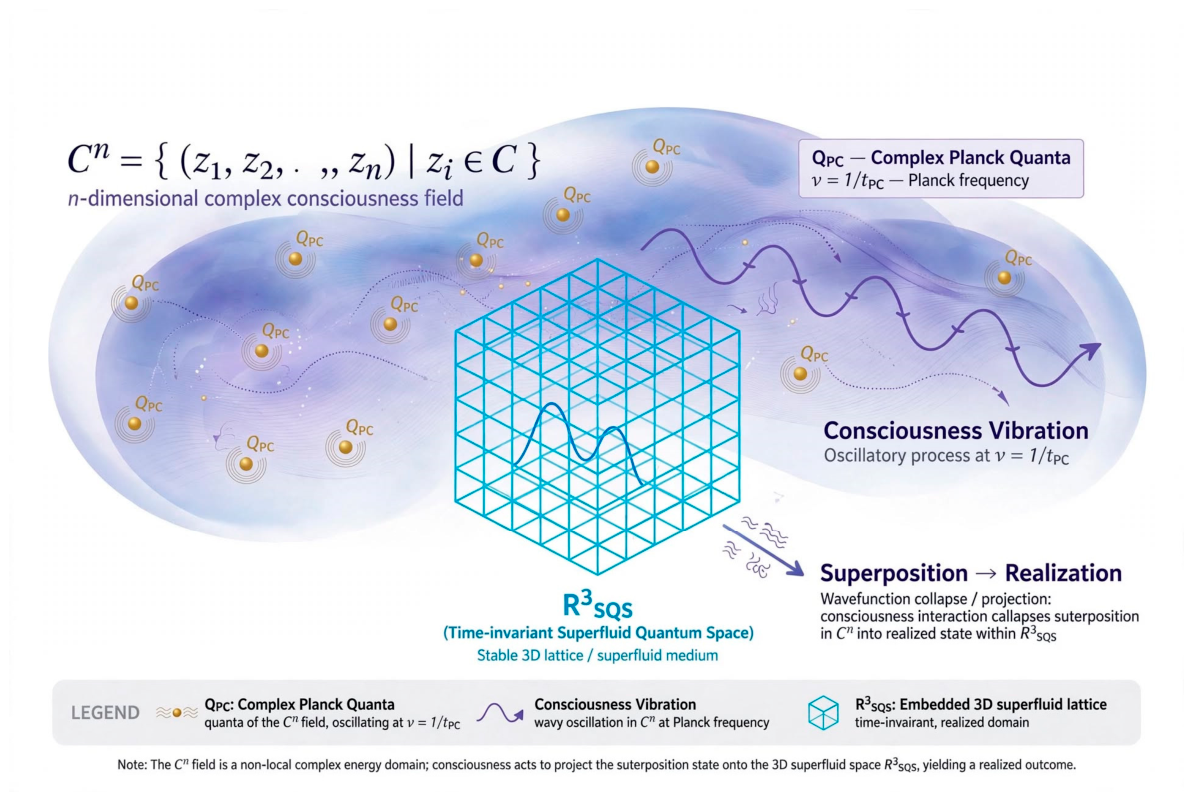
Figure 5.
From to pilot coupling and binary bio-photon transmission in microtubule.
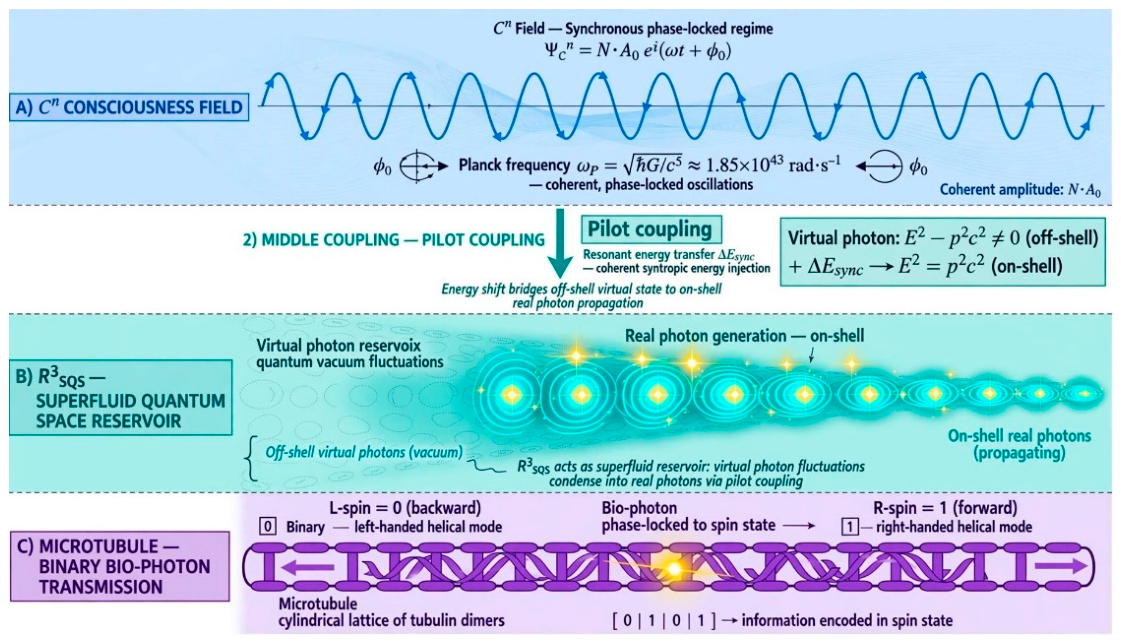
Figure 6.
Disappearance of consciousness in anaesthesia: Orch OR model versus model.
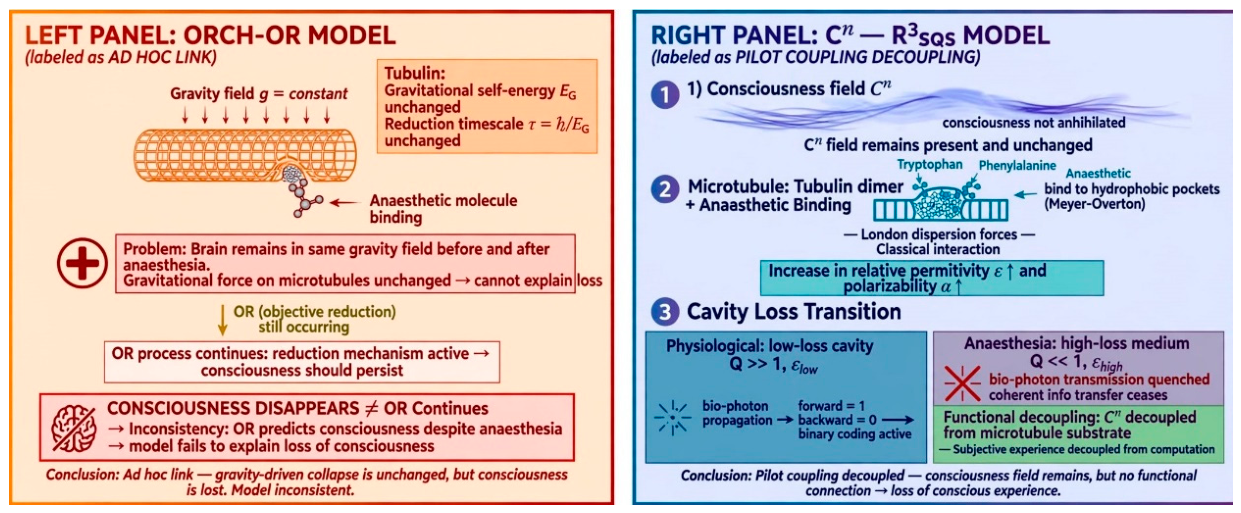
Figure 8.
model: Consciousness, mind, and neuronal coupling.
Disclaimer/Publisher’s Note: The statements, opinions and data contained in all publications are solely those of the individual author(s) and contributor(s) and not of MDPI and/or the editor(s). MDPI and/or the editor(s) disclaim responsibility for any injury to people or property resulting from any ideas, methods, instructions or products referred to in the content. |
© 2026 by the authors. Licensee MDPI, Basel, Switzerland. This article is an open access article distributed under the terms and conditions of the Creative Commons Attribution (CC BY) license (http://creativecommons.org/licenses/by/4.0/).
Copyright: This open access article is published under a Creative Commons CC BY 4.0 license, which permit the free download, distribution, and reuse, provided that the author and preprint are cited in any reuse.