
Submitted:
17 September 2026
Posted:
18 September 2026
You are already at the latest version
Abstract
Detailed petrography and LA-ICP-MS zircon U-Pb geochronological analyses of metasedimentary rocks in the Jiangbian area are carried out in this study in order to reveal the formation age of Precambrian crystalline basement in the western Hainan Island, South China Block. Field characteristics of the metasedimentary rocks show that they underwent intense deformation and are crystalloblastic texture. They are mainly composed of quartz and muscovite. Zircon U-Pb dating results show that a representative metasedimentary rock sample yields two age peaks of 1736 Ma and 2339 Ma, suggesting that there is Paleoproterozoic crystalline basement on Hainan Island. Integrated with regional geological data, it suggested the protolith of part of the Baoban Group that was previously divided into Mesoproterozoic stratigraphic sequence was likely to be formed in the Paleoproterozoic. All of the Hainan Island, Yangtze and Cathaysia blocks were part of old landmass of China and recorded the assembly of supercontinent Columbia/Nuna.
Keywords:
metasedimentary rocks
; Paleoproterozoic
; crystalline basement
; zircon U-Pb dating
; supercontinent Columbia
; Hainan Island
1. Introduction
The present-day South China Block is composed of the Yangtze and Cathaysia blocks, which are widely considered to have amalgamated along the Jiangnan Orogen during the Neoproterozoic, thereby forming a unified continental entity [1,2,3]. The Yangtze and Cathaysia blocks are characterized by markedly different Precambrian crystalline basement compositions [4]. It has been well documented that the Yangtze Block preserves Archean crystalline basement, as exemplified by the Kongling Group (also referred to as the Kongling Complex) [5,6,7,8,9], whereas the oldest crystalline basement so far identified in the Cathaysia Block is of Paleoproterozoic age, which is typified by the Badu Group (also termed the Badu Complex) [10,11,12,13]. Hainan Island is situated at the southernmost margin of the South China Block and is generally regarded as a constituent part of the Cathaysia Block [14]. A number of distinctive geological records are preserved on the island, including the occurrence of ~1.4 Ga granitic rocks and metabasic rocks [15,16,17], voluminous Devonian–Triassic magmatic rocks that are related to the evolution of the Paleo-Tethys [18,19], and large-scale Cenozoic basalts that were erupted in the northern part of the island [20]. Extensive investigations have been conducted on these geological records, and a wealth of results has been obtained [17,19,20,21]. Nevertheless, owing to intense overprinting by subsequent tectono-thermal events and dense vegetation coverage, robust geochronological evidence for the existence of a Paleoproterozoic crystalline basement on Hainan Island is still lacking. A suite of Paleoproterozoic metasedimentary rocks newly recognized in the Jiangbian area, Dongfang City, western Hainan Island, is reported in this study. This recognition implies the presence of a Paleoproterozoic crystalline basement on the island and offers a new window into the material composition, formation age, and tectonic evolution of the Precambrian crystalline basement of Hainan Island.
2. Regional Geological Setting and Sample Description
2.1. Regional Geological Setting
Geotectonically, Hainan Island is situated at the junction of the Pacific, Eurasian, and Indian plates and is controlled by both the Pacific and Tethyan tectonic domains. It has been subjected to multiple phases of tectono-thermal events, including the Mesoproterozoic (~1.4 Ga; [15,16,17]), the Early Paleozoic (~430 Ma; [22]), the Late Paleozoic–Early Mesozoic (353–237 Ma; [18,19,23]), the Late Mesozoic (107–81 Ma; [24,25,26]), and the Cenozoic [20], thereby possessing a complex tectonic evolutionary history. From north to south, the island is transected by four approximately E–W-trending faults, namely the Wangwu–Wenjiao, Changjiang–Qionghai, Jianfeng–Diaoluo, and Jiusuo–Lingshui faults, together with the NE-trending Baisha and Gezhen faults (Figure 1). The dominant structural trends are oriented E–W and NE (Figure 1). Magmatism on Hainan Island is widespread, and voluminous magmatic rocks of various episodes are exposed, covering approximately 64% of the island’s total area [27] (Figure 1).
The oldest strata currently delineated on the island are assigned to the Mesoproterozoic Baoban Group. Investigations of the Baoban Group can be traced back to the 1960s. In 1964, during 1:200,000 regional geological mapping conducted by the Guangdong Regional Geological Survey Party on Hainan Island, a suite of intensely metamorphosed mixed gneiss complex was recognized in areas including Baoban–Yaowen–Chongzuling in western Hainan Island and Huangzhuling in Qiongzhong in the east, and was designated the “Baoban Group”. In 1979, based on the study of this “mixed gneiss complex”, geologists proposed that its metamorphic grade was markedly higher than that of the Upper Ordovician–Lower Devonian Jiucunling Group (currently subdivided into the Ordovician Nanbigou Formation and the Lower Silurian Tuolie Formation) and that it had undergone conspicuous migmatization, thus representing a high-grade metamorphic sequence. The historical subdivision of the age assignment of the Baoban Group is summarized in Table 1.
The Baoban Group crops out over an area of approximately 160 km², with a thickness exceeding 3562 m. Lithologically, it is composed of a lower gneiss series and an upper schist series, which correspond, respectively, to the Gezhencun Formation and the Ewenling Formation as subdivided by Ma et al. (1997) [28] (Table 1). The gneiss series consists predominantly of plagioclase gneiss, granitic gneiss, monzonitic gneiss, and plagioclase amphibolite. The plagioclase amphibolite occurs largely as layered or stratiform bodies within the gneiss, with thicknesses mostly on the order of several meters and locally up to tens of meters. All of these rocks are characterized by intense migmatization [14].
2.2. Sample Description
The metasedimentary rock sample investigated in this study (sample DF1779) was collected from the north of Nawen Village, Jiangbian Township, Dongfang City, Hainan Island (Figure 2). Preliminary field geological survey reveals that the metasedimentary rock is grey to greyish-yellow on the surface, moderately to slightly weathered, intensely deformed, and locally characterized by pronounced fracturing, which imparts a distinct thinly layered appearance, and is relatively rich in quartz (Figure 3a).
The hand specimen displays a greyish-yellow surface with local reddish patches, indicating the presence of ferruginous minerals; the fresh surface is grey to greyish-white, with a granoblastic texture and massive structure, and abundant muscovite is visible. Microscopic observation reveals that the mineralogy is dominated by quartz (~60%) and muscovite (~40%) (Figure 3b, c). Fractures within fragmented quartz crystals are commonly filled by aligned muscovite. Both quartz and muscovite occur as crystalline aggregates. The width of quartz domains is mostly ~60 μm, locally reaching up to 120 μm, whereas that of muscovite domains is markedly narrower, typically ~30 μm. Influenced by tectonic deformation, quartz locally assumes a lenticular shape; muscovite is conspicuously bent, and both minerals exhibit a distinct preferred orientation (Figure 3b, c).
3. Zircon Geochronological Analysis Method
Zircon grains from the metasedimentary rock were separated using conventional heavy liquid and magnetic separation techniques. After separation, zircon grains exhibiting euhedral crystal morphology and relatively large sizes were preferentially handpicked under a binocular microscope and mounted, together with zircon reference standards, in epoxy resin. The preparation of the zircon grain mounts was undertaken by Chongqing Yujin Science and Technology Co., Ltd.
Transmitted-light, reflected-light, and cathodoluminescence (CL) imaging of the zircon grains, together with U-Pb geochronological dating, were all carried out at the Guangxi Key Laboratory of Hidden Metallic Ore Deposits Exploration, Guilin University of Technology.
Zircon U-Pb dating was conducted using laser ablation–inductively coupled plasma mass spectrometry (LA-ICP-MS) with an Agilent 7500cx ICP-MS coupled to an NWR-193 laser ablation system. The laser ablation system has an output wavelength of 193 nm and a spot size range of 2–150 μm; a beam diameter of 32 μm was adopted during the experiments. Data reduction, processing, and the calculation of U-Th-Pb isotopic ratios and ages were performed using the software package ICPMSDataCal 7.2. Zircon U-Pb age concordia diagrams and related plots were generated with the international standard program Isoplot 4.11, and all individual data-point errors are reported at the 1σ level.
4. Results
The zircon U-Pb dating results for the metasedimentary rock sample are presented in Table 2. The zircons selected for dating are transparent and predominantly light brown to brown in color. The majority of the grains are short-prismatic, with lengths typically ranging from 50 to 100 µm. Some zircons exhibit well-developed oscillatory zoning (Figure 4a), which is characteristic of a magmatic origin; others display metamorphic overgrowth rims (e.g., spots 06 and 10 in Figure 4a) or unzoned to weakly zoned internal structures (e.g., spots 03 and 04 in Figure 4a), indicative of a metamorphic origin.
A total of forty-nine spot analyses were conducted on zircons from sample DF1779, yielding Th/U ratios that vary predominantly from 0.10 to 1.33 (Table 2). Given that all the dated spots yield ages older than 1000 Ma, the 207Pb/206Pb ages were used for data analysis and plotting (Figure 4). The forty-nine spot analyses record 207Pb/206Pb ages ranging from 1589 to 2561 Ma (Table 2), with two prominent age peaks at 1736 Ma and 2339 Ma (Figure 4c).
5. Geological Significance
The Baoban Group on Hainan Island represents the oldest known exposed stratigraphic unit on the island, and is distributed primarily along both sides of the Gezhen Fault and the Baisha Fault, cropping out mainly in the Changjiang–Gancheng area of western Hainan Island and the Baoting–Qionghai area of the central-eastern part of the island (Figure 1). With regard to the formation age of the Baoban Group, several geochronological investigations have previously been conducted. For example, Liang (1995) [33] identified a plagioclase amphibolite schist from the Baoban Group in the Tuwai Shan area of Hainan Island that yielded a Sm-Nd isochron age of 1701 ± 20 Ma. Ma et al. (1997) [28] obtained a zircon upper-intercept age of 1824 ± 77 Ma for a migmatitic granite and an Rb-Sr isochron age of 1637 ± 31 Ma for a migmatite vein from the Gezhencun Formation. These data imply that the initial depositional age of the Baoban Group predates the Paleoproterozoic (1824 Ma).
Available research data show that a considerable amount of Mesoproterozoic age information has been obtained from the Baoban Group: Yu et al. (1992) [34] determined a zircon U-Pb crystallization age of 1441 Ma for granite of the Baoban Group; Ding (1995) [35] obtained a zircon Pb-Pb age of 1397 ± 46 Ma for granodiorite of the Baoban Group; zircon U-Pb ages of 1456–1364 Ma were reported for metagranite from the Ewenling Formation [28]; granite intruding the meta-volcaniclastic sedimentary rocks of the Baoban Group in the Gezhen area gave a SHRIMP zircon U-Pb age of 1455 ± 12 Ma [36]; SHRIMP zircon U-Pb dating of metavolcanic rocks from the Baoban Group yielded an age of 1433 ± 6 Ma [15], SIMS zircon U-Pb dating of metarhyolite gave an age of 1420 ± 12 Ma [16], and LA-ICP-MS zircon U-Pb dating of metabasic rocks gave ages of 1441–1424 Ma [17]. These data indicate that the formation ages of magmatic rocks developed within the Baoban Group are predominantly concentrated between 1456 and 1364 Ma, implying that the latest depositional age of the Baoban Group postdates the Mesoproterozoic (1364 Ma). The minimum age peak of 1440 Ma obtained from metasedimentary rocks of the Baoban Group [21] further corroborates this inference.
Regional geological data indicate that Neoarchean (2.8–2.7 Ga) TTG suites are pervasively developed in lithotectonic assemblages such as the Yudongzi Group and the Zhongxiang Complex along the northern margin of the Yangtze Block [37,38]. Among these, the Yudongzi Group experienced high-pressure metamorphism, and its TTG zircons display depleted Hf isotopic signatures with dominantly positive εHf(t) values, suggesting that their parental magmas were derived from a depleted mantle source [37,39,40,41]. In contrast, the Zhongxiang Complex is dominated by low-pressure metamorphism, and its TTG zircons exhibit both positive and negative εHf(t) values, implying derivation from both juvenile crustal and ancient crustal materials [42,43,44]. Furthermore, Paleoproterozoic magmatic and metamorphic records are also widely preserved in the Houhe Complex, Huangtuling Complex, and Dongling Complex along the northern margin of the Yangtze Block, as well as in the Cuoke, Dahongshan, Hekou, and Phan Si Pan (Vietnam) complexes along the southwestern margin of the Yangtze Block (Figure 5). These magmatic and metamorphic events are widely considered to have been associated with geological processes such as subduction and collisional orogenesis during the early crustal evolution [40,41,42,43,45,46,47].
The Badu Group and Mayuan Group in the Cathaysia Block preserve the oldest strata identified so far in this block. Li (1997) [54] identified a plagioclase amphibolite dated at 1766 ± 19 Ma in the Tianjingping Formation in Jianning, Fujian. Yu et al. (2009) [10] and Xia et al. (2012) [61] recognized S-type granites of 1888–1875 Ma and A-type granites of 1877–1849 Ma in the Badu Group. Li et al. (2011) [11] reported ~1850 Ma S-type granites from the Mayuan Group, with εHf(t) values ranging from −8.8 to +3.7, and these granites contain clinopyroxenite xenoliths displaying arc-like geochemical signatures, suggesting that their formation was linked to mantle-derived magmatism. Liu et al. (2014) [12] identified I-type granites of 1912–1887 Ma in the Badu Group, and Zhao et al. (2014) [13] also reported a granite with an age of 1929 ± 15 Ma and a metamorphic age of 1872 ± 34 Ma from the Badu Group. The ~1.8 Ga interval marks a critical period in the assembly of the Columbia/Nuna supercontinent [62]. The Paleoproterozoic I-type, S-type, and A-type granites documented in the Cathaysia Block display an overall progression from older to younger ages, implying that the Cathaysia Block may have preserved petrological records corresponding to different stages of the amalgamation of Columbia/Nuna (e.g., syn-collisional, post-collisional, and intraplate settings).
In this study, High-precision LA-ICP-MS zircon geochronological studies indicate that Paleoproterozoic metasedimentary rocks (~1736 Ma; Figure 4) were identified from strata previously assigned to the Silurian in the Jiangbian area, Dongfang City, western Hainan Island, thereby providing critical evidence for the existence of a Paleoproterozoic crystalline basement on the island. This age is broadly consistent within error with that of the migmatitic granite (1824 ± 77 Ma) reported previously from the Baoban Group [28], implying that these migmatitic granites may have served as a provenance for the metasedimentary rocks investigated in this study and further supporting the inference that the protolith of the Baoban Group was, at least in part, formed during the Paleoproterozoic. Consequently, the strata originally mapped as Silurian in this area should be dismembered, and at least a portion of them ought to be reclassified as Paleoproterozoic. Their lithological characteristics, marker horizons, and distribution remain to be constrained by more detailed future field geological surveys and laboratory analytical identifications.
Collectively, the data presented above indicate that Hainan Island, akin to the Cathaysia and Yangtze blocks, also hosts a Paleoproterozoic crystalline basement. Within this basement, well-preserved records of Paleoproterozoic magmatic and metamorphic events are retained, indicating that Hainan Island likewise constitutes an ancient continental block that has recorded the assembly of the Columbia/Nuna supercontinent.
6. Conclusion
A suite of Paleoproterozoic metasedimentary rocks was identified in the Jiangbian area, western Hainan Island, with a minimum zircon U-Pb age peak of ~1736 Ma. This finding provides critical evidence for the existence of a Paleoproterozoic crystalline basement on Hainan Island, indicating that the island is an ancient continental block that has preserved geological records of the assembly of the Columbia/Nuna supercontinent.
Supplementary Materials
The following supporting information can be downloaded at the website of this paper posted on Preprints.org.
Author Contributions
Conceptualization, J.O., Y.Z. and J.G.; methodology, J.O.; formal analysis, J.O. and J.G.; investigation, Y.Z. and Y.C.; data curation, J.O. and J.G.; writing—original draft preparation, J.O.; writing—review and editing, Y.C.; visualization, J.O.; supervision, Y.C.; funding acquisition, Y.C. All authors have read and agreed to the published version of the manuscript.
Funding
This research was funded by the National Natural Science Foundation of China, grant number 42372102, and the Third Guangxi Zhuang Autonomous Region “Bagui Young Scholars” Program grant to Yun Zhou.
Data Availability Statement
The original contributions presented in this study are included in the article/Supplementary Materials. Further inquiries can be directed to the corresponding author.
Acknowledgments
Assistance with zircon geochronological analyses provided by Dr. Zhenglin Li is gratefully acknowledged. Constructive comments and suggestions from the anonymous reviewers are sincerely appreciated.
Conflicts of Interest
The authors declare no conflicts of interest. The funders had no role in the design of the study; in the collection, analyses, or interpretation of data; in the writing of the manuscript; or in the decision to publish the results.
References
- Zhao, G.C.; Cawood, P.A. Precambrian geology of China. Precambrian Res. 2012, 222, 13–54. [Google Scholar] [CrossRef]
- Shu, C.T.; Zhu, X.; Li, Z.X.; Wang, J.Y.; Zhang, Z.Y.; Long, X.P. A central position for the South China Block in Rodinia: new evidence from a non-subduction origin of the 827 ± 22 Ma episode mafic–ultramafic rocks. Chem. Geol. 2026, 709, 123360. [Google Scholar] [CrossRef]
- Zhang, K.; Man, Z.H.; Wan, Z.H.; Fu, G.M.; Tao, X.; Ma, X.Z.; Yang, Y.F.; Mo, T. Segmented accretion: new insights into the convergence between the Yangtze and Cathaysia blocks, as interpreted from 3D magnetotelluric imaging. Earth Planets Space 2026, 78, 83. [Google Scholar] [CrossRef]
- Zhang, F.Q.; Zhou, J.J.; Dilek, Y.; Zhu, K.Y.; Wu, H.X.; Sun, D.H.; Deng, H.D.; Sun, Y.H.; Chen, H.L.; Yang, S.F. Detrital zircon U-Pb geochronology of Ediacaran siliciclastic carbonate rocks in eastern South China: insights into the Precambrian assembly of the Yangtze and Cathaysia blocks. Precambrian Res. 2025, 424, 107814. [Google Scholar] [CrossRef]
- Zhang, S.B.; Zheng, Y.F.; Wu, Y.B.; et al. Zircon U-Pb age and Hf–O isotope evidence for Paleoproterozoic metamorphic event in South China. Precambrian Res. 2006, 151, 265–288. [Google Scholar] [CrossRef]
- Wu, Y.B.; Gao, S.; Gong, H.J.; Xiang, H.; Jiao, W.F.; Yang, S.H.; Liu, Y.S.; Yuan, H.L. Zircon U-Pb age, trace element and Hf isotope composition of Kongling terrane in the Yangtze Craton: refining the timing of Palaeoproterozoic high-grade metamorphism. J. Metamorph. Geol. 2009, 27, 461–477. [Google Scholar] [CrossRef]
- Han, Q.; Peng, S. Paleoproterozoic subduction within the Yangtze Craton: constraints from Nb-enriched mafic dikes in the Kongling complex. Precambrian Res. 2020, 340, 105634. [Google Scholar] [CrossRef]
- Qiu, X.F.; Jiang, T.; Zhao, X.M.; Lu, S.S.; Xiao, Z.B. Baddeleyite U-Pb geochronology and geochemistry of Late Paleoproterozoic mafic dykes from the Kongling complex of the northern Yangtze block, South China. Precambrian Res. 2020, 337, 105537. [Google Scholar] [CrossRef]
- Wei, J.Q.; Wei, Y.X.; Wang, J.X.; Wang, X.D. Geochronological constraints on the formation and evolution of the Huangling basement in the Yangtze craton, South China. Precambrian Res. 2020, 342, 105707. [Google Scholar] [CrossRef]
- Yu, J.H.; Wang, L.J.; O'Reilly, S.Y.; Griffin, W.L.; Zhang, M.; Li, C.Z.; Shu, L.S. A Paleoproterozoic orogeny recorded in a long-lived cratonic remnant (Wuyishan terrane), eastern Cathaysia Block, China. Precambrian Res. 2009, 174, 347–363. [Google Scholar] [CrossRef]
- Li, L.M.; Sun, M.; Wang, Y.J.; Xing, G.F.; Zhao, G.C.; Cai, K.D.; Zhang, Y.Z. Geochronological and geochemical study of Palaeoproterozoic gneissic granites and clinopyroxenite xenoliths from NW Fujian, SE China: implications for the crustal evolution of the Cathaysia Block. J. Asian Earth Sci. 2011, 41, 204–212. [Google Scholar] [CrossRef]
- Liu, Q.; Yu, J.H.; O'Reilly, S.Y.; Zhou, M.F.; Griffin, W.L.; Wang, L.J.; Cui, X. Origin and geological significance of Paleoproterozoic granites in the northeastern Cathaysia Block, South China. Precambrian Res. 2014, 248, 72–95. [Google Scholar] [CrossRef]
- Zhao, L.; Zhou, X.W.; Zhai, M.G.; Santosh, M.; Ma, X.D.; Shan, H.X.; Cui, X.H. Paleoproterozoic tectonic transition from collision to extension in the eastern Cathaysia Block, South China: evidence from geochemistry, zircon U-Pb geochronology and Nd-Hf isotopes of a granite-charnockite suite in southwestern Zhejiang. Lithos 2014, 184–187, 259–280. [Google Scholar] [CrossRef]
- Bureau of Geology and Mineral Resources of Guangdong Province (BGMR). Regional Geology of Guangdong Province; (In Chinese). Geological Publishing House: Beijing, China, 1988; pp. 1–602. ISBN 7-116-00002-X. [Google Scholar]
- Li, Z.X.; Li, X.H.; Li, W.X.; Ding, S.J. Was Cathaysia part of Proterozoic Laurentia? new data from Hainan Island, south China. Terra Nova 2008, 20, 154–164. [Google Scholar] [CrossRef]
- Yao, W.H.; Li, Z.X.; Li, W.X.; Li, X.H. Proterozoic tectonics of Hainan Island in supercontinent cycles: new insights from geochronological and isotopic results. Precambrian Res. 2017, 290, 86–100. [Google Scholar] [CrossRef]
- Zhang, L.M.; Wang, Y.J.; Qian, X.; Zhang, Y.Z.; He, H.Y.; Zhang, A.M. Petrogenesis of Mesoproterozoic mafic rocks in Hainan (South China) and its implication on the Southwest Hainan-Laurentia-Australia connection. Precambrian Res. 2018, 313, 119–133. [Google Scholar] [CrossRef]
- Li, X.H.; Zhou, H.W.; Ding, S.J.; Lee, C.Y.; Zhang, R.J.; Zhang, Y.M.; Ge, W.C. Sm-Nd isotopic constraints on the age of the Bangxi-Chenxing ophiolite in Hainan Island: implications for the tectonic evolution of Eastern Paleo-Tethys. Acta Petrol. Sin. (in Chinese with English abstract). 2000, 16, 425–432. [Google Scholar] [CrossRef]
- Gou, Q.Y.; Qian, X.; He, H.Y.; Zhang, Y.Z.; Wang, Y.J. Geochronological and geochemical constraints on Lizhigou Middle Triassic felsic volcanic rocks in Hainan and its tectonic implications. Earth Sci. (in Chinese with English abstract). 2019, 44, 1357–1370. [Google Scholar] [CrossRef]
- Ho, K.S.; Chen, J.C.; Juang, W.S. Geochronology and geochemistry of late Cenozoic basalts from the Leiqiong area, southern China. J. Asian Earth Sci. 2000, 18, 307–324. [Google Scholar] [CrossRef]
- Zhang, L.M.; Zhang, Y.Z.; Cui, X.; Cawood, P.A.; Wang, Y.J.; Zhang, A.M. Mesoproterozoic rift setting of SW Hainan: evidence from the gneissic granites and metasedimentary rocks. Precambrian Res. 2019, 325, 69–87. [Google Scholar] [CrossRef]
- Zhou, Y. Early Paleozoic volcanism and sedimentation in Hainan Island: implications for the tectonic evolution. In Dissertation; (in Chinese with English abstract); Guangzhou Institute of Geochemistry: Guangzhou, China, 2014. [Google Scholar]
- Lin, Y.H.; Liang, D.Y.; Hu, Z.L.; Yuan, Q.M.; Lv, Z.Y.; Guan, J. Petrogenesis and geotectonic significance of magnesian andesite in the Nangunyuan area, northern Hainan Island, China. Front. Earth Sci. 2025, 13, 1613531. [Google Scholar] [CrossRef]
- Wang, Q.; Li, X.H.; Jia, X.H.; Wyman, D.; Tang, G.J.; Li, Z.X.; Ma, L.; Yang, Y.H.; Jiang, Z.Q.; Gou, G.N. Late Early Cretaceous adakitic granitoids and associated magnesian and potassium-rich mafic enclaves and dikes in the Tunchang–Fengmu area, Hainan Province (South China): partial melting of lower crust and mantle, and magma hybridization. Chem. Geol. 2012, 328, 222–243. [Google Scholar] [CrossRef]
- Zhou, Y.; Liang, X.Q.; Kröner, A.; Cai, Y.F.; Shao, T.B.; Wen, S.V.; Jiang, Y.; Fu, J.G.; Wang, C.; Dong, C.G. Late Cretaceous lithospheric extension in SE China: constraints from volcanic rocks in Hainan Island. Lithos 2015, 232, 100–110. [Google Scholar] [CrossRef]
- Liu, Z.H.; Zhang, Y.Z.; Yu, X.Q.; Qian, X.; Gan, C.S.; Sheldrick, T.C.; Wang, Y.J. Late Mesozoic magmatism in Hainan Island, South China: fingerprinting the transition from low-angle to high-angle subduction of the Paleo-Pacific plate. GSA Bull. 2025, 138, 1065–1084. [Google Scholar] [CrossRef]
- Lin, D.; Xue, G.C.; Zheng, Y.; Zhang, G.C.; Hu, Z.L.; Wei, C.X.; Zhang, Z.Z.; Yuan, Q.M. The uplift and denudation history of the Jianfeng pluton on Hainan Island, China. Minerals 2025, 15, 320. [Google Scholar] [CrossRef]
- Ma, D.Q.; Huang, X.D.; Chen, Z.P.; Xiao, Z.F.; Zhang, W.C.; Zhong, S.Z. New advanced in the study of the Baoban Group in Hainan Province. Reg. Geol. China (in Chinese with English abstract). 1997, 16, 130–136. [Google Scholar] [CrossRef]
- Guangdong Bureau of Geology; Regional Geological Survey Team. 1:200,000 Regional Geological Survey Report of Haikou (F-49-33), Haiwei (E-49-1), Zhanxian (E-49-2), Wenchang (E-49-3), Dongfang (E-49-7), Qiongzhong (E-49-8), Qionghai (E-49-9), Ledong (E-49-13), Yaxian (E-49-14) and Lingshui (E-49-15) Sheets, Hainan Island; National Geological Archives: Beijing, China, 1964. [Google Scholar] [CrossRef]
- Xia, B.D.; Ren, Z.P. Stratigraphy and sedimentary formation in Shilu and surrounded area in Hainan Island. J. Nanjing Univ. (Geol. Spec. Issue) 1979, 1, 43–55. [Google Scholar]
- Shan, H.Z. Study on the gold-bearing stratigraphic age in Baoban region, Hainan Province. Acta Sci. Nat. Univ. Sunyatseni (in Chinese with English abstract). 1990, 29, 71–77. [Google Scholar]
- Zhang, R.J.; Ma, G.G.; Jiang, D.H.; et al. Precambrian Geology of Hainan Island, South China; (in Chinese). China University of Geosciences Press: Wuhan, China, 1991; pp. 1–63. [Google Scholar]
- Liang, X.Q. Sm-Nd ages of the Precambrian granitic-greenstone series in Hainan Island and their geological significance. Acta Petrol. Sin. (in Chinese with English abstract). 1995, 11, 72–76. [Google Scholar]
- Yu, S.Y.; Xia, P.; Deng, T.Y.; Li, Q.; Chen, Y.W. Characteristics and U-Pb isotopic ages of zircons in the Middle Proterozoic granitoids from Baoban area, Hainan Province. Geochimica (in Chinese with English abstract). 1992, 21, 213–220. [Google Scholar]
- Ding, S.J. The geological characteristics of Gezhen intrusive mass in western Hainan and its significance. Geotecton. Metallog. (in Chinese with English abstract). 1995, 19, 336–343. [Google Scholar]
- Xu, D.R.; Xia, B.; Li, P.C.; Zhang, Y.Q.; Chen, G.H.; Ma, C. SHRIMP U-Pb dating of zircon from the Precambrian granitoids in northwest Hainan Island and its geological implications. Geotecton. Metallog. (in Chinese with English abstract). 2006, 30, 510–518. [Google Scholar]
- Liu, P.W.; Ding, X.Z.; Liu, Y.X.; Dong, G.C.; Zhang, J.B.; Li, T.D. Neoarchean crustal thickness and geothermal gradient of northwestern Yangtze Craton, South China: constraints from geochemistry and zircon U-Pb-Hf isotopes of TTGs. Lithos 2025, 516–517, 108248. [Google Scholar] [CrossRef]
- Liu, P.W.; Ding, X.Z.; Liu, Y.X.; Li, T.D. Neoarchean sanukitoids, metavolcanic rocks and TTGs of the northern Yangtze Craton, China: insights into petrogenesis and crust-mantle interactions. Lithos 2026, 540–541, 108670. [Google Scholar] [CrossRef]
- Zhang, Z.Q.; Zhang, G.W.; Tang, S.H.; Wang, J.H. On the age of metamorphic rocks of the Yudongzi Group and the Archean crystalline basement of the Qinling Orogen. Acta Geol. Sin. (in Chinese with English abstract). 2001, 75, 198–204. [Google Scholar]
- Chen, Q.; Sun, M.; Zhao, G.C.; Zhao, J.H.; Zhu, W.L.; Long, X.P.; Wang, J. Episodic crustal growth and reworking of the Yudongzi terrane, South China: constraints from the Archean TTGs and potassic granites and Paleoproterozoic amphibolites. Lithos 2019, 326–327, 1–18. [Google Scholar] [CrossRef]
- Zhang, S.B.; Zheng, Y.F.; Wu, P.; He, Q.; Rong, W.; Fu, B.; Yang, Y.H.; Liang, T. The nature of subduction system in the Neoarchean: magmatic records from the northern Yangtze Craton, South China. Precambrian Res. 2020, 347, 105834. [Google Scholar] [CrossRef]
- Zhang, L.J.; Ma, C.Q.; Wang, L.X.; She, Z.B.; Wang, S.M. Discovery of Paleoproterozoic rapakivi granite on the northern margin of the Yangtze block and its geological significance. Chin. Sci. Bull. 2011, 56, 306–318. [Google Scholar] [CrossRef]
- Zhou, G.Y.; Wu, Y.B.; Wang, H.; Qin, Z.W.; Zhang, W.X.; Zheng, J.P.; Yang, S.H. Petrogenesis of the Huashanguan A-type granite complex and its implications for the early evolution of the Yangtze Block. Precambrian Res. 2017, 292, 57–74. [Google Scholar] [CrossRef]
- Wang, K.; Dong, S.W. New insights into Paleoproterozoic tectonics of the Yangtze Block in the context of early Nuna assembly: possible collisional granitic magmatism in the Zhongxiang Complex, South China. Precambrian Res. 2019, 334, 105452. [Google Scholar] [CrossRef]
- Wang, Z.Z.; Guo, Y.; Yang, B.; Wang, S.W.; Sun, X.M.; Hou, L.; Zhou, B.G.; Liao, Z.W. Discovery of the 1.73 Ga Haizi anorogenic type granite in the western margin of Yangtze Craton, and its geological significance. Acta Geol. Sin. (in Chinese with English abstract). 2013, 87, 931–942. [Google Scholar] [CrossRef]
- Zhao, T.Y.; Li, J.; Liu, G.C.; Cawood, P.A.; Zi, J.W.; Wang, K.; Feng, Q.L.; Hu, S.B.; Zeng, W.T.; Zhang, H. Petrogenesis of Archean TTGs and potassic granites in the southern Yangtze Block: constraints on the early formation of the Yangtze Block. Precambrian Res. 2020, 347, 105848. [Google Scholar] [CrossRef]
- Zhang, L.; Zhang, S.B. The formation of a unified basement of the Yangtze Craton. Precambrian Res. 2025, 422, 107770. [Google Scholar] [CrossRef]
- Zhao, T.Y.; Cawood, P.A.; Wang, K.; Zi, J.W.; Feng, Q.L.; Nguyen, Q.M.; Tran, D.M. Neoarchean and Paleoproterozoic K-rich granites in the Phan Si Pan Complex, north Vietnam: constraints on the early crustal evolution of the Yangtze Block. Precambrian Res. 2019, 332, 105395. [Google Scholar] [CrossRef]
- Zhao, T.Y.; Cawood, P.A.; Zi, J.W.; Wang, K.; Feng, Q.L.; Nguyen, Q.M.; Tran, D.M. Early Paleoproterozoic magmatism in the Yangtze Block: evidence from zircon U-Pb ages, Sr-Nd-Hf isotopes and geochemistry of ca. 2.3 Ga and 2.1 Ga granitic rocks in the Phan Si Pan Complex, north Vietnam. Precambrian Res. 2019, 324, 253–268. [Google Scholar] [CrossRef]
- Hu, J.; Liu, X.C.; Chen, L.Y.; Qu, W.; Li, H.K.; Geng, J.Z. A ∼2.5 Ga magmatic event at the northern margin of the Yangtze craton: evidence from U-Pb dating and Hf isotope analysis of zircons from the Douling Complex in the South Qinling orogen. Chin. Sci. Bull. 2013, 58, 3564–3579. [Google Scholar] [CrossRef]
- Zhou, G.Y.; Wu, Y.B.; Gao, S.; Yang, J.Z.; Zheng, J.P.; Qin, Z.W.; Wang, H.; Yang, S.H. The 2.65 Ga A-type granite in the northeastern Yangtze craton: petrogenesis and geological implications. Precambrian Res. 2015, 258, 247–259. [Google Scholar] [CrossRef]
- Sun, M.; Chen, N.S.; Zhao, G.C.; Wilde, S. U-Pb zircon and Sm-Nd isotopic study of the Huangtuling granulite, Dabie-Sulu Belt, China: implication for the Paleoproterozoic tectonic history of the Yangtze Craton. Am. J. Sci. 2008, 308, 469–483. [Google Scholar] [CrossRef]
- Wu, Y.B.; Zheng, Y.F.; Gao, S.; Jiao, W.F.; Liu, Y.S.; et al. Zircon U-Pb age and trace element evidence for Paleoproterozoic granulite-facies metamorphism and Archean crustal rocks in the Dabie Orogen. Lithos 2008, 101, 308–322. [Google Scholar] [CrossRef]
- Li, X.H. Timing of the Cathaysia Block formation: constraints from SHRIMP U–Pb zircon geochronology. Episodes 1997, 20, 188–192. [Google Scholar] [CrossRef]
- Liu, K.; Lu, G.M.; Wang, Z.Z.; Huang, S.F.; Xue, E.K.; Wang, W. The Paleoproterozoic bimodal magmatism in the SW Yangtze block: implications for initial breakup of the Columbia supercontinent. Lithos 2019, 332–333, 23–38. [Google Scholar] [CrossRef]
- Cui, X.Z.; Wang, J.; Sun, Z.M.; Wang, W.; Deng, Q.; Ren, G.M.; Liao, S.Y.; Huang, M.D.; Chen, F.L.; Ren, F. Early Paleoproterozoic (ca. 2.36 Ga) post-collisional granitoids in Yunnan, SW China: implications for linkage between Yangtze and Laurentia in the Columbia supercontinent. J. Asian Earth Sci. 2019, 169, 308–322. [Google Scholar] [CrossRef]
- Zhu, W.G.; Bai, Z.J.; Zhong, H.; Ye, X.T.; Fan, H.P. The origin of the c. 1.7 Ga gabbroic intrusion in the Hekou area, SW China: constraints from SIMS U-Pb zircon geochronology and elemental and Nd isotopic geochemistry. Geol. Mag. 2017, 154, 286–304. [Google Scholar] [CrossRef]
- Wu, Y.B.; Gao, S.; Zhang, H.F.; Zheng, J.P.; Liu, X.C.; Wang, H.; Gong, H.J.; Zhou, L.; Yuan, H.L. Geochemistry and zircon U–Pb geochronology of Paleoproterozoic arc-related granitoid in the northwestern Yangtze Block and its geological implications. Precambrian Res. 2012, 200–203, 26–37. [Google Scholar] [CrossRef]
- Deng, Q.; Wang, Z.J.; Ren, G.M.; Cui, X.Z.; Cao, H.W.; Ning, K.B.; Ren, F. Identification of the ~2.09 Ga and ~1.76 Ga granitoids in the northwestern Yangtze Block: records of the assembly and break-up of Columbia Supercontinent. Earth Sci. (in Chinese with English abstract). 2020, 45, 3295–3312. [Google Scholar] [CrossRef]
- Chen, Z.H.; Xing, G.F. Geochemical and zircon U-Pb-Hf-O isotopic evidence for a coherent Paleoproterozoic basement beneath the Yangtze Block, South China. Precambrian Res. 2016, 279, 81–90. [Google Scholar] [CrossRef]
- Xia, Y.; Xu, X.S.; Zhu, K.Y. Paleoproterozoic S- and A-type granites in southwestern Zhejiang: magmatism, metamorphism and implications for the crustal evolution of the Cathaysia basement. Precambrian Res. 2012, 216–219, 177–207. [Google Scholar] [CrossRef]
- Zhao, G.C.; Cawood, P.A.; Wilde, S.A.; Sun, M. A review of the global 2.1–1.8 Ga orogens: implications for a pre-Rodinian supercontinent. Earth-Sci. Rev. 2002, 59, 125–162. [Google Scholar] [CrossRef]
Figure 1.
Simplified geological map showing the distribution of Proterozoic strata on Hainan Island.
Figure 1.
Simplified geological map showing the distribution of Proterozoic strata on Hainan Island.

Figure 2.
Simplified geological map of Jiangbian area, Hainan Island.

Figure 3.
Field photos (a) and photomicrographs (b, c) of metasedimentary rocks from Jiangbian area, Hainan Island. a shows obvious rock deformation and numerous quartz fragments; b and c show lenticular structures and stretching lineation (S1) that makes an angle with crenulation cleavage (S2). b: mono-polarization; c: crossed polars; Qtz: quartz; Ms: muscovite; Fe: iron mineral.

Figure 4.
CL images (a) and zircon U-Pb concordia diagrams (b, c) of the metasedimentary rocks from Jiangbian, Hainan Island.
Figure 4.
CL images (a) and zircon U-Pb concordia diagrams (b, c) of the metasedimentary rocks from Jiangbian, Hainan Island.
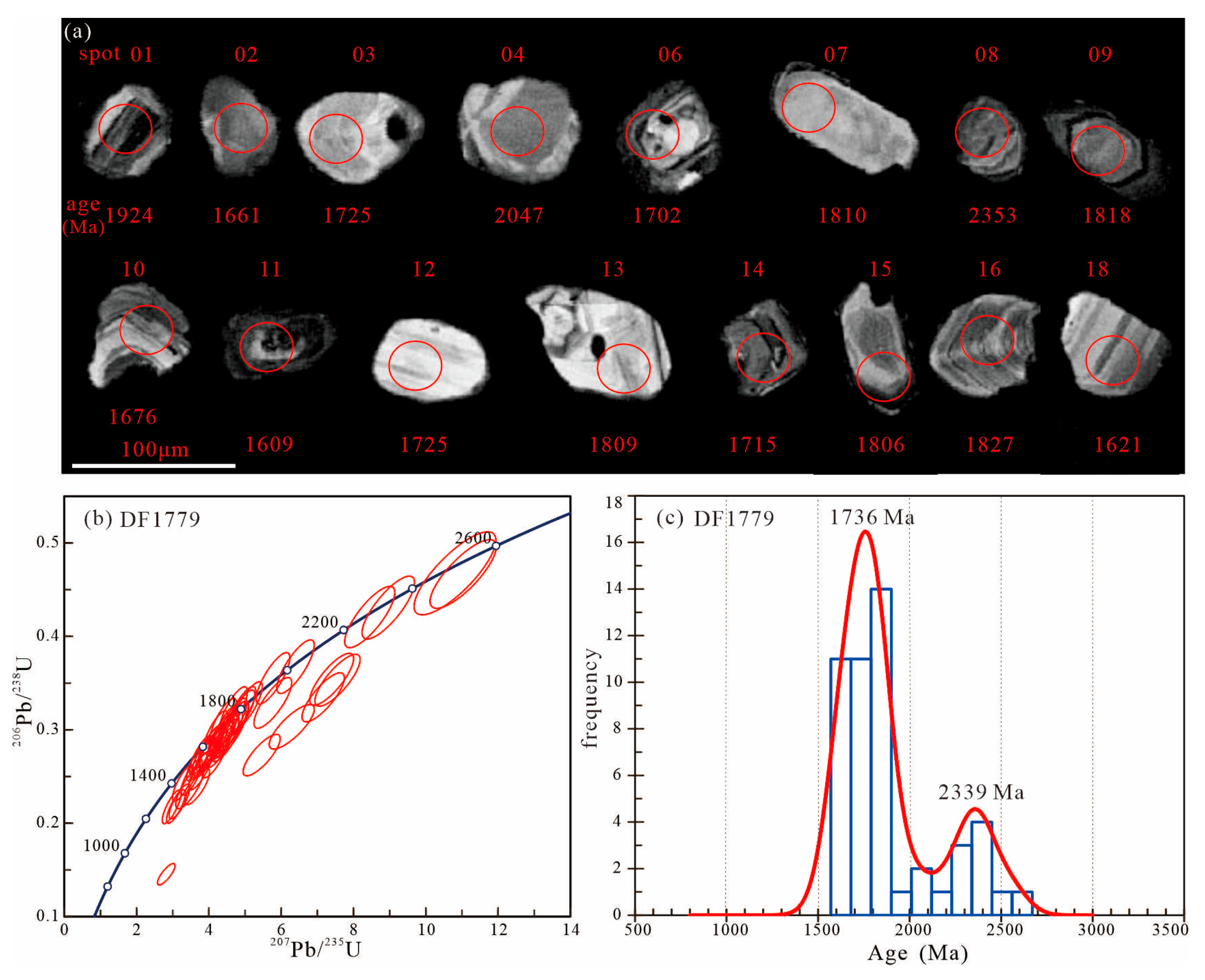
Figure 5.
Schematic geological map showing the distribution of Archean–Paleoproterozoic basements and rocks in the South China Block. Data source: Phan Si Pan Complex [48,49]; Douling Complex [50]; Huji Complex [41,51]; Huangtuling Complex [52,53]; Yuzidong Group [39,40,41]; Badu Complex [10,11,12,13]; Tianjingping Formation [54]; Kongling Complex [5,6,7,8,9]; Dahongshan Group [55,56]; Cuoke Complex [45,46]; Dongchuan Group [55]; Hekou Group [57]; Houhe Complex [58,59]; Zhongxiang Complex [42,43,44]; Dongling Complex [60].
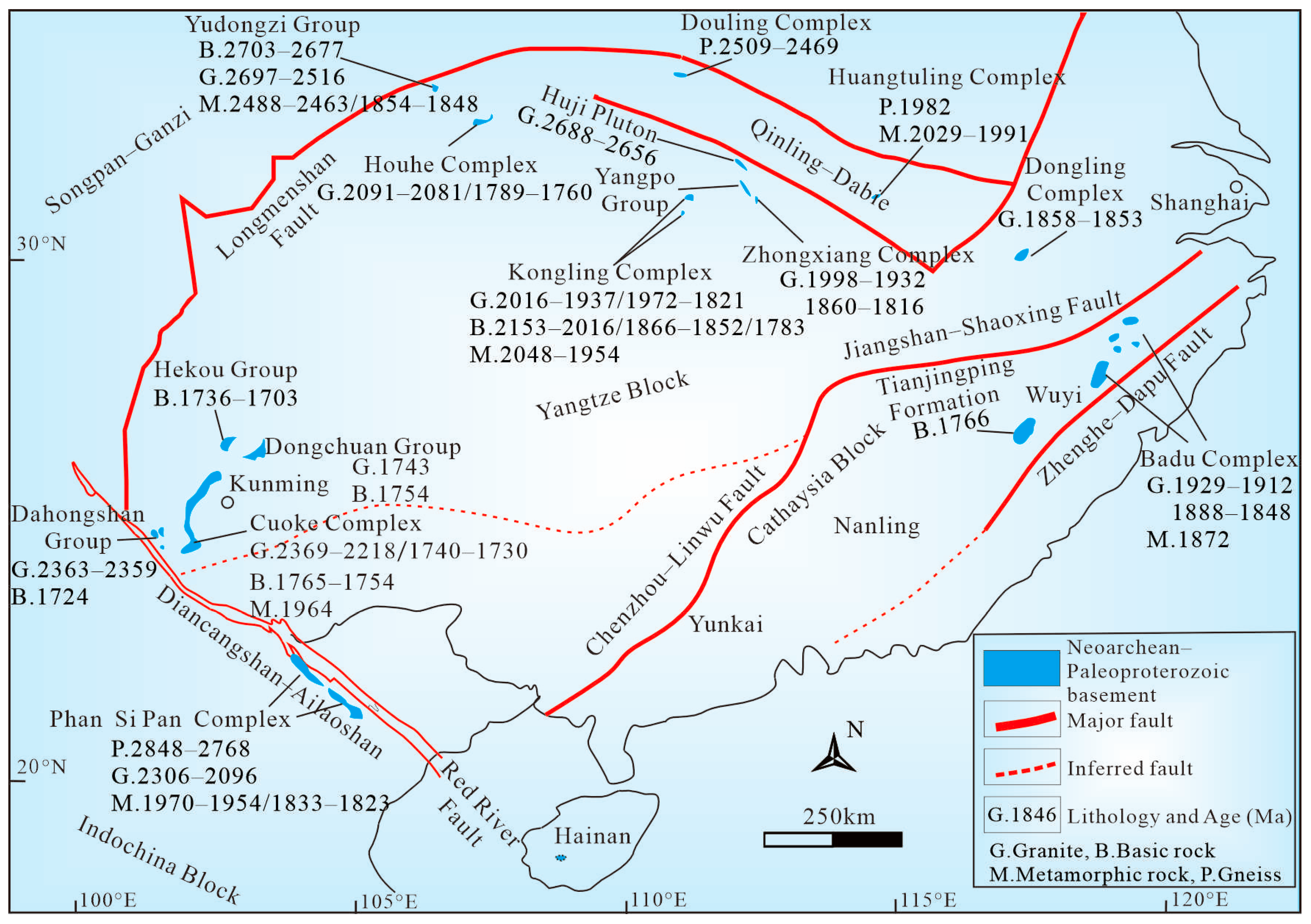

Table 1.
Stratigraphic subdivision of Baoban Group on Hainan Island and its formation age.
| Stratigraphic Assignment | Data Source | |||
|---|---|---|---|---|
| Cambrian | Guangdong Regional Geological Survey Team, 1964 4 [29] |
|||
| Tuolie Group | Baoban Group | |||
| Lower Devonian– Upper Ordovician |
Middle Ordovician– Cambrian |
Xia et al., 1979 [30] | ||
| Jiucunling Group | Baoban Group | |||
| Cambrian | Sinian | Guangdong Bureau of Geology and Mineral Resources, 1988 [14] |
||
| Tuolie Group | Baoban Group | |||
| Upper Subgroup |
Lower Subgroup |
|||
| Mesoproterozoic | Shan et al., 1990 [31] | |||
| Baoban Group | ||||
| Upper Subgroup | Lower Subgroup | |||
| Middle–Lower Silurian |
Mesoproterozoic | Zhang et al., 1991 [32] | ||
| Tuolie Group | Jixian System | |||
| Baoban Group | ||||
| Ordovician | Changcheng System |
Ma et al., 1997 [28] | ||
| Nanbigou Formation |
Baoban Group | |||
| Ewenling Formation |
Gezhencun Formation |
|||
Table 2.
Zircon U-Pb dating results of the metasedimentary rocks from Jiangbian, Hainan Island.
| Spot No. | Concentration (ppm) |
Th/U | Isotope ratio | Age (Ma) | |||||||||||
|---|---|---|---|---|---|---|---|---|---|---|---|---|---|---|---|
| 232Th | 238U | 207Pb/206Pb | 1σ | 207Pb/235U | 1σ | 206Pb/238U | 1σ | 207Pb/206Pb | 1σ | 207Pb/235Pb | 1σ | 206Pb/238U | 1σ | ||
| DF177901 | 1160 | 2592 | 0.45 | 0.1178 | 0.0062 | 5.7745 | 0.3076 | 0.3551 | 0.0182 | 1924 | 94 | 1943 | 46 | 1959 | 87 |
| DF177902 | 717 | 780 | 0.92 | 0.1020 | 0.0054 | 4.1798 | 0.2249 | 0.2972 | 0.0153 | 1661 | 104 | 1670 | 44 | 1677 | 76 |
| DF177903 | 209 | 418 | 0.50 | 0.1056 | 0.0057 | 4.6779 | 0.2546 | 0.3211 | 0.0165 | 1725 | 94 | 1763 | 46 | 1795 | 81 |
| DF177904 | 156 | 797 | 0.20 | 0.1263 | 0.0067 | 6.3974 | 0.3409 | 0.3676 | 0.0189 | 2047 | 94 | 2032 | 47 | 2018 | 89 |
| DF177905 | 774 | 1029 | 0.75 | 0.1042 | 0.0055 | 4.0749 | 0.2200 | 0.2835 | 0.0147 | 1702 | 98 | 1649 | 44 | 1609 | 74 |
| DF177906 | 259 | 481 | 0.54 | 0.1107 | 0.0059 | 4.8975 | 0.2639 | 0.3213 | 0.0165 | 1810 | 98 | 1802 | 45 | 1796 | 81 |
| DF177907 | 98 | 943 | 0.10 | 0.1506 | 0.0080 | 8.9628 | 0.4796 | 0.4309 | 0.0222 | 2353 | 91 | 2334 | 49 | 2310 | 100 |
| DF177908 | 191 | 2124 | 0.09 | 0.1112 | 0.0059 | 4.1582 | 0.2298 | 0.2702 | 0.0143 | 1818 | 102 | 1666 | 45 | 1542 | 72 |
| DF177909 | 481 | 1046 | 0.46 | 0.1028 | 0.0056 | 4.3917 | 0.2411 | 0.3094 | 0.0161 | 1676 | 100 | 1711 | 45 | 1738 | 79 |
| DF177910 | 482 | 1994 | 0.24 | 0.0991 | 0.0056 | 2.9716 | 0.1722 | 0.2175 | 0.0119 | 1609 | 105 | 1400 | 44 | 1269 | 63 |
| DF177911 | 114 | 236 | 0.48 | 0.1056 | 0.0060 | 4.1249 | 0.2421 | 0.2819 | 0.0148 | 1725 | 106 | 1659 | 48 | 1601 | 74 |
| DF177912 | 242 | 388 | 0.62 | 0.1106 | 0.0060 | 4.4608 | 0.2450 | 0.2923 | 0.0152 | 1809 | 100 | 1724 | 46 | 1653 | 76 |
| DF177913 | 606 | 1260 | 0.48 | 0.1050 | 0.0057 | 4.0692 | 0.2241 | 0.2791 | 0.0145 | 1715 | 100 | 1648 | 45 | 1587 | 73 |
| DF177914 | 217 | 649 | 0.33 | 0.1104 | 0.0059 | 4.8751 | 0.2613 | 0.3178 | 0.0162 | 1806 | 98 | 1798 | 45 | 1779 | 79 |
| DF177915 | 299 | 871 | 0.34 | 0.1117 | 0.0061 | 5.0605 | 0.2749 | 0.3261 | 0.0167 | 1827 | 99 | 1830 | 46 | 1819 | 81 |
| DF177916 | 704 | 576 | 1.22 | 0.1485 | 0.0095 | 6.2923 | 0.4119 | 0.3032 | 0.0157 | 2328 | 110 | 2017 | 57 | 1707 | 78 |
| DF177917 | 450 | 942 | 0.48 | 0.0998 | 0.0055 | 3.7770 | 0.2077 | 0.2725 | 0.0140 | 1621 | 103 | 1588 | 44 | 1554 | 71 |
| DF177918 | 321 | 1310 | 0.25 | 0.1023 | 0.0058 | 3.8475 | 0.2215 | 0.2704 | 0.0144 | 1678 | 105 | 1603 | 46 | 1543 | 73 |
| DF177919 | 746 | 4758 | 0.16 | 0.1389 | 0.0079 | 2.8204 | 0.1603 | 0.1454 | 0.0075 | 2214 | 93 | 1361 | 43 | 875 | 42 |
| DF177920 | 1498 | 1422 | 1.05 | 0.1024 | 0.0058 | 3.1856 | 0.1882 | 0.2233 | 0.0122 | 1678 | 104 | 1454 | 46 | 1299 | 65 |
| DF177921 | 402 | 1238 | 0.32 | 0.1024 | 0.0056 | 4.0278 | 0.2197 | 0.2820 | 0.0145 | 1678 | 100 | 1640 | 44 | 1601 | 73 |
| DF177922 | 258 | 997 | 0.26 | 0.1061 | 0.0058 | 4.4775 | 0.2434 | 0.3033 | 0.0156 | 1800 | 100 | 1727 | 45 | 1708 | 77 |
| DF177923 | 222 | 346 | 0.64 | 0.1103 | 0.0066 | 3.6801 | 0.2242 | 0.2393 | 0.0128 | 1806 | 109 | 1567 | 49 | 1383 | 66 |
| DF177924 | 459 | 556 | 0.83 | 0.0996 | 0.0055 | 3.6973 | 0.2056 | 0.2660 | 0.0137 | 1618 | 103 | 1571 | 44 | 1520 | 70 |
| DF177925 | 1098 | 1226 | 0.90 | 0.1433 | 0.0085 | 5.4602 | 0.3389 | 0.2730 | 0.0147 | 2333 | 102 | 1894 | 53 | 1556 | 74 |
| DF177926 | 286 | 2257 | 0.13 | 0.1022 | 0.0055 | 3.0892 | 0.1732 | 0.2179 | 0.0119 | 1665 | 100 | 1430 | 43 | 1271 | 63 |
| DF177927 | 270 | 302 | 0.89 | 0.1047 | 0.0059 | 4.0051 | 0.2259 | 0.2761 | 0.0142 | 1710 | (95) | 1635 | 46 | 1572 | 72 |
| DF177928 | 643 | 1679 | 0.38 | 0.1100 | 0.0059 | 4.5580 | 0.2469 | 0.2978 | 0.0153 | 1799 | 98 | 1742 | 45 | 1680 | 76 |
| DF177929 | 1150 | 1716 | 0.67 | 0.1657 | 0.0097 | 10.8068 | 0.7467 | 0.4675 | 0.0293 | 2517 | 99 | 2507 | 64 | 2473 | 129 |
| DF177930 | 345 | 563 | 0.61 | 0.1704 | 0.0094 | 11.0335 | 0.6054 | 0.4668 | 0.0243 | 2561 | 92 | 2526 | 51 | 2469 | 107 |
| DF177931 | 12 | 2231 | 0.01 | 0.1121 | 0.0060 | 4.6582 | 0.2487 | 0.2993 | 0.0153 | 1835 | 64 | 1760 | 45 | 1688 | 76 |
| DF177932 | 541 | 865 | 0.63 | 0.1016 | 0.0055 | 3.5229 | 0.1930 | 0.2496 | 0.0128 | 1654 | 100 | 1532 | 43 | 1436 | 66 |
| DF177933 | 506 | 1085 | 0.47 | 0.1062 | 0.0058 | 3.7648 | 0.2098 | 0.2567 | 0.0137 | 1800 | 100 | 1585 | 45 | 1473 | 70 |
| DF177934 | 3344 | 2570 | 1.30 | 0.1544 | 0.0083 | 7.1620 | 0.3860 | 0.3348 | 0.0173 | 2395 | 91 | 2132 | 48 | 1862 | 84 |
| DF177935 | 129 | 1339 | 0.10 | 0.1077 | 0.0058 | 4.3171 | 0.2329 | 0.2885 | 0.0148 | 1761 | 98 | 1697 | 44 | 1634 | 74 |
| DF177936 | 362 | 913 | 0.40 | 0.1113 | 0.0061 | 4.7032 | 0.2598 | 0.3061 | 0.0160 | 1821 | 100 | 1768 | 46 | 1721 | 79 |
| DF177937 | 781 | 1517 | 0.52 | 0.1546 | 0.0083 | 7.5579 | 0.4131 | 0.3531 | 0.0183 | 2398 | 92 | 2180 | 49 | 1949 | 87 |
| DF177938 | 636 | 1514 | 0.42 | 0.1097 | 0.0060 | 4.2816 | 0.2375 | 0.2821 | 0.0147 | 1795 | 100 | 1690 | 46 | 1602 | 74 |
| DF177939 | 482 | 539 | 0.89 | 0.1274 | 0.0077 | 5.7685 | 0.3446 | 0.3288 | 0.0179 | 2062 | 105 | 1942 | 52 | 1832 | 87 |
| DF177940 | 201 | 967 | 0.21 | 0.0976 | 0.0055 | 3.2831 | 0.1909 | 0.2428 | 0.0128 | 1589 | 74 | 1477 | 45 | 1401 | 66 |
| DF177941 | 1133 | 853 | 1.33 | 0.1052 | 0.0071 | 3.4700 | 0.2555 | 0.2382 | 0.0149 | 1718 | 125 | 1520 | 58 | 1377 | 78 |
| DF177942 | 580 | 568 | 1.02 | 0.1110 | 0.0060 | 4.7064 | 0.2586 | 0.3066 | 0.0159 | 1816 | 104 | 1768 | 46 | 1724 | 78 |
| DF177943 | 1211 | 2121 | 0.57 | 0.1049 | 0.0056 | 3.9092 | 0.2098 | 0.2700 | 0.0138 | 1722 | 99 | 1616 | 43 | 1541 | 70 |
| DF177944 | 273 | 546 | 0.50 | 0.1089 | 0.0059 | 4.6598 | 0.2563 | 0.3094 | 0.0160 | 1781 | 98 | 1760 | 46 | 1738 | 79 |
| DF177945 | 175 | 324 | 0.54 | 0.1081 | 0.0060 | 4.3976 | 0.2467 | 0.2946 | 0.0151 | 1769 | 102 | 1712 | 46 | 1665 | 75 |
| DF177946 | 99 | 2512 | 0.04 | 0.1509 | 0.0080 | 7.3963 | 0.4007 | 0.3541 | 0.0183 | 2367 | 90 | 2161 | 48 | 1954 | 87 |
| DF177947 | 243 | 649 | 0.37 | 0.1067 | 0.0058 | 4.3343 | 0.2356 | 0.2945 | 0.0151 | 1744 | 99 | 1700 | 45 | 1664 | 75 |
| DF177948 | 151 | 577 | 0.26 | 0.1455 | 0.0078 | 8.4499 | 0.4581 | 0.4207 | 0.0216 | 2294 | 93 | 2281 | 49 | 2264 | 98 |
| DF177949 | 267 | 540 | 0.49 | 0.1122 | 0.0063 | 4.4674 | 0.2540 | 0.2887 | 0.0149 | 1835 | 102 | 1725 | 47 | 1635 | 75 |
Disclaimer/Publisher’s Note: The statements, opinions and data contained in all publications are solely those of the individual author(s) and contributor(s) and not of MDPI and/or the editor(s). MDPI and/or the editor(s) disclaim responsibility for any injury to people or property resulting from any ideas, methods, instructions or products referred to in the content. |
© 2026 by the authors. Licensee MDPI, Basel, Switzerland. This article is an open access article distributed under the terms and conditions of the Creative Commons Attribution (CC BY) license (http://creativecommons.org/licenses/by/4.0/).
Copyright: This open access article is published under a Creative Commons CC BY 4.0 license, which permit the free download, distribution, and reuse, provided that the author and preprint are cited in any reuse.