
Submitted:
17 September 2026
Posted:
18 September 2026
You are already at the latest version
Abstract
Kazakhstan’s dairy sector has a substantial household production base, yet this production remains only partly connected to formal collection and processing systems. This study examines the structural and institutional conditions shaping Kazakhstan’s dairy supply system and identifies policy measures that could improve its coordination. Annual national data for 2007-2024 are analysed using descriptive indicators, producer-structure comparisons, and a review of official agricultural and livestock-policy documents. The analysis distinguishes between the volume of milk produced and the extent to which milk is collected, cooled, tested, and supplied to processors. The results show that household farms remained an important source of national milk throughout the study period, although their share of reported production gradually declined. In the analytical series, household farms still accounted for approximately 61% of total reported milk production in 2024. The sharp decline observed between 2021 and 2022 is interpreted cautiously because it may reflect statistical revisions, changes in reporting coverage, or producer reclassification, in addition to possible changes in physical production. The findings indicate that fragmented collection, limited cooling infrastructure, uneven quality control, restricted access to finance, and weak producer–processor coordination remain important barriers to formal market integration.The study proposes an evidence-informed policy framework based on dairy cooperatives, local collection and cooling points, quality-based support, productivity improvement, affordable equipment finance, regional dairy planning, and longer-term purchasing agreements. Sustainable sector development requires not only higher milk output but also a more reliable system for connecting producers with domestic processors.
Keywords:
Kazakhstan
; dairy supply system
; household farms
; milk processing
; cooperatives
; value-chain integration
; agricultural policy
1. Introduction
Milk production occupies an important position in Kazakhstan’s agricultural economy. It contributes to the domestic food supply and provides an important source of income for rural households. Official agricultural statistics distinguish between agricultural enterprises, peasant and farm households, and households of the population, reflecting the mixed structure of Kazakhstan’s agricultural production [1]. Kazakhstan’s dairy supply is characterized by the coexistence of commercial agricultural enterprises, peasant and farm households, and personal subsidiary farms. Household producers account for a substantial part of national milk production, but their output is dispersed across many small production units. In contrast, processors require regular deliveries of milk with predictable quality, sufficient volumes, cooling, testing, and traceability [2]. This difference creates difficulties in the collection and transportation of raw milk and limits the integration of household producers into formal dairy value chains.
The problem is therefore not limited to the volume of milk produced. It also concerns the way in which milk moves from producers to processors. Household farms often have limited access to milking equipment, cooling facilities, veterinary services, feed, affordable finance, and reliable sales channels. Milk may be sold through informal or short-term arrangements, while processors face difficulties in obtaining a stable supply that meets technical and sanitary requirements. As a result, an increase in aggregate production does not necessarily lead to a proportional increase in the supply of domestically processed dairy products.
Previous studies have shown that the performance of dairy farming depends on productivity, herd structure, production costs, access to finance, technology, and market conditions [3,4,5]. Other studies have emphasized the importance of cooperatives, advisory services, shared infrastructure, and stable relations between producers and processors in reducing transaction costs and improving smallholder participation in formal markets [6,9,10,11]. These findings are particularly relevant to Kazakhstan, where household production continues to play a major role but remains only partly connected to organized collection and processing systems.
The national dairy sector is also affected by changes in statistical reporting. The official series shows a considerable decline in reported milk production between 2021 and 2022. Such a change requires careful interpretation because it may reflect not only developments in physical production but also revisions to historical data, changes in statistical coverage, reclassification of producers, or adjustments in reporting procedures. For this reason, the present study distinguishes between an observed change in the published statistical series and a confirmed change in the underlying production process.
This article is related to the authors’ previous publication in Economies, which examined statistical associations between national milk output, household milk production, average milk yield, and gross livestock output using annual national data for 2007–2024 [7]. The two studies have different objectives and analytical emphases. The Economies article focused on an exploratory econometric assessment of aggregate statistical relationships. The present article does not reproduce that regression analysis or present its coefficients as new findings. Instead, it examines the organization of Kazakhstan’s dairy supply system, the role of household producers in formal milk collection and processing, the interpretation of changes in the official production series, and the policy conditions required for stronger value-chain integration.
The research gap addressed in this article is the limited integration of three perspectives within one analysis. The first concerns the structure and dynamics of national milk production. The second concerns the institutional and infrastructural conditions that determine whether household milk can enter formal processing channels. The third concerns the relationship between existing public-support measures and the practical requirements of a more coordinated dairy supply system. Treating these issues separately may lead to policies that increase production capacity without resolving collection, quality, cooling, and contractual problems.
The aim of this study is to examine the structural and institutional conditions shaping Kazakhstan’s dairy supply system and to identify policy pathways for improving the integration of household milk producers into formal collection and processing channels.
To achieve this aim, the study addresses three research questions:
RQ1. How did Kazakhstan’s milk-production structure and its main production, productivity, trade, and price indicators change during 2007-2024?
RQ2. What structural factors limit the integration of household milk producers into formal collection and processing systems?
RQ3. Which policy measures could improve milk quality, collection reliability, production efficiency, and coordination between household producers, cooperatives, and dairy processors?
The study makes three contributions. First, it analyses dairy production as a supply system rather than as a single aggregate output indicator. This approach allows the role of household producers to be considered together with collection, cooling, quality control, processing, and marketing arrangements. Second, it treats the 2021–2022 change in reported milk production cautiously and recognizes the possibility that statistical revision affected the observed series. Third, it develops a differentiated policy framework for household farms, commercial producers, cooperatives, processors, and public institutions.
The analysis is exploratory and does not estimate causal effects or evaluate the impact of individual government programmes. The conclusions are limited by the use of aggregate national data, the short annual time series, the absence of farm-level information, and possible changes in the statistical treatment of agricultural production. Nevertheless, the evidence provides a basis for identifying the main coordination problems in Kazakhstan’s dairy supply system and for formulating policy measures that can be tested through regional and farm-level initiatives.
The remainder of the article is organized as follows. Section 2 reviews the literature on dairy production, household farms, cooperation, and value-chain integration. Section 3 describes the data and analytical approach. Section 4 presents the structural findings concerning milk production, producer categories, the 2021-2022 statistical change, and formal processing. Section 5 discusses the policy implications and proposes differentiated support measures. Section 6 concludes the article and outlines directions for further research.
2. Literature Review
The development of the dairy sector depends on the interaction of production capacity, farm productivity, market conditions, and institutional arrangements. Earlier studies have shown that milk production is influenced by herd structure, feeding practices, animal health, production costs, labour availability, technology, and access to finance [3,4,5]. These factors are particularly important for small and medium-sized farms, which often operate with limited capital and have fewer opportunities to invest in modern equipment.
Productivity is one of the central issues in dairy development. Higher milk yield per cow can increase output without requiring a proportional expansion of the herd. However, productivity depends on several complementary conditions, including animal genetics, feed quality, veterinary care, housing, milking technology, and farm management. Therefore, policies focused only on increasing the number of animals may produce limited results if they are not accompanied by measures that improve the efficiency and quality of production.
The organization of dairy production is also affected by the structure of producers. In many countries, the dairy sector combines large commercial farms with numerous household or smallholder producers. Household farms may provide an important share of the raw-milk supply, but their participation in formal markets is often restricted by small production volumes, geographical dispersion, seasonal fluctuations, and limited access to quality-control and cooling facilities. These features increase the cost of collecting milk and make it more difficult for processors to maintain a regular and standardized supply.
Cooperatives and producer groups can help address some of these problems. Cooperation allows small producers to share collection points, cooling equipment, veterinary services, transportation, information, and marketing channels. It can also strengthen the bargaining position of farmers when negotiating with processors and reduce the transaction costs associated with individual sales. Research on rural households in Kazakhstan has shown that attitudes toward cooperation are influenced by trust, expected economic benefits, access to information, and the perceived effectiveness of cooperative organizations [6]. Consequently, the establishment of a cooperative does not automatically guarantee successful integration into the market. Its performance depends on governance, transparency, service quality, and reliable relations with buyers.
The relationship between producers and processors is another important element of dairy-sector development. Processing enterprises require predictable volumes of milk that meet sanitary, technological, and quality standards. Producers, in turn, need stable purchasing arrangements, transparent quality requirements, timely payment, and access to services that allow them to meet these requirements. Longer-term contracts, quality-based payment systems, shared collection infrastructure, and technical assistance may help to connect fragmented producers with formal processing channels. Without such mechanisms, increases in production may remain concentrated in informal markets or be used mainly for household consumption.
The literature also emphasizes the importance of public policy. Government support can influence investment, access to credit, breeding, feed production, infrastructure, veterinary services, and the development of processing capacity [9,10,11,12,13]. However, the effectiveness of support depends on how well policy instruments correspond to the actual constraints faced by different producer groups. Large agricultural enterprises, commercial dairy farms, cooperatives, and household producers do not have the same financial resources, technological capabilities, or access to markets. A uniform support mechanism may therefore benefit some groups while having limited practical value for others.
In Kazakhstan, public programmes have generally emphasized the expansion of livestock production, the development of large agricultural projects, investment in processing, and the promotion of cooperation. These directions are relevant, but they do not fully resolve the problem of connecting dispersed household production with formal dairy processing. The availability of processing capacity is not sufficient when processors face difficulties obtaining milk of stable quality and when household producers lack cooling, testing, transportation, and guaranteed sales arrangements.
Recent studies of the Kazakh dairy sector have examined production trends, producer structure, cooperation, productivity, and public support. The authors’ previous article in Economies analysed statistical associations among national milk output, household milk production, average milk yield, and gross livestock output using annual national data for 2007-2024 [7]. That study had an econometric focus. The present article does not repeat its regression analysis. Instead, it uses the broader literature to interpret the institutional and organizational conditions that determine whether household milk can be incorporated into formal supply chains.
A further issue concerns the interpretation of national agricultural statistics. Aggregate indicators are useful for identifying long-term patterns, but they cannot fully explain the behaviour of individual farms, the quality of milk, the destination of production, or the reasons why producers do or do not participate in formal markets. Statistical revisions, changes in reporting coverage, and differences in the classification of producers may also affect the comparability of annual observations. These limitations are especially important when a sharp change appears in a short national time series.
Overall, the literature suggests that a sustainable dairy supply system requires a combination of productivity improvement, producer coordination, quality control, infrastructure, finance, and reliable market relationships. Nevertheless, there is limited research that examines these elements together in the context of Kazakhstan’s household-based dairy supply structure. This article addresses that gap by combining national production evidence with an analysis of collection, processing, institutional coordination, and policy design.
3. Methods
3.1. Research Design
This study uses a mixed analytical design combining descriptive analysis of national dairy-sector indicators with a structured review of public-policy documents. The quantitative component describes changes in Kazakhstan’s dairy production structure during 2007–2024. The qualitative component examines whether existing policy instruments address the practical requirements of milk collection, quality control, producer coordination, and formal processing.
The unit of quantitative analysis is the country-year. The study does not use farm-level or household-level observations and does not claim to estimate the behaviour of individual producers. The statistical analysis is therefore intended to identify broad structural patterns rather than to establish causal effects.
The research design consists of four stages. First, official statistical data are compiled and checked for consistency. Second, the dynamics of milk production, producer structure, productivity, livestock numbers, trade, and prices are described. Third, the reported change between 2021 and 2022 is examined in relation to possible revisions in the statistical series. Fourth, the empirical findings are compared with the objectives and instruments of Kazakhstan’s agricultural and livestock-support policies.
This design differs from the authors’ previous article in Economies [7]. That publication focused on exploratory econometric associations among aggregate production indicators. The present study does not reproduce that regression analysis. Its focus is the organization of the dairy supply system and the conditions required for integrating household producers into formal collection and processing channels.
3.2. Data Sources and Variables
The quantitative analysis uses annual data for 2007-2024 obtained from the Bureau of National Statistics of the Agency for Strategic Planning and Reforms of the Republic of Kazakhstan. Additional information on agricultural policy, livestock development, cooperation, financing, infrastructure, and dairy processing was obtained from official policy documents and the Adilet legal information system.
The indicators included in the descriptive analysis are presented in Table 1.
Note: Household milk production is an absolute production volume and should not be confused with the household share . The household share is calculated separately as:.
where is household milk production and is total reported milk production in year .
All variables are based on official national statistics. The same units, statistical definitions, and data version must be used consistently in the tables, figures, and calculations throughout the manuscript.
3.3. Data Harmonization and Treatment of the 2021-2022 Change
Before analysis, the annual observations were compared across available official statistical publications. The purpose of this procedure was to identify differences caused by revised historical values, changes in reporting coverage, reclassification of producer categories, or changes in statistical methodology.
Only one internally consistent data version is used in the final tables and figures. Earlier and revised values are not combined within the same statistical series. If a later official publication revises an earlier observation, the revised value is used where it is available for the complete period. The selected data version is identified in the notes to the relevant table.
Particular attention is given to the change in reported milk production between 2021 and 2022. In the analytical series used in the manuscript, total reported milk production decreased from 6247.2 thousand metric tons in 2021 to 3350.2 thousand metric tons in 2022 [14]. The percentage change is calculated as follows:
This change is reported as an observed movement in the published statistical series. It is not automatically interpreted as a physical collapse of dairy production. Possible statistical revision, changes in coverage, or producer reclassification are considered before assigning an economic interpretation.
The analysis does not attribute the decline to feed prices, supply-chain disruption, animal health, or government policy unless such explanations are supported by independent documentary or statistical evidence.
3.4. Descriptive Analysis
The descriptive analysis includes the following indicators:
- -
- annual levels of total and household milk production;
- -
- the household share of total reported milk production;
- -
- changes in the number of cattle and dairy cows;
- -
- average milk yield per cow;
- -
- changes in dairy imports and exports;
- -
- changes in milk prices;
- -
- minimum, maximum, mean, and standard deviation values;
- -
- year-on-year growth rates.
For each indicator, the percentage change between two consecutive years is calculated as:
where is the value of the indicator in year , and is its value in the preceding year.
The analysis distinguishes between three related but different dimensions of the dairy sector:
- production scale, represented by livestock numbers and total milk output;
- production efficiency, represented primarily by average milk yield per cow;
- producer and market organization, represented by household participation, trade, prices, collection, and processing conditions.
This distinction prevents a high production volume from being interpreted automatically as evidence of efficient production or successful integration into the formal value chain.
3.5. Avoiding Mechanical Statistical Relationships
Household milk production is a component of total reported milk production. Consequently, a direct regression of on would partly reproduce an accounting relationship between an aggregate indicator and one of its components.
For this reason, the revised manuscript does not estimate a model in which total milk production is regressed on household milk production. Correlation results involving these two variables are used only to describe the structure of national milk supply and are not interpreted as evidence of an independent causal effect.
The analysis also avoids using the coefficient of determination, fitted values, or in-sample deviations as evidence of predictive accuracy. The available annual series contains only 18 observations and includes several indicators with common trends. Therefore, the statistical results are treated as descriptive evidence and not as a causal production function or a validated forecasting model.
Where appropriate, the household share of total milk production is used instead of household output alone:
This indicator allows the changing position of household producers to be examined without presenting household milk output as an independent explanation of total output.
3.6. Review of Policy Documents
The policy component is based on a structured review of official national documents relevant to the development of livestock production, dairy processing, agricultural cooperation, financing, infrastructure, veterinary services, and producer support.
The document set includes:
- -
- the State Programme for the Development of the Agro-Industrial Complex for 2017–2021;
- -
- the National Project for the Development of the Agro-Industrial Complex for 2021–2025;
- -
- the Concept for the Development of the Agro-Industrial Complex for 2021–2030;
- -
- the Comprehensive Plan for the Development of Animal Husbandry for 2026–2030.
Documents were included when they contained measures directly related to at least one of the following areas: livestock productivity, milk production, dairy processing, agricultural cooperation, financing, veterinary services, infrastructure, quality control, or market access.
For each document, the following information was recorded:
- the stated policy objective;
- the target producer category;
- the proposed support instrument;
- the implementation mechanism;
- the expected relevance to milk collection and processing;
- the principal limitation or implementation risk.
The document review is interpretive rather than evaluative. It identifies the stated priorities of public policy and compares them with the structural problems revealed by the statistical and supply-system analysis. It does not estimate the effectiveness or causal impact of individual government programmes.
3.7. Integration of Quantitative and Policy Evidence
The final stage links the statistical findings with the policy review. For example, a high household share in milk production is considered together with the availability of collection points, cooling facilities, quality-control mechanisms, cooperative services, and guaranteed sales arrangements.
Policy recommendations are included only when they are supported by at least one of the following:
- -
- an observed structural pattern in the national data;
- -
- a documented constraint in the dairy supply system;
- -
- a stated objective or instrument in an official policy document;
- -
- findings reported in the relevant academic literature.
The recommendations are therefore presented as policy options for piloting and evaluation rather than as interventions whose effectiveness has already been demonstrated by the present dataset.
3.8. Methodological Limitations
The methodology has several limitations. First, the quantitative analysis is based on only 18 annual observations. Second, aggregate national statistics do not capture differences between regions, farms, or household producers. Third, the available data do not provide direct information on milk quality, cooling conditions, contractual arrangements, collection distances, or processor rejection rates. Fourth, revisions to historical statistical series may affect the comparability of individual years. Finally, the overlap between household and total milk production prevents the interpretation of their direct statistical relationship as a causal effect.
These limitations define the scope of the study. The findings are most suitable for identifying structural patterns and policy priorities. Farm-level surveys, regional panel data, and pilot evaluations will be required to estimate the effects and cost-effectiveness of specific measures.
4. Results
4.1. Changes in Milk Production and Producer Structure
Table 2 presents the dynamics of total and household milk production in Kazakhstan during 2007–2024. Household production is shown both as an absolute volume and as a share of total reported milk output.
The data indicate a general increase in reported total milk production between 2007 and 2021. During this period, total output increased from 5073.2 thousand tons to 6247.2 thousand tons. Household milk production also remained high in absolute terms. However, its share in total reported production gradually declined from 90.4% in 2007 to 70.4% in 2021. This change suggests a gradual diversification of the producer structure. Household farms continued to supply a significant part of the national milk volume, while the relative role of other producer categories increased. The decline in the household share should not therefore be interpreted as the disappearance of household production. In 2024, household farms still accounted for approximately 61.1% of the total reported volume in the analytical series. A sharp change appears between 2021 and 2022. Total reported milk production decreased from 6247.2 thousand tons to 3350.2 thousand tons, which represents a decline of approximately 46.4%. Household production decreased from 4399.0 thousand tons to 2118.8 thousand tons during the same period. The size of this change requires careful interpretation. The available data do not allow the decline to be attributed to a single economic factor. It may partly reflect revisions in official statistics, changes in statistical coverage, reclassification of producers, or adjustments in reporting procedures. Therefore, the 2021–2022 movement is treated as a possible break in the statistical series rather than as confirmed evidence of a sudden collapse in physical dairy production [14,15].
The values for 2022-2024 show a partial recovery in the reported series. Total milk production increased from 3350.2 thousand tons in 2022 to 3577.3 thousand tons in 2024, while household production increased from 2118.8 thousand tons to 2184.5 thousand tons. Nevertheless, the 2024 values remained below the level reported for 2021.
4.2. Organization of the Dairy Supply System and Policy Implications
The results show that household farms remain a central part of Kazakhstan’s dairy supply. Their importance, however, cannot be assessed only by the volume of milk produced. Household milk may be used for household consumption, sold through informal channels, supplied to local markets, or delivered to processing enterprises. These channels differ in terms of quality control, cooling, transportation, traceability, and contractual security.
This distinction is important because a high household share does not automatically indicate strong integration into formal processing. Household producers are often geographically dispersed and may have limited access to cooling equipment, veterinary services, testing facilities, finance, and stable purchasing arrangements. For processors, this can result in irregular deliveries, variable quality, and higher collection costs.
The analysis therefore points to a difference between the production role of households and their position in the formal value chain. Household farms may provide a substantial share of raw milk while remaining only partly connected to organized collection and processing systems. This helps explain why growth in aggregate milk production does not necessarily lead to a proportional expansion of domestic dairy processing [16].
The review of policy documents shows that public support is directed toward livestock development, breeding, investment, processing capacity, agricultural cooperation, financing, and rural infrastructure. These measures address important aspects of sector development, but their practical effect depends on whether they also resolve the organizational problems faced by small producers.

Table 3.
Main supply-system problems and corresponding policy priorities.
| Problem identified | Relevant policy priority | Practical requirement |
| Fragmented household production | Agricultural cooperation | Joint collection, transportation, and service provision |
| Limited cooling infrastructure | Rural and dairy infrastructure | Local milk collection and cooling points |
| Uneven milk quality | Veterinary and quality-control services | Regular testing, technical advice, and quality-based payments |
| Productivity differences | Breeding, feed, and veterinary support | Productivity improvement rather than simple herd expansion |
| Unstable sales channels | Producer–processor coordination | Longer-term purchasing agreements |
| Limited access to equipment finance | Agricultural credit and modernization | Affordable financing for milking and cooling equipment |
The comparison shows that different producer groups require different types of support. Large agricultural enterprises may primarily need investment and technological support, whereas household farms require access to shared services, cooling facilities, veterinary assistance, and reliable markets. The findings do not demonstrate that any individual government program has caused an increase in milk production or improved processing performance. They indicate instead that existing policy instruments should be better connected with the practical requirements of the supply chain.
The main policy implication is that production growth should be accompanied by improvements in collection, cooling, quality control, cooperation, and contractual coordination. Without these measures, additional milk production may continue to be divided between household consumption, informal sales, and formal processing without creating a stable domestic raw-milk base.
Table 4.
Summary of the main findings.
| Finding | Interpretation |
| Household farms supplied a substantial share of national milk | Households remain structurally important to the dairy sector |
| Household share declined over time | The producer structure gradually became more diversified |
| A sharp decline was recorded in 2022 | The change may partly reflect a statistical revision or break in the series |
| Household production is not equivalent to formal integration | Collection, cooling, quality, and contracts remain essential |
| Existing policies support production and processing | Greater attention is needed for coordination and small-producer services |
| Aggregate data do not establish causal effects | Farm-level and regional research is required for policy evaluation |
5. Discussion
The findings show that Kazakhstan’s dairy-sector challenge is not limited to the amount of milk produced. It is also connected with the organization of the supply system through which milk is collected, tested, cooled, transported, and delivered to processors. Household farms remain an important source of milk, but their contribution to national production does not necessarily mean that they are fully integrated into formal dairy value chains. The gradual decline in the household share of total reported milk production suggests that the producer structure has become more diversified over time. This may be related to the development of agricultural enterprises, changes in production organization, or revisions in statistical reporting. Nevertheless, household farms continue to provide a substantial part of the reported milk supply. Their role is especially important in rural areas, where dairy production is linked to household income, local employment, and food availability [17,18].
The sharp change between 2021 and 2022 requires a cautious interpretation. The available data show a substantial decrease in reported total milk production and household milk production. However, the aggregate series does not make it possible to determine whether the change resulted from an actual decline in physical production, a revision of historical statistics, a change in producer classification, or a modification of reporting coverage. Feed prices, animal health, supply disruptions, and market conditions may also have influenced production, but their individual effects cannot be established using the available data. Accordingly, the 2021-2022 movement should be treated as a possible statistical break rather than as conclusive evidence of a sudden collapse in the dairy sector.
This issue is important for policy analysis. If revised and unrevised observations are combined, the resulting trend may exaggerate or understate the actual changes in production. It is therefore necessary to use one consistent statistical series and to indicate clearly when historical values have been revised. Future assessments of the dairy sector would benefit from a harmonized database in which changes in definitions, coverage, and reporting methods are recorded alongside the annual values.
The results also demonstrate the importance of distinguishing between production and market integration. Household milk may be used for household consumption, sold through informal channels, supplied to local markets, or delivered to processors. These channels differ in terms of quality requirements, cooling, traceability, transportation, payment arrangements, and contractual security. A high household share in national production therefore cannot be interpreted automatically as evidence of a stable supply of raw milk for the processing industry [19,20,21].
This distinction helps explain the continuing mismatch between the raw-milk base and formal processing requirements. Processors need regular deliveries of milk with predictable quality and sufficient volume. Individual household producers may not be able to purchase cooling equipment, arrange transportation, carry out quality testing, or negotiate favourable contracts independently. As a result, the sector may simultaneously have a large volume of household production and an insufficient supply of standardized milk for industrial processing.
The policy implications of this finding are summarized in Figure 1. Existing public support is mainly associated with livestock development, investment, breeding, credit, and the expansion of processing capacity. These areas remain important, but they do not fully resolve the practical problems associated with collection, cooling, quality control, and coordination between producers and processors.
Figure 1 shows that the proposed approach is not intended to replace existing livestock and processing policies. Rather, it extends them by placing greater emphasis on the links between producers and processors. Investment in processing facilities is unlikely to produce its full effect if processors do not have regular access to suitable domestic raw milk. Similarly, increasing the number of animals may have limited results if producers lack feed, veterinary services, modern equipment, and reliable marketing channels.
Cooperatives may help to address these problems by organizing milk collection, cooling, transportation, veterinary assistance, feed procurement, and negotiations with processors. However, cooperation should not be treated as an automatic solution. A cooperative can contribute to supply-chain integration only when it provides practical services, operates transparently, and maintains clear financial and organizational relations with its members and buyers. Formal registration alone does not guarantee effective cooperation.
Figure 2 presents the five policy directions developed from the statistical patterns, the literature, and the review of official policy documents.
The first direction is differentiated public support. Household farms, commercial dairy enterprises, cooperatives, and processors face different constraints and should not be treated as a single category. Household farms may require access to small-scale equipment, veterinary services, cooling, and training, whereas larger enterprises may need investment finance, breeding support, and advanced production technologies.
The second direction is the development of more reliable sales mechanisms. Longer-term agreements between processors, cooperatives, and producer groups could reduce uncertainty for farmers and improve the continuity of raw-milk deliveries. Such agreements should define quality requirements, purchasing conditions, payment procedures, and responsibilities for transportation and testing.
The third direction is the creation of regional dairy maps. These maps could bring together information on the location of livestock, household farms, collection points, feed resources, transport routes, processing facilities, and infrastructure gaps. Their purpose would be to improve the geographical coordination of public support and reduce the risk that investment is directed to areas without sufficient raw-milk potential or collection capacity.
The fourth direction concerns production efficiency. The results support greater attention to milk yield per cow, animal health, feed quality, breeding, and farm management. However, productivity improvement should not be understood as a simple recommendation to increase output. It should be linked to the ability of producers to meet quality requirements and supply processors on a regular basis.
The fifth direction is the gradual modernization of household farms. This approach is preferable to a policy that assumes that small producers can be rapidly replaced by large enterprises. Gradual modernization may include training, financial advice, improved milking practices, access to cooling equipment, veterinary support, and participation in cooperative services. Such measures could improve productivity and quality while preserving the economic role of household farms in rural communities.
Table 5 links the main problems identified in the study with possible policy responses and indicators for future monitoring.
The measures presented in Table 5 are directly related to the main constraints identified in the dairy supply system. The proposed priorities do not focus only on increasing milk production. They also address the conditions under which milk can be collected, cooled, tested, transported, and delivered to processors. This is particularly important for household farms, which produce a substantial share of national milk but often have limited access to equipment, finance, technical services, and stable purchasing arrangements.
The proposed measures should be implemented in a coordinated manner. Cooperative collection points, cooling facilities, quality-based payments, productivity support, and longer-term contracts can reinforce one another. For example, improved milk quality will have limited economic value if producers do not have access to cooling or a reliable buyer. Similarly, investment in processing capacity may not produce the expected results if the supply of domestic raw milk remains irregular [22,23,24,25].
The indicators included in Table 5 are intended to support future monitoring of policy implementation. They cover not only production volumes but also milk collection, quality, productivity, equipment modernization, delivery continuity, and processor capacity utilization. This broader set of indicators would make it possible to assess whether public support is improving the functioning of the supply system rather than merely increasing the number of livestock or processing facilities [26,27].
Overall, the discussion shows that Kazakhstan’s dairy policy should gradually move from a predominantly production-oriented approach toward a more integrated supply-system model. Household farms, commercial producers, cooperatives, processors, and public institutions have different functions and constraints; therefore, they require complementary forms of support. The proposed framework should be regarded as a basis for regional pilot projects and further evaluation, rather than as a set of measures whose effectiveness has already been proven by the available aggregate data.
6. Conclusions
This study examined Kazakhstan’s dairy supply system by considering production dynamics, producer structure, market integration, and public-policy priorities. In relation to the first research question, the data for 2007-2024 show that household farms remained an important source of national milk production, although their relative share gradually declined over time. The reported change between 2021 and 2022 requires particular caution because it may partly reflect revisions in statistical reporting, changes in coverage, or reclassification of producers. Therefore, the observed decline should not be interpreted automatically as a physical collapse of dairy production.
Regarding the second research question, the main constraint is not only the volume of milk produced but also the weak connection between dispersed household production and formal processing. Household farms often face limited access to cooling facilities, veterinary services, quality testing, equipment finance, transportation, and stable purchasing arrangements. These conditions reduce the regularity and marketability of milk deliveries and create difficulties for processors that require predictable volumes and standardized quality.
In response to the third research question, the study proposes a coordinated policy framework based on dairy cooperatives, local collection and cooling points, quality-based payment, productivity improvement, affordable modernization finance, regional dairy planning, and longer-term producer–processor agreements. The proposed measures are complementary. Their effectiveness will depend on whether they are implemented as part of an integrated supply-chain policy rather than as isolated support programs.
The study also clarifies the relationship between this manuscript and the authors’ previous article in Economies. The earlier publication examined exploratory statistical associations among aggregate dairy-sector indicators. The present article has a different focus and does not present the previous regression results as new findings. Because household milk production forms part of total reported milk output, its statistical relationship with total production cannot be interpreted as an independent causal effect.
Several limitations should be acknowledged. The analysis is based on only 18 annual national observations and does not capture differences between regions, farms, and household producers. The available statistics also do not provide direct information on milk quality, collection distances, cooling conditions, contract terms, or processor rejection rates. These limitations restrict causal interpretation and prevent the evaluation of individual government programs.
Future research should combine regional panel data with farm-level surveys and pilot evaluations. Particular attention should be given to the effects of cooperative collection, cooling infrastructure, quality-based payments, productivity programmes, and producer–processor contracts. Such research would make it possible to assess not only changes in production volume but also improvements in producer income, milk quality, delivery continuity, and processor capacity utilization.
Overall, strengthening Kazakhstan’s dairy sector requires more than increasing livestock numbers or processing capacity. Sustainable development will depend on the ability to connect household and commercial producers with reliable collection, quality-control, financing, and marketing systems. The evidence presented in this study supports a gradual transition toward a more coordinated and inclusive dairy supply system.
Author Contributions
Conceptualization, A.Y. and D.K.; methodology, A.Y., G.A.; software, N.P., G.B.; formal analysis, A.Y., D.K.; investigation, A.Y., G.A.; resources, G.B., N.P.; writing-original draft preparation, A.Y., D.K. and N.P.; writing-review and editing, A.Y., D.K., and G.A.; supervision, A.Y.; funding acquisition, A.Y. All authors have read and agreed to the published version of the manuscript.
Funding
This research was funded by the Science Committee of the Ministry of Science and Higher Education of the Republic of Kazakhstan, AP22687247.
Institutional Review Board Statement
Not applicable.
Informed Consent Statement
Not applicable.
Data Availability Statement
The original contributions presented in this study are included in the article.
Conflicts of Interest
The authors declare no conflicts of interest. .
References
- Bureau of National Statistics of the Agency for Strategic Planning and Reforms of the Republic of Kazakhstan. Agriculture, Forestry and Fisheries in the Republic of Kazakhstan: Statistical Yearbook. Available online: https://stat.gov.kz/en/publication/collections/ (accessed on 8 September 2026).
- Dugdill, B.; Morgan, N. Theme 1: Past experience and learning from successful and unsuccessful smallholder dairying initiatives. Food and griculture Organization of the United Nations. Available online: https://www.fao.org/4/i0281e/I0281E03.htm (accessed on 7 September 2026).
- Hyland, J.J.; Heanue, K.; McKillop, J.; Micha, E. Factors influencing dairy farmers’ adoption of best management grazing practices. Land Use Pol. 2018, 78, 562–571. [Google Scholar] [CrossRef]
- Carvajal-Pérez, L.A.; Montenegro-Arellano, G.F.; Revelo-Ruales, V.W. Socioeconomic determinants of small and medium-sized dairy farms in the Ecuador-Colombia border area. Trop. Anim. Health prod. 2024, 56, 254. [Google Scholar] [CrossRef]
- Kovesdi, G.; Lakner, Z.; Mezoszentgyorgyi, D. The economics of dairy production. Acta Carl. Rober. 2025, 15(1), 158–170. [Google Scholar] [CrossRef]
- Kaliyeva, S.; Jose Areal, F.; Gadanakis, Y. Attitudes of Kazakh Rural Households towards Joining and Creating Cooperatives. Agriculture 2020, 10, 568. [Google Scholar] [CrossRef]
- Yesbolova, A. National milk output and producer structure in Kazakhstan: An exploratory econometric assessment and evidence-informed policy discussion. Economies 2026, 14, 333. [Google Scholar] [CrossRef]
- Comprehensive plan for the development of animal husbandry in the Republic of Kazakhstan for 2026-2030. Decree of the Government of the Republic of Kazakhstan, 2026, No. 51. Available online: https://adilet.zan.kz/rus/docs/P2600000051?utm_source=chatgpt.com (accessed on 10 April 2026).
- Sultana, M.; Ahmed, J.U.; Shiratake, Y. Sustainable conditions of agriculture cooperative with a case study of the dairy cooperative of Sirajgonj District in Bangladesh. Journ. Co.-oper. Organiz. manag. 2020, 8, 100105. [Google Scholar] [CrossRef]
- Bukchin, S.; Kerret, D. The role of self-control, hope, and information in technology adoption by smallholder farmers: A moderation model. Journ.rur.stud. 2020, 74, 160–168. [Google Scholar] [CrossRef]
- Gong, T.; Battese, G.E.; Villano, R.A. Family farms plus cooperatives in China. Technical efficiency in crop production. J. Asian Econ. 2019, 64, 1–10. [Google Scholar] [CrossRef]
- Zhang, Y.; Ju, G.; Zhan, J.T. Farmers using insurance and cooperatives to manage agricultural risks: A case study of the swine industry in China. Journ. Integr. Agric. 2019, 18, 2910–2918. [Google Scholar] [CrossRef]
- Toleubayev, K.; Jansen, K.; van Huis, A. Knowledge and agrarian de-collectivisation in Kazakhstan. Journ. Peas. Stud. 2010, 37(2), 353–377. [Google Scholar] [CrossRef]
- Bureau of National Statistics. Agriculture, forestry, and fisheries in the Republic of Kazakhstan: Statistical yearbook for 2019-2024, 2024. Available online: https://stat.gov.kz/en/publication/collections/?year=2023&name=96634&period= (accessed on 20 May 2026).
- Bureau of National Statistics. Key indicators of livestock development in the Republic of Kazakhstan in 2024. 2025. Available online: https://stat.gov.kz/en/industries/business-statistics/stat-forrest-village-hunt-fish/ (accessed on 20 May 2026).
- Rezitis, A.N.; Kastner, G. On the joint volatility dynamics in international dairy commodity markets. Austr. Journ. agr. res. econ. 2021, 65, 704–728. [Google Scholar] [CrossRef]
- Tamenova, S.S.; Seitova, V.N.; Balabekova, D.B.; Kozhamkulova, I. Models for creating innovative cooperatives for processing and sales of milk in private farms. Bull. Turan Univer. 2024, 2, 189–199. [Google Scholar] [CrossRef]
- Mollers, J.; Traikova, D.; Birhala, B.; Wolz, A. Why (not) cooperate? A cognitive model of farmers’ intention to join producer groups in Romania. Post.-Comm. Econ. 2018, 30(1), 56–77. [Google Scholar] [CrossRef]
- Bijman, J. Exploring the sustainability of the cooperative model in dairy: The Case of the Netherlands. Sustainability 2018, 10, 24–98. [Google Scholar] [CrossRef]
- Ishak, S.; Omar, A.; Sum, S.M.; Othman, A.S.; Jaafar, J. Smallholder agriculture cooperatives’ performance: What is in the minds of management? Journ. Co.-oper. Organiz. manag. 2020, 8(2), 100110. [Google Scholar] [CrossRef]
- Grashuis, J.; Su, Y. A review of the empirical literature on farmer cooperatives: performance, ownership and governance, finance, and member attitude. An. Publ. Coop.Econ. 2019, 90, 77–102. [Google Scholar] [CrossRef]
- Morais, M.; Borges, J.A.R.; Binotto, E. Using the reasoned action approach to understand Brazilian successors’ intention to take over the farm. Land Use Pol. 2018, 71, 445–452. Available online: rights and content. [CrossRef]
- Jitmun, T.; Kuwornu, J.K.M.; Datta, A.; Anal, A.K. Factors influencing membership of dairy cooperatives: Evidence from dairy farmers in Thailand. Journ. Co.-oper. Organiz. manag. 2020, 8(2), 100109. [Google Scholar] [CrossRef]
- Stojcheska, A.M.; Kotevska, A.; Bogdanov, N.; Nikoliс, A. How do farmers respond to rural development policy challenges? Evidence from Macedonia, Serbia and Bosnia and Herzegovina. Land Use Pol. 2016, 59, 71–83. [Google Scholar] [CrossRef]
- Borawski, P.; Pawlewicz, A.; Parzonko, A.; Harper, J.K.; Holden, L. Factors Shaping Cow’s Milk Production in the EU. Sustainability 2020, 12, 420. [Google Scholar] [CrossRef]
- National Project for the Development of the Agro-Industrial Complex for 2021-2025 Resolution of the Government of the Republic of Kazakhstan. 2021. Available online: https://adilet.zan.kz/rus/docs/P2100000732 (accessed on 17 May 2026).
- Concepts for the development of the agro-industrial complex of the Republic of Kazakhstan for 2021 – 2030. Decree of the Government of the Republic of Kazakhstan. 2021. Available online: https://adilet.zan.kz/rus/docs/P2100000960 (accessed on 20 May 2026).
Figure 1.
Existing and proposed areas of public support for Kazakhstan’s dairy supply system.
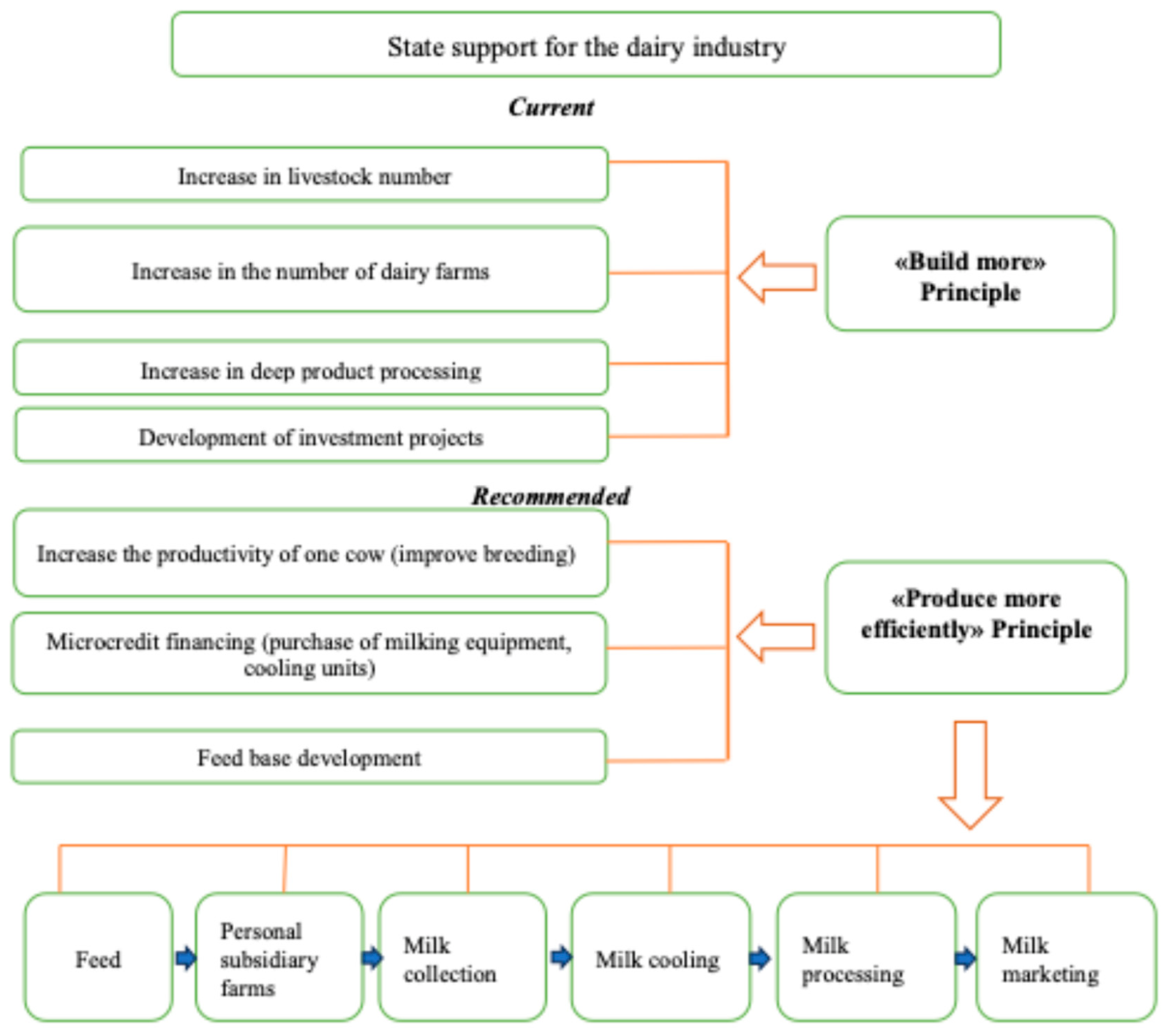
Figure 2.
Proposed policy framework for strengthening Kazakhstan’s dairy supply system.
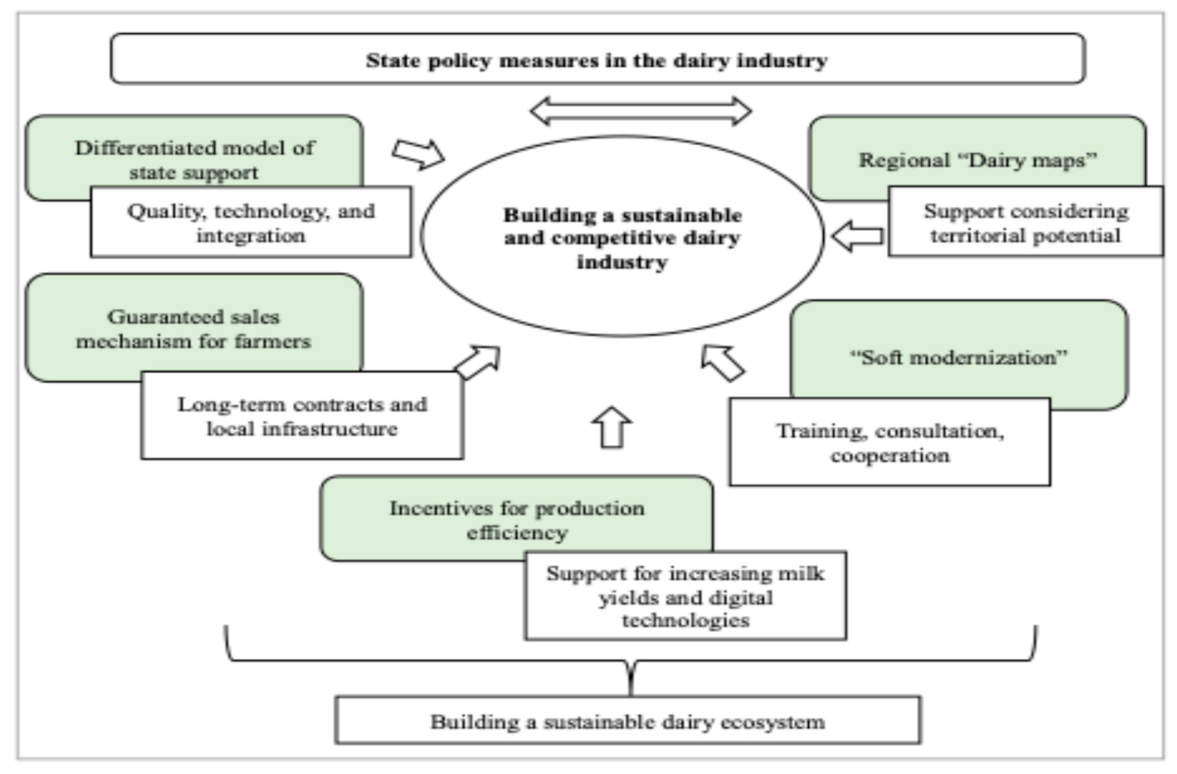
Table 1.
Indicators used to describe Kazakhstan’s dairy system, 2007-2024.
| Indicator | Symbol | Unit of measurement | Analytical purpose |
| Total cattle population | x1 | Thousand head | Describes the overall livestock base in Kazakhstan |
| Number of dairy cows | x2 | Thousand head | Describes the scale of the dairy herd |
| Average milk yield per cow | x3 | Liters per cow per year | Measures average productivity of dairy cows |
| Household milk production | x4 | Thousand tons | Measures the absolute volume of milk produced by household farms |
| Household share of total milk production | x4s | Percentage | Measures the relative contribution of household farms to total reported milk production |
| Gross livestock output | x5 | Million USD | Describes the broader economic scale of livestock production |
| Exports of milk and dairy products | x6 | Thousand tons | Describes the outward movement of dairy products and external market participation |
| Imports of milk and dairy products | x7 | Thousand tons | Describes the country’s dependence of imported dairy products |
| Milk price | x8 | USD per litre | Describes the reported price level in the dairy market |
| Total reported milk production | Y | Thousand tons | Measures the aggregate volume of milk produced in Kazakhstan |
Table 2.
Total and household milk production in Kazakhstan, 2007-2024.
| Year | Total reported milk production, thousand tons | Household milk production, thousand tons | Household share, % |
| 2007 | 5073.2 | 4586.5 | 90.4 |
| 2008 | 5198.0 | 4680.0 | 90.0 |
| 2009 | 5303.9 | 4761.4 | 89.8 |
| 2010 | 5381.2 | 4817.8 | 89.5 |
| 2011 | 5232.5 | 4612.8 | 88.2 |
| 2012 | 4851.6 | 4141.2 | 85.4 |
| 2013 | 4930.3 | 4129.3 | 83.8 |
| 2014 | 5067.9 | 4148.9 | 81.9 |
| 2015 | 5182.4 | 4125.9 | 79.6 |
| 2016 | 5341.6 | 4121.8 | 77.2 |
| 2017 | 5503.4 | 4078.1 | 74.1 |
| 2018 | 5686.2 | 4154.9 | 73.1 |
| 2019 | 5864.9 | 4240.7 | 72.3 |
| 2020 | 6051.4 | 4310.9 | 71.2 |
| 2021 | 6247.2 | 4399.0 | 70.4 |
| 2022 | 3350.2 | 2118.8 | 63.2 |
| 2023 | 3472.9 | 2132.2 | 61.4 |
| 2024 | 3577.3 | 2184.5 | 61.1 |
Table 5.
Policy priorities for strengthening Kazakhstan’s dairy supply system.
| Key problem | Current policy gap | Recommended measure | Monitoring indicator |
| Fragmented household production | Weak coordination among small producers | Support dairy cooperatives and producer groups | Milk collected through cooperatives |
| Limited cooling facilities | Insufficient local collection infrastructure | Establish collection and cooling points | Volume of cooled milk |
| Uneven milk quality | Limited testing and technical support | Introduce regular testing and quality-based payment | Share of milk meeting standards |
| Low productivity on some farms | Focus on herd size rather than efficiency | Support feed, breeding, veterinary care, and training | Milk yield per cow |
| Unstable sales channels | Short-term and informal purchasing arrangements | Promote longer-term producer-processor contracts | Delivery continuity |
| Limited access to equipment finance | Support is less accessible to households | Provide affordable finance for milking and cooling equipment | Number of upgraded farms |
| Weak supply-chain coordination | Production and processing measures are poorly connected | Develop regional dairy coordination plans | Processor utilization rate |
Note: The proposed measures are policy options based on the statistical analysis, literature review, and review of official policy documents. Their effectiveness should be assessed through regional pilot projects.
Disclaimer/Publisher’s Note: The statements, opinions and data contained in all publications are solely those of the individual author(s) and contributor(s) and not of MDPI and/or the editor(s). MDPI and/or the editor(s) disclaim responsibility for any injury to people or property resulting from any ideas, methods, instructions or products referred to in the content. |
© 2026 by the authors. Licensee MDPI, Basel, Switzerland. This article is an open access article distributed under the terms and conditions of the Creative Commons Attribution (CC BY) license.
Copyright: This open access article is published under a Creative Commons CC BY 4.0 license, which permit the free download, distribution, and reuse, provided that the author and preprint are cited in any reuse.